• Skip to primary navigation
  • Skip to main content
  • Skip to primary sidebar
  • Home
  • About Us
    • Privacy Policy
    • Comment Policy
    • Disclosures & Disclaimers
  • Resources
    • Links, Essays & Articles
    • Fandomology!
    • CLAMP Directory
    • BlogRoll
  • Features & Columns
    • 3 Things Thursday
    • Adventures in the Key of Shoujo
    • Bit & Blips (game reviews)
    • BL BOOKRACK
    • Bookshelf Briefs
    • Bringing the Drama
    • Comic Conversion
    • Fanservice Friday
    • Going Digital
    • It Came From the Sinosphere
    • License This!
    • Magazine no Mori
    • My Week in Manga
    • OFF THE SHELF
    • Not By Manga Alone
    • PICK OF THE WEEK
    • Subtitles & Sensibility
    • Weekly Shonen Jump Recaps
  • Manga Moveable Feast
    • MMF Full Archive
    • Yun Kouga
    • CLAMP
    • Shojo Beat
    • Osamu Tezuka
    • Sailor Moon
    • Fruits Basket
    • Takehiko Inoue
    • Wild Adapter
    • One Piece
    • After School Nightmare
    • Karakuri Odette
    • Paradise Kiss
    • The Color Trilogy
    • To Terra…
    • Sexy Voice & Robo
  • Browse by Author
    • Sean Gaffney
    • Anna Neatrour
    • Michelle Smith
    • Katherine Dacey
    • MJ
    • Brigid Alverson
    • Travis Anderson
    • Phillip Anthony
    • Derek Bown
    • Jaci Dahlvang
    • Angela Eastman
    • Erica Friedman
    • Sara K.
    • Megan Purdy
    • Emily Snodgrass
    • Nancy Thistlethwaite
    • Eva Volin
    • David Welsh
  • MB Blogs
    • A Case Suitable For Treatment
    • Experiments in Manga
    • MangaBlog
    • The Manga Critic
    • Manga Report
    • Soliloquy in Blue
    • Manga Curmudgeon (archive)

Manga Bookshelf

Discussion, Resources, Roundtables, & Reviews

yen press

Spice & Wolf, Volume 8: Town of Strife I

August 11, 2013 by Ash Brown

Author: Isuna Hasekura
Illustrator: Jyuu Ayakura

Translator: Paul Starr
U.S. publisher: Yen Press
ISBN: 9780316245463
Released: April 2013
Original release: 2008

Town of Strife I is the eighth volume in Isuna Hasekura’s light novel series Spice & Wolf, illustrated by Jyuu Ayakura. The previous volume, Side Colors, was actually a collection of three side stories; Town of Strife I picks up the story immediately following Spice & Wolf, Volume 6. As indicated by its title, Town of Strife I is the first part of a two-volume story, a first for Spice & Wolf. Town of Strife I was originally published in Japan in 2008. Paul Starr’s English translation of the novel was released by Yen Press in 2013. Spice & Wolf is a series that I have been enjoying much more than I thought I would. Although I wasn’t particularly taken with most of Side Colors, I was interested in getting back to the main story again with Town of Strife I.

Having had quite the adventure on the Roam River, Kraft Lawrence, a traveling merchant, and Holo the Wisewolf, a centuries-old spirit in the form of a young woman, have finally made their way to the port town of Kerube with a new companion in in tow–Col, a young student they encountered along the river. Together the three of them are following a curious rumor: a search is on for the bones of a northern town’s guardian deity. Many people think the story is some far fetched fairytale, but Lawrence, Holo, and Col know very well that there could be some truth behind the rumors. Upon their arrival at Kerube Lawrence seeks the aid of Eve, a former noblewoman and a skilled merchant in her own right. He’s been burned once before in his dealings with her, but Eve’s impressive network of connections may be their best chance of finding the bones.

One of the things that I have always enjoyed about Spice & Wolf is the relationship and developing romance between Lawrence and Holo. By this point in the series, Lawrence has lost some of his awkwardness when it comes to Holo. While I suppose this means he’s grown as a character, I do miss the more easily embarrassed Lawrence. With the addition of Col to the mix, the dynamics of Holo and Lawrence’s relationship has also changed. Their battles of wits and their good-natured bickering and teasing which once seemed so natural now feel forced as if the two of them are putting on some sort of performance for the boy. More often than not, Holo and Lawrence are verbally sparring for show in Town of Strife I and it’s not nearly as entertaining. Ultimately I do like Col (everyone in Spice & Wolf likes Col), but his presence in the story is somewhat distracting.

Not much happens in Town of Strife I; it mostly seems to be setting up for the second volume in the story arc. Hasekura promises that Lawrence will get to be “really cool” in the next volume and Town of Strife I does end on a great cliffhanger, but I’m not sure that I’m actually interested in finding out what happens. Unfortunately, the series has finally lost its charm for me. The characters know one another so well and their conversations are so cryptic that the story is difficult to follow. The narrative lacks sufficient detail and explanations leaving readers to puzzle out the characters’ motivations and actions. This has always been the case with Spice & Wolf but what makes it particularly frustrating in Town of Strife I is that the volume doesn’t even have a satisfying ending and doesn’t stand well on its own. Hasekura claims that he needed two volumes to tell this particular story, but considering how tedious much of Town of Strife I is, I’m not convinced.

Filed Under: REVIEWS Tagged With: Isuna Hasekura, Jyuu Ayakura, Light Novels, Novels, Spice and Wolf, yen press

Soulless: The Manga Vol. 1

July 11, 2013 by Anna N


Soulless: The Manga by Gail Carriger and Rem

I generally tend to steer clear of manga adaptations of books I’ve already read. I have read the first three books of Gail Carriger’s Parasol Protectorate series, and then I stopped following it, because of plot element that I usually find extremely annoying in romance novels. I spotted this manga version recently at my local library and decided to give it a try.

Soulless the book is a witty take on the steampunk/paranormal/historical romance genre. Heroine Alexia Tarabotti is a bit of a black sheep in her own family due to her intelligence and looks taking after her father instead of her mother. She’s also a unique and rare specimen of supernatural being because she’s a preturnatural, someone born without a soul. This gives her immunity to vampires and werewolves, which comes in handy as Victorian era London is overrun by supernatural beings.

Alexia has an encounter with a rather stupid vampire after she ducks out of a party in an attempt to find something decent to eat. This doesn’t sit well with the overbearing werewolf Lord Conall Macon, who is working for the government. Alexia and Conall insult each other and stalk off, only to find themselves thrown together again as unusual things begin to happen with the local London vampires. As a heroine, Alexia is very entertaining. She doesn’t hesitate to rescue herself by staking the odd vampire, and her status as a spinster ensures that she’s going to speak her mind without much regard for social conventions. On the other hand she has a hard time believing that anyone, even a werewolf would be attracted to her, because she’s been the topic of frequent put-downs by her family.

It is difficult to adapt an almost 400 page book into a 225 page manga. A certain amount of world building and character development does get lost in the process. The book goes into much more depth with Alexia’s relationships with the foppish vampire Akeldama and Ivy, Alexia’s good friend with horrific taste in hats. Some of the details about what exactly a preturnatural is and the more steampunkish aspects of this particular London were glossed over. But the essential plot and the developing romance between Alexia and Conall was maintained, so overall I can’t really quibble with the adaptation choices.

The art by Rem is detailed and fluid, with distinct designs for each character. The occasional lapse into chibi/wolf puppy style when Conall was in the grips of werewolf emotion was funny, and overall the art was extremely appealing. The illustrations did a good job at portraying the humorous reactions the characters have to each other even while they are dealing with plenty of suspicious supernatural incidents. Overall, I thought that this adaptation was one that fans of the book would enjoy. It also reminded me of what I liked about the prose series, so I might give the fourth book a try now.

Filed Under: REVIEWS Tagged With: Soulless, yen press

Guest Post: The Infernal Devices Vol 1: Clockwork Angel: Manga Review

April 25, 2013 by Ash Brown

Not too long ago I reviewed The Infernal Devices, Volume 1: Clockwork Angel, HyeKyung Baek’s graphic novel adaptation of Cassandra Clare’s novel by the same name. While I am familiar with The Infernal Devices, I haven’t actually read any of the original trilogy. I do, however, know people who have and thought it might be interesting to get another perspective on the work. And so I decided to bribe my good friend Traci with manga in exchange for her thoughts on the adaptation. The video below (a first for Experiments in Manga) is the result. I’m extremely excited that she agreed and am very pleased to welcome Traci to Experiments in Manga!

Hello, all. My name is Traci and I am the mastermind behind the alwynuu channel and Traci Reads vlog on YouTube. I am a photographer by passion and trade and a wanderer, philosopher, and reader by desire and happenstance. I enjoy most things geeky and nerdy, odd literary adaptations, and any genre that includes some form of magic or supernatural business. Don’t be shy. Drop in on occasion and see what I’ve gotten up to and where I’ve wandered.

* * *

Filed Under: UNSHELVED Tagged With: Cassandra Clare, comics, Hyekyung Baek, Infernal Devices, yen press

GFantasy, Where Girls’ Fighting Fantasies Live

March 6, 2013 by Erica Friedman 1 Comment

img_hyoushiOn Magazine no Mori we’ve discussed the issue of the demographic categories of manga several times. Today’s review is a perfect example of when those categories fail to be useful.

GFantasy, published by Square Enix, (along with what often seems like an endless number of magazines that have the word Gangan in the title) is listed by the publisher as a shounen magazine. And it is, quite likely, read by some number of young males. There is a lot of action in this magazine. But. The series best known from this magazine, has another audience entirely.

For GFantasy is the home of  Black Butler by Yana Toboso. It is true that Jun Mochizuki’s Pandora Hearts and Ryhogo Narita’s Durarara! have as much to appeal to men as women, however there is an extraordinary amount of “pretty boys in ridiculous clothes” and a fair dollop of slashable male pairs for a typical “shounen” magazine. A series like Cuticle Detective Inaba makes more sense, really, when you assume that the audience is female. Pretty boys with animal ears, shotacon, a cross-dressing boy…these are not typical tropes meant for a male audience.  GFantasy is really better understood as “shounen for women” with a fair bit of cross-over audience, as indicated by Peach Pit’s Zombie-Loan, and the Higurashi series.

As you can see from the many titles that have been translated, Yen Press has a pretty well-developed relationship with Square Enix and the Gangan imprint manga. (The anime for many of these series have been picked up  by Funimation and Sentai Filmworks.)

GFantasy began life back in 1993 as Fantastic Comic, had a few special releases and in 1994 was renamed GFantasy. There are no circulation numbers for GFantasy on the JPMA website. At 580 yen ($6.43 at time of writing) for 650 pages, it’s a good bet you’ll get your money’s worth, as long as you like fantasy adventure, perhaps spiced with a little romance.

The GFantasy website is quite good, with excited focus on the enclosed giveaway that month, news of series that have been transformed to anime and other media and a sample comic in 2 parts. More sample chapters can be found listed under “G Stories” and they have  a running prize for submissions to the magazine. (I really like manga magazines that do that. Recruitment for the next generation is an every-day job.) Unusually, the magazine has a blog on their website, as well as the usual news and fan mail form.  In my experience, this indicates a slightly higher than usual understanding of fan community by the editors and, probably, a slightly higher than usual engagement by the audience.

GFantasy Magazine, from Square Enix:  http://www.square-enix.co.jp/magazine/gfantasy/

Filed Under: Magazine no Mori Tagged With: Erica Friedman, Magazine no Mori, Manga Magazine, square enix, yen press

Comic Conversion: The Infernal Devices: Clockwork Angel

December 6, 2012 by Angela Eastman 3 Comments

The Infernal Devices: Clockwork Angel | Novel: Cassandra Clare / Margaret K. McElderry Books | Manga: Hyekyung Baek / Yen Press

Tessa Gray arrives in England to live with her brother, but instead of Nathaniel she finds herself kidnapped. A pair of warlocks keep her locked in a house, forcing her to utilize a power she didn’t know she had—the ability to change into anyone, living or dead, and access their memories simply by holding an object they possessed. Suddenly Tessa is rescued by Will Herondale, a beautiful and dangerous boy who claims to be a Shadowhunter—warriors blessed with angelic power who exist to rid the world of demons. The rest of the Shadowhunters, like the diminutive Charlotte and the kind but sickly Jem, agree to protect Tessa from the mysterious Magister who had her kidnapped, and to help her find her lost brother. But as Tessa, Will, and Jem strive to figure out what is happening, Tessa may uncover some terrible truths.

Cassandra Clare’s first series, The Mortal Instruments, tells the story of Clary and Jace, a pair of superbly star-crossed lovers, which takes place in the present day. When the first three of this soon-to-be six book series was completed, Clare began work on a prequel that takes place over a hundred years before Clary and Jace’s adventures, The Infernal Devices. It’s not necessary to read both series together, but The Infernal Devices does provide some background for the other The Mortal Instruments, giving us a look not only at the ancestors of some of our favorite characters from the first set of books, but also a peek into the earlier lives of some of the immortals that make an appearance in both books. Since I often find myself more delighted with the side characters (in this case, a couple of immortals) than the main pair in The Mortal Instruments, this is a series I couldn’t help but pick up. Yen Press’s release of the manga adaptation was the perfect excuse to give this series a go.

While this novel, and presumably the rest of the trilogy, can stand on its own, there are some times when Clare seems to take for granted that her readers are already familiar with The Mortal Instruments series, as she doesn’t go quite so deeply into the details about Shadowhunters and their history, or spend so much time explaining the problems with Downworlders. The big things are easy to pick up on, though, like the harshness of their lives (most don’t grow very old, as they die in battle, and if they decide to leave they lose all contact with the ones they loved) and the Accords, a deal set with creatures like vampires and werewolves to help keep the peace.

A problem I’ve had with Clare’s writing in the past is the abundance of dead details—in particular, descriptions that have absolutely no bearing on the story. Most things such as dresses and rooms I can let slide, as Clare uses these descriptions to fix her readers in the time period. Other things, however, are entirely useless, like her constant referral to Will’s blue eyes. Bits like this waste time, slowing down the pace of the novel while also leaving little for the reader to imagine herself. Another thing that tends to clunk up the story is the tendency for conversations to veer off course, like when Tessa begins to ask Will to leave her brother alone, then suddenly rants (for pages) about Will’s personality and how he should be looking for Jem’s cure. These conversations just turn into characters saying things the readers already know or that are inconsequential to the story, unnecessarily dragging out the time between plot points.

Even with my gripes, Clockwork Angel is an entertaining young adult book, particularly if you’re already a fan of Clare’s other series. Her story is engaging, with sudden twists and betrayals, which are still exciting even if you can see them coming for ages. The cast is diverse (if predictable), with both the “good” and “bad” boy romantic interests, but even the most seemingly flat characters, like Jessamine, have hidden depths that, even if they don’t reveal themselves completely in this novel, leave the readers to believe that we’ll come to understand these characters as the series progresses.

Now, for the manga. Hyekyung Baek’s adaptation does a good job of keeping us close to Tessa, convincingly converting the narration to her inner thoughts and giving us a shot of her dynamic expressions even in the middle of the excitement. Compared to the novel, the comic’s plot really clips along, with Baek skipping some unneeded scenes and cutting down the rambling conversations. But unfortunately, more often than not this swift pace works against the manga. Characters are moved like props from one place to the next so it’s hard to keep track of their movements, such as in one scene in which Tessa and company shift from the library to an upstairs room seemingly instantaneously. And while I feel readers get a clear understanding of Tessa and her character arc, the too-quick pace is damaging to the development of the other characters: we never get a clear picture of Charlotte’s trouble and insecurities with running the institute, and even snotty, selfish Jessamine comes across more sympathetic in the novel.

I enjoyed Baek’s art in the Gossip Girl adaptation, but while her style worked wonders in that glamorous, sexy world, it doesn’t quite click for me in Infernal Devices. Don’t get me wrong, Baek’s character designs are gorgeous, but I feel her style often makes the teenage characters look too old, and backgrounds are bland and boring, even when she includes detail. Baek also seems to go for prettiness over what was actually described in the novel, most notably when it comes to the maid Sophie’s face. When we first meet Sophie, Clare describes her scar: “a thick, silvery ridged scar slashed from the left corner of her mouth to her temple, pulling her face sideways and distorting her features into a twisted mask.” Baek draws the scar merely as a long scratch on the cheek, which could be taken as a stray strand of hair if Tessa didn’t mention it. One thing Baek’s art definitely improved upon were the goofy asides. Bits that came across as a bit awkward in the novel worked more easily in the comic, as exaggerated expressions and super-deformed characters gave the jokes more punch.

Many of my issues with Clare’s prose are stylistic, and while I wasn’t as invested in this novel as I have been in her other series, the problems I had still did not get in the way of my overall enjoyment of the book. The manga adaptation has its good points, but overall it left me feeling frustrated. While Clare’s novel may meander, the manga’s swift pace just barrels through the plot and skims over characterization. Baek’s adaptation is something fans will likely enjoy, but those looking to get a proper introduction to Clare’s universe are better off going with the novel.

Filed Under: Comic Conversion, FEATURES, FEATURES & REVIEWS Tagged With: Cassandra Clare, graphic novel, Hyekyung Baek, manga, Teen Lit, The Infernal Devices, yen press

Comic Conversion: Cirque Du Freak

August 2, 2012 by Angela Eastman 2 Comments

Cirque Du Freak | Novel: Darren Shan / Little, Brown and Company | Manga: Takahiro Arai / Yen Press

When Darren Shan and his best friend Steve find a flyer for Cirque Du Freak (a circus of freaks) they just have to go. A wolf-man, a snake-boy—what boy wouldn’t love it? But when Mr. Crepsley and his spider, Madame Octa, come on stage, both boys are overcome with desire—Darren, to own the spider, and Steve, to become a vampire! Darren manages to get his hands on the spider, but his control slips and the deadly bug bites his friend. Mr. Crepsley is the only one with an antidote, and he will only hand it over on one condition: Darren must become his assistant.

According to his website, Cirque Du Freak‘s author (confusingly also named Darren Shan) was inspired to write his vampire novels by the combined inspiration of Goosebumps, with its easy-to-read format, and the dark horror of Stephen King novels. Later, manga artist Takahiro Arai was awarded the opportunity to recreate Shan’s story in manga form after winning a contest. Even though the manga adaptation was originally published in Shonen Sunday, thanks to Yen Press’s ties with Little, Brown and Company (the original novels’ publisher) they were able to print the manga in English.

I love creepy stories. I ate up the Goosebumps series as a kid, cringing and wincing at every page and then scrambling for the next book. I’d been eying the Cirque Du Freak novels precisely because of the promise for creepiness, but unfortunately I found myself disappointed. Despite the generally excited tone of the narrator, the descriptions often read with too little emotion to invoke fear or horror, even when a woman’s hand is bitten clean off by a wolf-man. Shan also manages to ruin his tension simply by reminding us of it too much. In the prologue, his narrator reiterates the point that this is a “true story” where bad things can happen—a common enough tactic that beefs up the tension. But then, Shan keeps doing it: “Little did I know that Alan’s mysterious piece of paper was to change my life forever. For the worse!” “If only I hadn’t been so scared of looking like a coward! I could have left and everything would have been fine.” It quickly becomes repetitive, and makes it feel like Shan is trying to force anxiety on the readers.

Despite my dissatisfaction with the creepy tone, the story is still pretty compelling. A boy becomes a vampire not because he wants to or is forced to, but because that’s the price he pays to save a friend from the mistake he made. There are quite a few times where the novel drags. Shan apparently feels compelled to describe all of Darren’s actions—even unimportant ones like the chores he did while waiting to go to the circus—and the chapters set aside to describe all of the freaks take ages. The plot itself is engrossing enough to still qualify the book as a page turner, but it’s tough to ignore all the awkward bits.

Takahiro Arai’s manga adaptation is definitely creepier. This is thanks in large part to the art; particularly with the freaks, the character designs at times take on a surreal, over-exaggerated feel, and his backgrounds of oversized crescent moons and propped up coffins look like scenes out of Soul Eater. Sometimes Arai takes it a little too far with Steve. His wide eyes and sharp-toothed grins are too quick to give away that there’s something messed up about this kid, but even so he feels like more of a threat than he did in the novel. Darren does look much younger than I imagined him (though to be fair, the book never specifies his age), and unfortunately the designs for the side characters are either weak or generic-looking, like the “cute girl” assistants in the freak show.

The manga takes a couple of liberties with the story in both minor and major ways. In the manga, Darren and his friends play soccer for money rather than fun (as they do in the novel), but this streamlines their path between getting cash and buying the tickets. Arai also changes some of Mr. Crepsley’s actions. First, he gives the flyer directly to Darren (rather than someone handing a flyer to a friend’s brother), again streamlining the plot while also making it seem more deliberate than coincidental that Darren was there that night. Then Mr. Crepsley shows up immediately to take back Madam Octa after Steve is bitten—meaning that Darren’s little sister sees him. Having not read the rest of the series, I don’t know if Darren’s family ever makes it back into the narrative, so this could either be foreshadowing that Annie will eventually figure out what happened…or an unfulfilled expectation for the reader.

The sometimes emotionless writing of the book really kills the creepiness that Shan obviously wants to build, and while the pacing is quick there’s a good deal of unnecessary action that still manages to gunk the story up. Arai’s adaptation fixes a lot of these problems, rooting out unnecessary tidbits and making the story just a little scarier. But I think what I like the most about the manga version is that if I had had no awareness of the original book, I probably wouldn’t have been able to pick this out as an adaptation. The manga flows well on its own, and the straight-from-the-text narration is kept at an astonishingly low level. And even though the novel has the strange feeling of being more of a “part one” than its own stand-alone story, the full volume of set up works well in the manga format. The Cirque Du Freak manga has its own issues, but it’s still the better choice.

Filed Under: Comic Conversion, FEATURES, FEATURES & REVIEWS Tagged With: Cirque Du Freak, Darren Shan, Little Brown and Company, manga, Takahiro Arai, Teen Lit, yen press

Short Takes: Olympos and Utahime: The Songstress

June 22, 2012 by Katherine Dacey 8 Comments

When I first spotted the cover for Olympos, I had a nagging feeling I’d read something else by Aki, but couldn’t remember the title. A quick surf of the internet and presto! I had my answer: Aki also wrote Utahime: The Songstress, which DMP released in 2009 to strong reviews. In preparation for reading Olympos, I tracked down a new copy of Utahime. I had a vague notion of reviewing both books, then decided that the two-books-one-author concept would make a swell basis for a Short Takes column.

Which title did I like better? The answer might surprise you.

OLYMPOS

BY AKI • YEN PRESS • RATING: OLDER TEEN (16+)

Have you ever spotted a stunningly attractive person at a party, only to discover that he or she was a crashing bore? (Or worse, a boor?) If so, you may experience a few pangs of deja-vu while reading Olympos, a beautiful manga with a shapeless script.

Early in the story, the Sun God Apollo kidnaps Heinz, a human whose dearest wish is to marry his childhood sweetheart. Apollo offers Heinz a chance to perform a task in exchange for Maria’s hand — a task far more difficult than it initially seems. That sounds like a decent starting point for a cat-and-mouse game between Apollo and a plucky mortal, but Heinz soon disappears from the narrative altogether, creating a vacuum that’s never satisfactorily filled. Other figures from Greek mythology wander in and out of the story — Zeus, Poseidon, Artemis, and Hades all pop by for a cup of coffee and a little prophecy — but the endless stream of chatter grows tiresome.

That’s a pity, because Aki’s sensual linework is ideally suited to the material. Olympos is one of the few graphic novels in which the gods are so physically perfect, so pansexual in their appeal, that one can imagine why the gods bristled at the suggestion that any mortal might surpass them in beauty. Consider Hades, god of the underworld: Aki renders him as lithe man with goat horns, cloven feet, and a long mane of hair. For all his animal parts, however, Hades is undeniably attractive, moving with the grace of a Bolshoi dancer and meeting the other characters’ gazes with eyes that are both terrifying and alluring. The other gods are executed with similar care; even Poseidon, who’s portrayed as a bearded buffoon, has a handsome, agreeable face.

Some readers may find these drawings so appealing that the aimless script won’t spoil their enjoyment of Olympos. Others may find — as I did — that no amount of sensual imagery can hold their interest while the gods hold forth on the meaninglessness of their existence.

Review copy provided by Yen Press.

UTAHIME: THE SONGSTRESS

BY AKI • DIGITAL MANGA PUBLISHING • RATING: OLDER TEEN (16+)

Is gender destiny? That’s the question at the heart of Utahime: The Songstress, which takes place in a kingdom in which utahime, or “song princesses,” preserve the fragile peace through the power of their singing.

The story focuses on a trio of characters: fraternal twins Kain and Maria, whose mother is an utahime, and Thomas, whose father is the head of the nearby village. Kain, Maria, and Thomas’ relationship is shown at several stages, beginning with Kain’s return from a self-imposed exile of ten years. We then jump back in time to explore the characters’ childhoods, watching them come to terms with the ugly truth about Kain and Maria’s mother: she’s a virtual prisoner, jealously guarded by the local townspeople to ensure that their village remains safe and prosperous.

If you can soldier through the first few pages — which, I grant, are a mess — you’ll find an intimate story that focuses as much on the characters’ interior states as their actions. Aki allows her characters room for growth and reflection; though Kain and Thomas have a predictably antagonistic relationship as children, their shared concern for Maria overrides that hostility in adulthood. Aki also makes good use of her setting to explore the relationship between gender and destiny; if only women are allowed to be songstresses, what happens when a young man is born with the requisite voice?

If the artwork isn’t as lush as Olympos‘, it nonetheless makes a strong impression. Aki devotes the most attention to character designs, giving each cast member a distinctive appearance and an elastic, expressive face capable of registering subtle shifts in mood and energy. Her backgrounds, by contrast, are very sparse, making use of an occasional prop to establish the setting: a table and a few rickety chairs for a saloon, a high window and a iron frame bed for the utahime’s home.

That artistic restraint serves her story well, firmly establishing the characters’ emotional states without excessive reliance on dialogue and thought balloons. As a result, Utahime‘s script is leaner and more focused than Olympos‘, gently but insistently leading the reader through a series of effective (and affecting) scenes that help us appreciate the utahime’s plight. Recommended.

Filed Under: Manga Critic Tagged With: Aki, DMP, Greek mythology, Josei, yen press

Puella Magi Madoka Magica, Vol. 1

May 29, 2012 by Katherine Dacey 10 Comments

The opening pages of Puella Magi Madoka Magica suggest a dreary retread of Sailor Moon: Kyubey, a talking cat, appears before Madoka Kaname, a perky yet otherwise unremarkable school girl, and asks her, “Would you like to change destiny?” Our first clue that Puella has something nastier up its be-ribboned sleeve occurs midway through the first chapter, when transfer student Homura Akemi confronts Madoka with a dire, if cryptic, warning: “You should never consider ‘changing yourself’ in any way,” she tells Madoka. “If you choose not to heed my words, those things that you hold dear will all be lost.” Homura then attacks Kyubey, accusing him of using “dirty tactics” to persuade Madoka to make a contract with him.

Though all the trappings of a traditional magical girl manga are in place — the costume changes, the cute familiars, the teamwork — Puella charts a darker, more violent course than other translated examples of the genre. Homura and Madoka operate in a world where magical girls routinely die; though their powers are formidable, magical girls are worked to the point of emotional and physical exhaustion. Moreover, their contracts are signed under duress; Kyubey frequently appeals to girls in desperate circumstances, using their vulnerability as leverage. (In exchange for battling witches, he explains to Madoka, “I fulfill one wish. Any wish you want!”)

In short, Puella manages to have its cake and eat it, too, faithfully adhering to the genre’s conventions while offering an explicit critique of its underlying message of courage and selflessness. The story is the antithesis of a wish-fulfillment fantasy: the powers that Kyubey bestows come with responsibilities that are too difficult for a young, inexperienced person to bear. Throughout the manga, we see examples of magical girls who have become competitive or embittered by their experiences, at risk of becoming witches themselves. We also meet girls who regret the haste with which they made their contracts, as their wishes were fulfilled at the expense of friends and family members.

As sharp as Puella‘s genre critique may be, the artwork is a disappointment. The character designs are faithful to the original anime, but the magical elements look smudgy on the page, the product of too much dark grey screentone. The anime’s surreal fight sequences have lost their visual punch as well. Creatures that looked strange and menacing in color have been defanged, reduced to cute video game monsters floating above the picture plane.

Most of the fight scenes have been compressed into a few pages, further curtailing their impact; we barely have time to register who the opponents are before one of the magical girls has eliminated the threat. As a result, the volume’s climatic scene lacks emotional resonance. Though the characters have repeatedly discussed how dangerous their vocation is, the fight is so fleeting and impressionistic that the stakes seem too low to yield such a devastating outcome.

If the artwork lacks the personality of a Magic Knight Rayearth or Cardcaptor Sakura, however, the actual story is on par with the best translated examples of the magical girl manga. Like the aforementioned CLAMP titles, Puella Magi Madoka Magica treats the magical girl as a character worthy of complexity and genuine interiority; the Puella girls may engage in magical combat, but they’re painfully aware that saving the world can be an ugly business — even if they’re wearing smart costumes.

Review copy provided by Yen Press.

PUELLA MAGI MADOKA MAGICA, VOL. 1 • STORY BY MAGICA QUARTET, ART BY HANOKAGE • YEN PRESS • 144 pp. • RATING: OLDER TEEN (16+)

Filed Under: Manga Critic Tagged With: Magical Girl, Magical Girl Manga, Puella Magi Madoka Magica, shojo, yen press

Puella Magi Madoka Magica, Vol. 1

May 29, 2012 by Katherine Dacey

The opening pages of Puella Magi Madoka Magica suggest a dreary retread of Sailor Moon: Kyubey, a talking cat, appears before Madoka Kaname, a perky yet otherwise unremarkable school girl, and asks her, “Would you like to change destiny?” Our first clue that Puella has something nastier up its be-ribboned sleeve occurs midway through the first chapter, when transfer student Homura Akemi confronts Madoka with a dire, if cryptic, warning: “You should never consider ‘changing yourself’ in any way,” she tells Madoka. “If you choose not to heed my words, those things that you hold dear will all be lost.” Homura then attacks Kyubey, accusing him of using “dirty tactics” to persuade Madoka to make a contract with him.

Though all the trappings of a traditional magical girl manga are in place — the costume changes, the cute familiars, the teamwork — Puella charts a darker, more violent course than other translated examples of the genre. Homura and Madoka operate in a world where magical girls routinely die; though their powers are formidable, magical girls are worked to the point of emotional and physical exhaustion. Moreover, their contracts are signed under duress; Kyubey frequently appeals to girls in desperate circumstances, using their vulnerability as leverage. (In exchange for battling witches, he explains to Madoka, “I fulfill one wish. Any wish you want!”)

In short, Puella manages to have its cake and eat it, too, faithfully adhering to the genre’s conventions while offering an explicit critique of its underlying message of courage and selflessness. The story is the antithesis of a wish-fulfillment fantasy: the powers that Kyubey bestows come with responsibilities that are too difficult for a young, inexperienced person to bear. Throughout the manga, we see examples of magical girls who have become competitive or embittered by their experiences, at risk of becoming witches themselves. We also meet girls who regret the haste with which they made their contracts, as their wishes were fulfilled at the expense of friends and family members.

As sharp as Puella‘s genre critique may be, the artwork is a disappointment. The character designs are faithful to the original anime, but the magical elements look smudgy on the page, the product of too much dark grey screentone. The anime’s surreal fight sequences have lost their visual punch as well. Creatures that looked strange and menacing in color have been defanged, reduced to cute video game monsters floating above the picture plane.

Most of the fight scenes have been compressed into a few pages, further curtailing their impact; we barely have time to register who the opponents are before one of the magical girls has eliminated the threat. As a result, the volume’s climatic scene lacks emotional resonance. Though the characters have repeatedly discussed how dangerous their vocation is, the fight is so fleeting and impressionistic that the stakes seem too low to yield such a devastating outcome.

If the artwork lacks the personality of a Magic Knight Rayearth or Cardcaptor Sakura, however, the actual story is on par with the best translated examples of the magical girl manga. Like the aforementioned CLAMP titles, Puella Magi Madoka Magica treats the magical girl as a character worthy of complexity and genuine interiority; the Puella girls may engage in magical combat, but they’re painfully aware that saving the world can be an ugly business — even if they’re wearing smart costumes.

Review copy provided by Yen Press.

PUELLA MAGI MADOKA MAGICA, VOL. 1 • STORY BY MAGICA QUARTET, ART BY HANOKAGE • YEN PRESS • 144 pp. • RATING: OLDER TEEN (16+)

Filed Under: Manga, Manga Critic, REVIEWS Tagged With: Magical Girl, Magical Girl Manga, Puella Magi Madoka Magica, shojo, yen press

Until Death Do Us Part, Vol. 1

May 19, 2012 by Katherine Dacey 1 Comment

Until Death Do Us Part is a slickly packaged compendium of action movie tropes that reads like a story. That’s not to say it’s bad — it isn’t — but to warn you that you may experience a powerful sense of deja-vu as you thumb through its numerous shoot-outs, explosions, and speeches about terrorism.

The opening pages plunge us directly into the action: a solemn pre-teen girl leaps from a speeding car, accosts a blind man, and begs him to help her, promising him jewels and money in return for his assistance. That man, Mamorou, proves surprisingly adept at dispatching bad guys; he’s a modern-day Zaitoichi, using a pair of special goggles and a fine-edged sword to disarm Haruka’s captors, a group of thugs in the employ of the Ex Solid Corporation. (Which begs the question: how does such an ill-named company stay in business? But I digress.) Haruka’s ability to pick Mamorou from a crowd of thousands is no accident; like the pre-cogs in Minority Report, she has an uncanny ability to predict the future. For several years, she used that power to enrich her family — mostly by playing scratch tickets — but now she finds herself running from several powerful organizations, each of whom sees her precognition as a tool for advancing their own interests.

Whether Until Death‘s similarities to The Professional, Mission: Impossible, Minority Report, and the entire oeuvre of Jason Statham are intentional is difficult to say; some of the plots skirt the line between theft and homage. Mamorou’s fellow crime fighters, in particular, seem like IMF recruits, as they’re armed to the teeth with the latest spy technology and weaponry — an incredible feat for an off-the-the-grid vigilante organization with no ties to the government or the mob. (Just in case we don’t fully appreciate how awesome this weaponry is, there are several scientists on hand to explain in excruciating detail how they work.) The sheer abundance of borrowed characters and story lines, however, work in Death‘s favor, with no single borrowing overpowering the resulting fusion of sensibilities.

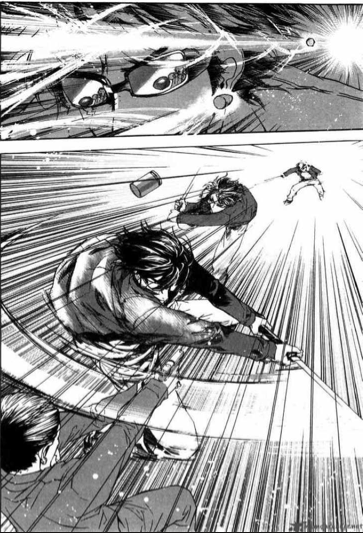
Like many action manga, the artwork tacks between static scenes of talking heads — usually imparting some key points of information about a bad guy’s history, or describing a hypothetical technology — and kinetic scenes of bone-crunching violence. Though the fights aren’t as inventively staged as a John Woo shoot-out, DOUBLE-S wins points for carefully delineating the space in which the gun battles unfold; the reader is conscious of how walls, objects, and sight lines influence the outcome of those battles. DOUBLE-S is overly enamored of slo-mo bullets — a visual gimmick so overused in the last fifteen years it’s become a parodic gesture — but he uses it to good effect, demonstrating how swiftly Mamorou moves, and how precisely his blade slices through solid objects:

Mamorou slices bullets with his scientifically modified katana.

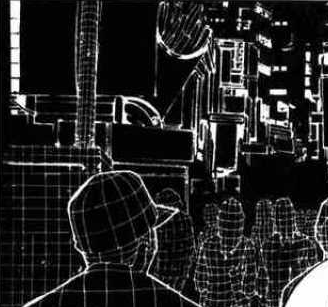
DOUBLE-S has several other nifty tricks up his sleeve as well. In one of the manga’s recurring visual gambits, DOUBLE-S shows us how Mamorou perceives his environment through his special goggles:

A Tokyo street as viewed through Mamorou's goggles.

Though the characters are recognizable in their computer-enhanced form, they have a spectral quality to them; if anything, they resemble echoes or after-images, rather than corporeal entities. The artist’s quick cuts between Mamorou’s perspective and ours neatly underscores how much Mamorou must rely on his other senses to give these incomplete forms flesh and blood: how else could he be so devastating, given the limitations of his goggles?

Perhaps the best compliment I could give Death‘s creators is to note the skill with which it recycles familiar action-movie conventions. We’ve seen Death‘s characters and plots and scientifically implausible weapons in other stories, but Hiroshi Takashige and DOUBLE-S stitch them together in such a fashion that the seamwork is almost invisible. The resulting manga isn’t original, exactly, but it has enough style and integrity to engage the reader’s interest, making it an agreeable beach or airplane companion.

Review copy provided by Yen Press.

UNTIL DEATH DO US PART, VOL. 1 • STORY BY HIROSHI TAKASHIGE, ART BY DOUBLE-S • YEN PRESS • 448 pp. • RATING: OLDER TEEN (16+)

Filed Under: Manga Critic Tagged With: yen press

Until Death Do Us Part, Vol. 1

May 19, 2012 by Katherine Dacey

Until Death Do Us Part is a slickly packaged compendium of action movie tropes that reads like a story. That’s not to say it’s bad — it isn’t — but to warn you that you may experience a powerful sense of deja-vu as you thumb through its numerous shoot-outs, explosions, and speeches about terrorism.

The opening pages plunge us directly into the action: a solemn pre-teen girl leaps from a speeding car, accosts a blind man, and begs him to help her, promising him jewels and money in return for his assistance. That man, Mamorou, proves surprisingly adept at dispatching bad guys; he’s a modern-day Zaitoichi, using a pair of special goggles and a fine-edged sword to disarm Haruka’s captors, a group of thugs in the employ of the Ex Solid Corporation. (Which begs the question: how does such an ill-named company stay in business? But I digress.) Haruka’s ability to pick Mamorou from a crowd of thousands is no accident; like the pre-cogs in Minority Report, she has an uncanny ability to predict the future. For several years, she used that power to enrich her family — mostly by playing scratch tickets — but now she finds herself running from several powerful organizations, each of whom sees her precognition as a tool for advancing their own interests.

Whether Until Death‘s similarities to The Professional, Mission: Impossible, Minority Report, and the entire oeuvre of Jason Statham are intentional is difficult to say; some of the plots skirt the line between theft and homage. Mamorou’s fellow crime fighters, in particular, seem like IMF recruits, as they’re armed to the teeth with the latest spy technology and weaponry — an incredible feat for an off-the-the-grid vigilante organization with no ties to the government or the mob. (Just in case we don’t fully appreciate how awesome this weaponry is, there are several scientists on hand to explain in excruciating detail how they work.) The sheer abundance of borrowed characters and story lines, however, work in Death‘s favor, with no single borrowing overpowering the resulting fusion of sensibilities.

Like many action manga, the artwork tacks between static scenes of talking heads — usually imparting some key points of information about a bad guy’s history, or describing a hypothetical technology — and kinetic scenes of bone-crunching violence. Though the fights aren’t as inventively staged as a John Woo shoot-out, DOUBLE-S wins points for carefully delineating the space in which the gun battles unfold; the reader is conscious of how walls, objects, and sight lines influence the outcome of those battles. DOUBLE-S is overly enamored of slo-mo bullets — a visual gimmick so overused in the last fifteen years it’s become a parodic gesture — but he uses it to good effect, demonstrating how swiftly Mamorou moves, and how precisely his blade slices through solid objects:

Mamorou slices bullets with his scientifically modified katana.

DOUBLE-S has several other nifty tricks up his sleeve as well. In one of the manga’s recurring visual gambits, DOUBLE-S shows us how Mamorou perceives his environment through his special goggles:

A Tokyo street as viewed through Mamorou’s goggles.

Though the characters are recognizable in their computer-enhanced form, they have a spectral quality to them; if anything, they resemble echoes or after-images, rather than corporeal entities. The artist’s quick cuts between Mamorou’s perspective and ours neatly underscores how much Mamorou must rely on his other senses to give these incomplete forms flesh and blood: how else could he be so devastating, given the limitations of his goggles?

Perhaps the best compliment I could give Death‘s creators is to note the skill with which it recycles familiar action-movie conventions. We’ve seen Death‘s characters and plots and scientifically implausible weapons in other stories, but Hiroshi Takashige and DOUBLE-S stitch them together in such a fashion that the seamwork is almost invisible. The resulting manga isn’t original, exactly, but it has enough style and integrity to engage the reader’s interest, making it an agreeable beach or airplane companion.

Review copy provided by Yen Press.

UNTIL DEATH DO US PART, VOL. 1 • STORY BY HIROSHI TAKASHIGE, ART BY DOUBLE-S • YEN PRESS • 448 pp. • RATING: OLDER TEEN (16+)

Filed Under: Manga, Manga Critic, REVIEWS Tagged With: yen press

Going Digital: March 2012

March 25, 2012 by MJ and Sean Gaffney 6 Comments

Welcome to the latest Going Digital, Manga Bookshelf’s monthly feature focusing on manga available for digital viewing or download. Each month, the Manga Bookshelf bloggers review a selection of comics we’ve read on our computers, phones, or tablet devices, to give readers a taste of what’s out there, old and new, and how well it works in digital form.

This month, MJchecks in on the iPad manga scene, while Sean takes a look a a recent JManga release for your web browser. Device, OS, and browser information is included with each review as appropriate, to let you know exactly how we accessed what we read.


iOS

Manga on the iPad: 18 month check-in

It’s been a year and a half since New York Comic Con 2010, where Yen Press announced the launch of their new iPad app. Viz followed soon after, and quickly rose to the head of the class thanks to their quickly growing catalogue and significantly lower pricing. Fast forward to NYCC 2011, where Kodansha USA finally joined the game, followed by Digital Manga Publishing a few months later.

For me, the success (or failure) of any manga app can be boiled down to three basic components: functionality, selection, and price. So now, 18 months after manga first began trickling onto the iPad, how are publishers faring on these three key issues?

Functionality

All four of the major manga apps began with strong functionality right out of the gate. Their (very similar) layouts are all fairly intuitive, with easy access to each publisher’s catalogue as well as the user’s own library of purchased manga. Each app offers high-quality images, and the ability to read in single or double page-view, as well as the ability to zoom in on (and out from) any single panel with ease. Of these apps, only Kodansha Comics’ displayed any functionality issues at launch time, with its progressive images that stall readability from page to page. Unfortunately, this issue appears to remain unresolved at the time of this writing, making Kodansha Comics’ app the least visually attractive of the manga apps to-date.

It’s worth noting here, too, that while both Viz and DMP both have browser-based stores as well, so far only Viz’s app allows for cross-platform purchases, while eManga customers must buy again to read their purchased volumes on the iPad.

Selection

Viz far outshines its mainstream competitors in this category, with over fifty titles available to-date (and more being added all the time), including super-popular titles like Naruto and One Piece, as well as more eclectic fare like House of Five Leaves and Saturn Apartments. Though I’m still hoping to see some of Viz’s out-of-print shoujo licenses show up here one day (e.g. Please Save My Earth, Banana Fish, Basara) there’s no denying that Viz is blowing everyone else away when it comes to selection on this platform. Recent additions like Hikaru no Go suggest that Viz indeed views its various digital platforms as a means for introducing long-running, completed series to new readers, and I certainly hope to see that continue.

DMP started out with a very strong catalogue, particularly for fans of its Juné and Digital Manga Guild imprints, but new additions have stalled since their recent issues with Apple censors, and it’s difficult to know at this point what the future of their app might be. BL fans can still pick up over fifty different titles (several with multiple volumes) at the time of this writing, ranging from newer releases like An Even More Beautiful Lie, Seven Days, and Blue Sheep Reverie, to older titles like Maiden Rose and Il Gatto Sul G. Though many more DMP/DMG titles are currently available to iPad readers by way of Amazon’s Kindle app (which has had its rocky moments, too), issues like image quality and reading direction make this option less than ideal.

While Yen Press’ catalogue is relatively small (25 titles as of this writing), it does have the advantage of being the only real source for Korean manhwa among these publishers to-date. Manga Bookshelf favorites like Time and Again and 13th Boy are both being released by Yen Press on this platform, and I certainly hope this will be a continuing trend. Though Yen’s manhwa licensing seems to have come to a halt over the past year or so, it would be a real treat to see series like Forest of Gray City or Very! Very! Sweet make a reappearance on the iPad so that they can be discovered by new readers. OEL series are another highlight of Yen’s app, including critical successes like Nightschool and Soulless: The Manga. Yen’s manga selection is less impressive, with titles Yotsuba&! and The Melancholy of Haruhi Suzumiya standing as its heaviest hitters.

Bringing up the rear in this category again is Kodansha Comics, whose catalogue has still not expanded beyond the four series it launched with (Arisa, Fairy Tail, Sayonara, Zetsubou-Sensei, and Until the Full Moon) even after six months.

Price

Here, again, Viz leads the pack, with prices starting at $4.99 a volume for Shonen Jump and Shojo Beat series, $5.99 for IKKI and Signature series, and between $6.99-$8.99 for oversized or omnibus releases. Though I still think that $5 a volume is too high to encourage real bulk purchases, it remains the best price out there for manga on the iPad. Kodansha Comics’ volumes sell for $4.99 apiece as well, though it’s worth mentioning that they ran a $2.99 special for Fairy Tail when the app first launched—a price I absolutely would pay for bulk purchases of a series I had interest in reading.

Both Yen Press and DMP lag in this category, with single volumes going for $6.99-$8.99 apiece—sometimes significantly more than print prices online—and $12.99 for larger volumes. Though BL readers, in particular, are accustomed to paying more for their habit, thrifty shoppers who are willing to put up with the downsides of the Kindle app can pretty much always get the same books for less by going that route—and have their purchase available on their other compatible devices as well, including their computers. I will admit that though I was fairly depressed not to be able to purchase Keiko Kinoshita’s You & Tonight through DMP’s far superior iPad app, it’s awfully nice to have it available on both my iPad and my laptop via Amazon’s Kindle app.

Bottom Line

Viz is the clear winner on the iPad overall, performing well in all three categories of functionality, selection, and price. DMP’s app is promising, and should they manage to resolve their issues with Apple and find a way to better serve cross-platform customers, they could become a digital powerhouse for BL fans, despite a significantly less attractive price point. Yen Press’s app lags in both selection and price, though it does hold a particular allure for manhwa fans. (Will we ever see NETCOMICS in the iPad app game?) And though Kodansha Comics does well when it comes to pricing, its dinky selection and less-than-optimum readability diminish its worth significantly.

What do you suppose this year’s New York Comic Con will bring? – MJ


Web Browser

Anesthesiologist Hana Vol. 2 | By Nakao Hakua and Kappei Matsumoto | Futabasha, Manga Action | JManga.com | Windows XP, Firefox 11.0
Volume Two of this medical series continues to pummel our heroine with exhausting daily living. I’d say crises, but she’s an anesthesiologist, so to a certain degree this is what she does. She has professors teaching a class putting her on the spot to embarrass her, the hospital changing to more of a trauma unit center (meaning longer hours), and most of all a new doctor in the unit, Hiura, who is a complete and utter jerk to her He’s constantly yelling at her and forcing her to step up her game, and is rude to her other colleagues… especially Dr. Kobayakawa, the troubled young doctor Hana hit it off with last volume. Of course, those familiar with this type of manga will know immediately that he is the sort of person that doesn’t suffer fools gladly. He dislikes Kobayakawa for his fear and wasted potential, and is so hard on Hana because of her increasing skills and pluck – he teaches by rudeness, basically.

He also, in yelling at Hana, basically notes that her breasts are big, something this manga never really allows us to forget. There’s no gratuitous shower scene here, but instead we get a new trauma doctor, Kenshi, who simply walks up, marvels at her breasts, and starts to fondle them. My jaw dropped briefly, and I am once again reminded of the huge sexual harassment gulf between here and Japan, in that Hana didn’t slug him. Yes, this is supposed to take place in the mid-90s rather than the time it was written, but sheesh. This doctor later gets a nice moment where he tries to teach Hana a basic truth – patients die, and that doctors simply have to accept this and try to save the next one just as hard – but he can’t read her as well as Hiura, so it doesn’t really take. In any case, if his schtick of groping Hana becomes his running gag, I can’t say I’ll be too fond of him.

There’s a lot of medical stuff going on here, and like the first volume if the reader doesn’t want to wade through some jargon they may be in trouble..That said, it’s not too difficult, and the basic premise remains the same – a doctor’s life is very hard, and every day is a struggle to wonder if it’s worth it. Especially given that these are anesthesiologists, so they don’t have the ‘these are my life-saving hands!’ aspect that, say, heart surgeons would. Hana, like the heroine of Nao Go Straight, can be too empathic at times – something contrasted with the new trauma doctors introduced towards the end. The best chapters were the two-parters, one dealing with the patient who loses his life, as I’d mentioned, and the other with how anesthesiologists have immense trouble with morbidly obese people. Hiura wants to harness Hana’s passion, and avoid having her become like Kobayakawa. Can he do it? To be continued! -Sean Gaffney


Disclosure: MJ is currently under contract with Digital Manga Publishing’s Digital Manga Guild, as necessitated for her ongoing report Inside the DMG. Any compensation earned by MJin her role as an editor with the DMG will be donated to the Comic Book Legal Defense Fund.

Filed Under: FEATURES, Going Digital Tagged With: DMP, iPad, JManga, Kodansha Comics, VIZ, yen press

A Bride’s Story, Vols. 2-3

March 16, 2012 by Katherine Dacey 14 Comments

Around the age of ten, I had a brief but intense love affair with historical fiction. It began with Little House in the Big Woods — required reading for all American girls of a certain age — and Roll of Thunder, Hear My Cry. I then discovered Johnny Tremain, made an unsuccessful attempt to read The Last of the Mohicans — way over my head, I’m afraid — and devoured Summer of My German Soldier.

The books that had the greatest claim on my heart, however, were Lois Lenski’s American regional novels: Strawberry Girl, Cotton in My Sack, Blue Ridge Billy, Mama Hattie’s Girl, and Shoo-Fly Girl. Looking back on these books now, I can see that they weren’t as meticulously crafted as Roll of Thunder or Johnny Tremain; Lenski’s writing was, at times, pedestrian, and her characterizations thin. What Lenski did well, however, was help young readers imagine what it was like to live in rural areas before television, telephones, and electricity were fixtures of the American home. Her books were filled with vivid descriptions of everyday activities: baking pies, picking crops, making dresses from patterns, canning vegetables, feeding chickens, washing clothes. From my sheltered point of view, Lenski’s characters led exotic, fascinating lives: who wouldn’t want to turn a bolt of calico into an actual dress, or spend the day picking berries? (The answer turns out to be me, as I flunked Home Economics.)

Though I’ve read my share of historical novels in the intervening years, I’ve seldom loved those books with the same fierce intensity as I did Strawberry Girl. Some of that disenchantment could be chalked up to adolescence: as a teenager, music superseded books as my most important form of escapism, and I read far fewer novels. And some of my disenchantment reflected my academic training: as a college student, I majored in History, taking courses that gave me the tools for exploring other places and times. Reading A Bride’s Story, however, reminded me how powerful good historical fiction can be.

A Bride’s Story depicts everyday life in a long-ago setting — in this case, Central Asia in the nineteenth century, where the fictional Eihon clan herd sheep and make textiles. To give readers a better understanding of the period, Kaoru Mori devotes entire chapters to describing how her characters live. In chapter 6 of A Bride’s Story, for example, Mori documents “oven day,” a communal event in which women prepare and bake bread. Mori captures the scene in meticulous detail, showing us how the women shape and stamp the dough into elaborate patterns. At the same time, however, Mori uses this gathering to explore the social dynamic within the Eihon clan; though none of the women are overtly hostile to new bride Amir, her inexperience and outsider status make it all but impossible for her to join the circle.

Other rituals are depicted with similar care. In chapter 10, for example, British anthropologist Henry Smith observes the Eihon women embroidering linen. Smith is a clever device: he serves as a natural reader surrogate, neatly anticipating the reader’s questions about the materials and cultural significance of the patterns. His questions serve another equally important purpose: they prompt Balkirsch, the clan matriarch, to identify the author of each design, explaining who she was and where she came from, in the process giving an informal history of the village.

Even in volume three, which introduces a new romantic subplot, Mori continues to document everyday activities in painstaking detail. Once again, Henry Smith serves as our eyes and ears, this time during a brief stay with two women he meets on the road to Ankara. Mori does a superb job of contrasting these women’s existence with the Eihons’: unlike the Eihons, who live in a thriving village, these women live alone on the edge of a vast plain, occupying two modest yurts with little in the way of possessions. Talas, the younger woman, must do the work of two people, grinding grain by hand, spinning wool, preparing meals, and tending a flock of sheep, following them on foot for miles each day. Though her face is youthful, her body language is not; in stark contrast to the physically robust Amir, Talas’s stooped shoulders and downcast eyes suggest the physical toll her daily labors exert.

Though Mori punctuates these moments of quiet reflection with dramatic, juicy scenes — a nighttime raid on the Eihon compound, an interrogation by Cossack soldiers, an angry confrontation between suitors — A Bride’s Story is at its best when it focuses on women’s daily lives. As this reviewer observes, Mori is not critiquing Central Asian society so much as depicting it in its full complexity. Mori never shies away from showing us how vulnerable women are in a patriarchal culture, as Talas’ situation demonstrates: without a father to arrange a new marriage for her, her late husbands’ relatives may claim her as property.

At the same time, however, Mori recognizes that women find small but meaningful ways to exercise their agency in such cultures, carving out a sphere of influence for themselves. She celebrates their wisdom and resilience, honoring their hard work by documenting it in minute detail. Perhaps that’s why I love A Bride’s Story so much; like Strawberry Girl and Little House in the Big Woods, A Bride’s Story helps me imagine what my daily life as a woman would have been like, warts and all, had I been born in another place and time. Highly recommended.

Review copy of volume three provided by Yen Press.

A BRIDE’S STORY, VOLS. 2-3 • BY KAORU MORI • YEN PRESS • RATING: OLDER TEEN (16+)

Filed Under: Manga Critic Tagged With: Bride's Story, Kaoru Mori, Silk Road, yen press

A Bride’s Story, Vols. 2-3

March 16, 2012 by Katherine Dacey

Around the age of ten, I had a brief but intense love affair with historical fiction. It began with Little House in the Big Woods — required reading for all American girls of a certain age — and Roll of Thunder, Hear My Cry. I then discovered Johnny Tremain, made an unsuccessful attempt to read The Last of the Mohicans — way over my head, I’m afraid — and devoured Summer of My German Soldier.

The books that had the greatest claim on my heart, however, were Lois Lenski’s American regional novels: Strawberry Girl, Cotton in My Sack, Blue Ridge Billy, Mama Hattie’s Girl, and Shoo-Fly Girl. Looking back on these books now, I can see that they weren’t as meticulously crafted as Roll of Thunder or Johnny Tremain; Lenski’s writing was, at times, pedestrian, and her characterizations thin. What Lenski did well, however, was help young readers imagine what it was like to live in rural areas before television, telephones, and electricity were fixtures of the American home. Her books were filled with vivid descriptions of everyday activities: baking pies, picking crops, making dresses from patterns, canning vegetables, feeding chickens, washing clothes. From my sheltered point of view, Lenski’s characters led exotic, fascinating lives: who wouldn’t want to turn a bolt of calico into an actual dress, or spend the day picking berries? (The answer turns out to be me, as I flunked Home Economics.)

Though I’ve read my share of historical novels in the intervening years, I’ve seldom loved those books with the same fierce intensity as I did Strawberry Girl. Some of that disenchantment could be chalked up to adolescence: as a teenager, music superseded books as my most important form of escapism, and I read far fewer novels. And some of my disenchantment reflected my academic training: as a college student, I majored in History, taking courses that gave me the tools for exploring other places and times. Reading A Bride’s Story, however, reminded me how powerful good historical fiction can be.

A Bride’s Story depicts everyday life in a long-ago setting — in this case, Central Asia in the nineteenth century, where the fictional Eihon clan herd sheep and make textiles. To give readers a better understanding of the period, Kaoru Mori devotes entire chapters to describing how her characters live. In chapter 6 of A Bride’s Story, for example, Mori documents “oven day,” a communal event in which women prepare and bake bread. Mori captures the scene in meticulous detail, showing us how the women shape and stamp the dough into elaborate patterns. At the same time, however, Mori uses this gathering to explore the social dynamic within the Eihon clan; though none of the women are overtly hostile to new bride Amir, her inexperience and outsider status make it all but impossible for her to join the circle.

Other rituals are depicted with similar care. In chapter 10, for example, British anthropologist Henry Smith observes the Eihon women embroidering linen. Smith is a clever device: he serves as a natural reader surrogate, neatly anticipating the reader’s questions about the materials and cultural significance of the patterns. His questions serve another equally important purpose: they prompt Balkirsch, the clan matriarch, to identify the author of each design, explaining who she was and where she came from, in the process giving an informal history of the village.

Even in volume three, which introduces a new romantic subplot, Mori continues to document everyday activities in painstaking detail. Once again, Henry Smith serves as our eyes and ears, this time during a brief stay with two women he meets on the road to Ankara. Mori does a superb job of contrasting these women’s existence with the Eihons’: unlike the Eihons, who live in a thriving village, these women live alone on the edge of a vast plain, occupying two modest yurts with little in the way of possessions. Talas, the younger woman, must do the work of two people, grinding grain by hand, spinning wool, preparing meals, and tending a flock of sheep, following them on foot for miles each day. Though her face is youthful, her body language is not; in stark contrast to the physically robust Amir, Talas’s stooped shoulders and downcast eyes suggest the physical toll her daily labors exert.

Though Mori punctuates these moments of quiet reflection with dramatic, juicy scenes — a nighttime raid on the Eihon compound, an interrogation by Cossack soldiers, an angry confrontation between suitors — A Bride’s Story is at its best when it focuses on women’s daily lives. As this reviewer observes, Mori is not critiquing Central Asian society so much as depicting it in its full complexity. Mori never shies away from showing us how vulnerable women are in a patriarchal culture, as Talas’ situation demonstrates: without a father to arrange a new marriage for her, her late husbands’ relatives may claim her as property.

At the same time, however, Mori recognizes that women find small but meaningful ways to exercise their agency in such cultures, carving out a sphere of influence for themselves. She celebrates their wisdom and resilience, honoring their hard work by documenting it in minute detail. Perhaps that’s why I love A Bride’s Story so much; like Strawberry Girl and Little House in the Big Woods, A Bride’s Story helps me imagine what my daily life as a woman would have been like, warts and all, had I been born in another place and time. Highly recommended.

Review copy of volume three provided by Yen Press.

A BRIDE’S STORY, VOLS. 2-3 • BY KAORU MORI • YEN PRESS • RATING: OLDER TEEN (16+)

Filed Under: Manga, Manga Critic, REVIEWS Tagged With: Bride's Story, Kaoru Mori, Silk Road, yen press

Is This A Zombie?, Vol. 1

March 9, 2012 by Katherine Dacey 18 Comments

Here’s a tip for aspiring manga artists: if you’re going to spoof a genre, your jokes should be poking fun at said genre’s conventions, not slavishly adhering to them. Is This a Zombie? wants to be a send-up of magical girl manga and harem comedies, but focuses so heavily on panty shots, “accidental” nudity (of the “whoops, my clothes disintegrated!” variety), and girl fights that it’s easy to forget that the story is supposed to be a cheeky riposte to Cutie Honey, Sailor Moon, Love Hina, and Negima!

The other great problem plaguing Is This a Zombie? is focus. From the opening pages of volume one, a reader might reasonably conclude that the main plot revolves around teenager Ayumu Aikawa’s quest to find out who killed him. The sudden arrival of Haruna, a self-proclaimed “magikewl girl” who wears a maid’s costume and carries a pink chainsaw, complicates the picture, however. By means never fully explained, Haruna’s powers are accidentally transferred to Ayumu, who undergoes a full Sailor Moon-style transformation into a dress-wearing, weapon-wielding magical girl in the presence of other supernatural beings.

If Haruna’s arrival provided genuine comic relief, or advanced the plot in a meaningful way, the resulting horror-magical girl mishmash might not seem so incongruous. The lame cross-dressing jokes, however, do almost nothing for the story except reveal Shinichi Kimura’s steadfast belief that if a man in a frilly dress is hilarious, then a male magical girl in a frilly dress is exponentially funnier. And if the guy-in-a-dress gags weren’t tired enough, Kimura gives Ayumu a full-fledged harem that includes Eu, a necromancer, and Sera, a vampire ninja. True to harem comedy form, the three girls live with Ayumu, clamoring for Ayumu’s attention, bickering with each other during meals, and seeking his approval on outfits. Whatever “comedy” results from their competition is of a meager sort; Kimura seems to think that that the girls’ catty put-downs have sufficient zing to generate laughs. (They don’t.)

The artwork does little to enhance the story’s comedic tone. Ayumu is as generic a hero as they come, with a carefully tousled mop of hair, a standard-issue high school uniform, and a nose that’s ever-so-slightly larger than the female characters’. Of the three magical girls, only Sera is drawn as a mature teen; Eu and Haruna each look about ten or eleven years old. The girls’ youthful appearance would be less unsettling if they kept their clothing on, but Haruna’s frequent costume failures put an icky, exploitative spin on a sight gag that’s clearly meant to be sexy.

The backgrounds and action scenes have the same perfunctory quality as the character designs. All of the settings — cemeteries, schoolrooms, apartments — look the same, a collection of simple, square shapes that barely establish the location. And while that means the fight scenes are lean and mean, unburdened with excessive detail, it also means that the combat seems to be taking place in an alternate universe from the main story, one that lacks any meaningful visual continuity with the other scenes.

I wish I could find something to like about Is This a Zombie?, as the story wants to be the Naked Gun of manga spoofs, a naughty but good-natured comedy that invites readers to laugh at tired tropes. The resulting story, however, feels a lot more like Epic Movie, a scattershot, semi-exploitative grab-bag of superhero jokes, Pirates of the Caribbean gags, and sword-and-sandal send-ups; substitute “zombie manga,” “harem comedies,” and “magical-girl manga” for the aforementioned genres, and you’d have Is This a Zombie? in all its awfulness.

Review copy provided by Yen Press. Volume one will be available on March 27th.

IS THIS A ZOMBIE?, VOL. 1 • STORY BY SHINICHI KIMURA, ART BY SACCHI, CHARACTERS BY KOBUICHI – MURIRIN • YEN PRESS • 172 pp. • RATING: MATURE (NUDITY, LANGUAGE, VIOLENCE)

Filed Under: Manga Critic Tagged With: Harem Manga, Magical Girl Manga, yen press, Zombies

  • « Go to Previous Page
  • Page 1
  • Page 2
  • Page 3
  • Page 4
  • Page 5
  • Page 6
  • Interim pages omitted …
  • Page 10
  • Go to Next Page »
 | Log in
Copyright © 2010 Manga Bookshelf | Powered by WordPress & the Genesis Framework