• Skip to primary navigation
  • Skip to main content
  • Skip to primary sidebar
  • Home
  • About Us
    • Privacy Policy
    • Comment Policy
    • Disclosures & Disclaimers
  • Resources
    • Links, Essays & Articles
    • Fandomology!
    • CLAMP Directory
    • BlogRoll
  • Features & Columns
    • 3 Things Thursday
    • Adventures in the Key of Shoujo
    • Bit & Blips (game reviews)
    • BL BOOKRACK
    • Bookshelf Briefs
    • Bringing the Drama
    • Comic Conversion
    • Fanservice Friday
    • Going Digital
    • It Came From the Sinosphere
    • License This!
    • Magazine no Mori
    • My Week in Manga
    • OFF THE SHELF
    • Not By Manga Alone
    • PICK OF THE WEEK
    • Subtitles & Sensibility
    • Weekly Shonen Jump Recaps
  • Manga Moveable Feast
    • MMF Full Archive
    • Yun Kouga
    • CLAMP
    • Shojo Beat
    • Osamu Tezuka
    • Sailor Moon
    • Fruits Basket
    • Takehiko Inoue
    • Wild Adapter
    • One Piece
    • After School Nightmare
    • Karakuri Odette
    • Paradise Kiss
    • The Color Trilogy
    • To Terra…
    • Sexy Voice & Robo
  • Browse by Author
    • Sean Gaffney
    • Anna Neatrour
    • Michelle Smith
    • Katherine Dacey
    • MJ
    • Brigid Alverson
    • Travis Anderson
    • Phillip Anthony
    • Derek Bown
    • Jaci Dahlvang
    • Angela Eastman
    • Erica Friedman
    • Sara K.
    • Megan Purdy
    • Emily Snodgrass
    • Nancy Thistlethwaite
    • Eva Volin
    • David Welsh
  • MB Blogs
    • A Case Suitable For Treatment
    • Experiments in Manga
    • MangaBlog
    • The Manga Critic
    • Manga Report
    • Soliloquy in Blue
    • Manga Curmudgeon (archive)

Manga Bookshelf

Discussion, Resources, Roundtables, & Reviews

Reviews

Manga Artifacts: Magical Mates

September 23, 2010 by Katherine Dacey

It’s hard to remember a time when the only translated manga featured explosions, monsters, and naked women, but for most of the 1980s and 1990s, manly-man manga was the norm; American publishers barely acknowledged that female comic fans existed in or outside Japan. There were licensed manga with female protagonists, to be sure, but The Legend of Mother Sarah and Mai The Psychic Girl were clearly written for male audiences, as the reductive tagline on Mai‘s front cover attests: “She is pretty. She is psychic. She is Japanese.” (Read: “She might go out with you.”) That began to change in the mid-1990s, when a few publishers made the then-radical decision to introduce manga for girls. VIZ released Moto Hagio’s They Were Eleven (1995) and A, A’ (1997); Mixx made a hit out of Naoko Takeuchi’s Sailor Moon (1997); and Antarctic Press, home of Ninja High School and Hurricane Girls, dabbled in shojo with Mio Odagi’s Magical Mates (1996).

If VIZ took the high road, introducing readers to one of Japan’s most influential and beloved creators, and Mixx took the middle road, courting female fans of Mighty Morphin’ Power Rangers and the Sailor Moon anime, Antarctic took the cheap road, licensing a self-published work by an obscure artist. The fact that Magical Mates reached American shores at all had more to do with who Odagi knew than the quality of her work. As Jason Thompson explains in a recent House of 1000 Manga column, Odagi was a member of Studio Do-Do, a small group of artists that had an inside connection at Antarctic Press: Ippongi Bang, whose friendship with Antarctic staffers helped open the door for her fellow Studio Do-Do artists.

Flipping through the six issues that comprise Magical Mates, Mio Odagi’s lack of skill is painfully obvious. The stories — which focus on a trio of tarot-reading, spell-casting teens — abound in the kind of poorly drawn panels and non-sequitors that would make a Hana to Yume editor pull out her hair. Odagi lavishes considerable attention on her characters’ eyes, rendering their irises and lashes with a meticulous precision that’s fundamentally at odds with the slapdash way she draws the rest of their bodies. She also struggles with backgrounds; her characters often appear to be floating above the picture plane, unencumbered by gravity.

Each story revolves around a romantic entanglement of one sort or another: in “Love on a Friendship Bracelet,” for example, Rinko, Kana, and Noemi help the manager of the boys’ soccer team express her feelings to the arrogant star player, while in “The Priestesses’ Love Letter,” the girls play matchmaker for the class brain and the rock guitarist she secretly adores. Not much connects the episodes, save for running gags about Rinko’s vanity — she vies with Kana and Noemi to be the “star” of the series — and about Rinko’s long-suffering suitor Eiji, a short, bespectacled nerd with an alter ego: The Student President of Darkness, a malicious teen who carries out Eiji’s darker wishes.

The Student President of Darkness gag embodies what’s good and bad about Magical Mates. Eiji’s frequent transformations are the kind of problem that could easily be fixed by logic or a lanyard; the fact that he’s always absent when the President is sabotaging a soccer match or flooding a water park doesn’t seem to register with Rinko or her friends. Yet for all the suspension of disbelief that Eiji’s Jekyll-and-Hyde persona demands, these transformations serve an important function, adding a badly needed element of emotional authenticity to Magical Mates; Eiji’s jealousy feels more real than anything else in the series, providing a reliable source of comic relief and dramatic conflict.

More striking than the stories themselves is Antarctic Press’ attempt to position Magical Mates as a comedy that older male readers would enjoy. Each issue featured advertisements for comics such as Warrior Nun Areala, Codename: Scorpio, and the NC-17 vampire comic Tabou, which had a tie-in with an adult film. Though the covers seem less deliberately calculated to appeal to male readers than the advertising, issue four is a notable exception: all three girls have been given a sexy makeover with super-long legs, savage tans, and skimpy bathing suits that are completely out of character. The one fan letter that Antarctic published — which appears on the back page of issue four — comes from a male reader who complains that he doesn’t like Magical Mates‘ cover art or title. “It’s got that Sailor Moon stigma,” he notes. “I hope readership picks up, and that people don’t get the wrong idea and think this is some sort of bland children’s comic.”

With the benefit of hindsight, it’s easy to fault Antarctic for treating Magical Mates as something other than a “children’s comic,” as its tone and episodic structure seem best suited for young readers. Yet at the time Mates debuted, there was no obvious market for girls’ manga. The Sailor Moon anime was just beginning to reach female audiences here in the US — it was still two years away from becoming a big hit — and American publishers had been neglecting the female comics market for decades. Antarctic made a logical gamble, presenting Mates as a wacky comedy starring three cute girls rather than a wacky comedy written for girls, never acknowledging that Odagi’s artwork, plotlines, and sensibility owed a significant debt to the magical girl genre.

Had it been marketed differently, Magical Mates still might not have found an audience — Moto Hagio, after all, bombed with readers, despite her impeccable pedigree and formidable talent. Yet Mates is significant because it anticipated the kind of shojo that caught on with American girls in the following decade, with its focus on romance, wacky hijinks, and unabashedly teen pursuits, from telling fortunes and swapping love charms to visiting amusement parks.

Readers curious about Magical Mates can find inexpensive copies of all six issues on eBay; note that Antarctic initially planned a nine-issue series, but canceled the last three.

Manga Artifacts is a monthly feature exploring older, out-of-print manga published in the 1980s and 1990s. For a fuller description of the series’ purpose, see the inaugural column.

Filed Under: Manga, Manga Critic, REVIEWS Tagged With: Antarctic Press, Mio Odagi, Studio Do-Do

Hetalia: Axis Powers, Vol. 1

September 19, 2010 by Katherine Dacey

To say that Hetalia: Axis Powers has a devoted fanbase is like saying that Cookie Monster is partial to Oreos; it’s the kind of series that inspires fans to write their own Hetalia stories by the truckload (there are over 14,000 posted at FanFiction.net), dress up as their favorite countries, and debate the virtues of various characters with quasi-religious intensity.

Part of Hetalia‘s appeal lies with the artwork: manga-ka Hidekaz Himeyura populates his stories with cute, attractive young men in lavishly detailed military costumes that are tailor-made for cosplay. The other part of Hetalia‘s appeal lies with its cheerfully subversive premise: all the major participants in World War II are represented as petulant bishies whose behavior mimics the way these countries interacted in the 1930s, and whose personalities conform to well-rehearsed national stereotypes. Whether or not you cotton to Hetalia will depend largely on whether you find the underlying concept a stellar example of the Japanese ability to kawaii-ify anything or proof that Japan’s younger generation doesn’t grasp just how terrible World War II really was.

I fall somewhere in the middle of the continuum: I’m not offended by Hetalia, but I’m not amused, either. Himaruya has certainly done his homework, seeding the dialogue with salacious historical tidbits and inserting flashbacks to major European wars of the eighteenth and nineteenth centuries, yet he never challenges the basic stereotypes that guide all the characterizations: Japan is prissy and horrified by European cuisine, England views America as his ill-behaved offspring, America loves hamburgers and talks with his mouth full, Germany is efficient and belligerent, and Northern Italy adores pasta and shirks responsibility. The endless stream of nationality-as-destiny jokes grows tiresome quickly; imagine spending an afternoon with someone who insists on referring to the French as “cheese-eating surrender monkeys” every time you mention a recent trip to Paris, and you have some idea of how stale the better gags become on their third or tenth repetition.

From time to time, Himaruya inserts the kind of pointed, tasteless joke that suggests at true subversion. In one scene, for example, Germany finds himself at a supermarket check-out, fuming because Korea is holding up the line, demanding reparations and an apology for how he’s been treated. A more skilled writer could have done something with this moment, perhaps using it as a jumping off point for exploring the complicated relationship between Japan and Korea. Instead, Himaruya treats this moment as just another wacky example of a country behaving according to national character, as if Korea’s legitimate protests over Japanese occupation were akin to Italians loving red wine or Russians placing ineffectual curses on their enemies. I’m mildly horrified to contemplate how Himaruya will treat German anti-Semitism — a personal quirk?

Which brings me to my biggest criticism of Hetalia: Axis Powers: there’s a strong whiff of pointlessness about the whole enterprise. Himaruya goes to great pains to get the history right, but it’s never clear what the series’ underlying message really is; why depict one of the ugliest, most brutal periods in human history as a cute, interpersonal drama if you’re not trying to make some greater point about the folly of international alliances, or the dangers of aggressive nationalism? I have no doubt that Trey Parker and Matt Stone could run with the Hetalia premise and turn it into something genuinely funny, rude, and intelligent, but Himaruya just doesn’t have the historical insight or the courage to do much with the material except make all the participants look very pretty.

Review copy provided by Tokyopop. Volume one of Hetalia: Axis Powers will be released on September 21, 2010.

HETALIA: AXIS POWERS, VOL. 1 • BY HIDEKAZ HIMARUYA • TOKYOPOP • 152 pp. • RATING: OLDER TEEN (16+)

Filed Under: Manga, Manga Critic, REVIEWS Tagged With: 4-koma, Comedy, Tokyopop

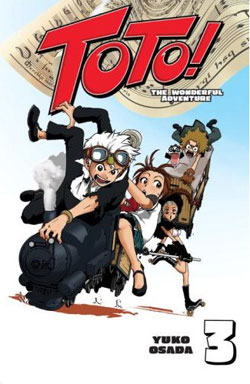
Toto! The Wonderful Adventure, Vols. 1-5

September 16, 2010 by Katherine Dacey

If you’ve ever been to Canal Street in New York City — the Counterfeit Capital of North America — you know that there are two types of goods for sale there. The first are inept knock-offs: the “Cooch” purse with plastic handles, the “Rollex” with cubic zirconia insets and a flimsy metal band. The second are just as fake as the first, but are executed with enough panache that style-conscious women get a secret thrill in owning them: the plastic “Birkin” bag that looks like the real thing but costs $30, the canvas “Louis Vuitton” wallet that comes in prettier colors than the original.

The same principles apply to manga as well: there are series which shamelessly imitate a best-selling title like Dragonball or InuYasha, rehearsing the same plot without capturing the original’s charm, and there are copycats which bear a strong resemblance to the original but nonetheless work well on their own terms. Toto! The Wonderful Adventure falls into the latter category, a good-natured rip-off of One Piece and Rave Master that accomplishes in five volumes what many shonen series need twenty or thirty to pull off.

As one might guess from the title, Yuko Osada dresses up his swashbuckling treasure hunt with frequent allusions to Frank L. Baum’s The Wonderful Wizard of Oz. The hero, Kakashi (literally, “scarecrow”), is an orphan who dreams of leaving his small island home for grand adventures, but lacks the brains to realize his ambition. When a zeppelin makes an unscheduled stop on the island, he stows away, thus beginning an odyssey that loosely mirrors the plot of Baum’s novel. Kakashi finds a puppy in the ship’s cargo hold, then meets a feisty teen named Dorothy who attends St. Kansas Academy, practices “tornado” senjutsu (a martial art involving spinning kicks), and plans to visit Emerald City. As Kakashi and Dorothy follow the Yellow Brick Road — here played by an old railway line — they acquire traveling companions, each modeled on one of Baum’s iconic characters: Noil, a kind but cowardly soldier who aspires to be a comedian; Dam, a big, blustering army officer with a metal arm; and Paisley, the Northern Investigator for the W.I.T.C.H. organization.

Central to the story is the relationship between Kakashi and Toto, the puppy he rescues in volume one. Though Toto initially appears benign, he has a big secret: his collar grants him the kind of amazing, destructive powers that make him of special interest to the military. It doesn’t take long before Kakashi and Dorothy find the Western army bearing down on them, anxious to reclaim their lost weapon.

Though the story’s Oz jokes add novelty value, Toto! barks like a typical wacky shonen adventure, with lengthy set-pieces that follow the same basic formula: Kakashi et al. arrive in a town, befriend one of the locals, and narrowly evade capture by the army. Some of these story arcs are genuinely delightful; in volumes two and three, for example, Kakashi and Dorothy stumble into the once-glorious Dego City, a former railroad hub that’s been stripped bare by the Imperial Army in its never-ending quest for scrap metal. The heroes’ getaway is executed with a perfect mixture of suspense and humor, culminating in a scene that Miyazaki would be proud to include in one of his films. Other storylines feel more labored. In volumes four and five, for example, Kakashi and friends get swept up in a feud between rival gangs: Alice and the Wonder Family in one camp, the Uchiyaka (literally, “rabbit gun”) in the other. Osada piles on the Lewis Carroll references, double- and triple-crosses, and crazy shoot-outs, but the frenzied pace and frequent jump cuts render these chapters almost incoherent.

At times, Osada’s dogged capitulation to shonen formula invites not-so-flattering comparisons between Toto! and more popular series. He populates his story with a dim but determined hero (with a dead explorer father, no less), a feisty female sidekick, a comic-relief character with an outsized Afro, and a posse of villains-turned-allies — in this case, a group of sky pirates called the Man Chicken Family. Osada even provides a complex mythology to explain Toto’s power — something involving twelve directions and twelve “accessories” — that feels like a complete afterthought, an editor’s attempt to make Toto! behave more like One Piece or Rave Master.

Yet for all Kakashi’s earnest declarations about “family” and “adventure,” and all the wacky villains, epic battles, and amazing artifacts pilfered from One Piece and Rave Master, Toto! has undeniable charm. The characters have great rapport, for one thing; though their interactions follow the standard shonen model of friendly antagonism, their obvious loyalty to and affection for one another is contagious. The girls are on equal footing with the boys, for another; Dorothy and Paisley prove stalwart and resourceful, getting significant butt-kicking turns in the spotlight. The art is terrific, too; Osada’s crisp linework and vivid caricatures evoke Eiichiro Oda and Hiro Mashima’s styles without feeling slavishly derivative of either.

Best of all, Toto! is brief. By the time the series concludes, Kakashi has realized his life’s greatest goal: to see the world with friends. It’s not clear whether volume five was intended to be the final installment, or if the editors at Weekly Shonen Magazine canceled it prematurely; either way, Toto! The Wonderful Adventure is proof that a hero’s journey from ignorance to enlightenment needn’t take fifty volumes to convincingly achieve.

TOTO! THE WONDERFUL ADVENTURE, VOLS. 1-5 • BY YUKO OSADA • DEL REY • RATING: TEEN (13+)

Filed Under: Manga, Manga Critic, REVIEWS Tagged With: Action/Adventure, del rey

The 9/11 Report: A Graphic Adaptation

September 10, 2010 by Katherine Dacey

Modern governments from the Bolshevik regime to the Bush presidency have sought simple, appealing ways to present complex information to their citizens, from “Red Pinkerton” novels (think politically correct Communist detective stories) to televised public service announcements. Ernie Colon and Sid Jacobson’s The 9/11 Report: A Graphic Adaptation is one such effort, produced with the full cooperation of the National Commission on Terrorist Attacks Upon the United States. The goal: to summarize the Commission’s findings in a concise, visually arresting format that would appeal to readers reluctant to tackle the full 500-page document. Unfortunately, the final product falls well short of the mark, offering a dense, confusing gloss on the Commission’s work that I found harder to read than the actual prose report.

One can’t fault Colon and Jacobson for their fidelity to the original material. Their book follows the report closely, down to the chapters and subheadings, and uses the Commission’s own words to explain the events that precipitated the 9/11 attacks. In their efforts to mimic the structure of the original document, however, Colon and Jacobson seldom find the right balance between text and image; most of the artwork feels more like an afterthought than a clarification of the prose. More frustrating is the book’s choppy visual flow; Colon and Jacobson’s panel placement often seems poorly chosen, making it difficult to read the images and text boxes in the correct sequence.

The artwork, too, is a disappointment, an eclectic assortment of traced elements, computer-generated graphics, maps, photo-realistic drawings, and Silver Age character designs that never mesh into a seamless whole. (It’s particularly odd to see some real-life figures get the cartoon treatment, while others are rendered in a naturalistic fashion; as depicted in The 9/11 Report, Condolezza Rice bears a striking resemblance to Lucy van Pelt.) Though Colon and Jacobson generally avoid visual stereotyping, there are a few unfortunate images sprinkled throughout the book. On page 115, for example, there’s a chart outlining strategies for combating Muslim extremism in the Middle East and Southeast Asia. The chart is embellished with several images of hook-nosed, squinty-eyed, turban-wearing terrorists, one of whom grins menacingly at the reader, rocket launcher perched on his shoulder; surely the problem of global terrorism deserves a more sophisticated treatment than cartoonish, racist typecasting.

The most effective section of The 9/11 Report is the very beginning, in which Colon and Jacobson meticulously recreate the morning of September 11, 2001. They present the sequence of events twice, first depicting what happened aboard the four hijacked airplanes, then reconstructing the official response to these same events, documenting the jurisdictional confusion and poor communication that prevented the government from taking more decisive action. Both passages consist of four horizontal timelines that allow the reader to see, at a glance, what was happening aboard all four planes on a minute-to-minute basis. (In the hardbound edition, these timelines are printed on a single piece of paper which readers can unfold to view the entire sequence of events.) Here, the comics medium seems uniquely suited to showing these events simultaneously, giving the reader a much better appreciation of just how quickly the day’s events unfolded, and how difficult it was for anyone — military commanders, aviation authorities, police and fire officials — to know how to proceed.

It’s a shame that the rest of The 9/11 Report doesn’t utilize the format as effectively as these early pages, where image and text function as co-equal partners. Whatever the flaws of the original report — and, depending on your political inclinations, those flaws are either minor factual errors or egregious omissions of evidence implicating the CIA in bringing down the World Trade Center — it is a more effective, compelling narrative than the one Colon and Jacobson fashioned from it.

THE 9/11 REPORT: A GRAPHIC ADAPTATION • BY SID JACOBSON AND ERNIE COLON, BASED UPON THE FINAL REPORT OF THE NATIONAL COMMISSION ON TERRORIST ATTACKS UPON THE UNITED STATES • HILL & WANG • 134 pp.

Filed Under: Comics, Manga Critic, REVIEWS Tagged With: Hill & Wang, Non-Fiction

Black Blizzard

September 9, 2010 by Katherine Dacey

First published in 1956, Black Blizzard is a juicy pulp thriller that will irresistibly remind Western readers of The 39 Steps, The Defiant Ones, and The Fugitive. The hero is twenty-five-year-old Susumu Yamaji, a down-on-his-luck pianist who stands accused of murdering the ringmaster of a traveling circus. The circumstantial evidence against him is so compelling that even Susumu — who was in a drunken stupor at the time — believes he did it. After surrendering to authorities, Susumu is handcuffed to hardened criminal Shinpei Konta, a middle-aged man who’s spent most of his adult life drifting in and out of jail. (When Susumu admits to his crime, Shinpei sniffs, “Just one? Tch! That’s nothing! I’ve been convicted five times. Twice for murder.”) An avalanche provides the shackled pair an opportunity to escape into a raging snowstorm, police hot on their trail.

Written in just twenty days, Black Blizzard unfolds at a furious clip, pausing only to allow Susumu a chance to tell Shinpei about his involvement with the circus. The two principals are more archetypes than characters, drawn in bold strokes, but the interaction between them crackles with antagonistic energy — they’re as much enemies as partners, roles that they constantly renegotiate during their time on the lam. Only in the final, rushed pages does manga-ka Yoshihiro Tatsumi falter, tidily resolving the story through an all-too-convenient plot twist that hinges on coincidence.

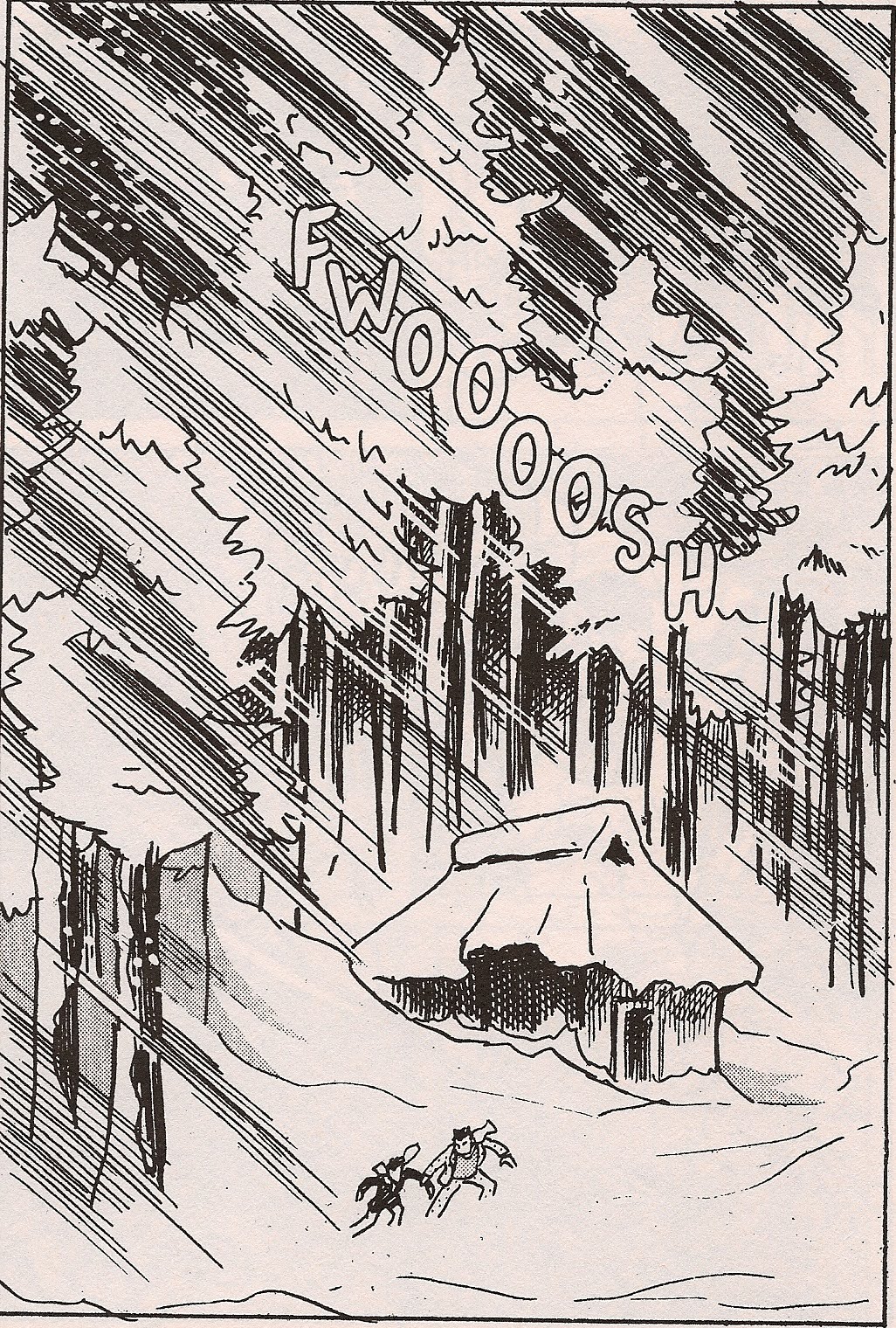
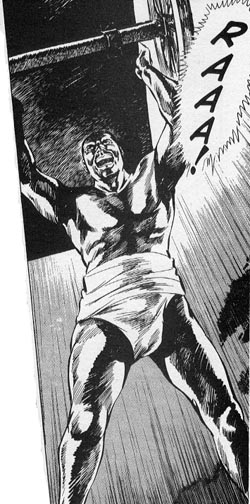
The plot may be pilfered from Manhunt — Tatsumi claims Mickey Spillane as an influence — but the art leaves a fresh impression. Tatsumi already had a substantial amount of work under his belt at the time he wrote Blizzard — seventeen novel-length stories, as well as several volumes’ worth of short ones — but was moving in the direction of what he called “manga that isn’t manga,” stories that exploited the medium’s capacity for representing action in a more dynamic, cinematic fashion. Black Blizzard is filled with slashing diagonal lines, dramatic camera angles, and images of speeding trains; it’s as if Giacomo Balla decided to try his hand at sequential art, filling the pages with as many signifiers of motion as he could muster without lapsing into abstraction:

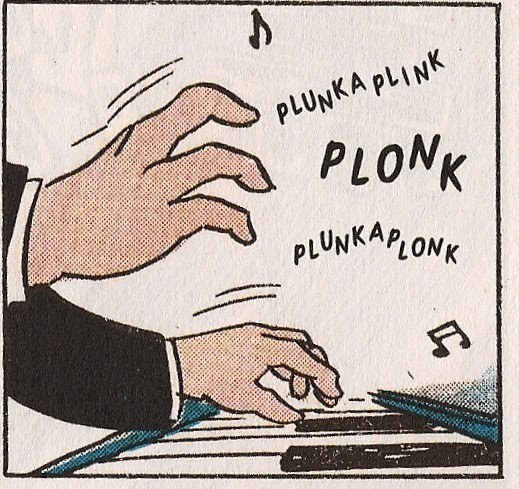
This kineticism extends to even the smallest gestures; in the very first panels, for example, we see a pair of hands banging out notes on a keyboard:

The composition couldn’t be simpler — just a few speedlines and sound effects convey the action — but these details, when coupled with the claw-like position of the hands, suggest the pianist’s extreme agitation, an impression confirmed just a few panels later when we first see Susumu’s sweat-drenched face.

Tatsumi’s regard for anatomy is, at times, careless; Susumu has Rachmaninoff-sized mitts, to judge from the awkward way in which his hands are drawn, while other cast members look stumpy, with grossly foreshortened legs. Yet for all the obvious flaws in his draftmanship, Tatsumi’s gestural approach to characterization proves well-suited to the material’s relentless pace, efficiently communicating each cast member’s personality, age, and plot function with a few artfully rendered lines and shapes. Shinpei, in particular, is a terrific creation, with a broad, sagging jaw and two thick, diagonal lines for eyebrows, making him a dead ringer for a jack-o-lantern.

Drawn & Quarterly has done a fine job of adapting Black Blizzard for Western readers, thanks, in large part, to a crisp translation by Akemi Wegmuller that captures the unique cadences of mid-century noir; one can almost imagine Shinpei referring to an attractive woman as a “tomato.” The volume also includes an interview with Tatsumi; read in tandem with “The Joy of Creation,” one of the later chapters in A Drifting Life, the interview sheds light on Tatsumi’s creative process as well as the work’s initial reception. Editor and designer Adrian Tomine has given Black Blizzard a retro-chic makeover, dying the trim yellow and boldly announcing the book’s price in the manner of a dime-store novel. It’s an attractive design (see above), but I can’t help wishing that Drawn and Quarterly had used Masami Kuroda’s original painting:

It’s a minor complaint, to be sure, but the original cover — to my mind, at least — is a closer expression of the story’s pulpy roots and futurism-tinged artwork.

That said, Black Blizzard is a welcome addition to the growing body of mid-century manga now available in English, providing an all-too-rare glimpse into the early stages of the gekiga movement. And while it lacks the visual and narrative polish of Tatsumi’s mature work, I’ll take the sweaty hyperbole of Black Blizzard over the dour verismo of The Push Man any day; Black Blizzard has a vital, improvisatory energy missing from Tatsumi’s later period, even though his command of the medium was clearly more assured in the 1960s and 1970s.

BLACK BLIZZARD • BY YOSHIHIRO TATSUMI • DRAWN & QUARTERLY • 132 pp. • NO RATING

Filed Under: Manga, Manga Critic, REVIEWS Tagged With: Classic, Drawn & Quarterly, Thriller, Yoshihiro Tatsumi

The Art of Osamu Tezuka

September 6, 2010 by Katherine Dacey

In the introduction to The Art of Osamu Tezuka: God of Manga, author Helen McCarthy argues that Tezuka’s work merits scholarly attention, but also deserves a more accessible treatment as well, one that acknowledges that Tezuka “was first and foremost a maker of popular entertainment.” Her desire to bring Tezuka’s work to a wider audience of anime and manga fans is reflected in every aspect of the book’s execution, from its organization — she divides her chapters into short, one-to-three page subsections, each generously illustrated with full-color plates — to its coffee-table book packaging.

As one might expect from such an ambitious undertaking, the results are a little uneven. The strongest chapters focus on the unique aspects of Tezuka’s work, exploring a variety of creative issues in straightforward, jargon-free language. McCarthy provides a helpful overview of Tezuka’s “star system” (a.k.a. recurring figures such as Acetylene Lamp and Zephyrus) and traces the evolution of his storytelling technique through dozens of series, debunking the notion that he “invented” cinematic comics while carefully spelling out what was innovative about his manga. McCarthy also makes a persuasive case for Astro Boy as one of the most important works in the Tezuka canon, the series that most clearly anticipated his mature style.

As a biography, however, The Art of Osamu Tezuka offers little insight into Tezuka’s personality beyond his relentless perfectionism and strong work ethic. McCarthy’s attempts to situate Tezuka’s work within the context of his life and times feel glib — a pity, as she makes some thought-provoking observations about Tezuka’s recurring use of certain motifs — especially androgyny, childhood, and disguise — that beg further elucidation.

That said, The Art of Osamu Tezuka largely succeeds in its mission to educate fans about Tezuka’s work process and artistic legacy, clarifying his place in Japanese popular culture, exploring his animated oeuvre, and introducing readers to dozens of untranslated — and sometimes obscure — series. A worthwhile addition to any serious manga reader’s library.

The Art of Osamu Tezuka: God of Manga
By Helen McCarthy
Abrams Comic Art, 272 pp.

Filed Under: Books, Manga, Manga Critic, REVIEWS Tagged With: Biography, Helen McCarthy, Osamu Tezuka

Harmony

September 4, 2010 by Katherine Dacey

VIZ launched its Haikasoru imprint in 2009, with the goal of bringing Japan’s best speculative fiction to the US. Haikasoru’s debut titles — All You Need Is Kill and The Lord of the Sands of Time — introduced Americans to two award-winning sci-fi authors whose work had previously been unavailable in English. As the line as grown, so, too, has the diversity of its offerings, which run the gamut from horror (e.g. Otsuichi’s ZOO) to teen-friendly fantasy (e.g. Miyuki Miyabe’s Brave Story and The Book of Heroes) to science fiction (e.g. Issui Ogawa’s The Next Continent and Hosume Nojia’s Usurper of the Sun). Harmony, the newest Haikasoru title, falls on the softer end of the sci-fi continuum, depicting a world in which “admedistrative” societies — that is, countries that operate by rule of medicine, rather than rule of law — are the new empire-builders.

Harmony takes place in the late twenty-first century, fifty years after nuclear holocaust destroyed North America and destabilized the international balance of power by flooding the Third World with an abundant supply of nuclear weapons. In the chaos that ensued, countries which successfully developed the medical technology to treat radiation sickness supplanted the old superpowers, while less scientifically advanced nations descended into guerilla warfare. The new admedistrative powers transformed the World Health Organization (WHO) into a global peacekeeping force tasked with monitoring other nations’ ability to “ensure their populace a lifestyle that [is] sufficiently healthy and human.” The key to that lifestyle is WatchMe, an elaborate system that keeps close watch over individuals’ health, guiding them away from potentially harmful choices — fatty food, alcohol, cigarettes, distressing literature — repairing cellular damage, and providing the government a steady stream of data about a person’s behavior and current medical condition.

<!—more—>

Harmony is told through the point of view of Tuan Kirie, a twenty-eight-year-old WHO agent tasked with solving the mystery behind an “outbreak” of suicide — an action that, in theory, should be impossible under the WatchMe system. Tuan is an appealing narrator, at once tough and funny, a natural contrarian who smokes and drinks and defies authority yet nonetheless treats her mission with the utmost seriousness. The story moves fluidly between past and present, using Tuan’s childhood memories to shed light on her conflicted, often subversive, behavior. Until the third act, the pacing is brisk and the dialogue crisp; as Tuan draws closer to finding out what prompted the wave of suicides, however, the story begins to sag under the weight of turgid conversations about free will and psychology, a flaw that the frequent changes of setting can’t conceal.

It’s a shame these third-act discussions are so pedestrian, as author Keikaku “Project” Itoh has devised a nifty set-up for examining the boundaries between public and private life, imagining a world in which the government’s desire to collect data and enforce civility goes well beyond speech, belief, and association — all manifestations of conscious thought — to the level of neural transmissions and body chemistry. For most of the book, Itoh manages to dramatize the conflict between public and private without speechifying or shortcuts, using Tuan’s role as a WHO agent to explore the nature of admedistrative rule. Though Tuan yearns for the physical and social freedom less technologically advanced societies enjoy, the persistence of armed conflict in the developing world is a potent reminder of why so many people willingly submit to the benevolent totalitarianism of the WatchMe system.

VIZ has done an excellent job of adapting Harmony for English-speaking audiences. Translator Alexander O. Smith, in particular, deserves praise for the smooth, idiomatic voicing of Tuan’s thoughts in language that captures the heroine’s fierce personality. Smith also navigates passages of scientific shoptalk and historical description with ease, producing a highly readable text that lacks any of the tell-tale signs of translation: awkward turns of phrase, confusing use of pronouns.

Aside from a few third-act hiccups, Harmony is a solidly entertaining book, offering a judicious mixture of globe-trotting action, social commentary, and suspense to engage all but the hardest science fiction fans, and a surprise ending that neatly resolves the main plot while raising new, thought-provoking questions. Recommended.

Review copy provided by VIZ Media, LLC.

HARMONY • BY PROJECT ITOH, TRANSLATED BY ALEXANDER O. SMITH • VIZ • 252 pp.

Filed Under: Books, Manga Critic, REVIEWS Tagged With: Haikasoru, Novel, Post-Apocalyptic Sci-Fi, VIZ

Apollo’s Song, Vols. 1-2

September 1, 2010 by Katherine Dacey

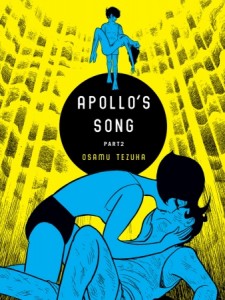
Apollo’s Song may be one of the strangest sex ed manuals ever written. It begins with a textbook Tezuka scene, at once lyrical and goofy: millions of anthropomorphic sperm race towards a comely egg. After one lucky soul pants and claws his way to the front of the scrum, the sperm and egg dissolve into a passionate embrace. In the following panel, we see the result of their union, an embryo, presiding over a veritable sperm graveyard. This juxtaposition of life and death — or, perhaps more accurately, sex and death — foreshadows the dialectic that will play out in the following chapters.

We are then introduced to Shogo, a young man who has just arrived at a psychiatric hospital. Shogo is a sociopath: unemotional, cruel to animals, scornful of society, and deeply misogynist. While undergoing electroshock therapy, Shogo has a vivid hallucination in which a stern goddess chastises him for renouncing all forms of love. As punishment for his cruelty, she condemns him to a fate straight out of Dante’s Inferno: Shogo will love and lose the same woman over and over again for eternity. Thus begins a series of romantic and sexual encounters between Shogo and various incarnations of his ill-fated partner.

Though the story begins and ends in the present day, the individual episodes unfold in both the past and future, reminding the reader that Shogo cannot escape his fate. Certain recurring motifs suggest that these scenarios are, in fact, manifestations of Shogo’s subconscious as he struggles to reconcile his hatred of women with his need to be loved. In each scenario, for example, Shogo adopts a hyper-masculine guise — Nazi foot soldier, fugitive, hunter, terrorist — that he must ultimately renounce in his quest for spiritual and sexual fulfillment. We’re never entirely certain which of these episodes are unfolding in Shogo’s mind and which, if any, are unfolding in the real world.

Though Apollo’s Song aspires to universality, Tezuka’s characters remain firmly rooted in the time and place of their creation. Tezuka blames Shogo’s mother — whose crimes include an inability to lactate, promiscuity, and emotional detachment — for her son’s pathology, even treating us to a scene of the youthful Shogo walking in on his mother and a lover. While no one would deny the deleterious effects of parental neglect, Shogo’s mother seems less like a character than a casebook study out of the 1952 DSM. Other characters, such as an “artsy-fartsy,” “self-centered” career woman who defends her chastity with hysterical fury, seem like the morbidly sexual figments of a Freudian imagination.

Tezuka’s moralizing, too, has a curiously alienating effect. In the first episode, for example, Shogo imagines that he is a German soldier aboard a train bound for an unnamed concentration camp. Through the slats of a cattle car, he spots Elise, whose beauty and modesty awakens his sense of moral outrage. He rescues her first from the wreckage of the train (which is bombed by Allied forces), then from German rapists, earning her love through his selflessness. This scenario is clearly meant to teach readers that love can transcend ethnic, racial, and religious divisions, yet this epiphany is of a shallow nature, as Shogo fails to grasp the true horror of the situation or appreciate Elise’s grief at losing her entire family – in essence, the Holocaust has been reduced to a colorful backdrop for yet another of Shogo’s doomed romances.

However problematic the story may be, the artwork in Apollo’s Song ranks among Tezuka’s best, filled with arresting landscapes and surprisingly carnal imagery. In chapter two, for example, Shogo finds himself stranded on a lush tropical island. Peering through a dense frame of vegetation, he spies a secluded glen where deer, panthers, and leopards embrace their mates in sexual congress. The sensuality of the moment is accentuated by their bodies’ curved lines and beatific expressions, infusing a potentially silly scene with a graceful spirituality. Later chapters also abound in vivid images; as Tezuka imagines the Tokyo of the future, the city has been transformed from a glass-and-concrete forest into an Art Deco monstrosity reminiscent of Fritz Lang’s Metropolis or a Soviet Bloc city. Its inhabitants, a race of sexless, synthetic beings that store their faces in jars, preside over a haunted landscape of tombs, forgotten infrastructure, and empty plazas; the very barrenness of the place brings the intensity of Shogo’s yearning and anger into sharp relief.

Revisiting Apollo’s Song three years after its initial release, I find myself torn. On the one hand, Tezuka’s artwork is a feast for the eyes, featuring some of the most erotic images he committed to paper. On the other hand, it’s a deeply flawed work that, in its attitudes towards women and finger-wagging tone, shows its age. Vertical has done an admirable job of fashioning a silk purse from a sow’s ear with the handsomely produced new edition, but even the knockout cover designs can’t conceal the fact that Apollo’s Song is a sour, heavy-handed tale that lacks the essential humanism – and humor – of Buddha and Phoenix.

This is a revised version of a review that appeared at PopCultureShock on 6/22/2007.

APOLLO’S SONG, VOLS. 1-2 • BY OSAMU TEZUKA • VERTICAL, INC. • RATING: OLDER TEEN (16+)

Filed Under: Manga, Manga Critic, REVIEWS Tagged With: Classic, Osamu Tezuka, Shonen, vertical

Gente and House of Five Leaves

August 20, 2010 by Katherine Dacey

I find Natsume Ono’s work rewarding and maddening in equal measure. On the plus side, I love her idiosyncratic style; her panels are spare and elegantly composed, with just enough detail to convey the story’s time and place. Her character designs, too, are a welcome departure from the youthful, homogenized look of mainstream shojo and shonen manga. Her people have sharp features and rangy bodies, yet inhabit their skins as comfortably as the proverbial pair of old shoes; it’s rare to see middle age depicted so gracefully. And speaking of middle age, her characters’ maturity is another plus, as they grapple with the kind of real-world problems — failed marriages, aging parents, child-rearing — that are almost never addressed in manga licensed for the US market.

On the minus side, Ono’s artwork is an acquired taste; the reader sometimes has to take it on faith that a particular character is handsome or pretty, as Ono’s children and twenty-somethings are less persuasively realized than her older characters. Then, too, Ono’s fondness for depicting everyday moments can rob her stories of any meaningful dramatic shape, creating long, meandering stretches where very little happens and even less is revealed about the characters. More frustrating still is her tendency to vacillate between allowing readers to interpret events for themselves and slapping readers across the face with a pointed observation, as if she doesn’t trust the audience to read the scene properly without a little authorial intervention.

VIZ has been lobbying hard to make Ono’s name familiar to American readers, first with not simple, a story about an abused young drifter, and then with Ristorante Paradiso, a dramedy exploring the complicated relationship between Nicoletta, a twenty-something woman, and Olga, the mother who abandoned her. This fall, VIZ will release two more works by Ono: Gente: The People of Ristorante Paradiso (August) and House of Five Lives (September). Gente, the weaker of the two, is a three-volume prequel to Ristorante Paradiso that focuses less on Nicoletta and Olga and more on the bespectacled waitstaff at Cassetta dell’Orso, the trattoria owned by Olga’s husband. House of Five Leaves is a very different beast, a historical drama reminiscent of such films as Hara Kiri and The Twilight Samurai. Its hero, Akitsu Masanosuke, is a timid ronin who can’t hang on to a job; when a businessman approaches him with work, Masanosuke readily accepts, not realizing that Yaichi, his new employer, runs a crime syndicate that specializes in kidnapping.

Though Gente can be read independently of Ristorante Paradiso, readers unfamiliar with the earlier work may feel like they’ve walked into a party that’s already in progress, as many of the stories assume that the reader will be familiar with — and therefore interested in — Cassetta dell’Orso’s employees. One of the few chapters that works well for newbies and fans alike is “Luciano,” which explores the relationship between a widower and his daughter. The story succeeds because the dynamic between them feels authentic; the daughter’s persistence and gentle needling about finding a new partner is met with equally quiet resistance from her father.

Other stories, however, preserve the rhythms of everyday life with a little too much fidelity to be interesting. “Un giornata di Vito,” for example, consists primarily of a man talking, shopping, and doing crossword puzzles with an architecture student half his age, while “Il primo anniversario” depicts a luncheon for the restaurant’s employees; in the chapter’s only dramatic moment, a waiter injures his back and retires to the kitchen to lie down. A good author doesn’t need to contrive a Big Event to enliven a slice-of-life vignette, of course, but compelling dialogue helps, and it’s here that both stories stumble. The conversation tends towards the earnest and dull, with characters occasionally stating things about themselves in a bald, unnatural fashion that seems fundamentally at odds with Ono’s desire to let us learn about her characters from watching them walk through their daily routines.

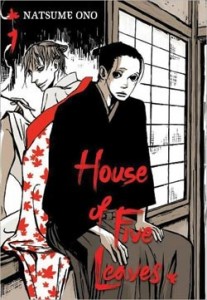
house5House of Five Leaves, too, focuses less on Big Events and more on everyday activity, but in Leaves, Ono’s restraint serves an important dramatic purpose: she’s showing us events through Masanosuke’s eyes, as he tries to reconcile the bandits’ seemingly ordinary lives with their extraordinary behavior. Making the reader‘s task more difficult is that Masanosuke isn’t very astute. He tends to focus on a kind gesture or a friendly conversation, missing many of the important aural and visual cues that might enable him to understand what’s happening — a trait that the group exploits. In one chapter, for example, Yaichi encourages Masanosuke to accept a job as a bodyguard for a merchant family while the group plans its next kidnapping. Masa befriends his new employer’s son, never realizing that his true assignment is to infiltrate the target’s household so that Yaichi’s minions can snatch the boy for ransom.

Whether Masa will harden over time or cling to his desperate belief that the Five Leaves are engaged in an honorable enterprise remains to be seen. What is apparent, however, is that this naive, self-effacing man will eventually be provoked to violence. And when that happens, we’ll appreciate the meticulous way in which Ono has been building to that moment, as we’ll at have real sense of who Masa is, and why he’s been reluctant to pick up a sword. Though Toshiro Mifune and Hiroyuki Sanada have made entire careers out of playing characters like Masanosuke, Ono makes a persuasive case that you don’t need a flesh-and-blood actor to tell this kind of story with heartbreaking intensity; she can do the slow-burn on the printed page with the same skill and intensity as Masaki Kobayashi and Yoji Yamada did on the big screen.

Review copies provided by VIZ Media, LLC. Gente is available now; volume one of House of Five Leaves will be released on September 21, 2010. House of Five Leaves is currently being serialized on the SigIKKI website.

GENTE: THE PEOPLE OF RISTORANTE PARADISO, VOL. 1 • BY NATSUME ONO • VIZ • 176 pp. • RATING: OLDER TEEN (16+)

HOUSE OF FIVE LEAVES, VOL. 1 • BY NATSUME ONO • VIZ • 208 pp. • RATING: OLDER TEEN (16+)

Filed Under: Manga, Manga Critic, REVIEWS Tagged With: Natsume Ono, Samurai, Seinen, SigIKKI, VIZ

Manga Artifacts: Lycanthrope Leo

August 15, 2010 by Katherine Dacey

Back in the 1980s and 1990s, before publishers realized that they could sell manga to teenagers through Borders and Books-A-Million, VIZ and Dark Horse actively courted the comic-store crowd with blood, bullets, and boobs. It was a golden age for manly-man manga — think Crying Freeman and Hotel Harbor View — but it was also a period in which publishers licensed some bad stuff. And when I say “bad stuff,” I mean it: I’m talking ham-fisted dialogue, eyeball-bending artwork, and kooky storylines that defy logic. Lycanthrope Leo (1997), an oddity from the VIZ catalog, is one such manga, a horror story with a plot that might best be described as Teen Wolf meets The Island of Dr. Moreau with a dash of WTF?!

The Leo of the title is Leo Takizawa, a high school student with a cute girlfriend and a gruff father. In the days leading up to his seventeenth birthday, he surprises his track teammates with an astonishing, world-record performance in the hundred-meter dash. Dad, noticing Leo’s dramatic transformation from speedy string-bean to Carl Lewis challenger, realizes that his worst fear is coming true: Leo is on the verge of turning into a lycanthrope, a powerful shape-shifter capable of rending a man limb from limb. So Dad does what all caring, self-respecting parents in his situation would do: he lures his son into an abandoned cabin in the woods, then attempts to shoot him with a fancy crossbow — but not before he gives a long, impassioned speech explaining what Leo is and why lycanthropes are mankind’s avowed enemy. Dad’s garrulousness proves his undoing; like so many villains, he spends too much time delivering an expository monologue and not enough time getting down to business, thus providing Leo opportunity to assume his true form and take Dad out with one blow of his werelion’s paw.

Yes, you read that right: Leo is a werelion. I admit the idea has potential; it liberates the author Kengo Kaji from the conventions of Western were-lore — the silver bullets and full moons and gypsies — while allowing him to milk the human/animal dichotomy for its full dramatic potential. Alas, Kaji extends the were-concept to other, less majestic animals for a subplot involving a centuries-old conflict between carnivore and herbivore lycanthropes. (The meat-eaters favor wiping out mankind; the cud-chewers prefer peaceable co-existence.) The nadir of the anything-is-more-awesome-in-were-form, however, is Mayuko Asuka, a sexy young teacher who turns out to be… a were-flying squirrel. And an evil were-flying squirrel, I might add, one who isn’t above seducing a seventeen-year-old or attacking a lycanthrope who threatens to reveal too much of the carnivores’ world-domination plans.

Kenji Okamura’s artwork is awe-inspiring and awful simultaneously. On the one hand, he draws amazingly detailed monsters, rendering their fur and claws and muscle-bound chests with exquisite care, even when they’re ripping each other to pieces; imagine Sylvester Stallone in werewolf drag, and you have some idea of what the male lycanthropes look like in their animal forms. On the other hand, Okamura’s human characters look like they belong in a Fernand Léger painting, with their plastic, impassive faces. Okamura struggles to convey emotion convincingly; about the best he can do is depict Leo sweating profusely. (By my count, Leo loses twenty to thirty pounds of water weight over the course of the first volume.) Worse still, Okamura frames almost every scene from an odd vantage point that distorts the characters’ anatomy, making them look ridiculously stumpy or leggy; I honestly thought Leo was being bullied by a midget in several scenes, thanks to the extreme angle at which we view Leo’s tormentor.

If you’re wondering why you haven’t heard more about Lycanthrope Leo, that’s because VIZ suspended production on the series after just one volume, citing poor sales. It’s not hard to imagine why Leo didn’t connect with American readers; the art has a throwback-to-the-eighties look, while the story is so preposterous and self-serious that it doesn’t work as straight horror or camp. From a reader’s standpoint, the most disappointing thing about Leo is the abruptness with which the English edition ends; Kaji introduces a key character in the final chapters of volume one, leaving readers to wonder whether the carnivores and herbivores eventually achieve detente. Of course, you probably won’t care if they do, considering all the sweaty, frantic silliness that precedes the introduction of the wise were-buffalo; for all the howling and “unsheathing of steel claws,” Lycanthrope Leo is about as scary as a kitten.

Manga Artifacts is a monthly feature exploring older, out-of-print manga published in the 1980s and 1990s. For a fuller description of the series’ purpose, see the inaugural column.
LYCANTHROPE LEO, VOL. 1 • STORY BY KENGO KAJI, ART BY KENJI OKAMURA • VIZ COMMUNICATIONS • 224 pp. • NO RATING (GRAPHIC VIOLENCE, NUDITY, STRONG LANGUAGE)

Filed Under: Manga, Manga Critic, REVIEWS Tagged With: Seinen, VIZ

Quick Takes: Shojo Beat Edition

August 15, 2010 by MJ 8 Comments

Welcome to the second edition of Quick Takes here at Manga Bookshelf! This week I take a look at some recent releases from Viz Media’s Shojo Beat imprint. Enjoy!


Dengeki Daisy, Vol. 1 | By Kyousuke Motomi | Published by Viz Media | Rated T+| Buy this book – As orphan Teru Kurebayashi’s older brother prepared to pass from this world, he gave her the gift of a cell phone–one which she could use to contact his mysterious friend “Daisy” who he promised would protect Teru in his absence.

Now in high school, Teru faces bullies of all kinds, including the surly school custodian, Kurosaki, who indentures her into servitude as repayment for breaking one of the school’s windows. But is Kurosaki more than he seems?

Though the mystery of “Daisy” is not maintained for long (at least for the reader) there is some real charm to this volume. Both Teru and Kurosaki are likable characters who are very easy to root for (individually and as an inevitable couple) which makes the romantic drama fun to follow.

Unfortunately, this series insists on perpetuating the sad shojo trope of a young woman who can only survive with the protection of a man–a concept that is becoming more and more tiresome for this reviewer. It’s really a shame, too. Teru appears to be a pretty tough cookie, which makes it even less believable that she’s so dependent on the fantasy she’s constructed around Daisy.

That said, this is a strong first volume containing all the essential elements for addictive high school romance: hateful antagonists, emotional drama, and just the right amount of attractive brooding. How can it be wrong?


Rasetsu, Vol. 6 | By Chika Shiomi | Published by Viz Media | Rated T+ | Buy this book – This is an emotionally heavy volume for Rasetsu, who tries to get over her feelings for Yako at the same time as she’s confronted with new truths about Kuryu (and his feelings for her). Meanwhile, Yako faces some very old spirits who mistake him for the person he most needs to forget.

What keeps this series compelling is that it is profoundly unsettled, and this applies to both the hearts of its characters and to their individual circumstances. There’s more to everyone than meets the eye. Furthermore, though each of the story’s characters is deeply conflicted, they still manage to band together into an unexpectedly warm, self-made family unit.

The love triangle between Kuryu, Rasetsu, and Yako may not be anything new to shojo manga, but it is played out in an unusually poignant manner. Each party’s strengths and weaknesses is being brought painfully to the fore, with no obvious resolution in sight.

Though this series gets off to a lukewarm start, over the course of six volumes it has become one of my favorite of Viz’s shojo series currently in release. Recommended.

Read previous reviews of this series.


Butterflies, Flowers, Vol. 3 | By Yuki Yoshihara | Published by Viz Media | Rated M (Mature) | Buy this book – In this installment, Choko and Masayuki take their first overnight trip together, with the intention of finally consummating their relationship. Of course the weekend is crashed by a collection of family and friends, though the two eventually find some time alone to do the deed.

The thing (the only thing) that saves this series is its humor. If it was not genuinely funny, chapter after chapter, it would be nothing more than the sad tale of deeply controlling man desperately working to get into his girlfriend’s pants. Is that too harsh? Maybe. It’s possible I’m still holding a grudge over “strict but warm,” which ranks right up there with “I get the message” and “Men have dreams that women will never be able to understand” on my list of Great Moments in Imported Sexism.

To be honest, though, not much has changed in this volume. Sure, Choko stands up for herself early on, accepting a date with another childhood acquaintance to show Masayuki that he does not, in fact, own her. But when the date goes awry, Masayuki is there to save the day and (more importantly) remind her how foolish she is to defy him. “This is what you get for not listening to me.” Yes, that’s actually what he says.

Fortunately, the smart humor that hooked me on this series’ first volume is still very much in play. That alone keeps me hanging on.

Read previous reviews of this series.


Stepping on Roses, Vol. 2 | By Rinko Ueda | Published by Viz Media | Rated T+ | Buy this book – The plot thickens in this volume, as it is revealed that Soichiro’s plan for success revolves entirely around manipulating his friend, Nozomu, into falling in love with his new wife, Sumi. Meanwhile, Sumi’s brother has already frittered away the money she sacrificed herself for, leaving the kids in the care of a slovenly drunk.
This volume is more engaging than the last, though that’s not exactly high praise. The story has become no less predictable (and no more believable) than it began, and it’s still difficult to watch its weak-willed heroine smile gratefully as she’s tossed around like an object by the series’ sad lineup of fairly repulsive men.

Some revelations about Soichiro’s past begin to offer up a bit more dimension, both to him and to the story overall, but can the payoff ever be great enough to make up for what’s lacking? Thankfully, Sumi’s country-bumpkin bumbling has been toned down in this volume, which does help a little.

Though I’m far from sold on Stepping on Roses, I’m at least beginning to feel mildly entertained. But can romance between these characters ever truly deliver?

Read previous reviews of this series.


Review copies provided by the publisher.

Filed Under: QUICK TAKES Tagged With: butterflies flowers, Dengeki Daisy, rasetsu, stepping on roses

The Manga Hall of Shame: Color of Rage

August 12, 2010 by Katherine Dacey

When reading historical manga, I grant the artist creative license to tell a story that evokes the spirit of an age rather than its details. What rankles my inner historian, however, are the kind of anachronisms that result from sheer laziness or paucity of imagination: modern slang, gross disregard for well-established fact. Alas, Color of Rage is filled with the kind of historical howlers that would make C. Vann Woodward or Leon Litwack gnash their teeth in despair.

The story begins in 1783. Off the coast of Japan, a whaling ship sinks in turbulent seas, claiming the lives of all but two crew members: George, a Japanese man, and King, an African-American slave. The two wash ashore, cut away their shackles, and set out in search of a community where they can live peacefully — no small challenge, given how conspicuous King is among such a homogenous population. Of course, this being a manga by Kazuo Koike, George and King’s journey is anything but picaresque, as they bump up against the vigorous defenders of Edo-era status quo: ruthless daimyo, yakuza thugs, samurai-for-hire.

For such a far-fetched premise to work, its principal characters’ thoughts, words, and actions need to make sense in historical context, yet George and King behave like modern action heroes deposited in feudal Japan, not products of the eighteenth century. During scenes of limb-severing carnage, for example, they banter with the consummate skill of Harrison Ford and Will Smith, pausing occasionally to deliver speeches about finding a place where “color doesn’t matter” — a noble sentiment, to be sure, but one cribbed from a Civil Rights speech circa 1964, not an eighteenth century abolitionist’s tract. A similar sense of historical amnesia informs another scene in which King declares that conditions are worse for Japanese peasants than for slaves in the American South, leaving me to wonder how a slave working on a colonial plantation would have any comparative basis for making such an assertion or, frankly, any notion of the “American South,” given that the Revolutionary War was still in full swing at the time King was gang-pressed into whaling. Other historical oversights abound: how did a Japanese man end up in the galley of an American whaling ship? Where did George learn to speak fluent English? Who taught King to handle a sword? And so forth.

colorofrageinteriorThe bigger problem, however, is that King entertains notions of race, class, and gender that would have been as alien to American colonists as they were to Japanese farmers and overlords. His blind commitment to addressing inequality wherever he encounters it — on the road, at a brothel — leads him to do and say incredibly reckless things that require George’s boffo swordsmanship and insider knowledge of the culture to rectify. If anything, King’s idealism makes him seem simple-minded in comparison with George, who comes across as far more worldly, pragmatic, and clever. I’m guessing that Koike thought he’d created an honorable character in King without realizing the degree to which stereotypes, good and bad, informed the portrayal. In fairness to Koike, it’s a trap that’s ensnared plenty of American authors and screenwriters who ought to know that the saintly black character is as clichéd and potentially offensive a stereotype as the most craven fool in Uncle Tom’s Cabin. By relying on American popular entertainment for his information on slavery, however, Koike falls into the very same trap, inadvertently resurrecting some hoary racial and sexual tropes in the process.
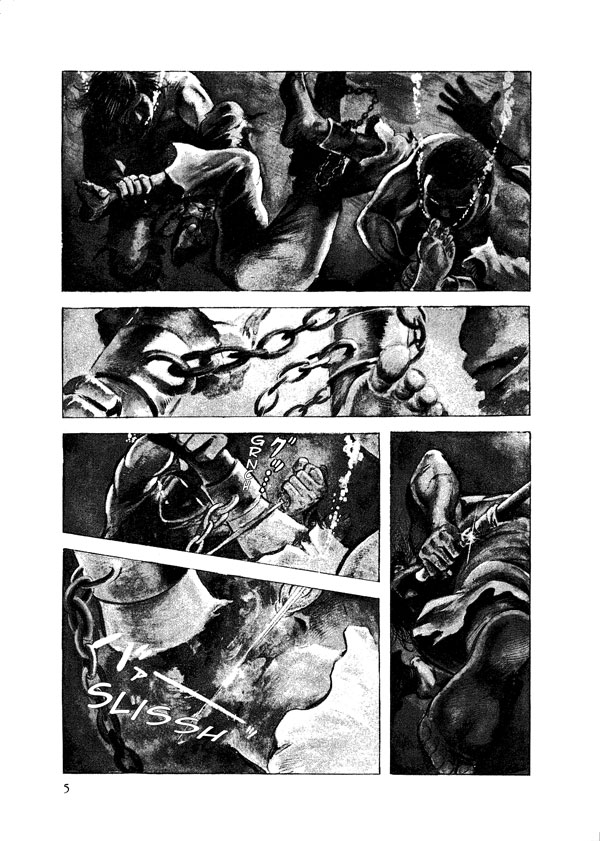
Koike’s treatment of female characters, like his handling of racial issues, can be downright ugly. In a valiant effort to head off feminists at the pass, the editors acknowledge Koike’s propensity for writing “samurai-era yarns with a certain sense of chauvinist violence and pulpy sexiness.” Now I’m all for “pulpy sexiness” — doesn’t that sound like fun? But the casual mingling of sex and violence in Color of Rage crosses the line from mere chauvinism to outright misogyny. The nadir is a scene in which King strips a woman naked and crams dirt into her mouth until she chokes. Her crime: being turned on by the sight of King’s big, strapping body (which, I might add, artist Seisaku Kano treats as a kind of fetish-object throughout the book). Richard Wright might have known how to make the moment horrific, tragic, and peculiarly just, but someone as ill-versed in American history as Koike does not. The result is an uncomfortable mixture of kink and racism that hints at the story’s 1970s roots; one wonders what, exactly, Koike had read or seen to inspire such a florid racial fantasy.

The artwork is a hodgepodge of styles and techniques. The best pages appear to be done in charcoal or pastels, and have the soft edges and expressionist lighting I associate with fin-de-siecle modernists such as Käthe Kollwitz. The opening scene, in particular, is beautifully rendered, a harrowing sequence of wordless, slightly abstract panels that reveals how George and King survived their maritime ordeal:

corv2

Most of the art, however, looks like homage to Goseki Kojima’s work on Lone Wolf and Cub, Samurai Executioner, and Path of the Assassin — not a bad thing, given Kojima’s superb draftsmanship and penchant for drawing memorable mugs. Seisaku Kano’s character designs are fine, but his fight scenes are poorly composed, a riot of swords, guts, and bodies in motion that fail to give the reader a clear picture of what’s happening. That might be an OK artistic choice once in a while, perhaps to suggest the chaos of hand-to-hand combat, but as the dominant mode of depicting action it soon grows tiresome, leaving the reader feeling more pummeled than entertained.

Though some of these criticisms could be leveled at Koike’s other work — Lady Snowblood, Crying Freeman and, yes, Lone Wolf and Cub — Color of Rage lacks something common to the aforementioned manga: a sense of play. Koike never takes himself too seriously in these other works, even when the plot takes a dark turn or two. In Color of Rage, however, his sincerity proves his undoing, as he tries to insert a noble black character into a world of vicious overlords and amoral samurai. King’s high-minded speeches and interventions clash violently with the story’s “pulpy sexiness” (for want of a better term), producing something that’s neither dramatically compelling nor fun to read. Die-hard Koike fans may feel the completist’s urge to buy Color of Rage — especially since Dark Horse has given it such a deluxe treatment — but casual readers will find much less here to love.

This is a revised version of a review that originally appeared at PopCultureShock on 5/14/2008.

COLOR OF RAGE • BY KAZUO KOIKE AND SEISAKU KANO • DARK HORSE • 414 pp. • RATING: MATURE (18+)

Filed Under: Manga, Manga Critic, REVIEWS Tagged With: Action/Adventure, Bad Manga, Dark Horse, Historical Drama, Kazuo Koike

The Manga Hall of Shame: The Qwaser of Stigmata

August 11, 2010 by Katherine Dacey

Though I frequently grouse about fanservice , I have a grudging respect for those artists who make costume failures, panty shots, and general shirtlessness play essential roles in advancing their plots. Consider Pretty Face, the story of a teenage jock who undergoes reconstructive surgery after a bus accident, only to end up looking like the girl he has a crush on (at least from the waist up). You don’t need to be a pervert to imagine how Yasuhiro Kano exploits the set-up for maximum T&A potential — even the hero gets groped and ogled, though Rando isn’t above leering at and lusting after girls himself. I loathe Pretty Face, yet I have to admit that Kano obviates the need for gusts of wind and breast-level collisions by making gender confusion such a fundamental part of his story; the fanservice may be gross and stupid, but it isn’t gratuitous.

Then there’s The Qwaser of Stigmata.

Qwaser raises the panty-shot-as-plot-element stakes, then kicks Pretty Face down the stairs, taunts it, and takes its lunch money with a gimmick so offensive I’m almost embarrassed to type the words: the characters rely on breast milk for their superpowers. Those characters have chosen St. Mihailov Academy as ground zero for an epic showdown involving religious icons, nubile maidens, and weapons derived from the periodic table of the elements. (No doubt Dmitri Mendeleev is tossing in his grave right now.) From the standpoint of an artist writing for a shonen magazine like Monthly Champion Red, the parochial school setting provides the perfect vehicle for celebrating fetishes under the guise of world-building. No stone goes unturned, from busty nuns and busty schoolgirls to moe-bait characters in spectacles and knee socks; there’s even a bit of fan service for the ladies that takes the form of a smoldering priest in an eyepatch and a sullen, silver-haired Russian named Alexander “Sasha” Nikolaevich Hell. (Or “Her,” in the Tokyopop translation.)

As with most manga featuring combatants of the cloth, the religious iconography seems more a pretext for cool outfits than an integral part of the story. The characters occasionally pause to contemplate the Theotokos of Tsarytsin, a religious icon depicting the Virgin Mary nursing the baby Jesus, but why they want the icon remains mysterious; only by consulting the Wikipedia entry on Qwaser did I learn that this particular image is “fabled to alter the homeostasis of the world.” For a manga exploring a religion that’s sure to be a mystery to most of its readers, in- and outside Japan, it’s curious that no one ever discusses what Russian Orthodox Christians believe, how they practice their faith, or what caused doctrinal crises within the Russian Church — a pity, because as this Slavophile will tell you, there is a boffo manga to be written about the Old Believers’ showdown with Peter the Great. (Don’t believe me? Rent a DVD of the Mariinski Theater’s production of Khovanshchina, an opera so badass that several characters immolate themselves rather than submit to Peter’s will.) The few other references to religion are more window-dressing than anything else; Qwasers, those holy warriors of the periodic table, fight alongside “Maria Magdalens,” described by Wikipedia’s anonymous authors as “the alter-ego combat partner of a Qwaser whose primary function is to provide soma [breast milk] not unlike how one may refuel a car or even a warplane while in flight.” (After reading that sentence, I’m not sure which is more egregious: the Wikipedia authors’ attempt to write about Qwaser in a pseudo-scientific voice, or the manga-ka’s decision to call these women “Maria Magdalens.”)

If the fanservice and faux-religious elements weren’t quite enough to land Qwaser a spot in The Manga Hall of Shame, the dreadful artwork and ADD plotting put it over the top. The fight scenes are utterly incomprehensible, a blur of speedlines, explosions, and whirling dervishes punctuated by the occasional pin-up drawing of a character brandishing a weapon or enduring some unpleasant, sexually tinged violence. The plotting isn’t much better, as the story skips between cliche scenes of classroom bullying and tortured, confusing conversations between the series’ two principal female characters. The dialogue takes the cake for sheer awfulness, however; it’s the kind of series in which villains state the atomic weight of the elements they’re manipulating, exclaim nonsense like “My heart that burns will slice through you!”, and utter things so vile that that the publisher substitutes the word “bleep” for references to female genitalia and sexual congress.

The bottom line: The Qwaser of Stigmata is a shonen manga that aspires to the subversiveness of porn, but doesn’t have the imagination or the weirdness to rise to the level of genuine kink.

THE QWASER OF STIGMATA, VOL. 1: HOLY WARS IGNITE • ART BY KENETSU SATO, STORY BY HIROYUKI YOSHINO • TOKYOPOP • 200 pp. • RATING: MATURE (18+)

Filed Under: Manga, Manga Critic, REVIEWS Tagged With: Bad Manga, Fantasy, Tokyopop

Short Takes: Manga Hall of Shame Edition

August 9, 2010 by Katherine Dacey

I have a special fascination with bad manga. And when I say “bad manga,” I’m not talking about stories that are merely cliche or derivative of other, better series — for better or worse, manga is a popular medium, and popular media survive, in part, by giving audiences what they want, even if that means more of the same — I’m talking about stories so ineptly drawn, so spectacularly dumb, or so offensive that they make Happy Cafe look like Phoenix by comparison. To judge from the coverage of this year’s San Diego Comic-Con, I’m not alone in my connoisseurship of wretched books; among the most widely reported panels was The Best and Worst Manga of 2010, in which a group of seasoned reviewers singled out titles for praise and punishment. To kick off my Bad Manga Week, therefore, I thought it would be a fun exercise to look at three of the titles that made the worst-of list to see if they were truly suited for inclusion in The Manga Hall of Shame. The candidates: Orange Planet (Del Rey), a shojo farce starring one clueless girl and three hot guys; Red Hot Chili Samurai (Tokyopop), a comedy about a hero who favors spicy peppers over PowerBars whenever he needs an energy boost; and Togainu no Chi (Tokyopop), an action-thriller that proudly boasts its origins as a “ground-breaking bishonen game.”

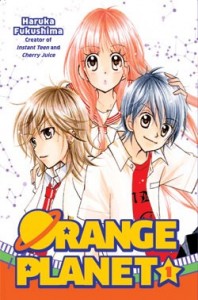
orangeplanet1Orange Planet, Vol. 1
By Haruka Fukushima • Del Ret • 200 pp. • Rated Teen (13+)
Haruka Fukushima specializes in what I call “chastely dirty” manga for tween girls — that is, manga that places the heroine in compromising situations, teasing the audience with the prospect of a kiss or a grope that never quite materializes because the heroine is a good girl, thank you very much. In Orange Planet, Fukushima’s sex-phobic lead is Rui, a junior high student who lives by herself — she’s been an orphan since childhood — and pays for her apartment with a paper route. (That must be some paper route, considering she lives in a modern high-rise apartment and not, say, a cardboard box.) Rui is one corner of a highly contrived love square; the other three points are all standard shojo types, from the boy next door and the hot young teacher to the mystery man from the heroine’s past.

Why any of them find her interesting is one of Orange Planet‘s great puzzles; Rui is ditzy, hysterical, and prudish, three qualities that men of all ages generally dislike in female companions. Why Rui would find any of them attractive is the series’ other, as all three boys behave like boors, popping into her bed unannounced (yes, you read that right) and offering her private “tutoring” sessions. The art is less offensive than the story, evocative of Natsumi Ando’s far better Kitchen Princess with its cast of pointy-chinned, doll-eyed characters and sparkling, rose-filled backdrops. The layouts are sloppily executed, careening from panels of awkwardly-posed bodies to extreme closeups of Rui looking terrified that one of the boys might actually lean in for a kiss. Maybe I would have found Orange Planet titillating when I was eleven or twelve, but I’d like to think that I was never quite that clueless about boys. Just sayin’.

Shameworthiness: Orange Planet earns a place in The Manga Hall of Shame for insulting girls’ intelligence with a wish-fulfillment story so slapdash it’s painful.

redhotchiliRed Hot Chili Samurai, Vol. 1
BY Yoshitsugu Katagiri • Tokyopop • 196 pp. • Rated Older Teen (16+)
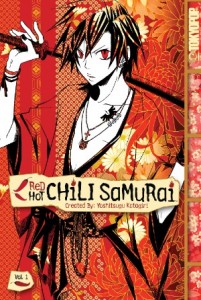
If you crossed Popeye with Samurai Champloo, the results might look a lot like Red Hot Chili Samurai, a labored comedy about a hot-headed swordsman who snacks on peppers — the spicier, the better — to turbo-charge his combat skills. Like all good heroes, Kokaku has a posse of fellow butt-kickers that includes Ento, a sarcastic samurai in glasses; Ran, a feisty woman who vacillates between thinking Kokaku is cute and thinking he’s an ass; and Shou, a ninja who communicates exclusively through handwritten signs, a la Louis in The Trumpet of the Swan. The four tackle an assortment of stock villains, from a yakuza thug who runs a crooked gambling parlor to a pimp who preys on vulnerable young women. Each story follows the same basic template, serving up a predictable mixture of jokes about Shou’s reluctance to speak and Kokaku’s fixation with chili peppers (“Maybe you should give those things up,” one character tells him, “You’ll get hemorrhoids, you know.”), as well as anachronistic sight gags (one character invents a Polaroid-style camera) and scratching-the-fourth-wall observations about samurai manga conventions. Clumsy, speedline-heavy fight scenes and character designs that suggest Champloo doujinshi only reinforce the bad impression left by the script, which is filled with long, airless pauses that precede every joke or snappy comeback. Take my samurai — please!

Shameworthiness: Red Hot Chili Samurai is dull and repetitive to be sure, and poorly drawn to boot, but isn’t quite cringe-worthy enough to merit inclusion in The Manga Hall of Shame’s permanent collection.

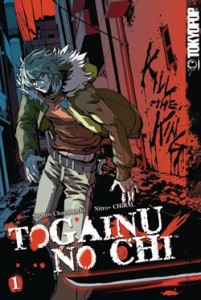
togainuTogainu no Chi, Vol. 1 
By Suguro Chayamuchi and NITRO+ CHiRAL • Tokyopop • 200 pp. • Rating: Older Teen (16+)
Here are seven words that ought to strike fear into every manga reader’s heart: “Based on the ground-breaking bishonen game!” Not only is the tagline vague — what kind of game? how are bishonen involved? what makes it ground-breaking? — but it also suggests that the editorial staff couldn’t think of anything positive to say about a sci-fi adventure that ought, in theory, to appeal to folks who liked Battle Royale. Alas, Togainu no Chi plays like an ungainly mixture of slash fiction and Deadman Wonderland, depositing its pretty, vacant heroes into a future run by gangs who sponsor elaborate street-fighting tournaments. The post-apocalyptic setting is suggested primarily through dark, overly toned streetscapes filled with rubbish and crumbling pavement; one could be forgiven for thinking the story takes place somewhere under the Cross-Bronx Expressway and not a Japanese city circa “20XX A.D.” In fact, nothing about the setting really suggests the future, near or distant, save for a few cliche visual signifiers: sword-wielding characters in trenchcoats, bad guys with enormous tattoos and multiple piercings, the complete absence of daylight. The action sequences are as poorly executed as the backgrounds, a confusing mishmash of blood spatters and facial close-ups (usually as someone is yelling “Noooooo….”), while the dialogue see-saws between manly, expletive-laden exchanges and exposition-heavy speeches. Perhaps Togainu no Chi‘s biggest offense is the laziness of the storytelling; the author frequently interrupts the narrative to explain the rules of The Igura (the tournament at the heart of the story), yet it’s still not clear by the end of volume one how the game is actually played, though it does involve dog tags and playing cards. Or something like that.

About the best I can say for Togainu no Chi is that the menfolk are generically handsome, providing fanfic writers ample opportunity to pair the boys off for some manly adventures followed by some sweet, sweet lovin’.

Shameworthiness: Move that Picasso to the left — this one needs a space in the permanent Manga Hall of Shame gallery.

Filed Under: Manga, Manga Critic, REVIEWS Tagged With: del rey, Samurai, Tokyopop

All You Need Is Kill

August 9, 2010 by Ash Brown

Author: Hiroshi Sakurazaka
Translator: Alexander O. Smith
U.S. publisher: Viz Media
ISBN: 9781421527611
Released: July 2009
Original release: 2004

I really don’t remember exactly when and where I first heard about Hiroshi Sakurazaka’s All You Need Is Kill but after I did it seemed to keep popping up everywhere I looked. It was even picked up by Warner Brothers to make into a live-action film. All You Need Is Kill was originally published in Japan as a light novel in 2004. The English edition, translated by Alexander O. Smith, was one of the very first books to be released by Viz Media’s Haikasoru imprint in 2009. I haven’ read much military science fiction but All You Need Is Kill certainly is that, complete with alien intelligence and battle suits. What particularly caught my interest in the novel was that the main character, Keiji Kiriya, dies during his first battle only to wake up in his bunk thirty hours before over and over again.

The battle on Kotoiushi Island would be pivotal in humanity’s war with the Mimics. If lost, the rest of Japan would follow, along with the technology that made it possible to fight against the constantly evolving invading force. Keiji is a Jacket jockey in the United Defense Force’s 301st Armored Infantry Division which was sent to reinforce the island. He doesn’t even make it through his first battle. Or his second. Or his third. Somehow stuck in a time-loop he is forced to live and die in the same battle again and again. The only thing he can do is learn to fight a little better and hope to survive a little longer each time. Rita Vrataski, member of the U.S. Army Special Forces, has killed more Mimics than any other person in the world. Known as the Full Metal Bitch, not that anyone would call her that to her face, she is formidable, efficient, and scary as hell on the battlefield. She is also one of the last hopes remaining to end the war and may be the only person who can help Keiji escape his fate.

Although All You Need Is Kill is primarily entertainment and not overly serious, Sakurazaka still works in some environmental, technological, and social commentary. At least for me, the story also had a convincing emotional impact. Repeatedly living through the horrors of war, your own death, and the death of your friends and those around you changes a person and Sakurazaka captures this quite well. I like Keiji a lot and was most interested in his story, told in the first person. The third quarter of the book, written in the third person, focuses on Rita and the background of the war with the Mimics. While interesting and certainly important, especially in understanding Rita and her history, I still looked forward to getting back to Keiji. Which is not to say that I didn’t like Rita, because I did. I liked most of the secondary characters as well; Keiji’s bunk-mate and veteran Yonabaru in particular amused me as much as he tended to annoy others in his platoon. I also appreciated the fact that not everyone was assumed to be straight (although pretty much all of them were.)

The translation Smith has done for All You Need Is Kill is great–it’s straightforward with a good flow that hits hard and fast. There is also a nice use of repeated phrases to emphasize the time-loop that Keiji’s stuck in. The original light novel was illustrated by Yoshitoshi ABe and it’s a pity that none of his art was included in the Haikasoru edition beyond the cover–I really would have liked to have seen more of his work. I enjoyed All You Need Is Kill even more than I was expecting to and was impressed by how much action and story Sakurazaka was able to fit into such a relatively short work (it comes in at just under 200 pages.) I’m really looking forward to picking up his only other work currently available in English, also released through Haikasoru, Slum Online.

Filed Under: REVIEWS Tagged With: All You Need Is Kill, Haikasoru, Hiroshi Sakurazaka, Light Novels, Novels, viz media

  • « Go to Previous Page
  • Page 1
  • Interim pages omitted …
  • Page 305
  • Page 306
  • Page 307
  • Page 308
  • Page 309
  • Interim pages omitted …
  • Page 346
  • Go to Next Page »
 | Log in
Copyright © 2010 Manga Bookshelf | Powered by WordPress & the Genesis Framework