• Skip to primary navigation
  • Skip to main content
  • Skip to primary sidebar
  • Home
  • About Us
    • Privacy Policy
    • Comment Policy
    • Disclosures & Disclaimers
  • Resources
    • Links, Essays & Articles
    • Fandomology!
    • CLAMP Directory
    • BlogRoll
  • Features & Columns
    • 3 Things Thursday
    • Adventures in the Key of Shoujo
    • Bit & Blips (game reviews)
    • BL BOOKRACK
    • Bookshelf Briefs
    • Bringing the Drama
    • Comic Conversion
    • Fanservice Friday
    • Going Digital
    • It Came From the Sinosphere
    • License This!
    • Magazine no Mori
    • My Week in Manga
    • OFF THE SHELF
    • Not By Manga Alone
    • PICK OF THE WEEK
    • Subtitles & Sensibility
    • Weekly Shonen Jump Recaps
  • Manga Moveable Feast
    • MMF Full Archive
    • Yun Kouga
    • CLAMP
    • Shojo Beat
    • Osamu Tezuka
    • Sailor Moon
    • Fruits Basket
    • Takehiko Inoue
    • Wild Adapter
    • One Piece
    • After School Nightmare
    • Karakuri Odette
    • Paradise Kiss
    • The Color Trilogy
    • To Terra…
    • Sexy Voice & Robo
  • Browse by Author
    • Sean Gaffney
    • Anna Neatrour
    • Michelle Smith
    • Katherine Dacey
    • MJ
    • Brigid Alverson
    • Travis Anderson
    • Phillip Anthony
    • Derek Bown
    • Jaci Dahlvang
    • Angela Eastman
    • Erica Friedman
    • Sara K.
    • Megan Purdy
    • Emily Snodgrass
    • Nancy Thistlethwaite
    • Eva Volin
    • David Welsh
  • MB Blogs
    • A Case Suitable For Treatment
    • Experiments in Manga
    • MangaBlog
    • The Manga Critic
    • Manga Report
    • Soliloquy in Blue
    • Manga Curmudgeon (archive)

Manga Bookshelf

Discussion, Resources, Roundtables, & Reviews

Features & Reviews

GTO: The Early Years, Vol. 15

October 22, 2012 by Sean Gaffney

By Toru Fujisawa. Released in Japan as “Shonan Jun’ai Gumi” by Kodansha, serialized in the magazine Weekly Shonen Magazine. Released in North America by Vertical.

And so, after much delay and a rescue by our friends at Vertical, the GTO Early Years series is now complete.It’s been a ling ride, and you can visibly see how much Fujisawa has improved and refined his art – Shinomi, for one, is almost unrecognizable compared to how she looked when we first saw her, and most of the characters have that ‘GTO’ look that we’re more familiar with from the sequel. What’s more, knowing he has to wrap things up, Fujisawa devotes much of this volume to our heroes’ two love-interests, showing how each of them compares and contrasts with their man. In particular, Shinomi demonstrates that, in her own way, she can screw everything up just as much as Eikichi.
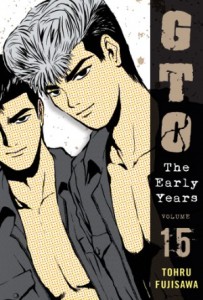
When I reviewed Vol. 14, I noted that I wasn’t sure if the cliffhanger reveal would be played for comedy or drama. Very cleverly, this is actually used in-story – Shinomi, in a fit or misplaced jealousy, is ready to mock Eikichi mercilessly, only to suddenly find that he’s far more affected by everything than she had anticipated. In fact, things get so bad so fast that she desperately confesses to him – which he seems to pretend not to hear, something that he’s very good at indeed. (Note that in GTO 14 Years he’s *still* pretending not to hear Shinomi at times…) After a heart to heart and a good cry with an old mentor, Shinomi decides to go all out and give herself body and soul to Eikichi. This ends up going horribly wrong in the best GTO tradition, and in the funniest scene of the entire book. I had always been a fan of Onizuka getting together with Azusa, given I read GTO first, but Shinomi is making me waver a bit. She’s a perfect complement to his idiocy.

Nagisa, meanwhile, is having troubles of her own. Mostly that Ryuji is using their dates to have sex with her and not much else. And the sex isn’t bad, but Nagisa is a romantic. So when a guy at a nearby high school confesses to her, she’s depressed enough to actually go out with him. Again, Ryuji has always been slightly (but only slightly) more mature than Eikichi, so it would make sense that his own complement is the same. As we see later in the book, she’s trying to study and get into college so she can become a therapist and deal with… well, people like herself. (It’s likely been long forgotten, but Nagisa has disassociative identity disorder). Getting Ryuji to realize that she’s not just there for him to stick it in is tough. Luckily, she’s still completely devoted to him, and it all works out.

And so we get to the final battles. There’s a group of new freshman entering high school, all of whom have heard about the famous exploits of the Oni-Baku Duo, and all of whom are now ready to pledge their lives to them and take over all of Shonan. This is somewhat disquieting to our heroes, who while they always unquestioningly defend their friends, and certainly enjoy being in a gang, fighting, and driving around on bikes, have never really had the ambition to take over the city. Or indeed do much at all. Ryuji sees his girlfriend’s fierce study and is blown away – he’s starting to wonder what to do with his life once he graduates. Onizuka is not quite at that stage (indeed, it will take until the start of GTO to push him there), but the two definitely realize they don’t want to be gang leaders the rest of their days, and something needs to be done.

As ever in the GTO series, events spiral out of control into complete madness, and talking everyone down is no longer an option. So the two of them decide to pull off an elaborate final fight (between each other, of course), and leave this world once and for all. Now clearly we’re not buying what they’re doing – we’ve seen GTO, after all, which shows them both as adults – but I think even readers seeing this back in 1996 knew this was all an elaborate put-on. And sure enough, it’s not even 15 pages before the reveal. Those 15 pages, though, are styled like a documentary/remembrance, with reactions ranging from anger to disbelief to genuine grief (Shinomi and Nagisa).

GTO and its prequels/sequels ran in Weekly Magazine rather than Weekly Jump, and the audiences are fundamentally different. But in the end, you can’t deny that GTO: The Early Years brings you some of the best in shonen ideals. Kids having fun, getting into goofy antics, and trying to get laid are contrasted with holding on to your dreams, always being there for your friends, and enjoying your youth while trying not to destroy it. Eikichi and Ryuji have walked a fine line between those ideals at times, but in the end have shown the main way to accomplish these ideals: a good heart. (And also possibly being a badass biker with ungodly stamina.)

Filed Under: REVIEWS

Manga Bestsellers: 2012, Week Ending 14 October

October 21, 2012 by Matt Blind Leave a Comment

Comparative Rankings Based on Consolidated Online Sales

last week’s charts
about the charts

##

Manga Bestsellers

1. ↔0 (1) : Sailor Moon 3 – Kodansha Comics, Jan 2012 [379.1] ::
2. ↔0 (2) : Yotsuba&! 11 – Yen Press, Sep 2012 [376.0] ::
3. ↔0 (3) : Sailor Moon 1 – Kodansha Comics, Sep 2011 [357.0] ::
4. ↑1 (5) : Sailor Moon 4 – Kodansha Comics, Mar 2012 [350.1] ::
5. ↓-1 (4) : Naruto 58 – Viz Shonen Jump, Sep 2012 [346.1] ::
6. ↔0 (6) : Sailor Moon 2 – Kodansha Comics, Nov 2011 [344.9] ::
7. ↔0 (7) : Death Note vols 1-13 box set – Viz Shonen Jump Advanced, Oct 2008 [303.6] ::
8. ↔0 (8) : Sailor Moon 7 – Kodansha Comics, Sep 2012 [299.6] ::
9. ↔0 (9) : Sailor Moon 8 – Kodansha Comics, Nov 2012 [284.2] ::
10. ↑1 (11) : Sailor Moon 6 – Kodansha Comics, Jun 2012 [267.4] ::

[more]

Top Imprints
Number of volumes ranking in the Top 500:

Yen Press 86
Viz Shonen Jump 77
Viz Shojo Beat 60
Kodansha Comics 44
Viz Shonen Jump Advanced 36
DMP Juné 27
Dark Horse 23
Vertical 21
Seven Seas 20
Viz 13

[more]

Series/Property

1. ↔0 (1) : Sailor Moon – Kodansha Comics [1,019.3] ::
2. ↔0 (2) : Naruto – Viz Shonen Jump [764.2] ::
3. ↔0 (3) : Bleach – Viz Shonen Jump [637.4] ::
4. ↔0 (4) : Maximum Ride – Yen Press [446.6] ::
5. ↔0 (5) : Alice in the Country of Clover – Seven Seas [428.6] ::
6. ↔0 (6) : One Piece – Viz Shonen Jump [419.1] ::
7. ↑1 (8) : Negima! – Del Rey/Kodansha Comics [414.0] ::
8. ↓-1 (7) : Death Note – Viz Shonen Jump Advanced [413.2] ::
9. ↔0 (9) : Yotsuba&! – Yen Press [398.4] ::
10. ↔0 (10) : Avatar: The Last Airbender – [multiple publishers] [355.9] ::

[more]

New Releases
(Titles releasing/released This Month & Last)

2. ↔0 (2) : Yotsuba&! 11 – Yen Press, Sep 2012 [376.0] ::
5. ↓-1 (4) : Naruto 58 – Viz Shonen Jump, Sep 2012 [346.1] ::
8. ↔0 (8) : Sailor Moon 7 – Kodansha Comics, Sep 2012 [299.6] ::
11. ↓-1 (10) : Alice in the Country of Clover Cheshire Cat Waltz 2 – Seven Seas, Sep 2012 [259.2] ::
12. ↔0 (12) : Bleach 46 – Viz Shonen Jump, Sep 2012 [243.1] ::
14. ↔0 (14) : Loveless 9 – Viz, Sep 2012 [242.0] ::
15. ↓-2 (13) : Bleach 47 – Viz Shonen Jump, Sep 2012 [239.6] ::
19. ↓-4 (15) : One Piece 64 – Viz Shonen Jump, Sep 2012 [229.4] ::
20. ↑3 (23) : Cardcaptor Sakura Omnibus 4 – Dark Horse, Oct 2012 [219.7] ::
23. ↑11 (34) : Bleach 48 – Viz Shonen Jump, Oct 2012 [200.9] ::

[more]

Preorders

9. ↔0 (9) : Sailor Moon 8 – Kodansha Comics, Nov 2012 [284.2] ::
17. ↑2 (19) : Sailor Moon 9 – Kodansha Comics, Jan 2013 [234.3] ::
18. ↓-1 (17) : Sailor Moon 10 – Kodansha Comics, Mar 2013 [232.4] ::
45. ↑6 (51) : Naruto 59 – Viz Shonen Jump, Nov 2012 [149.8] ::
51. ↑2 (53) : Nausicaa of the Valley of the Wind 2 vol hardcover box set [complete] – Viz Ghibli Library, Nov 2012 [141.0] ::
72. ↑8 (80) : Negima! 37 – Kodansha Comics, Jan 2013 [113.7] ::
75. ↓-1 (74) : Omamori Himari 9 – Yen Press, Nov 2012 [112.8] ::
91. ↑28 (119) : Ouran High School Host Club vols 1-18 box set – Viz Shojo Beat, Nov 2012 [98.3] ::
102. ↑23 (125) : Vampire Knight 15 – Viz Shojo Beat, Nov 2012 [95.5] ::
105. ↑5 (110) : Battle Angel Alita Last Order 16 – Kodansha Comics, Dec 2012 [94.5] ::

[more]

Manhwa

569. ↓-19 (550) : Bride of the Water God 10 – Dark Horse, Jan 2012 [17.1] ::
757. ↑10 (767) : Time & Again 6 – Yen Press, Jul 2011 [9.4] ::
766. ↑14 (780) : Bride of the Water God 11 – Dark Horse, May 2012 [9.2] ::
768. ↑197 (965) : Color Trilogy 1 The Color of Earth – Macmillan First Second, Apr 2009 [9.1] ::
792. ↑121 (913) : One Thousand & One Nights 8 – Yen Press, Aug 2009 [8.3] ::
842. ↓-50 (792) : Time & Again 3 – Yen Press, Jul 2010 [7.4] ::
843. ↑1 (844) : Time & Again 2 – Yen Press, Mar 2010 [7.4] ::
898. ↓-24 (874) : Time & Again 5 – Yen Press, Mar 2011 [6.1] ::
911. ↓-28 (883) : Time & Again 1 – Yen Press, Dec 2009 [5.9] ::
1027. ↑412 (1439) : March Story 4 – Viz Signature, Oct 2012 [4.1] ::

[more]

BL/Yaoi

14. ↔0 (14) : Loveless 9 – Viz, Sep 2012 [242.0] ::
32. ↓-3 (29) : Finder Series 6 Passion within the View Finder – DMP Juné, Jul 2012 [177.0] ::
80. ↑1 (81) : Secret Thorns – DMP Juné, Oct 2012 [105.6] ::
90. ↑51 (141) : The Tyrant Falls in Love 7 – DMP Juné, Sep 2012 [99.2] ::
120. ↑95 (215) : Samejima-Kun & Sasahara-Kun – DMP Juné, May 2012 [86.9] ::
184. ↑18 (202) : Only the Ring Finger Knows (novel) 5 – DMP Juné, Sep 2012 [63.0] ::
194. ↑17 (211) : Sleepless Nights – DMP Juné, Jan 2013 [60.4] ::
195. ↑68 (263) : The Man I Picked Up – DMP Juné, Aug 2012 [60.3] ::
225. ↑3 (228) : Honey*Smile – DMP Juné, Oct 2012 [54.2] ::
226. ↓-12 (214) : His Arrogance – 801 Media, Dec 2008 [53.8] ::

[more]

Ebooks

13. ↑3 (16) : Naruto 57 – Viz Shonen Jump, Jul 2012 [242.1] ::
21. ↓-1 (20) : Maximum Ride 1 – Yen Press, Jan 2009 [217.2] ::
30. ↓-4 (26) : Maximum Ride 5 – Yen Press, Dec 2011 [180.2] ::
36. ↔0 (36) : Naruto 56 – Viz Shonen Jump, May 2012 [172.6] ::
55. ↓-1 (54) : Naruto 55 – Viz Shonen Jump, Mar 2012 [129.6] ::
60. ↓-2 (58) : Maximum Ride 2 – Yen Press, Oct 2009 [125.8] ::
66. ↓-1 (65) : Maximum Ride 4 – Yen Press, Apr 2011 [119.3] ::
70. ↑9 (79) : Maximum Ride 3 – Yen Press, Aug 2010 [117.9] ::
77. ↑10 (87) : Blue Exorcist 1 – Viz Shonen Jump Advanced, Apr 2011 [109.1] ::
109. ↓-8 (101) : Naruto 52 – Viz Shonen Jump, Jul 2011 [92.2] ::

[more]

Filed Under: Manga Bestsellers Tagged With: Manga Bestsellers

Off the Shelf: King of RPGs, Genbu Kaiden, Pride

October 20, 2012 by MJ and Michelle Smith 2 Comments

MICHELLE: Hey, MJ! Did you hear about the fire at the circus?

MJ: Why no, Michelle. Why don’t you tell me about it?

MICHELLE: It was in tents!

MJ: Ba-dum dum *chick*.

MICHELLE: I concede that there is a distinct possibility that nobody enjoys these dumb jokes but me, but I can’t seem to resist trotting them out whenever it’s my turn to start us off. Anyhoo, read any good manga lately?

MJ: I certainly have! It’s been a long time coming, but I finally acquired myself a copy of the second volume of Jason Thompson and Victor Hao’s OEL manga series King of RPGs, released over a year ago by the much-missed Del Rey. I enthusiastically reviewed volume one many moons ago for Deb Aoki at About.com, but I’d missed continuing on. And now that I have, I’m sorry that it took me so long!

After volume one’s over-the-top, madcap, shounen-esque conclusion, the series’ second volume begins in relatively grounded territory as it introduces us to the online universe of “World of Warcraft Warfare,” the MMORPG that originally drove the story’s hero, Shesh, to hospitalization and extensive psychotherapy. WOW servers have been overrun by “gold farmers”—players who collect in-game valuables (currency, magical items, high-level characters, etc.) and sell them for real-world cash. As rival guild members battle and kill each other (rather than their AI enemies) over these valuables, the name “Moggrathka,” Shesh’s long-abandoned character, lives on in legend as the most-feared and respected player-killer of all time. Soon after, we’re reintroduced to Rona Orzak, volume one’s misguided, gamer-hating student policewoman, who inadvertently reawakens Shesh’s in-game alter-ego by way of her own WOW account, thus unleashing the player-killing monster into both the real and virtual worlds. Of course, in King of RPGs, only tabletop gaming can save the day!

This series has a lot going for it, particularly for gamers and shounen manga fans who are pretty much equally serviced by its generously applied fan culture references, character-driven narrative, and fast-paced adventure. But its greatest appeal by far is Jason Thompson’s spot-on humor, which somehow manages to make a bunch of potentially alienating in-jokes accessible to casual readers without mocking hard-core fans. I can only attribute this to Thompson’s obvious love for the subject matter, and its effectiveness really can’t be overstated. If there’s a consistent vibe that tends to emanate from real nerd culture, it’s a weird combination of passionate fandom and deep resentment over any attempt to bring newcomers into the fold—as if the conversion of each new fan somehow reduces the value of the fandom itself. But Thompson actively invites readers into the world of tabletop RPGs (and, more stealthily, shounen manga) with a real warmth and generosity that makes you want to join him at the table. That, more than anything, makes the series a great read. And the hilarity… oh, the hilarity!

I should mention, too, Hao’s artwork, which has really grown since the series’ beginning. Volume two’s visual storytelling is just as energetic as ever, but feels cleaner and vastly more focused, especially in later chapters.

MICHELLE: You know, I have volume one on my shelf, but never got around to reading it. It seems like I should rectify that. Has there been any word on the fate of this series now that Del Rey is no more?

MJ: Nothing official that I’m aware of (though I believe the authors are hopeful!), but Jason Thompson’s webcomic “expansion” has been running on the series’ website since February, so there’s something to tide us over, at least. Also, gamers will enjoy the fake blog of Theodore Dudek, King of RPGs‘ overenthusiastic GM.

So, now that I’ve sufficiently nerded-out, what have you been reading this week?

MICHELLE: I have been enjoying a marathon catch-up read of Fushigi Yûgi: Genbu Kaiden, by Yuu Watase!

The anime of the original Fushigi Yûgi was one of the first shoujo anime I ever saw, and the story remains dear to my heart, even though I am fully cognizant of its flaws. When Genbu Kaiden started coming out in English, I collected it faithfully, but somehow never ended up reading it. Now that the much-anticipated tenth volume has finally been published (almost three years after volume nine), I made it my priority to get caught up.

And what a delightful read it has been! Watase sure has matured a lot as a storyteller in the intervening years, crafting a story that’s similar enough to the original to appeal to long-time fans, but fully its own creation capable of attracting new readers. Genbu Priestess Takiko Okuda is a much more likable heroine than the original’s Miaka, and the primary romance here is one that leaves me more touched than annoyed. I was actually expecting to like Tomite and Hikitsu the best (especially Hikitsu), since they appeared in the original story (and since Hikitsu is very pretty), but my favorite characters have actually turned out to be the Celestial warriors appearing here for the first time. I’m surprised by how much I like Uruki (Takiko’s love interest), but my favorite is probably Namame, the mute (only Takiko can hear his voice) but ever-helpful warrior who spends most of his time in the form of a stone doll.

In volume ten, the Celestial warriors have infiltrated the capital, where one of their number is being imprisoned and made to use his powers for the protection of the power-hungry emperor. Some nifty revelations ensue, including a tour through the memories of Uruki’s corrupt dad, but by far the most significant aspect of the story is that Takiko has begun to show signs of the same illness that claimed her mother’s life, but is trying to hide it from the others. She knows now that she will be compelled to sacrifice herself if she summons Genbu, but since her death seems imminent anyway, it might as well serve the purpose of saving people who are dying from war, cold, and starvation.

Although there are a few lighthearted moments—as well as a smattering of romantic ones—on the whole, this is a much more sober tale than the original and definitely its equal, if not its superior. I’m exceedingly glad to see volume eleven on the near horizon (March 2013) and hope that one day Watase is able to pen the Byakko saga, as well!

MJ: I’m so glad you’ve caught up on this series, because now we can share the squee! Having (still!) not read the original—something I’ll rectify soon—I don’t have the same reference for comparison, but I’ve enjoyed Genbu Kaiden immensely. I’ve also been surprised by how much I like Uruki, and I thought his romance with Takiko was one of the highlights of volume ten. And could Namame possibly be more adorable? I don’t think so!

MICHELLE: I am starting to think you may want to avoid the original until Genbu concludes, because it does give away the ending, though I am sure Watase has some surprises in store on that account.

Anyway! Once again, we have both read the debut volume(s) of a newly released series, which is something we enjoy doing and something we intend to do more of in future! Care to tackle the introductory duties this time, MJ?

MJ: I’d be happy to!

So, this week’s mutual read comes from online publisher JManga, whose wealth of recent acquisitions includes Yukari Ichijo’s josei series Pride, originally from Shueisha’s Chorus magazine.

Pride follows the stories of two aspiring classical singers—Shio Asami, whose upscale musical education is abruptly halted by a sudden downturn in her widower father’s fortunes, and Moe Midorikawa, whose lower-class background has made entering the elitist world of opera an uphill battle from nearly every angle. Though the series’ plotline mainly concerns their mutual struggle to keep singing while maintaining day-to-day survival (along with the obligatory rivalries, both professional and romantic), the real meat of it all lies in the ways that their disparate backgrounds have formed their personalities and how that affects the way they approach their respective lives and careers.

Shio’s respectable upbringing and musical pedigree (her late mother was an international opera star) have burdened her with a sense of pride that is ultimately unhelpful when she requires assistance from others, and her well-schooled refinement hinders her ability to perform with any real emotional resonance. Meanwhile, Moe’s natural expressiveness as a singer is not quite enough to make up for inferior training, and her desperate personal circumstances have made her absolutely ruthless (and fairly ungraceful) in her quest for career success.

What works particularly well about all this is that Ichijo manages to make both characters pretty much equal parts sympathetic and maddening. And while Shio ends up tipping the scale in likability, it’s impossible not to sympathize with Moe’s deep need to escape from her truly icky origins. By the end of volume two, I found myself rooting for both of them, despite their genuinely ugly rivalry.

How about you?

MICHELLE: Kudos on that summary! I loved Pride almost without reservation. Let’s see if I can count the ways…

I love that Shio doesn’t follow the “poor little rich girl” stereotype. She and her father have a genuinely loving relationship, and though the fact that she’s been protected from pain and hardship all her life later becomes a weakness, it’s still this relationship that gives her the strength to persevere. As a musician, I really identify with Shio’s struggles with expressiveness and the realization that perfection is sometimes boring. I was especially interested when she abandons the fantasy of herself as a singing princess and really begins to recognize the reality of her situation. I worry that marrying Jinno, the producer, will allow her an only temporary return to that sparkling world, only to be followed my massive despair. (I worry for her marrying him much like I worried about Hachi marrying Takumi in NANA, actually.)
Too, I love that the rivalry between Shio and Moe is so very equal. They’ve each got skills the other doesn’t possess, which makes them the perfect mate/muse for the guy that the other girl fancies, and it all builds so organically. True, I can’t really like Moe very much, but I absolutely sympathize with her. About the only aspect of Pride that I didn’t love were the scenes involving Moe’s incredibly horrible mother, but I acknowledge they were necessary and am grateful that Ichijo kept them fairly brief.

Although each woman is dealt some awful blows, each also has a few lucky breaks, too, so everything balances out.

MJ: Well said, Michelle, on all counts!

I’ll add, I guess, that though I share your reservations about Shio marrying Jinno, at least she’s going in with her eyes open, unlike Hachi did in NANA. Shio’s not remotely in love with Jinno and has no illusions about him being in love with her, so while I think she’s ultimately in for a very unhappy marriage, at least she’s not fooling herself into thinking it’s a real marriage to begin with. In a way, that’s what makes it such a powerful plot point. She’s prepared for it to be disappointing, romantically, but I suspect it’s going to disappoint and hurt her in other ways that she’s not anticipating at all. And I’m sure it’ll make for great drama in future volumes!

MICHELLE: I’m sure it will! All in all, this is just a great depiction of how just plain old life can get in the way of one’s dreams, and how two women still have enough fight left in them to keep trying to attain what they want, rather than just giving up.

Thank you so much, JManga, for introducing us to Pride! Please, sirs, can we have some more?

MJ: Yes, yes, more!

Filed Under: OFF THE SHELF Tagged With: del rey, fushigi yugi genbu kaiden, JManga, king of rpgs, pride, VIZ

The Best Manga You’re Not Reading: Mail

October 20, 2012 by Katherine Dacey

Have spirit gun, will travel — that’s the basic plot of Mail, a three-volume collection of ghost stories penned by Kurosagi Corpse Delivery Service illustrator Housui Yamazaki. Like Kurosagi, Mail follows a spook-of-the-week formula, pausing occasionally to fill us in on the personal life of its chief exorcist, Detective Reiji Akiba. Akiba initially presents as a Columbo-esque figure, disarming clients with his rumpled coat and penchant for napping on the job, but his true nature is soon revealed in the first story: he’s handy with Kagutsuchi, his trusty pistol, and unflappable in the presence of the undead.

As we learn over the course of the series, Akiba was born blind. Medicine restored his sight, but with a side effect: he began seeing dead people. After years of living in fear of ghosts, Akiba learned to perform exorcisms with Kagutsuchi, a skill he parlayed into a career as a modern-day onmyoji.

If Akiba’s strategies for assisting his clients are decidedly hi-tech — websites, cellphones, GPS devices, bullets — the stories have a pleasantly old-fashioned quality to them. Some are morality plays; in “The Doll,” for example, a toy becomes the vessel for a hit-and-run victim to bring her killer to justice. Others read more like good campfire tales; in “Suppressed,” for example, a young woman begins receiving mysterious calls from a “friend” who’s en route to her home, the last of which appear to be originating from inside her apartment. Still others draw on urban legend for inspiration; “Ka-tsu-mi,” the fifth chapter in the series, focuses on a girl who dies after accidentally photographing a ghost.

I’d be the first to admit that Yamazaki is not a master of suspense. Though Mail is filled with suitably gruesome imagery and creative variations on oft-told ghost stories, the reader is never in doubt about Akiba’s ability to save his clients. The endings have a sameness that becomes more apparent when reading them back-to-back, as Akiba’s only method for banishing the undead is to fire Kagutsuchi. And while Akiba demonstrates remarkable sangfroid when confronting murdered babies, vengeful lovers, and drowning victims, his undeniable coolness doesn’t quite compensate for the predictability of the denounements.

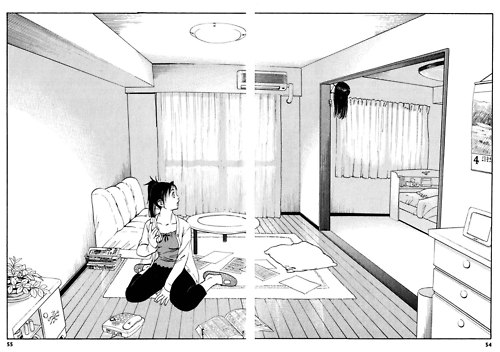
What Mail lacks in suspense it makes up in atmosphere. Yamazaki shows considerable flair for turning ordinary urban environments into unbearably scary places, whether he’s depicting an empty public bathroom or a high-rise building. In one of Mail‘s best stories, for example, a woman receives a letter urging her to move out of her apartment right away. Shortly after reading the letter, she catches glimpse of something moving along the ceiling of the adjacent room:

Though we’re outside the picture plane, viewing the action from a different angle than the hapless apartment dweller, we don’t have any more information about what’s lurking in the other room than she does; Yamazaki is relying on the reader to guess what might be crawling along the ceiling by planting one suggestive detail.

The other thing that makes this image so unsettling is the very mundaneness of the setting. With its square rooms and bland furnishings, this scene could be unfolding in almost any Tokyo neighborhood, in almost any modern apartment complex. (Add a parquet floor, and it could just as easily be taking place in any postwar building in Manhattan.) More unsettling still is that this scene is taking place in broad daylight, not at night; whatever is haunting the apartment isn’t relying on the camouflage of darkness, but is sallying forth at a time of day when spirits are supposed to be hidden and, more importantly, impotent.

Not all of the stories take place in Tokyo; several unfold in the countryside. Mail is at its best in urban settings, however, as the very nature of city living gives Yamazaki ample material to work with, whether he’s spinning a cautionary tale about the anonymity of modern life or simply reflecting on the myriad layers of history buried underneath new roadways and buildings. As a life-long city-dweller, I found stories such as “The Drive” — which takes place on an urban freeway — “The Elevator” — which takes place in a stalled elevator car — and “Hide-and-Seek” — which takes place in a haunted apartment — among the spookiest in the collection, as they tapped into a deep well of fear that all urban folk share: that cities harbor something even bigger and scarier than crime, high property taxes, or gridlock.

MAIL, VOLS. 1-3 • BY HOUSUI YAMAZAKI • DARK HORSE • RATING: OLDER TEEN/MATURE

Filed Under: Manga, Manga Critic, Recommended Reading, REVIEWS Tagged With: Dark Horse, Horror/Supernatural, Housui Yamazaki

Girl Friends The Complete Collection, Vol. 1

October 20, 2012 by Sean Gaffney

By Milk Morinaga. Released in Japan by Futabasha, serialized in the magazine Comic High!. Released in North America by Seven Seas.

I had reviewed the first digital volume of this series when JManga released it a while back, but it’s always worth revisiting things, especially in print. This omnibus contains the first half of the series, i.e. 2 1/2 volumes. It’s a chunky read, but I think that works to the book’s favor as it helps us really get to know the two heroines before we get to plunge into their new friendship and growing romance.

You’ll note the title is split into two words, and I think that’s for the best, as the author makes it a point to show us Mari and Akko bonding as friends for an entire volume before it really starts getting into the potential yuri romance. Given Mari’s shyness and insecurities, this helps keep things realistic. It also ups the stakes: Akko is Mari’s best friend, and while the romance may take all five volumes to really break out the friendship is close and endearing immediately. Mari is a sweet and sympathetic protagonist. and Akko is outgoing, impulsive and oblivious without it becoming too irritating, as many who read one-sided crushes know can happen easily.

But of course this is a yuri manga, and so Mari’s admiration of Akko soon turns into attraction to Akko. This can be tricky, as there’s a vague line between the sort of close ‘skinship’ friendships that aren’t necessarily sexual, and those what do turn into blooming relationships. Indeed, Akko’s reaction on hearing that Mari kissed her while she was sleeping is ‘oh, girls do that *all the time*’. Of course, when Mari is a little more drunk and a lot more forceful, even Akko manages to notice what’s going on.

These are teenagers, so there’s a lot of puzzlement and ‘is this what love is really like?’ on both sides, as well as yuri’s addition of ‘it will never work out because we are both girls’. Akko has a presumed sexual past with a guy (though we quickly learn that nothing happened, of course – this did run in a seinen magazine) which adds to Mari’s dread that all she’s doing is making herself miserable for something that can’t happen. So she turns to a guy from middle school who happens to like her – and manages to get Akko jealous, though she’s not quite sure why…

This is meant to feel like a fluffy shoujo soap opera, just with two girls as the lead, and that’s mostly what it does. There are also two best friends who are also very touchy-feely with each other but clearly aren’t going to be a couple, which is a relief in a genre that sometimes has everyone pairing off with everyone else. Seven Seas’ omnibus obscures the well-times endings of the first two books (Mari thinking she kissed Akko for Vol. 1, Akko boggling at Kiss #2 in Vol. 2), but that works out fine as it gives the omnibus volume a better cliffhanger, as Mari reveals she went all the way with her new boyfriend. (Does anyone really believe her? Well, except for Akko…)

This isn’t a lights out of compulsively addictive series. But it’s fun, wtih likeable characters and as realistic a yuri romance as you’re going to get in something that’s basically “Story A”, written with little consequence besides ALL THESE FEELINGS… IN MY HEART. I hope the second volume resolves said tortured feelings.

Filed Under: REVIEWS

It Came from the Sinosphere: The Love Eterne

October 18, 2012 by Sara K. 7 Comments

Example Scene

Liang Shanbo is on his merry way to see his sweetheart, with cheerful music playing in the background.

And this all gets interrupted by a parade, with an abrupt switch to solemn, almost mournful music. I can’t say exactly say that it rained on his parade … maybe the parade rained on him?

Liang Shanbo wonders what is going on.

And we have a shot hear of a bird singing in a cage. On the right we see a character which is often used ceremonially to represent auspiciousness, but the way it seems battered up doesn’t look so auspicious!

This brief segment succinctly sums up the film, at least emotionally.

I also suggest watching the 1-minute trailer before continuing reading this post.

About the Shaw Brothers and Huangmei Opera

I had previously discussed one of the Shaw Brothers’ kung-fu classics, The 36th Chamber of Shaolin.

Even though the Shaw Brothers’ Studio is best known outside of Asia for its kung-fu flicks, they also made their share of musicals (which doesn’t surprise me, since I think their kung-fu flicks are a lot like musicals). Some of these films were based on traditional Chinese opera, some of these films had musical numbers which would not have been completely out of place in a 1950s Hollywood film, and then there is Disco Bumpkins.

Talking about “Chinese opera” is like talking about “European opera.” Both Giuseppe Verdi and Richard Wagner wrote 19th century “European operas,” but they did not exactly belong to the same tradition. Well, just as there are differences between Italian and German opera, there are also differences between Cantonese opera and Beijing opera.

There is dispute about how the Huangmei opera arose, but a) most sources claim that it originated in the rural regions of China’s Anhui province and b) somehow, it became heavily influenced by Taiwanese folk songs. Since it emerged from rural folk culture, it’s not considered a “true” Chinese opera genre, and Huangmei opera singers were considered less professional than “true” Chinese opera singers. Unlike “true” Chinese opera, Huangmei opera is less stylized, the lyrics are easier to understand, and it’s generally much more accessible.

When common people got access to film and radio, did the Huangmei opera shrivel up as a popular form of entertainment? No! Instead, it joined the party—for about 10 years Huangmei opera films were extremely popular in Taiwna and Hong Kong.

This particular film, The Love Eterne, is the most popular Huangmei opera film ever. It was especially popular in Taiwan. When I say popular, I mean that over 90% of the population of Taipei saw it during it’s first run in theaters, and that there were many reports of fans (mostly female) watching the film over 50 times.

The Story

This film is based on a Chinese folktale, “The Butterfly Lovers,” which is sometimes referred to as the Chinese equivalent of “Romeo and Juliet.” It has inspired many works of art. If you don’t know the story, the internet can fill you in (quick version: two young people fall in love with each other, but they can’t marry each other, so they die).

Prettiness

This is such a pretty film. It makes me feel like a little kid, wanting to point out “hey, look at that” throughout.

First of all, the hats and the hairstyles. They make me squee.

Also, I totally dig the classic Chinese-style furniture and sets throughout the film. Actually, looking at these screenshots, it dawns on me how many of them look like paintings. I guess the director’s training at the Beijing Art Institute shows.

And finally, I adore the use of scenery in this film.

Whee!

That Gender Thing

In 1960s Hong Kong, homosexuality was a major taboo, and no mainstream film could delve into it (actually, I think even non-mainstream films wouldn’t have been to go there).

So of course this film is totally het, right? Well … nominally.

First of all, Zhu Yingtai is a “Sweet Polly Oliver,” since she wants to be a scholar but only boys are allowed to get scholarly training. But this is so common in creative works that this by itself not remarkable.

Then, this film is an example of “Sweet on Polly Oliver,” what with Liang Shanbo falling for Zhu Yingtai before he knows her true gender. This can of course be interpreted as boys’ love in a way. But even this is not particularly special.

However, the film takes this gender business to another level by casting an actress, Ivy Ling Po, to play Liang Shanbo, the charming male lead.

So, there is a character, played by an actress, who is a woman disguised as a man, and she falls in love with a man, who is also being played by an actress.

Though I don’t think it was intentional, there is definitely a case to be made for lesbian subtext when you have two characters performed by women professing their romantic love for each other.

While I think looking at this as boys’ love or as containing lesbian subtext are both valid interpretations, I prefer to see this film as depicting gender as irrelevant. These two characters are so in love with each other that their gender does not actually matter. Likewise, it isn’t a problem that Ivy Ling Po doesn’t have the same gender as her character since she does such a splendid job.

I think this is part of the reason why this film (and similar things, such as the Takarazuka review) have so many devoted fans—this invites people to shed the tyranny of gender roles and express themselves freely.

Speaking of the actresses…

The Stars

This is the film which propelled Ling Po, one of the most celebrated Chinese movie actresses ever, into stardom. It was also, as far as I know, her first male role. Due to the popularity of this performance, she was repeatedly cast in male roles in later films, and also starred in the Shaw Brothers version of Mulan.

Having seen this film, I have a clue why she is so beloved. It was very touching to see Liang Shanbo’s reaction to the revelation that Zhu Yingtai is female and wants to marry him. And the most moving scene of all in this film for me was this scene between Liang Shanbo and his mother, and I would give Ivy Ling Po 50% of the credit for this (I would divide the other 50% of the credit between the director and the music composer). More than anything else, Ivy Ling Po convinced me that she was deeply, deeply in love with Zhu Yingtai.

No wonder so many women became fans of this “Brother Liang.”

Now I am going to have to see more Ivy Ling Po films.

Betty Loh Ti as Zhu Yingtai

By focusing so much on Ivy Ling Po, I don’t mean to slight Betty Loh Ti. She does a fine job performing Zhu Yingtai. Betty Loh Ti was already a star when this film was made, and in shows in the way that the film focuses more on Zhu Yingtai than Liang Shanbo. She was best known as a beauty, but she could also act. While I don’t think her performance had the heart-grabbing sincerity of Ivy Ling Po’s Liang Shanbo, I do appreciate the way she showed how Zhu Yingtai had to subtly balance dropping hints at Liang Shanbo and maintaining her disguise.

The Directing Style

I think the genius of the way Li Hanxiang directed this film is that HE WAS NOT SUBTLE. He put tons of obvious metaphors throughout the film (see the beginning of the post, with Liang Shanbo’s merriness cut off by a solemn parade). While Zhu Yingtai and Liang Shanbo are travelling together, having a merry time, there’s lots of calm, beautiful scenery in nice, relaxing sunlight. After Zhu Yingtai and Liang Shanbo have been driven apart, there’s lot of wind, sunset colors, and other not-so-subtle signs that the world has been broken.

Yet it never feels heavy-handed. The point is that it is supposed to feel grander than life, and putting in metaphor after metaphor just drives things deeper into the audiences psyches.

Availability in English

This film is available on DVD with English subtitles, but apparently only in region 3 (if you know of a legal, non-region 3 DVD with English subtitles, please comment). It is also available on Blu-ray (Region A)v with English subtitles.

Conclusion

To be honest, I’m not entirely sure what to make of this film. I had never seen any other film quite like it before. Now, I do plan to see more Huangmei opera films, which will probably help.

When I first saw this film, I was rather irritated that they didn’t even try to elope. Yeah, it would have been difficult, but surely it would have sucked less than dying, not to mention that we are dealing with a female protagonist who had the guts to trick her parents into letting her live as a man to study away from home for three years. I would have felt better if they had tried to elope, failed, and then died (at the same time, I know there are cultural reasons why this was less feasible in classical China than in, say, medieval Europe).

But when I saw the film a second time, I got over that irritating business, and was able to more fully enjoy the many wonderful things about this film. It truly is a classic.

Next time: The 8th Bronze Man of Shaolin (manhua)

Note: there will be a 1-week hiatus … the next post will appear on October 29th

***

Sara K. apologizes for the reduced reliability this month. She should have more free time in November. If you’re wondering why this post is late, it’s because she missed the last train and had to spend an extra night in Hualian (not that spending an extra night in Hualian is a bad thing). At least she did get to go on Taiwan’s ‘Vertigo Trail’.

Filed Under: It Came From the Sinosphere Tagged With: Betty Loh Ti, Butterfly Lovers, Chinese Film, Huangmei opera, Ivy Ling Po, Li Hanxiang, Mandarin Film, shaw brothers, The Love Eterne

Manga the Week of 10/24

October 17, 2012 by Sean Gaffney

After a third week that was honestly pretty puny, this week brings a more robust group of titles.

Dark Horse has a new Bride of the Water God, one of those manwha titles that always makes me wish I had more money so I could give them a try. it also has the 25th volume of Gantz, which makes me wish that the author’s earlier series, HEN, was licensed instead.

Kodansha Comics has Volume 8 of Bloody Monday, its action thriller conspiracy title that sadly doesn’t lend itself well to jokes or puns.

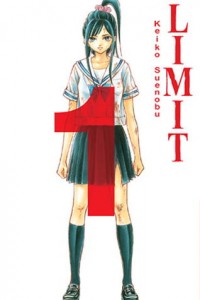
Vertical has its new shoujo series, Limit, from the author of Life (if anyone remembers the old days of Tokyopop). If you read Life you know what we get here. Only even more intense. HOT HOT BULLYING ACTION.

And there’s a pile of stuff from Yen. Black Butler hits Volume 11, but is no match for Black God, which is at Volume 17 (and just ended in Japan this August) (yes, it runs in Young Gangan, but the creators are Korean. Think March Story or Sun-Ken Rock). Nagato Yuki is still adorable and Ryoko is still not insane in the 2nd volume of Disappearance. Durarara!! hits the end of its first arc, but don’t worry: Yen already has the Saika arc lined up. Pandora Hearts hits a dozen volumes, and there’s also the debut of Infernal Devices: Clockwork Angel, a manga version of Cassandra Claire’s novel.

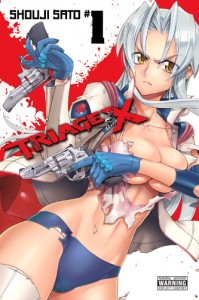
Lastly, there’s Triage X. Which runs in Dragon Age. And is by the artist who does High School of the Dead. The cover is presented here without comment.

So, what’s in your manga collection this week?

Filed Under: FEATURES, manga the week of

Manga Bestsellers: 2012, Week Ending 7 October

October 17, 2012 by Matt Blind 1 Comment

Comparative Rankings Based on Consolidated Online Sales

last week’s charts
about the charts

##

Manga Bestsellers

1. ↔0 (1) : Sailor Moon 3 – Kodansha Comics, Jan 2012 [372.2] ::
2. ↔0 (2) : Yotsuba&! 11 – Yen Press, Sep 2012 [358.2] ::
3. ↔0 (3) : Sailor Moon 1 – Kodansha Comics, Sep 2011 [346.9] ::
4. ↔0 (4) : Naruto 58 – Viz Shonen Jump, Sep 2012 [338.9] ::
5. ↑1 (6) : Sailor Moon 4 – Kodansha Comics, Mar 2012 [338.3] ::
6. ↓-1 (5) : Sailor Moon 2 – Kodansha Comics, Nov 2011 [336.3] ::
7. ↑1 (8) : Death Note vols 1-13 box set – Viz Shonen Jump Advanced, Oct 2008 [292.7] ::
8. ↓-1 (7) : Sailor Moon 7 – Kodansha Comics, Sep 2012 [290.7] ::
9. ↑5 (14) : Sailor Moon 8 – Kodansha Comics, Nov 2012 [271.6] ::
10. ↔0 (10) : Alice in the Country of Clover Cheshire Cat Waltz 2 – Seven Seas, Sep 2012 [262.9] ::

[more]

Top Imprints
Number of volumes ranking in the Top 500:

Yen Press 85
Viz Shonen Jump 78
Viz Shojo Beat 59
Kodansha Comics 43
Viz Shonen Jump Advanced 37
DMP Juné 23
Dark Horse 21
Vertical 21
Seven Seas 18
Viz 13

[more]

Series/Property

1. ↔0 (1) : Sailor Moon – Kodansha Comics [975.5] ::
2. ↔0 (2) : Naruto – Viz Shonen Jump [752.2] ::
3. ↔0 (3) : Bleach – Viz Shonen Jump [648.2] ::
4. ↑2 (6) : Maximum Ride – Yen Press [440.1] ::
5. ↓-1 (4) : Alice in the Country of Clover – Seven Seas [437.5] ::
6. ↓-1 (5) : One Piece – Viz Shonen Jump [429.6] ::
7. ↔0 (7) : Death Note – Viz Shonen Jump Advanced [403.8] ::
8. ↑1 (9) : Negima! – Del Rey/Kodansha Comics [391.3] ::
9. ↓-1 (8) : Yotsuba&! – Yen Press [381.8] ::
10. ↑1 (11) : Avatar: The Last Airbender – [multiple publishers] [346.7] ::

[more]

New Releases
(Titles releasing/released This Month & Last)

2. ↔0 (2) : Yotsuba&! 11 – Yen Press, Sep 2012 [358.2] ::
4. ↔0 (4) : Naruto 58 – Viz Shonen Jump, Sep 2012 [338.9] ::
8. ↓-1 (7) : Sailor Moon 7 – Kodansha Comics, Sep 2012 [290.7] ::
10. ↔0 (10) : Alice in the Country of Clover Cheshire Cat Waltz 2 – Seven Seas, Sep 2012 [262.9] ::
12. ↓-3 (9) : Bleach 46 – Viz Shonen Jump, Sep 2012 [253.7] ::
13. ↓-1 (12) : Bleach 47 – Viz Shonen Jump, Sep 2012 [247.9] ::
14. ↑4 (18) : Loveless 9 – Viz, Sep 2012 [244.4] ::
15. ↓-4 (11) : One Piece 64 – Viz Shonen Jump, Sep 2012 [243.5] ::
23. ↑8 (31) : Cardcaptor Sakura Omnibus 4 – Dark Horse, Oct 2012 [197.7] ::
30. ↑12 (42) : Negima! 36 – Kodansha Comics, Oct 2012 [170.4] ::

[more]

Preorders

9. ↑5 (14) : Sailor Moon 8 – Kodansha Comics, Nov 2012 [271.6] ::
17. ↔0 (17) : Sailor Moon 10 – Kodansha Comics, Mar 2013 [230.9] ::
19. ↔0 (19) : Sailor Moon 9 – Kodansha Comics, Jan 2013 [227.2] ::
51. ↑9 (60) : Naruto 59 – Viz Shonen Jump, Nov 2012 [134.4] ::
53. ↔0 (53) : Nausicaa of the Valley of the Wind 2 vol hardcover box set [complete] – Viz Ghibli Library, Nov 2012 [133.0] ::
74. ↔0 (74) : Omamori Himari 9 – Yen Press, Nov 2012 [106.6] ::
80. ↓-10 (70) : Negima! 37 – Kodansha Comics, Jan 2013 [102.3] ::
107. ↑12 (119) : Alice in the Country of Joker Circus & Liar’s Game 2 – Seven Seas, May 2013 [90.5] ::
110. ↑32 (142) : Battle Angel Alita Last Order 16 – Kodansha Comics, Dec 2012 [89.4] ::
111. ↑14 (125) : Alice in the Country of Joker Circus & Liar’s Game 1 – Seven Seas, Feb 2013 [88.9] ::

[more]

Manhwa

550. ↓-7 (543) : Bride of the Water God 10 – Dark Horse, Jan 2012 [16.5] ::
767. ↓-122 (645) : Time & Again 6 – Yen Press, Jul 2011 [8.6] ::
780. ↑8 (788) : Bride of the Water God 11 – Dark Horse, May 2012 [8.2] ::
792. ↓-130 (662) : Time & Again 3 – Yen Press, Jul 2010 [8.0] ::
844. ↓-194 (650) : Time & Again 2 – Yen Press, Mar 2010 [7.0] ::
874. ↓-123 (751) : Time & Again 5 – Yen Press, Mar 2011 [6.4] ::
883. ↓-89 (794) : Time & Again 1 – Yen Press, Dec 2009 [6.2] ::
913. ↓-105 (808) : One Thousand & One Nights 8 – Yen Press, Aug 2009 [5.7] ::
965. ↑540 (1505) : Color Trilogy 1 The Color of Earth – Macmillan First Second, Apr 2009 [4.7] ::
1068. ↓-57 (1011) : Arcana 4 – Tokyopop, Mar 2006 [3.5] ::

[more]

BL/Yaoi

14. ↑4 (18) : Loveless 9 – Viz, Sep 2012 [244.4] ::
29. ↑1 (30) : Finder Series 6 Passion within the View Finder – DMP Juné, Jul 2012 [173.4] ::
81. ↑86 (167) : Secret Thorns – DMP Juné, Oct 2012 [102.1] ::
141. ↑185 (326) : The Tyrant Falls in Love 7 – DMP Juné, Sep 2012 [74.7] ::
202. ↑72 (274) : Only the Ring Finger Knows (novel) 5 – DMP Juné, Sep 2012 [56.0] ::
211. ↑174 (385) : Sleepless Nights – DMP Juné, Jan 2013 [53.4] ::
214. ↓-19 (195) : His Arrogance – 801 Media, Dec 2008 [52.2] ::
215. ↑69 (284) : Samejima-Kun & Sasahara-Kun – DMP Juné, May 2012 [52.2] ::
228. ↑97 (325) : Honey*Smile – DMP Juné, Oct 2012 [50.8] ::
251. ↑6 (257) : Black Sun 1 – 801 Media, Nov 2008 [44.8] ::

[more]

Ebooks

16. ↔0 (16) : Naruto 57 – Viz Shonen Jump, Jul 2012 [241.7] ::
20. ↑2 (22) : Maximum Ride 1 – Yen Press, Jan 2009 [214.3] ::
26. ↔0 (26) : Maximum Ride 5 – Yen Press, Dec 2011 [180.2] ::
36. ↓-2 (34) : Naruto 56 – Viz Shonen Jump, May 2012 [164.2] ::
54. ↔0 (54) : Naruto 55 – Viz Shonen Jump, Mar 2012 [129.3] ::
58. ↓-3 (55) : Maximum Ride 2 – Yen Press, Oct 2009 [124.1] ::
65. ↑1 (66) : Maximum Ride 4 – Yen Press, Apr 2011 [117.7] ::
79. ↑14 (93) : Maximum Ride 3 – Yen Press, Aug 2010 [102.3] ::
87. ↓-4 (83) : Blue Exorcist 1 – Viz Shonen Jump Advanced, Apr 2011 [98.9] ::
101. ↑14 (115) : Naruto 52 – Viz Shonen Jump, Jul 2011 [91.8] ::

[more]

Filed Under: Manga Bestsellers Tagged With: Manga Bestsellers

A First Look at Cross Manage

October 13, 2012 by Katherine Dacey

For a series whose plot hinges on a mammary collision, Cross Manage is better than it has any right to be: it’s interesting, funny, and populated with appealing characters who rise above type. The collider and the collidee are, respectively, Sakurai, an aimless second-year student, and Misora, captain of the girls’ lacrosse team. Though Sakurai has joined and quit twelve clubs, he has yet to discover an activity at which he excels; he scoffs at the idea that anyone would play a sport or pursue a hobby simply for enjoyment. Misora is his diametric opposite, an enthusiast who can describe the history of lacrosse in voluminous detail, but can’t make a shot to save her life. When Sakurai accidentally grabs Misora’s chest during an impromptu coaching session, she offers him a choice: become the manager of the girls’ lacrosse team, or risk public humiliation.

Yikes! The “whoops-I-touched-your-boob!” gag is one of the most overused and least amusing “comic” bits in shonen manga, not least because it portrays boys as the victims of mammary collisions, rather than the other way around. I admit that my heart sank a little when I read that scene: surely Kaito could have found a more creative way to set the plot in motion, perhaps one that didn’t scream Love Hina: The Lacrosse Years. But I soldiered on for another chapter, and was pleasantly surprised to discover that Cross Manage wasn’t evolving into a panty-fest or a string of lecherous, Benny Hill-style gags, but an amusing character study of two charmingly screwed-up teens.

Anyone who’s read more than two shonen rom-coms will recognize Sakurai and Misora as familiar types, but artist/author Kaito has invested them with more personality than is called for by the genre. Misora, for example, is a classic Shonen Spaz Dream Girl, but she’s an interesting variation on the type; though she’s utterly incompetent at everything, she’s clearly knowledgeable about lacrosse. She freely admits that she’s terrible, but she doesn’t care because playing the game gives her a sense of accomplishment and purpose.

Sakurai embodies another classic type, the Cool Reader Surrogate. As portrayed in the first two chapters of Cross Manage, Sakurai is a natural at everything — photography, shogi, sports — even though he never practices. Sakurai is a sympathetic character nonetheless, one who’s both moved and puzzled by Misora’s dedication to a sport at which she… well, sucks. And while Misora has a lot to learn from Sakurai about how to handle the stick and pass the ball, Sakurai clearly has a lot to learn from Misora as well — not the least of which is how to enjoy doing things at which he’s not an expert. (Also how to comport himself around girls, of whom he has a deep, unnatural phobia that’s sure to be explained in a future chapter.)

As with many Shonen Jump titles, the artwork is crisp if not terribly distinctive; I’d have a hard time picking Sakurai and Misora out of a line-up of recent Jump characters, though both are memorable enough within the context of the story. Kaito has the artistic chops to populate Cross Manage with a diverse supporting cast — a key skill in a series that promises to have a bumper crop of comic relief characters. Though he hasn’t had many opportunities to showcase this skill just yet, a throwaway scene involving the “prince” of the shogi club hints at Kaito’s ability to establish personality through a few well-chosen details.

If Kaito can steer clear of excessive fanservice, and provide both Sakurai and Misora room for personal growth, I could see myself following Cross Manage; if not, it will join the large pile of shonen romantic comedies that I’ve abandoned after the fifth — or fifteenth — “misunderstanding” involving groping, nudity, or panties. Stay tuned.

CROSS MANAGE, CHAPTERS 1-2 • BY KAITO • VIZ MEDIA • CURRENTLY RUNNING IN WEEKLY SHONEN JUMP ALPHA

Filed Under: Manga, Manga Critic, REVIEWS Tagged With: Lacrosse, Shonen, Shonen Jump, Sports Manga, VIZ

Manga the Week of 10/17

October 10, 2012 by Sean Gaffney

If you thought last week was tiny, wait till you get a load of this week. Tiny tiny tiny. (I blame Yen for shipping a week later than usual.)

Kodansha has the 2nd omnibus of the popular shoujo title Kitchen Princess.

Speaking of omnibuses, Viz has the 9th Tenjo Tenge omnibus, showing that we’re getting near the end. And they also have Vol. 4 of March Story, which has a Korean creator but runs in a Japanese magazine, so is manga in my opinion.

That’s it. Not even enough to make bad jokes about. Anything?

Filed Under: FEATURES, manga the week of

Crazy For You, Vol. 1

October 10, 2012 by Sean Gaffney

By Karuho Shiina. Released in Japan by Shueisha, serialized in the magazine Bessatsu Margaret (“Betsuma”). Released in North America by JManga.

I will admit, JManga is very good at planning their surprises. I had thought the big news for NYCC would be the Kodansha rescues, where they picked up several old Del Rey series that sold poorly enough that Kodansha Comics didn’t want to continue them, and are going to finish them off on the JManga site. And that is indeed very awesome news. But they followed it up with new, unreleased in North America titles from another of the ‘untouchable’ publishers that everyone assumed was supporting JManga quietly without actually giving them anything. Shueisha has added two older shoujo titles that Viz presumably doesn’t have an interest in, and I couldn’t be happier. Especially as one of them is an earlier series from the author of Kimi ni Todoke.

The first 3/4 of this volume is, quite simply, warm fuzzy fluffy shoujo romance. The heroine is Sachi, who is bright, bubbly, and eager to experience life, whatever it may be. She’s naive to a fault, but otherwise is quite different from Sawako, Shiina’s other heroine. Her more down-to-earth friend Akemi is arranging a get together so Sachi and her other friends can meet some guys Akemi’s boyfriend knows (the curse of all-girl schools). While there, she sees Yuki, a somewhat passive yet handsome guy, and falls almost instantly in love. The problem is that Yuki has issues. Will she be able to get through to his true self and show him her feelings? And is she really ready for love herself?

Sachi is an interesting heroine, at once incredibly naive and yet aware of her own naivete. At times in this volume she sets herself up to be hurt, knowing that even if she does it will be a good life experience and make her a stronger person. She’s also able to see that Yuki is a deeply wounded young man, though she’s unable to see exactly what those wounds are. After he initially rejects her (we suspect as she’s not the sort of girl he can casually date and drop), they become friends, but Sachi is still trying to show how much she cares for him. There’s a very awkward yet warm tone to their conversations that KnT fans will find familiar.

So, we get a cute bubbly girl and a quiet guy whose mask hides his loneliness and true feelings. We also have the cute beta couple of Akemi and her boyfriend, and another guy, Akahoshi, who is another shoujo cliche, the guy who initially is annoyed by the girl’s ditziness, but starts to fall for her as he realizes she has a truly good heart. It’s all very cute but slight. But this is six volumes long, not one, and we realize that something has to go wrong. The last 15 pages or so are a total mood swing, turning violent and dramatic, and end with a brutal cliffhanger. I suspect Volume 2 will be a lot less happy and fluffy.

(I actually liked the way all the players came together. Kimi ni Todoke’s main romantic pairings all tend to happen in parallel to each other, with no intersections (except maybe Kent). This is a giant messy pile of friendships and relationships.)

I’ve said this before about other titles, but again, this is what I want to see JManga doing. A nice, solid shoujo title that other publishers aren’t going to bother with. It doesn’t quite hit the heights of Kimi ni Todoke (the art, in particular, is less elegant and more typical shoujo), but it has a likeable heroine and an addictive plot. I want to know what happens next. Good thing Vol. 2 is also out now.

Filed Under: REVIEWS

It Came From the Sinosphere: Spirit Sword

October 9, 2012 by Sara K. 12 Comments

The cover of the third volume of 'Spirit Sword'

I have previously discussed Zheng Feng’s first publishing success, Passionate Wastrel, Infatuated Hero. While that was her first published novel, this novel is actually the first novel she wrote, though after publishing Passionate Wastrel, Infatuated Hero she made major revisions to this one before publication. She said that, of the two, this novel was much more difficult to write, partially because she would often weep while revising it. I can believe it. In fact, she thinks she made Passionate Wastrel, Infatuated Hero so breezy to compensate for the solemness of this novel.

So, what is this novel about?

Story Overview

The martial arts world is being menaced by the ever-growing Fire Cult. So some people try to divine how to defeat the Fire Cult. They get a prophecy, which says that to extinguish the fire (as in the Fire Cult), the spirit sword must weep.

The story starts with a boy who has the power to read other people’s minds and to sometimes see the future (yep, psychic powers). Yet even though he can sometimes see the future, he doesn’t know about his own past – he has no memory of anything that happened to him before he was five years old, and knows nothing whatsoever about his parents. Furthermore, his body is covered with strange marks. He doesn’t even know his own family name – only his nickname, ‘Ming’er’.

Meanwhile, the Fire Cult is taking over the world with its kung fu, assisted by the psychic powers of its charismatic yet monomaniacal leader, Duan Dusheng. And for some reason, the Fire Cult is seeking out Ling Xiao, a former cult member who betrayed them. Yet Ming’er knows Ling Xiao’s father, Ling Manjiang and knows that he and Ling Xiao are about the same age … how could a little boy been a member of the cult, let alone do something so terrible that the cult would still be searching for him years later.

As it so happens, while Ming’er lives with Ling Manjiang, Ling Manjiang has a relationship with a woman, and she dies after giving birth to a daughter, Ling Yun. Ling Manjiang leaves, telling Ming’er to treat Ling Yun as his own sister.

Well, as a teenager, Ming’er finally figures it out … this ‘Ling Xiao’ boy is none other than himself. His mother was mad that Ling Manjiang was falling in love with another woman, so she left him and entered the Fire Cult. Duan Dusheng recognized Ling Xiao’s psychic powers, and decided to steal them. However, in order to make use of them, Duan Dusheng had to subject Ling Xiao to heavy-duty physical torture. His mother regretted bringing her son into the Fire Cult, so she made him drink a potion which made him lose all of his memories, sent him to a safe place. The cult punished her with torture and death. During the novel, Ling Xiao occasionally angsts over the fact that he doesn’t have a single memory of the mother who made such a sacrifice for him.

And of course, because he is in fact Ling Xiao, Ling Yun happens to be his biological half-sister.

This is only the beginning of course (this novel is over a thousand pages long), but I think this is enough to get the idea. Oh, and if you don’t know Chinese, you might want to know what the meaning of the prophecy is, right?

[MAJOR SPOILER WARNING]

At some point Duan Dusheng had loses his psychic powers, but he is still practically invincible because of a special kung-fu power. But to maintain this invicibility, he needs to regularly sexually assault young women. Most of these women die, and the ones who survive usually go mad. Now, if somebody interrupted the kung-fu ceremony, Duan Dusheng would temporarily lose his invincibility, but he’s not going to let anybody get close enough to do such a thing (well, except for his victim, since the victim has to be nearby for the ceremony to work, but trying to get into the ceremony this way is a suicidal mission).

So, during the course of the novel, Ling Xiao falls in love with a woman called Qin Yanlong, whose backstory is even more complicated than Ling Xiao’s. She has observed that, in spite of all of the suffering Ling Xiao has endured, he’s not a bitter guy at all, and it’s really difficult to make him angry. In fact, he doesn’t even hate Duan Dusheng. He is so used to being tormented that he thinks it’s normal … yet he won’t allow anyone he loves to suffer. The only time he ever wanted to kill anybody is when he thought that his beloved sister, Ling Yun, had been assaulted and tortured, and the only time he ever weeped was when he thought she herself (Qin Yanlong) was dead or dying.

Qin Yanlong eventually realizes that the ‘spirit sword’ mentioned in the prophecy is Ling Xiao himself. And she puts two and two together.

[END MAJOR SPOILER WARNING]

How it Works as a Prequel

So, since I had read Passionate Wastrel, Infatuated Hero first, I knew how things were going to end up in this story. That did not reduce the suspense. It might have actually increased the suspense, since I knew exactly how terrible things were going to get the for the main characters.

Yet there were many surprises. For example, when Qin Yanlong was first introduced as Cheng Da’s young male companion, my reaction was ‘WTH’, because a) in Passionate Wastrel, Infatuated Hero, Qin Yanlong is female and b) in Passionate Wastrel, Infatuated Hero, Qin Yanlong is paired with Ling Xiao, whereas Cheng Da is paired with Ji Huohe (to the extent you could call it a pair, since they were both had other partners).

And, as a fan of Passionate Wastrel, Infatuated Hero, I greatly enjoyed seeing the characters from that novel appear in this one, though I personally would have liked to have seen more of Ji Huohe (Zheng Feng says that she plans to write a novel about Cheng Da one day … I hope we might see more of Ji Huohe in that one). Learning more about their backgrounds, particularly Qin Yanlong’s background, was also a fannish delight.

Yet it is remarkable just how different this novel is from Passionate Wastrel, Infatuated Hero considering that many of the same characters appear in both. Whereas Passionate Wastrel, Infatuated Hero is fleet-footed and humorous (well, it’s can also pretty grim, but the grim parts tend to be brief), Spirit Sword is somber and tragic. And it was much harder to get into Sprit Sword. I was hooked on Passionate Wastrel, Infatuated Hero by page 10, but it took over a hundred pages for me to really get sucked into Sprit Sword.

And while Passionate Wastrel, Infatuated Hero is definitely more fun, Spirit Sword feels like a deeper experience. I cried a lot more while reading this novel. I think it’s because of the pain level. While Ling Haotian and Zhao Guan have to suffer quite a bit in Passionate Wastrel, Infatuated Hero, it’s not in the same league as what Ling Xiao and Qin Yanlong endure in Sprit Sword.

The fact that Zheng Feng has written two such different yet wonderful novels had only deepened my admiration for her.

The Intoxicating Atmosphere

It’s really hard to describe the feel of this novel. It’s … a lot like classic fairy tales, (the originals from Hans Christian Anderson, Brothers Grimm, etc … not the Disney versions). Those old fairy tales are often bizarre and, frankly, cruel when you take a cold look at them. Yet they form such striking impressions in one’s mind … blood red and snow white and all.

A lot of this novel like that. If you actually pause (like I did when I was trying to put in the description) you think ‘what the jianghu is that?!’ For example, while Ling Xiao is being tortured and slowly dying from the curse Duan Dusheng put on him, a woman comes into his dreams and relieves the symptoms of the curse, and Ling Xiao falls in love with her. That could come straight from a fairy-tale; a curse that kills slowly, and the mysterious dream woman who eases the pain. Or, for example, the time Qin Yanlong comes back bloodied up. It turns out that she had become friends with a tiger and her cubs, but when the tiger threatened Ling Yun, she ended up killing her friend (the tiger), getting heavily wounded herself, and begs Ling Xiao to take care of the orphaned cubs because she’s in no condition to raise them herself.

But life is like that. Or at least, a life worth living. Surprises happen. Great emotions get stirred by striking events. Whether it’s a 80 tall waterfall, or hearing that your great-aunt saw two of her children die, a full life is marked by punctures to mundane.

This novel is a bit like Please Save My Earth, and I’m not talking about the psychic powers. It sounds ridiculous when you summarize it, but makes total sense while actually experiencing it … and it just sucks you in with the complex character backgrounds and (often messed-up) interactions.

Availability in English

Ha ha ha ha ha.

Conclusion

I think you have all figured out by now that I love this novel. I’m now sad that there is currently only one un-read Zheng Feng novel left for me … but Zheng Feng is still an active writer, so I look forward to reading whatever she writes as long as her pen (or keyboard) keeps moving.

Next Time: The Love Eterne (movie)


Sara K. really did see an 80m high waterfall today. In fact, she saw a lot of waterfalls today. And rainbows. And mountains shrouded with clouds. And forest-blanked hills. And a clear, blue, cascading stream. And … you get the idea.

Filed Under: It Came From the Sinosphere Tagged With: Novel, spirit sword, wuxia, zheng feng

Bookshelf Briefs 10/8/12

October 8, 2012 by Michelle Smith, Sean Gaffney and MJ 1 Comment

This week, Michelle, MJ, and Sean look at recent releases from VIZ Media and Vertical, Inc.


The Drops of God: New World | By Tadashi Agi & Shu Okimoto | Vertical, Inc. – Rather than release a fifth volume of this series, which would’ve included volumes nine and ten of the original release, Vertical has jumped ahead to this New World arc (volumes 22 and 23 of the original), which focuses on wines from regions without a long-established winemaking tradition, particularly the US and Australia. It’s incredibly easy to jump back into the story even after a gap of over a dozen volumes, since so little changes with the characters., though Issei is a lot more prominent now and his hair has mysteriously gotten cuter. Highfalutin’ descriptions of wine still abound, and still make me roll my eyes with regularity, but there’s something captivating about this series that keeps me reading. Honestly, it’s more the sports manga-like themes of perseverence and presumed eventual triumph than the subject matter or the characters, but that’s enough for me. – Michelle Smith

The Flowers of Evil, Vol. 3 | By Shuzo Oshimi | Vertical, Inc. – There are a number of scenarios I might have imagined coming out of the rather stunning final pages of the second volume of The Flowers of Evil, but this series continues to be fresh and surprising in just about every way. Oshimi’s characters refuse to fall into neat categories, while still managing to ring true—in fact they feel truer with each page. Volume three is unexpectedly moving as Kasuga comes to the surprisingly insightful realization that putting his dream girl on a pedestal is not the same thing as loving her, and as all three of the series’ main characters are faced with truths they weren’t quite prepared for. If this series’ first volume read mainly as “better than Sundome” its third proves that it is really so much more. Highly recommended. – MJ

Jiu Jiu, Vol. 2 | By Touya Tobina | VIZ Media – After being so thoroughly unimpressed with the first volume of Jiu Jiu, I wasn’t expecting much from the second volume. Perhaps, then, my low expectations are the reason that I somehow now feel more kindly disposed towards the series, even though it’s still pretty generic and aimless and has weirdly proportioned art. I haven’t been moved to care more about Takamichi, Snow, and Night as characters, but I don’t hate the plot wherein the boys/dogs want to assert their independence, or that they’re prodded in this direction by Meru, a mischievous new character who spends part of his time in the form of a super-cute vampire pig. I hate to think a vampire pig is all it takes to sway me, but at least it’s something unique, which this series desperately needed. – Michelle Smith

Nura: Rise of the Yokai Clan, Vol. 11 | By Hiroshi Shiibashi | VIZ Media – In a contest for ‘Jump manga that varies most in quality’, Nura may not have any serious competition. This particular volume is mostly one long battle, which I generally don’t like to begin with, and unfortunately the author does not manage to save much of it from excessive tedium. There’s a focus in the middle on Awashima, who changes sex depending on whether it’s light or dark (so is rather grumpy about the darkness of Kyoto, keeping her female all the time), which is meant to show her accepting both sides of her, I think, but simply reads as an annoying diversion. At least towards the end we get a really nasty bad guy, who proceeds to take all our heroes and crumple them into little balls of failure. I suspect Nura will get his revenge in Vol. 12, hopefully in a more interesting way. -Sean Gaffney

The Story of Saiunkoku, Vol. 8 | By Kairi Yura and Sai Yukino | VIZ Media – It really is startling how much I’ve come to love this series. I think it’s the fact that all the court intrigue and scheming is presented in both a positive *and* negative light, with the best schemers winning because they are smarter and more devious than the bad guy. This is a series that has a lot of handsome men relying on people underestimating them, which is nice but means the author has to have them be savvy enough to back that up. It works very well here. Our heroine Shurei does very well keeping up with everyone, and is starting to chip away at the ‘she is a woman and therefore weak’ attitude in the court. Well, given the last chapter, she’s going to get a lot more chances to do that in the future. All this plus a tiny bit of romance again. Saiunkoku is simply a great story, full stop. -Sean Gaffney

Toriko, Vol. 12 | By Mitsutoshi Shimabukuro | Viz Media – Toriko fares much better than Nura this time around, mostly as it’s between arcs and has therefore gotten away from the standard Jump ‘2-3 volumes of people punching each other hard’ syndrome. Instead, we get to see the results of Century Soup, and then set out on a new arc, as Toriko is told he’s not really strong enough yet to take on the Gourmet World. So he does some training by climbing a ten-thousand-meter plus vine to a sky garden with the best vegetables in the world. Actually, Komatsu is the one who really impresses here – not that he does anything, but his simple willingness to carry on is amazing. Toriko is all about world building, which is what makes it so much fun – the combination of food, fighting, and larger than life characters. I also suspect our hero is in for some harsh reality soon, though… -Sean Gaffney

Filed Under: Bookshelf Briefs

Skip Beat!, Vol. 29

October 8, 2012 by Sean Gaffney

By Yoshiki Nakamura. Released in Japan by Hakusensha, serialization ongoing in the magazine Hana to Yume. Released in North America by Viz.

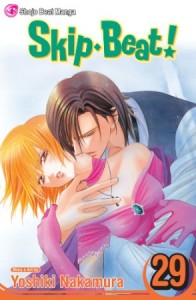
I hope you enjoyed the Black Bird-esque cover art, as that’s really the closest thing Skip Beat gets to romance. Oh yes, there’s Kyoko and Ren teasing each other briefly, but the point of that scene is the same as it’s been before – when pressed, Kyoko freaks out completely and shows, as Lory lampshades in this volume, that she’s not remotely ready for love or romance. Which is one reason why Skip Beat is at Vol. 29 and things are still up in the air. Not that we’ve any doubt that the final pairing will be Ren and Kyoko – if Sho somehow manages to win her heart I’ll be mind-boggled (and I think angry fans would storm Hakusensha’s offices). But there’s simply demons in Kyoko’s past that really haven’t resolved yet.

Honestly, I wish we’d see more of Kyoko’s mother. Yes, she’s horrible, and I certainly don’t want to see more of her interactions with Kyoko. Except I totally do, because her emotional abuse at her mother’s hands is what continues to drive her story. Every single time she twitches or reacts poorly to someone getting angry with her – even when it’s obviously meant to be comedic – it reminds me that she’s hypersensitive to everyone’s reactions. And one reason she may be so good at method acting is that she grew up trying to be the good child – or, as she increasingly got pawned off on Sho’s family, the dutiful wife/sister figure. Kyoko’s ability to immediately sense when Ren is upset with her, and her over the top reactions, are incredibly funny, but they’re also built on a foundation that screams ‘trigger warning’.

In a way, Kyoko’s emotional maturity when it comes to love and romance (and even simple things such as friendship) is trying to catch up to the personas that she’s put on her entire life. Which is why she’s still so incredibly naive about love. Her discussion with her Bo costume about Ren’s ‘playboy’ ways show that Lory isn’t kidding about her being completely unable to love. He may glibly tell Ren to avoid taking ‘that final step’ with her, but there’s a reason behind it – if Kyoko is freaking out to the point of bolting across the room when Ren even suggests seducing her, she’s not ready for anything else.

As for the rest of the manga, despite the fact that we’re twenty-nine volumes in, not much time has passed within the manga itself, as we can see given that Dark Moon is only just wrapping up. Meanwhile, Cain Heel’s drama finally starts filming, and we meet one of his fellow actors, Murasame, who seems to be a combination of rival and tsukkomi, as he points out to himself all the weird things Cain and Setsu are doing, but is also clearly attracted to Setsu. Of course, he shows this attraction via his own emotional immaturity – after pondering the best way to introduce himself to her, he starts by insulting her brother. Kyoko’s not the only one with issues.

I love the fact that this cute, funny shoujo manga can make me write about serious things. It doesn’t look to be ending anytime soon, so here’s to more volumes (and perhaps Kyoko conquering her love and affection demons).

Filed Under: REVIEWS

License Requesting the Fall 2012 Anime Season – Manga Edition

October 7, 2012 by Sean Gaffney

So you’ve decided you really like that hot new 2012 anime property – so much so that you want to support it by actually buying the manga instead of just reading it on a scan site! First of all, congratulations, you are a very rare individual. But it’s not as easy as walking up to a publisher at New York Comic Con and saying “Hey, you guys should get _____!” After all, what if they don’t deal with that publisher? What if it doesn’t have a manga? What if it’s already licensed and you didn’t realize it?

So, for the anime fan who wants to try a bit of manga, a quick guide to how to beg for Fall 2012 titles. (Note: if I don’t mention a title here, it doesn’t have a manga as far as I can tell.)

First off, let’s eliminate series that are already licensed and actively coming out here. That takes care of Bakuman (Viz), Hayate the Combat Butler (Viz), Hidamari Sketch (Yen), Jormungand (Viz), Kamisama Hajimemashita (Viz) and Yu-Gi-Oh Zexal (Viz). (It’s a Viz world, kids, we just live in it.) I’m also including BTOOOM! (Yen), which is licensed but doesn’t debut till next year.

Secondly, there’s a couple of series which were licensed, but are now, putting it politely, “On hiatus”. Asking about them will likely get you a pained look and a ‘We have no plans at this time’ response. So that takes out Code: Breaker (Del Rey), JoJo’s Bizarre Adventure (Viz), and Gintama (Viz). The one exception to this is Code: Breaker – JManga has picked up the two volumes Del Rey released, and there is a definite possibility for more in that online-only direction. And technically, JoJo’s finished the arc that it was putting out, so I suppose it’s more ‘didn’t pick up further arcs’ than ‘on hiatus’.

Lastly, Sakurasou no Pet na Kanojo is based off a light novel that has no manga yet, as far as I can tell. Asking about light novel licenses is a great way to get publishers to cry.

So, which publisher can you nag for which books?

SEVEN SEAS: Well, they aren’t at NYCC (they don’t do the East Coast), so a politely worded tweet might do the trick. The anime Onii-chan Dakedo Ai Sae Areba Kankei Nai yo ne, aka ‘As Long As There’s Love, I Don’t Care If He’s My Brother!’ is the latest in a theme of faux-incest titles. And runs in Comic Alive. Both of which are very similar to things Seven Seas has recently picked up.

TOKYOPOP: OK, so technically they don’t put out much these days. But honestly, there’s really no better fit for Seitokai no Ichizon, a Kadokawa title that runs in Dragon Age. See if you can sweet-talk Stu.

KODANSHA COMICS: There are two really obvious titles here and one less so. The non-obvious one is Shin Sekai Yori, based on an award-winning SF novel. Its manga adaptation does indeed run in Kodansha’s Bessatsu Shonen Magazine. It began… about 2 weeks ago. So ask them to keep it in mind for NYCC 2013. So that leaves the two big contenders: Sukitte Ii na yo and Tonari no Kaibutsu-kun, both of which run in Kodansha’s shoujo magazine Dessert. They’re both terrific, but they are in a magazine that is generally ignored when it comes to shoujo NA licenses (honestly, Kodansha Comics tends to avoid anything but Nakayoshi these days), and they’re both still running (series that haven’t already ended in Japan worry publishers).

VERTICAL, INC.: See the two previous titles. If Kodansha says no, maybe Vertical wants to try it out? They are putting out Limit this fall, after all…

JMANGA: Aside from Code: Breaker, which I mentioned above, the one that jumps out at me is Teekyū, a school tennis comedy from Earth Star Entertainment’s Comic Earth Star. JManga recently put out four of their titles, so there’s always a possibility of more.

YEN PRESS: The only one that really leaps out at me is Zetsuen no Tempest, a fantasy manga that runs in Square Exin’s Shonen Gangan. Being a Gangan title, Yen seems the most likely player there. It’s also possible they might look at Little Busters, the latest from the Air/Kanon/Clannad folks, which runs in Kadokawa’s Comp Ace, but that seems less likely.

VIZ MEDIA: There’s a whole host of properties Viz *could* license here, but I’m not sure how many are genuinely *possible* licenses. Magi – The Labyrinth of Magic has a lot of potential, and is probably the most likely title on this list, but it’s 14 volumes and still running, and it also runs in Shonen Sunday, whose success in North America has been poor in the post-Inu Yasha age. Dangerous Jii-san Ja is a comedy 4-koma manga for kids about a goofy grandpa that runs in Corocoro. I can’t see it coming out here. At all. Medaka Box I have discussed many times before, and the same points still apply. And as for To-Love-Ru Darkness, even if the prequel had come out via Viz, this new sequel is simply too M-rated for their usual Jump line.

I HAVE NO IDEA: Two titles simply don’t leap out as going to any publisher. Aoi Sekai no Chūshin de is a fantasy manga that seems to anthropomorphize the console wars, and is written by a Russian woman. It is put out by Micro Magazine. I don’t know who they are either. Judging by the name, I’m guessing they focus on gaming. Lastly, there’s Chiisai Oyaji Nikki, from Ohzora Shuppan, which is about a very small old man.

Anything in that list take your fancy? You know I’ll be uselessly beating the Medaka Box drum…

Filed Under: LICENSE REQUESTS, UNSHELVED

  • « Go to Previous Page
  • Page 1
  • Interim pages omitted …
  • Page 400
  • Page 401
  • Page 402
  • Page 403
  • Page 404
  • Interim pages omitted …
  • Page 541
  • Go to Next Page »
 | Log in
Copyright © 2010 Manga Bookshelf | Powered by WordPress & the Genesis Framework