• Skip to primary navigation
  • Skip to main content
  • Skip to primary sidebar
  • Home
  • About Us
    • Privacy Policy
    • Comment Policy
    • Disclosures & Disclaimers
  • Resources
    • Links, Essays & Articles
    • Fandomology!
    • CLAMP Directory
    • BlogRoll
  • Features & Columns
    • 3 Things Thursday
    • Adventures in the Key of Shoujo
    • Bit & Blips (game reviews)
    • BL BOOKRACK
    • Bookshelf Briefs
    • Bringing the Drama
    • Comic Conversion
    • Fanservice Friday
    • Going Digital
    • It Came From the Sinosphere
    • License This!
    • Magazine no Mori
    • My Week in Manga
    • OFF THE SHELF
    • Not By Manga Alone
    • PICK OF THE WEEK
    • Subtitles & Sensibility
    • Weekly Shonen Jump Recaps
  • Manga Moveable Feast
    • MMF Full Archive
    • Yun Kouga
    • CLAMP
    • Shojo Beat
    • Osamu Tezuka
    • Sailor Moon
    • Fruits Basket
    • Takehiko Inoue
    • Wild Adapter
    • One Piece
    • After School Nightmare
    • Karakuri Odette
    • Paradise Kiss
    • The Color Trilogy
    • To Terra…
    • Sexy Voice & Robo
  • Browse by Author
    • Sean Gaffney
    • Anna Neatrour
    • Michelle Smith
    • Katherine Dacey
    • MJ
    • Brigid Alverson
    • Travis Anderson
    • Phillip Anthony
    • Derek Bown
    • Jaci Dahlvang
    • Angela Eastman
    • Erica Friedman
    • Sara K.
    • Megan Purdy
    • Emily Snodgrass
    • Nancy Thistlethwaite
    • Eva Volin
    • David Welsh
  • MB Blogs
    • A Case Suitable For Treatment
    • Experiments in Manga
    • MangaBlog
    • The Manga Critic
    • Manga Report
    • Soliloquy in Blue
    • Manga Curmudgeon (archive)

Manga Bookshelf

Discussion, Resources, Roundtables, & Reviews

Reviews

Fullmetal Alchemist, Vol. 22

January 11, 2010 by MJ Leave a Comment

By Hiromu Arakawa
Viz, 192 pp.
Rating: T (Teen)

Having been finally released from Pride’s control, Al feels responsible for the damage done. In order to rectify the situation, he devises a plan to trap Pride that he must put into action with his father’s help (and without his brother’s knowledge). Anxious to get on with his own plans for world domination, Greed breaks off from the rest of the group, against the wishes of his body’s cohabitant, Lin.

Meanwhile, Mustang’s group continues their resistance, finding allies among Briggs’ Northern troops as well as a few unexpected quarters, and Hohenheim comes face-to-face with an old acquaintance once again. With the story’s major players all converging on Central City, the series’ final battle seems to truly have begun.

The time has come for each of the Elric men to show their true strength and artist Hiromu Arakawa has certainly ramped up the tension to get them there. Her real brilliance is best displayed, however, in the volume’s smallest moments—brief encounters and bits of characterization that make her characters shine in the din. Both Hohenheim’s quiet acts of compassion and Kimblee’s stubborn emotional detachment say more about each of them than their public actions ever could. As always, Arakawa’s artwork provides impressive clarity, even through the messiest action sequences, without ever sacrificing pace or expression.

This volume is a thrill from start to finish, certain to leave fans anxious for more.

Filed Under: MANGA REVIEWS Tagged With: fullmetal alchemist

Blue Sheep Reverie 1-2 by Makoto Tateno: B-

January 11, 2010 by Michelle Smith

bluesheep2When Kai’s lover, Maria, is murdered, he sets out to find her killer. His one clue is that the ring Maria always wore—a man-made blue jewel resembling the eye of a sheep—is missing, and he thinks he’s found it on the hand of Lahti Bara, a bigwig in Sarte, one of the gangs ruling the gritty city of Akatsuki. To get close to Lahti and check out his ring, Kai makes a bid to be his bodyguard and later consents to be his lover. It turns out that Lahti isn’t Maria’s murderer, but Kai has already grown fascinated by the powerful and enigmatic leader and gets embroiled in a bunch of gang politics involving a rival gang, an elite group within Sarte called the Four Kings, a renegade Sarte member attempting to bring them down, and a power struggle over gang leadership.

While I very heartily applaud any BL series for having as much plot as this one does, I must regretfully admit that I found most of the gang-related action dull and repetitive. Nearly every time something bad happens, the aforementioned renegade is the culprit but never seems to get caught. Kai isn’t a very strong character, either, but I do think his relationship with Lahti is an interesting one. It definitely isn’t love, as Lahti occasionally keeps Kai on door guard duty while he’s bedding other men, but Kai realizes that it’s not love and kindness he craves, but rather the strength to be worthy to stand at Lahti’s side, to be necessary to him.

So, is this good? Well, almost. It’s one of those cases where I like it despite its faults. I actually struggled a lot with whether to give it a B, since Tateno-sensei bothered to create such an intricate plot, but I just couldn’t do it.

Review copy for volume two provided by the publisher. Review originally published at Manga Recon.

Filed Under: REVIEWS Tagged With: digital manga publishing, Juné, Makoto Tateno

Fullmetal Alchemist, Vol. 21

January 10, 2010 by MJ 2 Comments

Fullmetal Alchemist, Vol. 21
By Hiromu Arakawa
Published by Viz Media


Buy This Book

Winry makes her way safely back to Resembool only to discover that Ed has beaten her to it. Though she’s grateful to find him all in one piece, she’s less thrilled with his insistence that she flee the country. Meanwhile, Al has encountered newly-uncovered homunculus Pride (aka Selim Bradley), whose terrifying power is enough to take control of him and set him against his own brother. Only the the surprise appearance of an old ally can turn this fight around! Now with President Bradley and his dangerous son out of Central City, Mustang’s group of rebels finally makes their move, taking the President’s wife hostage. Can they be prepared for the result?

After the last volume’s calm before the storm, Arakawa ramps up the tension by revealing the true horror of Pride’s power, wrapped up in the package of a cute little boy–one so ruthless he’ll consume his own allies if it will help him to win. Even so, Arakawa manages to balance this kind of pure evil with just the smallest drop of pathos, keeping the story from ever settling into comfortable black and white. This is one of her most impressive (and consistent) balancing acts and part of what makes her story so powerful. The series somehow maintains both pure-hearted shonen morality and multiple shades of gray, side by side, even in its primary characters. It is dark, but never pessimistic–moralistic, but never self-righteous. It follows established conventions of its genre without ever losing its persistent freshness.

Though the story’s increasingly serious bent has (understandably) overwhelmed its early humor, especially now as the climax draws near, there is still quite a bit to be found, particularly in the wonderfully dry humor of Major General Olivier Armstrong and pretty much anyone associated with Colonel Mustang. As the series reaches further into darkness and anxiety, these characters help keep the atmosphere from becoming too heavy, something I expect we’ll all be grateful for by series’ end.

“Tension” is the keyword in this harrowing volume of one of my favorite series in current publication. Keep a look out for tomorrow’s installment of Manga Recon‘s Manga Minis to see how things explode in the series’ next volume!

Review copy provided by the publisher.

Filed Under: MANGA REVIEWS Tagged With: fullmetal alchemist, manga

20th Century Boys, Vols. 1-6

January 9, 2010 by Katherine Dacey

Do you remember those first, glorious seasons of Heroes and Lost? Both shows promised to reinvigorate the sci-fi thriller with complex, flawed characters and plots that moved freely between past, present, and future. By the middle of their second seasons, however, it was clear that neither shows’ writers knew how to successfully resolve the conflicts and mysteries introduced in the first, as the writers resorted to cheap tricks — the out-of-left-field personality reversal, the all-too-convenient coincidence, and the arbitrary let’s-kill-off-a-character plot twist — to keep the myriad plot lines afloat, alienating thousands of viewers in the process. Heroes and Lost seemed proof that even the scariest doomsday scenario would fall flat if saddled with too many subplots and secondary characters.

Reading Naoki Urasawa’s 20th Century Boys, however, convinced me that it is possible to tell a twisty, layered story about ordinary people saving the world from annihilation without succumbing to cliche or unduly testing the audience’s patience. The key to Urasawa’s success? A strong script with vivid characters and a clear sense of purpose, reassuring the reader that all the plot strands are just that: strands, not loose threads.

In 20th Century Boys, humanity’s future rests in the hands of an unpromising lot. There’s Kenji, a college dropout who runs a convenience store; Maruo, a cheerful, plump soul who owns a shop down the street from Kenji; Yoshitune, a shy, bespectacled office man; Otcho, a scruffy renegade who’s been living off the grid in Thailand; and Yukiji, a K-9 officer who can’t control her drug-sniffing dog. All five were childhood friends, members of a secret club that wrote The Book of Prophecy, an elaborate doomsday scenario involving superheroes and giant robots. Now in their thirties, the gang has disbanded — that is, until their pal Donkey, a high-school science teacher, leaps to his death off a building.

Or did he? As Kenji begins pushing for answers, he discovers that Donkey was investigating a mysterious cult, known only as The Friends, that had appropriated the club’s “official” symbol. The more Kenji probes, the more parallels he discovers between The Friends’ clandestine activities and the Book of Prophecy, parallels that suggest the cult is headed by one of Kenji’s old schoolmates. Terrified that The Friends will attempt to recreate the story’s climatic battle, Kenji tracks down his clubmates one by one, assembling a small army to oppose the cult.

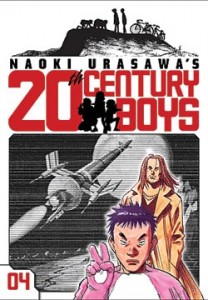
20thcentury4From the very first pages of volume one, Urasawa demonstrates an uncommon ability to move back and forth in time, juxtaposing scenes from Kenji’s past with brief glimpses of the future. The success of these scenes is attributable, in part, to Urasawa’s superb draftsmanship, as he does a fine job of aging his characters from their long-limbed, baby-faced, ten-year-old selves into thirty-somethings weighed down by adult responsibilities.
The integrity of Urasawa’s characterizations also contribute to the success of these temporal leaps; his characters’ adult behavior jives with what we know about them from childhood flashbacks. Otcho, for example, was the club’s most worldly member, the kid who introduced his pals to rock-n-roll and gave them the lowdown on Woodstock; it’s not surprising to see him reincarnated as a long-haired thug-for-hire who despises authority. Ditto for Yanbo and Mabo, twins who terrorized Kenji and friends back in the day. When Yanbo and Mabo resurface in volume five, Urasawa gives them a more pleasing appearance and demeanor than we might have expected, luring us into a false sense that they’ve outgrown their bullying ways. Urasawa then slaps us on the wrist for not trusting our original assessment of the twins, uncorking a fiendish plot twist that’s in keeping with what we already knew about them.

Urasawa uses these flashbacks and flash-forwards to build a dense network of connections among his characters, gradually revealing how and why Kenji’s childhood fantasies are providing the blueprint for a real-life apocalyptic scenario. Heroes and Lost attempted to do the same thing, but neither show succeeded in convincing us that those connections were lying just below the surface waiting for us to discover them; those connections had an arbitrary, bolt-from-the-blue quality. With 20th Century Boys, however, Urasawa makes us feel that we might have unearthed these links without any editorial guidance, as even the most surprising developments still make sense within the story’s elaborate framework.

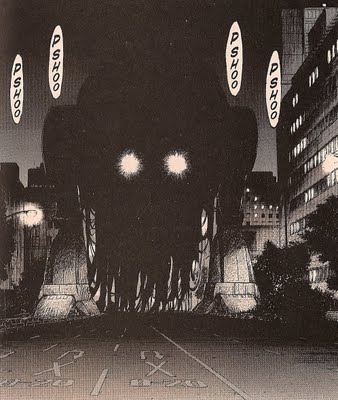
What gives the story its sense of urgency is Urasawa’s ability to create and sustain a strong sense of fear and anticipation. Six volumes into 20th Century Boys, we’ve had a few tantalizing glimpses of the robot that menaces Tokyo on the eve of the millennium, but we still don’t know what it looks like or what it can do. Urasawa has only shown us the enemy in silhouette:

20thcentury_robot

It’s a point I’ve raised in other reviews: an unseen menace is much scarier than one that’s routinely trotted out of the shadows to spook us. Consider the difference between Jaws and its sequels. In the original, Steven Spielberg hinted at the shark’s presence, showing us a dorsal fin or a dark outline moving rapidly beneath the water’s surface, but withholding the “money” shot (“tooth” shot, perhaps?) until the third reel. The few times that we see Jaws attack are genuinely scary because they finally put us face-to-face with those terrible teeth and dead eyes, confirming just how deadly the shark really is. In the sequels, however, the shark is featured prominently; we see it dine on boaters and swimmers in lurid detail. We may marvel at the stupidity of the shark’s victims, or feel disgusted by the gallons of fake blood, but we never feel scared, as we know what we’re up against from the very first scenes.

Urasawa takes a page from Spielberg’s book, showing us just enough of the robot’s form to engage our imagination. The robot’s silhouette hints at its size and strength; if anything, it looks like an enormous man-o-war lumbering through Tokyo. But what stays with us are those fierce, penetrating headlights, so evocative of a prison searchlight or a pair of eyes. As David Ford observes at Are You a Serious Comic Book Reader?, we feel a palpable sense of despair when we see the robot: how can Kenji hope to escape its all-seeing gaze? (By the way, I highly encourage you to read Ford’s essay, though spoiler-phobes should stay away until they’ve finished volume five.)

With more than ten volumes left in 20th Century Boys, I have no idea how Urasawa plans to tie all of the stories’ threads together. I’m confident, however, that he’ll do so with the skill of a master weaver, seamlessly incorporating all of the relationships, plot twists, and motives into an intricate, beautiful tapestry.

Review copies provided by VIZ Media, LLC. Volume seven will be released on February 10, 2010.

20TH CENTURY BOYS, VOLS. 1-6 • BY NAOKI URASAWA • VIZ • RATING: OLDER TEEN (16+)

Filed Under: Manga, Manga Critic, REVIEWS Tagged With: Naoki Urasawa, Sci-Fi, Thriller, VIZ, VIZ Signature

Town of Evening Calm, Country of Cherry Blossoms

January 4, 2010 by Katherine Dacey

In The Idea of History, author R. G. Collingwood argues that nineteenth-century historians viewed their task in a different spirit than their predecessors. While previous generations of scholars treated history as a simple chain of events, the Romantics wanted to recreate the past through their writings. The Romantic historian, Collingwood explained, “entered sympathetically into the actions which he described; unlike the scientist who studied nature, he did not stand over the facts as mere objects for cognition; on the contrary, he threw himself into them and felt them imaginatively as experiences of his own.”

I found myself revisiting The Idea of History as I read Town of Evening Calm, Country of Cherry Blossoms, a project that might well have resonated with Collingwood’s pioneering nineteenth-century historians in its efforts to “enter sympathetically” into the lives of Hiroshima’s survivors, the hibakusha, a group both pitied and shunned by their fellow Japanese in the years following the 1945 bombing. In the introduction to Town of Evening Calm, manga-ka Fumiyo Kouno explains her approach to the subject in terms that are strikingly similar to Collingwood’s:

I always thought all I needed to know about the bomb was that it was a terrifying thing that happened once upon a time, and a subject best avoided. After living in Tokyo for a while, however, I came to realize that people outside of Hiroshima and Nagasaki didn’t really know all that much about the ravages of the atomic bomb. Unlike me, they weren’t avoiding the subject—they never had the opportunity to learn about it even if they wanted to… I hadn’t experienced the war or the bomb first-hand, but I could still draw on the words of a different time and place to reflect on peace and express my thoughts.

Kouno’s decision to focus on the hibakusha and their descendants makes Town of Evening Calm an immediate, accessible work, one less concerned with recreating a specific historical moment than in imagining what it would be like to rebuild one’s life in the aftermath of that event. It’s a wise strategy, I think, given how difficult it is to convey the horror of war without relying on dramatic devices that can trivialize survivors’ experiences.

Kouno’s approach is not without pitfalls, however. In her review of Town of Evening Calm, Country of Cherry Blossoms, Casey Brienza argues that Kouno portrays her characters as victims of American aggression without acknowledging Japan’s role in precipitating the bombing, a tactic that could be interpreted as a “myopic… preoccupation with [Japan’s] wartime suffering” that “allow[s] the Japanese to forget that they started the war.” At the end of the first story, for example, a woman dying of radiation sickness wonders “if the people who dropped the bomb are pleased with themselves: ‘Yes! Got another one!'” It’s a powerful moment; the character’s comment is shocking in its raw honesty, especially for American readers. It’s an ambiguous moment, too; one could certainly read a note of national self-pity into the character’s words, as she never mentions the war itself, only the suffering caused by the bomb. Yet I think this passage invites a second reading as well, as a very human attempt to make sense of tragedy, to express the character’s understandable need to know why she — a civilian — was subjected to such unimaginable horror, rather than a denial of the suffering caused by the Japanese occupation of Korea, Manchuria, and the Philippines.

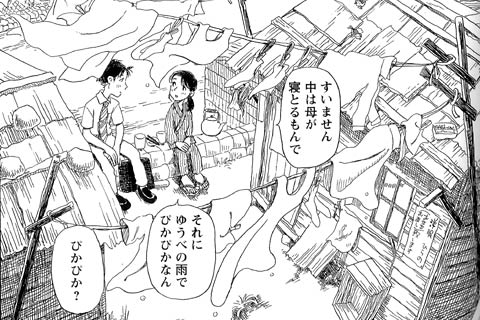
In less skillful hands, scenes like these might be mawkish, but Kouno crafts an emotionally authentic story from survivor narratives, deftly moving between present and past to show us how her characters hear the echoes of August 6th in their everyday lives. The first story, “Town of Evening Calm,” focuses on Minami, a young seamstress living in Hiroshima ten years after the atomic blast. Superficially, the city seems to be healing: its downtown is bustling with activity, as is the dressmaker’s shop where Minami works. Yet subtle signs of the devastation remain, from the ramshackle houses of the residential district to the scarcity of everyday goods. (In a particularly effective scene, we see Minami walk home barefoot so as to preserve her only pair of shoes.) Minami herself bears psychic wounds from the day, as is evident in her brusque demeanor with outsiders and her staunch refusal to leave her ailing mother’s side. Underneath her bravado, we see a fearful, guilt-ridden young woman who wonders when she will succumb to the long-term effects of the radiation, who cannot escape her horrifying memories, and who mourns the disintegration of her family. (Her father and sister perished in the blast; her brother was sent to live in Mito, and had yet to return to Hiroshima.)

town_interior1

The second story, “Country of Cherry Blossoms,” takes place nearly twenty years later in Tokyo. We first meet Nanami, a baseball-addled tomboy, as an eleven-year-old girl. Through a few telling details–Nanami’s dirty baseball uniform, Nanami’s interactions with classmates–we see that she suffers acutely from her mother’s absence. (Her mother, a hibakusha, succumbed to cancer.) Lacking a female role model, she latches onto Toko, a classmate who epitomizes girly grace. Kouno depicts a few ordinary moments from this odd pair’s childhood: a playground discussion of a homework assignment, a baseball game, a trip to the hospital where Nagio, Nanami’s younger brother, is hospitalized with severe asthma.

We then jump forward seventeen years. Nanami and Toko are estranged; Nagio, now healthy, is training to be a doctor; and Asahi, their elderly father, has been behaving oddly. Fearful that Asahi is losing his faculties, Nanami tails him through the streets of Tokyo, where she bumps into Toko. Their initial conversation is awkward and forced; seeing Toko dredges up some of Nanami’s most painful childhood memories. Toko, undeterred by Nanami’s rudeness, furnishes Nanami with a disguise, and the two set off for Hiroshima, where Asahi seems intent on completing a mysterious errand. As Nanami and Toko follow Asahi, we realize that Asahi is the link between the first and second stories; he is Minami’s “lost” brother, the one who was living with relatives when the Americans bombed Hiroshima, returning only after the death of his sister in 1955.

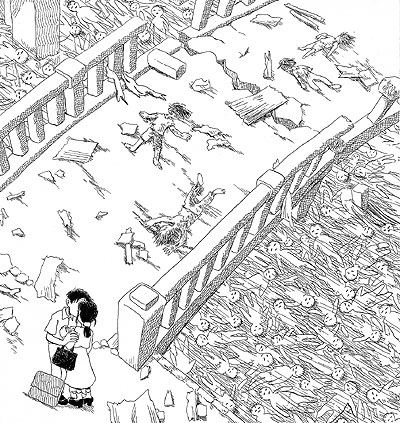
Kouno’s meticulously detailed illustrations create a strong sense of place, underscoring the contrast between Hiroshima’s orderly new business district and the crowded Aioi Doori neighborhood where the hibakusha live. In the few panels alluding to the actual events of August 6, 1945, Kouno’s art becomes more primitive and stylized, suggesting the horrific effects of the blast by depicting the victims as stick figures with swollen faces. The child-like simplicity and directness of these images are startling yet effective, a reminder both of Minami’s youth at the time of the attack and of the radiation’s devastating ability to rob its victims of their identities by destroying their hair, hands, and faces — in short, the very parts of their bodies that give them their individual appearance. These scenes are notable as well for the skillful way in which present and past co-exist within the same panels; we see the landscape as Minami does, alive with vivid, horrific memories of surviving the blast.

town_interior2

Kouno’s character designs exhibit a similar attention to detail and mood as her landscapes. Nanami, for example, bears a striking resemblance to her aunt Minami, not just in her behavior (Minami shared Nanami’s love of baseball and her brusque demeanor) but also in her facial expressions and carriage; she’s a subtle visual echo of the previous generation. Like all of Kouno’s characters, Nanami and Minami have a slightly rough, clumsy quality to them, with heads and hands that seem just a little too big for their wiry bodies. Yet these awkward proportions don’t detract from the beauty of the work; if anything, the illustrations make Kouno’s characters seem more vulnerable, more imperfect, more fragile—in short, more human and more believable. And that honest vulnerability, in turn, makes it possible for readers from all walks of life to enter sympathetically into Kouno’s haunting yet life-affirming story, to look past the politics of suffering and representation to understand the price that civilians pay in every war.

This is a revised version of a review posted at PopCultureShock on March 23, 2007. Click here for the original text; click here for a Japanese translation of the original review.

Filed Under: Manga, Manga Critic, REVIEWS Tagged With: Fumiyo Kōno, Hiroshima, Historical Drama, Last Gasp

Tactics, Vol. 8

January 4, 2010 by MJ Leave a Comment

tactics8By Sakura Kinoshita and Kazuko Higashiyama
TOKYOPOP, 192 pp.
Rating: Teen (13+)

This volume opens with the conclusion to Kantarou’s latest conflict with Raikou Minamoto and his underlings. Haruka arrives to save the day (and to reassure Kantarou of his loyalty) but though Minamoto’s immediate plans are destroyed, the fight ultimately ends in a draw. Things are looking up for Kantarou, however, as Haruka makes a promise to one day tell him about his past. The story then takes a break to make way for a string of short “Bedtime Stories” featuring the series’ regular characters, which provide filler for the latter two-thirds of the volume.

Though the volume starts strong, thanks to the underlying tension between Kantarou and Haruka, it quickly falls apart with the introduction of its short story series, “Record of One Hundred Goblins.” With a single exception, these shorts provide neither humor nor substance sufficient to hold readers’ attention. Fortunately, the volume’s final story, “Otoshi,” about an artist whose ability to paint youkai (supernatural creatures) has mysteriously failed him, has enough strength of its own to turn things around. Focusing on relationships between humans and youkai, this story provides one of the most poignant moments of the series so far, rescuing the volume from its flat middle chapters. “… How precious an ‘existence’ is to youkai,” muses Kantarou, having finally returned the artist’s ability to him. “… That’s why I use my writing to make them immortal and [the artist] uses his art to pass on to future generations.”

Despite its uneven storytelling and tone, the eighth volume of Tactics manages its way out of complete destruction with a healthy dose of true feeling.

Review copy provided by the publisher. Review originally published at PopCultureShock.

Filed Under: REVIEWS Tagged With: manga, tactics

Love*Com, Volume 14

January 1, 2010 by Deanna Gauthier 2 Comments

Guest Review: Love*Com, Vol. 14
By Aya Nakahara
Published by VIZ Media

Review by Deanna Gauthier

love*com14
Buy This Book

In this volume, Risa and Otani’s relationship is once again under attack. To Risa’s horror, her own grandfather has hired a woman to seduce Otani and break them up. Even worse, Otani believes the sob story he’s been given by the beautiful, buxom Hitomi and accuses Risa of lying to him about her grandfather’s scheme. When the truth comes out will it matter who was wrong and who was right now that a jealous and conniving Hitomi has tricked Risa and left her at the mercy of two yakuza thugs?

This is a romantic comedy so of course a plotline like this will never end as tragically as it could. Still, it is the darkest plotline (and Hitomi, the character with the blackest heart) to appear in Love* Com. Being the gullible reader I am, I believed Risa was in real danger. The threat of rape just doesn’t sit right with me as fodder for comedic misunderstanding. Love*Com has always delivered liberal doses of fluffy silliness along with angst as Risa and Otani discover what they mean to each other and learn what it means to like someone, let alone be in love with them. The mangaka, Aya Nakara, has characterized her manga as intended to bring a smile to the faces of her readers and give them even a moment of enjoyment in their lives. In that regard she has always delivered in spades. I found plenty to laugh about in this volume as I have in the volumes that preceded it–not to mention warm and fuzzy moments to make me smile. Risa and Otani are such innocent and awkward leads–two loveable stumbling idiots who are absolutely made for each other. I do not mean to pick on Nakahara too much for this storyline. It just struck me as too serious and dark a dilemma for an otherwise non-threatening shojo romantic comedy.

Speaking of non-threatening, this volume marks the return of the clownishly-drawn, not-too-bright punks who Risa’s brother nearly came to blows with in the previous volume. Nakahara’s artwork is strongest when it comes to facial expression, especially the eyes. Yet the facial features of her yakuza are drawn with very thin lines and no shading, reducing them almost to doodles that look like they don’t quite belong in the same universe as our main characters. I don’t particularly like the design and execution of the yakuza characters. It feels sloppy in comparison to how beautiful (or at least human) the rest of her characters look most of the time. However, I do feel Nakahara successfully uses this same technique of reducing the facial features of the rest of her cast to thin lines that stretch or contort into odd shapes to comically express certain emotions more strongly. It’s funny, but it’s only just now, fourteen volumes into the series, that it occurs to me: Nakahara uses this instead of drawing chibis!

I really am enjoying this series. It has given me reason to smile when I have really needed it during the dreary fall and winter days, and it holds up well to re-reads. It is definitely one for my keeper shelf. I look forward to the final three volumes!

Review copy provided by the publisher.

Filed Under: REVIEWS Tagged With: love*com, manga

Vampire Knight, Volume 8

December 30, 2009 by Megan M. 2 Comments

Guest Review: Vampire Knight, Vol. 8
By Matsuri Hino
Published by Viz Media

Review by Megan M.

vampireknight8
Buy This Book

Cross Academy is divided into two groups of students: the Day Class, made up of seemingly normal high school students, and the Night Class, whose members are actually vampires. Protecting the human students from the vampires are Yuki Cross (the headmaster’s foster daughter) and her childhood friend, Zero Kiryu. Yuki has always had a strange relationship with the head of the Night Class, Kaname, on whom she must rely to explain the mysteries of her past. Fortunately for Yuki, circumstances have reached a point where Kaname has no other choice but to do so.

I read the first three volumes of this series when they first came out in the U.S., but eventually dropped it. While I found the main plotline interesting and liked Yuki and Zero, I found Kaname to be extremely creepy and his relationship with Yuki even more so. The real deal breaker for me, however, was that the entire cast (excepting Zero) behaved as if Yuki was one of Kaname’s personal possessions. Having now read this volume, there is virtually nothing I can say on this topic that would not be considered a major spoiler, but suffice it to say that the story itself now appears to support this view of Yuki. Not only has Kaname been firmly established as a love interest, but we also learn that Yuki was literally created purely for the purpose of being Kaname’s bride. There are other plot elements that briefly appear–the mythology of the vampire hunters and the dangers of twin hunters, for instance–but these items are clearly secondary.

In addition to giving life to the creepiest implications of the story’s core premise, the overall quality of the series seems to have declined. In early volumes, I recall that Yuki had quite a bit to do. In this volume, she literally does nothing but run around in a nightgown. In addition, Zero does nothing but point his gun and angst. Only Kaname has anything of real substance on his plate, which unfortunately consists of obsessing over Yuki and seeking revenge. Had I not read previous volumes, I would wonder if Hino’s characters were capable of anything but angst (alternately tragic and angry), aside from some supporting characters, whose range extends to ominous, mysterious, and tragic.

The series’ art has also suffered a serious decline. In the past, I’ve found Matsuri Hino’s art to be too cluttered for my taste–more focused on looking pretty than storytelling–but her designs and backgrounds were interesting and appealing, and her art very detailed. Unfortunately, she has degenerated to substituting backgrounds with white space or hazy textures and her characters have become so generic that they are difficult to tell apart except by hairstyle.

I decided to give Vampire Knight another try thanks to a growing fondness for other gothic shojo titles over the last two years. Unfortunately, whatever it is that CLAMP, Higuri You and Kaori Yuki have, Matsuri Hino doesn’t.

Review copy provided by the publisher.

Filed Under: REVIEWS Tagged With: manga, vampire knight

Serenity 2: Better Days by Whedon, Matthews, and Conrad: B

December 28, 2009 by Michelle Smith

serenity2From the back cover:
When the Serenity crew uncovers a heaping pile of cash—marking their first successful heist—they divulge their most outlandish fantasies, and look forward to a little R&R in a tropical paradise. Unfortunately for these space cowboys, someone is hot on their heels in search of a prize more precious than money.

Joss Whedon, creator of Buffy the Vampire Slayer, joins Brett Matthews and Will Conrad—the team that brought you the smash hit Serenity: Those Left Behind—with a new chapter in the lives of Malcolm Reynolds and his roving band of space brigands in Better Days.

Review:
While Serenity: Better Days is the second comic miniseries based on the TV show Firefly to be released, I am not sure whether its events take place chronologically after the end of the show or not. The one thing that would help establish its place in the timeline—Inara’s decision to depart the ship—is not mentioned at all, nor is any reference made to Shepherd Book’s wish to leave (first stated by him in Serenity: Those Left Behind). While the story works just fine without knowing when it happens, this still bugs me a little bit.

The plot of Better Days is extremely simple. For once, things go well and the crew of Serenity is suddenly rich. Several members share the way they plan to spend their money in scenes that nicely capture the warm, family-like times the crew occasionally shares. Meanwhile, the Alliance is looking for Mal (when are they not?), though this guy is special in that he’s one of Inara’s clients, and a builder whose drone Mal stole is out for revenge. I must admit that this peril did not interest me very much, though I’m used to looking past occasionally lame plots in Whedon shows in favor of character interaction. The best character goodness happens here between Inara and Mal, especially in their final scene together, though there’s also some nice continuity between Wash and Zoe as well as an intriguing tidbit regarding Inara and Simon.

Will Conrad is back as the artist for this miniseries, and seems to have a little better feel for the characters now. The likenesses are more consistent and Inara is vastly improved, finally meriting some impressively realistic close-ups of her own. Although a new cover was created for this trade paperback, the original covers of the three comic issues—forming a triptych that depicts the crew lounging atop sacks of money—are reproduced within.

I have now read all of the Firefly-inspired comics currently in existence and enjoyed them a good bit. Any time Dark Horse would like to make more, I’ll be happy to give them my money.

Filed Under: REVIEWS Tagged With: Dark Horse, Firefly

Sayonara, Zetsubou-Sensei, Vol. 4

December 28, 2009 by MJ Leave a Comment

zetsubou4By Koji Kumeta
Del Rey, 192 pp.
Rating: OT (16+)

Suicidal schoolteacher Nozomu Itoshiki (Zetsubou-sensei) and his students are back, with a satirical take on such topics as Christmas, leftovers, societal hierarchies, cooling-off periods, second opinions, and how to deal with dead space. Even exam students are taken to task in this volume, as Zetsubou-sensei despairs over their ability to get away with nearly anything–a privilege he attempts to recapture for himself by engaging in a series of increasingly ridiculous certification programs. Easily passing tests for certifications in flower arrangement and animal breeding (and scraping by in subjects like “love”), he finds himself ultimately unqualified for either “life” or “death” (a certification that requires numerous sub-licenses, such as “writing a suicide note” and “how to leave your shoes”), leaving him trapped ever further in despair.

Since this series has been dismissed by some as relying too heavily on inside jokes and obscure cultural references to be effective with North American readers, it is important to note that volume four is easily the most accessible in the series so far, requiring very few trips to the translator’s notes provided in the back (and virtually none for readers familiar with Japanese manzai characters—the only cultural reference in this volume absolutely required for the understanding of an entire chapter). Smooth reading facilitates smooth comedy, making this volume more universally hilarious than its predecessors as well. For those who have loved this series from the beginning, volume four is yet another fabulous treat provided by tireless translator/adapter Joyce Aurino and the folks at Del Rey Manga. For those who have yet to warm to the series’ charms, perhaps this is the place to start.

Review copy provided by the publisher. Review originally published at PopCultureShock.

Filed Under: REVIEWS Tagged With: manga, sayonara zetsubou-sensei

Ciao Ciao Bambino by Momoko Tenzen: B

December 28, 2009 by Michelle Smith

ciaociaobambinoI think I must be a Momoko Tenzen fan, because this is the second time I’ve been impressed by her ability to create compelling characters in a short story format (the first being Unsophisticated and Rude). Not only that, she’s able to write stories about romance between middle schoolers and teachers that aren’t completely icky (only mildly icky).

There are five stories in this volume, though the first four focus on the same set of characters: Kaname, a lecturer at a cram school; Yuuta, Kaname’s student, seven years his junior; and Kei and Mako, friends of Yuuta’s who have feelings for each other. What I liked about these stories is that Kaname and Yuuta take several years to get to a point where love is openly discussed, and although Yuuta is still too young (in my opinion) when they finally sleep together, his character is developed enough that it’s clear he’s not being taken advantage of by an adult in position of authority.

The fifth story, “Brand New Wednesday,” is about a tall kid named Kana—and seriously, both he and Yuuta must attend one of the junior highs from Prince of Tennis, because they’re far bigger than any ninth graders I’ve known—who is in love with his home tutor. I found the tutor’s perspective especially poignant here, as he realizes how fragile a love like this can be when the younger person has so much changing left to do in their life.

I admit to feeling a little guilty that I liked these stories as much as I did, given their subject matter, but Tenzen’s approach is not salacious whatsoever. If you can get past the squick factor, these stories do offer some truly touching moments.

Review copy provided by the publisher. Review originally published at Manga Recon.

Filed Under: REVIEWS Tagged With: digital manga publishing, Juné, Momoko Tenzen

Serenity 1: Those Left Behind by Whedon, Matthews, and Conrad: B+

December 27, 2009 by Michelle Smith

serenity1From the back cover:
Here’s how it is—in a universe filled with hearts and minds as cold and dark as the reaches of space, one small Firefly-class starship named Serenity takes its ragtag crew of mercenaries, outlaws, and fugitives in search of a job, any job, that’ll earn them enough cash to afford that most elusive commodity—peace.

Joss Whedon, creator of Buffy the Vampire Slayer, unveils a previously unknown chapter in the lives of his favorite band of space brigands in this prequel to the Serenity feature film—the blockbuster follow-up to Whedon’s cult-hit TV show, Firefly.

Review:
Serenity: Those Left Behind takes place shortly after the final episode of Firefly, “Objects in Space.” Inara has not left yet; while the ship is en route to her destination, they’re taking jobs along the way and though Mal proclaims this is necessary it’s Wash, who’s well acquainted with doing stupid things (like working a dangerous job when he could make a cushy living) to remain near the woman he loves, who realizes that he’s just trying to keep her around a while longer.

After one such job, a bank heist, goes poorly, the crew is offered another job by Badger: to retrieve a stash of cash left at the scene of one of the bloodiest battles in the war. Meanwhile, Dobson (the federal agent who appeared in the first episode of the series) is teaming up with the hands-of-blue fellows to track them down. It’s unclear whether Badger is in on this or not, but it all boils down to an ambush in a field of spaceship debris, no payoff, and Dobson’s death. Too, in the final page, we seem to be witnessing the moment that the Operative (from the feature film) receives the assignment to bring in River. Another important thing that happens here is that Book decides he needs to leave the ship. He’s an active participant in helping the crew escape at one point and later hits Mal, something that the Captain is ready to forgive but which Book is not.

For the most part, Will Conrad’s art is decent. In some panels, the characters don’t look much like the actors who played them—Simon and Inara fare pretty poorly in this respect—but Conrad is an absolute ace at close-ups. There’ll be a page, for example, with a vaguely Kaylee-looking person in a few panels and then, once you zoom into her face, it’s “Oh, now she looks like Jewel Staite!” This happens with Mal a few times, too, and there are also a few outstanding close-ups of River. Different artists have also contributed some color portraits of members of the crew. Again, Simon and Inara get the short end of the stick—are their actors just too pretty to be drawn easily or well?—while Book (drawn by Tim Bradstreet), Jayne (Brian Hitch), and Wash (Sean Phillips) look fabulous! Honorable mention goes to Jo Chen’s Kaylee who, while she doesn’t really look like Jewel Staite, is positively adorable.

All in all, while this isn’t as good or as fulfilling as an episode of the show, it’s really great to see all of these characters again and fill in a little background for where we see them in the movie. Now on to the second comic miniseries, Better Days!

Filed Under: REVIEWS Tagged With: Dark Horse, Firefly

not simple by Natsume Ono: A

December 25, 2009 by Michelle Smith

notsimpleFrom the back cover:
A story within a story,
A book within a book,
A tale about the search for family,
For an emotional home.

Ian, a young man with a fractured family history, travels from Australia to England to America in the hope of realizing his dreams and reuniting with his beloved sister. His story unfolds backwards through the framing narrative of Jim, a reporter driven to capture Ian’s experiences in a novel: not simple.

Review:
I normally reserve my comments about a comic’s art for somewhere near the end of my review, but since the fact that Natsume Ono’s style deviates from the manga norm is glaringly obvious, I thought I’d address it first. Her art is spare and kind of squiggly, true, and yet it’s absolutely perfect, adding to rather than detracting from the narrative. I honestly cannot imagine this heartbreaking story being illustrated in any other way; to pair it with pretty art would be too wrong for words, so don’t let the lack of same be a deterrent.

If you, like me, have ever thought, “Why don’t more stories have sad endings?” then not simple is the manga for you. That’s not even a spoiler, really, since the structure of the story reveals the fate of Ian, the hapless protagonist, practically immediately. The book begins with a conversation between Jim, a writer, and Ian, in which Jim announces, “You’re going to be my next novel.” From there, a prologue depicts the end of Ian’s story, in which he is a drifter looking to keep a rendezvous with a woman he met years earlier, before shifting back in time to chronologically cover his life from childhood until the moment he leaves for the meeting.

The hardships and misfortunes of Ian’s existence are beyond many, and just when you think it couldn’t get worse, it does. Growing up in Australia as the child of a drunken mother and absentee father, he’s extremely close to his sister, Kylie. When Kylie is sent to prison for robbery—her means for funding a new life with Ian by her side—he’s left alone at home, and after his parents divorce, ends up living in London with his mother. Upon her release, Kylie finds him there and they have the briefest of brief reunions before she sends him back to Melbourne to be with his dad and promises that they’ll meet again once he achieves his dream.

Years pass. Ian has always loved running, and his dream is to break a certain runner’s record. He and Jim originally met when Jim was assigned to interview him, and they reconnect when Ian’s peculiarly jubilant response to placing fourth in a race attracts the notice of Jim’s editor. Ian, having achieved his goal, now feels free to seek out his sister. His search is long and disappointing, hindered by a series of terribly unlucky near-misses and a set of relatives that don’t care much about Kylie or Ian, let alone helping them achieve a reunion.

If this sounds like just about the most depressing story around, that isn’t far off the mark. And yet, it never strays into implausible territory. Ian is a likable guy—a strangely pure and innocent person who is, simultaneously, somewhat of an enigma—but the stresses of his life begin to take their toll and the final time he shows up at Jim’s place, after an absence of two years, the change is palpable. For years, he’s been matter-of-fact about the horrible things that have happened to him, but finally is so worn down that he’s become haggard and yearns only for the warm personal relationships that have been denied him. Jim’s an interesting observer, as well, ignoring his own family about as strenuously as Ian searches for his. If there’s anything I could complain about with not simple, it’s that we don’t learn more about Jim’s particular circumstances.

Depressing or not, not simple is masterfully told and completely unforgettable. If I had to sum it up in one word it would be this: haunting.

Review copy provided by the publisher.

Filed Under: REVIEWS Tagged With: Natsume Ono, VIZ, VIZ Signature

Bamboo Blade, Volume 2

December 20, 2009 by Megan M. 1 Comment

Guest Review: Bamboo Blade, Vol. 2
By Masahiro Totsuka and Aguri Igarashi
Published by Yen Press

Review by Megan M.

bambooblade2
Buy This Book

Kojiro is his school’s kendo coach and is always broke and hungry. When his senpai, the coach of a rival school, bets him a year’s worth of free sushi that Kojiro’s girls’ kendo team can’t beat his, Kojiro can’t resist. The only problem is that despite his recent acquisition of Tama, the daughter of a dojo, he only has four girls on his team, one less than what’s required. That’s assuming that his other new member, Miya, can work through her behavioral issues, and that the elusive member, Saya, can actually be tracked down and make it to practice. Meanwhile, Saya and Miya (neither of whom realize the other is a teammate) become enemies when Saya scolds Miya for smoking on school property.

Not having read the first volume, I’m uncertain as to whether the bet is the central plot of the series or simply a prominent subplot. I had heard of “Bamboo Blade” but been leery of it, as the description painted a picture of a school-based shonen series with a pervy teacher and a lot of fanservice, though I was curious enough about the subject of a girls’ kendo team to give it a try. Thankfully, my suspicions appear to have been wholly unfounded, as this volume is extremely clean and the closest thing Kojiro comes to having wrong thoughts about his students is to bemoan the fact that they don’t trust him with money. Actually, despite his engaging in underhanded plots to address the problem of not having enough team members, he may function better as a coach than most teachers in manga.

The book is genuinely funny and its characters engaging. Of the characters, my favorites are Saya, who is obsessively driven to find her true calling in life, and the much more laid back (almost spacey) Kirino. The two obviously appear to be best friends. Thankfully, Kojiro and his students aren’t portrayed positively at the expense of making their rivals evil or cruel and both teams and coaches are presented as humorous and engaging, with plenty of focus on the friendships between teammates. The art is a bit cartoonish and the designs are nothing new, but it’s functional and the characters are easy to distinguish. More importantly, the action is very easy to follow, something that’s important in a series that focuses on the mechanics of a sport.

I wasn’t sure what to expect with this one, given my suspicions regarding the premise, but I ended up enjoying it far more than I expected to, and am looking forward to reading more, especially as it appears that the next volume will focus even more on practice matches between the two teams.

Review copy provided by the publisher.

Filed Under: REVIEWS Tagged With: bamboo blade, manga

Natsume’s Book of Friends, Vol. 1

December 20, 2009 by MJ

Natsume’s Book of Friends
By Yuki Midorikawa
Published by Viz Media

natsume1
Buy This Book

Teenaged orphan Takashi Natsume has spent most of his life passed around from relative to relative, each anxious to be rid of him thanks to his habit of talking about things they can’t see. As it happens, Takashi is able to see spirits (yokai), an ability he inherited from his grandmother, Reiko. He also inherited the innocuously named “Book of Friends,” a book Reiko used to write down the names of yokai, effectively enslaving them to her every command. Now living with distant relatives near the home where his grandmother grew up, Takashi begins to encounter the many yokai she bullied over the years. Desperate to claim the book for themselves, the yokai first appear simply as enemies, but as Takashi discovers what it is they’re really after (thanks to an uneasy alliance with a cat-shaped demon he accidentally frees from its protective ward) he becomes determined to give them back their names. Word spreads, and soon the yokai are seeking him out, most with the purpose of gaining their freedom, though not all are so benign.

This story is a pleasant surprise on all counts–art, characterization, storytelling–providing something much more charming than I would have gathered simply from its PR material. It possesses a sort of xxxHolic meets Mushishi vibe I’d hoped for (but never found) in Tokyopop’s Tactics, which is not to suggest that it lacks its own unique charms. This volume is charming from start to finish, thanks to Takashi (whose good heart shines even as he faces rejection from family and peers) and the spirits he meets along the way, ranging from downright adorable to genuinely frightening.

The chapters are fairly episodic, each introducing a new spirit who has come to retrieve his or her name from Reiko’s book. Some especially poignant stories include that of a yokai who spent his life in a shrine, worshiped by locals as a god, now reduced to the size of a tiny doll as his worshipers have dwindled to one. His devotion to the last old woman to continue to offer respects is unexpectedly touching. Another especially moving story is that of a spirit (once a swallow) who attaches herself to Takashi in hopes of catching a glimpse of a human who once comforted her years ago. It is Takashi’s own loneliness that allows him to understand the feelings of these yokai and it is through his experiences with them that he learns the value of connecting with others. “Man and beast…even yokai… they search for that connection,” he says to himself at the end of the volume. “I love their fervent striving.” An emerging subplot involving another student at Takashi’s school promises more through-story as the series continues, which is something I’ll definitely look forward to.

This series is touching and even solemn in its treatment of both humans and yokai, but not without humor. Takashi’s supernatural companion, for instance (whom he refers to as “Nyanko-sensei”) is not a warm, fuzzy yokai by any means and only stays with Takashi because he’s been promised the “Book of Friends” should Takashi die before returning all the names. Yet he spent so many years trapped in the form of a Lucky Cat that he has taken on the form himself, much to his dismay. Several of the story’s characters, in fact (such as a couple of trickster yokai who at one point insist on becoming Takashi’s entourage) exist mainly to provide comic relief, but what makes the humor really work in this series is that it is never there purely for its own sake.

Yuki Midorikawa’s artwork is understated and perhaps nothing special, but she manages some beautiful imagery at just the right moments. There is a genuine feel to the story’s yokai, bringing a traditional sensibility into this modern story, much as the modern dress of Mushishi‘s Ginko does the reverse for its nineteenth-century setting. I particularly enjoy Midorikawa’s imaginative and intuitive panel layouts which are especially effective in terms of pacing.

Though many elements of its story are well-trodden territory in girls’ supernatural manga, Natsume’s Book of Friends brings a quiet thoughtfulness to the genre more characteristic of adult series like Mushishi or delicate shojo romances such as We Were There. An unexpected treasure among recent Shojo Beat titles, Natsume’s Book of Friends is definitely a series to keep an eye on.

Review copy provided by the publisher.

Filed Under: MANGA REVIEWS Tagged With: manga, natsume's book of friends

  • « Go to Previous Page
  • Page 1
  • Interim pages omitted …
  • Page 316
  • Page 317
  • Page 318
  • Page 319
  • Page 320
  • Interim pages omitted …
  • Page 346
  • Go to Next Page »
 | Log in
Copyright © 2010 Manga Bookshelf | Powered by WordPress & the Genesis Framework