• Skip to primary navigation
  • Skip to main content
  • Skip to primary sidebar
  • Home
  • About Us
    • Privacy Policy
    • Comment Policy
    • Disclosures & Disclaimers
  • Resources
    • Links, Essays & Articles
    • Fandomology!
    • CLAMP Directory
    • BlogRoll
  • Features & Columns
    • 3 Things Thursday
    • Adventures in the Key of Shoujo
    • Bit & Blips (game reviews)
    • BL BOOKRACK
    • Bookshelf Briefs
    • Bringing the Drama
    • Comic Conversion
    • Fanservice Friday
    • Going Digital
    • It Came From the Sinosphere
    • License This!
    • Magazine no Mori
    • My Week in Manga
    • OFF THE SHELF
    • Not By Manga Alone
    • PICK OF THE WEEK
    • Subtitles & Sensibility
    • Weekly Shonen Jump Recaps
  • Manga Moveable Feast
    • MMF Full Archive
    • Yun Kouga
    • CLAMP
    • Shojo Beat
    • Osamu Tezuka
    • Sailor Moon
    • Fruits Basket
    • Takehiko Inoue
    • Wild Adapter
    • One Piece
    • After School Nightmare
    • Karakuri Odette
    • Paradise Kiss
    • The Color Trilogy
    • To Terra…
    • Sexy Voice & Robo
  • Browse by Author
    • Sean Gaffney
    • Anna Neatrour
    • Michelle Smith
    • Katherine Dacey
    • MJ
    • Brigid Alverson
    • Travis Anderson
    • Phillip Anthony
    • Derek Bown
    • Jaci Dahlvang
    • Angela Eastman
    • Erica Friedman
    • Sara K.
    • Megan Purdy
    • Emily Snodgrass
    • Nancy Thistlethwaite
    • Eva Volin
    • David Welsh
  • MB Blogs
    • A Case Suitable For Treatment
    • Experiments in Manga
    • MangaBlog
    • The Manga Critic
    • Manga Report
    • Soliloquy in Blue
    • Manga Curmudgeon (archive)

Manga Bookshelf

Discussion, Resources, Roundtables, & Reviews

Archives for June 2010

My 10 Favorite CMX Titles

June 14, 2010 by Katherine Dacey 20 Comments

CMX may not have had the biggest titles or the biggest sales, but its catalog had a pleasing eclecticism:  who else would license series as utterly different as Moon Child, Madara, and Go West? I didn’t always love what they published, but I appreciated their efforts to bring important artists and off-beat series to American audiences’ attention. I also appreciated the care and consistency with which they edited books; it’s a sad irony that many fans will remember them for the Tenjo Tenghe fiasco and not for the fine job they did with Emma and Shirley. Below are the ten CMX titles I plan to keep in my permanent collection. (Click here for a kid-friendly list of CMX manga.)

astral110. ASTRAL PROJECT

MARGINAL AND SUYUJI TAKEDA • 4 VOLUMES (complete)

Astral Project might have been an indigestible stew of pseudo-science and Deep Thoughts About Jazz, thanks to its far-out premise: a young man discovers a connection between his sister’s disappearance and an Albert Ayler recording that helps facilitate out-of-body experiences. Marginal spins a ripping yarn, however, grounding the story’s more fantastic elements in the gritty realism of Tokyo’s red light district. He immerses us in the story to such a degree, in fact, that we learn things as Masahiko does; we’re never one step ahead of our protagonist, a common problem in thrillers. Syuji Takeya’s artwork won’t appeal to everyone, as it sometimes has a rough, sketchy quality that doesn’t mesh well with the dark, Photoshopped backgrounds, but Takeya creates a memorable assortment of faces and bodies that suggest the seediness of Masahiko’s world more readily than dialog could. Quite possibly Ornette Coleman’s favorite manga. (Originally reviewed at PopCultureShock on 10/27/08. )

chikyu19. CHIKYU MISAKI

YUJI IWAHARA • 3 VOLUMES (complete)

This fast-paced adventure plays like best live-action film Disney never made, mixing comedy, family drama, and fantasy elements to tell the story of fourteen-year-old Misaki, who discovers that the local lake is inhabited by a pint-sized Loch Ness Monster. The twist? Little Neo transforms into a cute little boy on land — a nifty trick when a band of kidnappers-cum-poachers get wind of his existence. Chikyu Misaki has a kind of fierce kid logic to it: who but a ten-year-old would dream up a story in which a dinosaur, a downed airplane, a lost suitcase filled with gold, and a potential stepmother all get a turn in the spotlight? Yuji Iwahara’s artwork is also a big plus: his character designs do a fine job of delineating each cast member’s personality and role in the drama, while his action scenes are crisp and fluid. Only a few odd, squicky moments of sexual humor prevent this from being a slam-dunk recommendation for the under-twelve crowd.

nameflower28. THE NAME OF THE FLOWER

KEN SAITO • 4 VOLUMES (complete)

Did Ken Saito have Charlotte Brontë on the brain when she dreamed up the plot for The Name of the Flower? I ask because Flower‘s storyline seems like pure Masterpiece Theater fodder: Chouko, a young orphan left mute and despondent by her parents’ death, is sent to live with a male guardian who  endured a similarly tragic past. Over time, the two form a deep attachment that neither dares admit, an attachment tested by Chouko’s decision to enroll in college and Kei’s general reclusiveness. If the set-up is ripe for melodrama, Saito manages to craft a story that’s rooted in everyday experience; her characters’ journey to self-awareness and romance is complicated by real-life obstacles, not mad wives in the attic. Lovely art cements the bittersweet mood of this borderline josei title. One of my nominees for Best New Manga of 2009.

Shirley_Cover7. SHIRLEY

KAORU MORI • 1 VOLUME (complete)

At first glance, Shirley looks like a practice run for Emma, a collection of pleasant, straightforward maid stories featuring prototype versions of Emma‘s main characters. A closer examination, however, reveals that Shirley is, in fact, a series of detailed character sketches exploring the relationships between three maids and their respective employers. While some of these sketches aren’t entirely successful — Kaoru Mori cheerfully describes one as “an extremely cheap story about a boy and an animal” and attributes the inspiration for another to The A-Team (no, really) — the five chapters focusing on thirteen-year-old Shirley Madison and her independent, headstrong employer are as good as any passage in Emma. (Reviewed at The Manga Critic on 3/9/10.)

kiichi26. KIICHI AND THE MAGIC BOOKS

TAKA AMANO • 5 VOLUMES (complete)

This poignant coming-of-age story focuses on Kiichi, a young oni whose lonely existence is transformed by a chance encounter with a traveling librarian. Inspired by the information in one of Mototaro’s books, Kiichi decides to leave his village in search of others like himself. Kiichi’s journey brings him into contact with a variety of people, many of whom seek to harm or profit from his unique abilities, or who simply fear his appearance. Though Taka Amano never shies away from the darker implications of her story, showing us just how unscrupulous, ignorant, and venal people of all ages can be, Kiichi and the Magic Books is never mawkish or didactic; the fantasy elements add considerable interest and charm, while Kiichi proves emotionally resilient in the face of prejudice and mistrust. Readers more accustomed to the look and feel of Naruto may not initially respond to Amano’s starkly beautiful pen-and-ink drawings. Encourage them to try Kiichi anyway, as this series offers the same degree of complexity, imagination, and emotional authenticity as an Ursula LeGuin or Phillip Pullman novel. CMX’s best title for readers under the age of twelve. (Originally reviewed at Good Comics for Kids on 1/23/09.)

presents15. PRESENTS

KANAKO INUKI • 3 VOLUMES (complete)

Any series that prompted John Jakala to coin a phrase as useful and catchy as “comeuppance theater” deserves a place on a top ten list of some kind; the fact that Kanako Inuki’s horror-comedy is fiendishly entertaining earns it a spot on this particular countdown. Presents reads a lot like Tales of the Crypt, with each story adhering to the same formula: creepy child-woman Karumi offers an enticing present to an unsuspecting person, a present that quickly reveals itself to be an instrument of punishment for the recipient’s bad behavior or poor character. (Hence Jakala’s term “comeuppance theater.”) Though she loves drawing bugs and hideously deformed faces, Inuki is less interested in scaring us than making us laugh and squirm with recognition at our own folly; Inuki’s creepiest stories are also her funniest, satirizing commercial culture and female vanity with aplomb. A must for fans of Kazuo Umezu and Hideshi Hino.

gon44. GON

MASASHI TANAKA • 7 VOLUMES (complete)

Billed as “the pint-sized terror from the Jurassic era,” Gon is a small orange dinosaur who runs amok in present-day forests, oceans, and arctic tundras, terrorizing predators, defending small animals, and doing whatever else suits his mood. Masashi Tanaka’s artwork is old school in the best sense, employing cross-hatching and delicate lines in lieu of screentone to create volume and depth. His panels are astonishingly detailed yet never fussy or poorly composed — if anything, Tanaka’s technique yields sharper images than the contemporary practice of mixing computer-generated fill with hand-drawn lines. Though Tanaka endows his creatures with unusually expressive faces, he resists the urge to fully anthropomorphize them; their behavior seems species-appropriate even if their expressions occasional verge on human. (Read: the elephants don’t wear spats or drive automobiles, the dogs don’t pretend to be World War I flying aces.) His restraint inoculates Gon against a terminal case of the cutes, resulting in a sometimes funny, sometimes violent, sometimes heartbreaking look at the natural world. (Originally reviewed at PopCultureShock on 2/20/08.)

eroica153. FROM EROICA WITH LOVE

YASUKO AOIKE • 15 VOLUMES (incomplete)

What begins as an unsatisfying story about a trio of telepathic teens quickly takes a turn for the awesome with the introduction of Dorian Red, an openly gay British earl who dresses like a rock star and crisscrosses the globe to steal priceless works of art. Eroica eventually settles into an entertaining cat-and-mouse game between Dorian and uptight NATO intelligence officer Klaus Heinz von dem Eberbach, a stoic homophobe who detests the winking, flirtatious Dorian. Though they travel separately, their paths frequently converge in hilarious and explosive ways: hijackings, kidnappings, car chases. The frosting on the cake is Yasuko Aoike’s vintage seventies character designs: Dorian is the spitting image of Robert Plant, right down to the ridiculously tight pants and flowing scarves, while Klaus wears a ‘do as severe and straight as he is. The result is a delirious, over-the-top action-adventure that brings rock-n-roll swagger to a James Bond premise.

swan32. SWAN

KYOKO ARIYOSHI • 15 VOLUMES (incomplete)

Swan captures a particular moment in ballet history when the best Russian troupes commanded large, enthusiastic audiences on both sides of the Iron Curtain; when every developed nation had a ballet company of its own (even if the form was imported from elsewhere); and when dancers like Nuryev and Fonteyn were bonafide international celebrities. Into this glamorous world comes sixteen-year-old Masumi, a Japanese girl from the sticks who has passion and raw talent, but lacks refinement. She wins a spot at a national academy for dance, and begins clawing her way up the ranks, learning the repertoire (cue the Tchaikovsky!), making friends and enemies, and eventually finding her way to New York for immersion in new styles and techniques. As compelling as the drama may be, the real star of Swan is the art: the dance choreography is beautifully rendered, capturing both the heroine’s graceful intensity and the music’s lyricism. A few aspects of Swan haven’t aged well — the heroine falls victim to bouts of hysterical deafness, for example — but the strong visuals, historically accurate details, and sports manga vibe keep this marvelous series buoyant throughout.

emma41. EMMA

KAORU MORI • 10 VOLUMES (complete)

If Emma‘s rich-boy-loves-poor-maid storyline suggests a lost volume of The Forsyte Saga, the expert way in which William and Emma’s courtship is told more than compensates for a few moments of narrative cliche. Kaoru Mori immerses us in the very different worlds of her lead characters, from the elaborate dinner parties and country outings of William’s circle to the scut work and boozy revelry of Emma’s fellow servants. Mori occasionally fumbles small details (pssst… Tosca didn’t debut until 1900!), but most of the time she convincingly recreates the period through her exquisite pen-and-ink drawings of intricate costumes, ornate furnishings, and fussy architecture. That keen sense of observation extends to her cast as well: Emma bursts at the seams with memorable supporting players, from Kelly Stowner, William’s crusty but kind-hearted former governess, to Hakim Atawari, an Eton-educated raj and friend of the Jones family. The main story concludes with volume seven; volumes eight, nine, and ten feature stories about some of the secondary characters, as well as a resolution for Emma and William’s long and tortured romance. (Originally reviewed at PopCultureShock on 9/19/07.)

* * * * *

Here’s a friendly challenge to everyone who’s still mourning the loss of a favorite CMX title: if I didn’t include your favorite on this list, add your suggestion(s) to the comments thread. I’ll compile everyone’s recommendations into a poll and let you choose one for me to review next month.

Filed Under: Manga Critic Tagged With: Animals, Classic, cmx, Historical Drama, Horror/Supernatural, Kanako Inuki, Kaoru Mori, Kid-Friendly Manga, Magnificent 49ers, Romance/Romantic Comedy, Seinen, shojo

9th Sleep

June 14, 2010 by MJ 2 Comments

9th Sleep
By Makoto Tateno
Digital Manga Publishing, 200 pp.
Rating: 16+

Luke is the child of a “Maria possession,” meaning that his mother was still a virgin when he was born. What he soon finds out is that he is also a god-prince fallen to Earth, as well as the reincarnation of the “King’s Soul,” which he received upon the death of his father. Unwilling to wed the bride chosen for him, Luke carried that soul with him when he committed suicide sixteen years previous and placed it in the womb of the earth-woman he loved.

Now that sixteen years have passed, he must fight his “brother” Malchus for possession of their father’s soul and kingdom.

If that summary seems convoluted, that’s no mistake. The premise of this manga is extraordinarily opaque, despite the fact that the mangaka attempts to explain it repeatedly, mainly by playing out the original scenario two more times over the course of the volume. In each incarnation, Luke avoids his final standoff with Malchus by killing himself, thus impregnating another unsuspecting young woman on the earth below.

While boys’ love plotlines are rarely required to be coherent (or even to exist at all) in order to attract a major portion of their fanbase, in this case there is also no boys’ love to speak of, leaving very little for fans of the genre to latch on to. Though the mangaka does offer up very pretty drawings of her two warring brothers, even standard fan service is in short supply.

Despite some attractive artwork, a confusing, vapid plot and lack of boys’ love action leave this one-shot manga without a clear audience.

Review copy provided by the publisher. Review originally published at PopCultureShock.

Filed Under: BL BOOKRACK, MANGA REVIEWS Tagged With: yaoi/boys' love

Two by Inoue: Slam Dunk & Real

June 13, 2010 by MJ 22 Comments

Slam Dunk, Vols. 1-2
By Takehiko Inoue
Published by Viz Media

Red-haired tough guy Hanamichi Sakuragi just can’t get a girl. After a string of rejections in junior high, he finally meets pretty Haruko on his first day of high school. Trouble is, Haruko already has a huge crush on a junior high basketball star who has also enrolled at their school! Determined to win Haruko’s heart, Hanamichi decides to join the basketball team. He’s a huge, strong guy with a lot of natural ability. Unfortunately, he’s also brash, self-involved, and utterly lacking in maturity or emotional boundaries. Can Hanamichi ever learn to be a team player?

On one hand, Slam Dunk is an extreme example of a typical shonen sports manga, with its overblown characters, outrageous rivalries, and intense focus on winning. On the other, it is a fresh, lighthearted look at a guy who just can’t seem to catch a break, despite a level of optimism previously unknown to mankind.

It’s not that Hanamichi never wins, of course. The guy can’t lose in a fight, and he even manages to win (sort of) against Haruko’s brother Akagi (who also happens to be the captain of the basketball team) in an epic game of one-on-one. What he can’t win, no matter how he tries, is the girl, and it’s somehow refreshing to meet a shonen sports hero whose real focus is far, far from the game. Also, while Hanamichi’s myopic pig-headedness makes him generally insufferable, it’s also the key to his charm.

There’s a scene in the second volume, for instance, in which the captain of the school’s judo team attempts to lure Hanamichi away from basketball by offering him some photographs of Haruko in exchange. After a series of conversations consisting basically of, “So, will you join the team?” “No.” “But don’t you want the photos?” “I do!” it finally becomes clear that Hanamichi intends to refuse the captain’s offer and simply take the photos by force. Though the scene does nothing to improve Hanamichi’s image as a hopeless brute, it is surprisingly satisfying to see the judo captain’s tired scheme dismissed so easily.

Another strength of the series is its supporting characters. Though Hanamichi’s strong and silent love rival, Rukawa, is barely seen in these early volumes, basketball captain Akagi is already a powerful character. Mature enough to separate his personal dislike of Hanamichi from his responsibilities as captain, he displays the beginnings of the kind of depth and nuance found in Inoue’s later seinen series, Real. Also notable is the basketball team’s manager, Ayako, who is very much welcome as a confident, athletic, female presence on the testosterone-heavy court.

Inoue’s art is similarly refreshing, with a clean, easy-to-follow quality too rare in shonen manga. The artwork is quite expressive as well, revealing a real investment in the characters and a genuine love of the game.

Though the real action gets a slow start in favor of important characterization (and some less impressive class hi-jinx), Slam Dunk shows its potential right from the beginning. Just two volumes in, it’s not difficult to see why it’s a popular series on both sides of the Pacific. Recommended.

This review is a part of Shonen Sundays, a collaborative project with Michelle Smith.

*****

Real, Vols. 1-8
By Takehiko Inoue
Published by Viz Media

Tomomi Nomiya is a high school dropout, consumed by guilt over his involvement in a motorcycle accident that leaves a young woman without the use of her legs. Kiyoharu Togawa is a former junior high runner whose struggle with bone cancer costs him his right leg below the knee. Hisanobu Takahashi is a high school basketball hotshot who becomes paralyzed from the chest down after colliding with a truck while riding a stolen bicycle. What these three teens all have in common is a passion for basketball.

It’s not quite fair to compare this series to Takehiko Inoue’s earlier basketball series, Slam Dunk. After all, Slam Dunk is written for young boys, and Real for adults. Still, with both series being released concurrently in English, its difficult to resist. Though Slam Dunk contains the seeds of a great basketball manga, it is through Real that Inoue is able to express not only his real love of the game, but his real insight into the human condition.

The main action of the series revolves around the Tigers, a wheelchair basketball team with which Togawa maintains a fairly tormented relationship over the course of the series’ early volumes. It’s this team that brings Togawa and Nomiya together to begin with (in a sort of roundabout way). And though Takahashi has (as of volume eight) still just barely begun rehabilitation that might make it possible for him to one day participate in wheelchair basketball, it feels inevitable that he’ll end up there at some point. The basketball scenes in this series are intense, in a very different way from the super-fueled play in Slam Dunk, and entirely gripping even for non-fans of the game.

What’s most impressive about this series, however, is Inoue’s ability to get inside his characters’ heads and transform their thoughts and feelings into compelling narrative. Enormous chunks of the later volumes, for instance, involve Takahashi’s bitterness over his father leaving him as a child, torment over his current condition, and his inability to adjust to his new body.

Inoue not only brings Takahashi’s memories to life with a series of powerful flashbacks, he also focuses heavily on Takahashi’s grueling rehabilitation process, with a level of realism that kicks your average training montage squarely in the behind. Yet, through all this, Inoue deftly steers clear of allowing his story become mired in its own weight. Even the series’ heaviest sequences are a true pleasure to read.

Something that seems important to note, and possibly why Real is able to avoid becoming intolerably dark, is that it’s clear from the beginning that Inoue genuinely likes people. Despite the fact that each of his characters has endured terrible heartbreak, pain, and various levels of personal misery (not to mention that most of them have also been responsible for causing significant pain to others), Real is far from cynical. There is no overarching disappointment in humanity here, no deep bitterness, no long-winded speeches about the unavoidable fallibility of the species. Even his characters’ most bitter reflections are directed toward individuals rather than humanity as a whole.

Inoue’s artwork in this series is impressively mature. Without the attractive sheen of Slam Dunk‘s shonen sensibility, the world of Real is unpolished and gritty. Inoue’s early expressiveness is even more pronounced in this series, and much more detailed. Also, despite some great dialogue, Inoue lets his artwork do the bulk of the storytelling. Important moments are played out visually, panel-to-panel, without the need for any narration or extraneous dialogue to pick up the slack.

Both heart-wrenching and down-to-earth, this series makes the most of its human drama, both on and off the court, without ever sinking into melodrama. Simply put, Real is real. Highly recommended.

Review copies of vols. 5-8 provided by the publisher.

Filed Under: MANGA REVIEWS Tagged With: real, shonen sunday, slam dunk

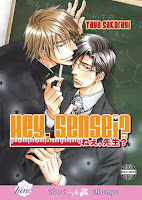
Hey, Sensei?

June 13, 2010 by Ash Brown

Creator: Yaya Sakuragi
U.S. publisher: Digital Manga
ISBN: 9781569700471
Released: April 2009
Original run: 2007

It is almost entirely the fault of Yaya Sakuragi’s Hey, Sensei? that I am now gladly suffering from an addiction to yaoi. Before Hey, Sensei?, I had never read yaoi. I had a basic understanding of the genre, but for whatever reason I had never tried it. (It actually really surprises me how long it took me to get around to reading any.) So, when I came across a review on Graphic Novel Reporter praising Hey, Sensei?, especially for not falling into some of the traps of the genre, I figured “Hey, why not? I gotta start somewhere.” I tracked down a copy with a little bit of difficulty and when it finally arrived I only allowed myself one chapter a day to make it last. Since then I’ve read plenty more yaoi and continue to do so but Hey, Sensei? remains one of my favorites—not just because it was my first yaoi manga, but because it is really quite good.

Hey, Sensei? actually contains two stories: the main story “Hey, Sensei?” which is four acts and an epilogue, and “Unbreakable Bones,” which is a one-shot. In “Hey, Sensei?”, high school math teacher Isa is taken aback when his ex-girlfriend’s younger brother, now one of his students, makes a pass at him during a review lesson. Isa can hardly take the situation seriously—what could Homura possibly see in a guy ten years older than him? The age difference will cause some difficulties, and they communicate terribly, but the two men have fallen hard for each other. In “Unbreakable Bones” two childhood friends are unexpectedly reunited after fourteen years. After growing apart, Yuji became a juvenile delinquent although he’s turned his life around and is now working in a ramen shop, while Manabu has become the small town’s local policeman. Yuji hates the idealized memories Manabu has of him, only to realize that he’s the one stuck in the past.

I really enjoy Sakuragi’s art style. Her men are distinctive and handsome and are unmistakably male. Her figures are elongated and angular, particularly noticeable in the hands and fingers and in the long, lanky legs when standing. These slightly odd proportions may bother some people, but I quite like the effect and love her character designs. Sakuragi also does a fantastic job with facial expressions, especially with the eyes; the characters don’t always come out and say what they’re feeling but it’s pretty apparent just by looking at them. She is also skilled in showing the same character at different ages and make the changes look natural while still being identifiable. One issue that I did have with the art was that the genitals were blurred out or erased. However, I’m not sure if this is the case in the original Japanese version or if the art has been censored for the United States which does happen. Either way, I found it distracting and feel that it calls more attention to itself that way.

While the stories in Hey, Sensei? may not be particularly original, Sakuragi makes up for it with the depth of her characters and their feelings for one another. Homura is immature, hot-tempered and brash but ultimately very sincere while Isa is inexperienced, sensitive and reserved but very capable of being stern when necessary; Yuji and Manabu’s relationship is also very sweet. The translation has an occasional awkward moment but overall is very good. In addition to Hey, Sensei? becoming a favorite, I have also become a huge fan of Yaya Sakuragi—I’ve also read and loved her Tea for Two series—and will pick up anything that she has worked on. However, Hey, Sensei? will always hold a special place for me. It’s one manga, yaoi or not, that I come back to again and again.

Filed Under: REVIEWS Tagged With: Digital Manga, Juné, manga, Yaya Sakuragi

Striding Folly by Dorothy L. Sayers: A-

June 11, 2010 by Michelle Smith

Book description:
Lord Peter Wimsey’s last three baffling cases all demonstrate his unique detection skills at their most spectacular. The enigma of a house numbered thirteen in a street of even numbers. An indignant child accused of theft. A dream about a game of chess that uncovers the true story behind a violent death. Each of the stories introduces a different side of the twentieth century’s most ingenious detective hero.

Review:
Short as it is, Striding Folly is still, by far, my very favorite of the Lord Peter short story collections.

Of the three stories collected herein, the title story is of the least consequence. It’s chiefly about a country gentleman who is suspected of killing a neighbor who planned to sell his land to developers. Lord Peter comes in at the end and prevents a miscarriage of justice. The title, incidentally, refers to the more tangible sort of folly, that is “a whimsical or extravagant structure built to serve as a conversation piece [or] lend interest to a view.” This one happens to be located on a property known as Striding. I had always thought it referred to a bit of foolishness engaged in while ambling about.

In “The Haunted Policeman” we get our first glimpse of Lord Peter since the events of Busman’s Honeymoon. It’s just over a year since his marriage to Harriet, and Peter has just passed a sleepless night while his wife gives birth to their first son. Once all is declared well, his spirits are high and he desires some conversation, even though it’s three in the morning. A passing policeman fits the bill and tells Peter the story of how he came to be accused of drunkenness by his sergeant. The tale involves a murdered man inside a house numbered thirteen on a street with only even-numbered residences. Again, Lord Peter serves as a force of vindication. Though the solution to the mystery is fairly ridiculous, the depiction of Peter is really excellent. I love the notion that, when fretting especially about Harriet, he takes solace in the company of the servants, who allow him to polish the silver.

The second charmer in the collection is “Talboys.” A further six years have passed since the previous story and Peter and Harriet’s family has grown to contain three sons. The eldest, Bredon, confesses at the outset to having stolen two peaches from a neighbor. Peter punishes him and the matter is considered closed until the following morning, when all of the peaches are discovered missing. A visiting houseguest—friend to Peter’s notoriously censorious sister-in-law—persists in suspecting Bredon while Peter rather easily proves his innocence. Again, the mystery is not really the point here. Instead we get a truly wonderful portrait of Peter as father—always willing to have a roll with the dog, let his children clamber all over him, and participate in mischief. I might wish for more emphasis on Harriet in this situation, but her happiness is never in doubt.

Of all the Lord Peter stories, only these last two have ever tempted me to come back and read them again. I had wondered how any short story could provide a sense of closure to the Wimsey series, but in fact it works perfectly, since little time and effort need be expended upon a mystery which is only of secondary importance. I will probably end up reading Thrones, Dominations in the near future but I certainly see the rationale behind stopping here, too.

Filed Under: Books Tagged With: Dorothy L. Sayers

Déjà Dead by Kathy Reichs: B

June 11, 2010 by Michelle Smith

From the back cover:
In the year since Temperance Brennan left behind a shaky marriage in North Carolina, work has often preempted her weekend plans to explore Quebec. When a female corpse is discovered meticulously dismembered and stashed in trash bags, Tempe detects an alarming pattern—and she plunges into a harrowing search for a killer. But her investigation is about to place those closest to her—her best friend and her own daughter—in mortal danger…

Note: There are many, many different covers available for this series. I picked the attractive British version.

Review:
For those who aren’t aware, this is the first volume in the series of mysteries upon which the TV series Bones is based. But if you’re looking for a story with banter/sexual tension between two attractive leads and a supporting cast of quirky scientists, then you’re going to be disappointed. The only real similarities are that the main character is named Temperance Brennan and that she is a forensic anthropologist.

The story is set in June 1994 in Montreal. Dr. Temperance (Tempe) Brennan is working for the Province of Quebec, examining skeletal remains of various types discovered around the city. When she notices some similarities between dismembered murder victims, she becomes convinced there’s a serial killer at work and must convince the detectives—one highly skeptical (Claudel) and one more receptive (Ryan)—of her theory. There’s a lot of emphasis on forensic technique and quite a bit of detail on Tempe’s findings; though the squeamish might find the latter too abundant, they are at least never relished. Meanwhile, the killer is annoyed by Tempe’s interference and begins leaving grisly presents in her yard and targeting her friends and family.

Déjà Dead is at its best when slathering on the suspense. Probably my favorite scene in the book is a wonderfully spooky one in which Tempe hears a weird noise at night and must investigate its origins. And there are some genuine surprises, too. I didn’t expect that any real harm would come to anyone Tempe cared about, and I liked that the culprit was not easily predicted. The characters are memorable and I really like her kitty, Birdie. My favorite line in the book relates to his grooming process: “Birdie focused on inter-toe spaces.”

At its worst, Déjà Dead puts its heroine into situations where I am supposed to be concerned for her peril but am instead annoyed. Why, oh why, do you go investigate a possible burial site on a dark and stormy night? Why go loiter in the seedy part of town in the wee hours to tail a creepy perv? I guess this is supposed to show how brave and determined she is and that my disapproval shows what a stodgy prig I am. Also, having Claudel’s resistance to the serial killer theory persist for so long in the face of overwhelming evidence doesn’t make much sense. He’s not a stupid man.

Despite my few complaints, I did enjoy Déjà Dead overall. By the end, Tempe is getting along especially well with Ryan and it seems possible that she and the intriguing Claudel might interact more compatibly in the future. Both of these developments are welcome, and compel me to seek out the second installment.

Filed Under: Books Tagged With: Kathy Reichs

Silent Möbius, Vol. 1

June 10, 2010 by Katherine Dacey

I like science fiction, I really do, but I have limited tolerance for certain tropes: futures in which all the women dress like strippers — or worse, fascist strippers — futures in which giant bugs menace Earth, and futures in which magic and technology freely commingle. Small wonder, then, that Kia Asamiya’s Silent Möbius has never been on my short list of must-read manga — it’s a festival of cheesecake, gooey monsters, and pistol-packing soldiers who, in a pinch, must decide whether to cast a spell or fire a rocket launcher at the enemy. Imagine my surprise when I discovered just how entertaining Silent Möbius turned out to be, gratuitous panty shots, bugs, and all.

When shorn of its mystical mumbo-jumbo and elaborate character histories, Silent Möbius is, at heart, a classic “They came from outer space!” tale. The story begins in 2026, when the Earth is under siege from interdimensional beings known as Lucifer Hawks, fierce, shape-shifting beasties that can assume a variety of forms: dragons, humans, oversize millipedes. Only a small team of elite agents — the so-called Attacked Mystification Police Force (AMP) — are capable of killing the Hawks with a mixture of up-to-the-minute technology and good old-fashioned sorcery. Where the Hawks are coming from and why remains mysterious — at least in the very early stages of the story — though we learn that one agent’s father may be responsible for opening the floodgate between Earth and the Hawks’ home world.

If the plot is pedestrian, Asamiya’s towering cityscapes and appealing character designs aren’t. To be sure, there are plenty of other sci-fi manga from the 1980s and 1990s peddling similar visions of a dysfunctional future paved in concrete and lit by neon, but Asamiya and his helpers pull off even the busiest compositions, bringing the urban scenes to energetic life; I dare you not to compare Silent Möbius with Blade Runner. (Someone else must have thought so, too, as Asamiya was tapped to do the manga adaptation of Star Wars: The Phantom Menace, yet another work that pilfered visuals from Scott’s ground-breaking film.) Then there are the character designs: each member of the AMP seems to be taking her grooming cues from the golden age of MTV, when video vixens came in two flavors: those with enormous feathered hair, and those with short, heavily lacquered locks. Better still, their uniforms consist of jackets with epaulets, neckties, and stirrup leggings. Who knew that 2026 would look suspiciously like 1986?

The other thing that won me over was the characters. I wouldn’t construe Asamiya’s decision to make the AMP a strictly female force as a nod to feminism; there are enough costume failures and half-clad characters to suggest Asamiya was as interested in satisfying the male gaze as he was in promoting the idea that women can kick ass just as well as men. At the same time, however, the ladies of AMP are tough and decisive, and don’t take guff from their male peers; in one of the series’ few nods to realism, the largely male police force resents the AMP for their ability to assume control of any investigation, grumbling about jurisdiction and occasionally baiting the women into fights.

Not that Silent Möbius doesn’t have moments of eyeball-rolling stupidity. Asamiya saddled his characters with borderline stripper names, for example: who but an adult entertainer would choose a name like “Rally Cheyenne” or “Katsumi Liqueur”? (Worse still: Katsumi’s father was Gilgelf Liqueuer, a name best suited for a drunken Hobbit.) Then, too, the series’ rather complicated mythology isn’t well explained; it’s the kind of universe where some characters kill aliens by drawing pentagrams on the ground while others use bazookas. And the cheesecake… sigh. I often had the sinking feeling that Asamiya was secretly auditioning to do a Pirelli Tire calendar with his frequent images of semi-naked women in provocative poses.

Costume failures and panty shots aside, I enjoyed the first volume of Silent Möbius well enough to continue with the series. It’s a fun, escapist romp that occasionally takes itself a little too seriously, but never bogs down in its own ridiculous mythology.

SILENT MÖBIUS: COMPLETE EDITION, VOL. 1 • BY KIA ASAMIYA • UDON ENTERTAINMENT • 200 pp. • RATING: OLDER TEEN (16+)

Filed Under: Manga, Manga Critic, REVIEWS Tagged With: Classic, Kia Asamiya, Post-Apocalyptic Sci-Fi, Silent Moebius, Udon Entertainment

Silent Möbius, Vol. 1

June 10, 2010 by Katherine Dacey

silentmobius1I like science fiction, I really do, but I have limited tolerance for certain tropes: futures in which all the women dress like strippers — or worse, fascist strippers — futures in which giant bugs menace Earth, and futures in which magic and technology freely commingle. Small wonder, then, that Kia Asamiya’s Silent Möbius has never been on my short list of must-read manga — it’s a festival of cheesecake, gooey monsters, and pistol-packing soldiers who, in a pinch, must decide whether to cast a spell or fire a rocket launcher at the enemy. Imagine my surprise when I discovered just how entertaining Silent Möbius turned out to be, gratuitous panty shots, bugs, and all.

When shorn of its mystical mumbo-jumbo and elaborate character histories, Silent Möbius is, at heart, a classic “They came from outer space!” tale. The story begins in 2026, when the Earth is under siege from interdimensional beings known as Lucifer Hawks, fierce, shape-shifting beasties that can assume a variety of forms: dragons, humans, oversize millipedes. Only a small team of elite agents — the so-called Attacked Mystification Police Force (AMP) — are capable of killing the Hawks with a mixture of up-to-the-minute technology and good old-fashioned sorcery. Where the Hawks are coming from and why remains mysterious — at least in the very early stages of the story — though we learn that one agent’s father may be responsible for opening the floodgate between Earth and the Hawks’ home world.

If the plot is pedestrian, Asamiya’s towering cityscapes and appealing character designs aren’t. To be sure, there are plenty of other sci-fi manga from the 1980s and 1990s peddling similar visions of a dysfunctional future paved in concrete and lit by neon, but Asamiya and his helpers pull off even the busiest compositions, bringing the urban scenes to energetic life; I dare you not to compare Silent Möbius with Blade Runner. (Someone else must have thought so, too, as Asamiya was tapped to do the manga adaptation of Star Wars: The Phantom Menace, yet another work that pilfered visuals from Scott’s ground-breaking film.) Then there are the character designs: each member of the AMP seems to be taking her grooming cues from the golden age of MTV, when video vixens came in two flavors: those with enormous feathered hair, and those with short, heavily lacquered locks. Better still, their uniforms consist of jackets with epaulets, neckties, and stirrup leggings. Who knew that 2026 would look suspiciously like 1986?

The other thing that won me over was the characters. I wouldn’t construe Asamiya’s decision to make the AMP a strictly female force as a nod to feminism; there are enough costume failures and half-clad characters to suggest Asamiya was as interested in satisfying the male gaze as he was in promoting the idea that women can kick ass just as well as men. At the same time, however, the ladies of AMP are tough and decisive, and don’t take guff from their male peers; in one of the series’ few nods to realism, the largely male police force resents the AMP for their ability to assume control of any investigation, grumbling about jurisdiction and occasionally baiting the women into fights.

Not that Silent Möbius doesn’t have moments of eyeball-rolling stupidity. Asamiya saddled his characters with borderline stripper names, for example: who but an adult entertainer would choose a name like “Rally Cheyenne” or “Katsumi Liqueur”? (Worse still: Katsumi’s father was Gilgelf Liqueuer, a name best suited for a drunken Hobbit.) Then, too, the series’ rather complicated mythology isn’t well explained; it’s the kind of universe where some characters kill aliens by drawing pentagrams on the ground while others use bazookas. And the cheesecake… sigh. I often had the sinking feeling that Asamiya was secretly auditioning to do a Pirelli Tire calendar with his frequent images of semi-naked women in provocative poses.

Costume failures and panty shots aside, I enjoyed the first volume of Silent Möbius well enough to continue with the series. It’s a fun, escapist romp that occasionally takes itself a little too seriously, but never bogs down in its own ridiculous mythology.

SILENT MÖBIUS: COMPLETE EDITION, VOL. 1 • BY KIA ASAMIYA • UDON ENTERTAINMENT • 200 pp. • RATING: OLDER TEEN (16+)

Filed Under: Manga Critic Tagged With: Classic, Kia Asamiya, Silent Moebius, Udon Entertainment

Off the Shelf: Second Edition

June 9, 2010 by MJ and Michelle Smith 20 Comments

Welcome to our second edition of Off the Shelf with MJand Michelle!

Joining me again is Soliloquy in Blue‘s Michelle Smith. This week, we cover a pretty varied range of titles, from Tokyopop, Yen Press, CMX, and Viz Media. I’ve got all shonen on the brain, thanks to this month’s Shonen Sundays, while Michelle takes a more well-rounded approach.

MJ: So, Michelle, thanks for joining me here again! What’s your first item for tonight’s discussion?

MICHELLE: How about a trip to bishie land with Alice in the Country of Hearts? Actually, I feel somewhat guilty referring to the series as “bishie land” because, while that’s technically an apt description, there’s really a lot more going on here than I ever would have expected. I read the third volume this week and enjoyed it quite a bit. …

Read More

Filed Under: OFF THE SHELF Tagged With: off the shelf, pandora hearts

Scanlations & Shipping News

June 9, 2010 by MJ 12 Comments

Happy Humpday everyone! To start the day off, here’s a quick round-up of what’s been going on over the past few days at Examiner.com.

First, a link to my weekly report on what’s shipping to the Boston area this week: What’s new at Comicopia, June 9, 2010. The list includes a number of my favorites, for instance, Very! Very! Sweet, an adorable girls’ manhwa title from Yen Press featuring a teen who’s willing to pose as another teen’s girlfriend (typical romance plot) in exchange for a really nice cat tower (not so typical). Yes, I am that easily pleased. But c’mon. A cat tower. So adorable.

On the more serious side, this week’s haul includes the latest volume of Viz’s Children of the Sea, one of my favorite titles of 2009. To quote from my review:

“Igarashi’s art is absolutely stunning. With an ethereal, …

Read More

Filed Under: NEWS Tagged With: examiner.com, scanlations

Manhwa Monday: June Preview

June 8, 2010 by MJ Leave a Comment

Welcome to another Manhwa Monday! With June now upon us, it’s time to take a look at what’s coming out in print this month. It’s a fairly lean month for manhwa, but there are some real goodies in the bunch.

First of all, from NETCOMICS, comes the debut print volume of There’s Something About Sunyool, the latest from Youngran Lee, author of Click and a host of other NETCOMICS titles. Like 100% Perfect Girl, Sunyool is being released simultaneously in the US and Korea. This kind of arrangement is something Japanese manga fans have been begging for, yet NETCOMICS seems to have received very little attention for their trouble.

And speaking of 100% Perfect Girl, its final volume (11) comes out in print this month as well. Though this title is not a favorite of mine, it (like Sunyool) is yet another manhwa series for grownup women in NETCOMICS’ catalogue, something else they’ve been very generous about with not much fanfare. For those who still haven’t noticed, check out these titles, plus 10, 20, and 30, Full House, Please, Please Me, and Small-Minded Schoolgirls.

Yen Press also offers up two titles this month, both personal favorites. First, volume seven of Very! Very! Sweet, a quirky, adorable sunjeong series that easily lives up to its name. Who doesn’t love a girls’ comics heroine whose most defining traits are extreme frugality and a love of cats? Also quirky and adorable is volume four of 13th Boy, the only comic I know of featuring a talking cactus who occasionally transforms into a love-struck teen boy.

This week in reviews, Julie Opipari looks at volume one of Raiders (Yen Press) at Newsarama. Susan S. checks out volume six of Very! Very! Sweet at Manga Jouhou. And at Comic Attack, Kristin Bomba reviews volume four of Sarasah.

Also, some very sad news. Last week, Francis Metcalfe, known online as Tiamat’s Disciple, passed away after a long battle with cancer. TD was one of just a handful of manga reviewers who regularly reviewed manhwa, and he was linked to often from this column. He will be greatly missed. Brigid Alverson has more information at MangaBlog. You can also find my short, obituary-like writeup at Examiner.com.

That’s all for this week. Don’t forget to read up for this month’s Manhwa Moveable Feast!

Is there something I’ve missed? Leave your manhwa-related links in comments!

Filed Under: DAILY CHATTER, Manhwa Monday Tagged With: manhwa monday

In the Teeth of the Evidence and Other Mysteries by Dorothy L. Sayers: B

June 8, 2010 by Michelle Smith

From the back cover:
A fleeing killer’s green mustache. A corpse clutching a note with misplaced vowels. A telephone with the unmistakable ring of death. A hopeful heir’s dreams of fortune done in when nature beats him to the punch. A playwright’s unwatered-down honor that is thicker than blood.

In each case, the murder baffles the local authorities. For his Lordship and the spirited salesman-sleuth Montague Egg, a corpse is an intriguing invitation to unravel the postmortem puzzles of fascinating falsehoods, mysterious motives, and diabolical demises.

Review:
In the Teeth of the Evidence and Other Mysteries is a collection of short stories, not all of them technically mysteries. Two feature Lord Peter Wimsey, five star Montague Egg, and the other eleven tell of wanted criminals, murderous relations, unpleasant smells, and more!

The two Lord Peter stories, “In the Teeth of the Evidence” and “Absolutely Elsewhere,” are not very exciting. They’re better than some of the Wimsey stories in previous collections, but coming off a novel like Busman’s Honeymoon in which Peter’s character is explored in greater depth than ever before, they seem incredibly lacking by comparison. It’s like we’re seeing a mere shadow of the person we’ve come to know, and anyone could have taken his place without altering the story one bit.

Montague Egg’s stories are somewhat more entertaining, although they share the common trait of ending abruptly. The focus here is on Egg’s cleverness, and once the clues have been interpreted to work out the method of the crime or the culprit, the stories tend to just stop. I suppose it isn’t really necessary to show the criminal being apprehended, and perhaps this would grow repetitive after a while, but the suddenness of the conclusions is jarring all the same.

The best and worst of the collection can be found in the stories with no detective character. Standouts include “The Milk-Bottles,” in which a week’s worth of milk bottles accumulating on a doorstep leads to suspicions of a terrible crime, and “Dilemma,” in which various tough decisions of the “which one would you save?” variety are debated. This last isn’t even a mystery at all, but just a really good story with a nice ending.

Several of the stories have amusing endings, in fact, though just as many have predictable ones, and a few seem absolutely determined never to end. One of the most tiresome for me was “Nebuchadnezzar,” which features a party attendee who becomes convinced that a group playing charades is about to reveal the fact that he murdered his wife. I think we spend too much time in his head as he freaks out, and it becomes annoying. Similarly, parts of “The Inspiration of Mr. Budd,” about a hairdresser who realizes that his customer is a wanted criminal, are irritating as the protagonist dithers about what to do, though this one redeems itself in the end.

While nowhere near as good or satisfying as a Wimsey novel, and barely offering anything about that noble sleuth, In the Teeth of the Evidence is still notable for containing some very good short stories by Sayers. I’m glad I read it.

Filed Under: Books Tagged With: Dorothy L. Sayers

13th Boy, Vols. 1-4

June 8, 2010 by Katherine Dacey

Like Water for Kimchi — that’s how I would describe 13th Boy, a weird, wonderful Korean comedy with a strong element of magical realism.

The plot is standard sunjong fodder: Hee-So, a teen with a flair for the dramatic, believes that the handsome Won-Jun is destined to be her twelfth and last boyfriend, the man with whom she’ll spend the rest of her life. Though Won-Jun accepts her initial confession of love — she drags him on television to ask him on a date — he dumps her just one month later, sending Hee-So into a tailspin: how could her destiny walk away from her? She then resolves to take fate into her own hands, launching an aggressive campaign to win him back: she stalks Won-Jun, looking for any opportunity to be alone with him; she joins the Girl Scouts so that she can go on a camping trip with him (he’s a Boy Scout); she even befriends her romantic rival Sae-Bom, defending Sae-Bom from bullies and risking her life to rescue Sae-Bom’s beloved stuffed rabbit from a burning building. In short: Hee-So is a girl on a mission, dignity be damned.

Our first clue that 13th Boy isn’t just another dreary comedy about a girl going to extremes to nab a cute boy is the introduction of Beatrice, Hee-So’s sidekick. Beatrice is a talking cactus (no, really, a talking cactus) who transforms into a handsome, if somewhat androgynous, teen whenever there’s a full moon. I don’t know too many storytellers who could make something as cracky as a lovelorn saguaro work, but SangEun Lee presents Beatrice matter-of-factly, as if every self-respecting girl had a walking, talking man-plant living in her bedroom. If anything, Beatrice functions as a nifty surrogate for the reader, voicing concern about Hee-So’s fanatical commitment to Won-Jun and urging Hee-So to focus her attention elsewhere.

Our second clue is the revelation that one of Hee-So’s classmates has magical powers: Whie-Young can change the weather, make himself invisible, walk through walls, and bring inanimate objects to life. Though Whie-Young’s mother and grandmother have warned him not to use his abilities, he persists, hoping to prove the depth of his feelings for Hee-So. (Yes, 13th Boy is one of those comedies in which every character is head-over-heels for the wrong person.) Those rescues and romantic acts come at a steep price, as each spell shortens Whie-Young’s life; if he doesn’t stop playing Hee-So’s guardian angel, he’ll die a very young man.

If the fantasy elements enliven a tepid premise, the story’s more down-to-earth aspects — especially Hee-So’s relationship with her female friends — give 13th Boy some real emotional heft. Hee-So’s best buddy, Nam-Joo, is a welcome addition to the cast, a tough tomboy who’s fiercely loyal to Hee-So yet takes a dim view of her pal’s romantic obsession. Their squabbles and pep talks have a ring of truth to them, even if Lee contrives some ridiculous scenarios for the girls to resolve their differences. (I don’t know about you, but I never settled a score with anyone by challenging them to a dodge ball game or judo match.) Sae-Bom, too, turns out to be a more interesting, complicated character than she first appears; as the story unfolds, we realize that she has the emotional IQ of a grade schooler but the physical appearance and intellect of a teenager, making her an object of scorn among the class alpha girls. If Hee-So’s motivation for defending Sae-Bom was initially less-than-pure (a fact she readily concedes), she develops a genuine sense of empathy for Won-Jun’s friend — one of our first clues that Hee-So’s boy-crazed exterior belies a more compassionate, less narcissistic nature.

Lee’s crisp layouts and cute character designs are an excellent complement to her storytelling. She uses bold, strong lines to define her characters, shying away from heavy use of screentone; the white of the page plays just as important a role in defining space and volume as the ink, making her designs pop. (Beatrice is a notable exception, as his cactus skin is toned dark grey.) Though Hee-So and Won-Jun have enormous, doll-like eyes, Lee’s grasp of anatomy is solid; her characters have the rangy, slightly awkward bodies of fifteen-year-olds, rather than the hyper-stylized physiques of the Bring It On! gang. Only the backgrounds disappoint, a mish-mash of traced architectural elements and Photoshopped images that seem a little too generic for such a whacked-out story. (Or maybe that’s the genius of the bland background art? I can’t decide.)

I’ll be honest: I went into 13th Boy knowing about Beatrice, which predisposed me to overlook some of the first volume’s groan-worthy moments. And as much as I love Beatrice — and really, what’s not to like about a chatty cactus? — what really won me over was the deft way in which SangEun Lee balanced the series’ magical elements with its more realistic ones, creating a unique story in which magical acts reveal character and everyday acts affect change.

Review copy of volume 4 provided by the publisher.

13TH BOY, VOLS. 1-4 • BY SANG-EUN LEE • YEN PRESS • RATING: TEEN

Filed Under: Manga Critic, Manhwa, REVIEWS Tagged With: manhwa, Romance/Romantic Comedy, yen press

13th Boy, Vols. 1-4

June 8, 2010 by Katherine Dacey

13thboy_1Like Water for Kimchi — that’s how I would describe 13th Boy, a weird, wonderful Korean comedy with a strong element of magical realism.

The plot is standard sunjong fodder: Hee-So, a teen with a flair for the dramatic, believes that the handsome Won-Jun is destined to be her twelfth and last boyfriend, the man with whom she’ll spend the rest of her life. Though Won-Jun accepts her initial confession of love — she drags him on television to ask him on a date — he dumps her just one month later, sending Hee-So into a tailspin: how could her destiny walk away from her? She then resolves to take fate into her own hands, launching an aggressive campaign to win him back: she stalks Won-Jun, looking for any opportunity to be alone with him; she joins the Girl Scouts so that she can go on a camping trip with him (he’s a Boy Scout); she even befriends her romantic rival Sae-Bom, defending Sae-Bom from bullies and risking her life to rescue Sae-Bom’s beloved stuffed rabbit from a burning building. In short: Hee-So is a girl on a mission, dignity be damned.

…

Read More

Filed Under: Manga Critic Tagged With: yen press

Mijeong

June 8, 2010 by MJ 2 Comments

Mijeong | By Byun Byung-Jun | Published by NBM Publishing – An angel finds his way to earth, drawn to a world that seems to embody the eternal sadness he carries with him, and longing for someone who might understand his pain. He finds this in a young woman he spots along the street, and in a moment of impulsive rebellion takes it upon himself to save her from being struck by an oncoming car. It is a moment of sharp ecstasy for the angel, who is able to feel both the woman’s deep despair and her great capacity to love as he embraces her. By doing this, however, he has doomed them both to a life of suffering, “a rending love for which I can do nothing.” “Her name is Mijeong,” he says, “and I have no name yet, here.” It is here that the tale ends–the title story in Byun Byung-Jun’s second anthology of short manhwa, Mijeong–a beautiful introduction to this melancholic collection.

Though the quality of its individual tales is somewhat uneven, Mijeong as a whole promises a great future for the artist, whose insight into his deeply lost and broken characters is nearly as stunning as his often impressionistic art style. The collection wanders in and out between true melancholy and dark humor, sometimes with more success than others. The volume’s second story, “Yeon-du, Seventeen Years Old,” the intersecting tales of an emotionally damaged young woman seeking revenge for the death of a childhood love and a desperately lonely older man, is one of its strongest and most thoughtful. Just as effective is the darkly humorous story, “Courage, Grandfather!” in which a girl expresses her gratitude to a boy who rescued her from a brutal attack, viewed entirely through the filter of a cat’s unrequited love. Another of the volume’s best shorts, “Utility,” (story by Yun In-wan) about a group of students dispassionately pondering the most effective way to dispose of a dead sibling’s body, is starkly brilliant yet quite difficult to read, thanks to its subject matter. On the flip side, “202 Villa Siril,” a dark comedy about a manhwa artist with a disturbing power, feels predictable and flat.

A recurring theme throughout the anthology is its characters’ enslavement to their pasts. “For me, only my past has any meaning,” says young Yeon-du in the story named for her. What keeps this book from slipping into irreparable despair, however, is that this isn’t only a bad thing. Byun Byung-Jun’s characters are both burdened and enriched by their histories, an insight that rings inescapably true. Even when longing for the past leaves characters bleeding to death in the grass (as in the grimly abrupt “Song for You”) there is an unmistakable sense of hope lingering around the edges of most of these stories—a haunting paradox that helps maintain the volume’s momentum.

Though the stories’ characters are almost uniformly touching, what is notable above all is the persistent sense of place. The volume’s first story sets the tone clearly with the cold, unfeeling city, filthy with despair, indifferent to its people’s gaping, open wounds. Whether it is the people who have created their environment or the other way around is a question in the background of each story—one that is destined to remain unanswered.

Byun Byung-Jun’s art varies throughout the collection, from the moody watercolor of “Song for You” to the sketchy photorealism of “Yeon-du, Seventeen Years Old,” though in all cases the art feels unsettled and immature. This is not so much a criticism as an observation, as there is a pervading sense that one is previewing the work of an artist who will inevitably achieve importance in the medium. In a note at the end of the book, the artist confesses that the work reflects his own state of mind. “Eternally hesitant, I feel like I’m stuck at an impasse.” What the work truly reveals, however, both in its storytelling and style, is a restless mind on the brink of true brilliance—something for all of us to look forward to.

Simultaneously dark and hopeful, Mijeong‘s inconsistency and fretful tone may betray the early weaknesses of its creator, but its insight and uncommon beauty promise much greater things to come.

Review copy provided by the publisher. Review originally published at PopCultureShock.

Filed Under: Manhwa Bookshelf, MANHWA REVIEWS Tagged With: NBM/Comics Lit

  • « Go to Previous Page
  • Page 1
  • Page 2
  • Page 3
  • Page 4
  • Page 5
  • Go to Next Page »
 | Log in
Copyright © 2010 Manga Bookshelf | Powered by WordPress & the Genesis Framework