• Skip to primary navigation
  • Skip to main content
  • Skip to primary sidebar
  • Home
  • About Us
    • Privacy Policy
    • Comment Policy
    • Disclosures & Disclaimers
  • Resources
    • Links, Essays & Articles
    • Fandomology!
    • CLAMP Directory
    • BlogRoll
  • Features & Columns
    • 3 Things Thursday
    • Adventures in the Key of Shoujo
    • Bit & Blips (game reviews)
    • BL BOOKRACK
    • Bookshelf Briefs
    • Bringing the Drama
    • Comic Conversion
    • Fanservice Friday
    • Going Digital
    • It Came From the Sinosphere
    • License This!
    • Magazine no Mori
    • My Week in Manga
    • OFF THE SHELF
    • Not By Manga Alone
    • PICK OF THE WEEK
    • Subtitles & Sensibility
    • Weekly Shonen Jump Recaps
  • Manga Moveable Feast
    • MMF Full Archive
    • Yun Kouga
    • CLAMP
    • Shojo Beat
    • Osamu Tezuka
    • Sailor Moon
    • Fruits Basket
    • Takehiko Inoue
    • Wild Adapter
    • One Piece
    • After School Nightmare
    • Karakuri Odette
    • Paradise Kiss
    • The Color Trilogy
    • To Terra…
    • Sexy Voice & Robo
  • Browse by Author
    • Sean Gaffney
    • Anna Neatrour
    • Michelle Smith
    • Katherine Dacey
    • MJ
    • Brigid Alverson
    • Travis Anderson
    • Phillip Anthony
    • Derek Bown
    • Jaci Dahlvang
    • Angela Eastman
    • Erica Friedman
    • Sara K.
    • Megan Purdy
    • Emily Snodgrass
    • Nancy Thistlethwaite
    • Eva Volin
    • David Welsh
  • MB Blogs
    • A Case Suitable For Treatment
    • Experiments in Manga
    • MangaBlog
    • The Manga Critic
    • Manga Report
    • Soliloquy in Blue
    • Manga Curmudgeon (archive)

Manga Bookshelf

Discussion, Resources, Roundtables, & Reviews

Archives for June 2010

MMF: Wednesday Update!

June 23, 2010 by MJ 1 Comment

June’s Manhwa Moveable Feast has just begun its third day and things look lively! Here’s a quick rundown of the most recent contributions from participants.

First, from Erica Friedman at Okazu (hosted here for lack of yuri) comes a review of the third book in the Color series, The Color of Heaven.

While Erica praises the book’s artwork, she takes issue with its metaphoric vision of a woman as an eternally rooted being with no purpose other than to wait for a man to distinguish her from the lot.

“I felt that the language of the book was both very beautiful and awkward. Laced heavily with unrealistic platitudes that are increasingly heaped upon our heads, many of them about the “lot of women,” I began to find the dialogue burdensome. Women, we are told, are plain trees in the winter that wait …

Read More

Filed Under: DAILY CHATTER, Manhwa Bookshelf Tagged With: MMF

The Laughing Cavalier by Baroness Orczy: B

June 22, 2010 by Michelle Smith

From the back cover:
The year is 1623, the place Haarlem in the Netherlands. Diogenes—the first Sir Percy Blakeney, the Scarlet Pimpernel’s ancestor—and his friends Pythagoras and Socrates defend justice and the royalist cause. The famous artist Frans Hals also makes an appearance in this historical adventure. Orczy maintains that Hals’ celebrated portrait of The Laughing Cavalier is actually a portrayal of the Scarlet Pimpernel’s ancestor.

Review:
What a perfectly abysmal blurb that is. Egads.

The Laughing Cavalier, one of two prequels to The Scarlet Pimpernel, tells the story of a penniless foreign adventurer who passed down his exceptional qualities—such as “careless insouciance”—to his descendant, Sir Percy Blakeney, the hero of the more famous work. This fellow, a half-English rogue enjoying the life of a vagabond in The Netherlands, goes by the name of Diogenes and has for companions/minions two fellows calling themselves Pythagorus and Socrates. When Gilda Beresteyn, sister of one man and former love of another who together conspire to kill the current ruler, overhears of these plans, Diogenes and his men are hired to spirit her away so that the assassination atttempt may proceed without her interference.

What follows is essentially a lot of what one would expect. Diogenes’ swaggering merriment (and, indeed, I ought to have counted the number of times his countenance, eyes, or laugh are described as “merry,” because the total would easily be in the triple digits) and saucy attitude make him the perfect adventure hero, capable of deftly handling many abrupt reversals in his fortunes. Gilda is the feisty and sensible noblewoman who is indignant at her plight at first but eventually comes to see that her captor is far more honorable than he originally seemed. The would-be traitor, Stoutenburg, is reduced to impotent fury by Diogenes’ constant smirking and eventually has his plans ruined and loses Gilda, whom he had planned to eventually woo back to his side.

As a story, the plot is not very deep or complicated. It takes fully one quarter of the book to simply arrange the details of the caper, making one antsy for Gilda to just get abducted already! Once she is, most of the rest of the book is comprised of simply moving her from place to place. The conclusion is fairly predictable, too. That the two leads end up together is neither a surprise nor a spoiler—this is a story leading to eventual parentage, after all—but it’s still fun to read their banter, even though Gilda’s sudden realization of her feelings comes rather out of the blue. I could very easily picture their relationship unfolding on screen—perhaps because it’s not exactly a new idea. (The Princess Bride comes to mind.)

I also really enjoyed the setting. I don’t think I’ve ever read a book taking place in The Netherlands before, so all the snowy landscapes, misty windmills, and icy rivers fit for nocturnal journeys on ice skates offered something new and different, even if the story itself did not. Also, there were tons of nifty Dutch honorifics and swear words! If you ever want to insult a Dutchman, apparently all you need do is call him a “plepshurk.”

In the end, I enjoyed The Laughing Cavalier and will read the follow-up volume, The First Sir Percy, at some point in the near future.

This review has been crossposted to the Triple Take blog, where K and I did a “double take.” You can find her review here.

Filed Under: Books, Historical Fiction, Triple Take Tagged With: Baroness Orczy

MMF Guest Review: The Color of Heaven

June 22, 2010 by MJ 6 Comments

Review by Erica Friedman

In any series focusing on the passage of a girl from childhood to womanhood, the focus almost invariably tends to be on the relationship between the young woman and her partner. Their recognition of their interest in and eventually, desire for, one another takes up a great deal of the narrative.

In Color of Heaven, Ehwa’s journey to adulthood is told through the shifting relationship she has with her mother – a woman who has chosen the same fate as the one Ehwa now embraces. They both sit and wait for the man they love to return to them to give their lives meaning.

Ehwa, at the opening of the book, has already matured beyond her best friend and peer. While the other girl speaks of the men she might have and the wedding she aspires to, Ehwa has already set that phase aside…

Read More

Filed Under: DAILY CHATTER, Manhwa Bookshelf Tagged With: MMF

Manhwa Monday: MMF Begins!

June 21, 2010 by MJ 1 Comment

Today marks the beginning of June’s Manga Moveable Feast, which is actually a Manhwa Moveable Feast, hosted right here! I start things off with an introduction to the series, Kim Dong Hwa’s “Color” Trilogy. Though this story of a young girl’s coming-of-age is Eisner-nominated (the first manhwa series to become so) it’s been a controversial one among reviewers, so this Feast is sure to be full of interesting (and perhaps heated) discussion.

Daniella Orihuela-Gruber chimes in first, with a review of the full series at her blog, All About Manga. Daniella takes issue with both the series’ (literally) flowery language and its portrayal of the lead character’s easy relationship with her single mother. The review is heavily personalized, mainly due to what Daniella sees as similarities between her own family and Ehwa’s.

“While I realize that Ehwa and I live in much different times…

Read More

Filed Under: Manhwa Bookshelf, Manhwa Monday Tagged With: manhwa monday, MMF

MMF: An Introduction to the Color Trilogy

June 21, 2010 by MJ 8 Comments

“I think that the process of a girl becoming a woman is one of the biggest mysteries and wonders of life.” – Kim Dong Hwa

Kim Dong Hwa’s Eisner-nominated “Color” trilogy, The Color of Earth, The Color of Water, and The Color of Heaven (published in English by First Second), follows the life of Ehwa, a young girl in a rural Korean village, as she grows from childhood to adulthood. According to Kim, he began writing The Color of Earth after sitting with his sick mother and thinking about what she might have looked like over the years, tracing her life back to her youth. The series focuses heavily on Ehwa’s sexual awakening, from a child’s curiosity to the confusion of young adulthood, as well as her relationship with her widowed mother.

The books are filled with poetic language, particularly flower metaphors, as Ehwa’s mother tries to explain to her the nature of men and women. …

Read More

Filed Under: DAILY CHATTER, Manhwa Bookshelf

Black Butler, Vols. 1-2

June 20, 2010 by MJ 6 Comments

Black Butler, Vols. 1-2
By Yana Tobaso
Published by Yen Press
Rated OT (Older Teen)

Sebastian Michaelis is the dashing, fantastically capable, devoted butler of the Phantomhive family, whose only son (junior high-aged Ciel) has commanded the estate and its businesses since the demise of his parents. Sebastian performs his duties with super-human strength and skill, able to create elaborate chocolate sculptures and fight off scores of assassins in a single breath. “I am the butler of the Phantomhive family. It goes without saying that I can manage something as trivial as this,” is the standard line (with variations).

The story begins as a comic romp, with Sebastian being forced to employ his outrageous skills in order to compensate for the incompetence of the rest of the estate’s bumbling staff–a group of characters so grating it’s incredibly difficult to find them funny. This circumstance is only made worse by the section following, in which Ciel’s overly exuberant young fiancée makes the irritating staff seem downright loveable. Fortunately, just as one might be tempted to toss the book across the room in a fit of frustration, things begin to look up.

As it turns out, Sebastian isn’t super-human. He’s not human at all, but rather a devil who has entered into a contract with Ciel. Though he’s bound to serve Ciel devotedly until the end of his life, Ciel’s soul will then be Sebastian’s for eternity, a shift into darkness that finally brings the series to life. Sebastian’s sinister nature not only makes him more compelling as a character, but it also humanizes Ciel, who suddenly becomes a complex victim instead of just a cold, soulless pre-teen. The series’ second volume improves on this further, thanks in no small part to the fact that its primary adventure takes place away from the Phantomhive estate and its maddeningly dim employees.

The story’s action is elegant and beautifully-drawn, and it is the action that provides most of the series’ highlights, at least in the first two volumes. Even Tobaso’s humor works best in these moments, lending genuine whimsy to Sebatian’s battles as he takes out hired gunmen with kitchen forks and knives. Unfortunately, some of the series’ other elements are less whimsical than disturbing.

Black Butler runs in Square Enix’s Monthly GFantasy, a magazine filled with quite a number of very pretty shonen manga drawn by women, such as Jun Mochizuki’s Pandora Hearts, Yuhki Kamatani’s Nabari no Ou, Peach Pit’s Zombie-Loan, Naked Ape’s Switch, and Yun Kouga’s Gestalt. That these series are intended to appeal to female readers seems plain, with their bishonen character designs, elaborate costuming, and frequent BL overtones.

Unfortunately, Black Butler‘s specialty is not just BL but shota, which makes Sebastian even creepier and not at all in a good way. Though there may be nothing essentially inappropriate about Sebastian associating Ciel’s sleeping face with the soft pads of a cat’s paw, there’s an authorial wink to the audience that feels somewhat less than pure.

That said, though Black Butler gets off to a very slow and fairly vapid start, there is a sense that a deeper story lies within. With Tobaso’s pretty artwork as pleasant accompaniment, it may be worth sticking around just to see.

Review copies provided by the publisher. This review is a part of Shonen Sundays, a collaborative project with Michelle Smith.

Filed Under: MANGA REVIEWS Tagged With: black butler, shonen sunday

Countdown to Manhwa Moveable Feast!

June 18, 2010 by MJ 5 Comments

With Monday quickly approaching, here’s a quick reminder to all that the Manhwa Moveable Feast is nearly upon us!

Let’s review the basics: This month’s series is Kim Dong Hwa’s Eisner-nominated trilogy, The Color of Earth, The Color of Water, and The Color of Heaven, published in English by First Second.

The Manga Moveable Feast is open to participation by anyone. No blog? No problem! Just email me your submission anytime between Monday, June 21st and Wednesday, June 30th, and I’ll post it on your behalf! Join the new MMF Google Group for updates. Also, feel free to leave any questions here in comments.

I’ll make an introductory post to the series on Monday, June 21st and let things go from there. Don’t forget to email or direct message me a link to your post! …

Read More

Filed Under: DAILY CHATTER, Manhwa Bookshelf Tagged With: announcements, MMF

Gankutsuou: The Count of Monte Cristo, Vols. 1-3

June 18, 2010 by Katherine Dacey

The Count of Monte Cristo, arguably Alexander Dumas’ best novel, is a big, sprawling beast, stuffed to the gills with characters, subplots, secret identities, suicides, and dramatic confrontations; small wonder that GONZO felt it would provide a solid foundation for a twenty-four episode anime. The series debuted to critical acclaim in 2004, thanks largely to its arresting visuals (designer Anna Sui had a hand in creating the characters’ elaborate costumes) and its dramatic soundtrack, which employed key musical themes from Donizetti’s Lucia di Lammermoor (the gold standard for operatic madness scenes) and Tchaikovsky’s Manfred Symphony (a piece of program music inspired by Byron’s poem of the same name).

The three-volume manga offers a darker, more focused presentation of the anime’s main plot while taking greater liberties with the source material. Like the anime, the manga follows the basic contours of Dumas’ novel: Edmond Dantes, an honest, hardworking sailor, is falsely imprisoned for treason, serving nearly fourteen years at the remote Chateau d’If before escaping and reinventing himself as the Count of Monte Cristo, a dashing aristocrat who uses his social standing, good looks, and vast fortune to exact revenge on the three friends who betrayed him. Though Dumas tells the story in a chronological fashion, Mahiro Maeda begins Gankutsuou at the novel’s midpoint, relating the circumstances of Dantes’ trial and punishment in several extensive flashbacks. Maeda adds a few ruffles and flourishes of his own, moving the action to the year 5053, transforming the Count into a space vampire — hard time will do that to a man, I’m told — and adding a faintly homoerotic element to the relationship between the Count and Albert de Morcerf, the son of Edmond’s former fiancee Mercedes.

As anime-to-manga adaptations go, Gankutsuou is better than average. Maeda wins points for employing a visual style that evokes the look of the anime without slavishly copying it, and for wisely limiting the scope of the story to the Count’s take-down of Gerard de Villefort, the ambitious prosecutor responsible for framing him. Volume one follows the anime closely, depicting the first meeting between the Count and Albert, and documenting how the Count insinuates himself into Parisian society. From there, however, the manga follows a somewhat different track, revealing both the full extent of Villefort’s duplicity and the true nature of Gankutsuou, the demon who possessed Edmon Dantes’ body while he was still imprisoned at the Chateau d’If (here played by a remote, unmanned space station).

The flashbacks to Dantes’ imprisonment are rendered in sensual, swirling lines suggestive of a Van Gogh painting; many panels verge on the abstract, taking the story out of the realm of the literal into a feverish dream world that effectively dramatizes Dantes’ emotional anguish without resorting to cliche imagery. Though these scenes are an inspired addition to the story (nothing like them appears in the anime), the manga’s big denouement is not. Maeda greatly simplifies the Count’s elaborate revenge on Villefort, trimming several key players from the drama and contriving a ludicrous love scene between Villefort’s second wife and his daughter Valentine that has as much to do with real Sapphic desire as a Budweiser commercial starring blond twins. It’s a shame that Maeda diverged so greatly from the original, as the Count’s revenge on Villefort is one of the novel’s most gripping subplots, filled with double-crosses, estrangements, murders (by poison, no less), and a secret love child who plays an instrumental role in destroying the trust between Villefort and Danglars, another key player in the original conspiracy against Dantes.

Folks who haven’t seen the anime or read The Count of Monte Cristo are probably the best audience for this series, as they won’t be encumbered with expectations about how events should unfold. Anyone with a strong investment in the anime or the novel, however, is likely to find this chamber piece an unsatisfying effort to represent the full complexity and drama of Dumas’ seminal work.

GANKUTSUOU, VOLS. 1-3 • BY MAHIRO MAEDA AND YURI ARIWARA • DEL REY • RATING: OLDER TEEN (16+)

Filed Under: Manga, Manga Critic, REVIEWS Tagged With: Alexander Dumas, Anime Adaptation, del rey, Gankutsuou, Sci-Fi

Gankutsuou: The Count of Monte Cristo, Vols. 1-3

June 18, 2010 by Katherine Dacey

The Count of Monte Cristo, arguably Alexander Dumas’ best novel, is a big, sprawling beast, stuffed to the gills with characters, subplots, secret identities, suicides, and dramatic confrontations; small wonder that GONZO felt it would provide a solid foundation for a twenty-four episode anime. The series debuted to critical acclaim in 2004, thanks largely to its arresting visuals (designer Anna Sui had a hand in creating the characters’ elaborate costumes) and its dramatic soundtrack, which employed key musical themes from Donizetti’s Lucia di Lammermoor (the gold standard for operatic madness scenes) and Tchaikovsky’s Manfred Symphony (a piece of program music inspired by Byron’s poem of the same name).

…

Read More

Filed Under: Manga Critic Tagged With: Alexander Dumas, del rey, Seinen

Off the Shelf: Episode three

June 16, 2010 by MJ and Michelle Smith 12 Comments

Welcome to the third edition of Off the Shelf with MJand Michelle!

Joining me as always is Soliloquy in Blue‘s Michelle Smith. This week, we chat about titles from Yen Press, Viz Media, and Tokyopop.

MICHELLE: Well, what do you know? It’s Wednesday again. I feel quite confident that you have been reading things since last time! Do tell!

MJ: It’s true! First off, I finally picked up Ristorante Paradiso.

MICHELLE: Ooh! What did you think? Did you appreciate Claudio’s sexy kindness?

MJ: You bet I did. Also, I really appreciated this manga for its …

Read More

Filed Under: OFF THE SHELF Tagged With: off the shelf

Honey Hunt, Vols. 1-4

June 16, 2010 by Katherine Dacey

HoneyHunt1If someone had told me a week ago that I’d be praising Honey Hunt, I’d have scoffed at them; I’ve never been a big fan of Miki Aihara’s work, thanks to the icky sexual politics of Hot Gimmick!, but her story about a poor little rich girl who seeks revenge on her celebrity parents turned out to be shockingly readable. It isn’t terribly original — the plot mirrors Skip Beat! in its basic outline — nor is its heroine a paradigm of strength and self-sufficiency — she weeps at least once every other chapter — but Honey Hunt is slick, fast-paced, and perfectly calibrated to appeal to a sixteen-year-old’s idea of the glamorous life.

Honey Hunt reads like a Jackie Collins novel, shorn of the racy bits: high school student Yura Onasuka is the sadly neglected daughter of two hot-shot celebrities, one a beautiful, award-winning actress, the other an internationally renown composer. When her parents announce their intention to divorce, Yura is stunned; she had no idea that her parents’ relationship was a sham, nor did she realize that both had been actively pursuing extramarital affairs. Worse still, her mother has been sleeping with Shin, Yura’s hunky next-door neighbor and sole confidante. (I hate it when that happens.) The normally timid Yura condemns her parents’ behavior in an impromptu press conference, an outburst so dramatic and moving that her father’s former manager Keichi Mizorogi makes her an offer she can’t refuse: he’ll help her become an actress of her mother’s stature if she’ll agree to be his client.

…

Read More

Filed Under: Manga Critic Tagged With: shojo, VIZ

Manhwa Monday: Quick Links

June 16, 2010 by MJ Leave a Comment

Welcome to another Manhwa Monday! It’s a busy, busy week here at Manga Bookshelf, with most of my manhwa-centric energy going into preparation for next week’s Manhwa Moveable Feast.

Meanwhile, here are a few quick links to satisfy your manhwa cravings! First, from S. L. Gallant, Manhwa- Korea gets biz-ay, a thoughtful look at two series from Dark Horse (and the artists who drew them), Kim Young-Oh‘s Banya the Explosive Delivery Man and Park Joong-Ki‘s Shaman Warrior.

“What impresses me most about them is the sense of motion they bring to the art. There’s an energy in the action, that I think comes from the combination of more realistic figures and motion blurs added directly into the art by hand, and not thru some trick of Photoshop …In these books, despite the insane action, there’s a level of realism maintained where we can still feel it’s actors performing, and not some computer animated figures …

Read More

Filed Under: DAILY CHATTER, Manhwa Monday

The Gentlemen’s Alliance Cross 11 by Arina Tanemura: C+

June 16, 2010 by Michelle Smith

When this series was wrapping up in Japan, I heard rumors about how it ended. Word was fans were peeved because, in the end, the heroine does not make a decision between the twin brothers for whom she has feelings. It turns out that this isn’t true, though author’s notes from Tanemura indicate that her original intention was for Haine to marry both boys and not just one. And yes, this is the kind of shojo that ends with a wedding.

As the conclusion approaches, all kinds of things happen that are probably supposed to be dramatic but just make me laugh. Haine confronts the twins’ grandfather about an archaic family tradition that establishes one as the heir and the other as mere stand-in, demonstrating her anger by ripping up a chair cushion. She then proceeds to talk down a gun-wielding friend by diagnosing his angst within three pages, gets shot anyway, narrates insipid dialogue like “Even if I’m mistaken… if what I make my mind up to do will lead to happiness then I can do it,” convinces gramps to acknowledge both twins, relays the good news to the boys, and then promptly collapses from her wound.

It’s all extremely silly, but there’s at least some enjoyment to be derived from watching all the clichés at play. Also, it seems that the art—though extravagantly toned as per usual—is a bit prettier in this volume. Perhaps Tanemura stepped it up a notch for the big finale.

Review copy provided by the publisher. Review originally published at Manga Recon.

Filed Under: REVIEWS Tagged With: Arina Tanemura, shojo beat, VIZ

Manhwa Monday: Quick Links

June 14, 2010 by MJ 2 Comments

Welcome to another Manhwa Monday! It’s a busy, busy week here at Manga Bookshelf, with most of my manhwa-centric energy going into preparation for next week’s Manhwa Moveable Feast.

Meanwhile, here are a few quick links to satisfy your manhwa cravings! First, from S. L. Gallant, Manhwa- Korea gets biz-ay, a thoughtful look at two series from Dark Horse (and the artists who drew them), Kim Young-Oh‘s Banya the Explosive Delivery Man and Park Joong-Ki‘s Shaman Warrior.

“What impresses me most about them is the sense of motion they bring to the art. There’s an energy in the action, that I think comes from the combination of more realistic figures and motion blurs added directly into the art by hand, and not thru some trick of Photoshop …In these books, despite the insane action, there’s a level of realism maintained where we can still feel it’s actors performing, and not some computer animated figures …

Read More

Filed Under: Manhwa Bookshelf Tagged With: manhwa, manhwa monday

My 10 Favorite CMX Titles

June 14, 2010 by Katherine Dacey

CMX may not have had the biggest titles or the biggest sales, but its catalog had a pleasing eclecticism:  who else would license series as utterly different as Moon Child, Madara, and Go West? I didn’t always love what they published, but I appreciated their efforts to bring important artists and off-beat series to American audiences’ attention. I also appreciated the care and consistency with which they edited books; it’s a sad irony that many fans will remember them for the Tenjo Tenghe fiasco and not for the fine job they did with Emma and Shirley. Below are the ten CMX titles I plan to keep in my permanent collection. (Click here for a kid-friendly list of CMX manga.)

astral110. Astral Project
By Marginal and Suyuji Takeda • 4 volumes (complete)
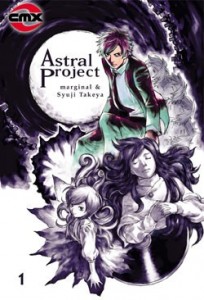
Astral Project might have been an indigestible stew of pseudo-science and Deep Thoughts About Jazz, as it focuses on a young man discovers a connection between his sister’s disappearance and an Albert Ayler recording that helps facilitate out-of-body experiences. Marginal spins a ripping yarn, however, grounding the story’s more fantastic elements in the gritty realism of Tokyo’s red light district. He immerses us in the story to such a degree, in fact, that we learn things as Masahiko does; we’re never one step ahead of our protagonist, a common problem in thrillers. Syuji Takeya’s artwork won’t appeal to everyone, as it sometimes has a rough, sketchy quality that doesn’t mesh well with the dark, Photoshopped backgrounds, but Takeya creates a memorable assortment of faces and bodies that suggest the seediness of Masahiko’s world more readily than dialog could. Quite possibly Ornette Coleman’s favorite manga. (Originally reviewed at PopCultureShock on 10/27/08. )

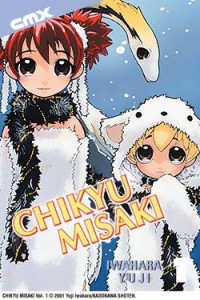
chikyu19. Chikyu Misaki
By Yuji Iwahara • 3 volumes (complete)
This fast-paced adventure plays like best live-action film Disney never made, mixing comedy, family drama, and fantasy elements to tell the story of fourteen-year-old Misaki, who discovers that the local lake is inhabited by a pint-sized Loch Ness Monster. The twist? Little Neo transforms into a cute little boy on land — a nifty trick when a band of kidnappers-cum-poachers get wind of his existence. Chikyu Misaki has a kind of fierce kid logic to it: who but a ten-year-old would dream up a story in which a dinosaur, a downed airplane, a lost suitcase filled with gold, and a potential stepmother all get a turn in the spotlight? Yuji Iwahara’s artwork is also a big plus: his character designs do a fine job of delineating each cast member’s personality and role in the drama, while his action scenes are crisp and fluid. Only a few odd, squicky moments of sexual humor prevent this from being a slam-dunk recommendation for the under-twelve crowd.

nameflower28. The Name of the Flower
By Ken Seito • 4 volumes (complete)
Did Ken Saito have Charlotte Brontë on the brain when she dreamed up the plot for The Name of the Flower? I ask because Flower‘s storyline seems like pure Masterpiece Theater fodder: Chouko, a young orphan left mute and despondent by her parents’ death, is sent to live with a male guardian who  endured a similarly tragic past. Over time, the two form a deep attachment that neither dares admit, an attachment tested by Chouko’s decision to enroll in college and Kei’s general reclusiveness. If the set-up is ripe for melodrama, Saito manages to craft a story that’s rooted in everyday experience; her characters’ journey to self-awareness and romance is complicated by real-life obstacles, not mad wives in the attic. Lovely art cements the bittersweet mood of this borderline josei title. One of my nominees for Best New Manga of 2009.

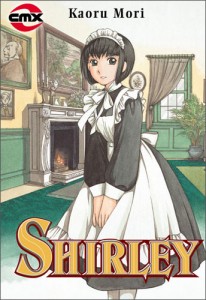
Shirley_Cover7. Shirley
By Kaoru Mori • 1 volume (complete)
At first glance, Shirley looks like a practice run for Emma, a collection of pleasant, straightforward maid stories featuring prototype versions of Emma‘s main characters. A closer examination, however, reveals that Shirley is, in fact, a series of detailed character sketches exploring the relationships between three maids and their respective employers. While some of these sketches aren’t entirely successful — Kaoru Mori cheerfully describes one as “an extremely cheap story about a boy and an animal” and attributes the inspiration for another to The A-Team — the five chapters focusing on thirteen-year-old Shirley Madison and her independent, headstrong employer are as good as any passage in Emma. (Reviewed at The Manga Critic on 3/9/10.)

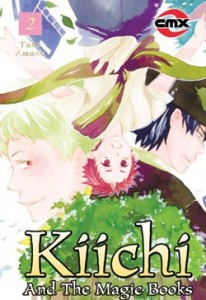
kiichi26. Kiichi and the Magic Books
By Taka Amano • 5 volumes (complete)
This poignant coming-of-age story focuses on Kiichi, a young oni whose lonely existence is transformed by a chance encounter with a traveling librarian. Inspired by the information in one of Mototaro’s books, Kiichi decides to leave his village in search of others like himself. Kiichi’s journey brings him into contact with a variety of people, many of whom seek to harm him or profit from his unique abilities, or who simply fear his appearance. Though Taka Amano never shies away from the darker implications of her story, showing us just how unscrupulous, ignorant, and venal people of all ages can be, Kiichi and the Magic Books is never mawkish or didactic; the fantasy elements add considerable interest and charm, while Kiichi proves emotionally resilient in the face of prejudice and mistrust. Readers more accustomed to the look and feel of Naruto may not initially respond to Amano’s starkly beautiful pen-and-ink drawings. Encourage them to try Kiichi anyway, as this series offers the same degree of complexity, imagination, and emotional authenticity as an Ursula LeGuin or Phillip Pullman novel. CMX’s best title for readers under the age of twelve. (Originally reviewed at Good Comics for Kids on 1/23/09.)

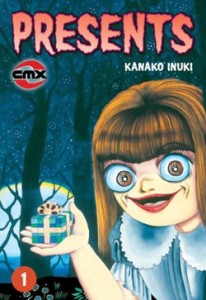
presents15. Presents
By Kanako Inuki • 3 volumes (complete)
Any series that prompted John Jakala to coin a phrase as useful and catchy as “comeuppance theater” deserves a place on a top ten list of some kind; the fact that Kanako Inuki’s horror-comedy is fiendishly entertaining earns it a spot on this particular countdown. Presents reads a lot like Tales of the Crypt, with each story adhering to the same formula: creepy child-woman Karumi offers an enticing present to an unsuspecting person, a present that quickly reveals itself to be an instrument of punishment for the recipient’s bad behavior or poor character. (Hence Jakala’s term “comeuppance theater.”) Though she loves drawing bugs and hideously deformed faces, Inuki is less interested in scaring us than making us laugh and squirm with recognition at our own folly; Inuki’s creepiest stories are also her funniest, satirizing commercial culture and female vanity with aplomb. A must for fans of Kazuo Umezu and Hideshi Hino.

gon44. Gon
By Masashi Tanaka • 7 volumes (complete)
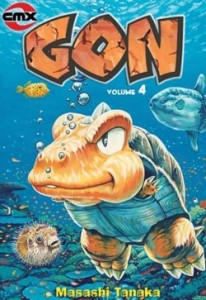
Billed as “the pint-sized terror from the Jurassic era,” Gon is a small orange dinosaur who runs amok in present-day forests, oceans, and arctic tundras, terrorizing predators, defending small animals, and doing whatever else suits his mood. Masashi Tanaka’s artwork is old school in the best sense, employing cross-hatching and delicate lines in lieu of screentone to create volume and depth. His panels are astonishingly detailed yet never fussy or poorly composed — if anything, Tanaka’s technique yields sharper images than the contemporary practice of mixing computer-generated fill with hand-drawn lines. Though Tanaka endows his creatures with unusually expressive faces, he resists the urge to fully anthropomorphize them; their behavior seems species-appropriate even if their expressions occasional verge on human. (Read: the elephants don’t wear spats or drive automobiles, the dogs don’t pretend to be World War I flying aces.) His restraint inoculates Gon against a terminal case of the cutes, resulting in a sometimes funny, sometimes violent, sometimes heartbreaking look at the natural world. (Originally reviewed at PopCultureShock on 2/20/08.)

eroica153. From Eroica with Love
By Yasuko Aoike • 15 volumes (incomplete)
What begins as an unsatisfying story about a trio of telepathic teens quickly takes a turn for the awesome with the introduction of Dorian Red, an openly gay British earl who dresses like a rock star and crisscrosses the globe to steal priceless works of art. Eroica eventually settles into an entertaining cat-and-mouse game between Dorian and uptight NATO intelligence officer Klaus Heinz von dem Eberbach, a stoic homophobe who detests the winking, flirtatious Dorian. Though they travel separately, their paths frequently converge in hilarious and explosive ways: hijackings, kidnappings, car chases. The frosting on the cake is Yasuko Aoike’s vintage seventies character designs: Dorian is the spitting image of Robert Plant, right down to the ridiculously tight pants and flowing scarves, while Klaus wears a ‘do as severe and straight as he is. The result is a delirious, over-the-top action-adventure that brings rock-n-roll swagger to a James Bond premise.

swan32. Swan
By Kyoko Ariyoshi • 15 volumes (incomplete)
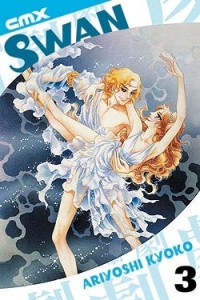
Swan captures a particular moment in ballet history when the best Russian troupes commanded large, enthusiastic audiences on both sides of the Iron Curtain; when every developed nation had a ballet company of its own (even if the form was imported from elsewhere); and when dancers like Nuryev and Fonteyn were bonafide international celebrities. Into this glamorous world comes sixteen-year-old Masumi, a Japanese girl from the sticks who has passion and raw talent, but lacks refinement. She wins a spot at a national academy for dance, and begins clawing her way up the ranks, learning the repertoire (cue the Tchaikovsky!), making friends and enemies, and eventually finding her way to New York for immersion in new styles and techniques. As compelling as the drama may be, the real star of Swan is the art: the dance choreography is beautifully rendered, capturing both the heroine’s graceful intensity and the music’s lyricism. A few aspects of Swan haven’t aged well — the heroine falls victim to bouts of hysterical deafness, for example — but the strong visuals, historically accurate details, and sports manga vibe keep this marvelous series buoyant throughout.

emma41. Emma
By Kaoru Mori • 10 volume (complete)
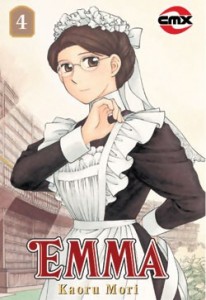
If Emma‘s rich-boy-loves-poor-maid storyline suggests a lost volume of The Forsyte Saga, the expert way in which William and Emma’s courtship is told more than compensates for a few moments of narrative cliche. Kaoru Mori immerses us in the very different worlds of her lead characters, from the elaborate dinner parties and country outings of William’s circle to the scut work and boozy revelry of Emma’s fellow servants. Mori occasionally fumbles small details (pssst… Tosca didn’t debut until 1900!), but most of the time she convincingly recreates the period through her exquisite pen-and-ink drawings of intricate costumes, ornate furnishings, and fussy architecture. That keen sense of observation extends to her cast as well: Emma bursts at the seams with memorable supporting players, from Kelly Stowner, William’s crusty but kind-hearted former governess, to Hakim Atawari, an Eton-educated raj and friend of the Jones family. The main story concludes with volume seven; volumes eight, nine, and ten feature stories about some of the secondary characters, as well as a resolution for Emma and William’s long and tortured romance. (Originally reviewed at PopCultureShock on 9/19/07.)

* * * * *

Here’s a friendly challenge to everyone who’s still mourning the loss of a favorite CMX title: if I didn’t include your favorite on this list, add your suggestion(s) to the comments thread. I’ll compile everyone’s recommendations into a poll and let you choose one for me to review next month.

Filed Under: Manga, Manga Critic, Recommended Reading Tagged With: Animals, Classic, cmx, Historical Drama, Horror/Supernatural, Kanako Inuki, Kaoru Mori, Kid-Friendly, Magnificent 49ers, Romance/Romantic Comedy

  • « Go to Previous Page
  • Page 1
  • Page 2
  • Page 3
  • Page 4
  • Page 5
  • Go to Next Page »
 | Log in
Copyright © 2010 Manga Bookshelf | Powered by WordPress & the Genesis Framework