Sugarholic, Vol. 1
By Gong GooGoo
Published by Yen Press


After the house she lives in with her mother and grandmother is destroyed in a landslide, twenty-year-old slacker Jae-Gyu is sent away from her rural hometown to live with her older brother in Seoul. With little money and even less optimism, she gets off the bus in the big city, only to lose her money and make an enemy (a good-looking but arrogant guy whose shirt she accidentally tears) right off the bat. Things get no better once she finds her brother, who is obviously engaged in shady business and really doesn’t want her around. She does find some refuge in her best friend, Hyun-Ah, whose family moved to the city a few years back, but even that is marred by the re-emergence of Hee-do, a childhood playmate Jae-Gyu bullied repeatedly, who is now an up-and-coming pop star harboring a long-held crush on her. Then to top things off, she gets embroiled in the middle of some kind of dangerous family trouble involving the torn-shirt guy (a martial artist named Whie-Hwan) who insists they pretend they are in love with each other in order to save himself from being sent out of the country.
…


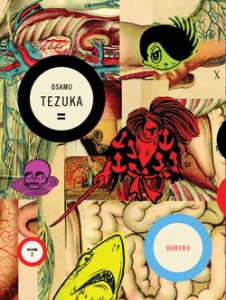 Though much of the devastation that Hyakkimaru and Dororo witness is man-made (Dororo takes placed during the Sengoku, or Warring States, Period), demons exploit the conflict for their own benefit, holding small communities in their thrall, luring desperate travelers to their doom, and feasting on the never-ending supply of human corpses. Some of these demons have obvious antecedents in Japanese folklore — a nine-tailed kitsune — while others seem to have sprung full-blown from Tezuka’s imagination — a shark who paralyzes his victims with sake breath, a demonic toad, a patch of mold possessed by an evil spirit. (As someone who’s lived in prewar buildings, I can vouch for the existence of demonic mold. Lysol is generally more effective than swordplay in eliminating it, however.) Hyakkimaru has a vested interest in killing these demons, as he spontaneously regenerates a lost body part with each monster he slays. But he also feels a strong sense of kinship with many victims — a feeling not shared by those he helps, who cast him out of their village as soon as the local demon has been vanquished.
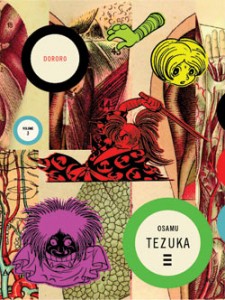 For folks who find the cartoonish aspects of Tezuka’s style difficult to reconcile with the serious themes addressed in Buddha, Phoenix, and Ode to Kirihito, Dororo may prove a more satisfying read. The cuteness of Tezuka’s heroes actually works to his advantage; they seem terribly vulnerable when contrasted with the grotesque demons, ruthless samurai, and scheming bandits they encounter. Tezuka’s jokes — which can be intrusive in other stories — also prove essential to Dororo‘s success. He shatters the fourth wall, inserts characters from his stable of “stars,” borrows characters from other manga-kas’ work, and punctuates moments of high drama with low comedy, underscoring the sheer absurdity of his conceits… like sake-breathing shark demons. Put another way, Dororo wears its allegory lightly, focusing primarily on swordfights, monster lairs, and damsels in distress while using its historical setting to make a few modest points about the corrosive influence of greed, power, and fear.
 If Phoenix is Tezuka’s Ring Cycle, Wagnerian in scope, form, and seriousness, then Dororo is Tezuka’s Don Giovanni, a playful marriage of supernatural intrigue and lowbrow comedy whose deeper message is cloaked in shout-outs to fellow artists (in this case,


 From the back cover:
 Since childhood, Misao has been cursed with an unlucky gift: the ability to see ghosts and demons. As her sixteenth birthday approaches, however, Misao’s luck begins to change. Isayama, the star of the tennis team, asks her out, and Kyo, a childhood friend, moves into the house next door, pledging to protect Misao from harm. Kyo’s promise is quickly put to the test when Isayama turns out to be a blood-thirsty demon who’s intent on killing — and eating — Misao. Just before Isayama attacks Misao, he tells her that she’s “the bride of prophecy”: drink her blood, and a demon will gain strength; eat her flesh, and he’ll enjoy eternal youth; marry her, and his whole clan will flourish. Kyo rescues Misao, revealing, in the process, that he himself is a tengu (winged demon) who’s also jonesing for her blood. Kyo then offers her a choice: marry him or die. Actually, Kyo is less tactful than that, telling Misao, “You can be eaten, or you can sleep with me and become my bride.”
