• Skip to primary navigation
  • Skip to main content
  • Skip to primary sidebar
  • Home
  • About Us
    • Privacy Policy
    • Comment Policy
    • Disclosures & Disclaimers
  • Resources
    • Links, Essays & Articles
    • Fandomology!
    • CLAMP Directory
    • BlogRoll
  • Features & Columns
    • 3 Things Thursday
    • Adventures in the Key of Shoujo
    • Bit & Blips (game reviews)
    • BL BOOKRACK
    • Bookshelf Briefs
    • Bringing the Drama
    • Comic Conversion
    • Fanservice Friday
    • Going Digital
    • It Came From the Sinosphere
    • License This!
    • Magazine no Mori
    • My Week in Manga
    • OFF THE SHELF
    • Not By Manga Alone
    • PICK OF THE WEEK
    • Subtitles & Sensibility
    • Weekly Shonen Jump Recaps
  • Manga Moveable Feast
    • MMF Full Archive
    • Yun Kouga
    • CLAMP
    • Shojo Beat
    • Osamu Tezuka
    • Sailor Moon
    • Fruits Basket
    • Takehiko Inoue
    • Wild Adapter
    • One Piece
    • After School Nightmare
    • Karakuri Odette
    • Paradise Kiss
    • The Color Trilogy
    • To Terra…
    • Sexy Voice & Robo
  • Browse by Author
    • Sean Gaffney
    • Anna Neatrour
    • Michelle Smith
    • Katherine Dacey
    • MJ
    • Brigid Alverson
    • Travis Anderson
    • Phillip Anthony
    • Derek Bown
    • Jaci Dahlvang
    • Angela Eastman
    • Erica Friedman
    • Sara K.
    • Megan Purdy
    • Emily Snodgrass
    • Nancy Thistlethwaite
    • Eva Volin
    • David Welsh
  • MB Blogs
    • A Case Suitable For Treatment
    • Experiments in Manga
    • MangaBlog
    • The Manga Critic
    • Manga Report
    • Soliloquy in Blue
    • Manga Curmudgeon (archive)

Manga Bookshelf

Discussion, Resources, Roundtables, & Reviews

Reviews

The Color Trilogy

August 8, 2010 by MJ Leave a Comment

At Manga Bookshelf’s Off the Shelf, Michelle Smith and I discuss Kim Dong Hwa’s Color trilogy (The Color of Earth, The Color of Water, and he Color of Heaven) published in English by First Second. Here’s an excerpt from the discussion:

MJ: Let’s get right to the meat of things. There’s been a lot of discussion among critics about whether or not this series is inherently sexist. Michelle, I’d like to start with bringing up a statement you made in your recent review of The Color of Heaven:

“I know that the limited scope of life for a woman in this time and place is historically accurate, and that for a mother to say, “There is nothing better in life than getting married” reflects a period where marriage provided the ultimate in protection for a woman … To be honest, I think a large part of my ire is due to the fact that The Color Trilogy is written by a man. If a woman wrote these things, I’d still be annoyed, but coming from a male author I can’t help but read such statements as downright condescending. Try as I might to view these attitudes through a historical lens, I’m simply unable to get over my knee-jerk reaction.”

First of all, I wouldn’t characterize your reaction as knee-jerk at all. I think what you’re reacting to (and I mentioned this in comments, but I’ll reiterate it here) is not the story’s historical context, but the author’s own sexism which he reveals in the way he portrays the realities of the period. My immediate thought upon finishing the series was that I found it inexpressibly sad. Ehwa’s mother spends almost the entire series teaching her daughter about what a woman’s life is in their world and helping her learn how to endure a lifetime of waiting and heartache that can only be relieved by the companionship of a beloved man. And I suspect there is quite a bit of historical accuracy in this sense of utter helplessness and lack of worth placed on a single woman in that period.

But despite the bleakness of their circumstances, Kim portrays it all with a loving nostalgia. Even when expressing the sadness and longing felt by Ehwa and her mother as they wait for their men, he portrays it all as beautiful and even romantic. This isn’t matter of being true to the period. These are Kim’s own values being revealed here, and that’s what we’re reacting to. The same story could be told without that veil of fond nostalgia and it would read very, very differently. If this series had actually been written during that time period, that would be different matter as well, but Kim is a contemporary writer, and as such, he’s responsible to contemporary readers for the story he’s chosen to tell and how he tells it.


Read the full discussion here.

Filed Under: Manhwa Bookshelf, MANHWA REVIEWS Tagged With: First Second, The Color Trilogy

Weekend Quick Takes

August 8, 2010 by MJ 2 Comments

Welcome to Quick Takes at Manga Bookshelf, a new weekly feature, offering brief opinions of recent releases, particularly (but not exclusively) mid-series volumes of ongoing manga. We begin this week with releases from Del Rey Manga, Bandai Entertainment, Viz Media, and Dark Horse Manga.


Sayonara, Zetsubou-Sensei: The Power of Negative Thinking, Vol. 6 | By Koji Kumeta | Published by Del Rey Manga | Rated OT (16+) | Buy this book – The eternal challenge of a gag comic, of course, is to remain funny time and time again. And perhaps the additional challenge faced by a gag manga (especially in translation) is to continuously engage readers despite the fact that nothing ever really happens.

Western fans of manga (and this reviewer is no exception) have generally been lured into the medium by the promise of epic drama, romance, or adventure. How can a multi-volume series of stand-alone jokes ever hope to compete?

If any series has a chance, it’s this one. Six volumes in, this series funnier than ever. And though the humor remains sharp, its heavy reliance on culturally-specific jokes has declined just enough to satisfy even its early skeptics (or so one would hope). Highly recommended.

Read previous reviews of this series.


Lucky Star, Vol. 4 | By Kagami Yoshimizu | Published by Bandai Entertainment | Rated 13+ | Buy this book – Speaking of gag manga, perhaps the toughest sell of all to western manga fans is the 4-koma, a 4-panel style of manga similar to newspaper comic strips in the west. Despite widespread acclaim for Kiyohiko Azuma’s Azumanga Daiho, 4-koma manga in general has had a fairly dismal track record among western readers.

Enter Lucky Star, a 4-koma manga that happens to be the basis for an insanely popular anime series of the same name. Given that fact, licensing the manga should have been a no-brainer. Sadly, Bandai’s early releases were marred by a nearly-unreadable translation that sucked all potential humor from this slice-of-life comedy.

Fortunately, those days are over. Though Lucky Star‘s otaku-focused humor may still be an acquired taste, translator William Flanagan (brought on to the project beginning with volume three) displays its charms to their greatest advantage, giving the series new life in the western market. For fans of the anime series, this volume is a must-buy. And for everyone else, it may finally be worth giving a try.

Read previous reviews of this series.


Kimi ni Todoke: From Me To You, Vol. 5 | By Karuho Shiina | Published by Viz Media | Rated Teen | Buy this book – With Sawako now aware of her feelings for Kazehaya, this series is finally able to focus on romantic feelings between some of its other characters, which adds extra depth to this volume and even to Sawako, who is able to get out of her own head enough to actually notice what’s going on. Also, Chizu and Ayane meet Sawako’s parents in this volume, which is worth the cover price all on its own.

As awesome as Sawako is as a character, this series’ greatest strengths rely heavily on the richness of its supporting characters, so it’s nice to see them get some dedicated “screen time” this time around.

This series is exceptionally slow-moving, even for a shojo romance manga, yet it still manages to be increasingly satisfying, chapter after chapter. Though this volume lacks the intensity of volume four’s bitter romantic rivalry, its quiet drama is considerably more poignant than anything the series has offered so far. It is, undoubtedly, my favorite yet. Recommended.

Read previous reviews of this series.


Okimono Kimono | By Mokona (CLAMP) | Published by Dark Horse Manga | Buy this book – Perhaps the most important thing to note when discussing Okimono Kimono is that though it is written by CLAMP’s Mokona and released specifically by a manga publisher, there is very little manga in this book. In fact, the short manga included near the end of this volume is perhaps its least interesting aspect overall.

That said, what this volume does offer is a beautiful introduction to the world of the kimono, highlighted by some of Mokona’s personal wardrobe as well as a few of her own designs. Manga fans unfamiliar with the conventions of kimono will be easily enticed by designs inspired by characters from xxxHolic (a kimono featuring the full wrath of the pipe fox is a personal favorite).

Mokona’s original designs offer a pleasant transition into the later depictions of more traditional kimono, some of which are likely to appear overly-busy and jarring to the western eye. A transcribed conversation between Mokona and Puffy AmiYumi’s Onuki Ami is a real treat, too, as Mokona indoctrinates Ami into the ways of the kimono.

Though CLAMP fans may be disappointed with this book’s lack of manga offerings, there is much to please anyone interested in a modern look at traditional Japanese dress.


Check back next weekend for more Quick Takes, here at Manga Bookshelf!

Review copies provided by the publishers.

Filed Under: QUICK TAKES Tagged With: quick takes

The Best Manga You’re Not Reading: ES: Eternal Sabbath

August 6, 2010 by Katherine Dacey

Back in June, Brigid Alverson, Robin Brenner, Martha Cornog and I gave a presentation at the American Library Association’s annual conference called “The Best Manga You’re Not Reading.” Our goal was to remind librarians that manga isn’t just for teens by highlighting fourteen titles that we thought would appeal to older patrons. Response to our presentation was terrific, so I decided to make “The Best Manga You’re Not Reading” a regular feature here at The Manga Critic. Some months I’ll shine the spotlight on something obscure or out-of-print; other months I’ll feature a title that you may have heard about (or even read) because I think it has the potential to appeal to readers who aren’t necessarily mangaphiles. This month’s title — ES: Eternal Sabbath (Del Rey) — was one of Brigid’s picks, a sci-fi manga that she felt had strong visuals and a suitably creepy atmosphere. I couldn’t agree more, so I decided to revise an old review from my PopCultureShock days to explain why you ought to read this trippy, thought-provoking story about the perils of cloning and extrasensory perception.

ES: ETERNAL SABBATH, VOLS. 1-8

BY FUYUMI SORYO • DEL REY • RATING: OLDER TEEN (16+)

The vivid images that haunt us when we sleep seem like perfect fodder for art, yet we often produce dream-inspired work that’s much goofier and far less potent than our nocturnal imaginings: think of Salvador Dali’s unabashedly Freudian dream sequence in Spellbound (the one false note in an otherwise great thriller), or John Fuseli’s heavy-handed symbolism in The Nightmare (in which a Rubenesque sleeper is tormented by a ghostly horse and an incubus, the ultimate Romantic two-fer). These images fail to shock because they seem too mannered, too staid — in short, too neat, failing to capture the subconscious mind’s ability to juxtapose the banal with the fantastic. In ES: Eternal Sabbath, however, manga-ka Fuyumi Soryo (best known to American readers for the shojo drama Mars) steers clear of the cliches and overripe imagery that reduce so many dreamy works to kitsch, producing a taut, spooky thriller that reminds us just how weird and terrifying a place the mind can be.

The first volume of ES introduces us to Shuro, a young man with the ability to read thoughts. Shuro uses the information he gathers from other people to impersonate their friends and family members, wiping their memories clean when he tires of the situation. His aimless routine is upended by a chance encounter with neuroscientist Mine Kujyou, who spots Shuro sauntering past a brutal crime scene in a state of utter indifference, as if he knew what was about to transpire. Her researcher’s instinct piqued, she begins to track Shuro’s movements, initiating a game of cat-and-mouse that quickly escalates into psychological warfare.
In a plot twist that would surely please Fox Mulder, a researcher from a clandestine government laboratory arrives on the scene, Smoking Man-style, to explain that Shuro is, in fact, a clone, created by scientists on the hunt for the “eternal sabbath,” a.k.a. eternal youth, gene. (The psychic powers powers are a happy by-product of the experiment.) Shuro escaped from his creators with fellow clone Isaac, an even more powerful, less scrupulous mind reader with a destructive agenda. Mine must then decide whether to assist Shuro and Isaac’s creator in re-capturing the wayward clones, or to allow Shuro to disappear back into the shadows and resume his impostor life of borrowed memories and feigned emotions.

To be sure, many of ES: Eternal Sabbath’s themes are science fiction staples: do scientists have an ethical obligation to treat engineered life forms with the same care as humans? Are there realms of knowledge and experience that cannot be quantified or explained through modern science? That such tried-and-true questions inform but never overwhelm the narrative is testament to Soryo’s storytelling skills. She creates a small, intimately linked cast whose conflicting desires, insecurities, fears, and friendships dramatize the series’ overarching theme, what does it mean to be human?, while underscoring the poignancy of the clones’ liminal status. (Isaac, as his name suggests, was intended as a sacrifice; his creators raised him for the sole purpose of studying and dissecting him.)

If her storytelling chops are strong, Soryo’s life drawing skills are not. Her character designs have a languid quality that makes them seem oddly placid in scenes fraught with conflict. Where Soryo shines are the dream sequences, which are visceral and unsettling. Some of the symbols she employs — horses, thorns — are familiar from television and movie dreams, yet the way in which she orchestrates these dreams is not, as she captures the peculiar rhythm and logic of a nightmare. One of the most effective sequences occurs right at the beginning of the series: a large insect emerges from a disturbingly organic mass that suddenly shatters into hundreds of living, moving pieces. The strangeness of the image, the abrupt shift in mood, the blurry line between inanimate and animate objects — these feel like an authentic product of the subconscious, and not a Freudian rebus to be decoded by the audience.

I could cavil about a few details (the translation is rather flat, as are Soryo’s pre-fab backgrounds), but on the whole, this eight-volume series has few wasted pages. The story moves at a brisk clip without sacrificing characterization or common sense; the art suggests the workings of the subconscious mind without silliness; and the ending is genuinely moving and surprising. Science fiction fanatics will find much to like here, as will horror buffs and readers who like the idea that women can kick butt in the sciences, Lawrence Summers and evil clones be damned.

This is an updated version of a review that appeared at PopCultureShock on 6/22/2008. The Best Manga You’re Not Reading is an occasional feature that highlights titles that aren’t getting the critical attention — or readership — they deserve. Click here for the inaugural column; click here for the series archive.

Filed Under: Manga, Manga Critic, Recommended Reading, REVIEWS Tagged With: del rey, Sci-Fi

Run, Bong-Gu, Run!, Dokebi Bride, Time and Again

July 30, 2010 by MJ Leave a Comment

At Manga Bookshelf’s Off the Shelf, Michelle Smith and I discuss three manhwa series, Byun Byung-Jun’s Run, Bong-Gu, Run! from NBM/Comics Lit, Marley’s Dokebi Bride from NETCOMICS, and JiUn Yun’s Time and Again from Yen Press.

Here’s an excerpt from our discussion:

MICHELLE: How about with Run, Bong-Gu, Run! by Byun Byung-Jun? I’ve spent a lot of time thinking about this one since I finished it. For those who aren’t familiar with it, this is a simple story of a boy and his mother who travel from a seaside town to Seoul in search of the father/husband who went to the city in search of work and who hasn’t been heard from in some time. While there, they meet a kindly old man and his granddaughter, rescue a bird from a building, and bemoan the difficulties of life in the city.

While low on plot, Run, Bong-Gu, Run is high on atmosphere, with a dreamy yet deliberate way of portraying the actions of our protagonists as opposed to the near faceless mob of Seoul-ites who go whizzing past them. Our smalltown heroes have not lost the ability to see others in pain, be they homeless humans or endangered pigeons. They manage to do a fair amount of good on their visit simply by noticing those around them and providing what help they can offer.

MJ: It’s true there isn’t much to the plot of this little manhwa, and for me that’s definitely part of its charm. I love the simplicity of the story and its characters, and Byun’s manner of presenting them. I like, too, that it’s not just the smalltown visitors doing good, either.

The old man they meet there is as kind and helpful as they are, and obviously has been helping out the woman’s husband while he’s been in the city. There’s this big, faceless city, but once you get down to the individuals, they are just people like anyone else, and I love that about this story. I think it’s significant that the old man is first seen in the story panhandling on the subway. That person–a begger on the subway–is the easiest for most of us to brush off in our lives as someone on the outskirts of our own experience. Yet he turns up later as a fully-realized character.

In a way, Byun portrays Seoul exactly as I think of big cities in general. They can seem intimidating–as though they might swallow your individuality whole–but when you really spend time in one, maybe even live in it, you realize that a neighborhood is a neighborhood, no matter where you live in the world. A city is just a dense collection of small towns with no official dividers between them.

I like your description of the atmosphere as “dreamy yet deliberate.” That’s the perfect way to describe Byun’s artwork and writing style. And it’s nice to see it used for a warm, simple story like this one. Run, Bong-Gu, Run! lacks the sheer bleakness of Byun’s melancholy anthology, Mijeong, and though some of those stories perhaps have more to them, this one is much more soothing for the soul.

Read more here!

Filed Under: Manhwa Bookshelf, MANHWA REVIEWS Tagged With: NBM/Comics Lit, netcomics, run bong-gu run! dokebi bride, time and again, yen press

Hyde & Closer, Vol. 1

July 28, 2010 by Katherine Dacey

Move over, Chucky — there’s a new doll in town. His name is Hyde, and he’s a stuffed bear who wears a fedora, chomps cigars, and wields a chainsaw. (More on that in a minute.) Hyde belongs to thirteen-year-old Shunpei Closer, a timid junior high school student whose biggest talent is avoiding conflict. Watching Shunpei dodge bullies at school, it’s difficult to believe that he is, in fact, the grandson of Alysd Closer, a powerful, globe-trotting sorcerer with enemies on every continent. Keenly aware that his rivals might seek revenge against his family, Alysd created Hyde, a plush fighting machine capable of fending off attacks with a magical chainsaw. Hyde remained dormant for almost six years before the delivery of a mysterious package containing a murderous, knife-throwing sock monkey activated his abilities. (I can’t believe I just typed the phrase, “knife-throwing sock money,” but there it is.) Thus begins a kind of magical tournament manga that pits Hyde and Shunpei against an array of powerful sorcerers and their toy henchmen.

You don’t have to be a ten-year-old boy to find the sight of karate-chopping, knife-throwing dolls amusing, though it certainly helps. There’s a gleeful, go-for-broke quality to the fight scenes that evokes the feeling of real childhood play, a sensation akin to chopping off your Barbie’s hair or staging an epic battle between your sister’s My Little Ponies and your Star Wars action figures. Making these scenes even more enjoyable is Hyde, who sounds like an affectionate parody of James Cagney, punctuating the combat with sharp, funny one-liners that wouldn’t be out of place in The Public Enemy.

Yet for all the energy and goodwill engendered by these scenes, Hyde & Closer tends to bog down in exposition masquerading as dialogue, thanks to its rather complicated mythology. The rules of engagement are different for each opponent, which means that Hyde spends part of every fight outlining his strategy for defeating the villain du jour. Hyde isn’t the only character who sounds, at time, more like an omniscient narrator than a participant in the action; the villainous sock monkey, for example, lectures Shunpei at great length about Alysd’s true identity, scoffing at Shunpei for thinking gramps was an archaeologist. “That’s his cover story,” the monkey explains. “I guess no one told you anything.” (Or, more accurately, “I guess that’s my opening to disabuse you of that silly notion!”)

The battle scenes are further encumbered by Shunpei’s self-flagellating outbursts, usually along the lines of “I’m pathetic!” or “It’s all my fault!” Each time Shunpei doubts himself, the action comes to a screeching halt until he can muster the courage to stop whimpering and start fighting. Shunpei is clearly meant to be the kind of average-joe character that readers can identify with, but it’s hard to imagine anyone over the age of ten or eleven finding him sympathetic; after all, his bodyguard is quite handy with a chainsaw. Call me crazy, but I’d find that rather empowering.

If the script is a little creaky, Haro Aso’s artwork is bold, stylish, and suitably sinister. Hyde, by far, is his best creation, with his enormous button eyes, rakishly tilted hat, and jagged seams; he’s the perfect mixture of beloved stuffed animal and thirties gangster, easily transforming from a benign, wide-eyed toy to a glowering menace. (In a nice touch, the stitches on Hyde’s mouth are stretched to their limit whenever he’s spitting dialogue or downing one of his signature drinks: honey on the rocks.) The villains, too, are imaginatively rendered, from the jack-in-the-box with shark-like teeth to the kokeshi with lethal, snaking hair. (Hommage to Junji Ito, perhaps?) The only downside to Aso’s art is his penchant for extreme camera angles. He draws his fight scenes from so many different perspectives — from the floor up, the ceiling down, or directly behind Hyde’s head — that it’s hard to track the characters’ movement through the picture plane; characters have a tendency to pop up in unexpected (and sometimes illogical) places.

Still, it’s hard to deny the appeal of stuffed animal cage matches or teddy bears who swagger like James Cagney, and for those two reasons, I’m going to stick with Hyde & Closer to see where Aso goes with his Fight Club-meets-Winnie the Pooh premise.

HYDE & CLOSER, VOL. 1 • BY HARO ASO • VIZ • 200 pp. • RATING: OLDER TEEN (16+)

Filed Under: Manga, Manga Critic, REVIEWS Tagged With: Action/Adventure, shonen sunday, VIZ

Antique Bakery, Vols. 1-4

July 24, 2010 by MJ 15 Comments

Antique Bakery, Vols. 1-4 | By Fumi Yoshinaga | Published by Digital Manga Publishing | Rated YA (16+)

As I begin this article, I find myself struck by the impossibility of saying anything about Antique Bakery that hasn’t already been said.

Undoubtedly Fumi Yoshinaga’s most celebrated work, at least on this side of the Pacific, this story of four men working in a western-style patisserie in Tokyo first hit US shelves in 2005, three years after completing its original run in Japan’s Wings magazine. The series is a Kodansha Manga Award-winner, a 2007 Eisner nominee, and entirely deserving of both.

Yoshinaga utilizes all her greatest strengths in this manga, rich characterization, rambling dialogue, and a deep love of food. The descriptions of the bakery’s various specialties is enough to make any pastry-lover swoon (enhanced by DMP’s scratch ‘n’ sniff covers). Her gift for gab brings this corner of Tokyo alive–especially the bakery’s customers, who wander in from all walks of life. Where Yoshinaga really outdoes herself, however, is with her delightful quartet of male leads.

The first volume begins with introductions, though it jumps around quite a bit in the story’s timeline. We meet a teenaged schoolboy who confesses his love to a male classmate, only to be brutally rejected; a similarly-aged schoolgirl who admires a braver girl from afar; a brilliant young boxer whose career has abruptly ended due to a physical defect; and a weary salaryman who finds an evening’s solace in the works of J.S. Bach and a shortcake from the department store bakery.

These disparate characters are finally brought together at the bakery “Antique.” Two of them are customers (the schoolgirl and the salaryman) who find their way to their neighborhood’s new bakery with a mixture of surprise and delight.

The others are inhabitants of the bakery itself. Yusuke Ono, the boy whose heart was crushed so cruelly in junior high, is the bakery’s genius pastry chef. The boy who rejected him, Keiichiro Tachibana, is its owner. And the boxer, Eiji Kanda, is Ono’s promising apprentice.

As the series goes on, each of these characters’ histories is further revealed, including their relationships to each other and the journeys that led them to the Antique. Ono’s story is told first, which, despite its rather dramatic beginning, is by far the least tragic. As it happens, his devastation over Tachibana’s rejection serves as a springboard to a new life of self-awareness and sexual freedom that takes him to Paris and back again.

Kanda’s tale is much sadder, though his love for sweets has at least given him a chance at a new career. Tachibana’s journey, however, is both somewhat tragic and opaque, its path forever altered by his childhood experience as a kidnapping victim.

The bakery’s fourth personality, Chikage Kobayakawa, Tachibana’s childhood friend and bodyguard, is not introduced until the second volume, and though his status as a bumbling hulk might normally doom him to a role of perpetual comic relief, he is actually one of the most poignant characters of the bunch.

Though much of the series maintains a slice-of-life sensibility, chronicling daily business at the bakery, broken up by various events and small personal dramas, the series’ final volume takes a more dramatic turn, as a new rash of child kidnappings commands Tachibana’s involvement.

Though this is undeniably the most plot-driven section of the series by far, it is still heavily rooted in characterization, as its main purpose is to reveal more about Tachibana’s motivations and to move him along to the next stage of his life. While this shift in tone seems rather sudden, it provides some unexpected momentum for the series’ final volume, while uncovering much substance within Tachibana, ultimately to great effect. It’s quite telling that the cover art for the fourth volume is the only one in the series to portray just one character.

Praising this series may be easy, but categorizing it is not. Western readers frequently classify it as yaoi, but that label seems woefully insufficient and even misleading. Though its cast certainly contains gay characters (more who actually identify as gay, frankly, than most yaoi I’ve personally read), romance is minimal and hardly the point.

This is not coy, homoerotic fantasy, nor is it anything approaching pornography. And, “Yama nashi, ochi nashi, imi nashi” (No climax, no point, no meaning)? Utterly inappropriate when applied to this series.

This is not a negative statement about yaoi, by the way. I’m a fan, after all. This series just seems so far removed from anything in that genre, that calling it “yaoi” makes as much sense to me as categorizing Detroit Metal City with NANA because they’ve both got characters in bands. From the evidence I’ve seen (including the stack of BL manga sitting here in front of me), yaoi sits squarely in the romance genre. Antique Bakery simply does not.

What Antique Bakery has going for it is an impressively rich cast of major and minor characters, both gay and straight, male and female, upon which it places a lens much broader than can reasonably be allowed by romance. Its strength is its lack of any particular focus, unless you count a delightful obsession with sweets.

Lack of focus, however, does not constitute a lack of specifics. Each of the characters is fully-formed, regardless of what else is going on–even the ones who appear for only a chapter or two. And the series’ main characters are beautifully fleshed-out, even those with the most comedic roles.

Yoshinaga’s artwork is as unique and expressive as usual, though she makes particularly strong use of wordless panels in this series. The nearly three full wordless pages devoted to Tachibana’s reaction to his own cruelty to Ono (from a flashback in volume four) are some of the most affecting in the series.

However you choose to classify it, one thing is clear. Like the many cakes and pastries described within its pages, Antique Bakery is a delight few can resist.

Filed Under: MANGA REVIEWS Tagged With: fumi yoshinaga

A Drunken Dream and Other Stories

July 22, 2010 by Katherine Dacey

The 1970s marked a turning point in the development of shojo manga, as the first time in the medium’s history that a significant number of women were working in the field. These “founding mothers” weren’t the first female manga artists; Machiko Hasegawa was an early pioneer with Sazae-san,[1] a comic strip that first appeared in her hometown newspaper in 1946, followed in the 1950s by such artists as Masako Watanabe, who debuted in 1952 with Suama-chan, Hideko Mizuno, who debuted in 1956 with Akakke Pony (Red-Haired Pony),[2] and Miyako Maki, who debuted in 1957 with Hahakoi Waltz (Mother’s Love Waltz). Beginning in the mid-1960s and continuing throughout the 1970s, more female creators entered the profession, thus beginning the quiet transformation of shojo manga from sentimental stories for very young readers to a vibrant medium that spoke directly to the concerns and desires of teenage girls.

Several figures played an important role in affecting this transformation. One was Osamu Tezuka, whose Princess Knight (1954)[3] is often erroneously described as “the first shojo manga.” (Shojo manga, in fact, dates to the beginning of the twentieth century, when magazines such as Shojo Sekai, or Girls’ World, featured comics alongside stories, articles, and illustrations.) An affectionate pastiche of Walt Disney, Zorro, and Takarazuka plays, Tezuka’s gender-bending story focused on a princess with two hearts — one female, one male — who becomes a masked crusader to save her kingdom from falling into the hands of a wicked nobleman. However conventional the ending seems now — Princess Sapphire eventually marries the prince of her dreams and hangs up her sword — the story was a rare example of a long-form adventure for girls; well into the 1950s, most shojo manga featured plotlines reminiscent of Victorian children’s literature, filled with young, imperiled heroines buffeted by fate until happily reunited with their families.

Another major influence was Yoshiko Nishitani, whose ground-breaking series Mary Lou appeared in Weekly Margaret in 1965. Mary Lou was among the very first shojo manga to feature an ordinary teenager as both the protagonist and romantic lead; its eponymous heroine suffered from the kind of everyday problems — a beautiful older sister, a boy who sends confusing signals — that invited readers to identify with her. Like Princess Knight, the gender politics of Mary Lou may strike contemporary Western readers as nostalgic at best, retrograde at worst, but Nishitani’s ability to make a compelling story out of ordinary adolescent experience struck a chord with Japanese girls, providing an important model for subsequent generations of shojo artists.

Moto Hagio and The “Founding Mothers” of Modern Shojo

In the hands of the Magnificent Forty-Niners and the other women who entered the field in the 1970s,  shojo manga underwent a profound transformation, giving rise to a new kind of storytelling that emphasized the importance of relationships and introspection, even when the stories took place in eighteenth-century France (The Rose of Versailles), Taisho-era Japan (Haikara-san ga Toru, or, Here Comes Miss Modern), or the distant future (They Were Eleven!). Inspired by Tezuka’s cinematic approach to storytelling, they sought to dramatize their characters’ inner lives with the same dynamism that Tezuka brought to car chases, fist fights, and heated conversations. Hagio and her peers placed a premium on subjectivity, trying their utmost to help readers see the world through the characters’ point of view, eschewing tidy grids for fluid, expressionist layouts, and employing an elaborate code of visual signifiers to represent emotions from love to anxiety — symbols still in widespread use today.

Moto Hagio was one of these shojo trailblazers, making her professional debut in 1969 with “Lulu to Mimi,” a short story that appeared in the girls’ magazine Nakayoshi. In the years that followed, she proved enormously versatile, working in a variety of genres: “November Gymnasium” (1971) explores a romantic relationship between two young men, for example, while The Poe Family (1972-76) focuses on a vampire doomed to live out his existence in a teenage boy’s body. Hagio is perhaps best known to Western readers for her science fiction’s unique blend of social commentary and lyrical imagery. A, A’, for example, examines the relationship between memory and identity, while They Were Eleven tackles the thorny question of whether gender determines destiny.

A Drunken Dream and Other Stories

The ten stories that comprise A Drunken Dream span the entire length of Hagio’s career, from “Bianca” (1970), one of her first published works, to “A Drunken Dream” (1985), a sci-fi fantasy written around the same time as the stories in A, A’, to “The Willow Tree” (2007), an entry in her recent anthology Anywhere But Here.

What A Drunken Dream reveals is an author whose childhood passion for Frances Hodgson Burnett, L.M. Montgomery, and Isaac Asimov profoundly influenced the kind of stories she chose to tell as an adult. “Bianca,” for example, is a unabashedly Romantic story about artistic expression. The main narrative is framed by a discussion between Clara, a middle-aged woman, and an art collector curious about the “dryad” who appears in Clara’s paintings. As a teenager, Clara secretly witnessed her younger cousin Bianca dancing with great abandon in a wooded glen, a child’s way of coping with the pain of her parents’ tumultuous relationship. Bianca’s dance haunted Clara for years, even though their acquaintance was brief. “The way [Bianca] danced… the way it made me feel… I can’t describe it in words,” the middle-aged Clara explains to her guest. “But the thrill of that moment still shines today, and still shakes me to my core. And it was my irresistible need to draw that which led me to become a painter.”

Other stories explore the complexity of familial relationships. “Hanshin: Half-God,” for example, depicts conjoined twins with a rare medical condition that leaves one brilliant but physically deformed and the other simple but radiantly beautiful. When a life-threatening condition necessitates an operation to separate them, Yudy, the “big sister,” imagines it will liberate her from the responsibility of caring for and about Yucy, never considering the degree to which she and Yucy are emotionally interdependent. In “The Child Who Comes Home,” the emphasis is on parent-child relationships, exploring how a mother and her son cope with the death of the family’s youngest member. Throughout the story, the deceased Yuu appears in many of the panels, though we are never sure if Yuu’s ghost is real, or if his family’s lingering attachment to him is making his memory palpable.

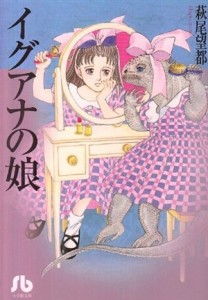
iguanagirlThe emotional core of A Drunken Dream — for me, at least — is Hagio’s 1991 story “Iguana Girl.” Rika, the heroine, is a truly grotesque figure — not in the everyday sense of being ugly or unpleasant, but in the Romantic sense, as a person whose bizarre affliction arouses empathy in readers. Born to a woman who appears human but is, in fact, an enchanted lizard, Rika is immediately rejected by her mother, who sees only a repulsive likeness of herself. Yuriko’s disgust for her daughter manifests itself in myriad ways: withering put-downs, slaps and shouts, blatant displays of favoritism for Rika’s younger sister Mami. As Rika matures, Hagio gives us tantalizing glimpses of Rika not as an iguana, but as the rest of the world sees her: a lovely but reserved young woman. As with “The Child Who Comes Home,” the heroine’s appearance could be interpreted literally, as evidence of magical realism, or figuratively, as a metaphor for the way in which children mirror their parents’ own flaws and disappointments; either way, Rika’s quest to heal her childhood wounds is easily one of the most moving stories I’ve read in comic form, a testament to Hagio’s ability to make Rika’s fraught relationship with her mother seem both terribly specific and utterly universal.

Perhaps the best compliment I can pay Hagio is praising her ability to make the ineffable speak through pictures, whether she’s documenting the grief that a young woman feels after aborting her baby (“Angel Mimic”) or the intense longing a middle-aged man feels for the college friends who abandoned him (“Marie, Ten Years Later”). Nowhere is this more evident than in the final story, “The Willow Tree.” At first glance, the layout is simple: each page consists of just two large, rectangular panels in which a woman stands beneath a tree, watching a parade of people — a doleful man and a little boy, a group of rambunctious grade-schoolers, a teenager wooing a classmate — as they stroll on the embankment above her. A careful reading of the images, however, reveals a complex story spanning many years. Hagio uses subtle cues — light, weather, and the principal character’s body language — to suggest the woman’s relationship to the people who walk past the tree. The last ten panels are beautifully executed; though the woman never utters a word, her face suddenly registers all the pain, joy, and anxiety she experienced during her decades-long vigil.

For those new to Hagio’s work, Fantagraphics has prefaced A Drunken Dream with two indispensable articles by noted manga scholar Matt Thorn.[4] The first, “The Magnificent Forty-Niners,” places Hagio in context, introducing her peers and providing an overview of her major publications. The second, “The Moto Hagio Interview,” is a lengthy conversation between scholar and artist about Hagio’s formative reading experiences, first jobs, and recurring use of certain motifs. Both reveal Hagio to be as complex as her stories, at once thoughtful about her own work and surprised by her success. Taken together with the stories in A Drunken Dream, these essays make an excellent introduction to one of the most literary and original voices working in comics today. Highly recommended.

A DRUNKEN DREAM AND OTHER STORIES • BY MOTO HAGIO, TRANSLATED BY MATT THORN • FANTAGRAPHICS • 288 pp.

NOTES

1. The Wonderful World of Sazae-San ran in newspapers from 1946 to 1974. The collected strips, comprising 45 volumes in all, have been perennial best-sellers in Japan, with over 60 million books sold. It’s imporant to note that Sazae-san is not shojo manga; the story focuses on a resourceful, strong-willed housewife and her family, a kind of Mother Knows Best story. Nonetheless, Machiko Hasegawa is an important figure in the history of the medium, both for the influence of her strip and her trailblazing role as a female creator.

2. For more information about Hideko Mizuno, see Marc Bernabe’s recent profile and interview at Masters of Manga.

3. Princess Knight has a long and complex publishing history. The original story appeared in Shojo Club from 1953 to 1956, was continued in Nakayoshi in 1958, and revived again for Nakayoshi in 1963. The third version is generally considered to be the definitive one; Tezuka re-worked a few details from the original version and re-drew the series. In 2001, Kodansha released a bilingual edition of the 1963 version which is now out of print.

4. Both essays originally appeared in issue no. 269 of The Comics Journal (July 2005).

FOR FURTHER READING

Bernabe, Marc. “What is the ‘Year 24 Group’?” Interview with Moto Hagio. [http://mastersofmanga.com/2010/06/hagioyear24] [Accessed 7/22/10.]

Gravett, Paul. Manga: 60 Years of Japanese Comics. New York: Collins Design, 2004.

Randall, Bill. “Three By Moto Hagio.” The Comics Journal 252 (April 2003). (Full text available online at The Comics Journal Archives.)

Shamoon, Deborah. “Revolutionary Romance: The Rose of Versailles and the Transformation of Shojo Manga.” Mechademia 2 (2007): 3-18.

Schodt, Frederick. Manga! Manga! The World of Japanese Comics. New York: Kodansha International, 1983.

Thorn, Matt. “The Multi-Faceted Universe of Shoujo Manga.” [http://www.matt-thorn.com/shoujo_manga/colloque/index.php] (Accessed 7/21/10.)

Thorn, Matt. “What Japanese Girls Do With Manga and Why.” [http://www.matt-thorn.com/shoujo_manga/jaws/index.php] (Accessed 7/21/10/)

Toku, Masaki, ed. Shojo Manga! Girl Power! Chico, CA: Flume Press, 2005.

Vollmar, Rob. “X+X.” The Comics Journal 269 (July 2005): 134-36.

WORKS BY MOTO HAGIO AND HER PEERS (IN ENGLISH)

Aoike, Yasuko. From Eroica With Love. La Jolla, CA: CMX Manga/Wildstorm Productions, 2004 – 2010. 15 volumes (incomplete).

Ariyoshi, Kyoko. Swan. La Jolla, CA: CMX Manga/Wildstorm Productions, 2005 – 2010. 15 volumes (incomplete).

Hagio, Moto. A, A’ [A, A Prime]. Translated by Matt Thorn. San Francisco: Viz Communications, 1997. (Reviewed at The Manga Critic on 5/31/10.)

Hagio, Moto, Keiko Nishi, and Shio Sato. Four Shojo Stories. Translated by Matt Thorn. San Francisco: Viz Communications, 1996. (Reviewed at The Manga Critic on 5/31/10.)

Mitsuse, Ryu and Keiko Takemiya. Andromeda Stories. New York: Vertical, Inc., 2007. 3 volumes. (Reviewed at The Manga Critic on 5/26/10.)

Takemiya, Keiko. To Terra. New York: Vertical, Inc., 2007. 3 volumes. (Reviewed at The Manga Critic on 5/23/10.)

Filed Under: Manga, Manga Critic, REVIEWS Tagged With: Classic, fantagraphics, Magnificent 49ers, moto hagio, shojo

Ooku, Vols. 1-3

July 22, 2010 by MJ 9 Comments

Ooku, Vols. 1-3 | By Fumi Yoshinaga | Published by Viz Media | Rated M (Mature)

In this alternate history of Edo-period Japan, an incurable disease has wiped out much of the nation’s male population, leaving women to take up traditional men’s roles, including that of shogun.

As this series is structured, its first volume begins eighty years after the disease’s initial outbreak, at which point the male population has declined by 75% and women have become firmly fixed in their new roles. The second and third volumes then return to the beginning of the outbreak, which finds the nation in a panic–desperate to maintain male rule, even to the point of delusion, if that is what is required.

This structural choice is, frankly, brilliant. By removing any real question about the outcome of events that occur during the second and third volumes, Yoshinaga allows herself (and the reader) to focus on the process, which really shows her off to her greatest advantage. Though the universe is dense and the language even more so (needlessly, to some extent, thanks to an unfortunate choice in its English adaptation), this arrangement allows for a great deal of slow, masterful character development and an emphasis on human relationships and the psychology of political theory.

The story revolves around the workings of the Ooku, the harem of Edo Castle, in which the shogun’s wife, servants, and concubines reside. Traditionally inhabited by thousands of women, this number is shown to have been shifted to men in the first volume of this series, each bound into service of the shogun–an especially decadent arrangement in a nation with a male-female ratio of 1:4.

Though each of the series’ first three volumes focuses heavily on the lives of young men entering the Ooku (some of whom are there of their own free will, others… not so much) the overarching story is that of the evolution of a powerful female shogunate.

Volume one, the story of Mizuno, whose understated appearance catches the eye of the new, no-nonsense shogun, exhibits a rather fascinating society in which this is already firmly in place. Yet it is even more compelling to watch this society emerge, slowly and painfully, from its deep, patriarchal roots over the course of the following volumes.

It is here that Yoshinaga displays a new talent for creating cold, self-serving, and even cruel characters who are complex enough to be, not just interesting, but actually relatable. And she does it just about as far out of her comfort zone as possible.

There is nothing warm or quirky about Ooku. Life inside the shogun’s chambers is nowhere near casual or even remotely lighthearted. Even Yoshinaga’s earlier stabs at period pieces (such as Gerard & Jacques or Garden Dreams) are inappropriate for comparison, so great is the difference in weight and complexity.

With the preservation of the Tokugawa shogunate as paramount within the Inner Chambers, even the nation’s appalling health crisis can be seen in a positive light, so long as it weakens families that might otherwise represent a threat to the current government. When impoverished farmers must abandon their fields to dodge tithes they can no longer afford, make a law that binds them to the land for life. Should famine strike, offer several days of free gruel, not with the purpose of relieving hunger, but to quell the seeds of rebellion. Above all, nothing is more important than producing appropriate progeny to keep the Tokugawa family safely in power.

This is the world of the shogunate, illustrated here without nostalgia or apology, yet populated with characters Yoshinaga is able to make her readers care about and occasionally even like.

The greatest downside to this series is its English adaptation which, in an effort to create formal-sounding speech, utilizes an awkward, quasi-17th-century style (referred to among critics as “Fakespeare”).

Though I personally was able to acclimate just a few pages in, even for me this has the disadvantage of dampening what is typically my greatest joy in Yoshinaga’s writing–her glorious abundance of dialogue. As a result, though Yoshinaga is as talky as ever, much of her delightful spark is gone.

While this may be an inevitability in such a politically dense story, the characters’ stilted manner of speech makes it difficult to know for sure. That said, there is not a single moment in this series so far that has not engaged me fully–quite a feat under the circumstances.

On the other hand, Yoshinaga’s artwork is more stunning than ever, employing a level of detail in costuming and background unusual for her work, yet retaining the elegant simplicity characteristic of her clean, expressive style. Her visual storytelling here is sophisticated and straightforward, with restrained panel layouts that suit the period and setting.

As a fan of Fumi Yoshinaga, josei manga, and the Viz Signature imprint, there is no question that a series like this, even just in theory, is a very exciting work. Fortunately, this truth extends beyond the theoretical and into the actual. Ooku is beautiful, engaging, and a very exciting work indeed. It is also challenging and ambitious enough to garner some real respect for josei manga in western fandom at last. And for that, I’m truly grateful.

Review copies provided by the publisher.

Filed Under: MANGA REVIEWS Tagged With: fumi yoshinaga, ooku

Garden Dreams

July 20, 2010 by MJ 4 Comments

Garden Dreams | By Fumi Yoshinaga | Published by Digital Manga Publishing | Rated T (Teens 13+)

Garden Dreams tells the story of Farhad, a young boy orphaned by the Crusades, who is rescued from the desert by Saud, one of his own people who has lost his family as well. The two make a living as traveling musicians, which eventually brings them to the estate of a foreign baron.

This visit will transform both of their lives, reuniting Saud with a loved one he thought long gone and providing Farhad with a new family and a place to call home.

Though Farhad’s story is the thread holding this manga together, the volume is actually a series of short tales, including a substantial look into the baron’s tragic past. This structure reads like a bit of a tease, with everything folding into a story-within-the-story by the end.

Though this isn’t exactly a bad thing, it does create a sense of distance between the reader and the characters unusual in Yoshinaga’s work. Absent is the intimacy offered up by series like Flower of Life, Antique Bakery, or Ichigemne…, replaced instead by the detached feel of an external narrator.

With this in mind, it’s no surprise that Yoshinaga’s normally chatty dialogue is subdued here as well, though this may be due to the period setting as much as anything else. Her style shines best with casual conversation, and there is little of that in this volume. That said, each of the stories has a classic, fairy-tale quality that is a pleasure in itself. There’s no lack of touching moments here, either, beginning from the manga’s opening pages.

Perhaps the most moving of these tales is the least like a proper story at all. In the volume’s final chapter, a letter is received from the baron’s adopted daughter, who earlier in the book had fled into the night with Farhad’s “brother” Saud. Weary of his inability to accept loss, the baron asks Farhad to commit suicide with him. Though this may sound horrid to the extreme, it’s actually quite poignant and so delicately drawn, it actually brought tears to my eyes.

Yoshinaga’s artwork brings out the best in these stories, which might otherwise fade quickly from memory. Her use of panel layouts to convey emotion in these particularly reserved characters is, frankly, quite stunning. Though I might miss the easy expressiveness of her talky, modern-day tales, it is a pleasure to watch the way in which she is able to bring forward strong feeling using other means.

Garden Dreams is by no means Yoshinaga’s best work, but its quiet meandering displays some true charms of its own.

Review copy provided by the publisher.

Filed Under: MANGA REVIEWS Tagged With: fumi yoshinaga

All My Darling Daughters

July 19, 2010 by MJ 8 Comments

All My Darling Daughters | By Fumi Yoshinaga | Published by Viz Media | Rated T+ (Older Teen)

Yukiko, nearly thirty and still living at home, is shocked when her widowed mother announces her sudden marriage to a young actor she met at a host club. Suspicious and resentful, Yukiko struggles to hold on to her place in her mother’s life as her entire world shifts around her.

Through a series of interconnected short stories, mangaka Fumi Yoshinaga explores the lives of Yukiko, her friends, her mother, and her grandmother, and how they all relate to one another. Though the stories extend to women in various circumstances–planning their careers as young girls, seeking a husband through arranged marriage, even carrying on an affair with a college professor–what most strikes a personal chord with me is Yoshinaga’s reflections on mothers and daughters as portrayed within three generations of Yukiko’s own family.

The first story begins with a short scene between a teenaged Yukiko and her mother, in which her mother, Mari, rails at her for slovenly habits and general lack of consideration. When Yukiko protests, “You’re just taking your frustration out on me!” her mother replies, “You’re right. That’s exactly what I’m doing! And what’s wrong with that? Parents are human. Sometimes they have bad moods!” Though the truth of that is not something Yukiko wants to hear, when all is said and done, she comes to the realization that all her mother really wants is to be served a cup of tea.

What’s so effective about this scene, is that despite being told from Yukiko’s point of view, Yoshinaga easily reveals the frustrations and vulnerabilities of both characters, as well as their core affection for each other.

Later, when Mari’s new husband, Ohashi, moves in, all of these vulnerabilities become even more prominent, as Yukiko stubbornly refuses to like him (which even she can admit is out of pure resentment). This story’s final image, after Yukiko has announced that she will move in with her coworker boyfriend, is a beautiful representation of the relationship between mother and daughter and all the complexity that entails.

Near the end of the volume, Yukiko gains further insight into her mother’s character through some conversation with both her grandmother and her new, young stepfather. What she discovers, of course, is the terrifying truth behind all parenting, which is that the greatest damage is often inflicted with the best intentions.

Having recently discussed another story of mothers and daughters, Kim Dong Hwa’s The Color of… trilogy, I’m struck by the contrast in how they are portrayed. That these stories are very different is certainly to be expected. After all, Kim’s story is set at least a hundred years earlier in an entirely different culture. What’s a bit stunning, however, is how much of this is due to simply to a difference in perspective.

While Kim views the relationship between mother and daughter from the outside, through a lens of reverent nostalgia, Yoshinaga explores the same relationship from a place of intimate understanding. Without the veil of nostalgia as an obstacle, Yoshinaga is able to create fully-realized characters who exist together, not just as mother and daughter, but also as roommates, friends, enemies, nagging burdens, and pillars of support. Though so much of their complicated relationship remains unspoken, it is all there–some lurking just beneath the dialogue, and even more within Yoshinaga’s spare, expressive artwork.

Perhaps it isn’t fair to expect such deep insight into the mother-daughter relationship from a male writer, but I’ll admit it is the lack of complexity in Kim’s portrayal that keeps me from enjoying his series as much as I might. If nothing else, this highlights what makes Yoshinaga’s work so strong, and prompts me to hope that she’ll continue to write more stories about women.

Though I’ve spent most of my time here focusing on the overarching story of Yukiko and Mari, the volume’s other stories are effective as well, particularly one that traces the path of one of Mari’s junior high friends from her youthful ambitions to the adult life she ultimately settles for.

Only one story feels slightly out of place–that of a college professor friend of Ohashi’s who finds himself wrapped up in a relationship with a masochistic student–mainly because it is the only story in the book not told from the perspective of a female character. Yet even this manages to fall into place by the end, as Yoshinaga muses on the value of imperfection and personal idiosyncrasy.

To say that this manga speaks to me on a very personal level seems like a fairly obvious understatement, but I’ll say it anyway. All My Darling Daughters is a must-read for grown-up women everywhere.

Images © Fumi Yoshinaga. Review copy provided by the publisher.

Filed Under: MANGA REVIEWS Tagged With: fumi yoshinaga

Peepo Choo, Vol. 1

July 19, 2010 by Katherine Dacey

When I was fifteen and in the throes of my mope-rock obsession, I fantasized a lot about England, home to my favorite bands. I imagined London, in particular, to be a place where everyone appreciated the sartorial genius of Mary Quant, fashionable ladies accessorized every outfit with a pair of shit kickers, regular moviegoers recognized Eat the Rich as brilliant satire, and — most important of all — teenage boys appreciated girls with dry, sarcastic wits and gloomy taste in music. You can guess my disappointment when I finally visited England for the first time; not only was London dirty, expensive, and filled with tweedy-looking people who found my taste in clothing odd, many of the teenagers I met were fascinated by American pop culture, pumping me and my companions for information about — quelle horror! — LL Cool J. I could have died. Though I’ve gone through similar phases since then — Russophilia, Woody Allenomania — I’ve never been able to abandon myself to those passions in quite the same way, knowing somewhere in the back of my mind that all Muscovites weren’t soulful admirers of Shostakovich and that most book editors didn’t live in pre-war sixes on the Upper East Side.

When we first meet Milton, the loser-hero of Felipe Smith’s visually dazzling Peepo Choo, he’s still innocent enough to believe that his love for anime makes him an honorary Japanese citizen. Milton proudly declares himself an otaku, viewing Japan as his spiritual home, a place where “everyone is nice,” “everyone cosplays,” and “everyone watches anime and reads manga.” “If I lived in Japan,” he tells himself, “I could be de me. The real Milton!” Looking at Milton’s life, it’s easy to see why Japan looms large in his imagination; when contrasted with his chaotic home — he shares a bedroom with eight rambunctious siblings — and crime-plagued Chicago neighborhood, Tokyo appears to be a model of order, a place where cuteness and civility prevail. What Milton discovers is that his Japan is nothing like the reality, a place populated by drunken salarymen, violent criminals, hairy cross-dressers, and puzzled commuters who wonder why he’s cosplaying on the subway. “There’s hostility in the air,” a deflated Milton observes upon spending his first day in Japan. “I know this feeling too well. I just never thought I’d feel it in Tokyo.”

Milton isn’t alone in his delusions; most of the characters in Peepo Choo are engaged in one form or another of culture shopping, trying on personae like so many pairs of jeans. There’s Jody, the jaded comic-store employee who adopts a street-thug pose and brags about his bedroom conquests, when, in fact, his sexploits amount to watching a lot of porn; there’s Takeshi, a wimp who reinvents himself as Morimoto Rockstar, a pimped-out yakuza whose greatest ambition is to emulate the Brick Side thugs (an imaginary Chicago gang); there’s Reiko, a voluptuous teen model who also cops a ghetto style and attitude, wearing enormous hoops and tiny shorts and backing up her demands for respect with foul language, middle fingers, and fisticuffs; and then there are the regulars at Enyo’s Collectibles, an anime-addled group of misfits who share Milton’s utopian vision of Japan.

To show us the unique lens through which each character views the world, Smith borrows a page from the William Faulkner playbook, switching “voices” as he moves from subplot to subplot. Milton’s story, for example, is punctuated by fantasy sequences that resemble a Takashi Murakami canvas; in Milton’s mind, even Japan’s landscapes have a pleasingly domesticated look, with smiling mountains and beaming suns presiding over a Noah’s Ark of anthropomorphic birds, cats, and hamsters. When Smith cuts to Gill, the hitman who runs Enyo’s Collectibles, the artwork becomes dark, ugly, and claustrophobic, evocative of such torture-porn films as Hostel and Saw. Smith shows us every blood splatter and cracked skull in gruesome, almost fetishistic detail, as Gill dispatches roomfuls of gangsters with gory abandon. (Gill even gets into character for his work, trading his suit and glasses for skull rings, a mohawk, and a Hannibal Lechter mask.)

Yet for all its technical virtuosity, there’s a hole at the center of Peepo Choo where its heart should be. Smith positively brutalizes his characters; in one scene, for example, two alpha girls dangle a bloody tampon in a classmate’s face, while in another, Takeshi disembowels a victim, carving a nonsense “Engrish” phrase into the man’s torso. The satirical intent of both scenes is obvious, but the crudeness of the satire feels more like provocation than actual commentary on manga cliches or Japanese fascination with American street life. The same goes for several sexually explicit passages in which Smith draws lusty women with watermelon breasts; it doesn’t take much imagination to see that he’s aping the visual language of Hustler and Playboy, but the scenes are too faithful to the source material to be anything more than affectionate parody.

Great satire is seldom generous or polite, but it shouldn’t be punitive, either, and that’s Peepo Choo‘s greatest shortcoming. Smith seems more intent on cranking up the sex and violence to eleven than making a real point about the ubiquity of either in seinen manga. I’m guessing — perhaps wrongly — that he’s hoping to implicate the audience in the characters’ rude behavior, to point out that it’s our own prurient interest in blood and boobs that drives creators to excess, but the point seems rather hollow when the artist himself seems to revel in his own ability to draw such mayhem. I wish I enjoyed Peepo Choo, as it’s obvious that Felipe Smith has the imagination and artistry to be a penetrating satirist; what Smith really needs is a little more empathy.

Review copy provided by Vertical, Inc.

PEEPO CHOO, VOL. 1 • BY FELIPE SMITH • VERTICAL, INC. • 252 pp. • RATING: MATURE (18+)

Filed Under: Manga, Manga Critic, REVIEWS Tagged With: Comedy, Felipe Smith, Vertical Comics

The Name of the Flower, Vols. 1-4

July 11, 2010 by Katherine Dacey

Given the sheer number of nineteenth-century Brit-lit tropes that appear in The Name of the Flower — neglected gardens, orphans struck dumb by tragedy, brooding male guardians — one might reasonably conclude that Ken Saito was paying homage to Charlotte Brontë and Frances Hodgson Burnett with her story about a fragile young woman who falls in love with an older novelist. And while that manga would undoubtedly be awesome — think of the costumes! — The Name of the Flower is, in fact, far more nuanced and restrained than its surface details might suggest.

The story starts from an old-as-the-hills premise: the orphan who grows up to marry — or, in this case, pine for — her guardian. In The Name of the Flower, the orphan role is fulfilled by Chouko, who, at the age of sixteen, lost her parents in a car accident. Overwhelmed by grief, Chouko stopped speaking or showing emotion until a distant relative took her into his home, admonished her for being silent, and suggested that she revive the house’s lifeless garden. Flash forward two years, and Chouko has emerged from her shell, still quiet but full of calm purpose and warm feelings for Kei, her guardian. Kei, however, is a troubled soul, a successful novelist who achieved notoriety for a string of nihilistic books written while he was in his early twenties. His eccentric garb (he wears a yukata just about everywhere) and brusque demeanor suggest a man in full flight from the outside world — or at least some painful memories.

The real drama begins when Chouko graduates from high school. Though Kei harbors feelings for Chouko, he worries about the gap in age and experience that separates them — he’s thirty, she’s eighteen — reluctantly acknowledging that it would be selfish to deny her a chance at independence. Despite Kei’s gruff prodding, however, Chouko can’t quite strike out on her own; her profound fear of abandonment keeps her tethered to Kei, even though she attends college and cultivates a small but supportive circle of friends. In short, the two are locked in a complicated, co-dependent relationship that’s about as healthy as Jane Eyre and Edward Rochester’s, though less sensational. (Kei doesn’t have a mad wife stashed in a remote corner of the house or a failed relationship with a French dancer in his past.) Only the intervention of other people — Akiyama, Kei’s sole friend, and Yousuke, Chouko’s classmate and not-so-secret admirer — prevents Kei and Chouko from sinking into a destructive cycle of clinging to and withdrawing from one another.

Throughout the series, Ken Saito walks a fine line between romanticizing Kei and Chouko’s relationship and recognizing its less savory aspects, generally erring on the side of sympathetic frankness. The series’ ending may be predictable, but the feelings it evokes in the reader are not, as we’re left to wonder whether Kei and Chouko can finally let go of their tragic pasts to embrace the present. At the same time, however, the story’s lighter moments — especially some wonderful comic business with Chouko’s friends, a group of hyper-verbal bibliophiles — suggest that Chouko, at least, is capable of feeling great joy and connecting with other people, a suggestion borne out by her relationship with the salty neighborhood septuagenarians, who stop by to trade gardening tips and upbraid Kei for his reclusive, sullen behavior.

Saito’s artwork is simple but lovely. Though her figures and faces aren’t especially distinctive, each of the principle characters’ appearance has been given careful consideration. Aspiring author Yousuke, for example, plays his part to the hilt, sporting a jacket with elbow patches and a tousled mop, while Chouko’s numerous experiments with hairstyles reveal a young woman just beginning to discover her own beauty. (I vacillated between ascribing Kei’s fondness for traditional garb to the author’s theory of the character and her desire to draw handsome men in period costume.) As one would imagine from a manga with the word “flower” in the title, floral imagery plays an important role in illustrating the characters’ inner lives, both in a conventional sense (e.g. faces superimposed atop images of roses) and in a more subtle fashion as well, with the plants’ own natural cycle of growth, death, and rebirth serving as a visual metaphor for the ebb and flow of Kei and Chouko’s relationship. Saito reserves her most detailed panels for Chouko’s garden, however, showing us not only what she planted, but also the physical space itself, from the trellises and vines to the rock formations — a gentle reminder that planting and tending flowers played a key role in Chouko’s emotional rehabilitation, just as it did for Mary Lennox in Burnett’s The Secret Garden.

At four volumes, The Name of the Flower is just the right length for the story that Saito wants to tell, allowing her enough space to explore Kei and Chouko’s relationship without resorting to false drama to delay its resolution. The prevailing mood is wistful and, at times, dark, but never melodramatic; Saito’s restraint is key to preventing The Name of the Flower from devolving into tawdry theatrics. It’s a surprisingly thoughtful character study that proves that shojo can be just as grown-up and sophisticated as its big sister josei. Highly recommended.

THE NAME OF THE FLOWER, VOLS. 1-4 • BY KEN SAITO • CMX • RATING: OLDER TEEN (16+)

Filed Under: Manga, Manga Critic, REVIEWS Tagged With: cmx, Drama, Romance/Romantic Comedy, shojo

My Favorite Shojo Manga: Kaze Hikaru

July 7, 2010 by Katherine Dacey

In Manga: Sixty Years of Japanese Comics, author Paul Gravett argues that female mangaka from Riyoko Ikeda to CLAMP have often used “the fluidity of gender boundaries and forbidden love” to “address issues of deep importance to their readers.” Taeko Watanabe is no exception to the rule, employing cross-dressing and shonen-ai elements to tell a story depicting the “pressures and pleasures of individuals living life in their own way and, for better or worse, not always as society expects.”

Kaze Hikaru begins in 1863, a period of immense political and social upheaval in Japan, as the ruling class divided into factions loyal to the emperor (whose seat was in Kyoto), and factions loyal to the shogun (whose government was housed in Edo, or present-day Tokyo). Exacerbating the tension between these groups was the looming question of sakoku, or isolationism, a centuries-old policy that was crumbling in the face of military and economic pressure from the West, an unstable currency, and the dawning realization that certain Western technologies might have a role to play in the modernization of Japan. Taeko Watanabe draws on the events of the Bakumatsu (or late shogunate era, 1863 – 1867) for Kaze Hikaru, incorporating real historical figures into the story and dramatizing some of the major and minor conflicts of the period, from the Ikedaya Affair of 1864 to the Shinsengumi’s ambivalence about adopting rifles and canons into the samurai arsenal.

In the opening pages of Kaze Hikaru, Sei Tominaga, the heroine, lives a sheltered existence under the watchful eye of her father and older brother. Local rabble-rousers accuse the Tominagas of harboring spies at the medical clinic they operate and burn it to the ground, leaving Sei homeless and orphaned. Determined to avenge her family, Sei disguises herself as a boy, adopts the name Kamiya Seizaburo, and joins the Mibu-Roshi, a band of ronin who are fiercely loyal to the Tokugawa Shogunate. (The Mibu-Roshi would come to be known as the Shinsengumi, or “newly chosen corps.” At the height of their power, their ranks numbered around 300, and included a few members who were not born into the samurai caste.) Sei finds a mentor in the slightly older Okita Soji, an accomplished swordsman who acts as a den mother for new recruits. He accidentally discovers Sei’s identity, agreeing to keep her secret if she can demonstrate her worth as bushi, or an honorable warrior.

Watanabe’s art is clean and crisp, conveying enough period detail to firmly establish the setting without overwhelming the eye. A similar attention to facial features and body shapes also informs her nuanced and varied character designs, a godsend for a such a densely populated series. The action sequences are staged simply but effectively, conveying the skill and physical strength necessary to best an opponent in hand-to-hand combat, or suggesting the dangers of a night-time raid. But it’s in the everyday moments that Watanabe’s artistry really shines, as she has a talent for depicting the energy and activity of an urban marketplace, a soliders’ encampment, or a red-light district. We see the Shinsengumi recruits train, squabble, drink, gamble, and abuse their power with innkeepers and merchants, with careful attention paid to the objects they handle, the clothing they wear, and the posture they adopt as they interact with people of higher and lower social status.

Much of the drama — as well as the humor — in Kaze Hikaru stems from Sei’s attempts to fit in with her fellow soldiers by proving her worth as a man — no mean feat, given her small size, feminine appearance, and cultivated upbringing. (This is one of the few cross-dressing stories in which characters routinely ask the question on readers’ minds: “Aren’t you a little too pretty to be a guy?” Not surprisingly, some of the men desire Sei as an exceptionally handsome boy, further confusing our protagonist.) Sei’s greatest challenge, however, is concealing her deep love for Okita as both a mentor and a man. She wants Okita to respect her as a warrior, yet fears that her gender-bending transgression may prevent him from reciprocating her romantic feelings. It’s a classic shojo predicament — think of Lady Oscar and her manservant Andre — that simultaneously reveals Sei’s vulnerability and resolve. Her fierce commitment to the Shinsengumi, however, eventually prevails over her desire to reclaim her feminine identity, as she decides to honor Okita’s wish that she be Seizaburo and not Sei.

When contrasted with other Shojo Beat titles, Kaze Hikaru seems a little old-fashioned. Watanabe tends to favor neat grids and clearly-defined panels over the freer, more expressive layouts used in series like We Were There, Sand Chronicles, and Vampire Knight. The pace, too, is more stately, demanding a higher level of attention from the reader than most Shojo Beat titles; Watanabe’s characters discuss political matters, clan rivalries, and military strategy in considerable detail, giving some scenes the feeling of a Kurosawa movie. Even Sei and Okita’s friendship, rooted as it is in mutual warrior regard, seems out of step with the racier romances depicted in Absolute Boyfriend and B.O.D.Y.: would a school council president or magical girl swoon when she received a customized katana from the object of her affection, even if it was a sincere expression of his respect for her skill and courage?

Yet for all its squareness — or perhaps because of it — Kaze Hikaru remains my all-time favorite shojo manga. What makes Kaze Hikaru so compelling is the way in which Watanabe appropriates a very tired story — samurai seeks revenge in a time of social and political turbulence — and infuses it with a fresh, feminine sensibility. I might call it Satsuma Gishiden for Girls, but I think that downplays Watanabe’s achievement. She’s created an action-filled drama in the vein of The Rose of Versailles or They Were Eleven but transplanted the setting from the relatively safe, romanticized worlds of the French Revolution and outer space to a period in Japanese history in which the male-identified virtues of courage, discipline, and patriotism dominated public discourse. She may not have intended it as a bold political statement, but Watanabe has done something extraordinary: she’s given girls the freedom to project themselves into Japan’s past without gender constraints. American artists looking to connect with female readers would do well to read Kaze Hikaru for inspiration — there’s a great graphic novel to be written about a cross-dressing Minuteman or Union solider, and Sei would make a terrific prototype for its spunky heroine.

Review copies of volumes 17 and 18 provided by VIZ Media, LLC. This is an expanded version of a review that appeared at PopCultureShock on 5/17/07.

KAZE HIKARU, VOLS. 1-18 • BY TAEKO WATANABE • VIZ • RATING: OLDER TEEN (16+)

Filed Under: Manga, Manga Critic, Recommended Reading, REVIEWS Tagged With: Samurai, shojo, shojo beat, VIZ

Portrait of M & N 1-2 by Tachibana Higuchi: B-

July 4, 2010 by Michelle Smith

Much as with Natsuki Takaya’s Tsubasa: Those with Wings, I had been looking forward to the English release of Portrait of M & N by Tachibana Higuchi only because I enjoy later work, Gakuen Alice. Aaaand, much as with Tsubasa: Those with Wings, I ended up somewhat disappointed.

Portrait of M & N is a love story starring a beautiful girl named Mitsuru Abe and a handsome boy named Natsuhiko Amakusa. Matters are complicated, however, because each character harbors an embarrassing secret: Mitsuru is a masochist (or M) and Natsuhiko is a narcissist (or N). Ostensibly, these conditions developed as a result of the way they were treated by their parents—the most attention Mitsuru received from her mother was when she was being punished, while sickly Natsuhiko was forbidden to go outside and play with other kids, and thus developed a fixation for his own reflection.

Both Mitsuru and Natsuhiko are hoping for a normal, peaceful high school life, and things seem to be off to a good start because their good looks have attracted positive notice from their classmates. That is, until Mitsuru’s masochistic tendencies are triggered in Natsuhiko’s presence. It’s almost as if she has a split personality: when she is hit in the face, she suddenly becomes aggressively submissive, offering anybody who happens to be nearby the chance to do whatever they want to her. Against his better judgment, Natsuhiko becomes friends with Mitsuru and attempts to protect her whenever she goes into M mode, and thus reveals his own secret to her, one that turns him into a tearful, blushing fool whenever he catches sight of himself in a mirror.

If you’re looking for an accurate, sensitive portrayal of masochism or narcissism, you’re not going to find it here. This is a comedy, after all, and Higuchi seemingly delights in inventing ridiculous situations for the characters to endure—like a mandatory game of dodgeball, for example. A third character, Hijiri, enters the mix in toward the end of the first volume and, realizing Mitsuru’s secret pretty quickly, uses it to extract her cooperation in protecting him from a particular dog (he has a secret phobia of his own) on his way to and from school. Mitsuru’s closeness with two of the hottest guys in school does not go over well with the other girls, who treat her very poorly. These are the most tiresome scenes in the series, by far.

Setting aside the ridiculous and the tiresome, however, there really are some things I genuinely like about Portrait of M and N. Most of the time, a shoujo romance is presented from the girl’s point of view. She falls in love with the boy and we’re privy to her emotions, but we rarely, if ever, get inside his head. That is not the case here and, in fact, I believe there has been more attention paid to Natsuhiko’s developing feelings than Mitsuru’s.

As one bit of text reads, “She swiftly fell in love in spring, he realized he was falling in love in summer.” For Mitsuru, it was easy to fall in love with Natsuhiko, who is kind and understands her, but for Natsuhiko, the realization that he is falling in love with someone else is doubly important because it means that he can. All of his life, relatives and classmates have been vocal in their doubts that such a thing would ever be possible, but he has proved them wrong, and his happiness is mixed with not a little relief.

While I find Hijiri generally annoying, he is useful in that his interactions with Mitsuru force Natsuhiko to confront how he feels about her, and they end volume two by sharing an awkwardly cute moment together. It’s for scenes like these that I’ll continue to read Portrait of M & N and hope that there’s less to irk me in volumes to come.

Portrait of M & N is published by TOKYOPOP. The series is complete in Japan with six volumes, and two have been released in English so far.

Review copies provided by the publisher.

Filed Under: REVIEWS Tagged With: Tachibana Higuchi, Tokyopop

Magical JxR, Vol. 1

July 4, 2010 by MJ 3 Comments

Magical JxR | By Lee Sun-Young | Published by Udon Entertainment | Rated Teen (13+) – Jay and Aru are young wizards, ready to graduate from wizarding school. To fulfill their final graduation test, they must make a contract to help a human girl, Cho-Ah. Hidden in the fine print, however, are the contract’s real terms, mandating that the two of them spend an entire year with her!

Though the previous appears to be the intended plot for this manhwa (as evidenced by very similar copy on the back of its cover), it’s difficult to know for sure, since the concept doesn’t actually appear until halfway through the volume. Though the earlier chapters do revolve around the two wizards as little boys, they read like false starts, as though Lee (or her editor) changed her mind several times before deciding on a story to tell.

As a result, the series’ first volume is a fairly frustrating read that really doesn’t get anywhere until the last few pages, in which it introduces the story’s main plot before cruelly coming to an end. Fortunately, it is the story’s most intriguing characters, Jay, Aru, and Cho-Ah, who will advance to the series’ next volumes.

Jay and Aru may be wizards, but it is their contrasting personalities (ice cold Jay and smiling Aru) that make them worth reading about, not their run-of-the-mill magical powers. Their relationship as partners is fun to watch as well, though this is more effectively established in the volume’s later chapters than in the early bits of backstory.

The real star, however, is Cho-Ah, who struggles between her natural abilities as a martial artist and her desire to be seen as a girly-girl. And it is the prospect of learning more about her that makes the most compelling argument for moving on to further volumes.

Lee’s artwork is a mishmash of beauty and chaos, with pretty, pretty character designs (quite similar to those by Sirial in Yen Press’ One Fine Day) and over-crowded panels that are sometimes so spastic and so full of different types of text, it’s difficult to tell what to read first. The worst of the mess has calmed by the volume’s later chapters, however, providing much hope going forward.

Though Magical JxR is by no means original or even particularly coherent, Lee’s pretty artwork and likable female lead provide enough genuine charm to warrant moving on to the next volume.

Review copy provided by the publisher.

Filed Under: Manhwa Bookshelf, MANHWA REVIEWS

  • « Go to Previous Page
  • Page 1
  • Interim pages omitted …
  • Page 306
  • Page 307
  • Page 308
  • Page 309
  • Page 310
  • Interim pages omitted …
  • Page 346
  • Go to Next Page »
 | Log in
Copyright © 2010 Manga Bookshelf | Powered by WordPress & the Genesis Framework