• Skip to primary navigation
  • Skip to main content
  • Skip to primary sidebar
  • Home
  • About Us
    • Privacy Policy
    • Comment Policy
    • Disclosures & Disclaimers
  • Resources
    • Links, Essays & Articles
    • Fandomology!
    • CLAMP Directory
    • BlogRoll
  • Features & Columns
    • 3 Things Thursday
    • Adventures in the Key of Shoujo
    • Bit & Blips (game reviews)
    • BL BOOKRACK
    • Bookshelf Briefs
    • Bringing the Drama
    • Comic Conversion
    • Fanservice Friday
    • Going Digital
    • It Came From the Sinosphere
    • License This!
    • Magazine no Mori
    • My Week in Manga
    • OFF THE SHELF
    • Not By Manga Alone
    • PICK OF THE WEEK
    • Subtitles & Sensibility
    • Weekly Shonen Jump Recaps
  • Manga Moveable Feast
    • MMF Full Archive
    • Yun Kouga
    • CLAMP
    • Shojo Beat
    • Osamu Tezuka
    • Sailor Moon
    • Fruits Basket
    • Takehiko Inoue
    • Wild Adapter
    • One Piece
    • After School Nightmare
    • Karakuri Odette
    • Paradise Kiss
    • The Color Trilogy
    • To Terra…
    • Sexy Voice & Robo
  • Browse by Author
    • Sean Gaffney
    • Anna Neatrour
    • Michelle Smith
    • Katherine Dacey
    • MJ
    • Brigid Alverson
    • Travis Anderson
    • Phillip Anthony
    • Derek Bown
    • Jaci Dahlvang
    • Angela Eastman
    • Erica Friedman
    • Sara K.
    • Megan Purdy
    • Emily Snodgrass
    • Nancy Thistlethwaite
    • Eva Volin
    • David Welsh
  • MB Blogs
    • A Case Suitable For Treatment
    • Experiments in Manga
    • MangaBlog
    • The Manga Critic
    • Manga Report
    • Soliloquy in Blue
    • Manga Curmudgeon (archive)

Manga Bookshelf

Discussion, Resources, Roundtables, & Reviews

Manga Critic

Junji Ito’s No Longer Human

January 2, 2020 by Katherine Dacey

Of all the famous works of literature to get the Classics Illustrated treatment, Osamu Dazai’s No Longer Human is an odd choice. Its protagonist is Oba Yozo, a tortured soul who never figures out how to be his authentic self in a society that places tremendous emphasis on hierarchy, self-restraint, and civility. Over the course of the novel, he binges, gambles, seduces a string of women, joins a Communist cell, attempts suicide, and succumbs to heroin addiction, all while donning the mask of “the farcical eccentric” to conceal his “melancholy” and “agitation” from the very people whose lives he ruins.

Though the novel is filled with incident, its unreliable narrator and relentless interiority make it difficult to effectively retell in a comic format, as Junji Ito’s adaptation demonstrates. Ito’s No Longer Human is largely faithful to the events of Dazai’s novel, but takes Dazai’s spare, haunting narrative and transforms it into a phantasmagoria of sex, drugs, and death. In his efforts to show us how Yozo feels, Ito leans so hard into nightmarish imagery that the true horror of Yozo’s story is overshadowed by Ito’s artwork—a mistake, I think, as Ito’s drawings are too literal to convey the nuance of what it means to exist, in Peter Selgin’s words, in a state of “complete dissociation… yet still capable of feeling.”

In Ito’s defense, it’s not hard to see what attracted him to Dazai’s text; Yozo’s narration is peppered with the kind of vivid analogies that, at first glance, seem ideally suited for a visual medium like comics. But a closer examination of the text reveals the extent to which these analogies are part of the narrator’s efforts to beguile the reader; Yozo is, in effect, trying to convince the reader that his mind is filled with such monstrous ideas that he cannot be expected to function like a normal person. There’s a tension between how Yozo describes his own reactions to the ordinary unpleasantness of interacting with other people, and how Yozo describes the impact of his behavior on other people—a point that Ito overlooks in choosing to flesh out some key events in the novel.

Nowhere is that more evident than in Yozo’s brief affair with Tsuneko, a destitute waitress. After hitting rock bottom financially and emotionally, Yozo persuades her to join him in a double suicide pact. Dazai’s summary of what happens is shocking in its brevity and matter-of-factness:

As I stood there hesitating, she got up and looked inside my wallet. ‘‘Is that all you have?” Her voice was innocent, but it cut me to the quick. It was painful as only the voice of the first woman I had ever loved could be painful. “Is that all?” No, even that suggested more money than I had — three copper coins don’t count as money at all. This was a humiliation more strange than any I had tasted before, a humiliation I could not live with. I suppose I had still not managed to extricate myself from the part of the rich man’s son. It was then I myself determined, this time as a reality, to kill myself.

We threw ourselves into the sea at Kamakura that night. She untied her sash, saying she had borrowed it from a friend at the cafe, and left it folded neatly on a rock. I removed my coat and put it in the same spot. We entered the water together.

She died. I was saved.

As Ito recounts this event, however, Tsuneko’s death is caused by a poison so painful to ingest that she collapses in a writhing heap, eyes bulging and tongue wagging as if she were in the throes of becoming a monster herself. Yozo’s reaction to the poison, by contrast, is to plunge into a hallucinatory state in which a parade of ghostly women mock and berate him, an artistic choice that suggests Yozo feels shame and guilt for his actions—and a reading of Dazai’s text that makes Yozo seem more deserving of sympathy than he does in Dazai’s novel:

Throughout this vignette, Yozo’s contempt for Tsuneko creeps into the narrative, even as he assures the reader that she was the first woman he truly loved. Yozo’s disdain is palpable, as is evident in the way he off-handedly introduces her to the reader:

I was waiting at a sushi stall back of the Ginza for Tsuneko (that, as I recall, was her name, but the memory is too blurred for me to be sure: I am the sort of person who can forget even the name of the woman with whom he attempted suicide) to get off from work.

Only a few episodes capture the spirit of Dazai’s original novel, as when Yozo’s father gives an inept speech to a gathering of businessmen and community leaders. Ito skillfully cross-cuts between three separate conversations, allowing us to step into Yozo’s shoes as he eavesdrops on the attendees, servants, and family members, all of whom speak disparagingly about each other, and the speech. By pulling back the curtain on these conversations, Ito helps the reader appreciate the class and power differences among these groups, as well as revealing that this episode was a turning point for Yozo: the moment when he first realized that adults maintain certain masks in public that they discard in private. Though such a moment would undoubtedly trouble a more observant child—one need only think of Holden Caulfield’s obsession with adult “phoniness”—this discovery plunges Yozo into a state of despair, as he cannot imagine how anyone reconciles their public and private selves in a truthful way.

Ito also wisely restores material from Dazai’s novel that other adaptors—most notably Usamaru Furuya—trimmed from their versions. In particular, Ito does an excellent job of exploring the dynamic between Yozo and his classmate Takeichi, the first person who sees through Yozo’s carefully orchestrated buffoonery:

Just when I had begun to relax my guard a bit, fairly confident that I had succeeded by now in concealing completely my true identity, I was stabbed in the back, quite unexpectedly. The assailant, like most people who stab in the back, bordered on being a simpleton — the puniest boy in the class, whose scrofulous face and floppy jacket with sleeves too long  for him was complemented by a total lack of proficiency in his studies and by such clumsiness in military drill and physical training that he was perpetually designated as an ‘‘onlooker.” Not surprisingly, I failed to recognize the need to be on my guard against him.

As one might guess from this passage, Yozo’s terror at being discovered is another critical juncture in the novel. “I felt as if I had seen the world before me burst in an instant into the raging flames of hell,” he reports, before embarking on a campaign to win Takeichi’s trust by “cloth[ing his] face in the gentle beguiling smile of the false Christian.” Though Ito can’t resist the temptation to draw an image of Yozo engulfed in hell fire, most of Yozo’s fear is conveyed in subtler ways: a wary glance at Takeichi, an extreme close-up of Yozo’s face, an awkwardly placed arm around Takeichi’s shoulder:
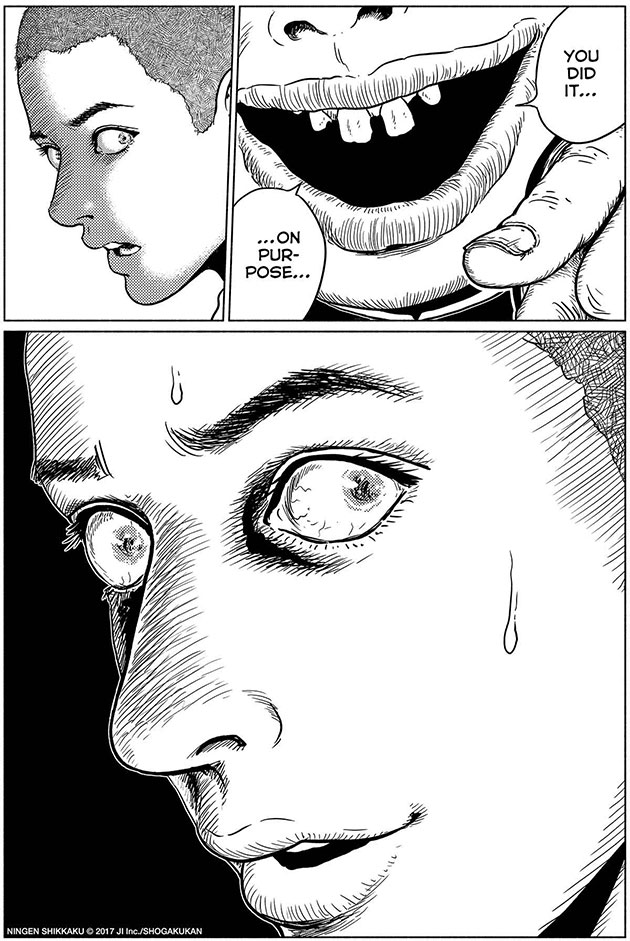
What happens next in Ito’s version of No Longer Human, however, is indicative of another problem with his adaptation: his decision to add new material. In Dazai’s novel, Takeichi simply disappears from the narrative when Yozo moves to Tokyo for college, but in Ito’s version, Yozo cruelly manipulates Takeichi into thinking that Yozo’s cousin Setchan is in love with him—a manipulation that ultimately leads to Takeichi’s humiliation and suicide. That violent death is followed by a gruesome murder, this time prompted by a love triangle involving Yozo, his “auntie,” and Setchan, who becomes pregnant with Yozo’s child. Neither of these episodes deepen our understanding of who Yozo really is; they simply add more examples of how manipulative and callous he can be, thus blunting the impact of the real tragedy that unfolds in the late stages of his story.

Ito’s most problematic addition, however, is Osamu Dazai himself. Ito replaces the novel’s original framing device with the events leading up to Dazai’s 1948 suicide, encouraging us to view No Longer Human as pure autobiography through reinforcing the parallels between Dazai’s life and Yozo’s. And while those parallels are striking, the juxtaposition of the author and his fictional alter ego ultimately distorts the meaning of the novel by suggesting that the story documents Dazai’s own unravelling. That’s certainly one way to interpret No Longer Human, but such an autobiographical reading misses Dazai’s broader themes about the burden of consciousness, the nature of self, and the difficulty of being a full, authentic, feeling person in modern society.

VIZ Media provided a review copy. You can read a brief preview at the VIZ website by clicking here. For additional perspectives on Junji Ito’s adaptation, see Serdar Yegulalp‘s excellent, in-depth review at Ganriki.org, Reuben Barron‘s review at CBR.com, and MinovskyArticle’s review at the VIZ Media website.

JUNJI ITO’S NO LONGER HUMAN • ORIGINAL NOVEL BY OSAMU DAZAI • BASED ON THE ENGLISH TRANSLATION BY DONALD KEENE • TRANSLATED AND ADAPTED BY JOCELYNE ALLEN • VIZ MEDIA • RATED M, FOR MATURE AUDIENCES • 616 pp.
Filed Under: Manga, Manga Critic, REVIEWS Tagged With: Junji Ito, no longer human, Osamu Dazai, VIZ, VIZ Signature

Short Takes: No Guns Life and Ryuko

November 12, 2019 by Katherine Dacey

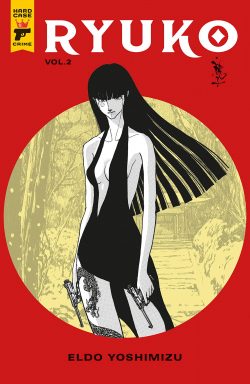
This month’s Short Takes column checks in with two previously-reviewed series: No Guns Life, a sci-fi thriller whose principled hero sounds like Sam Spade and looks like a Remington; and Ryuko, a thriller starring a yakuza assassin who’s hell-bent on avenging her mother’s kidnapping.

No Guns Life, Vol. 2
Story and Art by Tasuku Karasuma
Translation by Joe Yamazaki; Adaptation by Stan!
VIZ Media, 224 pp.
Rated T+ (Older Teens)

After a decent, if predictable, first volume, Tasuku Karasuma finds his groove in volume two of No Guns Life, maintaining a brisk pace while allowing his characters’ personalities to emerge more fully. Though the action occasionally pauses for the characters to expound on important plot developments, these dialogues are less of a drag on the story than they were in volume one; here, they add badly needed layers of  complexity to a familiar noir plot line. Better still, Karasuma introduces several new characters who push the narrative in a more interesting direction, hinting at the power and secrecy of the Berühen Corporation, as well as the general public’s mixed feelings about living alongside cyborgs. If Karasuma engages in a little too much fanservice, or relies too heavily on speedlines and sound effects to enliven his fight scenes, No Guns Life is still entertaining enough to make all but the most discriminating reader root for Juzo to succeed. Recommended.

VIZ Media provided a review copy. Click here to read my review of volume one.

Ryuko, Vol. 2
Story and Art by Eldo Yoshimizu
Translation by Motoko Tamamuro and Jonathan Clements
Titan Comics, 226 pp.
No rating (Best suited for older teen and adult readers)

Paging the exposition police! The second volume of Ryuko has all the swagger of the first, but leans more heavily into Talking Points Conversation to help expedite its resolution. In some respects, these exchanges are a welcome development, as they clearly—one might say baldly—delineate the various factions’ interest in the Golden Seal, an object whose significance was glossed over in volume one. These passages also help the reader untangle the complex web of relationships among the characters, making it easier to grasp why Ryuko forges an alliance with an avowed enemy and why US military forces are trying to manipulate the outcome of her feud with the Sheqing-Ban. These conversations would feel less forced if the pacing were more even, but the two-volume format is too compressed for such an ambitious, labyrinthine plot to unfold at a reader-friendly pace.

Volume two’s chief attraction is the same as volume one’s: the artwork. Eldo Yoshimizu has a flair for staging car chases, fist fights, gun battles, and dramatic escapes, immersing the reader in the action with his creative use of perspective and fastidious attention to detail; Ryuko’s leopard-print catsuit is practically a character in its own right. In less capable hands, this maximalist approach might be overwhelming, but Yoshimizu’s layouts have a strong narrative pull that leads the eye across the page at the speed of the action, creating an almost cinematic experience. The final confrontation between Ryuko and evil American operatives is a show-stopper involving a motorcycle stunt so outrageous that even Jackie Chan would be impressed with its audacity. None of the story makes much sense, but Yoshimizu’s energetic, bold, and—yes—sexy artwork is cool enough to carry the day. Recommended.

Click here to read my review of volume one. 

Filed Under: Manga, Manga Critic, REVIEWS Tagged With: Action/Adventure, Eldo Yoshimizu, No Guns Life, Ryuko, Sci-Fi, Titan Comics, VIZ, Yakuza

A Few Thoughts About Stranger Things

October 31, 2019 by Katherine Dacey

Over the course of three seasons, Stranger Things has devolved from an engaging period piece to a Potemkin village whose neon surfaces, vintage movie posters, garish fashions, and spiral perms have displaced the heart, humor, and horror that made the first two seasons so compelling. The proof lies in the media’s response to the current season, as the New York Times and Vulture have breathlessly cataloged every cereal box and song cue that link Stranger Things to The Goonies and The Neverending Story. In choosing to fetishize the material and pop culture of 1980s, however, the Duffer brothers have neglected the capable team of actors who’ve been selling audiences on the idea that Hawkins is the epicenter of an inter-dimensional catastrophe, lavishing their creative energies instead on recreating that most 80s of artifacts: the mall.

Don’t get me wrong: the idea of a shopping mall concealing a portal to the Upside Down has subversive potential, but the Duffers are too invested in making sure that everything looks right to care whether their story has anything new or meaningful to say about Reagan-era consumer culture. We’re treated to numerous tracking shots of the mall itself, with the camera lovingly documenting the stores, food court, and movie theater as teenagers shop to the sounds of Madonna’s “Material Girl.” Perhaps most tellingly, the characters never really look like they’re at the mall; these scenes look like an 80s sitcom’s idea of what hanging out at the mall was like, right down to the cartoonish portrayal of teenage mating rituals and clique behavior.

Adding insult to injury is the poor writing. Most of the problems lie with the scriptwriters’ decision to lean into the angrier, more compulsive side of Hopper’s personality, with little thought of how his behavior might appear to audiences. Hopper bullies Mike, for example, rather than examining his own feelings about Mike and Eleven dating. These scenes are played for laughs—dads always want to “kill” their daughters’ boyfriends, right?—but the intensity of Hopper’s anger makes these scenes uncomfortable to watch. If anything, his anger is a potent reminder of season two’s biggest flaw: the unexamined way in which Hopper’s desperate, violent attempts to keep Eleven safe crossed a line between loving concern and possessiveness. (Yes, Hopper and Eleven’s relationship was even more egregious than the much-maligned Punk Rockers episode.)

The once poignant dynamic between Joyce and Hopper has also curdled into something sourly antagonistic. Though their first heart-to-heart conversation in Melvald’s is moving, conveying both Hopper’s insecurities and Joyce’s ambivalence towards Hopper as a romantic prospect, the relationship goes downhill from there. Hopper behaves like a boor when Joyce stands him up for a dinner date, even though Hopper had repeatedly stressed that he wasn’t asking her out. That scene might have played better if we were encouraged to see Hopper as entitled or insensitive, but instead Joyce becomes the villain in this scenario, a scatterbrain who’s so obsessed with proving that something awful is happening in Hawkins that she’d rather chat about magnets with a high school science teacher than split a bottle of Chianti with Hopper. The script then puts Hopper and Joyce in a strenuously unfunny holding pattern as they bicker in a manner that’s supposed to show how much they’re secretly attracted to one another. Ryder, whose fierce intensity was an asset in seasons one and two, is particularly unsuited to this kind of banter, overselling every comeback with too much mugging. Worse still, the dialogue is so flat that it barely registers as amusing, let alone flirtatious.

Perhaps the biggest failing of season three, however, are the monsters. Though there’s a genuine ick factor to the Mind Flayer’s new form, it looks too much like raspberry Jello-O to be the stuff of nightmares; only a gruesome scene in which hordes of rats spontaneously explode registers as horrific. Other potentially scary moments–Nancy confronting the Mind Flayer in a hospital ward, Billy being dragged into the Flayer’s den–are too self-consciously derivative of Alien to make much of impression on viewers familiar with the Duffers’ favorite pop-cultural touchstones. As a result, season three lacks a single scene that’s as unnerving as Barb’s disappearance, or as harrowing as Eleven’s visits to the astral plane, two of the defining moments of season one.

There are a few bright spots, thanks to the Duffers’ generous treatment of the supporting characters. Steve and Robin’s friendship, forged through insults and amateur sleuthing, adds some screwball zest to the proceedings, demonstrating Joe Keery and Maya Hawkins’ potential as romantic comedy leads; their scenes crackle with the kind of wit and energy that’s sorely missing from Hopper and Joyce’s ill-fated courtship. Noah Schapp continues to impress as Will, bringing soulful presence to a character who’s often pushed to the margins of his own story. As his friends pair off in season three, Schapp makes us feel Will’s contempt for Mike, Dustin, and Lucas, who’ve traded Dungeons & Dragons for trips to the mall and awkward dates; Schapp’s facial and body language capture his frustration and shame at being relegated to the status of uncool friend.

Alas, little else in season three of Stranger Things feels as honest or scary as Will’s dilemma. Most of season three registers as 80s fanservice with its on-the-nose needle drops and acid-washed fashion, with little sense of what it was actually like to be alive in the Reagan years. Unless the writing team figures out how to bring back the suspense and humor that made seasons one and two so irresistible, Stranger Things will continue to feel more like Goonies cosplay than a horror story that just happens to take place in the 1980s. Not recommended.

Seasons one through three of Stranger Things can be streamed on Netflix.

Filed Under: Manga Critic, Movies & TV, REVIEWS Tagged With: Stranger Things

Cats of the Louvre

October 30, 2019 by Katherine Dacey

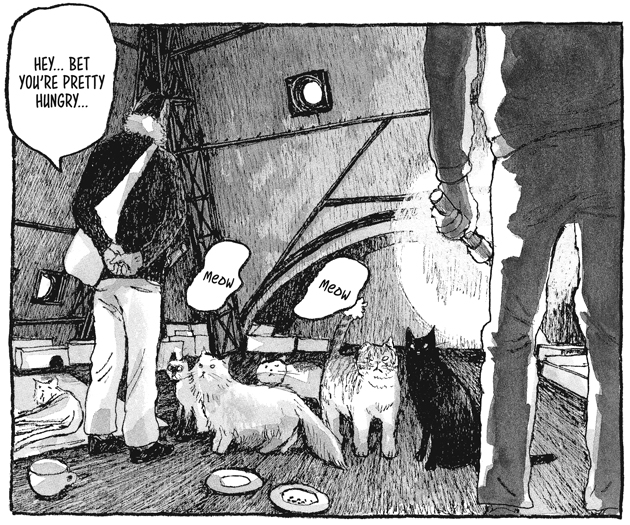
Weird. Uncanny. Melancholy. Beautiful. Those were just a few of the adjectives I jotted down while reading Taiyo Matsumoto’s Cats of the Louvre, the latest volume in the museum’s ongoing graphic novel series. Like Nicholas De Crécy’s Glacial Period and Jiro Taniguchi’s Guardians of the Louvre, Cats of the Louvre is less an illustrated guide to the museum than a story that happens to take place within its walls—in this case, the attic, where a colony of cats have taken up residence. Through a series of eighteen vignettes, Matsumoto gradually reveals that the cats’ primary caretaker—an elderly night watchman—has dedicated his life to searching the museum for his missing sister, who disappeared into one of the paintings when she was a child.

The key to finding Arrieta turns out to be Snowbébé, a kitten who frequently escapes from the attic to roam the galleries, hiding inside canvases to avoid detection. Snowbébé’s gift is both an essential plot point and an opportunity for Matsumoto to luxuriate in the smaller details of his favorite paintings, as is evident in a lovely, strange sequence that unfolds inside Henri Lerambert’s The Funeral Procession of Love (1580). From a modern viewer’s standpoint, Lerambert’s painting seems a little kitschy, with its parade of cherubs, poets, and philosophers strolling under the watchful eye of the goddess Diana:

Once Snowbébé steps into the painting, however, the landscape comes to life in unexpected ways: the flowers grin, the animals speak, and the laws of gravity disappear. In one brief but delightful sequence, for example, Snowbébé and Arrieta cavort across the ceilings and walls of a temple, while in another they board Diana’s chariot for a ride through the Milky Way. Yet for all the joyful (and weird) imagery, there’s a wistful quality to these two chapters, as Snowbébé slowly realizes that he cannot remain inside the Parade forever; his presence has disturbed the painting’s equilibrium, bringing storm clouds and disrupting the flow of time itself, forcing him to choose between staying with his new friend, or returning to the “cold and smelly and noisy” world of the Louvre.

What prevents Snowbébé’s odyssey from seeming twee or precious is Matsumoto’s studied primitivism; his characters’ mask-like faces, oddly proportioned bodies, and grotesque smiles are genuinely unnerving, creating a surreal atmosphere in which the boundaries between reality and imagination are blurred. Nowhere is this tendency more obvious than in the way he draws Snowbébé and his friends: the cats look like animals to their caretakers, but assume a humanoid form when interacting with each other. In Matsumoto’s hands, they look more like people in cat costumes than pussycats, with their essential feline features—ears, whiskers, tails, elongated limbs—rendered in an exaggerated fashion that gives them a faintly alien appearance.

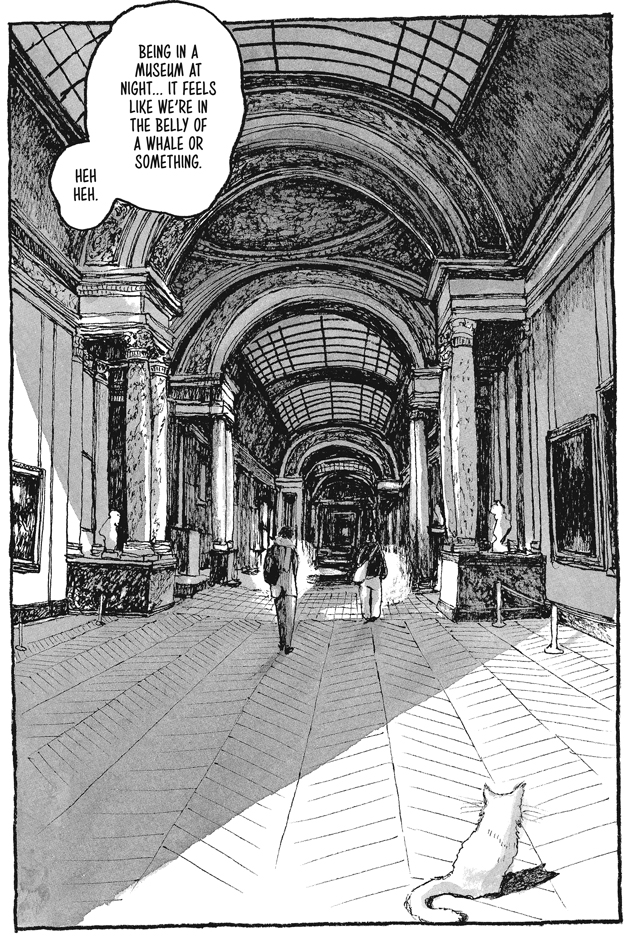
Matsumoto’s depiction of the Louvre is more straightforward, recreating iconic works with fidelity to the originals, whether he’s drawing a lesser-known genre painting or a genuinely famous sculpture. His rendition of the physical environment—the claustrophobic, dusty garret where the cats live, the grand staircases and hallways that lead to the galleries—is similarly precise, helping the reader envision the sheer size and opulence of the museum. As a result, the Louvre transcends its basic function as a setting, taking on the qualities of a living, breathing organism whose vaulted ceilings and majestic columns invite comparisons with dinosaurs or whales:

And while all the comics in the Louvre Collection have done an admirable job of depicting the museum, Cats of the Louvre approaches its subject matter without didacticism or pedantry; though Matsumoto’s human characters express strong feelings about art, those conversations spring organically from the story. Equally important, Cats of the Louvre has its own personality; unlike Hirohiko Araki’s Rohan at the Louvre, which recycled ideas and characters from JoJo’s Bizarre Adventure, Matsumoto’s story stands on its own, capturing his unique response to the museum and its collection. But the best reason to read Cats of the Louvre is its hero Snowbébé, whose quest to find his place in the world invites us to see the Louvre through fresh eyes, as a place of danger and sadness, but also of wonder, magic, and possibility. Recommended.

A review copy was provided by VIZ Media. To read a short preview, click here.

CATS OF THE LOUVRE • STORY AND ART BY TAIYO MATSUMOTO • TRANSLATED BY MICHAEL ARIAS • RATING: TEEN • 432 pp.

Filed Under: Manga, Manga Critic, REVIEWS Tagged With: Cats, Louvre Museum, Taiyo Matsumoto, VIZ, VIZ Signature

The Drifting Classroom Signature Edition, Vol. 1

October 13, 2019 by Katherine Dacey

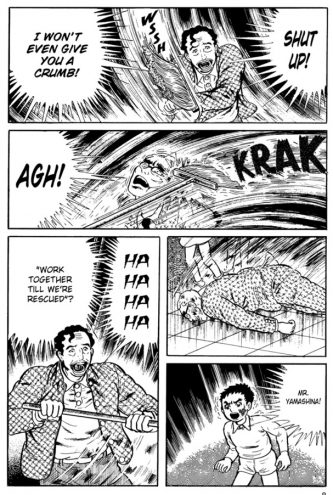
In a 2009 interview with Tokyo Scum Brigade, Kazuo Umezu acknowledged that his debt to Osamu Tezuka went beyond storyboarding and character designs. Tezuka “didn’t pull any punches for children or dumb down his works,” Umezu explained. “He dealt with complicated themes and let the readers work it out on their own.” The 1972 classic The Drifting Classroom reveals just how profoundly Umezu absorbed this lesson. Though it ran in Weekly Shonen Sunday, a magazine aimed at grade schoolers, Umezu’s work was bleak, subversive, and weirdly thrilling, depicting a nightmarish world where kids resorted to violence and deception to survive.

The Drifting Classroom begins with a freak accident in which a rift in the space-time continuum sends the Yamato Elementary School and its occupants into the distant future. Initially, the students and teachers believe that they are the sole survivors of a devastating nuclear attack, and the area immediately surrounding the school supports their hypothesis: it’s a barren wasteland with no water, plants, or signs of human habitation save a pile or two or non-degradable trash. As the school’s occupants realize the severity of the crisis, panic sets in. Teachers and students engage in a brutal competition for dwindling supplies while attempting to solve the mystery of what happened to them. And when I say “brutal,” I mean it: the body count in volume one is astonishing, with murders, mass suicides, fist fights, knife fights, and rampaging monsters culling the herd at a breathtaking rate.

It’s sorely tempting to compare The Drifting Classroom to The Lord of the Flies, as both stories depict school children creating their own societies in the absence of adult authority. But Kazuo Umezu’s series is more sinister than Golding’s novel, as Classroom‘s youthful survivors have been forced to band together to defend themselves against their former teachers, many of whom have become unhinged at the realization that they may never return to the present. Umezu creates an atmosphere of almost unbearable dread that conveys both the hopelessness of the children’s situation and their terror at being abandoned by the grown-ups, a point underscored by one student’s observation that adults “depend on logic and reason to deal with things.” He continues:

When something happens and they can’t use reason or logic to explain it, they can’t handle it. I don’t think they were able to accept that we’ve traveled to the future. You know how adults are always saying that kids are making things up? It’s because they only know things to be one way. Kids can imagine all kinds of possibilities. That’s why we’ve managed to survive here.

That speech is delivered by The Drifting Classroom‘s plucky protagonist Sho, a sixth grader who becomes the children’s de facto leader. When we first meet Sho, he’s behaving petulantly, pouting over his mother’s decision to throw away his marbles. The intensity of his anger is drawn in broad strokes, but it firmly establishes him as an honest-to-goodness ten year old, caught between his desire to play and his parents’ desire to mold him into a responsible teenager. Once transported to the future, Sho’s strategies for scavenging supplies or subduing a rampaging teacher are astute but not adult; there are flourishes of imagination and kid logic guiding his actions that remind us just how young and vulnerable he is. As a result, Sho’s pain at being separated from his parents, and of losing his comrades, is genuinely agonizing.

Umezu’s artwork further emphasizes the precarity of Sho’s situation. Sho and his classmates have doll-like faces and awkwardly proportioned bodies that harken back to Umezu’s work for shojo magazines such as Sho-Comi and Shoujo Friend, yet their somewhat unnatural appearance serves a vital dramatic function, underscoring how small they are when contrasted with their adult guardians. The adults, on the other hand, initially appear normal, but descend into monstrous or feckless caricatures as their plight becomes more desperate. Only Sho’s mother—who is stuck in the present day—escapes such unflattering treatment, a testament to her devotion, courage, and imagination; while her husband and friends have accepted the official story about the school’s fate, Sho’s mother is open to the possibility that Sho may be reaching across time to communicate with her.

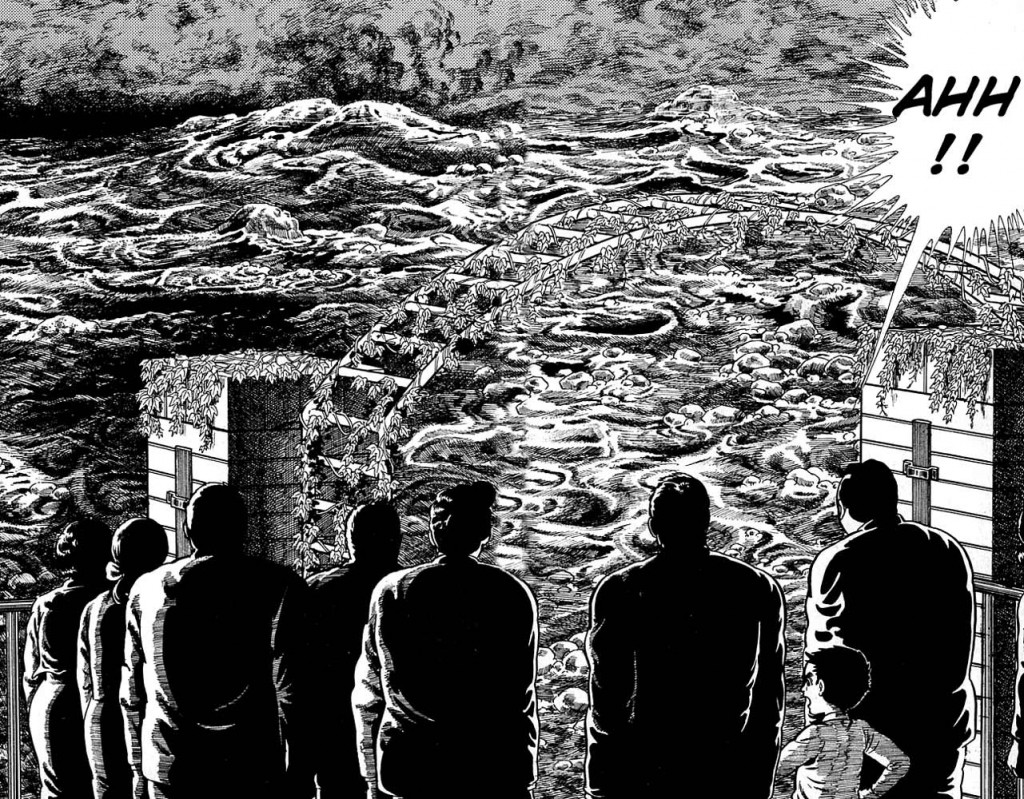
Like his character designs, Umezu’s landscapes are willfully ugly, evoking feelings of disgust, fear, and anxiety that are almost palpable, whether he’s drawing an abandoned building or a garden filled with grotesquely misshapen plants. The area just outside the school gates, for example, resembles the slopes of an active volcano, with sulfurous clouds wafting over a rocky expanse that seems both frozen and molten—an apt metaphor the characters’ state of mind as they first glimpse their new surroundings:

Though The Drifting Classroom‘s imagery still resonates in 2019, its gender politics do not, as an egregious subplot involving a sadistic girl gang demonstrates. When the gang attempts to seize control of the school, a classmate urges Sho to oppose them on the grounds that girls are fundamentally unsuited for leadership roles. (“Women are made to give birth and rear children so they can’t think long term,” Gamo helpfully opines.) Umezu’s goal here, I think, is to suggest that girls are as capable of violence and cruelty as boys, but the dialogue suggests the gang’s behavior is a symptom of innate irrationality instead of a genuine and logical response to a desperate situation. Making matters worse is that the few sympathetic female characters are consigned to stereotypically feminine roles that give them little to do besides scream, run, and comfort the younger children; even Sakiko, the smartest girl in the class, never gets a chance to solve a problem or offer a useful opinion.

Yet for all its obvious shortcomings, The Drifting Classroom is a thoughtful meditation on adult hypocrisy, exposing all the ways that adults manipulate and terrorize children for their own convenience. “Adults are humans, children are animals,” a cafeteria worker tells Sho and his friends. “That’s why adults have the power of life and death over kids.” That Sho and his followers cling to their humanity despite the adults’ selfish behavior reminds us that children are innocent but not naive; Sho and his friends are clear-eyed about their teachers’ failings, yet choose to persevere. Recommended.

This is a greatly expanded–and reconsidered–review of The Drifting Classroom that appeared at PopCultureShock in 2006. VIZ Media provided a review copy. Read a free preview here.

THE DRIFTING CLASSROOM, VOL. 1 • STORY AND ART BY KAZUO UMEZZ • TRANSLATED BY SHELDON DRZKA • ADAPTED BY MOLLY TANZER • RATED T+, FOR OLDER TEENS (VIOLENCE, HORROR, GORE) • 744 pp.

Filed Under: Manga, Manga Critic, REVIEWS Tagged With: Classic Manga, Drifting Classroom, Horror/Supernatural, Kazuo Umezu, VIZ, VIZ Signature

Short Takes: Museum and Phantom Tales of the Night

October 6, 2019 by Katherine Dacey

I have a confession: I am a complete chicken when it comes to horror movies. I watched Alien through my fingers and made it to the end of Fright Night by staring at the ingredient list on a candy wrapper; even the hot vampires of The Lost Boys weren’t soulful or shirtless enough to fully hold my gaze. But horror manga is another story, as I count Mermaid Saga, Gyo, Tomie, The Kurosagi Corpse Delivery Service, and PTSD Radio among my favorites series. I can’t explain why horror manga doesn’t affect me the same way that movies do–no soundtrack, perhaps?–but I’m glad that I’ve found the intestinal fortitude to read Junji Ito and Kazuo Umezu’s work. Alas, I had less patience with the two most recent horror series I read: Museum, a digital-only offering from Kodansha, and Phantom Tales of the Night, a cautionary tale about a mysterious innkeeper.

Museum, Vol. 1
Story and Art by Ryosuke Tomoe
Kodansha Comics
Rated M, for Mature (graphic violence)

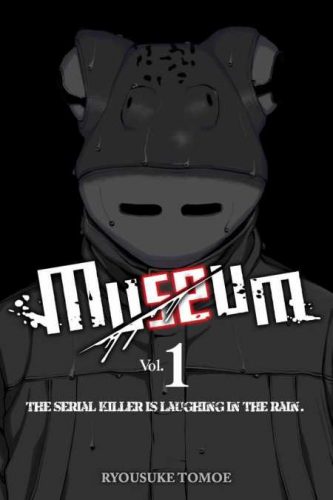
Stop me if you’ve heard this one before: a mask-wearing vigilante kidnaps and tortures his victims in grotesque fashion–feeding them to dogs, severing their ears, tying them to toilets–then leaves cryptic notes that characterize each act as a “punishment,” daring the authorities to catch him. The mystery of who the vigilante is and what motivates him is the main driving force behind Museum, but you might not want to soldier through the carnage for answers to those questions since Ryosuke Tomoe can’t decide if his vigilante is a hero or a monster. Tomoe depicts the violence with such fetishistic detail that the reader is invited to admire the killer’s technique rather than meditate on the true horror of what the character has done. The ugly, utilitarian artwork and  relentlessly dour tone are the nails in the proverbial coffin, underscoring just how unpleasantly banal Museum really is. Not recommended.

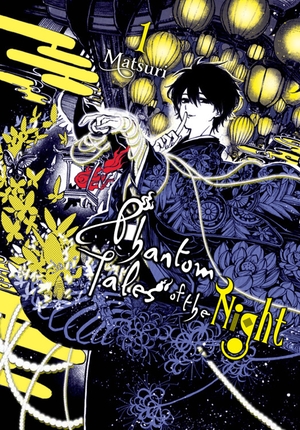
Phantom Tales of the Night, Vol. 1
Story and Art by Matsuri
Yen Press
Rated OT, for Older Teens (violence and sexual themes)

Phantom Tales of the Night is the kind of bad manga that’s difficult to review: it isn’t offensive or ineptly drawn, but it’s a chore to read thanks to its poor plotting, muddled characterizations, and maddeningly opaque dialogue. Ostensibly, the series focuses on the Murakamo Inn, where the demonic host cajoles his guests into revealing their secrets. The rules governing how the Murakamo Inn operates, however, are in a constant state of flux, making it hard to pin down what, exactly, Phantom Tales is about. In some chapters, characters share their secrets with the inn’s owner in exchange for having a wish fulfilled, while in others, characters learn a terrible secret about themselves. The later chapters hint at a potentially longer, more complex arc that will play out over several volumes, but the set-up is so abrupt and confusing that it robs the final pages of their full impact–a pity, since Matsuri has a flair for drawing genuinely creepy monsters. Perhaps the most damning thing about Phantom Tales of the Night is that the characters talk incessantly about “secrets” but lack a basic understanding of what a secret really is or why it holds such power—a key failing in a series that is predicated on the idea that secrets are a kind of supernatural currency. Not recommended.

Filed Under: Manga, Manga Critic, REVIEWS Tagged With: Horror/Supernatural, Kodansha Comics, yen press

Shojo & Tell: Moto Hagio Edition

September 28, 2019 by Katherine Dacey

To celebrate the release of Moto Hagio’s The Poe Clan, Shojo & Tell host Ashley MacDonald invited me to join her for an in-depth conversation about three of my all-time favorite manga: A, A’, They Were Eleven, and A Drunken Dream and Other Stories. We mulled over plot developments, discussed problematic passages, and agreed that “Iguana Girl” may be the biggest tear-jerker in the Hagio canon. (Seriously–I can’t read it without getting the sniffles.) Ashley just posted the episode, which you can check out here:

For more insight into the manga that we discussed, I recommend the following essays and reviews from The Manga Critic vault:

  • The Poe Clan, Vol. 1
  • A Drunken Dream and Other Stories
  • Manga Artifacts: A, A’ and They Were Eleven
  • An Introduction to Keiko Takemiya’s To Terra (essay explores Takemiya’s work in the context of the shojo manga revolution of the 1960s and 1970s)

I want to thank Ashley for the opportunity to chat about Hagio, and for doing such a terrific job of editing our conversation! If you’re not regularly following Shojo & Tell, I encourage you to check out the archive, as Ashley is a thoughtful host with a knack for choosing great manga and great guests. Recent contributors include Aisha Soleil and Rose Bridges discussing Bisco Hatori’s Ouran High School Host Club, Asher Sofman discussing CLAMP’s Tokyo Bablyon, and Manga Bookshelf’s own Anna Neatrour discussing Meca Tanaka’s The Young Master’s Revenge. Go, listen!


Filed Under: Manga, Manga Critic, REVIEWS Tagged With: Classic Manga, Magnificent 49ers, moto hagio, Sci-Fi, Shojo & Tell

The Way of the Househusband, Vol. 1

September 25, 2019 by Katherine Dacey

If you’ve seen Lillehammer or My Blue Heaven, you’ll immediately recognize the foundation on which The Way of the Househusband is built: a mafia don or hit man renounces his old life and joins the ranks of ordinary civilians working nine-to-five jobs, mowing lawns, and attending school plays. Predictably, the transition from whacking rivals to whacking weeds is a bumpy one, as the former criminal discovers that the skills he acquired in his old line of work haven’t fully equipped him for a more prosaic existence; seemingly benign interactions at the principal’s office or the post office are fraught with peril, as they’re guided by unfamiliar social codes. Then, too, there’s the specter of his old life—the possibility that a former associate might recognize him or seek him out for one last job.

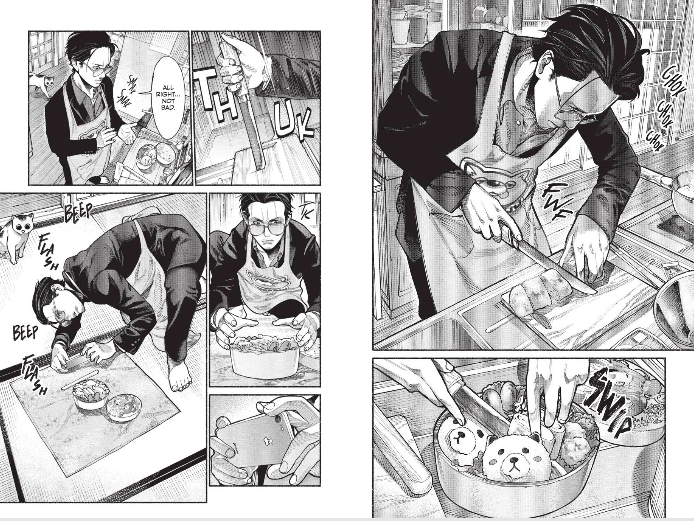
The Way of the Househusband covers all of this well-spaded ground, earning its laughs by putting fresh twists on familiar scenarios. Its protagonist, the stone-faced Tatsu, is a former yakuza boss-cum-househusband who spends his days making elaborate bento boxes for his wife and scouring the grocery store for bargains. As is standard for this particular fish-out-of-water genre, Tatsu’s sangfroid is sorely tested by the minor annoyances of civilian life: a visit from the neighborhood association president, a trip to the mall.

When a knife salesman knocks on Tatsu’s door, for example, author Kousuke Oono teases the idea that his characters’ interactions might end in violence or a harrowing demonstration of Tatsu’s knife-wielding skills. Instead, Tatsu has an opportunity to show off his culinary prowess, winning over the understandably nervous salesman with his “patented hamburger steak plate.” The salesman’s rhapsodic expression and interior monologue put the gag over the top, as the salesman identifies the dish’s secret ingredient—“minced fish paste”—and muses that its flavor “takes me back to my hometown.”

Strong artwork is essential to selling a slapstick premise like Househusband’s, and for the most part, Oono succeeds. Oono’s characters have distinctive appearances that makes it easy to “read” their comic function–the suspicious neighbor, the former crime associate–but Oono never relies on this technique alone, often giving bit players an unexpected moment of steeliness or resourcefulness that nudges the joke in an unexpected direction. The salesman, for example, looks like a soft, middle-aged man, but turns out to be stronger, pushier, and more determined than his initial reaction to Tatsu might suggest, quickly recovering his composure after Tatsu answers the door wearing a bloody apron. (“I was just, uh, doin’ a little butcherin’,” Tatsu explains sheepishly.)

Appearance-wise, Oono does a great job of making Tatsu look utterly incongruous with his surroundings. With his pencil-thin mustache, scarred face, and aviator sunglasses–not to mention his black suit and tattoos–Tatsu cuts a striking figure in the supermarket and on the street. Oono invigorates this obvious sight gag by swathing Tatsu in housewife “drag,” outfitting him in a kerchief and apron emblazoned with a shiba inu to further emphasize just what a fish out of water Tatsu is. That same attention to detail extends to the way that Tatsu moves; Oono draws him like a human cobra whose sinewy, explosive movements strike terror into his enemies’–and his neighbors’–hearts.

Sheldon Drzka and Jennifer LeBlanc’s skillful adaptation of the script is the icing on the cake, giving every character a distinctive voice, and every exchange the pleasant zing of a good Saturday Night Live or Key & Peele sketch–no mean feat, given the cultural specificity of the jokes.

As good as the script and art are, however, I have a sneaking suspicion that Way of the Househusband might run out of gas after three or four volumes unless Oono pivots the storyline in a new direction–say, by introducing a baby into the picture, or revealing that Tatsu’s hard-charging wife has a secret past of her own. But for now, I’m happy to continue reading any series that pits a former yakuza boss against a Roomba and a frisky cat, or depicts a manly man going to extreme lengths to ensure that his wife has a tasty lunch. In the immortal words of Paris Hilton, that’s hawt. Recommended.

VIZ Media provided a review copy. Read a free preview here.

THE WAY OF THE HOUSEHUSBAND, VOL. 1 • STORY AND ART BY KOUSUKE OONO • TRANSLATION BY SHELDON DRZKA, ADAPTATION BY JENNIFER LEBLANC • VIZ MEDIA, LLC • 166 pp. • RATED T+, FOR OLDER TEENS (SUGGESTED VIOLENCE, YAKUZA JOKES)

Filed Under: Manga, Manga Critic, REVIEWS Tagged With: Comedy, VIZ, VIZ Signature, Way of the Househusband, Yakuza

Become You, Vol. 1

September 16, 2019 by Katherine Dacey

Ichigo Takano’s orange may be one the of best shojo manga published in the last ten years, offering readers a vivid, sympathetic portrait of five friends who get an unexpected chance to save a suicidal classmate’s life. Though orange explored dark emotional terrain, it was never mawkish; instead, orange ended on a hopeful note that showed younger readers that life goes on after tragedies big and small.

Become You, Takano’s latest series, mines a similar thematic vein, this time focusing on two emotionally damaged boys who form an improbable bond through music. And by “improbable,” I mean Taiyou and Hikari are temperamental opposites who initially seem ill-suited for friendship, let alone artistic collaboration. Taiyou is one of those only-in-manga characters whose dogged optimism shades into fanaticism—the kind of character who calls everyone his friend, and wears down skeptics with his relentless overtures. Hikari, by contrast, is a classic Character With a Secret, a former prodigy who abruptly abandoned the piano despite (or perhaps because of) his phenomenal success, keeping his classmates at bay with blunt comments. Naturally—by the immutable laws of Shojo Manga Plot Mechanics—Taiyou tries to recruit Hikari for a band, despite the fact that Taiyou is a tyro guitar player.

At first glance, Become You seems to be following a well-worn path in which an enthusiastic novice persuades a reluctant genius to mentor him, in the process drawing out his teacher and helping his teacher recover something that he lost—say, his joy in playing the tuba, or his relationship with an estranged family member. But Takano adds an interesting wrinkle to this familiar plotline: midway through volume one, we learn that Taiyou originally wanted to be an artist, but lost his desire to paint after being bullied by a teacher. In the aftermath of this encounter, what Taiyou really wants is to be good at something—anything, really—and will work diligently towards achieving that goal, even if he shows little or no aptitude for his chosen pursuit. Equally important, Taiyou is just as emotionally vulnerable as his would-be mentor, even though Taiyou papers over his anguish with bright smiles and cheerful comments.

As with orange, a magical plot device brings Become You‘s principal characters together–in this case, a mysterious cloaked figure who presents Taiyou with an electric guitar and words of Yoda-like encouragement. It’s not entirely clear if Taiyou is fantasizing or having a premonition, since his guardian angel looks an awful lot like Hikari. And while the ambiguity of these scenes has little impact on the reading experience, they occupy more space than the time-traveling letters did in orange—a mistake, I think, because Taiyou’s daydreams don’t add any special urgency or poignancy to the story. By contrast, orange‘s letters served a twofold purpose, setting the plot in motion and highlighting all the small ways that innocent comments or decisions could hurt someone as fragile as the suicidal Kakeru.

The other drawback to Become You is that Takano doesn’t seem to know much about music. Taiyou, for example, cheerfully states his intention to attend a “music college,” but lacks the rudimentary skills to play in sync with a metronome or sight-read sheet music. (He also seems blissfully unaware that conservatories require an entrance audition.) The concert sequences are similarly revealing: though Takano draws attractive, animated characters, and can put them through their emotional paces, she struggles to make Taiyou and Hikari’s musical performances come to life on the page, either by showing the physical effort necessary to making a sound—embouchure, hand position, posture—or by drawing convincing crowd shots that convey the impact of the music on listeners.

I’m not ready to give up on Become You just yet, however, as Takano has something worthwhile to say about pursuing activities for emotional fulfillment, rather than for personal achievement. She also explores the idea of artistic mentorship with honesty, acknowledging that the teacher-student relationship can have a profound effect on how a young artists finds his voice; any violation of that compact—an unkind comment, a dogged insistence on doing things the “right” way—can leave deep scars and stunt one’s artistic growth. Here’s hoping volume two strikes a better balance between the magical realism and the realities of being a musician. Tentatively recommended.

BECOME YOU, VOL. 1 • STORY & ART BY ICHIGO TANAKA • TRANSLATED BY AMBER TAMOSAITIS • SEVEN SEAS • RATED TEEN • 200 pp.

Filed Under: Manga, Manga Critic, REVIEWS Tagged With: Drama, Ichigo Takano, Musical Manga, Seven Seas

No Guns Life, Vol. 1

September 9, 2019 by Katherine Dacey

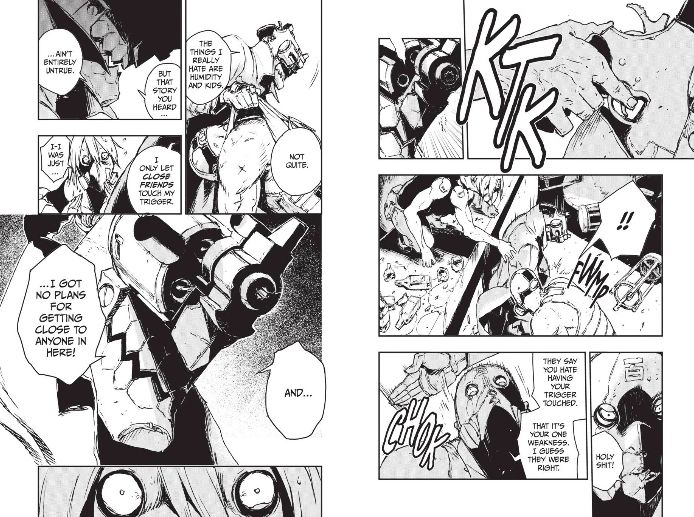
No Guns Life is a textbook example of  “robo noir,” a story that borrows tropes from Double Indemnity and The Maltese Falcon and transplants them to a not-too-distant future where old and new technologies rub shoulders, and damsels in distress might, in fact, be androids. The hero is Juzo Inui, a bodyguard-for-hire who has a strong moral code and an aversion to “humidity and kids.” Like the cyborg clientele he serves, Juzo’s body has been cybernetically enhanced, his head replaced with a giant revolver. Yes—you read that right. Juzo’s head can fire a round of ammunition, a creative decision that skirts the line between funny and horrific; only Juzo’s strong moral code makes the gun-as-head concept palatable.

And speaking of that moral code, volume one focuses on Juzo’s efforts to honor a contract with a fellow cyborg. That cyborg shows up at Juzo’s office with a 12-year-old boy in tow and a request: hide the boy from the Berühen Corporation, a powerful organization that manufactures top-secret weapons. With the police and Berühen’s goons on his trail, Juzo stashes Tetsuro with his friend Mary, a back-alley surgeon, and sets out to discover why Tetsuro is such a hot commodity.

While Juzo’s exploits are entertaining, No Guns Life is a mixed bag. On the plus side, the story is briskly paced and well drawn; Tasuku Karasuma creates a strong sense of place in his establishing shots, drawing a sprawling modern city that still has hole-in-the-wall office buildings, dingy basements, and crowded tenements, all populated by characters with memorable mugs. On the minus side, the story traffics in cliches, from the beautiful assassin who carries out her duties in a skimpy costume to the villains who deliver lengthy, exposition-dense monologues before pulling the trigger. The fight scenes, too, leave something to be desired; there are too many flash-boom panels that bury the action under sound effects and speed lines, leaving the reader to guess what’s happening. None of these shortcomings are fatal, but they emphasize the fact that No Guns Life is chiefly memorable because the protagonist looks like a Second Amendment poster boy, not because the story has something new to say about the boundaries between man and machine, or the ethics of human experimentation.

The bottom line: Fans of the anime will probably enjoy No Guns Life, but readers versed in sci-fi and noir conventions may find it too pedestrian to make a lasting impression.

A review copy was provided by VIZ Media, LLC. Volume one will be released on September 17, 2019. Read a free preview here.

NO GUNS LIFE, VOL. 1 • STORY AND ART BY TASUKU KARASUMA • TRANSLATED BY JOE YAMAZAKI • VIZ MEDIA • RATED T+, FOR OLDER TEENS (VIOLENCE, SCANTILY CLAD WOMEN) • 248 pp.

Filed Under: Manga, Manga Critic, REVIEWS Tagged With: No Guns Life, Post-Apocalyptic Sci-Fi, Sci-Fi, Ultra Jump, VIZ Signature

Go With the Clouds: North by Northwest, Vols. 1-2

August 30, 2019 by Katherine Dacey

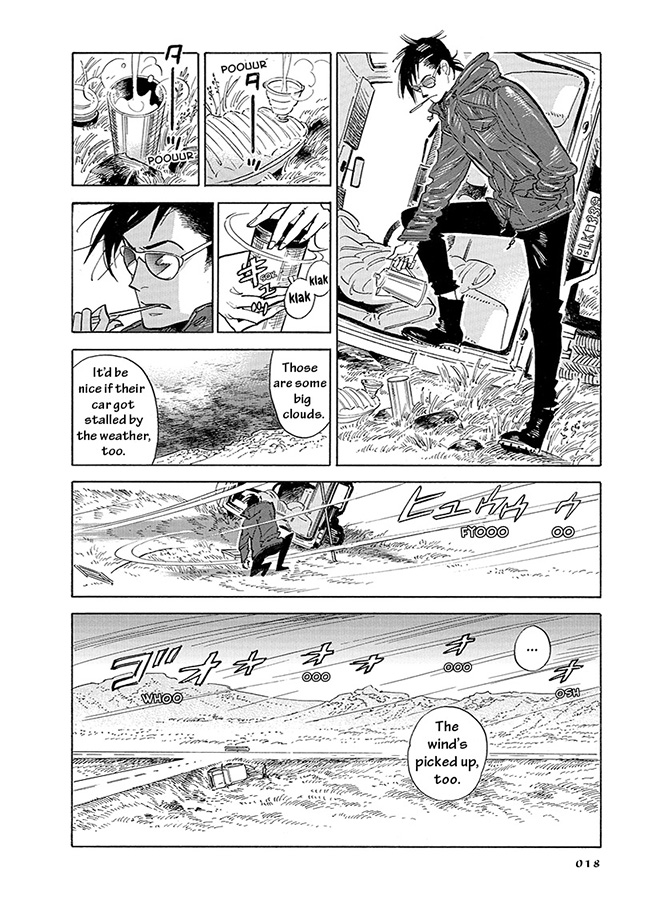
I’ve never used the word “shambolic” in a review before, but that was the first adjective that came to mind as I read Go With the Clouds: North by Northwest, a handsomely illustrated series that can’t decide if it’s a murder mystery, a coming-of-age story, an Icelandic travel brochure, or a Knight Rider episode. Go With the Clouds’ abrupt tonal shifts and plot twists left me scratching my head, but I was never bored or disappointed by Aki Irie’s narrative choices; if anything, the messy weirdness of the first volume was ingratiating, a reminder that sometimes the most interesting storytellers aren’t particularly disciplined.

The first volume is a bumpy ride, lurching from one idea to the next without warning. In the first five chapters alone, we learn that seventeen-year-old protagonist Kei Miyama is a detective-for-hire; has a younger sibling named Michitaka who’s the chief suspect in a double homicide; and can hear his car’s thoughts. (As befits a story set in Iceland, Kei’s car is very moody.) Though volume one ends with a dramatic confrontation over Michitaka, volume two barely acknowledges the murder investigation, focusing instead on a visit from Kei’s childhood friend Kiyoshi. The two spend an agreeable week touring the Icelandic countryside by car, visiting geysers, gawking at cliffs and waterfalls, and taking pictures. Michitaka makes the briefest of cameos, but is otherwise absent from volume two—a strange choice, given how urgent his storyline seemed in volume one.

Normally, this kind of narrative sloppiness if a turn-off for me, but Irie rewards the patient reader with complex characters, interesting bits of Icelandic lore, and—best of all—breathtaking artwork that captures the starkly beautiful landscape of the Golden Circle. Her linework is crisp and her use of tone sparing; in her most striking panels, we have a sense of how empty the Icelandic countryside really is thanks to her judicious use of white space. At the same time, however, she excels at detail work, giving the reader an intimate look at houses, cafes, churches, and—yes—car interiors. That same attention to detail extends to her character designs, which are an elegant blend of naturalism and stylization; you’d be forgiven for thinking that Kei looks more like a movie star than a moody teenager.

Her characterizations are likewise thoughtful. Kei, for example, isn’t defined solely by his gift; instead, it’s just a small facet of his personality that helps shed light on how attuned he is to his surroundings. The same is true for Kei’s grandfather, who’s initially portrayed as a stubborn curmudgeon but turns out to be more perceptive than his blustery persona might suggest, especially after Michitaka enters the picture. While several seemingly important characters are still in an embryonic stage of development—most notably Kei’s imperious neighbor Lilja—Irie’s ability to depict people in all their idiosyncrasies makes me confident that the supporting cast will be more fleshed out in future volumes.

I’d be the first to admit that the series’ pacing and narrative detours won’t be everyone’s cup of tea; I was initially put off by Kei’s one-sided conversations with his trusty jalopy, and frustrated by the sudden appearance—and equally sudden disappearance—of a Japanese investigator who is convinced of Michitaka’s guilt. By the end of volume one, however, I didn’t care; I felt that Go With the Clouds had transported me somewhere I hadn’t been before—in real life or my imagination—and was eager for another installment of Kei’s saga. Recommended.

GO WITH THE CLOUDS, NORTH BY NORTHWEST, VOLS. 1-2 • ART AND STORY BY AKI IRIE • VERTICAL COMICS • NO RATING

Filed Under: Manga, Manga Critic, REVIEWS Tagged With: Aki Irie, Iceland, Mystery/Suspense, Seinen, Vertical Comics

The Right Way to Make Jump

August 23, 2019 by Katherine Dacey

Most books about the manga industry fall into one of two categories: the how-to book, which offers advice on how to draw proportionate characters, plan a storyboard, and buy the right pens; and the how-I-became-an-artist story, which charts the emotional ups and downs of breaking into the manga biz. The Right Way to Make Jump takes a different approach, pulling back the curtain on the production process.

Our guide to the manga-making process is Takeshi Sakurai, an anxiety-ridden thirty-year-old who traded his dreams of becoming a professional manga-ka for a more predictable, less demanding life as an onigiri chef. Out of the blue, Sakurai receives a call from his former editor Momiyaxx-san about a once-in-a-lifetime opportunity to “create a non-fiction manga” that explains “how Jump is made.” After much hand-wringing and angst—and a friendly nudge from his cheerful, patient wife—Sakurai accepts the assignment, embarking on a series of factory tours and interviews to learn the nuts-and-bolts of publishing an issue of Weekly Jump. His odyssey takes him to a paper mill at the foot of Mt. Fuji, the editors’ bullpen at Shueisha headquarters, and VIZ’s corporate office in San Francisco, where Sakurai gets a first-hand look at how Jump is localized for different markets.

The book is cheekily divided into ten “arcs,” each of which focuses on a specific production step. The most interesting sections focus on the manufacturing process, explaining why Jump uses colored paper and how the magazines are cut, assembled, and bound. For readers who love the Discovery Channel—and I count myself among them—these early chapters are a blast, as they are studded with weird, wonderful facts about paper and machinery. (Among the most interesting: Jump paper dust plays an important role in Tokyo’s sewage treatment program.) The later chapters, by contrast, are less effective, as the editorial staff’s answers to potentially interesting questions are couched in polite, vague language that offers little insight into what they do; you’d be forgiven for rolling your eyes when a Jump staffer offers an essentialist justification for not hiring female editors, or chalks up the order of each issue to ‘intuition.’

Where The Right Way really shines is in Sakurai’s use of clever visual analogies to help the reader grasp the most  intricate parts of the manufacturing process. In “Platemaking,” for example, Sakurai creates a muscle-bound figure who represents the resin plate, a key element in the printing process:

The figure’s transformation neatly embodies the basic principles of creating a positive from a negative by comparing the process to suntanning—something that readers of all ages can relate to from personal experience.

As informative as such passages are, The Right Way can be a frustrating reading experience. Some chapters are briskly executed, achieving a good balance between education and entertainment, while others focus too much on slapstick humor, unfunny exchanges between Sakurai and Momiyaxx-san, and shameless plugs for Weekly Jump. Sakurai’s sardonic tone—expertly captured by translator Emily Taylor—helps mitigate some of these issues, but can’t always goose the tempo when Sakurai frets and fumes about meeting his deadlines; joking about your own shortcomings can be an effective strategy for ingratiating yourself to the reader, but not when you’re using those jokes to pad your weekly page count.

The overall structure of the book, too, leaves something to be desired. Though the first chapters focus on how the magazine is printed, the later chapters tackle a seemingly random selection of topics—Jump Festa, recycled paper stock, cover design, reader contests—suggesting that no one anticipated how long The Right Way would run in Weekly Jump. A topic-of-the-week approach is fine when readers wait for each new installment, but it makes for a chaotic, sometimes repetitive reading experience when collected in a single volume. The most logical strategy for organizing the tankubon edition would have been to start with the editorial process and end with the printing; not only does sequential presentation have obvious explanatory value, it also lends the material a compelling narrative arc, something that The Right Way to Make Jump sorely lacks.

Despite these shortcomings, I’d still recommend The Right Way to Make Jump, as it offers an all-too-rare glimpse of manga publishing’s less glamorous aspects, highlighting the contributions of professionals whose efficiency, creativity, and diligence have made Weekly Jump into a global phenomenon.

THE RIGHT WAY TO MAKE JUMP • ART AND STORY BY TAKESHI SAKURAI • TRANSLATED BY EMILY TAYLOR • VIZ MEDIA • 208 pp. • RATED T, FOR TEENS

Filed Under: Manga, Manga Critic, REVIEWS Tagged With: How-To, Shonen Jump, Takeshi Sakurai, VIZ

The Poe Clan, Vol. 1

August 15, 2019 by Katherine Dacey

Since its debut in Bessatsu Shōjo Comic, Moto Hagio’s The Poe Clan has proven almost as enduring as its vampire protagonists, living on in the form of radio plays, CD dramas, a television series, a Takarazuka production, and a sequel that appeared in Flowers forty years after the series finished its initial run. The Poe Clan’s success is even more remarkable considering that Hagio was in the formative stages of her career, having made her professional debut just three years earlier with the short story “Lulu to Mimi.” Yet it’s easy to see why this work captivated female readers in 1972, as Hagio’s fluid layouts, beautiful characters, and feverish pace brought something new to shojo manga: a story that luxuriated in the characters’ interior lives, using a rich mixture of symbolism and facial close-ups to convey their ineffable sorrow.

The Poe Clan‘s principal characters are Edgar and Marybelle Portsnell, the secret, illegitimate children of a powerful aristocrat. When their father’s new wife discovers their existence, Edgar and Marybelle’s nursemaid leads them into a forest and abandons them. The pair are rescued by Hannah Poe, a seemingly benevolent old woman who plans to induct them into her clan when they come of age. The local villagers’ discovery that the Poes are, in fact, vampirnellas (Hagio’s term for vampires) irrevocably alters Hannah’s plans, however, setting in motion a chain of events that lead to Edgar and Marybelle’s premature transformation into vampirnellas.

Though my plot summary implies a chronological narrative, The Poe Clan is more Moebius strip than straight line, beginning midway through Edgar and Marybelle’s saga, then shuttling back and forth in time to reveal their father’s true identity and introduce a third important character: Alan Twilight, the scion of a wealthy industrialist whose confidence and beauty beguile the Portsnell siblings. In less capable hands, Hagio’s narrative structure might feel self-consciously literary, but the story’s fervid tone and dreamy imagery are better served by a non-linear approach that allows the reader to immerse themselves in Edgar’s memories, experiencing them as he does: a torrent of feelings. Furthermore, Hagio’s time-shifting serves a vital dramatic purpose, helping the reader appreciate just how meaningless time is for The Poe Clan’s immortal characters; they cannot age or bear children, nor can they remain in any school or village for more than a few months since their unchanging appearance might arouse suspicion.

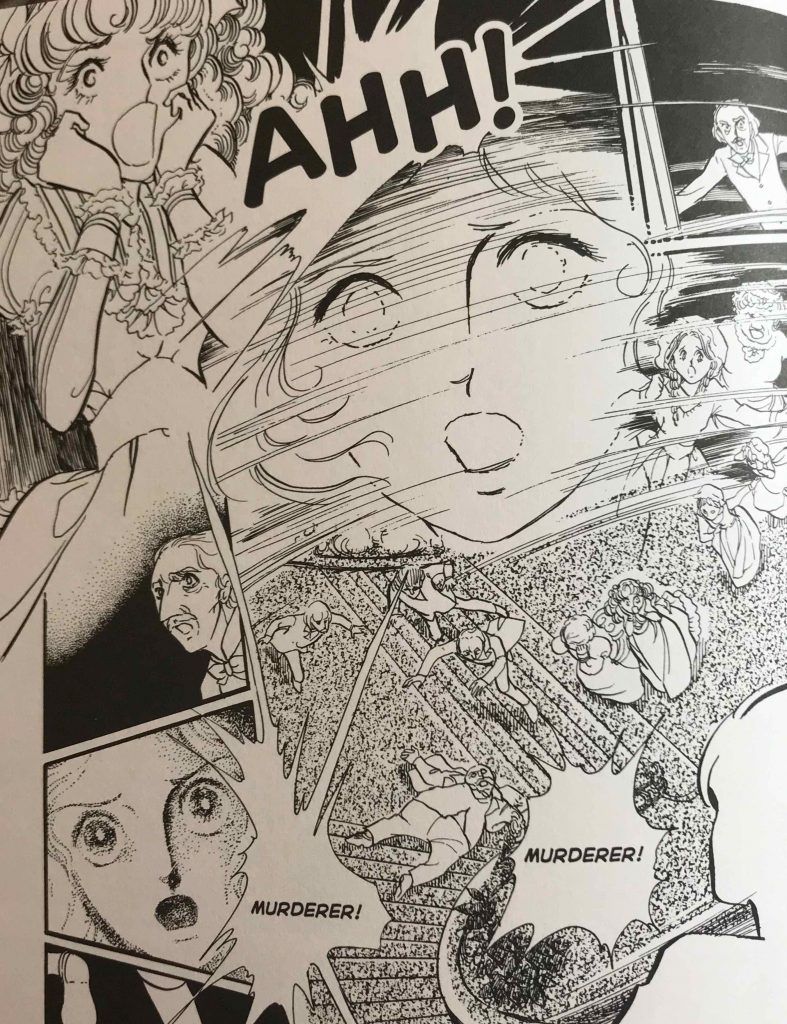
Hagio’s artwork further reinforces the dreamlike atmosphere through inventive use of panel shapes and placement, with characters bursting out of frames and tumbling across the page, freeing them from the sequential logic of the grid. In this scene, for example, Hagio uses these techniques to depict an act of impulsive violence—Alan pushes his uncle down a flight of stairs—as well as the reaction of the servants and relatives who bear witness to it:

While the influence of manga pioneers like Osamu Tezuka and Shotaro Ishinomori is evident in the dynamism of this layout, what Hagio achieves on this page is something arguably more radical: she uses this approach not simply to suggest the speed or force of bodies in motion, or the simultaneous reactions of the bystanders, but to convey the intensity of her characters’ feelings, a point reinforced by the facial closeups and word balloons that frame the uncle’s crumpled body.

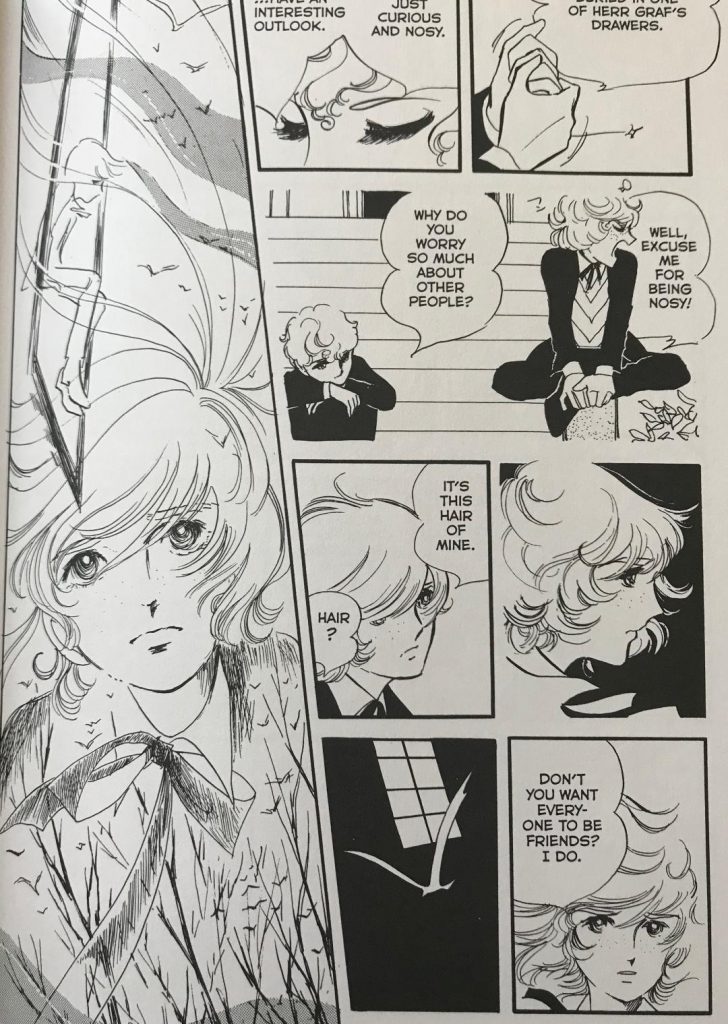
Her method for representing memories is likewise artful. Through layering seemingly arbitrary images, she creates a powerful analogue for how we remember events—not as a complete, chronological sequence but a vivid collage of individual moments and details. In this passage, Hagio reveals why one of Edgar’s schoolmates has confessed to a theft he didn’t commit:

The final frame of this passage reveals the source of Killian’s pain: he witnessed another boy’s suicide. But Killian isn’t remembering how the event unfolded; he’s remembering the things that caught his eye—birds and branches, feet dangling from a window—and his own feelings of helplessness as he realized what his classmate was about to do.

As ravishing as the artwork is, what stayed with me after reading The Poe Clan is how effectively it depicts the exquisite awfulness of being thirteen. Alan, Edgar, and Marybelle feel and say things with the utmost sincerity, so caught up in the intensity of their emotions that nothing else matters. Through the metaphor of vampirism, Hagio validates the realness of their tweenage mindset by depicting their existence as an endless cycle of all-consuming crushes, sudden betrayals, and confrontations with hypocritical, dangerous, or bumbling adults. At the same time, however, Hagio invites the reader to see the tragedy in the Portsnells’ dilemma; they are prisoners of their own immaturity, unable to achieve the emotional equilibrium that comes with growing up.

One final note: Fantagraphics deserves special praise for their elegant presentation of this shojo classic. Rachel Thorn’s graceful translation is a perfect match for the imagery, conveying the characters’ fervor in all its adolescent intensity, while the large trim size and substantial paper stock are an ideal canvas for Hagio’s detailed, vivid artwork. Recommended. 

This post was updated on August 23rd with more accurate information about the current status of The Poe Family‘s serialization in Flowers. Special thanks to Eric Henwood-Greer for the correction!

THE POE CLAN, VOL. 1 • ART AND STORY BY MOTO HAGIO • TRANSLATED BY RACHEL THORN • FANTAGRAPHICS • 512 pp. • NO RATING

Filed Under: Manga, Manga Critic, REVIEWS Tagged With: Classic Manga, fantagraphics, moto hagio, The Poe Clan, Vampires

Ryuko, Vol. 1

August 8, 2019 by Katherine Dacey

If you’ve been jonesing for a stylish thriller that doesn’t take itself too seriously, Eldo Yoshimizu’s Ryuko might just fit the bill: it has the pulpy soul of a Kazuo Koike manga and the brash attitude of a James Bond flick. And while Ryuko never quite achieves the simmering intensity or cohesion of Lady Snowblood and Crying Freeman, it does hold its own against Koike’s best work thanks to its audacious action sequences and cool-as-ice heroine who’ll stop at nothing to avenge her mother’s kidnapping.

Running in tandem with the kidnapping storyline are four —maybe five — other subplots, all connected to the Soviet-Afghanistan war. There’s gun-running and opium harvesting, Soviet malfeasance and CIA chicanery, and some other elements that, frankly, don’t make a lot of sense, though they provide sufficient justification for the imaginatively staged combat. Anyone hoping for a few helpful lines of expository dialogue will be frustrated, as the characters are so laconic they seldom utter more than a few words before throwing a punch or brandishing a gun.

The real star of Ryuko is Eldo Yoshimizu’s artwork, which deftly synthesizes Japanese and European influences without slavishly copying them. His female characters, in particular, have the undulating hips, flowing locks, and determined scowls of Leiji Matsumoto’s most lethal heroines, while the male characters’ appearances owe a debt to the rugged manly-men that stalked the pages of Hugo Pratt, Takao Sato, and Goseki Kojima’s adventure stories. Not surprisingly, Yoshimizu lavishes his greatest attention on Ryuko, swathing her in barely-there dresses and leopard-print catsuits–an artistic decision that makes her look cool, but seems impractical for dodging bullets and karate-chopping enemies.

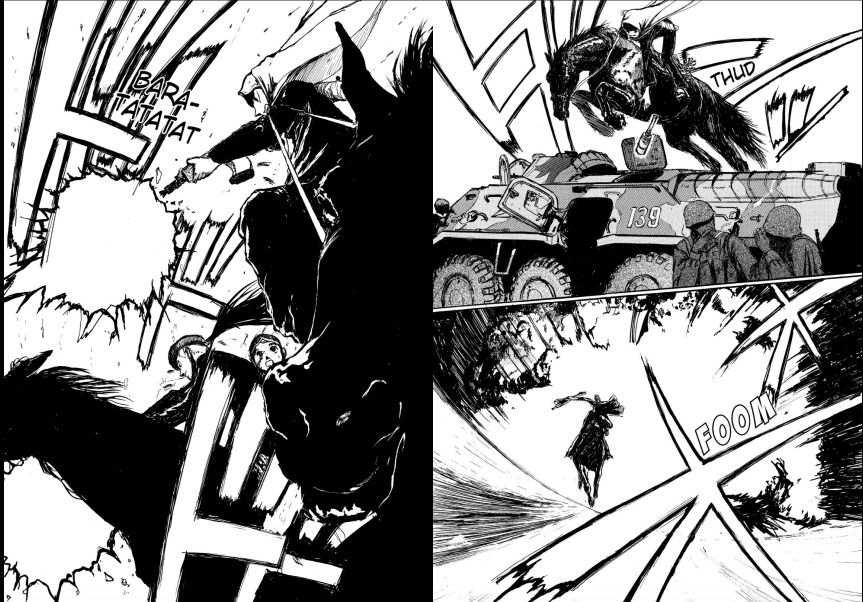
But oh, Ryuko’s fight scenes! They’re worth the price of admission, as they showcase the full range of Yoshimizu’s talents as a draftsman, veering sharply between naturalism, suggestion, and pure abstraction. In this sequence, for example, we see the young Ryuko ambushing a group of Soviet soldiers:

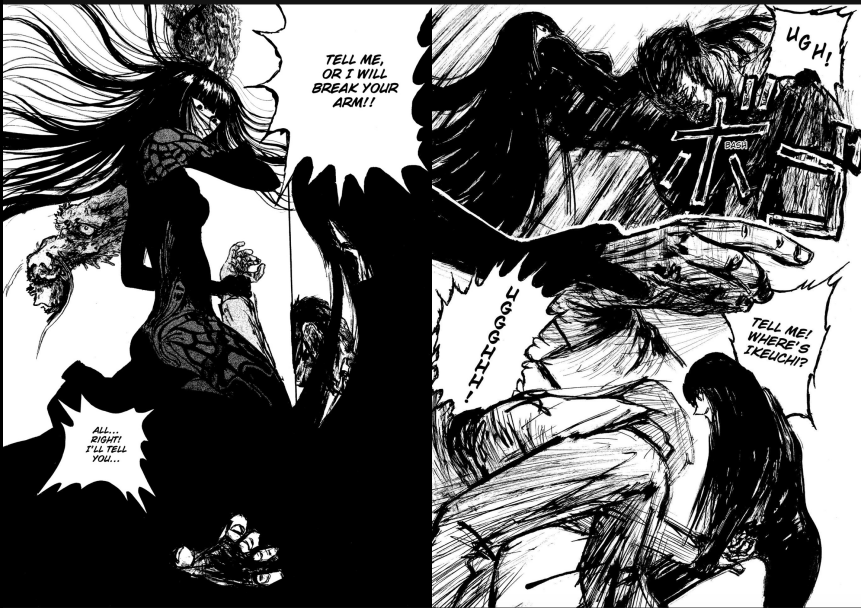
In the first panel, the tank is drawn with utmost specificity, allowing us to appreciate its sheer mass and its weaponry. The subsequent panels, however, are more gestural than the first, as we glimpse Ryuko silhouetted against the explosion, her age and gender completely obscured by the brilliant flash of light behind her. In the final panel of the sequence, Yoshimizu uses two horses to frame the action, rendering them as bold patches of black, with just a suggestion of a nostril and an eye, their demonic appearance echoing Ryuko’s own fierce resolve. Other sequences, such as this one, are even more abstract, dispensing with a grid in favor of fluid, overlapping images; in a particularly effective gambit, Ryuko’s arm forms a kind of panel boundary between the first stage of the attack — a knee to the stomach — and the second, in which she flips and pins her opponent:

Even Ryuko’s hair plays an important role in helping us understand what’s happening in this confrontation. In the first sequence, her hair swings around her face and shoulders in a naturalistic fashion, but in the final panel, her hair looks like a furious nest of snakes, each poised to strike her victim. That shift is subtle but important, a nifty metaphor for just how quick and lethal Ryuko can be.

For all the verve with which these scenes are drawn, Ryuko‘s characters never quite register as flesh-and-blood people. Yoshimizu has provided them with backstories, but the characters’ behavior is so steeped in action-movie cliche that their motivations for shooting and punching are almost immaterial. The story’s breakneck pacing doesn’t allow anyone much time for introspection, either; the few flashbacks to Ryuko’s childhood separation from her mother are the only genuinely emotional moments in the story. Still, no one reads trashy thrillers for a deep exploration of the human psyche; they’re looking for an over-the-top story that serves up generous helpings of car chases, gun battles, and fist-fights, the more outlandish, the better. On that front, Ryuko performs admirably, infusing a shopworn revenge plot with the sensual swagger of old-school classics like Lady Snowblood and Lupin III. Recommended.

RYUKO, VOL. 1 • ART AND STORY BY ELDO YOSHIMIZU • TRANSLATION BY MOTOKO TAMAMURO AND JONATHAN CLEMENTS • TITAN COMICS • NO RATING (PARTIAL NUDITY, VIOLENCE) • 256 pp.

Filed Under: Manga, Manga Critic, REVIEWS Tagged With: Eldo Yoshimizu, Ryuko, Titan Comics, Yakuza

Kakuriyo: Bed & Breakfast for Spirits, Vol. 1

January 9, 2019 by Katherine Dacey

One occupational hazard of reviewing manga is the powerful sense of déjà vu that a middle-of-the-road series can induce. I experienced just such a flash while reading Kakuriyo: Bed & Breakfast for Spirits, a pleasant, decently executed shojo series that hit so many familiar beats I was tempted to pull out a bingo card and tick off the stock characters and situations as I plowed through volume one.

As in other supernatural romances — think InuYasha and The Water Dragon’s Bride — the plot is set in motion by the heroine’s abduction to the kakuriyo, or spirit realm. There, Aoi learns that her late grandfather was capable of traveling between the kakuriyo and utsushiyo (human world), a skill that gramps exploited to run up a tab at a supernatural B&B. Gramps pledged Aoi as collateral, promising her hand in marriage to Odanna, the inn’s proprietor. Odanna is — wait for it — a handsome jerk with an attitude so condescending that Aoi can barely stand to be in the same room with him. He’s also an ogre. (A real ogre, not a metaphorical one.)

Indignant at the prospect of marrying a monster, Aoi instead vows to settle her grandfather’s accounts by working at the inn, a vow made more complicated by the other demons’ refusal to hire human staff for even the most menial tasks. The creators have used Aoi’s predicament as an opportunity to graft elements of a cooking manga onto the main plot by furnishing Aoi with culinary skills so impressive that even denizens of the kakuriyo are wowed by her omelet rice and chicken stew. The inclusion of these scenes feels perfunctory, however, as they add little to our understanding of who Aoi is; if anything, these interludes serve mostly to foreshadow the inevitable moment in volume two or five when Aoi finally persuades the inn’s chef to update his menu with Japanese comfort food.

The real pleasure in reading Kakuriyo: Bed & Breakfast for Spirits is the parade of ayakashi (spirits). The supporting cast seem to have stepped out of a Hyakki Yagyō scroll: there are kappas and tengus and oni, no-faced women and nine-tailed foxes, all drawn in a style that explicitly references the work of Utagawa Yoshiiku and Kawanabe Kyosai. When interacting with Aoi, these spirits morph into preternaturally elegant humans swathed in Edo-era couture. It’s an effective gambit, allowing illustrator Waco Ioka to emphasize her strengths — fabrics, textures, masks — while offering a plausible explanation for the demons’ uncanny appearance. (Looking through one of gramps’ photo albums, Aoi notes that the ayakashi‘s “faces look fake, like they’re pasted on.”)

Yet for all the joys of seeing the Night Parade of 100 Demons come to life in such a stylish fashion, I was so aware of the plot mechanics that I could never fully embrace Kakuriyo as a story. Someone less steeped in the conventions and cliches of shojo manga, however, might well find Kakuriyo a charming introduction to one of the medium’s most ubiquitous and appealing genres: the supernatural romance.

The verdict: Librarians working with middle school readers might find Kakuriyo a good addition to their graphic novel collection, as it’s largely free of provocative content (e.g. strong language, sexuality) but will feel more “adult” to readers in grades 6-8 than other T-rated romances.

A review copy was supplied by VIZ Media.

KAKURIYO: BED & BREAKFAST FOR SPIRITS, VOL. 1 • ART BY WACO IOKA, ORIGINAL STORY BY MIDORI YUMA, CHARACTER DESIGN BY LARUHA • TRANSLATED BY TOMO KIMURA • RATED T, FOR TEENS (FANTASY VIOLENCE) • 196 pp.

Filed Under: Manga, Manga Critic, REVIEWS Tagged With: Ayakashi, shojo, shojo beat, Supernatural Romance, VIZ, Waco Ioka

  • « Go to Previous Page
  • Page 1
  • Page 2
  • Page 3
  • Page 4
  • Page 5
  • Interim pages omitted …
  • Page 39
  • Go to Next Page »
 | Log in
Copyright © 2010 Manga Bookshelf | Powered by WordPress & the Genesis Framework