Here on the penultimate evening of Girls Only Week, I talk about the most recent volume of my favorite long-running shonen series which just happens to be written and drawn by a woman. Is this a coincidence? One must wonder. Meanwhile, enjoy:
Fullmetal Alchemist, Vol. 19
By Hiromu Arakawa
Published by Viz Media


In this volume, Hawkeye reveals the truth about President Bradley’s son to Mustang, though he finds it impossible to believe. Ed is badly injured in the attempt to take down Kimblee and ends up purposefully disappearing along with a couple of Kimblee’s men. Finally, Al is discovered by Scar and Winry’s group in time to warn them away from Fort Briggs, though it isn’t long before he suffers a repeat of last volume’s experience in which he begins to feel pulled out of his body. All of this feels almost trivial, however, compared to this volume’s real story, which reveals the origins of Father and the homunculi (down to their names), as well as the distant past of Ed and Al’s father, Von Hohenheim, and the dark history they share.
…




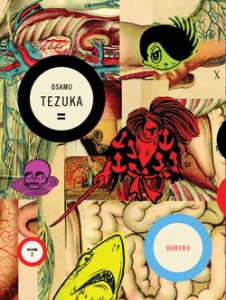 Though much of the devastation that Hyakkimaru and Dororo witness is man-made (Dororo takes placed during the Sengoku, or Warring States, Period), demons exploit the conflict for their own benefit, holding small communities in their thrall, luring desperate travelers to their doom, and feasting on the never-ending supply of human corpses. Some of these demons have obvious antecedents in Japanese folklore — a nine-tailed kitsune — while others seem to have sprung full-blown from Tezuka’s imagination — a shark who paralyzes his victims with sake breath, a demonic toad, a patch of mold possessed by an evil spirit. (As someone who’s lived in prewar buildings, I can vouch for the existence of demonic mold. Lysol is generally more effective than swordplay in eliminating it, however.) Hyakkimaru has a vested interest in killing these demons, as he spontaneously regenerates a lost body part with each monster he slays. But he also feels a strong sense of kinship with many victims — a feeling not shared by those he helps, who cast him out of their village as soon as the local demon has been vanquished.
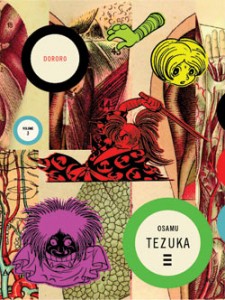 For folks who find the cartoonish aspects of Tezuka’s style difficult to reconcile with the serious themes addressed in Buddha, Phoenix, and Ode to Kirihito, Dororo may prove a more satisfying read. The cuteness of Tezuka’s heroes actually works to his advantage; they seem terribly vulnerable when contrasted with the grotesque demons, ruthless samurai, and scheming bandits they encounter. Tezuka’s jokes — which can be intrusive in other stories — also prove essential to Dororo‘s success. He shatters the fourth wall, inserts characters from his stable of “stars,” borrows characters from other manga-kas’ work, and punctuates moments of high drama with low comedy, underscoring the sheer absurdity of his conceits… like sake-breathing shark demons. Put another way, Dororo wears its allegory lightly, focusing primarily on swordfights, monster lairs, and damsels in distress while using its historical setting to make a few modest points about the corrosive influence of greed, power, and fear.


