• Skip to primary navigation
  • Skip to main content
  • Skip to primary sidebar
  • Home
  • About Us
    • Privacy Policy
    • Comment Policy
    • Disclosures & Disclaimers
  • Resources
    • Links, Essays & Articles
    • Fandomology!
    • CLAMP Directory
    • BlogRoll
  • Features & Columns
    • 3 Things Thursday
    • Adventures in the Key of Shoujo
    • Bit & Blips (game reviews)
    • BL BOOKRACK
    • Bookshelf Briefs
    • Bringing the Drama
    • Comic Conversion
    • Fanservice Friday
    • Going Digital
    • It Came From the Sinosphere
    • License This!
    • Magazine no Mori
    • My Week in Manga
    • OFF THE SHELF
    • Not By Manga Alone
    • PICK OF THE WEEK
    • Subtitles & Sensibility
    • Weekly Shonen Jump Recaps
  • Manga Moveable Feast
    • MMF Full Archive
    • Yun Kouga
    • CLAMP
    • Shojo Beat
    • Osamu Tezuka
    • Sailor Moon
    • Fruits Basket
    • Takehiko Inoue
    • Wild Adapter
    • One Piece
    • After School Nightmare
    • Karakuri Odette
    • Paradise Kiss
    • The Color Trilogy
    • To Terra…
    • Sexy Voice & Robo
  • Browse by Author
    • Sean Gaffney
    • Anna Neatrour
    • Michelle Smith
    • Katherine Dacey
    • MJ
    • Brigid Alverson
    • Travis Anderson
    • Phillip Anthony
    • Derek Bown
    • Jaci Dahlvang
    • Angela Eastman
    • Erica Friedman
    • Sara K.
    • Megan Purdy
    • Emily Snodgrass
    • Nancy Thistlethwaite
    • Eva Volin
    • David Welsh
  • MB Blogs
    • A Case Suitable For Treatment
    • Experiments in Manga
    • MangaBlog
    • The Manga Critic
    • Manga Report
    • Soliloquy in Blue
    • Manga Curmudgeon (archive)

Manga Bookshelf

Discussion, Resources, Roundtables, & Reviews

Features & Reviews

It Came From the Sinosphere: The Celestial Zone

August 14, 2012 by Sara K. 5 Comments

The cover of the English-language edition of The Celestial Zone

Example Scene

A ray of light enters a secluded pool.

I think this page is rather beautiful.

There is Chi Shuang, standing over the pool where her twin sister, Chi Xue, is wading. Meanwhile, Chuyi is bringing Xing Ling to see what is happening with Chi Xue and Chi Shuang. Previously, Xing Ling and Chi Xue were in a nasty fight. Xing Ling’s wounds have already been treated, but Chi Xue was so badly injured that Chuyi did not think she would make it. When Xing Ling said that Chi Shuang had some special method to cure Chi Xue, Chuyi decided an intervention was urgently needed.

Chuyi and Xing Ling approach the chamber where Chi Shuang prepares to heal Chi Xue.

And they see Chi Xue. I should note that Chi Xue is usually veiled and vicious, so to see her exposed and vulnerable is quite a contrast.

Chi Shuang undresses and enters the pool.

This is another lovely page.

Chi Xue is reluctant to be healed by this special method. Perhaps, like Chuyi, she know this healing method’s terrible secret.

Chi Shuang summons fancy light in the water.

And the healing process begins.

Lots of swirly water and wavy hair moves around.

Terrible secret or not, it’s quite lovely.

Lots of pretty waterfalls.

Maybe I Should Start at the Beginning of the Story…

Xing Ling is the finest sword fighter wandering around jianghu. When she’s up against 10+ rogues, it’s bad news—I mean bad news for the rogues. She uses her exceptional skills to bully the bullies and provide relief to the common people.

Xing Ling smiles at a bunch of rogues she just pwned.

One day she encounters an opponent who she can’t cream within minutes. In fact, the fight is actually a struggle for her. She doesn’t understand why her opponent is not being reduced to a pulp. The thing is, all of her previous opponents were human, whereas this opponent is … not.

Xing Ling lets the non-human opponent cut her hair so she can maneuver.

By exhausting all of her strength—and sacrificing her hair—Xing Ling manages to take down this non-human opponent. Then his non-human friends show up.

Just when Xing Ling appreciates the deep shit that she is in, two young men show up—one who mows down the non-human friends in minutes.

Xing Ling talks to the two men.

It turns out that the non-humans—as well as these two young men—come from the celestial zone, where people and creatures develop spiritual powers than ordinary mortals can barely imagine. She is the first ordinary person they ever saw beat a denizen of the celestial zone and … they notice that she is a bit like a certain special person.

Eventually, Xing Ling enters the Celestial Zone herself, cultivates her own spiritual powers, and joins the war between the Righteous Way and the Evil Way.

Background

This manhua is by Wee Tian Beng, who is the most commercially successful manhua artist in Singapore. To the best of my knowledge, no other Singaporean manhua artist has been published in Taiwan (which means it would me much more difficult for me to acquire copies). I have previously discussed Wee Tian Beng’s adaptation of the Jing Yong novel Return of the Condor Heroes.

The Celestial Zone is his signature work. It has attracted fans in many countries and its success has led to two sequels so far.

Female Characters

In a world where gender justice was the default, it would not be remarkable if a fighting/action oriented comic book featured many female characters and consistently gave them as much substance as the male characters, where they feel like they are there for their own sake, not to accompany the male characters. We do not live in a world where gender justice is the default. Therefore it is remarkable that The Celestial Zone is a fighting/action oriented comic book with many female characters who feel like they are there for their own sake and not to accompany the male characters.

This manhua passes the Bechdel test with flying colors. There are lots of female characters, they talk to each all the time, and they talk to each other about spiritual powers, demons, medicine, friendship, battle … in fact, they rarely talk to each other about men.

The one criticism I can make—and this a fairly minor criticism—is that Wee Tian Beng sometimes sexualizes the female characters in ways he does not sexualize the male characters. Nonetheless, even in this he is a mild offender, as he never goes farther in sexualizing the characters than he does in this illustration:

A sexualized picture of a female character.

It’s partially because men like Wee Tian Beng get female characters (mostly) right that I do not give male creators slack for getting female characters wrong. If Wee Tian Beng can get this right, all other male creators can get female characters right too. The question is, do they want to get female characters right?

The Artwork

As I read this manhua, I kept on wondering if Wee Tian Beng would run out of his bag of artistic tricks, and the art which I found so fresh and exciting would be reduced to tired visual tropes.

That did not happen. Right to the last volume, Wee Tian Beng kept on drawing things in new and exciting ways which titilated my visual senses. He does all this while staying true to his own distinct style.

I have found few comic book artists who can so consistently delight my imagination with their artwork.

Can I break this down a bit? Maybe.

First of all, Wee Tian Beng often juxaposes detail with simplicity, such as in the page below. It provides a rest for the eyes, and makes the page more dynamic than if there were merely detailed linework or merely simplicity.

Chi Xue and Xing Ling meet in the snow.

Also, Wee Tian Beng plays a lot with shadows, in different ways. Look at the following pages.

And then there is the way that Wee Tian Beng draws movement. It it utterly graceful. I don’t know how he does it (perhaps that’s why I’m not a visual artist myself). Look at the movement in the following pictures:

He also juxtaposes the action with natural scenery. The way he draws and incorporates nature is very much in the tradition of millennia of Chinese art. See how he uses images of nature in these pages:

As I’ve noted before, he uses panels in a very cinematic way. I love this following page where you can see how the characters expressions change on the beat.

Not to mention these cinematic pages:

Notice how the above page not only demonstrates his cinematic style, it also shows a) shadow play b) the way he draws human movement and c) images of nature.

And … he manages to infuse a solemnity into his compositions. Observe these pages.

And the composition in these following pages makes me squee. Especially the second page—instead of simply have a center panel with the two opponents squaring off in the distance and the side panels showing their faces, Wee Tian Beng combines the three panels together by having the opponents stand like chess pieces on their respective close-ups. Not to mention that a) the diagonal line between the opponents is dynamic and b) the long panels set up a nice set of parallel lines.

While the characters are rarely warm and bubbly (it’s not that kind of story) when warmth and bubbles are called for, he can draw that too.

But, more than anything else, Wee Tian Beng chooses compelling subjects to draw. Such as a dragon’s head suddenly emerging from the water:

Or this special healing technique with candles:

Or one of the baddies suddenly deciding to kiss one of the goodies in mid-fight:

Chinese Culture

This comic is steeped in traditional Chinese culture, especially Taoism (note: I actually do not know much about Taoism). I’ve already mentioned the influence from traditional Chinese paintings. I also learned why the word for “thing” in Mandarin literally is “east-west” (and I am a little curious how they would try to explain that in English, since it would be very difficult to explain to somebody who doesn’t know some Chinese). It does not feel didactic; on the other hand, I can tell Wee Tian Beng cares a lot about this and wants to pass it on to the readers.

More on the Characters

It should be apparent by now that the story has a lot in common with shounen battle manga.

I rather liked the twist on training the newbie hero(ine), in which Xing Ling, who is used to pwning her enemies, has to go back to square one once she enters the Celestial Zone and trains her spirit powers. However, once she got used to the Celestial Zone, I found her character less compelling. Wee Tian Beng sensed this too, as he shifted the story away from her to Chi Xue.

While I generally support using transliterations instead of translations of Chinese names, I almost wish the English language edition had made an exception for Chi Xue since her name, which means “Scarlet Snow,” is even more beautiful in English than in Chinese. “Xue” can also mean “blood”…

Even though Chi Xue is officially with the Righteous Way, she hunts demons so ruthlessly that, on the surface, she doesn’t feel like a good guy. Of course, it turns out that she is extremely tender-hearted, and that she fights so coldly partially because she is heartbroken (her heartbreak, by the way, has nothing to do with a man).

And … Xing Ling and Chi Xue make for a good friendship. Their relationship is opposites-attract, but in a non-romantic way. Xing Ling is generally cheerful while Chi Xue is generally moody, Xing Ling is inexperienced, while Chi Xue has experienced a bit too much … and so forth.

Good stories are generally about characters suffering and growing (or not) from it. Suffering doesn’t stick very well to the upbeat Xing Ling, which is why Chi Xue ultimately ended up being a much more interesting character. Other people must have agreed, because there is a spin-off manhua called The Adventures of Chi Xue.

Availablility

This entire comic has been published in English—in fact the original edition was simultaneously published in English and Chinese. Many volumes of the English-language edition are available at Mile High Comics—unfortunately they don’t have all volumes, but the volumes they do have in stock are reasonably priced.

In Chinese, this comic book has been published in both simplified and traditional characters.

European readers might find it easier to acquire the French edition than the English-language edition.

Conclusion

I would have loved this manhua to pieces as a little girl. I enjoyed action/fighting stories, doubly so if they featured main characters, triply so if it was pretty (it’s worth noting that my gateway to anime was Sailor Moon, and my gateway to manga was Inuyasha).

And, obviously, I do love the artwork in this manhua. And, darn it, artwork is important. Liking comics for the artwork is not superficial, silly, or otherwise to be looked down upon. I didn’t actually become truly visually literate until my college years, but to the extent I was visually literate before then, I can partially thank my father—he would often remark on the artwork in the comic books we read together (or anything else that caught his eye). In the modern world, where people are constantly bombarded with images, visual literacy is important, and visual literacy also makes life more fun. One of the advantages that comic books have over certain other storytelling media is that it can nuture one’s visual literacy. This manhua, in my opinion, is excellent for that.

I am okay with the story. I am not in love with the story. I cannot pick out any major flaws. I was interested in the arcs of some of the characters, and was occasionally moved. Nonetheless, the story did not grab me. I could speculate on why it didn’t grab me … but to be honest, I don’t know why it didn’t grab me.

I do recommend this manhua to people who like fighting comics, particularly if they want fighting comics with good female characters.

Next Time: Fated to Love You (idol drama)


While the topics of Sara K.’s personal blog are mostly not related to Asian culture, Mangabookshelf readers might be interested in reading her latest post: “Language Learning and Perpetual Childhood”.

Filed Under: It Came From the Sinosphere Tagged With: manhua, Singapore, The Celestial Zone, Wee Tian Beng

Bookshelf Briefs 8/13/12

August 13, 2012 by Michelle Smith, MJ and Sean Gaffney 1 Comment

This week, Michelle, MJ, and Sean look at recent releases from Seven Seas, VIZ Media, Yen Press, Kodansha Comics, and Dark Horse Manga.


Alice in the Country of Clover: Cheshire Cat Waltz, Vol. 1 | By QuinRose & Mamenosuke Fujimaru | Published by Seven Seas – I am pleased to report that, so far, Cheshire Cat Waltz is much better than the prior “country of Clover” installment, Bloody Twins! Some of the elements that made Alice in the Country of Hearts so surprisingly good are back, like ominous hints about a particular character and Alice experiencing culture clash with the various attitudes and mysteries of Wonderland. However, because this is much more obviously a romance—here, Alice is paired up with Boris, the Cheshire Cat—the story’s more intriguing aspects must occasionally take a backseat to Alice being confused about her motives for remaining in Wonderland, Alice being pounced upon, Alice getting smooched, and lovers’ quarrels born of jealousy. Although I am sure I’m being duped again and that nothing significant of Wonderland will be revealed, I remain interested enough that I’ll probably come back for volume two. – Michelle Smith

Bakuman, Vol. 13 | By Tsugumi Ohba & Takeshi Obata | VIZ Media – Bakuman‘s heroes, Mashiro and Takagi, are always the most interesting when they are at odds, and this volume is a perfect example of exactly why that is. As all the young Jump mangaka throw themselves into a rather unusual competition (writing romantic one-shots), it isn’t Nizuma’s sudden display of inexperience or even Hiramaru’s over-the-top romantic hero act that make the volume work, hilarious though they may be. What really steals the volume are a few scattered scenes between Mashiro and Takagi’s wife, Kaya, as they try to make sense of their shared partner. These moments are uncharacteristically honest and sincere for an Ohba/Obata manga, and it’s a real pleasure to discover them amidst all the slick shounen meta. On a personal note, Kaya has long been my favorite of Bakuman‘s characters, and I’ll admit that a scene in which she receives a basket of flowers from Shueisha as thanks for her work on her husband’s series was surprisingly gratifying. Still recommended. – MJ

A Devil and Her Love Song, Vol. 4 | By Miyoshi Tomori | VIZ Media – As “Devil” Maria’s class finally prepares for their choral performance, everything falls (rather predictably) apart, but fortunately this is shoujo manga, and even in a story with a heroine as prickly and jaded as Maria, a little romance can save the day. Any feelings of frustration one might have as the choral competition story drags interminably on are blown away completely by the impact of a wholly surprising confession by the character from whom you least expect it. Despite this series’ cynical bent, its romantic thread reads as genuinely sincere and even sweet—a mashup of contrasting tones that apparently works very well. Even as the series appears to be gearing up for a typical romantic triangle, it seems clear that Miyoshi Tomori’s gift for injecting raw emotional truth into standard shoujo tropes will continue to keep things interesting. – MJ

Drifters, Vol. 2 | By Kohta Hirano | Dark Horse Comics – Volume Two of this series continues to do what the series does best – give us a lot of people trying to kill other people in nasty ways. It’s great fun for those who don’t mind that sort of thing – Hirano draws battles that are easy to follow, and the ‘nasty’ aspect of the combat is not remotely glossed over here – Nobunaga’s treated arrows are as disgusting as possible, and the rape of the elven women is not played for laughs. As for our hero, Shimazu, well, he does seem to be strategizing a little more, almost despite himself, and is also forming a deep bond with Nobunaga that involves a lot of yelling and punching. Meanwhile, for those wondering when this ‘warlords in a fantasy world’ would reach Hitler, it didn’t take long at all. Still good fun, even if it plays mostly to the 12-year-old in all of us. –Sean Gaffney

Durarara!!, Vol. 3 | By Ryohgo Narita, Suzuhito Yasuda & Akiyo Satorigi | Yen Press – There’s a lot of big reveals in this volume, which would be churlish of me to talk about, so I will merely note that one of the weaker of our heroes turns out to have far more strength than we had imagined. Elsewhere, Shizuo shows once more how incredibly tough he is, Izaya is one of the most obnoxious S.O.B.s in all of the universe, and Celty is cute, if frantic. But then, she has reason to be frantic. There’s also a fantastic parody of Doraemon about 1/3 through, when the art style shifts to that in order to demonstrate Mikado’s disbelief at the latest plot twist. And of course there’s Namie and Seiji, whose creepy desires are something completely amped up in this manga, to the point where even the novel’s author was impressed. A solid adaptation. –Sean Gaffney

Kamisama Kiss, Vol. 10 | By Julietta Suzuki | VIZ Media – I have to say, Nanami is starting to remind me a bit of Tohru in Fruits Basket, who sometimes felt as if she existed to interact with the screwed-up Sohmas and heal them with her magical power of niceness. Tohru turned out to be just as screwed-up, though, whereas Nanami is shiny all around. Her interaction with Jiro (who irritates Tomoe as he reminds him of himself) is fairly predictable, though that doesn’t necessarily mean bad – there’s a wonderful bit towards the end where she notes Tomoe’s strength as something that might not be a positive. In the end, though, this arc wrapped up a lot easier than I’d anticipated, and I’m left with a feeling that things are simply going too well for our protagonists right now. Of course, I’m sure that will change – the manga is not ending anytime soon… –Sean Gaffney

Miles Edgeworth: Ace Attorney Investigations, Vol. 1 | By Kenji Kuroda & Kazuo Maekawa | Kodansha Comics – I try not to review Volume Ones in the Briefs category, but with something like this title there’s little choice, as there’s so little *to* it. Heck, we don’t even get to see Kay Faraday, which I was expecting given the title – the only regulars are Miles and Detective Gumshoe. The cases are both pretty good, though the first is extremely short, and the writing is much the same as it was in the Phoenix Wright books. The trouble is that Miles is not Phoenix – he doesn’t make screwups or say dumb things on occasion. He’s simply too smart to make this anything but a foregone conclusion. Indeed, in the first case he solves things so quickly that everyone around him just stares. Let’s hope future books find more of a challenge – and maybe more faces we know? –Sean Gaffney

Nura: Rise of the Yokai Clan, Vol. 10 | By Hiroshi Shiibashi | VIZ Media – The cliffhanger from last volume is resolved incredibly quickly, leaving us with two major plotlines for this volume consisting mostly of fighting sequences. First we see the conflict between Yura and her siblings, which shows us how even the purest of heart can be ruined by just a tiny sliver of pride and jealousy. Meanwhile, Rikuo and company are taking their airship to Kyoto (still being destroyed bit by bit), but infighting may destroy them before the enemy can. Here we see just how much trust Rikuo has gained over these ten volumes – and how much more he has yet to earn, though the greater control of his power here helps. Unfortunately, this conflict doesn’t look nearly like it’s reaching the end, so expect Volume 11 to me more fight, fight, fight.-Sean Gaffney

Toriko, Vol. 11 | By Mitsutoshi Shimabukuro | VIZ Media – Thankfully, the fighting briefly pauses here in this volume of Toriko, which is especially a relief as it means we don’t have to see more of the repulsive Tommyrod. Instead, our heroes leave the Ice Hell for their own separate quests – Toriko to somehow regrow the arm that he lost in the last book, and Komatsu to try to recreate the Century Soup from the brief sip that he got. Komatsu continues to be my favorite part of Toriko – he’s smart enough to know he has to make his own soup and can’t simply duplicate another, and stubborn enough to keep at it even knowing it might take years. Of course, in his own way Komatsu is as badass as Toriko, so we know it won’t take that long. In the meantime, there’s more weird food and weird creatures, which is the main reason to read this fun manga. –Sean Gaffney

Filed Under: Bookshelf Briefs

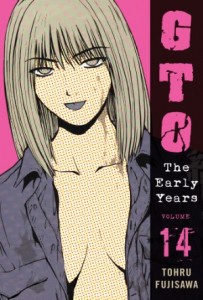
GTO: The Early Years, Vol. 13

August 13, 2012 by Sean Gaffney

By Toru Fujisawa. Released in Japan as “Shonan Jun’ai Gumi” by Kodansha, serialized in the magazine Weekly Shonen Magazine. Released in North America by Vertical.

It always seems as though there’s more dumb comedy in the Early Years manga than comes up in its sequels featuring Onizuka. Now, I’m sure if I went back and checked all of GTO this would not be the case – GTO has some monumentally silly things going on, and I’ve noted just last week how much dumb fun is in 14 Days in Shonan – but here Onizuka has the better excuse of actually being an immature high schooler, meaning that he and his friends lend themselves even well to situations that make one cry with laughter and weep at the stupidity of all involved.

First, though, we get some more epic fighting, as Onizuka still has to resolve his rivalry with Mafuyu, who is determined to take on Eileen, the one that killed his brother. Now, I figured out that Eileen was actually the name of a tropical event right off the bat, meaning it can be grating seeing everyone going around just NOT GETTING that Eileen isn’t a woman. But it leads to some interesting situations, as well as some epic surfing. We also get a very shonen moment where Onizuka is taking on a group of washed-out ex-military Americans, as he notes that saying ‘dreams will die’ and ‘know your limits’ is something that happens to other people. Oh, and showing them the wrath of a true Japanese person, of course. (It almost reads like the U.S. and Japan are rival gangs here, probably deliberately.)

After this, which takes half the volume, the other half is devoted to far shorter and sillier situations. We are reminded that this manga takes place in the late 80s/early 90s with Onizuka’s obsession with bootleg video porn. We see a chapter devoted to Onizuka’s mother, and realize just how horrible it must be trying to deal with a kid like him. There’s an amusing parody of Kindaichi Case Files where Onizuka and friends try to solve the murder of one of their own (spoiler: he’s not really dead). And after his mother finally throws him out, we see Onizuka and Danma moving into a roach-infested rathole of an apartment, which brings its own levels of disgusting humor.

And then there’s the Russian night vision goggles. First off, I really like how Onizuka and Danma are shown here as the leaders of their gang. Even though everything spiraled out of control because of their underlings being stupid and not getting the point, they still don’t back down from a fight, because, well, they’re leaders. Secondly, the idea of a shonen title spending this long discussing night vision goggles being used to masturbate while watching a neighbor strip through a peephole is simply mind-numbing. I’ve noted before that Shonen Magazine seems more ‘mature’ than its rivals Jump and Sunday, and apparently that was the case 20 years ago as well. This leads to an amazing finale, which for once features Danma as the stupider one. He likes to pretend he’s the more mature, especially given he actually has a girlfriend and has gotten lucky, unlike Onizuka, but the peephole situation (which I don’t care spoil) shows he can be even more perverse when it gets right down to it.

I can see why this was such a big success for teenage boys in Japan. Even though I doubt that’s the market for it here, fans of Onizuka should really pick up this prequel, which features less teaching but just as much badassery.

Filed Under: REVIEWS

Manga Bestsellers: 2012, Week Ending 12 August

August 12, 2012 by Matt Blind 1 Comment

Comparative Rankings Based on Consolidated Online Sales

last week’s charts
about the charts

##

Manga Bestsellers

1. ↑17 (18) : Yu-Gi-Oh! GX 9 – Viz Shonen Jump, Aug 2012 [393.9] ::
2. ↓-1 (1) : Sailor Moon 1 – Kodansha Comics, Sep 2011 [392.3] ::
3. ↓-1 (2) : Sailor Moon 4 – Kodansha Comics, Mar 2012 [390.3] ::
4. ↑4 (8) : Sailor Moon 3 – Kodansha Comics, Jan 2012 [373.3] ::
5. ↓-2 (3) : Sailor Moon 2 – Kodansha Comics, Nov 2011 [372.9] ::
6. ↓-2 (4) : Naruto 57 – Viz Shonen Jump, Jul 2012 [345.2] ::
7. ↓-2 (5) : Vampire Knight 14 – Viz Shojo Beat, Jul 2012 [337.5] ::
8. ↓-1 (7) : Finder Series 6 Passion within the View Finder – DMP Juné, Jul 2012 [336.8] ::
9. ↓-3 (6) : Sailor Moon 6 – Kodansha Comics, Jun 2012 [327.5] ::
10. ↔0 (10) : Negima! 35 – Kodansha Comics, Jul 2012 [301.2] ::

[more]

Top Imprints
Number of volumes ranking in the Top 500:

Viz Shonen Jump 91
Yen Press 88
Viz Shojo Beat 59
Kodansha Comics 51
Viz Shonen Jump Advanced 35
DMP Juné 26
Dark Horse 17
Seven Seas 17
Vertical 13
Viz Signature 11

[more]

Series/Property

1. ↔0 (1) : Sailor Moon – Kodansha Comics [1,072.8] ::
2. ↔0 (2) : Naruto – Viz Shonen Jump [778.6] ::
3. ↑1 (4) : Bleach – Viz Shonen Jump [663.4] ::
4. ↓-1 (3) : Highschool of the Dead – Yen Press [549.8] ::
5. ↑2 (7) : Vampire Knight – Viz Shojo Beat [502.4] ::
6. ↓-1 (5) : Negima! – Del Rey/Kodansha Comics [490.0] ::
7. ↑11 (18) : Yu-Gi-Oh! – Viz Shonen Jump [473.2] ::
8. ↑1 (9) : Ouran High School Host Club – Viz Shojo Beat [451.4] ::
9. ↓-3 (6) : Rosario+Vampire – Viz Shonen Jump Advanced [444.8] ::
10. ↑1 (11) : Black Butler – Yen Press [440.5] ::

[more]

New Releases
(Titles releasing/released This Month & Last)

1. ↑17 (18) : Yu-Gi-Oh! GX 9 – Viz Shonen Jump, Aug 2012 [393.9] ::
6. ↓-2 (4) : Naruto 57 – Viz Shonen Jump, Jul 2012 [345.2] ::
7. ↓-2 (5) : Vampire Knight 14 – Viz Shojo Beat, Jul 2012 [337.5] ::
8. ↓-1 (7) : Finder Series 6 Passion within the View Finder – DMP Juné, Jul 2012 [336.8] ::
10. ↔0 (10) : Negima! 35 – Kodansha Comics, Jul 2012 [301.2] ::
16. ↑18 (34) : Bleach 44 – Viz Shonen Jump, Aug 2012 [281.1] ::
17. ↓-8 (9) : Rosario+Vampire Season II 9 – Viz Shonen Jump Advanced, Jul 2012 [272.9] ::
22. ↓-2 (20) : Highschool of the Dead 7 – Yen Press, Jul 2012 [246.7] ::
24. ↑25 (49) : Bleach 45 – Viz Shonen Jump, Aug 2012 [232.1] ::
27. ↑2 (29) : Pandora Hearts 11 – Yen Press, Jul 2012 [225.7] ::

[more]

Preorders

13. ↔0 (13) : Sailor Moon 9 – Kodansha Comics, Jan 2013 [286.2] ::
14. ↑2 (16) : Sailor Moon 7 – Kodansha Comics, Sep 2012 [284.8] ::
21. ↓-2 (19) : Sailor Moon 8 – Kodansha Comics, Nov 2012 [254.4] ::
26. ↑2 (28) : Sailor Moon 10 – Kodansha Comics, Mar 2013 [226.3] ::
37. ↑2 (39) : Avatar: The Last Airbender The Promise 3 – Dark Horse, Oct 2012 [188.0] ::
41. ↑14 (55) : Yotsuba&! 11 – Yen Press, Sep 2012 [172.1] ::
66. ↑29 (95) : Naruto 58 – Viz Shonen Jump, Sep 2012 [132.3] ::
69. ↑3 (72) : Negima! 36 – Kodansha Comics, Oct 2012 [126.1] ::
92. ↓-8 (84) : Only the Ring Finger Knows (novel) 5 – DMP Juné, Sep 2012 [108.9] ::
103. ↓-11 (92) : Ai no Kusabi (novel) 7 – DMP Juné, Sep 2012 [100.1] ::

[more]

Manhwa

476. ↓-43 (433) : Time & Again 3 – Yen Press, Jul 2010 [23.0] ::
500. ↓-72 (428) : Time & Again 6 – Yen Press, Jul 2011 [22.0] ::
632. ↓-143 (489) : Time & Again 1 – Yen Press, Dec 2009 [15.4] ::
642. ↓-53 (589) : Bride of the Water God 10 – Dark Horse, Jan 2012 [14.9] ::
663. ↓-75 (588) : Bride of the Water God 11 – Dark Horse, May 2012 [14.2] ::
727. ↓-149 (578) : Time & Again 2 – Yen Press, Mar 2010 [11.1] ::
800. ↑65 (865) : One Thousand & One Nights 7 – Yen Press, Apr 2009 [8.6] ::
846. ↑166 (1012) : One Thousand & One Nights 11 – Yen Press, Aug 2010 [7.7] ::
945. ↑2 (947) : Let Dai 11 – Netcomics, Feb 2008 [5.5] ::
946. ↓-186 (760) : Time & Again 5 – Yen Press, Mar 2011 [5.4] ::

[more]

BL/Yaoi

8. ↓-1 (7) : Finder Series 6 Passion within the View Finder – DMP Juné, Jul 2012 [336.8] ::
65. ↓-6 (59) : Samejima-Kun & Sasahara-Kun – DMP Juné, May 2012 [133.2] ::
92. ↓-8 (84) : Only the Ring Finger Knows (novel) 5 – DMP Juné, Sep 2012 [108.9] ::
103. ↓-11 (92) : Ai no Kusabi (novel) 7 – DMP Juné, Sep 2012 [100.1] ::
110. ↓-25 (85) : In These Words – 801 Media, Jun 2012 [95.5] ::
181. ↓-19 (162) : Awkward Silence 1 – DMP Juné, Aug 2010 [65.7] ::
185. ↑71 (256) : Alcohol, Shirt, & Kiss – DMP Juné, Mar 2007 [64.5] ::
203. ↓-49 (154) : Private Teacher 3 – DMP Juné, May 2012 [60.7] ::
210. ↑35 (245) : Finder Series 5 Truth in the View Finder – DMP Juné, Dec 2011 [59.0] ::
229. ↑12 (241) : Private Teacher 2 – DMP Juné, Jan 2012 [53.5] ::

[more]

Ebooks

6. ↓-2 (4) : Naruto 57 – Viz Shonen Jump, Jul 2012 [345.2] ::
23. ↑2 (25) : Naruto 56 – Viz Shonen Jump, May 2012 [237.1] ::
32. ↑5 (37) : Maximum Ride 5 – Yen Press, Dec 2011 [198.4] ::
36. ↑5 (41) : Naruto 55 – Viz Shonen Jump, Mar 2012 [188.9] ::
48. ↑3 (51) : Blue Exorcist 1 – Viz Shonen Jump Advanced, Apr 2011 [157.8] ::
63. ↓-5 (58) : Naruto 54 – Viz Shonen Jump, Mar 2012 [135.3] ::
68. ↔0 (68) : Maximum Ride 3 – Yen Press, Aug 2010 [126.4] ::
80. ↓-7 (73) : Naruto 53 – Viz Shonen Jump, Dec 2011 [118.9] ::
90. ↑9 (99) : Blue Exorcist 6 – Viz Shonen Jump Advanced, Feb 2012 [111.5] ::
109. ↑6 (115) : Maximum Ride 1 – Yen Press, Jan 2009 [95.5] ::

[more]

Filed Under: Manga Bestsellers Tagged With: Manga Bestsellers

Manga the Week of 8/15

August 8, 2012 by Sean Gaffney

Sure, wait weeks for manga and then 38 turn up all at once. Midtown finally found all the Viz manga that most of us got this week. See my post on last week for that.

In titles I didn’t talk about last week, Kodansha has a new Air Gear and Cage of Eden, which both fight a war between entertaining folks with awesome shonen battles and pure blatant fanservice. Most of the time it tends to lean more towards the latter, but then they are Shonen Magazine titles. They also list Fairy Tail 12, but I think that’s part of the giant pile of reprints they’re doing this August – all of Fairy Tail, Ninja Girls, Shugo Chara, Wallflower and Parasyte are getting reprints.

It’s rare I use a Korean title for my featured image (in fact, it may have never happened before), but Lizzie Newton Mysteries has gotten a lot of good word of mouth, and might appeal to those who liked Young Miss Holmes. Meanwhile, the other debut from Seven Seas is I Don’t Like You At All, Big Brother!!, which is being released in a 2-for-1 omnibus. The cover art, and blurb saying it’s for fans of He Is My Master, kind of make me want to pull away from my keyboard in horror, but I have been assured that this title is better than it sounds, so will trust in that. And in the title I’m most excited about from this publisher, A Certain Scientific Railgun 5 continues to throw sisters at Misaki. I’m hoping after the cliffhanger horror of the last volume, she won’t completely lose it.

The BL imprint Sublime has two new debuts. Bond of Dream, Bond of Love seems to continue the trend of huge grumpy guy paired with small happy guy, and also has a character from the Tea For Two BL manga (remember Blu?) that came out several years ago from the same artist. Starting with a Kiss has a much saucier cover, but seems to be about the same type of situation, except this time the happy guy is a hotheaded guy. Also, the Japanese imprint for this series was SUPER BBC, with a lightning bolt in between. That’s totally irrelevant to this North American release, but makes me happy, and also wonder if SubLime will ever license some Blake/Avon slash.

Viz is also putting out some titles this week, despite the majority of Midtown’s list appearing elsewhere 8/8. A new Inu Yasha VIZBIG Edition, covering volumes 34-36. Vol. 6 of Itsuwaribito… no, I’m sorry, that’s a lie, it’s not coming out. No wait, I’m lying again, it totally is! And the penultimate volume of Kekkaishi, which given it’s penultimate had better be resolving everything.

Lastly, we have a giant pile of Yen. Bamboo Blade has reached its final volume, and I will be very sorry to see it go. The Betrayal Knows My Name is up to Volume 4, but still has a long way to go – and is still running in Asuka. Bunny Drop 6 is out for what will I’m sure be a smaller but just as dedicated audience of fans who didn’t drop it cold after Volume 5. The Melancholy of Haruhi Suzumiya has a non-spinoff manga, as Vol. 13 is out (and Midtown finally gets the Nagato Yuki the rest of us got last month). There’s new Nabari no Ou and Omamori Himari. There’s the 2nd volume of Magical Girl deconstruc… wait, it isn’t really. Anyway, new Madoka Magica. And Soul Eater hits Vol. 10, and will hopefully be creepier and more striking than Soul Eater Not was.

Even without the Viz blitz that hit Diamond this week, it’s a big week at Midtown. What’re you getting?

Filed Under: FEATURES, manga the week of

GTO: 14 Days in Shonan, Vol. 4

August 8, 2012 by Sean Gaffney

By Toru Fujisawa. Released in Japan by Kodansha, serialized in the magazine Weekly Shonen Magazine. Released in North America by Vertical.

It may come as a surprise to those reading GTO 14 Days, and noting its onging bevy of nudity and sexual situations (without any actual sex, of course), that it runs in Weekly Shonen Magazine, a title that supposedly has the same age 10-13 dynamic as its competitors Shonen Jump and Shonen Sunday. But Shonen Magazine skews much older than those two in reality, as readers of Akamatsu’s love comedies and the romantic hijinks of GE Good Ending could tell you. That said, talk to any 10-13 year old boy and I think you’ll find ‘boobies!’ is high on their list of priorities. And it’s not just the nudity: some of the pasts revealed in 14 Days are dark and definitely seem not for kids, but kids their age *do* deal with abuse and abandonment. Best not to sugarcoat it… or at least sugarcoat it with Onizuka’s brand of goofy humor.

It’s all about keeping a balance, and knowing when it’s OK to do action-adventure suspense stuff and when perversion is needed. Onizuka’s own life is balanced this way, as we’ve seen him use toilet humor and lechery as a mask to hide behind when he wants to avoid discussing serious situations. In the case of this volume, however, it’s Ayame and her shattered illusions that provide the humor. She’s gotten a biased sense of Onizuka through Fuyutsuki’s image of him, and was rather taken aback at Shinomi’s violent reaction last time. But here, seeing him ogling her in the bath, running around with his “tackle out”, and seemingly unable to take on assassins in a desperate emergency simply as they’re dressed like strippers, Ayame realizes that Onizuka really is just a horny guy after all.

Which is for the best, as now she can appreciate his better sides even more. It’s not as if knowing the ‘real’ Onizuka stopped Shinomi from falling in love with him, and seeing the brief instance in the hospital when she thinks he’s dead is rather touching, even if it quickly leads back to humor of the “how dare you make me reveal my emotions” variety. And his dogged persistence in helping these kids no matter what, getting them to see that they don’t have to turn out bad, and sheer nigh-invulnerability to physical attacks are also on display here, for those who love it when Onizuka gets badass.

Likewise, the situations these kids are in have to be deepened, or else their lives will be seen by the manga reader as a checklist. “Well, he’s solved Seiya’s problems, so who’s next?” But he hasn’t solved Seiya’s problems. He’s gotten him to think seriously about them, but there’s been pressure Onizuka doesn’t know about (not just twins, but evil twins!) and the end of this volume seems to have come full circle in that we see Seiya ready to confront his stepfather with violence. It’s also a good thing that we not only see a flashback showing the abuse that he suffered at his mom’s boyfriends hands, but also another showing his mother’s abandonment, and how it affected him just as hard. These are complex situations that Onizuka can’t just solve by punching people and giving inspirational speeches. Well, not ENTIRELY by that, at least.

Another cliffhanger for this volume, but I expect that nxt time we’ll move on to the twins Riko and Miko, who look to be even harder to get through to. (The twins are apparently popular in Japan – they got their own spinoff after 14 Days ended.) But for manga about inspirational, never say die teachers who nevertheless cannot resist looking at naked women, there’s no better than GTO.

Filed Under: REVIEWS

It Came From the Sinosphere: The 36th Chamber of Shaolin

August 6, 2012 by Sara K. 3 Comments

The opening title - 'The 36th Chamber of Shaolin'

The 36th Chamber of Shaolin does not have a subtle opening. It wastes no time in telling the audience that this is a kung-fu flick.

Gordon Liu shows off his fists.

The credit showing the screenplay is by 'I Kuang'

Ah, the screenplay is by Ni Kuang. Ni Kuang is an extremely prolific writer of science fiction and wuxia, and a personal friend of Jin Yong. I am sure I will bring him up again in this column, so I’ll postpone giving him a proper introduction.

Gordon Liu punches a curtain of water

All of this has nothing to do with the plot, it’s just assuring the audience that ass will be kicked over the course of the flim.

Gordon Liu strikes a kung-fu post with a red sunset in the background.

Background

Shaw Brothers Studio was the biggest movie company ever based in Hong Kong, and the 36th Chamber of Shaolin is one of their most famous titles. Before their demise in the 1980s, the Shaw Brothers Studio produced over 1000 films. These included titles such as “Hong Kong 73,” “My Name Ain’t Suzie,” “Tropicana Interlude,” “Mr. Funny-Bone Strikes Again” (adapted from a manhua) and “Sexy Girls of Denmark”. However, the Shaw Brothers studio is now best remembered for their martial-arts flicks.

This is the move which launched its lead actor, Gordon Liu, to stardom. In addition to starring in later Chinese-language martial arts flicks, he also performed in the Kill Bill movies as well as in a Bollywood movie.

I admit I am a Shaw Brothers newbie. My explorations are just beginning, and I still don’t completely understand their system of stars and directors. However, I am sure I will review other Shaw Brothers films for this column, so I hopefully will be able to offer deeper insights then.

Story

San Te is a student while the Manchus are oppressing the people. After the Manchu government kills his family, he realizes that book-learning is useless and decides to learn martial arts so he can fight back.

San Te watches his father being assaulted.

So he travels to Shaolin temple to become a monk and learn their martial arts techniques.

San Te arrives at Shaolin Temple in a basket full of vegetables.

Hey, why is there a man in our bok choy? We’re vegetarians.

At the Shaolin temple, he spends a year sweeping leaves before his martial arts training commences. And it is a brutal training regimen. He has to pass through the 35 chambers, each taxing his physical capacities in a new way.

Monks life buckets of water to increase their strength.

This is the 34th “chamber”.

After passing through all 35 chambers, San Te requests permission to create the 36h chamber—a chamber where he can teach laypeople martial arts so they can resist the oppressive Manchus.

The Fighting

The fighting in this moving is essentially dancing. It’s choreographed, it shows off the performers’ physical capacities, it is intended to be visually impressive, and it communicates a message. And it is good dancing.

A shot from a fight scene

It was actually really hard to get decent screenshots of the fight scenes. It’s all about how the actors move, and the screenshots do not show that.

A screenshot from the bamboo stake fight.

For example, there is a really cool fight with bamboo stakes, but it is impossible to convey the coolness in screenshots. What makes it cool is that it doesn’t just show off the actors’ dance stage fight skills, it’s also imaginative. It’s not a generic weapon fight. The bamboo stakes are used in unexpected ways. It builds on the training at the Shaolin temple—letting the audience recognize how elements from different fights fit together is pretty sweet.

Another imaginative fight – San Te fights a bunch of goons with lanterns:

San Te wields lanterns

San Te burns the goons with the lanterns.

On the second viewing, I noticed how much the movie makes use of water. Water is used in many other dance films too.

Splashing Water

If you find the prospect of free tickets to the ballet more exciting than free tickets to a pop concert (me), watched MGM musicals for the dance sequences (me again), or have ever attended a dance film festival (that’s also me), you should try some of these kung-fu flicks.

Gordon Liu’s Performance

The thing which most impressed me about Gordon Liu’s performance was how he portrayed San Te’s development. It is difficult to show the passing of years in a film that is less than 2 hours long, but the way Gordon Liu showed how San Te changed made me feel that years had passed.

This is Gordon Liu as a student:

San Te as a student

I realize you can’t tell from the screenshot, but in the beginning of the film, San Te doesn’t seem like somebody who can kick ass.

This is San Te after he has graduated from the Shaolin training regimen.

San Te the monk talks to somebody after a fight.

Again, you can’t tell from the screenshot, but San Te moves with such stillness (oxymoron, I know) and stands with such poise that I really felt that he had matured a great deal.

The Chambers

This, of course, is the highlight of the movie. The various chambers are even more imaginative than the fights. As a viewer, I learned to look forward to each chamber, wondering what bizarre new training technique I would see next.

San Te stands between two incense sticks.

This is my favorite chamber. San Te has to learn how to move his eyes without moving his head.

The monk moves a candlestick back and forth.

San Te has to keep his eyes on the candles.

San Te's head between two incense sticks.

If San Te moves his head, he will get burned by one of those incense sticks.

Commentary on Contemporary Buddhism

One of the points made in the film is that it’s wrong for the Shaolin temple to hoard its martial arts techniques while the common people suffer outside under the cruel Manchu dynasty. I am no expert on Buddhism, but I know there have been various calls in the past century that Buddhism became too disconnected from the problems real people suffer, and people have tried to reform it to increase the involvement of laypeople and make more concrete efforts to improve the human condition.

The example of this I am most familiar with is the Tzu Chi Buddhist Foundation in Taiwan. It was founded by a Buddhist nun, Cheng Yen, after she saw a poor woman die in childbirth. It is the largest charitable organization in Taiwan, and in addition to providing quality medical care in areas of Taiwan where medical care is otherwise difficult to get, they run recycling centers, provide relief for disasters, and run at least one organic tea plantation which is open to the public (I’ve visited that tea plantation—the views are beautiful).

I don’t know if the filmmakers were consciously putting this message into the film, but I can’t help but think that it is a reflection of modern attitudes towards the religion.

Something Else I Want to Mention

Dropping a lot of flour upon horse riders is cool.

The flour starts to fall from the gate onto the horse riders.

The flour hits the horse riders.

The horse riders are completely covered with flour.

That is all.

Availability in English

It is really easy to get a DVD with English subtitles. This movie is probably better known in the English-speaking world than anything else I have discussed in this column so far. And that observation leads me to my conclusion.

Conclusion

Chinese-language martial arts movies are far more available in English than the novels, TV shows, or manhua. For most people in the English-speaking world, almost all of what they know about Chinese-language martial arts fiction comes from these movies (this, by the way, also applied to me before I started studying Chinese).

Basing one’s knowledge of Chinese martial arts fiction solely on these movies would be like basing one’s knowledge of English-language science fiction solely on blockbuster Hollywood sci-fi movies. Sure, movies such as The Matrix, The Terminator, Forbidden Planet, and so forth certainly represent some of English-language science fiction. But individual 2-hour movies cannot support long, complex plots, nor can they employ the literary devices available to novelists. Even the Star Trek movies don’t demonstrate what makes the Star Trek TV series so outstanding. And blockbuster Hollywood sci-fi movies certainly don’t give viewers a sense of what novels like 1984, The Dispossessed, Dawn, or Diaspora or the short stories of James Tiptree Jr. offer.

This, of course, is not the movies’ fault. But in this column, I certainly hope to poke a hole through the language barrier so English-speakers can peek at just how broad Chinese-language martial arts fiction is.

As for this movie, I actually liked it even more after I saw it for the second time. This is a very good sign. Recommended.

Next time: The Celestial Zone (manhua)


Sara K. thinks it’s a pity that there is no kung-fu musical staring Gene Kelly and Gordon Liu. At least the dream sequence in The Pirate offers viewers a clue what a Gene Kelly kung-fu movie would be like.

Filed Under: It Came From the Sinosphere Tagged With: 36th chamber of shaolin, gordon liu, kung fu, ni kuang, shaw brothers

My Week in Manga: July 30-August 5, 2012

August 6, 2012 by Ash Brown

My News and Reviews

I had three posts for you all last week here at Experiments in Manga. First was the announcement of the Love Hina Giveaway Winner which also includes a brief list of some of the harem and reverse harem manga that have been licensed in English. I also posted July’s Bookshelf Overload. I managed to restrain my impulse buys over the last month (for the most part). And finally, I reviewed Frederik L. Schodt’s The Astro Boy Essays. I actually haven’t read or watched much Astro Boy, but Schodt’s book is a fantastic introduction to Astro Boy and Osamu Tezuka.

Many boys’ love fans celebrated “Yaoi Day” on August 1st, or 8/01. (With a little Japanese wordplay, 801 can be pronounced as “yaoi.”) I saw a lot of love for est em last week, and for a good reason–she’s a fantastic creator. Jocelyne Allen translated and posted a portion of her interview with est em from 2010 at her site Brain Vs. Book. Over at Otaku Champloo, Khursten Santos had a special spotlight on est em. And, while not part of the yaoi day celebrations, Jason Thompson’s House of 1000 Manga featured est em a few weeks back.

Also! The call for participation for August’s Manga Moveable Feast has been posted! Later this month the manga blogging community will be taking a closer look at Eiji Ōtsuka and Housui Yamazaki’s The Kurosagi Corpse Delivery Service.

Quick Takes

Fist of the North Star: Master Edition, Volumes 7-9 written by Buronson and illustrated by Tetsuo Hara. Gutsoon Entertainment was only able to publish nine volumes of Fist of the North Star before going defunct. I would absolutely love to see more of the series available in English. When I first started reading Fist of the North Star, it seemed like the series was heading towards a bad-guy-of-the-week sort of story. This isn’t necessarily a bad thing, but I was very happy to see it evolve an engaging overarching plot. Plus, I love the gloriously over-the-top martial arts. These last few English volumes further develop Kenshiro and his brothers’ backstories and introduces one of the primary antagonists of the series.

My Cute Crossdresser by Mitohi Matsumoto. A part of Digital Manga’s new hentai imprint Project-H, My Cute Crossdresser falls into the genre known as otokonoko. Generally written for a male audience, otokonoko features cross-dressing guys, often in somewhat compromising situations (it is ecchi, after all). I quite enjoyed My Cute Crossdresser. For the most part, the sexual content is actually fairly mild. The first and longest story, “Raising Decoy,” in which a guy dresses as a girl to catch gropers on the train in order to bring them to justice, ends up being rather sweet. “Spilled Milk” and “Leo and the Night Sky of Summer” are partially excuses for suggestive crossplay. The collection also includes “An Angel’s Flight” and “Actress.” The volume is fun and even a bit fluffy.

Sexy Voice and Robo by Iou Kuroda. It’s difficult for me to adequately capture my response to reading Sexy Voice and Robo, or to even describe what this manga actually is about. It’s a strange and rather unusual story, but I found it be appealing and immensely enjoyable. Nico, aka “Sexy Voice,” is a bright fourteen-year-old girl who wants to be spy when she grows up, or maybe a fortuneteller. She finds other people intensely fascinating and can’t help but meddle in their affairs, often putting herself in some very dangerous situations as a result. The endearing and hapless “Robo,” who is frequently caught up in her escapades, is one of many men she met while working for a tele-club dating scam.

Tactics, Volumes 1-2 by Sakura Kinoshita and Kazuko Higashiyama. First published by ADV Manga, then Tokyopop, and now available through JManga, Tactics is one of the few manga that I’ve read that takes place during Japan’s Taishō era. Kantarou is a young folklorist who is occasionally called upon to exorcise yokai that are causing problems for people. The plot moves a little too quickly at times and is nearly as hyperactive as its protagonist. The stories tend to be fairly benign even when they include slightly more menacing elements. Personally, I prefer my yokai tales to have a little more bite to them, but there were parts of Tactics that were genuinely fun. I was particularly amused by the tengu Haruka’s extreme attachment to his rice bowl.

Filed Under: My Week in Manga Tagged With: Buronson, Fist of the North Star, Iou Kuroda, Kazuko Higashiyama, manga, Mitoh Matsumoto, Sakura Kinoshita, Sexy Voice and Robo, tactics, Tetsuo Hara

Book Girl and the Wayfarer’s Lamentation

August 6, 2012 by Sean Gaffney

By Mizuki Nomura. Released in Japan by Enterbrain. Released in North America by Yen Press.

This volume of Book Girl does not introduce a new situation of tragic consequences that resonate with our hero’s own past and causes him to grow and change a little more. We’re done with that. Instead, we tie the previous four books together and bring things full circle, as Konoha must confront his past head on, deal with the return of his objectified girl, and realize that despite all the growth he’s made in this last year, he still has quite a ways to go.

These books are all told from Konoha’s point of view, and thus sometimes things can happen around him that he is unaware of. This is especially true of this volume, but Nomura-san is very skilled at letting the reader in on things that Konoha either doesn’t know or is deliberately deluding himself about. Those who have been frustrated by Konoha’s attitude in the past are not going to find this book any easier to delve into. Indeed, as a reader I found myself identifying more with Akutagawa, who is clearly sympathetic to Konoha, but also can’t stand what he’s doing to Kotobuki (and himself). There’s a wonderful scene where Akutagawa lays everything out for Konoha to see, with an expression on his face that says “you aren’t going to believe this or care but I am doing it anyway, dammit.” When his frustration boils over into violence, it’s very cathartic.

Speaking of Kotobuki, I think I’m finally coming to like her. It’s taken a while – she was very stereotypical to start with – but as she’s opened up we’ve seen more of her inner turmoil, and here we see her risking everything in order to protect Konoha. It’s inspiring, but also rather sad, as I think by the end of the book, despite what he may say, he’s no closer to Kotobuki than he was when the book began.

And then there’s Takeda. I’d mentioned in my review of the third volume that it was rather refreshing seeing how in this series, people’s issues aren’t magically fixed by page 235. And indeed, we see that sometimes they aren’t fixed at all. Takeda still puts on a mask of happiness to hide her confusion and sorrow, and now has even taken to self-harm. It’s quite interesting how she actually takes up with Ryuto, a boy who seems to delight in girls with issues, so to speak. Even by the end of the book, after another cathartic moment, we’re not sure if she’ll be OK.

And then there’s Miu. I was predisposed to liking her because of my nature (I find myself drawn to and supporting unlikeable characters), and felt that I was correct when I read the scene with a young Miu meeting Konoha, and telling him a story. Konoha’s narration of it is beautiful, and you believe that it shows you the real Asakura beneath all the anger, hatred and manipulation we’ve seen. And then, later on, that beautiful scene is thrown back at us, as we get it from Miu’s point of view and see the horrible pedestal Konoha has placed her on, leading to writer’s block and her desperate cribbing of stories from other sources. I’m not sure it makes up for everything she’s done, but at least I look forward to seeing if she can finally move on and begin to heal.

I haven’t talked all that much about the book as a book, but that’s mostly as I’m so drawn into the character’s lives. It’s a good book. Frustrating at times, but that’s the frustration of a reader towards the characters doing dumb things, not the author. I do wish we’d had more of Maki – she’s the only supporting character whose story didn’t tie into the others, and her presence at the end seems to be nothing more than ‘I need the whole cast here’ – but she apparently features heavily in Book 6, so I’ll let it go. I also haven’t mentioned Tohko, the titular Book Girl, but that’s because Tohko’s story is still so diffuse. Yes, she’s studying to get into university – barely – but she’s the one who helps others, the detective who puts everything together. We haven’t had her own story yet – clearly that will be Books 7 and 8, the finale. For now, all we get are suggestions and small tastes.

Filed Under: REVIEWS

Manga Bestsellers: 2012, Week Ending 05 August

August 5, 2012 by Matt Blind Leave a Comment

Comparative Rankings Based on Consolidated Online Sales

last week’s charts
about the charts

##

Manga Bestsellers

1. ↑2 (3) : Sailor Moon 1 – Kodansha Comics, Sep 2011 [402.7] ::
2. ↔0 (2) : Sailor Moon 4 – Kodansha Comics, Mar 2012 [401.0] ::
3. ↑1 (4) : Sailor Moon 2 – Kodansha Comics, Nov 2011 [385.7] ::
4. ↑1 (5) : Naruto 57 – Viz Shonen Jump, Jul 2012 [381.9] ::
5. ↑1 (6) : Vampire Knight 14 – Viz Shojo Beat, Jul 2012 [348.8] ::
6. ↑2 (8) : Sailor Moon 6 – Kodansha Comics, Jun 2012 [330.5] ::
7. ↑6 (13) : Finder Series 6 Passion within the View Finder – DMP Juné, Jul 2012 [326.8] ::
8. ↓-7 (1) : Sailor Moon 3 – Kodansha Comics, Jan 2012 [324.0] ::
9. ↓-2 (7) : Rosario+Vampire Season II 9 – Viz Shonen Jump Advanced, Jul 2012 [316.8] ::
10. ↓-1 (9) : Negima! 35 – Kodansha Comics, Jul 2012 [314.8] ::

[more]

Top Imprints
Number of volumes ranking in the Top 500:

Viz Shonen Jump 93
Yen Press 92
Viz Shojo Beat 62
Kodansha Comics 48
Viz Shonen Jump Advanced 38
DMP Juné 26
Dark Horse 17
Seven Seas 17
Vertical 13
Viz Signature 12

[more]

Series/Property

1. ↔0 (1) : Sailor Moon – Kodansha Comics [1,096.9] ::
2. ↔0 (2) : Naruto – Viz Shonen Jump [820.4] ::
3. ↑1 (4) : Highschool of the Dead – Yen Press [566.0] ::
4. ↓-1 (3) : Bleach – Viz Shonen Jump [559.2] ::
5. ↑1 (6) : Negima! – Del Rey/Kodansha Comics [523.2] ::
6. ↓-1 (5) : Rosario+Vampire – Viz Shonen Jump Advanced [505.5] ::
7. ↑1 (8) : Vampire Knight – Viz Shojo Beat [505.0] ::
8. ↓-1 (7) : Alice in the Country of Clover – Seven Seas [484.7] ::
9. ↑2 (11) : Ouran High School Host Club – Viz Shojo Beat [463.9] ::
10. ↔0 (10) : Fairy Tail – Del Rey/Kodansha Comics [449.2] ::

[more]

New Releases
(Titles releasing/released This Month & Last)

4. ↑1 (5) : Naruto 57 – Viz Shonen Jump, Jul 2012 [381.9] ::
5. ↑1 (6) : Vampire Knight 14 – Viz Shojo Beat, Jul 2012 [348.8] ::
7. ↑6 (13) : Finder Series 6 Passion within the View Finder – DMP Juné, Jul 2012 [326.8] ::
9. ↓-2 (7) : Rosario+Vampire Season II 9 – Viz Shonen Jump Advanced, Jul 2012 [316.8] ::
10. ↓-1 (9) : Negima! 35 – Kodansha Comics, Jul 2012 [314.8] ::
14. ↓-4 (10) : Fairy Tail 20 – Kodansha Comics, Jul 2012 [284.1] ::
18. ↑148 (166) : Yu-Gi-Oh! GX 9 – Viz Shonen Jump, Aug 2012 [266.8] ::
20. ↑1 (21) : Highschool of the Dead 7 – Yen Press, Jul 2012 [262.9] ::
26. ↓-9 (17) : Alice in the Country of Clover Cheshire Cat Waltz 1 – Seven Seas, Jul 2012 [236.0] ::
27. ↑2 (29) : D. Gray-Man 22 – Viz Shonen Jump Advanced, Jul 2012 [234.6] ::

[more]

Preorders

13. ↓-1 (12) : Sailor Moon 9 – Kodansha Comics, Jan 2013 [289.0] ::
16. ↔0 (16) : Sailor Moon 7 – Kodansha Comics, Sep 2012 [279.0] ::
19. ↑4 (23) : Sailor Moon 8 – Kodansha Comics, Nov 2012 [263.3] ::
28. ↑6 (34) : Sailor Moon 10 – Kodansha Comics, Mar 2013 [234.0] ::
39. ↑4 (43) : Avatar: The Last Airbender The Promise 3 – Dark Horse, Oct 2012 [187.0] ::
55. ↑4 (59) : Yotsuba&! 11 – Yen Press, Sep 2012 [145.1] ::
72. ↑1 (73) : Negima! 36 – Kodansha Comics, Oct 2012 [122.4] ::
84. ↓-1 (83) : Only the Ring Finger Knows (novel) 5 – DMP Juné, Sep 2012 [110.5] ::
89. ↑15 (104) : Nausicaa of the Valley of the Wind 2 vol hardcover box set [complete] – Viz Ghibli Library, Nov 2012 [105.3] ::
92. ↓-7 (85) : Ai no Kusabi (novel) 7 – DMP Juné, Sep 2012 [103.6] ::

[more]

Manhwa

428. ↑74 (502) : Time & Again 6 – Yen Press, Jul 2011 [26.2] ::
433. ↑74 (507) : Time & Again 3 – Yen Press, Jul 2010 [26.0] ::
489. ↑189 (678) : Time & Again 1 – Yen Press, Dec 2009 [22.0] ::
578. ↓-17 (561) : Time & Again 2 – Yen Press, Mar 2010 [17.5] ::
588. ↓-179 (409) : Bride of the Water God 11 – Dark Horse, May 2012 [17.0] ::
589. ↓-95 (494) : Bride of the Water God 10 – Dark Horse, Jan 2012 [17.0] ::
760. ↓-60 (700) : Time & Again 5 – Yen Press, Mar 2011 [9.9] ::
865. ↑119 (984) : One Thousand & One Nights 7 – Yen Press, Apr 2009 [6.9] ::
947. ↓-42 (905) : Let Dai 11 – Netcomics, Feb 2008 [5.5] ::
1012. ↑207 (1219) : One Thousand & One Nights 11 – Yen Press, Aug 2010 [4.3] ::

[more]

BL/Yaoi

7. ↑6 (13) : Finder Series 6 Passion within the View Finder – DMP Juné, Jul 2012 [326.8] ::
59. ↓-4 (55) : Samejima-Kun & Sasahara-Kun – DMP Juné, May 2012 [141.6] ::
84. ↓-1 (83) : Only the Ring Finger Knows (novel) 5 – DMP Juné, Sep 2012 [110.5] ::
85. ↓-17 (68) : In These Words – 801 Media, Jun 2012 [110.2] ::
92. ↓-7 (85) : Ai no Kusabi (novel) 7 – DMP Juné, Sep 2012 [103.6] ::
154. ↓-53 (101) : Private Teacher 3 – DMP Juné, May 2012 [74.8] ::
162. ↑30 (192) : Awkward Silence 1 – DMP Juné, Aug 2010 [70.0] ::
180. ↓-89 (91) : The Tyrant Falls in Love 6 – DMP Juné, May 2012 [65.8] ::
203. ↑32 (235) : Hybrid Child – DMP Juné, Aug 2006 [59.5] ::
212. ↑32 (244) : His Arrogance – 801 Media, Dec 2008 [57.3] ::

[more]

Ebooks

4. ↑1 (5) : Naruto 57 – Viz Shonen Jump, Jul 2012 [381.9] ::
25. ↔0 (25) : Naruto 56 – Viz Shonen Jump, May 2012 [243.0] ::
37. ↑2 (39) : Maximum Ride 5 – Yen Press, Dec 2011 [196.7] ::
41. ↑1 (42) : Naruto 55 – Viz Shonen Jump, Mar 2012 [186.3] ::
51. ↑6 (57) : Blue Exorcist 1 – Viz Shonen Jump Advanced, Apr 2011 [156.1] ::
58. ↓-5 (53) : Naruto 54 – Viz Shonen Jump, Mar 2012 [142.9] ::
68. ↓-4 (64) : Maximum Ride 3 – Yen Press, Aug 2010 [125.3] ::
73. ↓-3 (70) : Naruto 53 – Viz Shonen Jump, Dec 2011 [119.9] ::
90. ↑58 (148) : Blue Exorcist 2 – Viz Shonen Jump Advanced, Jun 2011 [104.5] ::
99. ↑19 (118) : Blue Exorcist 6 – Viz Shonen Jump Advanced, Feb 2012 [99.7] ::

[more]

Filed Under: Manga Bestsellers Tagged With: Manga Bestsellers

Manga Bestsellers: 2012, Week Ending 29 July

August 4, 2012 by Matt Blind Leave a Comment

Comparative Rankings Based on Consolidated Online Sales

last week’s charts
about the charts

##

Manga Bestsellers

1. ↑1 (2) : Sailor Moon 3 – Kodansha Comics, Jan 2012 [420.5] ::
2. ↓-1 (1) : Sailor Moon 4 – Kodansha Comics, Mar 2012 [415.5] ::
3. ↔0 (3) : Sailor Moon 1 – Kodansha Comics, Sep 2011 [414.3] ::
4. ↔0 (4) : Sailor Moon 2 – Kodansha Comics, Nov 2011 [408.8] ::
5. ↔0 (5) : Naruto 57 – Viz Shonen Jump, Jul 2012 [390.0] ::
6. ↔0 (6) : Vampire Knight 14 – Viz Shojo Beat, Jul 2012 [357.5] ::
7. ↔0 (7) : Rosario+Vampire Season II 9 – Viz Shonen Jump Advanced, Jul 2012 [335.8] ::
8. ↔0 (8) : Sailor Moon 6 – Kodansha Comics, Jun 2012 [327.5] ::
9. ↔0 (9) : Negima! 35 – Kodansha Comics, Jul 2012 [300.3] ::
10. ↑2 (12) : Fairy Tail 20 – Kodansha Comics, Jul 2012 [294.8] ::

[more]

Top Imprints
Number of volumes ranking in the Top 500:

Yen Press 91
Viz Shonen Jump 88
Viz Shojo Beat 58
Kodansha Comics 47
Viz Shonen Jump Advanced 36
DMP Juné 32
Dark Horse 20
Seven Seas 14
Vertical 13
Vizkids 11

[more]

Series/Property

1. ↔0 (1) : Sailor Moon – Kodansha Comics [1,139.3] ::
2. ↔0 (2) : Naruto – Viz Shonen Jump [824.3] ::
3. ↔0 (3) : Bleach – Viz Shonen Jump [649.1] ::
4. ↑2 (6) : Highschool of the Dead – Yen Press [555.2] ::
5. ↔0 (5) : Rosario+Vampire – Viz Shonen Jump Advanced [540.4] ::
6. ↓-2 (4) : Negima! – Del Rey/Kodansha Comics [525.0] ::
7. ↔0 (7) : Alice in the Country of Clover – Seven Seas [508.3] ::
8. ↔0 (8) : Vampire Knight – Viz Shojo Beat [499.1] ::
9. ↑1 (10) : Pandora Hearts – Yen Press [485.8] ::
10. ↑1 (11) : Fairy Tail – Del Rey/Kodansha Comics [481.5] ::

[more]

New Releases
(Titles releasing/released This Month & Last)

5. ↔0 (5) : Naruto 57 – Viz Shonen Jump, Jul 2012 [390.0] ::
6. ↔0 (6) : Vampire Knight 14 – Viz Shojo Beat, Jul 2012 [357.5] ::
7. ↔0 (7) : Rosario+Vampire Season II 9 – Viz Shonen Jump Advanced, Jul 2012 [335.8] ::
8. ↔0 (8) : Sailor Moon 6 – Kodansha Comics, Jun 2012 [327.5] ::
9. ↔0 (9) : Negima! 35 – Kodansha Comics, Jul 2012 [300.3] ::
10. ↑2 (12) : Fairy Tail 20 – Kodansha Comics, Jul 2012 [294.8] ::
13. ↑16 (29) : Finder Series 6 Passion within the View Finder – DMP Juné, Jul 2012 [287.9] ::
14. ↓-4 (10) : Ouran High School Host Club 18 – Viz Shojo Beat, Jun 2012 [280.4] ::
17. ↓-2 (15) : Alice in the Country of Clover Cheshire Cat Waltz 1 – Seven Seas, Jul 2012 [275.1] ::
20. ↓-6 (14) : Bleach 42 – Viz Shonen Jump, Jul 2012 [261.4] ::

[more]

Preorders

12. ↑1 (13) : Sailor Moon 9 – Kodansha Comics, Jan 2013 [292.3] ::
16. ↑2 (18) : Sailor Moon 7 – Kodansha Comics, Sep 2012 [275.9] ::
23. ↓-3 (20) : Sailor Moon 8 – Kodansha Comics, Nov 2012 [259.8] ::
34. ↔0 (34) : Sailor Moon 10 – Kodansha Comics, Mar 2013 [228.5] ::
43. ↑4 (47) : Avatar: The Last Airbender The Promise 3 – Dark Horse, Oct 2012 [189.0] ::
59. ↑13 (72) : Yotsuba&! 11 – Yen Press, Sep 2012 [136.9] ::
73. ↑3 (76) : Negima! 36 – Kodansha Comics, Oct 2012 [120.3] ::
83. ↑3 (86) : Only the Ring Finger Knows (novel) 5 – DMP Juné, Sep 2012 [107.4] ::
85. ↑9 (94) : Ai no Kusabi (novel) 7 – DMP Juné, Sep 2012 [104.0] ::
98. ↑19 (117) : Love Hina Omnibus 4 – Kodansha Comics, Aug 2012 [95.6] ::

[more]

Manhwa

409. ↓-19 (390) : Bride of the Water God 11 – Dark Horse, May 2012 [27.2] ::
494. ↓-5 (489) : Bride of the Water God 10 – Dark Horse, Jan 2012 [21.6] ::
502. ↓-11 (491) : Time & Again 6 – Yen Press, Jul 2011 [21.4] ::
507. ↑100 (607) : Time & Again 3 – Yen Press, Jul 2010 [21.1] ::
561. ↑158 (719) : Time & Again 2 – Yen Press, Mar 2010 [18.3] ::
678. ↓-13 (665) : Time & Again 1 – Yen Press, Dec 2009 [13.0] ::
700. ↓-31 (669) : Time & Again 5 – Yen Press, Mar 2011 [12.1] ::
905. ↓-9 (896) : Let Dai 11 – Netcomics, Feb 2008 [6.2] ::
965. ↓-121 (844) : Totally Captivated 4 – Netcomics, Sep 2008 [5.1] ::
981. ↓-22 (959) : One Thousand & One Nights 10 – Yen Press, Apr 2010 [4.7] ::

[more]

BL/Yaoi

13. ↑16 (29) : Finder Series 6 Passion within the View Finder – DMP Juné, Jul 2012 [287.9] ::
55. ↑2 (57) : Samejima-Kun & Sasahara-Kun – DMP Juné, May 2012 [143.3] ::
68. ↓-3 (65) : In These Words – 801 Media, Jun 2012 [126.7] ::
83. ↑3 (86) : Only the Ring Finger Knows (novel) 5 – DMP Juné, Sep 2012 [107.4] ::
85. ↑9 (94) : Ai no Kusabi (novel) 7 – DMP Juné, Sep 2012 [104.0] ::
91. ↓-12 (79) : The Tyrant Falls in Love 6 – DMP Juné, May 2012 [100.9] ::
101. ↓-12 (89) : Private Teacher 3 – DMP Juné, May 2012 [93.0] ::
149. ↓-18 (131) : The Tyrant Falls in Love 5 – DMP Juné, Jan 2012 [75.2] ::
153. ↓-70 (83) : Same Difference – DMP Juné, Jun 2012 [74.4] ::
157. ↓-28 (129) : Private Teacher 2 – DMP Juné, Jan 2012 [72.0] ::

[more]

Ebooks

5. ↔0 (5) : Naruto 57 – Viz Shonen Jump, Jul 2012 [390.0] ::
25. ↓-6 (19) : Naruto 56 – Viz Shonen Jump, May 2012 [250.3] ::
39. ↓-2 (37) : Maximum Ride 5 – Yen Press, Dec 2011 [202.3] ::
42. ↓-3 (39) : Naruto 55 – Viz Shonen Jump, Mar 2012 [197.9] ::
53. ↔0 (53) : Naruto 54 – Viz Shonen Jump, Mar 2012 [146.8] ::
57. ↑3 (60) : Blue Exorcist 1 – Viz Shonen Jump Advanced, Apr 2011 [139.8] ::
64. ↑3 (67) : Maximum Ride 3 – Yen Press, Aug 2010 [129.7] ::
70. ↓-8 (62) : Naruto 53 – Viz Shonen Jump, Dec 2011 [123.5] ::
99. ↓-1 (98) : Naruto 52 – Viz Shonen Jump, Jul 2011 [93.5] ::
105. ↓-5 (100) : Maximum Ride 1 – Yen Press, Jan 2009 [91.7] ::

[more]

Filed Under: Manga Bestsellers Tagged With: Manga Bestsellers

Manga, and the Olympic Inspiration

August 3, 2012 by Justin Stroman 4 Comments

I’m always kind of waiting for the good news. I’m tired of hearing about athletes getting in trouble and seeing scandals that ultimately question the actual humanity inside of a person. In the case of athletes, there’s always someone at fault and it usually involves the athlete themselves, and I can’t stand it since those who do get in trouble are pretty fortunate: they have a far more secure standing than most, and have made tons of money that they earned due to their talent and day and night training so they can make their living. Now, when the Olympics roll around every four years, I don’t pay attention to all of the sporting events; I especially don’t pay attention to it when NBC decides to tape delay it. However, I’m always up for hearing some great stories involving a participant in the games, and usually, while the Olympics does hold some controversy, there are moments that take place that can make a person and a community smile, just a little bit. And with Kouhei Uchimura’s story, this is one that manages to involve the manga community in its own little way.

While growing up, you’re most likely to have read a work that tells you to shoot for your dreams, and you’re most likely to have watched a cartoon or show with the theme inspiring you to never give up. Then you become an adult, and suddenly realize it’s not feasible to accomplish what you wanted to do as a child. Only a few out of the billions of people on Earth grow up to eventually accomplish what they want to do; Kouhei is part of that few, or more specifically, one of that few to have read a work and let that guide him throughout the 2012 Olympics. Kouhei began taking Gymnastics at his parents’ sports club in Nagasaki Prefecture at the age of 3. In 1994, Shogakukan launched Ganba! Fly High, a manga illustrated by Hiroyuki Kikuta and written by Shinji Morisue in Weekly Shounen Sunday. Ganba! Fly High tells the story of high school gymnast Shun Fujimaki who wants to compete in the 2000 Olympic Games. He eventually is able to rise through the competition and win a gold medal.

What is the correlation you ask? Shinji Morisue happened to be a participant in the Olympic Games—in fact, in the 1984 Summer Olympics, he left Los Angeles with three medals: a bronze in team combined exercises, a silver in vault, and a gold medal in horizontal bar. Uchimura will leave London with the gold in all-around competition. When I saw the original ANN link to the news, I was pretty touched, as it seemed to be right down my alley: an athlete saying how a manga he either read as a child or as a teen was one of his inspirations in making it to the Olympics, and it just so happened the author of the said manga he had read was the last to have won the gold in the same sport’s all-around event. As it turns out (clarified in the news link), Morisue did not win all around gold in 1984—that was a different Japanese gymnast, Koji Gushiken—but it doesn’t really diminish the real story.

The real story involves a manga created and based on what Morisue knew about Gymnastics, and how it managed to inspire an athlete to shoot for gold. Yes it’s kind of cheesy and Uchimura didn’t have to mention it, but he did. In case we might have forgotten inspiration can come from entertainment or literature, this can serve as a reminder. It’s still probably a rare occurrence, but it is certainly possible. The Olympic Games can mean a lot of things, but if there’s one thing people can take from it is that it’s an athlete-driven event that not only has highly paid superstars representing their respective countries, but also high school and college students who love to play their sport and get salaries comparable to a regular day job. It means the stories these athletes have are actually genuine, and worthy of great admiration.

Kouhei Uchimura has won events before, securing wins at numerous competitions prior to the London Olympics, so he has received good money for his accomplishments. I still find it cool to see that there was a manga that inspired him to keep on pushing, as attempting to be an athlete means pushing through all the good times and the bad times. As for Ganba! Fly High, to know of a work that did inspire someone to make a mention of it reminds me of how we always hear manga artists tell us who inspired them to create their works. It also makes me want to see more athletes share their stories in manga form, whether it’s a success story, one that doesn’t end as it should, or another athlete inspired by a manga. We all get inspiration from something, though, so it’s not exclusive to sports. So do you guys have something that inspired you, or have a story that you thought was pretty cool? Do you know of other manga works that athletes have written and shared aside from Ganba! Fly High? And what do you think of Uchimura’s story?

You may check out more of Justin’s work at Organization Anti-Social Geniuses.

Filed Under: FEATURES Tagged With: ganba! fly high, inspiration, manga, olympics

Manga Bestsellers: 2012, Week Ending 22 July

August 3, 2012 by Matt Blind Leave a Comment

Comparative Rankings Based on Consolidated Online Sales

last week’s charts
about the charts

##

Manga Bestsellers

1. ↔0 (1) : Sailor Moon 4 – Kodansha Comics, Mar 2012 [416.0] ::
2. ↑1 (3) : Sailor Moon 3 – Kodansha Comics, Jan 2012 [413.7] ::
3. ↓-1 (2) : Sailor Moon 1 – Kodansha Comics, Sep 2011 [410.8] ::
4. ↔0 (4) : Sailor Moon 2 – Kodansha Comics, Nov 2011 [405.0] ::
5. ↑1 (6) : Naruto 57 – Viz Shonen Jump, Jul 2012 [382.5] ::
6. ↓-1 (5) : Vampire Knight 14 – Viz Shojo Beat, Jul 2012 [365.3] ::
7. ↑2 (9) : Rosario+Vampire Season II 9 – Viz Shonen Jump Advanced, Jul 2012 [328.5] ::
8. ↑2 (10) : Sailor Moon 6 – Kodansha Comics, Jun 2012 [325.0] ::
9. ↓-2 (7) : Negima! 35 – Kodansha Comics, Jul 2012 [315.8] ::
10. ↓-2 (8) : Ouran High School Host Club 18 – Viz Shojo Beat, Jun 2012 [300.8] ::

[more]

Top Imprints
Number of volumes ranking in the Top 500:

Yen Press 91
Viz Shonen Jump 83
Viz Shojo Beat 59
Kodansha Comics 48
Viz Shonen Jump Advanced 37
DMP Juné 34
Dark Horse 20
Seven Seas 17
Vertical 13
Vizkids 12

[more]

Series/Property

1. ↔0 (1) : Sailor Moon – Kodansha Comics [1,130.0] ::
2. ↔0 (2) : Naruto – Viz Shonen Jump [826.7] ::
3. ↔0 (3) : Bleach – Viz Shonen Jump [674.8] ::
4. ↔0 (4) : Negima! – Del Rey/Kodansha Comics [543.1] ::
5. ↔0 (5) : Rosario+Vampire – Viz Shonen Jump Advanced [535.7] ::
6. ↑3 (9) : Highschool of the Dead – Yen Press [524.8] ::
7. ↑1 (8) : Alice in the Country of Clover – Seven Seas [520.3] ::
8. ↓-1 (7) : Vampire Knight – Viz Shojo Beat [510.5] ::
9. ↓-3 (6) : Ouran High School Host Club – Viz Shojo Beat [499.1] ::
10. ↑7 (17) : Pandora Hearts – Yen Press [477.8] ::

[more]

New Releases
(Titles releasing/released This Month & Last)

5. ↑1 (6) : Naruto 57 – Viz Shonen Jump, Jul 2012 [382.5] ::
6. ↓-1 (5) : Vampire Knight 14 – Viz Shojo Beat, Jul 2012 [365.3] ::
7. ↑2 (9) : Rosario+Vampire Season II 9 – Viz Shonen Jump Advanced, Jul 2012 [328.5] ::
8. ↑2 (10) : Sailor Moon 6 – Kodansha Comics, Jun 2012 [325.0] ::
9. ↓-2 (7) : Negima! 35 – Kodansha Comics, Jul 2012 [315.8] ::
10. ↓-2 (8) : Ouran High School Host Club 18 – Viz Shojo Beat, Jun 2012 [300.8] ::
12. ↑17 (29) : Fairy Tail 20 – Kodansha Comics, Jul 2012 [289.7] ::
14. ↓-2 (12) : Bleach 42 – Viz Shonen Jump, Jul 2012 [282.5] ::
15. ↓-1 (14) : Alice in the Country of Clover Cheshire Cat Waltz 1 – Seven Seas, Jul 2012 [280.6] ::
21. ↑2 (23) : Bleach 43 – Viz Shonen Jump, Jul 2012 [257.9] ::

[more]

Preorders

13. ↑6 (19) : Sailor Moon 9 – Kodansha Comics, Jan 2013 [284.8] ::
18. ↑3 (21) : Sailor Moon 7 – Kodansha Comics, Sep 2012 [269.5] ::
20. ↑2 (22) : Sailor Moon 8 – Kodansha Comics, Nov 2012 [258.6] ::
34. ↑6 (40) : Sailor Moon 10 – Kodansha Comics, Mar 2013 [219.8] ::
47. ↓-5 (42) : Avatar: The Last Airbender The Promise 3 – Dark Horse, Oct 2012 [188.5] ::
72. ↑33 (105) : Yotsuba&! 11 – Yen Press, Sep 2012 [119.9] ::
76. ↑6 (82) : Negima! 36 – Kodansha Comics, Oct 2012 [114.5] ::
86. ↓-1 (85) : Only the Ring Finger Knows (novel) 5 – DMP Juné, Sep 2012 [105.9] ::
94. ↑2 (96) : Ai no Kusabi (novel) 7 – DMP Juné, Sep 2012 [99.1] ::
117. ↑16 (133) : Love Hina Omnibus 4 – Kodansha Comics, Aug 2012 [87.8] ::

[more]

Manhwa

390. ↓-3 (387) : Bride of the Water God 11 – Dark Horse, May 2012 [28.9] ::
489. ↓-12 (477) : Bride of the Water God 10 – Dark Horse, Jan 2012 [21.6] ::
491. ↓-50 (441) : Time & Again 6 – Yen Press, Jul 2011 [21.6] ::
607. ↓-77 (530) : Time & Again 3 – Yen Press, Jul 2010 [16.0] ::
665. ↑13 (678) : Time & Again 1 – Yen Press, Dec 2009 [13.3] ::
669. ↓-36 (633) : Time & Again 5 – Yen Press, Mar 2011 [13.1] ::
719. ↓-42 (677) : Time & Again 2 – Yen Press, Mar 2010 [11.3] ::
844. ↓-98 (746) : Totally Captivated 4 – Netcomics, Sep 2008 [7.4] ::
845. ↑234 (1079) : Toxic (anthology) 1 – Udon, Jul 2012 [7.4] ::
896. ↓-23 (873) : Let Dai 11 – Netcomics, Feb 2008 [6.3] ::

[more]

BL/Yaoi

29. ↑1 (30) : Finder Series 6 Passion within the View Finder – DMP Juné, Jul 2012 [242.4] ::
57. ↑8 (65) : Samejima-Kun & Sasahara-Kun – DMP Juné, May 2012 [140.8] ::
65. ↑10 (75) : In These Words – 801 Media, Jun 2012 [127.5] ::
79. ↑85 (164) : The Tyrant Falls in Love 6 – DMP Juné, May 2012 [111.5] ::
83. ↑90 (173) : Same Difference – DMP Juné, Jun 2012 [107.5] ::
86. ↓-1 (85) : Only the Ring Finger Knows (novel) 5 – DMP Juné, Sep 2012 [105.9] ::
89. ↑56 (145) : Private Teacher 3 – DMP Juné, May 2012 [102.6] ::
94. ↑2 (96) : Ai no Kusabi (novel) 7 – DMP Juné, Sep 2012 [99.1] ::
129. ↑151 (280) : Private Teacher 2 – DMP Juné, Jan 2012 [84.3] ::
131. ↑103 (234) : The Tyrant Falls in Love 5 – DMP Juné, Jan 2012 [82.5] ::

[more]

Ebooks

5. ↑1 (6) : Naruto 57 – Viz Shonen Jump, Jul 2012 [382.5] ::
19. ↓-4 (15) : Naruto 56 – Viz Shonen Jump, May 2012 [262.1] ::
37. ↓-2 (35) : Maximum Ride 5 – Yen Press, Dec 2011 [209.6] ::
39. ↓-6 (33) : Naruto 55 – Viz Shonen Jump, Mar 2012 [208.0] ::
53. ↓-5 (48) : Naruto 54 – Viz Shonen Jump, Mar 2012 [157.1] ::
60. ↓-1 (59) : Blue Exorcist 1 – Viz Shonen Jump Advanced, Apr 2011 [138.0] ::
62. ↓-5 (57) : Naruto 53 – Viz Shonen Jump, Dec 2011 [131.7] ::
67. ↑2 (69) : Maximum Ride 3 – Yen Press, Aug 2010 [127.1] ::
98. ↓-1 (97) : Naruto 52 – Viz Shonen Jump, Jul 2011 [96.9] ::
100. ↑1 (101) : Maximum Ride 1 – Yen Press, Jan 2009 [96.6] ::

[more]

Filed Under: Manga Bestsellers Tagged With: Manga Bestsellers

Bringing the Drama: Big

August 3, 2012 by Anna N, Emily Snodgrass, Eva Volin and Nancy Thistlethwaite 6 Comments

Big: Not as charming as one would assume from this promotional image

ANNA: For this episode of Bringing the Drama, we are going to talk about Big, which is notable because it is the new show from fan favorite creators the Hong sisters and it also features the return to television of Gong Yoo, who was previously so excellent in Coffee Prince. The series is available on Dramafever and Hulu. Big‘s title and plot is a reference to the classic Tom Hanks movie of the 1980s but in execution the show might provoke more flashbacks to Freaky Friday. Gil Da Ran is studying to be a teacher, and her life seems to be going fairly well because she is engaged to be married to a doctor, Seo Yoon Jae. Yoon Jae doesn’t always seem to be able to find the time to spend with Da Ran, and a shady female colleague wants to break the couple up. Da Ran has an encounter with an overly precocious and slightly obnoxious teenager named Kang Kyung Joon. Kyung Joon and Yoon Jae get into a car accident with each other, and when Kyung Joon wakes up, he’s in the older doctor Yoon Jae’s body! Kyung Joon’s teenage body is stuck at the hospital in a lingering coma. What is Da Ran going to do, with a teenage boy in the body of her attractive and reserved fiance?

What were your reactions to the first few episodes?

EVA: I’m getting more and more used to Korean comedies starting off in tragic ways. Unrequited love! Orphaned children! Accidental drowning! What fun. But this one actually is. I completely bought Gong Yoo as both the doctor and the teenager (in fact, it took me until about halfway through episode three before I gasped and shouted at the computer, “It’s that guy from Coffee Prince!”) and Lee Min Jung’s reactions to both versions of Gong Yoo’s character is convincing. I’m impressed at how well the two actors are pulling this off.

EMILY: The first thing I noticed about Big is that it has a different feel than the other Hong sisters dramas I’ve seen. They usually go for the screwball comedy right from the get-go (just look at the beginning of You’re Beautiful) but this time they went with a more serious first episode. There were hints of humor, but in general, episode 1 plays things straight and sets up the premise of the story. Things start to get funnier in episode 2, but even then, it feels a bit toned down.

I like Gong Yoo in pretty much everything I’ve seen him in. Really, he could just sit there and read the phone book, and I’d probably tune in. In this drama, he faces the challenge of playing two characters- the adult doctor, Yoon Jae, and the teenager-trapped-in-an-adult-body, Kyung Joon. We don’t really get to see him in his role of Yoon Jae for very long, so it’s difficult to get a handle on the character. When he starts acting as Kyung Joon, he really lights up. I think he does fall into that trap, at first, of acting TOO childish, when trying to act like a teen, but he gets over it quickly and settles into the role.

I’m somewhat disappointed in the heroine, Gil Da Ran. She seems like such a cliched naive Kdrama heroine. I like how she acts around her younger brother- feisty and in charge- but everywhere else, she seems to have some doormat tendencies. While she isn’t quite as blindingly naive as Minam was in You’re Beautiful, she still scores high on the unbelievably-innocent scale. I have no problem with the actress playing her; it’s the character that feels a bit weak.

I love Da Ran’s family. They have a wonderful dynamic, one that almost mirrors the situation Da Ran will eventually face. Da Ran’s father is about 12 years older at least than her mom. In fact, they were teacher-student. Yet in spite of the age difference, and lots of parental drama they hint at, they have a successful and loving marriage. Something for Da Ran to keep in mind, perhaps, as she will no doubt become confused by the presence of Kyung Joon’s soul in her fiance’s body.

Thank you, Hong sisters, for all those bare-chested-post-army-body-fanservice scenes of Gong Yoo :)

One of the better things about Big: Gong Yoo and his abs

NANCY: I’m about eight episodes into the drama now, and I still don’t know what to make of it. It is not “Big,” for those who care about those kind of things. I would call it…a half-assed Secret Garden. Harsh, but…true.

I agree with Emily that Gong Yoo acts too childish for a 17-year-old (18 in Korea), and to top it off, his acting in no way resembles how Shin Won-Ho (the “real” Kyung Joon) interpreted the character. Kyung Joon is treated as such a child by Gil Da Ran that it’s impossible to view him as a romantic interest for her. So then is Yoon Jae her romantic interest? But he’s never around, so we have no idea what he’s like. It’s great that the viewer is unsure about Yoon Jae’s true feelings just as Gil Da Ran is—that is what makes the plot interesting—but it doesn’t work beyond that.

This is a romantic comedy without the romantic comedy. There is no couple to root for. I have no idea where this drama is going, and I feel like the drama itself doesn’t know where it’s going either.

EVA: See, here’s where it shows that I’m the noob here: I have no idea what Secret Garden is. But, yeah, this is nothing like Big and kinda-sorta like Freaky Friday.

It’s also clear that I’m (at least with this show) willing to cut the actors more slack than Emily and Nancy are. Yeah, Gong Yoo isn’t portraying the Kyung Joon character the same way Shin Won Ho did. But I was having so much fun with the character the way he decided to play it that I didn’t care. Heh.

ANNA: Actually having no idea where the show will go is mainly what appeals to me for this drama. Being unsure of which couple to root for actually seems somewhat refreshing. I’m sure that there will be a happy ending, but right now I’m not sure what to expect. I honestly am not sure if Gil Da Ran would be better off with Kyung Joon in in Yoon Jae’s body or the real Yoon Jae. She seems to have built much more of a solid friendship and companionship with Kyung Joon, even though she does treat him like a little kid. She really didn’t know Yoon Jae very well, despite being engaged to him. I agree that Gong Yoo’s frenetic little kid act settles down a bit a few episodes in. I’m afraid I’m too much of a fangirl to be all that critical of Gong Yoo’s performance or interpretation of the character, because he’s just so appealing as a lead character.

I feel like I have to give a shout out to Jang Ma-Ri, Kyung Joon’s ex-girlfriend who shows up and quickly suspects that something is wrong. She’s basically like The Terminator with ridiculous hair fashion accessories, and she injects a comedic element into the series that is definitely needed.

Ma Ri: Making Hair bows Menacing!

NANCY: I agree that Suzy as Ma-Ri is a great addition to the series! At first her interpretation of what is basically a sasaeng (crazy stalkers of kpop idols) scared the hell out of me. But once she stops acting like a freak, we see a loyal person who is trying to right a past wrong. She’s charming, and I also feel for Da-Ran’s brother.

Basically I’d like this series a lot more if Yoon Jae would just wake up to fix the plodding pace of this drama. :p

EVA: Ma-Ri is awesome. Once we got past the crazy stalker stage she became, fittingly, the most American of the characters — no noble idiot here. If she wants something she goes for it and damn the consequences. She may be incredibly annoying to the rest of the characters, but to me she’s a breath of fresh air.

I’m still only seven episodes in, so hearing that the show turns plodding is not good news. Emily, is there hope for a turn-around?

EMILY:
I finished the series this week, and was extremely disappointed with it. I still love Gong Yoo, and think he did a fantastic job with what he was given, but the writers really dropped the ball here. They just went in circles for so many episodes. There were so many pointless scenes. Heck, all of episode 15 is a waste of time. Even Ma-ri becaume a useless plot contrivance in the last episode- I can’t believe she got away with what she did, good grief. I also can’t believe this is a Hong Sisters Drama. I really enjoyed so many of their other shows (You’re Beautiful, Greatest Love, My Girlfriend is a Gumiho, etc) that I can’t understand what they were thinking when they came up with this series. I am usually very easy to please, but in this case, I was just left scratching my head and wondering what the hell I just watched. *sigh*

Still, this has been a good year for dramas over all. I LOVED Queen In-Hyun’s Man, I’m still enjoying A Gentleman’s Dignity (in spite of 1 episode of stupidity, the rest of it has been pretty solid), and there are a bunch of new shows coming that look like they will be fun. That’s the nice thing about the Korean and Japanese TV systems- if you don’t like a show, just wait 3 months, and a whole new crop of shows will start :D

ANNA: Oh, I was hoping it would get better by the end! I was stalled out at episode 10, but I was thinking that the Hong Sisters would somehow be able to pull off the show. My tastes in drama generally tend to synch up with yours, do you think the show is worth finishing, or should I switch over to A Gentleman’s Dignity for more satisfying drama watching?

EMILY: Personally, I would switch. Apparently, the Big ending was a let down to a LOT of people, judging from the flurry of blog posts I am seeing today. Granted, it’s not the worst ending I have ever seen in a drama (that honor goes to the K-drama “Let’s Go To School, Sang-Doo” and the J-drama “Cheap Love”) but it is extremely weak and leaves lots of questions. And important events happen off screen. So annoying.

ANNA: How quickly my excitement over a new Hong Sisters’ drama has turned into crushing despair! If we aren’t going to recommend that people watch this one, what should people watch instead? Coffee Prince, to experience the glory of Gong Yoo in a series with much better writing? Secret Garden, if people are looking for a series about body switching that is less maddening?

EMILY: Watch Coffee Prince for Gong Yoo, Secret Garden for awesome body-swapping, and You’re Beautiful/Greatest Love/Girlfriend is a Gumiho for better Hong Sisters efforts. ^_^

At least we can all cherish our memories of Coffee Prince!

Filed Under: Bringing the Drama Tagged With: Bringing the Drama

Young King Ours, A Slightly Eccentric Manga Magazine

August 2, 2012 by Erica Friedman 5 Comments

Young King Ours has the tagline (in English) “The Most Eccentric Manga Magazine,” however, as the art is not crazy nor are the stories particularly wacky, the claim is a bit of an overreach. I’d give Manga Erotics F or Comic Beam the wins for eccentricity, but Young King Ours would probably be one of the leaders of the following pack.

Young King Ours is published by Shonen Gahosha Publishing, one of the lesser known publishing companies, and yet many of the titles that ran in the Pages of YKO are well known to western readers. Rikudo Koshi’s Excel Saga called YKO home until it finished its 15-year run at the end of 2011. Kouta Hirano’s Hellsing is another well-known title, as is Yasuhiro Nightow’s Trigun Maximum.

YKO began life in 1993 as a supplement, but became a monthly magazine in it’s own right in 1997. It sells for 550 yen/issue ($7.00 at time of writing) for just around 550 pages. Japanese Magazine Publishers’ data puts YKO monthly circulation at a modest 53, 000 in 2010, down significantly from 2008’s 68,000.  The website is the very opposite of eccentric, as there is little on display other than the titles running that month and a message or two, lumped together as it is with the other Shonen Gahosha publications. No contests or giveaways here.

The stories that run in this magazine are not immune from the power of fanservice, but surprisingly, the characters drive the story far more than sexualized images. The magazine is more likely to appeal to a slightly less…dare I say it…creepy?…audience that does indeed like large breasts but doesn’t seem to need the constant reassurance that the female characters wear underwear that fills the pages of other seinen magazines. Maybe for that reason, it is an eccentric manga magazine after all.

Young King Ours by Gahosha Publishing: http://www.shonengahosha.jp/ours/index.php


Filed Under: Magazine no Mori

  • « Go to Previous Page
  • Page 1
  • Interim pages omitted …
  • Page 414
  • Page 415
  • Page 416
  • Page 417
  • Page 418
  • Interim pages omitted …
  • Page 551
  • Go to Next Page »
 | Log in
Copyright © 2010 Manga Bookshelf | Powered by WordPress & the Genesis Framework