• Skip to primary navigation
  • Skip to main content
  • Skip to primary sidebar
  • Home
  • About Us
    • Privacy Policy
    • Comment Policy
    • Disclosures & Disclaimers
  • Resources
    • Links, Essays & Articles
    • Fandomology!
    • CLAMP Directory
    • BlogRoll
  • Features & Columns
    • 3 Things Thursday
    • Adventures in the Key of Shoujo
    • Bit & Blips (game reviews)
    • BL BOOKRACK
    • Bookshelf Briefs
    • Bringing the Drama
    • Comic Conversion
    • Fanservice Friday
    • Going Digital
    • It Came From the Sinosphere
    • License This!
    • Magazine no Mori
    • My Week in Manga
    • OFF THE SHELF
    • Not By Manga Alone
    • PICK OF THE WEEK
    • Subtitles & Sensibility
    • Weekly Shonen Jump Recaps
  • Manga Moveable Feast
    • MMF Full Archive
    • Yun Kouga
    • CLAMP
    • Shojo Beat
    • Osamu Tezuka
    • Sailor Moon
    • Fruits Basket
    • Takehiko Inoue
    • Wild Adapter
    • One Piece
    • After School Nightmare
    • Karakuri Odette
    • Paradise Kiss
    • The Color Trilogy
    • To Terra…
    • Sexy Voice & Robo
  • Browse by Author
    • Sean Gaffney
    • Anna Neatrour
    • Michelle Smith
    • Katherine Dacey
    • MJ
    • Brigid Alverson
    • Travis Anderson
    • Phillip Anthony
    • Derek Bown
    • Jaci Dahlvang
    • Angela Eastman
    • Erica Friedman
    • Sara K.
    • Megan Purdy
    • Emily Snodgrass
    • Nancy Thistlethwaite
    • Eva Volin
    • David Welsh
  • MB Blogs
    • A Case Suitable For Treatment
    • Experiments in Manga
    • MangaBlog
    • The Manga Critic
    • Manga Report
    • Soliloquy in Blue
    • Manga Curmudgeon (archive)

Manga Bookshelf

Discussion, Resources, Roundtables, & Reviews

Katherine Dacey

Bookshelf Briefs 5/22/11

May 23, 2011 by MJ, Katherine Dacey, David Welsh and Michelle Smith 6 Comments

This week, MJ, Kate, David, & Michelle take a look at a slew of manga from Viz Media and one lonely manhwa from Yen Press.


13th Boy, Vol. 7 | By Sangeun Lee | Yen Press – There are few currently-running romance series I find as charming as Sangeun Lee’s 13th Boy, and exactly none can match it in sheer whimsy. Volume seven’s main drama revolves around sometimes-talking-cactus Beatrice who, in the midst of some serious heartache, reverts to his human form off-schedule without any sign of turning back, placing him smack in the middle of Hee-So’s newfound romance without a comfortable pot to retreat to. It’s an absurd situation, obviously, but though the series’ author doesn’t try to deny that fact, the emotional drama created for the story’s main characters is utterly serious. Lee’s sense of humor never sinks to self-concious eye-rolling, even in its most outrageous moments. It doesn’t hurt that I kinda ‘ship the story’s heroine with the cactus. What can I say? Still recommended. -MJ

Afterschool Charisma, Vol. 3 | By Kumiko Suekane | Viz Media – After two volumes of build-up and teasing, Kumiko Suekane finally offers readers a reward for their patience: not only does stuff blow up in volume three, but Suekane drops a nasty little surprise in one of her characters’ laps, forcing him to question his very identity as a clone. Good as volume three may be, pacing remains an issue; every time Suekane stages a bit of comic relief, the series’ creepy, unsettling vibe dissipates in a cloud of fanservice and lame historical jokes. Still, Afterschool Charisma gathers enough momentum in these chapters to overcome its narrative weaknesses, ending on a cliffhanger that’s sure to please fans. And really, what’s not to like about a manga that portrays Freud and Mozart as petulant bishies, or Rasputin as the class bad boy? -Katherine Dacey

Detroit Metal City, Vol. 9 | By Kiminori Wakasugi | Viz Media – As I struggle to come up with a summary for this volume that might distinguish it from those before, I think it may be time to admit that I’ve reached my limit with this series. I’ve been a fan since the beginning, but as is the case with so many gag manga, Detroit Metal City has worn out its gag. Yes, Negishi still wants to be a Swedish pop star, and yes, he still reverts to his death metal alter-ego whenever things (inevitably) do not go right in his sweet, cheese-tart-filled life. Though it was once interesting (and certainly hilarious) to ponder on Negishi’s real personality, the question has long outlived its potential for fascination, and even the best jokes are beginning to wear thin. Detroit Metal City, it was good to know you. But all things must pass. -MJ

Gente, Vol. 3 | By Natsume Ono | Viz Media – Is this the best Ono title available in English? Heavens, no. Did I enjoy it a great deal? Certainly. This volume is even more of a collection of casually related shorts than the previous two, but they’re good shorts with a gracious nature and a warm sense of humor. Ono takes closer looks at the lives of the distinguished staff of the Ristorante Casetta Dell’Orso. We see one man’s life before he took up the work of a waiter, and it’s an intriguing surprise. A married couple, regulars at the restaurant, brings their marital strife to the dining room, sparking a lot of gossip and some intriguing revelations. There’s family, friendship, romance, and food, and there are many worse ways to spend a sunny afternoon than in the company of Ono’s cast. Should you also be reading House of Five Leaves? Clearly. -David Welsh

Saturn Apartments, Vol. 3 | By Hisaw Iwaoka | Viz Media – The third volume of Saturn Apartments serves a hearty slice of sometimes disheartening, sometimes uplifting, and sometimes downright mysterious life. It seems that everyone besides the members of the window washers guild themselves think it’s a wretched occupation, and Mitsu refuses several job offers from wealth clients before ultimately being able to prove the importance of his job to a former classmate. Meanwhile, underemployed engineer Sohta begins work designing a craft with the capability to descend to Earth and thinks Mitsu might just be the perfect candidate to test it out someday. I’d say this volume is still about 90% episodic, but a 10% focus on an ongoing plot is a welcome change! -Michelle Smith

Vampire Knight, Vol. 12 | By Matsuri Hino | Viz Media – Volume twelve advances the narrative a full year ahead: Cross Academy is in shambles, Yuki’s uncle Rido is presumed dead, and Yuki is about to make her vampire society debut. The time jump is a wise decision, allowing Matsuri Hino to transition away from school-oriented plot lines while bringing different characters to the fore. As rewarding as it is to see villain Sara Shirabuki get a proper turn in the spotlight, however, Vampire Knight still suffers from a glaring problem: mediocre artwork. Hino lavishes so much attention on hairstyles and accessories that more basic design elements — background detail, panel flow, facial expressions — often feel like an afterthought. Though hardcore fans will be more focused on the relationships than on the art, readers with a more casual investment in the story may find the blandly undifferentiated character designs an impediment to following the story. -Katherine Dacey

Filed Under: Bookshelf Briefs Tagged With: 13th boy, afterschool charisma, detroit metal city, gente, saturn apartments, vampire knight

Moon and Blood, Vol. 1

May 22, 2011 by Katherine Dacey 11 Comments

If Rumiko Takahashi and Kaoru Tada collaborated on a manga, the results might look a lot like Nao Yazawa’s Moon and Blood, a cheerful mish-mash of slapstick humor, romance, and light horror.

Sayaka, the protagonist, walks into her kitchen one morning to discover that a handsome, imperious teenager named Kai has taken up residence with her family. “He’s the son of an old friend,” dad explains, though no one seems to remember which friend’s son Kai might be or when Kai’s family arranged the visit. Kai promptly enrolls in Sayaka’s school, where he distinguishes himself primarily by sleeping through every class, stirring only to solve a complex equation or dunk a basketball. Though Sayaka is annoyed by her new house guest, she’s also deeply curious about his nocturnal wanderings, as he slips out of the house every night, returning only at dawn. (Gee, I wonder what he could be up to?)

For a manga that covers such familiar territory, Moon and Blood proves surprisingly nimble and charming, poking gentle fun at many of shojo mangadom’s hoariest tropes. The first chapter reads like an affectionate parody of Itazura na Kiss, as Sayaka struggles to adjust to living under the same roof as Kai — he’s as smart and smug as Itazura‘s Naoki — and tries to fend off Takeshi, her big, goofy neighbor who’s adored her since childhood. Moon and Blood also scores points for allowing the reader to figure out what’s happening, rather than relying on an omniscient narrator to explain who Kai is, and why he’s insinuated himself into Sayaka’s home. Better still, Yazawa doesn’t artificially prolong that mystery by insisting the other characters behave like willful idiots; by the end of volume one, Sayaka and her brother are both on the verge of uncovering Kai’s true identity.

Art-wise, the characters boast the same upturned noses and rubbery faces of the Itazura na Kiss gang. The notable exception is Ai, a shape-shifting vampire who looks more like one of Takahashi’s sinister child minions, with her feline eyes, doll-like clothes, and blank, bored expression. (Her cat-form, too, has a Takahashian flair; Ai wouldn’t be out of place in Rin-ne, perhaps as Rokumon’s arch-nemesis.) Though Yazawa’s linework is clean, and her use of tone sparing, Yazawa isn’t quite Tada or Takahashi’s artistic peer; her character designs aren’t as refined as either Tada or Takahashi’s, and her reaction shots distort the characters’ faces and bodies to near-abstractions.

On the whole, however, Moon and Blood is a light, entertaining read that feels like something Tada or Takahashi might have produced in the late 1980s or early 1990s. That’s not a knock on Yazawa; if anything, the story’s character-driven plotlines, bickering antagonists, and horror-lite subplot are a welcome departure from the kind of intense, sexually fraught supernatural romances that are posting big numbers on the New York Times Manga Bestseller List in 2011. Recommended.

Review copy provided by Digital Manga Publishing, Inc.

MOON AND BLOOD, VOL. 1 • BY NAO YAZAWA • DMP • 70 pp. • RATING: TEEN (13+)

Filed Under: Manga Critic Tagged With: DMP, Nao Yazawa, shojo, Vampires

Moon and Blood, Vol. 1

May 22, 2011 by Katherine Dacey

If Rumiko Takahashi and Kaoru Tada collaborated on a manga, the results might look a lot like Nao Yazawa’s Moon and Blood, a cheerful mish-mash of slapstick humor, romance, and light horror.

Sayaka, the protagonist, walks into her kitchen one morning to discover that a handsome, imperious teenager named Kai has taken up residence with her family. “He’s the son of an old friend,” dad explains, though no one seems to remember which friend’s son Kai might be or when Kai’s family arranged the visit. Kai promptly enrolls in Sayaka’s school, where he distinguishes himself primarily by sleeping through every class, stirring only to solve a complex equation or dunk a basketball. Though Sayaka is annoyed by her new house guest, she’s also deeply curious about his nocturnal wanderings, as he slips out of the house every night, returning only at dawn. (Gee, I wonder what he could be up to?)

For a manga that covers such familiar territory, Moon and Blood proves surprisingly nimble and charming, poking gentle fun at many of shojo mangadom’s hoariest tropes. The first chapter reads like an affectionate parody of Itazura na Kiss, as Sayaka struggles to adjust to living under the same roof as Kai — he’s as smart and smug as Itazura‘s Naoki — and tries to fend off Takeshi, her big, goofy neighbor who’s adored her since childhood. Moon and Blood also scores points for allowing the reader to figure out what’s happening, rather than relying on an omniscient narrator to explain who Kai is, and why he’s insinuated himself into Sayaka’s home. Better still, Yazawa doesn’t artificially prolong that mystery by insisting the other characters behave like willful idiots; by the end of volume one, Sayaka and her brother are both on the verge of uncovering Kai’s true identity.

Art-wise, the characters boast the same upturned noses and rubbery faces of the Itazura na Kiss gang. The notable exception is Ai, a shape-shifting vampire who looks more like one of Takahashi’s sinister child minions, with her feline eyes, doll-like clothes, and blank, bored expression. (Her cat-form, too, has a Takahashian flair; Ai wouldn’t be out of place in Rin-ne, perhaps as Rokumon’s arch-nemesis.) Though Yazawa’s linework is clean, and her use of tone sparing, Yazawa isn’t quite Tada or Takahashi’s artistic peer; her character designs aren’t as refined as either Tada or Takahashi’s, and her reaction shots distort the characters’ faces and bodies to near-abstractions.

On the whole, however, Moon and Blood is a light, entertaining read that feels like something Tada or Takahashi might have produced in the late 1980s or early 1990s. That’s not a knock on Yazawa; if anything, the story’s character-driven plotlines, bickering antagonists, and horror-lite subplot are a welcome departure from the kind of intense, sexually fraught supernatural romances that are posting big numbers on the New York Times Manga Bestseller List in 2011. Recommended.

Review copy provided by Digital Manga Publishing, Inc.

MOON AND BLOOD, VOL. 1 • BY NAO YAZAWA • DMP • 70 pp. • RATING: TEEN (13+)

Filed Under: Manga, Manga Critic, REVIEWS Tagged With: DMP, Nao Yazawa, shojo, Vampires

Ginga Legend Weed, Vol. 1

May 19, 2011 by Katherine Dacey 9 Comments

As a critic, I tend to focus on how stories are told, rather than how they make me feel. Much as I’d like to chalk up that tendency to rigorous academic training or a Vulcan-like disposition, I’m afraid the underlying reason is much simpler and less flattering: I’m a snob.

I should qualify that statement by saying that I’m not really a snob, but I’ve spent enough time in the Ivory Tower to know that I’m supposed to appreciate the difference between Great Art and commercial crap, between penetrating explorations of the human condition and cheap sentiment. Crying while watching Sansho the Bailiff? Perfectly OK — it’s a Criterion film based on a critically regarded novel! Crying while watching Marley & Me? Intellectually suspect — it’s a mawkish paean to dog ownership, and an obvious play for the audience’s sympathy!

Except I’m more likely to weep buckets while watching Marley & Me.

OK, that’s only partially true. I cried harder during the final reel of Marley & Me than I did during the final reel of Sansho the Bailiff, though both left me devastated. But you grasp the point: Sansho the Bailiff may be a deep, moving statement about cruelty, sacrifice, and loyalty, but on an autonomic level, Zushio and Anju’s plight can’t hold a candle to a pooch in peril.

Which leads me to Ginga Legend Weed. The story is, in fact, a sequel to Ginga: Nagareboshi Gin, an eighteen-volume manga about an Akita who abandons his human master, joins a pack of feral dogs, and wrests control of the Ōu Mountains from a powerful, demonic bear nicknamed “Red Helmet.” Ginga Legend Weed picks up the thread several years after Akakabuto’s defeat: Gin’s mate, Sakura, has given birth to a pup, but is unable to raise him. On her deathbed, she implores an English Setter named GB to bring Weed to his father, thus initiating the first of many battle arcs that will pit Weed against a genetically altered dog, a vicious baboon troupe, a dog army led by an evil German Shepherd named Victor, and a “large hybrid bear.” (Actually, I have no idea what a “large hybrid bear” is, though it certainly sounds dangerous and impressive. Thanks, Wikipedia!)

As a well-trained product of a fancy-pants university, I can say with confidence that Ginga Legend Weed suffers from a host of structural problems. The pacing is uneven; the action sequences are repetitive, recycling the same attacks again and again; and the script is both tin-eared and thoroughly sentimental, ascribing a full complement of human emotions and motivations to its canine characters. Were I to judge Ginga purely on the quality of its execution, I’d have to proclaim it a mediocre specialty product calculated to appeal to a particular audience, the kind of readers who aren’t likely to roll their eyes dismissively when a puppy cries out for his mommy. Readers like… well, me.

Trading my critic’s cap for a dog lover’s,  I can see the obvious skill behind Yoshihiro Takahashi’s drawings; he’s spent many hours observing canine body language and facial expressions, and uses flattened ears, tucked tails, and raised hackles to show the full extent of his characters’ emotional states. Takahashi is also a student of canine social behavior. His dog societies may use human terms to describe each member’s rank — general, captain, and so forth — but Takahashi clearly grasps pack dynamics; canine power struggles frequently drive the plot, as dogs vie for alpha status and bully weaker members of the group.

What Ginga Legend Weed does most powerfully, however, is take the core values of a Shonen Jump manga — “friendship, effort, victory” — and apply them to a story about a young dog trying to find his place in the world. Weed’s unswerving commitment to his friends, his willingness to risk his life for others, and his ability to rally dogs to his cause are, perhaps, a bit absurd — he’s Naruto in quadriped form — but his efforts remind us that dogs are emotionally complex, intelligent creatures capable of forming deep attachments. For an animal lover like me, Ginga affirms the warm, affectionate bond I have with my own dog while stoking my indignation that many human-canine relationships are fraught with violence and neglect. (Many of the characters have been abandoned or abused by their human masters.) That may not have been Takahashi’s intended message, but that’s how Ginga Legend Weed made me *feel.*

And speaking of my emotional response to Ginga Legend Weed, yes, I did sniffle a bit while I read, especially during a story line involving a pup who’d been cruelly separated from his mother. And yes, I felt compelled to write a check to the Humane Society when I finished. I don’t know if either of those actions are testament to Ginga‘s quality, exactly, but they speak to its ability to push my emotional buttons. And sometimes knowing that I’m still attuned to my inner sap is reward enough for a highbrow gal like me.

Filed Under: Manga Critic Tagged With: Animals, Comics One, Dog Manga, Ginga Legend Weed, Shonen

Pick of the Week: Signature Style

May 16, 2011 by David Welsh, Katherine Dacey and Michelle Smith 3 Comments

MJ is on the road this week, so we’ve assembled a slightly smaller version of the Manga Bookshelf Battle Robot to take on Wednesday’s new arrivals. As always, we’re basing our recommendations on what will go on sale this week at Midtown Comics. And — not surprisingly, given the team’s reading habits — David, Michelle, and I are bullish about the new VIZ Signature offerings. Read on for our recommendations.


DAVID: It’s hard for me to pick among the three VIZ Signature titles that are arriving this week, as I like them all for their own reasons. Like an over-compensating parent, I’ll focus on the one I feel like I may be neglecting: the third volume of Shunji Aono’s I’ll Give it My All… Tomorrow. This shaggy, funny tale of a mope’s attempt to become a mangaka is the perfect tonic for Bakuman. Even more exciting is MJ’s promise that “in volume three stuff actually happens.” Slice-of-loser-life isn’t usually my genre of choice, but I love this book for its combination of biting humor and surprising sympathy. As Johanna Draper Carlson puts it, “I can relate, as can most adults who’ve grown up and made trade-offs.”

KATE: My vote goes to Gente: The People of Ristorante Paradiso, a series I initially found too drowsy to engage me. The latest installment, however, reminded me of a good Italian film: it has some comic moments, but the prevailing mood is wistful, as adults contemplate failed relationships, flirt with attractive strangers, and struggle to confess deeply buried feelings. At the risk of sounding like a grouchy old bat, one of the things I like best about Gente is that Natsume Ono makes age and experience look sexy; for someone who’s read a few too many stories about shy fifteen-year-olds who pine in secret for hot jerks, it’s refreshing to read a manga about real adult relationships. If only Marcello Mastrioanni had lived long enough to star in an adaptation… now *that* would have been hot.

MICHELLE: I’ll cast my vote for the other VIZ Signature offering, volume three of Saturn Apartments.  I described the first volume as a “low-key dystopia,” but the tone warmed up to “homey” levels in the second volume. After setting up the world and fleshing out its characters, I’m wondering where Hisae Iwaoka will take the story next, since volume two alluded to some mysterious action upon Earth’s surface. Even if it remains mellow, I’ll be happy, but should Saturn Apartments actually develop some intrigue, I can only assume that will be even better!


So, readers, what looks good to you this week? Inquiring minds want to know!

Filed Under: PICK OF THE WEEK Tagged With: gente, I'll give it my all... tomorrow, saturn apartments, VIZ

Bookshelf Briefs 5/16/11

May 16, 2011 by David Welsh, Katherine Dacey, Michelle Smith and MJ 6 Comments

This week, David, Kate, Michelle, & MJtake a look at several titles from Yen Press and Viz Media, including a special dual-view of Usamaru Furuya’s Genkaku Picasso.


Arata: The Legend, Vol. 4 | By Yuu Watase | Viz Media – Shôjo superstar Watase’s first foray into shônen has a number of appealing qualities, many of which are reminiscent of the work of Rumiko Takahashi. There’s a durable quest plot that suggests that Watase is in this for the long haul. There’s the concurrent fish-out-of-water narrative, with an average, contemporary kid swapping places with a roguish boy from a fantasy kingdom in turmoil. And there’s a burgeoning supporting cast of cranky but amusing jerks who can’t resisting throwing their lot in with the heroes. It’s not all Takahashi pastiche, though. Careers could certainly be (and probably have been) built on that, but Watase has her own sensibility that’s very much in evidence here: recognizable emotions writ large, and ordinary people thrown into extraordinary circumstances. It’s a very endearing, sturdy series that may not be particularly surprising, but it’s always nice to see Watase in good form. -David Welsh

Case Closed, Vol. 38 | By Gosho Aoyama | Viz Media – One of the unfortunate side effects of long-running shônen is a build-up of excessive familiarity, especially if there isn’t much forward plot motion. Case Closed is certainly guilty of that, but this high-concept mystery is lively fun if you don’t read too much of it at once. This volume is business as usual. Teen-turned-tyke super-sleuth Conan Edogawa looks for a way to restore himself to his proper age, helps his elementary-school friends solve a theft, figures out who murdered a professional wrestler in spite of adult dismissal and incompetence, and helps a rival teen super-sleuth out of a sticky situation. Aoyama certainly knows how to keep his episodes moving briskly, and it’s entertaining to try and solve the cases along with Conan and company. My favorite bits feature Conan and his classmates, and there’s at least one laugh-out-loud moment in their amiable investigation. -David Welsh

Genkaku Picasso, Vol. 3 | By Usamaru Furuya | Viz Media – The third and final volume of Genkaku Picasso follows the same basic template as the previous installments: Hikari, a.k.a. “Picasso,” draws pictures of what’s inside his classmates’ hearts, then plunges into the images to decode their meaning. This time around, however, Hikari finds himself trapped inside one of his own visions, and must interpret what he’s seeing in order to heal his own emotional wounds. Although the series ends on a happy note, the prevailing tone is decidedly cheeky; Furuya can’t seem to decide if he’s writing a Shonen Jump title or mocking one. That ambiguity isn’t a bad thing, however, as it injects even the most mawkish or predictable scenes with a jolt of subversive energy. -Katherine Dacey

Genkaku Picasso, Vol. 3 | By Usamaru Furuya | Viz Media – I was a bit critical of Genkaku Picasso‘s first two volumes, generally finding Usamaru Furuya’s art to be the main draw instead of the too-easy efforts of antisocial artist Hikari (and ghostly pal, Chiaki) to solve the secret problems plaguing his classmates. Imagine my surprise, then, when the final volume of this weird little series actually evoked a sniffle or two! True, some elements of the final chapter, in which Hikari dives into his own heart and must learn to accept the truth of Chiaki’s death, are kind of hokey, but I liked it anyway. – Michelle Smith

Higurashi When They Cry: Demon Exposing Arc | Story by Ryukishi07, Art by En Kito | Yen Press – The family that slays together stays together — or so we’re led to believe through most of the Demon Exposing Arc. The story focuses on the Kimiyoshis, recent transplants from the Hinamizawa region. In the days following a terrible explosion in Hinamizawa, Grandma Kimiyoshi becomes convinced that Oyashiro-sama, guardian spirit of Hinamizawa, was punishing the villagers for their lack of faith, and sets out to prove her devotion to this ancient and wrathful god. Grandma’s resolve alone would make for a spooky story, but as her family is drawn into her paranoid fantasies, the plot takes a grislier and more compelling turn. As with other installments of the Higurashi franchise, the story sometimes bogs down in dense, info-dump dialogue, but the story remains suspenseful from beginning to end, rewarding readers with a deliciously nasty surprise in the final pages. -Katherine Dacey

My Girlfriend’s a Geek, Vol. 3 | By Rize Shinba, story by Pentabu | Yen Press – Taiga gets a shock as this volume opens, when his girlfriend informs him that she’s found a girlfriend. Later on, he gets roped into some romantic Christmas cosplay, and nearly roped into attending winter Comiket. This series may not be deep, but it sure is fun, enhanced nicely by Rize Shinba’s skillful visual storytelling and fujoshi-tinged sense of humor. As a bonus, volume three also includes a chapter from Sepatte Takuro, Yuiko’s favorite slashable shounen manga-within-the-manga, drawn by mangaka Hiromi Namiki, which is frankly delightful. This is one of those series I feel I probably shouldn’t like, but I just really do, more so with each new volume. Recommended for a light weekend read. -MJ

Filed Under: Bookshelf Briefs Tagged With: arata: the legend, case closed, genkaku picasso, higurashi when they cry, my girfriend's a geek

Blood Alone, Vols. 1-3

May 14, 2011 by Katherine Dacey

In his essay Moe: The Cult of the Child, Jason Thompson argues that one of the most pernicious aspects of moe is the way in which the father-daughter relationship is sentimentalized. “Moe is a fantasy of girlhood seen through chauvinistic male eyes,” he explains, “in which adorable girls do adorable things while living in questionable situations with adult men.” The idealized “daughters” found in Kanna, Tsukuyomi: Moon Phase, and Yotsuba&! adore their “fathers” in an uncritical fashion, showering them with affection and trying — often unsuccessfully — to play the role of wife and mother, in the process endearing themselves to both the hero and the reader with their burnt meals, singed shirts, and sincere desire to please.

Blood Alone provides an instructive example of this phenomenon. The story focuses on Misaki, a young female vampire whose appearance and mental age peg her as an eleven- or twelve-year-old girl. Misaki lives with Kuroe, a twenty-something man who’s been appointed as her guardian — though in Yotsuba-eqsue fashion, the circumstances surrounding their arrangement remain hazy in the early volumes of the manga. When we first meet Kuroe, he seems as easygoing as Yotsuba’s “dad,” a genial, slightly bumbling man who supports himself by writing novels and moonlighting as a private detective. And if that isn’t awww-inducing enough, Kuroe’s first gig is to locate a missing pet, a job that Misaki takes upon herself to complete when Kuroe bumps up against a publisher’s deadline.

As soon as Misaki’s cat-hunting mission goes awry, however, we see another side of Kuroe: he’s handy with his fists, quickly dispatching a rogue vampire who threatens Misaki’s safety. Small wonder, then, that Misaki has a crush on her guardian; not only is he the kind of sensitive guy who writes books and rescues kitties, he’s also the kind of guy who goes to extreme lengths to protect his family.

If that were the extent of their relationship, Blood Alone would provide enough heart-tugging moments to appeal to moe enthusiasts without offending other readers’ sensibilities, but Masayuki Takano plays up the romantic angle to an uncomfortable degree. The most unsettling gambit, by far, is Kuroe and Misaki’s penchant for sleeping in the same bed together. That a grown man would even entertain such behavior is disturbing enough, but what makes it particularly egregious is that Kuroe rationalizes this arrangement because Misaki is afraid of “ghosts and monsters.” I think we’re supposed to find this endearing — a vampire who’s afraid of the dark! — but it serves to infantilize Misaki even more than her little-girl dresses, terrible cooking, and fierce jealousy of Sainome, the one adult woman in Kuroe’s life. If we only saw things from Misaki’s point of view, one could make a solid argument that Masayuki Takanao is deliberately showing us things through a distorted lens, but Takano’s narrative technique simply isn’t that sophisticated; Kuroe’s behavior — his solicitousness, his guilt — suggests that Misaki’s understanding of their relationship isn’t as far off the mark as an adult reader might hope.

This kind of confusion extends to other aspects of the manga as well. About one-third of the stories fall into the category of supernatural suspense. The dialogue favors information dump over organic revelation of fact, while the plot frequently hinges on characters suddenly disclosing a convenient power or revealing their vampire connections. Yet these chapters are more effective than the slice-of-life scenes, blending elements of urban fantasy, police procedural, and Gothic horror into atmospheric stories about vampires who use the anonymity of cities to hide among — and prey on — the living.

The rest of the series, however, is jarringly at odds with the suspenseful mood of these stories; we’re treated to numerous chapters in which very little happens, save a Valentine’s Day exchange of chocolates or a jealous spat. As a result, the series feels aimless; whatever overarching storyline may bind the supernatural element to the domestic is too deeply buried to give the series a sense of narrative urgency.

Art-wise, Blood Alone boasts attractive, cleanly executed character designs and settings, but stiff, unpersuasive action scenes. Backgrounds disappear when fists fly, and the bodies look like awkwardly posed mannequins, their legs and arms held away from the torso at unnatural angles.

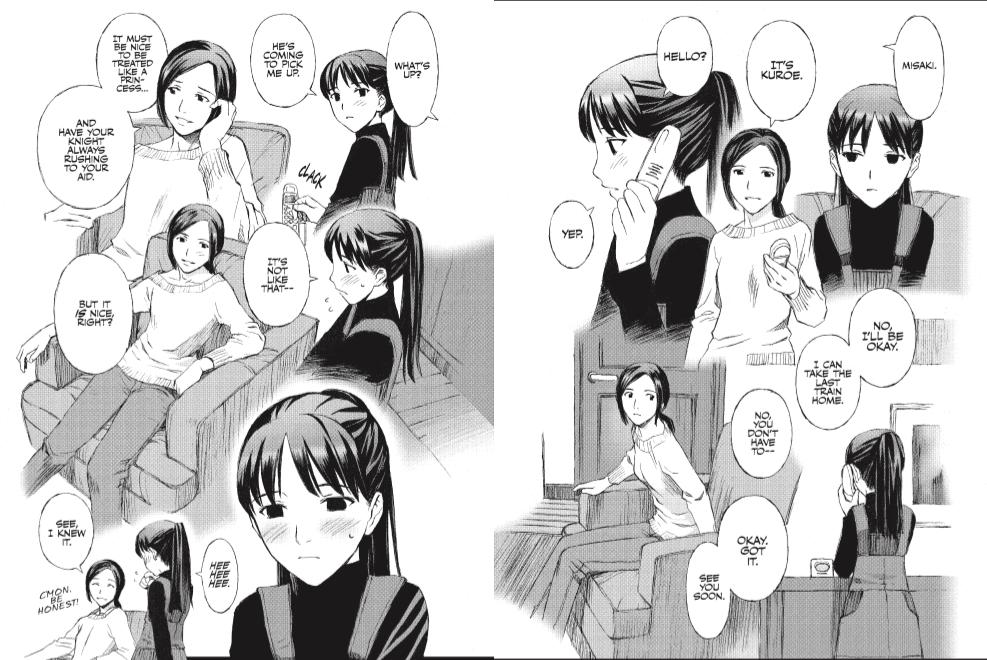
The most distinctive element of the artwork is Takano’s willingness to abandon grids altogether, creating fluid, full-page sequences in which the characters’ faces play a similar role to panel boundaries and shapes in directing the eye across the page. In this spread, for example, Sainome gently teases Misaki about her relationship with Kuroe:

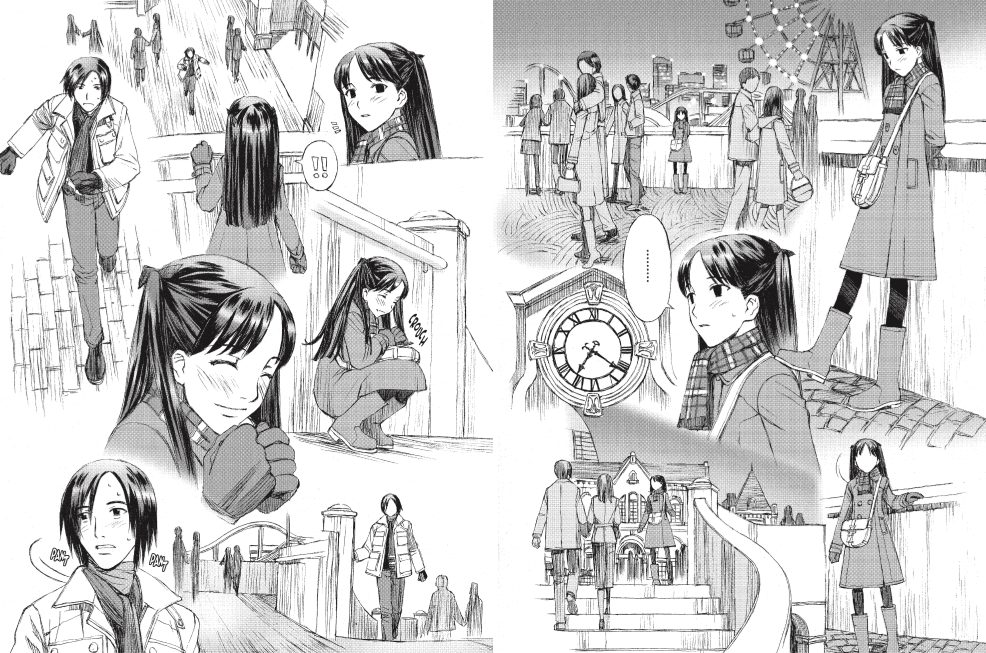
The undulating lines and overlapping images give these pages a pleasing, sensual quality, but what’s most striking is the way in which the strongest lines on the page point to Misaki’s eyes and mouth, showing us how difficult it is for Misaki to conceal her feelings for Kuroe. The wordless sequence below — in which Misaki waits for Kuroe to join her on a date — works in a similar fashion, using the direction of Misaki’s gaze to lead us through the proper sequence of events:

Though these two scenes are gracefully executed, they point to the biggest problem with Blood Alone: Misaki and Kuroe aren’t portrayed as ward and guardian, or brother and sister, but as star-crossed lovers whose age and circumstance make it impossible for them to fully express their true feelings for one another. Some readers may find their unconsummated romance heartwarming, the story of a love that can never be, but for other readers, Misaki and Kuroe’s relationship will be a deal-breaker, a sentimental and uncritical portrayal of an inappropriate relationship between a young vampire and her adult protector.

Review copy provided by Seven Seas.

BLOOD ALONE, VOLS. 1-3 • BY MASAYUKI TAKANO • SEVEN SEAS • 600 pp. • RATING: TEEN (13+)

Filed Under: Manga Critic Tagged With: Blood Alone, Seven Seas, Vampires

Blood Alone, Vols. 1-3

May 14, 2011 by Katherine Dacey

In his essay Moe: The Cult of the Child, Jason Thompson argues that one of the most pernicious aspects of moe is the way in which the father-daughter relationship is sentimentalized. “Moe is a fantasy of girlhood seen through chauvinistic male eyes,” he explains, “in which adorable girls do adorable things while living in questionable situations with adult men.” The idealized “daughters” found in Kanna, Tsukuyomi: Moon Phase, and Yotsuba&! adore their “fathers” in an uncritical fashion, showering them with affection and trying — often unsuccessfully — to play the role of wife and mother, in the process endearing themselves to both the hero and the reader with their burnt meals, singed shirts, and sincere desire to please.

Blood Alone provides an instructive example of this phenomenon. The story focuses on Misaki, a young female vampire whose appearance and mental age peg her as an eleven- or twelve-year-old girl. Misaki lives with Kuroe, a twenty-something man who’s been appointed as her guardian — though in Yotsuba-eqsue fashion, the circumstances surrounding their arrangement remain hazy in the early volumes of the manga. When we first meet Kuroe, he seems as easygoing as Yotsuba’s “dad,” a genial, slightly bumbling man who supports himself by writing novels and moonlighting as a private detective. And if that isn’t awww-inducing enough, Kuroe’s first gig is to locate a missing pet, a job that Misaki takes upon herself to complete when Kuroe bumps up against a publisher’s deadline.

As soon as Misaki’s cat-hunting mission goes awry, however, we see another side of Kuroe: he’s handy with his fists, quickly dispatching a rogue vampire who threatens Misaki’s safety. Small wonder, then, that Misaki has a crush on her guardian; not only is he the kind of sensitive guy who writes books and rescues kitties, he’s also the kind of guy who goes to extreme lengths to protect his family.

If that were the extent of their relationship, Blood Alone would provide enough heart-tugging moments to appeal to moe enthusiasts without offending other readers’ sensibilities, but Masayuki Takano plays up the romantic angle to an uncomfortable degree. The most unsettling gambit, by far, is Kuroe and Misaki’s penchant for sleeping in the same bed together. That a grown man would even entertain such behavior is disturbing enough, but what makes it particularly egregious is that Kuroe rationalizes this arrangement because Misaki is afraid of “ghosts and monsters.” I think we’re supposed to find this endearing — a vampire who’s afraid of the dark! — but it serves to infantilize Misaki even more than her little-girl dresses, terrible cooking, and fierce jealousy of Sainome, the one adult woman in Kuroe’s life. If we only saw things from Misaki’s point of view, one could make a solid argument that Masayuki Takanao is deliberately showing us things through a distorted lens, but Takano’s narrative technique simply isn’t that sophisticated; Kuroe’s behavior — his solicitousness, his guilt — suggests that Misaki’s understanding of their relationship isn’t as far off the mark as an adult reader might hope.

This kind of confusion extends to other aspects of the manga as well. About one-third of the stories fall into the category of supernatural suspense. The dialogue favors information dump over organic revelation of fact, while the plot frequently hinges on characters suddenly disclosing a convenient power or revealing their vampire connections. Yet these chapters are more effective than the slice-of-life scenes, blending elements of urban fantasy, police procedural, and Gothic horror into atmospheric stories about vampires who use the anonymity of cities to hide among — and prey on — the living.

The rest of the series, however, is jarringly at odds with the suspenseful mood of these stories; we’re treated to numerous chapters in which very little happens, save a Valentine’s Day exchange of chocolates or a jealous spat. As a result, the series feels aimless; whatever overarching storyline may bind the supernatural element to the domestic is too deeply buried to give the series a sense of narrative urgency.

Art-wise, Blood Alone boasts attractive, cleanly executed character designs and settings, but stiff, unpersuasive action scenes. Backgrounds disappear when fists fly, and the bodies look like awkwardly posed mannequins, their legs and arms held away from the torso at unnatural angles.

The most distinctive element of the artwork is Takano’s willingness to abandon grids altogether, creating fluid, full-page sequences in which the characters’ faces play a similar role to panel boundaries and shapes in directing the eye across the page. In this spread, for example, Sainome gently teases Misaki about her relationship with Kuroe:

The undulating lines and overlapping images give these pages a pleasing, sensual quality, but what’s most striking is the way in which the strongest lines on the page point to Misaki’s eyes and mouth, showing us how difficult it is for Misaki to conceal her feelings for Kuroe. The wordless sequence below — in which Misaki waits for Kuroe to join her on a date — works in a similar fashion, using the direction of Misaki’s gaze to lead us through the proper sequence of events:

Though these two scenes are gracefully executed, they point to the biggest problem with Blood Alone: Misaki and Kuroe aren’t portrayed as ward and guardian, or brother and sister, but as star-crossed lovers whose age and circumstance make it impossible for them to fully express their true feelings for one another. Some readers may find their unconsummated romance heartwarming, the story of a love that can never be, but for other readers, Misaki and Kuroe’s relationship will be a deal-breaker, a sentimental and uncritical portrayal of an inappropriate relationship between a young vampire and her adult protector.

Review copy provided by Seven Seas.

BLOOD ALONE, VOLS. 1-3 • BY MASAYUKI TAKANO • SEVEN SEAS • 600 pp. • RATING: TEEN (13+)

Filed Under: Manga, Manga Critic, REVIEWS Tagged With: Blood Alone, Seven Seas, Vampires

Pick of the Week: Viz Media Edition

May 9, 2011 by MJ, David Welsh, Katherine Dacey and Michelle Smith 10 Comments

New arrivals are few this week at Midtown Comics, so at Kate’s suggestion, we’re taking a bit of a detour. Inspired by David’s recent Viz 25 post, each of us will pick out a favorite Viz title we view as underrated. See our choices below!


MJ: I’m going to start us off looking ridiculous by naming Hiromu Arakawa’s Fullmetal Alchemist for my pick this week. It may seem crazy to call such a popular series “underrated,” but I actually think its popularity keeps many critics from recognizing its true quality. I blame this at least partly on the anime series, which, though fun and very compelling, barely scrapes the surface of its source material. And no wonder, when you consider how early on that series was made and how deep Arakawa has gone with her storyline since. When I first started reading manga, Arakawa was one of its storytellers I admired most, and that hasn’t changed at all over the past few years. She tells a complex, epic story with humor and a level of clarity I’ve seldom seen in any genre. Fullmetal Alchemist is just damn good.

DAVID: I can’t tell you how glad I am that Kate suggested this theme, because I was feeling horribly guilty about some of my (entirely defensible and necessary) omissions. I’ll begin the redressing by mentioning the prolific Yuu Watase. Now, for my money, the cream of her crop isn’t one of her fantasy-tinged epics. It’s the down-to-earth romantic comedy Imadoki! Nowadays. When a country girl (accompanied by her pet fox) travels to the big city to attend an elite school, she really wants to make friends, though the icy snobs make that a challenge. Tanpopo is a relentless optimist, though, and like the dandelion for which she’s named, she can blossom in the most inhospitable environments. I always enjoy comics about friendship, though there’s plenty of romance on offer as well. Sweet, funny, surprisingly moving, and only five volumes.

KATE: At the risk of sounding like a broken record, my suggestion is Kaze Hikaru, Taeko Watanabe’s gender-bending samurai drama about a young woman who joins the Shinsengumi to avenge her father and brother’s deaths. I’d be the first to admit that the pacing can be stately — think Hara Kiri, not Hana to Yume — and the romantic elements muted, but Kaze Hikaru features one of the smartest, fiercest heroines in shojo manga, a girl so principled she’d rather be respected as a warrior than adored as a woman. (Now that’s bad-ass.) Writing about the series last year, I argued that Watanabe has “created an action-filled drama in the vein of The Rose of Versailles or They Were Eleven but transplanted the setting from the relatively safe, romanticized worlds of the French Revolution and outer space to a period in Japanese history in which the male-identified virtues of courage, discipline, and patriotism dominated public discourse,” in effect giving girls “the freedom to project themselves into Japan’s past without gender constraints.” VIZ has published eighteen of the twenty-nine ongoing volumes, with volume nineteen scheduled for an August 2011 release. Easily my favorite shojo manga.

MICHELLE: I probably should be writing about Basara here. I always write about Basara in response to this sort of question. This time, though, I am going to cast my vote for Akimi Yoshida’s Banana Fish—stay tuned for a roundtable on the final three volumes coming to Manga Bookshelf later this month!—the suspenseful and action-packed story of a beautiful, brilliant badass named Ash Lynx and the warm-hearted Japanese boy with whom he can allow his weaknesses to show. As he works to learn the truth behind the drug that claimed his brother’s sanity, gangleader Ash finds himself up against rival gangs, the mafia, and the U.S. government. This is the series to give anyone who sneeringly derides shoujo manga—it’s exciting and gritty and, okay, the awesomeness of its hero is a little over-the-top, but overall it’s a tremendously fun read.


So, readers, what are your favorite underrated Viz titles?

Filed Under: PICK OF THE WEEK Tagged With: banana fish, fullmetal alchemist, imadoki! nowadays, kaze hikaru

Bookshelf Briefs 5/9/11

May 9, 2011 by MJ, David Welsh, Katherine Dacey and Michelle Smith 8 Comments

This week, Kate, David, MJ, and Michelle take a look at a slew of new releases from Viz Media, Digital Manga Publishing, TOKYOPOP, and Vertical.


Gente: The People of Ristorante Paradiso, Vol. 3 | By Natsume Ono | Viz Media – Comics, Italian Style — that’s how I’d describe Natsume Ono’s Gente, a series exploring the complicated personal lives of the people who work at and patronize Cassetta dell’Orso, the bistro featured in Ristorante Paradiso. Though Gente took a few volumes to find its footing, the third installment is magical: Ono’s men are dapper and virile; her women are bemused and tolerant; and the stories have the ebb and flow of real life, punctuated by moments of absurd humor or sadness that will remind movie buffs of Yesterday, Today, and Tomorrow and Marriage, Italian Style. If you don’t suppress a sniffle reading “Un Amore,” the story of a crumbling marriage, you’ve never experienced true heartbreak. Highly recommended, especially for fans of classic Italian cinema. – Katherine Dacey

Honey-Colored Pancakes | By Keiko Kinoshita | Digital Manga Publishing – This boys’ love anthology features five short stories, the first and last of which chronicle the bumpy relationship between Chiharu, a talented pastry chef, and Tougo, a handsome actor who’s as besotted with Chiharu’s desserts as he is with the hunky baker. The other three stories — “Tomorrow Will Be Rosy,” “A Clever Man at Work,” and “For Love” — also explore the formative stages of courtship, with characters screwing up the courage to confess their feelings or steal a first kiss. Though the book suffers from overly familiar scenarios, Keiko Kinoshita’s handsome character designs and discrete bedroom scenes make Honey-Colored Pancakes a good choice for readers who favor romance over smut. – Katherine Dacey

Kamisama Kiss, Vol. 3 | By Julietta Suzuki | Viz Media – One of the things I like best about this series is how it demonstrates Suzuki’s versatility. Karakuri Odette (Tokyopop) seemed to me to essentially be about talking through things until the characters understood their feelings. Kamisama Kiss is about feelings that sneak up on characters to the point that they don’t necessarily need to express them. In this volume, it’s fox spirit Tomoe’s chance to rescue accidental priestess Nanami from a difficult situation, though she’s hardly passive, and she’s pulled his fur out of the fire in the past. As our evenly matched protagonists grow closer, circumstances intervene to suggest that Nanami may not know her companion as well as she thinks she does. Suzuki seems quite assured at throwing credible, character-driven obstacles in the path of her maybe-lovers, which is a fine skill for a shôjo mangaka. -David Welsh

Kizuna Deluxe Edition, Vol. 2 | By Kazuma Kodaka | Digital Manga Publishing – What a difference a volume makes! The first installment of Kizuna was a bit of a mess, hopping around chronologically as Kadoka tried on a variety of drawing styles. The series finds its footing in the second volume, however, blending episodic stories about long-time couple Ranmaru Samejima and Kei Enjouji—Ranmaru wishes Kei would get a haircut, Kei gets upset when Ranmaru volunteers to step aside should Kei find a nice girl—with glimpses into the yakuza world (Kei and his half-brother, Kai, are the children of a notorious boss). I never expected I’d actually get into the latter, but I really enjoyed the suspenseful final chapter in this volume, in which Kai is hauled in by the cops on suspicion of dealing narcotics. I’m beginning to see why Kizuna is such a classic and now eagerly await volume three! -Michelle Smith

Rasetsu, Vol. 9 | By Chika Shiomi | Viz Media – In this series’ final volume, with Rasetsu’s 20th birthday upon her, she finally faces the demon who claimed her long ago. Though the ending has its twists, what really makes it work is the rich emotional framework that has defined the series all along. After all, Rasetsu’s worst demons are her own fears, and this what she and her quirky, self-made family must battle in the end. There’s nothing shocking here at all—no overwhelming drama to put a big “bang” on the ending—just a few, deeply damaged people who will work things out together the way they always have. It’s lovely, truly, and a perfect ending for this genuinely enjoyable series. Complete in just nine volumes, Rasetsu is a rare, short shoujo gem. Recommended. -MJ

Sakura Hime: The Legend of Princess Sakura, Vol. 1 | By Arina Tanemura | Viz Media – I ordinarily approach a new Tanemura series with some trepidation, since I either loathe them or find that they’re better than expected. Sakura Hime doesn’t give a very good impression at first, as its first chapter is the whirlwind story of a spunky heroine learning that a) she’s the granddaughter of Princess Kaguya and b) that it’s her destiny to fight nasty demonic critters called youko. Everything seems generic, including the fact that she immediately falls in love with the fiancé she had claimed to hate, but when he turns around and tries to kill her… well, that spices things up a bit. I’m still not sure whether Sakura Hime is going to be a series I follow to its conclusion, but it has earned a second look, at least. -Michelle Smith

Silver Diamond, Vol. 9 | By Shiho Sugiura | TOKYOPOP – Rakan and friends continue to make their way toward the Imperial Capital, pausing to calm the spirits in a graveyard and befriend the inhabitants of a village. The pace of the story is as leisurely as always, but Silver Diamond can be counted upon to provide a calming, benevolent, imaginative, comforting, funny, and touching read nonetheless. Unfortunately, this is the final volume that TOKYOPOP produced, and it ends with a cliffhanger—Rakan has been put to sleep in order to prevent him from leaving the village and one of the residents is plotting how best to do away with his companions! Take heart, however! Silver Diamond is available in French, and if you’re not afraid of a little Google Translate action, continuing the story should be pretty easy. That’s what I intend to do, at least! -Michelle Smith

Twin Spica, Vol. 6 | By Kou Yaginumaa | Vertical, Inc. – “Graceful” is the word that most frequently comes to mind when I’m reading this series about students at a school for astronauts. The quintet of leads spends most of this volume learning more about each other, particularly rich, removed Marika. There are lots of comics about a group of young people who have a dream in common but not much else, but few of them are as delicate and understated in approach as this one. Heroine Asumi continues to bring out the best in her classmates, partly due to her kindness, partly due to the example she sets, and partly due to the vulnerability she displays. I think it’s quite an accomplishment to create a heroine who inspires both the desire to protect and the anxiety that already she’s miles ahead. Why wasn’t this series nominated for an Eisner again? -David Welsh

Filed Under: Bookshelf Briefs Tagged With: gente, honey-colored pancakes, kamisama kiss, kizuna, rasetsu, sakura hime, silver diamond, twin spica

Where to Buy Manga: Book-Off

May 8, 2011 by Katherine Dacey 19 Comments

Used bookstores can be a terrific place to score cheap manga, but the dusty, rummage-sale vibe at many second-hand establishments isn’t necessarily conducive to browsing. That’s where Book-Off comes in: this Japanese chain promises a Borders-like shopping experience while offering consumers steep discounts on used books, CDs, DVDs, video games, and — most importantly, from an otaku standpoint — manga. There are currently eight Book-Off stores here in the United States, concentrated mostly in California and Hawaii, with a single East Coast location in Manhattan. And while you’re unlikely to find the sixth edition of The Concise Baker’s Biographical Dictionary of Musicians at Book-Off, it’s a swell place to hunt for the sixth volume of Ranma 1/2 , a Japanese magazine, or The Art of Tokyo Babylon.

Inventory at Book-Off generally favors the new and the popular, especially with hardcover books and CDs. Book-Off certainly carries recent manga — I spotted volumes of Black Jack, Kingyo Used Books, and Neko Ramen on a visit to the Manhattan store — but the manga section’s best deals are on older, out-of-print titles that are commanding high prices on Amazon and eBay — say, Cyborg-009 or Sanctuary — or on titles whose popularity crested a few years ago — say, InuYasha or Le Chevalier d’Eon.

Book-Off has a two-tiered pricing system for manga: books in excellent condition sell for 30% off the cover price (generally around $7.00), while gently used books sell for $1.00. On my last visit to the New York City location, I purchased three volumes of The Drifting Classroom, one volume of From Eroica With Love, and one volume of Firefighter! Daigo of Company M for $18.00. I’d be hard-pressed to say which books cost me $1.00 and which ones cost me $7.00, as the condition of all five ranged from very good to immaculate:

Which ones cost $1.00?

Other trips have yielded similar results: I nabbed the tenth volume of Cyborg-009 for $7.00, the fifth volume of Sanctuary for $7.00, three volumes of Tower of the Future for $3.00, and had to stop myself from buying the full run of Land of the Blindfolded for $9.00. (Only Jason Thompson’s tepid review in Manga: The Complete Guide saved me from my worst bargain-hunting impulses.)

Strapped for cash? Book-Off will buy your unwanted manga, provided the books are in good condition, odor-free, and unmarked; Book-Off won’t accept advanced reader copies or books which have visible damage to the cover or pages. I’m not sure what the going rate is — Book-Off doesn’t advertise that information on their website — but for folks within striking distance of a Book-Off location, it’s an easy way to unload manga that might otherwise gather dust.

The bottom line: Book-Off is a fun place to browse, especially for readers interested in manga published before 2007. I’ve found it a terrific place for plugging holes in my manga collection and for sampling unfamiliar titles. (Organizational nerd that I am, I always bring a shopping list with me so that I don’t overlook an opportunity to snag a volume of Worst or What’s Michael.) My only word of caution: online retailers can match Book-Off’s prices on recent titles, so if it’s important to buy your manga new, you may find Amazon or Lulu.com a better bet for series that are still in print.

KNOW BEFORE YOU GO

There are eight US locations: two in Hawaii, five in California, and one in New York. Click here to view the full list.

Book-Off will purchase gently used books, CDs, DVDs, and videogames. Sellers do not need an appointment, but should bring ID with them if they are selling a substantial amount of books, CDs, etc. Selling guidelines can be found here.

In addition to carrying manga in English, Book-Off also stocks a good selection of Japanese-language material: magazines, novels, art books, and, of course, manga.

Filed Under: Manga Critic Tagged With: Book-Off, Where to Buy Manga

Review Redux: Gosick, Vol. 1

May 5, 2011 by Katherine Dacey 16 Comments

American publishers have been trying to market light novels to manga fans for close to a decade, with mixed results. Though Dark Horse’s Vampire Hunter D books have sold more than 300,000 units, few other companies can claim similar success with light novels. TOKYOPOP, for example, launched its Pop Fiction imprint in 2006 with several high-profile series, among them The Twelve Kingdoms and Trinity Blood, but poor sales doomed the line to obscurity; by the time TOKYOPOP announced that it would be shuttering its North American publishing operation, it had scrapped its Pop Fiction imprint and drastically curtailed its light novel production.

Part of the problem was logistics: light novels pose a unique problem for retailers, who must decide whether the books should be shelved with graphic novels — where manga fans are more likely to find them — or with science fiction and fantasy books — where a broader readership might discover them. And part of the problem was quality: many of the light novels TOKYOPOP published were poor-to-middling, rendered in flat, functional prose that conveyed little of the energy or imagination of the best manga TOKYOPOP licensed. There were some genuine stand-outs in the Pop Fiction catalog, however, among them Kino’s Journey, a wistful travelogue about a young woman who wanders the globe on a talking motorcycle; Welcome to the NHK, a rude, hilarious expose on Japan’s hikokimori subculture; and Gosick, an old-fashioned murder mystery that’s equal parts Arthur Conan Doyle and Scooby Doo.

Described as a “modern twist on Holmes and Watson,” Gosick adheres to a tried-and-true formula in which a cold but brilliant detective is paired with a sincere but slightly dim sidekick who’s always a few clues behind the audience. In the case of Gosick, the Holmes stand-in is Victorique, the resident eccentric at the Saint Marguerite Academy in Sauville (a fictional European country, just in case you were about to visit the Wikipedia), while the Watson surrogate is Kazuya Kujo, the school’s sole Japanese student. Victorique is a little less degenerate than Conan Doyle’s greatest creation, favoring a pipe over a glass of absinthe; nonetheless, she shares Holmes’s contempt for small minds, superstitions, and emotionally driven decision-making. Her reputation for deductive reasoning leads the nearby town’s pretty-boy inspector to seek her advice whenever there’s a murder – which, given the size and geographical remoteness of the town, occurs with rather alarming frequency.

In the course of investigating a fortune teller’s death, Victorique and Kazuya board the Queen Berry, a ship which supposedly sank ten years earlier with a cargo of murdered children. The two endure a night of extreme violence and seemingly supernatural events as they comb the ship for clues about the old woman’s past. These scenes play like Ten Little Indians crossed with Battle Royale: the ship’s other passengers visit horrific deaths on one another, usually with sharp objects or booby traps. Interspersed with the carnage – which, despite my description, is pretty tame – are numerous conversations in which Victorique patiently debunks the notion that the Queen Berry is haunted, culminating in the kind of “if it wasn’t for those meddling kids I would have had my revenge!” ending familiar to Scooby Doo fans.

What sets Gosick apart from most of the light novels I’ve read — admittedly, a small and unscientific sampling — is the prose. As Carlo Santos noted in his review of volume one, “we get real paragraphs and sentences, with a good mix of description, dialogue and action to keep the story moving” instead of the “clipped, telegraphic sentences” characteristic of the Code Geass and Full Metal Panic novels. To be sure, no one will confuse Gosick with the stark lyricism of Snow Country or the biting snarl of Kamikaze Girls, but the prose is adequate to the task at hand. Aside from a few fussy and oft-repeated details about the characters’ appearance, most of the description focuses on the setting and the elaborate death-traps aboard the Queen Berry, keeping the readers’ attention squarely focused on the mayhem.

The plot may disappoint some contemporary mystery buffs; if you’re an ardent fan of Alexander McCall Smith or Tony Hillerman, you may find Gosick‘s parlor-room denouement too pat and old-fashioned to be genuinely satisfying. Readers who enjoyed Case Closed, The Kindachi Case Files, and Higurashi When They Cry, however, will find Gosick‘s exaggerated characters, Baroque murders, and slick illustrations right in their wheelhouse.

This is an expanded version of a review that originally appeared at PopCultureShock on 4/8/08.

GOSISCK, VOL. 1 • STORY BY KAZUKI SAKURABA, ART BY HINAKO HIRATA • TOKYOPOP • 192 pp.

Filed Under: Manga Critic Tagged With: Gosick, Mystery/Suspense, Review Gosick Light Novel, Tokyopop

Spice and Wolf, Vol. 4

May 4, 2011 by Katherine Dacey 22 Comments

At some point in your childhood, a well-meaning adult — a parent, a teacher, Mr. Rodgers — exhorted you “not to judge a book by its cover.” I’m not as diligent about following that advice as I should be, though I have enough experience as a consumer to correctly guess a book’s contents and intended audience from the packaging. Every now and then, however, I completely misjudge a title, as I did with volume four of Spice and Wolf. The cover suggested a fantasy-adventure in a medieval setting — perhaps something along the lines of Claymore — but the story read more like an economics textbook with sexy illustrations.

Ostensibly, Spice and Wolf focuses on the relationship between Holo, a six-hundred-year-old wolf god, and Lawrence, a twenty-five-year-old human. The two meet cute when Holo stows away in Lawrence’s wagon, looking for a ride to her homeland of Yoitsu. Though they’re temperamental opposites — Holo is crafty and impulsive, Lawrence is deliberate and careful — the two discover that they make good business partners; Holo’s ability to manipulate trading partners complements Lawrence’s financial acumen and risk assessment skills.

That’s not a bad premise for a manga; in the right hands, Holo and Lawrence’s travels could be the basis for a smart social satire or an engaging comedy. Unfortunately, the script frequently requires Lawrence to explain the finer points of loans, currency, and inventory control to Holo, expositions that are about as much fun to read as a chapter from Modern Management: Concepts and Skills. Holo’s responses are equally stultifying; in one scene, she cheerfully tells Lawrence, “It’s my intention to pay you back with interest. That means the more I borrow, the more you profit.” Ace student, that Holo.

These tedious exchanges about interest rates and guild politics are occasionally interrupted by comic interludes, usually prompted by Holo’s discovery of a stash of booze or Holo’s decision to groom her tail, an elaborate procedure that requires her to assume a number of fetching poses as she preens. If there was any chemistry between Holo and Lawrence, these scenes might not feel so completely perfunctory, but they serve little purpose beyond catering to the male reader’s gaze. Worse still, the story lacks any sense of urgency or purpose; the dramatic climax of volume four involves Lawrence discovering that he bought a wagon’s worth of worthless armor. There’s more at stake in a typical episode of The Apprentice, and they’re hawking salad dressing and mattresses.

Yet for all my criticisms of Spice and Wolf, I can see why the series has a devoted following. The artwork is immaculate, with clean lines, appealing character designs, and meticulously rendered landscapes, buildings, and urban markets; Keito Koume’s crowd scenes bustle with activity, as characters negotiate deals and flirt with each other, bringing the walled medieval towns to vivid life. The supporting cast, too, boasts some memorable characters. In volume four, for example, Lawrence and Holo cross paths with Norah, a shepherdess whose pleasant demeanor masks a complicated personal history. The volume closes with a bonus story showing us Norah’s visit to a local town, followed by a difficult night when she and her dog Ennek hide from Church authorities. It’s a simple mood piece, but it’s tense and effectively staged, hinting at the broad — even overreaching — power invested in religious authorities.

That the Church’s power and history remain mysterious four volumes into the manga points to the series’ biggest problem: most of the interesting conflicts in Spice and Wolf are so deeply buried beneath the commercial shop-talk that they barely register at all. As a result, Spice and Wolf reads more like Project X: Cup Medieval Noodle than a proper drama; what it desperately needs is a high-speed wagon chase, sword fight, or — dare I say it? — a love scene to goose the proceedings.

Review copy provided by Yen Press. Volume four of Spice & Wolf arrives in stores on May 31, 2011.

SPICE AND WOLF, VOL. 4 • STORY BY ISUNA HASEKURA, ART BY KEITO KOUME • YEN PRESS • 192 pp. • RATING: MATURE

Filed Under: Manga Critic Tagged With: Seinen, Spice and Wolf, yen press

Spice and Wolf, Vol. 4

May 4, 2011 by Katherine Dacey

At some point in your childhood, a well-meaning adult — a parent, a teacher, Mr. Rodgers — exhorted you “not to judge a book by its cover.” I’m not as diligent about following that advice as I should be, though I have enough experience as a consumer to correctly guess a book’s contents and intended audience from the packaging. Every now and then, however, I completely misjudge a title, as I did with volume four of Spice and Wolf. The cover suggested a fantasy-adventure in a medieval setting — perhaps something along the lines of Claymore — but the story read more like an economics textbook with sexy illustrations.

Ostensibly, Spice and Wolf focuses on the relationship between Holo, a six-hundred-year-old wolf god, and Lawrence, a twenty-five-year-old human. The two meet cute when Holo stows away in Lawrence’s wagon, looking for a ride to her homeland of Yoitsu. Though they’re temperamental opposites — Holo is crafty and impulsive, Lawrence is deliberate and careful — the two discover that they make good business partners; Holo’s ability to manipulate trading partners complements Lawrence’s financial acumen and risk assessment skills.

That’s not a bad premise for a manga; in the right hands, Holo and Lawrence’s travels could be the basis for a smart social satire or an engaging comedy. Unfortunately, the script frequently requires Lawrence to explain the finer points of loans, currency, and inventory control to Holo, expositions that are about as much fun to read as a chapter from Modern Management: Concepts and Skills. Holo’s responses are equally stultifying; in one scene, she cheerfully tells Lawrence, “It’s my intention to pay you back with interest. That means the more I borrow, the more you profit.” Ace student, that Holo.

These tedious exchanges about interest rates and guild politics are occasionally interrupted by comic interludes, usually prompted by Holo’s discovery of a stash of booze or Holo’s decision to groom her tail, an elaborate procedure that requires her to assume a number of fetching poses as she preens. If there was any chemistry between Holo and Lawrence, these scenes might not feel so completely perfunctory, but they serve little purpose beyond catering to the male reader’s gaze. Worse still, the story lacks any sense of urgency or purpose; the dramatic climax of volume four involves Lawrence discovering that he bought a wagon’s worth of worthless armor. There’s more at stake in a typical episode of The Apprentice, and they’re hawking salad dressing and mattresses.

Yet for all my criticisms of Spice and Wolf, I can see why the series has a devoted following. The artwork is immaculate, with clean lines, appealing character designs, and meticulously rendered landscapes, buildings, and urban markets; Keito Koume’s crowd scenes bustle with activity, as characters negotiate deals and flirt with each other, bringing the walled medieval towns to vivid life. The supporting cast, too, boasts some memorable characters. In volume four, for example, Lawrence and Holo cross paths with Norah, a shepherdess whose pleasant demeanor masks a complicated personal history. The volume closes with a bonus story showing us Norah’s visit to a local town, followed by a difficult night when she and her dog Ennek hide from Church authorities. It’s a simple mood piece, but it’s tense and effectively staged, hinting at the broad — even overreaching — power invested in religious authorities.

That the Church’s power and history remain mysterious four volumes into the manga points to the series’ biggest problem: most of the interesting conflicts in Spice and Wolf are so deeply buried beneath the commercial shop-talk that they barely register at all. As a result, Spice and Wolf reads more like Project X: Cup Medieval Noodle than a proper drama; what it desperately needs is a high-speed wagon chase, sword fight, or — dare I say it? — a love scene to goose the proceedings.

Review copy provided by Yen Press. Volume four of Spice & Wolf arrives in stores on May 31, 2011.

SPICE AND WOLF, VOL. 4 • STORY BY ISUNA HASEKURA, ART BY KEITO KOUME • YEN PRESS • 192 pp. • RATING: MATURE

Filed Under: Manga, Manga Critic, REVIEWS Tagged With: Seinen, Spice and Wolf, yen press

PotW: Hikaru no go, Lychee Light Club, Kekkaishi

May 2, 2011 by Michelle Smith, MJ, David Welsh and Katherine Dacey 8 Comments

It’s a banner week for manga arrivals at Midtown Comics. See below for recommendations from the Manga Bookshelf bloggers and special guest Michelle Smith!


MICHELLE: There’s a lot of good stuff hitting Midtown Comics this week, including new volumes of several of my Shojo Beat favorites. But I simply must award my pick of the week to the 23rd and final volume of Hikaru no Go. I have loved this series for a long time—I read the first volume in June 2004, and that was after I’d seen the anime—and the fact that it’s finally ending is pretty bittersweet. I’ll miss following much-beloved characters as they, in the grand tradition of sports manga, try their best to get stronger, but at the same time, it’s hard to feel too bummed out knowing that I’ll now have the luxury of binging on the entire series at once. Not only is Hikaru no Go a keeper, it’s a treasure.

MJ: Well, wow, it’s incredibly tempting to second Michelle’s choice. I have a deep, deep love for Hikaru no Go, something you’ll all be hearing more about as the week goes on. In the interest of diversity, however, I’ll take up the torch for Usamaru Furuya’s Lychee Light Club, a highly-anticipated new title from Vertical, featuring a secret society of middle-school boys who are developing a lychee-fueled “thinking machine.” Billed by Vertical as “Lord of the Flies for our new century,” the book is reportedly dark and pretty graphic in terms of sexuality and gore. It’s also reportedly awesome. Given Vertical’s recent track record with me, I say, “sign me up!”

DAVID: It’s certainly an embarrassment of riches this week, and I certainly second both Michelle and MJ’s choices, and there are new volumes of some utterly winning shôjo series (Kimi ni Todoke and The Story of Saiunkoku leap to mind), but I’m going to cast my vote for the Kekkaishi 3-in-1 Edition by Yellow Tanabe. I’ve read some of this series and enjoyed it a great deal, and I’ve always meant to go start it from the beginning at some point, so I’m very pleased to have an easy and inexpensive entry point. Any book that Kate describes as “The Best Manga You’re Not Reading” is worth some serious attention, I think.

KATE: I’ve always been puzzled that Kekkaishi wasn’t a bigger hit here in the US, as it has so many things going for it: great characters, cool-looking monsters, and artfully choreographed fight scenes that are exciting and unpredictable. With the series coming to an end in Japan, VIZ seems to be re-doubling its efforts to make Kekkaishi a success, promoting the anime through its website and re-issuing the series in a wallet-friendly omnibus edition. I’d strongly encourage InuYasha fans to give it a try, as I think they’ll find a lot of positive similarities between the two series, from the authors’ imaginative use of folklore to the authors’ penchant for feisty, smart female characters who pull their own weight in battles.


Readers, what are your Picks this week?

Filed Under: PICK OF THE WEEK Tagged With: hikaru no go, kekkaishi, lychee light club

  • « Go to Previous Page
  • Page 1
  • Interim pages omitted …
  • Page 66
  • Page 67
  • Page 68
  • Page 69
  • Page 70
  • Interim pages omitted …
  • Page 89
  • Go to Next Page »
 | Log in
Copyright © 2010 Manga Bookshelf | Powered by WordPress & the Genesis Framework