• Skip to primary navigation
  • Skip to main content
  • Skip to primary sidebar
  • Home
  • About Us
    • Privacy Policy
    • Comment Policy
    • Disclosures & Disclaimers
  • Resources
    • Links, Essays & Articles
    • Fandomology!
    • CLAMP Directory
    • BlogRoll
  • Features & Columns
    • 3 Things Thursday
    • Adventures in the Key of Shoujo
    • Bit & Blips (game reviews)
    • BL BOOKRACK
    • Bookshelf Briefs
    • Bringing the Drama
    • Comic Conversion
    • Fanservice Friday
    • Going Digital
    • It Came From the Sinosphere
    • License This!
    • Magazine no Mori
    • My Week in Manga
    • OFF THE SHELF
    • Not By Manga Alone
    • PICK OF THE WEEK
    • Subtitles & Sensibility
    • Weekly Shonen Jump Recaps
  • Manga Moveable Feast
    • MMF Full Archive
    • Yun Kouga
    • CLAMP
    • Shojo Beat
    • Osamu Tezuka
    • Sailor Moon
    • Fruits Basket
    • Takehiko Inoue
    • Wild Adapter
    • One Piece
    • After School Nightmare
    • Karakuri Odette
    • Paradise Kiss
    • The Color Trilogy
    • To Terra…
    • Sexy Voice & Robo
  • Browse by Author
    • Sean Gaffney
    • Anna Neatrour
    • Michelle Smith
    • Katherine Dacey
    • MJ
    • Brigid Alverson
    • Travis Anderson
    • Phillip Anthony
    • Derek Bown
    • Jaci Dahlvang
    • Angela Eastman
    • Erica Friedman
    • Sara K.
    • Megan Purdy
    • Emily Snodgrass
    • Nancy Thistlethwaite
    • Eva Volin
    • David Welsh
  • MB Blogs
    • A Case Suitable For Treatment
    • Experiments in Manga
    • MangaBlog
    • The Manga Critic
    • Manga Report
    • Soliloquy in Blue
    • Manga Curmudgeon (archive)

Manga Bookshelf

Discussion, Resources, Roundtables, & Reviews

Katherine Dacey

Voices of a Distant Star

March 19, 2018 by Katherine Dacey

What would it be like to embark on a deep space voyage, knowing that when you returned, nothing on Earth would be as you remembered it? That’s the question at the heart of Makoto Shinkai and Mizu Sahara’s Voices of a Distant Star, a thoughtful — if sometimes clumsy — rumination on the human toll of interstellar travel.

The story begins in 2046, as sixteen-year-old Noboru Terao anxiously awaits text messages from his childhood friend Mikako Nagamine, who’s enlisted in the military. As we learn through snippets of conversation and text, Nagamine isn’t at a conventional boot camp: she’s been deployed to Mars, where humanity is preparing for a lengthy campaign against an alien race known as the Tharsians. Her early exchanges with Noboru arrive in a matter of days or weeks, but when she’s transferred to the front lines, she realizes that it may be years before Noboru receives her next text; as she ruefully observes, “By the time this message reaches you, everyone will be growing up into people I don’t know.”

The emotional honesty of their epistolary romance is the best reason to read Voices of a Distant Star. Through their brief exchanges, we grasp that Noboru and Nagamine are torn between the desire for a normal relationship and the dawning realization that they may be better off pursuing their own destinies — a realization made more poignant by the sharp contrast between Noboru’s ordinary school life and Nagamine’s extraterrestrial mission. Their dilemma would be more moving, however, if the artwork wasn’t executed in such a desultory fashion. The characters are utterly generic, lacking any semblance of individuality, while the space combat lacks any sense of place; the story could just as easily be unfolding in Phoenix, AZ as on a planet eight light years from Earth. I know — the story is supposed to give me the feels, not the chills — but a little more attention to the dangerous aspects Nagamine’s mission would have raised the emotional temperature of Voices of a Distant Star from mild to muy caliente. In spite of these artistic shortcomings, Noboru and Nagamine’s plight remains powerful, reminding us that our greatest obstacle to space travel isn’t distance — it’s time. Recommended.

Voices of a Distant Star
Story by Makoto Shinkai, Art by Mizu Sahara
Translated by Melissa Tanaka
Vertical Comics, 238 pp.

Filed Under: Manga, Manga Critic, REVIEWS Tagged With: makoto shinkai, Sci-Fi, voices of a distant star

Pick of the Week: An Assortment of Manga

March 19, 2018 by Sean Gaffney, Michelle Smith, Ash Brown, Anna N, Katherine Dacey and MJ Leave a Comment

MICHELLE: There are quite a few good things coming out this week! I’ll definitely be reading the latest Giant Killing and Wake Up, Sleeping Beauty, and I’m happy to see more Sweet Blue Flowers. Too, there’s Perfect World, a josei series with a very interesting premise. But still, Twinkle Stars is coming to an end, and I find I’m really in the mood to see how this one wraps up, so that’s my pick for this week.

SEAN: Sadly, I suspect I will be the only one picking this, meaning I can’t call Pick of the Week “Take Back Your Mink”. But my Pick this week is definitely the first omnibus of Dragon Half, which I’m hoping will let me wallow in nostalgia.

KATE: I hate to be predictable, but my pick is volume four of Golden Kamuy. Is it a cooking manga with action sequences, or an action manga with lengthy discussions about squirrel meat preparation? Danged if I know, but I’m hooked.

ASH: So much is coming out this week that I’m looking forward to! Sweet Blue Flowers, Golden Kamuy, Twinkle Stars, Dragon Half and more. I’ll take this opportunity to pick one that hasn’t been mentioned by someone else yet, Natsume Ono’s ACCA 13-Territory Inspection Department. The first volume was a slow burn, but stylish and intriguing.

ANNA: There’s a lot of great titles coming out this week! I have to go with my general inclination to celebrate josei whenever a new series comes out, so my pick is Perfect World.

MJ: since I’m going last here, I’ll round things out by picking the third omnibus of Sweet Blue Flowers. I’m a fan of this series, and I’m a fan of angst, so this works well for me.

Filed Under: PICK OF THE WEEK

Toppu GP, Vol. 2

March 13, 2018 by Katherine Dacey

For two decades, Kosuke Fujishima’s Oh! My Goddess was a veritable institution in the US. It arrived in comic book stores in 1994 and finished its run in 2015, along the way introducing several generations of manga fans to the fraught relationship between the nebbishy Keiichi Morisato and his otherworldly companion Belldandy. Fujishima’s current project Toppu GP debuted last year with little attention from critics, but this sports manga might just be the better of the two series; as I noted in my review of volume one, the characters are types and the drama predictable, but the motorcycle races are thrilling, funny, and surprisingly educational, helping the novice appreciate the skill necessary to ride at an elite level.

The latest installment of Toppu GP does all the things you’d expect the second volume of a sports manga to do: it introduces new rivals for the principal characters, expands the supporting cast, and features several lengthier, riskier races. Not all of these gambits work. Toppu’s new fanclub — which includes Billy Izumo, a tow-headed bike enthusiast, and Itsuki Nagoya, a nerdy girl with a crush on Toppu — provides the weakest sort of comic relief by making Nagoya and Myne compete for Toppu’s attention. (“Who is this old lady?” Nagoya sniffs when introduced to Myne.) When the action shifts to the race track, however, the story roars to life, offering Fujishima a unique opportunity to explain the physics and strategy of moto GP through imaginative visual metaphors. In one sequence, for example, Toppu compares the components of his bike to instruments in a rock band — a neat way to suggest the sound and function of each — while in another, Fujishima represents Toppu’s anxiety as a giant, coiled rattlesnake. These metaphors are corny, to be sure, but they enliven the racing sequences, breaking the relentless stream of speedlines, facial close-ups, and banked turns.

Though Toppu gets top billing, Myne also gets a turn in the spotlight in a fiercely competitive race against Daiya Ishibashi, the reigning champ at the Course 2000. Their race is a genuine nail-biter, with Ishibashi and Myne aggressively vying for the lead. By the end of the volume, it’s not clear if Myne will prevail over Ishibashi, but her tenacity and cunning have made that outcome a real possibility. Readers who want to know whether Myne wins have two choices: wait until August for volume three, or purchase chapters 15 and 16 right now. (The digital serialization is up to chapter 23.) Me? I’m going to tough it out until August, since Toppu GP is one of the few series I’m actively collecting. Recommended.

Toppu GP, Vol. 2
By Kosuke Fujishima
Translated by Stephen Paul
Kodansha Comics, 192 pp.
Rated T, for Teen (13+)

Filed Under: Manga, Manga Critic, REVIEWS Tagged With: Kodansha Comics, Kosuke Fujishima, Moto GP, Sports Manga, Toppu GP

Pick of the Week: Different Sides

March 12, 2018 by Sean Gaffney, Katherine Dacey, Anna N, Michelle Smith and Ash Brown Leave a Comment

SEAN: My pick this week, despite my whining and groaning, goes to the 12th and final volume of Genshiken: Second Season. I’m afraid to say that my reason for this is entirely selfish. It’s because MY SHIP WINS! HAH! (cough) Or, in other words, the harem plot is finally satisfactorily resolved. I will miss complaining about it.
KATE: Predictably, my pick for the week is the fourth installment of The Girl from the Other Side, but I’ll need a chaser for that one — words like “moody” and “harrowing” come to mind when describing it — so I’ll throw a copy of Sorry for My Familiar in the basket, too.

ANNA: There’s not a lot coming out this week that appeals to me, but The Girl From the Other Side is so unique and surreal, it would likely be my pick during a week with many of my favorite series being released.

MICHELLE: I’m with Kate and Anna on this one! For my chaser, I’ll go with Blue Morning, as I love BL with a complex storyline.

ASH: Oh, that sounds like a great plan, Michelle! The Girl from the Other Side is absolutely marvelous and is without a question my pick. I definitely look forward to getting my hands on Blue Morning, too, though. I don’t read quite as much BL as I once did, but the series is very high on my list, BL or not.

Filed Under: PICK OF THE WEEK

Again!!, Vol. 1

March 10, 2018 by Katherine Dacey

There are no second chances in life, but there are in manga — think A Distant Neighborhood, Erased, and orange. The latest entry in the second-chance sweepstakes is Again!!, a dramedy about Imamura Kinichirou, a loner who tumbles down a flight on stairs at his high school graduation and wakes up on the first day of freshman year. Doomed to repeat the worst three years of his life, Imamura impulsively signs up for the school’s ouendan, but quickly runs afoul of prickly captain Yoshiko Usami, whose dedication to the struggling club proves more deterrent than draw for would-be members.

Imamura isn’t the only time-traveler; joining him on his temporal odyssey is Akira Fujieda, a perky classmate who also tumbles down a flight of stairs at graduation. Unlike Imamura, Akira greets this development with enthusiasm, but her fond memories of high school make her too quick to assume that everything will unfold the same way twice: she propositions her not-yet-boyfriend too boldly (he turns her down) and dismisses a would-be friend’s taste in music. (“It’s too bad Cara Mana broke up so soon,” Akira declares. “It didn’t take me long to get sick of them, though, since all their songs sort of sound the same.”) Crushed by the double rejection, Akira becomes Imamura’s reluctant ally in the quest to restore the ouendan to its former glory.

Whether you cotton to Again!! depends on how you react to the principal characters. I found Usami’s fierce commitment to tradition exhausting; she bellows, belittles, complains, accuses, and sobs, but seems fundamentally unable to have a normal conversation. Her bluster is meant to suggest her sincerity and vulnerability, I think, but has the opposite effect, reducing her to a one-note character. More convincing is Imamura, who decides that a do-over isn’t as terrible as he’d imagined. (I particularly enjoyed his nonchalant turn at the board in his math class; his classmates’ reaction to his display of mathematical acumen is priceless.) Imamura even flirts with the possibility of a social life: when the girls’ cheer squad mobilizes against Usami, for example, Imamura conspires with Akira and Reo, a pretty classmate, to undermine the cheerleaders’ plan.

Akira, too, is a pleasant surprise, a busybody who’s suddenly relegated to the margins of freshman life. Though her sense of the school’s pecking order remains unchanged, she can’t resist the opportunity to advise the once-lowly Imamura on how best to manipulate the cheerleading squad — it’s her chance to demonstrate her expertise, and perhaps to reclaim her former Queen Bee status by engineering a major social coup. As one might expect, Akira gets the sauciest lines, but she also learns the hardest lesson of the three principal characters: serendipity plays as big a role in popularity as personality and looks.

Mitsurou Kubo’s art plays a vital role in helping us understand Imamura and Akira’s predicament. In the first two chapters, Kubo does an excellent job of distinguishing past from present with subtle details: Imamura’s mom, for example, is a little plumper, while Akira is shorter and less physically developed. (Akira realizes something is amiss when she realizes that her breasts are smaller.) Equally impressive is the care with which Kubo reconstructs the same sequence of events that precede the time jump, showing us Imamura’s memories of the day and then Akira’s. Here again, it’s the little details — a snippet of conversation, a minor change in hairstyle — that convey whose perspective is represented, and how that character’s personality influences what we’re seeing and hearing.

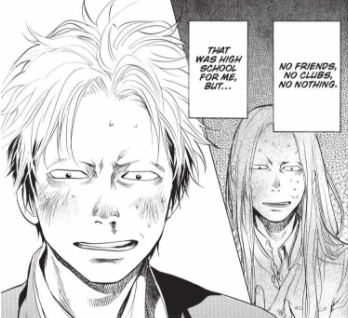
Kubo’s facial drawings show the same degree of meticulousness as her handling of the time travel sequences. Her reaction shots do more than just capture a character’s immediate response to a new development; they convey the emotions and experiences that underlie that reaction. Consider this split-screen image of Imamura:

This panel appears at the end of chapter one, as Imamura stands at a temporal and figurative crossroads: he can change his future by joining the ouendan, or recede into the background and be a loner once again. Imamura’s furrowed, sweaty brow and crestfallen expression capture his sense of helplessness; he has the look of someone who’s actively reliving a terrible experience moment by moment, contemplating the real possibility that nothing will change the second time around.

It’s this level of nuance that makes Again!! worth reading, even when the plot mechanics are creaky and the characters too strident. Watching Imamura forge new connections on his own terms is both funny and poignant, a reminder that we always have the potential to change our destiny, even when it seems preordained. I’m curious to see how Imamura and Akira grow and change, and how their behavior influences the future. Count me in for volume two.

AGAIN!!, VOL. 1 • STORY AND ART BY MITSUROU KUBO • TRANSLATED BY ROSE PADGETT • KODANSHA COMICS • 208 pp. • RATED TEEN (13+)

Filed Under: Manga, Manga Critic, REVIEWS Tagged With: Again!!, Comedy, Kodansha Comics, Mitsurou Kubo, Ouendan, Sports Manga

The Promised Neverland, Vol. 2

March 6, 2018 by Katherine Dacey

The first volume of The Promised Neverland was a masterclass in how to launch a series: the plotting was intricate but the brisk pacing and well-timed twists prevented an exposition-heavy story from sagging under the weight of its own ambition. Of necessity, volume two unfurls at a slower clip than the first, as the principal trio of Emma, Ray, and Norman work through the logistics of escaping Gracefield Manor, weighing the pros and cons of each element in their intricate plan. Kaiu Shirai also expands the cast to include other stakeholders, dedicating several chapters to Krone, Mother’s new subordinate, and Don and Gilda, two high-achieving students who haven’t yet learned the true purpose of Gracefield Manor.

These character moments are one of the great strengths of volume two. Krone, for example, turns out to be more resourceful than we might have guessed from her brief introduction in volume one; Shirai and Posuka Demizu use a woodland game of tag to reveal Krone’s formidable strength, speed, and cunning, establishing her as yet another major obstacle to escape. In other passages, Shirai peels away the outer layers of her principal characters, complicating the reader’s understanding of who they are, what motivates them to escape, and with whom their true allegiance lies — a necessary corrective to the first volume, which portrayed Emma, Ray, and Norman as just a little too smart, too capable, and too thoughtful to fully register as twelve-year-olds.

Volume two hits an occasional speed bump when characters discuss the escape plan. One overly deliberate scene, for example, finds Roy and Norman in full Scooby Doo mode, explaining how they figured out there was a mole among the residents. And volume two’s physical depiction of Krone is, frankly, uncomfortable, as some of her facial features have been exaggerated in ways that recall the iconography of blackface minstrelsy. Despite these lapses, The Promised Neverland remains suspenseful thanks, in no small part, to Demizu’s brief but horrific dream sequences; these suggestive images — a swirl of bodies, teeth, and monstrous eyes — provide a potent reminder of what’s at stake if the kids don’t escape Mother’s clutches.

The Promised Neverland, Vol. 2
Story by Kaiu Shirai, Art by Posuka Demizu
Translated by Satsuki Yamashita
VIZ Media; 192 pp.
Rated T, for Teen

Filed Under: Manga, Manga Critic, REVIEWS Tagged With: Shonen Jump, The Promised Neverland, VIZ

Pick of the Week: We Got the Beat

March 5, 2018 by Sean Gaffney, Michelle Smith, Katherine Dacey, Ash Brown and Anna N Leave a Comment

MICHELLE: There’s a lot that I’m getting this week. Ace of the Diamond, Haikyu!!, One-Punch Man… But, honestly, this week’s pick was preordained because one of my favorite series only comes out twice a year: Skip Beat!, I choose you!

KATE: I’m suffering from a manga hangover at the moment, since last week was EPIC. Is it OK to plug Again!! and Silver Spoon a second time? ‘Cuz there’s nothing coming out this week that makes me as happy of either of those debuts.

SEAN: My pick this week goes to a title I know nothing about except really good word of mouth. There was much happiness when Kaguya-sama: Love Is War was licensed, and I am excited to see why.

ASH: Like Kate, I’m still thrilled about last week’s debuts. I’m looking forward to catching up on some ongoing series this week, though, such as Frau Faust and Haikyu!!.

ANNA: Last week was great and this week is pretty good too! Like Michelle, I’m always thrilled when there is a new Skip Beat volume, so that is my pick!

Filed Under: PICK OF THE WEEK

The Best Manga You’re Not Reading: Venice

March 2, 2018 by Katherine Dacey

Venice — one of the last projects Jiro Taniguchi completed before his death in 2017 — is perhaps the most beautiful work he produced, a paean not only to the great Italian city, but to his own superb command of light, color, and line. Rendered in watercolor and ink, Venice‘s subtle palette and expansive treatment of the page are reminiscent of Taniguchi’s Guardians of the Louvre, while its premise recalls The Walking Man, Furari, and The Solitary Gourmet, three manga in which an unnamed male character strolls through the thoroughfares and byways of a major city, stopping to admire a blossoming tree or duck into an unassuming noodle shop.

Taniguchi makes an agreeable guide to Venice, frequently pausing to luxuriate in the very places that a visitor would find most charming: an outdoor marketplace filled with fruit and vegetable vendors, a moonlit promenade dotted with strolling couples, a faded but elegant hotel. Though Taniguchi renders these locations with the utmost precision, his most striking images are of canals and harbors. He captures the play of light on water with the same authority as a great maritime painter like Homer Winslow, using a watercolor palette of greens, blues, grays, blacks, and pinks to pinpoint the time of day and weather, as well as the tide — a small but potent reminder of Venice’s precarious relationship with the sea.

Though framed as a travelogue, Venice also explores similar thematic terrain as Taniguchi’s A Distant Neighborhood. Like the protagonist of Neighborhood, the Venetian wanderer is a middle-aged man making sense of his family’s past, a quest triggered by the discovery of a small lacquer box among his late mother’s possessions. A single image — a photo of a dapper Japanese couple feeding pigeons at the San Marco Piazza — leads him to Venice, where he retraces the couple’s steps. Taniguchi handles the mystery in an elegant fashion, eschewing pointed dialogue or voice-overs in favor of evocative imagery: a sepia-toned portrait of a family, a hand-drawn postcard of the Grand Canal. By focusing on these artifacts, Taniguchi provides just enough information for the reader to figure out who this young couple was without baldly explaining what drove them apart; only a brief inscription on the back of a postcard suggests the length and anguish of the couple’s separation.

These temporal shifts in the narrative are echoed in the way Taniguchi draws Venice itself. On several pages, for example, Taniguchi shows us familiar Venetian streetscapes as they looked in the 1930s, when the mystery couple lived there. On other pages, Taniguchi achieves a similar effect through the juxtaposition of the traditional with the modern: kayakers bob alongside gondoliers, floating past Renaissance merchants’ grand homes, while the mouth of the Canal de la Galeazze frames the arrival of a giant cruise ship. (In a nice touch, Taniguchi tracks the ocean liner’s stately progress over several panels, allowing us to appreciate its enormous size and sleek lines.) Even the most prosaic scenes emphasize the degree to which Venetians’ daily routines are shaped by its lengthy history; we see young children in baseball jackets sipping water from a fountain built in the 17th century and dog walkers chatting in the shadow of Venice’s great Campanille, unawed or unaware of these landmarks’ significance.

And while such sensuous images are fundamental to Venice‘s appeal, Taniguchi does more than recreate Venice’s great architecture; he conveys the rhythms and emotions of a journey, the experience of savoring new places while realizing in the moment that the place where you stand will be different the next time you visit. He evokes the curious sensation of déjà vu you experience in an unfamiliar city, as you see small elements of your own life reflected in the way that strangers live theirs. And he conveys the profound sense of discovery that comes from visiting a place that holds significance for a parent, lover, or friend, as you see the landscape through their eyes for the first time. That Taniguchi evokes these emotions primarily through the artful use of color and detail, rather than character development or dialogue, is testament to the depth of his artistry. Highly recommended.

For more insight into Venice, I encourage you to watch this brief video in which Taniguchi discusses the genesis of the story, and how he created some of the book’s most arresting images:

VENICE • BY JIRO TANIGUCHI • FANFARE/PONENT MON • NO RATING • 128 pp. 

Filed Under: Manga, Manga Critic, Recommended Reading, REVIEWS Tagged With: Fanfare/Ponent Mon, Jiro Taniguchi, Louis Vuitton, Venice

Giant Spider & Me, Vol. 1

February 26, 2018 by Katherine Dacey

Giant Spider & Me is a gentle fantasy that’s tinged with whimsy and rue. The story focuses on Nagi, a perky tween who lives by herself in a well-appointed cottage, awaiting the return of her father from a mysterious trip. In his absence, she’s proved remarkably self-sufficient, growing and foraging for her own food and preparing delicious meals for herself. Our first hint that something is amiss occurs early in chapter one, when she stumbles across a mastiff-sized spider in the woods. Their initial encounter doesn’t go well — Nagi is understandably terrified — but her apprehension soon gives way to a unique interspecies friendship when she discovers Asa (her name for the spider) shares her passion for pumpkin dumplings and leisurely picnics.

What inoculates Giant Spider & Me from a terminal case of the cutes is the specificity of Kikori Morino’s vision. On a superficial level, Giant Spider & Me is a culinary manga that walks the reader through the process of making turnip soup and miso ratatouille while conveying the joy of sharing food with others. (And yes, recipes appear at the end of each chapter.) On a deeper level, however, Giant Spider & Me is a thoughtful reflection on what it means to share your home with an intelligent creature, recognizing the pleasures of such an arrangement while acknowledging the communication gap between species. Asa proves a lively and willful guest in Nagi’s house, scaling walls and punching a hole in the roof in its quest for greater freedom — a detail that frustrated cat owners will appreciate.

The other secret to Morino’s success is her artwork, which strikes an elegant balance between clarity and detail. She never explains what caused the apocalypse of the title, but hints at its devastation with small but important clues: a partially submerged city, a vigilante in a gas mask and military-issue poncho. Morino applies that same mixture of restraint and exactitude to her character designs; Asa is both menacing and cute, an eight-eyed, eight-legged creature whose terrible mandibles are balanced by a feather-soft abdomen and a puppy-like demeanor. By emphasizing Asa’s duality as pet and monster, Morino helps us see Asa as Nagi does while also helping us understand why other survivors take a dimmer view of Asa. Something tells me I might need a tissue or two before the series finishes its run. Recommended.

Giant Spider & Me: A Post-Apocalyptic Tale, Vol. 1
Story & Art by Kikori Morino
Translation by Adrienne Beck; Adaptation by Ysabet Reinhardt MacFarlane
Seven Seas, 180 pp.
Rating: Teen

Filed Under: Manga, Manga Critic, REVIEWS Tagged With: Cooking and Food, Fantasy, Giant Spider & Me, Seven Seas

Pick of the Week: At Last, Farming Manga!

February 26, 2018 by Sean Gaffney, Michelle Smith, Katherine Dacey, MJ, Anna N and Ash Brown Leave a Comment

SEAN: My pick this week is Silver Spoon Again!!, a touching story of a young man who dies from overworking himself as an agriculture student in Hokkaido, but is given the opportunity to go back and live his life again, and becomes an ouendan cheerleader for the school’s equestrian squad.

MICHELLE: Ha! I am behind that pick 100%!

KATE: I’m on Team Silver Spoon this week, but for selfish reasons: I’m hoping that Silver Spoon will be such a hit that Yen Press will rescue Hiromu Arakawa’s Hyakusho Kizuko and offer it in a snazzy print edition. JManga released the first volume in 2012 before folding up its tent, and I’ve always felt it deserved a second chance with American readers. Here’s a link to my original review; it has 100% more cow manure jokes than Fullmetal Alchemist.

MJ: I have been hoping for Silver Spoon so much for so long, that has to be my pick! Hiromu Arakawa is a manga goddess and I am always on her team. And hey, I will also get behind Kate’s argument. More Arakawa is always better!

MICHELLE: I’ll get behind it, too. There are definitely several JManga titles that I wish could find new homes.

ANNA: I’m also looking forward to Silver Spoon. I always feel like throwing a party whenever a manga I thought would never be available here gets released in translation.

ASH: Like everyone else here, Again!! and Silver Spoon are definitely at the top of my list this week. I’ve been waiting to read Silver Spoon longer, so I guess that’ll be my official pick, but I’m looking forward to the debut of both series a great deal.

Filed Under: PICK OF THE WEEK

Pick of the Week: Fish, Spiders and Distant Stars

February 19, 2018 by Sean Gaffney, Michelle Smith, Katherine Dacey, Ash Brown and Anna N Leave a Comment

MICHELLE: By now, it probably goes without saying that I will definitely be getting the new volume of Chihayafuru, so I will instead pick Voices of a Distant Star. I never read it the first time around, but I remember MJreally loved it. The your name. movie made me cry buckets, so I bet I will probably love this story, too.

SEAN: I’m definitely picking up Voices, but my pick this week goes to Giant Spider & Me. A combination of food manga, sweet slice of life, and post-apocalyptic survival, it feels like every new trend we’ve had brought into one title.

KATE: I’m exited about the return of Voices of a Distant Star, and charmed by the idea of a slice-of-life story about a girl and her giant spider, but my must-read manga this week is Fukushima Devil Fish, a collection of short stories by Susumu Katsumata. And yes, the Fukushima of the title refers to the nuclear plant that experienced a partial meltdown after the 2011 Tohoku earthquake; according to publisher Breakdown Press, the anthology includes “two stories from the 1980s on the subject of ‘nuclear gypsies,’ the men who labor under oppressive conditions to maintain Japan’s fleet of nuclear power plants.”

ASH: I’m certainly curious about Giant Spider & Me since learning that it is in fact a food manga but, like Kate, Fukushima Devil Fish is what takes priority for me this week.

ANNA: There’s a ton of great manga coming out this week, but I’m most interested in Voices of a Distant Star, since I wasn’t able to catch it the first time it was released.

Filed Under: PICK OF THE WEEK

Takane & Hana, Vol. 1

February 19, 2018 by Katherine Dacey

The opening pages of Takane & Hana offer a uniquely Japanese twist on the meet cute: the couple in question are set up by a marriage broker who thinks she’s introducing a twenty-three year old beauty to a twenty-six-year-old bachelor. The bride-to-be, however, is a sixteen-year-old high school student who’s posing as her older sister — don’t ask — while the potential groom is an impossibly handsome jerk who’s angry that his family is pressuring him to settle down. Guess what happens next? If you said, “Opposites attract!”, you wouldn’t be wrong, though the course of true love hits a few potholes along the way.

I’m of two minds about Takane & Hana. My fifteen-year-old self adores Hana for being so smart and sassy, the kind of girl who says devastatingly true things and still manages to stay in other people’s good graces. My forty-five-year-old self, however, feels uncomfortable with the ten-year age gap between its lead characters. While Yuki Shiwasu cheerfully acknowledges the troubling power dynamic between Takane and Hana, she wants to eat her cake and have it, too: Hana’s incisive comments are supposed to level the playing field with the older, more experienced Takane, making it OK for the two to flirt, date, and kiss. At the end of the day, however, the economic and educational gulf between Hana and Takane still seems vast, making Takane seem like a predatory creep for preferring the company of a mature sixteen-year-old over a woman his age.

I know, I know: I’m humorless. A killjoy. A big ol’ capital-F feminist. But in a moment when we’re having serious conversations about power and consent, I’m having difficulty getting caught up in Takane and Hana’s romantic shenanigans, however much Hana sounds like a teenaged Rosalind Russell, or how wonderfully elastic Takane and Hana’s faces may be. Takane & Hana is unquestionably someone’s guilty pleasure — just not mine.

Takane & Hana, Vol. 1
Story and Art by Yuki Shiwasu
Adaptation by Ysabet Reinhardt MacFarlane
VIZ Media, 200 pp.
Rated T, for Teens

Filed Under: Manga, Manga Critic, REVIEWS Tagged With: Romance/Romantic Comedy, shojo, shojo beat, takane & hana, VIZ

Baccano!, Vol. 1

February 15, 2018 by Katherine Dacey

There are two things you need to know before you read this review. First, I’m a ride-or-die Godfather II fan, the kind of person who’s obsessively watched Robert DeNiro’s performance as the young Don Corleone more times than I can count. Second, I am not a Light Novel Person, despite my repeated efforts to embrace the format.

I disclose this information because Baccano! is a manga adaptation of a light novel series set in Prohibition-era New York, where rival families — one from Sicily, one from Naples — run guns, booze, and card games. That meant there was a 50% chance I’d love this series, since the premise screams “Manga Godfather!”, and a 50% chance I’d hate Baccano!, since the manga was conceived as a tie-in product for the novels’ hardcore fans. What I didn’t expect, however, was just how inept the adaptation would be; I assumed that my objections would be to content or characterization, not a sloppy, hole-filled (holy?) narrative. Shinta Fujimoto’s storytelling, however, is serviceable at best and amateurish at worst, cramming too many events and characters into volume one. The result is a jumbled mess of introductions, reunions, and exposition masquerading as conversation; I spent as much time backtracking two or three pages as I did moving forward, relying on the Wikipedia to demystify poorly explained plot twists, not the least of which is that some characters are immortal. 

Superficially, the artwork seems more polished than the narrative, but a close examination reveals just how perfunctory Fujimoto and Katsumi Enami’s character designs really are. The Martillos and Gandors are so blandly drawn that nothing about them reveals about the characters’ ethnicity, social standing, or profession, let alone the time period in which the story unfolds. The same is true for the physical environment. A few establishing shots depict fire escapes and brick buildings, but Fujimoto seldom provides much in the way of period detail, nor does he convey just how densely settled Little Italy was in the 1920s.

His lazy world-building is most evident in chapters two and three, when Firo Prochainezo, a foot soldier in the Martillo Camorra, tracks an assassin through the tumult of the San Gennaro Festival in much the same fashion as Don Corleone pursues Don Fanucci in The Godfather II. In Coppola’s hands, these scenes are bursting with the activity of brass bands and puppeteers re-enacting San Gennaro’s martyrdom, a vibrant pageant of Sicilian Catholic tradition. In Fujimoto’s version, however, the festival looks about as exciting as a high school pep band rehearsal, with a few token shots of musicians and festival goers. Worse still, Fujimoto has difficulty making these scenes an organic part of the story, inserting them into a potentially suspenseful cat-and-mouse game that unfolds in the alleyways of … well, it’s supposed to be Little Italy, but honestly, it looks as much like Sesame Street as any real city.

About the best I can say for Baccano! is that it clocks in at a mere 160 pages; anything longer would seem as eternal as the characters themselves. I know I’m not the intended audience for this manga, but the series’ die-hard fans — those who read the novels and watched the anime — surely deserve a more artful tie-in than this disastro totale.

BACCANO!, VOL. 1 • ORIGINAL STORY BY RYOHGO NARITA, ART BY SHINTA FUJIMOTO, CHARACTER DESIGN BY KATSUMI ENAMI • TRANSLATION BY TAYLOR ENGEL • YEN PRESS • 160 pp. • RATED T, FOR TEEN (LANGUAGE, VIOLENCE)

Filed Under: Manga, Manga Critic, REVIEWS Tagged With: Baccano, Gangster Manga, yen press

Pick of the Week: Happiness Will Prevail

February 12, 2018 by Sean Gaffney, Katherine Dacey, Anna N, Michelle Smith, Ash Brown and MJ 2 Comments

SEAN: My pick this week is the 15th volume of Haganai: I Don’t Have Many Friends. It’s been 15 months since the last volume, where we saw Kodaka finally getting the ever-loving crap kicked out of him for his feigned obliviousness. Will this actually shake up the harem, though? I want to find out. Or at least see him get pounded again.

KATE: Any week that sees the release of a new Descending Stories is a good week in my book, but I’m also stoked for Theory of Happiness, a sequel to one of 2017’s most pleasant surprises: I Hear the Sunspot. It wasn’t as dramatic or splashy as some of 2017’s best books, but it won a place in my heart for its sensitive portrayal of male friendship — something we don’t see often enough in our popular culture.

ANNA: I agree with Kate, I Hear the Sunspot was such a wonderful surprise. Theory of Happiness is my pick of the week, I’m eager to find out what happens next with this series.

MICHELLE: I haven’t yet managed to read I Hear the Sunspot, so while I’m sure its sequel will be great, I’ll cast my vote for the fifth volume of Descending Stories, one series I have finally managed to read and am enjoying quite a bit.

ASH: I’ll definitely be reading the latest volume of Descending Stories, but this week my heart (and my pick) belongs to Theory of Happiness. I loved I Hear the Sunspot and have been looking forward to its sequel from the moment I learned that it existed.

MJ: Theory of Happiness! Theory of Happiness! Theory of Happiness! I’m not sure what else to say.

Filed Under: PICK OF THE WEEK

Pick of the Week: Return to Neverland

February 6, 2018 by Sean Gaffney, Michelle Smith, Katherine Dacey, Ash Brown, Anna N and MJ Leave a Comment

MICHELLE: I will definitely be picking up the tenth Yona of the Dawn, and Takane & Hana is intriguing too, but having been positively stunned by the awesome that is Promised Neverland, I must pick the second volume of that series. I literally made an entry on my calendar to remind me.

SEAN: I honestly am torn. I enjoyed Takane & Hana so much – it’s exactly the sort of manga I love. But The Promised Neverland was so good last time and feels like the more IMPORTANT manga out this week. Really, get both. Don’t try to choose. (It helps that they’re nothing alike.)

KATE: I vote for volume two of The Promised Neverland. ‘Nuff said!

ASH: Like everyone else so far, the next volume of The Promised Neverland is certainly high on my list. However, I’m pretty excited to read the psychological thriller Perfect Blue, too. Even if it wasn’t the basis of Satoshi Kon’s striking film, the novel sounds like it should be something right up my alley.

MJ: Since I am the big loser who hasn’t actually read the first volume of The Promised Neverland, I will go ahead and indulge my interest in Takane & Hana, which has lured me in with a combination of its source magazine and its spunky-looking heroine. Shoujo, I am in your corner this week!

ANNA: I enjoyed the first volume The Promised Neverland and I’m intrigued by Takane & Hana, but the title that thrills my heart is Yona of the Dawn . It just keeps getting better and better, and at 10 volumes in has built up an extended cast of characters that I’m rooting for.

Filed Under: PICK OF THE WEEK

  • « Go to Previous Page
  • Page 1
  • Interim pages omitted …
  • Page 33
  • Page 34
  • Page 35
  • Page 36
  • Page 37
  • Interim pages omitted …
  • Page 89
  • Go to Next Page »
 | Log in
Copyright © 2010 Manga Bookshelf | Powered by WordPress & the Genesis Framework