• Skip to primary navigation
  • Skip to main content
  • Skip to primary sidebar
  • Home
  • About Us
    • Privacy Policy
    • Comment Policy
    • Disclosures & Disclaimers
  • Resources
    • Links, Essays & Articles
    • Fandomology!
    • CLAMP Directory
    • BlogRoll
  • Features & Columns
    • 3 Things Thursday
    • Adventures in the Key of Shoujo
    • Bit & Blips (game reviews)
    • BL BOOKRACK
    • Bookshelf Briefs
    • Bringing the Drama
    • Comic Conversion
    • Fanservice Friday
    • Going Digital
    • It Came From the Sinosphere
    • License This!
    • Magazine no Mori
    • My Week in Manga
    • OFF THE SHELF
    • Not By Manga Alone
    • PICK OF THE WEEK
    • Subtitles & Sensibility
    • Weekly Shonen Jump Recaps
  • Manga Moveable Feast
    • MMF Full Archive
    • Yun Kouga
    • CLAMP
    • Shojo Beat
    • Osamu Tezuka
    • Sailor Moon
    • Fruits Basket
    • Takehiko Inoue
    • Wild Adapter
    • One Piece
    • After School Nightmare
    • Karakuri Odette
    • Paradise Kiss
    • The Color Trilogy
    • To Terra…
    • Sexy Voice & Robo
  • Browse by Author
    • Sean Gaffney
    • Anna Neatrour
    • Michelle Smith
    • Katherine Dacey
    • MJ
    • Brigid Alverson
    • Travis Anderson
    • Phillip Anthony
    • Derek Bown
    • Jaci Dahlvang
    • Angela Eastman
    • Erica Friedman
    • Sara K.
    • Megan Purdy
    • Emily Snodgrass
    • Nancy Thistlethwaite
    • Eva Volin
    • David Welsh
  • MB Blogs
    • A Case Suitable For Treatment
    • Experiments in Manga
    • MangaBlog
    • The Manga Critic
    • Manga Report
    • Soliloquy in Blue
    • Manga Curmudgeon (archive)

Manga Bookshelf

Discussion, Resources, Roundtables, & Reviews

Archives for April 2013

Weekly Shonen Jump Recap: April 22, 2013

April 23, 2013 by Derek Bown Leave a Comment

April 22 Cover PageBit of a short issue this week, or at least it feels like that for me since I stopped trying to decipher Yugioh! Zexal. It may be lax of me as a reviewer to ignore that series, but the only way for me to give it a fair shake in any kind of review would be to actually do my research and read the series. But, let’s face it, I could already tell you from chapter one it wouldn’t be interesting—and I haven’t seen anything since then to change my mind.

Dragon Ball Z Ch. 012
Dragon Ball Z (I refuse to call it Dragon Ball since saying “Dragon Ball Ch. 012″ would be inaccurate) really is at its best during chapters that would be nothing but talking heads, were Toriyama not so good at utilizing panel layout and camera angles to make even the talkiest of scenes dynamic. Again, it’s impossible to comment on these chapters without letting my prior knowledge of the series color my perspective, so I’ll limit it to saying that I’m amused by how Gohan actually goes through with his plans to become a scholar, despite everyone saying it’s such a waste. Follow your own dreams, not those others inflict on you. Even if you’re talented at something, it doesn’t mean you are required to pursue it. Sure people that want to do what you’re good at will think it a waste of talent, but that’s not what matters. It’s really a good lesson for all of us.

One Piece Ch. 706
There aren’t many creators who could take a character who was beaten down like a putz and have him come back as a legitimate threat. Not only did Bellamy come across as a threat, but he actually is one of the two characters I predict to win Block B. Oda set up the fights to take advantage of the fact that we all expect Luffy to win, and managed to introduce doubt in the other two blocks by focusing on four characters in the two blocks, either of which could win their respective blocks. So it’s certainly suspenseful when normally it would not be.

Also, Nami is going to be furious if she finds out Bellamy stole the golden pillar that was supposed to be theirs.

One Piece

One-Punch Man Ch. 014
Oh Hammerhead, I’m so glad you didn’t die. He makes a great final punch line because he is the opposite of the usual. Instead of someone dying, it’s someone living when they shouldn’t. Sonic’s expression is also the scariest thing I’ve seen all week. That is all.

One-Punch Man

Bleach Ch. 534
While this chapter was not as engaging as the past few chapters have been, I quite liked it compared to the chapters before this flashback. I think it’s because this is a story I’ve been waiting for a long time, but also because it eschews the baggage Bleach has accumulated in the past years. I think Kubo is capable of telling good stories, but he’s overburdened himself with years of continuity. Sometimes you just need a fresh start, and this story is as close to a fresh start as we’re going to be getting for a while.

Nisekoi Ch. 071
When I found myself rating One Piece as the best chapter this week, I realized that I was doing what I had sworn I would not. I was ranking it number one because I always rank it number one. But this week that honor goes to Nisekoi. The setups for the final punchline were all wonderful, and the punchline itself was just hilarious. Every chapter I think I have a new favorite character, and every time I find myself proven wrong yet again. That’s it—just give this series a harem ending, I won’t mind. I can’t pick which girl to root for anymore.

Nisekoi

Toriko Ch. 230
This chapter of Toriko was the embodiment of “But wait, there’s more!” in manga. There are so many unexpected reveals and awesome cliffhangers that I can’t focus on one. Nor do I want to give anything away. Let’s just say that an unimportant character from early on in the manga comes back in a big way, and another fairly important character who only showed up once changes sides. And then Zebra. Just Zebra. You think he’s peaked in awesomeness, but then you find out you are once again wrong.

Toriko

World Trigger Ch. 011
What could have been a pretty major threat, and has been the main threat for the series’ run, turns out to handled in a montage. Now, I wouldn’t be surprised if it turns out there are more gates opening in strange places, because nobody functioning as a writer in any kind of professional capacity could ever possibly make such a basic writing blunder in such a high stakes game. Could they?

We’ll have to wait to see what happens. But hopes are not high. A shame, truly, considering how much I enjoyed the first chapter.

Cross Manage Ch. 030
How does this series keep getting better!? Last week I thought it would be disastrous if Kaito skipped the match. And either he has the most common sense of any writer, or he’s reading my mind. If the latter, please pay attention, Kaito-sensei, I have a few ideas for some omake material. This chapter really showed how good Cross Manage could be as a straight up sports manga. Which just doubles my enjoyment because I already was enjoying it as a character piece. Considering possible upcoming cancellations and series ending their runs I wouldn’t be surprised if Cross Manage lives to fight another day. It better, it’s survived this long and gotten this good that canceling it now would be an abject shame.

Cross Manage


Despite being a short issue, this week’s Weekly Shonen Jump was very strong. Perhaps the lack of Naruto skewed the overall quality. One more week, and then we’re off for Golden Week. I’ll be craving new manga chapters all week, but at least I get to take a break just like the manga authors do that week.

If you want to hear more, check out the Manga^3 Podcast Archives. Or go directly to last week’s episode, Episode 044 – April 15, 2013 – The Naruto Conundrum: Why Do We Hate Sasuke? | Mutant Turtles Gaiden and Super Turtles.

Filed Under: FEATURES & REVIEWS, Weekly Features, WSJA Recaps Tagged With: bleach, Cross Manage, Dragon Ball Z, nisekoi, One Piece, one punch man, toriko, world trigger

It Came from the Sinosphere: Yanyu Mengmeng (TV Drama) Part 2

April 23, 2013 by Sara K. 1 Comment

yymm27

Pouring Sugar on Stakes Thrust through the Heart, or TV Drama vs. Novel

The plot between the novel and this TV adaptation is mostly the same, aside from the addition of new characters (the Li family, Keyun, Du Fei, Ji Yao), and expanded roles for Erhao, Mengping, and Fangyu.

However, the feeling is significantly different. The TV drama does a lot of sugar-coating. For example…

[HUGE SPOILER WARNING + TRIGGER WARNING FOR SEXUAL VIOLENCE / SUICIDE, skip to “End Trigger/Spoiler Warning” if you want to avoid spoilers and/or triggers]

In the novel, Mengping is gang-raped and gets pregnant. When she can’t identify the father, her father stop treating her as his daughter, or even as a human being. After a back-alley abortion gone wrong, Mengping spends most of the novel in the hospital, out of sight. By the time she gets out of the hospital, her mother is in prison, her father and sister are dead, her younger brother is in an orphanage, and she has to live with her older brother, who is penniless.

She is also gang-raped, emotionally discarded by her father, and gets injured in an abortion in the TV Drama. But in the TV drama, her loving sister cares for her after the rape, and her boyfriend agrees to marry her even after he knows what happened. Furthermore, her boyfriend tracks down the rapist and personally punishes them, with some help from Mengping’s father, who starts treating her as his daughter again once a man (her boyfriend) agreed to marry her. Mengping and her boyfriend (later, husband) live happily ever after.

Then there is Ruping.

Mengping and Ruping

Mengping and Ruping

In the TV drama, Ruping commits suicide. After the suicide, all of the characters are heartbroken, blame each other for her suicide, blame themselves, and pour out all of the love they felt for Ruping but didn’t express properly while she was alive.

In the novel, when Ruping commits suicide, the characters either a) hardly notice or b) are upset because her death inconveniences them. None of the characters are depicted being sincerely sad that she is dead (well, maybe He Shuhuan is sincerely sad … to some extent).

In the TV drama, Ruping is mistaken to think that nobody loves and cares about her. In the novel … she is mostly correct.

[END TRIGGER/SPOILER WARNING]

Though the plot is mostly the same, these little differences add up to a very different message. In the novel, the message is “What goes around, comes around.” Since what goes around is pain and abuse, what comes around is not pretty. By contrast, the message in the TV drama is that, deep down, everybody loves each other, they just don’t know it, and that love can get you through everything. That is a VERY different message.

Why Was the Message Changed

So … why does the TV Drama sugar-coat the story?

I have some ideas.

First, the novel was written in the 1960s. Many people in Taiwan, including most of the characters and Chiung Yao herself, had been in China during the Chinese Civil War, and were still recovering from the aftermath. The rest of the population had experienced WWII under Japanese rule and the 2/28 Incident, which was also very traumatic. The novel was also published during the height of the “White Terror,” when Taiwan’s authoritarian government practised strict censorship and imprisoned anybody who was inconvenient to the people in power.

yymm26

By contrast, the 1980s was a much more forgiving era. The economy was booming and standards of living had risen. Taiwan was already moving towards democracy, and in 1987, just a year after this drama aired, martial law was lifted. things didn’t seem so bad.

Then there is Chiung Yao’s own personal circumstances. At the time she wrote the novel, she was a young mother, and had either just ended her first marriage or was about to end it (I couldn’t find a timeline to double-check the order of events), but in any case, ending a marriage while caring for a young child is stressful. She relied on the money she made by writing to make ends meet, so if she had stopped writing, or if her writing hadn’t sold well, she would have been in trouble.

yymm28

By contrast, in the 1980s, she was financially secure and independent, had well-established and extremely successful writing career, and had been happily married to her second husband for years. Chiung Yao herself says that she couldn’t have written the novels she wrote as a young woman at a later age because she had stopped experiencing such sharp, forceful feelings.

It’s entirely possible that a TV drama faithful to the spirit of the novel would not have been allowed to air in the 1980s. I think that Taiwanese TV nowadays wouldn’t produce a TV show with even the 80s drama adaptation’s level of emotional harshness. Audiences would not receive it well.

In fact, based on the reviews I’ve read, the 2000 adaptation of Yanyu Mengmeng is even sappier than the 80s version.

Why I Hate This Story

For starters, I hate most of the characters … Yiping, Ruping, He Shuhuan, Lu Zhenhua, Xueqin, etc. In the novel, just about the only significant characters I didn’t hate were Fu Wenpei (Yiping’s mother) and Fang Yu. I don’t hate any of the new characters (Keyun, Du Fei, etc.) who were added to the story in the TV adaptation.

Yiping has ulterior motives for going out with Erjie.

Yiping has ulterior motives for going out with Erjie.

Okay, I did feel more sympathetic to Yiping in the TV drama, so I suppose I don’t hate TV!Yiping, but that’s mainly because I felt everybody else was treating her unfairly. Everybody was telling her that she should set aside her hatred for the Lu family, that she was their daughter, and that she should learn to love them. I, on the other hand, felt that not only was Yiping entitled to resent the Lu Family, but I was advising her to cut off contact with them as soon as feasible. Her father abused and neglected her for more than ten years, and her siblings either contributed to the abuse/neglect, or refused to offer any help to Yiping … and never ONCE in the entire drama do they apologize to Yiping and admit to her that they were wrong (his father quasi-apologizes to her mother). If any reconciliation is to happen, I think the Lu family (particularly his father) is responsible for the first move, and before there is a clear and sincere apology, nobody should tell Yiping to let go of her bad feelings about the family.

That’s not to say that I approve of Yiping’s actions – on the contrary, I advised her (in my head) to forget revenge so she can get the Lu family as much out of her life as possible. I also advised her to dump He Shuhuan, particularly considering how inclined he is to use physical force to control her in the drama (at least in the novel he’s not physically abusive). Yiping needs a sassy gay-friend, not a self-centered borderline-abusive boyfriend like He Shuhuan (I personally think Yiping was doing Ruping a favor when she ‘stole’ He Shuhuan, but I know Ruping disagrees with me).

When Yiping wants to get away from Shuhuan, he grabs her, carries her as she's kicking and screaming, and pins her to a fence.  What a charming boyfriend.

When Yiping wants to get away from Shuhuan, he grabs her, carries her as she’s kicking and screaming, and pins her to a fence. What a charming boyfriend.

And how could I hate Ruping? Mainly because she seems very passive-aggressive to me. She repeatedly claims that she loves Yiping like a sister but … well, it never translates into her actions. When Yiping needs help, Ruping does nothing (and I don’t buy that Ruping doesn’t have enough courage, because she certainly has enough courage when her other siblings get in trouble). And when Yiping is going through some really terrible things, Ruping is caught up in her own selfish concerns. Yiping, at least, is honest about the fact that she is not looking out for Ruping, and even tells Ruping so.

Ruping needs a cool-old-lady friend.

What’s worse, Yiping, Shuhuan, and Ruping are all bookworms. To Yiping, novels are like water, and reading is one of her main mechanisms for getting through the day. Shuhuan has a large library. Yiping loves 19th century European novels – Tolstoy, Bronte sisters, etc., while Shuhuan enjoys contemporary foreign literature. Ruping is a fan of popular Chinese-language literature, particularly romance and wuxia (I find it intriguing that she is an wuxia fan, considering that she’s a total doormat who wouldn’t hurt a fly). I also identify as a bookworm, and I suspect most people who read the novel are bookworms to some extent, so this makes the characters more like the readers.

In Shuhuan's library.

In Shuhuan’s library.

And that brings me to the crux of why I hate the story – I can see myself in the characters, and it’s an awful part of myself. My family is much more functional than the Lu family – but even I know something about the resentment which builds up between family members, and how it can drive people (myself included) to do terrible things. You could say that I am Yiping’s daughter (my mother as a young woman had some things in common with Yiping). In the TV show, and especially in the novel, I could feel that a) what the characters were doing was wrong and b) understand why they were doing it because, under similar circumstances, I would have the same impulses.

I hate being shown that I can be an awful person.

I seriously considered not watching the TV drama because I hate the novel that much.

My Reaction to the Drama

This is hands down the most addictive TV drama I’ve seen in Chinese, and one of the most addictive things I’ve watched in my life. Even though I already knew the story, I simply had to keep going. As soon as one train-wreck has happened, it’s possible to see the next train coming to pile on the damage.

yymm30

In some ways, the TV drama is much better written than the novel – many supporting characters are much more fully realized, and the suspenseful elements are more deftly crafted.

And the tears. Oh the tears. In my mind, I’ve re-titled the drama “River of Tears” because of the effect it had on me.

But towards the end of the TV drama, I stopped engaging with it because it started to seem a little false to me. The story wants to go to awful places, but somebody puts on the brakes, assuring the audience, ‘no, it’s not really that awful’.

The ending of novel feels profoundly sad because it feels true. The more optimistic ending of the TV drama does not feel true to me.

Availability in English

Currently, this is not available in English, and since it’s a Taiwanese drama from the 1980s, I am not going to hold my breath. Still, if any Taiwanese drama from the 1980s has a chance of being licensed by a streaming service with English subtitles, it’s this one, or another one of the 80s Chiung Yao dramas.

Conclusion

yymm24

Nowadays, before I pick up a Chiung Yao novel, I have to ask myself whether I am ready to tear out my heart and put it through the washing machine for cycle. I’ve read that Yanyu Mengmeng is the rawest of them all, but based on some of the summaries I’ve seen, I suspect some of Chiung Yao’s other novels might wrench me even more. She is a genius of pressing emotional buttons.

For a heart-warming Chiung Yao story, read Princess Pearl. Otherwise, beware!

Next Time: Datang Shuanglong Zhuan (novel)


Why is it that Sara K. only found out that the Takarazuka Revue was coming to Taiwan AFTER the tour was over????? Now she’ll actually have to go to Japan to see them perform live. Oh well, if she ever has the chance to see them in Japan, it will probably be better than seeing them in Taiwan.

Filed Under: Dramas, It Came From the Sinosphere Tagged With: chiung yao, Love in the Rain, taiwan, TV, Yangyu Mengmeng

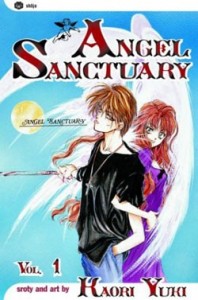
Angel Sanctuary, Vol. 1

April 23, 2013 by Sean Gaffney

By Kaori Yuki. Released in Japan as “Tenshi Kinryouku” by Hakusensha, serialized in the magazine Hana to Yume. Released in North America by Viz Media.

It’s worth noting that this came out in the mid-to-late 90s in Hana to Yume, which these days is better known as the home of series like Oresama Teacher and Skip Beat!. It evolved rapidly in the early years of the 21st century, because back in the late 80s-early 90s there was a lot more darkness and a lot more androgyny in the magazine. And one of the best examples of this is Kaori Yuki’s Angel Sanctuary, a 20-volume series about angels, demons, impossible relationships, and above all strange things happening so fast the cast cannot get proper time to angst (but they manage to work it in anyway).

angelsanctuary1

First of all, yes, as my Manga Bookshelf colleagues have noted, this first volume is a bit tedious at times. There’s a lot of setup, a lot of putting pieces in place, and a lot of backstory that really doesn’t make much sense. We also don’t get enough time to like Sara’s friend as herself before she’s immediately possessed/killed/whatever. That said, I think that the volume manages to succeed anyway, almost entirely on mood. Everything is tense here as we wait for horrible things to happen to our lead, Setsuna, who is a typical troubled teenager with an atypical love for his sister, Sara. He’s having enough trouble trying to shut out his own lustful desires, he really does not need folks coming down and saying he’s the reincarnation of an angel. In fact, his hotheaded and impulsive personality is very reminiscent of a shonen protagonist. But boy, is he in the wrong series.

I mentioned the incest elements, and it’s worth noting how they’re handled. Given that here in 2013 there is an overabundance of incest in almost every manga or anime designed for the otaku, you’d think it would lose its thrill. But this is not here to titillate. Setsuna’s feelings are powerful and deep, and they horrify him. I loved that the first thing he did was check the family register to make sure that one of them wasn’t secretly adopted – he’s read other shoujo manga, I see! But no, he doesn’t get an out that way. And of course Sara feels the same way, though I don’t think either of them is quite aware of the depths of their love just yet. It helps that, familial relationship aside, they make the cutest couple in the book – which, to be fair, is not about romance. Well, not shoujo schoolgirl romance anyway.

The art is another strong point here – at times, it’s the only humor in the series, and I love some of Setsuna’s facial expressions and asides. Given that the series is about angels and demons, there’s also a lot of androgyny on display here, and I guessed wrong about the gender of two of the characters TWICE before nailing it down. (Kurai and Arachne also provide much needed humor here, I should note.) But overall, if I was to use a word to describe this series, it would be overdramatic. And I don’t necessarily mean that just in a bad way. It’s a great series for teenagers – particularly, I think teenage girls would eat this up – as everyone is pretty and your forbidden love is, literally, the end of the world.

Filed Under: REVIEWS

Tania Del Rio interviewed; Kaori Yuki MMF launches

April 22, 2013 by Brigid Alverson

Sorry about the radio silence—I live just north of Boston, so it has been a very strange week. I’m looking forward to things getting back to normal and to heading out to Chicago later this week for C2E2.

Back in the heyday of global manga, Tania Del Rio was one of its more articulate practitioners, and I was happy to have the chance to interview her for MTV Geek about Archie’s re-release of her manga-style Sabrina comics in a black-and-white tankoubon format.

The Manga Bookshelf team looks over this week’s new releases and discusses their Pick of the Week. And in her 3 Things Thursday column, MJ names three series she wishes she could like—but doesn’t.

This month’s Manga Moveable Feast, featuring Kaori Yuki, kicks off at host blog The Beautiful World; Katan writes about Yuki’s art, and at Manga Bookshelf, MJ and Michelle Smith devote their Off the Shelf column to Angel Sanctuary.

Erica Friedman has a new edition of Yuri Network News at Okazu.

Lori Henderson looks at manga that is available digitally and reviews the first volume of Knights of Sidonia in her Manga Dome podcast at Manga Xanadu.

Tony Yao looks at critical thinking in Naruto at Manga Therapy.

Reviews: The Manga Bookshelf team kicks off the week with some short reviews of recent releases in their Bookshelf Briefs column. Ash Brown looks at another week of manga reading at Experiments in Manga.

Leroy Douresseaux on vol. 2 of 21st Century Boys (I Reads You)
Rebecca Silverman on vol. 1 of Alice in the Country of Joker: Circus and Liar’s Game (ANN)
Carlo Santos on vol. 55 of Bleach (ANN)
Leroy Douresseaux on vol. 56 of Bleach (The Comic Book Bin)
Sean Gaffney on vol. 7 of A Certain Scientific Railgun (A Case Suitable for Treatment)
Erica Friedman on Dolce Due (Okazu)
Rebecca Silverman on Hiroaki Samura’s Emerald and Other Stories (ANN)
Victoria K. Martin on vols. 2 and 3 of Is This a Zombie? (Kuriousity)
Leroy Douresseaux on vol. 8 of Itsuwaribito (The Comic Book Bin)
Daniella Orihuela-Gruber on vols. 1 and 2 of I’ve Seen It All (All About Manga)
Sean Gaffney on vols. 1 and 2 of Kanokon (A Case Suitable for Treatment)
Daniella Orihuela-Gruber on Love Circumstances (All About Manga)
Connie on Picnic (Slightly Biased Manga)
Matthew Warner on vol. 9 of Psyren (The Fandom Post)
Philip Anthony on vol. 7 of Sailor Moon (Manga Bookshelf)
Lesley Aeschliman on vol. 10 of Sailor Moon (Blogcritics)
Derek Bown on the April 15 issue of Shonen Jump (Manga Bookshelf)
Leroy Douresseaux on vol. 9 of The Story of Saiunkoku (The Comic Book Bin)
Anna N. on vol. 9 of The Story of Saiunkoku (Manga Report)
Matthew Warner on vol. 2 of Strobe Edge (The Fandom Post)
Erica Friedman on vol. 2 of Umesato the Third! (Okazu)
Sean Gaffney on Unico (A Case Suitable for Treatment)

Filed Under: MANGABLOG

Pick of the Week: Pandora Hearts, Doubt, Negima!

April 22, 2013 by MJ, Michelle Smith and Sean Gaffney 2 Comments

potw-4-21MJ: The shipping list this week is formidable, and while I expect Tezuka’s Unico will get a lot of the manga blogosphere’s attention, there are also new volumes forthcoming of favorites like Bunny Drop and even an intriguing debut series, Doubt. But given my personal excitement over the latest volume of Jun Mochizuki’s epic fantasy series, Pandora Hearts, I’ve got to do the predictable thing and give that series another boost. I got a chance to read volume fifteen this weekend, and I have to say that it’s even more dramatic than I expected; Even as a consistent fan of the series, I’ll admit I’m blown away but several of the volume’s major revelations, and… yeah, wow. That’s all I can really say. Despite the fact that most of my favorite characters barely register in this volume, it’s got me firmly in its thrall. And I may have new favorite characters. This remains to be seen. Oh, Pandora Hearts, you intrigue me so!

MICHELLE: Gah, I don’t even know what my pick is this week. I’m a few volumes behind on Pandora Hearts and I’m feeling a little trepidatious about Bunny Drop these days. So I guess I’m going with Doubt, a series that I know virtually nothing about except that it involves a deadly survival game of some sort.

SEAN: Despite my many issues with its abrupt, inconclusive ending, my pick of the week is going to be the 38th and final volume of Negima!, mostly as I enjoyed the series for so long and it produced so many awesome characters to root for. A series that started as merely “Harem Potter” turned into a very emotional, action-oriented battle manga, even if it never quite abandoned what Kodansha wanted Akamatsu to write: more nude girls. I hope that someday he revisits it to answer a few of the questions the audience still has after this volume.

Readers, what looks good to you this week?

Filed Under: PICK OF THE WEEK Tagged With: doubt, negima!, pandora hearts

Bookshelf Briefs 4/22/13

April 22, 2013 by Anna N, Sean Gaffney and MJ Leave a Comment

Today, Anna, Sean, and MJlook at recent releases from Viz Media, Yen Press, and Vertical, Inc.


07ghost307-Ghost, Vol. 3 | By Yuki Amemiya and Yukino Ichihara | Viz Media Some of the worldbuilding in 07-Ghost is a bit incoherent, and I have to admit that I’m not exactly following all the permutations of demons that beset young orphan castoff prince Teito as he is studying to become a Bishop in the Barsburg Church. That being said, I enjoy the general atmosphere of this manga very much, and there’s usually a visually arresting moment in each volume that makes me want to read the next. In this case, Teito dives into the fountains at the church and discovers a secret underwater world connected to the cell where rebel Bishop Frau is being held. A bit of backstory was filled in in this volume too, so while I might not enjoy the demon of the week so much, I am still interested in this story. – Anna N.

shonan8GTO: 14 Days in Shonan, Vol. 8 | By Toru Fujisawa | Vertical, Inc. – The story was always going to get more serious before it wrapped up, and that’s what we see here. We’ve seen lots of emotional abuse in the past 7 volumes – neglect, abandonment – but the series does not shy away from physical or sexual abuse, and the bookends here are harrowing. Sakurako’s father returns with a crooked lawyer and doctor, and it’s only by outcrooking him that they manage to get Sakurako away. And Ikuko, who’s been mostly a minor presence here, finally gets a focus, as we see what she’s gone through at the hands of her mother. There is very much a sense of “Onizuka will help these kids, but who will help the ones in real life?” to this volume, with sexual abuse statistics included. If you’re looking for badassery, that’s here as well, but this volume works best when it’s ramping up the parental horror. – Sean Gaffney

kiminitodoke16Kimi ni Todoke, Vol. 16 | By Karuho Shiina | Viz Media – I’ve mentioned my general distrust of Kento before, and it’s good that both the author and Ayane realize this – as, later, does Kento himself. He and Ayane do have something in common, which is that they’re used to wearing a ‘playboy/girl’ facade to a degree, but have never really allowed anyone to really get inside their heart. It’s a very different kind of awkwardness when compared to Sawako and Kazehaya, who both suffer from terminal shyness and repression, or Chizuru and Ryu, who are having to redefine a very comfortable friendship into something different. This all leads up to the Christmas party, where romance is traditional. This volume also has some very cute art by other Margaret artists at the end, including Natsumi Aida of Switch Girl!, a title I’d love to see here. – Sean Gaffney

nura14Nura: Rise of the Yokai Clan, Vol. 14 | By Hiroshi Shiibashi | Viz Media – In general, humor has been thin on the ground since we hit the never-ending Kyoto arc for Nura and company, so it’s terrific seeing Tsurara’s pointless jealousy as she realizes that ‘equip’ is something that can be done with anyone who’s close to Rikuo, and not just girls who are in love with him. Cue huff, and Rikuo’s bafflement. The rest of this is pure fighting, though, mixed with a bit of horror every time we cut back to Nue, or even get a flashback. There’s more death of innocents than in most Jump titles. Also, lots of familiar yokai designs – one of the antagonists here looks just like a yokai from Natsume’s Book of Friends. Still, things look like they’re gearing up to a final battle and climax. Of course, I’ve thought that before and been wrong. -Sean Gaffney

pandora15Pandora Hearts, Vol. 15 | By Jun Mochizuki | Yen Press – Oh, Pandora Hearts… dear Pandora Hearts, cruel Pandora Hearts. As expected, this volume is filled with fallout from the previous installment, some of which is scary, some oddly poignant, and some deeply tragic. Though Mochizuki’s storytelling continues to be occasionally abstruse, I find more and more that I’m completely willing to re-read as needed in order to truly catch on, volume-to-volume. As always, I’m struck by the emotional effectiveness of her artwork, which often provides clarity when the text does not. One wordless two-page spread in particular comes to mind (it’s part of the “deeply tragic” section). Though it would be impossible for new readers to even dream of jumping in at this late date, I’ll continue to recommend this for a good, epic read. This volume’s final page is permanently etched in my mind. – MJ

slamdunk28Slam Dunk, Vol. 28 | by Takehiko Inoue | Viz Media There’s not much to be said about Slam Dunk other than a reference to its general awesomeness, but this volume featured some art that reminded me a lot of Vagabond in the surreal moments that were frozen in time as Shohoku’s game against Sannoh continues. Panels focusing only on Sakuragi’s limbs as he jumps bring home the physicality of the game, and there’s are some insane visuals as Akagi is broken out of his fugue state when his hulking father steps on the court and shaves a piece of daikon radish on him. Sakuragi is rallying the team as only an idiot can, and if Akagi is able to overcome his opponent, scrappy Shohoku might just win the game. – Anna N.

toriko15Toriko, Vol. 15 | By Mitsutoshi Shimabukuro | Viz Media – The gentleman on the cover with his face shredded is Zebra, the fourth and most dangerous of the Heavenly Kings. They’ve always been eccentrics to date, but Zebra acts genuinely unhinged at times. Other than that, and Zebra getting the same vague mancrush on Komatsu that everyone in Toriko gets, this is another manga where you watch it for the amazing worldbuilding, as it’s a cornucopia of strange creatures, awesomely terrifying landscapes, and incredibly dangerous food. This is a more serious volume, than usual, though there is some humor (particularly involving the warden of Honey Prison, who has magical pheromone powers. I’ll be interested to see how things continue, as for once Komatsu is on his own in a deep labyrinth, with little protection from his stronger friends. – Sean Gaffney

Filed Under: Bookshelf Briefs

Off the Shelf: Angel Sanctuary, MMF Edition

April 21, 2013 by MJ and Michelle Smith 8 Comments

thumb-6169-AGS_01_webMICHELLE: Hey, MJ! When two angels meet, what do they say to each other?

MJ: Well, judging from the title we’re reading this week, something like, “Die, die, DIE!”?

MICHELLE: The punchline is technically “Halo!,” but I admit that your suggestion is much more appropriate!

I can’t remember whose turn it is to summarize, but I have a feeling you’ll do a great job with Angel Sanctuary, so want to give it a go?

MJ: I’ll do my best!

So, this month’s Manga Moveable Feast is dedicated to the works of Kaori Yuki, an artist whose work I’d had essentially no exposure to at all before the past few days. Though most of her existing work in English was published before I became a manga fan, Viz Media’s new practice of re-releasing older shoujo series in digital form has suddenly made one of them easily available. As Michelle has already indicated, that series is Angel Sanctuary, currently being released at VizManga.com.

Angel Sanctuary begins with the story of Setsuna Mudo, a scrappy high school student with a reputation for fighting, though his weakness as a fighter is that he falls asleep at the sight of blood. His other, greater weakness is that he harbors strong feelings of romantic love for his younger sister, Sara—feelings that she unfortunately returns in kind, which is a source of deep shame for them both.

As it turns out, Setsuna is actually the reincarnation of Alexiel, a powerful angel who long ago rebelled against the growing cruelty of the angelic realm, following the disappearance of God. Alexiel was ultimately defeated and sentenced to be reincarnated into misery, over and over again, but not before sealing away her twin brother, Rosiel, who had led the fight against her.

Though Alexiel has never retained memories from one reincarnation to the next, she’s been protected through all of them by a demon-like personage who makes agreements with humans to carry out their deepest wishes in return for taking control of their mortal bodies to keep himself in Alexiel’s company. In Setsuna’s lifetime, this demon lives in the body of Sakuya Kira, Setsuna’s oldest friend and protector.

(click images to enlarge)

IMG_0402

Meanwhile, Rosiel’s faithful seek to awaken him from exile by way of a video game called “Angel Sanctuary,” which sacrifices the lives of the humans who play it in order to gather the power required to return Rosiel to corporeal form. This quest is led by Katan, a former lower being who was elevated to angelic status by Rosiel back during the height of his power.

IMG_0399

MICHELLE: Nicely done! (Of course, the backstory doesn’t come out nearly as cleanly or clearly in the actual manga, but after a first volume that is, frankly, somewhat of a mess, the pacing for these revelations improves a good deal.)

After tainting himself by taking innocent human life, Katan is dismayed to find that Rosiel, whom he had hoped would end an ongoing power struggle in Heaven, is insane (and probably always has been) and obsessed with tormenting Setsuna to the point that Alexiel awakens, so that he might kill her.

IMG_0400

Meanwhile, Kurai and Arachne—two demon survivors formerly protected by Alexiel—also seek the awakening, but for different reasons. This is complicated when Kurai falls in love with Setsuna, since he would cease to exist if Alexiel were to return.

MJ: I’d actually like to return to your parenthetical point up there, because this is really a pretty big deal. After all, I think we both originally thought we’d simply stop after the first excruciating volume, and it was only duty that pushed me on further, at which point I discovered that the story really does get going at long last. Before that, Angel Sanctuary is, to use your words at the time, “quite the slog.”

Unfortunately, some fairly crucial revelations (in terms of making this story work at all) are withheld until the third volume—I’m thinking particularly of the truth about Alexiel’s painful reincarnations. Up until that point, Setsuna and Sara’s agonizing love story feels more like some kind of authorial fetish rather than a meaningful plot point, and given that this is one of the most important relationships in the series, I think this contributed greatly to the “slog” impression, at least on my part. Admittedly, I’m also vastly more interested in the relationships and general character development than I am in the series’ complicated angel mythology, so perhaps this affected me more strongly than it might others, but damn. A little explanation earlier on would have gone a long way towards compelling me forward with something approaching enthusiasm. As it is, I crawled my way to volume three with hands and knees increasingly bloodied. It was not pleasant.

MICHELLE: My experience was quite the same. I don’t have exact quotes to hand, but something about Yuki-sensei’s author-talk columns gave me the feeling that she was congratulating herself for her audaciousness for tackling the subject of incest, so that put me off somewhat. And I have almost no interest in angel power struggles at any time, so hard-to-decipher angel power struggles are even less compelling. This ties in with what I think is the chief flaw of Angel Sanctuary in the early chapters—information overload, before we’ve had time to get to know or care about these characters.

There’s a telling note at the end of volume two, actually, where Yuki-sensei writes:

When someone says, “If you take this part slowly, there’ll be more feeling.” I have to reply, “But this chapter needs to go up to this part of the storyline.” And so, I cut out some, but it’s not enough, so I end up taking out sappy dialogue.

I think she should’ve listened to those people a bit more! Not that I necessarily want more sappy dialogue, but taking things more slowly might’ve, for example, allowed readers to be able to see Sara as her own person—someone who turns out to be stronger and more interesting than I initially expected—before focusing on how she and Setsuna are in love with each other.

MJ: Yes, exactly. I was surprised to find that, by the end of the third volume, I was actually beginning to care about their relationship. And that in itself should be surprising, because it’s the kind of relationship I normally would find compelling from the start, if I cared about the characters in the slightest. It’s worth noting that amidst the recent spate of fanservice-laden, incest-themed moe titles we’ve been seeing, Satsuna and Sara’s plight reads as particularly poignant. It’s never played for laughs, it’s genuinely heartbreaking—it’s got classic romantic tragedy written all over it. It’s more Flowers in the Attic than I Don’t Like You At All, Big Brother!! and I’ll admit I ate that series up with a spoon when I was a teen.

(click images to enlarge)

IMG_0409

MICHELLE: And though it may be tragic, it’s not as if the characters are playing at a bit of drama. One of the first scenes that got me interested in Sara occurs early in volume two, when Rosiel’s flunky has distributed pictures that look as if Setsuna and Sara are kissing, and she’s been called in to the office at her school. The nun lectures, “Feelings of love between brother and sister belong only to silly, spoiled girls who have fantasies of being some tragic heroine.” Sara’s internal denials of this were what, for the first time, made me realize that she truly was equally serious in her love for Setsuna.

And thankfully, despite the shaky start, I did come to care about other relationships in the series, too. I have a great deal of sympathy for Katan, for example, who sacrificed much for Rosiel’s sake, only to be cast aside for not being obedient enough. And then there’s Kira, who was the one bright spot early on and who continues to be fascinating, as he at first denies that he could possess any affection for Setsuna the “mere human,” but eventually must acknowledge that the merger with his human host has rendered him capable of love.

MJ: I agree—both the relationships you mention here end up being very compelling, and I’d like to discuss them both, too. Let’s start with Katan and Rosiel, because it’s one that gets fleshed out a bit earlier than the others, I think. What I find most heartbreaking here are Katan’s realizations over the course of the first few volumes, because he really is so loyal. He sees Rosiel as a true savior, and is utterly devastated when he finally realizes that, with the exception of himself, Rosiel has acquired all his devoted followers by using some kind of magic capsule to turn them into mind-controlled puppets. I found it particularly interesting that it wasn’t just the discovery of Rosiel’s means that horrified Katan, but specifically that Rosiel resorted to this method when many of his puppets actually had been truly loyal to Rosiel before they were turned. The fact that Rosiel was unwilling to trust that he could lead by appealing to others’ free will seemed to be what really upset Katan.

IMG_0414

Then, of course, when Rosiel reveals that he’s not even willing to trust Katan‘s long-proven loyalty, it’s like a dagger to the heart.

MICHELLE: I genuinely loved that reveal about Rosiel’s army, both for the emotional impact on Katan but because it also sparked a tiny glimmer of interest in the angel power struggle. Katan’s dismissal made me wonder—and you’ve read farther than I have, so you might know the answer to this—whether he might eventually defect to the other side and help to defeat Rosiel.

MJ: You are *so* right. After endless pages of wordy exposition filled with names like “Raziel,” “Zaphikel,” and “Sandalphon,” and who’s who in the angelic hierarchy, having a little genuine intrigue and, for lack of a better word, humanity thrown in the mix was a lifesaver. I think this whole thing, including the realization that Rosiel has genuinely gone mad, also helps to make all the characters sympathetic in some way, which is a big deal for me, honestly. I’ve never really been interested in epic stories of good vs. evil (because I don’t really believe in the purity of either one), so the more Yuki grays things up, the better. I like things messy, in every way possible.

It’s this kind of nuance that really makes Kira’s story shine as well. We’re only just beginning to understand his true nature, but one thing that has become central to the story in volumes three and four is his own realization that he’s developed human attachments, and what that means for everyone involved. I was incredibly moved by scenes featuring Kira’s human father, who could not learn to hate his son, even after finding out that the Kira he’d raised from age eleven on wasn’t even his son at all. Some of this may come after the point you’ve read to, but oh, Michelle, it’s some of the best writing in the whole series so far.

IMG_0421

MICHELLE: I agree entirely about the scenes between Kira and his father, in which we learn that Kira has been behaving awfully in an attempt to cause this man to abandon his love for his son in preparation of a time when Kira no longer needs that body, and he ends up dying for real, this time. (All of which is at the request of the original Sakuya, with whom demon!Kira is seemingly able to hold conversations.)

Honestly, with supporting characters like Katan and Kira around, I pretty much don’t give a flying flip about Rosiel and Alexiel’s conflict and drama. Perhaps Yuki-sensei will be able to make me care about that, as she was eventually able to do with some other plot elements.

MJ: It’s true, the whole Rosiel vs. Alexiel story is the least interesting thing to me in this entire series, at least by the end of volume four. Which is not to say that I have no interest in them as characters, but despite the fact that they are holding on to this old rivalry so tightly, it’s really their relationships with the other characters that make them who they are in the present. I suppose this is the real tragedy that only the reader can see, and perhaps that’s even something Yuki-sensei is trying to show us—that if Rosiel, especially, could put aside the thirst for power that drove him mad in the first place, and actually recognize the real love and loyalty available to him, vengeance might lose its urgency. I suppose this really is just a lesson for Rosiel, as it seems clear that Alexiel actually prefers to be Setsuna than herself. An early scene that caught my attention is one between Alexiel and Kurai, in which Alexiel admits she’d like to be reborn as a man.

Actually, gender, and particularly unhappiness with one’s biological gender, is an ongoing theme in this series. And while there are some fairly problematic elements in Yuki’s discussion of the subject, there’s so much discussion that it’s difficult to dismiss it all as the usual heteronormative manga gender-bending. It’s difficult to smash the gender binary in English, because we’re so dependent on gender-specific pronouns, but at least one character refers to herself as a “third gender,” and Kurai, for example, manages to be much more nuanced than the typical “tom boy” characterization. So as weary as I get with the endless statements about women only needing to be beautiful and to be protected, there seems to be some deeper thought behind it all.

IMG_0420

MICHELLE: Oh, yes, I meant to bring up those statements. I thought it was interesting that most of the lines like “A girl needs to be protected; only then will she be beautiful and gentle” and “Find yourself a guy who’ll protect you” come from one character: Alexiel. That made them a little easier to stomach, like these are her opinions for some reason—she also implies that if she had a man’s love, she might never have conflicted with the other angels—and not necessarily the mangaka’s. True, Setsuna idealizes Sara and believes she must be protected, but then Yuki-sensei shows us that Sara’s not so weak or oblivious, after all. So, I wasn’t as irked by those comments as I otherwise might have been. (But, y’know, still a little irked.)

thumb-6433-AGS_4_webMJ: I’ll be interested to see where that line of thinking goes as the series continues. I’d like to think that these are beliefs that Yuki-sensei is interested in proving wrong, but it would be foolish to get my hopes up too high on that point.
As I flip through the first few volumes, looking for accompanying artwork, I realize that there are a whole host of characters we haven’t brought up at all, and I have to believe that this is mainly because, so far, they’re really just a part of the whole angelic political turmoil, in which neither of us has the slightest interest. I think it’s quite telling that the characters we have discussed are the ones who have become important in other ways.

MICHELLE: I feel like probably we should talk about Ruri, Sara’s friend, but I really don’t have much to say about her, since we see her as her actual self only briefly. Really, her fate just falls under the “Rosiel schemes to torment Setsuna” heading. And we haven’t even mentioned the super supreme angelic being everyone’s so in awe of, because he simply has no impact on the story as a character. He just appears once and, like, reattaches Setsuna’s arm. (Sidebar: there is a fair amount of arm reattachment in this series.)

MJ: I’d actually be interested in reconvening our discussion sometime after you’ve read volume four, because that’s when the “super supreme angelic being” (aka “Adam Kadamon”) finally becomes something truly significant in the story. The beginning of volume four offers up revelations on most of the topics we have discussed as well, including Kira and his father, Rosiel and Katan, and even Setsuna and Sara, whose story only becomes more poignant as Setsuna finds that he must force himself awake from a dreamworld in which he and Sara are a run-of-the-mill high school boyfriend and girlfriend (no familial ties at all), coexisting happily with all of their friends. Everything comes to a head in the beginning of volume four, leading to the beginning of a new arc just a chapter or so in that I’m hoping will finally make the story’s supernatural politics into something meaningful.

MICHELLE: For all its stumbling at the beginning, I think I’m invested in Angel Sanctuary enough to continue with it, so I am amenable to that suggestion!

MJ: I look forward to it!


Volumes 1-5 of Angel Sanctuary are currently available at VizManga.com. For more of the Kaori Yuki Manga Moveable Feast, keep your eyes on The Beautiful World!

Filed Under: OFF THE SHELF Tagged With: angel sanctuary, Kaori Yuki, Manga Moveable Feast, MMF

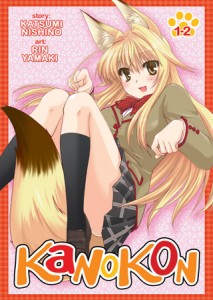
Kanokon, Vols. 1-2

April 21, 2013 by Sean Gaffney

By Katsumi Nishino and Rin Yamaki. Released in Japan as by Media Factory, serialized in the magazine Comic Alive. Released in North America by Seven Seas.

As I’ve noted before, in general these days I try to give every new Vol. 1 a chance and a review. Sometimes, though, I suspect on seeing the advance solicit that I know I’m just hurting myself. Kanokon was that sort of title. Moe foxgirl on the cover. Runs in Comic Alive. Harem title. Lots of overt fanservice and sexuality with little actual sex. Male lead whose sole good quality is his endearing niceness. That said, I was hoping at least for a chance to write a scathing review with lots of amusing vitriol, a la Sasameke or Qwazer of Stigmata. But the manga doesn’t even hit those levels of bad. It’s simply a mediocre-to-fair yokai harem manga.

kanokon_vol1-2_full

The title is another of those abbreviations that are becoming increasingly needed in a world where every book coming out has a title like “My Light Novel Can’t Possibly Be This Awkwardly Phrased” (AwkPhr for short). In this case, Kanokon stands for “Kanojo wa Kon to, Kowaiku Seki wo Shite”, or “She Coughed With a Cute Little “Yip”. (eeeeurgh…) Seven Seas does helpfully have a couple notes at the back explaining this, as well as a few other culture notes. As for the plot, if you were asked to write a harem manga for comic alive and given the premise of yokai, this is probably what you’d come up with. New transfer student Kouta is from the country, and thus attracts the attention of the popular girl Chizuru. She turns out to be a fox yokai, and has not only fallen for Kouta but can also merge and take over his body to a degree, though it depends on their feelings for each other. Cue angry brother, angry classmate, angry fellow yokai, and teachers, all of whom would like to see Chizuru be a bit more reticent and a lot less horny.

From what I understand, the anime got a lot more blatant, or perhaps this just feels worse when you see it as moving images. In any case, I was not nearly as horrified as my friends who saw the anime said I would be. Instead, it was more of a malaise. There does appear to be an ongoing plot that has potential to get interesting (and thank God this was in omnibus format, as if it had just been the first half it might have been unbearable). That said, the story has some very dumb stuff in it in order to allow the plot to function, particularly how, in creating a juvenile delinquent school for troubled yokai, they then allow totally normal humans to attend, for reasons I cannot fathom. (Yes, yes, learn how to blend in, etc. Still, highly dangerous.)

With all that said, I went into this knowing it was not a series for me. It does, however, have a fanbase of people who love this sort of thing. Cute fox girls, titillation, some fights, and a lead non-entity they can project themselves on who has a girl falling all over herself to sleep with him (and I’ve no doubt there will be more girls added later on). It does its job well for those readers, and thus is not actively radioactive. It’s simply not my thing.

Filed Under: REVIEWS

Adventures in the Key of Shoujo: Sailor Moon, Vol.7

April 20, 2013 by Phillip Anthony Leave a Comment

sm7Pretty Guardian Sailor Moon, Vol. 7 | By Naoko Takeuchi | Published by Kodansha Comics USA | Rated: T, Ages 13+

What a difference a day makes, 24 little hours! I was going to write down a red hot review after finally, FINALLY getting through volume 7 of Sailor Moon. Then sleep and fatigue set in and I had a think about it. So now I’ll temper my steel as some of my thoughts last night don’t make a whole lot of sense the day after. So let’s begin!

We find our heroes recovering from their last battle and wondering about the mystery behind the Mugen Academy—specifically why the new Sailor Senshi Sailors Neptune and Uranus are so antagonistic toward the rest. Meanwhile, Chibi-Usa is starting to worry about her new friend Hotaru Tomoe, a girl whom we met briefly in volume 6. Hotaru is the daughter of Professor Tomoe who runs the Mugen Institute, which is part of the Mugen Academy. Are you following me so far? Because I can help matters by telling you that Mugen Academy is evil. We know this because Master Pharaoh 90 and her/his (I don’t want to guess at this point) minions, the Death Busters, are in cahoots with Professor Tomoe. See, the ol’ Prof is attempting to build the perfect life form, and he thinks the best way of doing this is by bonding life energy onto creatures of Tomoe’s design. What Chibi-Usa doesn’t know is that Hotaru is hiding a secret. I like how Hotaru clearly understands that her father’s work and she herself are dangerous, and that she tries to shield Chibi-Usa from the truth while trying to have a life. The poor girl just wants to be normal, but because of who and what she is, anyone innocent around her is in danger.

The thing that annoyed me about the last volume is the change in tone for Neptune and Uranus. Before, they were playful and a bit mysterious but now they are openly hostile toward Usagi and the rest of the team. They believe as protectors of Silver Millenium (the kingdom on the moon that Usagi and the rest once lived on) that they have to go ahead of Usagi who, as the future Queen, is in their care. They want to stop the ascension of Sailor Saturn who is only supposed to arrive on the scene when the world must be destroyed. This presents me with an interesting conundrum: if the two Sailor Senshi wish to prevent the destruction of, well, everything then they have to kill another Sailor Saturn before she can become a Senshi, then doesn’t that mean that they knew they would have to kill her from the get go? Plus, wouldn’t killing her go against being a team? It’s not really explained, so I’m left with these questions. Thankfully, Takeuchi doesn’t confuse the issue by having them explain the whole nature of the Silver Millenium and the pre-destiny of the Senshi. Still, Usagi’s constant cries of “Let us help you and work together!” and the Outer Senshi’s replies of “NOOOO! WE have to do this on our own! IT’S FOR YOUR OWN GOOD!!!” are confusing, as they are unnecessary.

One of my favourite characters from earlier volumes is Sailor Pluto. Sailor Pluto met her end in a previous volume and I missed her, because while she came across as very formal, her love for Chibi-Usa allowed a crack in her armor; she became my secret favourite Senshi (don’t tell Sailor Venus). Now, we spotted her in a reincarnated form at the end of volume six, and here she turns up again as Setsuna Meio, a researcher of all things. That’s not important because she’s back as Sailor Pluto as well. Strangely, while the other Senshi all became their alter-egos after coming into contact with Usagi, Pluto, along with Neptune and Uranus, already know that they are Sailor Senshi. This means they already know their jobs better than the others and they sometimes come across as older sister types despite being the same age. Pluto’s personality isn’t as full-on as the other two, but she’s not the same Pluto as the original version. The formality isn’t quite there yet, and she does love the other Senshi, but she feels as Neptune and Uranus do and wants to deal with the Mugen Academy without the Inner Senshi.

As for the fight with Mugen itself, the team receives a new power level and Usagi becomes Super Sailor Moon and lays a Chuck Norris-style beatdown on the minions of Master Pharaoh 90 (what’s with these ridiculous names!?). The others do try and fight against Mugen but they are quickly overwhelmed by the bad guys and Professor Tomoe (who goes all Dr. Jekyll and becomes a monster using his own research). He gets put down in the blink of an eye, so there’s something to be said for planning ahead. The greatest danger the team and Usagi are up against is something that I’ve been meaning to talk about since the character of Chibi-Usa was introduced. Hotaru goes mad with the creature that is inside of her and the creature, in lashing out, accidently absorbs the crystal energy that Usagi and Chibi-Usa both share. Chibi-Usa, being Usagi’s daughter, carries this ’round in the form of a crystal avatar. When it is removed, Chibi-Usa becomes fatally ill. Mamoru stays with her while Usagi goes to bring the smackdown on Mugen and get Chibi-Usa’s energy back. Now, this leads to said point of order. How does Usagi view Chibi-Usa? She and Mamoru ARE Chibi-Usa’s parents in the future so Mamoru clearly has paternal instincts toward his future daughter. But Usagi seems to fight for Chibi-Usa at every turn without showing any sign that she sees her as a daughter. It’s not like when she fights for the other Senshi—she fights for them in her own way. When Chibi-Usa is threatened, Usagi pulls out the big guns and not in a proactive way. When Usagi powers up and saves Chibi-Usa, she finds strengths and powers that she didn’t realize she had. Maybe this is her way of saying “this is my daughter, evil-doers, and I will kick your arse if you threaten her!”

The end of the manga calls for a showdown between the remains of Hotaru and Usagi. Whatever is left of Hotaru’s physical body is under the direct control of Master Pharaoh 90 and has destroyed the lab, the buildings and the academy. I don’t know how they’ll cover this up come the morning! Something happened to Hotaru’s spirit which leads me to believe she will be quickly resurrected in the next couple of volumes. I know I’m giving somewhat short answers here but this stuff literally comes up at the last second in the volume so I have no information to go on. Whatever happens, Sailor Moon is as always a mixture of the good, the bad and the unexplained.

Filed Under: Adventures in the Key of Shoujo Tagged With: Kodansha Comics, sailor moon, shoujo

Manga the Week of 4/24

April 18, 2013 by Sean Gaffney, MJ and Michelle Smith 6 Comments

SEAN: It’s a healthy fourth week of the month here at Manga the Week of Central, with something for everyone. Let’s delve deeper.

Dark Horse gives us lucky Vol. 13 of Bride of the Water God, which is manwha, so I defer to those who know it better than I do.

MJ: This series is incredibly beautiful to look at. I’m behind a few volumes at this point, but it’s one of those I absolutely try to keep up with in print, just because it’s so pretty. It’s a keeper.

SEAN: There’s also Vol. 27 of Gantz, where bad things continue to happen to everyone, but at least they’re all in rubber lycra outfits.

MICHELLE: *snerk*

unico

SEAN: Unico has shipped to most of its Kickstarter backers by now, but it finally hits retail next week. I have a review out that gives a deeper opinion, but suffice to say it’s cute, sad, and a little bit weird, like the best of Tezuka. Also, although there are lots of Pink Lady refs, be assured there is no Jeff Altman.

MJ: Children’s manga is rarely my thing, but your description is pretty compelling.

MICHELLE: Yeah, “cute, sad, and a little bit weird” sounds like a winning combination to me.

SEAN: Kodansha seems to have indicated that sales for Bloody Monday are meh, so I suspect this may be the penultimate volume over here. It’s still filled with action, intrigue, and lots of dead folks.

MJ: I dropped this early on, not because it wasn’t interesting, but because it wasn’t interesting *enough* to earn my money, volume after volume. I guess it’s not just me.

MICHELLE: I bought a couple of volumes but then never read them. I like the creative team, but just never found the time.

SEAN: Fairy Tail is a quarter of the way to 100 now, as Vol. 25 continues the S-class battles, with Fairy Tail fighting itself to see who is strongest. I suspect a third-party will get involved and ruin everything, myself…

negima38

The last of Del Rey Manga’s four debut series reaches its end, albeit at Kodansha Comics. Negima hits Vol. 38, with an ending that, um, well, it’s certainly something people talk about! Aheh. I’ll have more to say in my review, but let’s just say: Fandom *hates* Where Are They Now? endings.

MICHELLE: Even though I’m not a Negima! fan, it’s still something of an achievement that it’s finally complete in English.

SEAN: And then there’s Yen. The latest Alice spinoff, My Fanatic Rabbit, ends with its second volume. I really liked the balance between romance and psychosis, and hope it stays even in Vol. 2, though I admit I’m not optimistic.

Another lucky 13, with Black Butler. Though given the sheer power of its cast, I don’t think they really need to worry about black cats. I understand this volume has some nice Sebastian revelations.

MJ: I wish I could like this series. I would really like to like it. But every time I try, it’s a complete failure.

MICHELLE: I’m planning to talk about this volume soon on Off the Shelf, so I look forward to hearing about your attempts. For me, this is a series I kind of like, or at least find easy to read, but have no intentions of rereading.

SEAN: Ah, Bunny Drop has hit Vol. 8. I think this means that the matter of “that spoiler” may now be discussed. And may I say I’m almost relieved? In any case, I’m sure it will be SAFE AND FUN.

MJ: I’m really looking forward to seeing how this plays out! I have a lot of faith in the mangaka.

MICHELLE: I’m a bit more dubious, but will certainly be finishing out the series.

doubt1

SEAN: A new series, in handy omnibus form! Yen has the first 2 volumes of Doubt, whose cover has everyone wearing bunny heads, but trust me, Bunny Drop this ain’t. It’s another survival game title, where you learn not to get too attached to anyone at all.

MJ: I suspect this may not be for me, but I fully intent to give it a try! These omnibus releases are great for that, because you get a really substantial go at it.

MICHELLE: Maybe it’ll turn out to be kinda fun, like BTOOOM!.

SEAN: Is This A Zombie? 4… yeah. Moving on.

Kieli has its 8th novel published. The story of a girl who can see ghosts, and her relationship with a man named Harvey. Who is not a 6-foot-tall pink rabbit, though it would fit with this week’s accidental theme.

The Melancholy of Haruhi Suzumiya 15 continues to adapt the 7th novel, and has steadily improved, though not to the point where I can say “you don’t have to read the book”. Because you do.

Pandora Hearts is also at 15, and I think I will yield to MJfor this one.

MJ: Oh, Sean… as you know, this series basically owns my soul. I’m expecting an enormous amount of drama in this volume, given where we left off. I’m expecting at least one heartbreaking loss. And I just can’t wait. Expect a flustered review of some kind to show up over the next week. I think this one’s gonna be a doozy.

MICHELLE: I’m a few volumes behind with Pandora Hearts. Clearly, I must rectify this.

SEAN: Lastly, there’s the 8th novel of Spice & Wolf, a title that always reminds me of Playboy Magazine, in that people always say they read it for the economics.

Getting anything interesting this week?

Filed Under: FEATURES, manga the week of

3 Things Thursday: Wishful Thinking

April 18, 2013 by MJ 11 Comments

Today, as the Battle Robot chatted about next week’s new manga (see Sean’s post later this evening), a title came up that is one I have tried hard to like, but failed utterly to do so. My desire to “like” is large, in general. I’m a liker. I like to like things. My ability to “like” is a major contributor to my quality of life. This may diminish my worth as a manga critic, but in the big picture I’m okay with that if it means that, above all else, I get to deeply enjoy the medium I spend so many hours with. Obviously I don’t like everything, and I’m not afraid to complain loudly and often, especially when it comes to genres directed at my gender, like BL, shoujo, and josei manga. (Yes, Black Bird, I’m looking at you.) But I always approach a new series with the desire to like it (even love it, if possible), and I’m occasionally heartbroken when that desire bears no fruit.

So, with that in mind…


3 manga series I wish I could like:

blackbutler41. Black Butler | By Yana Tobaso | Yen Press – Though I’ll admit I gave up many volumes ago, I initially tried hard to like Black Butler. I’ll usually give any series at least three volumes to grab me, and I gave this one five, but my efforts were in vain. Why did I want so much to like Black Butler? I suppose it’s a longing for connection. With its enormous female fanbase and significant slash fandom, it crosses over heavily into circles I once called my own, and my lack of ability to connect lends itself to a sort of (mild) identity crisis. Furthermore, the series runs in my pet “shounen” magazine GFantasy, home of many series I do like (and even love), such as Gestalt, Nabari no Ou, and my beloved Pandora Hearts. Is it just me? I fear it may be.

alice-omnibus2. Alice in the Country of Hearts | By QuinRose & Soumei Hoshino | Yen Press – My desire to like this series has a name, and that name is “Michelle.” Normally, I’d feel no alarm or sadness at all over my inability to like a reverse-harem series based on a game. In fact, I’d consider any positive reaction to be more of a pleasant surprise. In this case, however, Michelle’s enjoyment of the series (and her oft-stated hope I might share in her enjoyment) raises the stakes considerably, and I’m rather sad and ashamed to admit that after reading through two of Yen Press’ new omnibus volumes I just can’t quite get there. I’m so sorry, Michelle. I really, really wanted to like this. Can you forgive me?

saiyukireload43. Saiyuki Reload | By Kazuya Minekura | Tokyopop – Of all of these, I think Saiyuki Reload makes me saddest of all. Those who know me must be aware of my fervent love for the works of Kazuya Minekura, especially her unfinished BL noir-action series Wild Adapter, which Michelle, David, and I have spent much time praising to high heaven (or the non-theist equivalent of same). Wild Adapter, in fact, is one of the few topics capable of compelling me to discuss things like industry news. Somewhat less beloved by me, but still thoroughly enjoyed, is Minekura’s nine-volume shounen fantasy-adventure Saiyuki, which was extended into a shoujo series for Comic Zero Sum called Saiyuki Reload.
I originally borrowed all the then-available volumes of Saiyuki and Saiyuki Reload from a friend, and it’s telling that afterwards I made it my business to acquire my own copies of the former and not the latter. I don’t know what it was—maybe the increased indulgence in the characters’ hotness and BL subtext demanded by a shoujo magazine—but something about the continuation just didn’t click. Though I’ll admit that, were it possible to get my hands on these volumes again, I’d be open to giving it a second chance. License rescue, anyone?


Readers, what manga series do you wish you could love? And why?

Filed Under: 3 Things Thursday Tagged With: alice in the country of hearts, black butler, saiyuki reload

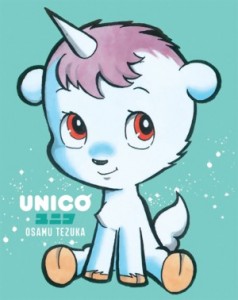
Unico

April 18, 2013 by Sean Gaffney

By Osamu Tezuka. Released in Japan by Sanrio, serialized in the magazine Lyrica. Released in North America by Digital Manga Publishing.

Here’s an unusual one: a Tezuka title that read left-to-right originally. Unico was apparently written for a magazine that was going to come out in the West, so was drawn in the Western way. It’s also full-color, and (given it’s Sanrio) features an adorable, thoroughly marketable creature on the cover and throughout the story. But it’s also Tezuka, so you know there’s going to be some darkness in there, even if it’s for kids. The question is, how does the story hold up?

unico

The main plot is basically a MacGuffin to let Tezuka tell whatever story he wants, as the goddess Venus, pissed off as usual that she isn’t the fairest in the land, banishes Unico for basically being too adorable and awesome. He’s whisked all over space and time, and whenever he shows signs of being happy or achieving something, the West Wind whisks him away again. He’s also mindwiped so he never remembers anything. It’s really pretty horrible if you swell on it. Luckily, Unico is nothing if not earnest, and knows enough about himself to help others with his unicorn magic… though occasionally that help goes sour.

The stories themselves are basic children’s fairy tales, with talking animals and mythical beasts, a place where Unico will not have much trouble at all fitting in. The saddest is the first one, a tale of a forbidden love between a young Native American boy and a white settler girl, who become older via Unico’s magic so they can experience adult passion. The concepts behind that are staggeringly fascinating (and creepy), and it’s no surprise that everything goes wrong. Honestly, I was pleased that the rest of the volume didn’t get quite that morally ambiguous… or political.

The rest of the stories are slightly less ambiguous. The longest one is about a cat who yearns to belong to a witch, and I believe it was adapted into a movie. It features a man who is so over the top evil that I had to laugh. All he lacked was a mustache to twirl. That said, the shots of him massacring the animals of the forest are quite dramatic, and small children might find them quite scary. Other highlights include a young girl being kidnapped by a sentient factory that has fallen in love with her (didn’t Demon Seed come out around the time Tezuka wrote this?) and a young Russian thief who secretly wants to be a shy princess, but can’t quite pull it off as she’s simply too awesome.

As you’d expect, the translation is quite good, being simple without sounding childish. There are footnotes for the few culture references in here, most of which have to do with the band Pink Lady, who were becoming superstars at the time Tezuka was writing this. And a few of Tezuka’s ‘star system’ characters can be glimpsed in here, in different roles. But even if you aren’t a Tezuka fan, Unico is worth checking out. it’s family friendly, straightforward, and cute. It doesn’t have much of an ending, but that’s what you get when your lead character drives the plot but isn’t really the plot himself.

Filed Under: REVIEWS

The Story of Saiunkoku, Vol 9.

April 16, 2013 by Anna N

The Story of Saiunkoku, Vol. 9 by Sai Yukino and Kairi Yura

It is rare for a manga series to end leaving me wishing that it was twice as long, but that is exactly what happened as I was reading the final ninth volume of Story of Saiunkoku. The eighth volume was a natural stopping point, and this volume has some side stories that help shed some light on the histories of selected members of the supporting cast. This volume might not be totally necessary to round out Shurei’s main story, but fans of the series will enjoy visiting with the extended Hong clan and the amazingly eccentric Ryuren.

The first story, “So Began the Fairy Tale” focuses on Shurei’s father, giving greater background into the more ruthless personality behind his smiling exterior. While he’s an amazingly gentle and wonderful father, his past as an assassin gives a bit of an edge to all of his actions in the manga. Here we see the beginnings of his ability to plot as he takes action to make sure that the Hong clan isn’t endangered. “Hurricane Ryuren Strikes the Capital” flashes back to the examination period, where we see Shurei and Eigetsu start to cement their friendship with the eccentric Ryuren despite his crazy clothes, horrible flute playing, and tendency to make odd pronouncements. This story ends up serving as a meditation on the nature of friendship, even as Shurei and Egitsu’s overtures to Ryuren wind up taking them on a detour through the gambling underworld. The final story focuses on the Hong family again, with “Someday I Will Come to You (Though I Love You, How Far You Are From Me)” focusing on Shurei’s uncle Reishin Hong’s bizarre psychological hang-ups. This volume featured plenty of humor, as a series of masks duplicating the expressions of Shurei’s father are put to an unorthodox use, and the reactions Ryuren accidentally provokes from the people surrounding him are always funny.

It does make me a little sad knowing that there’s a very long light novel series containing more adventures of The Story of Saiunkoku that we’ll never see translated here, but the manga adaptation of the story was certainly fun to read. This is going to be a “keeper” series for me, as I can see myself wanting to reread this every few years. It is so unusual to find a shoujo ending where the happy ending for the heroine is a life of civil service as opposed to everything wrapping up nicely with a romantic interest. Many things combined to make this an entertaining manga – the clear art, fun supporting cast, and the blend of humor and drama made this manga very enjoyable.

Filed Under: REVIEWS Tagged With: shojo beat, shoujo, story of saiunkoku, viz media

Weekly Shonen Jump Recap: April 15, 2013

April 16, 2013 by Derek Bown 5 Comments

April 15 Title CardHey kids, you want to hear a nerd get irrationally angry over a fictional character? Head over to the Manga^3 Podcast Archives to hear the first time I get legitimately angry at a manga chapter. It should be up on Tuesday, but no guarantee, it’s a long one this week, so it might not be out until Wednesday.

But besides that, the rest of this week’s chapters were all either good or great.

Toriko Ch. 229
We start this week off strong with the return of Toriko. Surprisingly enough, Shimabukuro manages to continue making a fight between two characters we only just met entertaining. Writing and drawing interesting and dynamic fights is difficult enough, but to keep that up using characters that were only introduced to the series recently is impressive.

Not only that, but once again he explains powers in a way that makes sense. I don’t know how such outlandish powers could ever really make sense, but Shimabukuro pulls it off. He even manages to end the fight in a believable way—another thing that doesn’t break the established rules of this conflict. I’m all-around impressed. This chapter solidifies the idea that the enemies are getting slaughtered here. Granted, I hope a major character ends up losing to keep the fights from getting predictable.

Toriko

Naruto Ch. 627
Based on my previous statements about this series I imagine most of you figured out it would be Naruto that had me so riled up. And yes, yes it is. This is the big chapter, where Sasuke finally realizes how much of an idiot he’s been (he doesn’t actually) and decides to fight for the village instead of against it. Oh, like how he probably should have done when he found out his brother died to protect the village! I have many reasons I dislike Sasuke as a character, all of which are major. But his ridiculous decision making process certainly hasn’t endeared him to me. No, I still remember the two years worth of manga that focused entirely on him. I remember and I will never, ever forgive. Mostly this decision comes across as not being properly developed. He spent the entire manga stubbornly blaming his woes on everyone else, and just one meeting with his brother was enough to finally have him change his mind. I don’t even believe anything Hashirama said actually influenced him. Were it not for that meeting with Itachi he never would have changed his mind; and after multiple years of negative character development I don’t buy for one second that Sasuke suddenly is going to be one of the good guys.

And then, of course, Karin comes back into the story and we get another of the major reasons I despise Sasuke as a character. He negatively influences others’ character development. Remember how Ino got great character development? Nope, she hasn’t developed in the slightest throughout the series. Remember how Sakura became a much more enjoyable character after Sasuke left? Well, the moment he comes back into the equation all that character development is discarded. I will be furious if Sakura just forgives him after he tried to kill her. And she probably will, because here comes Karin, immediately forgiving him the moment he apologizes. Her decision to give up on him was the first time any of his fangirls finally had character development that makes sense. And of course that is thrown out the moment he comes back into the picture. I just loathe, beyond all reason or sanity, how this character influences the series. He wasn’t interesting in the first place, and ever since the time skip he has consistently negatively influenced Naruto. Tip for any aspiring writers, if you have a character who negatively influences other characters’ development, consider cutting that character or rewriting them. Because chances are your readers will hate him or her as much as I hate everything to do with Sasuke and the Uchiha in general.

Hopefully that will be the last time you get an kind of major rant from me. I hope Naruto doesn’t ever give me a reason to do it again.

One Piece Ch. 705
I liken this week to a sandwich made of the most delicious bread, with a slice of month old spam in the middle. One Piece doesn’t disappoint in terms of being entertaining. Rather than a single storyline being expanded, all the storylines of this arc are properly established. And it wasn’t until this week that I realized how many different stories we had to follow. This is going to be a long, long arc. And I don’t mind. I like long stories out of One Piece. While I don’t have much to say about this chapter itself, I can say that from the snippets we got I’m looking forward to the rest of the arc. Something big is going down and it will probably devolve into a massive battle as the marines move in to take on the criminals at the arena, and most likely Doflamingo himself.

One-Punch Man Ch. 013
One-Punch Man wasn’t at its greatest this week. While it still had funny moments, they were overshadowed by the surprisingly gory deaths of Hammerhead’s gang. Not to say One-Punch Man isn’t gory, but usually it’s monsters being killed. I’m surprised to see so many regular humans killed. And since most of the chapter was the fight against Sonic and Hammerhead, there wasn’t enough comedy for me to really enjoy the chapter like I have previous chapters. It was still good, just not as good as I’ve grown accustomed to with One-Punch Man.

One-Punch Man

Dragon Ball Z Ch. 011
I definitely enjoy Dragon Ball most when it lets itself just have some fun with the world it is set in. The fights are interesting and everything, but those chapters are always far too fast and make for bad week-to-week reading. As long as we get more chapters like this I’ll be satisfied—especially as the mythology of the Dragon Ball world is expanded. Though, as we creep up the power scale, I’ll be laughing at the idea of characters like Enma and King Kai being more powerful than the main characters.

World Trigger Ch. 010
Nothing like a bunch of new characters I don’t care about to solidify how uninspired World Trigger has turned out to be. I found myself complaining against all the board members acting like idiots and discussing Osamu’s relatively trivial rule breaking instead of spending all their time figuring out why gates are opening where they shouldn’t be. I’d been giving World Trigger more than a few chances, but this chapter solidified it as one of the less interesting manga to be published in the online edition of Weekly Shonen Jump.

Cross Manage Ch. 029
Cross Manage, on the other hand, has endeared itself to me so much that I will be enraged if it gets cancelled. I don’t even care about the fact that we never see the games (though we better at least see the game against Choran), it’s all about the characters and the small moments between them. And that’s what this chapter was, a bunch of excellent small moments. All the cumulative development in the series coming together to make an enjoyable chapter. I pray that Cross Manage makes the next cut and lets us see what Kaito can do with the other characters.

Cross Manage

Bleach Ch. 533
Besides the fact that I’m convinced Aizen and Urahara are conspiring to make Isshin and Masaki have a kid (hard to take the chapter seriously that way), I quite liked this chapter. This story has been a long time coming, and my general disappointment with Bleach over the last few years is being ignored in favor of finally figuring out what Isshin and Masaki’s story is. There are quite a few questions left to be answered, and a few this chapter has raised that I am interested to learn the answer to, rather than being annoyed that too many questions are muddling the story. I would like to get back to the characters I’m actually interested in, aka, the characters we started this series with (Orihime, Chad, Uryu, etc.) but since that’s probably not going to happen I can at least enjoy the series when it’s actually being good.

Nisekoi Ch. 070
This chapter was cuter than it should have been. Tsugumi is kind of the odd duck among Rakku’s love interests, being the only one not to have a childhood connection to him, but she’s also one of the more interesting characters. This chapter makes me root for her more, while at the same time employing some oddly out of place fanservice. It doesn’t happen that often in this series, and I’m impressed that Naoshi has avoided resorting to fanservice to help his ratings. I know harem endings are the worst endings for romantic harem comedies, but I can’t help but want that to happen for this series. All the girls are great, and I don’t want to see any of them disappointed!

Nisekoi


I apologize if I offended anyone with my rant earlier, but it had to be said. And I know I can’t be the only person thinking it. Though, from what I can tell I have the majority of Naruto fandom on my side on this one. Let me know if you disagree, or if you have comments about what I said for any of the other chapters. In fact I might prefer if you talk about those instead.

If you want to hear more, check out the Manga^3 Podcast Archives. Or go directly to last week’s episode,

Filed Under: FEATURES & REVIEWS, WSJA Recaps

It Came From the Sinosphere: Yanyu Mengmeng (TV Drama) Part 1

April 16, 2013 by Sara K. Leave a Comment

The English title of this drama is “Love in the Rain,” but I will henceforth use the Mandarin title, Yanyu Mengmeng, which roughly means “The Misty Rain is Hazy.” It’s more poetic.

Example Scene

In this scene, Erhao brings his girlfriend, Fang Yu, to meet his “warm and loving” family for the first time. I have translated the dialogue to the best of my ability, but I think some of liveliness has been lost.

[Erhao and Fang Yu enter the house]

yymm01

Erhao: This is … hey, Mengping! Could you shut off the record player? Show a little respect for your brother.

Mengping: Hey, you sure have guts to hang out with a guy like my brother. Don’t you know how many girlfriends he’s had? The last one…

Erhao: What are you saying [grabs Mengping’s ear]

yymm02

Mengping: That hurts!

Erhao: Pay no attention to my sister. She loves to make up rumors and stir things up.

Mengping: Erhao, you don’t care about anything other than chasing girls! Erhao!

[Erhao covers Mengping’s mouth]

yymm03

Mengping: Even before you’ve married her, you’re already bullying your little sister!

Erhao: What are you saying!

Mengping: Ma, save me!

yymm04

Xueqin (the mother): Aya, you’re all going to be the death of me. It’s always yelling all the time.

Erhao: Ma, this my girlfriend, Fang Yu. I’ve mentioned her before.

yymm05

Fang Yu: (using very polite language) Erhao has said a lot about you. I should have met you earlier.

Xueqin: So you’re Fang Yu. You look very nice. No wonder my son fell in love. How old are you?

yymm06

Fang Yu: 20 years old.

Xueqin: Ah, so you’re the same age as our Ruping. Ruping, come here! Look at Fang Yu.

Ruping: I’m Ruping, Erhao’s younger sister. Fang Yu, welcome to our home. Please sit down. Father is upstairs, he’ll come down soon.

Xueqin: Ruping! I want you to take a good look at Fang Yu.

Ruping: Ma, I’m looking at her.

yymm07

Xueqin: Look at her … her eyebrows … her eyes … she’s dressed herself up very nicely. Her waist, her figure, she doesn’t look at all like your sloppy appearance. So she has a boyfriend. Ruping, you’re also 20 years old. Why do you spend all day alone in your room? You really are stupid.

Ruping: Ma.

yymm08

Erhao: Fang Yu, my mother is praising you.

Fang Yu: So, we’re the same age! Erhao often says that he has a sweet and warm-hearted sister. He certainly means you. Ruping, we’ll surely become good friends.

Xueqin: Ayo, this little mouth knows its sweet talk. No wonder she’s won little Erhao’s heart. Ruping, you should learn how to be like her.

Ruping: Ma, I know I’m useless. I’m plain. I don’t know how to dress up. I can’t speak. I especially can’t keep a boyfriend. I’m damaged goods, damaged goods, damaged goods. I’m sorry that you had to bear a daughter like me, who only embarasses you.

yymm09

Ruping: But if you want to reprimand me, please reprimand me behind closed doors. This is Fangyu’s first time visiting our home. Please let me have the tiniest bit of dignity, and show Fangyu a little respect, and show Erhao a little respect. Criticizing me in such a heartless way, letting other people see it … why! Why! [Ruping runs up the stairs in tears]

Mengping: Wow, Ruping has a spine after all. I want to call out “Long Live Ruping” three times. She’s finally grown up.

yymm10

Mengping and Erjie: Long Live Ruping! Long Live Ruping! Long Live Ruping!

Xueqin: What kind of world is this? Do you children have the slightest regard for your mother? Even Ruping is talking back to me. I’ve lived in vain. I’m going to drag that girl down here and get a straight answer about what the hell is going on!

Erjie: Long Live Ruping! Long Live Ruping! Long Live Ruping!

yymm11

Xueqin: You backstabber [hits Erjie]

Erjie: Papa, Mama hit me. I was just saying “Long Live Ruping!” I’m not allowed to say “Long Live Ruping”? Papa! Papa!

yymm12

Xueqin: Don’t call for Papa. If you continue…

Erjie: Papa, save me!

Zhenhua (Father): What is everybody fighting over! You don’t even let me have a few minutes of peace! What nonsense.

yymm13

Erhao: Papa, this is Fangyu.

Zhenhua: Erjie, come here. [Erjie comes over]. Sit down. Where were you hit?

yymm14

Erjie: Here.

Fangyu: Bo… bo… bofu [in Mandarin, ‘bofu’ is a polite way to address an older man with whom one has a personal relationship, for example, your boyfriend’s father]

Erjie: What “bo-bo-bo”? It’s “bo-po-mo-fo” [this is a reference to how Taiwanese children learn how to read].

Erhao: [grabs Erjie’s ear] What are you saying!

Erjie: Papa, Erhao is hitting me!

yymm15

Zhenhua: Erhao, how dare you! You bring your girlfriend how, and then turn this house upside down! Erhao! Let go!

[Erhao lets go, and Erjie hits him]

Zhenhua: What nonsense! [Notices Fang Yu] Ah, so you’re Erhao’s girlfriend? What’s your name?

Fang Yu: My name is Fang… fang… fang…

Erjie: Then there’s yuan, yuan, yuan [this is a reference to the word “fangyuan,” which means “circumference”]

yymm16

[Mengping giggles]

Zhenhua: Ah, how did you meet Erhao.

Fang Yu: I’m Yiping’s classmate, and met him at Yiping’s place.

yymm19

Zhenhua: So you’re Yiping’s classmate? Excellent! Of all of my children, Yiping has the strongest personality and temper. She’s resilient and stubborn, proud and sharp. Every word she says is just like a razor blade. What a pity she was born in these times, and born as a girl. After that fight, I don’t know when she’ll ever come back. It’s all my fault. I shouldn’t have hit her.

***

So, that’s the Lu family. Now it’s time for a song! Notice how much grabbing/hitting/pushing there is (even some of the kissing looks violent):

Background

This TV series is adapted from the novel by Chiung Yao, who I’ve discussed before, first published in 1964. Chiung Yao also wrote the script for the TV show, had some say in the casting of the actors, and even wrote the lyrics for the songs, so I also consider the TV Drama to be one of her direct artistic works. Between the writing of the novel and the production of this TV drama, Chiung Yao had more than 20 years to grow and change as a writer, and I consider this drama to be a re-write of the story reflecting that change.

It’s one of the most popular Taiwanese dramas of the 1980s, and these Chiung Yao dramas have a strong influence on Taiwanese idol dramas.

Can you stare down Leanne Liu?

Can you stare down Leanne Liu?

This TV drama, like many other 80s Chiung Yao dramas, stars Leanne Liu, who is famous for her expressive eyes. The co-star is Chin Han, who has appeared in tons of Chiung Yao adaptations, and is one of the “Two Chins, Two Lins” who repeatedly starred in Chiung Yao adaptations through the 70s and 80s.

Maybe it’s time to meet the characters whom Leanne Liu and Chin Hao play…

The Leads

yymm17

He Shuhuan. He is a close friend of Lu Erhao and, at the beginning of the story, Lu Ruping’s potential new boyfriend. One day, when he was going to visit the Lu family, he sees a young woman outside in the pouring rain, with visible injuries and no umbrella. She refuses to report anything to the police, but agrees to let He Shuhuan take her to his apartment so she can clean herself up. When she finds out that she is a “friend” of the Lu family, she refuses to have anything more to do with him, and runs out.

Shuhuan is incredibly curious about this young woman. Erhao at first says he knows nothing, but then they encounter this young woman at a dance club, where it’s clear that she and Erhao have some kind of personal relationship, though Erhao insists that she is not his girlfriend. Eventually, Shuhuan finds out that the mysterious, proud young woman is none other than…

yymm18

Lu Yiping. The heroine (or anti-heroine). The novel is written in first person from her perspective. She is the half-sister of Erhao / Ruping / Mengping et al. Her father had driven her mother and herself out ten years ago, and since then they had been living from hand to mouth on what little money he would deign to give them. Yiping would personally have to go to “that place” to beg her father for money.

When they are several months behind on rent, there isn’t enough money for food, her mother needs to see a doctor, and Yiping needs new shoes, she once again goes to “that place.” While Ruping has a nice dog and an expensive new ring, Mengping dances to a fancy record player, and Erjie has a shiny new bicycle, their father, Lu Zhenhua, only agrees to give Yiping a fraction of the money they need to make ends me. Yiping says because he refuses to support his own daughter, he is not a real man. This makes him furious, so he whips her. Everybody else watches silently.

After the whipping, Yiping says she will get revenge on ALL of them. Her father finally decides to give her the money, but she throws it in his face, saying that they are no longer father and daughter. She runs out in the rain … and that’s when Shuhuan first sees her.

When she finds out that Ruping is in love with Shuhuan and he might become her new boyfriend, Yiping sees her first opportunity for revenge. But can Yiping break other people’s hearts without breaking her own?

yymm20

The 60s and the 80s

The novel was written in and is set in 1960s Taiwan. The TV drama, likewise, is set in 1960s Taiwan. Occasionally, the TV drama shows distinctly 1960s culture—for example, the references to Huangmei opera, which were not in the novel.

However, if you look at this drama, it looks totally 80s. In fact, it feels so thoroughly 80s that the occasional throwbacks to the 60s feel jarring to me, even though I know the story is technically set in the 1960s.

This shows that the makers of the drama were oblivious to just how much they were infusing contemporary style into the show, assuming that the 80s were not terribly different from the 60s. And since this was made in the 80s, they probably were able to notice the 80s style about as well as fish can see water.

Pouring Sugar on Stakes Thrust through the Heart, or TV Drama vs. Novel

yymm22

This is the title of the first section of Part 2. If you want to know what I’m talking about, or why I hate this story, be sure to come back next week!


Sara K. is hosting April’s Carnival of Aces over at her personal blog. If you’re inclined, you’re welcome to submit something of your own.

Filed Under: Dramas Tagged With: chiung yao, Leanne Liu, Love in the Rain, TV drama, Yanyu Mengmeng

  • « Go to Previous Page
  • Page 1
  • Page 2
  • Page 3
  • Page 4
  • Page 5
  • Go to Next Page »
 | Log in
Copyright © 2010 Manga Bookshelf | Powered by WordPress & the Genesis Framework