• Skip to primary navigation
  • Skip to main content
  • Skip to primary sidebar
  • Home
  • About Us
    • Privacy Policy
    • Comment Policy
    • Disclosures & Disclaimers
  • Resources
    • Links, Essays & Articles
    • Fandomology!
    • CLAMP Directory
    • BlogRoll
  • Features & Columns
    • 3 Things Thursday
    • Adventures in the Key of Shoujo
    • Bit & Blips (game reviews)
    • BL BOOKRACK
    • Bookshelf Briefs
    • Bringing the Drama
    • Comic Conversion
    • Fanservice Friday
    • Going Digital
    • It Came From the Sinosphere
    • License This!
    • Magazine no Mori
    • My Week in Manga
    • OFF THE SHELF
    • Not By Manga Alone
    • PICK OF THE WEEK
    • Subtitles & Sensibility
    • Weekly Shonen Jump Recaps
  • Manga Moveable Feast
    • MMF Full Archive
    • Yun Kouga
    • CLAMP
    • Shojo Beat
    • Osamu Tezuka
    • Sailor Moon
    • Fruits Basket
    • Takehiko Inoue
    • Wild Adapter
    • One Piece
    • After School Nightmare
    • Karakuri Odette
    • Paradise Kiss
    • The Color Trilogy
    • To Terra…
    • Sexy Voice & Robo
  • Browse by Author
    • Sean Gaffney
    • Anna Neatrour
    • Michelle Smith
    • Katherine Dacey
    • MJ
    • Brigid Alverson
    • Travis Anderson
    • Phillip Anthony
    • Derek Bown
    • Jaci Dahlvang
    • Angela Eastman
    • Erica Friedman
    • Sara K.
    • Megan Purdy
    • Emily Snodgrass
    • Nancy Thistlethwaite
    • Eva Volin
    • David Welsh
  • MB Blogs
    • A Case Suitable For Treatment
    • Experiments in Manga
    • MangaBlog
    • The Manga Critic
    • Manga Report
    • Soliloquy in Blue
    • Manga Curmudgeon (archive)

Manga Bookshelf

Discussion, Resources, Roundtables, & Reviews

Archives for September 2010

Manhwa Monday: Review Round-up

September 13, 2010 by MJ 3 Comments

Welcome to another Manhwa Monday! After several weeks with very few manhwa reviews to share, things are finally picking up!

My pick for this week is David Welsh’s look at volume one of There’s Something About Sunyool (NETCOMICS) at The Manga Curmudgeon. Though NETCOMICS hasn’t offered any new chapters of this series since the end of June, there’s still some buzz around the series’ debut print volume, which will hopefully lead to many more! Here are some tidbits from David’s review:

The title of Youngran Lee’s There’s Something About Sunyool (Netcomics) is accurate, though it takes a while to figure out what that something is and if you’d like to see more of it. By the time I’d finished the first volume, she had gone from blandly quirky to confidently madcap, and I was very much in her corner.

… I always feel a certain resistance to arranged-marriage comedy, particularly when it isn’t a period piece, but Youngran Lee approaches it with such a bemused smirk that it’s hard to get too bogged down in my western perceptions … I’m looking forward to seeing her refuse to suffer new fools and roll with life’s nastier punches as the series progresses.

Read David’s full review here, and check out the comic at NETCOMICS.com.

At RocketBomber, Matt Blind posts the latest manga ratings, including his new manhwa breakout. Volume six of Bride of the Water God (Dark Horse) has the best showing this week, by far, coming in at #48 in the rankings overall.

This week brings a couple of new reviews of Sirial’s One Fine Day (Yen Press), with Danica Davidson weighing on on volume two at The Graphic Novel Reporter and Chris Zimmerman checking out the very new volume three at Comic Book Bin. Here’s a quick quote from the latter: “One Fine Day is closer to a slice of life tale than it is a fantasy, though there is a healthy intermingling of the two. Despite its length and overall lack of any real development of a plot to speak of, the series delivers on its promise of adorable characters experiencing what it means to live. Those in search of uplifting moments as a means to brighten their day need look no further.”

Zimmerman also reviews volume three of Laon (Yen Press) this week, offering up one of the most positive reviews of the series I’ve seen so far. “Laon doesn’t fall into any one classification. While it remains firmly steeped in the paranormal, it can just as easily switch to horror or action. While some might find this to be jarring, the fact that the series can branch into so many genres adds to its appeal, keeping the audience guessing while it continues to tell a unique story.”

Finally, at Manga Xanadu, Lori Henderson has little positive to say about the latest volume of Jack Frost (Yen Press). “I was hoping for an improvement with this volume, but unfortunately was denied … After two volumes, nothing has changed or improved in Jack Frost. It’s still a barely average title with no discernible direction.”

That’s all for this week!

Is there something I’ve missed? Leave your manhwa-related links in comments!

Filed Under: Manhwa Bookshelf, Manhwa Monday

Shojo manga: navel-gazing edition

September 12, 2010 by MJ 19 Comments

With all the recent discussion of shojo manga that’s been going on, it should be no surprise that I’ve had shojo on the brain. Some of the comments that have struck me most in all the din have come from adult women who find themselves in the position of wanting to defend shojo manga and its readers, while being forced to acknowledge the fact that they’ve lost interest in most shojo (and its more persistent tropes) themselves.

While this doesn’t reflect my own experience, I can certainly understand how awkward that must be for them amidst the current discussion. And I have to admit that it’s led me to question why it is, at the age of forty-one, I’m not in the same boat. “Shouldn’t I be over shojo?” my inner adult asks. After all, I’ve publicly chalked up my disinterest in the Twilight series to cynical middle-age. So what exactly is it that’s got me going out on a limb to defend the honor of Fruits Basket?

One of the things that has astonished me most, as I look back at a life that includes several major moves (featuring a 9-year span or so in the middle that best resembles nomadism), a series of total career shifts, numerous relationships of many kinds, and a general lack of conventional stability, is really how little my life has changed over the years, or at least how little I have. While it’s true that I’ve learned a great deal throughout the course of my life so far, and have developed a few attitudes and opinions that could be considered jaded or even cynical, for the most part, my core personality has remained intact, year in and year out.

As a child, the trait I most tragically lacked was guile (and the ability to see through anyone else’s), so I spent most of my teen years utterly bewildered by the actions of my peers, who seemed able to make friends and drop them without so much as a thought, and whose skill with a cutting remark or personal insult often left me stunned and bleeding (figuratively, for the most part) on the hallway floor. Though I’ve developed somewhat more sophisticated social skills over the years, and a few simple methods of self-protection, overall, I’m still cursed with what Chris Mautner might view as an “overly sincere, heart-on-the-sleeve-style” personality.

With only that in mind, I think I can perhaps understand some of the reasons why shojo manga (and shonen manga, for that matter) might appeal to me, in particular, and why even some of the most melodramatic stories published for that demographic often ring very true to me. Even more to the point, however, I find that many of the struggles faced by the heroines of shojo manga (or the older-but-still-young heroines in series such as NANA)–particularly in terms of personal relationships and finding one’s place in the world–are struggles I still face daily in my adult life.

Who am I? Who do I want to be? Whom can I trust? Does this person love me? These are all questions that still loom large in the life of this forty-something. When I cried for a half an hour after reading volume four of We Were There, it wasn’t because it reminded me of the pain of adolescence. It was because it reflected pain I was experiencing right then at the time. When I see Shugo Chara!‘s Amu struggling to reconcile the variations in all her would-be selves, it speaks to my ongoing career angst and the many decisions I have not yet made, even at my age.

While there are certainly shojo series that win me over with nostalgia (Please Save My Earth, for example, which is practically a perfect imprint of my 12-year-old mind), many more are favorites because they resonate with the current me. And though there are seinen and josei series that stimulate me much more on an intellectual level, they rarely address the unresolved issues at the core of my own life. Who am I? Who do I want to be? Whom can I trust? Does this person love me? Ask me a question about politics, religion, philosophy, the arts, human rights–on these grown-up concerns I have hours worth of fully-formed thoughts, all ready for discussion and debate. Ask me the others… well, I’m still there with Amu, Nanami, Nana, and Hachi, struggling to figure it all out.

If my life was more settled into a normal “adult” groove, would I still find such resonance in these kinds of books? It’s hard to say. On one hand, I think remaining in close touch with my younger self may just be a part of my personality. Perhaps I’d still enjoy these series as nostalgia pieces, even if I was truly sitting at the grown-up table. But with this in mind, I can certainly understand why a lot of other women might have difficulty finding many of them compelling. And though I think that trivializing them based on that is fairly problematic, I have a great deal of appreciation for women who are trying really hard not to.

I’m well aware that there are plenty of adult women who still enjoy (or perhaps even enjoy for the first time) young adult fiction, including things like shojo manga, so I know I’m not alone. I also know that their reasons for connecting with it may or may not be anything like my own, so this little post can only serve as personal account and nothing more. Take it as you will.

Filed Under: DAILY CHATTER Tagged With: shojo manga

The 9/11 Report: A Graphic Adaptation

September 10, 2010 by Katherine Dacey

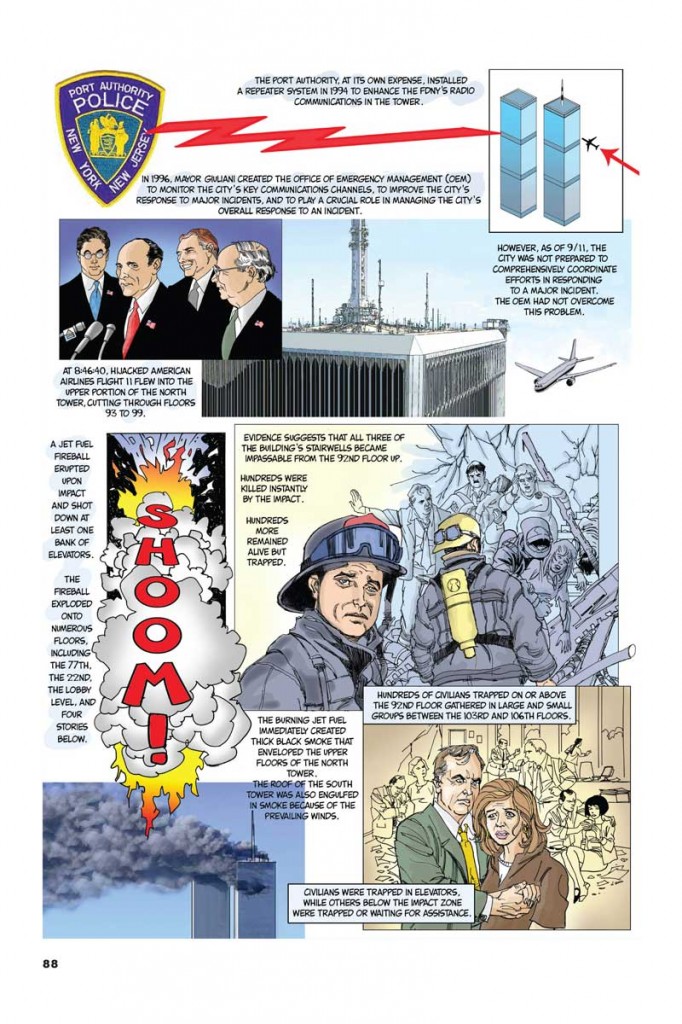
Modern governments from the Bolshevik regime to the Bush presidency have sought simple, appealing ways to present complex information to their citizens, from “Red Pinkerton” novels (think politically correct Communist detective stories) to televised public service announcements. Ernie Colon and Sid Jacobson’s The 9/11 Report: A Graphic Adaptation is one such effort, produced with the full cooperation of the National Commission on Terrorist Attacks Upon the United States. The goal: to summarize the Commission’s findings in a concise, visually arresting format that would appeal to readers reluctant to tackle the full 500-page document. Unfortunately, the final product falls well short of the mark, offering a dense, confusing gloss on the Commission’s work that I found harder to read than the actual prose report.

One can’t fault Colon and Jacobson for their fidelity to the original material. Their book follows the report closely, down to the chapters and subheadings, and uses the Commission’s own words to explain the events that precipitated the 9/11 attacks. In their efforts to mimic the structure of the original document, however, Colon and Jacobson seldom find the right balance between text and image; most of the artwork feels more like an afterthought than a clarification of the prose. More frustrating is the book’s choppy visual flow; Colon and Jacobson’s panel placement often seems poorly chosen, making it difficult to read the images and text boxes in the correct sequence.

The artwork, too, is a disappointment, an eclectic assortment of traced elements, computer-generated graphics, maps, photo-realistic drawings, and Silver Age character designs that never mesh into a seamless whole. (It’s particularly odd to see some real-life figures get the cartoon treatment, while others are rendered in a naturalistic fashion; as depicted in The 9/11 Report, Condolezza Rice bears a striking resemblance to Lucy van Pelt.) Though Colon and Jacobson generally avoid visual stereotyping, there are a few unfortunate images sprinkled throughout the book. On page 115, for example, there’s a chart outlining strategies for combating Muslim extremism in the Middle East and Southeast Asia. The chart is embellished with several images of hook-nosed, squinty-eyed, turban-wearing terrorists, one of whom grins menacingly at the reader, rocket launcher perched on his shoulder; surely the problem of global terrorism deserves a more sophisticated treatment than cartoonish, racist typecasting.

The most effective section of The 9/11 Report is the very beginning, in which Colon and Jacobson meticulously recreate the morning of September 11, 2001. They present the sequence of events twice, first depicting what happened aboard the four hijacked airplanes, then reconstructing the official response to these same events, documenting the jurisdictional confusion and poor communication that prevented the government from taking more decisive action. Both passages consist of four horizontal timelines that allow the reader to see, at a glance, what was happening aboard all four planes on a minute-to-minute basis. (In the hardbound edition, these timelines are printed on a single piece of paper which readers can unfold to view the entire sequence of events.) Here, the comics medium seems uniquely suited to showing these events simultaneously, giving the reader a much better appreciation of just how quickly the day’s events unfolded, and how difficult it was for anyone — military commanders, aviation authorities, police and fire officials — to know how to proceed.

It’s a shame that the rest of The 9/11 Report doesn’t utilize the format as effectively as these early pages, where image and text function as co-equal partners. Whatever the flaws of the original report — and, depending on your political inclinations, those flaws are either minor factual errors or egregious omissions of evidence implicating the CIA in bringing down the World Trade Center — it is a more effective, compelling narrative than the one Colon and Jacobson fashioned from it.

THE 9/11 REPORT: A GRAPHIC ADAPTATION • BY SID JACOBSON AND ERNIE COLON, BASED UPON THE FINAL REPORT OF THE NATIONAL COMMISSION ON TERRORIST ATTACKS UPON THE UNITED STATES • HILL & WANG • 134 pp.

Filed Under: Comics, Manga Critic, REVIEWS Tagged With: Hill & Wang, Non-Fiction

The 9/11 Report: A Graphic Adaptation

September 10, 2010 by Katherine Dacey

Modern governments from the Bolshevik regime to the Bush presidency have sought simple, appealing ways to present complex information to their citizens, from “Red Pinkerton” novels (think politically correct Communist detective stories) to televised public service announcements. Ernie Colon and Sid Jacobson’s The 9/11 Report: A Graphic Adaptation is one such effort, produced with the full cooperation of the National Commission on Terrorist Attacks Upon the United States. The goal: to summarize the Commission’s findings in a concise, visually arresting format that would appeal to readers reluctant to tackle the full 500-page document. Unfortunately, the final product falls well short of the mark, offering a dense, confusing gloss on the Commission’s work that I found harder to read than the actual prose report.

One can’t fault Colon and Jacobson for their fidelity to the original material. Their book follows the report closely, down to the chapters and subheadings, and uses the Commission’s own words to explain the events that precipitated the 9/11 attacks. In their efforts to mimic the structure of the original document, however, Colon and Jacobson seldom find the right balance between text and image; most of the artwork feels more like an afterthought than a clarification of the prose. More frustrating is the book’s choppy visual flow; Colon and Jacobson’s panel placement often seems poorly chosen, making it difficult to read the images and text boxes in the correct sequence.

The artwork, too, is a disappointment, an eclectic assortment of traced elements, computer-generated graphics, maps, photo-realistic drawings, and Silver Age character designs that never mesh into a seamless whole. (It’s particularly odd to see some real-life figures get the cartoon treatment, while others are rendered in a naturalistic fashion; as depicted in The 9/11 Report, Condolezza Rice bears a striking resemblance to Lucy van Pelt.) Though Colon and Jacobson generally avoid visual stereotyping, there are a few unfortunate images sprinkled throughout the book. On page 115, for example, there’s a chart outlining strategies for combating Muslim extremism in the Middle East and Southeast Asia. The chart is embellished with several images of hook-nosed, squinty-eyed, turban-wearing terrorists, one of whom grins menacingly at the reader, rocket launcher perched on his shoulder; surely the problem of global terrorism deserves a more sophisticated treatment than cartoonish, racist typecasting.

The most effective section of The 9/11 Report is the very beginning, in which Colon and Jacobson meticulously recreate the morning of September 11, 2001. They present the sequence of events twice, first depicting what happened aboard the four hijacked airplanes, then reconstructing the official response to these same events, documenting the jurisdictional confusion and poor communication that prevented the government from taking more decisive action. Both passages consist of four horizontal timelines that allow the reader to see, at a glance, what was happening aboard all four planes on a minute-to-minute basis. (In the hardbound edition, these timelines are printed on a single piece of paper which readers can unfold to view the entire sequence of events.) Here, the comics medium seems uniquely suited to showing these events simultaneously, giving the reader a much better appreciation of just how quickly the day’s events unfolded, and how difficult it was for anyone — military commanders, aviation authorities, police and fire officials — to know how to proceed.

It’s a shame that the rest of The 9/11 Report doesn’t utilize the format as effectively as these early pages, where image and text function as co-equal partners. Whatever the flaws of the original report — and, depending on your political inclinations, those flaws are either minor factual errors or egregious omissions of evidence implicating the CIA in bringing down the World Trade Center — it is a more effective, compelling narrative than the one Colon and Jacobson fashioned from it.

THE 9/11 REPORT: A GRAPHIC ADAPTATION • BY SID JACOBSON AND ERNIE COLON, BASED UPON THE FINAL REPORT OF THE NATIONAL COMMISSION ON TERRORIST ATTACKS UPON THE UNITED STATES • HILL & WANG • 134 pp.

Filed Under: Manga Critic

Shojo manga: a tangent

September 9, 2010 by MJ 4 Comments

To a great extent, this post serves as an excuse to link to David Welsh, whose Thursday thoughts revolve around the question of how critics talk about shojo manga, and whether some reviews of Moto Hagio’s A Drunken Dream and Other Stories reveal a chronic devaluation of works written by/for girls and women. I’ve probably said enough on the second half of that topic already to warrant keeping my mouth shut for quite some time. Still, I wanted to address one small thing.

One of the reviews David quotes is this one from Chris Mautner (a critic whose writing I respect a lot, by the way) at Robot 6. Here’s the quote:

“Dream, on the other hand, has both feet firmly planted in the world of shojo manga. The ten tales that make up this book all consist of overly sincere, heart-on-the-sleeve-style work. There’s very little ironic distancing and self-effacing humor here, although it does peep its head out occasionally. Mostly though, that’s been ignored in favor of heightened melodrama and earnest heart-tugging. While it avoids the sort of contrived, romantic, situation-comedy type plots that mark a lot of the shojo manga that has been translated into English over the past decade, there can be little doubt that Dream has more in common with Fruits Basket and Boys Over Flowers than Red Colored Elegy or Abandon the Old in Tokyo.”

Ignoring, for the moment, David’s main purpose in pulling this quote, I find myself compelled by one major question: What do Fruits Basket and Boys Over Flowers really have in common?

Let’s look at the (abbreviated) facts:…

Read More

Filed Under: DAILY CHATTER Tagged With: boys over flowers, fruits basket

Black Blizzard

September 9, 2010 by Katherine Dacey

First published in 1956, Black Blizzard is a juicy pulp thriller that will irresistibly remind Western readers of The 39 Steps, The Defiant Ones, and The Fugitive. The hero is twenty-five-year-old Susumu Yamaji, a down-on-his-luck pianist who stands accused of murdering the ringmaster of a traveling circus. The circumstantial evidence against him is so compelling that even Susumu — who was in a drunken stupor at the time — believes he did it. After surrendering to authorities, Susumu is handcuffed to hardened criminal Shinpei Konta, a middle-aged man who’s spent most of his adult life drifting in and out of jail. (When Susumu admits to his crime, Shinpei sniffs, “Just one? Tch! That’s nothing! I’ve been convicted five times. Twice for murder.”) An avalanche provides the shackled pair an opportunity to escape into a raging snowstorm, police hot on their trail.

Written in just twenty days, Black Blizzard unfolds at a furious clip, pausing only to allow Susumu a chance to tell Shinpei about his involvement with the circus. The two principals are more archetypes than characters, drawn in bold strokes, but the interaction between them crackles with antagonistic energy — they’re as much enemies as partners, roles that they constantly renegotiate during their time on the lam. Only in the final, rushed pages does manga-ka Yoshihiro Tatsumi falter, tidily resolving the story through an all-too-convenient plot twist that hinges on coincidence.

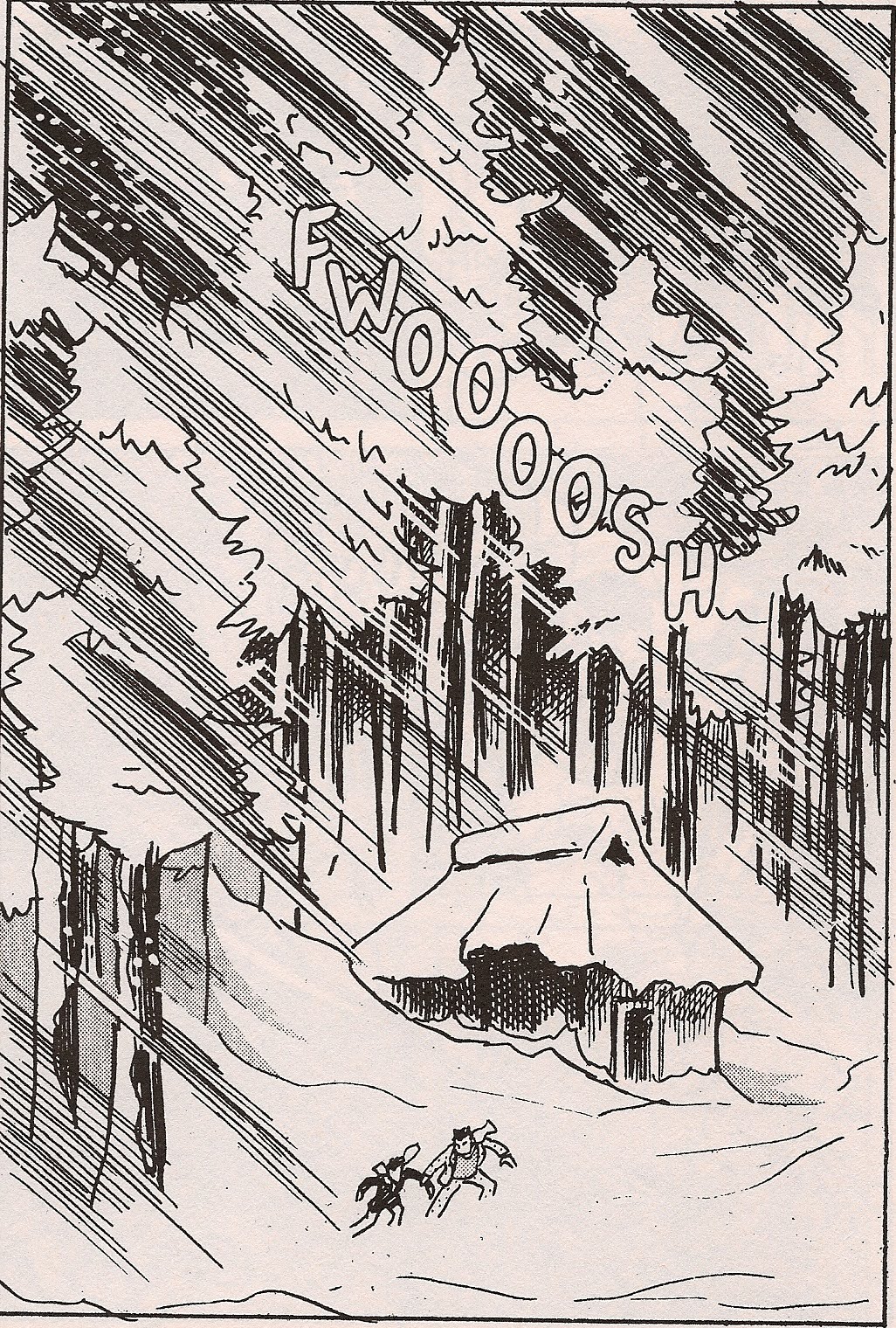
The plot may be pilfered from Manhunt — Tatsumi claims Mickey Spillane as an influence — but the art leaves a fresh impression. Tatsumi already had a substantial amount of work under his belt at the time he wrote Blizzard — seventeen novel-length stories, as well as several volumes’ worth of short ones — but was moving in the direction of what he called “manga that isn’t manga,” stories that exploited the medium’s capacity for representing action in a more dynamic, cinematic fashion. Black Blizzard is filled with slashing diagonal lines, dramatic camera angles, and images of speeding trains; it’s as if Giacomo Balla decided to try his hand at sequential art, filling the pages with as many signifiers of motion as he could muster without lapsing into abstraction:

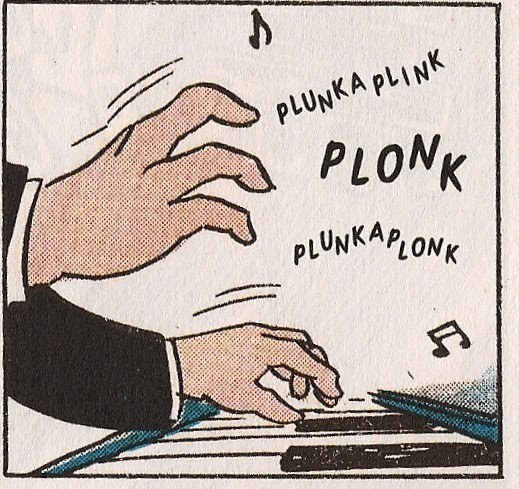
This kineticism extends to even the smallest gestures; in the very first panels, for example, we see a pair of hands banging out notes on a keyboard:

The composition couldn’t be simpler — just a few speedlines and sound effects convey the action — but these details, when coupled with the claw-like position of the hands, suggest the pianist’s extreme agitation, an impression confirmed just a few panels later when we first see Susumu’s sweat-drenched face.

Tatsumi’s regard for anatomy is, at times, careless; Susumu has Rachmaninoff-sized mitts, to judge from the awkward way in which his hands are drawn, while other cast members look stumpy, with grossly foreshortened legs. Yet for all the obvious flaws in his draftmanship, Tatsumi’s gestural approach to characterization proves well-suited to the material’s relentless pace, efficiently communicating each cast member’s personality, age, and plot function with a few artfully rendered lines and shapes. Shinpei, in particular, is a terrific creation, with a broad, sagging jaw and two thick, diagonal lines for eyebrows, making him a dead ringer for a jack-o-lantern.

Drawn & Quarterly has done a fine job of adapting Black Blizzard for Western readers, thanks, in large part, to a crisp translation by Akemi Wegmuller that captures the unique cadences of mid-century noir; one can almost imagine Shinpei referring to an attractive woman as a “tomato.” The volume also includes an interview with Tatsumi; read in tandem with “The Joy of Creation,” one of the later chapters in A Drifting Life, the interview sheds light on Tatsumi’s creative process as well as the work’s initial reception. Editor and designer Adrian Tomine has given Black Blizzard a retro-chic makeover, dying the trim yellow and boldly announcing the book’s price in the manner of a dime-store novel. It’s an attractive design (see above), but I can’t help wishing that Drawn and Quarterly had used Masami Kuroda’s original painting:

It’s a minor complaint, to be sure, but the original cover — to my mind, at least — is a closer expression of the story’s pulpy roots and futurism-tinged artwork.

That said, Black Blizzard is a welcome addition to the growing body of mid-century manga now available in English, providing an all-too-rare glimpse into the early stages of the gekiga movement. And while it lacks the visual and narrative polish of Tatsumi’s mature work, I’ll take the sweaty hyperbole of Black Blizzard over the dour verismo of The Push Man any day; Black Blizzard has a vital, improvisatory energy missing from Tatsumi’s later period, even though his command of the medium was clearly more assured in the 1960s and 1970s.

BLACK BLIZZARD • BY YOSHIHIRO TATSUMI • DRAWN & QUARTERLY • 132 pp. • NO RATING

Filed Under: Manga, Manga Critic, REVIEWS Tagged With: Classic, Drawn & Quarterly, Thriller, Yoshihiro Tatsumi

Black Blizzard

September 9, 2010 by Katherine Dacey

First published in 1956, Black Blizzard is a juicy pulp thriller that will irresistibly remind Western readers of The 39 Steps, The Defiant Ones, and The Fugitive. The hero is twenty-five-year-old Susumu Yamaji, a down-on-his-luck pianist who stands accused of murdering the ringmaster of a traveling circus. The circumstantial evidence against him is so compelling that even Susumu — who was in a drunken stupor at the time — believes he did it. After surrendering to authorities, Susumu is handcuffed to hardened criminal Shinpei Konta, a middle-aged man who’s spent most of his adult life drifting in and out of jail. (When Susumu admits to his crime, Shinpei sniffs, “Just one? Tch! That’s nothing! I’ve been convicted five times. Twice for murder.”) An avalanche provides the shackled pair an opportunity to escape into a raging snowstorm, police hot on their trail.

Written in just twenty days, Black Blizzard unfolds at a furious clip, pausing only to allow Susumu a chance to tell Shinpei about his involvement with the circus. The two principals are more archetypes than characters, drawn in bold strokes, but the interaction between them crackles with antagonistic energy — they’re as much enemies as partners, roles that they constantly renegotiate during their time on the lam. Only in the final, rushed pages does manga-ka Yoshihiro Tatsumi falter, tidily resolving the story through an all-too-convenient plot twist that hinges on coincidence.

The plot may be pilfered from Manhunt — Tatsumi claims Mickey Spillane as an influence — but the art leaves a fresh impression. Tatsumi already had a substantial amount of work under his belt at the time he wrote Blizzard — seventeen novel-length stories, as well as several volumes’ worth of short ones — but was moving in the direction of what he called “manga that isn’t manga,” stories that exploited the medium’s capacity for representing action in a more dynamic, cinematic fashion. Black Blizzard is filled with slashing diagonal lines, dramatic camera angles, and images of speeding trains; it’s as if Giacomo Balla decided to try his hand at sequential art, filling the pages with as many signifiers of motion as he could muster without lapsing into abstraction:

This kineticism extends to even the smallest gestures; in the very first panels, for example, we see a pair of hands banging out notes on a keyboard:

The composition couldn’t be simpler — just a few speedlines and sound effects convey the action — but these details, when coupled with the claw-like position of the hands, suggest the pianist’s extreme agitation, an impression confirmed just a few panels later when we first see Susumu’s sweat-drenched face.

Tatsumi’s regard for anatomy is, at times, careless; Susumu has Rachmaninoff-sized mitts, to judge from the awkward way in which his hands are drawn, while other cast members look stumpy, with grossly foreshortened legs. Yet for all the obvious flaws in his draftmanship, Tatsumi’s gestural approach to characterization proves well-suited to the material’s relentless pace, efficiently communicating each cast member’s personality, age, and plot function with a few artfully rendered lines and shapes. Shinpei, in particular, is a terrific creation, with a broad, sagging jaw and two thick, diagonal lines for eyebrows, making him a dead ringer for a jack-o-lantern.

Drawn & Quarterly has done a fine job of adapting Black Blizzard for Western readers, thanks, in large part, to a crisp translation by Akemi Wegmuller that captures the unique cadences of mid-century noir; one can almost imagine Shinpei referring to an attractive woman as a “tomato.” The volume also includes an interview with Tatsumi; read in tandem with “The Joy of Creation,” one of the later chapters in A Drifting Life, the interview sheds light on Tatsumi’s creative process as well as the work’s initial reception. Editor and designer Adrian Tomine has given Black Blizzard a retro-chic makeover, dying the trim yellow and boldly announcing the book’s price in the manner of a dime-store novel. It’s an attractive design (see above), but I can’t help wishing that Drawn and Quarterly had used Masami Kuroda’s original painting:

It’s a minor complaint, to be sure, but the original cover — to my mind, at least — is a closer expression of the story’s pulpy roots and futurism-tinged artwork.

That said, Black Blizzard is a welcome addition to the growing body of mid-century manga now available in English, providing an all-too-rare glimpse into the early stages of the gekiga movement. And while it lacks the visual and narrative polish of Tatsumi’s mature work, I’ll take the sweaty hyperbole of Black Blizzard over the dour verismo of The Push Man any day; Black Blizzard has a vital, improvisatory energy missing from Tatsumi’s later period, even though his command of the medium was clearly more assured in the 1960s and 1970s.

BLACK BLIZZARD • BY YOSHIHIRO TATSUMI • DRAWN & QUARTERLY • 132 pp. • NO RATING

Filed Under: Manga Critic Tagged With: Classic, Drawn & Quarterly, Yoshihiro Tatsumi

Off the Shelf: Beyond the Cat Incident

September 8, 2010 by MJ and Michelle Smith 17 Comments

Welcome to another edition of Off the Shelf with MJ & Michelle! I’m joined, once again, by Soliloquy in Blue‘s Michelle Smith.

This week, we talk about four fairly disparate titles from Vertical, Inc, Viz Media, and Yen Press.


MICHELLE: Well, even though it feels like Tuesday, the calendar informs me that it’s Wednesday. Which can mean only one thing!

MJ: Dawn’s in trouble? No, wait… I have that wrong.

MICHELLE: Haha! You have beaten me to the Buffy reference! What is the world coming to?

MJ: No good, no good at all!

MICHELLE: Every single week, the same arrangement, we talk about a lot of books… o/~ (There. Now I have redeemed myself.)

What’s on your plate this time?

MJ: Sorry to have upset the equilibrium like that right from the start. I don’t know what I was thinking. :)

So, yes, books! Well, after last week’s focus on manga for kids, I guess I must have felt the need to remember my age (or at least feel it). It’s been all dark, broody shonen and dark, thinky josei for me this week. I’ll start with the one I feel guiltiest about, volume ten of Black Jack.

I’ve had this volume for several months (with two more in the stack still waiting–hence the guilt), but despite the fact that everybody told me it would be no big deal to just jump in anywhere, “it’s totally episodic, blah blah blah,” I was determined to work my way up from the beginning (thank you, local library system), and honestly I’m glad I did. While I can see that it would not be at all difficult to catch on to the premise from any given point, there’s really so much nuance to this series, and much of that I would have missed. Even some fairly major bits of characterization go all the way back to the first volume, like the origins of Pinoko (Black Jack’s childlike companion) for one. Something like that, though it’s not essential to the plot of this volume, is still a pretty significant factor when it comes to understanding Black Jack and his general worldview.

MICHELLE: Yeah, I like to start from the beginning whenever possible, even when it isn’t absolutely necessary. Case Closed, for example, is perfectly enjoyable if one hops right in to volume 25, like I first did, but once I realized I liked the series I went back to volume 1. (Again, thank you, local library system!) …

Read More

Filed Under: OFF THE SHELF Tagged With: black jack, gossip girl, library wars, ooku

Pick of the Week – Arata: The Legend

September 7, 2010 by MJ 4 Comments

Oh, how the week flies! It hardly seems possible that it’s already time to choose another Pick of the Week, yet here I sit again with the latest upcoming arrivals list from my favorite comic shop, Boston’s Comicopia.

My pick this week is volume three of Yuu Watase’s Arata: The Legend published by Viz Media. I’ve had a rocky relationship with Watase’s work, and though I’m fond of her current shojo series, Fushigi Yugi Genbu Kaiden, what I think I’ve learned from the early volumes of Arata: The Legend is that I actually like Watase best as a shonen artist.

From my review of the series’ first two volumes:

While Watase’s shojo fantasies have always featured a lot of action, this series allows her to really shine, with fights, chases, and weapons galore. There’s a natural, easy feel to the artwork in this series, even when compared to her other current work like Fushigi Yugi Genbu Kaiden, as though by choosing to draw shonen action heroes, she’s finally really hit her stride.

Though I have yet to take a look at the series’ latest volume, there’s still time to check it out at Viz’ Shonen Sunday website before its release. So go & read, and if you like it, buy it!

Filed Under: PICK OF THE WEEK Tagged With: arata: the legend, pick of the week

The Art of Osamu Tezuka

September 6, 2010 by Katherine Dacey

In the introduction to The Art of Osamu Tezuka: God of Manga, author Helen McCarthy argues that Tezuka’s work merits scholarly attention, but also deserves a more accessible treatment as well, one that acknowledges that Tezuka “was first and foremost a maker of popular entertainment.” Her desire to bring Tezuka’s work to a wider audience of anime and manga fans is reflected in every aspect of the book’s execution, from its organization — she divides her chapters into short, one-to-three page subsections, each generously illustrated with full-color plates — to its coffee-table book packaging.

As one might expect from such an ambitious undertaking, the results are a little uneven. The strongest chapters focus on the unique aspects of Tezuka’s work, exploring a variety of creative issues in straightforward, jargon-free language. McCarthy provides a helpful overview of Tezuka’s “star system” (a.k.a. recurring figures such as Acetylene Lamp and Zephyrus) and traces the evolution of his storytelling technique through dozens of series, debunking the notion that he “invented” cinematic comics while carefully spelling out what was innovative about his manga. McCarthy also makes a persuasive case for Astro Boy as one of the most important works in the Tezuka canon, the series that most clearly anticipated his mature style.

As a biography, however, The Art of Osamu Tezuka offers little insight into Tezuka’s personality beyond his relentless perfectionism and strong work ethic. McCarthy’s attempts to situate Tezuka’s work within the context of his life and times feel glib — a pity, as she makes some thought-provoking observations about Tezuka’s recurring use of certain motifs — especially androgyny, childhood, and disguise — that beg further elucidation.

That said, The Art of Osamu Tezuka largely succeeds in its mission to educate fans about Tezuka’s work process and artistic legacy, clarifying his place in Japanese popular culture, exploring his animated oeuvre, and introducing readers to dozens of untranslated — and sometimes obscure — series. A worthwhile addition to any serious manga reader’s library.

The Art of Osamu Tezuka: God of Manga
By Helen McCarthy
Abrams Comic Art, 272 pp.

Filed Under: Books, Manga, Manga Critic, REVIEWS Tagged With: Biography, Helen McCarthy, Osamu Tezuka

Short Takes: The Art of Osamu Tezuka and Korea As Viewed by 12 Creators

September 6, 2010 by Katherine Dacey

I’m taking a break from shojo romances and seinen shoot-em-ups in favor of two books aimed squarely at older comics connoisseurs. The first is Helen McCarthy’s The Art of Osamu Tezuka: God of Manga (Abrams Comics), an award-winning biography of Japan’s best-known manga-ka. (Her book just nabbed a Harvey in the Best American Edition of Foreign Material category, a category normally reserved for translated comics such as Yoshihiro Tatsumi’s Abandon the Old in Tokyo.) The second is Korea As Viewed by 12 Creators (Fanfare/Ponent Mon), a much-anticipated follow-up to the critically acclaimed anthology Japan As Viewed By 17 Creators. Which ones deserve a place on your bookshelf? Read on for details.

THE ART OF OSAMU TEZUKA: GOD OF MANGA

BY HELEN MCCARTHY • ABRAMS COMIC ART • 272 pp.

In the introduction to The Art of Osamu Tezuka: God of Manga, author Helen McCarthy argues that Tezuka’s work merits scholarly attention, but also deserves a more accessible treatment as well, one that acknowledges that Tezuka “was first and foremost a maker of popular entertainment.” Her desire to bring Tezuka’s work to a wider audience of anime and manga fans is reflected in every aspect of the book’s execution, from its organization — she divides her chapters into short, one-to-three page subsections, each generously illustrated with full-color plates — to its coffee-table book packaging.

As one might expect from such an ambitious undertaking, the results are a little uneven. The strongest chapters focus on the unique aspects of Tezuka’s work, exploring a variety of creative issues in straightforward, jargon-free language. McCarthy provides a helpful overview of Tezuka’s “star system” (a.k.a. recurring figures such as Acetylene Lamp and Zephyrus) and traces the evolution of his storytelling technique through dozens of series, debunking the notion that he “invented” cinematic comics while carefully spelling out what was innovative about his manga. McCarthy also makes a persuasive case for Astro Boy as one of the most important works in the Tezuka canon, the series that most clearly anticipated his mature style.

As a biography, however, The Art of Osamu Tezuka offers little insight into Tezuka’s personality beyond his relentless perfectionism and strong work ethic. McCarthy’s attempts to situate Tezuka’s work within the context of his life and times feel glib — a pity, as she makes some thought-provoking observations about Tezuka’s recurring use of certain motifs — especially androgyny, childhood, and disguise — that beg further elucidation.

That said, The Art of Osamu Tezuka largely succeeds in its mission to educate fans about Tezuka’s work process and artistic legacy, clarifying his place in Japanese popular culture, exploring his animated oeuvre, and introducing readers to dozens of untranslated — and sometimes obscure — series. A worthwhile addition to any serious manga reader’s library.

KOREA AS VIEWED BY 12 CREATORS

VARIOUS ARTISTS, EDITED BY NICOLAS FINET • FANFARE/PONENT MON • 222 pp. • NO RATING

This anthology of twelve short stories, six by Korean artists and six by French, follows the same basic template as Japan As Viewed by 17 Creators, offering brief, impressionistic scenes of contemporary Korean life. Though 17 Creators is a uniformly excellent work, its companion volume is not; the stories run the gamut from pedestrian to brilliant, with the Korean artists making the strongest contributions.

The unevenness of the collection is attributable, in part, to a home field advantage. Artists such as Choi Kyu-sok and Byun Ki-hyun tackle deeper, more penetrating topics than their French counterparts, exploring homelessness (“The Fake Dove”), sexual discrimination and violence (“The Rabbit”), and the decay of traditional social networks (“The Rain That Goes Away Comes Back”). Though the artists’ ambition sometimes outstrips their allocated space, all three stories boast beautiful, detailed artwork that suggests the rhythm and feeling of modern urban life. The French contributions, by contrast, are travelogues of one sort or another: in “Beondegi,” for example, Mathieu Sapin imagines what it would be like for a French-Korean woman to return to her parents’ home country, while in “Letters From Korea,” Igort offers brief descriptions of places he visited in Seoul. The weakest of the collection is Catel’s “Dul Lucie,” an uneventful travel diary filled with observations about “doll-like” and “sensual” Koreans that — in English, at least — leave a bad aftertaste of exoticism. Though the other French artists are not as patronizing, the stories feel shallow; imagine an essay about New York City written by someone who only visited Times Square, and you have some idea of how superficial these artists’ appreciation of Korea seems to be.

Two stories make this collection a worthwhile investment. The first is “Solgeo’s Tree,” by Lee Doo-hoo, in which a monk paints a mural so life-like that birds attempt to perch in its branches. Told with almost no dialogue, the story relies heavily on Lee’s exquisite pen-and-ink drawings to impart its Buddhist moral. The second is “A Rat in the Country of Yong,” Herve Tanquerelle’s playful, wordless story about a mouse visiting Seoul. The surrealistic imagery — skies full of dragon transports, streets filled with animal-eared people, pools inhabited by monstrous carp — and Chaplin-esque physical comedy evoke the strangeness and excitement of visiting a new city without falling into the trap of essentializing its people. Both comics attest to the vitality and richness of the “as viewed by” concept, and suggest what might have emerged from this sometimes insightful, sometimes banal French-Korean collaboration.

Filed Under: Manga Critic Tagged With: Fanfare/Ponent Mon, Osamu Tezuka

Manhwa Monday: September Preview

September 6, 2010 by MJ 1 Comment

Welcome to another Manhwa Monday! It’s fairly quiet on this holiday weekend, so perhaps it’s time to look at what’s coming for the month ahead.

Yen Press is the only American manhwa publisher with new releases planned for September–all new volumes of continuing series. My pick of the bunch is volume three of One Fine Day, Sirial’s whimsical look at the domestic life of three pets and their magical master. (Click here for my review of volume one.)

Also this month, Yen releases volume nine of Legend (click here for reviews) and volume three of Laon.

NETCOMICS is conspicuously silent on the print front this month, though regular updates of their online series have finally resumed in earnest, including the release of volume four, chapter seven of The Adventures of Young Det just last week.

At Rocket Bomber, Matt Blind posts the latest round of manhwa rankings, this time for the week ending August 29th. The usual contenders remain strong, and NETCOMICS’ BL one-shot U Don’t Know Me moves up even one more notch to first place in manhwa this week (and 158 in “manga” overall).

It’s been a very quiet week for reviews, but at PopMatters, Oliver Ho posts a thoughtful review of one of my favorite manhwa, Byun Byung-Jun’s Mijeong (NBM/ComicsLit). Meanwhile, at Slightly Biased Manga, Connie finally checks out volume one of Sarasah (Yen Press), though she’s not pleased with what she finds.

That’s all for this week!

Is there something I’ve missed? Leave your manhwa-related links in comments!

Filed Under: Manhwa Bookshelf, Manhwa Monday Tagged With: manhwa monday

Harmony

September 4, 2010 by Katherine Dacey

VIZ launched its Haikasoru imprint in 2009, with the goal of bringing Japan’s best speculative fiction to the US. Haikasoru’s debut titles — All You Need Is Kill and The Lord of the Sands of Time — introduced Americans to two award-winning sci-fi authors whose work had previously been unavailable in English. As the line as grown, so, too, has the diversity of its offerings, which run the gamut from horror (e.g. Otsuichi’s ZOO) to teen-friendly fantasy (e.g. Miyuki Miyabe’s Brave Story and The Book of Heroes) to science fiction (e.g. Issui Ogawa’s The Next Continent and Hosume Nojia’s Usurper of the Sun). Harmony, the newest Haikasoru title, falls on the softer end of the sci-fi continuum, depicting a world in which “admedistrative” societies — that is, countries that operate by rule of medicine, rather than rule of law — are the new empire-builders.

Harmony takes place in the late twenty-first century, fifty years after nuclear holocaust destroyed North America and destabilized the international balance of power by flooding the Third World with an abundant supply of nuclear weapons. In the chaos that ensued, countries which successfully developed the medical technology to treat radiation sickness supplanted the old superpowers, while less scientifically advanced nations descended into guerilla warfare. The new admedistrative powers transformed the World Health Organization (WHO) into a global peacekeeping force tasked with monitoring other nations’ ability to “ensure their populace a lifestyle that [is] sufficiently healthy and human.” The key to that lifestyle is WatchMe, an elaborate system that keeps close watch over individuals’ health, guiding them away from potentially harmful choices — fatty food, alcohol, cigarettes, distressing literature — repairing cellular damage, and providing the government a steady stream of data about a person’s behavior and current medical condition.

<!—more—>

Harmony is told through the point of view of Tuan Kirie, a twenty-eight-year-old WHO agent tasked with solving the mystery behind an “outbreak” of suicide — an action that, in theory, should be impossible under the WatchMe system. Tuan is an appealing narrator, at once tough and funny, a natural contrarian who smokes and drinks and defies authority yet nonetheless treats her mission with the utmost seriousness. The story moves fluidly between past and present, using Tuan’s childhood memories to shed light on her conflicted, often subversive, behavior. Until the third act, the pacing is brisk and the dialogue crisp; as Tuan draws closer to finding out what prompted the wave of suicides, however, the story begins to sag under the weight of turgid conversations about free will and psychology, a flaw that the frequent changes of setting can’t conceal.

It’s a shame these third-act discussions are so pedestrian, as author Keikaku “Project” Itoh has devised a nifty set-up for examining the boundaries between public and private life, imagining a world in which the government’s desire to collect data and enforce civility goes well beyond speech, belief, and association — all manifestations of conscious thought — to the level of neural transmissions and body chemistry. For most of the book, Itoh manages to dramatize the conflict between public and private without speechifying or shortcuts, using Tuan’s role as a WHO agent to explore the nature of admedistrative rule. Though Tuan yearns for the physical and social freedom less technologically advanced societies enjoy, the persistence of armed conflict in the developing world is a potent reminder of why so many people willingly submit to the benevolent totalitarianism of the WatchMe system.

VIZ has done an excellent job of adapting Harmony for English-speaking audiences. Translator Alexander O. Smith, in particular, deserves praise for the smooth, idiomatic voicing of Tuan’s thoughts in language that captures the heroine’s fierce personality. Smith also navigates passages of scientific shoptalk and historical description with ease, producing a highly readable text that lacks any of the tell-tale signs of translation: awkward turns of phrase, confusing use of pronouns.

Aside from a few third-act hiccups, Harmony is a solidly entertaining book, offering a judicious mixture of globe-trotting action, social commentary, and suspense to engage all but the hardest science fiction fans, and a surprise ending that neatly resolves the main plot while raising new, thought-provoking questions. Recommended.

Review copy provided by VIZ Media, LLC.

HARMONY • BY PROJECT ITOH, TRANSLATED BY ALEXANDER O. SMITH • VIZ • 252 pp.

Filed Under: Books, Manga Critic, REVIEWS Tagged With: Haikasoru, Novel, Post-Apocalyptic Sci-Fi, VIZ

Harmony

September 4, 2010 by Katherine Dacey

In 2009, VIZ launched its Haikasoru imprint with the goal of bringing Japan’s best speculative fiction to the US. Haikasoru’s debut titles — All You Need Is Kill and The Lord of the Sands of Time — introduced Americans to two award-winning sci-fi authors whose work had previously been unavailable in English. As the line as grown, so, too, has the diversity of its offerings, which run the gamut from horror to teen-friendly fantasy and science fiction. Harmony, the newest Haikasoru title, falls on the softer end of the sci-fi continuum, depicting a world in which “admedistrative” societies are the new empire-builders.

Harmony takes place in the late twenty-first century, fifty years after a nuclear holocaust destroys North America. Countries which successfully developed a cure for radiation sickness have supplanted the old superpowers, while less scientifically advanced societies have descended into a perpetual state of guerilla warfare. Keeping the peace is the World Health Organization (WHO), which is tasked with monitoring world’s well-being. Their mission sounds benign, but WHO’s “peacekeeping” efforts smack of Big Brother: they use WatchMe, an elaborate system that keeps tabs on what people eat, do, and say while providing the government a steady stream of data about a person’s medical condition.

Harmony is told through the point of view of Tuan Kirie, a twenty-eight-year-old WHO agent tasked with solving the mystery behind an “outbreak” of suicide — an action that, in theory, should be impossible under the WatchMe system. Tuan is an appealing narrator, at once tough and funny, a natural contrarian who smokes and drinks and defies authority yet nonetheless treats her mission with the utmost seriousness. The story moves fluidly between past and present, using Tuan’s childhood memories to shed light on her conflicted, often subversive, behavior.

Until the third act, the pacing is brisk and the dialogue crisp. As Tuan draws closer to finding out what prompted the wave of suicides, however, the story begins to sag under the weight of turgid conversations about free will and psychology, a flaw that the frequent changes of setting can’t conceal. It’s a shame these discussions are so pedestrian, as author Keikaku “Project” Itoh has devised a nifty set-up for examining the boundaries between public and private life, imagining a world in which the government’s desire to collect data and enforce civility goes well beyond speech, belief, and association — all manifestations of conscious thought — to the level of neural transmissions and body chemistry. Though Tuan yearns for the physical and social freedom less technologically advanced societies enjoy, the persistence of armed conflict in the developing world is a potent reminder of why so many people willingly submit to the benevolent totalitarianism of the WatchMe system.

VIZ has done an excellent job of adapting Harmony for English-speaking audiences. Translator Alexander O. Smith, in particular, deserves praise for the smooth, idiomatic voicing of Tuan’s thoughts in language that captures the heroine’s fierce personality. Smith also navigates passages of scientific shoptalk and historical description with ease, producing a highly readable text that lacks any of the tell-tale signs of translation: awkward turns of phrase, confusing use of pronouns.

Aside from a few third-act hiccups, Harmony is a solidly entertaining book, offering a judicious mixture of globe-trotting action, social commentary, and suspense to engage all but the hardest science fiction fans, and a surprise ending that neatly resolves the main plot while raising new, thought-provoking questions. Recommended.

Review copy provided by VIZ Media, LLC.

HARMONY • BY PROJECT ITOH, TRANSLATED BY ALEXANDER O. SMITH • VIZ • 252 pp.

Filed Under: Manga Critic Tagged With: Haikasoru, VIZ

Cakes and Ale by W. Somerset Maugham: A

September 3, 2010 by Michelle Smith

From the back cover:
Lionized by literary society, Edward Driffield is married to his second wife, a woman of iron will, indisputable rectitude and great charm. Her request to Alroy Kear, lightweight novelist, to write a biography of her husband seems both flattering and agreeable. But on delving into Driffield’s past Kear revives the spectre of his first wife, Rosie, delectable companion of less respectable days and the unlikely muse of his greatest work.

In this novel Maugham has created the unauthorized biography, the book that cannot be written for fear of offending Driffield’s unsuspecting public. And in Rosie he has given us his greatest heroine, luscious, inconstant and commonplace, yet lingering most persistently in the mind.

Review:
Prior to reading Cakes and Ale, my exposure to W. Somerset Maugham was sorely limited. I first heard of him during my teen years in the context of “the guy who wrote the book that became the movie that starred Bill Murray in his first serious role.” (I was a bit of an SNL fanatic in those days.) After reading Cakes and Ale, I wonder what took me so long.

Cakes and Ale will possibly sound disorganized when described, but flows logically when read. The narrator, William Ashenden, is a middle-aged author who’s approached by a more commercially successful peer, Alroy Kear, to help with a biography Kear is writing. The subject is Edward Driffield, a novelist with whom Ashenden was acquainted when he (Driffield) was married to a vibrant but unfaithful former barmaid named Rosie, but who spent his later years with a respectable second wife who struggled for years to make him fit the mold of a venerated elder statesman of literature.

Despite Kear’s assertions that he wants to know everything that Ashenden has to tell about Driffield’s former marriage, Ashenden realizes that, with the second Mrs. Driffield backing the biography project, there’s no way any of it would be usable anyhow. The fact is, Driffield wrote better books when he was married to Rosie and though she was wildly unfaithful, it wasn’t done from malice. Rather than tell Kear what he wants to know, Ashenden instead reminisces privately about his awkward first meeting with the Driffields as a boy of fifteen—during which period he obediently adopted the class prejudice of the aunt and uncle with whom he lived—and the later resumption of their friendship when he is a 20-year-old medical student living in London.

Maugham’s writing style is especially appealing to me, managing to be clever, witty, insightful, and concise all at the same time. There aren’t words enough to express how much I adore the passages about young Ashenden. He’s so self-conscious and awkward, and I love how Maugham depicts Ashenden’s struggle between the warnings he’s received about working-class people versus what he is actually seeing for himself. It’s a nostalgic sort of portrait, fond and sympathetic, of a boy who gradually sheds the things he’s been led to believe and learns to think for himself. This isn’t the only portrait to be found, of course. Both Rosie and Kear are quite extensively developed, and the reaction of other characters to them also allows for some wry commentary on communities both rural and literary. Oddly enough, the least developed character is probably Driffield himself, about whom the biography is being written!

The only complaint I have about Cakes and Ale is that it’s too short! That’s not to say that the story is incomplete, for it isn’t, but I enjoyed the book so much I could have gone on reading it for thrice as long! Happily, Maugham wrote quite a few other things, one of which is waiting for me at the library and another of which is on its way from Amazon at this very moment.

Filed Under: Books Tagged With: W. Somerset Maugham

  • « Go to Previous Page
  • Page 1
  • Page 2
  • Page 3
  • Page 4
  • Go to Next Page »
 | Log in
Copyright © 2010 Manga Bookshelf | Powered by WordPress & the Genesis Framework