• Skip to primary navigation
  • Skip to main content
  • Skip to primary sidebar
  • Home
  • About Us
    • Privacy Policy
    • Comment Policy
    • Disclosures & Disclaimers
  • Resources
    • Links, Essays & Articles
    • Fandomology!
    • CLAMP Directory
    • BlogRoll
  • Features & Columns
    • 3 Things Thursday
    • Adventures in the Key of Shoujo
    • Bit & Blips (game reviews)
    • BL BOOKRACK
    • Bookshelf Briefs
    • Bringing the Drama
    • Comic Conversion
    • Fanservice Friday
    • Going Digital
    • It Came From the Sinosphere
    • License This!
    • Magazine no Mori
    • My Week in Manga
    • OFF THE SHELF
    • Not By Manga Alone
    • PICK OF THE WEEK
    • Subtitles & Sensibility
    • Weekly Shonen Jump Recaps
  • Manga Moveable Feast
    • MMF Full Archive
    • Yun Kouga
    • CLAMP
    • Shojo Beat
    • Osamu Tezuka
    • Sailor Moon
    • Fruits Basket
    • Takehiko Inoue
    • Wild Adapter
    • One Piece
    • After School Nightmare
    • Karakuri Odette
    • Paradise Kiss
    • The Color Trilogy
    • To Terra…
    • Sexy Voice & Robo
  • Browse by Author
    • Sean Gaffney
    • Anna Neatrour
    • Michelle Smith
    • Katherine Dacey
    • MJ
    • Brigid Alverson
    • Travis Anderson
    • Phillip Anthony
    • Derek Bown
    • Jaci Dahlvang
    • Angela Eastman
    • Erica Friedman
    • Sara K.
    • Megan Purdy
    • Emily Snodgrass
    • Nancy Thistlethwaite
    • Eva Volin
    • David Welsh
  • MB Blogs
    • A Case Suitable For Treatment
    • Experiments in Manga
    • MangaBlog
    • The Manga Critic
    • Manga Report
    • Soliloquy in Blue
    • Manga Curmudgeon (archive)

Manga Bookshelf

Discussion, Resources, Roundtables, & Reviews

Archives for September 2010

Bakuman。1 by Tsugumi Ohba and Takeshi Obata: B+

September 3, 2010 by Michelle Smith

Moritaka Mashiro is bored. For his fourteen years of life he’s merely gone along with the flow, a path which is destined to end with him becoming a normal white-collar worker. He doesn’t want this, but sees no alternative until Akito Takagi, the top student in class, notices Moritaka’s artistic skills and proposes that the two team up to create a manga. Moritaka is resistant at first—he’d much rather loaf around and play video games—but when the object of his affections (and aspiring voice actress), Miho Azuki, agrees to marry him when his manga becomes an anime, he is suddenly unstoppable.

Moritaka expects resistance from his family—after all, his uncle essentially killed himself by trying to become a successful manga artist—but they’re surprisingly supportive and it turns out that his uncle’s studio has been preserved, untouched, since his death. I absolutely adore the chapter where Moritaka and Akito rush to the studio for the first time—it is seriously a manga-lover’s dream. Not only are there plenty of artistic supplies, but there are shelves upon shelves of manga (“for reference”) as well as neatly organized boxes of storyboards and final drafts. All of the scenes with the boys working on their story—they decide to submit a final draft for consideration by the end of summer break—are absolutely fascinating and bring home just how grueling creating comics can be.

There are a couple of problematic things about Bakuman, however. Moritaka and Azuki’s pledge to get married when they achieve their dreams—without dating in the meantime—is pretty silly, but not out-of-character for a couple of fourteen-year-olds. The fact that they’ll be encouraging each other via e-mail, just like Moritaka’s uncle was encouraged by letters from his classmate, who just so happens to be Azuki’s mother, is a coincidence I could’ve done without. In general, this whole subplot failed to interest me; I was much more interested in the boys’ efforts to get their manga off the ground, but I suppose listless Moritaka needed to find motivation somewhere.

More significantly, many reviewers have taken issue with the displays of sexism in Bakuman. Having now read it for myself, I get the impression that certain characters are sexist but I’d stop short of applying that label to the series as a whole. This makes me wonder, though… why, when characters in Bakuman say things like “She knows by instinct that the best thing for a girl is to get married and become somebody’s wife” or “Men have dreams that women will never be able to understand” does it not piss me off as righteously as when characters make very similar comments in The Color Trilogy by Kim Dong Hwa?

I think it depends, for me, on who’s saying it. If, as in the case of The Color Trilogy, a male author puts such words into the mouths of female characters, I can’t seem to help getting peeved about it. In Bakuman, the speaker of the first line above is Akito—in other words, just an overconfident teen who thinks he knows everything. He goes on to say he doesn’t like a particular girl in class because she’s proud of how well she does in school, but when Azuki’s mother later tells him she doesn’t like smart guys, he flails about and says, “But that’s just your taste.” Perhaps what he earlier presented as deep insight about Azuki was really his own taste coming through. The second line above, about men’s dreams, though technically spoken by Moritaka’s mother, is actually a quote from his off-camera father and was easy for me to dismiss as, “Oh, he’s just an older man with outdated opinions.”

I’m not trying to argue that these characters aren’t sexist, but they don’t succeed in getting my dander up and certainly will not deter me from reading more of the series.

Bakuman is published in English by VIZ. One volume’s been released here so far, while the ninth volume of this still-running series came out in Japan last month.

This review was originally published at Comics Should Be Good.

Review copy provided by the publisher.

Filed Under: Manga, Shounen Tagged With: Shonen Jump, Takeshi Obata, VIZ

Magical Girl Evangelism: Shugo Chara!

September 2, 2010 by MJ 5 Comments

I’ve got Shugo Chara! on the brain today, thanks to last night’s discussion for Off the Shelf.

I know Peach-Pit doesn’t get a lot of respect, and I’m not a big fan of their other series, so I can understand that on some level. But I love Shugo Chara! and I honestly don’t understand some of the criticisms of it I’ve read elsewhere. It’s one of those series I often read reviews of on other sites and honestly think to myself, “Could we possibly be reading the same series?” That’s how strongly opinions may differ on this particular title.

Now, arguing with other critics is not only obnoxious, but foolish. An opinion on a subjective topic can’t actually be wrong. But I’ve made what are (in my mind) some pretty compelling arguments in favor of the series over the course of the past year or so, so what I can reasonably do is point readers to those and hope to convince them to give the series a real chance if they haven’t done so already.

So, here’s a chronological listing of my reviews of Shugo Chara!, each of which contains specific, heartfelt praise:

Volume 5
Volume 6
Volume 7
Volume 8

In addition, you can read things like Why I think Shugo Chara! overpowers Kamichama Karin Chu or (from last night) Why I think Shugo Chara! should be rated for ages 10+.

Alternatively, these posts can all be accessed together via my Shugo Chara! tag.

Without a doubt, Shugo Chara! is a favorite for me amongst pink, sparkly manga for girls. I hope one day it may be for you too. This has been my manga evangelism moment for the day. Enjoy! :)

Filed Under: DAILY CHATTER Tagged With: shugo chara!

Off the Shelf: For Kids or Not For Kids?

September 1, 2010 by MJ and Michelle Smith 14 Comments

Welcome to another edition of Off the Shelf with MJ & Michelle! I’m joined, once again, by Soliloquy in Blue‘s Michelle Smith.

With the latest Manga Moveable Feast well underway (hosted this month by the crew at the School Library Journal’s Good Comics for Kids), Michelle and I take a look at books from Yen Press, Viz Media, Del Rey Manga, and CMX. Enjoy!


MJ: So, it’s another Manga Moveable Feast week here at Off the Shelf! The object of the Feast is a bit different this time around. Though the primary title chosen for discussion is Kiyohiko Azuma’s Yotsuba&! (Yen Press), we’re also offered the opportunity to talk about some other titles that are being marketed for kids, either here or in Japan (and perhaps both).

What I’m most interested in is probably the question of why Yotsuba&! is recommended for kids here, though it’s published for adults in Japan, while some other titles are rated much higher here than they are over there. But I suspect you might have your own agenda too. Am I right?

MICHELLE: Well, no, actually. I’m still happy from my seven-volume binge and hung up on how awesome Yotsuba&! is. I haven’t really gotten beyond that yet. So, what I’m saying is I’ll happily be swept along by your agenda. :)

MJ: Well, okay! Let’s start with Yotsuba, then. For those who don’t know, Yotsuba&! is a slice-of-life series that chronicles the daily adventures of Yotsuba, a green-haired five-year-old who lives with Koiwai, her youngish adoptive dad, and who approaches everything in life with a sense of true wonder and (frequently) an earnest lack of understanding. Over the course of the series, she is introduced to everyday concepts like air-conditioning and cake, each more wonderful than the next….

Read More

Filed Under: OFF THE SHELF Tagged With: hikaru no go, off the shelf, shugo chara!, the palette of 12 secret colors, yotsuba!

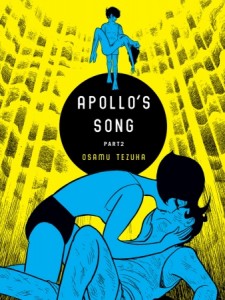
Apollo’s Song, Vols. 1-2

September 1, 2010 by Katherine Dacey

Apollo’s Song may be one of the strangest sex ed manuals ever written. It begins with a textbook Tezuka scene, at once lyrical and goofy: millions of anthropomorphic sperm race towards a comely egg. After one lucky soul pants and claws his way to the front of the scrum, the sperm and egg dissolve into a passionate embrace. In the following panel, we see the result of their union, an embryo, presiding over a veritable sperm graveyard. This juxtaposition of life and death — or, perhaps more accurately, sex and death — foreshadows the dialectic that will play out in the following chapters.

We are then introduced to Shogo, a young man who has just arrived at a psychiatric hospital. Shogo is a sociopath: unemotional, cruel to animals, scornful of society, and deeply misogynist. While undergoing electroshock therapy, Shogo has a vivid hallucination in which a stern goddess chastises him for renouncing all forms of love. As punishment for his cruelty, she condemns him to a fate straight out of Dante’s Inferno: Shogo will love and lose the same woman over and over again for eternity. Thus begins a series of romantic and sexual encounters between Shogo and various incarnations of his ill-fated partner.

Though the story begins and ends in the present day, the individual episodes unfold in both the past and future, reminding the reader that Shogo cannot escape his fate. Certain recurring motifs suggest that these scenarios are, in fact, manifestations of Shogo’s subconscious as he struggles to reconcile his hatred of women with his need to be loved. In each scenario, for example, Shogo adopts a hyper-masculine guise — Nazi foot soldier, fugitive, hunter, terrorist — that he must ultimately renounce in his quest for spiritual and sexual fulfillment. We’re never entirely certain which of these episodes are unfolding in Shogo’s mind and which, if any, are unfolding in the real world.

Though Apollo’s Song aspires to universality, Tezuka’s characters remain firmly rooted in the time and place of their creation. Tezuka blames Shogo’s mother — whose crimes include an inability to lactate, promiscuity, and emotional detachment — for her son’s pathology, even treating us to a scene of the youthful Shogo walking in on his mother and a lover. While no one would deny the deleterious effects of parental neglect, Shogo’s mother seems less like a character than a casebook study out of the 1952 DSM. Other characters, such as an “artsy-fartsy,” “self-centered” career woman who defends her chastity with hysterical fury, seem like the morbidly sexual figments of a Freudian imagination.

Tezuka’s moralizing, too, has a curiously alienating effect. In the first episode, for example, Shogo imagines that he is a German soldier aboard a train bound for an unnamed concentration camp. Through the slats of a cattle car, he spots Elise, whose beauty and modesty awakens his sense of moral outrage. He rescues her first from the wreckage of the train (which is bombed by Allied forces), then from German rapists, earning her love through his selflessness. This scenario is clearly meant to teach readers that love can transcend ethnic, racial, and religious divisions, yet this epiphany is of a shallow nature, as Shogo fails to grasp the true horror of the situation or appreciate Elise’s grief at losing her entire family – in essence, the Holocaust has been reduced to a colorful backdrop for yet another of Shogo’s doomed romances.

However problematic the story may be, the artwork in Apollo’s Song ranks among Tezuka’s best, filled with arresting landscapes and surprisingly carnal imagery. In chapter two, for example, Shogo finds himself stranded on a lush tropical island. Peering through a dense frame of vegetation, he spies a secluded glen where deer, panthers, and leopards embrace their mates in sexual congress. The sensuality of the moment is accentuated by their bodies’ curved lines and beatific expressions, infusing a potentially silly scene with a graceful spirituality. Later chapters also abound in vivid images; as Tezuka imagines the Tokyo of the future, the city has been transformed from a glass-and-concrete forest into an Art Deco monstrosity reminiscent of Fritz Lang’s Metropolis or a Soviet Bloc city. Its inhabitants, a race of sexless, synthetic beings that store their faces in jars, preside over a haunted landscape of tombs, forgotten infrastructure, and empty plazas; the very barrenness of the place brings the intensity of Shogo’s yearning and anger into sharp relief.

Revisiting Apollo’s Song three years after its initial release, I find myself torn. On the one hand, Tezuka’s artwork is a feast for the eyes, featuring some of the most erotic images he committed to paper. On the other hand, it’s a deeply flawed work that, in its attitudes towards women and finger-wagging tone, shows its age. Vertical has done an admirable job of fashioning a silk purse from a sow’s ear with the handsomely produced new edition, but even the knockout cover designs can’t conceal the fact that Apollo’s Song is a sour, heavy-handed tale that lacks the essential humanism – and humor – of Buddha and Phoenix.

This is a revised version of a review that appeared at PopCultureShock on 6/22/2007.

APOLLO’S SONG, VOLS. 1-2 • BY OSAMU TEZUKA • VERTICAL, INC. • RATING: OLDER TEEN (16+)

Filed Under: Manga, Manga Critic, REVIEWS Tagged With: Classic, Osamu Tezuka, Shonen, vertical

Apollo’s Song, Vols. 1-2

September 1, 2010 by Katherine Dacey

Apollo’s Song may be one of the strangest sex ed manuals ever written.

It begins with a textbook Tezuka scene, at once lyrical and goofy: millions of anthropomorphic sperm race towards a comely egg. After one lucky soul pants and claws his way to the front of the scrum, the sperm and egg dissolve into a passionate embrace. In the following panel, we see the result of their union, an embryo, presiding over a veritable sperm graveyard. This juxtaposition of life and death — or, perhaps more accurately, sex and death — foreshadows the dialectic that will play out in the following chapters.

We are then introduced to Shogo, a young man who has just arrived at a psychiatric hospital. Shogo is a sociopath: unemotional, cruel to animals, scornful of society, and deeply misogynist. While undergoing electroshock therapy, Shogo has a vivid hallucination in which a stern goddess chastises him for renouncing all forms of love. As punishment for his cruelty, she condemns him to a fate straight out of Dante’s Inferno: Shogo will love and lose the same woman over and over again for eternity. Thus begins a series of romantic and sexual encounters between Shogo and various incarnations of his ill-fated partner.

…

Read More

Filed Under: Manga Critic Tagged With: Classic, Osamu Tezuka, Shonen, vertical

  • « Go to Previous Page
  • Page 1
  • Page 2
  • Page 3
  • Page 4
 | Log in
Copyright © 2010 Manga Bookshelf | Powered by WordPress & the Genesis Framework