• Skip to primary navigation
  • Skip to main content
  • Skip to primary sidebar
  • Home
  • About Us
    • Privacy Policy
    • Comment Policy
    • Disclosures & Disclaimers
  • Resources
    • Links, Essays & Articles
    • Fandomology!
    • CLAMP Directory
    • BlogRoll
  • Features & Columns
    • 3 Things Thursday
    • Adventures in the Key of Shoujo
    • Bit & Blips (game reviews)
    • BL BOOKRACK
    • Bookshelf Briefs
    • Bringing the Drama
    • Comic Conversion
    • Fanservice Friday
    • Going Digital
    • It Came From the Sinosphere
    • License This!
    • Magazine no Mori
    • My Week in Manga
    • OFF THE SHELF
    • Not By Manga Alone
    • PICK OF THE WEEK
    • Subtitles & Sensibility
    • Weekly Shonen Jump Recaps
  • Manga Moveable Feast
    • MMF Full Archive
    • Yun Kouga
    • CLAMP
    • Shojo Beat
    • Osamu Tezuka
    • Sailor Moon
    • Fruits Basket
    • Takehiko Inoue
    • Wild Adapter
    • One Piece
    • After School Nightmare
    • Karakuri Odette
    • Paradise Kiss
    • The Color Trilogy
    • To Terra…
    • Sexy Voice & Robo
  • Browse by Author
    • Sean Gaffney
    • Anna Neatrour
    • Michelle Smith
    • Katherine Dacey
    • MJ
    • Brigid Alverson
    • Travis Anderson
    • Phillip Anthony
    • Derek Bown
    • Jaci Dahlvang
    • Angela Eastman
    • Erica Friedman
    • Sara K.
    • Megan Purdy
    • Emily Snodgrass
    • Nancy Thistlethwaite
    • Eva Volin
    • David Welsh
  • MB Blogs
    • A Case Suitable For Treatment
    • Experiments in Manga
    • MangaBlog
    • The Manga Critic
    • Manga Report
    • Soliloquy in Blue
    • Manga Curmudgeon (archive)

Manga Bookshelf

Discussion, Resources, Roundtables, & Reviews

Seinen

Gangsta Vols 4 and 5

April 16, 2015 by Anna N

As I embarked on getting caught up on Gangsta, I found myself very grateful for the character bios and plot summaries in front of the volumes. The first couple volumes focused on the slightly more intimate lives of Alex as she meets and is taken in by the Handymen Worick and Nic inter cut with various scenes of violence, but the series is now headed into a full on gang war, and it is useful to be reminded of just who is who in the ever expanding cast of characters.

Gangsta Volume 4 by Kohske

The fourth volume deals with the personal problems of the characters as well as introducing more members of the sprawling underworld in the city of Ergastulum. The handymen are cleaning up after an attack, and Alex is distracted with memories of her younger brother. After shaking the dependency on the drugs she was previously addicted to, more of her normal memories are starting to come back, but she’s not yet able to recall the details of her past life. One of the things I like about this series is the artful way Kohske portrays her action scenes. Alex goes on an errand for the Handymen, and when she happens on a scene where another woman is being attacked, she grabs a stray piece of lumber and rushes in to defend a stranger without thinking of her own safety. Alex is about to get attacked herself, when on the next page a single panel of Nic in motion, mid-leap behind her attacker shows that the problem is being taken care of with almost frightening efficiency.

Alex and the Handymen go to a party thrown by the Cristiano Family, one of the weakest mafia families who is also the most charitable when it comes to taking care of Twilights who would otherwise not have a place to claim sanctuary. The head of the family is a tiny young girl named Loretta, who pragmatically surrounds herself with skilled bodyguards. An equally young twilight hunter shows up at the party and sets off a bloodbath. Another hunter names Erica appears, and while the Handymen and their allies manage to fight off the attack, they sustain huge losses in the process.

Gangsta Volume 5 by Kohske

In this volume it seems clear that the mafia factions in Ergastulum are going to be headed into war. The team of Destroyers becomes more defined, and the situation for regular Twilights not affiliated with an organization is looking worse and worse. Alex has gained even more of her memories, remarking to Nic that she knew him before, only to not get a response. Worick is forced to use his sense for objects to identify corpses, and he and Nic are separated throughout most of this volume, with dangerous consequences. The Destroyers begin to tear through the city, and identify themselves as agents of the Corsica family. Still, even in the middle of a tidal wave of violence, there are quick scenes of normal daily life, when Nic hands Alex a mug as soon as she wakes up from some disturbing dreams of her past. Nic heads off to help out Loretta, and Worick is left to help fend off an attack at the Monroe family house. Things are looking fairly grim for the found family the Handymen have built for themselves. We’re starting to get more caught up with the Japanese release of Gangsta, and I know I’m going to start getting impatient as the wait between volumes grows longer.

While Gangsta does feature plenty of action and grim themes centered around drugs, class issues, and the mafia, the core story circling around Alex and her relationship with the Handymen ensures that the violence in the manga always seems to have a narrative purpose. Koshke’s narrative start small and builds up to a intercut scenes of a sprawling cast headed into some serious confrontations is building more and more suspense and tension as the series progresses. I’m also always impressed with the variety of character designs and defined looks as the manga includes more and more characters. I’m glad that Viz is continuing to give quality seinen some serious attention in the Signature Line with this title.

Filed Under: REVIEWS Tagged With: Gangsta, Seinen, viz media, VIZ Signature

License This! Kinou Nani Tabeta? by Yoshinaga Fumi

December 22, 2012 by Travis Anderson 16 Comments

Hello again and welcome to another installment of This Is Why I Can’t Be Trusted To Write a Weekly Column…I mean License This! Because, yeah, wow, a month passed! That snuck up on me quickly.

So although I really want to be writing about some older series (and will eventually, I promise!), this time I will once again go with something current that doesn’t require me to do a lot of rereading to remember why I liked it so much. ^_^;;

Kinou Nani Tabeta? 5 Kinou Nani Tabeta? (What Did You Eat Yesterday?) by Yoshinaga Fumi is the story of Kakei Shiro, a forty-something gay lawyer who loves to cook, especially for Kenji, his live-in boyfriend. It’s a slice-of-life manga, with about half of each chapter given to preparing and eating a meal. And as you might expect from a known foodie like Yoshinaga, the cooking segments are really detailed. I mean really, really detailed. She is essentially writing a recipe book here in manga form, as Kakei thinks about each step of the meal during preparation (and actual recipes are generally included at the end of each chapter as well). But it’s not just about cooking. The meals are always well-integrated into the story, and with each chapter we learn more about Shiro and Kenji, as well as their friends, relatives, neighbors, and co-workers.

This is one I’m actually surprised is not licensed yet. Not only is Yoshinaga very popular with English-speaking audiences, but even her random book about eating food in Tokyo was published in English, so publishers are clearly willing to publish anything she writes. And yet this series is already at seven volumes in Japan (at a rate of about one per year, like most seinen manga) and no one’s picked it up? That kind of makes it seem hopeless, and yet I do hope that eventually it will be picked up, because it’s awesome.

With such a long gap between volumes, I often forget just how much I like it, but then a new one comes out and I’m utterly charmed once again. Maybe it’s the lack of clear genres that is stopping this from getting published. It’s a foodie manga (complete with the above-mentioned lovingly-rendered step-by-step instructions for everything Shiro cooks), but the protagonist is a gay man living with his boyfriend. And it runs in a seinen magazine, so while the protagonist and many supporting characters are gay, it’s not a romance and doesn’t feature the sort of BL tropes that so many love.

That’s a feature for me, though, not a bug! When I was younger and desperate for any stories about queer people, I read a whole lot of BL. Much of it I even enjoyed, simply because there was nothing else out there. But those tropes do bother me, and I am always thrilled to find manga with queer characters that isn’t BL (or the rare BL story that isn’t quite so tropey). And omg this really delivers. I enjoyed Antique Bakery quite a lot for similar reasons, but this is far and away the better manga, IMO, at least in that regard.

One of my favorite plotlines so far, which I think is a good example of just how dedicated Yoshinaga is to giving us a realistic view of what it’s like to be gay in Japan, is when a gay couple who are friends with Shiro and Kenji come to Shiro for legal advice.

I’ve taken the liberty of translating the page where Tetsu brings up why they’ve come to dinner:

Kinou Nani Tabeta? vol. 4 pg. 36

Not only do I love the way Yoshinaga tackles the topic (something I doubt would ever come up in a typical BL manga), but I love the expression on the guy’s face in the second-to-last panel. He doesn’t say why he wouldn’t want any money going to his parents, but he doesn’t have to. It’s clear to everyone present (as well as the readers) that they must have rejected him.

There’s just so much stuff like that. It’s not heavy-handed and it’s not like all the plots are About Being Gay. It’s just that these things are part of their lives and are incorporated as such. And I love it so much, but at the same time it makes me sad and angry that one reason I love it so much is because there is literally nothing else like it, and that sucks. I really hope that some publisher gives it a chance in English.

Filed Under: License This! Tagged With: fumi yoshinaga, kinou nani tabeta?, queer characters, Seinen

Drifting Net Cafe, Vol. 1

June 19, 2012 by Katherine Dacey 6 Comments

It takes nerve — nay, stones — to update Kazuo Umezu’s bat-shit classic The Drifting Classroom. That’s exactly what Shuzo Oshimi (The Flowers of Evil) has done in Drifting Net Cafe, however, substituting a nebbishy salaryman for Sho, the original series’ twelve-year-old protagonist, and an Internet cafe for Sho’s school. The results are a decidedly mixed bag, suggesting that some texts lend themselves to revision, while others are too much the product of particular author’s imagination to warrant re-telling.

As in the original series, the story begins with a snapshot of the hero’s daily life: 29-year-old Toki has an argument with his pregnant wife, Yukie, then goes to an office job he dislikes. On impulse, he stops in an Internet cafe on his way home from work, where he bumps into Tohno, a girl he loved in middle school. The two begin comparing notes on their current lives when an earthquake plunges the building into darkness. When no one arrives to lead Toki, Tohno, and their fellow customers to safety, the group makes a terrifying discovery: the cafe has been transported from Tokyo to a wasteland from which all evidence of human civilization — roads, buildings, people — has been expunged.

To his credit, Oshimi takes enough time to establish Toki’s routine and personality for the reader to appreciate what’s at stake if Toki doesn’t find a way to return to his old life. None of the other characters, however, are fleshed out to the same degree. Yukie is portrayed as a howling grotesque, at the mercy of her hormones; Tohno is saintly and brave; and the other cafe customers are assigned one or two defining traits, depending on their gender and age. Thin characterizations are a common problem in disaster stories; authors are often reluctant to bestow too much humanity on characters who are destined to become monster food or cannon fodder, lest the audience find the story too dispiriting. Oshimi, however, takes that indifference to an extreme, creating a supporting cast of repellant, one-note characters whose comeuppance elicit cheers, not tears.

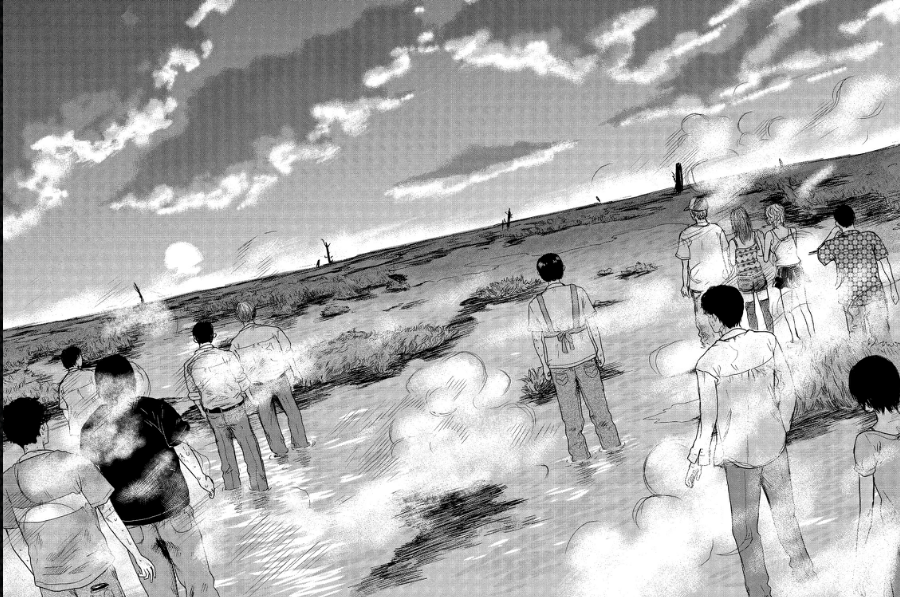
The other great drawback to Drifting Net Cafe is Oshimi’s lack of imagination. Though Oshimi is a competent draftsman, he shows little of Umezu’s flair for nightmarish imagery. Consider the way Oshimi renders the cafe’s final destination:

The wasteland, as imagined by Shuzo Oshimi in Drifting Net Cafe.

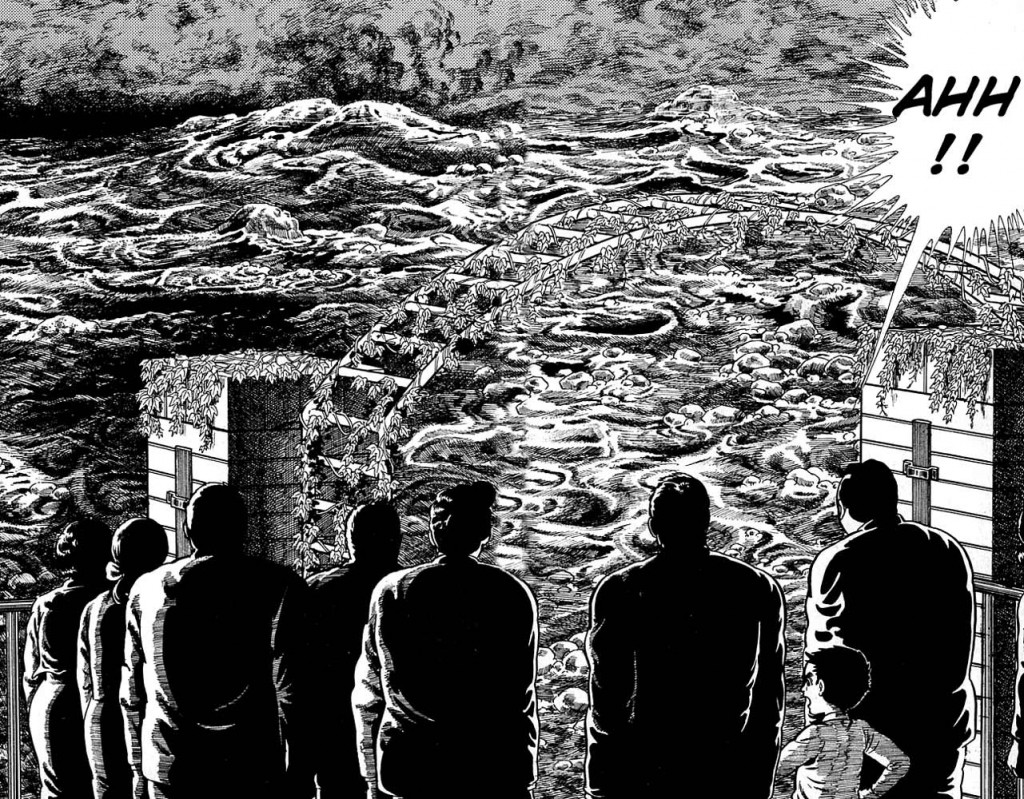
It’s not a badly composed image; Oshimi makes effective use of the tilted camera angle to convey the characters’ disorientation, and uses a few charred trees to suggest that something powerful scoured the landscape clean. When contrasted with the original version, however, it’s clear that Oshimi’s image elicits a much tidier, less emotional response than the repulsive, molten moonscape that Sho and his teachers discover just beyond the school gates:

Umezu’s vision of the wasteland, from The Drifting Classroom.

Oshimi’s monsters, too, betray his tendency to favor blandly polished imagery over inspired, if crudely rendered, boogeymen. Late in volume one of Drifting Net Cafe, for example, a creature resembling a typical Star Trek parasite attacks a female character, latching onto her thigh. It’s a memorable scene, tapping a similar vein of body-violation horror as Alien and Prometheus, but the monster’s quick defeat makes it seem more like a pretext for fanservice than a genuine menace. Umezu’s monsters, by contrast, take a variety of forms — giant insects and lizards, creepy aliens with bulbous foreheads, giant metallic serpents with grasping hands — all of which seem like the products of a feverish child’s imagination, rather than something copied from a TV show or straight-to-DVD movie.

The characters’ conflicts, too, seem smaller and less compelling than they did in Umezu’s original, which pitted Sho and his classmates against their teachers. The Drifting Classroom‘s adults quickly become deranged with grief and fear, leaving the children to fend for themselves in a hostile environment. Sho and his classmates spend several agonizing chapters struggling to accept the fact that none of the adults are in charge anymore; the students’ first attempts to defend themselves against crazed teachers and giant bugs end in catastrophe, a gruesome reminder of their misplaced trust in the adults.

In Oshimi’s version, however, all the characters are adults. They challenge one another’s leadership, squabble over resources, and indulge their worst impulses, sexual and otherwise. Though some of these scenes pack a visceral punch, most simply reinforce the idea that Toki and Tohno are the only decent folk among a group of unpleasant, self-interested urbanites — not exactly the stuff of high-stakes drama, even if one character finds himself on the business end of a pocket knife.

Where Drifting Net Cafe improves on the source material is pacing. The Drifting Classroom unfolds at a furious clip; characters are maimed or menaced in every chapter, and speak at decibel levels better suited for the Bonnaroo Music Festival than everyday conversation. Oshimi, on the other hand, varies the narrative tempo of Drifting Net Cafe: some chapters are packed with important revelations and dramatic confrontations, while others are more leisurely. These quieter chapters are among the most unnerving, however, as we watch the characters size up each others’ weaknesses, like sharks circling a wounded seal.

Though conceived as a tribute to The Drifting Classroom, Oshimi’s work is more likely to appeal to readers who haven’t read the original, or who find Umezu’s distinctive artwork dated and ugly. Long-time fans of Classroom are likely to find Oshimi’s update slick but soulless, as it relies more heavily on low-budget disaster movies than the original source material for its characters and conflicts.

DRIFTING NET CAFE, VOL. 1 • BY SHUZO OSHIMI • JMANGA • 251 pp. • RATING: MATURE (18+)

Filed Under: Manga Critic Tagged With: Drifting Classroom, JManga, Kazuo Umezu, Seinen, Shuzo Oshimi

Drifting Net Cafe, Vol. 1

June 19, 2012 by Katherine Dacey

It takes nerve — nay, stones — to update Kazuo Umezu’s bat-shit classic The Drifting Classroom. That’s exactly what Shuzo Oshimi (The Flowers of Evil) has done in Drifting Net Cafe, however, substituting a nebbishy salaryman for Sho, the original series’ twelve-year-old protagonist, and an Internet cafe for Sho’s school. The results are a decidedly mixed bag, suggesting that some texts lend themselves to revision, while others are too much the product of particular author’s imagination to warrant re-telling.

As in the original series, the story begins with a snapshot of the hero’s daily life: 29-year-old Toki has an argument with his pregnant wife, Yukie, then goes to an office job he dislikes. On impulse, he stops in an Internet cafe on his way home from work, where he bumps into Tohno, a girl he loved in middle school. The two begin comparing notes on their current lives when an earthquake plunges the building into darkness. When no one arrives to lead Toki, Tohno, and their fellow customers to safety, the group makes a terrifying discovery: the cafe has been transported from Tokyo to a wasteland from which all evidence of human civilization — roads, buildings, people — has been expunged.

To his credit, Oshimi takes enough time to establish Toki’s routine and personality for the reader to appreciate what’s at stake if Toki doesn’t find a way to return to his old life. None of the other characters, however, are fleshed out to the same degree. Yukie is portrayed as a howling grotesque, at the mercy of her hormones; Tohno is saintly and brave; and the other cafe customers are assigned one or two defining traits, depending on their gender and age. Thin characterizations are a common problem in disaster stories; authors are often reluctant to bestow too much humanity on characters who are destined to become monster food or cannon fodder, lest the audience find the story too dispiriting. Oshimi, however, takes that indifference to an extreme, creating a supporting cast of repellant, one-note characters whose comeuppance elicit cheers, not tears.

The other great drawback to Drifting Net Cafe is Oshimi’s lack of imagination. Though Oshimi is a competent draftsman, he shows little of Umezu’s flair for nightmarish imagery. Consider the way Oshimi renders the cafe’s final destination:

The wasteland, as imagined by Shuzo Oshimi in Drifting Net Cafe.

It’s not a badly composed image; Oshimi makes effective use of the tilted camera angle to convey the characters’ disorientation, and uses a few charred trees to suggest that something powerful scoured the landscape clean. When contrasted with the original version, however, it’s clear that Oshimi’s image elicits a much tidier, less emotional response than the repulsive, molten moonscape that Sho and his teachers discover just beyond the school gates:

Umezu’s vision of the wasteland, from The Drifting Classroom.

Oshimi’s monsters, too, betray his tendency to favor blandly polished imagery over inspired, if crudely rendered, boogeymen. Late in volume one of Drifting Net Cafe, for example, a creature resembling a typical Star Trek parasite attacks a female character, latching onto her thigh. It’s a memorable scene, tapping a similar vein of body-violation horror as Alien and Prometheus, but the monster’s quick defeat makes it seem more like a pretext for fanservice than a genuine menace. Umezu’s monsters, by contrast, take a variety of forms — giant insects and lizards, creepy aliens with bulbous foreheads, giant metallic serpents with grasping hands — all of which seem like the products of a feverish child’s imagination, rather than something copied from a TV show or straight-to-DVD movie.

The characters’ conflicts, too, seem smaller and less compelling than they did in Umezu’s original, which pitted Sho and his classmates against their teachers. The Drifting Classroom‘s adults quickly become deranged with grief and fear, leaving the children to fend for themselves in a hostile environment. Sho and his classmates spend several agonizing chapters struggling to accept the fact that none of the adults are in charge anymore; the students’ first attempts to defend themselves against crazed teachers and giant bugs end in catastrophe, a gruesome reminder of their misplaced trust in the adults.

In Oshimi’s version, however, all the characters are adults. They challenge one another’s leadership, squabble over resources, and indulge their worst impulses, sexual and otherwise. Though some of these scenes pack a visceral punch, most simply reinforce the idea that Toki and Tohno are the only decent folk among a group of unpleasant, self-interested urbanites — not exactly the stuff of high-stakes drama, even if one character finds himself on the business end of a pocket knife.

Where Drifting Net Cafe improves on the source material is pacing. The Drifting Classroom unfolds at a furious clip; characters are maimed or menaced in every chapter, and speak at decibel levels better suited for the Bonnaroo Music Festival than everyday conversation. Oshimi, on the other hand, varies the narrative tempo of Drifting Net Cafe: some chapters are packed with important revelations and dramatic confrontations, while others are more leisurely. These quieter chapters are among the most unnerving, however, as we watch the characters size up each others’ weaknesses, like sharks circling a wounded seal.

Though conceived as a tribute to The Drifting Classroom, Oshimi’s work is more likely to appeal to readers who haven’t read the original, or who find Umezu’s distinctive artwork dated and ugly. Long-time fans of Classroom are likely to find Oshimi’s update slick but soulless, as it relies more heavily on low-budget disaster movies than the original source material for its characters and conflicts.

DRIFTING NET CAFE, VOL. 1 • BY SHUZO OSHIMI • JMANGA • 251 pp. • RATING: MATURE (18+)

Filed Under: Manga, Manga Critic, REVIEWS Tagged With: Drifting Classroom, JManga, Kazuo Umezu, Seinen, Shuzo Oshimi

7 Essential VIZ Signature Manga

April 26, 2012 by Katherine Dacey 10 Comments

Are you an adult reader new to manga? Or a librarian who’s looking to add more graphic novels to your adult collection? Then this list is for you! The VIZ Signature imprint is one of the best resources for adults who read — or are curious about — manga. All of the Signature titles originally appeared in Japanese magazines that cater to grown-up tastes. As a result, the Signature line has broader appeal than many of VIZ’s other imprints, offering something for manga lovers who have “aged out” of Naruto as well as general interest readers who are more likely to discover a graphic novel through The New York Times than The Comics Journal.

Below, I’ve compiled a list of seven titles that best represent the VIZ Signature catalog. In choosing manga for this list, I was less concerned about identifying the “best” titles and more concerned with steering readers towards stories that resonate with their taste in movies, television, and comics. I’ve also focused on more recent series, as some of the line’s older titles — Monster, Sexy Voice and Robo, Phoenix — are out of print. Manga fans are strongly encouraged to add their recommendations in the comments section!

ALL MY DARLING DAUGHTERS

FUMI YOSHINAGA • 1 VOLUME

The five vignettes in All My Darling Daughters depict women negotiating difficult personal relationships: a daughter confronts her mother about mom’s new, much younger husband; a college student seduces her professor, only to dump him when he tries to court her properly; a beautiful young woman contemplates an arranged marriage. Like all of Yoshinaga’s work, the characters in All My Darling Daughters love to talk. That chattiness isn’t always an asset to Yoshinaga’s storytelling, but here the dialogue is perfectly calibrated to reveal just how complex and ambivalent these relationships really are. Yoshinaga’s artwork is understated but effective, as she uses small details — how a character stands or carries her shoulders — to offer a more complete and nuanced portrait of each woman. (One of my picks for Best New Manga of 2010.)

Recommended for: Readers who liked Drinking at the Movies, Dykes to Watch Out For, Make Me a Woman, and other graphic novels exploring the everyday lives of women; readers who are reluctant to commit to a multi-volume series.

BIOMEGA

TSUTOMU NIHEI • 6 VOLUMES

In this sci-fi/horror hybrid, an outbreak of a mysterious virus turns all but one resident of an island colony into zombies. Zoichi Kanoe, a corporate bounty hunter, is sent to retrieve that survivor, only to discover that she’s being guarded by a talking, gun-toting bear. Tsutomu Nihei has the artistic chops to pull off some outlandish stuff, including a rooftop chase scene that borrows a few pages from Bullitt and a spooky Martian prologue that would do John Carpenter proud. Nihei also has the good sense to exercise restraint — if one can describe an apocalyptic zombie scenario with pistol-packing grizzlies as “restrained” — revealing key bits of information only as the characters learn them. The result is a lean, fast-paced shoot-em-up that has just enough thought behind it to make it plausible but not so much that it seems ham-fistedly allegorical. (Reviewed at The Manga Critic on 2/14/10.)

Recommended for: Readers who like science fiction with elements of horror (e.g. Alien, John Carpenter’s The Thing); readers who like zombie fiction, comics, and movies.

DETROIT METAL CITY

KIMINORI WAKASUHI • 10 VOLUMES

Satirizing death metal is a bit like shooting fish in a barrel: how hard can it be to parody a style associated with bands named Cannibal Corpse or Necrophagia? Poking fun at death metal while respecting the sincerity of its followers, however, is a much more difficult trick to pull off, yet Kiminori Wakasugi does just that in Detroit Metal City, ridiculing the music — the violent lyrics, the crudely sexual theatrics — while recognizing the depth of DMC fans’ commitment to the metal lifestyle. Though the musical parodies are hilarious, the series’ funniest moments arise from classic fish-out-of-water situations: Negishi driving a tractor on his parent’s farm while dressed as alter ego Lord Krauser (complete with makeup, fright wig, and platform boots), Negishi bringing a fruit basket to a hospitalized DMC fan while dressed as Krauser… you get the idea. The series begins to run out of gas around volume six, but has the decency not to overstay its welcome. (Reviewed at The Manga Critic on 5/28/09.)

Recommended for: Readers who love musical parodies (e.g. This Is Spinal Tap, South Park, Flight of the Conchords); readers who have fond memories of attending KISS or GWAR concerts back in the day.

HOUSE OF FIVE LEAVES

NATSUME ONO • 7 VOLUMES, ONGOING (8 TOTAL)

Timid ronin Akitsu Masanosuke can’t hold a steady job, despite his formidable swordsmanship. When a businessman approaches him with work, Masanosuke readily accepts, not realizing that his new employer, Yaichi, runs a crime syndicate that specializes in kidnapping. Masanosuke’s unwitting participation in a blackmailing scheme prevents him from severing his ties to Yaichi; Masanosuke must then decide if he will join the House of Five Leaves or bide his time until he can escape. Though Toshiro Mifune and Hiroyuki Sanada have made entire careers out of playing characters like Masanosuke, Natsume Ono makes a persuasive case that you don’t need a flesh-and-blood actor to tell this kind of story with heartbreaking intensity; she can do the slow-burn on the printed page with the same skill as Masaki Kobayashi (Hara Kiri, Samurai Rebellion) and Yoji Yamada (The Twilight Samurai) did on the big screen. (Reviewed at The Manga Critic on 8/20/10.)

Recommended for: Kurosawa junkies; readers who like costume dramas; readers with an interest in Japanese history.

OISHINBO A LA CARTE

STORY BY TETSY KARIYA, ART BY HANASAKI AKIRA • 7 VOLUMES

Equal parts Iron Wok Jan, Mostly Martha, and The Manga Cookbook, this educational, entertaining series explores Japanese cuisine at its most refined — sake, seabream sashimi — and its most basic — rice, pub food. The stories fall into two categories: stories celebrating the important role of food in creating community, and stories celebrating the culinary expertise of its principal characters, newspaperman Yamaoka Shiro and his curmudgeonly father Kaibara Yuzan. (Fun fact: Yuzan is such a food snob that he drove Yamaoka’s mother to an early grave, causing an irreparable break between father and son.) Though the competition between Yamaoka and Yuzan yields some elegant, mouth-watering dishes, Oishinbo is at its best when it focuses on everyday food in everyday settings, shedding light on how the Japanese prepare everything from bean sprouts to ramen. Warning: never read on an empty stomach! (Reviewed at The Manga Critic on 6/24/09.)

Recommended for: Foodies, gourmets, and other people who like to watch the Food Network (or have daydreamed about becoming a restaurant critic); readers who enjoy The Drops of God.

REAL

TAKEHIKO INOUE • 10 VOLUMES, ONGOING

In lesser hands, REAL might have been an Afterschool Special in manga form, an earnest, uplifting story about disabled teens who find a new sense of purpose on the basketball court. Takehiko Inoue, however, steers clear of easy sentiment; his characters are tough, competitive, and profane, occasionally self-pitying, and fiercely determined to create a space for themselves that’s theirs—and theirs alone. Though the court scenes are brief (at least by shonen sports manga standards, where matches can take several volumes to unfold), Inoue captures the speed and energy of his athletes with consummate skill. A funny, honest, and sometimes rueful series that works equally well for teens and adults. (My choice for Best New Manga of 2008 at PopCultureShock; reviewed at The Manga Critic on 5/3/09.)

Recommended for: Basketball enthusiasts; readers who enjoy sports stories with a human interest angle.

20TH CENTURY BOYS

NAOKI URASAWA • 20 VOLUMES, ONGOING (24 TOTAL)

Naoki Urasawa’s 20th Century Boys tells a twisty, layered story about ordinary people saving the world from annihilation. Other auteurs have explore similar turf — Tim Kring’s Heroes comes to mind — but Urasawa manages to sustain the reader’s interest without succumbing to cliche or unduly testing our patience. The key to Urasawa’s success is strong script with vivid characters and a clear sense of purpose, reassuring the reader that all the plot strands are just that: strands, not loose threads. Crisp, detailed artwork helps sell the more ludicrous aspects of the story, and distinguish the sprawling cast from one another. (Reviewed at The Manga Critic on 1/9/10.)

Recommended for: Conspiracy theory buffs; readers who enjoy television programs that blend elements of science fiction, suspense, and paranoia (e.g. Alcatraz, Heroes, Lost).

Filed Under: Manga Critic Tagged With: Cooking and Food, Drama, fumi yoshinaga, Horror/Supernatural, Naoki Urasawa, Natsume Ono, Sci-Fi, Seinen, Sports Manga, Tsutomu Nihei, VIZ, VIZ Signature

An Introduction to the VIZ Signature Imprint

April 22, 2012 by Katherine Dacey

If TOKYOPOP was the company that first embraced the teen market, licensing Sailor Moon and bringing manga to big chain stores, then VIZ was the company that first wooed adult readers, using distinctive packaging and punchy trade names to help older manga fans distinguish stories about boy ninjas from stories about disillusioned samurai. VIZ wasn’t the only company courting older fans, of course; Dark Horse has been synonymous with manly-man manga for most of its licensing history, while TOKYOPOP made several unsuccessful forays into ladies’ comics. VIZ, however, has done more than any major American publisher to create a market for titles like Oishinbo and 20th Century Boys, seinen works that appeal equally to male and female readers in their twenties, thirties, and beyond.

One of VIZ’s first branding experiments was its short-lived Spectrum Editions line (1990-91). VIZ published three seinen titles in a prestige format with vinyl dust jackets, high-quality paper, and a large trim size. Those titles — Natsuo Sekikawa and Jiro Taniguchi’s Hotel Harbour View, Yukinobu Hoshino’s Saber Tiger, and Yu Kinutani’s Shion: Blade of the Minstrel — didn’t make much of a splash in the market, but they anticipated some of the design choices that VIZ would make with its Editor’s Choice and Signature imprints a decade later.

Another important precedent for the VIZ Signature line was PULP: The Manga Magazine. First launched in 1997, VIZ billed its monthly anthology as “manga for grownups,” and featured edgier stories than its companion magazines Animerica and Manga Vizion. Titles such as Banana Fish, Bakune Young, Dance Til Tomorrow, Even a Monkey Can Draw Manga, Short Cuts, Strain, and Uzumaki debuted in PULP before they were collected into graphic novels that bore the magazine’s name.

After struggling to find an audience, PULP was canceled in 2002. The significance of PULP wasn’t lost on its editors, however; when the magazine ceased production, they issued the following statement, summarizing their achievement:

PULP was the first English-language magazine to run the kind of manga that make comics a mass medium for ordinary adults in Japan, from dynamic action narratives to avant-garde ventures, when it debuted in December 1997… PULP offered readers a Japanese comics contrast to both the superhero genre that typifies American comics and the stereotypical “anime-esque” manga often offered to U.S. readers.

After VIZ phased out the magazine, several PULP titles — Dance Til Tomorrow, No. 5 — found a home at the newly created Editor’s Choice imprint. Like PULP, the Editor’s Choice line was designed to appeal to older readers, featuring titles such as Maison Ikkoku, Nausicaa of the Valley of the Wind, Phoenix, and Saikano. The Editor’s Choice imprint had something else in common with PULP: it was short-lived. By 2006, VIZ had rebranded the catalog with the VIZ Signature name, using it to help adult readers distinguish Naoki Urasawa’s Monster from Naruto.

In its six years of existence, the VIZ Signature line has been steadily diversifying to serve a wider audience. Speaking to Publisher’s Weekly in 2009, VIZ Managing Editor Leyla Ayker explained that one of the goals of the line was “to create a balance between the more ‘literary’ works that would appeal to readers of Western graphic novels like Fun Home or Asterios Polyp and the more ‘action’ works that would appeal to readers of American superhero comics and genre fiction.” To that end, VIZ has been licensing a mixture of highbrow titles — All My Darling Daughters, Oishinbo A La Carte, Pluto: Urasawa x Tezuka — and pulp fiction for mature readers — Black Lagoon, Biomega, Dogs: Bullets and Carnage.

The Signature line was never tied to a print magazine, but in 2009, VIZ launched an ambitious collaboration with the Japanese anthology IKKI: select IKKI titles would be serialized online, allowing North American readers to read free monthly updates of series such as I’ll Give It My All… Tomorrow and Saturn Apartments. VIZ would then publish those series as part of its Signature line, with a special logo to distinguish the IKKI titles from other Signature manga. For a year and a half, the site flourished, offering readers a mixture of new comics and feature articles: an interview with Q Hayashida (Dorohedoro), a comic drawn by one of the VIZ designers. By the end of 2011, however, regular updates to the site had ceased, prompting speculation about the future of the project.

Whatever the future of SigIKKI, the project epitomizes what the VIZ Signature line does best: publishing high-quality manga that appeal to a wide spectrum of adult readers As Leyla Aker explained to Publisher’s Weekly:

The reason why IKKI and Signature are such a good fit is because their objectives are the same: to publish series that offer a diverse range of content but that are all marked by creative excellence. Another factor is that both lines are gender-neutral, so to speak; their content is aimed at both adult men and women, which is fairly unusual for manga.

And that, in a nutshell, is the VIZ Signature imprint: 43 titles that run the gamut from kitchen-sink drama (All My Darling Daughtes, Gente: The People of Ristorante Paradiso) to horror stories (Cat-Eyed Boy, Uzumaki), sword-and-sandal epics (Vagabond), science fiction (Bokurano: Ours, Saturn Apartments), thrillers (Black Lagoon, Monster), romances (Ristorante Paradiso), mysteries (not simple, Sexy Voice and Robo), and fantasies (Dorohedoro, GoGo Monster).

N.B. VIZ began designing a new Signature website which remains unfinished as of 4/22/12. In the comments below, reader Eric Rupe notes that VIZ doesn’t seem to have made much progress on the site; links redirect the reader to an empty product page at viz.com.

* * * * *

The goal of this month’s Manga Movable Feast is to create a place where grown-ups can discuss their favorite — or least favorite — VIZ Signature manga. Anyone can contribute: all you need to do is send me a link to an essay, podcast, or review about a VIZ Signature title, and I’ll feature it in one of my daily round-ups. (Email or Twitter are the best way to submit links; Twitter submissions should be directed to @manga_critic.) Note that the feast runs from today (Sunday, April 22nd) through Saturday (April 28th). For more information, please visit the VIZ Signature MMF archive.

Filed Under: Manga, Manga Critic Tagged With: Manga Movable Feast, Seinen, SigIKKI, VIZ, VIZ Signature

MMF: An Introduction to the VIZ Signature Imprint

April 22, 2012 by Katherine Dacey 15 Comments

If TOKYOPOP was the company that first embraced the teen market, licensing Sailor Moon and bringing manga to big chain stores, then VIZ was the company that first wooed adult readers, using distinctive packaging and punchy trade names to help older manga fans distinguish stories about boy ninjas from stories about disillusioned samurai. VIZ wasn’t the only company courting older fans, of course; Dark Horse has been synonymous with manly-man manga for most of its licensing history, while TOKYOPOP made several unsuccessful forays into ladies’ comics. VIZ, however, has done more than any major American publisher to create a market for titles like Oishinbo and 20th Century Boys, seinen works that appeal equally to male and female readers in their twenties, thirties, and beyond.

One of VIZ’s first branding experiments was its short-lived Spectrum Editions line (1990-91). VIZ published three seinen titles in a prestige format with vinyl dust jackets, high-quality paper, and a large trim size. Those titles — Natsuo Sekikawa and Jiro Taniguchi’s Hotel Harbour View, Yukinobu Hoshino’s Saber Tiger, and Yu Kinutani’s Shion: Blade of the Minstrel — didn’t make much of a splash in the market, but they anticipated some of the design choices that VIZ would make with its Editor’s Choice and Signature imprints a decade later.

Another important precedent for the VIZ Signature line was PULP: The Manga Magazine. First launched in 1997, VIZ billed its monthly anthology as “manga for grownups,” and featured edgier stories than its companion magazines Animerica and Manga Vizion. Titles such as Banana Fish, Bakune Young, Dance Til Tomorrow, Even a Monkey Can Draw Manga, Short Cuts, Strain, and Uzumaki debuted in PULP before they were collected into graphic novels that bore the magazine’s name.

After struggling to find an audience, PULP was canceled in 2002. The significance of PULP wasn’t lost on its editors, however; when the magazine ceased production, they issued the following statement, summarizing their achievement:

PULP was the first English-language magazine to run the kind of manga that make comics a mass medium for ordinary adults in Japan, from dynamic action narratives to avant-garde ventures, when it debuted in December 1997… PULP offered readers a Japanese comics contrast to both the superhero genre that typifies American comics and the stereotypical “anime-esque” manga often offered to U.S. readers.

After VIZ phased out the magazine, several PULP titles — Dance Til Tomorrow, No. 5 — found a home at the newly created Editor’s Choice imprint. Like PULP, the Editor’s Choice line was designed to appeal to older readers, featuring titles such as Maison Ikkoku, Nausicaa of the Valley of the Wind, Phoenix, and Saikano. The Editor’s Choice imprint had something else in common with PULP: it was short-lived. By 2006, VIZ had rebranded the catalog with the VIZ Signature name, using it to help adult readers distinguish Naoki Urasawa’s Monster from Naruto.

In its six years of existence, the VIZ Signature line has been steadily diversifying to serve a wider audience. Speaking to Publisher’s Weekly in 2009, VIZ Managing Editor Leyla Ayker explained that one of the goals of the line was “to create a balance between the more ‘literary’ works that would appeal to readers of Western graphic novels like Fun Home or Asterios Polyp and the more ‘action’ works that would appeal to readers of American superhero comics and genre fiction.” To that end, VIZ has been licensing a mixture of highbrow titles — All My Darling Daughters, Oishinbo A La Carte, Pluto: Urasawa x Tezuka — and pulp fiction for mature readers — Black Lagoon, Biomega, Dogs: Bullets and Carnage.

The Signature line was never tied to a print magazine, but in 2009, VIZ launched an ambitious collaboration with the Japanese anthology IKKI: select IKKI titles would be serialized online, allowing North American readers to read free monthly updates of series such as I’ll Give It My All… Tomorrow and Saturn Apartments. VIZ would then publish those series as part of its Signature line, with a special logo to distinguish the IKKI titles from other Signature manga. For a year and a half, the site flourished, offering readers a mixture of new comics and feature articles: an interview with Q Hayashida (Dorohedoro), a comic drawn by one of the VIZ designers. By the end of 2011, however, regular updates to the site had ceased, prompting speculation about the future of the project.

Whatever the future of SigIKKI, the project epitomizes what the VIZ Signature line does best: publishing high-quality manga that appeal to a wide spectrum of adult readers As Leyla Aker explained to Publisher’s Weekly:

The reason why IKKI and Signature are such a good fit is because their objectives are the same: to publish series that offer a diverse range of content but that are all marked by creative excellence. Another factor is that both lines are gender-neutral, so to speak; their content is aimed at both adult men and women, which is fairly unusual for manga.

And that, in a nutshell, is the VIZ Signature imprint: 43 titles that run the gamut from kitchen-sink drama (All My Darling Daughtes, Gente: The People of Ristorante Paradiso) to horror stories (Cat-Eyed Boy, Uzumaki), sword-and-sandal epics (Vagabond), science fiction (Bokurano: Ours, Saturn Apartments), thrillers (Black Lagoon, Monster), romances (Ristorante Paradiso), mysteries (not simple, Sexy Voice and Robo), and fantasies (Dorohedoro, GoGo Monster).

N.B. VIZ began designing a new Signature website which remains unfinished as of 4/22/12. In the comments below, reader Eric Rupe notes that VIZ doesn’t seem to have made much progress on the site; links redirect the reader to an empty product page at viz.com.

* * * * *

The goal of this month’s Manga Movable Feast is to create a place where grown-ups can discuss their favorite — or least favorite — VIZ Signature manga. Anyone can contribute: all you need to do is send me a link to an essay, podcast, or review about a VIZ Signature title, and I’ll feature it in one of my daily round-ups. (Email or Twitter are the best way to submit links; Twitter submissions should be directed to @manga_critic.) Note that the feast runs from today (Sunday, April 22nd) through Saturday (April 28th). For more information, please visit the VIZ Signature MMF archive.

Filed Under: Manga Critic Tagged With: Manga Movable Feast, Seinen, SigIKKI, VIZ, VIZ Signature

The Best Manga You’re Not Reading: Benkei in New York

March 20, 2012 by Katherine Dacey

I’ve always thought that I had something in common with Warren Ellis — besides a sailor’s fondness for colorful language, that is — and reading Benkei in New York confirmed my suspicions: we both like Jiro Taniguchi. Flip to the back cover of the VIZ Pulp edition, and you’ll see Ellis declaring that “Benkei is better than 96% of the crime fiction coming out of America right now.” I have no idea how he arrived at that figure, but eleven years after Benkei’s initial US release, I’m still inclined to agree with him.

Originally serialized in Big Comic Original, Benkei in New York (1991-96) is a collaboration between Taniguchi and writer Jinpachi Mori, best known in Japan for Kasai no Hito, a long-running manga about an eccentric but wise judge. The seven Benkei stories focus on a Japanese ex-pat living in New York. Like many New Yorkers, Benkei’s career is best characterized by slashes and hyphens: he’s a bartender-art forger-hitman who can paint a Millet from memory or assassinate a thug using a swordfish. (Let’s just say they call it “swordfish” for a reason.)

Benkei’s primary job, however, is seeking poetic justice for murder victims’ families. Of course, there wouldn’t be much of a story if Benkei simply used a gun; part of the series’ allure is watching him set elaborate traps for his prey, whether he’s borrowing a page from the Titus Andronicus playbook or using a grappling hook to wound an unscrupulous dockworker. In “Haggis,” for example, Benkei uses a draft-dodger’s memories of a 1968 trip to Scotland to win the man’s confidence, persuading him to visit an out-of-the-way bar where a gruesome dish awaits him. “Throw Back,” another stand-out, culminates in an elaborate showdown in the American Music of Natural History that gives new meaning to the phrase “interactive exhibits”; Benkei and his victim plunder display cases for weapons, dueling their way through the Hall of Human Origins.

As the scene in the Natural History Museum suggests, New York City is as much a “character” as Benkei himself. Taniguchi clearly spent hours poring over photographs of the city: his rendition of Coney Island, for example, doesn’t just show the Cyclone — an easy symbol for this iconic stretch of New York coastline — but all the bathhouses, apartment buildings, and other structures that line the boardwalk, including the distinctive facade of the New York Aquarium. Moreover, he captures the feeling of Coney Island in the off-season — the dark grey color of the ocean, the empty expanses of boardwalk, the absence of people — imbuing the scene with a melancholy authenticity.

Taniguchi’s eye for detail is evident in his busier scenes as well. In the opening pages of “Throw Back,” Benkei pursues his mark through the 42nd Street subway station. A series of narrow, horizontal panels convey the bustling energy of the platform, cross-cutting between a busker pounding on plastic drums (a subway fixture in the 1990s) and Benkei threading his way through the commuters. Taniguchi swiftly pulls back from extreme close-ups of the the drummer and Benkei to crowd scenes, in so doing helping us see this claustrophobic, noisy space as Benkei does: camouflage for the urban hunter.

Like many VIZ manga from the 1990s and early 2000s, Benkei in New York boasts a stylish translation. (Yuji Oniki is credited as the adapter.) The script crackles with wit and energy, as Benkei trades one-liners with clients and targets alike. One of my favorite exchanges occurs early in the volume, as Benkei talks business with the leader of an art forgery ring:

Forger: Timing is of crucial importance. Once we agree on a deal, it’s our responsibility to deliver the product to the client while they’re still drooling.
Benkei: You sound like you run a pizza joint.
Forger: What’s wrong with that? Selling pizzas is how I learned everything about New York.

Hokey as that conversation may be, it wouldn’t be out of place in a gangster flick; one could almost imagine a character in Goodfellas or The Godfather reminiscing about his past in a similar fashion.

If Benkei’s motives and methods are sometimes inscrutable — or downright illogical — the stories still work beautifully, with crack pacing and memorable denouements that can be as deeply unsettling as they are emotionally satisfying — or, in Warren Ellis’ words, Benkei in New York is “diabolically well-told.” Couldn’t have said it better myself.

BENKEI IN NEW YORK • STORY BY JINPACHI MORI AND ART BY JIRO TANIGUCHI • VIZ • 224 pp. • RATING: MATURE (18+)

Filed Under: Manga, Manga Critic, Recommended Reading, REVIEWS Tagged With: Jinpachi Mori, Jiro Taniguchi, Noir, Seinen

The Best Manga You’re Not Reading: Benkei in New York

March 20, 2012 by Katherine Dacey 11 Comments

I’ve always thought that I had something in common with Warren Ellis — besides a sailor’s fondness for colorful language, that is — and reading Benkei in New York confirmed my suspicions: we both like Jiro Taniguchi. Flip to the back cover of the VIZ Pulp edition, and you’ll see Ellis declaring that “Benkei is better than 96% of the crime fiction coming out of America right now.” I have no idea how he arrived at that figure, but eleven years after Benkei’s initial US release, I’m still inclined to agree with him.

Originally serialized in Big Comic Original, Benkei in New York (1991-96) is a collaboration between Taniguchi and writer Jinpachi Mori, best known in Japan for Kasai no Hito, a long-running manga about an eccentric but wise judge. The seven Benkei stories focus on a Japanese ex-pat living in New York. Like many New Yorkers, Benkei’s career is best characterized by slashes and hyphens: he’s a bartender-art forger-hitman who can paint a Millet from memory or assassinate a thug using a swordfish. (Let’s just say they call it “swordfish” for a reason.)

Benkei’s primary job, however, is seeking poetic justice for murder victims’ families. Of course, there wouldn’t be much of a story if Benkei simply used a gun; part of the series’ allure is watching him set elaborate traps for his prey, whether he’s borrowing a page from the Titus Andronicus playbook or using a grappling hook to wound an unscrupulous dockworker. In “Haggis,” for example, Benkei uses a draft-dodger’s memories of a 1968 trip to Scotland to win the man’s confidence, persuading him to visit an out-of-the-way bar where a gruesome dish awaits him. “Throw Back,” another stand-out, culminates in an elaborate showdown in the American Music of Natural History that gives new meaning to the phrase “interactive exhibits”; Benkei and his victim plunder display cases for weapons, dueling their way through the Hall of Human Origins.

As the scene in the Natural History Museum suggests, New York City is as much a “character” as Benkei himself. Taniguchi clearly spent hours poring over photographs of the city: his rendition of Coney Island, for example, doesn’t just show the Cyclone — an easy symbol for this iconic stretch of New York coastline — but all the bathhouses, apartment buildings, and other structures that line the boardwalk, including the distinctive facade of the New York Aquarium. Moreover, he captures the feeling of Coney Island in the off-season — the dark grey color of the ocean, the empty expanses of boardwalk, the absence of people — imbuing the scene with a melancholy authenticity.

Taniguchi’s eye for detail is evident in his busier scenes as well. In the opening pages of “Throw Back,” Benkei pursues his mark through the 42nd Street subway station. A series of narrow, horizontal panels convey the bustling energy of the platform, cross-cutting between a busker pounding on plastic drums (a subway fixture in the 1990s) and Benkei threading his way through the commuters. Taniguchi swiftly pulls back from extreme close-ups of the the drummer and Benkei to crowd scenes, in so doing helping us see this claustrophobic, noisy space as Benkei does: camouflage for the urban hunter.

Like many VIZ manga from the 1990s and early 2000s, Benkei in New York boasts a stylish translation. (Yuji Oniki is credited as the adapter.) The script crackles with wit and energy, as Benkei trades one-liners with clients and targets alike. One of my favorite exchanges occurs early in the volume, as Benkei talks business with the leader of an art forgery ring:

Forger: Timing is of crucial importance. Once we agree on a deal, it’s our responsibility to deliver the product to the client while they’re still drooling.
Benkei: You sound like you run a pizza joint.
Forger: What’s wrong with that? Selling pizzas is how I learned everything about New York.

Hokey as that conversation may be, it wouldn’t be out of place in a gangster flick; one could almost imagine a character in Goodfellas or The Godfather reminiscing about his past in a similar fashion.

If Benkei’s motives and methods are sometimes inscrutable — or downright illogical — the stories still work beautifully, with crack pacing and memorable denouements that can be as deeply unsettling as they are emotionally satisfying — or, in Warren Ellis’ words, Benkei in New York is “diabolically well-told.” Couldn’t have said it better myself.

BENKEI IN NEW YORK • STORY BY JINPACHI MORI AND ART BY JIRO TANIGUCHI • VIZ • 224 pp. • RATING: MATURE (18+)

Filed Under: Manga Critic Tagged With: Jinpachi Mori, Jiro Taniguchi, Noir, Seinen

Drifters, Vol. 1

February 14, 2012 by Katherine Dacey

Back in the 1980s — the heyday of Dolph Lundgren, Arnold Schwarzenegger, and Sylvester Stallone — Hollywood cranked out a stream of mediocre but massively entertaining B-movies in which a man with a freakishly muscular physique and a granite jaw battled the Forces of Evil, dispatching villains with a catch-phrase and a lethal weapon. I don’t know if Kohta Hirano ever watched Predator or Red Scorpion, but Drifters reads like the first draft of a truly awesome eighties movie, complete with a trademark phrase — “Say farewell to your head!” — and a simple but effective premise that promises lots of silly, over-the-top fight scenes.

The Dolph Lundgren character — if I might be allowed to call him that — is Shimazu Toyohisa, a Satsuma warrior facing long odds at the Battle of Sekigahara (1600). Just as Shimazu’s death seems imminent, he finds himself transported to an alternate dimension, one in which mankind’s greatest warriors — Hannibal, Nobunaga Oda, Joan of Arc — have been assembled for an elaborate game. The purpose and rules of the game remain elusive, but the primary objective seems to be mass destruction: the game’s organizer unleashes hordes of ghouls and dragons on Shimazu and his allies, in the process laying waste to cities, forts, and crops.

Like all good Schwarzenegger or Stallone vehicles, Drifters makes a few token gestures towards subplot and world-building. Shimazu helps a group of elves resist their oppressors, for example, teaching them the manly art of standing up for themselves. Hirano provides so little explanation for the elves’ marginalized status, however, that the entire episode registers as a stalling tactic for the climatic battle at volume one’s end, a half-hearted effort to show us that however unhinged or deadly Shimazu may be, he knows injustice when he sees it.

Drifters’ other shortcoming is the artwork. Hirano’s clumsy character designs make the entire cast look like Picasso’s Les Demoiselles d’Avignon, with huge, sunken eyes, large, triangular noses, and blocky torsos. Though one might reasonably argue that Picasso’s bodily distortions were a deliberate aesthetic choice, it’s harder to make the same case for Hirano’s work; his characters’ mitt-like hands and poorly executed profiles suggest a poor command of perspective, rather than an artistic challenge to it.

Hirano’s action scenes suffer from an entirely different problem: they’re riotously busy, bursting at the seams with too many figures, monsters, and weapons, overwhelming the eye with visual information. One could be forgiven for thinking that Hirano was trying to out-do Peter Jackson; not since Sauron flattened the forces of Middle Earth have so many warriors and monsters been assembled in one scene to less effect. Looking at the opening chapter, however, it’s clear than Hirano can stage a credible battle scene when he wants to: he depicts the Battle of Sekigahara as a churning mass of horses, samurai, and swords, effectively capturing the confusion and claustrophobia of medieval combat. Once dragons and orcs enter the picture, however, the action scenes begin to lose their urgency and coherence, substituting the terrible immediacy of hand-to-hand fighting for larger, noisier air battles where the stakes are less clearly defined.

It’s a pity that Drifters is so relentless, as the story certainly has the potential to be a guilty pleasure; what’s not to like about a manga in which Japan’s greatest feudal warriors fight alongside Hannibal, Joan of Arc, and elves? What Hirano needs is a little restraint: when the story is cranked up to eleven from the very beginning, the cumulative effective is deafening, making it difficult for the reader to hear the endearingly cheesy dialogue above the clank of swords and explosions. And if there’s anything I learned from watching old chestnuts like Commando, it’s that even the most testosterone-fueled script needs to pause long enough for the hero to utter his catch phrase.

DRIFTERS, VOL. 1 • BY KOHTA HIRANO • DARK HORSE • 208 pp.  RATING: OLDER TEEN

Filed Under: Manga, Manga Critic, REVIEWS Tagged With: Dark Horse, Fantasy, Kohta Hirano, Seinen

Drifters, Vol. 1

February 14, 2012 by Katherine Dacey 12 Comments

Back in the 1980s — the heyday of Dolph Lundgren, Arnold Schwarzenegger, and Sylvester Stallone — Hollywood cranked out a stream of mediocre but massively entertaining B-movies in which a man with a freakishly muscular physique and a granite jaw battled the Forces of Evil, dispatching villains with a catch-phrase and a lethal weapon. I don’t know if Kohta Hirano ever watched Predator or Red Scorpion, but Drifters reads like the first draft of a truly awesome eighties movie, complete with a trademark phrase — “Say farewell to your head!” — and a simple but effective premise that promises lots of silly, over-the-top fight scenes.

The Dolph Lundgren character — if I might be allowed to call him that — is Shimazu Toyohisa, a Satsuma warrior facing long odds at the Battle of Sekigahara (1600). Just as Shimazu’s death seems imminent, he finds himself transported to an alternate dimension, one in which mankind’s greatest warriors — Hannibal, Nobunaga Oda, Joan of Arc — have been assembled for an elaborate game. The purpose and rules of the game remain elusive, but the primary objective seems to be mass destruction: the game’s organizer unleashes hordes of ghouls and dragons on Shimazu and his allies, in the process laying waste to cities, forts, and crops.

Like all good Schwarzenegger or Stallone vehicles, Drifters makes a few token gestures towards subplot and world-building. Shimazu helps a group of elves resist their oppressors, for example, teaching them the manly art of standing up for themselves. Hirano provides so little explanation for the elves’ marginalized status, however, that the entire episode registers as a stalling tactic for the climatic battle at volume one’s end, a half-hearted effort to show us that however unhinged or deadly Shimazu may be, he knows injustice when he sees it.

Drifters’ other shortcoming is the artwork. Hirano’s clumsy character designs make the entire cast look like Picasso’s Les Demoiselles d’Avignon, with huge, sunken eyes, large, triangular noses, and blocky torsos. Though one might reasonably argue that Picasso’s bodily distortions were a deliberate aesthetic choice, it’s harder to make the same case for Hirano’s work; his characters’ mitt-like hands and poorly executed profiles suggest a poor command of perspective, rather than an artistic challenge to it.

Hirano’s action scenes suffer from an entirely different problem: they’re riotously busy, bursting at the seams with too many figures, monsters, and weapons, overwhelming the eye with visual information. One could be forgiven for thinking that Hirano was trying to out-do Peter Jackson; not since Sauron flattened the forces of Middle Earth have so many warriors and monsters been assembled in one scene to less effect. Looking at the opening chapter, however, it’s clear than Hirano can stage a credible battle scene when he wants to: he depicts the Battle of Sekigahara as a churning mass of horses, samurai, and swords, effectively capturing the confusion and claustrophobia of medieval combat. Once dragons and orcs enter the picture, however, the action scenes begin to lose their urgency and coherence, substituting the terrible immediacy of hand-to-hand fighting for larger, noisier air battles where the stakes are less clearly defined.

It’s a pity that Drifters is so relentless, as the story certainly has the potential to be a guilty pleasure; what’s not to like about a manga in which Japan’s greatest feudal warriors fight alongside Hannibal, Joan of Arc, and elves? What Hirano needs is a little restraint: when the story is cranked up to eleven from the very beginning, the cumulative effective is deafening, making it difficult for the reader to hear the endearingly cheesy dialogue above the clank of swords and explosions. And if there’s anything I learned from watching old chestnuts like Commando, it’s that even the most testosterone-fueled script needs to pause long enough for the hero to utter his catch phrase.

DRIFTERS, VOL. 1 • BY KOHTA HIRANO • DARK HORSE • 208 pp.  RATING: OLDER TEEN

Filed Under: Manga Critic Tagged With: Dark Horse, Fantasy, Kohta Hirano, Seinen

Stargazing Dog

December 23, 2011 by Katherine Dacey

Few things can reduce me to a puddle of tears as quickly as a dog story, especially if the canine subject is lost, abused, or sacrificed for the well-being of his owner. Yet for all my sentimentality, I am particular about my dog stories. Too often, authors allow extreme displays of loyalty or mischievousness to stand in for a thoughtful portrayal of the dog’s own personality; the author is so intent on showing the redemptive power of canine ownership that the ostensible subject of the book feels more like a walking metaphor than an actual presence in the narrative.

Takashi Murakami largely avoids this trap in Stargazing Dog by granting his canine protagonist a voice. In less capable hands, Happie’s narration might be precious or manipulative, prompting the reader to feel unearned sympathy for him. Murakami, however, finds just the right words for Happie, expressing his point of view with a simplicity and directness that seem appropriate for a dog.

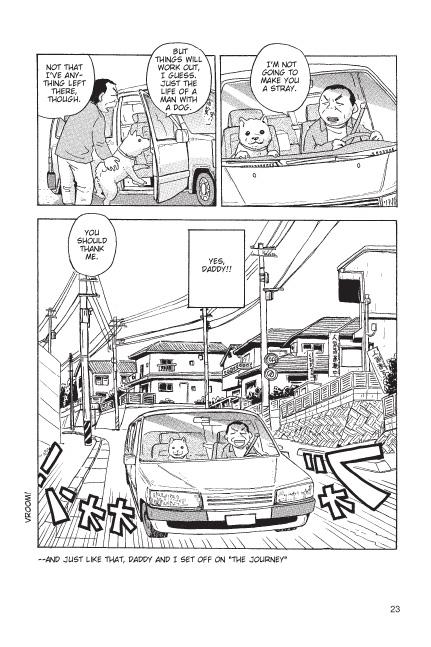
Early in Stargazing Dog, Happie forms a strong attachment to a character identified only as “Daddy,” a father who gradually becomes estranged from his wife and teenage daughter. With the dissolution of his family, Daddy packs Happie and a few possessions in his car, and begins driving towards the sea. The outcome of their journey is never in doubt — we learn Happie and Daddy’s fate in the very opening pages of the book — yet Murakami draws the reader into the story with a nuanced depiction of the master-dog relationship.

Daddy and Happie take to the road.

Murakami has two fundamental insights into that dynamic. The first is routine: Happie’s devotion to Daddy stems from many hours of walking, sitting, and eating together. These rituals consume Happie’s thoughts until the very end of the story; Happie eagerly anticipates their daily walks, adapting to changes in Daddy’s schedule with heartbreaking alacrity. (“We used to go for a walk in the evening,” Happie observes. “These days, Daddy takes me out in the daytime.”)

The second is communication: though Happie and Daddy clearly share a special emotional connection, there’s a fundamental gap between them that can’t be bridged. Happie never fully grasps what’s happening to him and his master, perceiving the changes in their routine without understanding their cause. Daddy, for his part, never acknowledges the degree to which he views Happie as an extension of himself; as his circumstances deteriorate, he continues to rely on Happie for companionship, putting his own emotional needs before the dog’s.

Murakami never romanticizes Happie and Daddy’s relationship, though he honors the sincerity and warmth of their bond. The roughness of the art — the human characters’ clumsy hands and round heads, the crude use of perspective — further inoculates the story against mawkishness, while the exaggerated facial expressions and child-like rendering of space and objects echo the naivete of Happie’s narration. Only a few poorly chosen fonts and backwards signs mar the design, reminding the reader that the artwork has been flipped for English-speaking audiences.

Perhaps the best compliment I can pay Murakami is to acknowledge just how much Stargazing Dog moved me. Not in a cheap, dog-in-peril sort of way, but in the same way that Vittorio de Sica’s Umberto D. touched me: as a beautiful meditation on the human-canine bond, one that acknowledges the complexity and inequality of that relationship, as well its enduring power. One of 2011’s best new manga.

STARGAZING DOG • BY TAKASHI MURAKAMI • NBM/COMICSLIT • 128 pp. • NO RATING

Filed Under: Manga, Manga Critic, REVIEWS Tagged With: Animals, NBM/Comics Lit, Seinen

Stargazing Dog

December 23, 2011 by Katherine Dacey 8 Comments

Few things can reduce me to a puddle of tears as quickly as a dog story, especially if the canine subject is lost, abused, or sacrificed for the well-being of his owner. Yet for all my sentimentality, I am particular about my dog stories. Too often, authors allow extreme displays of loyalty or mischievousness to stand in for a thoughtful portrayal of the dog’s own personality; the author is so intent on showing the redemptive power of canine ownership that the ostensible subject of the book feels more like a walking metaphor than an actual presence in the narrative.

Takashi Murakami largely avoids this trap in Stargazing Dog by granting his canine protagonist a voice. In less capable hands, Happie’s narration might be precious or manipulative, prompting the reader to feel unearned sympathy for him. Murakami, however, finds just the right words for Happie, expressing his point of view with a simplicity and directness that seem appropriate for a dog.

Early in Stargazing Dog, Happie forms a strong attachment to a character identified only as “Daddy,” a father who gradually becomes estranged from his wife and teenage daughter. With the dissolution of his family, Daddy packs Happie and a few possessions in his car, and begins driving towards the sea. The outcome of their journey is never in doubt — we learn Happie and Daddy’s fate in the very opening pages of the book — yet Murakami draws the reader into the story with a nuanced depiction of the master-dog relationship.

Daddy and Happie take to the road.

Murakami has two fundamental insights into that dynamic. The first is routine: Happie’s devotion to Daddy stems from many hours of walking, sitting, and eating together. These rituals consume Happie’s thoughts until the very end of the story; Happie eagerly anticipates their daily walks, adapting to changes in Daddy’s schedule with heartbreaking alacrity. (“We used to go for a walk in the evening,” Happie observes. “These days, Daddy takes me out in the daytime.”)

The second is communication: though Happie and Daddy clearly share a special emotional connection, there’s a fundamental gap between them that can’t be bridged. Happie never fully grasps what’s happening to him and his master, perceiving the changes in their routine without understanding their cause. Daddy, for his part, never acknowledges the degree to which he views Happie as an extension of himself; as his circumstances deteriorate, he continues to rely on Happie for companionship, putting his own emotional needs before the dog’s.

Murakami never romanticizes Happie and Daddy’s relationship, though he honors the sincerity and warmth of their bond. The roughness of the art — the human characters’ clumsy hands and round heads, the crude use of perspective — further inoculates the story against mawkishness, while the exaggerated facial expressions and child-like rendering of space and objects echo the naivete of Happie’s narration. Only a few poorly chosen fonts and backwards signs mar the design, reminding the reader that the artwork has been flipped for English-speaking audiences.

Perhaps the best compliment I can pay Murakami is to acknowledge just how much Stargazing Dog moved me. Not in a cheap, dog-in-peril sort of way, but in the same way that Vittorio de Sica’s Umberto D. touched me: as a beautiful meditation on the human-canine bond, one that acknowledges the complexity and inequality of that relationship, as well its enduring power. One of 2011’s best new manga.

STARGAZING DOG • BY TAKASHI MURAKAMI • NBM/COMICSLIT • 128 pp. • NO RATING

Filed Under: Manga Critic Tagged With: Animals, NBM/Comics Lit, Seinen

The Drops of God, Vols. 1-2

December 16, 2011 by Katherine Dacey

Reading The Drops of God is like drinking a good table wine: the flavor may not be as complex as a finely aged varietal, but it goes down easily, leaving a pleasant aftertaste of melodrama, intrigue, and romance.

Like Oishinbo, the manga it most closely resembles, The Drops of God revolves around a slightly preposterous contest between a father and son. Kanazaki Yutaka, a revered wine critic, dies unexpectedly, leaving behind a will that’s a much a gauntlet as it is a set of instructions for his son: Shizuku will inherit Yutaka’s wine collection, but only if Shizuku can identify the thirteen different wines mentioned in his father’s will.

To complete his task, Shizuku must overcome several serious handicaps, not the least of which is his own lack of experience buying and drinking wine. (At the start of the series, Shizuku is a junior sales executive at a beer distributor, proudly eschewing wine for ale.) Adding special urgency to his quest is a rival, Tomine Issei, a handsome young wine critic who was adopted by Shizuku’s father. If Issei successfully names the “Twelve Apostles” and the “Drops of God” before Shizuku, Issei will inherit the entire collection.

No manga cliche goes unturned in the opening chapters. The brash Shizuku has never so much as drunk a glass of wine, but resolves to do his best to defeat Issei. Shizuku’s ability to win that contest is never really in doubt, however: from the very first pages of the story, Shizuku demonstrates a discerning palate, wowing oenophiles and greenhorns alike with his ability to recognize great wines. In his first showdown with Issei, for example, Shizuku correctly identifies the age, varietal, and origin of a wine even though his only exposure to that particular grape came from eating a handful of them as a child. (Top that, Robert Parker!)

Also disappointing is the portrayal of Shizuku’s partner-in-wine-tasting, Miyabi Shinohara, an aspiring sommelier. Though other characters praise Miyabi for her book knowledge of wine, she rarely has an opportunity to shine in her role as the expert on viniculture; Miyabi’s primary function is to recite each wine’s provenance in detail, allowing Shizuku the more entertaining role of waxing poetic about the wine’s flavor. Throughout volumes one and two, Shizuku frequently upstages Miyabi, even when Miyabi’s professional experience ought to afford her greater insight into an appropriate wine-food pairing, or lead her towards an inexpensive but sophisticated French import.

Yet for all the creaky plot mechanics and broad-brush characterizations, The Drops of God proves surprisingly fun, thanks to the author’s imaginative attempts to describe the flavor of particular wines. Early in volume one, for example, one character likens a a 2001 Chateau Mont-Perac to Freddie Mercury’s singing—an odd but inspired choice, as Mercury’s voice is one of the most distinctive rock-n-roll sounds of the last forty years, a piercing, operatic instrument that’s immediately recognizable, even to the untrained ear. The fact that the artist’s rendering of Mercury looks nothing like him is beside the point; the comparison alone is enough to instill in the reader a sense of how visceral and distinctive the Mont-Perac’s flavor is.

The other thing that prevents The Drops of God from sinking under the weight of hackneyed story elements are the supporting characters. Tadashi Agi (actually a pseudonym for the brother-sister writing team of Shin and Yuko Kibayashi) populates the story with mustache-twirling villains, oddball oenophiles, and opinionated co-workers, each of whom leaves a vivid impression. One of the most appealing is Chosuke Honma, a member of the Wine Division at Taiyo Beer. Though drawn in bold strokes, Chosuke seems like a real person — a wine enthusiast who firmly believes that Italy, not France, produces the world’s best wines, and who frequently bursts into song. (His tune of choice: “O sole mio,” of course!) Chosuke’s passion, temper, and obsession with Italian culture — not to mention his receding hairline — make him a great foil for the ridiculously perfect Shizuku, whose movie-star looks, charming personality, and superior ability to identify great wines make him more a fantasy figure than a real character.

Artistically, The Drops of God is a feast for the eyes. Shu Okimoto’s characters are beautifully rendered, making the numerous scenes of characters discussing wine something to savor, rather than something to be endured. Okimoto also does a terrific job of translating terroir into imagery, transporting the reader from Japan to Europe with crisp, evocative drawings of French vineyards; the reader can practically smell the soil and the ripening fruit. Most importantly, Okimoto finds creative ways to suggest the complexity of a good wine, using vivid imagery —  a field of sunflowers, a masquerade party — to suggest how the “nose” of a wine sparks strong associations with events, places, and people.

Long-time manga readers won’t be surprised to learn that The Drops of God is an entertaining way to learn about wine; as titles such as Oishinbo and Not Love But Delicious Foods Make Me So Happy! demonstrate, a skilled writer can fold a considerable amount of educational detail into a story without reducing it to a textbook. Manga newbies or readers looking for a good introduction to wine terminology will find Drops a revelation, however, as it imparts highly specialized information with the same natural ease that Law & Order illustrates the inner workings of a crime investigation, while at the same time functioning as a fun soap opera; even if the reader isn’t the least bit interested in wine, Shizuku’s quest for the “Drops of God” is an irresistible hook. Highly recommended.

THE DROPS OF GOD, VOLS. 1-2 • WRITTEN BY TADASHI AGI, ILLUSTRATED BY SHU OKIMOTO • VERTICAL, INC.

Filed Under: Manga, Manga Critic, REVIEWS Tagged With: Seinen, The Drops of God, vertical, wine

The Drops of God, Vols. 1-2

December 16, 2011 by Katherine Dacey 7 Comments

Reading The Drops of God is like drinking a good table wine: the flavor may not be as complex as a finely aged varietal, but it goes down easily, leaving a pleasant aftertaste of melodrama, intrigue, and romance.

Like Oishinbo, the manga it most closely resembles, The Drops of God revolves around a slightly preposterous contest between a father and son. Kanazaki Yutaka, a revered wine critic, dies unexpectedly, leaving behind a will that’s a much a gauntlet as it is a set of instructions for his son: Shizuku will inherit Yutaka’s wine collection, but only if Shizuku can identify the thirteen different wines mentioned in his father’s will.

To complete his task, Shizuku must overcome several serious handicaps, not the least of which is his own lack of experience buying and drinking wine. (At the start of the series, Shizuku is a junior sales executive at a beer distributor, proudly eschewing wine for ale.) Adding special urgency to his quest is a rival, Tomine Issei, a handsome young wine critic who was adopted by Shizuku’s father. If Issei successfully names the “Twelve Apostles” and the “Drops of God” before Shizuku, Issei will inherit the entire collection….

Read More

Filed Under: Manga Critic Tagged With: Seinen, The Drops of God, vertical, wine

  • « Go to Previous Page
  • Page 1
  • Page 2
  • Page 3
  • Page 4
  • Interim pages omitted …
  • Page 7
  • Go to Next Page »
 | Log in
Copyright © 2010 Manga Bookshelf | Powered by WordPress & the Genesis Framework