The ocean occupies a special place in the artistic imagination, inspiring a mixture of awe, terror, and fascination. Watson and the Shark, for example, depicts the ocean as the mouth of Hell, a dark void filled with demons and tormented souls, while The Birth of Venus offers a more benign vision of the ocean as a life-giving force. In Children of the Sea, Daisuke Igarashi imagines the ocean as a giant portal between the terrestrial world and deep space, as is suggested by a refrain that echoes throughout volume one:
From the star.
From the stars.
The sea is the mother.
The people are the breasts
Heaven is the playground.
How, exactly, sea and sky are connected is the central mystery of Children of the Sea. The story begins in the present day, as a woman promises to tell her son “about a giant shark that lives deep beneath the waves,” “the ghosts that cross the sea,” and “the path that connects the sea to space.” We then jump back to a defining moment in Ruka’s childhood when, on a visit to the local aquarium, she saw a fish disappear in a bright flash of light – what she describes as “a ghost in the water.” Ruka doesn’t think much of the incident until she meets Umi and Sora, two humans whose bodies are better adapted to life in the ocean than on land. Under the watchful eye of her father and his assistant Jim, the boys live at the aquarium, venturing out into daylight only to visit the hospital and swim in the open ocean. Eager to know more about Umi and Sora, Ruka sets out to sea with them, where she watches the boys swim with a second “ghost in the water”: a luminescent whale shark that leaves a starry wake in its trail.
As Ruka struggles to understand Umi and Sora’s connection to the shark, she begins to realize that a profound change is taking place at sea. Thousands of common fish are disappearing from aquariums around the world; rarely seen deep-water species are washing ashore on Japanese beaches; and dugongs are visiting waters normally too cold for such tropical creatures. What these events mean is not yet clear, though they all seem like manifestations of the same phenomenon.
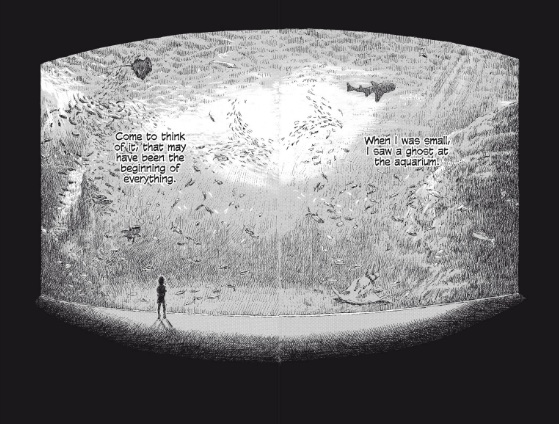
Daisuke Igarashi is a masterful storyteller, liberally mixing genres – the coming-of-age story, the scientific mystery – to create a unique drama that’s eerie and compelling. As fanciful as the story’s details may be, Children of the Sea maintains a firm grip on reality, thanks to its memorable, true-to-life characters. Ruka, in particular, is a fine creation, a strong, independent girl who reacts with her fists instead of her mouth, has trouble making friends, and burns with curiosity about the things she’s seen. Umi and Sora, too, both have distinctive personalities; whatever their role in the story’s eventual denouement, neither are portrayed as innocents or naifs but as smart, worldly, and sometimes prickly individuals who are in a desperate race against time.
Igarashi’s expert storytelling is beautifully complemented by his artwork. He favors a naturalistic style, rendering every element of the layout in his own hand rather than relying on tracings or prefabricated backgrounds. As a result, his pages are visually complex but thoroughly organic; every element of the design feels essential to establishing the story’s location in space and time. His characters are realistic, though their proportions are slightly awkward. Their large heads and big hands make them seem otherworldly and fragile, especially when contrasted with the large, powerful animals they encounter at sea.
If you’re not yet sold on Children of the Sea, I strongly encourage you to visit Viz’s IKKI website, where all eight chapters of volume one are available for free online browsing. Be warned, however, that this poetic, graceful, and thought-provoking story may cast a spell on you, too, making you reflect on the truth of Jacques Cousteau’s comment that “The sea, the great unifier, is man’s only hope. Now, as never before, the old phrase has a literal meaning: we are all in the same boat.”
Review copy provided by VIZ Media, LLC.
CHILDREN OF THE SEA, VOL. 1 • BY DAISUKE IGARASHI • VIZ • 320 pp. • RATING: OLDER TEEN (16+)


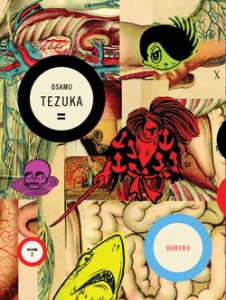 Though much of the devastation that Hyakkimaru and Dororo witness is man-made (Dororo takes placed during the Sengoku, or Warring States, Period), demons exploit the conflict for their own benefit, holding small communities in their thrall, luring desperate travelers to their doom, and feasting on the never-ending supply of human corpses. Some of these demons have obvious antecedents in Japanese folklore — a nine-tailed kitsune — while others seem to have sprung full-blown from Tezuka’s imagination — a shark who paralyzes his victims with sake breath, a demonic toad, a patch of mold possessed by an evil spirit. (As someone who’s lived in prewar buildings, I can vouch for the existence of demonic mold. Lysol is generally more effective than swordplay in eliminating it, however.) Hyakkimaru has a vested interest in killing these demons, as he spontaneously regenerates a lost body part with each monster he slays. But he also feels a strong sense of kinship with many victims — a feeling not shared by those he helps, who cast him out of their village as soon as the local demon has been vanquished.
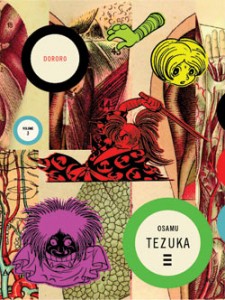 For folks who find the cartoonish aspects of Tezuka’s style difficult to reconcile with the serious themes addressed in Buddha, Phoenix, and Ode to Kirihito, Dororo may prove a more satisfying read. The cuteness of Tezuka’s heroes actually works to his advantage; they seem terribly vulnerable when contrasted with the grotesque demons, ruthless samurai, and scheming bandits they encounter. Tezuka’s jokes — which can be intrusive in other stories — also prove essential to Dororo‘s success. He shatters the fourth wall, inserts characters from his stable of “stars,” borrows characters from other manga-kas’ work, and punctuates moments of high drama with low comedy, underscoring the sheer absurdity of his conceits… like sake-breathing shark demons. Put another way, Dororo wears its allegory lightly, focusing primarily on swordfights, monster lairs, and damsels in distress while using its historical setting to make a few modest points about the corrosive influence of greed, power, and fear.


 From the back cover:

 From the back cover: