When I was struggling earlier today to begin a post, something that kept coming to me was how much my feelings for music seemed related–or at least similar–to my feelings for manga, both in depth and breadth. This led me to think about why I love both, and then to why I love manga. But to start, I think the question I must begin with is:
Something I’ve always had difficulty relating to is the concept of “real life” as being something different than a person’s online life. I mean, I get it kind of, but it’s not like I become imaginary when I sit down at my computer, and every person I deal with online is just as real as I am regardless of whether or not they are being honest about who they are. Just as in “real life,” my words and actions have the power to affect other people, for good or ill. So how is this not a part of my real life? Similarly, I’ve always been at odds with the idea that imagining, writing, reading, or interacting with fiction is somehow less a part of what’s real in this world (and in our lives) than anything else. Fiction is our greatest tool for sharing ideas with each other as a species, in a way that touches and inspires not just our logical minds, but our hearts and even that intangible thing we like to call our “souls.”
Nearly everything important I have learned about life, people, and the world around me has come from one of two places: my own personal experience or fiction; and I have a feeling that if it was possible to sit down and write out every one of those things, fiction would come out on top. After all, the potential human experience available to one forty-year-old woman is miniscule compared to the volume of fictional works written since the dawn of man, or even just since the dawn of modern language.
Fiction is the the place of dreams, yes, but also the foundation of reality–how we perceive it and how we express that to others. Even the most escapist works tell us something about ourselves, both as individuals and as a society, and I can personally vouch for the fact that even these works are capable of inspiring deep thinking and emotion, whether their authors ever intended that or not. Each person’s experience with a fictional work is wholly unique to that person, and yet it is a connection between one person’s ideas and another’s that gives it its power. This, to me, is the most awesome thing in all the world.
My personal devotion to the products of human imagination–for me, fiction and music in particular–has always been what makes me feel most connected to other human beings, and the only thing capable of successfully bridging my very rich inner life with my more troublesome outer life. As such, I feel these things are inextricable from my life and who I am, and I’m very comfortable with that.
Why Comics?
The one particular product of human imagination it took me until recent years to truly connect with and appreciate is visual art. Outside of a childhood obsession with attempting (unsuccessfully) to draw all the characters out of my own imagined fiction and one year at college during which I would repeatedly visit a particular Pierre Bonnard painting at the Carnegie Museum of Art–earnestly seeking the answer as to why it affected me in a strong, emotional way that other art generally did not–I was never a person who connected deeply with visual representations of life.
The simple explanation for this may actually be that, unlike music, prose fiction, or theater, visual art was not something I could successfully experience as a creator (or at least a participant)–something that those who know me well can recognize as an important part of how I interact with art. How it happened to be comics that finally achieved this is somewhat of a mystery to me, though perhaps it has something to do with the fact that the art is acting as part of a narrative, which is something I can personally connect to more easily than an isolated image.
Yet it was not western comics that actually pulled me in, but manga. Which brings me to…
Why Manga?
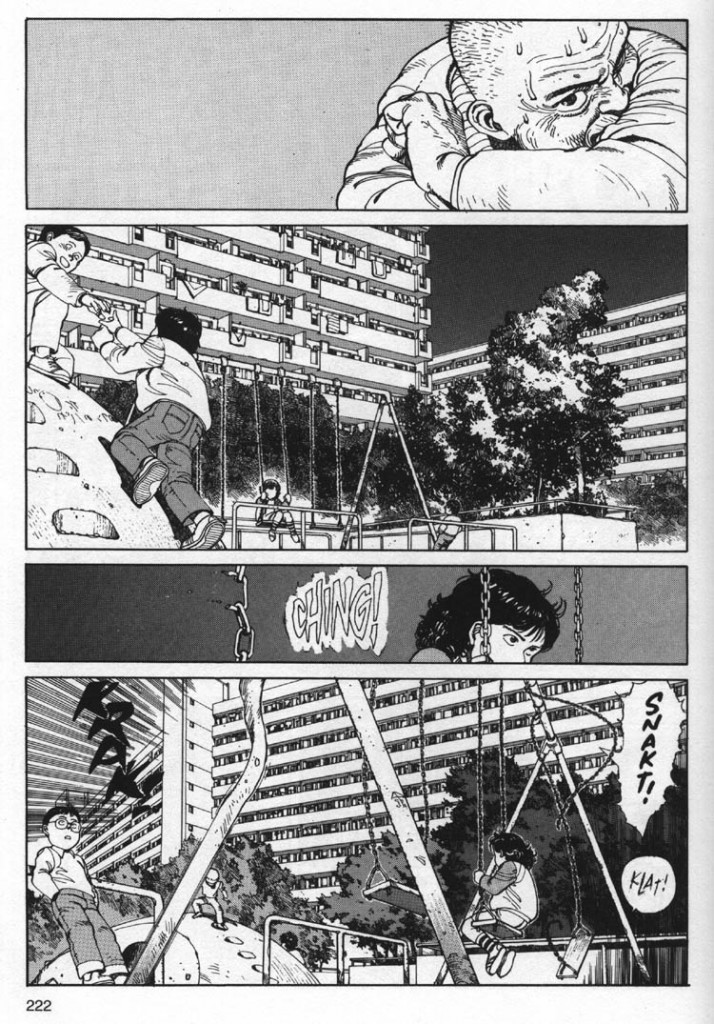
The fact that comics are part of mainstream popular fiction and therefore serve a much broader audience in Japan than they do here is, I’m sure, largely responsible for many of the elements that draw me most to manga–epic (but finite), single-creator stories in a huge variety of genres and styles, offering me the same variety and breadth of human experience and emotion as I’d find in prose fiction, movies, or television in this country. Whether this is connected to the sudden and profound realization that I could glean something new about the human experience from hand-drawn black lines on white paper, I am not certain, but I do know that my first encounter with manga was life-changing. It’s as though I was experiencing sight for the first time. For years, my imagination had subsisted (and very heartily) on written, and oral (including musical) language, either brought to life entirely by my imagination (as with print) or by other live humans (theater, television, film)–the closest thing to a visual element I was really in touch with. I can say honestly that up to the point I first read a manga, I really had no concept of how powerful and real a drawing could be or how strongly I could connect with such a thing.
It’s possible that a great deal of why I easily connect with manga in this way after failing to do so with western comics, is the tendency of manga to let the art take the lead in telling the story, which I think is less often the case in comics here. Odd that this would be the key, considering my previous attachment to prose; or perhaps not odd at all, since one of my problems with reading western comics had been that I kept feeling that the pictures were in the way as I tried to read the story. This is not a judgement on western comics, but really a suggestion that until I read manga, I was actually kind of impaired, and it took manga to fix that.
I think what is special about manga and why I have immersed myself so deeply in it in such a short time (aside from the fact that this is just how I do things) is that it offers a unique opportunity for the reader’s imagination. Something I used to talk about regarding art song, which was my favorite form of music to work on as a classical voice student, was that it offered an experience for interpretation that was different than anything else. Unlike opera, in which the music and libretto were working together to tell a single story, art song usually began as a poem–a form that invites greater personal interpretation than narrative fiction –to which the composer would add his/her personal interpretation through music–another form that invites great personal interpretation. The singer is then in the position to draw upon both these potentially disparate elements to create a third interpretation–one that is likely to be unique to each singer (ditto with the pianist, lest this be forgotten). By the time the art song reaches the listener–the final collaborator–the possibilities for interpretation are so richly layered that each person will take away with them something not only unique in itself, but uniquely guided by all who touched the piece before it reached them.
Now you’re saying, “Whoooa, crazy music lady, the manga is more like opera,” (unless you’re just saying, “Whoa, crazy lady you lost me three paragraphs back”) and you’d be right. Except not exactly. Plays, movies, and television are like the opera. Manga is something in between. Though the pictures and the words are working together to tell the same story, the fact that it is black-and-white drawn, still images providing the more specific interpretation of the text actually leaves much more for the reader’s imagination to fill in, which to me is closer to the art song, though perhaps close enough to the opera too to provide the best of both worlds. While the skilled mangaka has the power to inject true, specific human emotion into something as small as a single line on a character’s face, it is still up to the reader’s imagination to actually translate that into the face of a real human–a face that will inevitably be a little different one for each person who imagines it. Aside from the element of color, this is true of western comics as well, but it is the combination of all these things at once–the epic, finite works; variety of genres; visual storytelling style; and the crazy music lady stuff–that makes manga special, or at least makes it special for me.
~o~
If you’ve made it this far, you probably deserve a drink. Since I can’t offer that across cyberspace (is this proof of the whole “real life” business??) I will instead thank you for reading and ask for your thoughts. :)


From the back cover:
For the most part, Gakuen Alice is a fairly episodic series about the adventures of spunky ten-year-old Mikan as she acclimates to attending a mysterious school whose students all have special powers known as Alices. Beginning in volume six, however, its first multi-volume arc, involving an organization that’s opposed to the Alice Academy and is responsible for infecting Mikan’s best friend, Hotaru, with a virus, gets underway. In volume seven, Mikan and friends are pursuing the organization responsible through a forest beset with dangerous traps.
From the back cover: