• Skip to primary navigation
  • Skip to main content
  • Skip to primary sidebar
  • Home
  • About Us
    • Privacy Policy
    • Comment Policy
    • Disclosures & Disclaimers
  • Resources
    • Links, Essays & Articles
    • Fandomology!
    • CLAMP Directory
    • BlogRoll
  • Features & Columns
    • 3 Things Thursday
    • Adventures in the Key of Shoujo
    • Bit & Blips (game reviews)
    • BL BOOKRACK
    • Bookshelf Briefs
    • Bringing the Drama
    • Comic Conversion
    • Fanservice Friday
    • Going Digital
    • It Came From the Sinosphere
    • License This!
    • Magazine no Mori
    • My Week in Manga
    • OFF THE SHELF
    • Not By Manga Alone
    • PICK OF THE WEEK
    • Subtitles & Sensibility
    • Weekly Shonen Jump Recaps
  • Manga Moveable Feast
    • MMF Full Archive
    • Yun Kouga
    • CLAMP
    • Shojo Beat
    • Osamu Tezuka
    • Sailor Moon
    • Fruits Basket
    • Takehiko Inoue
    • Wild Adapter
    • One Piece
    • After School Nightmare
    • Karakuri Odette
    • Paradise Kiss
    • The Color Trilogy
    • To Terra…
    • Sexy Voice & Robo
  • Browse by Author
    • Sean Gaffney
    • Anna Neatrour
    • Michelle Smith
    • Katherine Dacey
    • MJ
    • Brigid Alverson
    • Travis Anderson
    • Phillip Anthony
    • Derek Bown
    • Jaci Dahlvang
    • Angela Eastman
    • Erica Friedman
    • Sara K.
    • Megan Purdy
    • Emily Snodgrass
    • Nancy Thistlethwaite
    • Eva Volin
    • David Welsh
  • MB Blogs
    • A Case Suitable For Treatment
    • Experiments in Manga
    • MangaBlog
    • The Manga Critic
    • Manga Report
    • Soliloquy in Blue
    • Manga Curmudgeon (archive)

Manga Bookshelf

Discussion, Resources, Roundtables, & Reviews

Features & Reviews

Bookshelf Briefs 6/6/11

June 6, 2011 by MJ, Katherine Dacey, David Welsh and Michelle Smith 4 Comments

This week, MJ, Kate, David, & Michelle take a look at a variety of manga from Viz Media, Vertical Inc., Digital Manga Publishing, and Yen Press.


Bakuman, Vol. 5 | By Tsugumi Ohba & Takeshi Obata | Viz Media – The theme for this volume may as well be “Everyone makes progress toward making their dreams come true!” Not that everything is smooth sailing. Mashiro and Takagi finally have a series in Shonen Jump, but along with that comes new editor, Miura, who is rather inexperienced. It takes him some time to gain the confidence to steer the boys in a direction that will keep their series popular with readers. Meanwhile, other friends and rivals aim for the same goal and even Miho experiences a rejuvenation in her dedication to become a voice actress. It’s a thoroughly shounen setup, which is only fitting for a story about making shounen manga. I wish we actually got to see some of this manga they’re creating, though! Maybe in due time… -Michelle Smith

Black Bird, Vol. 8 | By Kanoko Sakurakoji | Viz Media – If there’s one thing that can be said for Kanoko Sakurakoji’s Black Bird, it’s that it stays unflinchingly on message, volume after volume. “Girls, always obey what the menfolk tell you,” it says over and over, in a thousand different ways. “They’re smarter and stronger than you are, so they always know what’s best.” That’s the overwhelming message of this series, though there’s an equally consistent side note attached, “Be grateful and understanding when your man punishes you for your mistakes. After all, it’s for your own good.” Volume eight personifies these messages without fail, as always, with the added bonus of the much-anticipated consummation of Misao and Kyo’s sexual relationship, which is of course preceded by extra gratitude, humility, and expressions of flushed desperation from our heroine. Yay? -MJ

Bleach, Vol. 35 | By Tite Kubo | Viz Media – Despite its status as a hit battle manga, for a reader like me, the best of Bleach exists between battles, when Tite Kubo is able to utilize his (not insignificant) talent for writing quirky, compelling characters. Unfortunately Kubo tends to excess in this area, creating a never-ending stream of brand new characters, leaving less room and page time for those we already love. With that in mind, volume 35 reveals both the best and worst of Kubo’s habits, providing some genuinely satisfying moments with some of our favorite characters while leading us into another series of battles with an array of new foes. If I could deliver one message to Kubo, it would be that when it comes to supporting characters, sometimes less is more. 35 stacks up in the “win” column, but the future looks far less bright. – MJ

Blue Exorcist, Vol. 2 | By Kazue Kato | Viz Media – In discussion of this series’ first volume, I said, ” I’d like to see more … with Rin actually learning the craft under Yukio’s tutelage, because watching the two of them together is the most compelling aspect of the story so far.” The good news here is that we do see more of this, and it indeed remains the series’ greatest strength. The less good news is that the bulk of this volume is spent introducing the class’ other students, including hotheaded Suguro and by-the-book tsundere Izumo. Though there’s obviously a self-formed family of young exorcists being nurtured here, it’s a shame to have so much of the volume’s focus stolen away by it, when we’ve only just begun with the series’ two main characters. Still, this remains the most compelling new shounen series to travel westward this year. I look forward to seeing where it goes from here. – MJ

A Bride’s Story, Vol. 1 | By Kaoru Mori | Yen Press – This is one of those books where I’m convinced I could pass off random page scans as a review, possibly followed up with, “See? See?!” I can’t quite decide if it’s more gorgeous than Mori’s Emma (CMX), but I can say without question that it’s one of the loveliest manga you’re likely to find in current release. It’s also as quietly moving and packed with absorbing details as Emma was, so you really can’t lose. In this tale set in central Asia in the 19th century, a 20-year-old woman enters into an arranged marriage with a 12-year-old boy. We see quietly forceful Amir adapt from her nomadic lifestyle to the more settled state of affairs with her young bridegroom. There’s the whispered promise of an actual plot, but I could read dozens of volumes of nothing but Mori’s meticulously researched, breathtakingly drawn slice of life. Really, what more do you need? -David Welsh

Chi’s Sweet Home, Vol. 6 | By Konami Kanata | Vertical, Inc. – After five volumes of cute kitten antics — including Chi’s first visit to the vet, Chi’s first bath, and Chi’s first excursion beyond the safe confines of home — I thought Kanata Konami would have run out of material. I’m pleased to report that volume six of Chi’s Sweet Home is just as appealing and fresh as the previous installments, offering plenty of awwww-inducing moments as well as some genuinely funny scenes. (Don’t miss the chapter in which Chi stalks a parakeet; Chi’s reaction to the parakeet is priceless.) Konami continues to expand the scope of the story to include more animals, more people, and more settings, neatly mimicking Chi’s growing awareness of her surroundings while preventing the story from becoming too cutely claustrophobic. As in previous volumes, the illustrations are simple but effective, capturing Chi’s surprise and delight in discovering new things: vacuum cleaners, Kleenex, birthday cake. Recommended. -Katherine Dacey

Chi’s Sweet Home, Vol. 6 | By Konami Kanata | Vertical, Inc. – Whenever a new volume of Chi’s Sweet Home comes into my possession it automatically vaults to the top of the to-read pile. The first five volumes all offered colorful, cute, and (mostly) cheerful stores about Chi, an adorable tabby kitten, and the sixth is no exception. Kanata has a knack for depicting scenarios familiar to any cat owner, like massacred houseplants and the species-wide fascination with climbing into boxes, while imagining what the world must look like to a cat. Chi’s nocturnal journey to the local park is a particular standout. My one complaint is that Chi’s owners, the Yamadas, continually do frustrating things like leave cakes unattended and store breakable objects at the top of a flight of stairs, then proceed to freak out when Chi messes with them. You’ve got a cat now, folks. You either put things away or get used to the gnaw marks. -Michelle Smith

Itsuwaribito, Vol. 2 | By Yuuki Iinuma | Viz Media – In this volume, Utsuho proves himself trustworthy to the implausibly youthful Dr. Yakuma by rescuing him from the clutches of a bizarre fellow whom I shall christen “Freaky Dude.” Not only that, he correctly deduces the cause of Freaky Dude’s killing spree and helps him to see the error of his ways. The display convinces Yakuma to invite Utsuho on a journey to Nadeshiko Island, where he suspects a treasure of life-extending medicine awaits. It also happens to be the location of many exiled criminals. I’m still not enraptured by Itsuwaribito, but I found this volume a lot more entertaining than the first. For reasons I cannot quite pinpoint, it reminds me of Black Cat, in a simple shounen adventure kind of way. Plus, there’s an adorable twitchy-eared talking tanuki! I’ll definitely be checking out volume three. -Michelle Smith

Twin Spica, Vol. 7 | By Kou Yaginuma | Vertical, Inc. – In the seventh volume of Twin Spica, Kou Yaginuma explores Marika’s childhood, as well as Marika’s struggle to create her own destiny, rather than the one for which she was created. Though Marika’s story is emotionally compelling, Yaginuma strains too hard to show us that Marika, Asumi, and Fuchuya have a shared history; there’s a tidiness to the connection that feels a little false, as if the characters’ shared memory of the Lion disaster wasn’t grounds enough for bonding. The volume’s final chapters are more dramatically persuasive, giving the three female leads a chance to demonstrate just how smart, resourceful, and tough they can be under duress. N.B. Beginning with volume seven, Vertical will be releasing Twin Spica in a longer omnibus format of 300-400 pages (roughly 1.5 volumes). -Katherine Dacey

Your Story I’ve Known | By Tsuta Suzuki | Juné Manga – It’s rare that I find the sex scenes in a boys’-love title to be the most interesting, but that’s definitely the case in the title story of this book. Suzuki laces the physically intimate moments with intriguing, revealing observations. Unfortunately, those kinds of notes are largely absent in the rest of this tale of a gangster who takes up with the son of one of his ex-girlfriends. It’s drawn well, but the characters and their dynamic aren’t very engaging. The back-up stories compensate for the centerpiece, though. One’s about a young man dealing with his lover’s irritating reticence. Another is a love story between a kid and a goofy, centuries-old ghost. The last describes the awkward early courtship between two salarymen. Each has a distinct, quirky charm, making the book a worthwhile investment overall. -David Welsh

Filed Under: Bookshelf Briefs Tagged With: a bride's story, bakuman, black bird, bleach, blue exorcist, chi's sweet home, itsuwaribito, twin spica, your story I've known

The Science of Doctor Who by Paul Parsons

June 4, 2011 by Michelle Smith

From the front flap:
Almost fifty years after the Doctor first crossed the small screen, he remains a science fiction touchstone. His exploits are thrilling, his world is mind-boggling, and that time travel machine—known as the Tardis—is almost certainly an old-fashioned blue police box, once commonly found in London.

Paul Parsons’s plain-English account of the real science behind the fantastic universe portrayed in the television series answers such burning questions as whether a sonic screwdriver is any use for putting up a shelf, how Cybermen make little Cybermen, where the toilets are in the Tardis, and much more.

(Note: This is the 2010 revision of a book originally published in 2006.)

Review:
I am not a science person. In my years of schooling, I never once came up with a non-lame idea for a science project and was positively abysmal at experiments. I did pretty well on tests and homework, but if someone’s test tube was going to spontaneously erupt in a geyser of brown froth (true story!), it would be mine.

Suffice it to say, then, that while I enjoy science fiction entertainment, it’s not because of the science. Still, The Science of Doctor Who promises “a plain-English account of the real science behind the fantastic universe portrayed in the television series,” so I reckoned on being able to follow it. Alas, Paul Parsons’s definition of plain English is a bit different than mine.

I was okay with the majority of the material. Chapter topics include the Doctor’s recurring foes, regeneration, gadgets, weapons, space stations, force fields, parallel universes, and more. In general, Parsons would start by mentioning something that happened in a particular Doctor Who serial and then interview renowned scientists as to whether this is actually possible. Most of the time the answer is “no” or “only with extreme amounts of energy/effort,” but there are a few things that are not so far off. The chapters on alien worlds (Lots of planets really do have a north!) and mirror planets were particular favorites of mine.

Stupidly, however, I hadn’t counted on there being so much physics! I frequently found my eyes glazing over during these sections, which were unfortunately clustered near the beginning (making it hard to get started) and end (causing a strong urge to set the book down with only forty pages to go) of the book.

Take, for example, this quote from page 35:

M-theory’s main thrust is to generalize the one-dimensional objects of string theory into p-dimensional objects known, amusingly enough, as p-branes (where setting p = 0 gives a particle, p = 1 gives a string, p = 2 a “membrane,” and so on).

My brain’s response: asdlkjasldkfzzt!

Seriously, is that plain English? I note that Parsons did not bother to define “p-dimensional,” though that probably wouldn’t have been much help to me anyway.

In the end, I did learn some interesting things. In the chapter on Cybermen, for example, I learned that a cybernetic brain implant currently exists that can block the signals that cause Parkinson’s disease. That’s pretty awesome! I also now know that Sontarans reproduce by cloning and it takes only ten minutes for their offspring to reach adulthood. That’s less awesome.

I’m glad I didn’t give up on reading The Science of Doctor Who but now I think I’ll give my brain a rest by actually watching some.

Additional reviews of The Science of Doctor Who can be found at Triple Take.

Filed Under: Books, Nonfiction, Science, Television, Triple Take Tagged With: Doctor Who, Paul Parsons

A Spy in the House by Y. S. Lee

June 4, 2011 by Michelle Smith

From the back cover:
Mary Quinn leads a remarkable life. At twelve, an orphan and convicted thief, she was miraculously rescued from the gallows. Now, at seventeen, she has a new and astonishing chance to work undercover for the Agency.

It is May 1858, and a foul-smelling heat wave paralyzed London. Mary enters a rich merchant’s household to solve the mystery of his lost cargo ships. But as she soon learns, the house is full of deceptions, and people are not what they seem—including Mary herself.

Review:
As a convicted thief, twelve-year-old Mary Lang is about to be executed when she is saved by the ladies of Miss Scrimshaw’s Academy for Girls. There, she receives an education and by the age of seventeen is teaching other students the skills they will need to be independent. Trouble is, she’s not satisfied and the few other career options open to her gender don’t interest her much, either. When she mentions this to the two women running the school, they suggest another alternative: the Agency.

The Agency is a covert organization of female spies, operating under the assumption that because women are presumed to be flighty and empty-headed, their agents will be able to retrieve information more easily than a man might, particularly in situations of domestic servitude. Mary quickly agrees, despite the threat of danger, and soon finds herself serving as paid companion to spoiled Miss Angelica Thorold, whose merchant father is suspected of dealing in stolen Hindu goods.

Mary (now using the surname Quinn) isn’t the lead on the investigation and isn’t supposed to actually do much of anything, but she gets antsy, and in the process of snooping meets James Easton. James’s older brother desperately wants to marry Angelica, but James has heard rumors about her father’s business practices, and so is doing some sleuthing of his own to determine whether a family connection would be unwise. He and Mary form a partnership and spend most of the book poking about in warehouses and rest homes for aging Asian sailors and following people on foot or in carriages while maintaining a flirty sort of bickering banter.

Author Y. S. Lee tries to make the mystery interesting, giving us a bit of intrigue between Angelica and her father’s secretary as a distraction, but ultimately it feels very insubstantial to me. Nothing much comes as a surprise and two story elements that could’ve been highlights—Mary’s month-long intensive training and Scotland Yard’s raid on the Thorold house—occur off camera! Too, Mary is harboring a secret about her parentage which is thoroughly obvious: she’s part Asian. Only towards the end did Lee actually make clear that Mary is keeping this a secret from others because of the foreigner bias of the time, and I must wonder whether the intended young adult audience was reading this going, “What’s the big deal?”

Not that it isn’t nifty to have a part-Asian heroine, of course. Mary is competent and level-headed, though I admit I did get irritated by how often she is favorably compared to “ordinary women,” who would scream or faint in situations in which Mary is able to keep her head. When a mystery stars a male sleuth, do we need to hear over and over how much smarter he is than the ordinary fellow? I don’t think so. On the flip side, the overall theme of the book seems to be “don’t understimate women,” and Mary finds time to inspire a scullery maid to seek out Miss Scrimshaw’s and to convince Angelica to pursue a musical career.

In the end, A Spy in the House is a decent read. It’s not perfect, but I still plan to read the second book in the series in the near future.

Additional reviews of A Spy in the House can be found at Triple Take.

Filed Under: Books, Historical Fiction, Mystery, Triple Take, YA Tagged With: Y. S. Lee

Don’t Fear the Adaptation: Ristorante Paradiso

June 4, 2011 by Cathy Yan 9 Comments

Ristorante Paradiso | by Natsume Ono | Manga: Ohta Shuppan / Viz | Anime: David Production / Crunchyroll

Whenever you write a review of Ristorante Paradiso, you always have to get one thing out of the way first: which one is your favorite gentleman? When I read the manga, Luciano was mine, because I fall pretty hard for the gruff types who despite their claims of disinterest can’t help but meddle. And while the anime cemented my love of Luciano, I have to say anime Teo is exactly the handsome aniki I’d fall in love with at Casetta dell’Orso. It helps that he’s a dessert chef, mouthy, and also rides a motorcycle. (Lorenzo is disqualified from my rankings — he’s too perfect and there’s no way to avoid being in love with him and horribly, horribly jealous of Olga.)

Ristorante Paradiso is primarily about Nicoletta, a twenty-one year old determined to exact revenge on her mother Olga, who left Nicoletta behind in order to marry Lorenzo, a restaurant owner in Rome. But when she arrives in Rome, Nicoletta falls in love with Claudio, a waiter at Lorenzo’s restaurant, and ends up staying there as a kitchen apprentice. Like most of Natsume Ono’s stories, it’s a mature slice-of-life production with a slow plot and an ensemble cast filled with enigmatic men and self-assured women. The manga is short at one volume but has a three-volume prequel-sequel entitled Gente: The People of Ristorante Paradiso. The anime mixes and matches the overall Nicoletta-and-Claudio plot of Ristorante Paradiso but detours heavily into the backstories of Gente. The end product is very, very much House of Five Leaves meets Antique Bakery. Why else do you think I pleaded with MJto let me do a Natsume Ono double punch? ;)

Ristorante Paradiso the anime is a feel-good jousei version of a dating game crossed with a butler café. It falls somewhere in between the beloved reverse harem romcoms like Ouran Host Club and the “counseling session of the week” trope of Bartender (which, incidentally, was also adapted into an anime). Like Antique Bakery, Ristorante Paradiso has its moments of drama — some might even argue, melodrama — but it’s one of those series that ultimately boils down to its playful sampling of human life. It’s bursting with little stories about romance, family, growing up, and, well, more romance. There’s a particularly memorable side story about a woman whose husband keeps cheating on her. The dell’Orso staff, especially Gigi and Vito, get involved, and the episode caps off with a very serious, but touching, lesson about marriage and coincidence that even O’Henry would have been proud of. Episode eight and nine owe more to Giuseppe Tornatore than Iron Chef, and episode four, which chronicles the founding of dell’Orso, could be a movie all by itself.

All the characters, especially the gentlemen, get a boost from being animated and paired with a voice actor. Gigi and Lorenzo as twenty-somethings are heartwrenchingly adorable when animated, and Claudio as a young and awkward server trying to find off the amorous intentions of a rich patron will make you swoon. Of special note for me are the relatively unknown Mitsutaka Tachikawa as Luciano and Jin Yamanoi as Claudio. Listening to Yamanoi really makes you believe you’re in the presence of a saint, while Tachikawa’s Luciano is beyond endearing, especially when he growls.

The additional materials from Gente, on top of keeping the anime from having to stretch out one volume’s worth of material into eleven slow episodes, also gives more depth to Nicoletta and her relationship with Claudio. Nicoletta’s observation that love comes in different shapes makes more sense when you get to meet all the significant others of the dell’Orso staff. That they spend more time together and go through a lot more troubles together makes their ending in the anime far sweeter and more conclusive. An unexpected benefit of getting to know Luciano better in the anime was that Claudio, in the process, came into better focus. Their friendship and comparable statuses (Luciano as a widow and Claudio, a divorcee) meant Claudio comes off in the anime as more than just a nice guy. You struggle with him over his idealistic nature, sympathize with his inability to move past his ex-wife Gabrielle, and really, truly wish for his happiness. You feel like you understand just what it is that Nicoletta sees in him.

David Production is a smaller, newer studio compared to Madhouse, the studio responsible for Ono’s other anime adaptation House of Five Leaves. The style in Ristorante Paradiso is less obviously Ono’s this time around, but David Production still did an excellent job translating Ono’s art style. The glimpses of food in the series are mouthwatering, and the shots of the staff’s favorite enoteca, with shelves and shelves of wine bottles, make me want to follow Nicoletta’s journey and spend an extended vacation in Rome. There’s some awkward use of CG as well as a laughable moment in episode six, where if you pause the video in Olga’s office, you can see that the certificate behind her is issued to “Bob Fields”, Cambridge, and qualifies the recipient to teach English to adults. Other than that, the animation is top notch. Episode seven introduces Luciano’s daughter Margherita who is almost indistinguishable from Nicoletta, but that, I think, is more the fault of Ono herself and not the studio’s.

For fans of the manga who were frustrated with the slowness of Ristorante Paradiso‘s first few chapters, but liked Gente‘s character development, the anime is the best of both worlds. (It’s just a terrible shame that Crunchyroll took down their videos.) For those of you who have yet to read the manga, while some have complained that the anime’s flashbacks were too confusing, I would recommend watching the anime over reading the manga. The meshing of Gente with Ristorante Paradiso makes for a fuller, more fleshed out cast and also tempers the ending of Nicoletta’s storyline, which I found unsatisfactorily abrupt when reading the manga. It’s far from realistic, the initial conflict between Olga and Nicoletta is still solved too easily, and very few of the staff’s backstories cover truly original ground. But if you like food, are a people-watcher, or simply enjoy a little romanzo in your life, Ristorante Paradiso welcomes you to Casetta dell’Orso.

Filed Under: Don't Fear the Adaptation Tagged With: anime, gente, Natsume Ono, ristorante paradiso

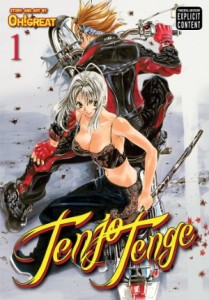
Tenjo Tenge: Full Contact Edition, Vol. 1

June 3, 2011 by Katherine Dacey

When I tell people that I review manga, they often ask me, “Isn’t it all porn and ninjas?” No, I assure them, there are manga about cooking, gambling, dating, teaching, crime solving, alien fighting, computer programming, ghost busting, mind reading, wine tasting, dog training, and just about any other topic you can imagine; if there’s an audience to be served, Japanese publishers will find a way to reach them through comics. “But it seems like every manga I’ve seen has a girl in a short skirt waving a sword,” they reply. I usually offer a counter-example — say, Ouran High School Host Club or What’s Michael? — but I know the kind of manga they have in mind. It’s filled with female characters who have women’s bodies and girls’ faces; schoolgirls who wear their uniforms twenty-four hours a day; fighters who use swords, even though the story is set in the present; and supporting characters who dress like Edo-era refugees, even though their cohorts are wearing sneakers and hoodies. In short, what they’re seeing in their mind’s eye looks a lot like Tenjo Tenge.

Plot-wise, Tenjo Tenge isn’t much more complicated than “girls in skirts waving katanas.” The story takes place at Todo Academy, one of those only-in-manga institutions where students study martial arts technique to the exclusion of anything else. (If anyone attends a math class in Tenjo Tenge, I missed it.) First-year students Soichiro Nagi and Bob Makihara fully expect to rule the roost with their awesome fighting skills, but are quickly disabused of the notion when they run afoul of Todo’s Executive Council. Mindful of their greenhorn status, the boys join the Juken Club, an organization lead by Maya Natsume, a third-year student who’s handy with a sword. In so doing, however, Soichiro and Bob become targets for the Executive Council, which carries on an energetic, bloody feud with Maya and her younger sister.

Flipping through the first volume of VIZ’s “Full Contact” edition, it’s easy to see why DC Comics censored the original English print run. The story abounds in the kind of gratuitous nudity and sexual encounters that make an unadulterated version a tough sell at big chain stores like Wal-Mart and Barnes & Noble. DC Comics’ solution was an inelegant one: they re-wrote the script, drew bras and panties on naked girls, and cut some of the most offensive passages. As an advocate of free speech, I can’t condone the bowdlerization of any text, especially in the interest of a more commercially viable age-rating , but as a woman, it’s hard to celebrate the restoration of a graphic rape scene or images of naked girls throwing themselves at the heroes.

Whether those scenes are really necessary to advancing the plot is another issue. The rape, in particular, is an ugly exercise in exploitation, pitting a grown man against a teenager who has a twelve-year-old’s face and a porn star’s body. Though Oh!Great shows us the victim’s terrified expression in several panels, he lavishes far more attention on her anatomy, twisting her body into the kind of grotesque, provocative poses that were a stock-in-trade of Hustler. What makes this passage especially nasty is its underlying intent; we’re not being asked to identify with the victim, or burn with outrage over her violation, but to be aroused by her naked body. In a word: yuck.

From time to time, Oh!Great gives the Natsume sisters a chance to strut their martial arts stuff, suggesting that both girls are as tough and cunning as their male counterparts, but he can’t resist tearing off their clothes, or showing us their panties, especially when they’re in the middle of intense, hand-to-hand combat. And if the characters’ complete objectification wasn’t bad enough, Oh!Great draws such grossly misshapen bodies that it’s hard to imagine who would find them sexy; say what you will about Ryoichi Ikeda and Kazuo Koike’s Wounded Man — and yes, there’s plenty to say about the exploitation of its female characters — but Ikeda knew how to draw beautiful women. Oh!Great’s female characters, on the other hand, look like blow-up dolls, incapable of standing on their own two feet, let alone brandishing a sword or high-kicking an opponent.

Tenjo Tenge fans who were angered by the first English-language edition will be pleased with VIZ’s new translation. Many of the elements that had been eliminated or camouflaged in the first version have been restored; characters drop f-bombs and drop trou without editorial intervention. As an added enticement, VIZ has formatted the story as a series of two-in-one omnibuses, complete with glossy color plates and oversized trim. Given the care with which the new Tenjo Tenge was prepared, I wish I could say that the uncensored version convinced me that I’d unfairly dismissed the genius of Oh!Great the first time around. Alas, the answer is no; the story comes is too perilously close to the porn-and-ninjas stereotype for my taste.

Review copy provided by VIZ Media, LLC. Volume one of Tenjo Tenge will be released on June 7, 2011.

TENJO TENGE: FULL CONTACT EDITION, VOL. 1 • BY OH!GREAT • VIZ MEDIA • 386 pp. • RATING: MATURE (18+)

Filed Under: Manga, Manga Critic, REVIEWS Tagged With: Martial Arts, Oh!Great, Tenjo Tenge Full Contact Edition, VIZ

The Josei Alphabet: S

June 3, 2011 by David Welsh

“S” is for…

Sekai de Ichiban Yasashii Ongaku, written and illustrated by Mari Ozawa, originally serialized in Kodansha’s Kiss, 16 volumes. Most series about single parents that have been licensed are about single fathers, so this tale of a single mother would be most welcome. Also, I’m kind of in love with the covers; you can view more of them at Kodansha’s site for the title.

Shibou to lu Na no Fuku o Kite, written and illustrated by Moyocco (Sugar Sugar Rune, Happy Mania) Anno, originally serialized in Shufu to Seikatsusha’s Shuukan Josei, one volume. Anno looks at a woman’s ambivalent struggle with her weight in a thin-dominated society.

Shin Yami no Koe – Kaidan, written and illustrated by Junji (Uzumaki, Gyo, Tomie) Ito, originally serialized in Asahi Sonorama’s Nemuki, one volume. I’m not a huge horror fan, but I find Ito’s work irresistibly unsettling, so I’d love to read this collection of shorts created for a josei magazine.

Silver, written by Penny Jordan, adapted to manga by Kazuko Fujita, originally serialized in Shogakukan’s Josei Seven, nine volumes. An innocent heiress marries badly and realizes that her husband was just in it for the money. She remakes herself into the perfect woman to avenge herself and her family. It sounds kind of trashy but awesome.

Spicy Pink, written and illustrated by Wataru (Ultra Maniac, Marmalade Boy) Yoshizumi, originally serialized in Shueisha’s Chorus, two volumes, published in French by Glénat. I would be happy as a clam if someone finally decided to publish a josei series from this terrific creator. This one’s about a busy mangaka with no time for a social life who meets an obnoxious but not entirely unpromising doctor on a group date.

Josei Magazines:

  • Shuukan Josei, published by Shufu to Seikatsusha

Licensed josei:

  • Saiyuki Reload, written and illustrated by Kazuya Minekura, originally serialized in Ichijinsha’s Comic Zero-Sum, published in English by Tokyopop, 10 volumes.
  • Sengoku Nights, written by Kei Kusunoki, illustrated by Kaoru Oohashi, originally serialized in Shueisha’s Comic Crimson, published in English by Tokyopop, two volumes.
  • Suppli, written and illustrated by Mari Okazaki, originally serialized in Shodensha’s Feel Young, partly published in English by Tokyopop, 10 volumes plus extra.

What starts with “S” in your josei alphabet?

Reader recommendations and reminders:

  • Sounds of Love, written and illustrated by Rin Tanaka, originally serialized in Ohzora Shuppan’s Renai Hakusho Pastel, published in English by Luv Luv Press, three volumes.
  • Sugiru Juunana no Haru, written by Fuyumi Ono, illustrated by Kotetsuko Yamamoto, currently running in Gentosha’s Spica. 
  • Shuukatsu!! – Kimi ni Naitei, written and illustrated by Aki Yoshino, originally serialized in Shogakukan’s Petit Comic, two volumes.

Filed Under: FEATURES

License request day: Takemitsu Zamurai

June 3, 2011 by David Welsh

You all know I can’t resist an awards program as fodder for a license request, so I’ve greeted the announcement of the Tezuka Cultural Prize (written up by Asahi Shimbun) with predictable eagerness. Unfortunately, I’ve already requested that someone publish the winning title (Motoka Murakami’s Jin). Fortunately, this year resulted in a not-uncommon tie for first place. (Yoshihiro Tatsumi and Fumi Yoshinaga tied in 2009.) Even more fortunately, Taiyo Matsumoto is involved.

The gifted Matsumoto, of TekkonKinkreet and GoGo Monster fame, has done illustration duties on the other winning title, Takemitsu Zamurai, which was written by Issei Eifuku. The esteemed panel of judges noted that the book was “the most advanced work in terms of the level of illustration techniques.” That shouldn’t surprise anyone who’s looked at Matsumoto’s pages.

It’s about an out-of-work samurai who retires to teach in one of the tenements of Edo-era Japan. Apparently, it’s not a peaceful retirement for a swordsman-turned-educator. In spite of his efforts to leave violence behind, he’s a suspect in a murder, and an investigator starts digging into his past. His presence brings unwelcome visitors to the neighborhood, along with a number of other complications. It sounds like a more muscular House of Five Leaves, and anything that I can favorably compare to House of Five Leaves piques my interest about as much as anything with Matsumoto’s name on the cover.

The eight volume-series was originally published in Shogakukan’s Big Comic Spirits. As you might expect, it’s being published in French (by Kana, in this case). While I’m inclined to take the word of judges like Keiko Takemiya and Go Nagai, I’m drooling to see some of the interior pages, because the covers are sickeningly gorgeous.

Seriously, Viz, you have like one month to announce this title. It’s only eight volumes long, it’s finished, it won the most prestigious manga prize Japan has to offer, and it was practically minted for your Signature imprint. Do your part to liven up San Diego for manga fans.

Filed Under: LICENSE REQUESTS

The Josei Alphabet: R

June 2, 2011 by David Welsh

“R” is for…

Real Clothes, written and illustrated by Satoru Makimura, currently serialized in Shueisha’s You: This fashionable manga features a plain salesclerk who is transferred to the women’s clothing department of her store. Needless to say, a makeover is in order. We need more fashion manga.

Receptacle, written and illustrated by Rendou Kurosaki, currently serialized in Hakusensha’s Rakuen le Paradis. This has barely started, but it’s got a solid magazine provenance and the cover is really cute. It’s apparently about two girls who kind of crush on each other and talk about their lives as geek girls. I love chatty, woman-driven manga.

Reset, written and illustrated by Mayuri Yamamoto, serialized in Bunkasha’s Horror M, eight volumes. Josei combined with episodic horror sounds like two great tastes that taste great together! In this series, a rotating cast of protagonists are given the choice to reset their lives at a critical point. It sounds like an intriguing premise.

River’s Edge, written and illustrated by Kyoko Okazaki, serialized in Takarajimasha’s Cutie, one volume. This dramatic tale of emotionally stunted teens sounds like the perfect cross-marketing opportunity for indie comics fans. In fact, I’m pretty sure there are already seven or eight versions of this story already on the shelves.

Rouge Noir, written and illustrated by Kyoko Mizutani, serialized in Shogakukan’s Petit Comic, two volumes. An aspiring musician takes up private piano instruction, and we all know how that ends up, don’t we? We don’t? Okay, well, in this case, the teacher gets the unrequited hots for one of her students, and they meet years later at an audition for a jazz combo. And surely we all know how that ends up, right?

Josei magazines:

Rakuen le Paradis, published by Hakusensha, enticingly described by Erica (Okazu) Friedman.

What starts with “R” in your josei alphabet?

Reader recommendations and reminders:

  • Real Love, written and illustrated by Mitsuki Oda, originally published by Ohzora Shuppan, published in English by Luv Luv Press, one volume.
  • RIP: Requiem in Phonybrain, written and illustrated by Mitsukazu Mihara, originally published in Index Communications’ Kera, published in English by Tokyopop, one volume.

Filed Under: FEATURES

Off the Shelf: Anniversary Edition

June 1, 2011 by Michelle Smith, MJ, Katherine Dacey and David Welsh 13 Comments

MICHELLE: Gee, they told me that we’d be holding Off the Shelf here this week, but it’s dark and doesn’t look like anyone’s here yet…

MJ: Surprise!!

Er. Sort of?

MICHELLE: OMG, no way! You guys~!

KATE: It’s OK, Michelle–we figured you might be on to us. But you do an excellent job of feigning surprise, if that’s any consolation.

DAVID: I made punch! It’s vivid pink and thick with booze!

MJ: I’ll take a glass of that punch!

MICHELLE: Well, I did kind of invite all of you here to celebrate not only my official induction into the Manga Bookshelf family, but also the one-year anniversary of Off the Shelf!

DAVID: And we’re thrilled to be here!

MJ: That’s right, we’ve actually been doing this column for a full year as of today. How wonderful that this coincides with Michelle’s official entry into our ranks!

KATE: Call me a skeptic, but that seems planned!

MICHELLE: I can vouch for it being a happy accident! Once we realized the coincidence, we knew we had to have a partay!

MJ: So, we’ve never tried to do this with more than two people before. I guess I should ask someone… So, David, read any good books this week?

DAVID: Ah! I have the perfect tonic for skepticism! And it comes in an omnibus-sized dose!

MICHELLE: Lay it on us!

DAVID: Indeed I did! When not hiking the canyons of southern Utah or trying to figure out how the lights worked in a Las Vegas hotel, I was paying a visit to CLAMP Land.

Now, based on what I’ve read of their work, I’m not a huge CLAMP fan. I think they can be pretty self-indulgent, and coherent narrative is not their highest priority. So I was totally delighted to see how focused Cardcaptor Sakura is. I read Book 1 of Dark Horse’s re-release while I was on vacation, and it was a complete treat. (I also suspect I was the only 40-something gay man in Utah who happened to be reading Book 1 of Cardcaptor Sakura at that point in time, which was gravy in a strange way that I can’t fully explain.)

Everyone probably already knows this, but it’s in the magical girl genre. Our heroine, Sakura, finds a dusty old book that used to contain the powerful Clow Cards, which grant the user various abilities. The guardian of the book, an adorable little whatsit called Kero, informs Sakura that she has magical abilities and can collect the missing cards, thus preventing unspecified disaster. It’s your basic gather-stuff-and-get-stronger structure, but it isn’t bogged down in the details of that ongoing quest. The CLAMP quartet doesn’t neglect Sakura’s card-capturing adventures, but they aren’t encyclopedically obsessed, either.

Their primary interest seems to be to give you reasons to like Sakura and her friends and family, and they knock that out of the park. Sakura is spunky and funny. She knows she’s a novice at the whole magic thing, but she’s not insecure about it. She has good instincts and trusts them, and she has reliable helpers. There’s the previously mentioned Kero, and there’s her rich classmate Tomoyo who, in addition to being unfailingly supportive, provides fabulous costumes for Sakura and chronicles her adventures on video. She’s like Edna Mode with a camcorder.

I like Sakura’s brother, Toya, and his twin impulses to tease and protect Sakura seem entirely credible. I like Sakura’s rival in card collection, Syaoran, mostly for the fact that Sakura seems generally unfazed by his criticisms and finds him a useful indicator that she’s on the right track. And while I don’t have much of an opinion on Yukito, Toya’s best friend, I find the fact that Sakura and Syaoran both have huge crushes on him to be totally adorable and ceaselessly amusing. In fact, the undercurrents of homo-romanticism (I can’t really call it homo-eroticism) in the book give it such an interesting flavor, because they’re such non-issues. They’re just believable side notes that make things livelier.

I’ve already used the word “adorable” twice in this review, and you should gird yourself for me using it again, because this book is adorable in all of the best ways a thing can be adorable. The character designs? Adorable. The jokes and romance? Adorable. The sparkly, easy-to-read art? Adorable. It’s cheerful, heartwarming stuff that still manages to be thoughtful and exciting, and I can’t wait to read more of it, because, beyond being very endearing magical-girl manga, it seems like it might be heading interesting, even daring places. I’m not ready to excuse CLAMP School Detectives or the song lyrics and angel drag in Clover or anything that drastic, but this definitely gives CLAMP one for the win column.

MJ: David, the way you describe this, I feel like I need to rush out and buy the Dark Horse editions RIGHT NOW.

DAVID: You totally do. It is the best kind of cute manga. Of course, you’re the real CLAMP devotee of the group, Kate. What did you pull off the shelf?

KATE: Not CLAMP, I’m afraid! I think I’m beginning to outgrow them, honestly; when I want melodramatic, inter-dimensional craziness, I’m more inclined to reach for Keiko Takemiya or Saki Hiwatari these days. I still plan to buy Magic Knight Rayearth, X/1999, and Gate 7 as they’re released, but I don’t feel that same sense of giddy anticipation about a new CLAMP title that I might have back in the day. (Mind you, by “back in the day,” I mean, “about four years ago, when David interviewed me about my CLAMP habit.”)

No, I just finished the fourth volume of Neko Ramen. As the title suggests, Neko Ramen features a cat who likes noodles — or, to be more precise, a cat who runs a small ramen joint. The joke, of course, is that he’s a cat; the restaurant’s bathroom is a back-room letterbox, the dishes frequently come with cat-hair garnishes, and the food is all but inedible from a human perspective.

What makes Neko Ramen such an unexpected joy is that Kenji Sonishi goes a step further with the jokes; yes, there are scratching post gags in later volumes, but most of the series’ humor is rooted in Taisho’s crazy business schemes. Taisho is always cooking up new strategies for improving business, strategies that, on their face, make good sense: discount cards, buyer reward programs, giveaways. In practice, however, Taisho has a knack for undermining himself, developing ill-advised dishes — boomeramen, anyone? — and promotions that repel more diners than they attract.

At the beginning of volume four, for example, Taisho decides to “go green” and substitute hand-made clay bowls for plastic ones. The problem? His paw prints and fur are embedded in the new serving dishes. (“I feel kind of dirty eating this,” a customer mutters as Taisho serves him his meal.) An attempt to make 3-D noodles similarly goes awry: though the dish looks cool when viewed through 3-D glasses, Taisho used real paint to color the noodles red and blue, making them unsafe to eat.

The series’ best running joke is that Taisho hasn’t grasped his true market value. Taisho has figured out that animals are a potential draw for customers, however, and is endlessly experimenting with mascots and costumes. In volume one, for example, he himself dons a crab suit, while in volume four, he hires someone to greet customers dressed as a polar bear. (In a weird touch, the guy in the suit is actually an anteater.) The irony is that Taisho resists any attempt to make himself the star attraction; he vehemently refuses to act cute and cat-like for one of his animal-loving customers, viewing it as an affront to his dignity.

Better still, Neko Ramen reads like a good newspaper strip. The jokes and stories are self-contained, so readers can jump into Neko Ramen without knowing anything about the characters. But if you do choose to spend time with Taisho and his friends, you’ll find the humor has more layers than meet the eye.

MJ: Kate, I haven’t read any of this series, but you’re making it sound cuter to me than it has in the past.

KATE: I think Neko Ramen succeeds precisely because it isn’t cute. There’s a gleeful, absurd quality to many of Neko Ramen’s jokes. I mean — boomeramen, the dish that comes back to you? That’s both groan-worthy and totally inspired.

DAVID: It sounds great, but I’m confused. I thought all four-panel manga had to feature four to six high-school girls of different but complementary temperaments.

KATE: Me, too–that’s why I’m not usually a 4-koma kinda girl. Neko Ramen is the anti-Sunshine Sketch.

MICHELLE: I think I need another hit of punch after being reminded of Sunshine Sketch.

MJ: Pass some of that punch over here.

MICHELLE: Here you go. I also brought you one of those swirly bits of ham with a toothpick. So, what’d you read this week, MJ?

MJ: This week, I finally caught up with volume seven of Kou Yaginuma’s charming series, Twin Spica. This is a double-sized volume with a lot going on, especially for this type of manga, which I tend to think of as sort of sweetly lazy in terms of pace. It’s a warm, gentle manga, with just enough darkness to make it incredibly compelling, and this volume is a perfect example of that. We find out more about Marika’s unusual origins in this volume, and we get a bit more backstory for Asumi’s father, too.

Something I’ve really enjoyed about this series in its most recent volumes is the hint of teen romance, I think particularly because it is presented much more subtly than what I’m accustomed to in school-based romances, most of which are shoujo. This actually reminds me more of the YA novels I loved most as a teen and pre-teen, which were character-driven, certainly, and always contained some small nugget of romance, but were much less romance-focused than most of the shoujo I (gleefully) read. Yeah, Anne Shirley was *totally* going to get together with Gilbert Blythe someday, but most of the story was about Anne herself, only leaning heavily to romance in later installments of the series.

Despite its seinen roots, Twin Spica, to me, feels like one of these stories. It’s like Lucy Maud Montgomery, Maud Hart Lovelace, and Margaret Sutton all wrapped up together… IN SPACE. Okay, not really in space, but you get my point. It’s got all the best qualities of my favorite old YA novels, along with all the best qualities of my favorite younger-aimed sci-fi novels, with a small helping of whimsy on the side. Mr. Lion is a particular favorite of mine, and I think even Anne would have had difficulty dreaming him up.

I also really love that fact that though all the boys in this story seem vaguely (or not so vaguely) fascinated with Asumi, it’s because she’s genuinely awesome. Their interest in her is not remotely inexplicable. Also, all three of the series’ main female characters are really fantastic and richly written. Late in this volume, when the three of them are teamed up for a seemingly impossible mission, one of the boys observes that their team “has the toughest members.” And it’s wonderfully, actually true.

I know we’ve all praised this series in our blogs at least once, so none of this is news. But I continue to be bowled over by the loveliness of this series.

DAVID: Twin Spica is one of those series that just get better as you consume more of it. Not unlike this punch.

MICHELLE: I don’t know how I ended up so far behind on Twin Spica, but the Anne Shirley comparison makes me regret this terribly. It’s nice to think this series may be as meaningful to some tween girl as Anne of Green Gables was to me.

MJ: You know, I think it could have been that for me, easily. I dreamed so often of flying into space in those days. This really would have been a meaningful series for me. It’s a meaningful series to me now.

So what about you, Michelle? What do you have to share on this super-celebratory occasion?

MICHELLE: I have lately been loving the heck out of SangEun Lee’s manhwa series, 13th Boy, and its seventh volume (due later this month from Yen Press) is no exception.

One of the most endearing quirks about 13th Boy has always been Beatrice, the talking cactus who serves as confidante and advisor to Hee-So Eun, the series’ slightly spazzy protagonist. Beatrice watched over his master as she attempted to land the guy of her dreams, Won-Jun Kang, and now that she’s finally succeeded, he’s feeling lonely and jealous. More to the point, he has realized that he has feelings for her.

It’s these feelings that allow Beatrice to change into his human form (usually only possible on a full moon) and stay that way, but unfortunately, all this does is result in inconvenience for Hee-So. She has to hide him from her family, so they spend several days of her precious summer vacation hiding away in her room, eating noodles on a hot plate. She makes excuses to her friends, and bails on a couple of dates with Won-Jun. Poor Beatrice has gotten what he wished for, but he just feels like a burden, and eventually decides to relieve Hee-So of his presence.

Hee-So, in turn, realizes that the one who was truly dependent was her, and immediately launches out into the rain to search for Beatrice with little regard for her personal safety. One of the best things about this series is the dialogue that you’d never find anywhere else. Like this line, for example:

Once I find you, I’ll punch you in the face first, and then I’ll—I’ll get you some chicken.

Of course, there’s a little bit of romantic strife thrown in for good measure, as Hee-So is jealous of Won-Jun’s relationship with his friend Sae-Bom and Won-Jun is jealous of Hee-So’s interactions with magically inclined hottie, Whie-Young, but for the most part, this volume’s about a girl and her cactus.

MJ: You know I love this series, and I have to admit I totally ‘ship Hee-So with the cactus.

MICHELLE: I don’t think I actually ship Hee-So with anyone in particular, because each contender has his own unique baggage. I do love that she loves Beatrice so much that when he’s in peril or in pain, it drives any thought of dreamy romance right out of her head. And there’s a great panel, too, when she returns to her bedroom after having been unable to find him and realizes that, for the first time in eight years, she is all alone there.

KATE: We may be the only three women in North America who are eagerly anticipating volume 8! I smell a roundtable discussion here…

MJ: Yes, yes, we must convince them all! If a roundtable is what it takes, I’m up for it.

DAVID: Now I have to track down early volumes. If it makes the three of you this giddy, I feel positively foolish for waiting this long.

MJ: I think any series in which a talking cactus is a viable romantic option is a winner no matter how you look at it.

MICHELLE: Forsooth.

DAVID: And on that note, I’m letting the punch run its course. Welcome to the battle robot, Michelle, and thanks for the invitation to this week’s Off the Shelf!

KATE: Thanks for having us — y’all know how to host a great party!

MICHELLE: Thanks for coming! Can I be the green lion?

MJ: Today, Michelle, you can be anything you want. :)

And that’s a wrap!

Filed Under: OFF THE SHELF Tagged With: 13th boy, cardcaptor Sakura, neko ramen, twin spica

Manga Moveable Feast: Wild Adapter Archive

June 1, 2011 by MJ

    From Your Hosts

  • Call for Participation
  • Introduction to Wild Adapter
  • BL Bookrack: Wild Adapter Roundtable (with special guest David Welsh)
  • 3 Things Thursday: Wild Adapter
  • Sacrifices made in the name of blogging
  • Fanservice Friday: The Human Touch
  • Let’s Get Visual: Wild Adapter
  • Late Breaking News: Wild Adapter moves to Ichijinsha
    Essays, Roundtables, Discussions, Podcasts, etc.

  • Random weekend question: hot stuff (David Welsh, The Manga Curmudgeon)
  • MMF: Bathtub manga (David Welsh, The Manga Curmudgeon)
  • Cover Watch: Wild Adapter (Lissa Patillo, Kuriousity)
  • Random Musings: Mahjong, Kubota, and Wild Adapter (Ash Brown, Experiments in Manga)
  • MMF: More Minekura (David Welsh, The Manga Curmudgeon)
  • No Us and Them: Theme in Wild Adapter (Chou Jones, Manga Bookshelf)
    Reviews

  • Wild Adapter… reading volume 1 (Linda, Animemiz’s Scribblings)
  • MMF: Likeability (David Welsh, The Manga Curmudgeon)
  • Wild Adapter, Volume 1 (Ash Brown, Experiments in Manga)
  • Saiyuki, volumes 1-3 (Lori Henderson, Manga Xanadu)
  • The slow, wild ride to appreciating Wild Adapter (Jason S. Yadao, Honolulu Star Advertiser)
  • This Genius’s Manga Movable Feast: Wild Adapter (Justin Stroman, Organization Anti Social Geniuses)
  • Rereading Saiyuki Volumes 1-3 (Anna, Manga Report)
  • Connie’s Wild Adapter reviews (Connie C., Slightly Biased Manga) added 2/1/12
    From the Archives

  • Minekura, Kazuya: Wild Adapter, vol. 1-2 (Joy Kim, joykim.net)
  • Wild Adapter (Anna, TangognaT)
  • Wild Adapter 1-6 (Michelle Smith, Soliloquy in Blue)
  • Wild Adapter, Vol. 1 (Deanna Gauthier, Manga Bookshelf)
  • Wild Adapter, Vols. 2-6 (MJ, Manga Bookshelf)
  • Wild Adapter Mini Review (Lianne Sentar, Sleep is for the Weak)
  • Wild Adapter Vol. 1 Review (A. E. Sparrow, IGN)
  • Quick comic comments: Wild Adapter vol. 3 (David Welsh, The Manga Curmudgeon)
  • Review: Wild Adapter, Vol. 6 (Lissa Pattillo, Kuriousity)
    Past Feasts

  • May 2011: Cross Game (Derik Badman, The Panelists)
  • April 2011: Rumiko Takahashi (Rob McMonigal, Panel Patter)
  • March 2011: Aqua and Aria (Linda, Animemiz’s Scribblings)
  • February 2011: Barefoot Gen (Sam Kusek, A Life in Panels)
  • January 2011: Karakuri Odette (Anna, Manga Report)
  • December 2010: One Piece (David Welsh, The Manga Curmudgeon)
  • September 2010: Afterschool Nightmare (Sean Gaffney, A Case Suitable for Treatment)
  • August 2010: Yotsuba&! (Robin Brenner, Good Comics for Kids)
  • July 2010: Paradise Kiss (Michelle Smith, Soliloquy in Blue)
  • June 2010: The Color Trilogy (MJ, Manhwa Bookshelf)
  • May 2010: To Terra (Kate Dacey, The Manga Critic)
  • April 2010: Mushishi (Ed Sizemore, Comics Worth Reading)
  • March 2010: Emma (Matt Blind, Rocket Bomber)
  • February 2010: Sexy Voice and Robo (David Welsh, The Manga Curmudgeon)

Filed Under: FEATURES Tagged With: Manga Moveable Feast, MMF, wild adapter

The Best Manga You’re Not Reading: Rica ‘tte Kanji!?

June 1, 2011 by Katherine Dacey

The most basic yuri plotline — what publisher Erica Friedman calls “Story A” — traces its roots back to the pioneering Class S fiction of Nobuko Yoshiya (1896-1973). In works such as Hana monogatari (1916-24) and Yaneura no nishojo (1919), schoolgirls developed intense, often romantic, feelings for other schoolgirls. Given the period in which Yoshiya wrote, it’s not surprising that her characters’ relationships were never consummated; the girls might exchange passionate letters or meaningful glances, but marriage, graduation, or death prevented them from being together as a couple. Fifty years later, when manga artists such as Ryoko Yamagishi and Riyoko Ikeda began writing girls’ love stories, they, too, favored tragic endings; Yamagishi’s Shiroi Heya no Futari (1971), for example, culminates in a melodramatic death (suicide by ex-boyfriend, to be exact), as do Ikeda’s Oniisama e… (1975) and Claudine…! (1978).

Small wonder, then, that manga-ka Rica Takashima saw a vacuum that needed filling. “There were very few manga with lesbian stories,” Takashima explains in the afterword to Rica ‘tte Kanji!? “Only depressing, sad stories about ‘forbidden love’ and with a break-up in the end. For example, ‘If I were a man, I could marry you.’ That kind of thing, but I wanted to read a HAPPY story.”

And “happy” is the perfect adjective to describe Rica ‘tte Kanji!? Rica, the heroine, is a cheerful optimist who moves to Tokyo to attend junior college (she plans to major in early childhood development) and explore the Nichome district, home to the city’s gay community. At the beginning of the series, Rica is nervous about visiting Nichome for the first time, worrying about what to wear and how to handle pick-up lines:

Rica’s fears are quickly allayed when she’s introduced to Miho, a sardonic art student a few years Rica’s senior. The two meet cute on Rica’s first trip to Nichome’s Lily Bar, where Rica confesses that she’s never met “an actual lesbian.” “I grew up out in the country,” she explains to Miho. “It’s the same for everyone in the beginning,” Miho assures her, prompting Rica to declare Miho her first gay friend. Though Miho falls for Rica right away, Rica’s lack of experience and general ditziness makes her oblivious to Miho’s advances. Their relationship has another hurdle to clear as well: Rica is just as nervous about the idea of having sex as she was about making a good impression at the Lily Bar, and keeps Miho at arm’s length — figuratively and literally — as she tries to decide what she’s comfortable doing.

What Takashima does better than most is to find the comedy in these situations, not by creating artificial misunderstandings between the characters, or manufacturing romantic rivals, but by making us privy to Rica and Miho’s thoughts. The two women’s internal monologues are funny, peppered with cute and weird observations, but they’re also very truthful; who among us hasn’t worried about putting the moves on a friend or being naked with a new partner?

Though Takashima’s script is charming, what really makes Rica ‘tte Kanji!? work is the art. That may seem like a funny thing to say about a story in which the characters are little more than well-dressed stick figures with cute, round faces, but Takashima’s illustrations have a warm, handmade quality. Better still, the artwork never panders to male yuri fans; by rendering the characters as cute, paper-doll figures, Takashima directs the eye away from Rica and Miho’s bodies towards their faces, compelling the reader to see the women as two people fumbling through a relationship, not fantasy objects.

And speaking of fantasy, a few reviewers have pointed out the absence of real conflict in Rica ‘tte Kanji!?. Though Miho and Rica’s relationship hits a few minor snags, their romance takes place in a bubble untouched by homophobia or workaday concerns. It’s a fair criticism, I suppose, but one that misses the point; Rica ‘tte Kanji!? is a cheeky, cheerful rebuke to the Tragic Gay Story, substituting a happily-ever-after ending for death and separation.

Impatient readers can find copies of Rica ‘tte Kanji on Amazon for about $24.00. If you’re willing to wait a few months, however, ALC Publishing will be releasing a new omnibus edition that will include the original Rica ‘tte Kanji stories, as well as material written for ALC’s Yuri Monogatari anthologies.

RICA ‘TTE KANJI!? • BY RICA TAKASHIMA • ALC PUBLISHING • 96 pp.

Filed Under: Manga, Manga Critic, Recommended Reading, REVIEWS Tagged With: ALC Publishing, Rica 'tte Kanji Review, Rica Takashima, yuri

13th Boy 3-6 by SangEun Lee

June 1, 2011 by Michelle Smith

After I read the first two volumes of SangEun Lee’s 13th Boy, in which a pertinacious girl named Hee-So Eun does everything in her power to win the love of the handsome Won-Jun Kang, I had high hopes for the quirky series but apparently not high enough because, starting with volume three, the story veers into unexpectedly (and awesomely) dark territory. That’s not to say that the sense of whimsy—best represented by Beatrice, a talking cactus—has disappeared. Indeed, volume six has several silly moments. But both the reader and Hee-So discover that things are more serious than expected, with the result being that she reveals some admirable qualities that she had not previously displayed.

The bulk of the drama revolves around three childhood friends: Won-Jun, Whie-Young, and Sae-Bom. The three of them have been stuck in a love triangle for years, with Won-Jun pining away for Sae-Bom, and Sae-Bom pining for Whie-Young. But so much time has passed, they begin to question what it is they actually feel for each other. Won-Jun, for example, is staying near Sae-Bom partly out of guilt born of an awful secret that in turn led to a serious accident. Sae-Bom is stunted because of these incidents, behaving like her seven-year-old self (though she is now fifteen) in an attempt to return things to how they used to be. And Whie-Young doesn’t want much to do with either of them.

Into their group comes Hee-So, and though she first appears obnoxious (I didn’t like her much in the first two volumes) her bright outlook and unfiltered expression of what she’s feeling make a big difference in their lives. At first, she merely turns the triangle into a square, with Whie-Young drawn to her while she chases after Won-Jun, but soon begins to make an impact on the others as well. Although Hee-So initially befriends Sae-Bom because it hurts to see Won-Jun caring for his damaged friend so solicitously and she figures he’ll have to do less of that if she helps out, she throws herself into the friendship with true commitment and eventually helps Sae-Bom relinquish her tight hold (literal and mental) on Toe-Toe, a stuffed rabbit who at one point had been given life by Whie-Young, who has magical powers.

You might not think that convincing a teenage girl to give up her stuffed animal would be riveting drama, but it really is. There’s a lot of emotional baggage concerning Toe-Toe, like who was responsible for his death and what that has subsequently meant for Sae-Bom’s emotional state. Simultaneously, Hee-So’s ability to rebound after being snubbed by Won-Jun makes him relax, because even if he should hurt her accidentally, it doesn’t affect how she feels about him. In time, he grows to feel a profound peace in her company and once Sae-Bom actually starts to look at him instead of Whie-Young, it may already be too late for her, because Hee-So has gotten her wish at last.

Starting in volume three, each volume is full of major progress in the story, to the point where I began to think “And there are twelve volumes of this series?! We’re not supposed to find this stuff out until the very end!” But SangEun Lee continues to come up with unforeseen avenues for the story to travel, with the most recent development being that Beatrice, the talking cactus, has realized that he is in love with Hee-So. Although this results in some amusingly absurd dialogue, like “Please don’t say that. It’s an unworthy thought. I am a cactus. I don’t have the right to love her…” it’s still treated fairly seriously, and Beatrice’s wish to become human (something he already manages each month on the full moon) has the potential to complicate the story still further.

And yet, while the romantic feelings of each character are definitely important and inform their motivations, this is not a story that can simply be settled by Hee-So and Won-Jun getting together and living happily ever after. There are too many secrets and too many deep bonds for matters to wrap up so neatly. Will Sae-Bom succeed in redirecting Won-Jun’s attention onto herself? Will Won-Jun, now that he has conquered the symbolic hurdle of “crossing the bridge” into Hee-So’s neighborhood, regress back into childhood obligations or continue on his own path, which ultimately might not include Hee-So? Will Whie-Young, who purports to be tough but yet frequently grants magical favors at the cost of his own health, really fail to live to the age of twenty? In many series, I would doubt that the death of a major character would be allowed to occur, but not 13th Boy.

If you read only the beginning of the series and dismissed it as a romantic comedy, I urge you to reconsider, because 13th Boy is surprising, complex, and well worth reading.

Review copies for volumes three, five, and six provided by the publisher.

Filed Under: REVIEWS Tagged With: yen press

Kamisama Kiss 2 by Julietta Suzuki

May 31, 2011 by Michelle Smith

From the back cover:
Nanami Momozono is alone and homeless after her dad skips town to evade his gambling debts and the debt collectors kick her out of her apartment. So when a man she’s just saved from a dog offers her his home, she jumps at the opportunity. But it turns out that his place is a shrine, and Nanami has unwittingly taken over his job as a local deity!

Nanami doesn’t want to miss out on the fun when a hot teen idol joins the student body. Tomoe reluctantly agrees to let her go, as long as she conceals her divine mark. After all, what could possibly go wrong at high school…?

Review:
Nanami has been out of school for three months, living in the shrine that is her new home, but the appalling lack of worshippers means her days are very dull indeed. When she sees a TV news story about a famous pop idol transferring to her high school, her school spirit is suddenly reinvigorated and she decides to return, even though Tomoe (her fox-eared familiar) insists she wear a stupid-looking headscarf to cover the mark that identifies her as a tochigami (deity of a specific area of land), lest yokai detect her presence and attack.

The pop idol, Kurama, turns out to be a jerk, but he’s intrigued by Nanami’s ability to resist his charms. The other students aren’t too friendly, either, and tease Nanami about her poverty. Enter Tomoe to save the day, clearing her name when she is accused of theft, delivering a delicious lunch when she’s too poor to afford something from the cafeteria, and generally making it appear as if she’s now under the care of a wealthy family. When Tomoe later finds himself in need, having been shrunk by another deity who has taken over the shrine, Nanami is grateful to be able to give back to him, watching over him as his child’s body struggles to contain his powers. In the end, when the other deity is ousted, Tomoe chooses to reenter into a contract with Nanami.

I’m still unsure exactly what to make of Kamisama Kiss. I definitely like its sense of humor—it’s pleasantly absurd, like when Kurama (who predictably turns out to be a yokai) is chased through the halls of the school by one of Tomoe’s fireballs while in the form of an ostrich—and the supporting cast (like the two onibi-warashi who occupy the shrine along with Nanami and Tomoe), but the main characters have yet to really intrigue me. It’s nice that Tomoe and Nanami are building a more friendly relationship, and that both clearly care about each other, but there’s nothing to really distinguish this development from all the other stories in which two argumentative sorts wind up falling for each other.

I think part of the problem is that I am still mentally comparing it to Suzuki’s other series released in English, the very charming Karakuri Odette. I shouldn’t, because they’re very different types of stories, but every now and then Nanami gets an expression on her face that reminds me so much of Odette that I can’t help myself.

Because Karakuri Odette turned out to be so good, I am reasonably confident that Kamisama Kiss will eventually win me over, but in the meantime I’m left a little bit disappointed.

Review copy provided by the publisher.

Filed Under: Manga, REVIEWS, Shoujo, Supernatural Tagged With: Julietta Suzuki, shojo beat, VIZ

Let’s Get Visual: Mono no Aware

May 28, 2011 by MJ

MICHELLE: It’s the last Saturday of the month, and that means it’s time for another Let’s Get Visual column! Joining me as always is MJ, from Manga Bookshelf. This month, we’ve chosen images that convey the feeling of mono no aware, which Wikipedia defines as, “the awareness of impermanence, or the transience of things, and a gentle sadness (or wistfulness) at their passing.”

If I’m interpreting that definition correctly, there appears to be a subtle difference between mono no aware and outright nostalgia, where the former is more of-the-moment (Honey and Clover springs to mind here) while the latter would be something like the retrospective narration in Ai Yazawa’s NANA.

What’s your take on it, MJ?

MJ: I actually feel rather unclear myself, so I’m hoping that between you and our generous readers I’ll gain a better understanding via this column. Though I’ve read the Wikipedia entry, along with several other web pages that attempt to explain the concept, I’m not entirely sure I understand the true essence of mono no aware. I’ll do my best, of course, to take a stab at it!

MICHELLE: As will I! And if we do get it wrong, generous readers, please go easy on us!

What images have you chosen to talk about? (Click images to enlarge.)

Blue, Pages 224-end (Fanfare/Ponent Mon)

MJ: Well, since we do focus on visuals here, I chose a series of panels from the end of Kiriko Nananan’s bittersweet yuri romance, Blue, published in English by Fanfare/Ponent Mon. To a great extent, I think the entire manga exemplifies mono no aware, at least as I understand it at this time, as its primary romance seems obviously transient from the beginning. There’s never a sense that its protagonists, Kirishima and Endo, have a long-term future together, so the tone is wistful throughout. Every detail, down to the artist’s stark drawing style, suggests a gentle melancholy, even in the characters’ happiest moments.

As you can see, the story’s final pages are nearly text-free. After exchanging restrained parting words, Kirishima rides off to Tokyo in a train, leaving Endo on the platform, smiling sadly. As the train pulls away, Kirishima turns and leans against the door, finally letting her tears fall, unseen by Endo.

Not only do these panels express the sadness of an (apparently) inevitable parting, but they deliberately display this in the simplest, most beautiful way possible. Nananan’s barely toned artwork accents the slightest movement, giving enormous weight to a single teardrop–even to a single fold in Kirishima’s clothing. This sadness is elegant in every way, down to the strands of black hair tumbling over Kirishima’s fingers in the books’ final frame. It’s gorgeous, truly, and so simply bittersweet.

Though, as I’ve said, I’m not entirely sure I fully understand mono no aware, these panels perfectly illustrates what I think it might be. I hope someone will tell me if I’m wrong or right.

MICHELLE: I think you’ve got it right, because we can tell that Kirishima realizes that this is the last time she is going to see Endo. She still loves her, but their time together is over. It’s a very sad scene, but it’s also a beautiful scene, and because this heartbreaking moment is depicted with such care and such clarity, I think it qualifies as mono no aware.

MJ: I’m relieved to know that you think so!

So what have you chosen to share with us tonight?

Shugo Chara!, Volume 10, Pages 148-149 (Kodansha Comics)

MICHELLE: I’ve chosen a two-page spread from the tenth volume of Peach-Pit’s magical girl series, Shugo Chara!. The series has followed its protagonist, Amu Hinamori, since she was in the fourth grade, and now her final days of sixth grade are drawing nigh. She and her friends are responsible for planning the graduation ceremony and Amu has gone to check out the state of the auditorium.

When she gets there, Amu is stunned by the sight of a room full of empty chairs. It’s silent and still, and its emptiness is only emphasized by the barrel ceiling. The sight reminds her of the many things that have happened at school and with her new friends, times when this room was full of life, but there’s more to it than that. There is still one more occasion where they will all be together—graduation. Things are not quite over for them, this room will once more be peopled by those whom Amu cares about, but still, the knowledge that change is imminent makes Amu wistful somewhat in advance.

Maybe the difference between mono no aware and nostalgia can be summed up as “these days will never come again” versus “those were the days.”

MJ: What a perfect choice for illustrating that point! You’re absolutely right, the wistfulness here is for the present much more than it is for the past. She’s living in the very moment she mourns, struck by the warmth of the present and its imminent loss all at once. What a lovely example, Michelle!

MICHELLE: Thanks! This image was the inspiration for this column, actually. I’ve certainly read other series that employ mono no aware—I loved that aspect of Honey and Clover before I even knew that it had a specific name—but I was struck by how this one spread conveyed the same idea almost completely wordlessly. “Living in the very moment she mourns” is a beautiful way to put it.

MJ: So I suppose it’s up to our readers now to let us know how well we’ve done in our attempt to interpret mono no aware?

MICHELLE: Indeed! And if anyone has images they’d like to share, please feel free! Also, please come back and join us next month for a special Wild Adapter-themed edition of Let’s Get Visual to coincide with the Manga Moveable Feast being hosted at Manga Bookshelf the week of June 19th through 25th!

Filed Under: FEATURES, Let's Get Visual Tagged With: Fanfare/Ponent Mon, Kodansha Comics

A Zoo in Winter

May 28, 2011 by Katherine Dacey

One of the best-selling manga in the US right now is Bakuman, a drama about two teens trying to break into the Japanese comics industry. Flipping through the first two volumes, it’s easy to see why the series has such an ardent following: Tsugumi Ohba and Takeshi Obata have portrayed the characters’ journey not as an aesthetic or introspective process, but as an adventure story in which the boys battle progressively more talented opponents while they work toward their ultimate goal of creating a hit series.

For all its lip service to perseverance and craft, Bakuman is, at heart, a fantasy that trumpets youth, native ability, and confidence as the keys to artistic success. To be sure, Ohba and Obata make a concerted effort to show their characters engaged in the less dramatic aspects of manga-making: brainstorming story ideas, working with an editor, experimenting with unfamiliar tools. These scenes aren’t really meant to chart the boys’ growth as artists, however, but to reinforce the idea that Mashiro and Takagi are naturals.

Jiro Taniguchi’s forthcoming A Zoo in Winter offers a very different perspective on breaking into the manga industry, one in which the principle character engages in a long, complicated, and frequently humbling process of refining his skills. When we first meet seventeen-year-old Mitsuo Hamaguchi, he’s working at a manufacturing company, contemplating a future designing textiles while harboring dreams of becoming an artist. Hamaguchi spends his free time sketching animals at the local zoo, and chaperoning his boss’ wayward daughter on excursions around town.

At loose ends, Hamaguchi visits Tokyo on a whim, landing a position as an assistant to popular manga-ka Shiro Kondo. The work is anything but glamorous: Hamaguchi frequently pulls all-nighters, erasing pencil marks, blacking in objects, drawing speedlines, and copying backgrounds from other assistants’ drawings. Working on Kondo’s manga rekindles Hamaguchi’s own childhood ambition to become an artist, inspiring Hamaguchi to take live drawing classes and start work on his own story — a goal that proves more elusive than Hamaguchi imagined.

Hamaguchi’s emotional development is as fitful as his artistic. Though he’s savoring his independence, he frequently reverts to adolescent behavior whenever he hits a roadblock, wallowing in self-pity when another assistant seems poised to get his big break, for example, or drinking himself into a stupor when his girlfriend moves away. Hamaguchi’s relationship with his older brother is particularly telling: separated by ten years, Hamaguchi continues to view him as a father figure, squirming in embarrassment when his brother visits Kondo’s studio. (“Please, brother, try to mind your own business,” Hamaguchi pleads.) As their visit progresses, however, Hamaguchi marvels at his brother’s ability to chat up Kondo and mix with the bohemian element at the assistants’ favorite dive-bar, gradually realizing that his older brother isn’t as judgmental or rigid as Hamaguchi assumed, just deeply concerned with the family’s welfare.

In another artist’s hands, Hamaguchi’s brother might have been a sterner figure, one who dismissed an artistic career as a frivolous or irresponsible choice. Yet Jiro Taniguchi resists the temptation to make Hamaguchi’s brother into a straw man, instead allowing Hamaguchi to discover his brother’s relaxed decency for himself; Hamaguchi’s epiphany is a small one, but one that brings him a few steps closer to adulthood. Taniguchi manages the difficult feat of honoring the sincerity of Hamaguchi’s feelings while creating emotional distance between Hamaguchi and the reader; we’re not invited to experience Hamaguchi’s embarrassment so much as remember what it was like to learn that our parents were, in fact, just like all the other adults we knew and liked.

What makes these passages even more effective is Taniguchi’s draftsmanship. Though he has always been a superb illustrator, capable of evoking the bustling sprawl of a Japanese city or the craggy face of a mountain, his characters’ faces often had an impassive, Noh-mask quality. In Zoo in Winter, however, the characters’ facial expressions are rendered with the same precision he usually reserves for landscapes and interiors, capturing subtle shifts in their attitudes and emotions. Not that Taniguchi neglects the urban environment; one of the manga’s loveliest sequences unfolds in a zoo on a snowy day. Anyone who’s had the experience of running in Central Park on a rainy November afternoon, or walking a winter beach will immediately recognize Hamaguchi’s elation at having the zoo to himself, and of seeing the landscape transformed by the weather.

It’s the subtlety of the characterizations, however, that will remain with readers long after they’ve finished A Zoo in Winter. The story does more than just dramatize Hamaguchi’s journey from adolescence to adulthood; it shows us how his emotional maturation informs every aspect of his artistry — something that’s missing from many other portrait-of-an-artist-as-a-young-man sagas, which place much greater emphasis on the pleasure of professional recognition than on the satisfaction of mastering one’s craft. To be fair, Ohba and Obata address the issue of craft in Bakuman, but I’ll take the quiet honesty of A Zoo in Winter over the sound and fury of a Shonen Jump title any day. Highly recommended.

Review copy provided by Fanfare/Ponent Mon. A Zoo in Winter will be released on June 23, 2011.

A ZOO IN WINTER • BY JIRO TANIGUCHI • FANFARE/PONENT MON • 232 pp.

Filed Under: Manga, Manga Critic, REVIEWS Tagged With: Fanfare/Ponent Mon, Jiro Taniguchi, Seinen

  • « Go to Previous Page
  • Page 1
  • Interim pages omitted …
  • Page 447
  • Page 448
  • Page 449
  • Page 450
  • Page 451
  • Interim pages omitted …
  • Page 538
  • Go to Next Page »
 | Log in
Copyright © 2010 Manga Bookshelf | Powered by WordPress & the Genesis Framework