• Skip to primary navigation
  • Skip to main content
  • Skip to primary sidebar
  • Home
  • About Us
    • Privacy Policy
    • Comment Policy
    • Disclosures & Disclaimers
  • Resources
    • Links, Essays & Articles
    • Fandomology!
    • CLAMP Directory
    • BlogRoll
  • Features & Columns
    • 3 Things Thursday
    • Adventures in the Key of Shoujo
    • Bit & Blips (game reviews)
    • BL BOOKRACK
    • Bookshelf Briefs
    • Bringing the Drama
    • Comic Conversion
    • Fanservice Friday
    • Going Digital
    • It Came From the Sinosphere
    • License This!
    • Magazine no Mori
    • My Week in Manga
    • OFF THE SHELF
    • Not By Manga Alone
    • PICK OF THE WEEK
    • Subtitles & Sensibility
    • Weekly Shonen Jump Recaps
  • Manga Moveable Feast
    • MMF Full Archive
    • Yun Kouga
    • CLAMP
    • Shojo Beat
    • Osamu Tezuka
    • Sailor Moon
    • Fruits Basket
    • Takehiko Inoue
    • Wild Adapter
    • One Piece
    • After School Nightmare
    • Karakuri Odette
    • Paradise Kiss
    • The Color Trilogy
    • To Terra…
    • Sexy Voice & Robo
  • Browse by Author
    • Sean Gaffney
    • Anna Neatrour
    • Michelle Smith
    • Katherine Dacey
    • MJ
    • Brigid Alverson
    • Travis Anderson
    • Phillip Anthony
    • Derek Bown
    • Jaci Dahlvang
    • Angela Eastman
    • Erica Friedman
    • Sara K.
    • Megan Purdy
    • Emily Snodgrass
    • Nancy Thistlethwaite
    • Eva Volin
    • David Welsh
  • MB Blogs
    • A Case Suitable For Treatment
    • Experiments in Manga
    • MangaBlog
    • The Manga Critic
    • Manga Report
    • Soliloquy in Blue
    • Manga Curmudgeon (archive)

Manga Bookshelf

Discussion, Resources, Roundtables, & Reviews

Features & Reviews

My Little Monster, Vol. 1

February 25, 2014 by Sean Gaffney

By Robico. Released in Japan by Kodansha, serialized in the magazine Dessert. Released in North America by Kodansha Comics.

(This review is based on an advance copy provided by the publisher.)

After an extended period where it seemed that only Nakayoshi titles could get licensed in North America, Kodansha Comics is slowly edging its way back into the more mature shoujo market, starting with this title from the older teen magazine Dessert. (Brief nerd aside: Dessert arose from the ashes of Shoujo Friend, Kodansha’s main ‘older teen’ magazine, which also spawned ‘Bessatsu Shoujo Friend’, aka Betsufure, home of The Wallflower et al. In case you wondered where the Fure came from.) As you can see by the cover, our two lead characters are just absolutely delighted with life and each other, and this is their sweet, fluffy love-love comedy.

mylittle1

Oooooookay, maybe that’s not quite accurate after all. Haru, the male lead, is the monster of the title, a freakishly strong, freakishly weird loner who doesn’t have any real friends, mostly as his reactions to any social situation are so far off the map from any reasonable human interaction he drives everyone away. As for Shizuku, she just wants to get perfect grades so that she can grow up to be rich, and has absolutely no time for nonsense or friendship. Which is a shame as she’s starring in a shoujo manga, so you know that she’s going to be dragged into shenanigans, if unwillingly.

I want to note that, though he’s nowhere near WataMote levels of social maladjustment (this is still a normal shoujo manga), Haru can be very hard to take for the average reader. I could have done without his forcefully dragging Shizuku into an alley at one point, and later forcefully kissing her without her consent. It stems from his ignorance of the basic norms of society, but that doesn’t make it any easier to see. We’ve also just barely begun the series, so there’s no real explanation as to why he’s like this beyond “well, he’s wacky like that”. I hope as the series goes on he gains some depth, as he seems a bit like a Manic Pixie Dream Boy at the moment.

I was far more interested in Shizuku. As the volume goes on and you see the way she interacts with people, you begin to notice that she’s not really the normal, slightly snarky girl she initially comes across as. Indeed, for all that Haru goes on about the need to have friends, Shizuku is equally solitary, and has closed herself off from emotions so much that she has difficulty dealing with then when they need to emerge… which can result in sudden explosions, such as when she realizes Haru is the #1 student in the school (if only he weren’t suspended at the start of the year). I suspect as this title goes on we’ll find she needs this interaction even more than Haru does.

We also get a couple of other characters set up to be regulars… Natsume is the slightly overwrought, ditzy type who contrasts well with Shizuku, and Sasayan is a sports-oriented boy who knew Haru from his previous school and I suspect will turn out to have a dark past or somesuch. This manga doesn’t really break any new shoujo ground. But it’s put together well, the characters are intriguing, and it can be funny (if a bit unnerving) much of the time. It’s 12 volumes total, so we’ll see how long it can keep this up. Definitely a solid first volume, though.

Filed Under: REVIEWS

Bookshelf Briefs 2/24/14

February 24, 2014 by Michelle Smith, Sean Gaffney and Anna N 2 Comments

This week, Michelle, Sean, & Anna look at recent releases from Viz Media and Yen Press.


devil13A Devil and Her Love Song, Vol. 13 | By Miyoshi Tomori | Viz Media – Recently, A Devil and Her Love Song has been pretty melodramatic, but I’m pleased to report that the thirteenth and final volume is the best in some time. The best parts, though, have nothing to do with main couple Maria and Shin. Instead, I really liked how much focus the group of friends received as a whole, particularly Ayu, with her unrequited feelings for Yusuke, and Yusuke with his unrequited feelings for Maria. Their plight is much more genuinely interesting than that of Maria and Shin, and the ending is actually kind of awesomely bittersweet, if I am interpreting Yusuke’s narration in the right way. Unfortunately, the series struggled a little getting to this point, and I’m not sure if I’m down for rereading it, but at least it comes to a very satisfatory conclusion. – Michelle Smith

saika3Durarara!!: Saika Arc, Vol. 3 | By Ryohgo Narita, Suzuhito Yasuda, and Akiyo Satorigi | Yen Press – In the first Durarara!! arc, we saw how seemingly meek and mild-mannered Mikado was far more than he seemed. In this arc, we discover the same thing about quiet and reserved Anri, who is quiet and reserved for a very good reason. The series has several ‘monsters’ in it – Celty, Shizuo and his strength, and now, as we discover, Anri. Yet it also takes pains to show us how human and relatable they all are, and in fact the one inhuman monster left, Izaya, seemingly has no superpowers at all (is jerkass a superpower?). It’s a fun series with lots of fights and smug characters being smug. I expect the Yellow scarves arc, coming this fall, will focus on Masaomi, given what we’ve seen so far. I hear it’s much darker than the Saika Arc. – Sean Gaffney

librarywars11Library Wars: Love and War, Vol 11 | By Kiiro Yumi | Viz Media – I feel like it has been quite some time since I’ve been able to enjoy a new volume of Library Wars. This volume takes a turn towards the grim and solemn side, as a confrontation defending freedom of expression at a museum turns deadly, giving Iku her first traumatic combat experience, and severely wounding superior officer Genda. Dojo helps Iku get through the aftermath as best he can, but the political pressures on the Library Corps prompt Commander Inamine to announce his resignation, leading to even more emotional turmoil in the ranks. Library Wars tends to shift in tone a bit, and this volume didn’t have much of the light-hearted scenes to break up the action and angst. I did find this volume very gripping and I’m looking forward to what happens next, hopefully with a bit of relaxation time for my favorite front line combat librarians. – Anna N

magi4Magi, Vol. 4 | By Shinobu Ohtaka | Viz Media – The first half of this volume is devoted to showing off the pure awesome that is Morgiana, and I for one could not be happier. Aladdin may have destiny, and Alibaba may have street smarts, but Morgiana has PURE POWER, and she learns here how to use it to help and save others. Meanwhile, in case the cover didn’t clue you in, we get a new hero introduced in the 2nd half. Given that his name is Sinbad, I expect that he will be playing a large role here. As for Alibaba, well, we’re not really sure what to make of him, as he seems to have joined the side of the villains this time around. Luckily, his friends are there to beat some sense into him (literally at times), and I expect that the nxt volume will give us a nice, tragic backstory to explain everything. This is still a terrific shone action series. – Sean Gaffney

strobeedge9Strobe Edge, vol 9 | By Io Sakisaka | Viz Media – I could feel myself getting a little bit impatient with this series during the last volume, and I am still looking forward to the conclusion, just because I generally don’t enjoy romance scenarios where the inevetible main couple is kept apart because they refuse to actually talk to each other about their emotions. This does continue a bit in this volume, but I’m also really enjoying Sakisaka’s art while I’m waiting for Ninako and Ren to hurry up and finally get together. Here Ninako’s holding back from confessing her feelings again for Ren due to her not wanting to hurt Ando, while Ren finally seems to be ready to force the issue. The next volume is the last, which seems about right for this series. Even though the plot elements are a bit predictable, Sakisaka’s execution of standard shoujo manga tropes is excellent, and I hope that more series from her get translated. – Anna N

voiceover3Voice Over! Seiyu Academy, Vol. 3 | By Maki Minami | Viz Media – Most of this volume is devoted to the fact that Hime can’t do her ‘prince voice’ on command, and trying to make it come naturally to her. Unfortunately, this is easier said than done – to date, she’s only done it when the situation really needed it, which isn’t something that an actor can count on all the time. Luckily, she has her manager and friends to help her, even if it may also involve falling for her. (She’s contrasted with another actress who didn’t have the willpower to succeed Hime possesses.) We also get a closer look at Senri, and open one one of the classic genderbender plot t2wists – Hime is disguised as a boy and Senri can’t spot the difference. I expect this to lead to a lot of wacky and tragic misunderstandings. Not as eventful as the 2nd volume, but still fun. – Sean Gaffney

Filed Under: Bookshelf Briefs

My Week in Manga: February 17-February 23, 2014

February 24, 2014 by Ash Brown

My News and Reviews

Two reviews posted last week! First up was Jeffery Angles’ Writing the Love of Boys: Origins of Bishōnen Culture in Modernist Japanese Literature. It’s a very interesting work examining the portrayal of male-male desire in Japanese literature in the early twentieth century. I discovered Writing the Love of Boys while looking for more information about Edogawa Rampo and his writing. The work even briefly addresses boys’ love manga, which I didn’t realize that it would when I first picked up the volume. The second review from last week was of Yoshikazu Yasuhiko’s Mobile Suit Gundam: The Origin, Volume 4: Jaburo. I’ll be honest, since I wasn’t already a Gundam fan, I didn’t anticipate that I would be enjoying this series as much as I am. I’ve actually been quite impressed with the manga. Yasuhiko’s artwork is fantastic and the balance between the individual characters’ struggles and the war as a whole has been excellent. And It doesn’t hurt that Vertical’s edition of The Origin is simply gorgeous.

As for interesting things online: Matt Thorn received An unambiguous response from Asano Inio regarding the use of pronouns and has some final thoughts on the whole affair. I had somehow forgotten about Ryan Holmberg’s What Was Alternative Manga? column at The Comics Journal. The latest article examines Shinohara Ushio’s Action Cartooning. In the most recent House of 1000 Manga column, Jason Thompson uses the return of two boxes of manga amounting to 64 Pounds of Porn as a jumping off point to discuss some of the history of the publication of hentai and ecchi manga in English. Manga translator Amanda Haley was interviewed over at Organization Anti-Social Geniuses. In somewhat older news, but Brigid Alverson and Publishers Weekly now have bit more information about it–Digital Manga, Inc. to Publish Tezuka Backlist.

Quick Takes

Gangsta, Volume 1Gangsta, Volume 1 by Kohske. Other than having seen some of the artwork and having a rough sense of the series’ premise, I actually didn’t know much about Gangsta going into the first volume. It turns out that the manga is Kohske’s first series and it seems to be doing fairly well for her. At the very least, I can say that I’m definitely interested in reading more of Gangsta. Worick and Nicolas are two “handymen” who are brought in to deal, often quite violently, with people and situations that for one reason or another the authorities would rather avoid. The two men have dark pasts, ties to organized crime, and a very close relationship with each other, but only one volume in the details have mostly just been hinted at. I like Nic and Worick a lot, and am particularly interested in learning more about Nic and his background. At one point a mercenary, he’s an incredibly skilled and powerful fighter. He’s also a “tag” with superhuman abilities, considered to be a monster or freak by many. Worick can hold his own, too, though. They’re both badasses with attitudes. The supporting cast is also pretty great.

Ikigami: The Ultimate Limit, Volume 1Ikigami: The Ultimate Limit, Volumes 1-2 by Motoro Mase. In order to encourage the population to value life and increase social productivity, the National Welfare Act is passed. During inoculation, 1 out of 1,000 people are randomly injected with a nano-capsule that will kill them sometime between the age of 18 and 24. The day before they are scheduled to die, they receive death papers–Ikigami–so that they can prepare for their last hours. Ikigami follows those people and how they deal and cope with their impending deaths. It’s a grim subject matter, but handled well. The manga manages to show that even seemingly senseless deaths matter and can have a purpose–people can continue to influence others even after they are gone. At this point, Ikigami seems to be largely episodic. However, there is also an overarching framing story that ties everything together. Kengo Fujimoto is one of the government workers responsible for delivering Ikigami to those who are about to die. He struggles to come to terms with his work and the role he plays within the system as he (and therefore the readers) learn more about it.

The Manzai Comics, Volume 1The Manzai Comics, Volume 1 written by Atsuko Asano and illustrated by Hizuru Imai. I discovered The Manzai Comics due to the fact that it is written by the author of No. 6. It’s a five-volume series, but only the first volume was ever released in English. I was actually quite surprised by The Manzai Comics; it’s a rather delightful and amusing manga. And touching, too, as transfer student Ayumu struggles to overcome his hikikomori tendencies and is almost forcefully befriended by his new classmates. One of the major running jokes is that almost everything that Takashi says to Ayumu when taken out of context makes it sound like he’s hitting on him. When he’s talking about “doing it” and so on, he’s talking about becoming a manzai duo, not boyfriends. (Although it may very well be that Takashi is gay; it’s left as an ambiguous possibility.) In some ways, The Manzai Comics is like a boys’ love manga without actually being a boys’ love manga. People who are at least passing familiar with manzai stand-up comedy will probably get a little more out of it than those who aren’t, but that knowledge isn’t at all necessary to enjoy the story as a whole.

Swan, Volume 10Swan, Volumes 10-12 by Kyoko Ariyoshi. I am still absolutely loving Swan. The Second Annual Tokyo World Ballet Competition is drawing to a close, but the passion and intensity of the dancers is as strong as ever. They are all pushing themselves to the breaking point in order to give their very best performances. Ultimately the competition is too much for some of the dancers, both physically and emotionally, as they are confronted with their own limitations. These particular volumes of Swan emphasize the importance of a dancer’s personal strength and abilities, but also the importance of a dancer’s partner and their ability to work with, rely upon, and support each other. This extends beyond the realm of dance and spills over into the rest of their lives, as well. Years have passed since the story first began; it’s marvelous to see how much Masumi has changed and developed as the Swan has progressed, not just as a dancer but as a person. I like her even more now than I did the beginning. She’s gone through a lot of trials, pain, and suffering for her art, but she has also experienced great joy and satisfaction because of it.

Gatchaman CrowdsGatchaman Crowds directed by Kenji Nakamura. I am only vaguely familiar with the Gatchaman franchise and so wasn’t initially intending to watch Gatchaman Crowds, but after hearing nothing but good things about the series I decided to give it a try. I’m glad that I did because I ended up quite enjoying Gatchaman Crowds. Hajime Ichinose is the most recent member of the Gatchaman team, a group of humans and aliens granted superpowers in order to protect the planet from aliens that would do it and the population harm. She’s an extraordinarily vibrant and optimistic young woman, and at first I thought she was going to be terribly annoying, but Hajime turns out to be a fantastic character and is not nearly as naive as one might expect. Her presence on the team has a huge effect on the other members and they all begin to rethink what it means to be Gatchaman and what their roles as superheros should be. Basically, it’s a series about using your skills and talents to the best of your ability no matter who you are and how even dangerous powers (and technology) can be harnessed for good.

Filed Under: FEATURES, My Week in Manga Tagged With: anime, Atsuko Asano, Gangsta, Gatchaman, Hizuru Imai, Ikigami: The Ultimate Limit, Kohske, Kyoko Ariyoshi, manga, Manzai Comics, Motoro Mase, swan

Weekly Shonen Jump Recap: February 2, 2014

February 23, 2014 by Derek Bown Leave a Comment

Cover Feb 2, 2014This was another really strong week, though the lack of Naruto might be what put me in such a good mood about this week’s issue. Who knows, I doubt that’s the case since I’ve actually been enjoying the past couple weeks of Naruto. Though perhaps for the wrong reasons.

Toriko Ch. 264
Toriko is back! After a month off we finally get the start of the Gourmet World Arc. Finally Toriko is going to save Komatsu and…wait did I miss something? Komatsu has already been rescued? It’s been over a year that they’ve been in the Gourmet World? What’s going on!?!?!

The thing about timeskips and manga is that they can work when we are warned ahead of time. And then there’s the approach Fairy Tail and Toriko took, which is to spring it on us with no warning. And that leaves me feeling conflicted. On the one hand we dodged a rescue arc, though it’s not like Midora would have tried to keep him. He said Komatsu could go, but the latter decided to stick around and wait for his ride. Chances are Toriko would have shown up, ready to fight, and Midora was all “Whatever, take him.” And I kind of wanted to see that!!

Given how much time we spent getting Komatsu captured, it feels like all of that was a waste of time if it doesn’t even matter in the end. I have to admit, while I don’t care for rescue arcs, given how they’ve been overdone, having it completely skipped like this feels incomplete.

An odd return for one of my favorite manga, but considering Toriko has a track record of amazing chapters, and some less than stellar, I’m willing to wait and see where this goes.

Toriko

One Piece Ch. 736
It’s always a good chapter when a brand new character finds themselves trapped in Luffy’s pace. Though I have to wonder how on earth Zoro still hasn’t gotten used to Luffy always doing the wrong thing. You’d think he’d be able to predict it by now. I hope that at some point in the future we’ll get Luffy about to go and do the absolute worst thing possible and one of the smarter crew members catches him before he can.

And you gotta love DoFlamingo losing his cool as he realizes that the “Lucy” in the coliseum is not Luffy at all. It’s the beginning of the fall for him.

And then there’s a giant rock monster. Looks like we’re moving into the action packed climax of this story, and I can’t wait for all the fighting goodness.

One Piece

World Trigger Ch. 047
What is it with manga always having military groups act completely unprofessionally? Even if the neighbors invading aren’t exactly human, they must be some kind of military group, so what’s with all the bickering? It’s getting a bit tiring seeing this in every manga I read.

The escalation of the battle is handled very well, especially considering how early on in the series we still are. Compared to other series that had wars happen. And the fact that I actually care about the characters, compared to where we started with this series is kind of surprising.

Nisekoi Ch. 108
I’m curious to see where the next chapter goes, seeing how it will determine whether Haru is just a bland character or the worst character in the manga in a way that will never be surpassed by anyone else. Her obsession with her Prince Charming is an annoyance I would rather do without, but it would really make her a pretty awful person if she decides to pursue Ichijo, who to this point she hated, just because it turns out he did something nice for her in the past. It’d be kind of a crummy thing to pursue someone you know your sister likes just because you have a sense of romance that even Disney has been trying to distance itself from.

I wouldn’t be so annoyed by all this, if it weren’t for the fact that this series is really good when Haru isn’t the focus. And trying to play her off as another one of the girls being added to the harem feels unnecessary considering Nisekoi is usually so good at not being just another harem series. I’d hate to see it change that. And trying to pass off a pretty unlikable character as legitimate as the other characters that have been around for much longer would be a pretty boneheaded move.

Nisekoi

All You Need Is Kill Ch. 003
Definitely a strong showing for this series. The ongoing development of Keiji as a soldier is fascinating to watch, and the weaponry and battle tactics employed by the humans is very interesting. Though it makes me wonder why they even bother with guns if said guns are not effective.

The timeloop does raise some problematic issues that I’m not sure how the manga will adapt to. Keiji seeking out an axe like Rita’s doesn’t make much sense, if he’s in a timeloop he’d need to have it made new every time. I’m pretty sure there is no way for him to take it back in time with him. And if those axes aren’t standard issue, which they should be, how does he expect to carry one of those into battle without questions being asked.

And, of course, we get a third woman, with a design that really, really doesn’t fit in with the rest of the manga. They all feel like they belong in the dating sim version of All You Need Is Kill (would that be All You Need Is Ecchi?)

Still, this is a promising series, and the art by Obata, some design choices aside, is always a treat.

All You Need Is Kill

Bleach Ch. 566
I’m curious to see what the explanation for Rukia not being affected by Äs Nödt’s fear powers. She certainly has experience enough in her life that there isn’t much left to fear I imagine. And the continued abuse of Umlautte by Kubo aside, I look forward to seeing Rukia win a fight without almost dying herself.

At times, however the art gets a bit confusing and I can’t make out exactly what is happening. Which really shouldn’t be something Kubo has to worry about, considering how much space he gives his art. I could understand someone with a cramped art style having a hard time with the blocking of their action scenes, but when someone uses a style that leaves a lot of open space I wouldn’t expect them to be the one that has a hard time showing exactly what is happening.

Seraph of the End Ch. 010
There are few things sadder than seeing a writer continue to fail at comedy. Shinoa is not a funny character, and the constant attempts to make her endearing in an odd way just aren’t working. And it’s amazing how Yuichiro is everything a stereotypical shonen hero is. And yet somehow he manages to combine all the worst qualities of shonen heroes without any of the charm any of his predecessors have. Everything he does just infuriates me even more. When Luffy doesn’t listen and just does his own thing it’s endearing. When Yuichiro does it he’s the worst character in existence. And I’m not entirely sure why this is.

Maybe it’s because I’m an adult now, as opposed to when I started reading One Piece. Back then I could appreciate a hero that did his own thing, without taking any guff from anyone. Now anytime I see the same thing in a new manga my reaction is more akin to “Damn kid, can’t you just listen for once you little moron?”

It almost makes me sad that the vampires didn’t finish them off when they had the chance this week. It’s not like it would have taken long. Just a couple minutes and you could have been on your way. Please?

Seraph of the End

Dragon Ball Z Ch. 049
This chapter was really good. The obvious, “I have a message about this character” was kept to a minimum, and what did happen was really funny. Most people think of Dragon Ball Z as just an action series. But keep in mind Dragon Ball was a comedy originally. And Toriyama is still adept at comedy this early on in the Z incarnation.

Though I have to wonder, how is it that the Dragon Balls are limited by their creator’s power level, but they can resurrect the dead? Does that mean Kami can resurrect the dead? And if he can, why does he constantly make them gather the Dragon Balls? Unless the idea is that he has enough power to do so, but doesn’t know how? Which doesn’t make any sense because I know for a fact that if I had supernatural powers, and my ability was strong enough to learn how to raise the dead, I sure as heck would take the time to learn how to do it. Or maybe the idea is that he is powerful enough, but cannot do it without a focus like the Dragon Balls.

Either way, it’s never explained and I want a bloody explanation!


If you want to hear more, check out the Manga^3 Podcast Archives.

Filed Under: FEATURES & REVIEWS, WSJA Recaps Tagged With: bleach, blue exorcist, Dragon Ball Z, naruto, nisekoi, One Piece, one punch man, toriko, world trigger

Attack on Titan: Junior High, Vol. 1

February 23, 2014 by Sean Gaffney

By Saki Nakagawa. Released in Japan in two separate volumes by Kodansha, serialization ongoing in the magazine Bessatsu Shonen Magazine. Released in North America by Kodansha Comics.

(This review is based on a copy provided by the publisher.)

Attack on Titan has been such a breakout success both here and in Japan that spinoffs were inevitable, and indeed there are now at least four distinct spinoffs, all available (or coming soon) in English. Two of these are dramatic prequels covering life before the fall of the Wall and Levi’s past. One, out via the online Mangabox site, is a straight-up 4-koma gag comic. I had assumed that Junior High would also be that sort of title, but no, it’s got actual plot and sequential art. It is, however, aimed squarely at comedy, and some of the comedy is very funny indeed.

titanhigh

If you’ve ever read one of the several thousand High School AU fics on Fanfiction.Net, you know where this series is going. Eren and company all go to a junior high that’s quite unusual… it’s divided into human and titan sections. This appalls Eren, who has a hideous grudge against the titans for destroying his life five years earlier. (This being a gag manga, how his life is destroyed will be a punchline.) With the help of his exasperated yet overprotective childhood friend Mikasa, nerdy shut-in Armin, walking appetite Sasha, and “rival” Jean, will he be able to get through school life without making a fool of himself?

Of course not. Seeing Eren make a fool of himself is part of the point of this series. In fact, no one in the entire cast is spared ritual humiliation. Everyone’s personality traits are exaggerated and deconstructed. Eren’s constant anger is combined with a sort of shonen hero effect. Mikasa is still sort of crushing on Eren, but thankfully this isn’t made too explicit. Annie is definitely crushing on Eren, but seeing her interaction with Mikasa is funnier. Sasha is sadly two-dimensional, but at least it’s a funny dimension (her family’s poverty makes for some of the best side-comments). Some cast get very little screen time (Bertolt, Ymir), but this is likely due to this running at the same time as the main series was, so they hadn’t had their big reveals yet.

Indeed, this spinoff actually gives some folks a bit more development than the regular series. Hitch, Annie’s snarky co-worker in the Military Police, is here a snarky princess type, working with Annie on the Student Council, and her personality works well with everyone, but especially Jean. Levi’s squad are back from the dead as 2nd year students, and each get some of the amusing quirks we saw in the original. Nothing here is really deep or meaningful, but I’d hardly expect that from a manga of this sort. If you take Attack on Titan very seriously, you likely rejected this when you heard the title.

Lastly, I want to mention the translation. For some odd reason, this title has not been scanlated online like all the other Titan titles. This proved to be a godsend to translator William Flanagan, who is thus allowed to adapt loosely in order to make things even funnier without fear of fans pointing at an over-literal translation online and crying foul. So expect some Western Culture references mixed in. Best of all, the subject of Hange’s gender is made into a running gag (which I imagine must be Western-only, as in Japan it’s much easier to be gender-ambiguous) which mocks everyone who takes offense to Hange being anything other than ‘uncertain’. Not since Excel Saga have I read a book where it looks like the translator is having as much fun as the reader.

Don’t expect more than a light-hearted comedy AU here. But it’s very good comedy, with lots of quotable bits. In fact, let me leave with one of my favorite lines, from Mikasa as she tries to get hikkikomori Armin to come to school for the athletic festival:

“It’s true that you’re clumsy, talentless, and constantly weirding everyone out. And we know that in the match you’ll just flail around like a terrified toddler fleeing a birthday clown. You don’t have to worry about that. Everyone’s ready to accept you as the freak show weakling that you are.”

Filed Under: REVIEWS

The Disappearance of Nagato Yuki-chan, Vol. 5

February 22, 2014 by Sean Gaffney

By Nagaru Tanigawa and Puyo. Released in Japan as “Nagato Yuki-chan no Shoushitsu” by Kadokawa Shoten, serialization ongoing in the magazine Young Ace. Released in North America by Yen Press.

So when does one choose to end a cash cow? Particularly if the cash cow is a spinoff of an even bigger cash cow whose author seems to have dwindled down to 2 books a decade? Well, the answer is that you don’t – you need to keep the audience interested in these characters for as long as you possibly can, and if the main Suzumiya Haruhi series is on hiatus while its author deals with trying to wrap yup the monster he’s created, and the manga has to end as it can’t make up new Main Storyline stuff – well then, you keep the spinoffs going for as long as they are able.

nagato5

(For the record, I have generally assumed that when dealing with spinoff titles like these, the main plot is being created by the artist, with the writer only signing off on suggestions and censoring plots he wants to handle himself. Thus I assume that Puyo is in charge of both this and the Haruhi-chan manga, but I could be wrong.)

This volume really reads like the author was intending to wrap it up here. Yuki and her AU counterpart have a talk in her mind, after which she’s back to normal with no memories of what happened before… which is a bit of a pain to Kyon and Ryouko. Luckily it’s summer vacation and Haruhi returns to drag everyone through a series of fun activities. You can see Puyo starting to wrap things up. Haruhi reveals how things changed for her 3 years prior, and shows how she developed in a different, slightly more sedate direction due to Kyon’s unthinking response. There’s a sense she’;s moving on from him here. Likewise, Kyon manages to resolve the awkwardness he feels around Nagato, and we finally get to the big confession…

…except there are fireworks, so she doesn’t hear him. And he immediately pulls back, noting that it’s OK if he said it, and now they can go back to their happy carefree days. We then move on to a slight homework arc, and return to the school for the 2nd half of the year, which features Haruhi trying to figure out how to inveigle herself into the culture festival despite not going to that school, and the return of a very familiar face.

Yes, if you write a spinoff featuring the most popular Haruhi character in a starring role, it makes sense to bring in the big breakout character of the last few years as well. So Sasaki’s back. What will her return mean for the relationship between Yuki and Kyon? Probably not a lot, to be honest. But it will at least keep it dragged out for another couple of volumes, which is all Kadokawa asks, really.

I really do enjoy this title. I wish the art rose above mediocre, but given the popularity of Attack on Titan, mediocre art is not a big setback anymore. Puyo specializes in quiet, introspective emotional moments, and the humor here is gentle and mild – it’s probably to contrast with the Haruhi-chan 4-koma he also writes. But I simply can never get out of my head the fact that this is a cash grab for a large anime franchise, and the addition of Sasaki and pullback from an obvious ending do nothing to assuage my worries in that regard. As always, recommended for Haruhi fans.

Filed Under: REVIEWS

Mobile Suit Gundam: The Origin, Vol. 4: Jaburo

February 21, 2014 by Ash Brown

 Mobile Suit Gundam: The Origin, Volume 4: JaburoCreator: Yoshikazu Yasuhiko
Original story: Yoshiyuki Tomino and Hajime Yatate

U.S. publisher: Vertical
ISBN: 9781935654988
Released: December 2013
Original release: 2008

Yoshikazu Yasuhiko’s manga series Mobile Suit Gundam: The Origin was my first real introduction to the massively popular Gundam franchise. I was somewhat hesitant to enter into the fray; Gundam can appear rather daunting to a newcomer considering the sheer number of series and alternate timelines involved. However, I was already a fan of Yasuhiko’s other manga. If I was going to start anywhere with Gundam it made sense for me to start with The Origin. So far, in my admittedly limited experience with the Gundam franchise, The Origin has been my favorite rendition of the story. The manga is a retelling of the original 1979 anime series with which Yasuhiko was also involved. Jaburo is the fourth volume in the collector’s edition of The Origin, initially published in Japan in 2008 and released in English by Vertical in 2013. The guest contributor for Jaburo was Yokusaru Shibata, which I believe makes it his manga debut in English.

After a far too brief stalemate in which fighting had all but ceased, the war between the self-proclaimed Principality of Zeon and the Earth Federation has quickly begun to escalate once more. Escaping from the destruction of the Federation’s Side 7 space colony, the ship White Base is carrying with it the Federation’s best hope to regain technological superiority over Zeon–the newly developed Gundam mobile suit. Crewed by a mix of civilians and inexperienced military personnel and doggedly pursued by some of Zeon’s finest commanders, White Base has surprisingly been able to persevere. The ship is drawing closer to Jaburo, the Federation’s headquarters on Earth, but the journey will still require passing through Zeon-occupied territory. The mission’s success and the crew’s survival will not only depend on their own inherent skills and talents but the support received from what remains of the Federation military and its dwindling resources.

While the war between Zeon and the Federation continues on a grand scale, Jaburo reveals some of the very personal reasons why the individual soldiers have chosen to fight that war and why some of the civilians have joined in the battle as well. Over the last couple of volumes in The Origin, Zeon has suffered several deaths of particular significance. Garma Zabi’s death has served as a rallying point for Zeon’s forces as a whole, but Ramba Ral’s death has triggered a much more aggressive vendetta from those who knew him best. They are less concerned with Zeon’s cause than they are with their own personal revenge. But neither side of the conflict is immune to the effects of war. In Jaburo, it’s the Federation and the crew of White Base who must face some severe losses of their own. Death and destruction has not been lacking in The Origin, but growing to know the characters, what they hold important, and what they are willing to die for make their demise even more potent.

In addition to the excellent character development found in Jaburo, I was also particularly impressed by Yasuhiko’s artwork in this volume. The color work is especially effective. In general, I have largely favored Yasuhiko’s black and white illustrations in The Origin, but the color artwork in Jaburo is simply gorgeous. The lush greens and blues of the Amazon and South America are beautiful, contrasting with the reds and oranges of fires and explosions as humankind continues to destroy itself. Yasuhiko’s black and white art in the series remains very strong as well and has a fantastic “old school” feel to it. The battles are fierce and dramatic, but Yasuhiko handles the chaos in a controlled manner that still retains a sense of pandemonium. The story has moved from space to Earth and so the technology, mobile suits, and strategies have to be adjusted for the new environment. Both the characters and Yasuhiko are aware of this, and it shows in Jaburo. I’m continuing to enjoy The Origin and look forward to reading more.

Filed Under: REVIEWS Tagged With: Gundam, Hajime Yatate, manga, vertical, Yoshikazu Yasuhiko, Yoshiyuki Tomino

Manga the Week of 2/26

February 20, 2014 by Sean Gaffney, Michelle Smith, Ash Brown, Anna N and MJ 2 Comments

SEAN: This is a very small end of the month, which is good, as it gives me time to pick out two titles I forgot to mention last week, and one digital only title that made its big debut this Tuesday.

Dark Horse has Blood Blockade Battlefront 5 and Blood-C 3 coming out this week, so they should have been on last week’s list. Honestly, I find both titles so uninspiring that I often forget they exist, which may explain why I didn’t include them. But here they are.

Fairy Tail ended its last volume in a really nasty place, and I’m pretty sure that all the reader is thinking right now is REVENGE. We’ll see if they get it. Also, would Lucy lose quite so many fights if she were a male protagonist? (A reminder that she, and not Natsu, is the protagonist.)

I’m finding that reading The Wallflower is much like reading Ranma 1/2. The moment you take it seriously or hope it is heading into a final arc, you get extremely ANGRY with it. Best just to let Vol. 32 roll off of you and be amusing.

MICHELLE: Man, is that series still going?!

ASH: It is! Though it’s been a while since I’ve read any of it.

direction

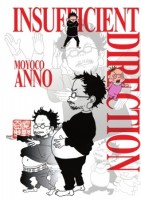
SEAN: The big release this week is Vertical’s manga autobiography of Moyoco Anno – or rather, of her relationship with Uber-Otaku and Evangelion overlord Hideaki Anno. Insufficient Direction simply looks like a giant pile of fun, and I have very high hopes for it.

MICHELLE: Oooooh.

ASH: I’m always happy to see more Moyoco Anno manga in English, so I’m very excited for this release.

ANNA: I am also very excited!

MJ: As am I!

SEAN: Lastly, Viz is finally releasing the first collected volume of One-Punch Man digitally. The rumor is that a print release may follow, but I’m not holding my breath. But that shouldn’t matter – you should buy this, as it’s an awesome title that mocks superheroes and shonen cliches in the best way.

MICHELLE: After having read Bakuman, I can’t help but envision this concept being pitched at the Shueisa serialization meeting! It’s good to hear it doesn’t take itself too seriously.

ASH: I’ll hold my breath as long as it takes to get a physical release! (In the meantime, I’ll be reading it digitally.)

ANNA: I’m looking forward to reading this too, it sounds great.

MJ: I’ve been keeping up with Derek’s weekly recaps, so my expectations are a bit tempered, but perhaps I’ll be pleasantly surprised!

SEAN: Any manga plans this week?

Filed Under: FEATURES, manga the week of

Writing the Love of Boys: Origins of Bishōnen Culture in Modernist Japanese Literature

February 19, 2014 by Ash Brown

Writing the Love of BoysAuthor: Jeffrey Angles
Publisher: University of Minnesota Press
ISBN: 9780816669707
Released: February 2011

I’ve recently become rather enamoured with Edogawa Rampo and his writings which is how I happened to come across Jeffrey Angles’ Writing the Love of Boys: Origins of Bishōnen Culture in Modernist Japanese Literature. Published by the University of Minnesota Press in 2011, the volume is an extension of Angles’ 2004 PhD dissertation “Writing the Love of Boys: Representations of Male-Male Desire in the Literature of Murayama Kaita and Edogawa Rampo.” Angles is currently an associate professor of Japanese literature, language, and translation at Western Michigan University. His primary research interests include translation, modern Japanese poetry, and romance and sexuality in Japanese literature, and especially the portrayal of same-sex desire. All of these subjects are at least touched upon if not thoroughly explored in Writing the Love of Boys. They are all topics that I am particularly interested in as well, so I was rather pleased to discover Writing the Love of Boys while searching for more information on Rampo and his works.

In Writing the Love of Boys, Angles examines the expression of same-sex desire, and specifically male-male desire, in Japanese literature during the late Taishō era (1912-1926) and early Shōwa period (1926-1989). In doing so he focuses on the work of three authors in particular: Murayama Kaita (1896-1919), who was also a poet and a painter; Edogawa Rampo (1894-1965), an incredibly influential writer of detective and mystery fiction among other things; and Inagaki Taruho (1900-1977), whose avant-garde work is noted as being particularly innovative. All three of these authors produced work that either incorporated or directly addressed male-male desire of both homosocial and homoerotic nature. Writing during a time in which attitudes towards sexuality in Japan were changing due to the influence of new medical and psychological approaches, Kaita, Rampo, and Taruho portrayed male-male desire in a way that was different from their immediate predecessors. Placing them within this historical and literary context, Angles also shows how their work would influence creators who followed them as well.

Another subject that is particularly important in Writing the Love of Boys is the erotic grotesque nonsense movement and fad of the 1920s and 1930s. Ero guro literature allowed its authors to explore the bizarre and the strange, including sexual desire that was considered by society to be perverse. However, although Kaita, Rampo, and Taruho were all involved in the rise of ero guro literature, Angles argues that their portrayal of male-male desire was frequently sympathetic and even subversive within the context of the genre which generally used sexuality for the purpose of titillation. Of the three authors that Angles focuses on in Writing the Love of Boys, it is Rampo who is the most well-known in English and who has had more of his work translated. Reading Angles’ analyses and translated excerpts of these three authors’ work, I can’t help but lament the fact that more of their writing isn’t currently available in English. But even though most of the works discussed in Writing the Love of Boys have yet to be released in translation, it is still interesting and valuable to learn about their place and importance within the literary and queer history of Japan.

For me, one of the most intriguing parts of Writing the Love of Boys was the literary lineage that Angles outlines, beginning with Kaita, who influenced Rampo, who in turn collaborated with Taruho, who was a direct inspiration to Takemiya Keiko, one of the creators whose work in the 1970s would lay the foundation for the entire boys’ love genre. In fact, much of the conclusion of Writing the Love of Boys is devoted to the lasting influence and legacies of Kaita, Rampo, and Taruho that can be seen in boys’ love manga. Angles credits Taruho as one of the authors who began developing an aesthetic of male-male desire for a female audience; several of his stories, including his debut, were published in magazines for women. This is one of the links that Angles uses to tie these three authors to the more recently developed genre of stories featuring male-male love primarily written for women by women. To some extent it does feel a little tangential to the work as a whole, and it was somewhat jarring to jump from the 1930s to the 1970s and beyond, but there is a legitimate connection. I found Writing the Love of Boys to be incredibly fascinating; it ended up addressing more of my interests than I initially realized it would–queer theory, ero guro, and even manga, in addition to many other topics.

Filed Under: REVIEWS Tagged With: Edogawa Rampo, Jeffrey Angles, Kaita Murayama, Nonfiction, Taruho Inagaki

Soul Eater, Vol. 18

February 19, 2014 by Sean Gaffney

By Atsushi Ohkubo. Released in Japan by Square Enix, serialization ongoing in the magazine Shonen Gangan. Released in North America by Yen Press.

Soul Eater is an ensemble cast, but as with most ensemble casts, some characters are more lead than others, and so Soul Eater really stars Maka and Soul. Throughout the series we’ve seen the growing closeness between the two, and the confidence that they now have. Which is why the chapters on Envy and Sloth that they both go through are so traumatic. It’s such a shame that Maka, deep down, really has these issues with her. Of course, Maka is all of us, and you can never quite get rid of that core of self-loathing, no matter how much confidence you have. Luckily, Maka has Soul to snap her out of it.

soul18

As for everyone else, the Lust chapter actually plays out a lot faster than everyone thought, once the basic ‘what if they all changed sexes’ gag is done. Naturally, the more repressed a person is, the longer it takes to change back, which gives us an excuse to watch Tsubaki and Liz be humiliated. Gluttony, Wrath and Pride are excuses for character-based humor, as Black*Star and Patti pig out and we have to deal with the return of the most annoying sword in the world, which even Liz can’t wield in order to save Kid. (There’s some amusing 4th wall breaking here, as it’s noted that Black*Star screaming at Excalibur is buried in the gutter of the book.)

Speaking of 4th wall breaking, the art itself undergoes a change in the Sloth chapter, fitting in with what Maka and Soul are going through. This is probably the most disturbing part of the book, as Giriko shows up and threatens to rape Maka using extremely crude language, which (being in an existential crisis) she just sits there and takes. Luckily, Soul is there to come to her rescue, and she’s able to supposedly kill Giriko, though this may prove trickier than they expected. “People don’t explode when you kill them!” Is this meant to be another commentary on shonen tropes?

And then there’s Kid. We’ve had his obsessive-compulsive disorder used for humor for so long that it’s a bit jarring to see it be so serious now. And, truth be told, it’s a great way to get Kid to turn to the side of evil – point out that the best way everything can truly be symmetrical forever is to make everything become nothing, the empty symmetry of nonexistence. It’s chilling. Luckily, we have the one man whose ego is so big that facing off against something like this is nothing, and the cliffhanger sets us up for the big fight between Kid and Black*Star. The first time they fought, Kid wiped the floor with him, but I suspect things will go differently this time.

Soul Eater is slowly makes its way towards a big confrontation, but the journey is also fun, and this continues to be one of the best shonen titles out there.

Filed Under: REVIEWS

Dawn of the Arcana Vols 11 and 12

February 19, 2014 by Anna N

Dawn of the Arcana Vol 11 by Rei Toma

Dawn of the Arcana is a series that I think is best experienced in mini bursts of 2 or 3 volumes, simply due to the deliberate pace of the storytelling in the manga, as well as the fact that it sometimes takes a half volume or so for my brain to kick in with my memories about what happened in the previous volume due to all the relationships developing and the shifting nature of the geopolitical situations happening in Toma’s world. Usually I’m far too impatient to let the volumes pile up like this though!

After 10 volumes, the new status quo for red haired socially outcast with alarming powers of precognition Princess Nakaba and formerly arrogant but really a nice guy who has a social conscience inspired by the power of love Prince Caesar is to be separated. Nakaba has returned to Senan, determined to do some ruling in her own right, and Caesar is back in his home country of Belquat, dealing with his evil family. This volume shows the emotional impact of Nakaba’s power, the Arcana of Time, as she is determined to save the outcast child of a village that is in the direct path of an avalanche. This becomes a story that further explores the position of the humanoid animal hybrid race called ajin, as Lala the child with bunny ears is actually the product of a human/ajin encounter, leading to her abandonment. Lala has one human friend, and Nakaba’s ever present ajin protector Loki is there to save the day as always.

Loki always seems to have a new revelation every few volumes, either about his emotions or background, and a secret is revealed in this volume that shows that he and Nakaba have even more in common than I previously thought. While there’s the more conventional romantic storyline with Caesar and Nakaba, I actually find Nakaba’s relationship with Loki much more interesting, as they trade off protector duties in unexpected ways. Nakaba decides to take power in her home country, and her choices are largely driven by wanting to prevent Loki from going too far for her.

Dawn of the Arcana Vol 12 by Rei Toma

Everything keeps zipping along, as now that Nakaba and Caesar are in power in their respective countries, they have a chance to finally see each other again, when Caesar is ordered to invade Senan. Nakaba’s been looking in on Caesar and remarks that he’s going to start a revolution, so she’s “Here to lend a hand.” Nakaba’s power also provides Toma with a great way of providing more backstory about her characters. Nakaba looks back at Caesar’s father when he was young, even though Loki warns her that it might be difficult for her to see because she’s “too kind”. Nakaba sees King Guran’s first meeting with his unconventional first queen, the commoner Sara. The unhappy ending of this romance provides a reason for why King Guran might have ended up so twisted and bitter, but it doesn’t prevent a confrontation that is sure to cause even more fallout to happen in the volumes ahead.

One of the things that I really like about the art in this series is that it is so clear and easy to read. Toma might not have the most intricate backgrounds or innovative approach to paneling, but I’m never left puzzled about action scenes or finding that I have to go back and reread a page to make sure I understand the sequencing. The wordless exchanges between Nakaba and Caesar and the sidelong glances between Loki and Caesar do more to express the tensions between the characters than several pages of dialog. Overall, these were two very solid volumes in a fantasy series that is always surprising me with unexpected depths. I’m looking forward to the next few volumes to see what will become of Nakaba, Caesar, and Loki (well, really mostly Loki).

Filed Under: REVIEWS Tagged With: dawn of the arcana, shojo beat, shoujo, viz media

My Week in Manga: February 10-February 16, 2014

February 17, 2014 by Ash Brown

My News and Reviews

Not one, but two in-depth manga reviews were posted last week at Experiments in Manga. It wasn’t intentional on my part, though it did make me happy, but both manga deal with queer themes. The first review was for Takako Shimura’s Wandering Son, Volume 6. Even though it can be a somewhat difficult read for me personally since the subject matter often hits very close to home, I’m still absolutely loving this series. The seventh volume of Wandering Son is currently scheduled for release in August, which feels like a long ways off right now. As part of my “Year of Yuri” review project, last week I also took a closer look at Kiriko Nananan’s Blue, the only example of her long-form manga available in English. It’s a sweet and melancholic story of first love which follows the relationship of two young women who are classmates at an all-girls high school. The artwork in particular is very striking.

I’ve come across plenty of interesting reading and news over the last week. Brigid Alverson attended the Angoulême International Comics Festival this year and has been writing several reports on the experience. One of those explores the current state of the French manga market. In other festival news, The Guys with Pencils podcast interviewed Christ Butcher to talk about the fantastic Toronto Comics Arts Festival which he co-founded in 2003. Justin Stroman recently wrote two articles that I found to be particularly interesting: The Great Tumblr Industry Experience for Organization Anti-Social Geniuses and The Legal Manga Reading Sites You Don’t Know About for Manga Bookshelf. Finally, there has been some more movement on the licensing front. Yen press announced three new manga titles (Übel Blatt by Etorouji Shiono, Barakamon by Satsuki Yoshino, and Hiroyuki Aigamo’s adaptation of Accel World), as did Vertical (Gamon Sakurai’s Demi-Human, Ryū Mizunagi’s Witchcraft Works, and Midori Motohashi’s adaptation of The Garden of Words).

Quick Takes

Mister Mistress, Volume 2Mister Mistress, Volume 2 by Rize Shinba. It’s been quite a while since I read the first volume of Mister Mistress, but I did enjoy it enough that I made a point to track down the now out-of-print second volume. (Happily, both volumes are now available digitally from SuBLime, though I don’t believe there are currently any plans to continue the series.) Mister Mistress works best for me when it sticks to being a comedy. Shinba introduces a somewhat tragic backstory for Rei in this volume, but fortunately it doesn’t take too long for this to be turned around and played for laughs. The series’ strength really isn’t its plot, but its humor. Fujimaru is a bit of a goofball who can’t quite decide what to do about Rei. He halfheartedly attempts to exorcise the incubus several times, but on occasion he actually appreciates having him around. Though I’m not entirely convinced by their developing feelings for each other, it can be rather convenient for a horny teenager to have a personal incubus to aid in the realization of his sexual daydreams. As such, the sex scenes in Mister Mistress tend to be a little unusual.

Sherlock Bones, Volume 2Sherlock Bones, Volumes 2-3 written by Yuma Ando and illustrated by Yuki Sato. I wasn’t sure after reading the first volume of Sherlock Bones, but after reading the second and third volumes it appears as though the series will be mostly episodic. Which is just fine and works pretty well. After the basic premise of the series has been established–Sherlock Holmes reincarnated as a mix-breed puppy–the mysteries tend to be fairly self-contained. I was pleasantly surprised by the first volume of Sherlock Bones and, if anything, I think these two volumes are even better than the first. Sherdog seems to always be present when a murder is taking place, so Sherlock Bones isn’t really a “whodunit.” Instead, the series focuses on outwitting the criminals and finding ways to reveal their attempts to cover up what they have done. For the most part this means relying on circumstantial evidence and pressuring the killers into confessing. Although murder seems to be the crime du jour, Sherlock Bones features some more lighthearted and silly investigations as well which take advantage of the fact that Sherdog is adorable.

Stone, Volume 1Stone, Volumes 1-2 by Sin-ichi Hiromoto. In 2004, the editor of the English edition of Hiromoto’s short manga series Stone called it a “tribute to all of the fantastic sci-fi/action/fantasy films of the past thrity-odd years.” That seems to be a fairly accurate description of Stone. Hiromoto borrows and remixes elements from many films and franchises along with his own creations to devise something entirely his own. I was frequently reminded of Waterworld and to some extent Dune, and I definitely caught nods to Hellraiser and Star Wars. I get the feeling that there were references that I completely missed, too. Stone is a quickly paced manga with plenty of action set in a post-apocalyptic world in which the planet has been covered in a literal sea of sand. My favorite parts of Stone are the nightmarish sand creatures that Hiromoto has designed. Zizi, a fiesty young woman and the series’ lead, is also pretty great. I did prefer the series’ beginning over its end. As the manga becomes increasingly chaotic as the story progresses. The artwork remains visually interesting and engaging, but the plot makes less and less sense as it goes along.

Two Flowers for the Dragon, Volume 5Two Flowers for the Dragon, Volumes 5-6 by Nari Kusakawa. I have now reached the point in this series where I must lament the fact that the final volume wasn’t able to be released in English before CMX folded. These two volumes form the climax of Two Flowers for the Dragon and include some extraordinarily significant plot developments and betrayals. The direction the story has taken was definitely foreshadowed, but that doesn’t make it any less heart-wrenching to see play out. I thought it was all very well done. One of the things that I like the best about Two Flowers for the Dragon is how well-developed and complicated the main characters are. They all have their strengths and their weaknesses, flaws as well as redeeming qualities. The supporting cast is likewise well-rounded, though at this point the series’ true villain unfortunately seems to be less so. The characters and their interactions are a highlight of Two Flowers for the Dragon, but I’m really enjoying the story as well. I like the mix of action, fantasy, romance, and intrigue. So much so, that I’m tracking down a copy of the last volume in Japanese. I want to know what happens!

Filed Under: FEATURES, My Week in Manga Tagged With: manga, Mister Mistress, Nari Kusakawa, Rize Shinba, Sherlock Bones, Sin-ichi Hiromoto, Stone, Two Flowers for the Dragon, Yuki Sato, Yuma Ando

Blue

February 14, 2014 by Ash Brown

BlueCreator: Kiriko Nananan
U.S. publisher: Fanfare/Ponent Mon
ISBN: 9788493340971
Released: 2006
Original release: 1997

I first discovered Kiriko Nananan’s work while reading Secret Comics Japan: Underground Comics Now. Two of her short manga–“Heartless Bitch” and “Painful Love”–were included in the volume. I was quite taken by the pieces and so was determined to find more of Nananan’s manga in English. Sadly, very little has been translated. Another of her short manga, “Kisses,” was collected in Sake Jock: Comics from Today’s Japanese Underground, an early English anthology of alternative Japanese manga. Nananan debuted in the avant-garde manga magazine Garo in 1993, which is one of the reasons her work is found in these “underground” collections. She is particularly well-known for her short manga; Blue is her only long-form manga to have been released in English. Originally published in Japan in 1997, Fanfare/Ponent Mon published the English edition of the manga in 2006 after releasing a Spanish-language edition in 2004. Blue has also been translated into French and German. The manga was also popular enough to receive a live-action film adaptation directed by Hiroshi Ando in 2002.

“The sky that stretches out above the dark sea. The school uniforms and our desperate awkwardness. If those adornments of our youth held any color it would have been deep blue.” Thus begins Kiriko Nananan’s Blue. Kayako Kirishima, a senior at the Hijiri all-girls high school, is fascinated by her classmate Masami Endō, the young woman who sits directly in front of her. Endō was suspended from school the previous year. Because of that and her general attitude, many of the students at Hijiri find her difficult to approach. But Kirishima eventually musters up the courage to finally talk to Endō. Her fascination becomes friendship and eventually love. But their relationship isn’t an easy one. Uncertainty, worry for the future, and past regrets all have an impact on Kirishima and Endō and how they relate to each other and to the rest of their friends. Love can be a wonderful thing, but it can also be painful. As high school draws to an end, they must face the inevitable changes in their lives either together or alone.

Nananan’s artwork in Blue is very simple, almost minimalistic, and yet it is also incredibly arresting. There is very little shading employed. In fact, the use of negative and white space is just as important to the manga’s composition as the deep black of Nananan’s ink work. It has a distancing and cooling effect. The fragility of Kirishima and Endō’s relationship is reflected in the fragility of Nananan’s lines. At times the pages are nearly empty, giving a sense of loss and contemplativeness, as if the feelings of the two young women are in danger of disappearing altogether. Body language is especially important in Blue. Hands in particular are a recurring motif and are very expressive–they reach out to grasp someone or to push them away, they hide a face in shame or frustration. Nananan shows intimacy of varying degrees in Blue through the characters’ actions and touch. It can be extremely sensual, but it can also be very chaste.

Blue has a reflective, poetic, and lyrical quality to it. The manga is a fairly simple and straightforward story of first love which is both sweet and sad. However, Nananan is adept at capturing the realistic complexities of love and all of the feelings associated with it–the jealousy and heartache as well as the happiness and joy. Kirishima is constantly thinking about Endō. Even when she isn’t immediately present on the page Endō is the focal point of the manga and always on Kirishima’s mind. The two of them obviously care deeply about each other and so it is particularly unfortunate that they seem unable to be completely open and honest with each other or with themselves. They are both young and don’t always make the best or most mature decisions. Blue is told from Kirishima’s perspective as she looks back from some point in the future to her high school days with understandable sentimentality. Although the manga is frequently melancholic and intensely emotional, it never comes across as melodramatic. Blue is a beautiful and striking work; I would love to see more of Nananan’s manga translated.

Filed Under: REVIEWS Tagged With: Fanfare/Ponent Mon, Kiriko Nananan, manga, Year of Yuri

Manga the Week of 2/19

February 13, 2014 by Sean Gaffney, Michelle Smith, Ash Brown and MJ 1 Comment

SEAN: Third week of the month is pretty hefty this month thanks to Yen Press’s pile o’ stuff, plus a few titles from everyone else.

strikewitches1Kodansha brings us the 13th volume of Cage of Eden. The series has now ended in Japan, so we know there will be 21 total. That still leaves us many more volumes of huge killer animals and naked women bathing to go.

And for those of you who are of a more BL disposition, Kodansha also has the 5th No. 6.

ASH: I’m actually really enjoying this series! After a somewhat weak first volume, it keeps getting better and better.

MJ: Ash’s endorsement here makes me feel like I should check it out!

SEAN: Seven Seas debuts a new series whose anime is already famous – or, indeed, infamous. Strike Witches: Maidens in the Sky is known to me primarily as “that anime with the girls who are WWII fighter pilot archetypes and wear no pants.” Let’s see how the manga entertains.

MICHELLE: … So very not for me.

MJ: Uh. Yeah.

SEAN: There’s also Vol. 4 of World War Blue, which prefers to use video game companies for its archetype needs.

We have reached the penultimate volume of Bokurano: Ours from Viz, so surely the cast must be down to only 1 or 2 people, right?

MICHELLE: I need to get caught up with this one!

gangstaSEAN: The debut I’m most excited for this week is Gangsta, a seinen series from Shinchosha’s Comic Bunch with 87,000 tons of style.

ASH: I’m very interested in this one, too.

MJ: Agreed!

SEAN: Blood Lad has caught up with Japan, so it’s been a while since we saw it. This 4th omnibus should have Vols. 7 and 8 from Japan. Can’t wait, this is one of my big sleeper hits.

MICHELLE: Woot! It’s been a long time!

MJ: I am so happy to see more Blood Lad! It is one of my very favorite series currently running, and I am so surprised to be saying that.

SEAN: We have also reached Vol. 5 of BTOOOM!, which I understand has finally given its survival game heroine a name.

MICHELLE: I made myself snicker by imagining her name was “Crotchina.”

MJ: ❤

SEAN: Now that The Disappearance of Nagato Yuki-chan has gotten rid of its big plot surprise, can it still entertain while going back to slice-of-life cuteness?

Yen also has Vol. 7 of Is This A Zombie?. I keep wanting there to be a sequel called “Yes, This IS A Zombie!”

pandora20MICHELLE: *snerk*

SEAN: Vol. 9 of Jack Frost, one of Yen’s longer-running manwha titles. I lost track of it. Is it Horror? Action? Comedy?

Speaking of survival game manga, we also get Vol. 3 of Judge, which continues Doubt‘s basic themes with a (mostly) new cast.

It’s Pandora Hearts 20! Huzzah! Be warned, I think we’re nearly caught up with Japan. The days of every other month are almost over.

MICHELLE: Waah.

MJ: WOE IS MEEEEE. Though of course I’m happy to see this volume. :)

SEAN: Puella Magi Kazumi Magica 4 continues to ask the question: “How much more money can we earn by putting magical girls through horrible trauma?” The answer. A whole lot.

Lastly, there is the 3rd and final hardcover omnibus of Thermae Romae, Mari Yamazakis tribute to baths and bathing filtered though Ancient Rome. Can Lucius find a happy ending and a nice long soak?

MJ: I’m looking forward to this, if a bit passively.

What’s your manga valentine?

Filed Under: FEATURES, FEATURES & REVIEWS, manga the week of

Wandering Son, Vol. 6

February 12, 2014 by Ash Brown

Wandering Son, Volume 6Creator: Takako Shimura
U.S. publisher: Fantagraphics Books
ISBN: 9781606997079
Released: January 2014
Original release: 2007

Wandering Son is currently the only manga by Takako Shimura to have been released in print in English. Although I would love to see more of her work translated and published, I am particularly grateful that it is Wandering Son that has been licensed for print release. (Fantagraphics’ large format hardcover edition is simply lovely, too.) Wandering Son is a beautiful series that explores the young protagonists’ search for personal identity and addresses issues of gender and sexuality in a very sincere, sensitive, and accessible way. Wandering Son often hits incredibly close to home for me which is one of the reasons that I personally hold the series so dear. I’m not sure how popular the series is in general, but it has been well-received by critics both inside and outside of Japan. The sixth volume of Wandering Son was initially published in Japan in 2007. Fantagraphics’ English-language edition of Wandering Son, Volume 6 was released in 2014.

As the school’s cultural festival approaches, the students are hard at work preparing for their classes’ projects. Chiba and Shuichi are trying to put the final touches on their script for a gender-swapped version of Romeo and Juliet despite some of their classmates’ well-intentioned interference. To Chiba and Shuichi the play is much more than a simple seventh-grade class production. It’s also a very personal expression of their desires: Chiba wants to see Shuichi in the role of Juliet and Shuichi wants to be seen as a girl. In some ways their version of Romeo and Juliet is a reflection of Shuichi and Takatsuki as the two of them are faced with challenging society’s established gender roles and expectations. Shuichi and Takatsuki’s bonding over the play is a source of immense frustration for Chiba. She’s in love with Shuichi, and Shuichi has feelings for Takatsuki, but Takatsuki isn’t interested in pursuing those feelings. The result is that there’s quite a bit of drama both on and off the stage.

For my part, I’m glad to see Shuichi and Takatsuki becoming close again after their relationship was disrupted by Shuichi’s confession of love. Thankfully, they were able to work through that and are once again able to lean and rely on each other as friends. This is particularly important for the two of them since they share so much in common. The additional support is something that Shuichi especially needs. At the beginning of Wandering Son, Shuichi was a very meek and hesitant person. However, as the series has progressed, Shuichi has grown, becoming much more assertive and confident and is now able to begin to express in words needs and desires. In a very touching scene with Takatsuki, Shuichi sums it up quite nicely, “It’s my wish. You as a boy…me as a girl…a happy ending for everybody.” It’s really the first time that Shuichi has been able to be so clear and forthright about the their situation. Happily, it’s not the last time that it happens, but it is a very formative and noteworthy moment.

One of the things that Shimura captures remarkably well in Wandering Son is the natural development of the characters and their relationships with one another. Wandering Son is a story about growing up and determining not only who you are as an individual but who you are in relation to other people; how people see themselves in addition to how others see them. Life itself could be said to be a performance. It’s particularly interesting then that in Wandering Son, Volume 6 so many parallels are made between Shuichi and Takatsuki’s real life and the very deliberately crafted Romeo and Juliet production. Through it they are able to reveal a part of themselves for everyone to see. It may not be a particularly subtle narrative technique on Shimura’s part, but it is a very effective one. The play echos their experiences, emphasizing specific aspects of their lives and relationships not only for the characters, but for the readers as well. Wandering Son continues to be an absolutely wonderful series. As always, I am very much looking forward to the next volume.

Filed Under: REVIEWS Tagged With: Fantagraphics Books, manga, Takako Shimura, Wandering Son

  • « Go to Previous Page
  • Page 1
  • Interim pages omitted …
  • Page 350
  • Page 351
  • Page 352
  • Page 353
  • Page 354
  • Interim pages omitted …
  • Page 538
  • Go to Next Page »
 | Log in
Copyright © 2010 Manga Bookshelf | Powered by WordPress & the Genesis Framework