My News and Reviews
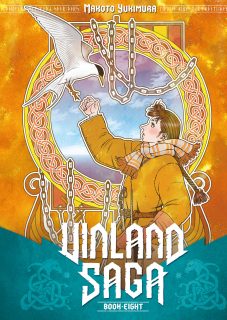
It’s been several months since my last in-depth review, but over the weekend I actually managed to post one delving into the eighth omnibus of Makoto Yukimura’s Vinland Saga. I really love this series so I am thrilled that Kodansha Comics was able to continue publishing it. The eighth omnibus marks the start of an exciting new story arc and introduces some great new characters. On a personal note, it also felt good to actually finish writing a review since it’s been so long. I’d like to continue posting at least one long-form review or feature every month in addition to the usual My Week in Manga, Bookshelf Overload, and Giveaway features. On the surface it seems to be a reasonable goal, so I guess I’ll see how it goes!
Elsewhere online, Sparkler Monthly‘s first issue of 2017 has been released. As can be expected, all of the content is great, but this issue specifically features Denise Schroeder and her delightful lesbian-themed comic Before You Go. I took a look at the first installment of Before You Go as part of my Year of Yuri review project a couple of years ago. It’s a great comic, so I’m glad so see more of it. And if things go well, there should be a collected edition in the near future as well! Also last week, Seven Seas announced its collaboration with J-Novel Club to release Ao Jyumonji’s Grimgar of Fantasy and Ash and Chiyomaru Shikura’s Occultic;Nine in print.
Quick Takes
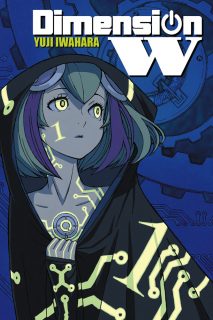 Dimension W, Volumes 1-2 by Yuji Iwahara. Several of Iwahara’s manga series have been released in English. I’ve read and enjoyed both Cat Paradise and King of Thorn, but there’s also Chikyu Misaki and most recently Dimension W. I’ve come to expect a few things from Iwahara’s manga: great artwork and action, large and diverse casts, intriguing settings and premises, and entertaining stories that take numerous twists and turns (and which often end up rather convoluted as a result). So far, it seems as though Dimension W will also follow this pattern and, being Iwahara’s longest series, I suspect that the plot will go in some truly bizarre directions. But even considering that Iwahara seems to be constantly making up and changing the rules when it’s convenient just to make the story work, I’m actually really enjoying Dimension W. In the series, New Tesla is a company that has gained a tremendous amount of political and social influence due to the fact that it monopolizes a nearly limitless source of energy and the technology needed to use it. The power could be dangerous in the wrong hands, and New Tesla may very well be the wrong hands.
 Firefighter! Daigo of Fire Company M, Volumes 11-20 by Masahito Soda. One of the things about Firefighter! is that once I start reading it, I can’t seem to put it down. It’s a fantastic action series that’s firmly based in reality, although some of the scenarios are so completely over-the-top that they strain believability. Even so, the drama and intensity of Firefighter! is thrilling. With every rescue Soda keeps increasing the stakes, finding ways to make each one even more daring and astonishing than the last. And seeing as the first half of Firefighter! ends with Daigo intentionally crashing a fire engine into a building, that’s a pretty impressive feat. Admittedly, the series can get pretty absurd, but it’s always entertaining as well as engaging. The character development is excellent, too. In the heat of the moment, Daigo has the tendency to make some incredibly dangerous although ultimately life-saving decisions, but afterwards he struggles to come to terms with his actions and underlying motives. Firefighter! is a great series and well-worth a look. The manga is currently out-of-print, but fortunately it is readily available digitally.
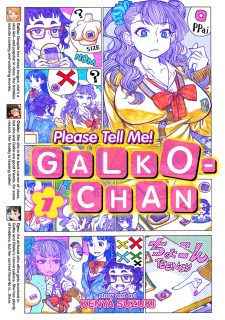 Please Tell Me! Galko-chan, Volume 1 by Kenya Suzuki. I first learned about the Please Tell Me! Galko-chan manga due to its recent anime adaptation (which I haven’t actually seen yet), but I was still very curious about the original series. What I didn’t realize until I picked up the first volume was that the manga is actually completely illustrated in color; the palette and style that Suzuki uses for the cover illustration is pretty much what is used for the interior artwork as well. Please Tell Me! Galko-chan is a surprisingly sweet, funny, and charming series, especially considering that it frankly deals with issues surrounding puberty, sex, and so on. Some of the subject matter is more innocent, but there’s plenty of dirty humor and jokes, too. Though the framing of the series is fictional, the largely short and episodic manga of Please Tell Me! Galko-chan do incorporate a fair amount of factual information. What I really appreciate about Please Tell Me! Galko-chan is that while the topics covered often embarrass the characters–frequently they’re discussing breasts, menstruation, and sex in a deliberate attempt to make each other blush–there’s never a sense that they or their bodies are shameful.
 Ze, Volumes 10-11 by Yuki Shimizu. Despite at one point being rather fond of Shimizu’s supernatural boys’ love Ze, it’s taken me a while to actually get around to reading the main manga’s last story arc and conclusion. (Granted, that may have also been partly due to the numerous delays and unreliability of Digital Manga’s release schedule.) As a whole Ze tends to be fairly sexually explicit, but these two volumes are for the most part relatively tame and include very little sex at all. The relationships and power dynamics in the series are still pretty intense, though. The final story arc of Ze is almost entirely devoted to revealing the backstory of Waki and his connection to the Mitou family. In an interesting twist, it turns out that Waki has always been an asshole and there was nothing in particular that made him that way; although unfortunate things have certainly happened to him, his depraved personality is completely his own. The Mitou family’s past is certainly a strange and tragic one that has resulted in a great deal of suffering over time, but Shimizu does manage to end the series on a positive and redemptive note.

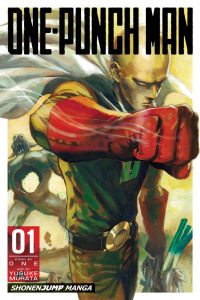 My name is Saitama. I am a hero. My hobby is heroic exploits. I got too strong. And that makes me sad. I can defeat any enemy with one blow. I lost my hair. And I lost all feeling. I want to feel the rush of battle. I would like to meet an incredibly strong enemy. And I would like to defeat it with one blow. That’s because I am One-Punch Man.
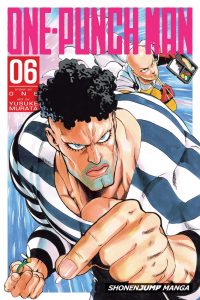 The balancing act ONE and Murata achieve here is impressive. On the one hand, One-Punch Man is gloriously silly. Heroes and foes alike are apt to be ludicrous, and some of the former have terrific names like Tank Top Vegetarian or Spring Mustachio (although I actually think he’s pretty cool). On the other hand, there is a lot of excellent shounen manga storytelling going on. The way Saitama lives his life without criticism for others makes me think he’d get along well with One Piece‘s Luffy, and the devotion his pupil Genos shows for him means they can always rely on each other. Too, after Saitama joins the Hero Association, we get regular updates on how his rank is improving, and this puts him in contact with even more heroes, some of whom are inept, some of whom are capable, and one of whom might actually be an enemy. He doesn’t seek glory, so many are unaware of his true strength, but I assume that eventually he will attain the rank he deserves (currently, due to poor performance on the written test, he’s far below Genos).
 As of volume eleven, there are several plotlines in play. Monsters are appearing everywhere, and appear to be organizing. Is this tied in with the prediction of an extinction-level event within the next six months? What about that hint of a possible traitor that was dropped a few volumes back? While a rogue martial artist named Garo is hunting heroes, Saitama is off at a martial arts tournament to learn more how to defeat Garo (not knowing that he totally already did) and seems destined to face off against another strong fighter who is desperate for a challenge. I admire how this story has widened in scope in a natural way, without compromising the balance of narrative and humor. It could conceivably go on for a very long time, and I deeply hope it does.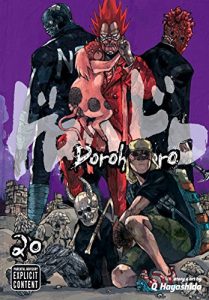


 and
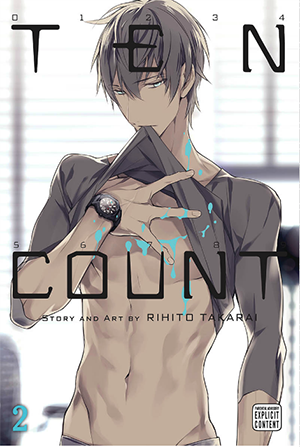
and  ) by Rihito Takarai, published here by SuBLime. From what I understand, the series has reached five volumes (ongoing) in Japan. The third volume is due out from SuBLime next month.
  Shirotani is a lifelong germaphobe, resigned to his condition, though it keeps him isolated from others. Fortunately, with the help of his understanding employer, he is able to tolerate his job as secretary to a corporate CEO. It is in the corporate line of duty, then, that he first meets Kurose, a therapist at a local mental health clinic. Kurose notices Shirotani’s condition immediately, and suggests he seek help, but though Shirotani is able to make his way to the clinic, he can’t bring himself to go inside. Acknowledging this difficulty, Kurose offers to help him in a non-clinical capacity, as a friend, an arrangement to which Shirotani eventually agrees. As Kurose slowly helps him accomplish progressively difficult tasks (touching a doorknob with his bare hand, buying a book from a bookstore), the two become close in ways that complicates their relationship and threatens the fragile boundaries between them.
  MICHELLE: Another thing that strikes me about the questions Kurose poses is how detached and clinical they can seem, even after a sexual act. One example is, “Were you more concerned with the possibility that I found you unpleasant than whether or not you found the situation itself unpleasant?” Leaving aside the tacit admission that he knows Shirotani could’ve been finding the situation unpleasant, attempting to reassert the therapist/patient dynamic at such a moment is, well, kind of creepy.
