• Skip to primary navigation
  • Skip to main content
  • Skip to primary sidebar
  • Home
  • About Us
    • Privacy Policy
    • Comment Policy
    • Disclosures & Disclaimers
  • Resources
    • Links, Essays & Articles
    • Fandomology!
    • CLAMP Directory
    • BlogRoll
  • Features & Columns
    • 3 Things Thursday
    • Adventures in the Key of Shoujo
    • Bit & Blips (game reviews)
    • BL BOOKRACK
    • Bookshelf Briefs
    • Bringing the Drama
    • Comic Conversion
    • Fanservice Friday
    • Going Digital
    • It Came From the Sinosphere
    • License This!
    • Magazine no Mori
    • My Week in Manga
    • OFF THE SHELF
    • Not By Manga Alone
    • PICK OF THE WEEK
    • Subtitles & Sensibility
    • Weekly Shonen Jump Recaps
  • Manga Moveable Feast
    • MMF Full Archive
    • Yun Kouga
    • CLAMP
    • Shojo Beat
    • Osamu Tezuka
    • Sailor Moon
    • Fruits Basket
    • Takehiko Inoue
    • Wild Adapter
    • One Piece
    • After School Nightmare
    • Karakuri Odette
    • Paradise Kiss
    • The Color Trilogy
    • To Terra…
    • Sexy Voice & Robo
  • Browse by Author
    • Sean Gaffney
    • Anna Neatrour
    • Michelle Smith
    • Katherine Dacey
    • MJ
    • Brigid Alverson
    • Travis Anderson
    • Phillip Anthony
    • Derek Bown
    • Jaci Dahlvang
    • Angela Eastman
    • Erica Friedman
    • Sara K.
    • Megan Purdy
    • Emily Snodgrass
    • Nancy Thistlethwaite
    • Eva Volin
    • David Welsh
  • MB Blogs
    • A Case Suitable For Treatment
    • Experiments in Manga
    • MangaBlog
    • The Manga Critic
    • Manga Report
    • Soliloquy in Blue
    • Manga Curmudgeon (archive)

Manga Bookshelf

Discussion, Resources, Roundtables, & Reviews

Michelle Smith

Bookshelf Briefs 9/19/11

September 19, 2011 by Katherine Dacey, David Welsh, Sean Gaffney and Michelle Smith 4 Comments

This week, Kate, David, Sean, & Michelle take a look at recent releases from Viz Media, Digital Manga Publishing, Kodansha Comics, and Vertical, Inc.


Afterschool Charisma, Vol. 4 | By Kumiko Suekane | Viz Media – Afterschool Charisma has all the right ingredients to be a Kaori Yuki manga: there are impossibly attractive leads wearing fanciful costumes (see Florence Nightingale’s clone), evil bishies (see Rasputin’s clone), wackadoo plot twists (see Hitler and Napoleon’s clones), and excursions into taboo territory (see Joan of Arc’s clones). What sets Afterschool Charisma apart from Fairy Cube or Grand Guignol Orchestra, however, is that Kumiko Suekane uses action sequences to advance the plot and not just interrupt the talking. In so doing, Suekane liberates her characters from the burden of explaining what’s happening — a key shortcoming of Yuki’s storytelling, which often bogs down in long-winded exposition. Suekane isn’t as wildly imaginative as Yuki, but shows a similar talent for creating and sustaining a mood of almost unbearable dread, producing a story that’s both incredibly suspenseful and deliciously silly. Recommended. -Katherine Dacey

Kimi ni Todoke, Vol. 10 | By Karuho Shiina | Viz Media- Sometimes you can get frustrated with a series taking so long to buildup to what seems like an obvious conclusion. You stare at the leads misunderstanding each other over and over, and wish that they’d just get on with it. Of course, when they DO get together, and it’s even sweeter than you possibly imagined, you forget you were ever frustrated in the first place, because it’s all worth it. This is an entire volume of payoff. Right from the cover, which seems to be a mirror of the first volume, through our desire to KILL Joe for being what he is – an author-crafted character designed to get in the way, and through Pin once again being helpful and yet appalling at the same time, it’s all worth it for those wonderful scenes of Sawako and Kazehaya finally achieving enlightenment. I think it can best be summed up by the start of Chapter 42, where Sawako has written notes her herself all over her room telling her it wasn’t a dream. No, but it sure felt like one, huh?– Sean Gaffney

March Story, Vol. 3 | By Kim Hyung-Min and Yang Kyung-Il | Viz Media – After two hit-or-miss volumes, March Story has finally found its sea legs. The five stories that comprise volume three run the gamut from folklore (“Wedding March”) to horror (“Song of the Waves,” “The Sword-Maiden and the Glass Palace”) to comedy (“Extra Version”) while giving each of the principal characters a turn in the spotlight. It’s hard to single out one chapter as the volume’s highpoint, though “Ode to a Doll” comes close: the plot revolves around a toy who develops a deep attachment to its owner, going to extreme lengths to bring a lonely little girl a few moments of joy. As in the previous two installments, the artwork is a pleasing amalgam of stylistic influences from Hayao Miyazaki’s Spirited Away to Jim Henson’s Labyrinth. The character designs, faux-European settings, and objects are rendered in meticulous detail, making March Story one of the best-looking titles in the VIZ Signature line. Recommended. -Katherine Dacey

Mardock Scramble, Vol. 1 | Created by Tow Ubukata, manga by Yoshitoki Oima | Kodansha Comics – I’m probably as guilty as anyone of judging books by their covers, and I can’t say this one’s made a great impression, with its aggressively vulnerable but sexy waif gazing out at me. I was pleasantly surprised by the content behind that cover, though. It’s about a homeless prostitute who’s nearly murdered but ends up rescued and remade with amazing powers by an odd pair of private investigators. Our heroine, Rune Balot, adapts quickly to her new abilities to sense and control all of the electric currents around her, but she’s much less sure of her place in the world and even her willingness to stay in it. There’s a genuine gravitas to Rune and her plight, which elevates the book over its familiar and potentially pandering premise. Here quirky benefactors – a mad scientist named Dr. Easter and a great partner named Oeufcoque – have lots of promise. There is a lot of formula evident here, but there’s also a lot of sincere feeling and some fun surprises. – David Welsh

One Piece, Vol. 58 | By Eiichiro Oda | Published by Viz Media – Much like volume 57 before it—which saw the beginning of a battle at Marineford, where Luffy’s brother Ace is scheduled to be executed—the first half of volume 58 sidelines even Luffy (the only Straw Hat pirate we’ve seen in some time) to focus on the conflict between Whitebeard’s crew and the navy. That’s not to say that the conflict isn’t epic or interesting, but that it does not feel immediate. Not to worry, though, as Oda brings the emotional gut-punches to the second half of the volume, driving Luffy to the point of death to achieve his goal, reminding everyone of various familial or family-esque bonds, and then showing how such costly sacrifice can be squandered when one is unable to put aside their pride. This is tragedy, folks, in the Greek sense of the word. – Michelle Smith

Rabbit Man, Tiger Man, Vol. 1 | By Akira Honma | Digital Manga Publishing – In this yakuza-themed romance, Nonami, a brash mobster, falls in love with Uzuki, the timid doctor who saved him from bleeding to death in an alley. No yaoi cliche goes untouched: Nonami is boorish and heterosexual, but inexplicably and powerfully drawn to Uzuki, while Uzuki discovers that he’s attracted to Nonami, even though he’s sorely afraid of him. (Poor Uzuki sweats like a triathlete whenever Nonami calls him or walks into the same room.) Nothing about the characters or their relationship has a whiff of plausibility about it: is the Japanese economy so abysmal that Tokyo U. grads are really taking gigs as hit men? The artwork is Rabbit Man, Tiger Man‘s sole redeeming feature, as Honma demonstrates a flair for drawing handsome male characters and cute animal caricatures. Strictly for yaoi enthusiasts. -Katherine Dacey

Twin Spica, Vol. 9 | By Kou Yaginuma | Vertical – While this series is ultimately very gentle, I’m consistently impressed by the way Yaginuma makes the most of small character grace notes. In this volume, a relatively brief sequence shows an unexpected but rewarding side of Asumi, Yaginuma’s tiny, determined heroine. A younger student moves into her rooming house, and Asumi is troubled by the lack of respect she receives from the newcomer. One of Asumi’s defining traits is that she looks so much younger than she actually is, but it’s never really shown as bothering her. She compensates by redoubling her efforts. Now, she’s presented with someone who isn’t aware of those efforts, and just reacts to Asumi’s surface. It results in a few extremely telling moments that give Asumi the luxury of being a little egotistical and one of her friends the chance to show how well he understands Asumi. It’s not a seismic event, but it really adds to the overall narrative. – David Welsh

Velveteen & Mandala | By Jiro Matsumoto | Vertical – I wasn’t quite sure what to expect from this book, besides ‘alternative’. I was surprised, therefore, to find that it held my attention for almost the entire volume. Yes, I could have done without the casual body humor, and the fourth-wall breaking, normally something I’m quite fond of, didn’t really work for me in this setting. But much of the volume is spent trying to figure out what’s going on – how much of what Velveteen and the Super say is true; is this is post-apocalypse, the afterlife, or something in between; what’s alive, dead, or a zombie; and the entire problem of whether one of the two leads actually exists. I thought that it fell down a bit right at the end – after Velveteen is hit by the car, things fell apart for me. But just because the ending didn’t quite satisfy dind’t mean the journey wasn’t worth it. And I did love both final images of the heroines, each of which give a strange hope that isn’t anywhere in the actual narrative. Flawed, and not for the easily grossed out, but worthy.– Sean Gaffney

Filed Under: Bookshelf Briefs

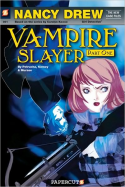
Nancy Drew: The New Case Files, Vols. 1-2

September 18, 2011 by Michelle Smith

By Stefan Petrucha, Sarah Kinney, and Sho Murase | Published by Papercutz

You might wonder why I read a couple of Nancy Drew graphic novels, but when I tell you that these volumes comprise parts one and two of an arc called “Vampire Slayer,” perhaps you will understand. It was the unlikely union of Nancy Drew and Buffy—and yes, said show is specifically referenced in the endnotes—that compelled me and my compatriots at Triple Take to make this our pick for this month. I admit I didn’t expect to like this very much, but the story turned out to be even more blah than I was anticipating.

Here’s the premise: Nancy and friends Bess and George are on their way to see the hot new movie, Dielight. If they arrive in costume, they get a discount, so when they are chased by a pointy-toothed guy in the cemetery (is it supposed to be a fun twist when it’s revealed that he’s actually running from Nancy’s dog?) they assume he’s headed there, as well. He doesn’t show up for the film, but Nancy spots a mysterious-looking cloaked figure lurking alone in the back of the theatre.

Afterwards, tooth dude pops up again and introduces himself as Gregor Coffson. He is super intrigued by the fact that Nancy is a detective and asks her out, prompting this oh-so-hilarious exchange:

Nancy: Thanks… I’m flattered, but I already have a Ned… I mean… boyfriend.

Gregor: So?

Ned: Hi. I’m boyfriend. I mean Ned.

Gregor: Oh.

Oh boy am I ever rolling on the floor now. *eyeroll*

Anyway, things don’t improve very much from here. Gregor indicates that he has a secret, but he won’t divulge it until he is sure that he can trust Nancy. And because Nancy is a big nosypants, she ends up hanging out with him all the time, oblivious to Ned’s growing jealousy. At first I was pleased that Ned was confident that Nancy would not cheat on him, but that doesn’t last long and he soon begins throwing jealous hissy fits. Gregor’s secret turns out to be totally lame—someone’s stalking him because they think he’s a vampire—and so does the resolution of the story.

Ultimately, the adjective that most comes to mind when describing this story is “lazy.” In addition to the fact that Gregor’s secret is a letdown and Ned’s reaction predictable, there are other signs of shoddy craftsmanship. Gregor claims not to have a cell phone, but then how is he receiving threatening text messages from his stalker? The big reveal (spoilers, if you care) that the stalker is actually Gregor’s long-lost sister Garina is torpedoed when Nancy refers to the girl as Garina several pages before the existence of Gregor’s twin even comes up. And I’d swear that one scene of Gregor and Nancy sitting at a table was simply copied and pasted from one place to another, with only a slight adjustment of Gregor’s arm and the application of some green tint to Nancy’s shirt to differentiate them.

Probably they thought that only kids would read this and no one would notice, but kids deserve effort and originality, too. About the best thing I can say about this is that Nancy’s friend, George, is appealingly androgynous. She should get her own series.

Additional reviews can be found at Triple Take.

Filed Under: REVIEWS

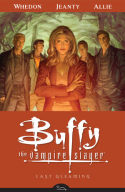
Buffy the Vampire Slayer Season Eight, Vol. 8

September 16, 2011 by Michelle Smith

By Joss Whedon, et al. | Published by Dark Horse

Because I’ve spent so much time and energy in the attempt to quantify why and how Season Eight lost me, I find myself sorely tempted to dismiss this final volume with a simple “meh,” but I suppose I can summon one more burst of effort.

This volume comprises the last five issues of Season Eight (#36-40) and also includes a fun Riley one-shot by Jane Espenson called “Commitment through Distance, Virtue through Sin.” When last we left off, Buffy had turned down sex-spawned paradise to return to this dimension and help her friends fend off the demons that poured in once her mystical boinkage with Angel created a new universe. Then Spike showed up.

As usual, the arc actually starts off pretty well. We see how Angel was convinced (by a talking dog who gets some great lines of Whedon dialogue) to take up the Twilight cause, and some of how Spike became involved. (Please note at this point that Spike has just apparently read Buffy’s name in the newspaper, where she is labeled a terrorist. This will be relevant in a moment.) Now with Buffy and the others, Spike says that “the seed of wonder,” the source of all magic in the world, can stop all of this. And it just so happens to be in the Sunnydale Hellmouth, guarded by the revived Master.

So everyone goes there or maybe they were there already. I have honestly lost track. Anyway, Twilight is very displeased that its parents have abandoned it, and while Buffy and friends are ostensibly protecting the Seed, Twilight possesses Angel and makes him attack Buffy. Long story short: Giles attempts to kill Angel with the scythe, but it’s absolutely hopeless and Angel breaks his neck (just like Jenny Calendar). Buffy, mad with grief, has just had enough and she breaks the seed, severing the connection between this world and magic. Willow, who had possibly been making some headway against the attackers, is promptly stripped of her powers. Though I often criticize Georges Jeanty’s art, Willow’s expression at this moment is some of his best work.

Issue #40 picks up four months later and largely serves to set up Season Nine. Buffy is crashing on the couch at Dawn and Xander’s San Francisco apartment, working in a coffee shop and routinely dealing with confrontations with Slayers and Wiccans who feel that she betrayed them. Dawn has gone back to school and Xander has once again found gainful employment in construction. Giles left everything to Faith in his will (ouch!), including a London flat. She is also apparently the only one willing to care for a catatonic Angel, which I think is pretty awesome. Given their affinity, it makes perfect sense that she’s the one willing to forgive him when no one else can so much as even look at him.

So. Here are the things I disliked about all of this:

1. I swear sometimes that Whedon is actively trying to get me to hate Buffy. In issue #31, she confesses her love for Xander. In issue #34, she boffs Angel. In issue #36, she is still glowy about that, despite the havoc that ensued. “You gave me perfection and you gave it up. That’s not just the love of my life. That’s the guy I would live it with.” Um, did you forget the 206 girls he killed to get to that point? I can buy Faith’s actions so much more easily than Buffy’s because though she forgives him, it’s not like she’s forgotten all that he’s done.

As if this weren’t bad enough, in issue #37 Buffy is talking with Spike and begins daydreaming about making out with him. A throwaway comment suggests that perhaps this is a remnant of Twilight mind control, and I hope that’s true. I’m not suggesting that Buffy is usually virtuous or that she doesn’t make some impulsive choices when lonely, but holy crap. What a horndog!

2. Remember that newspaper that mentioned “terrorist Buffy Summers”? Well, how is Buffy able to resume life in San Francisco under her own name? In a recent Q&A, Scott Allie says “Buffy didn’t become a household name,” but issue #36 sure seems to indicate otherwise.

3. So far, I feel nothing about Giles’ death. It just doesn’t feel real. There wasn’t enough impact or something. Hearing his will helped it sink in more (and he gets a middle name: Edmund), but, odd as it sounds, I want to be sobbing over this, and I am not.

Now, that’s not to say that there aren’t good things in this volume. Looks like there’s 3 of those, too.

1. There are some great scenes between pairs of characters. Giles and Buffy have a nice scene and Giles and Xander do, as well. Probably my favorite scenes involve Spike and Buffy, though, because he is pretty frank concerning how disgusting he finds everything.

Spike: Under all that demon viscera, you still reek of him, and that’s not a treat for me—but it can’t be Buffy if she doesn’t bonk the bad guy, right?

Buffy: Snark!

Spike: Comes with the sizable package.

As mentioned, Willow’s grief is pretty amazing, and Kennedy haters will rejoice to learn that Willow soon breaks up with her. Less awesome is the throwaway reveal that Willow possibly loved her sexy snaky mentor, whom she will now never see again thanks to Buffy.

2. The fulfillment of the “betrayal” issue. Back in issue #10, Buffy and Willow went to visit a… seer or something, who shows Buffy a glimpse of herself (a pose that is finally realized in issue #39 after the seed has been destroyed) and says that it’s due to “Betrayal. The closest, the most unexpected.”

At first, I was kind of annoyed that the traitor was not conclusively identified, but the more I thought about it, the more I realized this is quintessential Whedon. Buffy betrayed everyone by boinking the enemy, bringing down demon hordes, and then ridding the world of magic. Buffy and Angel betrayed the new universe they created. Angel betrayed Buffy by killing Giles… Ultimately, I think the prophecy refers to Buffy herself, but it’s kind of neat that it can be interpreted in several different ways.

3. One might not expect a one-shot prequel starring Riley and his wife Sam to be kind of awesome, but this one is. It’s full of great dialogue (and when I mentioned my favorite line to Jane Espenson on Twitter she actually replied!) and reminds us once again why Sam is so fantastic. I think I now want a mini-series focusing on these two as they are occasionally summoned away from bucolic corn-growing bliss to save the world.

So now the big question is… will I read Season Nine?

While there were some things I disliked about earlier arcs in Season Eight, Brad Meltzer’s penultimate “Twilight” arc was the proverbial straw that broke the fangirl’s back, and I resolved to stay away from further Buffy comics once this particular season had wrapped up. Advance press for Season Nine, however, has made me change my mind.

Season Nine just sounds so much more like something I’d want to read (and will be co-written by Andrew Chambliss, who penned my favorite Dollhouse episode, “A Spy in the House of Love”). For example, the synopsis for the second issue begins “Buffy continues her nightly patrols while trying to cobble together a sensible life…” That sounds great to me! Much better than all this big-budget sprawl. And the Angel and Faith companion series sounds like it could be even better!

I may end up disappointed, but I just don’t think I’ll be able to resist.

Filed Under: Comics, Media Tie-In, REVIEWS, Supernatural Tagged With: Buffy the Vampire Slayer, Dark Horse

Off the Shelf: A Little Sunshine

September 15, 2011 by MJ and Michelle Smith Leave a Comment

MJ: *blinks* Oh. Hello Manga Bookshelf world. Wow. I’ve been far, far away from here for the past week. Michelle? Are you still here?

MICHELLE: Oh, sorry. I was just in the back room clearing out some cobwebs. It’s amazing how much time seems to pass between these weekly columns.

MJ: *cough* It’s a little dusty in here, too.

MICHELLE: It is. Shall I open the musty curtains of disuse and allow the sunshine of manga goodness to brighten our dingy surroundings?

MJ: Please do!

MICHELLE: Alrighty, then! It’s going to be a Shonen Sunday week for me, as I take a look at the latest volumes of a pair of series published by VIZ under this imprint.

The first is volume seven of Yuu Watase’s Arata: The Legend and I’m just going to state right up front: as a fan of Watase’s Fushigi Yûgi: Genbu Kaiden and as a fan of shounen series by female creators, you really must read this series. (Conveniently, the first five volumes are available on VIZManga.com!) The general premise of Arata might sound like a typical modern-kid-in-a-fantasy-world adventure, but trust me, the execution makes all the difference.
In a world known as Amawakuni, Princess Kikuri has reigned for 60 years and has maintained control over the hayagami (gods in sword form) wielded by her twelve attendants (known as shinsho). On the day of a ceremony in which she is supposed to transfer power to a successor—played by a boy in drag named Arata for reasons one needn’t go into—she is cut down by one of these shinsho, but manages to hang on to a shred of life. Meanwhile, Arata is blamed and through various plotty means changes places with a modern high-school kid named Arata Hinohara, who is promptly chosen by a super special hayagami that will enable him to save the princess, in a nutshell.

Where the story gets really interesting is with all the complications Watase imposes upon this narrative. Hinohara was tormented by a bully in middle school, and can’t be the kind of sho that goes around making others submit to him, which in this case actually involves giving up one’s life to reside in another’s hayagami. He’s experienced that sort of forced domination, and can’t inflict it on anyone else. Instead, he convinces his opponents to entrust their souls to him, and has become the target of all of those who would stop him and take the throne for themselves. Meanwhile, he’s falling in love with the other Arata’s childhood friend and now his tormentor has arrived in Amawakuni, sending a powerful shinsho to Japan in his place who starts killing off his old classmates.

It might seem like there’s a lot going on in this series and, indeed, there is, but Watase just handles it so well it never feels overwhelming for a second. The world makes sense, characterization is consistent, and she employs a sure hand in dealing out story details on a need-to-know basis. In addition to his quest to save the princess, Hinohara is also battling his own emotional trauma and it’s this (plus the bevy of attractive fellas) that gives Arata something of a shoujo flair.

I look forward to volume eight almost as much as I look forward to you reading this!

MJ: I’ve actually read the first two (maybe three?) volumes, and I agree it’s my kind of story! You’re making me feel very anxious to pick up the later volumes, though. For whatever reason, I really I do love shounen series written by women.

MICHELLE: One issue I had with the first few volumes was that Arata (the one now stuck in Japan) wasn’t given much of anything to do. Now that that’s been addressed, the series seems a bit… invigorated. The same can be said of my conviction to read Genbu Kaiden soon, durnit!

So, what had you been reading this week?

MJ: Well, I’ve been pretty well consumed with my day job over the past few days, so I haven’t read a lot. But I did find time to gobble down the latest volume of CLAMP’s xxxHolic, which was just released in (some) stores this week. I know you haven’t caught up on recent volumes, so I’ll try very hard to avoid spoiling you.

With volume seventeen, we’re now further into the portion of the series that was renamed xxxHolic Rō in Japan, following a major event in the story’s plotline. The ramifications of that event have really settled in, and this volume feels more solid than the previous because of it. It’s mesmerizing, really, to watch Watanuki, now so fully immersed in his new role. One of the things that struck me about this volume, too, is how much we’re learning about Yuuko, simply by watching Watanuki. She’s always been an enigma, and suddenly she’s someone we can truly understand. I really don’t want to spoil you, so I won’t explain further, but really, Michelle, it’s something to see.

This is my first taste of xxxHolic in quite some time, and I found I’d almost forgotten just how stunning the artwork is. I often talk about my love for Tokyo Babylon, and there are a lot of things that endear me to that series in particular. But one of its major draws for me is the artwork, and xxxHolic is the first of CLAMP’s series since then to affect me in the same way, visually. It’s all about the use of black. Now of course, Tokyo Babylon is more heavily toned, so the black isn’t necessarily as stark as it is in xxxHolic, which has such dark blacks and clean, deliberate line work it often looks like it could have been created with woodblock printing. Opening a volume of xxxHolic again was a visually spectacular experience, which I hope to be able to repeat soon.

Michelle, I hope you are able to catch up on this series soon, because I’m dying to be able to discuss it with you in more detail. I know there are people whose interest in xxxHolic waned early on, but I’ve only become more deeply involved as the series has progressed. I really can’t get enough of it.

MICHELLE: Now I feel guilty that I am restraining you from praising it to the extent that you desire! I will read it soon!

What you were saying about the artwork actually brought to mind another series that I’ve been reading lately, and that’s Sayonara, Zetsubou-sensei. These two series could not be more different, and yet they treat the color black in a very similar way, with sleek and stylized results.

Art is cool.

MJ: Funny you should mention that series in particular, since Zetsubou-sensei’s character design has actually always reminded me of Watanuki!

MICHELLE: I can see that!

MJ: So, what’s your other Shonen Sunday pick this week?

MICHELLE: My second Shonen Sunday pick is volume five of Mitsuru Adachi’s Cross Game, which I recently cited as my favorite series beginning with a C for David’s latest Favorites Alphabet column. In short, this is the story of a slackery boy named Ko Kitamura who is motivated to make the most of his baseball skills by the passing of a dear friend who dreamed that he’d make it to Koshien.
I’ve talked at some length about my ardent love of sports manga, and it’s true that I avidly devoured the regional tournament match between Ko’s team and their heavily favored opponents. Adachi doesn’t just depict the action of the game, but recreates the whole experience. The crowd, the clouds, the passageways underneath the stadium that finally emerge behind a row of sunlit seats… It’s about as lovely as a baseball game can ever get, reinforced by a story that prizes sheer love of the game over pride and ego.

But there’s more to Cross Game than baseball. Even though she doesn’t survive beyond the first volume, Ko’s childhood friend Wakaba continues to make her presence felt in this volume, which comprises volumes ten and eleven of the original release. Several of Ko’s teammates are united in their goal because they want to fulfill Wakaba’s dream, and this similar feeling of unity in the face of loss is reinforced when a new girl with an uncanny resemblance to Wakaba moves into the neighborhood. The stunned reactions are conveyed poignantly, and even though Ko has been steadily growing close to Wakaba’s prickly younger sister, Aoba, it makes perfect sense why the presence of this new girl might generate some confusion.

If you like sports manga, you will like Cross Game. And if you don’t like sports manga, you will still like Cross Game.

MJ: As you know, I’ve gotten as far as actually buying the first volume with Viz’s digital app, and every time you and David talk about the series, I think about just how much I need to sit down and read it. Maybe this time I finally will. You make a compelling argument, as always.

MICHELLE: It’s really very very good. And you know I don’t say that lightly. Another great thing about it is that you’re getting at least two volumes at once. It’s hard to believe we’re already over halfway through with the series! I don’t have a clue how well it sells but I am really hoping that VIZ decides to release more Adachi in similar fashion.

MJ: I hope so, too!

Oh, this week has done me in, Michelle. Can I go to sleep now?

MICHELLE: Sure you can! But don’t forget to brush your teefs.

MJ: Cross my heart! ‘Night!

Filed Under: OFF THE SHELF Tagged With: arata: the legend, cross game, xxxholic

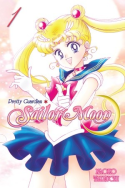
Pretty Guardian Sailor Moon, Vol. 1

September 13, 2011 by Michelle Smith

By Naoko Takeuchi | Published by Kodansha Comics | Did I Mention Squee?

I think it’s probably impossible for me to be impartial about Sailor Moon. I just love it so much. The third season of the anime comprised one of my first exposures to shoujo anime, and even though I’m cognizant of its shortcomings, I can’t look back upon it and feel anything other than nostalgic adoration.

I’ve read the manga before. I was warned early on that the TOKYOPOP versions changed some characters’ names and relationships, so I never bothered trying to acquire them. Instead, I remember checking the website for Boston’s Sasuga Books (sadly no longer with us) regularly to see whether the latest volume of the gorgeous tenth anniversary edition was available for order. Reading each volume was a fairly painstaking process of matching a text-only translation to the images in the physical book. But one makes do.

Still, as with Codename: Sailor V, I feel like I got much more out of the experience this time when reading a professionally prepared English translation. It felt more immediate to me. Alas, though I would love to be able to report that Pretty Guardian Sailor Moon is free from the text errors that plagued Sailor V, I can’t. I only spotted four problems, though: two cases of misplaced sound effects (one only noticeable if you read kana) and two where the word “who’s” is used instead of “whose.” Pretty minor, yes, but still disappointing. I can’t be alone in wishing for a flawless edition.

Moving on!

Because Pretty Guardian Sailor Moon came about due to the earlier success of Codename: Sailor V, there are some obvious similarities in their lead characters. Like Minako Aino, fourteen-year-old Usagi Tsuniko is a below-average and perpetually tardy middle-school student with a fondness for video games. Where Minako craves the spotlight and is somewhat more bold, however, Usagi is a crybaby who’s inclined to take the easy way out. Both are informed of their special destiny by a talking cat—white (male) Artemis for Minako (Sailor Venus) and black (female) Luna for Usagi (Sailor Moon)—and both soon find themselves squaring off against “the enemy” whose plans invariably involve sucking energy out of the populace.

From the start, Usagi handles her duties differently than Minako. She’s more empathetic, but has a tendency to feel overwhelmed and require encouragement. (These are still, of course, early days.) She’s bolstered by her fellow guardians, however, and quickly accumulates three allies: the brilliant Ami Mizuno, guardian of water and wisdom (Sailor Mercury); classy and clairvoyant Rei Hino, guardian of fire and passion (Sailor Mars); and tomboyish yet girlish Makoto Kino, guardian of thunder and courage (Sailor Jupiter). Luna provides them all with information—I enjoy any scene that depicts the kitty in research mode—and handy gizmos that allow them to communicate and transform.

Together they face off against Queen Beryl and her Four Kings of Heaven, who are busily concocting schemes to collect energy to revive their “great ruler” while simultaneously searching for the “legendary silver crystal.” (We learn more about the enemies here than in Sailor V, incidentally, which makes them much more interesting. It’s still slightly disconcerting to see how quickly some of them are defeated, though, considering how long they stick around in the anime. Nephrite, for example, is vanquished after just one chapter!) The Guardians want to find the all-powerful crystal too, and are also searching for “the princess,” whom they are duty-bound to protect.

Also searching for the “legendary silver crystal” is a handsome fellow called Tuxedo Mask, two words that efficiently describe his costume. He has dreams wherein a faceless woman begs him to find the crystal, and so he tries to comply. Usually his efforts consist of lurking around when Sailor Moon is busy confronting the enemy, so as to be ready to bolster her confidence. Meanwhile, in his civilian guise of high school student Mamoru Chiba, he and Usagi keep running into each other and exchanging insults. I never much cared about their relationship in the anime, but it actually kind of works for me here. Maybe manga!Mamoru is appreciably more dreamy than his anime counterpart, because I can at least see why Usagi finds him so appealing. In this volume, there’s also some question as to whether he’s friend or foe, which gives Usagi something to worry about. (In general, while I don’t mind hyper Usagi, I like her much more when she’s being serious.)

I would probably still like Sailor Moon if it were merely the story of a band of cute girls in colorful outfits who defeat the enemy with various nifty/goofy attacks like “moon tiara boomerang” and “flower hurricane,” but its feminist message definitely elevates it in my esteem. While Usagi may be drawn to Mamoru and while Makoto may yet pine for the sempai who rejected her, these girls are fully cognizant that they’ve got a mission that’s more important than romance. Consider this exchange in which Makoto is explaining her reason for transferring schools:

Makoto: It seemed there was something far more important… even more important than falling in love… that was waiting for me here.

Rei: You’re right! We don’t have the luxury of the time it takes to cry over a man.

Though normal teens until just recently, these girls are quickly coming to grips with their destiny and the enormous importance of preventing the crystal from falling into the wrong hands. One gets the sense that this experience, though dangerous, is going to be critical in forming who they become as people, especially lazy Usagi, who is now thrust into a leadership role. And even though Mamoru does help her on occasion, it never comes off as condescending, but more like he’s reminding her of the strength that she already possesses. He, after all, has no powers of his own so it’s up to her to save the day.

Thank you, Kodansha Comics, for licensing this series and giving us a proper translation at last. I’m happy for myself and other existing fans, but I also can’t wait to see what Sailor Moon newbies make of the story.

Pretty Guardian Sailor Moon is published in English by Kodansha Comics. They’ve licensed the tenth anniversary edition, which condensed the eighteen-volume series into twelve volumes of the main narrative plus two volumes of short stories. It also has pretty new covers and some retouched art.

Review copy provided by the publisher.

Filed Under: REVIEWS Tagged With: Kodansha Comics, Naoko Takeuchi

Codename: Sailor V, Vol. 1

September 12, 2011 by Michelle Smith

By Naoko Takeuchi | Published by Kodansha Comics | Squee

There are few things in this world that can literally make me do “the dance of squee,” but the arrival of the first volumes of Codename: Sailor V and Pretty Guardian Sailor Moon at my house definitely did the trick. My husband can bear witness.

I’ve read Codename: Sailor V before (back in 2003), but that was with the Japanese edition in hand and a text translation on the computer screen, doing my best with my limited Japanese skills to put words and images together. But now it’s out in English, and translated by the venerable William Flanagan, to boot! I feel like I got a lot more out of this time, but whether that’s due to increased comprehension or a change in personal perspective, I can’t really say.

First, a bit of publication history. After completing her first series, The Cherry Project, Naoko Takeuchi and her editor decided that her next series would feature a magical girl in a sailor suit who fights for love and justice. The result was Codename: Sailor V, which premiered in the magazine Run-Run in July 1991. An anime was soon planned, but instead of starring only Sailor V, it would feature a five-person team, with the focus on a new character named Sailor Moon.

The Pretty Guardian Sailor Moon manga debuted in 1992, with the anime premiering shortly thereafter. Chapters of Codename: Sailor V continued to be released periodically, and actually wrapped up a couple of months after the Sailor Moon series. In this way, it functions both as a prequel and as a companion series to the more famous work.

Now to the story itself! Minako Aino is thirteen years old and in her first year of middle school. She’s got some… quirks—she is described at one point as a “binge-eating, nap-taking, below-average student” who “likes standing out in a crowd”—but also thinks fast on her feet and has acute physical reflexes. After observing her for a while, a mysterious white cat introduces himself as Artemis and tells her she has been chosen by the planet Venus. “You were born to fight to protect the world of incandescent heat. And you have a mission. A duty that no one but you can fulfill.” This whole sequence reminds me a lot of a young Buffy, similar in temperament and ability, hearing similar words from her first Watcher.

Minako promptly faints, and when she wakes she thinks the conversation was just a dream. When she spots her crush brainwashing a girl into becoming his slave, however, the “boss” speaks to her through a magical pen (really) and tells her that he is her enemy and that she must defeat him and save everyone. (She’s also got a crescent-shaped compact that can be used as a weapon and for creating disguises.) Her first transformation into Sailor V is accompanied by the following narration:

I feel liberated! I’m overflowing with power!! I’m struck with the urge to act!

And there, in a nutshell, is why this magical girl franchise appeals to feminists like me. It’s not about a girl in a sailor suit looking cute to attract boys or being validated by them. It’s about a girl choosing to become strong herself, to achieve her full potential, and to contribute to the welfare of the planet by actively engaging “the enemy.” If you’re tired of passive heroines—got those Black Bird blues?—then you really do need to read these books.

Further adventures pit Sailor V against a series of idols represented by the Dark Agency, whose modus operandi is to stage concerts and suck out the energy of their fans, who then become their slaves. The Agency president is a woman named Fluorite and she reports to an unseen guy named Danburite, and so far they seem content to try to take over the world by repeating the same tactics over and over, though they do eventually change things up a little near the end. These episodic stories do dull the impact of Sailor V’s mission slightly, but her introductions to her foes are always fun. Here’s my favorite:

Using idols to brainwash both men and women, young and old… Now that’s just greedy! Those are horrendous business practices and the Japanese Tax Office will not stand for it!

I am sometimes a GI Fighting Girl, and sometimes a Debuting Idol Beauty… But my true form is…—Moon Power: Transform!—Codename: Sailor V!! Champion of Justice!! The Pretty Guardian in a Sailor Suit! Sailor Venus… has arrived!

Takeuchi’s art is lovely, if somewhat busy. (Sometimes I wonder if she has a phobia of white space, because a lot of screentone is used to fill those areas. My favorite is the one that inexplicably mixes stamps and penguins.) I’m particularly fond of the chapter title pages, because Sailor V looks especially cool and mature in those. The English translation reads well, too, so it’s really too bad that the rest of the text has so many minor errors. For the most part, these consist of misattributed dialogue or sound effects being placed in the wrong spot. Though annoying, they don’t hamper one’s enjoyment much. The reference to Science Ninja Team Gotchaman (sic) in the end notes did elicit a cry of dismay from me, though.

So, yes. It is truly wonderful to have Codename: Sailor V available in English. Perhaps it won’t appeal to everyone as much as it does to me, but it’s got more depth that one might expect, and is definitely worth checking out.

Codename: Sailor V is published in English by Kodansha Comics. They’ve licensed the tenth anniversary edition, which condensed the original three volumes into two.

Review copy provided by the publisher.

Filed Under: REVIEWS Tagged With: Kodansha Comics, Naoko Takeuchi

Pick of the Week: Magical Girls FTW

September 12, 2011 by Michelle Smith, Sean Gaffney, MJ, David Welsh and Katherine Dacey 5 Comments

Though Midtown Comics expects some real winners this week, much of the gang looks to other distribution sources for one of the most-anticipated releases of the year.


MICHELLE: While this week’s list over at Midtown Comics does include some real contenders—Bunny Drop and Goong especially—I simply must go off list this time and pick what has to be one of the most highly anticipated (if not the most, but we are in a situation where Princess Knight is also on its way!) releases of the year: Pretty Guardian Sailor Moon. It’s a classic and a nostalgic favorite for many, but also has an empowering message for young girls. They’ve got a duty, a mission, they can become strong, and it’s up to them to make the most of themselves and save the world. Don’t miss the prequel/companion series Codename: Sailor V, either!

SEAN: Yes, while I really should be trying to drive up Hayate the Combat Butler’s sales by talking about how enjoyable this current serious arc is, it’s got to be Sailor Moon this week. Or rather, I’ll talk about Code Name: Sailor V, the series whose popularity is what led to Sailor Moon in the first place. Many who are unaware of the series’ origins have noted the similarities between Usagi and Minako, and there’s a good reason for that – Moon is just V with an added sentai team, as requested by the author’s publisher. This does not make V any less awesome – Minako is more proactive (and impulsive) than Usagi, which leads to some fantastic humor. (As TV Tropes noted, trying to contrast the two heroines: “Usagi is a crybaby and Minako is a drama queen.”) So happy to see North America finally getting a chance to read this.

MJ: Though I’m loathe to pass up the chance to talk more about Goong, I simply can’t deny the spectacular nature of this week’s release of Pretty Guardian Sailor Moon and its prequel, Code Name: Sailor V. Though it’s yet unknown whether I will fall for the series as so many have, I am absolutely thrilled to finally have the opportunity to experience what was the initial point of entry for so many American manga fans, and especially for female fans. These are absolutely my must-read manga for the week.

DAVID: For whatever incomprehensible reason, neither of the Sailor debuts will be showing up at my local comic shop, which would have been enough to plant a seed of dark bitterness in my heart, were it not for the fact that I can look forward to the fourth volume of Yumi Unita’s Bunny Drop from Yen Press. (Okay, there was also the intervention of a small squadron of Sailor Scouts who fired sparkly beams at me from their accessories.) I have a weakness for stories that unfold in something close to real time, and when you combine that with a thoughtful, slice-of-life examination of parenting, I’m pretty much undone. I love this book, and I’m looking forward to meeting more of better-than-he-expected adoptive father Daikichi’s extended family. Seeing a competent male parent, single or otherwise, is something that’s so rare in entertainment that Daikichi’s anxious, thoughtful efforts are particularly welcome.

KATE: Since MJ is singing the praises of Sailor Moon, I’ll bang the drum for volume 12 of Goong: The Royal Palace. This gorgeously illustrated manhwa isn’t just for monarchy watchers, though anyone who followed Kate and William’s nuptials will certainly adore this soap opera. It’s for folks who like a good old-fashioned drama, with a big, sprawling cast of characters, a plucky heroine, several handsome suitors, and the kind of meddling parents who make Queen Elizabeth look like the founder of the Free Range Kids movement. And if you’re the kind of person who keeps tabs on what Kate and Pippa wear around London, so much the better: no one in Goong ever, ever leaves their room without dressing to the nines. In short, it’s a stylish, compelling soap opera that makes the most of its royal trappings, and I’m totally addicted to it.


Readers, what looks good to you this week?

Filed Under: PICK OF THE WEEK Tagged With: bunny drop, codename: sailor v, goong, sailor moon

Arata: The Legend, Vols. 1-6

September 11, 2011 by Michelle Smith

By Yuu Watase | Published by VIZ Media

As a fan of Yuu Watase’s shoujo classic, Fushigi Yûgi, I expected that I would like Arata: The Legend, her first shounen series. Turns out, I had underestimated my enjoyment: I really like it!

The story begins in a world known as Amawakuni, where the child-like princess is preparing to yield the thrown to her successor after reigning for 60 years. There are no suitable females in the royal (Hime) clan to take her place, however, and so a fifteen-year-old boy named Arata is coerced into passing himself off as a girl until another suitable candidate can be found. During the ceremony, the twelve retainers of the princess—known as the shinsho, because they are masters of powerful sword-gods known as hayagami—revolt and the princess is cut down before Arata’s eyes. The shinsho pin the deed on him and his flight to evade capture takes him to the mysterious Kando Forest, where he is swallowed up and exchanged with his counterpart from another world: Arata Hinohara.

Hinohara has been having a tough time lately. In middle school, he was bullied so much that he eventually stopped going altogether. Now it’s his first year of high school, and at first everything seems to be going okay. He purposefully chose a school far away, where no one would know his old self, and is able to make friends quickly, thanks to his quick actions in capturing a train groper. After a month, however, his former nemesis Kadowaki arrives and the torment starts anew, capped off by the betrayal of Arata’s closest new friend, Suguru.

When he arrives in Amawakuni—and is taken for Arata by everyone he meets—Hinohara is thrust into Arata’s role as a wanted criminal. When his touch awakens a slumbering family artifact—what turns out to be a legendary hayagami known as Tsukuyo—he is suddenly recognized as a sho, which means he’s part of the battle for the the throne. The shinsho overthrew the princess because they were tired of the control she exerted over their powers, but now they must battle and dominate each other until one stands supreme. Like it or not, as a sho, Arata is swept up in the conflict and has two choices: submit himself (this essentially means death) or force others to submit. (Meanwhile, Arata contends with life in modern Japan, including going to school and eventually beating up Kadowaki.)

I really love how Watase fleshes out Hinohara’s complex character here, because everything he does makes sense based on what he’s been through. When he first arrives, he refuses to trust anyone, but when Arata’s childhood friend, Kotoha, makes good on her promises to stick by him no matter what, it has a profound effect on him. Too, the prospect of forcing others to submit reminds him too much of the domination he suffered.

Because of his experiences—and because of the unique property that allows Tsukuyo to safeguard the souls of other sho without actually causing their death—he is gradually able to win over a few sho by sympathizing with their own suffering, whether it be betrayal, isolation, or loneliness. In a conversation with the princess—courtesy of the special necklace that also occasionally allows him to converse with Arata—he promises to unite the hayagami under Tsukuyo and return to her before she dies completely. He’s got a long road ahead, and it’s one that can only be won by changing the hearts of others.

It is this mission of Hinohara’s—not unlike those usually assigned to magical girls—that makes me want to apply the demographic label “jounen” to this series. It’s definitely shounen in scope and feel, but it’s also attuned to its shoujo side. The slowly developing romance between Hinohara and Kotoha is very well done, for example, with Hinohara cognizant of Kotoha’s love for the real Arata and Kotoha confused because “Arata” is responding to her in a way he never did before. I also like that Kadowaki eventually arrives in Amawakuni because a) that is so very Yuu Watase, for two outsiders to come into a fantasy world and immediately assume powerful destinies and b) the ultimate test of Hinohara’s newfound bravery and purpose is for him to be able to sustain it in the face of Kadowaki’s unrelenting hostility.

The pacing of the series is also outstanding. There’s just enough foreshadowing of significant things—the gravestone that connects one of the shinsho, Kannagi, with his reasons for rebelling against the princess—to make the eventual reveal more significant, but one never has to wait too long for the answer to a question. Similarly, Hinohara frequently actually comes out and says what he’s thinking, so misunderstandings are not allowed to perpetuate for long. In fact, revealing the truth behind things—like when Hinohara finally convinces Kotoha that he is not her beloved Arata—gives the story more places to go rather than reducing all dramatic options.

My one complaint about the series is largely rectified by Kadowaki’s entrance into Amawakuni, and that’s that Arata is given very little to do. At first, there’s only a chapter or two from his point of view every once in a while, but once he meets an intriguing girl named Oribe—who can tell he’s an entirely different person than Hinohara—things begin looking up, especially when one of the shinsho is transplanted to Japan in Kadowaki’s place. Suddenly, Arata is in genuine peril, which is bad for him but good for the story!

In the end, while there’s a lot going on in Arata, it never feels like too much, always makes sense, and yet always leaves one wondering what is going to happen next. Not only am I genuinely excited about continuing the series, it has also rekindled my determination to read Fushigi Yûgi: Genbu Kaiden, of which I have heard good things.

Arata: The Legend is still in serialization in Japan; the twelfth collected volume was released there in August 2011.

Review copies for volumes one, two, four, and five provided by the publisher.

Filed Under: REVIEWS Tagged With: shonen sunday, VIZ, Yuu Watase

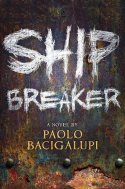
Ship Breaker by Paolo Bacigalupi

September 9, 2011 by Michelle Smith

From the back cover:
In America’s Gulf Coast region, where grounded oil tankers are being broken down for parts, Nailer, a teenage boy, works the light crew, scavenging for copper wiring just to make quota—and hopefully live to see another day. But when, by luck or by chance, he discovers an exquisite ship beached during a recent hurricane, Nailer faces the most important decision of his life: strip the ship for all it’s worth or rescue its lone survivor, a beautiful and wealthy girl who could lead him to a better life…

In this powerful novel, award-winning author Paolo Bacigalupi delivers a thrilling, fast-paced adventure set in a vivid and raw, uncertain future.

Review:
Ship Breaker won the Printz Award this year, and I must say I think it deserved it! It took a little while to grow on me, but I liked it a lot by the end.

At some unspecified point in the future, a community of people has sprung up on Bright Sands Beach (on the Gulf Coast) where the best work to be found is on crews breaking down giant, rusting wrecks of oil tankers. Everyone toils away to meet their quota, all the while dreaming of the lucky strike—oil or other scarce commodities—that could make them rich. Nailer Lopez is fifteen years old and works on the light crew, where his job is scuttling through pipes to scavenge copper, aluminum, and nickel.

After a near-death experience during which his wits and luck save him from drowning in a pocket of oil, Nailer is christened Lucky Boy by his friends. This moniker seems apt when he and his friend Pima discover a valuable wreck left behind in the wake of a hurricane. They set to work stripping it but are stunned to discover a survivor—a very wealthy girl named Nita Chaudhury, who promises her father will reward them for saving her life. When Nailer’s drunken and dangerous father Richard discovers the wreck, however, he opts to trade Nita to her father’s enemies, which forces Nailer to make a whole bunch of difficult decisions.

When he and Pima find the wreck, she urges Nailer to be smart about it. In her eyes, “smart” seems to involve profiting enough to obtain a position of power on Bright Sands Beach. Nailer is aiming higher, however, and makes Nita promise to take him and Pima away and into a better life. The choices he makes from that point on are partly in pursuit of this goal, but also out of a growing sense of loyalty towards Nita, who proves herself capable and quickly loses her prejudices towards those less cultured than she. There are many times where he could have walked away and abandoned Nita to her fate but doesn’t, and ultimately, his concern for her works out in his own favor.

The story ranges over a few different settings, from the beach to the drowned docks of “Orleans” to a clipper ship crewed by people loyal to Nita’s father. As a big fan of the Hornblower series, I liked the ship the best. I hadn’t realized how much I missed depictions of naval battles until the awesome sequence wherein Nailer’s familiarity with the coastline results in a surprise advantage over a superior foe. In fact, the whole final sequence of the book was quite exciting, and makes me think this would make a good movie.

I also found it interesting that the main villain of the work is Nailer’s father, Richard, because Nailer harbors such conflicted feelings about him. He remembers the man his father used to be before his mother died, and though Richard’s now more likely to be high and abusive than relaxed and kind, Nailer feels obliged to care about him and give him chances to be a better person. After many disappointments, he finally realizes that Pima and her nurturing mother, Sadna, are his true family and is able to muster the strength to stop believing that his father is capable of turning over a new leaf at this point. Essentially, he’s a victim of domestic abuse who finally achieves the strength to say, “I’m not going to let you hurt me anymore.”

Lastly, Ship Breaker is commendable for its effortless portrayal of characters of many ethnicities. None of the lead characters is Caucasian. Their skin color is mentioned as part of their physical description, but doesn’t factor in to their relationships at all. Characters are judged purely based on their individual actions. If anything, the only real prejudice left in the world seems to be between the rich (or “swanks”) and the poor, but Nailer’s actions convince Nita, at least, of the errors of her ways, especially since he proves fully capable of functioning in her world if given half a chance.

Although initially a little frustrating—despite my love for dystopic YA, I still get a little frustrated with crappy situations that just seem to be getting crappier—Ship Breaker turns out to be a well-crafted and riveting tale.

Filed Under: Books, Sci-Fi, YA Tagged With: Paolo Bacigalupi, Printz Award

Off the Shelf: Hungry?

September 7, 2011 by MJ and Michelle Smith 4 Comments

MICHELLE: Mmm… Leftover pad thai.

MJ: Um. Macaroni & cheese from a box? I’m not sure I can *quite* say “yum.”

MICHELLE: We put diced tomatoes in ours. It’s definitely yum. :)

So, what have you been reading this week?

MJ: Well, first I checked out the first two volumes of Eri Takenashi’s Kannagi. The second volume isn’t due out from Bandai Entertainment until October, but the first has been out for a while, and I’m just now catching up with it.

Kannagi tells the story of Jin, a spiritually gifted high school student who pays tribute to his town’s recently cut-down sacred tree by carving a statue of its spirit from the leftover wood. Having met the spirit of the tree as a child, his likeness is close enough to the real thing to actually bring the tree’s guardian deity to life in the form of a human girl. With her tree now gone, the deity, Nagi, has lost some of her power, and must rely on Jin to help her cleanse “impurities” that lurk around looking like insects and snakes. Meanwhile, newly-human Nagi wreaks havoc on Jin’s life, both at home and school.

As a premise, this all works pretty well. Foisting a pretty, domineering, otherworldly girl into the life of a young everyman may not be the most original shounen plot ever, but in-between boob jokes, Takenashi throws in some genuinely quirky stuff. For instance, after watching a magical girl anime on television, Nagi soberly builds her own magical staff out of plastic toys and paper, believing it will help her stamp out the impurities. The book’s early chapters are filled with small bits of humor like this, and even when the first volume beings to drift into harem territory, it retains most of its charm.

Unfortunately, things slide quickly downhill in volume two, when much of the series’ original premise is abandoned in favor of an increasingly obvious harem setup, complete with maid cafes, random swimsuits, and an endless supply of breast/otaku jokes (rotating on a regular schedule). By the end of the volume, in fact, pretty much everything I found charming about the series initially was gone, and it’s hard to say whether I’ll be sticking around to see if it ever returns.

MICHELLE: Oh, that’s too bad. For a while there it seemed like a shounen romantic comedy that any audience could enjoy. I guess it was too good to last.

MJ: Well, maybe I’ve given up too soon. But I’ll admit to being pretty disappointed, after such a promising start.

So what have you got for us this week?

MICHELLE: Like you, I read the first two volumes of a series whose second volume came out recently and its first some time ago (2009, in this case). I’m talking about Angelic Runes, a josei supernatural/fantasy series from Makoto Tateno, better known here for her BL work.

Sowil is a young man possessed of a unique brand of magic who is looking for his father and some answers. Shortly into his quest he comes upon a village where the people are preparing to bury two children alive, believing them to be the source of a curse. Sowil intervenes and ends up taking the kids—a girl named Allueh and a boy named Erudite—with him on his journey. Very quickly he realizes that they’re oracles; Allu can hear the divine voices of demons and Eru the voices of angels. These celestial beings provide Sowil advice on his travels and generally steer him in the direction of people needing his help.

As the trio travels, Sowil ends up helping an ocean-dwelling spirit return home and identifies the being responsible for a series of killings. Both have a connection to the father he is seeking, and gradually Sowil begins to break through the seal that has been placed over his memories and those of the people where he grew up. The angels and demons observing through Eru and Allu are concerned, as well, and through them we see even more investigation of Sowil’s past. Tateno mixes quite a lot of mythologies here, but it’s all in good fun.

What this results in is a kind of low-key story with some genuinely likeable characters, which is definitely my cup of tea. Sowil is really nice—his propensity to help random townspeople reminds me of Rakan from Silver Diamond—but his unique runic magic also makes him somewhat of a badass, so that’s an interesting juxtaposition. I’m also really interested in Allu and Eru, who seemingly have no personalities of their own and simply function as vessels for higher powers. That’s either mysterious or incredibly sad. Perhaps both.

Anyway, there is at least one more volume of this. I hope it won’t be another two years before we see it.

MJ: That does sound like a tasty cup of tea. Why have I been ignoring this series?

MICHELLE: Well, when the first volume comes out and then nothing happens for two years, I think one is justified in thinking, “Hm, perhaps this series has been discontinued.” I like Tateno in general, though, and remembered that Connie (of Slightly Biased Manga) liked the first volume back when we were all part of Manga Recon, so I never forgot about it. It probably doesn’t sell too well, alas, but I hope DMP makes enough through their BL catalog to finance a third volume someday.

What’s your second manga du jour?

MJ: My second read this week was volume one of Bloody Monday, one of Kodansha Comics’ many recent debut series over the past month or so. It’s a thriller about a teen hacker named Fujimaru aka “Falcon.” Though Fujimaru’s skills are often sought out by his special agent dad, he also uses them to do things like liberate his private school from the influence of a harassing faculty member.

When his dad stumbles onto something that gets him framed for murder and puts his family in jeopardy, Fujimaru takes matters into his own hands and, with the help of his high school newspaper crew, continues his dad’s investigation regardless of the danger. Though the series’ super-smart-teen shares some of the more over-the-top qualities of Death Note‘s Light Yagami, he’s at least not a sociopath, which certainly helps in terms of likability, if not in believability. Opening boob and panty shots would suggest that this series shares some other attitudes in common with Death Note-style boys’ comics as well, but at least it seems to feature at least a couple of potentially competent female team members. I suppose time will tell.

Comparisons to Death Note might suggest that I found little to like in Bloody Monday, but actually I enjoyed it more than I expected. Though it’s obviously intended to appeal to fans of the former, I have to admit that its kinder tone goes a long way with me. Despite its highly derivative premise, I expect I’ll continue on with it.

On the petty side, I did notice something early on, Michelle, that made me think of you. There’s a panel in the first chapter that is so poorly laid out in terms of speech bubble placement, that one bit of dialogue looks like it’s being spoken by a character’s hand, or maybe the canister she’s holding. Once I figured out what was really supposed to be going on, I thought, “Michelle would have a field day with this!”

MICHELLE: Probably I would! I kind of relish skewering things like that. I am glad you enjoyed this, though, because it’s written by the same guy behind GetBackers, which is a series I liked a good bit. If GetBackers is any indication, Bloody Monday may well be able to balance the fanservice and competent female characters to your liking.

Now this makes me sigh ‘cos I wish Kodansha would pick up GetBackers, but it’s really been so long…

MJ: I’m definitely interested to see where this goes! I feel a little weird about enjoying something that’s so obviously derivative of a series I was fairly wishy-washy on, but I’m going to just go with it.

So what’s your second offering for the evening?

MICHELLE: I seem to be mirroring you this week, since I also checked out another Kodansha debut. Gon may not be new to American audiences, but it was new to me. I’d seen it praised quite a bit, but never before been compelled to check it out. Now that I have… well… I’m not entirely sure whether I’ll keep reading it.
The premise and execution are certainly unique. Gon is the last remaining dinosaur, and is only a year old. This doesn’t stop him from challenging animals many times his size, however, as this volume finds him facing off against a bear whom he later uses for a bed, convincing a lion to serve as his steed and later eating alongside him as equals, and protecting a nest of eagles from a prowling bobcat. The art is incredibly detailed and entirely nonverbal. So, in that respect, I must say that Gon is really something special.

The thing is… I just don’t like Gon. While I commend mangaka Masashi Tanaka for not making him cute and endearing—he’s fierce and intimidating, even if diminutive—how can I like a critter who basically floods out an entire forest habitat making a dam that makes it easier for him to catch fish? So, on the one hand I’m like “Heh, what a little bastard”—and it is kind of cool how one can so easily invent dialog for all the displaced animals along the lines of “I hate that guy”—but on the other hand I’m like, “Man, what a little bastard!” Can I enjoy bastardly doings for six more volumes? I’m not sure.

One last thing puzzles me. This volume is quite slim. The material has previously been released in the US. And, being without words as it is, is a very quick read, even for a notorious slowpoke like me. These three factors seem to suggest this would be an ideal candidate for omnibus treatment—something Kodansha has shown a willingness to undertake for series like Love Hina and Tokyo Mew Mew—so why not Gon?

MJ: Well, huh. I’m intrigued for sure, though I suspect I may have a similar reaction overall. I find it really difficult to enjoy a series whose protagonist I dislike, especially if there isn’t some other character for me to really latch on to. Your omnibus question is interesting as well. I wonder if it has to do with licensing?

MICHELLE: Probably it does. Or else they’re keeping the volumes small so they’re not intimidating for kids.

MJ: Ah yes, could be.

MICHELLE: So. Um. Good night, then. :)

MJ: And to you, my friend!

Filed Under: OFF THE SHELF Tagged With: angelic runes, Bloody Monday, gon, kannagi

Pick of the Week: All Viz, all the time

September 5, 2011 by Katherine Dacey, Michelle Smith, Sean Gaffney, MJ and David Welsh 4 Comments

It’s a Viz-heavy week at Midtown Comics. Check out picks from the Battle Robot below!


KATE: It’s time for the semi-monthly VIZ dump, which means new volumes of such long-running titles as Naruto and One Piece, as well as a random assortment of shojo and shonen series. My pick is the fourth volume of Oresama Teacher, a juvie-gone-straight comedy from the creator of Magic Touch. The fact that the same person is responsible for both series is nothing short of mind-blowing; I found Magic Touch tepid, tedious, and entirely too wholesome for its own good. Oresama, on the other hand, is fun and silly, with a great, feisty lead character and just enough edges that an old curmudgeon like me can enjoy it without needing an insulin injection.

MICHELLE: I actually thought the 58th volume of One Piece was coming out in October, so with Midtown’s list providing evidence to the contrary, how could I do otherwise than name this my pick of the week? It’s pretty special to be this excited about the 58th volume of a series, but mangaka Eiichiro Oda continues to do new and interesting things with the world and characters he’s created. In the current arc, for example, the simmering tensions between pirates and navy have finally come to a head in the form of an epic battle in the midst of which Luffy, and his kickass drag queen allies, strive to rescue his brother, Ace. Yes, I miss the other Straw Hats, but this is definitely going to be a volume I start reading immediately after coming into possession of it.

SEAN: First of all, I enjoyed The Magic Touch quite a bit, so neener neener neener. (Sorry, I had to respond, it’s contractual). For my pick of the week I will pick a final volume, the last of the josei experiment from our friends at Shojo Beat, Butterflies, Flowers. I have been back and forth about this title its entire run, generally depending on how much backbone its heroine is showing at the time. However, unlike some other shoujo series with bad reputations, Choko does show SOME backbone – when she puts her foot down it can be awesome. And the hero is of an over the top type we really haven’t seen over here – Tamaki from Ouran might match him for foolishness but is far too much of a gentleman to ever go as far into the gutter as Masayuki does throughout. Best of all, even if it’s offensive and wrong at times, it at least KNOWS it’s a comedy – which is more than one can say for Ai Ore half the time. I’ll miss it, and hope Viz tries more Josei Beat soon.

MJ: My choice is pretty surprising, or at least it is to me, but after reading the 36th volume of Bleach due out this week, I found myself more interested in the series than I have been for a long time. A long jump back in time might not be the most original storytelling convention ever, but it turns the focus away from battles and back to characterization, which is where I love Tite Kubo best. I don’t know for sure how long this backstory arc will last, but I’m grateful for it while it’s here. It’s nice to feel excited about reading Bleach again.

DAVID: I’m rather surprised to see myself type this, as I’m still on the fence about the series, but I’m going to go with the fourth volume of Kaori Yuki’s Grand Guignol Orchestra. My reaction to each volume so far has been mixed, but Yuki keeps bringing enough eye-popping weirdness and energy to the proceedings to keep me on the hook, even if consistency isn’t her watchword. Our band of zombie-fighting musicians has really put their collective feet in it as this volume begins, forcing Yuki to pay attention to her overarching plot. In my admittedly limited experience, her likelihood of success in this endeavor is about 50%, but I know there will at least be some freaky, “What the hell was that?” diversions.


Readers, what looks good to you this week?

Filed Under: PICK OF THE WEEK

Bookshelf Briefs 9/5/11

September 5, 2011 by MJ, Sean Gaffney, Katherine Dacey, David Welsh and Michelle Smith 6 Comments

This week, Sean, Kate, David, MJ, & Michelle look at recent releases from Yen Press, Kodansha Comics, Viz Media, and Digital Manga Publishing.


Black Bird, Vol. 10 | By Kanoko Sakurakoji | Viz Media – Dear Black Bird: I’ve nearly defeated you. After allowing you to work me into a state of blind fury over the course of nine volumes, I’ve finally become indifferent to your crimes. The constant belittlement of your heroine, her permanently flushed face—even the way your beloved hero always manages to blame her for his most abusive behavior no longer has the power to affect me. Wait, what am I saying? Okay, I admit I lied. You did get to me by the end of the volume, you sneaky devil. Sorry about those pages I ripped up and burned, but you have to admit you were asking for it. After all, I think you said it best. “There are times I want to treat you really well … and times when I want to treat you mean and make you cry … Which way I lean all depends on you. So don’t blame it all on me.” – MJ

Bleach, Vol. 36 | By Tite Kubo | Viz Media – It’s easy to become jaded as a manga reviewer, especially when it comes to long-running shounen manga. Though some series manage to transcend formula, others just seem to settle in, churning out pages of endless battles, increasingly generic foes, or whatever popular staples their genres require. Bleach has long walked the line between the two, just barely balancing compelling drama with mind-numbing repetition. After volume 35‘s strict conformity to this pattern, nothing could be more surprising than volume 36. Completely abandoning (for the moment) the battle set up in the volume before, Bleach 36 dives back into the past, promising new and exciting revelations about characters we already care about, including the enigmatic Kisuke Urahara and the entire lot of Visored. Though future tedium undoubtedly awaits, for the moment, Kubo gives us his very best. Unexpectedly recommended. – MJ

Deltora Quest, Vol. 1 | By Emily Rodda and Makoto Niwano | Yen Press –As a reviewer, sometimes you have to try to avoid the easy way out and grind through why you couldn’t really enjoy a title. It’s tempting, especially with a title as dull as Deltora Quest was, to simply wrote “No.” as a review and be done with it. But it’s my own fault, as I ordered the book even knowing that sword-and-sorcery fantasy is one of my least favorite genres, because it was part of a big pile of Kodansha Vol. 1s. And I have not even read the original novels by Emily Rodda either. Oh, and I’m not a 9-year-old boy. So, honestly, it should come as no surprise that I found this manga a tedious slog, with two-dimensional characters, action scenes where I kept flipping the pages faster and faster, and tortured exposition. Best of all, a time skip at the end shows us that the entire volume was mere prologue for the real story, which begins with the son of our protagonist next time. Also, kings should know better than to have grand viziers by now. It’s just asking for trouble. Skip this.– Sean Gaffney

Mardock Scramble, Vol. 1 | By Tow Ubukata and Yoshitoki Oima | Kodansha Comics – Mardock Scramble walks a fine line between dark and glum. The premise places it squarely in dark and compelling territory: a young woman gets a second chance at life — and a chance to bring her would-be killer to justice — after getting a bionic woman makeover. Rune Balot’s reluctance to embrace her new abilities, however, frequently threatens to drag Mardock into glum terrain; though it’s entirely plausible that someone as damaged as Rune isn’t ready to get all Lady Snowblood on her abuser’s ass, watching her passively resist self-actualization is a depressing and frustrating spectacle. Only the presence of Oefcoque, a cyborg mouse capable of transforming into just about anything, prevents the story from collapsing under the weight of its own grim agenda. – Katherine Dacey

The Melancholy of Haruhi Suzumiya, Vol. 9 | By Nagaru Tanigawa and Gaku Tsugano | Yen Press –This volume takes us through the end of Disappearance. For the most part, once again it’s simply poor when compared to the novel and the anime. I’ve no frame of reference to gauge how I’d feel about it if I hadn’t read/seen either of those, but I suspect I’d still find it wanting. I did note that Asakura is drawn far peppier and less evil/menacing than she appeared in the movie, which makes her final scene even creepier. There’s also a bonus story of the Christmas Party itself (which involves accidentally creating an ancient Egyptian hot pot), and another one set in Edo times (with Edo Haruhi being just as bad as the modern one, and wanting the perfect cup of tea), but neither add anything of note to the canon, nor are they bad enough to be entertaining on their own like the boxing story was last time. Substandard, though Vol. 10 apparently features Love at First Sight, a story as yet unanimated, so maybe it can try again there.– Sean Gaffney

Phoenix Wright: Ace Attorney, Vol. 2 | By Kenji Kuroda and Kazuo Maekawa | Kodansha Comics – I described the first volume of Phoenix Wright: Ace Attorney as “blah,” and I’m pleased to report that second volume is more to my liking. I’m still having issues with suspension of disbelief—ask me to believe in yokai, cyborgs, or reincarnated moon princesses and I’m fine, but ask me to believe that suspects go on trial two days after the crime, and I balk—but I’ve been (mostly) won over by the Case Closed vibe the kooky murder methods conjure. It doesn’t hurt that half of this volume is occupied with investigating the murder of an amusement park employee who was garbed in the furry mascot costume of a character named “Twinklestar” at the time of his death. Phoenix and his assistant Maya take it seriously, of course, but I enjoy the sheer absurdity of it all. – Michelle Smith

The Story of Saiunkoku, Vol. 4 | By Sai Yukino and Kairi Yura | Viz Media –First of all, I cannot emphasize enough how disappointed I am by Ensei shaving. His rough and tumble beard made him look like a man from a completely different world in this manga filled with interchangeable bishies. Now he’s just another one of them. At least he has a scar, but still, it’s the principle of the thing. In addition, we get hung up here with a classic problem adapting a prose novel to visual – someone has been described as inhumanly beautiful. The artist does their level best, but in the end, nope, just another pretty bishie. To be fair, it’s impossible to draw ‘inhumanly beautiful’, so they did their best. As for the manga itself, it’s still good, mainly focusing on court intrigue and Shurei’s learning curve, with only a brief stop at romance (I am highly amused that the emperor is doing the right thing entirely through instinct, rather than overthinking things. An excellent read.– Sean Gaffney

Warning! Whispers of Love | By Puku Okuyama | Digital Manga Publishing – This addition to the reading list was the result of one of my boys’-love polls , monthly quests where I try to find gems among the new BL and yaoi releases. Okuyama’s storytelling has its charms, but I found myself wishing for a little more genuine feeling mixed in with the antics. The title story is about a game of cat and mouse between two high-school students where both realize they enjoy the game. Logic isn’t driving the bus here, but Okuyama manages a pretty good, weird, recurring joke along the way. The middle piece, about a guy who values his solitude taking in a roommate on impulse, brings more emotional authenticity to the table, though the creator clearly has a possibly excessive fondness for flaky gamines. The last story is pretty much all antics, but at least there’s a really cute dog to distract me from the underdeveloped human characters in the story. This was pleasant enough, but I don’t think I’d rush to read more of Okuyama’s work. – David Welsh

Filed Under: Bookshelf Briefs

Off the Shelf: Three from Kodansha Comics

August 31, 2011 by MJ and Michelle Smith 8 Comments

MJ: Well, howdy, stranger.

MICHELLE: Howdy. This place looks like a ghost town. Check out that well-timed tumbleweed.

MJ: Do you think we can bring it back to life?

MICHELLE: I reckon we can. Especially if we can rustle up some of them ladies of ill repute.

MJ: Oh, good idea! I’ll see what I can come up with on that front. In the meantime, you wanna tell us what you’ve been reading?

MICHELLE: I guess it’ll pass the time.

A whole bunch of new series from Kodansha have debuted this month, so I checked out a couple of those. The first was Animal Land by Makoto Raiku, whose Zatch Bell! was previously released by VIZ. I wasn’t sure if I’d like this and, even after having read it, I’m still not quite sure what to make of it.

Monoko the tanuki lost her parents to wildcats three months ago and is very lonely. One day, when she’s trying to catch a fish in the river, she spots a floating basket with a baby inside and is instantly smitten. She is determined to be a mother to the baby, and braves many dangers to provide milk for him and, with the help of the other tanuki, brings him back to life when he seems on the verge of death.

It soon becomes apparent that this is one unusual baby, since he’s not only able to understand tanuki speech, but can actually converse with all animals. This skill manifests most poignantly in regards to Kurokagi, a scarred, black wildcat who’s been hanging around. The tanuki all fear him, but Kurokagi has actually appointed himself their protector after a tragic incident in which he caused the death of an infant animal. It’s fairly bizarre watching this baby, who doesn’t even crawl all that well, holding a reasonably adult conversation with a giant wildcat, I must say.

So, yes, there are some nice moments here. And I like Kurokagi. But there are also some things I don’t like. The art, for one, is often unattractive. I don’t like how the tanuki are drawn at all, for example. For another, this is clearly a story for young kids, with a zany sense of humor that relies heavily on poop jokes. Seriously, characters will just randomly start pooping for no reason. It’s ironic, really, since I bet the poop is there to appeal to ten-year-old boys—I imagine Japanese manga editors calling for “More poop!”—but here in the US, its prevalence results in the book receiving a teen rating.

I’ll probably check out a second volume, but this may end up being a series that’s just not for me.

MJ: You know, even as a kid, I was pretty much immune to the charm of poop jokes. I just don’t get the appeal.

MICHELLE: I think appreciation of poop jokes resides on the Y chromosome.

So, what have you been reading this week?

MJ: Well, I decided to make it a Kodansha week too, and the results surprised me greatly. First, I read the debut volume of Mardock Scramble, which is the manga adaptation of Tow Ubukata’s novel trilogy of the same name that was released as a single volume early this year on Viz’s Haikasoru prose imprint. I hadn’t read the novel, and didn’t have high expectations for the manga adaptation, but actually I enjoyed it quite a bit.

Young Rune Balot thinks she’d be better off dead. “Rescued” from a life of abuse and prostitution by a guy named Shell, it’s only after Shell tries to kill her that Rune makes a (subconscious) choice to stay alive. She’s rescued from near-death by a techie detective, who gives her a new body and a shape-changing cyborg mouse to protect her, in the hopes that she’ll agree to testify against Shell in court.

There’s a whole bunch of stuff about Shell, who apparently kills girls and then loses his memory afterwards, and another mysterious man who’s coming after Balot, but even with so much plot and intrigue going on, the real story is in Balot, about whom we still know little, whose second chance at life could turn her into a completely different person–probably awesome, possibly terrifying. She’s the thing that really draws the reader in. Though the super-cute, badass mouse doesn’t hurt either.

Novel adaptations are hit-and-miss with me.Too often, I think they try to rush the story, or try too hard to be visually thrilling (especially in terms of fanservice) when really they just need to practice good storytelling. But I’m on the edge of my seat with this one. There’s still a lot to be revealed, and mangaka Yoshitoki Oima has left us with quite a bit of mystery (and a pretty big cliffhanger) at the end of the series’ first volume, but I’ve been given enough to be pretty well hooked.

I’m tempted to pick up the novel now, though I’d hate to risk compromising my enjoyment of the manga when I really am enjoying it so much.

MICHELLE: Wow, that sounds truly awesome. I was also somewhat wary that the prostitution backstory would mean fanservice would ensue, so I am happy to hear that’s not the case. And my inner twelve-year-old is *really* keen on that mouse!

MJ: Michelle, you would love the mouse. Truly.

Now, my second Kodansha adventure this week had a bit of the opposite effect on me, and since I know we both tried out this one, I’m anxious to hear whether your experience was similar. Care to start with a little summary?

MICHELLE: I will give it a whirl.

Until the Full Moon is a two-volume series by Sanami Matoh (Fake) that was originally published in the US by Broccoli Books. I actually owned that edition for several years and gave it away unread, but now I am finally giving it another chance.

Vampire cousins David and Marlo were extremely close growing up, but Marlo has been keeping his distance the past ten years or so while his family lived in America. Now they’re back, and have come to David’s doctor father to discuss a bizarre condition Marlo has recently developed. He’s half-werewolf, and has begun to transform into a woman on the full moon! His parents angst in over-the-top fashion until David’s father suggests that the only possible solution is that David and Marlo must get married. The date is set for a full moon a year in the future.

Various obstacles insinuate themselves between the couple, be it a family friend who mistakenly believes his sister is in love with David, or an ex-girlfriend of Marlo’s who is jealous when she realizes that David is the one to whom Marlo was referring when he confessed he loved someone else. Everything is very campy, with lots of silliness and epic kisses upon floral backgrounds. The interior artwork is possessed of retro charm and that vintage Matoh look, but the cover art is distressingly generic-looking: I found myself very distracted by my inability to tell who some of these characters were even supposed to be. They look like they’re from some other series entirely!

MJ: Yes, I never would have picked it up from the cover art, but as soon as I saw the old-school look of the inner artwork, I was determined that I would love it. On top of that, the outrageous, gender-switching werewolf premise convinced me that this would be exactly the kind of cracktastic “classic” shoujo in which I most delight. Unfortunately, I was pretty disappointed in the silly reality.

The premise is, indeed, cracktastic, but the story itself reads more like a bad teen-penned novel than brilliantly mad shoujo. The volume’s main conflicts all read as completely contrived, with no real tension or meaning of any kind. I mentioned in Monday’s Pick of the Week that I would be content simply looking at this manga, and I’m wondering if I should have left it at that after all.

MICHELLE: While I was reading it, I kept comparing it to what I’d heard about the inventive kookiness of Demon Sacred which, from all accounts, was the very epitome of “brilliantly mad shoujo.” Alas, you’ve hit the nail on the head in describing this as “contrived.” David and Marlo also keep up the standard horny!seme and reluctant!uke roles, no matter what gender Marlo happens to be at the moment. The one element of the story I do appreciate is how David makes it clear that his feelings are for Marlo the person, not Marlo the specific gender.

MJ: The comparison with Demon Sacred is very apt, and sadly brings Until the Full Moon‘s shortcomings into clear view. Demon Sacred used its super-fantasy world as a tool for enhancing the real emotions of its characters. Here, the vampire/oddly transforming werewolf stuff feels superfluous to everything, like a badly re-themed board game.

What’s particularly sad to me, is that I actually sort of like David and Marlo as a couple, even with the clichéd BL roles, and might have been quite interested in just watching the two of them deal with their own issues. But the author relies so much on the external characters to threaten their happy existence, there’s never really any time spent on the two of them as a couple.

MICHELLE: You’re absolutely right. We just know they love each other ‘cos they say it all the time, but we don’t actually know why or see any of the moments between them that led to the development of these feelings. It’s extremely shallow.

And, yes, dead horse, but can we go back to the cover for a minute? Because seriously…. who are these people? Is David the blond on the couch with the ponytail? I don’t recognize ANY of these other characters. Not one. I am truly baffled.

MJ: I can only assume it’s going for a more contemporary style in an attempt to bring in newer readers? It’s a shame, really, since the vintage artwork is the book’s best quality by far.

MICHELLE: I assume that as well, but I am at a loss as to who the female characters in particular are even supposed to be. Maybe they’ll turn up in volume two, but it’s very puzzling and, as you will note, distracted me a good deal. :)

MJ: Yeah, it’s kinda like they took characters from Pandora Hearts (or something along those lines) and randomly stuck them on the cover.

MICHELLE: Heh. Yeah. So, anyway, do you think you’ll read volume two? I probably will, since that’s also the final volume.

MJ: Yes, I probably will. Though this disappointed me, it didn’t actively offend me, and I’ll nearly always give something a few volumes to find itself. Surely I can make my way through one more.

MICHELLE: I think that’s a great note to end on. “Until the Full Moon… not actively offensive!”

MJ: Works for me! See you next week!

Filed Under: OFF THE SHELF Tagged With: animal land, mardock scramble, until the full moon

Buffy the Vampire Slayer Season Eight, Vol. 7

August 31, 2011 by Michelle Smith

By Brad Meltzer, et al. | Published by Dark Horse

When I write a review, I do my best to articulate what I liked and didn’t like as clearly as possible. When one is a passionate fan of something, however—as I undoubtedly and unabashedly am of Buffy the Vampire Slayer—such clarity becomes more difficult to achieve. I will do my best to explain my aversion to the “Twilight” arc contained in this volume, but what it really boils down to is that I just don’t like it.

Spoilers abound. Beware.

The volume actually starts off pretty well, with a Joss-penned one-shot called “Turbulence” (issue #31) that finally gets rid of those irksome colorful goddesses for good and contains an amazing scene between Buffy and Xander wherein she reacts to seeing him kissing Dawn by confessing that she has begun to see him in a romantic light. He is appropriately incredulous:

Xander: Yoooou… have feelings. At me.
Buffy: Would that be good?
Xander: That would be great. If it was a bunch of years ago and you actually meant it.

He also points out that, even if her feelings were genuine, once she saw him and Dawn together she should’ve realized that the decent thing to do would be to keep quiet. Honestly, I’m a little bothered by how immature and selfish Buffy is here, but her desperate loneliness coupled by Xander’s rejection might play a part in her actions a few issues later. Xander, on the other hand, comes off as entirely in character; I think he is probably the best thing about the Season Eight comics, actually.

Really, the first 2.5 issues of the “Twilight” arc are pretty good, too. Buffy and Xander explore the extent of her newfound superpowers. Dawn is concerned, pointing out that “you don’t get power for free,” and she is proven correct when Willow’s search for the missing Faith, Giles, and Andrew leads to the discovery of a bunch of dead Slayers. It turns out that 206 Slayers have died since the start of the conflict, and Buffy has inherited all of their powers. She’s understandably pretty freaked out by this. “If I’m sucking their power… it makes me a vampire.”

Meanwhile, the missing trio are being held at Twilight headquarters, where Giles recognizes the enemy’s voice and many hints are dropped concerning what’s going on and Giles’s knowledge of it. “Every Watcher wonders if his Slayer might be the girl… and you’ve had more reason than any.”

The high point of the arc is when Buffy interrupts this conversation to attack Twilight, at which points he unmasks himself. Angel. Buffy’s anger is initially white-hot. “You killed my girls! Two hundred and six girls!” and “Why did you put us through this fucking hell for the past year?!” Angel rationalizes his actions as a way to keep the body count lower than if governments had gotten involved. If he posed as the masked villain and talked of “master plans,” he would distract others who might’ve wanted to take action. Simultaneously, he would focus Buffy and help her superpowers develop.

And here’s where things start to break down for me. What it boils down to is this: by activating all the Potentials, Buffy upset the balance of the Universe. But also, there’s this prophecy (referred to as merely a myth by Giles when he’s accused of not sharing his awareness of the possibility) that a Slayer and Vampire will be used to usher in a new reality of superbeings. Or something. It’s all very vague. When this new reality is established, the old one (and humanity with it) will be discarded. This is what the whole season has been building toward, and it’s just such a disappointment. Ugh.

What I really hate about this idea is that it basically retcons Buffy’s personal attraction to vampires and makes it something that the Universe’s grand plan was engineering. How much of what is happening is free will, and how much is the Universe controlling their actions? Does Angel really believe all this stuff? Or is he essentially possessed? Did Buffy really want to jump his bones so desperately (which she does, in fact, proceed to do) because she’s in a lonely and vulnerable place, or did the Universe make it easy for her to put aside her fury and make with the sexy times?

I also hate how their sexual encounter is treated, with a peanut gallery making jokes about it and many silly panels where they zoom across the sky, bodies entwined, while the world erupts in seaquakes and cyclones. It just looks stupid, but more than that, I think it was done to shock the reader. Is this juxtaposition (NSFW) of imagery and text coincidence? I think not, especially after the whole Buffy/Satsu thing.

The final issue of the arc offers some redemption, with Buffy gradually regaining her focus after sexual bliss and being dissatisfied with the pleasure paradise to which she and Angel have ascended. He is ready to believe in it (and, again, is this really his personal opinion?) and dwell there together forever but she doesn’t trust it and, more than that, can’t be happy in a nirvana while her friends are fighting for their lives. Her exact words are “Fuck evolution,” and, after a brief sad smile to acknowledge what might have been, she and Angel return to help her family fight off the hordes of demons who have invaded “the lower plane.” Willow is suitably pissed at Angel—“What you got coming you better hope never comes”—and then Spike arrives, seemingly with the intent of knocking a bunch of sense into everyone. Yay, Spike!

So, anyway, I just don’t like this arc. I don’t think it was thought through very well, and I don’t like the implications it retroactively conveys upon the events of the series. While I’m airing grievances, I shall also point out that Meltzer gets a basic fact wrong—Faith did not become a Slayer upon Buffy’s death—that no one on the editorial staff was knowledgable (or attentive) enough to spot. Too, Georges Jeanty’s renderings of Faith continue to be extremely ugly. The only way to enjoy her scenes is to just try really hard to imagine Eliza Dushku in her place.

The volume is rounded out by “Willow: Goddesses and Monsters,” another Joss-penned one-shot set before the beginning of Season Eight. In it, Willow takes some sort of magical journey that she originally skipped over in her accelerated path to power. There’s really not a lot going on here, and a lot of the dialogue is supposed to be funny but isn’t, but it’s noteworthy because it’s the first time we’ve glimpsed Tara in the comics.

One more volume to go, and it includes Spike! I never did read the final two issues, so though I am spoiled on one pivotal event, much of it will be new to me. I hope I don’t hate it.

Filed Under: REVIEWS Tagged With: Buffy the Vampire Slayer, Dark Horse

Bruiser by Neal Shusterman

August 30, 2011 by Michelle Smith

From the back cover:
Tennyson:
Don’t get me started on the Bruiser. He was voted “Most Likely to Get the Death Penalty” by the entire school. He’s the kid no one knows, no one talks to, and everyone hears disturbing rumors about. So why is my sister, Brontë, dating him? One of these days she’s going to take in the wrong stray dog, and it’s not going to end well.

Brontë:
My brother has no right to talk about Brewster that way—no right to threaten him. There’s a reason why Brewster can’t have friends—why he can’t care about too many people. Because when he cares about you, things start to happen. Impossible things that can’t be explained. I know, because they’re happening to me.

Review:
Let me just state upfront that any parents pretentious enough to name their children Tennyson and Brontë need a damn good whacking.

Moving on, Bruiser (from the author of Unwind) is the story of a social outcast named Brewster Rawlins who is perceived as a creepy delinquent by his classmates but is actually harboring a secret that compels him to keep his distance: if he cares about someone, he will absorb their pain, both mental and physical. Alternating between the perspectives of four characters (broody poetry fan Brewster, twins Tennyson and Brontë Sternberger, and Brewster’s daredevil little brother), the novel depicts how Brewster’s gift/curse affects his relationships with others and how, ultimately, being healed of all one’s ills is not necessarily a good thing.

Initially, Tennyson is opposed to his sister dating Brewster and sets out to warn the guy off, but once he catches a glimpse of Brewster’s terribly scarred back, he begins to suspect something awful is going on at the boy’s home. Concern and conscience win out, and he and Brewster begin to become friends, which is when Tennyson first notices that the scabs on his knuckles (a lacrosse injury) have miraculously disappeared in Brew’s presence. It takes a while for the specifics of his ability to come to light, and an interminable time for Tennyson and Brontë to realize that Brew’s ability to take away pain also extends to their feelings.

At first, I thought they did realize that Brew could quell mental anguish, and that that was part of the reason they convinced/manipulated their on-the-verge-of-divorce parents into taking temporary custody of Brew and his brother, Cody, after their guardian, Uncle Hoyt, passes away. Selfish to use Brew in this way, yes, but believably so for desperate teens. Eventually, though, it seems they really did not know, which is why Brontë kept pushing and pushing for Brew to make new friends, never considering that, for him, more people to care about means more potential injury. Uncle Hoyt was an abusive drunken bastard, true, but his ability to hang on to his own anger (instead of passing it off to Brew) and his insistence that Brew keep his distance from the world are seen in a new light by the novel’s end. (And speaking of the end, reports of its cheesiness are not exaggerated. The last few lines made me go “Pfft.”)

Even with the mystery of Brewster’s powers, Bruiser lacks the high-impact concept of Unwind. Instead of an epic dystopia where the whole country is going in a bizarre direction, Tennyson and Brontë’s world is defined by their home life, where they can tell that something very wrong is happening between their parents. Brew’s presence in their home acts as a balm for a while, but eventually they want to own their own pain because it seems so wrong to feel content while their family crumbles. The novel may not be as dramatic as Unwind, but is possessed of its own subtle themes and messages. I’ll definitely be reading more Shusterman in the future.

Filed Under: Books, YA Tagged With: Neal Shusterman

  • « Go to Previous Page
  • Page 1
  • Interim pages omitted …
  • Page 134
  • Page 135
  • Page 136
  • Page 137
  • Page 138
  • Interim pages omitted …
  • Page 182
  • Go to Next Page »
 | Log in
Copyright © 2010 Manga Bookshelf | Powered by WordPress & the Genesis Framework