• Skip to primary navigation
  • Skip to main content
  • Skip to primary sidebar
  • Home
  • About Us
    • Privacy Policy
    • Comment Policy
    • Disclosures & Disclaimers
  • Resources
    • Links, Essays & Articles
    • Fandomology!
    • CLAMP Directory
    • BlogRoll
  • Features & Columns
    • 3 Things Thursday
    • Adventures in the Key of Shoujo
    • Bit & Blips (game reviews)
    • BL BOOKRACK
    • Bookshelf Briefs
    • Bringing the Drama
    • Comic Conversion
    • Fanservice Friday
    • Going Digital
    • It Came From the Sinosphere
    • License This!
    • Magazine no Mori
    • My Week in Manga
    • OFF THE SHELF
    • Not By Manga Alone
    • PICK OF THE WEEK
    • Subtitles & Sensibility
    • Weekly Shonen Jump Recaps
  • Manga Moveable Feast
    • MMF Full Archive
    • Yun Kouga
    • CLAMP
    • Shojo Beat
    • Osamu Tezuka
    • Sailor Moon
    • Fruits Basket
    • Takehiko Inoue
    • Wild Adapter
    • One Piece
    • After School Nightmare
    • Karakuri Odette
    • Paradise Kiss
    • The Color Trilogy
    • To Terra…
    • Sexy Voice & Robo
  • Browse by Author
    • Sean Gaffney
    • Anna Neatrour
    • Michelle Smith
    • Katherine Dacey
    • MJ
    • Brigid Alverson
    • Travis Anderson
    • Phillip Anthony
    • Derek Bown
    • Jaci Dahlvang
    • Angela Eastman
    • Erica Friedman
    • Sara K.
    • Megan Purdy
    • Emily Snodgrass
    • Nancy Thistlethwaite
    • Eva Volin
    • David Welsh
  • MB Blogs
    • A Case Suitable For Treatment
    • Experiments in Manga
    • MangaBlog
    • The Manga Critic
    • Manga Report
    • Soliloquy in Blue
    • Manga Curmudgeon (archive)

Manga Bookshelf

Discussion, Resources, Roundtables, & Reviews

Michelle Smith

BL Bookrack: October 2012

October 28, 2012 by MJ and Michelle Smith 3 Comments

Welcome to the October installment of BL Bookrack! This month, Michelle takes a look at the debut volume of Bond of Dreams, Bond of Love from SuBLime, while MJchecks out My Dear Prince at JManga. In Brief: Hitorijime Boyfriend (JManga) and est em’s ULTRAS (DMG).


Bond of Dreams, Bond of Love, Vols. 1-2 | By Yaya Sakuragi | Published by SuBLime | Rated Mature – I’ve confessed before that I tend to judge BL by its cover, and I must admit that had I not previously read and enjoyed something by Yaya Sakuragi, I would’ve passed on Bond of Dreams, Bond of Love. Unfortunately, however, this isn’t one of those times where the cover belies the contents. What you see is, in fact, exactly what you get. This manga is all about a shrimpy teenager repeatedly pushing his feelings on his older, tsundere neighbor.

The story begins when seventeen-year-old Ao Sawanoi has a wet dream about Ryomei Kosaka, his neighbor, older-brother figure, and priest of the nearby Shinto shrine. Ao proceeds to openly discuss this occurrence with several people, including Ryomei himself, and then becomes obsessed with making the dream a reality. He pesters Ryomei quite a lot, and eventually snags a kiss, which convinces him that he is in love. Ryomei puts up some token resistance, but when Ao takes his rejection too much to heart and ceases his daily visits to the shrine, Ryomei ends up seeking him out and encouraging his feelings. (There are two volumes yet to go of this series, so as of the end of volume two, the guys are not yet a couple.)

Bond of Dreams, Bond of Love is another of those BL titles that isn’t outright bad, but it’s pretty generic. (I think I am going to start keeping a tally of how often I see that gross, obligatory panel in which a “sexy” string of spittle connects the tongues of the two leads in a BL manga.) I don’t like Ao—he’s vacuous and immature—and I don’t understand why Ryomei would be interested in him. I also don’t get why Ryomei’s friend is encouraging the relationship, but then again, this is the same guy who lets his second-grade daughter man a convenience store alone and has her cook meals for guests when it’s her bedtime.

Most likely I am taking this too seriously, but with so much BL manga now available, there are much better things to read.

– Review by Michelle Smith


My Dear Prince | By Fumi Tomoe | Published by JManga/Libre Publishing | Rated Mature – Shinta and Tsukasa (whose name can also be pronounced “Prince”) have been dating for a while—in secret, according to the adamant Shinta. The reality is that their whole class knows about them and would do practically anything to keep them together, if only to help out their beloved Prince. Tsukasa (who initiated the relationship) worries constantly that Shinta doesn’t really want to be with him, and Shinta worries constantly that Tsukasa will find out that he’s a “pervert,” but no matter their troubles, there’s a sense from the start that everything will always be okay.

If this sounds like a story with too little conflict to be engaging, that’s definitely a concern. Yet somehow, despite its overly rosy view of teenaged romance, there’s a freshness and adorableness about My Dear Prince that saves it from becoming a total snore. Tsukasa’s spells of paranoia feel mostly warranted, and thus avoid falling completely into either melodrama or camp. In fact, they’re actually quite endearing, which keeps the overall tone light. Meanwhile, Shinta’s worries feel authentic to the trials of adolescent sexuality without ever becoming creepy or pushing him into overbearing seme territory. Mostly, though, what really carries this fluffy little story along is the genuine charm of it all. No matter how unrealistic the boys’ story seems, it’s undeniably pleasant to read.

Like so many BL one-shots, My Dear Prince is only a few chapters long, leaving the rest of the volume to be filled in with several short manga—often of lesser quality. Tomoe’s shorts are a little better than most, mainly due to the same charm she brings to the title story. Even the creepiest of the bunch, “Happy Bride Project,” about a delinquent high school student who strives to become the perfect “bride” after his teacher requests his hand in marriage, is almost saved (I repeat, “almost.”) from its potentially skeevy premise and hideous devotion to traditional gender roles by the power of a cute puppy:

As you see in this panel, Tomoe’s artwork is clear and cute, and that carries over into the volume as a whole, even on a philosophical level. Problems are easily understood and solved, people are adorable—inside and out, and happiness is as accessible as a cute little puppy.

My Dear Prince is no masterpiece, and there’s no denying that amidst a stronger lineup, it would hardly make an impression. But sometimes a bit of good-natured fluff is enough to win the day.

– Review by MJ


In Brief:

Hitorijime Boyfriend | By Memeco Arii | Published by JManga/Ichijinsha | Rated Mature – Back in elementary school, Kensuke parted with BFF Hasekura on painful terms. Reunited now in high school, Kensuke has a second chance to rekindle their friendship, but “friendship” may not be what Hasekura has in mind. Such is the premise of Hitorijime Boyfriend. Sounds unoriginal but potentially cute, right? Sadly, “potential” is really all it’s got. Though best-friends-turned-lovers is one of my favorite romantic fantasy scenarios, even that can’t survive the book’s relentless non-con or a clumsy English adaptation that becomes less and less readable as the story goes on. JManga has had an increasingly strong track record with BL since first launch. Unfortunately, Hitorijime Boyfriend goes against the trend. Not recommended. – MJ

ULTRAS | By est em | Digital Manga Guild | Rated Mature – Ordinarily, I’m not a huge fan of BL anthologies, but the format really shows off est em’s gift for swiftly establishing her characters, enabled by her distinctive, economical, and expressive artistic style. The title story, about a pair of Spaniards who are as passionate about soccer (though for opposing teams) as they are for each other, is more than a love story, it’s a lesson in both tolerance and pursuing what you want despite what others may think. Although this is the best story in the collection, the others are pretty interesting, too. My favorite is probably “Say Hello to Mr. Smith,” which involves a conman, a pickpocket, and a monkey. I hope that someday est em decides to tackle a multi-volume work—it’s awesome to contemplate what greatness might ensue! – Michelle Smith


Review copies provided by the publishers.

Disclosure: MJ is currently under contract with Digital Manga Publishing’s Digital Manga Guild, as necessitated for her ongoing report Inside the DMG. Any compensation earned by MJin her role as an editor with the DMG will be donated to the Comic Book Legal Defense Fund.

Filed Under: BL BOOKRACK Tagged With: yaoi/boys' love

Chatting About Canon

October 28, 2012 by Michelle Smith

The following discussion contains spoilers.

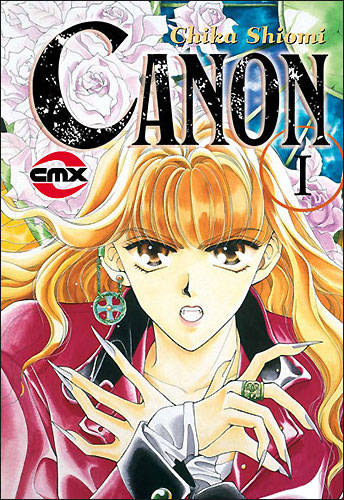
MICHELLE: As we did for the CLAMP Manga Moveable Feast, special guest Karen Peck and I decided to collaborate on a contribution. This month’s MMF theme is vampires, so we opted (actually, this was totally Karen’s brainwave) to talk about Canon, the four-volume Chika Shiomi shoujo series published by CMX. I really didn’t know what to expect, having never read it before, but I think you had, right, Karen?

KAREN: I read it years ago, as I am a total Chika Shiomi fangirl, and figured the MMF would be a great excuse to talk about a lesser-known CMX series. A little background on Chika Shiomi and the series—Canon was her first series after her 1993 debut, running in Mystery Bonita Special. She’s one of those mangaka who’s had her work released by several English-language publishers—Night of the Beasts by Go!Comi, one volume of Queen of Ragtonia by Aurora, and Viz has most recently released Yurara and its sequel series Rasetsu. Her current work is Yukarism, a time-travel tale running in Bessatsu Hama to Yume, which is currently on hiatus.

Canon Himuro, ill with an incurable disease, was the sole survivor of a massacre that left her classmates dead. Months later a reporter runs into her, and she looks healthier than before—and carries a secret. Her classmates were attacked by a vampire, who then turned Canon into one. Horrified and wracked by guilt, she declares revenge on the vampire with silver hair and blue eyes. Holding onto her humanity, Canon refuses to drink blood, and wears a cross necklace given to her by a kindly foreigner, as explained in the second chapter. She is also accompanied by a vampire crow, Fui, who helps keep the story going and provides the humor. Canon is out for vengeance; Fui would just like a snack.

So, Michelle, what did you think of the series? Beyond the ’90s fashion, that is?

MICHELLE: I shall tell you, though we really must get back around to the fashion topic!

I ended up enjoying Canon quite a lot, though moreso in the first two volumes. The story begins episodically, and after a first volume that I’d describe as “not riveting, but entertaining,” the second volume packs a real wallop as Rod (such an intimidating name!)—the silver-haired, blue-eyed vampire—makes his entrance. By this point, Canon has met Sakaki, a smug and violent half-breed who’s also out for revenge against Rod (who murdered his parents), and they’ve formed an alliance. Fairly soon, though, Rod’s servants are telling Canon that their master lives as a hermit and couldn’t possibly be responsible for the attack upon her classmates, and suggesting that the real culprit is Sakaki. Canon resists the truth until Fui overhears a conversation confirming it (and is gravely wounded by Sakaki as a result).

I probably should’ve seen this reveal coming, but I was sort of enjoying the series in an uncomplicated way and wasn’t expecting it to veer into territory this dark. Ultimately, you’ve got Canon unable to forgive Sakaki, Sakaki unable to forgive Rod, and some uncomfortable parallels for Canon to navigate as her own hatred (fueled by the humiliation of having been tricked) threatens to undo her efforts to retain her human heart. It’s good stuff, really!

That said, I thought the entrance of Glenn as a common enemy kind of squandered the momentum a little. I mean, I’m glad that Rod and his awesome servant, Machua, got to become good guys, but Glenn lacks any real depth as a character, and I found his sudden change of heart regarding Canon—he’d previously been adamant about the need to exterminate her—rather baffling.

KAREN: The names crack me up, too. “Rod” just doesn’t sound… menacing. Rod and Glenn sound like they’d be assistant managers at an Office Depot, not powerful vampires.

It is good stuff! One thing I dislike about vampire stories—in manga and in print—is the angsty, boohoo I’m a vampire aspect. Canon does not wallow in that too much, the action is swirling around her and she’s a part of it all—she’s not a passive character. I think the shortness of this series helped as well; she had to stick to the unexpectedly twisty story–everyone has a motive, and they’re bound by vampire laws and revenge. Except Glenn. I agree with you, Michelle, that his change of heart is baffling–he’s the person that exists to move the story in one direction yet doesn’t seem to be upset that his purpose in the story is nullified by that direction. It’s a bit sloppy, but given how well she plotted out everything else, I’ll give Shiomi-sensei a pass since this is her first work.

As for the Canon/Sakaki relationship, at first I didn’t get it. After some consideration, though, it does fit in with what Canon was trying to get through to Sakaki and Rod–to stop the cycle of vengeance, that everyone can move on. Yes, Sakaki created Canon and messed with her memories to create a weapon to get at Rod in an exquisitely personal way, but her own words apply just as much to herself. She could kill him for her own vendetta, or she could remember that little boy who was left bleeding next to the corpses of his parents and understand what drove him. There’s a theme of forgiveness and breaking cycles here that I think is (mostly) well-done.

So, back to the fashion. Canon’s ankle boots have actually come back around to being fashionable again, but I fear that Rod’s overcoat on top of a turtleneck overcoat look will never be repeated. I suppose hermit vampires who feel bad about killing their best friends are just naturally chilly?

MICHELLE: I hadn’t actually seen that about Rod’s garb until you pointed it out, but once I did, I couldn’t stop noticing it. I think I thought the black one was a cloak at first, but upon closer inspection, it clearly has sleeves.

You’re absolutely spot-on about Canon remembering the terrible things that had happened to Sakaki that caused him to inflict terrible things upon her. And though it might feel like a betrayal of her classmates, she can’t stop loving him. This reminded me a lot of Shuri and Sarasa in Basara, actually, where she is able to forgive him for the atrocities committed as the Red King, even though other villagers will never be able to. And, of course, any time something can be compared to Basara is a good sign!

Speaking of comparisons to other works, the side story in volume four about the other half-breed who briefly takes care of orphaned Sakaki reminded me a lot of Shion’s backstory in Please Save My Earth, as another example of a boy in such tremendous need who tragically loses yet another person who could’ve shown him love. And Sakaki’s physical appearance reminds me some of Tokyo Babylon‘s Seishirou, especially round about the shoulder region.

Actually, Sakaki’s got some fashion challenges of his own to surmount. In this picture, his coat’s billowing so much it looks like a frickin’ hoop skirt!

KAREN: I know–why does he need two coats? I think it’s a little hypocritical of a vampire to wear turtlenecks anyway.

Now you’re reminding me that I need to finish reading Basara! But it’s a good comparison, and one that reflects favorably on Chika Shiomi–I think a lot of people can write a love story, but it’s harder to write one where it makes sense and is right for the characters. Hand-waving with a “that’s how love is!” is lazy, and she doesn’t take the easy way out. The ending offers a further complication, but again, it goes with the feeling that the characters really need to want this instead of just engaging in relationship fanservice.

The art—especially for Sakaki—really had a CLAMP-circa-X vibe going on, but this was 1994. I also enjoyed Machua’s style, even if it wasn’t as flamboyant and flowing.

MICHELLE: I liked her, too, though at first I thought she might be a dude!

The art really is frequently lovely in that early-’90s kind of way. Below I’ve included an image of one of my favorite two-page spreads, where you’ve got all sorts of overlapping panels, huge flowers, leads superimposed over a background of space… My cynical side wonders if Shiomi had a checklist of specific items to include, but the overall effect is still one I enjoy. And, of course, I can’t help thinking that MJ, with her well-documented love for old-school shoujo art, would just love this to pieces. (Click image to enlarge.)

KAREN: This is some lovely ’90s art, and it holds up pretty well—Canon herself (sans ankleboots) could just as easily be a design in a modern Chika Shiomi work. I also enjoyed her eye for action–I was a little unsure about how the vampires were always leaping about, but I assume it’s a case of Our Vampires Are Different. The pages you picked show how nice a page with flashbacks and conversations can be–it’s not just good storytelling, it also sets an emotional mood that really sells the scene for me.

I’m glad there was a Vampire MMF to make me get this series off the shelf and re-read it. It’s one of those quiet CMX series that came and went with little fanfare, but shows how well-curated their shoujo line was–I’m sure they could have found a more sensationalistic vampire manga with prettier, broodier boys, but this is one with an overall strong story and a tough heroine. It may not be a classic on the lines of contemporary works like X, but it’s cheap on the used market and, in my opinion, a good short series.

MICHELLE: I definitely agree! Thank you for suggesting it!

And now, an announcement: because Karen and I had such a good time reading Canon, it really fanned the flames of “Damn, we miss CMX.” And so, to help offset our still-lingering pain, we’ve decided to embark upon a monthly feature called The CMX Project, where we will revisit both the lauded and the lesser-known works from the CMX catalog. Look for the first column—featuring Land of the Blindfolded—in January 2013!

Filed Under: FEATURES Tagged With: Chika Shiomi, cmx

JManga The Week Of 11/1

October 26, 2012 by Sean Gaffney, MJ, Michelle Smith and Katherine Dacey 5 Comments

SEAN: Welcome to a new feature here at Manga Bookshelf, which for want of a better title will be called JManga The Week Of. As you might guess, it is similar to my Manga the Week of posts, in that we break down what’s coming out next week from JManga (and possibly other e-publishers if I can find an easy way to get their release dates) and discuss what we’re looking forward to, what we’re curious about, what what we don’t really see the appeal of at all.

Since this is an inaugural post, I will start with THIS week’s JManga titles, then move on to next week. So it’s a double dose!

First off, we’re getting more “rescues” from the former folks at Del Rey, consisting of the titles they didn’t bring with them to Kodansha. School Rumble has 8 more volumes, which brings it up to date with what Del Rey had put out. This would mean Vols. 17-22, as well as the one-off sequel School Rumble Z, would be original JManga translations/productions. School Rumble is a comedic harem title from Weekly Shonen Magazine, and was quite popular among the blogosphere when it was coming out. And by popular I mean folks read the scans avidly. Cough. When the manga ended, as most harem manga do, with an ending that did not please everyone, the fandom died faster than Ali MacGraw. I do hope that enough time has passed that said fans return to the fold to support the remainder of the series.

MJ: I’ve always been sort of curious about this title—I even bought the first volume at one point, but never read it—so JManga’s acquisition here is definitely of interest to me. That said, there are Del Rey titles I miss much, much more (*cough* Nodame *cough*) so I’m not quite jumping up and down yet.

MICHELLE: I feel exactly the same way, MJ. I’m not generally interested in shounen harem manga, but there’s just something about this one that I find kind of appealing. Still, I’m more in a state of holding my breath for other things—aside from Nodame, I’m hoping that JManga will finish Papillon and Ghost Hunt!

SEAN: Re: School Rumble. It’s an interesting title as I suspect that it changed considerably from what the author had planned. It’s very much a gag manga at the start, with few harem elements. Then the author had its male lead, Harima, interacting with two polar opposites, the tsundere princess-type Eri and the meek young housewife-type Yakumo, and popularity soared. (Note that Tenma, the actual female lead, has never been as popular – in fact, Western fans tend not to like her much, mostly due to her childish characteristics.) Combine that with a truly huge cast, and you get a strange kudzu-like manga with multiple genres (though it never quite backs away from its gag manga roots, except towards the end).

Re: Nodame Cantabile, I have a theory about that. There are a few Del Rey hiatus series still not on JManga, such as Alive: The Final Evolution and Moyashimon. But Nodame is the most prestigious of those, and that may be the problem. It’s one of Japan’s biggest sellers. It’s huge in other countries. It has anime and live-action adaptations. And I love JManga and what they’re doing, but Kodansha giving them all these titles is very much a “we have no more interest in getting these out in print, so here.” I can see Kodansha thinking to themselves, “we need to hold onto Nodame in hopes that we *can* get it back into print, as it’s a flagship josei title.”

Pastel, another harem manga from Shonen Magazine (though after Vol. 6 it moved to the monthly Magazine Special), has also caught up with Del Rey releases, as Vols. 9-14 are out. Pastel is *still running* in Japan, with Volume 33 due out in November. Given it is, at heart, an ecchi harem manga bout a weak male lead, the various busty girls who fall for him, and their series of misunderstandings, the mind reels. I didn’t get very far into Pastel, but I know it has fans who enjoyed its slice-of-life, sometimes sweet story, so hope they enjoy seeing it go on. And on.

Speaking of license rescues, we have a new old series from Mag Garden’s Comic Blade. The first volume of Elemental Gelade came out from Tokyopop in 2006; they put out 12 of the 18 volumes before it was dropped. Digital Manga Guild re-licensed the series earlier this year; I’m not sure if this is their translation. In any case, it’s a fantasy series with pirates and living weapons, and also spawned its own anime.

MJ: While I’m always happy about manga becoming as accessible to people as possible, am I the only one who finds duplicate releases like this a little confusing?

SEAN: Ninja Papa hits Volume 3 of its seven volumes. As I’ve noted before, no one will ever accuse this of being great literature. But if you’re a middle-aged flabby balding guy and you want to imagine yourself doing mad ninja tricks, gorily killing bad guys in sprays of blood, then returning home to make love to your gorgeous hot wife… well, then you might want a subscription to Futabasha’s Manga Action in general. But this is *particularly* for you.

MICHELLE: … I can totally see this plot being yoinked for an American movie.

KATE: I’d like to see a josei take on this same basic fantasy: middle-aged woman performs mad ninja tricks, dispatches bad guys, then comes home to her impossibly hot husband. I’d definitely read that manga.

SEAN: Clair Voyance is a new manga from Ohta Shuppan’s online magazine Pocopoco. It’s actually by a Singaporean artist, FSc, aka Foo Swee Chin. She has done some alternative comics for Neko Press and Slave Labor Graphics. It seems to be about Monster Helpers rather than Monster Hunters, and I’m intrigued to see where it’s headed.

MJ: Thanks to Kate’s recommendation, I’m definitely planning to pick this up!

MICHELLE: Yeah, that one looks neat!

SEAN: And there’s Vol. 4 (of 7 and still going) of My Sadistic Boyfriend, which runs in Futabasha’s little known shoujo magazine Comic Mahou no Island. From what I’ve gathered, this fits squarely in the Black Bird/Hot Gimmick/B.O.D.Y. mode of “I love this guy who treats me horribly and I let him as I am weak and he is sexy.” I admit it is not my genre, but Viz apparently sells them like hotcakes (well, mildly warmcakes), so the audience is there. Has anyone compared this one with the classics like Hot Gimmick? How does it stack up?

MJ: “From what I’ve gathered, this fits squarely in the Black Bird/Hot Gimmick/B.O.D.Y. mode of ‘I love this guy who treats me horribly and I let him as I am weak and he is sexy.'” In a word, “Ugh.”

MICHELLE: I admit that I have judged this one purely on its title and did no further investigation regarding it. Also, I snickered at mildly warmcakes. :)

KATE: Wait… Hot Gimmick is a classic?

SEAN: Next up, JManga just announced 5 titles for release next Thursday.

Neko Ramen is another Mag Garden Comic Blade license rescue from Tokyopop, and is a cute 4-koma series about, well, a cat who owns a ramen shop. Funnier than it sounds, this was a surprisingly fun series when it first came out, and I’m pleased to see it here.

Peacemaker Kurogane is also a Comic Blade title, and this one has a long and tortured publication history. ADV manga (remember them?) put out Vols. 1-3 a long while back, then went under. Tokyopop revived the series and released Vol. 4, then they moved on. Now JManga has reissued the first 2, with presumably plans for more. I hope it catches on this time. It’s a Shinsengumi book, supposedly chronicling the life of Tetsunosuke Ichimura during the Meiji period and his attempts to get revenge.

MJ: Here’s a title I’ve always wanted to read! I’m pretty excited about this one, actually. I was a fan of the first volume of Momo Tama (from the same artist), though I never managed to pick up subsequent volumes, and I’ve been curious about this series ever since.

MICHELLE: Peacemaker doesn’t engender much of a response from me, but I am very pleased to see Neko Ramen arrive! I found the series to be a pleasant surprise, and though some volumes weren’t quite as giggle-inducing as others, it’s definitely among the series I mourned when TOKYOPOP went under. It fits in well with JManga’s quirky foodie manga, too!

KATE: I’m also glad to see Neko Ramen series get a second chance with readers. In the abstract, Neko Ramen sounds like a one-joke manga — hey, waiter, there’s a cat hair in my soup! — but the strips manage to wring fresh humor out of Taisho’s misguided promotions, menu items, and interactions with long-suffering customers. I don’t know if JManga will preserve the original Tokyopop translation, but I hope they do; the Tokyopop re-write has the same snappy quality as an Abbott and Costello routine.

SEAN: Lastly, there’s a new classic literature adaptation from Variety Art Works. This publisher specializes in adapting famous works of literature (both Japanese and worldwide, though the latter is what JManga has mostly focused on) in single volume manga format. This new title adapts Sun Tzu’s The Art of War, which, um, is really more of a lecture than a story, but hey. It’ll be quite interesting to see how this gets presented.

KATE: I’ve read a few of these “Illustrated Classics” — including the adaptation of Osamu Dazai’s No Longer Human — and thought the artwork was pretty bad. Their great redeeming virtue is that they hew closely to the original texts, so I suppose they have some value as Cliff Notes.

SEAN: So, what are you picking up this week?

Filed Under: FEATURES, manga the week of

Bookshelf Briefs 10/22/12

October 22, 2012 by Sean Gaffney, Katherine Dacey, Michelle Smith and MJ Leave a Comment

This week, Sean, Kate, MJ, and Michelle look at recent releases from Kodansha Comics, VIZ Media, Yen Press, and Vertical, Inc.


Cage of Eden, Vol. 7 | By Yoshinobu Yamada | Kodansha Comics – Yes, the fanservice is still as gratuitous as ever. That said, there’s a lot to like here. For one, we get more casualties, reminding us that the longer everyone stays on the island, the more the cast is going to be culled. The fact that the group is taken out by what turns out to be ticks is quite chilling. Akira’s open show of determination and leadership, meanwhile, gives everyone inspiration and makes them want to keep up with him. This then takes a much darker turn, as we see the consequences of everyone not wanting to be dragging the group down – the cast getting altitude sickness that nearly kills them because no one will rest. And finally the cast start to hallucinate (a genuine symptom of altitude sickness) – which allows for a cliffhanger involving more horrific extinct animals. Shonen madness! – Sean Gaffney

A Devil And Her Love Song, Vol. 5 | By Miyoshi Tomori | VIZ Media – Maria’s first instinct when confronted with conflict is still brutal honesty, and I admire the fact that the manga shows this remains ultimately a good thing. Indeed, it’s not just Maria in this volume, as Shin shows off his own tendency to say exactly what he thinks. He thus ends up meeting Maria’s friend from her old school, Anna. I knew from the moment we started Volume 1 that Anna would be appearing at some point, and would be an antagonist. Thus I am once again pleased at how believable Tomori-san makes her. Maria, meanwhile, is still having trouble dealing with her feelings for Shin. This fails to surprise anyone, given how she has trouble with friendships, much less love. But I can’t wait to see what happens next. – Sean Gaffney

Fairy Tail, Vol. 21 | By Hiro Mashima | Kodansha Comics – There is a WHOLE lot going on in this volume. We meet most of the Fairy Tail cast doppelgangers – including Lisanna, who’s dead in Natsu’s universe – and find Erza’s working for the bad guys. Speaking of the bad guys, they’re the usual eccentric lot, ranging from obviously sympathetic to completely insane. There’s a healthy dollop of humor here, as we see Lucy’s double showing off how alike the two are and Loki ignoring Lucy’s call to battle as he’s on a date (presumably with Aries). And there are sad and heartwarming moments, such as Carla’s realization of what she’s been involved in, as well as the identity of the cats who briefly harbor them. Most of all, I’ve finally stopped thinking about how much Fairy Tail rips off One Piece when I read it. Which is quite the accomplishment. – Sean Gaffney

The Flowers of Evil, Vol. 3 | By Shuzo Oshimi | Vertical, Inc. – Though I had high praise for the first two volumes of The Flowers of Evil, volume three is a weaker and less psychologically plausible installment than what preceded it. Saeki’s increasingly desperate attachment to Takao seems more like a plot contrivance than a natural progression for her character, while Nakamura’s bullying sails over the line from nasty manipulation to outright sadism. The two girls’ tug-of-war isn’t beyond the realm of possibility; nor is Saeki’s unfounded belief that Takao represents something more interesting or profound than what other boys her ages could offer. What feels wrong is the way in which that conflict manifests itself, culminating in a scene that only a teenage boy would feel was an accurate representation of how girls think and behave. I’m not ready to throw in the towel just yet, but I’m no longer convinced that Oshimi has as a firm a grasp of his characters as he did in the first chapters of the series. – Katherine Dacey

The Flowers of Evil, Vol. 3 | By Shuzo Oshimi | Vertical, Inc. – I wrote in my brief review of volume two that I “pretty much hated” The Flowers of Evil and couldn’t see myself continuing with it, and yet here I am. I suppose curiosity got the best of me. Volume three deals with the aftermath of Kasuga and Nakamura’s classroom vandalism, during which it becomes clear to Saeki and Kasuga’s mother that he is the one responsible. I actually did like certain things about what follows—especially Kasuga’s admittance that he was only reading Baudelaire in an effort to convince himself he’s special and that he’s scared of facing the real Saeki as opposed to his idealized vision of her—but spent a lot of time baffled by the characters’ actions and reactions. What is clear is that nobody is the person that others thought they were, which seems like a decent note upon which to end the series, but it actually continues from this point. I’m still not sure if I’ll be reading it. – Michelle Smith

Jiu Jiu, Vol. 2 | By Touya Tobina | VIZ Media – First of all, that cover is far saucier than a typical Hakusensha shojo title – something the author lampshades in one of her notes! Despite that, this title is becoming for females what Cage of Eden is for males. There’s lots of rampant fanservice of Snow and Night looking half-naked and sweaty. The plot is still a bit ‘make it up as you go along’, but I’m used to that with Hakusensha. The author hasn’t made it clear whether we – and Takamichi – are supposed to think of the two male leads as pets, or as children/family, or as love interests. It’s somewhat uncomfortable, and I think that’s at least partly deliberate. The addition of a few new cast members is nice to see, but for the most part this is still a three-hander about young people who are very bad at social interaction and the laughs and awkwardness that comes with that. Hope it continues to improve. -Sean Gaffney

Library Wars: Love & War, Vol. 8 | By Hiro Arikawa and Kiiro Yumi | VIZ Media- Okay, seriously, how did Library Wars end up being so shoujoliciously good? I mean, the premise is rather silly and the characters are far from convincing as soldiers, but the past couple of volumes have been genuinely enjoyable. In volume eight, the truth of why Iku’s being interrogated regarding a book-burning incident comes to light, which ultimately leads to her finally realizing that her commanding officer, Dojo, is her prince, whereupon she freaks out in a pretty awesome way. Combined with her composure under questioning and her reaction to this news, I am finally beginning to like Iku at long last. This volume also prominently features Iku’s awesome roommate, Shibazaki, who is one of those “I am jaded and unable to fall in love but will protect my idealistic friend with all I’ve got” characters whom I always adore. I’m looking forward to volume nine! – Michelle Smith

Pandora Hearts, Vol. 12 | By Jun Mochizuki | Yen Press – As tension ramps up over Oz’s questionable origins and the return of a mysterious villain with a penchant for beheading, I’ll admit that what really makes this whole volume for me is a (presumably) throwaway section in which Oz’s younger sister Ada reveals her secret obsession with the occult. That may not sound funny on the face of it, but trust me… it’s honestly hilarious, surprisingly charming, and makes it even harder to continue to hate the supposedly evil Vincent Nightray, to whom she bares her magically-consumed soul. Too, this section highlights one of the strengths of Mochizuki’s writing. No matter how dark and complicated her story becomes, she never loses her sense of whimsy or her deep love for her odd little cast of characters. Humorous interludes aside, volume twelve is full of terrific little nuggets of characterization—just part of the series’ considerable payoff for fans who have stuck with it so far. Still recommended. – MJ

Skip Beat!, Vol. 29 | By Yoshiki Nakamura | VIZ Media – I am probably somewhat of a broken record where Skip Beat! is concerned, because not only do I genuinely enjoy every new volume, I also always wish that I had twenty more of them waiting in the wings, that’s how much I adore it. In this volume, Kyoko has realized that she’s on the verge of sprouting feelings for Ren, which scares her very much, since he is able to slip past her defenses so easily. She’s so distracted she allows a male costar to make her over for a wrap party, which yields two developments: Kyoko becomes convinced Ren sees her as too childish to pursue and she gains confidence in her ability to transform herself for a role. That’s Skip Beat! in a nutshell—even when there’s a smidgen of romantic progress, there’s a healthy dollop of career progress for the awesome heroine to go along with it. Perennially recommended. – Michelle Smith

Filed Under: Bookshelf Briefs Tagged With: a devil and her love song, Cage of Eden, Fairy Tail, Flowers of Evil, Jiu Jiu, pandora hearts, Skip Beat!

Pick of the Week: Limit

October 22, 2012 by Katherine Dacey, MJ, Michelle Smith and Sean Gaffney 1 Comment

KATE: Though I’m glad to see that Dark Horse is still releasing new volumes of Bride of the Water God—surely one of the most beautiful and confusing manhwa available in English—my vote goes to volume one of Keiko Suenobu’s Limit. The story focuses on a group of girls who survive a terrible bus accident. As they wait for help, the class pariah discovers she has the upper hand over her tormentors, and exploits that turn of events to its fullest. Suenobu sometimes tries too hard to make her story a parable about bullying and social dynamics, but on the whole, Limit manages to be thoughtful *and* entertaining — think Mean Girls with weapons.

MJ: I have to say, I’m with Kate this week. Though there are a number of my favorites on the list this week (I must continue to mention the ever-charming Pandora Hearts), Limit is really a must-buy.

MICHELLE: I’m going to have to chime in with a “ditto,” as well. It’s not too often that we get shoujo like this, and it’s definitely something worth checking out and supporting.

SEAN: Much as I do like the Nagato and DRRR!! spinoffs, I must chime in for Limit as well, which is simply a change of pace from ‘sweet young girl goes to high school and meets cool guy who likes her’ shoujo manga. Limit has its pacing issues, but is a gripping read with lots of high-tension emotion.


Readers, what looks good to you this week?

Filed Under: PICK OF THE WEEK

Off the Shelf: King of RPGs, Genbu Kaiden, Pride

October 20, 2012 by MJ and Michelle Smith 2 Comments

MICHELLE: Hey, MJ! Did you hear about the fire at the circus?

MJ: Why no, Michelle. Why don’t you tell me about it?

MICHELLE: It was in tents!

MJ: Ba-dum dum *chick*.

MICHELLE: I concede that there is a distinct possibility that nobody enjoys these dumb jokes but me, but I can’t seem to resist trotting them out whenever it’s my turn to start us off. Anyhoo, read any good manga lately?

MJ: I certainly have! It’s been a long time coming, but I finally acquired myself a copy of the second volume of Jason Thompson and Victor Hao’s OEL manga series King of RPGs, released over a year ago by the much-missed Del Rey. I enthusiastically reviewed volume one many moons ago for Deb Aoki at About.com, but I’d missed continuing on. And now that I have, I’m sorry that it took me so long!

After volume one’s over-the-top, madcap, shounen-esque conclusion, the series’ second volume begins in relatively grounded territory as it introduces us to the online universe of “World of Warcraft Warfare,” the MMORPG that originally drove the story’s hero, Shesh, to hospitalization and extensive psychotherapy. WOW servers have been overrun by “gold farmers”—players who collect in-game valuables (currency, magical items, high-level characters, etc.) and sell them for real-world cash. As rival guild members battle and kill each other (rather than their AI enemies) over these valuables, the name “Moggrathka,” Shesh’s long-abandoned character, lives on in legend as the most-feared and respected player-killer of all time. Soon after, we’re reintroduced to Rona Orzak, volume one’s misguided, gamer-hating student policewoman, who inadvertently reawakens Shesh’s in-game alter-ego by way of her own WOW account, thus unleashing the player-killing monster into both the real and virtual worlds. Of course, in King of RPGs, only tabletop gaming can save the day!

This series has a lot going for it, particularly for gamers and shounen manga fans who are pretty much equally serviced by its generously applied fan culture references, character-driven narrative, and fast-paced adventure. But its greatest appeal by far is Jason Thompson’s spot-on humor, which somehow manages to make a bunch of potentially alienating in-jokes accessible to casual readers without mocking hard-core fans. I can only attribute this to Thompson’s obvious love for the subject matter, and its effectiveness really can’t be overstated. If there’s a consistent vibe that tends to emanate from real nerd culture, it’s a weird combination of passionate fandom and deep resentment over any attempt to bring newcomers into the fold—as if the conversion of each new fan somehow reduces the value of the fandom itself. But Thompson actively invites readers into the world of tabletop RPGs (and, more stealthily, shounen manga) with a real warmth and generosity that makes you want to join him at the table. That, more than anything, makes the series a great read. And the hilarity… oh, the hilarity!

I should mention, too, Hao’s artwork, which has really grown since the series’ beginning. Volume two’s visual storytelling is just as energetic as ever, but feels cleaner and vastly more focused, especially in later chapters.

MICHELLE: You know, I have volume one on my shelf, but never got around to reading it. It seems like I should rectify that. Has there been any word on the fate of this series now that Del Rey is no more?

MJ: Nothing official that I’m aware of (though I believe the authors are hopeful!), but Jason Thompson’s webcomic “expansion” has been running on the series’ website since February, so there’s something to tide us over, at least. Also, gamers will enjoy the fake blog of Theodore Dudek, King of RPGs‘ overenthusiastic GM.

So, now that I’ve sufficiently nerded-out, what have you been reading this week?

MICHELLE: I have been enjoying a marathon catch-up read of Fushigi Yûgi: Genbu Kaiden, by Yuu Watase!

The anime of the original Fushigi Yûgi was one of the first shoujo anime I ever saw, and the story remains dear to my heart, even though I am fully cognizant of its flaws. When Genbu Kaiden started coming out in English, I collected it faithfully, but somehow never ended up reading it. Now that the much-anticipated tenth volume has finally been published (almost three years after volume nine), I made it my priority to get caught up.

And what a delightful read it has been! Watase sure has matured a lot as a storyteller in the intervening years, crafting a story that’s similar enough to the original to appeal to long-time fans, but fully its own creation capable of attracting new readers. Genbu Priestess Takiko Okuda is a much more likable heroine than the original’s Miaka, and the primary romance here is one that leaves me more touched than annoyed. I was actually expecting to like Tomite and Hikitsu the best (especially Hikitsu), since they appeared in the original story (and since Hikitsu is very pretty), but my favorite characters have actually turned out to be the Celestial warriors appearing here for the first time. I’m surprised by how much I like Uruki (Takiko’s love interest), but my favorite is probably Namame, the mute (only Takiko can hear his voice) but ever-helpful warrior who spends most of his time in the form of a stone doll.

In volume ten, the Celestial warriors have infiltrated the capital, where one of their number is being imprisoned and made to use his powers for the protection of the power-hungry emperor. Some nifty revelations ensue, including a tour through the memories of Uruki’s corrupt dad, but by far the most significant aspect of the story is that Takiko has begun to show signs of the same illness that claimed her mother’s life, but is trying to hide it from the others. She knows now that she will be compelled to sacrifice herself if she summons Genbu, but since her death seems imminent anyway, it might as well serve the purpose of saving people who are dying from war, cold, and starvation.

Although there are a few lighthearted moments—as well as a smattering of romantic ones—on the whole, this is a much more sober tale than the original and definitely its equal, if not its superior. I’m exceedingly glad to see volume eleven on the near horizon (March 2013) and hope that one day Watase is able to pen the Byakko saga, as well!

MJ: I’m so glad you’ve caught up on this series, because now we can share the squee! Having (still!) not read the original—something I’ll rectify soon—I don’t have the same reference for comparison, but I’ve enjoyed Genbu Kaiden immensely. I’ve also been surprised by how much I like Uruki, and I thought his romance with Takiko was one of the highlights of volume ten. And could Namame possibly be more adorable? I don’t think so!

MICHELLE: I am starting to think you may want to avoid the original until Genbu concludes, because it does give away the ending, though I am sure Watase has some surprises in store on that account.

Anyway! Once again, we have both read the debut volume(s) of a newly released series, which is something we enjoy doing and something we intend to do more of in future! Care to tackle the introductory duties this time, MJ?

MJ: I’d be happy to!

So, this week’s mutual read comes from online publisher JManga, whose wealth of recent acquisitions includes Yukari Ichijo’s josei series Pride, originally from Shueisha’s Chorus magazine.

Pride follows the stories of two aspiring classical singers—Shio Asami, whose upscale musical education is abruptly halted by a sudden downturn in her widower father’s fortunes, and Moe Midorikawa, whose lower-class background has made entering the elitist world of opera an uphill battle from nearly every angle. Though the series’ plotline mainly concerns their mutual struggle to keep singing while maintaining day-to-day survival (along with the obligatory rivalries, both professional and romantic), the real meat of it all lies in the ways that their disparate backgrounds have formed their personalities and how that affects the way they approach their respective lives and careers.

Shio’s respectable upbringing and musical pedigree (her late mother was an international opera star) have burdened her with a sense of pride that is ultimately unhelpful when she requires assistance from others, and her well-schooled refinement hinders her ability to perform with any real emotional resonance. Meanwhile, Moe’s natural expressiveness as a singer is not quite enough to make up for inferior training, and her desperate personal circumstances have made her absolutely ruthless (and fairly ungraceful) in her quest for career success.

What works particularly well about all this is that Ichijo manages to make both characters pretty much equal parts sympathetic and maddening. And while Shio ends up tipping the scale in likability, it’s impossible not to sympathize with Moe’s deep need to escape from her truly icky origins. By the end of volume two, I found myself rooting for both of them, despite their genuinely ugly rivalry.

How about you?

MICHELLE: Kudos on that summary! I loved Pride almost without reservation. Let’s see if I can count the ways…

I love that Shio doesn’t follow the “poor little rich girl” stereotype. She and her father have a genuinely loving relationship, and though the fact that she’s been protected from pain and hardship all her life later becomes a weakness, it’s still this relationship that gives her the strength to persevere. As a musician, I really identify with Shio’s struggles with expressiveness and the realization that perfection is sometimes boring. I was especially interested when she abandons the fantasy of herself as a singing princess and really begins to recognize the reality of her situation. I worry that marrying Jinno, the producer, will allow her an only temporary return to that sparkling world, only to be followed my massive despair. (I worry for her marrying him much like I worried about Hachi marrying Takumi in NANA, actually.)

Too, I love that the rivalry between Shio and Moe is so very equal. They’ve each got skills the other doesn’t possess, which makes them the perfect mate/muse for the guy that the other girl fancies, and it all builds so organically. True, I can’t really like Moe very much, but I absolutely sympathize with her. About the only aspect of Pride that I didn’t love were the scenes involving Moe’s incredibly horrible mother, but I acknowledge they were necessary and am grateful that Ichijo kept them fairly brief.

Although each woman is dealt some awful blows, each also has a few lucky breaks, too, so everything balances out.

MJ: Well said, Michelle, on all counts!

I’ll add, I guess, that though I share your reservations about Shio marrying Jinno, at least she’s going in with her eyes open, unlike Hachi did in NANA. Shio’s not remotely in love with Jinno and has no illusions about him being in love with her, so while I think she’s ultimately in for a very unhappy marriage, at least she’s not fooling herself into thinking it’s a real marriage to begin with. In a way, that’s what makes it such a powerful plot point. She’s prepared for it to be disappointing, romantically, but I suspect it’s going to disappoint and hurt her in other ways that she’s not anticipating at all. And I’m sure it’ll make for great drama in future volumes!

MICHELLE: I’m sure it will! All in all, this is just a great depiction of how just plain old life can get in the way of one’s dreams, and how two women still have enough fight left in them to keep trying to attain what they want, rather than just giving up.

Thank you so much, JManga, for introducing us to Pride! Please, sirs, can we have some more?

MJ: Yes, yes, more!

Filed Under: OFF THE SHELF Tagged With: del rey, fushigi yugi genbu kaiden, JManga, king of rpgs, pride, VIZ

Pick of the Week: Quick Pick

October 8, 2012 by Sean Gaffney, Michelle Smith and MJ 1 Comment

SEAN: It’s a mild second week at Midtown, leading to a somewhat mild choice of picks for the week. I’ll go with the first omnibus volume of Girl Friends, which JManga released digitally last year. Seven Seas is doing its own edition with a different translation. I’m happy to buy it again, as I like reading paper volumes, but it’s also a fun story. One might argue that it’s a bit too cute and fluffy – this is a far cry from angsty 70s shoujo series where one girl always has to die – but honestly I’m happy to sacrifice that for some happy endings. Not that there isn’t a fair share of fretting to be found here, but this is seinen yuri, not shoujo—so the moe is ascendant. Good stuff.

MICHELLE: My vote’s going for the second volume of Punch Up!, which is actually by Shiuko Kano and not Hinako Takenaga (sic), as Midtown claims. This series from SuBLime isn’t really my usual cup of BL tea—nothing about it is sweet or adorable—and yet I am intrigued to see where it goes from here. Plus, there is a cat!

MJ: I’m making my pick a bit frantically today, as I prepare to travel for New York Comic Con, but the title that stands out for me most on the list this week is Viz’s omnibus release of Loveless, volumes one and two. I’m a fan of Yun Kouga in general, but this is a series I missed on its first go-around, so I’m grateful to have a chance to catch up to the newer volumes Viz is releasing as well! Definitely my must-buy of the week.


Readers, what looks good to you this week?

Filed Under: PICK OF THE WEEK

Bookshelf Briefs 10/8/12

October 8, 2012 by Michelle Smith, Sean Gaffney and MJ 1 Comment

This week, Michelle, MJ, and Sean look at recent releases from VIZ Media and Vertical, Inc.


The Drops of God: New World | By Tadashi Agi & Shu Okimoto | Vertical, Inc. – Rather than release a fifth volume of this series, which would’ve included volumes nine and ten of the original release, Vertical has jumped ahead to this New World arc (volumes 22 and 23 of the original), which focuses on wines from regions without a long-established winemaking tradition, particularly the US and Australia. It’s incredibly easy to jump back into the story even after a gap of over a dozen volumes, since so little changes with the characters., though Issei is a lot more prominent now and his hair has mysteriously gotten cuter. Highfalutin’ descriptions of wine still abound, and still make me roll my eyes with regularity, but there’s something captivating about this series that keeps me reading. Honestly, it’s more the sports manga-like themes of perseverence and presumed eventual triumph than the subject matter or the characters, but that’s enough for me. – Michelle Smith

The Flowers of Evil, Vol. 3 | By Shuzo Oshimi | Vertical, Inc. – There are a number of scenarios I might have imagined coming out of the rather stunning final pages of the second volume of The Flowers of Evil, but this series continues to be fresh and surprising in just about every way. Oshimi’s characters refuse to fall into neat categories, while still managing to ring true—in fact they feel truer with each page. Volume three is unexpectedly moving as Kasuga comes to the surprisingly insightful realization that putting his dream girl on a pedestal is not the same thing as loving her, and as all three of the series’ main characters are faced with truths they weren’t quite prepared for. If this series’ first volume read mainly as “better than Sundome” its third proves that it is really so much more. Highly recommended. – MJ

Jiu Jiu, Vol. 2 | By Touya Tobina | VIZ Media – After being so thoroughly unimpressed with the first volume of Jiu Jiu, I wasn’t expecting much from the second volume. Perhaps, then, my low expectations are the reason that I somehow now feel more kindly disposed towards the series, even though it’s still pretty generic and aimless and has weirdly proportioned art. I haven’t been moved to care more about Takamichi, Snow, and Night as characters, but I don’t hate the plot wherein the boys/dogs want to assert their independence, or that they’re prodded in this direction by Meru, a mischievous new character who spends part of his time in the form of a super-cute vampire pig. I hate to think a vampire pig is all it takes to sway me, but at least it’s something unique, which this series desperately needed. – Michelle Smith

Nura: Rise of the Yokai Clan, Vol. 11 | By Hiroshi Shiibashi | VIZ Media – In a contest for ‘Jump manga that varies most in quality’, Nura may not have any serious competition. This particular volume is mostly one long battle, which I generally don’t like to begin with, and unfortunately the author does not manage to save much of it from excessive tedium. There’s a focus in the middle on Awashima, who changes sex depending on whether it’s light or dark (so is rather grumpy about the darkness of Kyoto, keeping her female all the time), which is meant to show her accepting both sides of her, I think, but simply reads as an annoying diversion. At least towards the end we get a really nasty bad guy, who proceeds to take all our heroes and crumple them into little balls of failure. I suspect Nura will get his revenge in Vol. 12, hopefully in a more interesting way. -Sean Gaffney

The Story of Saiunkoku, Vol. 8 | By Kairi Yura and Sai Yukino | VIZ Media – It really is startling how much I’ve come to love this series. I think it’s the fact that all the court intrigue and scheming is presented in both a positive *and* negative light, with the best schemers winning because they are smarter and more devious than the bad guy. This is a series that has a lot of handsome men relying on people underestimating them, which is nice but means the author has to have them be savvy enough to back that up. It works very well here. Our heroine Shurei does very well keeping up with everyone, and is starting to chip away at the ‘she is a woman and therefore weak’ attitude in the court. Well, given the last chapter, she’s going to get a lot more chances to do that in the future. All this plus a tiny bit of romance again. Saiunkoku is simply a great story, full stop. -Sean Gaffney

Toriko, Vol. 12 | By Mitsutoshi Shimabukuro | Viz Media – Toriko fares much better than Nura this time around, mostly as it’s between arcs and has therefore gotten away from the standard Jump ‘2-3 volumes of people punching each other hard’ syndrome. Instead, we get to see the results of Century Soup, and then set out on a new arc, as Toriko is told he’s not really strong enough yet to take on the Gourmet World. So he does some training by climbing a ten-thousand-meter plus vine to a sky garden with the best vegetables in the world. Actually, Komatsu is the one who really impresses here – not that he does anything, but his simple willingness to carry on is amazing. Toriko is all about world building, which is what makes it so much fun – the combination of food, fighting, and larger than life characters. I also suspect our hero is in for some harsh reality soon, though… -Sean Gaffney

Filed Under: Bookshelf Briefs

Not By Manga Alone: Supernatural Revue

October 7, 2012 by Megan Purdy and Michelle Smith Leave a Comment

This month Michelle catches up with vampires and vampire slayers with Buffy Season Nine and Angel & Faith, while Megan visits the Twilight Zone through Underwater Welder, and the trencoats-and-tentacles world of Fatale.

Welcome back to Not By Manga Alone!

Buffy the Vampire Slayer Season Nine, Vol. 1 | By Joss Whedon, et al. | Dark Horse – After pretty much hating Season Eight by the end, I wasn’t sure I was going to bother with Season Nine. The completist in me couldn’t quit so easily, however, and I ended up tentatively checking out the first issue. It was loads better than anticipated, and so here we are!

This first collected volume includes the first five issues of the series, which comprise the four-issue “Freefall” arc and a oneshot entitled “Slayer, Interrupted.” The former introduces readers to Buffy’s new life in San Francisco, where she’s working as a barista and living with a couple of new roommates. Willow’s got a job as a computer programmer, and Dawn and Xander are trying to distance themselves from the supernatural element and move on with their lives. Buffy’s keen to have a normal existence, too, but soon finds herself a fugitive when some formerly vampire corpses turn up and she’s the prime suspect.

The plot here is not exactly exciting, but there are some good moments. Despite seeming somewhat younger than she did at the end of the TV series, Buffy feels more or less in character, especially when you consider that she’s finally free to act her age. At times, the dialogue seems a little too focussed on being amusing, but it’s hard to really complain about that. And if you’re a Spike fan and missed him in Season Eight, you’ll be gratified by his interaction with Buffy in these issues. You might, though, be a little bummed that Xander and Willow don’t seem to be playing much of a role in Buffy’s life these days. And you might be further bummed that Georges Jeanty’s art is still occasionally downright bad, including some abysmal renderings of Willow.

So far, Season Nine is a distinct improvement over Season Eight, but it isn’t perfect. And we haven’t even gotten to the controversial twists in the next batch of issues! Those will have to wait for next time. – Michelle Smith

* * * * *

Angel & Faith, Vol. 1 | By Christos Gage, et al. | Published by Dark Horse – I’ve always found Angel and Faith’s relationship to be a really interesting one. They’ve bonded over their search for atonement for past misdeeds and have seen each other at their worst. So it makes perfect sense that, after Angel does something terrible at the end of Season Eight (seriously, it’s impossible to avoid spoilers, so get out now if you don’t want to know!), Faith is the only one who cares enough about how it affects him to stay by his side.

I have to say… I really love this series. It is, by far, the best Buffy comic I’ve ever read. There are a few reasons for that. Time for a list!

It’s got a cool premise. Angel and Faith are now living in London, following up on cases from Giles’ journals. Angel has gotten it into his head that he’s going to bring Giles back to life, and Faith is torn between supporting someone who’s been there for her in some terrible moments and stopping him from committing a tremendous mistake.

Tighter focus than other Buffy comics. There’s no obligation to include half a dozen recurring characters (though a fluff piece about Harmony is included here) and therefore no grumblings when they appear to receive short shrift.

Faith is really a terrific character. She has matured so much, and has several great lines of dialogue as she confronts this realization, like, “I’m the — what? You’re kidding, right? If I’m the grownup, we’re screwed.”

The art. Hallelujah, Faith is free from the mangling inflicted upon her by Georges Jeanty. As drawn by Rebekah Isaacs, Faith not only looks as lovely as Eliza Dushku, but she’s expressive in ways Jeanty could never dream of achieving.

In short, this comic is great. Even if you hated Season Eight and even if you have no interest in Season Nine, Angel & Faith is still worth your time. – Michelle Smith

* * * * *

Underwater Welder | By Jeff Lemire | Top Shelf — I heard a lot about this book before I read it. That’s what happens when you go to a ook launch cold. Lemire talked a lot about process (did you know he redraws every panel, rather than scanning and editing? take note, tracers), and a lot about how hard it is to find time to work on passion projects. Underwater Welder is four years in the making. Lemire made substantial changes to the plot and character designs along the way, and it all pays off. Underwater Welder is a weirdly pretty book. It’s also a smart one, tightly written and illustrated. There are no unnecessary panels, few misfires, and no dropped threads. This is 220 pages of wrung out coming of age, through a glass darkly.

In the introduction, Damon Lindeloff says that Underwater Welder is akin to one of the great Twilight Zone episodes, and man is he right. (All the cool reviewers are saying so!) Jack, our eponymous (literal) welder, is an expectant father with daddy issues grounded in real tragedy. When Jack was a boy, his father went diving one Halloween night and never came back. Jack was left waiting, and he’s never stopped waiting. With a baby on the way, and the looming promise of being dry docked while waiting out an injury and parental leave, things come to a head. Spoiler alert! Jack goes diving, and with the help of a lost and found pocket watch, things get weird. Jack gets the time and space, in the form of an emptied out town gone moebius strip, to work out those issues. And, you know how these things work, soon enough it becomes obvious that working things out is necessary to his ever getting home. This is a really spare narrative. It feels about as long as an hour long tv episode, quickly sketched, and full of supporting characters who I wish we’d had more time with. The focus is strictly on Jack and his dad, with the slightest detour for Jack’s wife and his mother. Jack’s wife is a latter days addition–Lemire originally intended her role to be filled by a male friend–and while it’s a smart choice, I still wish she’d gotten more page time.

Fundamentally, Underwater Welder is about fathers and sons. Jack and his dad are allied actually and thematically, even with Jack’s dad dead or MIA for most of the book. They both love the water, need the water, and are disconnected from the ordinary because of it. The demands that Jack’s wife and mother put on him have some weight, but once he’s in the water, they’re lifted. But only for a while, because this is a coming of age story. Specifically a coming into fatherhood story. Jack’s task, the thing he’s got to work out during his supernatural time out, is to be the man and the father that his own father never could be, and to be the one he should and needs to be. Lemire and his wife were starting their own family while he worked on the book, and that gives the book some of its weight and purpose. Lemire is nothing like Jack, but Jack’s journey is, supernatural experiences aside, an utterly ordinary one.

At the talk, Lemire mentioned that he’s one of those artists who can’t look at old work. The increase in skill from Essex County (nominated for everything, a few years back) to Underwater Welder, is pretty obvious. It’s a tighter, prettier, and more thoughtful book. The mix of scratchy figures and wide expanses of dreamy wash are, you know, Lemire’s thing, but also a wonderfully useful tagteam for storytelling purposes. This is a book where art and layout always perfectly in tune with story. The town is characterized by claustrophobic grids of same size panels; the ocean by splash pages. It’s considered, and arresting, and makes the book an even better read. – Megan Purdy

* * * * *

Fatale Vol. 1 | By Ed Brubaker and Sean Phillips | Image — I’m a trade waiter, so I do a lot of breathless waiting. But this is a Brubaker and Phillips book, and as they say on Tumblr, my feels, let me show you them. I discovered Brubaker through Catwoman, rediscovered him through Captain America, and then, adoration cemented, I started in on his creator owned stuff. His work with Phillips is by now effortless. They’ve been teaming up regularly since 2003, when they started on Wildstorm’s (underrated and unread) superheroes-and-spies limited series Sleeper. In 2006 they gave us the critically acclaimed (and adored by Megan) crime drama Criminal, and in 2008 the superhero/pulp mashup Incognito, and now there’s Fatale.

The pitch everyone gives for this series is that Fatale is cthulhu noir, and, wow. Ok. Who needs a review, right? Trench coats and tentacles. Cthulhu noir. It’s a perfect premise, but does it work? Kind of.

Fatale Vol. 1 is strictly an introductory book, but because it’s dominated by a flashback and has an ending bereft of pressing questions, it’s hard to know where the series will go next. It’s a weak first volume that focuses on premise and feeling more than character, to the extent that it’s hard to get a handle on any of them. Will Dominic, the male lead of the flashback sequence, be back? I don’t know. Do I care about what’s going on with Nick, the male lead of the framing story? Not really. Who is Josephine, the female lead of both stories, aside from the femme fatale to end all femme fatales? I’m not sure. But so far, she’s the only character I’m interested in seeing more of. The hook here is all in the what, rather than the who.

Fatale opens with Dominic’s funeral, and Nick standing over his grave. We learn that this man’s only friend, Nick’s father, is now institutionalized. We meet Jo, a beautiful woman with a past. Nick finds an unpublished manuscript, shots are fired, the caper begins. Soon we’re thrust back in time to Dominic’s own adventure, the story on which Nick’s newfound manuscript is based, but there’s a thematic disconnect. The opening is straight up noir and with the move to Dominic’s story, there’s a sudden genre shift into a Lovecraftian thriller. Things play out for Dominic more or less as you’d expect. And the volume closes with Nick, now looking for Jo. It’s a poor introduction in the sense that it’s all introduction. The volume feels unfinished, and doesn’t stand on it’s own. The framing story drags down the flashback. The flashback doesn’t pay enough forward to make the framing story intriguing. Neither part serves the other, and the sum of it is like, ok, that was a thing that happened. And while I want to know what happens next, don’t need to know–I’m not hooked. I’ll keep reading because Brubaker and Phillips have yet to fail me, but I wonder if another reader, one who isn’t already a fan, would make the same choice. Nick and Dominic are dull everymen, and while desperate, cursed Josephine has enough ruthlessness to be interesting, I’m not sure if she’s interesting enough to to carry the book. Premise and setting are doing all the heavy lifting so far. The villain and his minions, the crooked cops, the looming horror of elder gods, face tentacles–they’re where Fatale shows real energy.

Unsurprisingly, Phillips does good. The art is stylish and expressive, and there’s not much more I can say on that subject, other than a greater visual distinction between past and present would have given Brubaker’s script some more oomph. As it is, it’s a matter of period details (clothes, buildings), rather than a sense of visual character that divide the two parts of the book.

I can recommend Fatale, but mostly on the merits of the team’s previous work, and the expectation that it’s going to get better. As it is, this volume was a bit of a disappointment. – Megan Purdy

Filed Under: Not By Manga Alone

Pick of the Week: Saiunkoku, GTO, Skip Beat!

October 1, 2012 by Katherine Dacey, MJ, Sean Gaffney and Michelle Smith 1 Comment

KATE: It’s VIZ dump week, in which a large and random assortment of VIZ titles arrive at Midtown Comics. Although there are several great titles to choose from—Skip Beat!, Slam Dunk, A Devil and Her Love Song—my vote goes to volume eight of The Story of Saiunkoku. The volume is worth it just for the scene of Minister Ko’s unmasking, but there’s plenty more going on as well: sexual discrimination, clan intrigue, and romance. (Remember the emperor? He factors into the story in a more prominent way in this volume.) Frustratingly tidy as Saiunkoku can be, it’s still fun to read; I’m irresistibly reminded of Yentl and Mulan every time I sit down with a new volume.

MJ: While the VIZ dump certainly has a lot to offer, I admit I’m leaning in Vertical’s direction. Arrivals this week at Midtown include my pick from last week, Paradise Kiss, but also the fifth volume of GTO: 14 Days in Shonan, one of my least expected current favorites. Though nothing about the premise suggests that this series would be something I’d fall in love with, the fact is, I have, and I can’t help looking forward to each new volume. It’s definitely a GTO week for me!

SEAN: I also went with ParaKiss last week, so I’ll dip into the Viz Blitz this week and pick Vol. 29 of Skip Beat!. First of all, that cover is pure Barbara Cartland, even if no actual hot hot seduction will be happening within the actual pages. What we’ll get instead, I suspect, is more acting angst, more of Ren brooding, Kyoko freaking out about something at least once, and hopefully a shot or two of humor. At 29 volumes and counting, this is one of the longest shoujo series to be published over here, and I’ glad that it still seems to sell well. Mostly as Kyoko is simply fun to read about.

MICHELLE: I think I am going to have to go with Skip Beat!, too. It’s a special series that still makes me go, “Oh, yay! New Skip Beat!” even when we’re talking about volume 29. I could probably love this series at volume 79, actually. It’s that good, and the characters that endearing.


Readers, what looks good to you this week?

Filed Under: PICK OF THE WEEK

Bookshelf Briefs 10/1/12

October 1, 2012 by Sean Gaffney, Katherine Dacey, MJ and Michelle Smith 1 Comment

This week, Sean, Kate, MJ, and Michelle look at recent releases from VIZ Media, Yen Press, and Vertical, Inc.


Arata: The Legend, Vol. 11 | By Yuu Watase | VIZ Media – The last time I wrote about Arata, I described it as consistently entertaining. Alas, I haven’t really been feeling these two most recent volumes. So much seems to be repeating the same pattern—Arata encounters a hostile bishounen shinsho and employs his shoujo-heroine-in-a-shounen-manga mojo to discover the fellow’s true feelings, which he soothes before the two become allies—that when important things do happen, like the revelation that a pair of characters changed places (between modern Japan and Amawakuni) in their infancy, it fails to register any sort of impact. Things begin to look up slightly towards the end of the volume, though, as the group heads into the territory of the most hostile bishounen of them all: Akachi. Somehow I doubt he’s going to want to talk about his feelings for, oh, at least two volumes. – Michelle Smith

The Drops of God: New World | By Tadashi Agi and Shu Okimoto | Vertical, Inc. – If Drops of God had sold better, this would be half of Vol. 11 and half of 12, and we’d be reading it a couple years from now. As it is, this is the last planned volume, and I understand the publisher in Japan asked that it jump ahead to focus on American (and Australian) wines. Honestly, there isn’t that much missed – the biggest change is that Loulan, Issei’s hookup from Vol. 4, is now in Japan and acting as his Miyabi. (It’s unclear if they’re married, still lovers, or what have you.) And Issei is the one who clearly has gotten the most character development – he almost seems like a 2nd protagonist than a rival by now, and has mellowed out considerably. Shizuku, on the other hand, still feels as if he’s lagging behind and unable to progress. Which, to be honest, is true – he’s much the same as he was in V. 1-4. I do hope we eventually see more of this. -Sean Gaffney

Fushigi Yugi Genbu Kaiden, Vol. 10 | By Yuu Watase | VIZ Media – In my experience, a long wait between volumes of a manga series can be either a blessing or a curse—maybe even both. On one hand, anticipation is undoubtedly sweet, and a wait of nearly three years certainly provides plenty of that. On the other hand, anticipation can shift quickly to expectation, and after nearly three years… well, you get the idea. Fortunately, Fushigi Yugi Genbu Kaiden delivers, at least where it most counts. Despite the long wait, Watase’s well-paced storytelling and energetic artwork pull us right back into the story (and its awesomely giddy primary romance), as though no time has passed at all. On the downside (or is it?), the volume’s final pages are likely to throw readers right back into the clutches of sweet (and painful!) anticipation once again. – MJ

GTO: 14 Days in Shonan, Vol. 5 | By Toru Fujisawa | Vertical, Inc. – One of the main reasons we enjoy reading GTO is to see Onizuka kick the crap out of people as he tells them how they’re screwing things up. That said, he is meant to be a teacher, and pass on his example to others. This volume doesn’t have quite as much Onizuka in person, but it has him leading by inspiration – including a long mid-volume sequence starring Uchiyamada, the antagonistic vice-principal from the GTO series proper. It’s easy to see Onizuka dealing with young, impressionable teens. But just because folks are adults doesn’t mean they’re wise and all-knowing, or that their problems go away. So seeing Uchiyamada preparing to confront 50 gang members, or Ayame beating the crap out of a yakuza in order to confront the twins behind all this, is just as awesome as Onizuka himself. -Sean Gaffney

Spice & Wolf, Vol. 6 | Story by Isuna Kasekua, Art by Keito Koume, Character Design by Jyuu Ayakura | Yen Press – Here are eight words I never thought I’d type: I liked volume six of Spice & Wolf. Yes, there was some gratuitous nudity, and yes, there was some limp flirtation between Holo and Lawrence, but on balance, volume six delivered enough action to erase the memory of all those Economics for Dummies speeches in previous volumes. Better still, Holo spent most of the volume as a wisewolf, inflicting bodily harm on soldiers, extracting confessions from enemies, and menacing her (perceived) romantic rival Norah. I’ll take Holo in her feral form any day; she’s funny and fierce, using her physical strength, rather than her feminine wiles, to get the job done. I’m not sure that a handful of decent chapters are enough to make me revisit earlier volumes, but they did, at last, help me understand why this series has been such a phenomenon among American otaku. – Katherine Dacey

The Story of Saiunkoku, Vol. 8 | Art by Kairi Yura, Story by Sai Yukino | VIZ Media – Never underestimate the power of Cover Girl — that’s my takeaway from volume eight, in which Shurei decides her only chance of claiming her rightful position as a civil servant is to show her male peers she’s 100% woman… by donning makeup. The resolution of that conflict is a little too tidy, relying on narration rather than dramatization to show us how Shurei establishes her civil servant credentials. On the whole, however, volume eight is a solid installment in this period soap opera, serving up an appealing mixture of comedy, drama, intrigue, and romance, and ending with the kind of cliffhanger that promises to advance the story in a new and meaningful direction. Still recommended. – Katherine Dacey

Yotsuba&!, Vol. 11 | By Kiyohiko Azuma | Yen Press – It’s been nearly a year since I last read any Yotsuba&!. I didn’t realize how much I’d missed it until I started to read and the first chapter, in which Yotsuba invites herself into the kitchen of an udon shop to watch how it’s made, completely reminded me of everything that is great about this series. Seriously, this is the kind of manga where you suddenly realize you’re smiling and wonder how long you’ve been sitting there, doing that. Pizza, bubbles, cameras… these are a few of the things that fill Yotsuba with wonder in these pages, but the last page of the volume is the one that really made me laugh out loud and get verklempt all at the same time. Is this praise copious enough? If you haven’t read Yotsuba&!, what are you waiting for? Jeez, man. Get with it! – Michelle Smith

Filed Under: Bookshelf Briefs

Off the Shelf: Marginally glamorous

September 29, 2012 by MJ and Michelle Smith 8 Comments

MJ: I’m having an unusually domestic morning here on this gloomy New England Saturday—laundry, dishes, pet care, and general de-cluttering. It’s a little depressing, frankly, and I’d much rather be talking about manga.

MICHELLE: Pretty much the first thing I do every day is scoop the kitty litter. It’s an unglamorous life, to be sure.

MJ: It is, indeed. So, shall we glam things up a bit?

MICHELLE: I don’t know about glam, but I’ll do my best.

One notable read for me this week was volume 20 of Taeko Watanabe’s Kaze Hikaru, a series that began its run in the shoujo pages of Betsucomi in 1997 before transferring to Flowers when that josei mag came into existence. It’s the story of Tominaga Sei, daughter of a former bushi, who joins the Shinsengumi disguised as a boy to avenge her father and brother. Under the name Kamiya Seizaburo, she has been with the troop for several years now and fallen in love with her captain, Okita Soji, who is the only one who knows her secret.

This series is really a charmer, and I’m so grateful that VIZ is continuing to release it, even if at the rate of one volume per year. Watanabe breathes life and warmth into these historical figures, developing a cast of men who are simultaneously endearing and uncouth. I’m particularly fond of their flawed and idealistic leader, Kondo, who inspires intense devotion from Okita in particular. There are comedic elements aplenty (and plenty of guys who find themselves attracted to “Kamiya”), but there are also tragic ones. (I was seriously so affected by the events of volume eleven that I stayed away from the series for, like, two years.) Historical events are portrayed with admirable accuracy, but the focus is always on how this affects the characters.

In this particular volume, there are things happening in the wider world—Kondo has gone off with the member of the troop most likely to sow dissent—but the main plot revolves around Kamiya “disguising” herself as a girl in order to spy on a fellow believed to be an assassin. All this time, Okita has been staunch in his resolve never to fall in love, wishing to devote his life to Kondo, but this mission causes him to simultaneously worry about Kamiya and become even more conscious of her femininity. I love that Watanabe has taken her time in getting him to this point; it’ll only heighten the tearful squee when and if he finally admits he loves her. Seriously, I just got geekbumps typing that.

What makes this even more potentially awesome, of course, is that the vast majority of the Shinsengumi does not meet a happy end. With the series still running in Japan, and US readers so far behind now, I have to wonder whether we’ll actually see that here. But I most earnestly hope that we do.

I also most earnestly hope that you are one day able to read this series, MJ, for I think you would adore it.

MJ: I think I would, too, Michelle! And I’m especially anxious to pick it up, because though I’ve tired a bit of the whole “girl disguised as a boy” trope, I suspect that I’d love its execution in this particular series. Also, it sounds like there is some genuinely awesome heart-poundy squee to be had, which sends my romance-loving heart into spasms of true longing.

MICHELLE: If I recall rightly, I was a little dubious about the series at first because of its premise, and because Sei starts off as a bit of a hothead, but I’m glad I stuck with it. If VIZ ever transitions any series to digital-only status, I suspect Kaze Hikaru might be a prime candidate. So maybe that’ll be a way for you to catch up on it.

What’ve you been reading this week?

MJ: Well, fortunately, I’m in a position to bring on the glam!

This week, I allowed myself the pleasure of reading the first volume of Vertical’s new omnibus release of Ai Yazawa’s Paradise Kiss, which of course is a long-time favorite for both of us.

For the uninitiated, Paradise Kiss tells the story of Yukari, a pretty, long-limbed senior at a prestigious high school. Yukari is dutifully studying for college entrance exams in order to fulfill her parents’ expectations, though she herself has no real love for academics. While “pretty” and “long-limbed” are not adjectives I’d normally use when introducing a book’s heroine, they are extremely relevant in this case, as Yukari’s journey begins with a sudden request from a group of fashion design students who scout her as a model for their final senior project. Though Yukari initially refuses, she is slowly drawn in by both the students’ radically different approach to their imminent adulthood and their charismatic leader, George. As her career interests shift and her relationship with George intensifies over the course of the first two volumes (included here in Vertical’s initial omnibus), tension mounts quickly in Yukari’s school and family lives, making some kind of breaking point pretty inevitable.

Since we’ve discussed this series here pretty extensively in the past, I’ll get right to the nitty-gritty of Vertical’s release. When it comes to manga trim size, bigger is nearly always better, and Vertical’s edition benefits heavily from its luxurious page size. The whole production feels elegant, from the silky cover texture to the book’s smooth paper. And though my scanner isn’t high-quality enough to offer any value in terms of demonstrating print quality, you can see from this set of contrasting scans that the trim size also allows us to see a bit more of the artwork in the margins of each page.

(Click images to enlarge.)


Paradise Kiss, Tokyopop Edition


Paradise Kiss, Vertical Edition

Vertical’s editions also include a brand new translation, which already demonstrates that it intends to be more up-front about things like George’s sexual kinks (even using the term “kink” regularly, rather than having Arashi repeatedly refer to him as a “pervert”). These are all good things. I’ve chosen these particular pages, however, to bring attention to some of the translation differences that work slightly *less* well for me than the TOKYOPOP editions did.

Though I don’t own the Japanese editions of this series (and wouldn’t be able to read them if I did), given what I know about the two publishers in question (and even just the aesthetic of the manga industry then versus now), I’m going to to out on a limb and guess that the TOKYOPOP translation is more liberally adapted than Vertical’s—by which I mean to say that there may be more license taken with the adaptation in favor of reaching an English-speaking audience. Many consider this type of heavy adaptation to be a negative thing, but I’ll admit that I often disagree.

Let’s take this scene, for example. Again, I’m guessing that the TOKYOPOP edition is more liberal with its wording here—choosing “friendly” over “good” for their flirty banter, and so on. But as the scene goes on, I have to admit that the Vertical translation simply doesn’t have the same punch. When I first read this series, Yukari’s final external/internal rant here pretty much blew my romantic heart to bits.

“You call that friendly? That’s not nearly enough to satisfy me. Don’t think the world revolves around you. I’ll make you so in love with me, that every time our lips touch, you’ll die a little death.”

I mean, that’s pretty awesomely dramatic. It’s strong. It’s… GAH. Yeah. That. The last line in particular is a romantic kick in the gut. In contrast, Vertical’s wording here, “I’ll make you so entranced you won’t be able to keep playing it so cool” just feels kinda… well… namby-pamby. And, frankly, kind of a mouthful. Even though I suspect it’s closer to the original meaning (folks in the know can tell me if I’m wrong), it’s just much weaker English prose.

Obviously, there’s a lot of trade-off, and overall I think Vertical’s adaptation may come out ahead. But these differences make me glad to own both versions of the series, so that I have the chance to experience both takes on it.

MICHELLE: I vastly prefer the TOKYOPOP interpretation of that scene, myself.

And, wow! Thank you for comparing these editions this way! I had been wondering whether I ought to keep my mismatched TOKYOPOP set, and now it is clear that I should. There’s room in my heart for both, I find.

MJ: Yes, well said! There is room in my heart for both as well. I highly recommend buying the lovely, new editions and also hanging on to the old ones. For a series this good, it’s worth the extra shelf space!

So, we also partook in a mutual read this week—another Vertical title, in fact. Would you like to introduce it?

MICHELLE: Sure!

The debut volume of Limit—a shoujo manga by Keiko Suenobu, also of TOKYOPOP’s Life—introduces readers to several female high school students. There are the cool ones—Sakura, the beautiful ringleader who despises “fugly” people, and her devotees—and the uncool ones, including Kamiya, a bookish and sensible girl, and Morishige, who’s rather weird. In between these groups floats Mizuki Konno, who is ostensibly part of Sakura’s group, but who is really just adept at going with the flow. She’s determined that being friends with the popular crowd will make her own high-school experience easier, so that’s what she’s doing, even though she secretly admires Kamiya’s kindness. When a bus accident on a school trip leaves Sakura dead and Morishige in charge, Konno’s capability for adapting is tested, as the girls face at least several days before rescue can be expected.

MJ: Well done, Michelle!

The series is being marketed as a mix of Lord of the Flies and Heathers, which is appropriate I suppose, but in a way I think it diminishes both its strengths and weaknesses. Despite its dark tone and heavy subject matter, Limit is in no way as thematically ambitious as Lord of the Flies, nor is it as sharply satirical as Heathers—and to be fair, I don’t think it’s attempting to be either. It does, however, have plenty of strengths of its own.

Limit‘s biggest asset at this point, in my opinion, is Konno, its difficult protagonist. I call her “difficult” because I think it’s really tricky to get an audience invested in a main character whose motives are so morally weak and self-serving, but when done well, this can be really freaking effective. As I say that, I realize this is actually one of the traits Limit indeed shares with Heathers, whose protagonist spends so much of her time participating in things she knows are shitty but keep her in the Heathers’ good graces. Author Keiko Suenobu is even more brutal with Konno, however, as she actively initiates cruelty (such as turning Kamiya’s kindness towards a collapsed man on the street into fodder for bullying) when she feels her position in the group weakening. Suenobu pulls it off, though, and as the end of the first volume comes to a close, I found myself secretly rooting for Konno, despite her questionable moral backbone.

MICHELLE: One of the things that got me to sympathize with Konno was that Suenobu immediately dives into her motivations, so that we know that she’s not unredeemably mean, but just trying to make it through school/life/etc. without getting hurt. Not everyone can manage that, but she can, so she’s taking advantage of the path that presents itself to her and not feeling too bad about it. I can’t really blame her for that, though of course some of the things this compels her to do are, as you say, shitty.

I also liked that Suenobu immediately assigns some imagery to Konno’s philosophy: the swimming goldfish and the crosswalk sign. The green light of the latter becomes a symbol for Konno going with the flow, reappearing when she’s participating in teasing Kamiya, for example. When she later realizes that Morishige is insane and that the trauma of this experience, even if she survives it, will forever prevent her life from being easy, the light reappears, this time stuck on red. That perfect little world is gone forever.

MJ: I’m glad you brought that up, Michelle, because that kind of imagery is one of the things that makes this book work so well. Actually, the artwork overall is wonderfully expressive and bold when it needs to be. I was impressed throughout by how powerful the visual storytelling is, and this was definitely a major factor in my enjoyment of the book.

MICHELLE: The swirling fishes at the beginning reminded me of Moon Child, actually, and I thought, “I bet MJwill like this art!”

MJ: You know me so well! Though it isn’t the artwork alone that sells me on this series, it definitely does a lot of the heavy lifting.

This is definitely an unusual shoujo release—at least here in North America—and it’s easy to see why Vertical picked it up since it fits in better with their catalogue than it would anywhere else, I think. I’m grateful they did pick it up, too. Though it’s the kind of premise I’d more often expect to see published in a shounen or seinen magazine (even with its all-female cast) it’s nice to see this story being told specifically for a female audience. This gives me hope, too, that we’ll see more nuance later on in characters like Morishige who, as the perpetually-bullied party, should be ultimately more sympathetic than she seems right now.

MICHELLE: I’m definitely curious to see how it plays out. Looks like it’s finished in Japan, too, with six volumes, so chances are good we’ll know the outcome by next summer. Maybe that’ll help soothe the woe over Life disappearing even before TOKYOPOP itself did.

Filed Under: OFF THE SHELF Tagged With: kaze hikaru, Limit, paradise kiss

Pick of the Week: Barbara & More!

September 24, 2012 by Katherine Dacey, Michelle Smith, Sean Gaffney, MJ and Brigid Alverson 4 Comments

KATE: Once again, you could count this week’s new arrivals on one hand. But, oh, those arrivals! DMP’s long-awaited edition of Barbara is now available through traditional retail outlets. Like most of Osamu Tezuka’s mature fiction of the 1970s, it’s equally fascinating and infuriating, with passages of sublime beauty and passages of sheer, WTF?! ridiculousness. I’m not sure I “liked” it exactly; a simple “good/bad” rating really doesn’t capture Barbara‘s weirdness, or its ambition, or its compulsive readability. Perhaps the best compliment I can pay Barbara is to say that it elicited a very strong response from me every time I’ve read it—and that’s not something I can say about 98% of the manga I review.

MICHELLE: It’s not on Midtown’s list, but Amazon shows that the latest volume of Vertical’s wine-tasting/sports manga, Drops of God, is due out this Tuesday. Subtitled “New World,” this installment jumps ahead in the storyline to a segment focusing on Napa Valley wines, which should be pretty interesting and which will hopefully garner enough interest to fill in the missing volumes in the near future!

SEAN: If we’ve decided to go rogue and pick stuff in bookstores but not comic shops this week, I think I will go with the first omnibus edition of Ai Yazawa’s Paradise Kiss. A semi-sequel to a shoujo manga from Ribon (as yet unlicensed), this features a young high school girl running into a group of eccentric young fashion designers and finding that she has talent as a model… but is the world of modeling really the safest choice? Pure soap opera, with riveting characters, this was most people’s introduction to Yazawa in North America back in the Tokyopop days, and paved the way for Nana to be an even bigger hit. Glad to see Vertical putting it back in print so it can get the attention it deserves.

MJ: I’ll just chime in here to say that I’m with Sean! I’m all about Paradise Kiss this week!

BRIGID: I never finished the first run of Genshiken, so I think I’d spring for the second volume of the Genshiken omnibus from Kodansha. It is an otaku’s otaku story, filled with all sorts of in-jokes, but the basic premise is universal, and I’ll learn a lot from the translator’s notes.


Readers, what looks good to you this week?

Filed Under: PICK OF THE WEEK

Pick of the Week: Magical Girls, Massacres, & More

September 17, 2012 by MJ, Michelle Smith, Sean Gaffney and Katherine Dacey 1 Comment

MJ: This week’s list at Midtown Comics may look a bit short, but it’s got some pretty compelling offerings, including new volumes of popular favorites like 20th Century Boys, Sailor Moon, and Yotsuba&!, and the second volume of the relatively intriguing Attack On Titan. But my heart belongs to the Dark Horse’s final omnibus edition of CLAMP’s Cardcaptor Sakura. Wanna know why? Well, I wrote a rather giddy essay about it for the CLAMP MMF. Dark Horse’s large-format editions are beautiful enough to make this a must-buy even for fans who already own the TOKYOPOP books, and it’s certainly a must-buy for me.

MICHELLE: I’m going to cast my vote for the second volume of Until Death Do Us Part, from Yen Press. I wasn’t at all sure what to expect from this story about a precognitive girl and the blind swordsman she enlists to protect her, but it turned out to be really interesting, especially the civilian vigilante network that funds the swordsman’s efforts. True, the premise is sustaining me more at this point than the characters, but I’m definitely eager to read more.

SEAN: If you’ve been following Higurashi‘s manga from arc to arc, you’ve begun to see how the lead characters are starting, almost unconsciously, to learn from their past mistakes, mistrust and paranoia and to rely on each other and the Power Of Friendship. We now start the penultimate arc, which is not going to solve everything (it is titled the Massacre Arc, after all), but is starting to have the heartwarming, feel-good moments outweigh the horror and despair. Plus, given it’s now in 2-volume omnibus volumes, it’s getting here faster!

KATE: And my vote goes to Berserk… not! Actually, I’m interested in another Dark Horse title: volume one of CLAMP’s Angelic Layer, a shonen tournament manga that was originally released by Tokyopop in 2002. I have vague memories of reading one or two volumes and judging them harshly against soap opera theatrics of X/1999 and Tokyo Babylon, so I’m curious to see how I feel about Angelic Layer now. Even if the story turns out to be a dud, I know the book itself will be handsomely produced and well translated, so I won’t feel quite so sore about spending the money on it.


Readers, what looks good to you this week?

Filed Under: PICK OF THE WEEK

Bookshelf Briefs 9/16/12

September 17, 2012 by Sean Gaffney, Katherine Dacey and Michelle Smith Leave a Comment

This week, Sean, Kate, and Michelle look at recent releases from Viz Media, Kodansha Comics, and Seven Seas.


The Earl & The Fairy, Vol. 3 | By Ayuko & Mizue Tani | Viz Media – I’m afraid that Edgar and Lydia are not helping their causes when it comes to making me not want to strangle them. Edgar continues to be the sort of hero who hides everything that he does, no matter the reason, because it’s just his way. (To be fair, his upbringing likely invited this.) And Lydia keeps looking for reasons to mistrust him, and finding them, of course, as one does in a series like this. Also, despite the appearance of a bogey-beast partway through this volume, there was a lot less fantasy and a lot more romantic angst. The villain being a typical spoiled brat is also not helping its cause. I’m sure things will get more involved in the 4th (and final?) volume, but nothing in this one convinced me it shouldn’t have ended nicely with two. -Sean Gaffney

Itsuwaribito, Vol. 6 | By Yuuki Iinuma | Viz Media – Volume six of Itsuwaribito reads a lot like an early story line from InuYasha: there are killer dolls, a spider-like villain with eight arms, and a brother-sister pair who would give Kohaku and Sango a run for their money in the pathos department. Alas, that’s where the similarities between these two titles end. Though Rumiko Takahashi did a good job of allowing her story to unfold without too much authorial intervention, Yuuki Iinuma saddles his characters with info-dump dialogue and thought balloons filled with excruciatingly obvious observations. The result is a curiously unengaging story, devoid of suspense or shock; only the most inattentive reader will be surprised by the outcome of Utsusho, Yakuma, Neya, and Pochi’s battle with Naraku the deadly spider demon. -Katherine Dacey

Lizzie Newton: Victorian Mysteries, Vol. 1 | By Hey-jin Jeon and Ki-ha Lee | Seven Seas – A new manhwa series! And a mystery series, at that! As if that weren’t enough to entice me, we’ve also got an intelligent, clear-headed, marriage-averse young Victorian lady sleuth as a protagonist, and while that role might be rather cliché nowadays, it’s still a type that I enjoy reading about. Set in London in 1864, Lizzie Newton begins with the titular heroine attending a social function during which the hostess’ despondent brother turns up dead. Lizzie declares the feat a murder, though the obvious signs point to suicide, and then—with the help of her barrister suitor turned family steward, Edgar—conducts her own chemical experiments to confirm the evidence before calmly giving her testimony to an astounded Inspector who comes to call. Again, this kind of story isn’t exactly new, but it’s sort of… invigorating, all the same. I look forward to volume two! – Michelle Smith

Pretty Guardian Sailor Moon, Vol. 7 | By Naoko Takeuchi | Kodansha Comics – This volume comprises the meat of the “S” arc, the details of which are quite a bit different in the manga than they are in the anime. What’s not different, though, is the dramatic goodness supplied by two groups of Sailor Guardians with opposing missions. Usagi is determined that everyone ought to fight as one, but the older and more powerful “outer” Guardians are equally resolved to save the world at any cost, even if it means taking the life of an innocent girl with the potential to bring ruin and destruction. There are Guardian awakenings, Guardian revelations, and Guardian power-ups in this volume, plus a healthy dose of Haruka awesomeness. (I’m especially fond of her obvious affection for Usagi.) Chalk it up to fangirl enthusiasm if you will, but after the somewhat yawn-inducing “R” arc, it’s nice to be excited about the series again. – Michelle Smith

Psyren, Vol. 6 | By Toshiaki Iwashiro | Viz Media – Having killed off the extremely likeable Elmore Wood kids easily in the previous volume, this one (now back in the past before that happens) gets to show off how they’re all actually really talented, so that it looks more impressive. Also impressive was seeing Ageha, up[on finding out that someone is going to die, immediately trying to change the future by telling them. He gets beaten up for this and told, essentially, “You can’t break the rules”, but I liked his moxie. If there’s a drawback here, it’s that this volume, which serves to develop the ‘normal’ world and show how folks can abuse psi powers, doesn’t really tie into the main plotline, leaving everything hanging a bit, Also, Sakurako’s barely in it. Still, if the excuse is ‘broadening the scope of the manga’s worldview’, it’s a good one.-Sean Gaffney

Toradora!, Vol. 5 | By Yuyuko Tamemiya & Zekkyo | Seven Seas – I’d mentioned that I loved this manga for Minori’s goofy moments, so imagine my surprise when it’s Kitamura who proves to be the complete whackjob here, showing us far more of himself than anyone wanted to see. In fact, Minori actually gets some angst here, as we’re starting to see that her outward personality hides some self-doubt and melancholy. Ryuuji’s advice to her is pitch-perfect, and shows who he’s still a harem lead even though he and Taiga are the obvious end couple. Speaking of Taiga, she’s mostly herself here, but gets a lovely moment when Ami and company go out for a girl’s day out, and Taiga comes along. For once everyone manages to have fun, and Taiga’s thanks is heartfelt – even Ami realizes it. This is a cliched title, but works as the characters are simply so likeable. -Sean Gaffney

Filed Under: Bookshelf Briefs

  • « Go to Previous Page
  • Page 1
  • Interim pages omitted …
  • Page 122
  • Page 123
  • Page 124
  • Page 125
  • Page 126
  • Interim pages omitted …
  • Page 182
  • Go to Next Page »
 | Log in
Copyright © 2010 Manga Bookshelf | Powered by WordPress & the Genesis Framework