• Skip to primary navigation
  • Skip to main content
  • Skip to primary sidebar
  • Home
  • About Us
    • Privacy Policy
    • Comment Policy
    • Disclosures & Disclaimers
  • Resources
    • Links, Essays & Articles
    • Fandomology!
    • CLAMP Directory
    • BlogRoll
  • Features & Columns
    • 3 Things Thursday
    • Adventures in the Key of Shoujo
    • Bit & Blips (game reviews)
    • BL BOOKRACK
    • Bookshelf Briefs
    • Bringing the Drama
    • Comic Conversion
    • Fanservice Friday
    • Going Digital
    • It Came From the Sinosphere
    • License This!
    • Magazine no Mori
    • My Week in Manga
    • OFF THE SHELF
    • Not By Manga Alone
    • PICK OF THE WEEK
    • Subtitles & Sensibility
    • Weekly Shonen Jump Recaps
  • Manga Moveable Feast
    • MMF Full Archive
    • Yun Kouga
    • CLAMP
    • Shojo Beat
    • Osamu Tezuka
    • Sailor Moon
    • Fruits Basket
    • Takehiko Inoue
    • Wild Adapter
    • One Piece
    • After School Nightmare
    • Karakuri Odette
    • Paradise Kiss
    • The Color Trilogy
    • To Terra…
    • Sexy Voice & Robo
  • Browse by Author
    • Sean Gaffney
    • Anna Neatrour
    • Michelle Smith
    • Katherine Dacey
    • MJ
    • Brigid Alverson
    • Travis Anderson
    • Phillip Anthony
    • Derek Bown
    • Jaci Dahlvang
    • Angela Eastman
    • Erica Friedman
    • Sara K.
    • Megan Purdy
    • Emily Snodgrass
    • Nancy Thistlethwaite
    • Eva Volin
    • David Welsh
  • MB Blogs
    • A Case Suitable For Treatment
    • Experiments in Manga
    • MangaBlog
    • The Manga Critic
    • Manga Report
    • Soliloquy in Blue
    • Manga Curmudgeon (archive)

Manga Bookshelf

Discussion, Resources, Roundtables, & Reviews

Archives for August 2009

Tegami Bachi: Letter Bee, Vol. 1

August 7, 2009 by Katherine Dacey

tegami_coverTegami Bachi has all the right ingredients to be a great shonen series: a dark, futuristic setting; rad monsters; cool weapons powered by mysterious energy sources; characters with goofy names (how’s “Gauche Suede” grab you?); and smart, stylish artwork. Unfortunately, volume one seems a little underdone, like a piping-hot shepherd’s pie filled with rock-hard carrots.

The problem lies with the story: manga-ka Hiroyuki Asada takes a simple premise and gussies it up with fussy, poorly explained details. The story itself may remind readers of Banya the Explosive Delivery Man or The Postman, as Tegami Bachi‘s principal characters are also mail carriers — or, in the series’ parlance, Letter Bees — who traverse dark wastelands to deliver letters and packages to the far-flung residents of their homeworld. In the case of Tegami Bachi, that homeworld is Amberground, a planet illuminated by a single, man-made star that hovers above its capital city, Akatsuki, where the wealthiest, most powerful citizens live. Amberground’s cities are separated by country inhabited only by Gaichuu, giant insects whose metal exoskeletons are impervious to most weapons, save the shindanjuu, or heart gun, the preferred sidearm of Letter Bees.

…

Read More

Filed Under: Manga Critic Tagged With: Shonen, VIZ

We Were There, Volume 5

August 6, 2009 by MJ 1 Comment

We Were There, Vol. 5
By Yuki Obata
Published by Viz Media

wwt5
Buy This Book

It’s been a week since Nana broke up with Yano and though Nana’s trying very hard to move on, Yano is really not doing well at all. A friend’s attempt to bring him on a group date is a complete failure, resulting in a drunken, late-night visit to best friend Takeuchi’s and a close brush with drunk dialing (or at least drunk texting). Things for Yano really don’t improve over the course of the volume either, as Nana is visibly irritated with his (admittedly weak) attempts to win her back, and Takeuchi takes advantage of Yano’s uncertainty over his feelings for his deceased ex in order to pursue Nana himself. Meanwhile, Nana is simply trying to get over her own heartbreak against all odds. The volume ends with a cruel cliffhanger, softened somewhat by an enlightening side story featuring a younger Yano and Takeuchi and the perils of unrequited love.

…

Read More

Filed Under: MANGA REVIEWS Tagged With: girls only, manga, we were there

Children of the Sea, Vol. 1

August 5, 2009 by Katherine Dacey

The ocean occupies a special place in the artistic imagination, inspiring a mixture of awe, terror, and fascination. Watson and the Shark, for example, depicts the ocean as the mouth of Hell, a dark void filled with demons and tormented souls, while The Birth of Venus offers a more benign vision of the ocean as a life-giving force. In Children of the Sea, Daisuke Igarashi imagines the ocean as a giant portal between the terrestrial world and deep space, as is suggested by a refrain that echoes throughout volume one:

From the star.
From the stars.
The sea is the mother.
The people are the breasts
Heaven is the playground
.

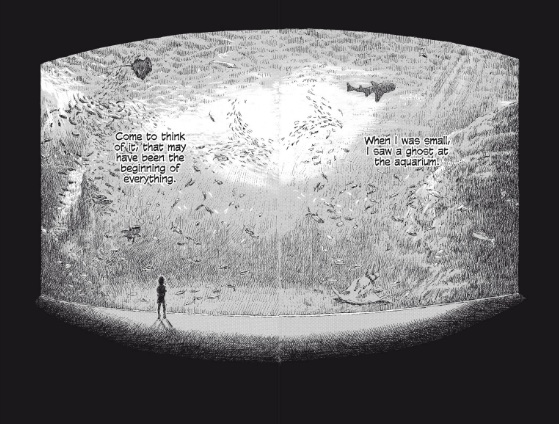
How, exactly, sea and sky are connected is the central mystery of Children of the Sea. The story begins in the present day, as a woman promises to tell her son “about a giant shark that lives deep beneath the waves,” “the ghosts that cross the sea,” and “the path that connects the sea to space.” We then jump back to a defining moment in Ruka’s childhood when, on a visit to the local aquarium, she saw a fish disappear in a bright flash of light – what she describes as “a ghost in the water.” Ruka doesn’t think much of the incident until she meets Umi and Sora, two humans whose bodies are better adapted to life in the ocean than on land. Under the watchful eye of her father and his assistant Jim, the boys live at the aquarium, venturing out into daylight only to visit the hospital and swim in the open ocean. Eager to know more about Umi and Sora, Ruka sets out to sea with them, where she watches the boys swim with a second “ghost in the water”: a luminescent whale shark that leaves a starry wake in its trail.

As Ruka struggles to understand Umi and Sora’s connection to the shark, she begins to realize that a profound change is taking place at sea. Thousands of common fish are disappearing from aquariums around the world; rarely seen deep-water species are washing ashore on Japanese beaches; and dugongs are visiting waters normally too cold for such tropical creatures. What these events mean is not yet clear, though they all seem like manifestations of the same phenomenon.

ruka1

Daisuke Igarashi is a masterful storyteller, liberally mixing genres – the coming-of-age story, the scientific mystery – to create a unique drama that’s eerie and compelling. As fanciful as the story’s details may be, Children of the Sea maintains a firm grip on reality, thanks to its memorable, true-to-life characters. Ruka, in particular, is a fine creation, a strong, independent girl who reacts with her fists instead of her mouth, has trouble making friends, and burns with curiosity about the things she’s seen. Umi and Sora, too, both have distinctive personalities; whatever their role in the story’s eventual denouement, neither are portrayed as innocents or naifs but as smart, worldly, and sometimes prickly individuals who are in a desperate race against time.

Igarashi’s expert storytelling is beautifully complemented by his artwork. He favors a naturalistic style, rendering every element of the layout in his own hand rather than relying on tracings or prefabricated backgrounds. As a result, his pages are visually complex but thoroughly organic; every element of the design feels essential to establishing the story’s location in space and time. His characters are realistic, though their proportions are slightly awkward. Their large heads and big hands make them seem otherworldly and fragile, especially when contrasted with the large, powerful animals they encounter at sea.

If you’re not yet sold on Children of the Sea, I strongly encourage you to visit Viz’s IKKI website, where all eight chapters of volume one are available for free online browsing. Be warned, however, that this poetic, graceful, and thought-provoking story may cast a spell on you, too, making you reflect on the truth of Jacques Cousteau’s comment that “The sea, the great unifier, is man’s only hope. Now, as never before, the old phrase has a literal meaning: we are all in the same boat.”

Review copy provided by VIZ Media, LLC.

CHILDREN OF THE SEA, VOL. 1 • BY DAISUKE IGARASHI • VIZ • 320 pp. • RATING: OLDER TEEN (16+)

Filed Under: Manga, Manga Critic, REVIEWS Tagged With: Seinen, SigIKKI, VIZ

Children of the Sea, Vol. 1

August 5, 2009 by Katherine Dacey

cots1The ocean occupies a special place in the artistic imagination, inspiring a mixture of awe, terror, and fascination. Watson and the Shark, for example, depicts the ocean as the mouth of Hell, a dark void filled with demons and tormented souls, while The Birth of Venus offers a more benign vision of the ocean as a life-giving force. In Children of the Sea, Daisuke Igarashi imagines the ocean as a giant portal between the terrestrial world and deep space, as is suggested by a refrain that echoes throughout volume one:

From the star.
From the stars.
The sea is the mother.
The people are the breasts
Heaven is the playground
.

How, exactly, sea and sky are connected is the central mystery of Children of the Sea. The story begins in the present day, as a woman promises to tell her son “about a giant shark that lives deep beneath the waves,” “the ghosts that cross the sea,” and “the path that connects the sea to space.” We then jump back to a defining moment in Ruka’s childhood when, on a visit to the local aquarium, she saw a fish disappear in a bright flash of light – what she describes as “a ghost in the water.” Ruka doesn’t think much of the incident until she meets Umi and Sora, two humans whose bodies are better adapted to life in the ocean than on land. Under the watchful eye of her father and his assistant Jim, the boys live at the aquarium, venturing out into daylight only to visit the hospital and swim in the open ocean. Eager to know more about Umi and Sora, Ruka sets out to sea with them, where she watches the boys swim with a second “ghost in the water”: a luminescent whale shark that leaves a starry wake in its trail.

…

Read More

Filed Under: Manga Critic Tagged With: Seinen, SigIKKI, VIZ

Click 6-8 by Youngran Lee: B-

August 5, 2009 by Michelle Smith

I’ve decided to absolve myself from the entirely self-imposed edict that I review each volume of a series separately and start offering multi-volume reviews on this site. The final three volumes of Click seemed like an ideal place to start, since it was getting to be challenge coming up with new things to say about each volume when taken individually.

The romantic angst ramps up as we approach the conclusion, with Jinhoo realizing he has feelings for Joonha (and, believing Joonha is male, proceeding to be melodramatic and tortured about it) and Heewon being depressed because of her own pathetic behavior regarding same. (Meanwhile, Taehyun’s family resolves to learn the true gender of the person who has captivated his heart. I hesitate to include that in the angst category, though, since it’s pretty pointless and boring.) One has to wonder why all of these characters are in love with Joonha, since she’s only somewhat less of an ass now than she used to be.

In any case, Joonha seems to feel about equal affection for them all (judging by a conversation with her father at the beginning of the seventh volume) and they all know about each other too, resulting in fisticuffs between Taehyun and Jinhoo at one point. Jinhoo, the presumed favorite, breaks up with his girlfriend, Hyejin (whom he realizes he cares for but has never truly loved), and finally, finally comes out and asks Joonha, “Why does everyone say you’re a girl?” Alas, it’s here where the series takes a turn for the dramatastic, for as Joonha begins to respond to the question, Jinhoo’s phone rings with news that Hyejin’s entire family has been in a car accident. Dun dun dunnnn.

From that point on, the kooky just keeps on coming, with two of the contenders for Joonha’s affection removing themselves from the picture for pretty much unnecessary reasons. The way the two scenes parallel each other is kind of interesting, though, and I finally have some sympathy for (okay, this is a spoiler, but did anyone really think this person would be the one?) Heewon who was feeling like a dupe for ever falling in love, but who now seems to be more at peace with the way things happened. There’s also an entirely random kidnapping that made me laugh out loud, it was so ridiculous.

I’ve seen where some have found the ending of this series to be unsatisfying, and I can see where they’re coming from. My problem’s not with the ultimate pairing, though, but rather with how it was carried out. Like Beauty Pop, instead of actually showing the protagonist confessing her feelings to the person of her choice, the story instead jumps forward in time a few years to a point where they’re a recognized couple already. What a cheat! Plus, they’re not acting much differently than they ever did, and it seems to have taken four years for any kissing to transpire!

Click continues to be a fast read through to the end, and while the endless drama is part of it, the art’s another big factor. The page layouts tend to be pretty simple, with large panels and not a lot of backgrounds to stall the eye. This presents a problem, though, because without any pace-slowing, transitional panels, one can be zipping through a brief scene with Taehyun’s family and suddenly, disconcertingly, turn to a page on which Jinhoo is dramatically announcing that he’s postponing his return trip to New York. It happens fairly often and is jarring each time, like zooming along the interstate then suddenly slamming on the brakes.

Ultimately, I’m glad I read Click. Yes, it could be cheaply manipulative and ridiculous, and no, I didn’t much like any of the characters, but it was a fun ride all the same.

Filed Under: REVIEWS Tagged With: netcomics, Youngran Lee

CSBG NANA Project Continues!

August 5, 2009 by MJ 2 Comments

nana-4Fitting very nicely into my Girls Only Week, part 2 of the Comics Should Be Good NANA Project featuring Danielle Leigh, Michelle Smith, and me is up this morning! In this installment, we discuss NANA volumes three and four, focusing on Nana and Hachi, Hachi and Shoji, and finally addressing some of the less fantastic aspects of the series’ English adaptation.

I mentioned recently on Twitter that I think a good English adaptation has a real sense of place so that the sensibility of the original language comes through for the reader. The early volumes of NANA really fall short in that area, and we talk a bit about why. Perhaps the most surprising aspect of this round of conversation for me, however, is that I found myself actually defending Shoji, which is not something I’d have ever expected, especially considering my strong identification with Hachi.

So head on over and join us in comments! (Or click here for our discussion of volumes one and two if you missed it!) Can’t wait to see you there!

Filed Under: NEWS Tagged With: csbg, manga, nana, nana project

March on Earth, Volumes 1 & 2

August 4, 2009 by MJ 1 Comment

We are now three days in to Girls Only Week here at There it is, Plain as Daylight! Today I review Mikase Hayashi’s March on Earth, a sweet two-volume series about a young teen raising her nephew alone after her older sister’s death. Don’t forget to check out this week’s earlier reviews, for volume six of Peach-Pit’s emotionally rich magical girl series Shugo Chara! and volume two of Yun Kouga’s shonen fantasy series Gestalt!

March on Earth, Vols. 1 & 2
By Mikase Hayashi
Published by CMX

marchonearth1
Buy This Book

When Yuzu’s parents died, it was up to her older sister to take care of her. Now that her sister has been killed in a car crash, only Yuzu is left to care for her sister’s two-year-old son, Shou. Determined to do for her sister’s young son what her sister did for her, Yuzu takes on this responsibility with her whole heart. Fortunately, she’s got a kind landlady with two sons, each of whom dotes on Yuzu and Shou (particularly the older son, Seita, who harbors a not-so-secret crush on Yuzu) so she is far from alone, no matter how bleak things might seem to Yuzu in the loneliness of night. Over the course of the story, Yuzu pieces together a family for herself and Shou, first with the discovery of the man who is Shou’s father and finally including the family who already loves her, regardless of the lack of blood relation. She also faces questions about her own future and whether or not her own dreams can exist alongside her commitment to Shou.

…

Read More

Filed Under: MANGA REVIEWS Tagged With: girls only, manga, march on earth

Gestalt, Volume 2

August 3, 2009 by MJ 1 Comment

Gestalt, Volume 2
By Yun Kouga
Published by Viz Media

gestalt2
Buy This Book

This volume begins on a fairly dramatic note, as Father Olivier is possessed by something clearly unfriendly and very powerful. Ouri manages to drive out the intruder (using a pretty interesting tactic involving an incubus whose usual role is as “the monster that gives you wet dreams”) and the group’s quest continues after a short break in which more background is given about Ouri’s personal mission and how she acquired female form. The real drama of this volume, however, involves fortune-teller Shazan, whose participation in a local tournament (the prize for which is an item needed for the group’s transport) causes his true identity to be revealed. The volume ends with both Ouri and stray elf Suzu facing dangerous foes who also happen to be their siblings.

…

Read More

Filed Under: MANGA REVIEWS Tagged With: gestalt, girls only, manga

PAD Introduces New Guest Reviewer & Girls Only Week!

August 2, 2009 by MJ 7 Comments

First off, I’d like to introduce our new guest reviewer, Megan M! To quote her bio, “Megan M. is a customer service representative for an evil credit card company who lives in Texas. She would be a single English major living alone with a cat if her apartment complex allowed pets, and has compensated for the lack of a cat with far too many books. She has read so much that it has turned her brain and her shelves are overflowing with romance novels, fantasy novels, mystery novels, american comics, and, of course, manga. If one looks closely, one may spot the rare volume of Serious Literature valiantly gasping for air, struggling to survive in the sea of popular fiction. Her fictional preferences for women with weapons and attractive, often roguish, male accessories were firmly established at a very young age due to early exposure to Star Wars and Willow.”

Megan starts things off with a fantastic mini review of CMX’s Genghis Khan: To the Ends of the Earth and Sea. Please give her a warm welcome!

Secondly, today marks the beginning of Girls Only Week, a week-long focus on female mangaka here at There it is, Plain as Daylight. Inspired by the recent controversy over SDCC, the creation of the Women Make Comics t-shirt, and the re-launching of Girlamatic, I’ve decided to spend the entire week featuring works solely by female writers and artists. Something I think is important to point out here, in terms of just how many “women make comics” is that I don’t have to reach to do this. I’m not going back to my shelves and digging through to find female-created manga. I’m just glancing at what’s in my review stack, throwing in a couple of features I’d already planned to do anyway, and there it is, a full week, easy.

Today begins with a review for the most recent volume of one of my favorite shojo series for young girls, Shugo Chara! by female mangaka duo, Peach-Pit. Please note that though the creators may be “girls only,” the manga definitely won’t be. I’ll be covering works in a range of styles and genres this week, so stay tuned!

Filed Under: NEWS Tagged With: girls only, guest reviewers, megan

Shugo Chara! Volume 6

August 2, 2009 by MJ 5 Comments

shugochara6Shugo Chara! Vol. 6
By Peach-Pit
Published by Del Rey

As volume six opens, Kairi is becoming more troubled over his role as Easter’s spy within the Guardians and especially his mission to distribute the “Wishing CD” to students at Seiyo Academy. Rima is struggling as well, both with her parents’ constant fighting and their overprotective behavior, particularly their insistence that she quit the Guardians. It doesn’t take long for either of these issues to be resolved, for better or worse. Meanwhile, Amu faces demons of her own as she finds herself once again forced into battling teen pop idol Utau (still working as a puppet for the evil corporation, Easter) who is now character transforming with Amu’s wayward guardian character, Diamond. Winding up to a final battle involving all the Guardians, Utau, and Ikuto, several new character transformations, and at least one unexpected guest, you’d think that was enough for one volume, but there is yet another surprise in store for Amu by the end.

Let me be perfectly up-front from the beginning. I love Shugo Chara! It is one of my very favorite series for younger girls and a great example of the way a talented team like Peach-Pit can take all the trappings of a standard shojo formula (in this case, the “magical girl” genre) and use it to tell a rich, thoughtful story that successfully explores the dreams and fears of children and adults alike. Its core concept–that all children have a “Heart’s Egg” that holds the potential for their most personal dreams–is honestly adorable, but more than that, it allows the story to delve into questions of desire, ability, hope, hopelessness, insecurity, self-awareness, and even gender identification (yes, really) as the series goes on. Its heroine, Amu, whose outward persona and inward personality are constantly at odds, begins the story by making a heartfelt wish to find “the courage to be reborn as the person I want to be.” Her wish brings her heart’s egg into the world to hatch as a shugo chara (guardian character)–a tiny, human-like representation of her would-be self. Where the story gets brilliant, however, is that Amu ends up giving “birth” to four different guardian characters over the course of these six volumes, representing all the many aspects of who she might be, making it clear that there is no one future self for any of us–but rather a wide array of potential selves, any of whom we may become or destroy, depending on our choices and desires.

This concept looms large in the series’ sixth volume, as Amu finds herself facing her own would-be self in battle. Yes, these mangaka have managed to create a literal fight between their heroine and a single piece of her inner self that is not only clever but actually quite stunning to behold. The children’s “character transformations”–magical incarnations of their would-be selves created by a bonding between them and their guardian characters–are a highlight of the series, and Amu’s transformation here is an enormous step forward for her. In the end, she discovers that believing in herself is what is truly important, even if she doesn’t yet understand who that is.

What draws me so to this aspect of the story’s premise, is that it contradicts the too-common idea that there is just a single destiny possible for any one person and that we must each choose one future for ourselves, no more, no less. Children these days are encouraged to make “permanent” decisions about their lives or careers earlier all the time, which is something I’ve found quite disturbing over the years. As someone who has already experienced several major career shifts in my life and explored many different versions of my would-be self, I suppose I feel akin to Amu, but my feelings about this go far beyond the personal. I really believe it is important to encourage children to acknowledge all their varied potential when they are young, and to make it clear to them that there is always possibility beyond what is right in front of them, even as adults. This series embraces that kind of thinking and that definitely contributes to my affection for it. It also doesn’t hurt that Amu’s would-be selves demonstrate that there is more to any girl than can be portrayed by a single stereotype. Between cheerful, athletic Ran, outspoken, artistic Miki, and girlish, nurturing Su, Amu can’t be placed into any neat shojo category (nor would she ever stand for such a thing) and that’s the kind of message I think young girls need to be getting from their fiction.

Another major theme in this series is cooperation, and that comes strongly into play in this volume as well. Just as Tadase finally achieved his first character transformation (“Platinum Royale”) in volume five, here the two remaining transformation-less Guardians achieve theirs as well, which is not only exciting but also frankly awesome (in the case of Kairi, whose “Samurai Soul” is beyond cool) and surprisingly cute (Yaya’s “Dearest Baby” uses a flock of rubber duckies as a weapon). Though Amu remains the most powerful of the group, as their enemies become more formidable, the children discover quickly that they always fight more effectively if they work as a team. This volume is quite action-heavy, containing at least two major battles. While this means that there is not as much page time given to thoughtful characterization in this volume, these battles are the culmination of all the careful plotting and character development the mangaka put into the first five volumes, and they provide quite a nice payoff. On a quieter note, something I mentioned in my review of volume five was how telling I thought it was that, despite his obvious personal conflict, Kairi was the one boy of the group able to appreciate and admire Amu for who she actually is (rather than who she might be), and this volume offers a major payoff in that area as well. Lastly, look for a subtle hint at the return of a beloved character who has been gone far too long!

As always, the art is a real highlight of this volume. Though this series adheres to the usual sensibilities of shojo for young girls–big eyes, sparkles, flowery backgrounds, and ornate paneling–it is done so cleanly and so well that it’s impossible not to admire it, even as a jaded adult. The style always adjusts to fit the character’s moods as well, as is most evident in an early scene with Rima, which is drawn in an uncharacteristically subdued manner, appropriate to her deep sadness at the time. The final chapter of the volume is honestly stunning, as both Amu and Utau achieve new character transformations, ending with a desolate look at Ikuto’s position that evokes true loneliness.

As this review becomes quite obviously over-long, I think it’s clear that I have a lot to say about this series, and I think my level of admiration probably comes dangerously close to hyperbole. It’s really satisfying, however, to read a series that makes me want to go on and on like this in praise. For those who think manga like Shugo Chara! is kids’ stuff (or perhaps more to the point, “girls’ stuff”) I urge you to set those preconceptions aside and give it a try. This series nicely demonstrates just how emotionally complex and genuinely moving sparkly, girly manga can be.

Filed Under: MANGA REVIEWS Tagged With: girls only, manga, shugo chara!

  • « Go to Previous Page
  • Page 1
  • Page 2
  • Page 3
 | Log in
Copyright © 2010 Manga Bookshelf | Powered by WordPress & the Genesis Framework