Given Volume 1 by Natsuki Kizu
Even before I read this manga, I remember scrolling past something on twitter and seeing the cover. Who is the mildly cranky guitarist? What’s up with the diffident dude with the red guitar? Has there been yaoi manga translated here featuring a rock band since Gravitation? I have no idea, but I was more than ready to check out this series.
Uneoyama is a cranky high school student and guitar player who is quite irked to see another boy passed out holding a guitar in his favorite sleeping spot. Uneoyama is perturbed that the guy is clutching a Gibson with rusted out strings, but the mysterious boy says “Can this be fixed?” with a look of desperation on his face. Uneoyama quickly tunes the guitar, strums a cord, and is promptly asked for guitar lessons. Uneoyama isn’t sure how to teach an absolute novice the guitar, but his newfound companion tags along to band practice and introduces himself as Mafuyu Sato. Mafuyu meets bassist Haruki and drummer Kaji, and continues to be relentless about asking Uneoyama for guitar lessons.
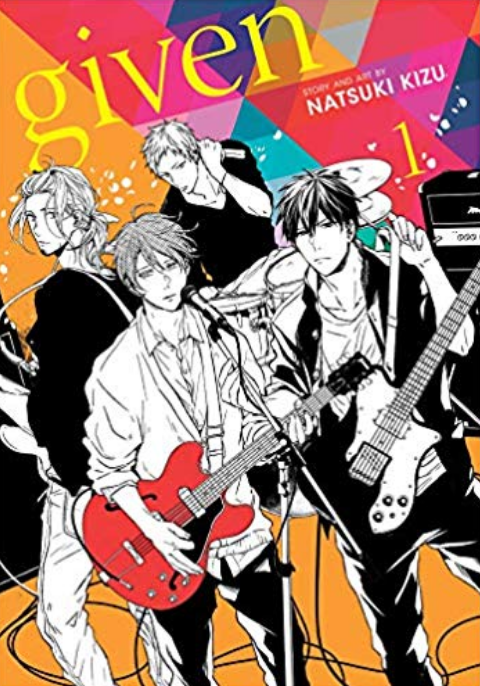
Throughout most of this first volume, Mafuyu is presented as an innocent enigma, but as Uneo gets to know him he begins to discover that Mafuyu’s emotional attachment to the Gibson he can’t play is rooted in a tragic event from his past. Uneoyama’s jaded attitude towards music is gradually changed by Mafuyu’s enthusiasm and he begins to think about his mysterious new friend more and more. Given perfectly executes the “I’m mad at you because you are so pretty” trope that is so enjoyable when done well. The scenes of the band playing music are dynamic, and Uneoyama’s growing feelings are built up in a subtle way even though he’s not yet ready to be honest with himself. Haruki and Kaji also have some cute scenes together, and as older band members spend a bit of time being amused at Uneoyama actually feeling off-kilter due to the fact that he is finally emotionally invested in something. Kizu’s character designs are all distinct and stylish, and I enjoyed the bonus illustrations of all the major characters that showed sketches of facial expressions as well as vital statistics. This was an extremely promising first volume, and I’m expecting this series will continue to entertain with a winning combination of slow burn romance and music.

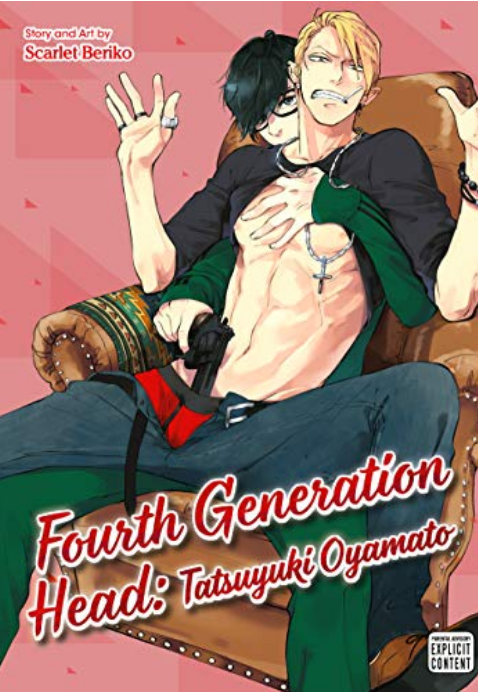
 and
and  ) by Rihito Takarai, published here by SuBLime. From what I understand, the series has reached five volumes (ongoing) in Japan. The third volume is due out from SuBLime next month.
  Shirotani is a lifelong germaphobe, resigned to his condition, though it keeps him isolated from others. Fortunately, with the help of his understanding employer, he is able to tolerate his job as secretary to a corporate CEO. It is in the corporate line of duty, then, that he first meets Kurose, a therapist at a local mental health clinic. Kurose notices Shirotani’s condition immediately, and suggests he seek help, but though Shirotani is able to make his way to the clinic, he can’t bring himself to go inside. Acknowledging this difficulty, Kurose offers to help him in a non-clinical capacity, as a friend, an arrangement to which Shirotani eventually agrees. As Kurose slowly helps him accomplish progressively difficult tasks (touching a doorknob with his bare hand, buying a book from a bookstore), the two become close in ways that complicates their relationship and threatens the fragile boundaries between them.
  MICHELLE: Another thing that strikes me about the questions Kurose poses is how detached and clinical they can seem, even after a sexual act. One example is, “Were you more concerned with the possibility that I found you unpleasant than whether or not you found the situation itself unpleasant?” Leaving aside the tacit admission that he knows Shirotani could’ve been finding the situation unpleasant, attempting to reassert the therapist/patient dynamic at such a moment is, well, kind of creepy.


 As a feminist, yaoi puts me in a difficult position. On the one hand, I love the idea of women creating erotica for other women, of creating a safe and fun space where female readers can explore their sexual fantasies. (I don’t know about you, but Ron Jeremy has never factored into any of mine.) On the other hand, I’m often uncomfortable by the way in which rape is conflated with extreme romantic desire in yaoi; it’s disappointing to see the “you’re so irresistible, I couldn’t help myself!” defense trotted out as a justification for sexual violation. To be sure, the rape-as-love trope abounds in romance novels and mainstream pornography as well, but as a feminist, it makes me just as uncomfortable to encounter it in yaoi as it does to encounter it in an episode of General Hospital. Then, too, there’s the issue of the characters’ homosexuality, which is sometimes trivialized (i.e., they’re not gay, they’re just so good-looking they couldn’t help themselves!), ignored, or “explained” by a character’s tragic past, as if sexual orientation were a simple, situational decision.
 Since childhood, Misao has been cursed with an unlucky gift: the ability to see ghosts and demons. As her sixteenth birthday approaches, however, Misao’s luck begins to change. Isayama, the star of the tennis team, asks her out, and Kyo, a childhood friend, moves into the house next door, pledging to protect Misao from harm. Kyo’s promise is quickly put to the test when Isayama turns out to be a blood-thirsty demon who’s intent on killing — and eating — Misao. Just before Isayama attacks Misao, he tells her that she’s “the bride of prophecy”: drink her blood, and a demon will gain strength; eat her flesh, and he’ll enjoy eternal youth; marry her, and his whole clan will flourish. Kyo rescues Misao, revealing, in the process, that he himself is a tengu (winged demon) who’s also jonesing for her blood. Kyo then offers her a choice: marry him or die. Actually, Kyo is less tactful than that, telling Misao, “You can be eaten, or you can sleep with me and become my bride.”
 Gorgeous Carat caught my eye because it seemed to be a frothy costume drama set in turn-of-the-century Paris, and I’m a sucker for historical fiction. There’s something delicious about seeing another time and place through a sympathetic character’s eyes, trying to imagine what it was like to live during the Napoleonic wars or the Tokugawa era. What’s not so delicious, however, is seeing a contemporary author unconsciously absorb the prejudices of another era and incorporate them into her story.