• Skip to primary navigation
  • Skip to main content
  • Skip to primary sidebar
  • Home
  • About Us
    • Privacy Policy
    • Comment Policy
    • Disclosures & Disclaimers
  • Resources
    • Links, Essays & Articles
    • Fandomology!
    • CLAMP Directory
    • BlogRoll
  • Features & Columns
    • 3 Things Thursday
    • Adventures in the Key of Shoujo
    • Bit & Blips (game reviews)
    • BL BOOKRACK
    • Bookshelf Briefs
    • Bringing the Drama
    • Comic Conversion
    • Fanservice Friday
    • Going Digital
    • It Came From the Sinosphere
    • License This!
    • Magazine no Mori
    • My Week in Manga
    • OFF THE SHELF
    • Not By Manga Alone
    • PICK OF THE WEEK
    • Subtitles & Sensibility
    • Weekly Shonen Jump Recaps
  • Manga Moveable Feast
    • MMF Full Archive
    • Yun Kouga
    • CLAMP
    • Shojo Beat
    • Osamu Tezuka
    • Sailor Moon
    • Fruits Basket
    • Takehiko Inoue
    • Wild Adapter
    • One Piece
    • After School Nightmare
    • Karakuri Odette
    • Paradise Kiss
    • The Color Trilogy
    • To Terra…
    • Sexy Voice & Robo
  • Browse by Author
    • Sean Gaffney
    • Anna Neatrour
    • Michelle Smith
    • Katherine Dacey
    • MJ
    • Brigid Alverson
    • Travis Anderson
    • Phillip Anthony
    • Derek Bown
    • Jaci Dahlvang
    • Angela Eastman
    • Erica Friedman
    • Sara K.
    • Megan Purdy
    • Emily Snodgrass
    • Nancy Thistlethwaite
    • Eva Volin
    • David Welsh
  • MB Blogs
    • A Case Suitable For Treatment
    • Experiments in Manga
    • MangaBlog
    • The Manga Critic
    • Manga Report
    • Soliloquy in Blue
    • Manga Curmudgeon (archive)

Manga Bookshelf

Discussion, Resources, Roundtables, & Reviews

VIZ

Trillion Game, Vol. 1

February 16, 2025 by Katherine Dacey

By all rights, Trillion Game should be a blast. Creators Riichiro Inagaki and Ryoichi Ikegami have more than a dozen hit series to their names—including Eyeshield 21, Dr. Stone, Sanctuary, and Crying Freeman—and a flair for writing shamelessly entertaining stories that burst at the seams with crazed villains, over-the-top plot twists, and jaw-dropping action scenes. Trillion Game, however, is just plain bad, saddled with a premise so dumb I’m almost embarrassed to type it: a young man sets out to be the first Japanese entrepreneur to make a trillion dollars without an actual plan for achieving that goal.

A dumb premise isn’t automatically a deal-killer; executed with panache, a silly idea can still work if the reader feels invested in the main character’s success. Trillion Game, however, has both a dumb premise and an awful lead who is less a person than a teenage male fantasy, a ruthless entrepreneur who weaponizes his charm and good looks to get what he wants. Haru lies, bluffs, and cheats, manifesting new talents—say, bantering in Mandarin or scaling skyscrapers—whenever the plot demands, prompting other characters to gush about his charisma and business acumen. His only redeeming quality is his unwavering loyalty to friend and business partner Gaku, a helmet-haired nerd with computer skills. Even that relationship is fraught, however, as Haru repeatedly puts Gaku into situations that test the limits of his abilities.

The other issue plaguing Trillion Game is its sincerity: we’re supposed to admire Haru’s audacious, go-for-broke style, even when his behavior seems more sociopathic than strategic. No matter what he does, Haru always gets the best of his opponents, especially when they appear to be more logical, experienced, or perceptive than he is. That dynamic is most evident in his interactions with the beautiful, inscrutable Kirika Kokuryū, a.k.a. “Kirihime,” a twenty-six-year-old wunderkind who helps her father run the all-powerful Dragon Bank. Any time she gets the upper hand in her dealings with Haru and Gaku, the authors undercut Kirihime’s authority by dreaming up new ways to humiliate her while suggesting she’s turned on by Haru’s cutthroat tactics.

The only bright spot is Ikegami’s artwork. As he did in series like Samurai Crusader and The Wounded Man, Ikegami populates the story with attractive leads while rendering the supporting players as caricatures, making it easy to keep track of the sprawling cast. The layouts, too, are easy to scan: they’re dynamic and detailed, capturing the density and opulence of Tokyo’s financial district with the same degree of realism as the spartan office that Haru and Gaku rent.

No amount of stylish artwork, though, can disguise the fact that Trillion Game feels like an macho artifact of the 1980s, a Wall Street for the Young Jump reader. I have no doubt that there are folks who will love this series, but I found it impossible to get swept up in Haru’s embrace of greed and deceit, especially when he approvingly cites broligarchs like Mark Zuckerberg and Jeff Bezos as an inspiration. Not recommended.

TRILLION GAME, VOL. 1 • STORY BY RIICHIRO INAGAKI • ART BY RYOICHI IKEGAMI • TRANSLATED BY STEPHEN PAUL • TOUCH-UP & LETTERING BY JOANNA ESTEP • VIZ MEDIA • RATED M FOR MATURE (NUDITY, SEXUAL REFERENCES) • 208 pp.
Filed Under: Manga, Manga Critic, REVIEWS Tagged With: Riichiro Inagaki, Ryoichi Ikegami, Seinen, VIZ, VIZ Signature

Neighborhood Story Vol. 1 By Ai Yazawa

January 28, 2024 by Anna N

Neighborhood Story Volume 1 by Ai Yazawa

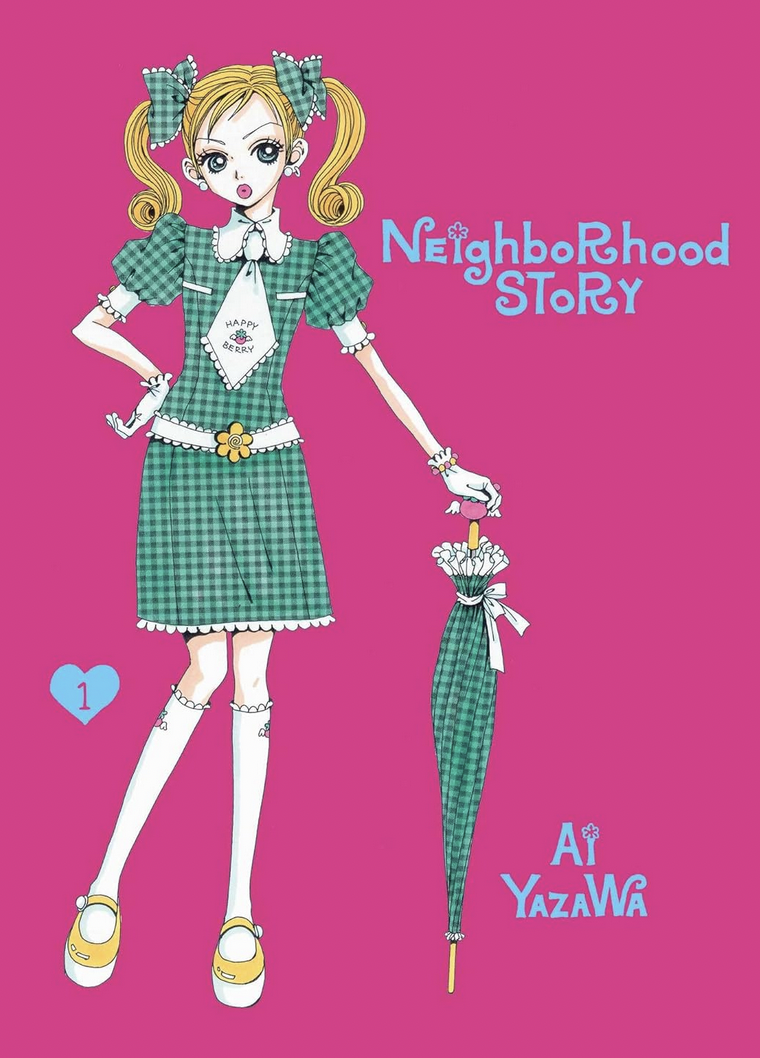
Neighborhood Story is a manga I’ve been aware of for a long time, because the characters drop in on Ai Yazawa’s Paradise Kiss, but I never thought it would actually be translated into English! I’m glad that Viz has licensed this shoujo classic. Mikako is an aspiring fashion designer who has a ton of personality packed into her tiny body. Tsutomo is the boy next door. They’ve been constant childhood companions, and many of their surrounding family and friends seem to expect that they’ll end up together.

Neighborhood Story Volume 1

Mikako is a little suspicious about Tsutomo’s inadvertent womanizing ways, as his similarity to a pop idol causes him to be fascinating to random girls. Tsutomo wonders if he and Mikako are so close that they aren’t ever really going to experience life without some time apart. They seem obviously perfect for each other and yet sometimes oblivious to their own emotions in ways that are utterly realistic for teenagers experiencing the first stirrings of something that might be love. Mikako is a force to be reckoned with, and as their extended group of friends start gathering together to pursue their creative dreams, I’m looking forward to experiencing again that combination of love story and artistic ambition that Ai Yazawa writes so well.

While the art isn’t as polished as Yazawa’s later series, her spindly characters and their fashion forward style contribute to the creative community that surrounds and supports Mikako and Tsutomo. Reading Neighborhood Story feels nostalgic in the best way, and I’m glad I finally have a chance to experience it.

Filed Under: Manga Reviews, REVIEWS Tagged With: neighborhood story, shojo beat, shoujo, VIZ

The Best and Worst Manga of 2023

January 9, 2024 by Katherine Dacey

This weekend’s Nor’easter provided me a swell opportunity to finish my long-gestating Best and Worst Manga list for 2023. One of the things that tripped me up was the sheer volume of new work published last year; when I first started reviewing manga in 2006, it was hard to imagine a market that offered a title for every conceivable reader, from the Chainsaw Man enthusiast to the the romantic, the oenophile, the foodie, the soccer fan, the gore hound, the isekai buff, and even the middle-aged manga critic. Though I made a concerted effort to be as thorough as possible, I freely admit that my picks barely capture the sheer quantity and diversity of last year’s new releases. Instead, I focused on the titles that stayed with me weeks and months after I first read them, from the exuberant One Hundred Tales to the unnerving The Summer Hikaru Died. For additional perspective on 2023’s best and worst manga, I encourage you to check out the well curated lists at Anime News Network, Anime UK News, Asian Movie Pulse, The Beat, The Comics Journal, From Cover to Cover, Okazu, and The School Library Journal.

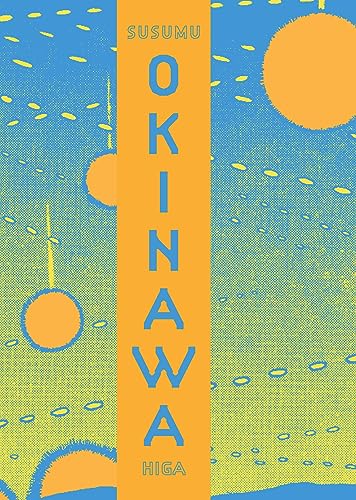
Best New Manga: Okinawa
Story and Art by Susumu Higa • Translated by Jocelyne Allen • Lettering by Patrick Crotty and Kayla E. • Fantagraphics
There are books that critics like, and books that readers like. I’d put Okinawa squarely in the first category, as it has all the hallmarks of a Serious Manga™: slightly naïve artwork, historically important events seen through the eyes of ordinary people, and detailed footnotes explaining the story’s cultural and linguistic nuances. If I sound a little cynical, I was; I put off reading Okinawa for months after its release because so many reviewers rehearsed the same talking points about how “harrowing,” “heartbreaking,” “complex,” and “haunting” it was. After reading Okinawa, however, I have to admit the critics were right: Okinawa is a deeply moving exploration of the island’s fraught relationship with Japan and the United States. It’s also a tribute to Susumu Higa’s parents, whose memories of World War II pervade many of Okinawa’s most affecting stories; a celebration of Okinawan resilience and spirituality; and the best manga I read in 2023.

Best New Drama: River’s Edge“Story and Art by Kyoko Okazaki • Translated by Alexa Frank • Vertical Comics
River’s Edge offers a gritty portrait of adolescence before chat rooms, cell phones, and social media, focusing on the slackers and misfits at a Tokyo high school. Haruna Wakakusa, the protagonist, is caught between her fierce sense of justice and her ambivalent feelings towards her on-again, off-again boyfriend Kannonzaki, a horny, hot-headed loser who bullies weaker classmates. Over the course of the story, Haruna forges an unlikely friendship with one of Kannonzaki’s targets, an aloof young man whose popularity with the girls belies his true sexual orientation. Okazaki’s spare, stylish linework is ideally suited to the material, as the character’s exaggerated facial features and ungainly proportions remind the reader of how confusing, weird, and uncomfortable it is to be on the physical cusp of adulthood. Okazaki also nails the casual cruelty and cluelessness of adolescence: her characters’ impulsiveness, selfishness, and inexperience often compel them to betray each other in small (and big) ways that feel true to life even when the plot teeters on the brink of melodrama.

Best Classic Title: One Hundred Tales
Story and Art by Osamu Tezuka • Translated by Iyasu Adair Nagata • Lettering by Aidan Clarke • ABLAZE
Over the course of his long career, Osamu Tezuka published three series based on the legend of Doctor Faustus, among them One Hundred Tales (1971), which ran in Weekly Shonen Jump. Tezuka takes a few liberties with the original story: his hero is not a brilliant scholar in search of knowledge but a lowly samurai who’s been sentenced to death for his employer’s misdeeds. In a fit of desperation, he sells his soul to a witch and is reborn as Fuwa Usuto, a dashing young man who wants two things: love and power. What follows is a rowdy picaresque, as Fuwo ventures into the lair of an alluring demon, saves his daughter from an arranged marriage, and insinuates himself into the house of a foolish daimyo in his quest to become more worldly and powerful. These episodes provide Tezuka ample opportunity to insert pop-cultural sight gags—Christopher Lee and Astro Boy both make fleeting appearances—but they also showcase Tezuka’s flair for character design and panel structure; the artwork is fluid and playful, equally suited to moments of exquisite silliness and heartbreaking sadness as Fuwo stumbles towards transcendence.

Best New Horror Series: The Summer Hikaru Died
Story and Art by Mokumokuren • Translated by Ajani Oloye • Lettering by Abigail Blackman • Yen Press
The Summer Hikaru Died begins with a familiar scene: two high school buddies are clowning around outside a convenience store, trading good-natured barbs. But something’s off, and midway through a seemingly ordinary conversation Yoshiki realizes that he’s talking to an impostor who’s the spitting image of his friend Hikaru. Though the mystery of what happened to the real Hikaru is resolved quickly, many questions remain: is it possible for Yoshiki to befriend “Hikaru” even though he has no real memories of their relationship? And what, exactly, is “Hikaru”? Mokumokuren resists the temptation to provide simple answers, relying instead on suggestion to create a tense, atmospheric story that skillfully blends elements of body horror, BL, and fantasy in a fresh, unsettling way.

Best New Cat Manga: Nights With a Cat
Story and Art by Kyuryu Z • Translated by Stephen Paul • Lettering by Lys Blakesly • Yen Press
Though there are dozens of great pet manga now available in English, Nights with a Cat has something genuinely new to offer: simple, observational storytelling that doesn’t shamelessly tug on the heartstrings or anthropomorphize our furry companions. The series explores the relationship between Fuuta and Kyuruga, his roommate’s cat. As someone who’s never lived with a cat before, Fuuta is fascinated by Kyuruga, marveling at Kyuruga’s anatomy—his pupils, his sandpaper tongue, his retractable claws—as well as Kyuruga’s ability to silently materialize in surprising places. Kyuryu Z doesn’t play these moments for laughs, choosing instead to emphasize how strange and amazing cats really are with illustrations that capture the fluidity of Kyuruga’s movements and the changeability of his moods. Recommended for new and long-time cat owners alike. (Reviewed at Manga Bookshelf on 5/21/23)

Best Ongoing Series: Go With the Clouds, North by Northwest
Story and Art by Irie Aki • Translated by David Musto • Vertical Comics
After a two-year wait, a new installment of Go With the Clouds, North by Northwest arrived in stores this fall, demonstrating once again why this odd, delightful, and occasionally thrilling story deserves a bigger audience. Strictly speaking, Go With the Clouds is a murder mystery, but Aki Irie refuses to observe the basic tenets of the genre, frequently interrupting her story for interesting diversions: a fitful romance between supporting characters, a brief lesson on Icelandic geography, a casual conversation between Kei, the main protagonist, and his trusty jeep. What prevents the story from being twee or mannered is its matter-of-fact tone. In the first chapter of volume six, for example, Kei uses ESP to track a kidnapping victim through the streets of Reykjavik by chatting up parked cars around the city, a goofy gambit that works thanks to Irie’s superb pacing and commitment to character development; Kei’s methodical approach suggests that his ESP is something he uses on an everyday basis, not something that manifests per the plot’s demands. Swoon-worthy art and twisty plotting add to the series’ considerable appeal. (Volumes one and two reviewed at The Manga Critic on 8/30/19).

Most Disappointing New Series: #DRCL: Midnight Children
Story and Art by Shin’ichi Sakamoto • Based on Bram’s Stoker’s Dracula • Translation Caleb Cook • Touch-Up & Lettering by Brandon Hull • VIZ Media
Let’s face it: Bram Stoker’s Dracula sucks, marred by turgid prose and a convoluted form. In the hands of other creators, however, Stoker’s ideas have thrilled, titillated, and shocked six generations of horror buffs. The introduction to #DRCL: Midnight Children suggests that Shin’ichi Sakamoto might be one of those creators, as he offers the reader a claustrophobic, suspenseful riff on Dracula‘s most famous chapter, “The Voyage of the Demeter.” The rest of volume one, by contrast, is a fever dream of short, incoherent scenes that bump up against each other like commuters on a rush-hour train. Anyone familiar with Stoker’s original novel will recognize the characters’ names but wonder why Sakamoto re-imagined Renfield as a nun who’s chained up in a dormitory room or Mina Murray as a short, scrappy redhead who’s an expert wrestler. (Also: a dead ringer for Anne of Green Gables.) It’s a pity that the story is so fragmented and overripe, as Sakamoto has a fertile imagination; the first volume is filled with hauntingly beautiful renditions of Dracula himself that instill a sense of awe and fear that’s missing from the rest of the story.

Filed Under: Manga, Manga Critic, Recommended Reading, REVIEWS Tagged With: ABLAZE, Aki Irie, Bad Manga, BEST MANGA, Cats, fantagraphics, Kyoko Okazaki, Mokumokuren, Osamu Tezuka, Shin'ichi Sakamoto, Susumu Higa, Vertical Comics, VIZ, yen press

YashaHime: Princess Half-Demon, Vols. 1-2

June 27, 2023 by Katherine Dacey

YashaHime: Princess Half-Demon epitomizes what I dislike most about IP-driven entertainment. It’s a manga adaptation of an anime sequel to a popular series, made with little involvement from the original author. Though the scriptwriters have created new characters and plot lines for the sequel, YashaHime feels more like the product of a focus group than an organic continuation of the story.

Like InuYasha, YashaHime begins in present-day Tokyo, where one of Sesshomaru’s twin daughters is living with the Higurashi clan. There are a few hints that Towa is troubled—she’s bounced from school to school, never really fitting in with her peers—but she valiantly tries to be a normal teenager. The sudden appearance of a demon at the Higurashi’s shrine sets the plot in motion, whisking Towa back to the feudal era and reuniting her with Setsuna, her fraternal twin, and Moroha, her cousin. Once back in her own time period, Towa joins Setsuna and Moroha on a quest to locate a set of “mystical pearls” and solve the mystery of what happened to their families.

There’s real potential in building a sequel around Sesshomaru and InuYasha’s daughters, but the authors skimp on meaningful character development. Setsuna, for example, is stoic and surly like Sesshomaru, while Moroha is boastful and loud like InuYasha; only Towa feels like a fully realized character. Towa is depicted as a shojo prince, decked out in a white pants suit and cropped haircut that lend her an aura of gender-bending cool—a point reinforced in the early chapters of volume one, when Towa is showered with notes from adoring female classmates. Beneath her cool exterior, however, Towa is haunted by the gaps in her memory, as she struggles to fit in with her adoptive family.

The other big drawback to YashaHime is that the authors lack Rumiko Takahashi’s gift for imaginative, economical storytelling. They shamelessly mine the original series for ideas, staging several action sequences that recall the earliest chapters of InuYasha. (Remember the three-eyed crows? Or the centipede demon who kidnapped Kagome? They’re back for another turn in the spotlight.) In between the demon-wrangling and the unfunny sight gags, the authors fall back on long-winded conversations to reveal how the three girls were separated from their parents, over-explaining everything to such a degree that the story groans under the weight of expository dialogue.

About the best I can say for YashaHime is that Takashi Shiina has done an admirable job of capturing the charm of InuYasha‘s character designs while making them look a little more up-to-date. Though Shiina’s linework is more angular than Rumiko Takahashi’s, the characters strongly resemble Takahashi’s original creations. All three leads have features that recall their famous fathers—Setsuna’s fluff is a particularly nice touch—while the human characters from InuYasha have aged in a naturalistic fashion. The demons, too, are drawn with care; Myoga, Jaken, and Kirara are all immediately recognizable.

I wish I enjoyed this series more, as I’ve been an InuYasha fan for almost twenty years. Part of the reason I loved the original series was that it felt like a real work of imagination, with odd flourishes of horror and genuine moments of pathos. YashaHime, by contrast, is so beholden to Takahashi’s original text that it never takes the kind of creative risks that would elevate it beyond the level of corporate doujinshi. There’s nothing as deeply unsettling as the sight of Naraku’s flesh bubbling in a cauldron, or as poignant as Kikyo and InuYasha’s final conversation; everything has a warmed-over quality, even when Shiina and Katsuyuki Sumisawa’s script explores new ground. Not recommended.

YASHAHIME: PRINCESS HALF-DEMON, VOLS. 1-2 • STORY AND ART BY TAKASHI SHIINA, MAIN CHARACTER DESIGN BY RUMIKO TAKAHASHI, SCRIPT COOPERATION BY KATSUYUKI SUMISAWA • TRANSLATED BY JUNKO GODA • ADAPTED BY SHAENON K. GARRITY • LETTERING BY JAMES GAUBATZ • VIZ MEDIA • 200 pp. • RATED TEEN (Fantasy violence, horror)

Filed Under: Manga, REVIEWS Tagged With: Fantasy, Horror/Supernatural, inuyasha, Rumiko Takahashi, shonen sunday, VIZ, YashaHime

Insomniacs After School, Vol. 1

April 6, 2023 by Katherine Dacey

First published in 1911, Frances Hodgson Burnett’s The Secret Garden has beguiled millions of readers with its portrait of Mary and Colin, two sickly children who heal themselves by finding a forgotten space and bringing it back to life. Burnett’s story is very much a product of the Edwardian era, steeped in colonialism and patriarchy, but the core plot—in which the children discover their own agency, and create their own sanctuary—seems as relevant in 2023 as it did over a century ago.

Insomniacs After School steals a page or two from The Secret Garden, shifting the action from a British manor to a Tokyo high school where Nakami, a grumpy, uptight boy, and Magari, a goofy, spontaneous girl, are struggling with insomnia. The two meet cute when Nakami stumbles over Magari sleeping on the floor of the school’s long-abandoned observatory. After commiserating about their difficulty falling asleep, Nakami and Magari hatch a plan to transform the observatory into a clubhouse where they can hang out or sneak in a much-needed midday nap. They scavenge furniture, hang curtains, and welcome a neighborhood cat into their space, in the process uncovering the telescope left behind by the now-defunct astronomy club and, of course, becoming friends.

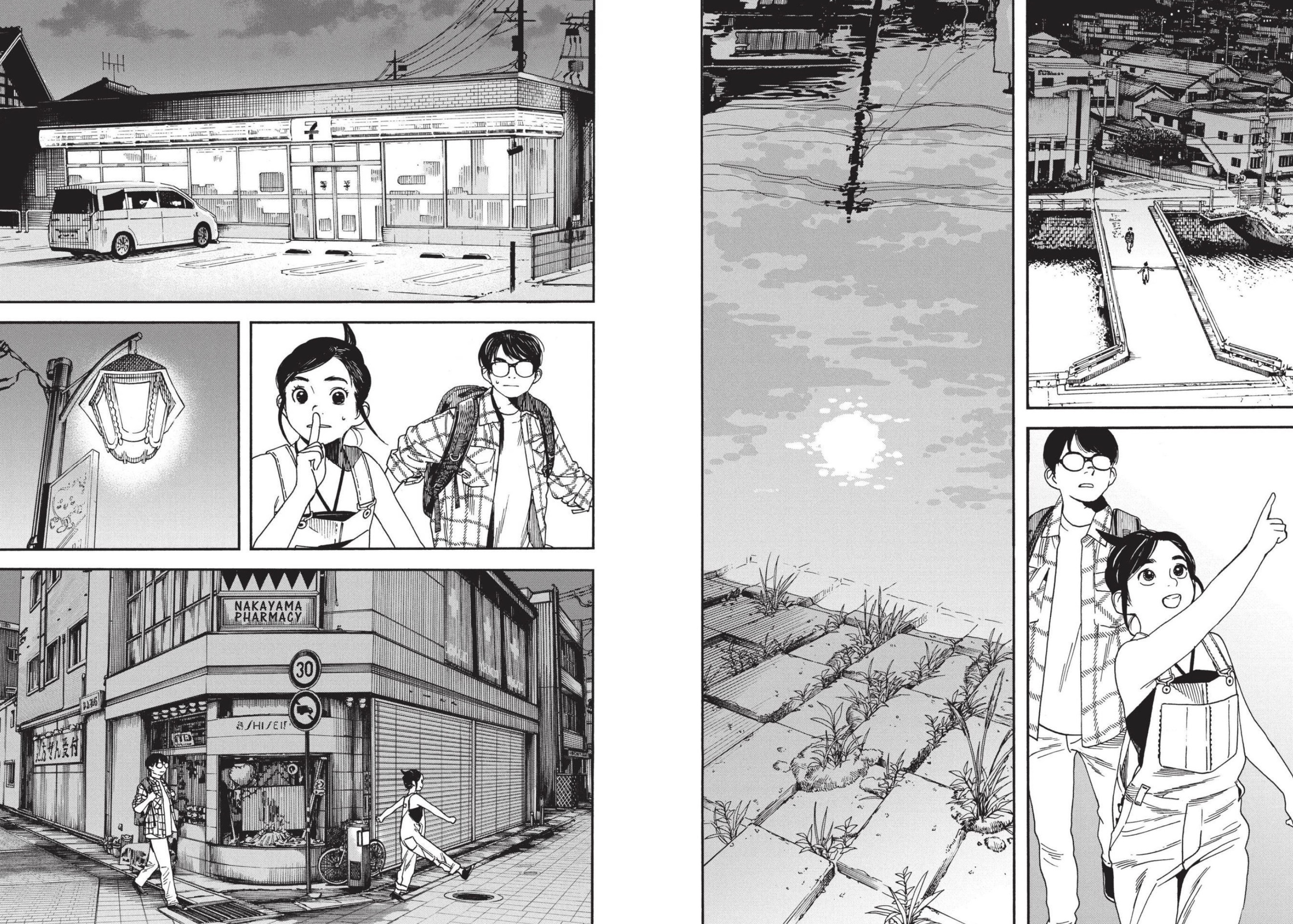
As delightful as these early scenes are, the best sequence in volume one documents their first outing as members of the “Enjoy-the-Night Club.” Nakami and Magari sneak out of their homes and into the city, meandering through empty neighborhoods, dodging a night patrolman, posing for photographs, and gazing out over the harbor as the first glimmers of dawn form on the horizon. Though there are a few lines of dialogue sprinkled throughout the chapter, most of Nakami and Magari’s adventure unfolds in companionable silence, allowing us to appreciate the stillness of early morning, and their thrill at being the only ones to witness the sunrise:

One of the strengths of Insomniacs After School is Ojiro’s low-key approach to character development. Ojiro isn’t in a hurry to reveal too much about his characters, fleshing out their backstories in an organic fashion through snippets of conversation and brief glimpses into their home lives. Nakami’s dad, for example, seems troubled, though it’s not clear from context what might be wrong, while Magari reveals she suffered from a serious childhood illness that made her frail. Neither teen wants their parents to know the full extent of their exhaustion, however, so they don’t seek help from the adults; as Magari declares, “When I was sick as a kid, I really hated how everyone worried about me. That’s why I keep my insomnia a secret.”

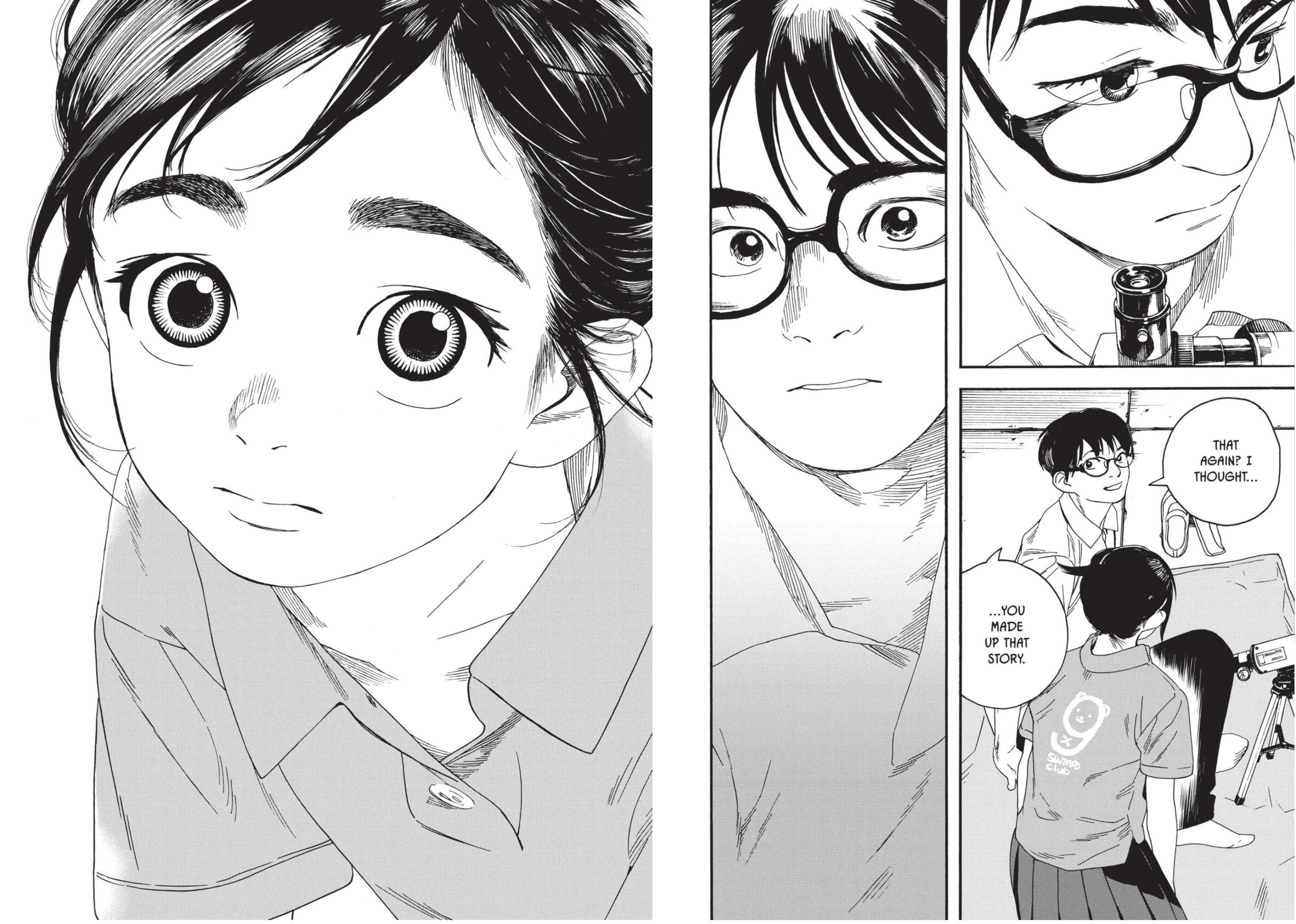
Another strength is the clean, expressive artwork. Ojiro’s facial close-ups and fresh use of perspective give us a sense of the characters’ eagerness for connection as well as their vulnerability and inexperience. In this sequence, for example, we see what happens when Nakami’s simple, matter-of-fact statement lands differently than expected:

The shift in perspective neatly underscores Nakami’s confusion: one minute he felt at ease with Magari, and the next he’s puzzled by her reaction, a note of trepidation registering on his face. Ojiro resists the temptation to verbalize what his characters are thinking, instead letting the reader feel his characters’ discomfort as Nakami’s comment hangs in the air.

Ojiro’s knack for capturing these small but emotionally charged moments lends Insomniacs After School a realism that will appeal teen readers; it’s a quiet, carefully observed portrait of two kids who are navigating the space between friendship and romance, with all the confusion and excitement that entails. Other readers—especially those of us with vivid memories of The Secret Garden—will find Insomniacs a warm reminder that bringing light and life to a neglected place can heal the heart, no matter how old you are. Highly recommended.

INSOMNIACS AFTER SCHOOL, VOL. 1 • BY MAKOTO OJIRO • TRANSLATED BY ANDRIA CHENG • TOUCH-UP & LETTERING BY INORI FUKUDA TRANT • VIZ MEDIA • RATED T (FOR TEENS)

Filed Under: Manga, Manga Critic, Recommended Reading, REVIEWS Tagged With: Romance/Romantic Comedy, VIZ

The Manga Review, 11/18/22

November 18, 2022 by Katherine Dacey 1 Comment

Last week, ICv2 publisher Milton Griepp sat down for a lengthy conversation with Dark Horse Comics’ CEO Mike Richardson. The two discussed the company’s history–particularly its early investment in manga–as well as current trends in graphic novel sales. Among Richardson’s most interesting revelations was that a significant portion of Dark Horse’s business is happening outside of comic book stores. “85% of our sales are found in traditional bookstores,” he notes. “We’ve been told by PRH (Penguin Random House) that we consistently outsell Marvel and DC in bookstores and it’s bookstores that have pushed Dark Horse sales over nine figures.” Richardson also expressed his frustration with the media’s tendency to report Diamond Distributor figures as an accurate indicator of comic book sales. “Last I checked, we had sold almost five million copies of Berserk,” he notes. “Yes, that’s what I said, and we have a number of books that have sold seven figures.  None of them are included in the Diamond market share because we don’t distribute our books through Diamond.”

NEWS AND VIEWS

Jocelyne Allen explains the appeal of Asada Nemui’s Sleeping Dead, a new entry in the growing sub-genre of zombie BL. “I honestly love every page of this,” she notes. “There’s really not a wasted panel, and while I’m not one hundred percent on board with the explanation for the zombie effect, I am here for the actual zombie action. The developing relationship between mad scientist and zombie is fascinating, especially with the bumps in the road as they each discover things about themselves, and I seriously can’t wait to see how this story resolves in the second volume, which came out only recently.” [Brain vs. Book]

VIZ has just added a new Shonen Jump title to its line-up: The Ichinose Family’s Deadly Sins. The story focuses on a middle-school student who’s reunited with his family after an accident wipes his memory. The catch? His family seems to harboring some big secrets from him! The first chapter is available online. [VIZ]

On the fifteenth anniversary of its original publication, Kara Dennison revisits the first volume of Takashi Okazaki’s Afro-Samurai. [Otaku USA]

Congratulations to SKJAM! Reviews for ten years of thoughtful manga, movie, television, and book reviews; that’s a milestone worth celebrating! [SKJAM! Reviews]

Morgana Santilli leads a spirited roundtable discussion of three shojo titles: MARS, Midnight Secretary, and Ouran High School Host Club. [Manga Machinations]

In the latest installment of Multiversity Manga Club, Walt Richardson, Emily Myers, and Zach Wilkerson recap chapters 956-981 of One Piece. [Multiversity Manga Club]

ICYMI: Hagai Palevsky deconstructs Yuichi Yokoyama’s Plaza. “Such a project is perfect for Yokoyama, as a cartoonist who is interested in the temporality and kinesis of comics and completely uninterested in narrative components such as emotion and character development,” Palevsky observes. “It is elevated by his careful balance between the overall simplicity of lines and the density of objects: he does not bother with overwrought rendering, making do with economic recognizability of objects and putting most of his efforts into a ‘clutter’ both tangible and sensory. There is a lot going on in every single panel, but there is always an order to it, a clarity that rearranges the space in the eyes of the cooperative reader.” [Solrad]

REVIEWS

Over at Okazu, Erica Friedman explains how you should read Tatsuki Fujimoto’s Look Back. “Read it slowly. Pay attention to the details,” she advises. “It’s a slim volume, and not terribly complicated in terms of concept. In fact, I’d call this a very typical ‘the second story a manga artist does after their series goes mega-hit and they need to write about creating manga’ manga. But it is loaded to the gills with feels.” Also worth a look: Sarah offers a frank (and fair!) assessment of The Poe Clan‘s second volume, while Bradathon Nu critiques Tatsuki Fujimoto’s newest one-shot Just Listen to the Song. On the capsule review front, Masha Zhdanova looks at three new VIZ titles, while the gang at Beneath the Tangles offer short-n-sweet assessments of Rooster Fighter, The Remarried Empress, and Tower of God.

  • Aria the Masterpiece, Vol. 4 (HWR, Anime UK News)
  • Avant-Garde Yumeko (Demelza, Anime UK News)
  • The Beginning After the End, Vol. 1 (Sara Smith, The Graphic Library)
  • Call of the Night, Vol. 9 (King Baby Duck, Boston Bastard Brigade)
  • The Fiancée Chosen By the Ring, Vol. 2 (Krystallina, The OASG)
  • A Galaxy Next Door, Vol. 3 (Josh Piedra, The Outerhaven)
  • Getter Robo Devolution (Megan D., The Manga Report)
  • The Hunter’s Guild: Red Hood, Vol. 1 (Sara Smith, The Graphic Library)
  • Josee, The Tiger and the Fish (Harry, Honey’s Anime)
  • Kaiju Girl Carmelise, Vol. 6 (Krystallina, The OASG)
  • Kubo Won’t Let Me Be Invisible, Vol. 4 (Josh Piedra, The Outerhaven)
  • Magu-chan: God of Destruction, Vol. 5 (King Baby Duck, Boston Bastard Brigade)
  • Nana & Kaoru, Vol. 1 (Jean-Karlo Lemus, Anime News Network)
  • A Sign of Affection, Vol. 3 (Sara Smith, The Graphic Library)
  • SHOKU-KING, Vols. 1-5 (Krystallina, Daiyamanga)
  • The Summer You Were There, Vol. 1 (Eleanor W., Okazu)
  • Wandance, Vol. 2 (Sarah, Anime UK News)
  • Watamote, Vol. 20 (Josh Piedra, The Outerhaven)

Filed Under: FEATURES, Manga Review Tagged With: Dark Horse, Manga Sales Analysis, shojo, Shonen Jump, VIZ

The Manga Review, 8/19/22

August 19, 2022 by Katherine Dacey Leave a Comment

Attention manga shoppers! Kodansha is currently holding a blow-out sale on digital manga. And when I say “blow out,” I mean it: they’re offering deep discounts on over 3,000 titles, with first volumes priced as low as 99 cents, and later volumes discounted 50%. It’s a great opportunity to try a buzz-worthy series such as Blue Period, Boys Run the Riot, Knight of the Ice, PTSD Radio, or Witch Hat Atelier; to catch up on long-running favorites; or to check out classic titles such as Black Jack and Princess Knight. Don’t wait, though; the sale ends on Monday, August 22nd.

MANGA NEWS

The July NPD Bookscan Numbers are in, with My Hero Academia, Spy x Family, and Kaiju No. 8 topping the list. Also making a strong showing on this month’s bestseller list are Demon Slayer: Kimetsu no Yaiba and Chainsaw Man. [ICv2]

Have you completed this month’s Seven Seas Reader Survey? If not, don’t miss your opportunity to make licensing requests and give feedback on new and upcoming releases. [Seven Seas]

Coming soon to the Azuki platform: Red Riding Hood’s Apprentice: Final Testament to the Moon (Glacier Bay Books) and Doomsday Cleaning (Star Fruit Books). [Azuki]

Job alert: VIZ Media is currently looking for a Copy Editor. [VIZ Media]

Help Erica Friedman celebrate the 20th anniversary of Okazu by participating in a treasure hunt! The winner will receive a t-shirt of their choice from the Yuricon store. [Okazu]

And speaking of Erica Friedman, she and Rica Takashima (Rica ‘tte Kanji?!) will both be guests at Flame Con this weekend. [Anime News Network]

Blood on the Tracks, Blue Period, and Cat + Gamer are among the titles competing for Best Manga at this year’s Harvey Awards. Also making the cut are Chainsaw Man, Red Flowers, and Spy x Family. [ICv2]

Cartoon Crossroad Columbus (CXC) announced that manga scholar Frederik L. Schodt will be the recipient of the second annual Tom Spurgeon Award, which “honors those who have made substantial contributions to the field of comics, but are not primarily cartoonists.” Schodt is author of three books: Manga! Manga! The World of Japanese Comics (1983), Dreamland Japan: Writings on Modern Manga (1996), and The Astro Boy Essays: Osamu Tezuka, Mighty Atom, and the Manga/Anime Revolution (2007). In addition, he has translated a number of manga into English, including Osamu Tezuka’s Astro Boy and Henry Yoshitaka Kiyama’s The Four Immigrants Manga. [CXC 2022]

FEATURES, PODCASTS AND INTERVIEWS

If you’re a parent, teacher, or librarian in search of STEM-friendly comics, look no further than this helpful list compiled by the experts at No Flying No Tights. [No Flying No Tights]

Brigid Alverson posts a brief but thoughtful tribute to illustrator Sho Murase, who passed away earlier this month. [ICv2]

It’s Witch Week at Mangasplaining! Join the crew for lively discussions of Witch Hat Atelier, Witchcraft Works, and Witches, then stay for the bonus discussions of Fuyumi Soryo’s MARS and Yayoi Ogawa’s You’re My Pet (originally published in English as Tramps Like Us). [Mangasplaining]

The latest Manga Machinations podcast focuses on Yokohama Kaidashi Kikou as well as two manga/Marvel crossovers: Wolverine: SNIKT! and Secret Reverse. [Manga Machinations]

What did David and Jordan think of Monster Hunter Orage? Tune in to the latest Shonen Flop episode for their thoughts on Hiro Mashima’s other battle manga. [Shonen Flop]

ICYMI: Ashley and Loyola Rankin dissect the first eight volumes of Love*Com (Lovely Complex). [Shojo & Tell]

In honor of Sailor Moon‘s thirtieth anniversary, Christopher Chiu-Tabet revisits the first eight issues of Codename: Sailor V. [Multiversity Comics]

Jocelyne Allen flips through the pages of Keiko Takemiya’s Kokuhaku. “The takeaway for this volume… is pure vibes,” she notes. “The seven stories in the  collection technically have plots, but these tales are mostly about the feels. Because the stories themselves inspire questions like ‘how?’ and ‘why is this happening?’, and the smaller details of what is going on aren’t really relevant. Takemiya is using science fiction to dig deep into psyches and emotions and relationships because this is shojo before it’s SF, and shojo demands feels.” Someone license this, please! [Brain vs. Book]

Elias Rosner interviews Ryan Holmberg about translating Yamada Murasaki’s Talk to My Back. [Multiversity Comics]

Over at TCJ, John Holt and Chikuma Teppei  translate Natsume Fusanosuke’s essay “The Transgenerational Manga Sazae-san and Its Meaning.” In their preface, Holt and Teppei attribute the enduring cultural appeal of Hasegawa Machiko’s series to its long-running anime adaptation. “Like The Simpsons, the animated Sazae-san has been a fixture of Japanese television for decades,” they observe, “but unlike Matt Groening’s creation, Sazae-san has been a wholesome staple of family life, still operating by the terms of 1950s and 1960s culture in new episodes today. Therefore, although it lacks a Simpsons-level criticality, Sazae-san is still a mirror of society. As Natsume argues, the manga and anime create a kind of touchstone to what was good about Japan in the late 20th century. In this way, Sazae-san not only entertains, but also it curates a way of life that may be now remote or even alien to the lived experience of contemporary viewers in Japan.” [The Comics Journal]

REVIEWS

Scott Cederlund reflects on the radical empathy of Gengoroh Tagame’s Our Colors, while Eric Alex Cline explains why he won’t be picking up volume two of Rooster Fighter. “Whether one finds the series worth following will largely depend on if they share its ridiculous sense of humor, and if they’re willing to overlook incredibly blatant bigotry in character design,” Cline observes. “The major con is that some of the monster designs are lackluster, and the last one in particular tanks the fun vibes with a sudden veer into blatant transphobia.” You’ll also find new capsule reviews at Women Write About Comics, where Masha Zhdanova looks at three new VIZ titles, and right here at Manga Bookshelf, where Sean Gaffney, Michelle Smith, and I tackle Rooster Fighter, Shadow House, and Wandance.

New and Noteworthy

  • The Abandoned Empress, Vols. 1-2 (Noemi10, Anime UK News)
  • Bleach: 20th Anniversary Edition, Vol. 1 (Tony Yao, Drop-In to Manga)
  • Blue Lock, Vol. 1 (Renee Scott, Good Comics for Kids)
  • Box of Light, Vol. 1 (Rebecca Silverman, Anime News Network)
  • Dandadan, Vol. 1 (Brett Michael Orr, Honey’s Anime)
  • The Elusive Samurai, Vol. 1 (King Baby Duck, Boston Bastard Brigade)
  • GAME: Between the Suits, Vol. 1 (Rebecca Silverman, Anime News Network)
  • I Am a Cat Barista, Vol. 1 (Johanna Draper Carlson, Comics Worth Reading)
  • Kowloon Generic Romance, Vol. 1 (Sarah, Anime UK News)
  • Lost Lad London, Vol. 1 (Johanna Draper Carlson, Comics Worth Reading)
  • New York, New York, Vol. 1 (Al, Al’s Manga Blog)
  • The Other World’s Books Depend on the Bean Counter, Vol. 1 (Sarah, Anime UK News)
  • Pretty Guardian Sailor Moon: Naoko Takeuchi Collection, Vol. 1 (SKJAM, SKJAM! Reviews)
  • Romantic Killer, Vol. 1 (Brett Michael Orr, Honey’s Anime)
  • Talk to My Back (Lindsay Pereira, Broken Frontier)
  • To Strip the Flesh (Seth Smith, Women Write About Comics]
  • The Town of Pigs (Danica Davidson, Otaku USA)
  • Vampeerz, Vol. 1 (Danica Davidson, Otaku USA)
  • Why Raeliana Ended Up at the Duke’s Mansion, Vol. 1 (Noemi10, Anime UK News)
  • The Wolf Never Sleeps, Vol. 1 (Rebecca Silverman, Anime News Network)

Ongoing and Complete Series

  • Beastars, Vols. 18-19 (King Baby Duck, Boston Bastard Brigade)
  • Beauty and the Feast, Vols. 2-3 (Rebecca Silverman, Anime News Network)
  • Can’t Stop Cursing You, Vols. 2-3 (Demelza, Anime UK News)
  • Cheeky Brat, Vol. 3 (Krystallina and Justin, The OASG)
  • Cherry Magic! Thirty Years of Virginity Can Make You a Wizard?!, Vol. 3 (Johanna Draper Carlson, Comics Worth Reading)
  • Daytime Shooting Star, Vol. 11 (Jaime, Yuri Stargirl)
  • Deadpool: Samurai, Vol. 2 (King Baby Duck, Boston Bastard Brigade)
  • Fly Me to the Moon, Vol. 12 (Josh Piedra, The Outerhaven)
  • Magu-chan: God of Destruction, Vol. 4 (King Baby Duck, Boston Bastard Brigade)
  • Minami Nanami Wants to Shine, Vol. 2 (Demelza, Anime UK News)
  • My Hero Academia: Vigilantes, Vol. 12 (King Baby Duck, Boston Bastard Brigade)
  • My Love Mix-Up!, Vol. 4 (Rebecca Silverman, Anime News Network)
  • Rebel Sword (Megan D., The Manga Test Drive)
  • Superwomen in Love: Honey Trap and Rapid Rabbit, Vol. 4 (Erica Friedman, Okazu)
  • Whisper Me a Love Song, Vol. 5 (Erica Friedman, Okazu)
  • Witch Hat Atelier, Vols. 8-9 (Sarah, Anime UK News)
  • Witch Hat Atelier, Vol. 9 (Helen and Justin, The OASG)

Filed Under: FEATURES Tagged With: Azuki, Frederik L. Schodt, Gengoroh Tagame, Harvey Awards, Hiro Mashima, Kodansha Comics, Manga Industry Jobs, Okazu, Rica Takashima, sailor moon, Sazae-chan, Sho Murase, VIZ, yuri

Ima Koi: Now I’m in Love, Vols 1 and 2

July 19, 2022 by Anna N

Ima Koi: Now I’m in Love Volumes 1 and 2 by Ayuko Hatta

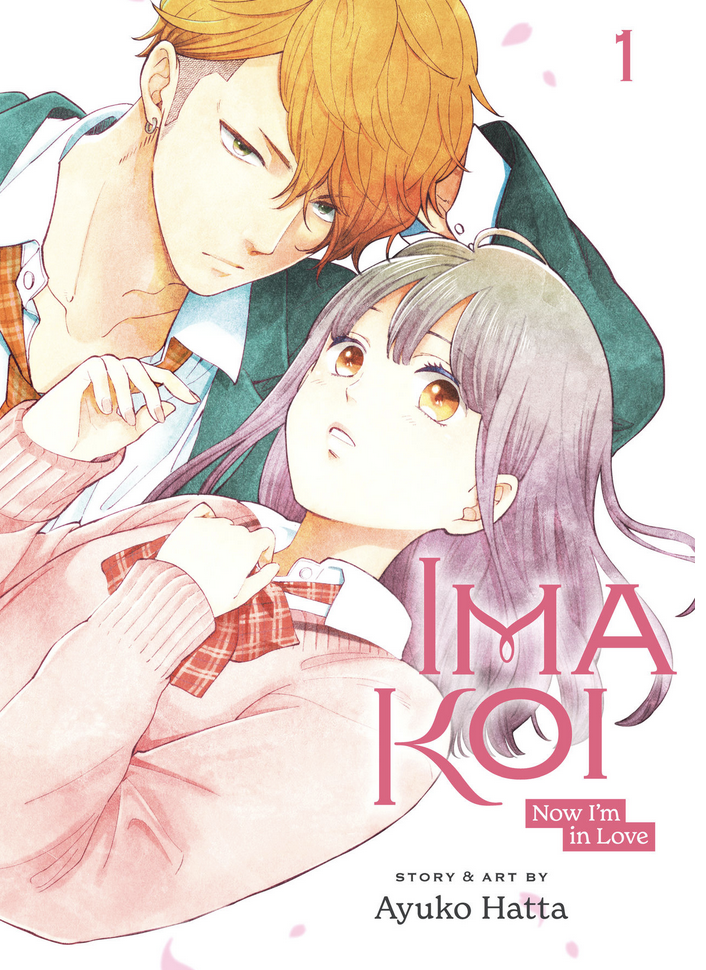
In today’s stressful times, reading determinedly uncomplicated romance can be quite soothing, which is why I’m enjoying the angst free and sometimes silly series Ima Koi. Satomi was too shy to confess her feelings to a crush in middle school, so she’s determined to be different in high school and seize her next chance for love. When stoic, incredibly tall Yagyu saves her from a train groper and she finds out that he goes to her school she follows through on her vow and asks him out. He says yes, and thus their romance begins.

Ima Koi

Satomi is cute, with her quick entry into dating she’s fulfilled her main goal, but she’s still figuring out what to do now that she’s in a relationship. Yagyu is a bit more enigmatic, but he’s won over by Satomi’s forthright nature and her tendency to fling herself on top of him from the subway stairs. He’s interested in getting to know her, and they soon start dating. They deal with complications that beset any new couple as Satomi has to navigate around Yagyu’s suspicious best friend and his obsessed younger sister. While this manga doesn’t reach the hilarity of My Love Story!! there are plenty of funny situations, such as when Yagyu and Satomi go on a date to the zoo and his younger sister Juri tags along. Juri becomes more and more enraged as Satomi keeps not reacting to her attempts to undermine the date, until she transforms into a menacing side character from JoJo’s Bizarre Adventure. Ima Koi is a fun escape, and the way most issues get resolved by the end of every volume makes for a relaxing shoujo series.

Filed Under: Manga Reviews, REVIEWS Tagged With: ima koi, shojo beat, shoujo, VIZ

The Manga Review, 7/1/22

July 1, 2022 by Katherine Dacey Leave a Comment

Good news: The United Workers of Seven Seas (UW7S) achieved a major victory this week when the company agreed to recognize their union. Though management has not yet spoken to the press, the UW7S Twitter feed posted the following statement on June 24th: “This decision by Seven Seas eliminates the need for an NLRB conducted election and will pave the way for a more expedited path to bargaining a first contract. At a time when many employers continue to fight the unionization of their employees, we appreciate that Seven Seas decided to respect the voices of the majority of staff and recognize us. We look forward to developing a mutually beneficial relationship and reaching a collective bargaining agreement in the near future.” The path to a better contract and better working conditions, however, is a long one. As OASG contributor Krystallina notes, “Bloomberg Law estimates the average length of time for initial negotiations to be 409 days — in other words, 1 year, 1 month, and 2 weeks. One analyst says there’s only about a 50-50 chance of reaching an agreement in a year, with additional estimates calculating it will take about a year and a half.”

NEWS

After 247 chapters, Yuki Suegetsu will bring Chihayafuru to an end. The series, which has been running in Be Love since 2007, proved so popular with Japanese readers that it spawned three live-action films and three anime series. [Anime News Network]

Looking for a manga industry job? VIZ is currently advertising four positions in its publishing division: Copy Editor, Editor, Editor of Original Graphic Novels, and Publishing Production Assistant. [VIZ]

The American comics market is booming, according to industry experts Milton Griepp and John Jackson Miller. They report that “total comics and graphic novel sales to consumers in the U.S. and Canada were approximately $2.075 billion, a 62% increase over sales in 2020.” Comics performed well at many types of retail outlets as well. As Griepp observes, “Sales through comic stores were up 60% vs. last year and 34% vs. 2019; sales through the book channel, including book fairs (which were back in operation) grew at a blistering 81% pace. Digital growth, while slower, was coming off a gangbuster year in 2020 during the shutdowns.” [ICv2]

FEATURES, INTERVIEWS, AND PODCASTS

As Pride Month comes to a close, Okazu reader Meru explains how reading yuri manga played an important role in their decision to come out as transgender. “When I look at Yuri, I see myself: I see the soft butches that could, in another series, be they/them or even they/he,” they note. “I see bodies and ideals and identities that mirror myself. I feel less alone. I feel natural in a country that would rather me turn my back on playing at soft masculinity and gender ambivalence in exchange for kitten heels, a lack of body hair, and legs crossed at the ankle. When I crack open a volume of Yuri and see tomboys and boyish girls and girls straddling the lines of socially acceptable gender and being themselves.” [Okazu]

If you’re a fan of Daytime Shooting star, Deb Aoki thinks you might like Mika Yamamori’s latest series, In the Clear Moonlit Dusk. [Mangasplaining]

On the newest installment of Manga Mavericks, Colton and Lum check in with ongoing series Haikyu!! and Magu-Chan!, and look at new offerings from VIZ, Manga Plus, and Azuki. [Manga Mavericks]

The Manga Machinations crew discuss three series that explore different facets of the LBGTQ experience: New York, New York; Catch These Hands!; and I Want to Be a Wall. [Manga Machinations]

Kory, Helen, and Apryll dedicate the latest Manga In Your Ears podcast to My Solo Exchange Diary and Yuri Is My Job! [Taiiku Podcast]

Paul Semel and Anne Ishii interview Gengoroh Tagame about Our Colours, a coming-of-age story that centers on a queer teen artist. “It’s something I’d wanted to read as a middle and high schooler myself, so decided to write for my own self,” Tagame explains. As I’m now in my 50s, I think of it as a gift to myself 40 years ago.” [Paul Semel]

Also of interest: Cayla Coates talks to Okura about I Think Our Son Is Gay, a gentle comedy about a woman who begins questioning her son’s sexual orientation. “I’ve always felt that gay people in manga and drama are often portrayed as either comic relief or someone with struggles and hardship.,” Okura observes. “I wanted to draw what I consider to be natural, ordinary gay people.” [Crunchyroll]

REVIEWS

Erica Friedman delves into the latest installment of Even Though We’re Adults, singling out the translation and lettering for special praise. “Jocelyne Allen’s translation is outstanding, in providing the nuance and ‘adultness’ this series needs,” she notes, while the “lettering and retouch by Rina Mapa lets’ me feel in the story in exactly the same way as I do when I’m reading the Japanese.” Meanwhile, Megan D. explores the forgotten corners of Tokyopop’s BL catalog with a look at Innocent Bird, “a limp, shallow romance… illustrated with an indifferent and murky hand,” and Christopher Chiu-Tabet continues his retrospective on Sailor Moon with a look at issues 15-20.

  • Cat + Gamer, Vol. 1 (A.M. Ziebruh, Bloom Reviews)
  • Chainsaw Man, Vols. 10-11 (King Baby Duck, Boston Bastard Brigade)
  • Death Note: Short Stories (Harry, Honey’s Anime)
  • The Elusive Samurai, Vol. 1 (Lesley Aeschliman, Lesley’s Anime and Manga Corner)
  • Fangirl, Vol. 2 (Johanna Draper Carlson, Comics Worth Reading)
  • Hikaru in the Light!, Vol. 1 (Bill Curtis, Yatta-Tachi)
  • Kubo Won’t Let Me Be Invisible, Vol. 2 (Lesley Aeschliman, Lesley’s Anime and Manga Corner)
  • Love After World Domination, Vol. 4 (Justin, The OASG)
  • Magical Artisan Dahlia Wilts No More, Vol. 1 (A.M. Ziebruh, Bloom Reviews)
  • Our Colours (Ron, Game-News24)
  • Sensei’s Pious Lie, Vol. 1 (Joh Piedra, The Outerhaven)
  • Sex Ed 120%, Vol. 3 (Justin, The OASG)
  • Shortcake Cake, Vol. 1 (Kaley Connell, Yatta-Tachi)
  • To Strip the Flesh (Brianna Lawrence, The Mary Sue)
  • To Strip the Flesh (Lesley Aeschliman, Lesley’s Anime and Manga Corner)
  • Uncle From Another World, Vols. 1-2 (Helen, The OASG)
  • Until I Meet My Husband (Danica Davidson, Otaku USA)
  • Welcome Back, Alice, Vol. 1 (Danica Davidson, Otaku USA)
  • Whisper Me a Love Song, Vols. 1-4 (Anson Leung, Broken Frontier)
  • With a Dog AND a Cat, Every Day Is Fun, Vols. 3-4 (Krystallina, The OASG)
  • With You and the Rain, Vols. 1-2 (Justin, The OASG)
  • Yashahime: Princess Half-Demon, Vol. 1 (Renee Scott, Good Comics for Kids)
  • Yuri Espoir, Vol. 1 (Rebecca Silverman, Anime News Network)

Filed Under: FEATURES Tagged With: Gengoroh Tagame, LGBTQ Manga, Manga Industry Jobs, Manga Sales Analysis, Mika Yamamori, Seven Seas, UW7S, VIZ, yuri

The Manga Review, 5/20/22

May 20, 2022 by Katherine Dacey Leave a Comment

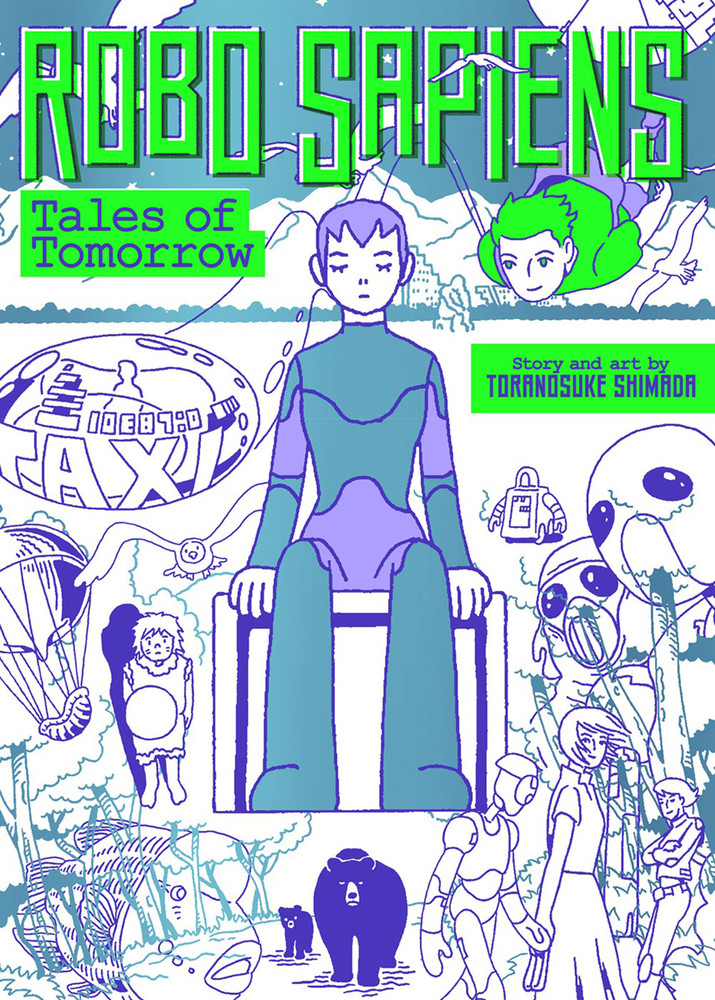
This year’s Eisner nominations have just been announced. In the Best U.S. Edition of International Material—Asia category, VIZ Media garnered five of the six nominations with crowd-pleasers such as Chainsaw Man and Spy x Family, while Seven Seas nabbed one for Robo Sapiens: Tales of Tomorrow. The only other manga nominated for an Eisner was Zom 100: Bucket List of the Dead, which is competing in the Best Humor Publication category. Also nominated for an Eisner is Eike Exner’s Comics and the Origins of Manga: A Revisionist History, which was published by Rutgers University Press last year.

MANGA NEWS

Big news from Seven Seas! The company has just launched two imprints: Seven Seas BL, which will publish works in the BL/Boys’ Love genre, and Seven Seas GL, which will publish works in the GL/Girls’ Love (yuri) genre. [Seven Seas]

The final chapter in Wataru Hinekure’s My Love Mix-Up! will run in the June issue of Bessatsu Margaret. [Anime News Network]

Brigid Alverson previews three new shonen titles that debut in July. [ICv2]

Over at Book Riot, Carina Pereira highlights eight of the summer’s most anticipated graphic novels. [Book Riot]

How do librarians respond book challenges in their communities? Shawn, Megan, and Tayla offer a variety of helpful strategies for handling complaints about graphic novels, from setting clear policies about who can bring a formal complaint to using peer-reviewed sites to demonstrate that your collection is, in fact, age-appropriate. [No Flying, No Tights]

FEATURES AND INTERVIEWS

Looking for a good read? The crack team at ANN have just posted their Spring 2022 Manga Guide. Look for daily updates through the end of this week. [Anime News Network]

Tony explores the complex friendship between Kaguya Shinomiya and Ai Hayasaka in Kaguya-sama: Love Is War. [Drop-In to Manga]

On the latest Manga Mavericks podcast, host Siddharth Gupta convenes a roundtable discussion about Yona of the Dawn with panelists from Anime Feminist, But Why Tho?!, and Good Friends Anime Club. [Manga Mavericks]

Geremy and Kevin round up the latest Shonen Jump chapters, then turn their attention to volume thirteen of Haikyu!! [Jump Start Weekly]

Why did Nobuhiro Watsuki’s Gun Blaze West get the axe after just three volumes? David and Jordan investigate. [Shonen Flop]

Did you know that Tokyopop’s Warriors fandom is still going strong after fifteen years? Patrick Kuklinksi shines a light on the fan-made comics that explore “parts of the books that weren’t detailed in canon,” re-write controversial storylines, and introduce original characters. [SOLRAD]

Megan D. jumps in the WABAC machine for a look at Rumiko Takashi’s Rumic Theater, a collection of short stories that VIZ published more than twenty-five years ago. “What caught my notice about this anthology is that they all feature something you don’t see a lot of in American manga releases: adult women,” she observes. “Every lead character is either a currently married woman (be they with or without children) or one who was married in the past.  A lot of their stories are small-scale, focused on their homes and their immediate community of friends and family. True to Takahashi fashion, though, they are also often comical”.” [The Manga Test Drive]

REVIEWS

Are you following Al’s Manga Blog? If not, you should: this review-focused website has been publishing insightful, crisply written essays since 2016. Al’s latest offerings include in-depth reviews of The Music of Marie, a new title by Usamaru Furuya (Short Cuts, Genkaku Picasso); Island in a Puddle, a thriller by Kei Sanabe (Erased); and Sakamoto Days, a new Shonen Jump series by Yutu Suzuki.

Also of note: ANN’s Caitlin Moore draws on her own experiences with ADHD in a thoughtful review of My Brain is Different: Stories of ADHD and Other Developmental Disorders, while Masha Zhdanova posts capsule reviews of three new VIZ titles.

  • All-Out!! (Krystallina, Daiyamanga)
  • All-Rounder Meguru (Krystallina, Daiyamanga)
  • Awkward Silence (Megan D. The Manga Test Drive)
  • Boys Run the Riot, Vol. 1 (Seth Smith, Women Write About Comics)
  • Devil Ecstasy, Vol. 1 (Demelza, Anime UK News)
  • Fly Me to the Moon, Vol. 11 (Josh Piedra, The Outerhaven)
  • A Galaxy Next Door, Vol. 1 (Brett Michael Orr, Honey’s Anime)
  • Giant Spider & Me: A Post-Apocalyptic Tale (Megan D., The Manga Test Drive)
  • Golden Japanesque: A Splendid Yokohama Romance, Vol. 5 (Krystallina, The OASG)
  • The Haunted Bookstore, Vol. 1 (SKJAM, SKJAM! Reviews)
  • Island in a Puddle, Vol. 1 (King Baby Duck, Boston Bastard Brigade)
  • Jujutsu Kaisen, Vols. 14-15 (King Baby Duck, Boston Bastard Brigade)
  • Kubo Won’t Let Me Be Invisible, Vol. 1 (Josh Piedra, The Outerhaven)
  • The Music of Marie (darkstorm, Anime UK News)
  • My Androgynous Boyfriend (Megan D., The Manga Test Drive)
  • The Poe Clan, Vol. 1 (Eric Alex Cline, AiPT!)
  • Record of Ragnarok, Vol. 1 (Danica Davidson, Otaku USA)
  • Rent-A-(Really Shy!)-Girlfriend, Vol. 2 (Demelza, Anime UK News)
  • Sakamoto Days, Vol. 1 (Renee Scott, Good Comics for Kids)
  • Seaside Stranger, Vol. 2: Harukaze no Étranger (Kate Sánchez, But Why Tho?!)
  • Sensei’s Pious Lie, Vol. 1 (Sarah, Anime UK News)
  • Short Sunzen (Megan D. The Manga Test Drive)
  • Stravaganza (Megan D., The Manga Test Drive)
  • To Strip the Flesh (Quinn, But Why Tho?!)
  • Wind Breaker, Vol. 1 (Brett Michael Orr, Honey’s Anime)

Filed Under: FEATURES Tagged With: BL, censorship, Eisner Awards, Rumiko Takahashi, Seven Seas, Shonen Jump, Tokyopop, VIZ, yuri

Sakamoto Days, Vol. 1

May 19, 2022 by Katherine Dacey

The opening pages of Sakamoto Days unfold with ruthless efficiency: in just a handful of panels, author Yuto Suzuki shows us how twenty-two-year-old Taro Sakamoto, once Japan’s most “feared and revered” hit man, became Mr. Sakamoto, twenty-seven-year-old husband, father, and shopkeeper. Though Sakamoto seems content being the neighborhood jack-of-all-trades, his former associates view him as a potential threat, dispatching renown assassin Shin the Clairvoyant to kill him. Shin appears to have the upper hand in this contest—he’s younger, fitter, and, as his name suggests, telepathic—but Sakamoto quickly subdues Shin with a bag of cough drops and a well-timed kick, leaving Shin gasping for breath—and, oddly, eager to join forces with his old rival.

This initial encounter highlights Suzuki’s strengths and weaknesses as a storyteller. In the plus column is Suzuki’s ability to stage a great sight gag, as evidenced by Sakamoto’s MacGuyver-esque ability to transform ordinary objects into powerful weapons. Suzuki also makes the most of Sakamoto’s sangfroid; no matter how chaotic the scene or ridiculous his opponent, Sakamoto never betrays a hint of emotion, making him an excellent foil for the chatty Shin. In the minus column is Suzuki’s fixation with Sakamoto’s weight. Other characters routinely comment on how “out of shape” Sakamoto is, and express surprise at his speed and agility—Shin, for example, initially dismisses Sakamoto as a threat because “he’s gone all tubby now.” One or two comments in this vein are enough to subvert the idea that a skilled assassin needs to be fit to be lethal, but this “joke” is repeated almost every time Sakamoto mixes it up with a new bad guy. 

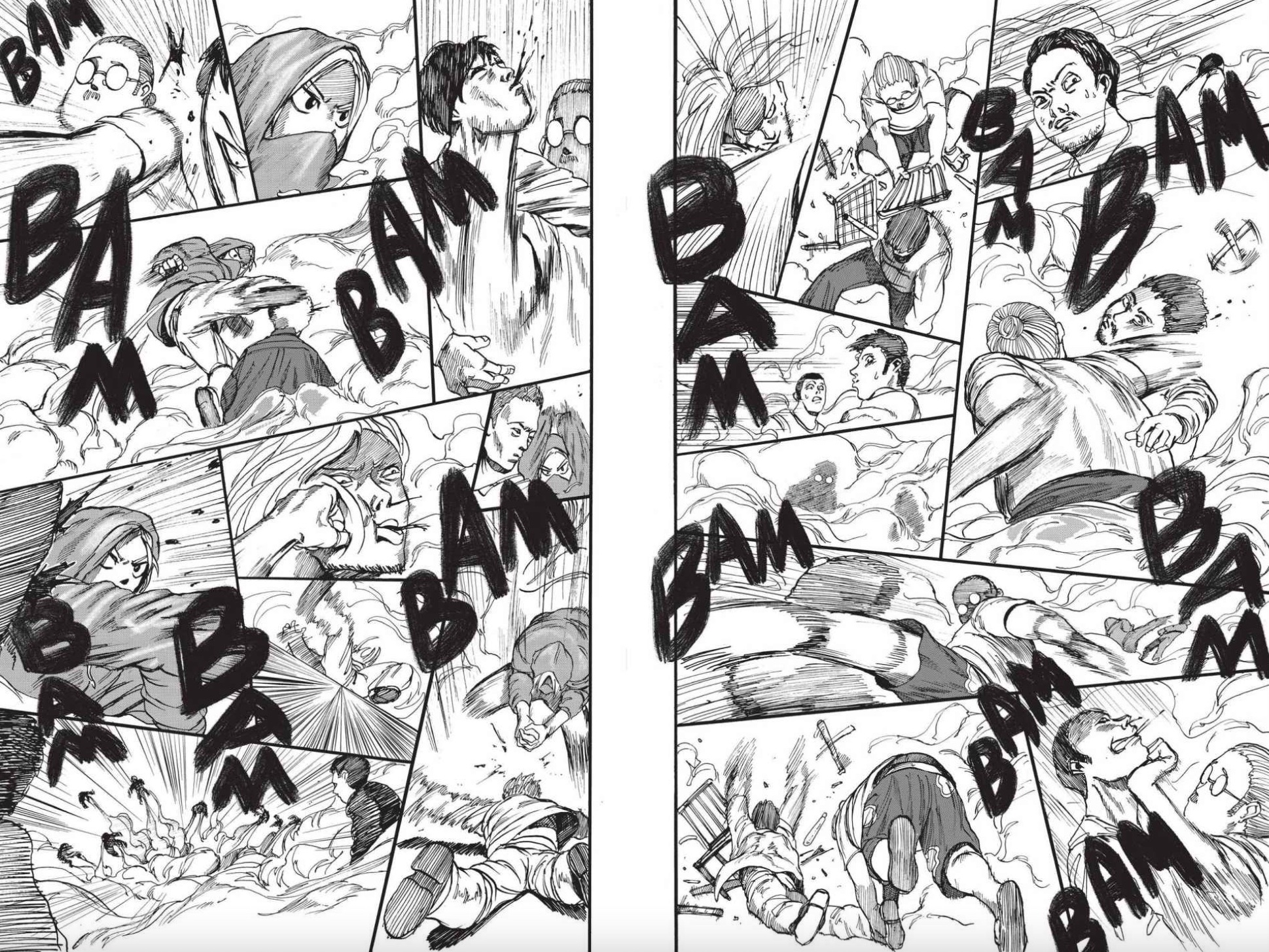
Art-wise, Suzuki’s style is pleasingly organic, relying more on linework than screentone to create depth and volume. Suzuki compliments this approach with an imaginative use of perspective and panel shape that suggests the controlled frenzy of Sakamoto’s attacks. In chapter three, for example, Shin and Sakamoto attempt to rescue Officer Nakase, a newly-minted cop who’s been kidnapped by a motorcycle gang. Sakamoto uses a smoke bomb to surprise his opponents, then unleashes a series of kicks, body slams, and upper cuts to overwhelm the gang members:


Suzuki presents the fight in a kaleidoscopic fashion, using panels of varying shapes and sizes to show how Sakamoto takes advantage of the smoke screen to dispatch his enemies, using the poor visibility to bob and weave his way to victory. The density of the images allows Suzuki to compress the action into just a few pages, creating a reading experience that puts the viewer in the middle of the action, watching the fight unfold in something approximating real time—a welcome antidote the bloated, multi-chapter fights scenes characteristic of so many Shonen Jump titles.

If some of the later chapters aren’t as tightly executed as the first, Sakamoto Days nonetheless achieves a good balance between character development and karate-chopping, affording us enough insight into Shin and Sakamoto’s personalities to make their Laurel and Hardy dynamic amusing. Recommended.

SAKAMOTO DAYS, VOL. 1 • ART AND STORY BY YUTO SUZUKI • TRANSLATED BY CAMILLA NIEH • LETTERING BY EVE GRANDT AND SNIR AHARON • VIZ MEDIA • RATED TEEN PLUS (VIOLENCE AND GORE) • 196 pp.

Filed Under: Manga, REVIEWS Tagged With: Comedy, Shonen Jump, VIZ

My Love Mix-Up! Vol 1

October 16, 2021 by Anna N

My Love Mix-Up Volume 1 by Wataru Hinekure and Aruko

I was curious about My Love Mix-Up since I’m always up for a new shoujo series and Aruko illustrated the astoundingly good My Love Story!!. While this new series doesn’t have the innate hilarity of My Love Story!!, it is a light, warm-hearted unconventional love triangle with protagonists who are all kind to each other.

Aoki has a long-term crush on Hashimoto, the girl who sits next to him in class. On a fateful day he borrows her eraser and sees the name of another boy, Ida, with a heart symbol next to it. When Aoki drops the eraser and Ida picks it up, Ida assumes that Aoki has a crush on him. Aoki plays along with this assumption because he doesn’t want to reveal Hashimoto’s secret. Ida’s reaction to all of this is thoughtful consideration. Ida’s never dated anyone before, so he doesn’t immediately reject Aoki, even though Aoki is encouraging him to! As Aoki gets to know Ida better he starts realizing what a cool guy Ida is. While there is less opportunity for Aruko to engage in the more broad caricature work of My Love Story!!, there are a few great scenes where Aoki looks like a haunted zombie due to the depths of his teenage embarrassment about the confounding situation that he finds himself in.

There’s a similar sort of love triangle in Blue Flag, and My Love-Mix! up looks like it is going to cover the same territory but without the emotional depth. I don’t think that every series needs to have that degree of pathos, sometimes a relatively angst free love triangle is the perfect diversion. There’s a cliffhanger at the end that promises plenty of more romantic mix-ups ahead.

Filed Under: Manga Reviews, REVIEWS Tagged With: my love mix-up!, shojo beat, shoujo, VIZ

Prince Freya Vol. 1

September 24, 2021 by Phillip Anthony Leave a Comment

Like a well-listened to lullaby, I find myself in front of the keyboard with a manga volume beside me. And so, the song starts again. Fitting that I chose a story set in a fairy-tale world to return with.

Prince Freya is neither a Western style fable nor a Japanese high-fantasy adventure. Rather, it has elements of traditional fairy-tale stories in the Germanic-Franco style. I bet you didn’t know that in the original version, Cinderella’s sisters were beautiful but wretched and doves sent by Cinderella’s dead mother pecked their eyes out? Yeah, brutal. Well, the same kind of logic applies in Prince Freya. Freya, a young girl living with her ailing mother in a village in the Kingdom of Tyr. Nearby Sigurd is threatening to gobble up Tyr. So, secretly, her childhood adoptive brothers come back to the village to make sure a plan in Tyr’s capital doesn’t come to fruition. See, Tyr’s plan is to use Freya to sub in for Prince Edward, the ruler of Tyr. Edward is dying from poison and needs someone to pretend to be him to save the kingdom. So we’ve got elements of Prince and the Pauper, Grimm’s Fairy Tales, and a few that I’ve forgotten the name of.

Freya herself is a big crybaby, borne from her constant, unstated, fear that the people she loves will be taken from her. So when Aaron and Alek, her brothers, have to go back to the castle empty handed, she overhears a plot by Sigurd’s officers to kill Aaron as payment for Tyr’s resistance. She volunteers to Edward to take his place, in one hell of a Faustian pact: she becomes the prince, even with her crippling emotional state, but even in saving those she cares for, some of her happiness is destroyed. I found the bulk of the first volume to deal with the unseen threats that she did not foresee: palace intrigue, people who follow the prince’s every orders being thrown off by “his” abrupt change of behaviour, and being a person she could never be in her old life. But underneath, she remains the person back in her home village. When she (literally) leaps into the role of the prince in front of the castle, her sense of justice is now augmented by her new-found power as the regent. So the same girl who reached out for hurt people as a child now wields incredible public power. Some people who distrust her now can be smoothed over, others must be left for another day. Give and take, political pragmatism, and discretion being the better part of valour. All these things she has to learn in hours. All the while, Ishihara keeps the darker side of the fairy tale in play because at every turn, inside and outside the castle, death lies in wait.

The two major male leads in the first volume, Alek and Aaron, are where the volume’s emotional gravity comes from. Aaron’s the older one, the one who had the Prince’s Black Knight bodyguard role, and he comes from the perspective of the practical soldier: yes, childhood was an adventure but there are evils out there, waiting to devour the unwary. He carries himself with the weight of a young man who knows the cost of friendship, family, and love. He’s prepared to pay it but can’t save those around him from heartache. Alek, on the other hand, is the prototypical foot soldier; hard-working but not made in the eyes of the court. Alek could die tomorrow and nobody in the castle will grieve. His cross to bear is that he has to rise to the challenges within and without or everyone he loves will be stolen from him. In many ways, he is his older brother but not a complete clone. Aaron seems to be certain that Freya needs to find her own way, however heart-breaking it is, whereas Alek thinks the same but yet as he sees it, who will protect Freya if they throw their lives away at the first sign of danger? Freya is not so much torn between them as she is trying to make sure they both get different levels of support from her while she battles her fear and terror at her role in this dangerous political play. Her upset is from them risking all for save her when she feels that she should do all she can to balance the scales.

The manga plays with all this and keeps the background machinations going as elements within the castle shift their weight as some know that Freya isn’t Edward and others don’t. These elements will end up colliding with Freya and the boys while she wrestles with her choices and decisions. The story hits hard in several scenes and reminded me that not all fairy tales end with the heroes making it out of every book. I liked how Freya loses more and more of who she and the boys were back in the village as they take on each terrifying moment. Ishihara has made a typical fantasy setting and made it more on what happens to Freya’s state of mind than what the world around her does. As the older stories tell us, there are worst things than death in a high fantasy.

Now, I put down this volume and reach for another. The lullaby goes on, the setting changes. See you next time, readers!

Filed Under: Adventures in the Key of Shoujo Tagged With: manga, shojo beat, shoujo, VIZ

Zom 100: Bucket List of the Dead, Vol. 1

March 2, 2021 by Katherine Dacey

If your chief criticism of King of Eden was “not enough boobs,” have I got the manga for you: Zom 100: Bucket List of the Dead, a comedy about a corporate drone whose life is transformed by the onset of a zombie plague. Its hero, Akira Tendo, sees opportunity where others see only chaos, and decides to make a bucket list of 100 things he wants to do before he, too, becomes one of the walking dead. His top priorities? Telling his voluptuous co-worker Ohtori how much he likes her—even if she is the “boss’ side piece”—and tracking down a mysterious hottie he encounters in a convenience store.

While Akira’s quest doesn’t sound particularly memorable, his new-found optimism makes him an agreeable guide through a Tokyo overrun by zombies. His palpable joy in quitting a soul-crushing job is infectious—if you’ll pardon the expression—as he finds pleasure in small things: riding a motorcycle for the first time, scavenging for his favorite beer, playing video games during normal business hours. No matter how much carnage he encounters, or how many of his bucket-list errands don’t go according to plan, Akira’s can-do spirit remains undiminished. So, too, is his loyalty to others, as evidenced by his willingness to rescue his childhood friend Tencho from a hotel overrun by zombies.

The hotel scene is indicative of what’s good and not so good about Zom 100. On the one hand, the friends’ shared ordeal leads to a heartfelt exchange in which they discuss why they drifted apart after college. Their dialogue is a little on-the-nose—“I got jealous of how successful you were and took my anger out on you,” Akira confesses in a torrent of tears and snot—but the characters’ sincerity makes Akira and Tencho’s reconciliation feel like a genuine moment of maturity.

On the other hand, the main reason this scene begins in a hotel—specifically, a love hotel—is to offer some good old-fashioned fan service, as Kencho is trapped in a bondage chamber with an irate, naked zombie who’s been chained to the wall. The zombie is drawn in loving detail, right down to her perky breasts, but serves no real dramatic purpose; she exists mainly to make young male readers gawp at Kencho’s predicament. The same goes for several other gratuitous moments of nudity and pin-up posturing, none of which feel necessary or demonstrate artist Kotaro Takata’s skill at drawing attractive, anatomically correct women. (All of his figures seem to have a few extra vertebrae.)

The fan service is indicative of a deeper problem as well: the zombies—or the boobs, for that matter—don’t feel essential to Akira’s story. Almost any catastrophe or life-altering event could have set the plot in motion, whether it was a devastating medical diagnosis or Earth’s impending collision with a meteor. Equally disappointing is that Akira’s quest feels more like a to-do list than a real emotional journey; even he seems disappointed in his inability to come up with a sufficiently long or imaginative bucket list. As a result, Akira seems like just another standard-issue shonen lead, blessed with an optimism that sometimes makes him seem a little dim, a superhuman ability to escape life-threatening situations, and an uncanny knack for stumbling into situations with hot women. I don’t know about you, but I would have enjoyed this series 100% more if the gender roles had been reversed, if only for the sight of a former office lady cheerfully riding a Harley through a zombie horde on her way to score a few brews.

To read a brief excerpt of Zom 100: Bucket List of the Dead, click here.

ZOM 100: BUCKET LIST OF THE DEAD, VOL. 1 • STORY BY HARO ASO • ART BY KOTARO TAKATA • TRANSLATION BY NOVA SKIPPER • TOUCH-UP ART & LETTERING BY VANESSA SATONE • EDITED BY KARLA CLARK • VIZ MEDIA • RATED: OLDER TEEN (PARTIAL NUDITY, GORE, VIOLENCE) • 159 pp.

Filed Under: Manga, Manga Critic, REVIEWS Tagged With: Comedy, Horror/Supernatural, VIZ, VIZ Signature, Zombies

A First Look at YashaHime: Demon Half-Princess

October 11, 2020 by Katherine Dacey

For a brief moment in the early 2000s, Rumiko Takashashi’s InuYasha was the shonen franchise in America. It was a constant presence on cable television, where it anchored Cartoon Network’s Adult Swim line-up, and a commercial success for VIZ Media, which issued and re-issued the series in formats ranging from flipped floppies to deluxe, three-in-volumes. By the time InuYasha finished its run in 2008, readers had moved on to other franchises, but InuYasha was an important series for the North American comics market, as it helped reveal an underserved population of teens who weren’t particularly interested in Batman or Captain America, but were interested in reading comics about characters their own age.

InuYasha also demonstrated that teen girls were just as enthusiastic about action, adventure, and horror comics as their male counterparts, especially if the series featured well-rounded female characters. To be sure, plenty of shonen manga included at least one Tough Female Character™, but InuYasha’s three female leads were defined as much by their frustrations, insecurities, and smarts as they were their ass-kicking capabilities. Equally important, Kagome, Sango, and Kikyo weren’t drawn for the male gaze; they were depicted as normal young women, making it easier for teen girls to identify with the characters’ struggles and triumphs.

It seems fitting, then, that the new InuYasha spin-off puts girls front and center. YashaHime: Princess Half-Demon is a “next generation” sequel that focuses on the original characters’ offspring—in this case, the teenage daughters of InuYasha and his big brother Sesshomaru. This time around, however, Sesshomaru’s twins Towa and Setsuna are the leads and InuYasha’s kid Moroha is the brash, impetuous foil to her sterner, more reticent cousins.

The good news is that YashaHime faithfully adheres to the spirit of the original series, with its characteristic mixture of romance, slapstick, horror, and action; anyone worried that the new series might try too hard to differentiate itself from InuYasha will be happy to see that the new show keeps the focus on demon-fighting, quests, and camaraderie. The bad news is that the first episode is so compressed that the new heroines barely make an impression on the viewer, as their introductions are overshadowed by clumsy bits of exposition, cameo appearances by the original series’ main characters, and a showdown between a demon and the old gang.

In an effort to create more continuity between the original series and the sequel, the second episode reveals that Towa was raised by Kagome’s younger brother Sota in present-day Tokyo. Towa’s introductory scenes are so focused on explaining her backstory that her distinctive choice of clothing—a schoolboy’s uniform—initially seems like an afterthought: “better for fighting,” Towa tells us in a voice-over. That detail turns out to be an important clue about how Towa sees herself, as she complains that “girls must be feminine and boys must be masculine,” a distinction that Towa finds as restrictive as the clothes she’s expected to wear. Towa’s gender presentation is addressed in a ham-fisted way—her younger sister pleads with Towa to be more “girly” and “cute”—but the writers’ willingness to address Towa’s fierce rejection of gender binaries suggests that YashaHime may explore some interesting new thematic territory.

The only truly disappointing aspect of YashaHime is the animation, a flaw that’s most evident in its stiffly executed fight scenes. The animators never create a persuasive illusion of people jumping, flying, and running through three-dimensional space; all the characters look like paper cut-outs superimposed on unimaginative backgrounds. The flatness of the imagery is even more obvious when YashaHime and InuYasha are viewed side-by-side, as InuYasha’s softer, more nuanced color palette gave the picture plane more depth and the characters’ bodies more weight. The one bright spot is YashaHime‘s character designs: Moroha, Towa, and Setsuna bear just enough resemblance to their parents to make it easy for the viewer to grasp the father-daughter connection, even though each girl has her own unique look. That attention to detail extends beyond their physical appearance, too, influencing the way they move, talk, and twitch their noses when they catch wind of a demon.

If I sound a little ambivalent about YashaHime, I am: it shows considerable promise, but hasn’t quite escaped the long shadow of its parent series or found the right pacing for the kind of stories it wants to tell. I’m reserving final judgment until the relationships between Towa, Setsuna, and Moroha are more clearly delineated—after all, it was the complex web of feelings and friendships that made InuYasha compelling as much as its demon-of-the-week adventures. Here’s hoping the sequel will embrace that approach, too.

Episodes 1-2 of YashaHime: Princess Half-Demon are currently streaming on Crunchyroll, Funimation, and Hulu. New episodes air on Saturdays.

Filed Under: Manga Critic, Movies & TV, REVIEWS Tagged With: anime, inuyasha, VIZ, YashaHime

  • Page 1
  • Page 2
  • Page 3
  • Interim pages omitted …
  • Page 26
  • Go to Next Page »
 | Log in
Copyright © 2010 Manga Bookshelf | Powered by WordPress & the Genesis Framework