• Skip to primary navigation
  • Skip to main content
  • Skip to primary sidebar
  • Home
  • About Us
    • Privacy Policy
    • Comment Policy
    • Disclosures & Disclaimers
  • Resources
    • Links, Essays & Articles
    • Fandomology!
    • CLAMP Directory
    • BlogRoll
  • Features & Columns
    • 3 Things Thursday
    • Adventures in the Key of Shoujo
    • Bit & Blips (game reviews)
    • BL BOOKRACK
    • Bookshelf Briefs
    • Bringing the Drama
    • Comic Conversion
    • Fanservice Friday
    • Going Digital
    • It Came From the Sinosphere
    • License This!
    • Magazine no Mori
    • My Week in Manga
    • OFF THE SHELF
    • Not By Manga Alone
    • PICK OF THE WEEK
    • Subtitles & Sensibility
    • Weekly Shonen Jump Recaps
  • Manga Moveable Feast
    • MMF Full Archive
    • Yun Kouga
    • CLAMP
    • Shojo Beat
    • Osamu Tezuka
    • Sailor Moon
    • Fruits Basket
    • Takehiko Inoue
    • Wild Adapter
    • One Piece
    • After School Nightmare
    • Karakuri Odette
    • Paradise Kiss
    • The Color Trilogy
    • To Terra…
    • Sexy Voice & Robo
  • Browse by Author
    • Sean Gaffney
    • Anna Neatrour
    • Michelle Smith
    • Katherine Dacey
    • MJ
    • Brigid Alverson
    • Travis Anderson
    • Phillip Anthony
    • Derek Bown
    • Jaci Dahlvang
    • Angela Eastman
    • Erica Friedman
    • Sara K.
    • Megan Purdy
    • Emily Snodgrass
    • Nancy Thistlethwaite
    • Eva Volin
    • David Welsh
  • MB Blogs
    • A Case Suitable For Treatment
    • Experiments in Manga
    • MangaBlog
    • The Manga Critic
    • Manga Report
    • Soliloquy in Blue
    • Manga Curmudgeon (archive)

Manga Bookshelf

Discussion, Resources, Roundtables, & Reviews

Seven Seas

The Manga Review, 5/13/22

May 13, 2022 by Katherine Dacey Leave a Comment

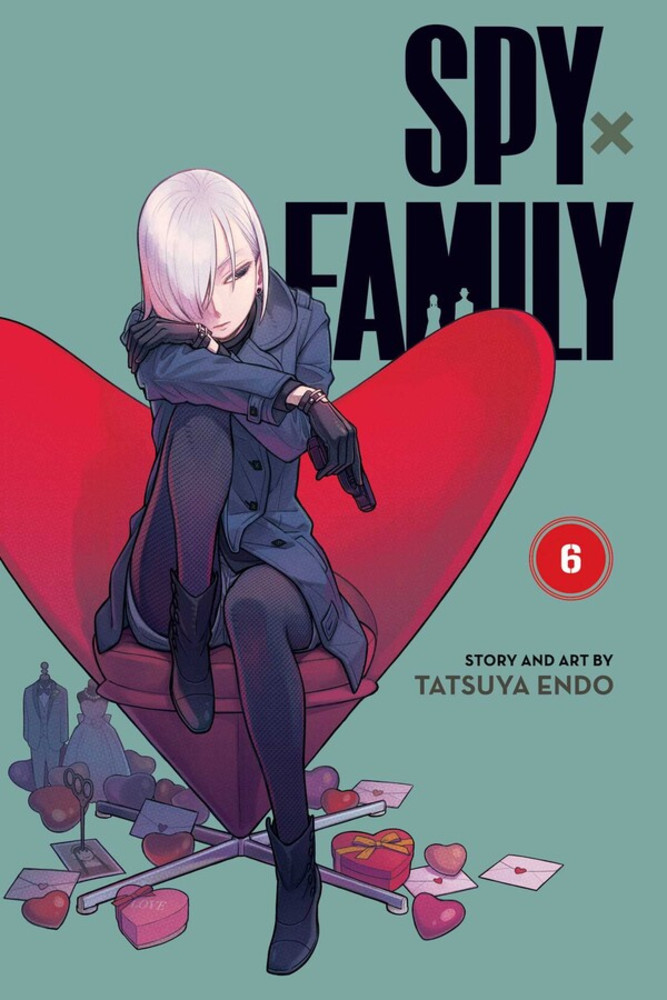
April sales figures are in, and manga continues to dominate the NPD Adult Graphic Novels list. Though the list includes some perennial favorites–Berserk, Demon Slayer, My Hero Academia—Spy x Family saw a big jump in sales after its anime debuted on Crunchyroll last month. ICv2’s Brigid Alverson points out that  “April marks the fourth consecutive month that manga has completely filled the chart of the top 20 Adult graphic novels in the book channel.” Manga sales aren’t quite as robust in comic book stores, but three titles made ComicsHub’s Top 20 Graphic Novels for April: Chainsaw Man (4), Kaiju No. 8 (16), and Spy x Family (20). For additional insights into the current state of the manga, check our Madeline Dunnett’s recent post at Anime News Network.

MANGA NEWS

Kodansha just announced the winners of its 46th annual Manga Awards. [Anime News Network]

With less than three weeks to go, Sam Sattin and Guruhiru’s Kickstarter campaign for Unico: Awakening has exceeded its pledge goal of $50,000. The story is “an homage to the God of Manga’s original messaging of social welfare and eco-consciousness.” [Kickstarter]

Good news for Moto Hagio fans: Fantagraphics will be re-printing the first volume of The Poe Clan this summer. While there’s no official release date for the new edition, the long-awaited second volume will be released on July 26, 2022. [Fantagraphics]

Drawn and Quarterly will be publishing Nejishiki, an anthology of short stories by Yoshiharu Tsuge. Look for it in stores in April 2023. [Drawn and Quarterly]

Earlier this week, Yen Press announced that it will publish Sho Harusono’s Hirano and Kaguira, a spin-off of Sasaki and Miyano. [Yen Press]

Brace yourself: Seven Seas just announced even more new manga licenses! Among the most promising are Polar Bear Café: Collector’s Edition and Ex-Yakuza and Stray Kitten, which is pretty much what it sounds like: a former mobster indulges his softer side by rescuing a cat from the streets. [Seven Seas]

Over at The OASG, Justin and Helen round up the latest anime, manga, and licensing news. [The OASG Podcast]

FEATURES AND INTERVIEWS

Patricia Thang takes issue with the marketing label “manga-inspired,” arguing that “To call a comic ‘manga-inspired’ is akin to me saying, ‘Here’s a painting I did! It’s art-inspired! You’d think (or at least hope) I was joking, right? Because what in the fuck would that even mean?!” [Book Riot]

On the most recent Manga in Your Ears podcast, Kory, Helen, and Apryl dissect two manga by Naoki Urasawa: Sneeze, a short story anthology, and Asadora!, his latest series. [Manga in Your Ears]

Andy and Elliot dedicate the latest episode of the Screentone Club to City Hunter and Goodbye-Eri. [Screentone Club]

Walt Richardson and Emily Myers review the April issue of Shonen Jump. [Multiversity Comics]

The Mangasplainers turn their attention to Kakegurui: Compulsive Gambler, “the smash hit seinen manga that pits trust-fund-teens against one another in battles that cause embarrassment and ecstasy, skirting the line between schadenfreude and sadism!” [Mangasplaining]

As the spring anime season kicks into gear, Silvana Reyes Lopez recommends fifteen “unmissable” manga adaptations, from Chainsaw Man to Kakegurui Twin. [Book Riot]

Wondering what to read after Black Clover wraps up later this year? Christian Markle has a few recommendations. [Honey’s Anime]

Brianna Lawrence argues that Death Note Short Stories is more than just a sequel or a companion to the original series; it’s a thoughtful exploration of “how the government would react if such a terrifying weapon was available.” [The Mary Sue]

In an interview with TCJ’s Alex Deuben, Ken Niimura discusses his latest work, Never Open It: The Taboo Trilogy, which re-tells three of Japan’s most famous folk tales. “What I like about these stories… is that they’re pretty open ended,” Niimura explains. “They can be interpreted in many different ways. For example, there’s what’s considered to be the standard version of ‘The Crane Wife,’ but there are actually different versions depending on the region, the era, with many differences to the characters, the ending, etc…” [The Comics Journal]

REVIEWS

Readers in search of “hallucinogenic” stories might want to check out Keiichi Koike’s Heaven’s Door: Extra Works. “In some of these stories, the scale is pure Akira, but the detail and fluidness of the line are absolutely Moebius,” reviewer James Hepplewhite opines. Speaking of over-the-top manga, Megan D. revisits one of the most ludicrous series Tokyopop ever published: The Qwaser of Stigmata. (No, really; this manga goes to eleven.)

  • After School!, Vols. 1-2 (Krystallina, Daiyamanga)
  • Apollo’s Song (SKJAM, SKJAM! Reviews)
  • A Bride’s Story, Vol. 13 (Sakura Aries, The Fandom Post)
  • Bungo Stray Dogs Wan!, Vol. 1 (Rebecca Silverman, Anime News Network)
  • A Centaur’s Life (Megan D., The Manga Test Drive)
  • Dead Mount Death Play, Vol. 7 (Josh Piedra, The Outerhaven)
  • Death Note Short Stories (Joseph Luster, Otaku USA)
  • Death Note Short Stories (Kate Sánchez, But Why Tho?)
  • Dissolving Classroom (King Baby Duck, Boston Bastard Brigade)
  • Dr. STONE, Vol. 21 (Marina Z., But Why Tho?)
  • Eclair Bleue, Eclair Rouge, and Eclair Orange (Jaime, Yuri Stargirl)
  • Hinowa ga CRUSH!, Vol. 6 (Josh Piedra, The Outerhaven)
  • Hinowa ga CRUSH!, Vol. 6 (Krystallina, The OASG)
  • I Want to Be a Wall, Vol. 1 (Danica Davidson, Otaku USA)
  • Little Miss P: The Fourth Day (Demelza, Anime UK News)
  • Love of Kill, Vol. 7 (Krystallina, The OASG)
  • Made in Abyss (Harry, Honey’s Anime)
  • Magic Artisan Dahlia Wilts No More, Vol. 1 (Justin, The OASG)
  • The Magical Revolution of the Reincarnated Princess and the Genius Young Lady, Vol. 1 (Sakura Eries, The Fandom Post)
  • Marionette Generation (Megan D., The Manga Test Drive)
  • Moriarty the Patriot, Vols. 6-7 (King Baby Duck, The Boston Bastard Brigade)
  • The Music of Marie (Krystallina, Daiyamanga)
  • Our Colors (Publisher’s Weekly)
  • Our Teachers Are Dating, Vol. 4 (Erica Friedman, Okazu)
  • Our Teachers Are Dating, Vol. 4 (Jaime, Yuri Stargirl)
  • The Royal Tutor, Vol. 16 (Sakura Eries, The Fandom Post)
  • Seimaiden (Megan D., The Manga Test Drive)
  • Spy x Family, Vol. 7 (Rebecca Silverman, Anime News Network)
  • The Transcendent One-Sided Love of Yoshida the Catch, Vol. 1 (Rebecca Silverman, Anime News Network)
  • Walkin’ Butterfly (Megan D., The Manga Test Drive)
Filed Under: FEATURES Tagged With: death note, Drawn and Quarterly, Fantagraphics Books, Manga Sales Analysis, moto hagio, Naoki Urasawa, Osamu Tezuka, Seven Seas, Shonen Jump, The Poe Clan, Unico, yen press

The Manga Review, 5/6/22

May 6, 2022 by Katherine Dacey Leave a Comment

When it comes to manga commentary, I freely admit that I’m more of a reader than a listener. Mangasplaining, however, is helping change my mind about manga podcasts. Every week, Deb Aoki, David Brothers, Christopher Butcher, and Chip Zdarsky analyze manga old and new, from classic titles such as AKIRA to fan favorites such as Wotakoi: Love Is Hard for Otaku. The Mangasplainers are frequently joined by industry professionals for interesting conversations about translating, publishing, and creating manga; among their most recent guests were Jamila Rowser, founder of Black Josei Press, and Ken Niimura, a Spanish-Japanese artist best known for his work on I Kill Giants. Complementing the podcast is MSX: Mangasplaining Extra, a weekly newsletter written by Deb, Christopher, and Andrew Woodrow-Butcher that focuses on their newest venture: translating and publishing manga for North American readers.

NEWS AND FEATURES

Deb Aoki offers an in-depth look at the North American manga market. Though global supply issues have made it more difficult to bring readers their favorite series in print, manga sales reached a record high in 2021. As VIZ Media’s Kevin Hamric observes, “Manga is no longer a niche category. It is now a mainstream/mass category.” [Publisher’s Weekly]

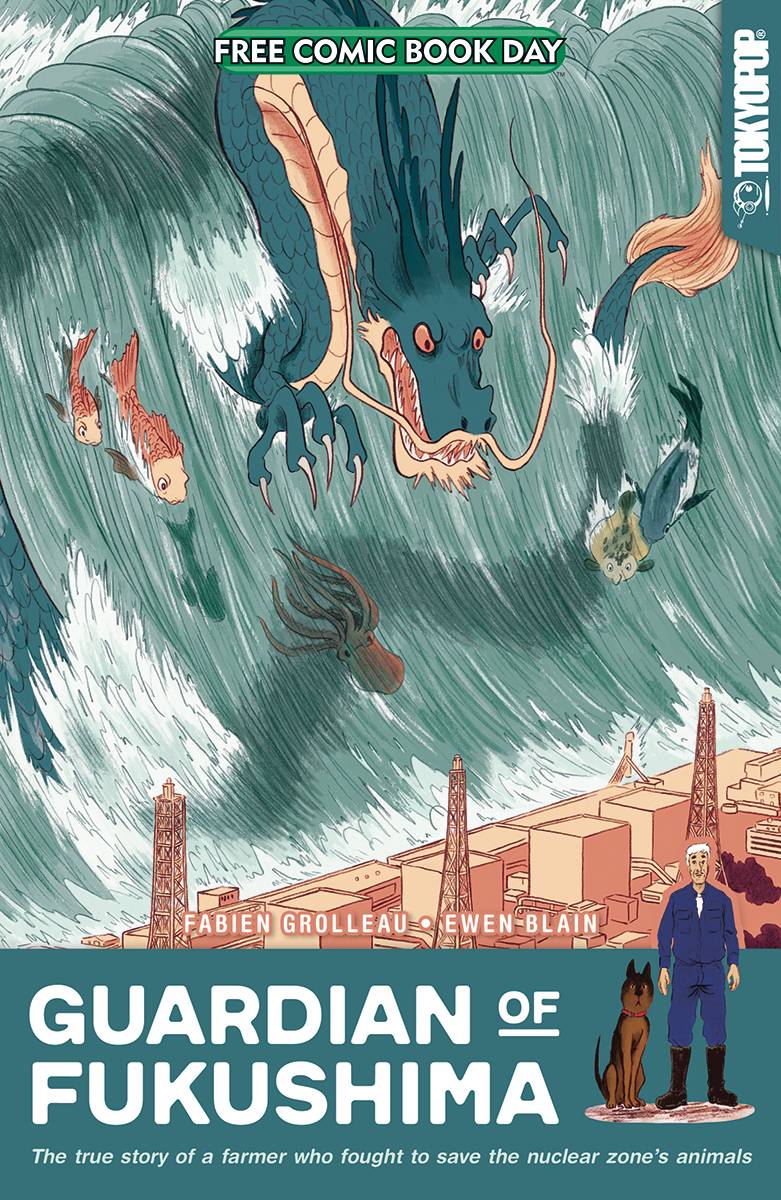
Free Comic Book Day is tomorrow! Several manga publishers will have kid- and teen-friendly titles, from VIZ’s Pokémon Journeys to Tokyopop’s Guardian of Fukushima, a graphic novel about Naoto Matsumura, a farmer who defied government orders by returning to Fukushima to save his animals. [Free Comic Book Day]

Cat lovers take note: Daisuke Igarashi just launched a new series called Kamakura Bakeneko Kurabu, which translates roughly to Kamakura Monster Cat Club. [Anime News Network]

On Wednesday, Seven Seas unveiled four new manga licenses: Gap Papa: Daddy at Work and at Home, The Knight Blooms Behind Castle Walls, My Sister The Cat, and No Longer Human… In Another World, “a dark comedy starring a famous historical writer who would honestly rather die than live out an isekai fantasy.” [Seven Seas]

Tezuka Productions recently launched an English-language Twitter feed. [Twitter]

Megan Thee Stallion has impeccable taste in anime. [Black Girl Nerds]

If you plan to be in Tokyo next March, why not check out the Spy x Family musical, which will have its premier at the Imperial Theater? [Otaku USA]

Wondering what’s new at your local comic book store? Bill Curtis just posted a complete list of May’s manga and light novel releases. [Yatta-Tachi]

In the latest episode of Shojo & Tell, Ashley and guest Olive St. Sauver discuss the first six volumes of Suu Morishita’s Shortcake Cake. [Shojo & Tell]

Good news for yuri manga fans: Erica Friedman’s By Your Side: The First 100 Years of Yuri Anime and Manga is now available for pre-order. Her book is the first of its kind in English, offering a thoughtful, wide-ranging exploration of “the key creators, tropes, concepts, symbols and titles of the first 100 years of the Yuri genre.” [Okazu]

Sam Sattin chats with Masha Zhdanova about his latest project: a reboot of Osamu Tezuka’s Unico. “Unico in particular I found to be a fascinating character who is often misunderstood,” Sattin observes. “Unico was created for children, but like many of Tezuka’s child-oriented fables, the character’s story is complex, emotional, and chock full of meaning… In it, I see an amazing story that could simultaneously serve a new generation of readers and honor Osamu Tezuka’s work.” [Women Write About Comics]

Jeff Trexler, the Interim Director of CBLDF, sounds a cautionary note about Free Comic Book Day, noting that retailers need to be vigilant about which books they give away, and to whom. “The new comic’s code is an algorithm,” Trexler observes. “What people are trying to do is not simply the fact that they’re trying to get retailers arrested or school teachers arrested or librarians arrested. They recognize in the age of Twitter, you don’t have to do that. All you have to do is get them shamed or banned. You can mass swarm a retailer and report them to Facebook or Twitter for selling pornography.” [ICv2]

REVIEWS

Congratulations to Megan D., who celebrates the tenth anniversary of The Manga Test Drive this week! You can help her mark this milestone by checking out her recent reviews of Dick Fight Island (NSFW, as you might imagine), Hinadori Girl, Wanted, and Peepo Choo. Over at Book Dragon, Terry Hong posts a review of Gengoroh Tagame’s Our Colors, “another poignant, empowering, gay-centered narrative… translated by queer manga expert Anne Ishii.”

  • Ace of the Diamond, Vols. 1-7 (Krystallina, Daiyamanga)
  • Anyway, I’m Falling in Love With You, Vols. 1-2 (Rebecca Silverman, Anime News Network)
  • Blackguard, Vol. 1 (Demelza, Anime UK News)
  • Blue Period, Vol. 6 (Sarah, Anime UK News)
  • Boys Run the Riot, Vol. 1 (James Hepplewhite, Bleeding Cool)
  • The Case Files of Jeweler Richard, Vol. 1 (Al, Al’s Manga Blog)
  • The Case Files of Jeweler Richard, Vols. 1-2 (Rebecca Silverman, Anime News Network)
  • The Dragon Knight’s Beloved, Vol. 1 (Kaley Connell, Yatta-Tachi)
  • Goodbye, Eri (Ari Tantimedh, Bleeding Cool)
  • The Great Jahy Will Not Be Defeated!, Vol. 2 (Demelza, Anime UK News)
  • High School Prodigies Have It Easy, Even in Another World!, Vol. 1 (Megan D. The Manga Test Drive)
  • How De We Relationship?, Vol. 5 (King Baby Duck, The Boston Bastard Brigade)
  • I Belong to the Baddest Girl at School, Vol. 3 (Demelza, Anime UK News)
  • I Want to Be a Wall, Vol. 1 (Christian Markle, Honey’s Anime)
  • In Another World with My Smartphone, Vol. 5 (Josh Piedra, The Outerhaven)
  • Karakuri Odette, Vol. 3 (Thomas Zoth, The Fandom Post)
  • Kubo Won’t Let Me Be Invisible!, Vol. 1 (Eric Alex Cline, AiPT!)
  • Lady Snowblood, Vol. 1 (SKJAM, SKJAM! Reviews)
  • Love After World Domination, Vol. 2 (Justin, The OASG)
  • Lovesick Ellie, Vol. 1 (Demelza, Anime UK News)
  • A Man and His Cat, Vol. 5 (Rebecca Silverman, Anime News Network)
  • Mizuno and Chayama (Christian Markle, Honey’s Anime)
  • My Brain Is Different: Stories of ADHD and Other Developmental Disorders (Danica Davidson, Otaku USA)
  • My Hero Academia: Team-Up Missions, Vol. 2 (King Baby Duck, The Boston Bastard Brigade)
  • My Love Mix-Up!, Vols. 2-3 (Rebecca Silverman, Anime News Network)
  • Nighttime for Just Us Two, Vol. 1 (King Baby Duck, The Boston Bastard Brigade)
  • Orochi: The Perfect Edition (Renee Scott, Good Comics for Kids)
  • Our Kingdom, Vol. 1 (Library Girl, A Library Girl’s Familiar Diversions)
  • Our Kingdom, Vol. 2 (Library Girl, A Library Girl’s Familiar Diversions)
  • Phantom Tales of the Night, Vol. 1 (Helen, The OASG)
  • Queen’s Quality, Vol. 14 (Josh Piedra, The Outerhaven)
  • Rent-a-Girlfriend, Vols. 10-11 (Demelza, Anime UK News)
  • Rurouni Kenshin: Three-in-One Omnibus, Vol. 1 (Library Girl, A Library Girl’s Familiar Diversions)
  • The Royal Tutor, Vol. 16 (Krystallina, The OASG)
  • Sacrificial Princess and the King of Beasts, Vol. 15 (Krystallina, The OASG)
  • Sasaki and Miyano, Vol. 5 (Eric Alex Cline, AiPT!)

Filed Under: FEATURES Tagged With: CBD, Daisuke Igarashi, Free Comic Book Day, Osamu Tezuka, Seven Seas, Tokyopop, yuri

Cutie and the Beast

September 17, 2021 by Phillip Anthony Leave a Comment

Coming to Yuhi Azumi’s Cutie and the Beast, I really only had a recommendation from Brigid Alverson and a description from her too. So with that, I dived in with the gusto of a wrestling star like our male lead, Kuga and tried to see if this was an entertaining first match or a one-off special.
Momoka is a high school student who watches wrestling matches on TV and follows the stars of the league, in particular a star currently portraying a heel (wrestling slang for a performer cast in the role of a villain in the league) called Kuga. Kuga is twenty nine and a committed wrestler who loves his role and his profession. One day, after interacting with Momoka online, Kuga crosses paths with her and an entirely unexpected relationship opens up for both of them.

Cutie and the Beast presents the relationship between Kuga and Momoka as pretty straightforward: Momoka has a massive crush on Kuga but Kuga is as inexperienced in love as she is. So the two of them spend the early moments of their relationship within the first volume as awkward teenagers. He’s a bit hesitant and unsure, she’s frustrated at the distance between them when she realises that he shares her affection. The issue of their age comes to the fore mid-way through and unusually, it’s Kuga’s wrestling friend who helped put them together who suggests that Kuga cools his jets. Kuga has too much to lose, Momoka still has to go to school. Their lives wouldn’t work. But like the proverbial square peg in the round hole, Koga and Momoka refuse to come unstuck. In real life, this would be very messy and I don’t know how long the story can sustain this. But the two of them are so nice both on their own and together, that I can give it a temporary pass. It’s kind of a suspension of reality where if a single person were to point it out to you while you read it, it would all be ruined. I love the framing when Kuga comes clean about why he’s been avoiding Momoka online and his distress as to their relationship. It’s neat and tidy, not going for high drama. In a way, that’s the whole manga in a nutshell: searching for places for its leads to be in but not rushing it to get there any quicker than is needed.

Azumi peppers her dish with various little things like the immediacy of Twitter and how it help Momoka connect with Kuga or how Momoka’s sister starts the story as a pest but rapidly gets in gear to get her and Kuga together. The wrestling matches and events that Momoka uses to interact with Kuga are careful, quiet, and used reservedly so it’s less like a love-sick fan who hangs on her favourite wrestlers every appearance and more about how she’s processing going from “I like this guy” to “I want this guy to give me a straight answer!” Along the way, the groundwork is laid for future volumes to either rally or lose their hard-won victories. I love how Momoka and Kuga are with each other and I can’t wait to read the next volume to see how the changes at the end of the first one set out their arcs in the future.

Filed Under: Adventures in the Key of Shoujo Tagged With: manga, Seven Seas, shoujo

The Wize Wize Beasts of the Wizarding Wizdoms

January 9, 2020 by Katherine Dacey

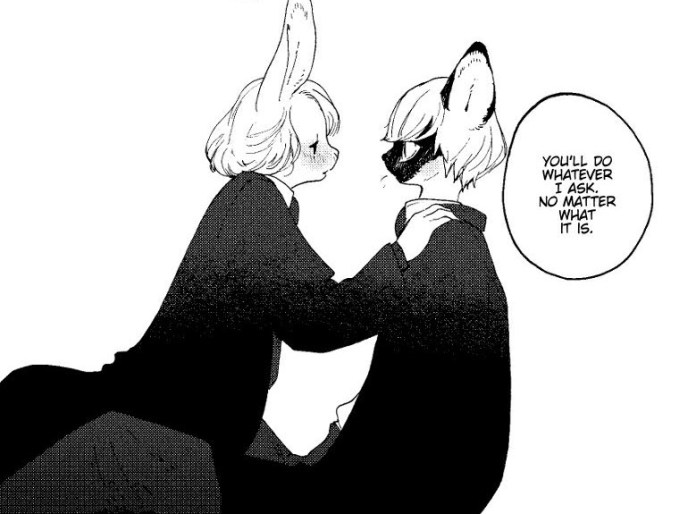
“Whimsical tales of anthropomorphic beasts in love”—or so the dust jacket of The Wize Wize Beasts of the Wizarding Wizdoms promises. The eight stories in this collection do feature a race of half-animal, half-human creatures who behave like boys at a British boarding school, forming intense friendships that sometimes cross the line into romance. I’m a little reluctant to call these stories “whimsical,” however, as that word implies a certain degree of playfulness that was lacking in most of the stories, some of which were intensely sincere, and some of which raised legitimate questions about boundaries and consent.

Wize Wize Beasts unfolds at a special academy “dedicated to the study of wizardry,” where demi-humans of every imaginable type peacefully co-exist as they learn the arts of potion-making, spell-casting, and alchemy. Each story centers on a pair of opposites: prey and predator, teacher and student, mammal and reptile, smart and average. Most of their relationships fall under the general heading of “unrequited love,” in which one demi-human pines for his opposite, but can’t muster the courage to say how he feels.

In the most enjoyable chapters—”Marley & Collette,” “Cromwell & Benjamin”—Nagabe explores the healthier side of attraction, showing how strong feelings of admiration and concern can bring out the best in friends, allowing for moments of tenderness, warmth, and emotional honesty even when the friendship remains platonic. My favorite, “Mauchly & Charles,” read like an irresistible mash-up of Winnie the Pooh and The Girl from the Other Side, focusing on a bear (Mauchly) and the human he rescued (Charles) from a dark, rainy forest. After Charles returns to his own world, he and Mauchly hold an annual reunion, using this ritual as an opportunity to reflect on what’s changed in the ensuing year. The emotional vulnerability and candor of their interactions is genuinely astonishing—not because men don’t have close friendships, but because the kind of physical intimacy and gentleness that defines Mauchly and Charles’ friendship is seldom depicted in popular culture.

The weakest stories in the collection, by contrast, often conflate possessive or coercive behavior with romantic attraction, justifying one character’s actions by suggesting his feelings were so intense that they compelled him to transgress social norms. In “Doug & Huey,” for example, a crow (Doug) carries a torch for his handsome friend Huey, who—natch—is a peacock. Though Huey spends most of his time chasing girls, Doug’s devotion to him is unwavering—so much so, in fact, that Doug sabotages Huey’s efforts to land a girlfriend so that Huey will “never be closer to someone else.” Huey, for his part, is so deeply narcissistic that he doesn’t recognize Doug’s controlling behavior, creating a deeply toxic bond between them that is presented as a simple case of unrequited love.

The issue of consent lingers over other chapters in Wize Wize Beasts as well. “Alan & Eddington,” for example, depicts the friendship between a brilliant Siamese (Alan) and a hardworking rabbit (Eddie) who’s dazzled by his classmate’s effortless mastery of complex subjects. Afraid that Alan will reject his advances, Eddie concocts and serves him a love potion. While under the influence of Alan’s spell, Eddie compels Alan to kiss him and profess his love for him—a scene that’s meant to be a little naughty, I think, but instead registers as squicky. Alan confronts Eddie about the incident, but then invites Eddie to “start over” without a magical aide, undercutting the power of his previous speech about Alan’s “cowardly” behavior.

If I was sometimes ambivalent about the content, I found Nagabe’s crisp illustrations thoroughly enchanting. His anthropomorphic character designs capture the essential animal natures of each character while retaining just enough human features for Nagabe to plausibly swathe them in flowing capes and tweedy trousers. Nagabe’s command of light, shadow, and line is superb, creating a strong sense of place without excessive reliance on screentone or tracing; his characters inhabit a well-defined world that has been vividly and imaginatively rendered on the page.

In the afterword to Wize Wize Beasts, Nagabe cheerfully jokes about “winning” readers over to his particular fandom. “I’d be deeply honored if this work exposes more people to non-human characters,” he notes. “And if you start to think, ‘Wow, non-human characters are awesome,’ go on. Get in there up to your neck.” I can’t say that Wize Wize Beasts made me a convert, but I did admire Nagabe’s creativity, sincerity, and honesty, as well as his willingness to take narrative risks that might not pay off with all readers. Your mileage may vary.

THE WIZE WIZE BEASTS OF WIZARDING WIZDOMS • STORY AND ART BY NAGABE • TRANSLATED BY ADRIENNE BECK • SEVEN SEAS • RATED TEEN • 228 pp.

Filed Under: Manga, Manga Critic, REVIEWS Tagged With: LGBTQ, Nagabe, Seven Seas

Become You, Vol. 1

September 16, 2019 by Katherine Dacey

Ichigo Takano’s orange may be one the of best shojo manga published in the last ten years, offering readers a vivid, sympathetic portrait of five friends who get an unexpected chance to save a suicidal classmate’s life. Though orange explored dark emotional terrain, it was never mawkish; instead, orange ended on a hopeful note that showed younger readers that life goes on after tragedies big and small.

Become You, Takano’s latest series, mines a similar thematic vein, this time focusing on two emotionally damaged boys who form an improbable bond through music. And by “improbable,” I mean Taiyou and Hikari are temperamental opposites who initially seem ill-suited for friendship, let alone artistic collaboration. Taiyou is one of those only-in-manga characters whose dogged optimism shades into fanaticism—the kind of character who calls everyone his friend, and wears down skeptics with his relentless overtures. Hikari, by contrast, is a classic Character With a Secret, a former prodigy who abruptly abandoned the piano despite (or perhaps because of) his phenomenal success, keeping his classmates at bay with blunt comments. Naturally—by the immutable laws of Shojo Manga Plot Mechanics—Taiyou tries to recruit Hikari for a band, despite the fact that Taiyou is a tyro guitar player.

At first glance, Become You seems to be following a well-worn path in which an enthusiastic novice persuades a reluctant genius to mentor him, in the process drawing out his teacher and helping his teacher recover something that he lost—say, his joy in playing the tuba, or his relationship with an estranged family member. But Takano adds an interesting wrinkle to this familiar plotline: midway through volume one, we learn that Taiyou originally wanted to be an artist, but lost his desire to paint after being bullied by a teacher. In the aftermath of this encounter, what Taiyou really wants is to be good at something—anything, really—and will work diligently towards achieving that goal, even if he shows little or no aptitude for his chosen pursuit. Equally important, Taiyou is just as emotionally vulnerable as his would-be mentor, even though Taiyou papers over his anguish with bright smiles and cheerful comments.

As with orange, a magical plot device brings Become You‘s principal characters together–in this case, a mysterious cloaked figure who presents Taiyou with an electric guitar and words of Yoda-like encouragement. It’s not entirely clear if Taiyou is fantasizing or having a premonition, since his guardian angel looks an awful lot like Hikari. And while the ambiguity of these scenes has little impact on the reading experience, they occupy more space than the time-traveling letters did in orange—a mistake, I think, because Taiyou’s daydreams don’t add any special urgency or poignancy to the story. By contrast, orange‘s letters served a twofold purpose, setting the plot in motion and highlighting all the small ways that innocent comments or decisions could hurt someone as fragile as the suicidal Kakeru.

The other drawback to Become You is that Takano doesn’t seem to know much about music. Taiyou, for example, cheerfully states his intention to attend a “music college,” but lacks the rudimentary skills to play in sync with a metronome or sight-read sheet music. (He also seems blissfully unaware that conservatories require an entrance audition.) The concert sequences are similarly revealing: though Takano draws attractive, animated characters, and can put them through their emotional paces, she struggles to make Taiyou and Hikari’s musical performances come to life on the page, either by showing the physical effort necessary to making a sound—embouchure, hand position, posture—or by drawing convincing crowd shots that convey the impact of the music on listeners.

I’m not ready to give up on Become You just yet, however, as Takano has something worthwhile to say about pursuing activities for emotional fulfillment, rather than for personal achievement. She also explores the idea of artistic mentorship with honesty, acknowledging that the teacher-student relationship can have a profound effect on how a young artists finds his voice; any violation of that compact—an unkind comment, a dogged insistence on doing things the “right” way—can leave deep scars and stunt one’s artistic growth. Here’s hoping volume two strikes a better balance between the magical realism and the realities of being a musician. Tentatively recommended.

BECOME YOU, VOL. 1 • STORY & ART BY ICHIGO TANAKA • TRANSLATED BY AMBER TAMOSAITIS • SEVEN SEAS • RATED TEEN • 200 pp.

Filed Under: Manga, Manga Critic, REVIEWS Tagged With: Drama, Ichigo Takano, Musical Manga, Seven Seas

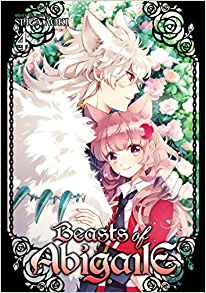
Beasts of Abigaile Vol. 4

January 2, 2019 by Anna N

Beasts of Abigaile Volume 4 by Spica Aoki

I hadn’t realized that Beasts of Abigaile was only 4 volumes long, and I’m guessing that the mangaka wasn’t planning on the series wrapping up so quickly either, based on the sheer amount of backstory and exposition crammed into one volume. Still, the story does end on a satisfying note, although I would have been fine to see the series get stretched out to 5 or 6 volumes in order to be able to spend more time with the supporting cast.

Nina’s been captured and her secret of being a human at the werewolf academy on the island of Abigaile is threatened with exposure! She encounters a chained-up Giles, who fills in some of the details about the manipulation of Angelica the student body president who is nursing a special hatred for Nina. Nina is determined to be a force for good at the academy after hearing more about how its potential has been subverted by the school administrators. Roy is on his way to rescue Nina when she flies in with a high kick and they take off and hide in rose bushes to escape. One of the things that I like about this series is that for all of Roy’s alpha male blustering, Nina often manages to rescue herself through sheer determination.

On the way to the resolution of the series, the reader learns about Nina’s secret past, Roy and Giles’ secret past, and Nina comes to realize exactly what her own feelings are. There are some spectacular revelations and many panels of people staring intensely through jail bars. While this volume suffered a bit from too much story being crammed into a few short chapters, overall Beasts of Abigaile was a fun to read breezy paranormal shoujo series that I enjoyed. I hope it did well enough for Seven Seas that they continue to publish the occasional shoujo manga, as I like to see shoujo coming here from a variety of Japanese publishers.

Filed Under: Manga Reviews, REVIEWS Tagged With: beasts of abigaile, Seven Seas, shoujo

Versailles of the Dead, Vol. 1

November 6, 2018 by Katherine Dacey

Kumiko Suekane’s Versailles of the Dead feels like a kissing cousin of Seth Grahame-Smith’s Pride & Prejudice & Zombies. It’s a clever and handsomely drawn manga that also inserts zombies into a well-known story for shock value: who knew the real cause of the French Revolution was an outbreak of “resurrection illness”? The net result, however, is so intentionally kitschy that it sometimes holds the reader at arm’s length, inviting us to appreciate the imagination and research that went into creating Versailles of the Dead without fully drawing us into the story.

You might reasonably think that the zombies were Versailles of the Dead’s most gonzo element, but you’d be wrong: it’s actually Suekane’s decision to invent a sibling for Marie Antoinette. This sibling — a twin brother named Albert — is Marie’s doppelgänger, a handsome lad with the same high cheekbones and pert nose as his infamous sister. En route to Marie’s nuptials, their carriage is ambushed by zombies, forcing Albert to impersonate his sister after she meets a gruesome end. Albert’s identity is quickly discovered by a handful of courtiers, all of whom are invested enough in preserving the status quo at Versailles that they conspire to look the other way, even when rumors surface that Albert beheaded his own sister.

Watching Albert step into the role of Dauphine is fun; he embraces the opportunity to manipulate courtiers through gossip and flirtation, exploiting rivalries within the court to his own advantage. The supernatural interludes, by contrast, sometimes feel like an afterthought, rather than a vital part of the story. Though the zombies are handled in a straightforward fashion, Suekane relies too much on flash-booms, jump cuts, and smudgy silhouettes to imply that certain members of the French court are possessed. Suggestion is an important tool for generating suspense, of course, but here it feels like a half-baked effort at world-building — what if there were demons in eighteenth century France, too? Not everything needs to be explained in a baldly literal fashion, of course, but the demonic angle feels like one accessory too many on a busy outfit.

If the supernatural intrigue is more afterthought than essential element, the artwork is sumptuous, capturing the opulence of Versailles without overwhelming the reader. Suekane’s secret? Lavishing attention on character designs rather than material objects, allowing the intricacy of the hairstyles, gowns, and frock coats to be the focal point of most panels. That approach gives her breathing room to draw the kind of subtle but important details that help establish the characters’ true natures. Albert, for example, never fully disappears into his sister’s clothes and wigs; the twinkle in his eye and the boldness of his carriage are conspicuous signs of his male upbringing, even though he looks ravishing as a woman. Other characters’ personalities are just as thoughtfully embodied through costume and movement. Madame du Barry, the Dauphine’s great rival, makes a dramatic display of her décolletage, framing her chest in a wreath of feathers that accentuate du Barry’s mature womanhood — a not-so-subtle attempt to assert her power and experience over a teenage interloper.

It’s this level of thoughtfulness that helped me soldier through the more clumsy parts of the story, where characters solemnly explain why Albert’s marriage must go forward for “the good of our two countries,” and Madame du Barry thinks in complete Wikipedia paragraphs. (Her internal monologues are surprisingly dull for such a canny strategist.) I’m not sure that all of the plot lines will eventually converge in a satisfying way — there’s a lot of supernatural silliness — but I find Albert a compelling character, a skilled political operator who revels in his ability to sow discord. Count me in for volume two.

VERSAILLES OF THE DEAD, VOL. 1 • STORY & ART BY KUMIKO SUEKANE • TRANSLATION BY JOCELYNE ALLEN • SEVEN SEAS • RATED TEEN (PARTIAL NUDITY, MILD GORE, VIOLENCE)  172 pp.

Filed Under: Manga, Manga Critic, REVIEWS Tagged With: Horror/Supernatural, Kumiko Suekane, Seinen, Seven Seas, Versailles, Zombies

Cutie Honey A Go-Go

May 15, 2018 by Katherine Dacey

Cutie Honey a Go Go! is not a conventionally good manga: the plot is riddled with holes, the story lacks a proper conclusion, and the characters are paper-thin. Yet for all its obvious limitations, Cutie Honey a Go Go! is cheeky fun in the manner of an Austin Powers movie; it’s a cartoon of a cartoon, an irreverent send-up of the source material that simultaneously captures the original manga’s naughty tone while updating the plot and characters for contemporary readers.

Cutie Honey a Go Go! borrows liberally from Hideaki Anno’s 2004 film and Go Nagai’s original 1973 manga, mixing elements of both with a few new flourishes. In Cutie Honey a Go Go!, for example, Aki Natsuko is no longer a blushing school girl with a crush on her android sempai, but a hard-charging special agent who faces down danger with the brash confidence of a Harrison Ford character. Aki and Cutie’s arch nemesis Sister Jill has likewise gotten a makeover, from whip-wielding bad girl to wicked android intent on world domination. The signature elements of Nagai’s original story remain intact, however: Cutie Honey is still an impossibly innocent, cheerful android whose clothing dissolves to tatters every time she powers up, and her main opponents are the Panther Claw ladies, a group of monstrous beauties who work for Sister Jill.

Though manga-ka Shimpei Itoh’s action scenes are clumsy, his character designs are a playful nod to the era that begat Cutie Honey, straddling the fence between retro and modern. The Panther Claw gang look like Betty Paige cosplayers, busty gals in barely-there costumes that feature leopard spots and extra arms, while Cutie Honey rocks her signature pixie cut and a backless jumpsuit that David Lee Roth might have worn in 1984. It’s hard to be offended by the T&A, though, since Cutie Honey a Go Go! resembles a 1962 issue of Playboy more than a volume of Air Gear; there’s a pin-up coyness about Itoh’s cheesecake that renders these images benign. It’s also difficult to be offended by a manga that works so hard to entertain the reader with its anything-for-a-laugh jokes, over-the-top battle sequences, and campy dialogue. I found its unironic goofiness charming — costume failures and all — and think you might, too. Recommended.

Cutie Honey a Go Go!
Original Story by Go Nagai; Story & Art by Shimpei Itoh; Planning Cooperation by Hideaki Anno
Translated by Zack Davisson and Adrienne Beck
Seven Seas, 400 pp.
Rated T, for Teen (Nudity and bloodless violence)

Filed Under: Manga, Manga Critic, REVIEWS Tagged With: Cutie Honey, Go Nagai, Hideaki Anno, Seven Seas, Shimpei Itoh

The Girl from the Other Side: Siúil, a Rún, Vol. 4

April 24, 2018 by Katherine Dacey

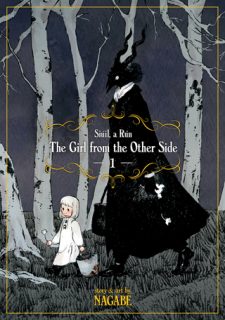
The Girl from the Other Side: Siúil, a Rún was one of 2017’s surprise hits, an emotionally wrenching fantasy manga about a demon who rescues an orphan girl from a plague-ridden world. Nagabe’s art — with its graceful linework and unique character designs — was enough to distinguish Girl from the Other Side from virtually any other series licensed by a major American publisher. But it was the characters and the poignancy of their relationship that truly captivated readers, as the bond between Teacher (the demon) and Shiva (the girl) was tested by Shiva’s ties to the human world, particularly her attachment to the aunt who raised her — and then abandoned her in the woods. Four volumes in, Girl from the Other Side is still casting a powerful spell, even as the story takes another grim turn.

As the volume opens, Teacher, Shiva, and Auntie have formed an uneasy family unit, with Shiva desperate to broker the peace between her adoptive parents. Nagabe does a fine job of dramatizing the conflict between Teacher and Auntie without spoiling the quiet mood of the story, using small gestures to convey how desperately each wants to protect Shiva from the human world. Nagabe also includes a handful of scenes that chart the progress of Auntie’s disease, showing us how quickly the curse erases a victim’s memory and personality — a development that raises the interesting question of who Teacher was before he assumed his demonic form.

Perhaps the most striking aspect of volume four is how much of the characters’ interior lives are revealed through the artwork. In the first chapter, for example, Teacher and Auntie slip into the woods for a nighttime conference about Shiva. Each carries a lantern as they walk and talk — two pinpoints of light against a scrim of trees — their conversation ending when Auntie’s lantern flickers out, leaving her and Teacher side by side in darkness. What makes this sequence so effective is the deliberate placement of the characters on the page and the meticulous attention to lighting; Nagabe has found an elegant — and wordless — way to demonstrate the characters’ shared resolve to protect Shiva, even though they remain suspicious of one another. Such carefully observed moments are a potent reminder that The Girl from the Other Side is an all-too-rare example of a manga whose story engages the heart and mind by suggesting, rather than saying, what the characters are feeling. Recommended.

The Girl From the Other Side: Siúil, a Rún, Vol. 4
Art and Story by Nagabe
Translated by Adrienne Beck
Seven Seas, 180 pp.

Filed Under: Manga, Manga Critic, REVIEWS Tagged With: Fantasy, Girl from the Other Side, Nagabe, Seven Seas, Shonen

Giant Spider & Me, Vol. 1

February 26, 2018 by Katherine Dacey

Giant Spider & Me is a gentle fantasy that’s tinged with whimsy and rue. The story focuses on Nagi, a perky tween who lives by herself in a well-appointed cottage, awaiting the return of her father from a mysterious trip. In his absence, she’s proved remarkably self-sufficient, growing and foraging for her own food and preparing delicious meals for herself. Our first hint that something is amiss occurs early in chapter one, when she stumbles across a mastiff-sized spider in the woods. Their initial encounter doesn’t go well — Nagi is understandably terrified — but her apprehension soon gives way to a unique interspecies friendship when she discovers Asa (her name for the spider) shares her passion for pumpkin dumplings and leisurely picnics.

What inoculates Giant Spider & Me from a terminal case of the cutes is the specificity of Kikori Morino’s vision. On a superficial level, Giant Spider & Me is a culinary manga that walks the reader through the process of making turnip soup and miso ratatouille while conveying the joy of sharing food with others. (And yes, recipes appear at the end of each chapter.) On a deeper level, however, Giant Spider & Me is a thoughtful reflection on what it means to share your home with an intelligent creature, recognizing the pleasures of such an arrangement while acknowledging the communication gap between species. Asa proves a lively and willful guest in Nagi’s house, scaling walls and punching a hole in the roof in its quest for greater freedom — a detail that frustrated cat owners will appreciate.

The other secret to Morino’s success is her artwork, which strikes an elegant balance between clarity and detail. She never explains what caused the apocalypse of the title, but hints at its devastation with small but important clues: a partially submerged city, a vigilante in a gas mask and military-issue poncho. Morino applies that same mixture of restraint and exactitude to her character designs; Asa is both menacing and cute, an eight-eyed, eight-legged creature whose terrible mandibles are balanced by a feather-soft abdomen and a puppy-like demeanor. By emphasizing Asa’s duality as pet and monster, Morino helps us see Asa as Nagi does while also helping us understand why other survivors take a dimmer view of Asa. Something tells me I might need a tissue or two before the series finishes its run. Recommended.

Giant Spider & Me: A Post-Apocalyptic Tale, Vol. 1
Story & Art by Kikori Morino
Translation by Adrienne Beck; Adaptation by Ysabet Reinhardt MacFarlane
Seven Seas, 180 pp.
Rating: Teen

Filed Under: Manga, Manga Critic, REVIEWS Tagged With: Cooking and Food, Fantasy, Giant Spider & Me, Seven Seas

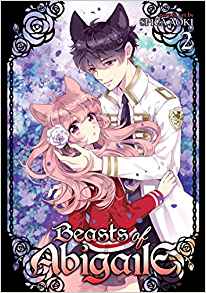
Beasts of Abigaile Vol. 2

November 4, 2017 by Anna N

Beasts of Abigaile Volume 2 by Spica Aoki

I enjoyed the first volume of this series more than I was expecting to, so I was hoping that the second volume would deliver more paranormal romance trashy fun, and I was not disappointed. Nina continues to attempt to survive her undercover existence at werewolf school, ending up with more power and influence than anyone would have predicted.

Towards the end of the first volume, Nina takes an interest in Poe, a somewhat non-verbal artist who as an Omega, gets picked on by the rest of the students and the instructors. Nina is unhappy about the unsanctioned fight clubs that put students up against real live wolfs. Meanwhile, Roy and mean girl Eva seem to be having some significant fractures in their relationship, as Roy continues to find Nina fascinating, and Eva lurks in the bushes like a lupine Maleficent, spying on her possible female rival. Nina wants to let Poe into her pack, the White Rose Maiden Association, but the art kids that she hangs out with don’t want their status to drop by taking him in. They’d also be put in a position of danger in needing to defend him against other students as well. Eventually the situation boils over and Nina impetuously volunteers to take Poe’s place in the fight club. She declares herself Poe’s Alpha and says that she’ll fight all his battles for him. While Nina’s karate skills come in handy, she’s eventually rescued by Giles, who always seems to be around when she needs him.

This volume filled in a little bit of the backstory, both with Nina’s past history with bullying that makes her a relentless advocate for the downtrodden, and also some of the history of the school and why Poe has been placed in such a lowly position. Roy continues to be a total jerk, and I’m hoping that Nina doesn’t end up with him in the end, but with the way shoujo manga tends to go I’m guessing Nina’s influence will change him from being a terrible person. The art in this series continues to be well-executed, even if it doesn’t have a very distinct style. I’m still enjoying this series, but I tend to be a bit of an easy mark for supernatural shoujo.

Filed Under: Manga Reviews, REVIEWS Tagged With: beasts of abigaile, Seven Seas, shoujo

Yokai Rental Shop, Vol. 1

October 31, 2017 by Katherine Dacey

Yokai Rental Shop is a classic example of Monkey Paw Theater, in which a foolish person comes into possession of a magical object, uses said object to grant an ill-advised wish, then pays a terrible price for his rash decision. Author Shin Mashiba puts a Japanese spin on W.W. Jacob’s famous story, substituting a nekomata and an okuri-inu for a cursed paw, but otherwise conforms the tenets of the genre. The clientele of Pet Shop Crow seek quick or unwise solutions to everyday problems: one mourns the untimely demise of her favorite idol, another dreads his daily encounter with bullies, and a third worries that her younger sister is trying to steal her boyfriend. To help each client “solve” her problem, shop owner Karasu rents them an exotic pet with special abilities. That pet comes with specific instructions — defy them and the deal goes sideways, resulting in bodily harm or emotional trauma.

I liked this story better when it was called Pet Shop of Horrors.

Part of the problem is that Karasu’s clientele is an unsympathetic lot, especially when contrasted with the characters in “The Monkey’s Paw” or Pet Shop of Horrors. The bullying victim, for example, is so enraptured by his yokai companion’s powers that he explicitly ignores Karasu’s instructions, fantasizing about how he will utilize his new-found strength. Within two pages, however, he realizes the folly of his arrogance, as the okuri-inu metamorphoses into a canid Godzilla with a taste for human flesh. Only a quick intervention from Karasu prevents the chapter from devolving into a gruesome spectacle, though you may wish that Karasu had adopted a more laissez-faire attitude towards his foolish client.

The other major issue plaguing Yokai Rental Shop is that Mashiba doesn’t stick with the monster-of-the-week formula for long. A subplot involving Karasu and his half-brother Hiiragi, a fussy civil servant, takes a detour into InuYasha territory when Karasu makes an important discovery about their father. Mashiba tries milking the brothers’ temperamental differences for laughs, but the jokes don’t land with much force; if you’ve seen one episode of The Odd Couple or read a chapter of xxxHolic, you’ve seen this dynamic executed with more gusto and imagination, two qualities that Yokai Rental Shop sorely lacks.

Neither of these deficiencies would be so glaring if the artwork was less perfunctory, but Mashiba’s serviceable character designs and settings do little to imbue the story with its own identity. The shop’s clientele, in particular, are blandly interchangeable; they look like they belong in a government-issue manga about tax returns or recycling, lacking the kind of individuality that might highlight the poignancy of their dilemmas or underscore just how determined they are to get what they want. Even the “turn” in each story — in which the yokai reveal their true natures — is executed in get-the-job-done manner, relying too much on dialogue, smudgy screentone, and slashing lines to suggest what’s happening.

By skimping on these moments, Mashiba misses a crucial opportunity to make the reader feel pity, revulsion, satisfaction, or fear at the outcome of each story; the strongest reaction that any of these scenarios elicits is a shrug of the shoulders. The reader is left wondering why the author even bothered with the horror angle when her true objective seems to be writing a dramedy about a Mutt-and-Jeff pair of brothers—albeit eccentric ones.

YOKAI RENTAL SHOP, VOL. 1 • BY SHIN MASHIBA • TRANSLATED BY AMANDA HALEY, ADAPTED BY JULIA KINSMAN • SEVEN SEAS ENTERTAINMENT • RATED TEEN

Filed Under: Manga, Manga Critic, REVIEWS Tagged With: Horror/Supernatural, Seven Seas, Shin Mashiba, Yokai

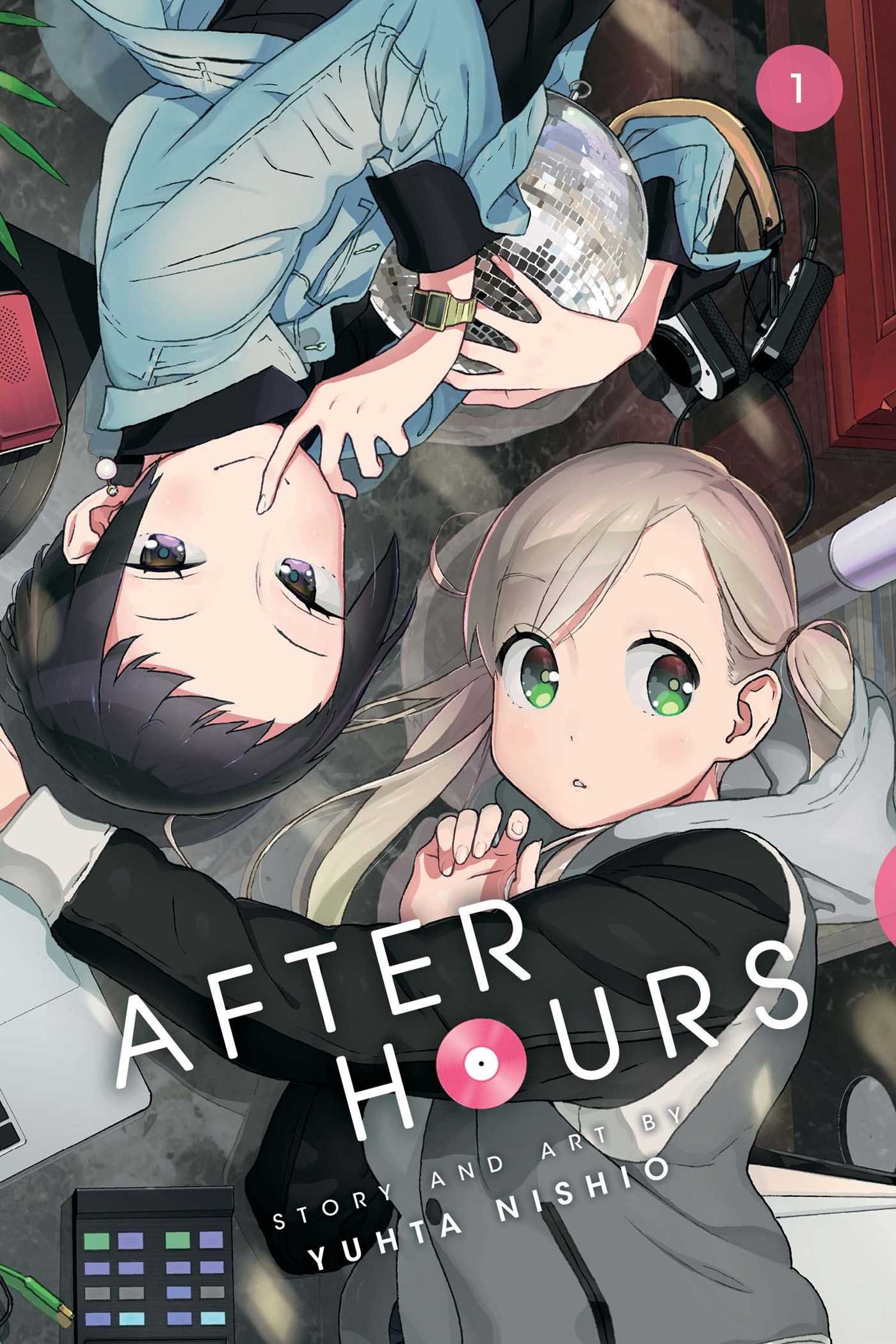
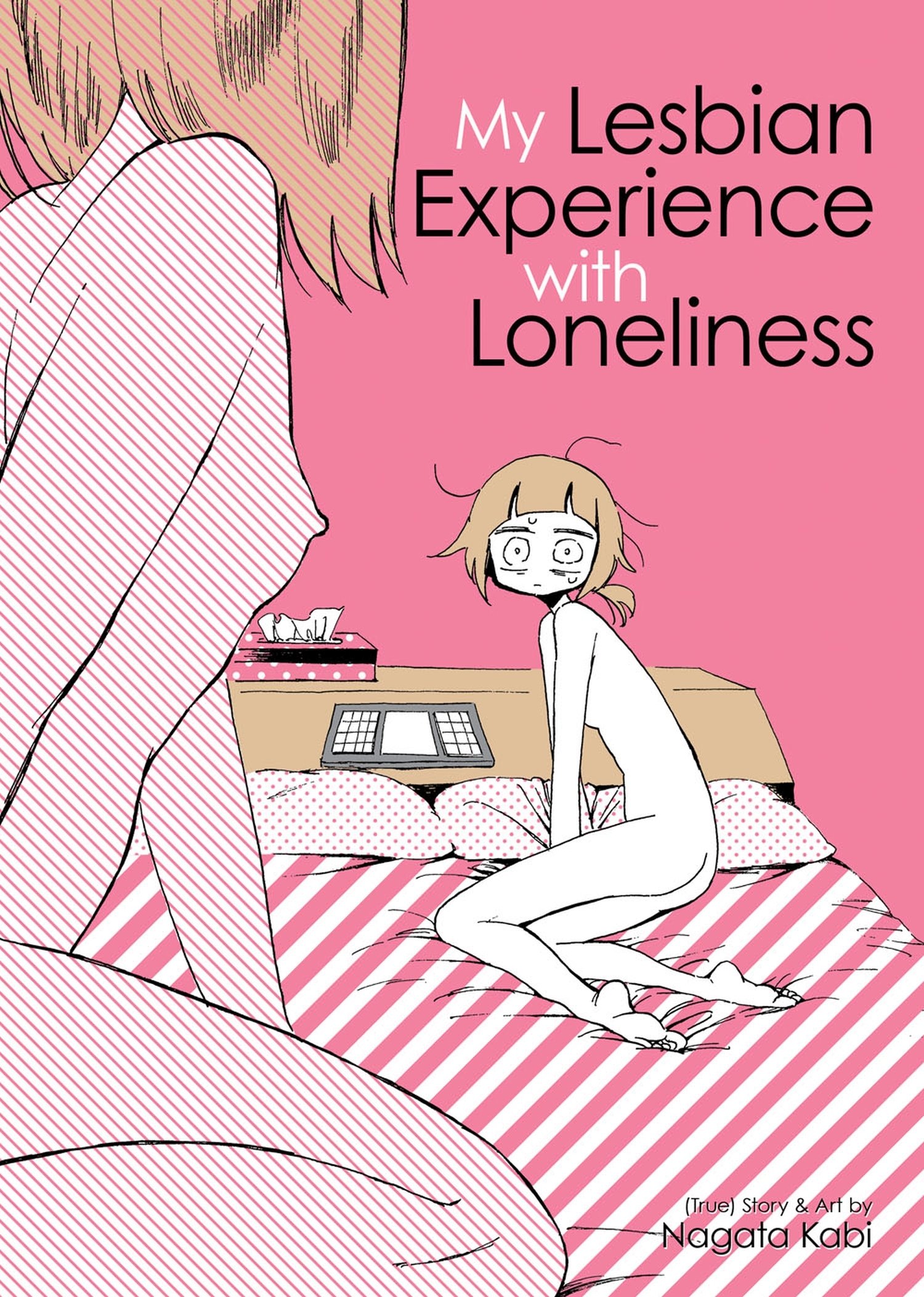
After Hours and My Lesbian Experience with Loneliness

September 22, 2017 by Katherine Dacey

After Hours and My Lesbian Experience with Loneliness epitomize a small but growing trend in yuri manga licensing: both focus on women in their twenties exploring their sexuality, rather than depicting middle- or high-school aged girls crushing on each other.

After Hours is the more upbeat of the two, a sympathetic portrait of twenty-three-year-old Emi, a recent college graduate who’s just quit her job and is struggling to figure out what comes next. A chance encounter with Kei, a twenty-nine-year-old deejay, is a turning point in Emi’s young adult life: not only is she drawn to Kei’s confidence, she’s also intrigued by Kei’s passion for spinning records. As their connection deepens, Emi takes a more active role in supporting Kei’s career, joining Kei’s circle of friends and trying her hand at “veejaying,” selecting videos to complement Kei’s set lists.

One of the most striking aspects of After Hours is Yuhta Nishio’s sensitive depiction of Emi and Kei’s sexual encounters. He uses a handful of discrete signifiers — a pile of clothing on the floor, a tender embrace, a flirtatious post-coital chat — rather than explicit or provocative imagery. That’s a wise choice, I think, as it allows Nishio to portray Emi and Kei as grown women with healthy sexual urges without reducing them to sexualized objects. Nishio’s restrained approach also emphasizes the aspects of Emi and Kei’s bodily intimacy that foster a mutual sense of trust, familiarity, and affection — a dimension of sexual experience that’s often missing from straight romance manga.

Though the first chapters are largely uneventful, future volumes promise dramatic complications. Emi has yet to disclose her relationship to her friends or her not-quite-ex-boyfriend, with whom she’s still sharing an apartment. More interestingly, Emi hasn’t really thought about what it means to be in a relationship with another woman; she’s initially surprised by her attraction to Kei, but resists labeling those feelings as lesbian, bisexual, or queer, choosing instead to savor the sense of purpose and joy that being with Kei brings to her life. The ease with which Emi embraces her new love is a refreshing development, a quiet rebuttal of the idea that sexual orientation is absolute or easily defined.

By contrast, Nagata Kabi’s My Lesbian Experience with Loneliness is a more complex story, a confessional comic documenting the author’s sexual awakening in her late twenties. Nagata narrates her odyssey with candor, acknowledging the degree to which mental illness dictated her adult life. She describes the bodily ravages of disordered eating — she vacillated between anoxeria and bulimia — and the emotional toll of disordered thinking, noting the degree to which both depression and body dysmorphia prevented her from holding down a job, maintaining friendships, or thinking about herself as a sexual person. She also ruminates on her chilly relationship with her parents, and her profound sense of shame in disappointing them by not becoming a “real” adult with a conventional office job.

After hitting rock bottom, Nagata realizes the degree to which she’s suppressed her sexuality. In an effort to reassert control over her life, Nagata decides to hire a female escort for her first sexual experience. Nagata documents this encounter in an almost clinical fashion, contrasting her feverish anticipation with her stiff, detached response to being touched. For all of her progress towards mental health and self-acceptance, she realizes that she cannot yet surrender to the bodily sensations of desire — a tension that remains unresolved at the end of her narrative, even though Nagata’s final panels suggest her sense of relief and pride for taking such a bold step.

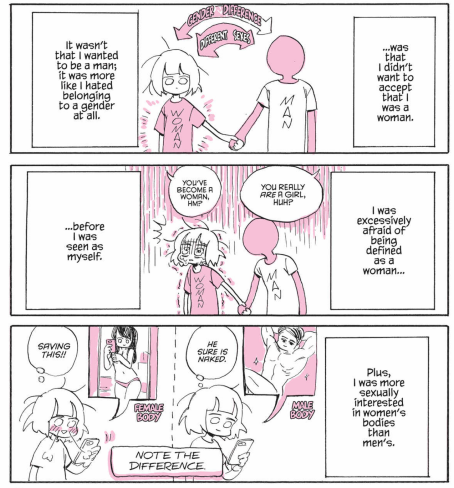
That Nagata’s journey is more inspiring than depressing is a testament to her writing skills (and, I might add, Jocelyne Allen’s artfully wry translation). Though Nagata never shies away from describing uncomfortable thoughts or self-destructive behavior, she finds moments of grace and humor in even the darkest situations, especially as she begins to contemplate what it means to be a sexual person. In three sharp, economical panels, for example, she explores her profound discomfort with binary gender labels, even as she begins to recognize her sexual attraction to women:

It feels churlish to criticize such a personal work, and yet I found myself wishing that Nagata’s art felt more essential to the story she was telling. Writing for The Comics Journal, critic Katie Skelly voiced similar concerns, arguing that Nagata’s tendency to mix big blocks of text with cute drawings keeps the reader at arm’s length when Nagata discloses intimate, sometimes disturbing, details of her eating disorders and self-mutilation. “Nagata can’t find a suitable bridge to mend the gap between the story of her experience and aesthetic,” Skelly notes. “[H]er style can read as generic and her tone never quite finds its mark.” I admit to feeling the same way about Nagata’s work: I admired her raw honesty, but felt that My Lesbian Experience with Loneliness could have been a book, a movie, or a Moth Radio Hour segment just as easily as a comic; nothing about the way Nagata related her experiences felt like it was uniquely suited to manga, as her drawings were more illustrative of what she felt than genuinely revelatory about why she felt such profound self-loathing.

For all the things that go unsaid in My Lesbian Experience with Loneliness, however, there’s much wisdom in Nagata’s story, especially for people struggling with what it means to be healthy, whole, and sexual. Nagata’s recovery is a testament to the human capacity for resilience, and her willingness to share her most vulnerable moments with strangers an act of genuine courage. Here’s hoping that she continues to document her journey of self-discovery.

VIZ Media provided a complimentary review copy of After Hours.

AFTER HOURS • STORY AND ART BY YUHTA NISHIO • TRANSLATION BY ABBY LEHRKE • 160 pp. • RATED TEEN+ (for older teens)

MY LESBIAN EXPERIENCE WITH LONELINESS • STORY AND ART BY NAGATA KABI • TRANSLATED BY JOCELYNE ALLEN • SEVEN SEAS • 152 pp. • RATED OT (for older teens)

Filed Under: Manga, Manga Critic, REVIEWS Tagged With: LGBTQ, My Lesbian Experience With Loneliness, Nagata Kabi, Seven Seas, VIZ, yuri

The Girl from the Other Side: Siúil, a Rún, Vol. 1

April 28, 2017 by Ash Brown

The Girl from the Other Side: Siúil, a Rún, Volume 1Creator: Nagabe
Translator: Adrienne Beck
Adapter: Ysabet Reinhardt MacFarlane
U.S. publisher: Seven Seas
ISBN: 9781626924673
Released: January 2017
Original run: 2016

The Girl from the Other Side: Siúil, a Rún by Nagabe was easily one of my most anticipated manga debuts of 2017. Nagabe is known as a creator of somewhat unusual or unorthodox manga, The Girl form the Other Side easily fitting into that category. (Nagabe’s work was actually first brought to my attention thanks to a series of beautifully drawn boys’ love doujinshi featuring birds.) The first volume of The Girl from the Other Side was originally published in Japan in 2016, while the English-language edition was released by Seven Seas early in 2017. The quality of the physical release is admittedly a little disappointing–the cover stock feels ephemeral and ink tends to smudge and transfer between pages (granted, this does at least seem to be thematically appropriate)–but I’m thrilled that The Girl from the Other Side is being translated at all. It’s also worth noting that the manga does share some obvious parallels with another unusual series, Kore Yamazaki’s The Ancient Magus’ Bride, but even considering their similarities they are quite different from each another.

Once upon a time, two kingdoms existed in a world divided into the Outside and the Inside. Humans live on the Inside behind a wall intended to keep the monstrous Outsiders and the dark curse associated with them at bay. Coming into contact with an Outsider is to be avoided at all costs; to do otherwise means risking ones’ life and humanity. But the darkness of the Outside is slowly encroaching upon the light of the Inside. Humans are succumbing to a cursed disease and are abandoning entire villages as they unsuccessfully try to flee from it. Out of fear and suspicion, people have started to turn against one another in a desperate effort to survive. In the midst of this turmoil is a young girl, Shiva. Unexpectedly left behind in an area which is now considered a part of the Outside, she is waiting to be reunited with her family. In a peculiar twist of fate, Shiva is being guarded and cared for by an inhuman Outsider who she simply calls “Teacher.” The circumstances are unusual and dangerous for them both as Shiva’s safety becoming more and more difficult to guarantee the longer she remains on the Outside, set apart from others.

 The Girl from the Other Side: Siúil, a Rún, Volume 1, page 32The fact that Shiva’s very life is in danger is clear from the beginning of The Girl from the Other Side. As a sort of prologue, the manga opens with her being warned of the curse brought by the touch of an Outsider while the first panel of the story-proper shows her lying listless on the stump of a tree. She has only fallen asleep, but the visual cues of the scene are closely reminiscent of death. An ominous feeling of uncertainty–is Shiva actually alive or is she dead, how much of her world is real and how much of it is a fairytale–pervades The Girl from the Other Side. Shiva is young enough that she doesn’t completely understand everything that is happening to her and doesn’t know enough to be afraid. But as she experiences more her awareness grows, even when Teacher tries to shield her from life’s harsher realities. Likewise, readers gain more knowledge as the underlying truths of Shiva’s situation are slowly revealed. However, they don’t have Teacher to soften the blows for them. To some extent Shiva’s innocence protects her from the tragedy and heartbreak inherent to The Girl from the Other Side which is so obvious from an outside perspective.

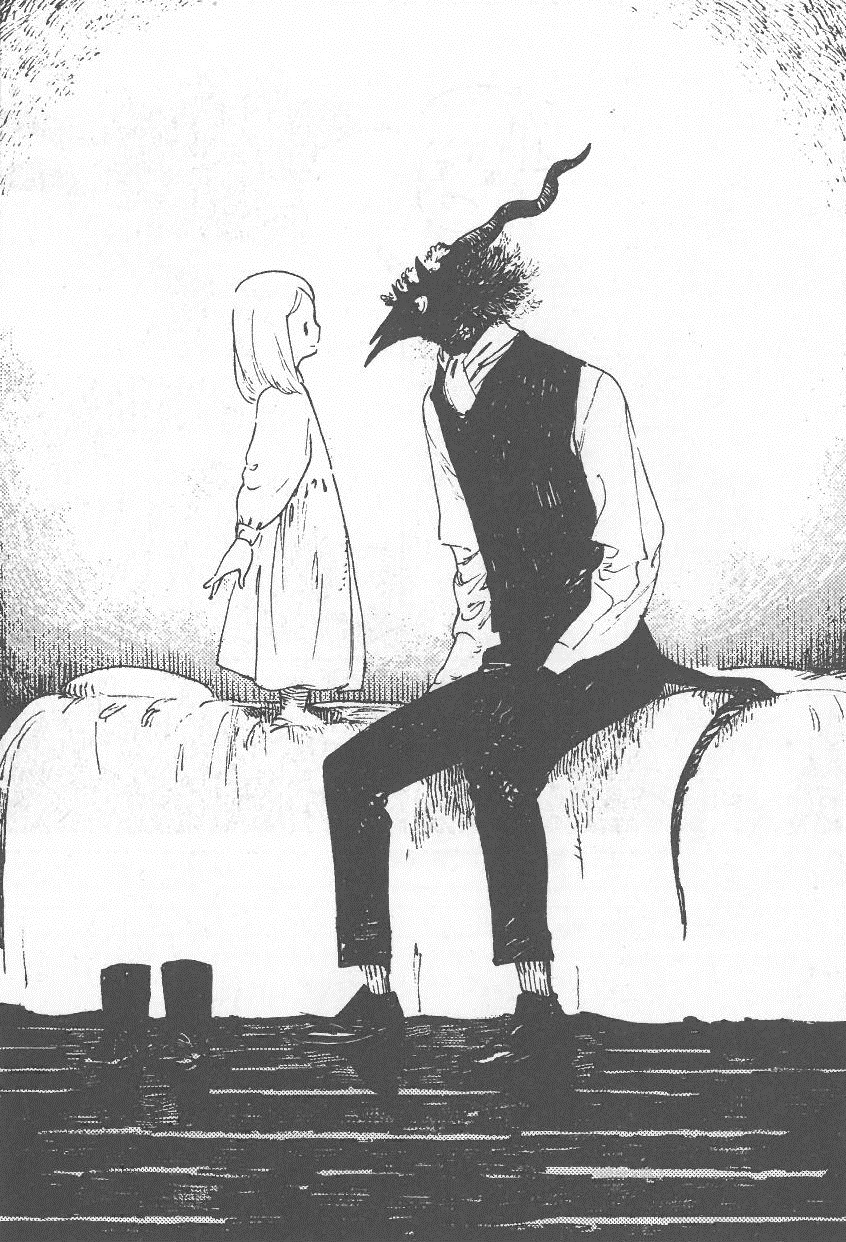
The Girl from the Other Side is incredibly atmospheric, a beautiful and surprisingly gentle and charming story which simultaneously manages to be disconcerting and unsettling. The series is very dark, in both theme and illustration. There is a tremendous amount of ink on the manga’s pages–the oppressive shadow of death which haunts the story is reinforced visually, the darkness permeating the scenes. Shiva, with her light-colored hair and dressed in white, stands apart from the unwelcoming environment. She is obviously out of place, separate from what is around her. In contrast, Teacher is clothed in black and at times is barely discernible from the background. But although an Outsider and demonic in form, Teacher is Shiva’s only hope, trying to safeguard her from anyone who would seek to do her harm. Their strange yet sweet and endearing relationship is core to The Girl on the Other Side. The life that they have, no matter how impermanent, carries great weight as they face an uncertain future together. The Girl from the Other Side is a gorgeous and striking work; I can’t wait for the next volume to be released.

Filed Under: REVIEWS Tagged With: Girl from the Other Side, manga, Nagabe, Seven Seas

The Girl From the Other Side: Siúil, a Rún, Vol. 1

January 17, 2017 by Katherine Dacey

On the surface, The Girl From the Other Side: Siúil, a Rún looks like a fairy tale. It unfolds in a long-ago, far-away place governed by one simple rule: humans and Outsiders must never cross paths. The principal characters are Shiva, a young girl, and Teacher, an Outsider who adopted Shiva after finding her alone in the woods. At first glimpse, their situation seems idyllic, two opposites living harmoniously in a charming little cottage — that is, until the human and demon worlds take interest in Shiva, testing Teacher’s commitment to protecting her.

Probe a little deeper, however, and it becomes clear that the manga’s nuanced characterizations elevate Shiva and Teacher from fairy tale archetypes to fully realized characters. Shiva, for example, talks and acts like a real six-year-old, toggling between moments of impetuousness and thoughtfulness. Though she is obviously fond of Teacher, she fantasizes about a reunion with her aunt, fervent in her desire to rejoin the human world. Shiva has an inkling that Teacher might be “sad” if she left, but she cannot fully appreciate his anguish over their possible separation. (Translator Adrienne Beck and adaptor Ysabet Reinhardt MacFarlane deserve special mention for voicing Shiva’s dialogue with naturalism; Shiva never sounds older or wiser than her years.)

The sophisticated artwork, too, plays an important role in transporting the reader to a specific place and time, rather than simply “long ago.” Nagabe’s elegant pen and ink drawings demonstrate a superb command of light; using washes and cross-hatching, she evokes a world lit by fire, where the glow of a candle casts a small spell against the darkness, and monsters lurk in the shadows. Her figure drawings are likewise strong, neatly conveying the characters’ personalities in a few well-chosen details. Teacher, for example, is a clever amalgamation of animal and demon parts. His most menacing features — his mouthless face and piercing eyes — are tempered by the way he carries himself; he’s fastidious in his movements and dress, gliding through the woods with the graceful, upright posture of a dancer.

Lest The Girl From the Other Side sound mawkish or precious, the brisk pacing and crisp dialogue prevent the story from sagging under the poignancy of the characters’ dilemma. It’s perhaps a little early to nominate it for a “Best of 2017” award, but this promising first volume demonstrates a level of craft, imagination, and restraint that’s sorely lacking in many fantasy manga. Highly recommended.

THE GIRL FROM THE OTHER SIDE: SIUIL, A RUN, VOL. 1 • BY NAGABE • SEVEN SEAS • RATING: ALL AGES

Filed Under: Manga, Manga Critic, REVIEWS Tagged With: Fantasy, Girl from the Other Side, Nagabe, Seven Seas

  • « Go to Previous Page
  • Page 1
  • Page 2
  • Page 3
  • Page 4
  • Go to Next Page »
 | Log in
Copyright © 2010 Manga Bookshelf | Powered by WordPress & the Genesis Framework