• Skip to primary navigation
  • Skip to main content
  • Skip to primary sidebar
  • Home
  • About Us
    • Privacy Policy
    • Comment Policy
    • Disclosures & Disclaimers
  • Resources
    • Links, Essays & Articles
    • Fandomology!
    • CLAMP Directory
    • BlogRoll
  • Features & Columns
    • 3 Things Thursday
    • Adventures in the Key of Shoujo
    • Bit & Blips (game reviews)
    • BL BOOKRACK
    • Bookshelf Briefs
    • Bringing the Drama
    • Comic Conversion
    • Fanservice Friday
    • Going Digital
    • It Came From the Sinosphere
    • License This!
    • Magazine no Mori
    • My Week in Manga
    • OFF THE SHELF
    • Not By Manga Alone
    • PICK OF THE WEEK
    • Subtitles & Sensibility
    • Weekly Shonen Jump Recaps
  • Manga Moveable Feast
    • MMF Full Archive
    • Yun Kouga
    • CLAMP
    • Shojo Beat
    • Osamu Tezuka
    • Sailor Moon
    • Fruits Basket
    • Takehiko Inoue
    • Wild Adapter
    • One Piece
    • After School Nightmare
    • Karakuri Odette
    • Paradise Kiss
    • The Color Trilogy
    • To Terra…
    • Sexy Voice & Robo
  • Browse by Author
    • Sean Gaffney
    • Anna Neatrour
    • Michelle Smith
    • Katherine Dacey
    • MJ
    • Brigid Alverson
    • Travis Anderson
    • Phillip Anthony
    • Derek Bown
    • Jaci Dahlvang
    • Angela Eastman
    • Erica Friedman
    • Sara K.
    • Megan Purdy
    • Emily Snodgrass
    • Nancy Thistlethwaite
    • Eva Volin
    • David Welsh
  • MB Blogs
    • A Case Suitable For Treatment
    • Experiments in Manga
    • MangaBlog
    • The Manga Critic
    • Manga Report
    • Soliloquy in Blue
    • Manga Curmudgeon (archive)

Manga Bookshelf

Discussion, Resources, Roundtables, & Reviews

Reviews

Black Bird, Volume 2

November 3, 2009 by MJ 23 Comments

Black Bird, Vol. 2
By Kanoko Sakurakoji
Published by Viz Media

blackbird2
Buy This Book

Misao Harada, already in the unpleasant position of having to depend on the dreamy yet controlling demon Kyo for her very life, finds things further complicated by the arrival of the rest of Kyo’s tengu clan. The new arrivals (all male, each prettier than the next) include Kyo’s older brother, Sojo, whom Misao also knew as a child. On the plus side, Misao finds out that Kyo fought to take Sojo’s position as head of the clan, presumably in order to marry her, lending additional credibility to his declaration of love. Unfortunately, deceptively mild-mannered Sojo turns out to be a pretty sick guy who will do anything to destroy Kyo and take back what was his, placing everyone’s lives in peril.

This is a fairly eventful volume that packs quite a punch, both in terms of romance and melodrama. Sojo is a truly hateful villain who even abuses adorable little tengu Taro and his brothers–the general equivalent of kicking an uncommonly cute puppy–making him incredibly easy to despise. Revelations about Kyo’s past with Misao and the memories that were erased from her mind by Sojo’s magic create a dark, romantic tone that would be difficult for any hot-blooded shojo fan to resist, despite the story’s sexually-charged violence. Unfortunately, this volume’s final chapter destroys the one thing that had, until this point, kept its misogynistic overtones somewhat in check.

In my review of volume one, I said that it was Misao’s clear view of her own situation that made the story palatable, despite Kyo’s deeply controlling nature. Misao knew that she was stuck depending on Kyo and hated it, highlighting both the poignance of her circumstances and her own personal strength, and presenting an opportunity for Kyo to be the one to change in order to be worth of her. This begins to erode early in volume two, as Misao falls further for Kyo’s charm and the bits of memories she’s clung to all these years. Still, it is possible to hang on as evidence mounts suggesting Kyo’s sincere intentions. Then everything falls apart all at once with a bit of internal monologue from Misao as Kyo unbelievably forces himself on her as a form of “punishment” for her behavior with his bishonen relatives.

He never has sweet words for me. He uses force to make me understand what he’s thinking. That’s why when he hugs me gently I can feel it. I get the message.

With these words, any hope of Misao remaining a strong heroine is lost and I suspect this series has lost me. Though it has great potential as a compelling piece of deliciously trashy shojo, I’m not sure it can come back from that. Prove me wrong, Black Bird?

Review copy provided by the publisher.

Filed Under: MANGA REVIEWS Tagged With: blackbird, manga

Vampire Knight 8 by Matsuri Hino: B

November 2, 2009 by Michelle Smith

vampireknight8Have you ever seen anyone claim, in defense of Vampire Knight, “It gets better! Wait until you get to chapter 35!”? Well, it turns out that they’re half right.

Chapter 35 is a game-changer, with the full details of Yuki’s forgotten past coming to light along with unexpected revelations and their attendant complications. I found part of what occurs easy to predict, given the final moments of volume seven, but was genuinely surprised by a few things and absolutely delighted by Zero’s tortured reaction. (And yes, I am being terribly vague on purpose. It really is that big of a spoiler.)

However, I wouldn’t say that the series is necessarily better as a result of this dramatic turn. Kaname’s evil relative, Rido, has emerged as the villain of the piece, but he’s a recent addition and woefully undeveloped. Shifting allegiances are tough to pin down, Kaname behaves inscrutably, and the political maneuverings of the vampire realm can be confusing.

These flaws aren’t anything new—and are ameliorated somewhat by the gorgeous art—so I’d advise against developing unrealistically high expectations. Shocking developments aside, volume eight essentially offers more of the same.

Review copy provided by the publisher. Review originally published at Manga Recon.

Filed Under: REVIEWS Tagged With: Matsuri Hino, shojo beat, VIZ

Ouran High School Host Club 13 by Bisco Hatori: B

November 2, 2009 by Michelle Smith

ouran13Feelings. That’s entirely what this volume is about. First, you’ve got Haruhi taking a love quiz and finally realizing that what she feels for Tamaki isn’t just admiration of his many good qualities, but actually love. Not that she’s ready to deal with that just yet, so she resolves to take his advice and start accumulating more life experience. Next, Hikaru informs Tamaki that he loves Haruhi, which sends Tamaki into a tizzy that still doesn’t result in him realizing his own feelings.

Even though I get the sense that not too much about this series is planned in advance, Hatori-sensei does at least offer a credible explanation for Tamaki’s family fixation and exactly why he may be unable to acknowledge his feelings for Haruhi. I also like how Haruhi realizes that Tamaki’s been encouraging her to be less apathetic for quite some time now and how he, who is pursuing his new career goals with much energy, has actually become her role model in a lot of ways.

This series is nothing if not lighthearted, but sometimes the side trips into comedy (or unnecessary appearances by other host club members) get in the way of the love story. Still, it’s fundamentally a warm, fuzzy, and satisfying read.

Review copy provided by the publisher. Review originally published at Manga Recon.

Filed Under: REVIEWS Tagged With: Bisco Hatori, shojo beat, VIZ

Ouran High School Host Club 12 by Bisco Hatori: B+

November 1, 2009 by Michelle Smith

ouran12From the back cover:
Hikaru and Kaoru’s fight over Haruhi is taking its toll on Hunny and Mori, who are trying to watch over the estranged twins. Meanwhile, unbeknownst to Tamaki, Kyoya starts looking for Tamaki’s mother in France.

Review:
Three plot threads are simultaneously underway in this volume, though they converge nicely by the end. In the first, Kyoya is using the class trip to France to look for Tamaki’s mother. In the second, Kaoru and Hikaru are fighting over their feelings for Haruhi and Kaoru launches a plan to spur Hikaru into action. And in the third, Tamaki is trying to decide what he wants to do with his life, and a job offer from his dad gives him a lot to consider.

Although I like the twins and enjoyed the chapters focusing on them—wherein Kaoru rightly sees the need for him and Hikaru to establish themselves as individuals but has a rather convoluted way of going about it—the heart of this series for me will always be Haruhi and Tamaki. Tamaki has backed out on the class trip to France at the last minute, but everyone else believes he has gone. There’s a priceless scene around the middle of the book where Haruhi’s on the phone with Kyoya asking how Tamaki’s doing and then spots him lurking in front of her house. There’s a lot more to the scene than that, but I don’t want to spoil it.

Haruhi and Tamaki proceed to have a lovely scene with just the two of them, wherein he gives her license to ask anything about his childhood. He also confides in her that his desire to make people happy comes from a vow to his mother and that he’d also like to carry this oath further into a career. Haruhi’s encouragement clearly means the world to him, and it’s also clear that Haruhi admires him and is getting a bit flustered in his presence (something that completely failed to happen during an outing with Kaoru in the volume’s earlier chapters). When Kyoya is later able to report that Tamaki’s mother is doing well (sniffle alert!), Tamaki decides to embrace his place in the Suoh family and accept his father’s offer to work with a chain of hotels the Suoh corporation owns.

So here we have a volume that features several characters maturing, two reticent characters displaying fondness for Tamaki, a classic bit of comedy, and a scene that brought tears to my eyes. I guess that may not seem like much, but for a largely episodic series like this one, it really is quite a lot. It also, as someone mentions in uncredited narration, is starting to feel like the beginning of the end. I think the timing’s perfect—we’ve had quite a while to enjoy these characters in a variety of situations and now it’s time for some of them to grow up enough to realize that it’s not a bad thing if relationships evolve from their current states. From all present indicators, it would seem the ending is shaping up to be a satisfying one.

Filed Under: REVIEWS Tagged With: Bisco Hatori, shojo beat, VIZ

Vampire Knight 5-7 by Matsuri Hino: B

October 30, 2009 by Michelle Smith

vampireknight5Vampire Knight is a series with a plot that makes sense while you’re reading it, but is difficult to summarize in a coherent manner. In these three volumes, the story moves away from Zero and his angst to focus more squarely on Yuki, who is increasingly more insistent upon uncovering her missing memories. She correctly surmises that Kaname is hiding things from her and confronts him several times, only to have him evade the question. Meanwhile, whenever she attempts to remember on her own, she experiences blood-drenched hallucinations. Her visions get progressively worse, prompting Kaname to whisk her away at the end of volume seven with the words, “It’s time to wake up… before you go mad.”

vampireknight6Other things are going on in the background: political factions in the vampire world are at odds over their government, with some wanting to restore the monarchy (which would make Kaname king) and others in support of the senate; Zero is suspected of killing a pureblood vampire, but is not actually the culprit; Ichiru, Zero’s brother, enrolls at Cross Academy with the apparent goal of doing something nefarious to Yuki; and, most importantly, a rival heir to the Kuran lineage awakens and inhabits the body of his son, currently attending the school. This last personage is shaping up to be the main villain of the piece, and it’s likely that Kaname has taken various steps to both up his own power and increase Yuki’s status amongst his brethren (by acknowledging her as his lover, he essentially guarantees her a vampire guard) all in order to protect her from this creepy foe.

vampireknight7As it has progressed, the story of Vampire Knight has become increasingly engaging, and I think it’s pretty safe to say that I’m addicted by this point. Zero has stabilized somewhat—a drink of Kaname’s blood, offered solely for Yuki’s sake, has stalled the progress of his insanity—while Kaname has grown both darker and more vocal about his feelings for Yuki, declaring his love for her outright at one point. Hino has also stopped writing scenarios in which Yuki blindly rushes into a dangerous situation and then promptly requires rescue. In these three volumes, it only happens once. These factors combine to make Kaname’s feelings for Yuki more believable, thus enabling me to be more invested in their interactions, which are growing progressively more sexay. I wouldn’t say yet that I actually like Yuki, but at least I no longer feel the desire to grab her by the shoulders and shake vigorously.

The art continues to be gorgeous, dark and gloomy and full of beautifully despondent boys. Hino’s also adept at cliffhangers; the one at the end of volume seven is the most suspenseful yet. While it may not be the best shojo series in existence, Vampire Knight offers an appealing blend of angst and gloom that has me hooked.

Filed Under: REVIEWS Tagged With: Matsuri Hino, shojo beat, VIZ

Mijeong

October 30, 2009 by MJ Leave a Comment

mijeongI have a new review over at Manga Recon this morning featuring Byun Byung-Jun’s Mijeong, a collection of short manhwa with a decidedly melancholy tone. This is the artist’s second published anthology and though the work still feels immature, it is clearly something special. For my full thoughts on the subject, read my review, but I’ll share here the last sentence which really sums up my feelings about this work. “Simultaneously dark and hopeful, Mijeong’s inconsistency and fretful tone may betray the early weaknesses of its creator, but its insight and uncommon beauty promise much greater things to come.”

I dearly hope that releases like this one will help push forward the publication of more and varied manhwa in English. Despite the medium’s 100 year history we still see so little of it here and I, for one, want much, much more!

Filed Under: REVIEWS

Full House, Volume 1

October 27, 2009 by MJ 5 Comments

Full House, Vol. 1
By Sooyeon Won
Published by NETCOMICS

FullHouse1
Buy This Book

Ellie is a young, independently-minded, Oxford educated screenwriter living in London, far from her native Korea, on an estate called Full House, left for her by her recently deceased father. Having given up on romance with her childhood friend Felix, who became frustrated with her lack of interest in a physical relationship, Ellie is content to live the life of a single career woman in the house she so loves. Her happy existence is disrupted, however, when she is evicted from the house by its new owner, scandal-ridden matinee idol, Ryder Baye. Following her eviction, Ellie lingers on a street corner, pondering her future and vowing to complete the screenplay she holds in her hands. A gust of wind blows the pages into the street, and as Ellie struggles to gather them up, her foot is run over by a passing car, the driver of which turns out to be none other than Ryder Baye.

With Ryder already embroiled in scandal, he and his handlers pamper Ellie in the hospital, hoping to keep the accident out of the news. In a burst of anger and desperation, Ellie suggests that Ryder marry her so that she can recover ownership of her home, an idea which–much to her surprise–is pounced upon eagerly by Ryder’s manager, Miranda, who is anxious to prove that Ryder is not gay. Finally agreeing to a false engagement with a guarantee she can return to Full House (which she will share with Ryder, whom she hates), Ellie begins her new life in the public eye, for better or worse.

Though the setup is classic and so far predictable, Full House has a number of things working strongly in its favor. First of all, Sooyeon Won is delightfully wordy, crafting pages of pithy banter between determined enemies Ellie and Ryder as well as long pieces of narration that read more like a novel than a comic. Though this is the same style responsible for the deliciously overwrought melodrama of her well-known boys’ love series, Let Dai, here it reads as stylish romance with a vintage theatrical feel. Ellie’s quick wit and sharp tongue make her an unconventionally appealing heroine, more interested in her career than her appearance or any other traditionally feminine concerns. Ryder is thoroughly enjoyable as her foil, whose only goals are to do his work and carry on his affairs without hassle. That he is especially drawn to the house that Ellie would do anything to keep gives them one piece of common ground, though this romantic comedy is guaranteed to be volatile for a good long time before either of them recognize it.

Another point in this series’ favor is NETCOMICS’ English adaptation, which reads surprisingly well, even capturing a genuinely British feel in the dialogue, something that is helped along significantly by the decorous third-person narration that accompanies much of the volume. Not having read any of the volumes of this series released by its former licensee, Central Park Media, I can’t compare the two, but considering NETCOMICS’ poor early track record with translation, it seems important to mention how nicely they’ve done with this series so far.

Sooyeon Woo’s art, though not as detailed or beautiful to look at as her work on Let Dai, has a light, sketchy feel that complements the breezy tone of the series, aided further by her playful paneling which keeps the pace brisk despite the abundance of dialogue. Both art and dialogue look clean and crisp in NETCOMICS’ online reader, even at its lower-resolution setting, and even the smallest text is readable against the series’ backgrounds, something that can’t be said for Let Dai.

Despite its questionably believable plot and obvious setup, this series has enough spark and energy behind it to easily propel readers into its second volume. Its fast-paced banter and classic romantic comedy feel make Full House an appealing new addition to NETCOMICS’ manhwa catalogue.

Volume one of Full House is available from NETCOMICS online.

Filed Under: REVIEWS Tagged With: full house, manhwa

Manga Artifacts: Domu: A Child’s Dream

October 25, 2009 by Katherine Dacey

Revisiting AKIRA prompted me to re-read Domu: A Child’s Dream, an earlier work that helped cement Katsuhiro Otomo’s reputation as the leading manga-ka of his generation. Though both series include elements of horror and science fiction, the two are utterly different in approach: AKIRA is sweeping, grand, and allegorical, whereas Domu is compact, a taut psychological thriller that unfolds in a mere 230 pages.

Domu begins like a police procedural: an older detective and his hot-headed young partner arrive at a Tokyo apartment complex to investigate a series of deaths. Though the victims’ histories suggest foul play rather than suicide, the detectives are baffled by the crime scenes: all of the victims have jumped off rooftops or slashed their own throats, with no evidence of anyone watching or aiding them. A few tantalizing clues lead investigators to “Old Cho,” a seemingly benign, senile resident who spends most of his time sitting on a bench and muttering. Inspectors Yamagawa and Tamura can’t connect Cho to the crimes, but Etsuko, a stolid little girl who has just moved into the complex, knows how Cho killed them: telekinesis and hypnotic suggestion.

What follows is an intensely creepy cat-and-mouse game between Etsuko and Cho. Though Cho is nominally an adult, his mind is terrifyingly child-like; he kills his neighbors for their “treasures”: a baseball cap with wings, a fake ruby ring, an umbrella, a stuffed toy. Cho initially regards Etsuko as an impediment to his fun, but when he discovers that Etsuko can also move objects with her mind, he begins testing her strength and sense of morality. Their battle begins in the narrow hallways and dim elevator shafts of Etsuko’s building, but quickly consumes the entire complex as Cho attempts to annihilate Etsuko.

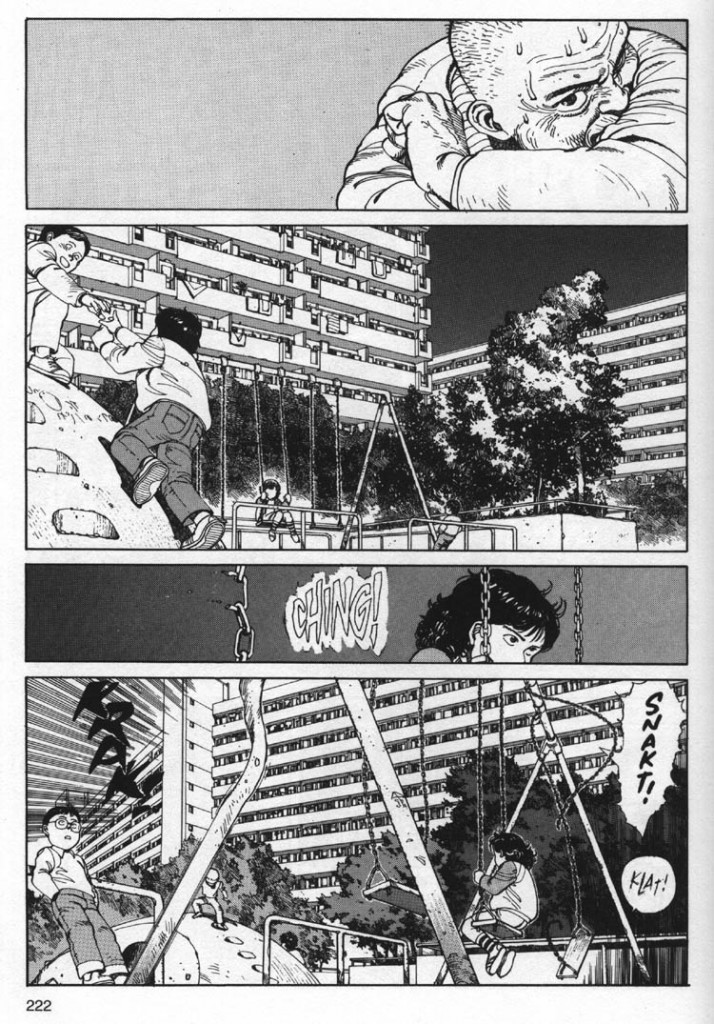
domu_page

Though I found the artwork for AKIRA a bit dated, a relic of a particular moment in sci-fi history, Domu seemed less mired in the 1980s. The characters are refreshingly realistic in their appearance; Cho actually looks like an eighty-year-old man, with a stooped frame, a deeply-etched face, and liver-spotted hands, while Etsuko’s plump cheeks and slightly awkward proportions seem appropriate for an eight-year-old. Otomo lavishes similar attention on his bit players, too, giving each apartment dweller a distinctive look that speaks volumes about his economic status, age, and fear of being swept up in Yamagawa and Tamura’s murder investigation. Even the apartment complex functions as a kind of character, a sterile collection of high-rise buildings whose imposing exteriors give way to dark, dingy interiors and cramped apartments. As Otomo guides us through its labyrinthine hallways and stairwells, we feel a palpable sense of dread; the complex is filled with the kind of dead ends and blind spots that feature prominently in our worst nightmares.

Domu would be a solid, if not remarkable, thriller on the strength of its artwork alone, but Etsuko’s predicament gives the story an added jolt of energy and terror. She’s the strongest, most adult character in the story, the only one with a clear sense of what’s happening, and the only one powerful enough to stop Cho. Making her plight more compelling is the fact that Etsuko behaves like an eight-year-old who just happens to have a deadly gift, rather than a god-like creature who just happens to be eight years old; she’s small and vulnerable, eager for the comfort of her mother’s arms, but she’s also fiercely moral and incredibly brave in the face of nightmarish events, a child whose natural desire to set things right is cruelly tested by a childish adult.

N.B. Domu has been out of print for several years, though copies are relatively easy to find through eBay and Amazon’s extended seller network. Dark Horse released Domu in several formats, including three slim TPBs and an omnibus edition.

DOMU: A CHILD’S DREAM • BY KATSUHIRO OTOMO • DARK HORSE • NO RATING (RECOMMENDED FOR OLDER TEENS)

Filed Under: Manga, Manga Critic, Recommended Reading, REVIEWS Tagged With: Classic, Dark Horse, Katsuhiro Otomo, Sci-Fi

Oh! My Brother 1 by Ken Saito: B-

October 23, 2009 by Michelle Smith

ohmybrother1-125Masago Kamoguchi is a normal girl: normal looks, normal grades, and normal athletic ability. But normal isn’t good enough for Masago when she’s constantly being compared to her older brother, Shiro, who is smart, good-looking, popular, and someone who draws people to him wherever he goes. As the story begins, Shiro is leading the student council in preparations for the school’s Cultural Festival and Masago is keeping a relatively low profile. All of that changes when Shiro dies saving Masago’s life and his consciousness somehow ends up sharing his sister’s body. Assuming that the incomplete plans for the festival are the “unfinished business” keeping Shiro around, Masago (with some oratorical assistance from her brother) convinces the remaining members of the student council to put aside their grief and make the festival a success in his honor. The students do just that, and though Shiro doesn’t move on as a result, that’s okay with Masago, who has decided she likes having him around.

The name Ken Saito might be familiar to some as the creator of The Name of the Flower. I like that series a lot, so I’d been looking forward to Oh! My Brother ever since the license acquisition was announced. Unfortunately, I found it to be somewhat of a disappointment. There are quite a few characters introduced all at once, and their various reactions to Shiro’s death—stemming from unrequited love or unfulfilled soccer rivalry—lack poignancy when we’ve only just met them; the tone is inconsistent, with the comedic aspect of the body-sharing predicament vying with teary moments for dominance; and I literally groaned aloud when the first page revealed the series was entering well-trod school festival territory already. Also, the relationship between the siblings is kind of icky at times: seriously, who blushes furiously when their brother gives them a peck on the cheek?

That isn’t to say it’s without good moments or the potential for a compelling story. When the successful completion of the festival fails to free Shiro’s spirit from this earthly plane, Masago realizes that his unfinished business is actually her and that his wish is for his sister to live life more fully. Of course, one of the ways in which she might do this is by allowing her feelings for Shiro’s friend, Kurouma-sempai, to flourish (and most likely be reciprocated), a path that Shiro seems determined to thwart by taking control of her body any time he thinks they’re getting too close. This dichotomy in Shiro’s intentions is interesting; I hope it’ll be explored later in the series. Also, it’s always completely clear which sibling is in control of Masago’s body at any given time, either by mannerism, expression, or dialogue. That can’t have been easy to achieve.

Artistically, Oh! My Brother has a cute style, though it’s a little too sketchy sometimes, particularly where light-haired characters are concerned. There’s one panel in particular in which a wispy-looking Masago appears right next to a solid-looking, dark-haired Kurouma-sempai. Perhaps there’s actually some deep symbolism going on here—she’s not fully here while he’s got both feet firmly on the ground?—but I rather doubt it. Also, there are a few errors in CMX’s script, a “your” that should be a “you’re,” and a “thoese” that should be either a “those” or a “these,” but definitely not both at once.

Ultimately, while I am slightly disappointed in this first volume, I plan to continue reading. Maybe this one just needs a little time to grow.

Oh! My Brother is published by CMX. The series is complete in Japan with four volumes, though only one has been published in English so far.

Review copy provided by the publisher. Review originally published at Manga Recon.

Filed Under: REVIEWS Tagged With: cmx, Ken Saito

AKIRA, Vol. 1

October 22, 2009 by Katherine Dacey

My first exposure to Katsuhiro Otomo came in 1990, when a college boyfriend insisted that we attend a screening of AKIRA at an artsy theater in the Village. I wish I could say that it had been a transforming experience, one that had awakened me to the possibilities of animation in general and Japanese visual storytelling in particular, but, in fact, I found the film tedious, gory, and self-important. Little did I imagine that I’d be reviewing AKIRA nineteen years later, let alone in its original graphic novel format.

I was pleasantly surprised to discover that Otomo’s epic tale works better on the page than it does on the screen, though it’s easy to see why Otomo felt the lengthy motorcycle chases and fight scenes were swell fodder for a movie. Ditto for the setting: what artist wouldn’t want the chance to rebuild a city as complex and ultra-modern as Tokyo from the ground up?

The story, however, demands the more intimate medium of print, as those chases and fights seem urgent and kinetic on the page, an essential tool for drawing the reader into the story, rather than an opportunity for the animators to dazzle audiences with their technical prowess. The story’s setting works better in print as well; the city feels feels more claustrophobic when rendered in black and white than in color. And the story’s length, too, is a factor; the movie compresses over 2,000 pages of material into two hours, trimming some of the manga’s more interesting subplots and secondary characters in order to accommodate the explosions and high-speed chases, and grossly simplifying the relationship between Tetsuo and Kaneda. As in the movie, neither personality is firmly established before Tetsuo begins morphing from juvenile delinquent to god-like psychopath, yet the manga gives each character more room to be, and not just react. As a result, both seem human and vulnerable, more teenage boys than action figures.

The basic plot has held up well. Its paranoid, don’t-trust-the-military vibe seems as resonant in 2009 as it did when the manga was first released in 1982, as does its message about the devastating consequences of WMDs. Watching China prepare for the Beijing Olympics in 2008 — leveling shanty towns, silencing protests — suggested parallels with AKIRA‘s own Olympic subplot, both in the secrecy surrounding the facilities’ construction and in the government’s adamant denial of citizen opposition to the projects.

The artwork hasn’t aged quite as gracefully as the story; it’s the manga equivalent of a mullet, betraying its early eighties roots. Otomo’s backgrounds and weaponry look liked they’ve been traced from The Star Wars Storybook, exuding the same mixture of sterility and rust that was a hallmark of period science fiction, while his characters have thick bodies and pudgy faces, just like the heroes of Tsukasa Hojo’s manga. Yet it’s hard to deny AKIRA‘s visual appeal. Otomo is one of the few artists who can make a chase or an explosion seem like it’s actually happening on the page, thanks to his ability to convey what I call the “geography” of the scene: how big the space is, how high off the ground it is, how far apart the characters are standing. The sound effects are almost superfluous, as Otomo does such a superb job of showing us how the characters move through the space that one can almost hear the whoosh! and vroom! as they fly past.

If you didn’t finish collecting AKIRA when it was still a Dark Horse property, you can round out your set without compromising its appearance on your shelf; the Kodansha edition is virtually identical, save for the logo on the spine. (No, really: it’s the same translation, same trim size, same cover design, and same price as the 2000 version.) And if you haven’t read it yet? Well, now’s your chance to read one of the medium’s greatest sci-fi epics in a nice, oversized package. Recommended.

Review updated on October 5, 2010.

AKIRA, VOL. 1 • BY KATSUHIRO OTOMO • KODANSHA • RATING: OLDER TEEN (16+) • 368 pp.

Filed Under: Manga, Manga Critic, REVIEWS Tagged With: Classic, Katsuhiro Otomo, Kodansha Comics, Post-Apocalyptic Sci-Fi

xxxHOLiC, Vol. 14

October 20, 2009 by MJ Leave a Comment

By CLAMP
Del Rey, 192 pp.
Rating: T (13+)

With a quiet life restored thanks to her wish, Kohane gives her mother the space necessary for her to gain an understanding of how she must change by moving in with the fortune-teller from volume two, who will also take the opportunity to pass on her craft to Kohane. While visiting, Watanuki teaches Kohane to cook and Doumeki reveals to Kohane the reason behind his friendship with Watanuki. As they walk home later that evening, Watanuki startles Doumeki with a confession (no, not that kind) of his own. Back at the shop, a new customer arrives—a young woman with a wish to obtain cooking lessons. Watanuki is (unwillingly) tasked with fulfilling her wish, which gives him some unexpected insight into both Doumeki’s eating habits and the individual nature of cooking.

Though this volume proceeds more quietly than the last, it is filled with wry humor and thoughtful revelation, two of the series’ best qualities. Also notable in this volume is a strong sense of warmth, something that has increasingly become a part of the series. This is particularly evident in each character’s relationship with Watanuki—from Yuuko to the fortune-teller—including even dry-humored characters like Doumeki and Mokona (with whom Watanuki shares an especially sweet moment in this volume). It is the connection between people that makes this series feel so rich, a point made stronger in this volume when Watanuki reveals that it is these connections that have inspired him to continue his own existence. As usual, this volume also provides enough mouth-watering discussion of food to send every reader running to the kitchen (or at least the nearest Japanese restaurant).

With its gorgeous artwork and philosophical tone, xxxHOLiC continues to provide a feast for both the eye and soul.

Review copy provided by the publisher. Review originally published at PopCultureShock.

Filed Under: MANGA REVIEWS Tagged With: xxxholic

xxxHolic, Volume 14

October 20, 2009 by MJ 6 Comments

xxxholic14Today I have a short review of xxxHolic, Vol. 14 in a special Tuesday edition of Manga Minis. This series is so wonderfully rich and there is much I might have said about this volume, given more space. I’ll try to include some of it here.

First of all, one of the things I discussed in my mini is the level of warmth this series has taken on. The “sweet” moment I mention between Watanuki and Mokona, for instance, is so adorable one could die, and when Kohane asks Doumeki why he remains with Watanuki, the image Doumeki calls forth–Watanuki by the river on a particular rainy day–is enough to break one’s heart. That this is followed by Kohane asking Doumeki to “Take care of Kimihiro-kun… please?” is truly the final nail in the coffin.

It is here, too, that I must mention CLAMP’s effective use of paneling, because it is not so much the dialogue that does the work here, but the imagery. Doumeki doesn’t respond to Kohane with anything more than the squeeze of a hand, but the way that moment is built up–with a flashback to Yuuko’s ominous words about hesitation, individual profiles (cut narrowly within wide horizontal panels) of Doumeki and then Kohane, then a single page consisting only of a larger, fuller profile of Doumeki followed by a close-up of his hand squeezing Kohane’s–draws out the moment perfectly, giving it enormous emotional weight. Similarly effective means are used in the story’s next scene too, in which Watanuki confesses his new resolve to remain in this world. The panels are clean and heavy on contrast as is usual for CLAMP (especially in this series) and this deceptive visual simplicity, much like simplicity of language, allows for stronger statements than could ever be made with more verbose visual language.

This volume is filled with foreshadowing, which I suppose is no different than the rest of the series to this point, but at this point the foreshadowing contains a sense of urgency and immediacy that has not been present before, at least to this extent. That a customer arrives in the middle of it all–something we haven’t seen for quite some time–might appear to break the momentum, but it actually seems to be a part of it somehow, with Watanuki taking on Yuuko’s usual role. A later scene with the voices (but not the bodies) of Maru and Moro only strengthens this feeling, and the book’s final scene sets an uneasy, anticipatory tone for the next volume, despite the unearthly calm of its participants. Will it be Watanuki who is able to grant Yuuko’s wish after all, just as he has hoped to do? It seems likely that we will find out soon.

What read as cold philosophy at the beginning of this series has become intimate personal drama fourteen volumes in, and even Yuuko can’t pretend to be detached from the story’s outcome, particularly as concerns Watanuki, whom she obviously loves. Though I think it goes without saying at this point that reading Tsubasa: Reservoir Chronicle has become an essential part of understanding this series, there is something deep at the core of xxxHolic that stands entirely on its own, and nowhere is that clearer than in this volume.

Click here to read my miniaturized thoughts on the subject (I’m not lying about the food thing; I made rice balls immediately after reading this volume). And please, read xxxHolic. It is truly a thing of beauty.

Review copy provided by the publisher.

Filed Under: MANGA REVIEWS Tagged With: manga, xxxholic

Boys Over Flowers Jewelry Box

October 19, 2009 by MJ 2 Comments

Boys Over Flowers Jewelry Box
By Yoko Kamio
Published by Viz Media

BoysOverFlowers_JB_500
Buy This Book

Though Boys Over Flowers‘ main story finally concluded after 36 volumes, neither fans nor mangaka Yoko Kamio were quite content, thus the release of Boys Over Flowers Jewelry Box featuring two side stories set after the series’ final volume. The first of these follows heroine Tsukushi Makino, now out of high school and working as a clerk in a real estate office to pay her family’s bills. With boyfriend Tsukasa still in New York, former love interest Rui has taken to visiting Tsukushi’s family regularly, becoming so familiar he even addresses her father as “dad.” When the whole group is assembled in Paris to witness the wedding of Rui’s former crush, Shizuka, Tsukasa clearly demonstrates his jealousy by asserting control and throwing money (and insults) at Tsukushi, as usual. The second story focuses on Rui, his uncertainty over his future, and his difficulty letting go long-held feelings for Tsukushi.

Unlike many fans, I felt quite satisfied with the way things were left at the end of volume 36, with true love finally settled (at least for Tsukushi and Tsukasa) but not so settled that the character’s futures were unnecessarily narrowed. After all, the story’s heroine was still in high school at the end of the series, and I think I’d have felt incredibly uncomfortable if things had been left any more certain than they were. That said, there is something decidedly comforting about sneaking a peek into Tsukushi and Tsukasa’s future lives and seeing them still bumbling along in their fiery-yet-conservative romance, as awkward and volatile as ever. Though it is disconcerting to see Tsukasa falling back into his worst, most controlling self at the first twinge of insecurity, demonstrating very little personal growth since the end of the series proper, if there’s one thing that has been made clear over the course of the series, it is that Tsukushi can handle herself regardless of his behavior.

Even nicer is the look into Rui’s world, something that remained largely mysterious throughout the series particularly in terms of his feelings for Tsukushi and, really, women in general. With its thoughtful, melancholy look at Rui and his place both in Tsukushi’s life and within the F4, this volume’s second story is quite plainly the best reason to buy it. I’d consider it a must-read for any fan.

Though this manga offers nothing on the level of Boys Over Flowers‘ greatest drama, that is perhaps the secret to its charm. Short but not too sweet, Boys Over Flowers Jewelry Box provides a nicely quiet postscript to this deliciously melodramatic epic.

Review copy provided by the publisher.

Filed Under: MANGA REVIEWS Tagged With: boys over flowers, manga

Rin-Ne, Vol. 1

October 18, 2009 by Katherine Dacey

I read a Rumiko Takahashi manga for the same reason I watch an Alfred Hitchcock thriller: I know exactly what I’m going to get. Certain plot elements and motifs recur throughout each artist’s work — Hitchcock loves pairing a brittle blond with a rakish cad on the run from authorities, for example, while Takahashi loves pairing a female “seer” with a demonically-tinged boy — yet the craft with which Hitchcock and Takahashi develop such tropes prevents either artist’s work from feeling stale or repetitive. Takahashi’s latest series gives ample proof that while she may have a limited repertory, she’s the undisputed master of the supernatural mystery.

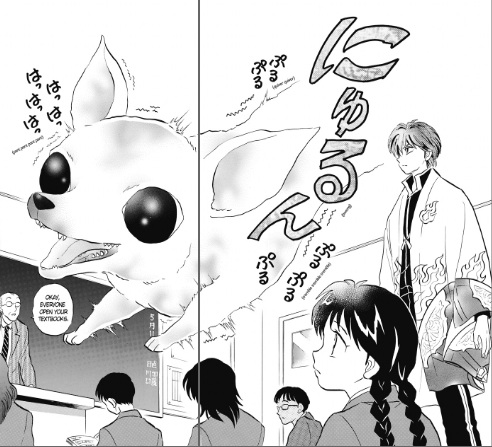
Sakura Mamiya and Rinne Rokudo, Rin-ne‘s oil-and-water leads, are a classic Takahashi pair: Sakura is a seemingly ordinary teenager with the ability to see ghosts, while Rinne is a hot-headed boy who’s part human and part shinigami. The two meet cute in Sakura’s tenth-grade classroom when Rinne arrives to claim his long-empty seat. “Looks like he made it,” Sakura whispers to a friend before realizing that she’s the only person who can see the tall, flame-haired boy in a fancy ceremonial robe. Sakura then watches Rinne  attempt to banish an enormous Chihuahua demon to the afterlife — an exorcism that goes horribly (and comically) awry when the dog’s spirit merges with the spirit of a love-starved teen. Now forced to contend with an even more powerful, angry ghost, Rinne uses Sakura to lure it to the Wheel of Reincarnation, an enormous portal that separates the material and spirit worlds.

rinne_chihuahua

After their dramatic introduction, Sakura and Rinne forge a reluctant partnership. Sakura provides material assistance and ethical guidance to Rinne, while Rinne banishes the spirits that plague Sakura’s high school. Sakura soon learns that Rinne’s grandmother, a shinigami, fell in love with a young man whose spirit she was sent to collect. In exchange for extending his life by fifty years, Rinne’s grandmother agreed to “fulfill her shinigami duties at ten times her usual quota.” When she failed to reach that target, Rinne was forced to enter the family trade, operating on the fringes of both the human and spectral worlds with limited ability to function in either realm — hence his weak exorcism skills.

Where, exactly, Takahashi plans to take the story is still something of a mystery. As she did with InuYasha, she’s using the first few volumes to establish the premise, explain how the Wheel of Incarnation works, and develop the chemistry between her lead characters by subjecting them to a host of unhappy spirits. The first eight chapters have a pleasant, spook-of-the-week feeling, as Sakura and Rinne tangle with a ghostly cell phone caller, a damashigami (a shinigami who meets his quota by luring innocent people to their deaths), and an ochimusa (a disgraced warrior). At the same time, however, Takahashi is clearly laying the groundwork for a more extended storyline, introducing several supporting characters, leaving key questions about Sakura’s past unanswered, and creating space for a Naraku-esque villain to fill.

The first volume’s leisurely pace also allows Takahashi plenty of room to showcase her comedic talents. Though InuYasha, Mermaid Saga, and Rumic World have canted more strongly towards horror, Rin-ne is decidedly humorous, incorporating supernatural elements into everyday settings in delightfully absurd ways. Takahashi’s demon Chihuahua is a great example: the demon continues to behave like a nervous, short-haired toy even after it grows to enormous size, and remains susceptible to the savory appeal of milk bones. Rinne’s grandfather is another example of the supernatural made ridiculous; as Rinne’s grandmother wistfully notes, her husband was reincarnated as a mackerel — the destiny for which he was slated when she fell in love with him.

Though utterly enjoyable, Rin-ne has its flaws. Takahashi relies a little too heavily on interior monologues to cue us into what’s happening; Sakura is frequently called upon to mutter, “So that’s why no one can see him!” even when the illustrations make it plain that Rinne is invisible to humans when he dons his flame-patterned haori. Takahashi isn’t above recycling bits from other works, either; Rokumon, a familiar introduced in chapter six, bears a strong resemblance to InuYasha‘s Shippo in both appearance and plot function, comic relief in the form of a child-like animal spirit. Sakura, too, seems more like a Kagome clone than a character in her own right, though she’s a little edgier and more skeptical than her jewel-seeking predecessor.

Still, it’s hard to dismiss a manga that’s crafted with as much skill and good humor as Rin-ne. The story and characters may remind readers of other works in the Takahashi canon, but that strikes me as a good thing — yet another opportunity to spend time with the kind of spunky heroines, rash-but-kind heroes, and oddball supporting characters that give Takahashi’s work its distinctive flavor.

Review copy provided by VIZ Media, LLC. Volume one of Rin-ne will be available on October 20, 2009.

RIN-NE, VOL. 1 • BY RUMIKO TAKAHASHI • VIZ • 182 pp. • RATING: OLDER TEEN (16+)

Filed Under: Manga, Manga Critic, REVIEWS Tagged With: Action/Adventure, Rumiko Takahashi, shonen sunday, VIZ

The Gentlemen’s Alliance Cross 10 by Arina Tanemura: C

October 16, 2009 by Michelle Smith

gentlemen's10After resolving some convoluted-sounding subplots involving Haine’s family—featuring maternal amnesia, uncertain paternity, and mansions afire—The Gentlemen’s Alliance Cross moves into the home stretch as Haine is pressed to finally choose between the identical twins with whom she is in love. Alas, just when she finally grasps the idea that the nice twin (Takanari) is probably a better choice than the scheming git (Shizumasa), he’s captured by his brother’s minions and imprisoned. Like any self-respecting shojo heroine, Haine vows to rescue him.

Being the penultimate volume of the series, volume ten offers a variety of dramatic moments and revelations, including arranged marriages, envelopes with surprising contents, and a tale of childhood betrayal that explains the current animosity between the twins. My favorite, though, is the surprise leukemia.

The end product of all these dire events tumbling one atop the other can be described as little else than a mess, and I was much more compelled to snicker at the ridiculous developments than sympathize with anyone involved. Still, I was pretty impressed by how easy it was to jump in and follow the story at this point and ended up liking Takanari, too, though I must question his taste in girls.

Review copy provided by the publisher. Review originally published at Manga Recon.

Filed Under: REVIEWS Tagged With: Arina Tanemura, shojo beat, VIZ

  • « Go to Previous Page
  • Page 1
  • Interim pages omitted …
  • Page 319
  • Page 320
  • Page 321
  • Page 322
  • Page 323
  • Interim pages omitted …
  • Page 346
  • Go to Next Page »
 | Log in
Copyright © 2010 Manga Bookshelf | Powered by WordPress & the Genesis Framework