• Skip to primary navigation
  • Skip to main content
  • Skip to primary sidebar
  • Home
  • About Us
    • Privacy Policy
    • Comment Policy
    • Disclosures & Disclaimers
  • Resources
    • Links, Essays & Articles
    • Fandomology!
    • CLAMP Directory
    • BlogRoll
  • Features & Columns
    • 3 Things Thursday
    • Adventures in the Key of Shoujo
    • Bit & Blips (game reviews)
    • BL BOOKRACK
    • Bookshelf Briefs
    • Bringing the Drama
    • Comic Conversion
    • Fanservice Friday
    • Going Digital
    • It Came From the Sinosphere
    • License This!
    • Magazine no Mori
    • My Week in Manga
    • OFF THE SHELF
    • Not By Manga Alone
    • PICK OF THE WEEK
    • Subtitles & Sensibility
    • Weekly Shonen Jump Recaps
  • Manga Moveable Feast
    • MMF Full Archive
    • Yun Kouga
    • CLAMP
    • Shojo Beat
    • Osamu Tezuka
    • Sailor Moon
    • Fruits Basket
    • Takehiko Inoue
    • Wild Adapter
    • One Piece
    • After School Nightmare
    • Karakuri Odette
    • Paradise Kiss
    • The Color Trilogy
    • To Terra…
    • Sexy Voice & Robo
  • Browse by Author
    • Sean Gaffney
    • Anna Neatrour
    • Michelle Smith
    • Katherine Dacey
    • MJ
    • Brigid Alverson
    • Travis Anderson
    • Phillip Anthony
    • Derek Bown
    • Jaci Dahlvang
    • Angela Eastman
    • Erica Friedman
    • Sara K.
    • Megan Purdy
    • Emily Snodgrass
    • Nancy Thistlethwaite
    • Eva Volin
    • David Welsh
  • MB Blogs
    • A Case Suitable For Treatment
    • Experiments in Manga
    • MangaBlog
    • The Manga Critic
    • Manga Report
    • Soliloquy in Blue
    • Manga Curmudgeon (archive)

Manga Bookshelf

Discussion, Resources, Roundtables, & Reviews

Features & Reviews

Mobile Suit Gundam: Awakening, Escalation, Confrontation

September 20, 2013 by Ash Brown

Mobile Suit GundamAuthor: Yoshiyuki Tomino
Translator: Frederik L. Schodt
U.S. publisher: Stone Bridge
ISBN: 9781611720051
Released: April 2013
Original release: 1979-1981

The first part of the massive Gundam franchise to be officially released in English was a trilogy of novels by Yoshiyuki Tomino that were initially published in Japan between 1979 and 1981. The novels are a reimagining of the original 1979 anime series Mobile Suit Gundam which was directed and primarily developed by Tomino. Based on the trilogy’s 1987 edition, the novels were originally translated by Frederik L. Schodt and published by Del Rey between 1990 and 1991. They subsequently went out of print but were released again by Stone Bridge Press in 2004 in an omnibus edition with a revised translation. The omnibus, too, went out of print only a few years later. It wasn’t until 2012 that the license was able to be re-secured, but Mobile Suit Gundam: Awakening, Escalation, Confrontation is once again available in a newly redesigned omnibus. It also includes some of the concept design sketches form the original anime series as illustrations.

In Universal Century 0079, the colonists of Side 3 rebelled against the Earth Federation, establishing the Principality of Zeon. During the ensuing war, half of the solar system’s human population was annihilated before the two sides of the conflict could reach a temporary ceasefire. In less than a year, the relative peace came to an end. The fighting began again as the Federation and Zeon forces were caught up in an arms race. Each side continued developing more and more advanced and powerful weapon systems and mobile suits. Combined with the emergence of Newtypes–humans with astounding powers of intuition and expanded consciousness–the conflict quickly escalated. No one is entirely sure what the Newtype phenomenon means for the future of the human race or what dangers those with Newtype potential will present, but both militaries are resolved to harness their abilities in order to gain an advantage in the war.

I haven’t seen the original 1979 Mobile Suit Gundam anime series in its entirety, but I do know that the novels are a darker, more mature, and more detailed take on the story. The ending of the trilogy is significantly different from that of the anime, as well. My first real introduction to the Gundam franchise was actually through Yoshikazu Yasuhiko’s manga series Mobile Suit Gundam: The Origin, which is also a retelling of the original anime. If I am to be completely honest, I much greatly prefer the manga over the novels. However, simply by the nature of the medium, the novels allow Tomino to explore the world of Mobile Suit Gundam in greater depth than either the anime or the manga; some of the specifics about the characters and their motivations can be found nowhere else. But this can also be a drawback–at times, Mobile Suit Gundam: Awakening, Escalation, Confrontation reads more like an insider’s guide to the Gundam universe rather than a set of novels.

I like the story of Mobile Suit Gundam as well as its setting. Unfortunately, I wasn’t nearly as fond of the novels’ execution. There was an annoying preoccupation with who was or wasn’t, or who could or could not possibly be a Newtype. Though frequently debated, the characters never reach a solid conclusion and constantly change their opinions on the matter. This is somewhat understandable since the Newtype phenomenon is a new step in human evolution that has yet to be strictly identified or defined, but it’s particularly frustrating when the author doesn’t seem to have a firm grasp of the concept, either. I do like the Newtype theory, though, and it is a very important part of Mobile Suit Gundam. I also like that the novels show both sides of the conflict between Zeon and the Federation from multiple perspectives. Mobile Suit Gundam is an ambitious war tale with a fairly large cast of interesting characters. But in the end, I have a feeling that the novels will appeal most to readers who are already fans of the franchise.

Filed Under: REVIEWS Tagged With: Gundam, Novels, Stone Bridge Press, Yoshiyuki Tomino

Manga the Week of 9/25

September 19, 2013 by Sean Gaffney, Ash Brown, Michelle Smith, Anna N and MJ 1 Comment

SEAN: A surprisingly huge last week of the month. Shall we get right down to it?

Cyborg-009-Cover

Archaia has their new modern adaptation of Cyborg 009 debuting this week. I recall the old 60s series when Tokyopop took a flyer on it, and it was fun if very ‘a product of its time’. It’s a series that a modern retelling, getting rid of some of the racism and sexism, could really work wonders. Intriguing.

ASH: I’ve already got my copy of this one. I haven’t read it yet, but I can say this–Archaia’s Cyborg 009 has one of the coolest book designs that I’ve seen in quite a while.

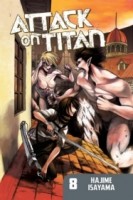
SEAN: Kodansha continues the speedup of Attack on Titan with Vol. 7, which reminds you that the series can still be really, really brutal.

ASH: Yes it can! If Attack on Titan has one thing going for it, it’s the series’ intensity. And tragic deaths.

MICHELLE: I feel very wrong that “tragic deaths” has seriously made me consider Attack on Titan.

ANNA: I feel the same way. What is the ratio of tragic deaths to non-tragic deaths per volume?

MJ: I also would like to see some statistics on this. Yes.

SEAN: Also, lest you think there’s only omnibuses, there’s the 18th volume of Battle Angel Alita: Last Order.

And speaking of speedups, here’s Fairy Tail 30, which wraps up its very long S-class arc, and has a major plot shift that affects… well, not quite everything.

I admit I sometimes miss things coming out via Picturebox and their cadre of indie manga releases. Here’s a new one called World Map Room, which I know nothing about.

ASH: Picturebox is a publisher that has really caught my eye this year. I don’t always enjoy Yuichi Yokoyama’s manga, but I can certainly appreciate his draftsmanship and experimental work.

MJ: Agreed. I’m very interested in what they’re doing.

dictatorialgrimoire_vol1_full

SEAN: I had assumed that Dictatorial Grimoire: Cinderella was another series from Quin Rose in the Alice in the Etc Etc. vein, but apparently not. This is from Media Factory’s oddball shoujo-ish Comic Gene, and is a Grimm’s Fairy Tales rewrite, in a way.

MICHELLE: Huh. I’m feeling a little oversaturated with fairy tail adaptations, though.

ANNA: I love fairy tale adaptations! Not sure if I will check it out although content from oddball shoujo-ish magazines sounds promising.

MJ: Well, huh. This does sound like my kind of thing!

SEAN: Alice in the Country of Clover: Cheshire Cat Waltz is almost finished, I believe, but not quite, so here’s more Boris and Vol. 6.

Mobile Suit Gundam: The Origin has been one of my most awaited titles of 2013, with every volume desperately needing to get into my hands as quickly as possible. Vol. 3 is called Ramba Ral!

ASH: I’ve been very impressed by Vertical’s edition of The Origin. It’s a great manga and a gorgeous release. Plus, I’m a fan of Yoshikazu Yasuhiko’s manga.

MICHELLE: I’m enjoying it, too!

ANNA: I am so happy that Vertical is putting out this series.

SEAN: If you’d told me a few years ago Vertical would be licensing a Young Animal title, I’d have laughed. But here we are. Sickness Unto Death is along the lines of Flowers of Evil, but only 2 short volumes. The first ships this week.

ASH: I’m very curious about this one.

MICHELLE: I don’t know what to think about it.

MJ: I’m always interested in what Vertical has to offer, so count me in!

SEAN: Are You Alice? has a 2nd volume that may potentially have something comprehensible happen, which Vol. 1 lacked, in my opinion.

And The Betrayal Knows My Name, a series that feels like it should be Wings but is instead in Asuka (which is becoming the new Wings), hits Vol. 6, and has lots of reincarnation romance.

MJ: I have been shamelessly addicted to this series ever since my holiday marathon read last year. More, more!

Mori_Bride_StoryV5_HC

SEAN: A Bride’s Story really picked up for me with the introduction of the twins in Vol. 4, so seeing their wedding in this new volume is definitely high on my list of things to do.

ASH: I’m always happy to see a new volume of Kaoru Mori’s A Bride’s Story! (Now, if we could only get Emma back into print, too…)

MICHELLE: Someday I will have time to read this.

ANNA: Me too. I need to catch up. The first two volumes were lovely.

MJ: I adore this series, and I’m very excited about the wedding! Hurray!

SEAN: Kieli hits Vol. 9… of the novels, that is. Don’t get your novels and manga mixed up, especially from Yen, which tends to license both more than most companies.

The regular old manga may be ending in Japan, but its gag spinoff continues, as we see the 7th volume of The Melancholy of Haruhi-chan Suzumiya.

Lastly, Soul Eater hits sweet 16, and will likely start spinning out new plot threads here to see what sticks. Always fun.

What’s whetting your appetite?

MICHELLE: Isn’t Goong 13 coming out too this week, now that I think about it? At least, Amazon has it with the same date as the other Yen, and I just got it in a box of review copies (yay!).

ANNA: eeeeeeeee!

MJ: YAY GOONG YAY!

SEAN: It’s still hard for me to remember Korean books…

Filed Under: FEATURES, manga the week of

Attack on Titan, Vol. 7

September 19, 2013 by Sean Gaffney

By Hajime Isayama. Released in Japan by Kodansha, serialization ongoing in the magazine Bessatsu Shonen Magazine. Released in North America by Kodansha Comics.

(please continue to avoid spoilers in comments)

We all knew a volume like this was coming. Despite the mass deaths and danger, things had simply been going too well for our heroes recently. There were heartwarming moments, and points where you marveled at the awesomeness of humanity. That clearly cannot last. And so you have Attack on Titan 7, which, yes, also gives you heartwarming and reaffirming love for humanity, but then brutally stomps all over it and tears it to shreds while laughing in your face.

titan7

So yeah, it really didn’t bode well that Levi’s team, for all their backstory and character building, never had biographies at the front of the book. Much of this book (and indeed the series in general) is about the mindset of a soldier, and how you can commit to actions that seem stupid or that you may not believe in. I’ll give Special Ops this, they were decisive and trying to stop the Female Titan. And, in the end, they weren’t good enough and were brutally murdered. This doesn’t mean it was a bad decision, or that they didn’t die like heroes. It’s just a function of life in this book, and how horrible the situation is with the Titans. Things are really bad, and sometimes you make a firm decision that leads to an ignoble death.

Speaking of the Female Titan, as Armin has already noted, she’s definitely one of a special group of Titans that are intelligent and crafty, and it shows throughout the entire book. Even when Erwin has her cornered, she’s still able to think of a way out. And her fight with Eren and Mikasa is not only epic but gives us some stunning motivation on what the Titans are trying to achieve; when given an opportunity to kill Eren, she doesn’t, but tries to kidnap him instead. Eren, presumably as he’s also a Titan, is useful to them in some way. Chilling, really.

I do sort of wonder what it will take to get Levi to break, or if he ever will. He’s the most popular character in the series in Japan, and rapidly taking that position over here as well, but there’s only so far stoic can take you. Will he continue to suffer nobly and look off into the middle distance? If nothing else, he makes a very good contrast to hotheads Eren and Mikasa.

But it’s all about the final scene, which simply makes you want to cry. Eren waking up to see everyone re-entering the city. The jeers of the adults, and the cheers of the little children. Petra’s dad, running to Levi, asking him to give her something, and Levi’s stoic non-response. And the final narration, noting that they’re all basically under arrest, Eren’s going to be turned over (presumably to be tortured and executed), and Erwin and company may be in a lot of trouble all around. It’s a horrible place to leave a cliffhanger. And so naturally here is where it is.

But hey, from here things can only get better… right?

Filed Under: REVIEWS

No. 6, Vol. 2

September 18, 2013 by Ash Brown

No. 6, Volume 2Creator: Hinoki Kino
Original story: Atsuko Asano

U.S. publisher: Kodansha
ISBN: 9781612623566
Released: August 2013
Original release: 2011

My introduction to Atsuko Asano’s No. 6 was through the anime adaptation of the original novels. I enjoyed the setting and characters, but was disappointed in the anime’s rushed, original ending. Asano’s No. 6 novels are unlikely to be released in English, so I was glad when Kodansha licensed Hinoki Kino’s manga adaptation of the series. The second volume of the No. 6 manga, originally published in Japan in 2011, was released in English in 2013. Although Kino’s character designs are based on the same ones used for the anime and many of the underlying elements are the same (they are both adaptations of the No. 6 novels after all), Kino’s version of the story is different. The first volume of the manga was a little too quickly paced for my taste, but for the most part I still enjoyed it. However, I did have hopes that the second volume would slow down a bit after the first volume‘s rush to establish the characters, story, and setting.

After barely escaping from the holy city of No. 6, Shion is now a fugitive hiding in West Block, a dangerous area outside of the city walls and No. 6’s dumping grounds. Although he is out of immediate danger, he still has a lot to learn about West Block if he hopes to survive there. The violent and bleak conditions outside the city are very different from the peaceful and pampered life that Shion led in No. 6. The only reason he’s made it this far is thanks to the help of Rat, the young man whose life Shion once saved as a boy. The two make an unusual pair. Shion is altruistic and slow to doubt people, characteristics which could get him into big trouble in West Block, while Rat only looks out for himself and is much more wary of others. Saving Shion’s life was a way for Rat to repay his debt, but in the process he has begun to open up to another person. For the time being Rat persists in watching over the other young man, but he is also capable of turning on Shion at any moment.

One of my favorite things about the No. 6 anime was the relationship between Rat and Shion. I’ve happily found this to be the case with the manga as well. Even though it’s only the second volume, there has already been some very nice character development. Both Shion and Rat are beginning to change due to the circumstances surrounding Shion’s escape from No. 6 and their continued association with each other. As Shion is faced with the harsh realities of living in West Block and Rat’s seemingly uncaring attitude, he is learning to stand up for himself and what matters to him. In turn, Shion is also influencing Rat to a much greater extent than either of them at first realize. When it comes to Shion, Rat finds himself acting out of character and letting his guard down. It understandably bothers and worries him, but it’s also rather touching from an outsider’s perspective. I’m really enjoying watching their relationship evolve in No. 6.

In addition to character development, the second volume of the No. 6 manga also reveals more about No. 6 and West Block. As Shion experiences West Block first hand, nearly getting killed in the process, the readers are also introduced to the world in which he now lives through the people he meets–the children who are starving, the marketplace vendors who are quick to pull guns on thieves, the prostitutes and pimps. Everyone is struggling to get by in any way that they can. It also reveals in part why Rat has the personality that he does. To survive in West Block requires people to place their own needs above those of others. Simply trusting another person means taking a huge risk. It’s a hard lesson for Shion with his innocent nature and privileged upbringing. The second volume of No. 6 does build and improve on the first in its pacing, characterization, and world-building. I can honestly say that I’m looking forward to the next volume of Kino’s adaptation.

Filed Under: REVIEWS Tagged With: Atsuko Asano, Hinoki Kino, kodansha, Kodansha Comics, manga, no. 6

Weekly Shonen Jump Recap: September 9, 2013

September 18, 2013 by Derek Bown 6 Comments

September 9 CoverIt’s strange, even though I haven’t really been missing Bleach, seeing it back in the lineup makes everything feel right again. I think we’ve gotten a glimpse of what life will be like post-big three, and I must say, I don’t care for it. What will I do without the top three most popular shonen manga to either love or hate? What will my life become? These are all things worth considering, leave your survival strategies in the comment section. But for now, let’s talk about the manga itself.

Bleach Ch. 547
Well, Bleach is back. Can’t say I really missed it all that much, even though my manga reading life did feel a bit emptier without it. Bleach, and Naruto, and I have a bit of an abusive relationship. They give me nothing but pain and I just can’t quit them. Bleach has the upper hand in that it hasn’t actually done anything to hurt me, rather it’s like being in a relationship that you’ve grown tired of, but you aren’t ready to quit because your partner still knows how to function like a human being and hasn’t done anything to royally piss you off.

Sure there’s some misplaced comedy, and the idea that the Quincy were hiding in Soul Society all along is pretty ludicrous, but whatever. At least Bleach doesn’t force characters I hate down my throat. Rather it forces characters I don’t care about down my throat. Which is still annoying, but not as rage inducing as what other series I’ve read do.

One matter of note is that having gotten another good look at Ichigo’s sword I have to wonder why Kubo keeps designing swords that look like they would be incredibly uncomfortable to use. His swords don’t even have hilts, they’re just pieces of the blade that happen not to be sharp. But they still have edges that look like they would dig into your skin quite painfully after a while.

Bleach

World Trigger Ch. 029
Anytime I find myself thinking, “This chapter of World Trigger wasn’t so bad” I have to remind myself that it’s taken twenty nine chapters to do what most series would do in one or two. The “moderately interested” stage of manga reading should not take several months to kick in. So, even when it gets a little bit interesting I remember that World Trigger took forever just to be competent. That doesn’t bode well for any actual future enjoyment.

To be fair, this chapter, on its own, was enjoyable. A lot of my hatred for this series stems from the fact that I apparently have a hard time letting go of grudges. At best all I can say about World Trigger is what I’m saying about this chapter, “It wasn’t awful, but I’m not expecting anything from this series.”

One Piece Ch. 720
Eiichiro Oda is a master of a character writing style that I started practicing a couple years ago. The method involves taking character archetypes and stereotypes and then adding a contradictory element to them. I haven’t exactly mastered it yet, but Oda is the writer I look up to most for this method after this chapter. Already Bartolomeo was a fun character, but to find out that he’s a massive Luffy fanboy just made him shoot up in my One Piece character rankings.

Rebecca was less impressive, she does reveal more of the underlying backstory for this arc, but as far as characters go she follows the vein of most women in One Piece that aren’t main characters. She’s not a bad character, but she’s not very interesting. The fact that she spends most of the time almost completely naked (I refuse to consider that outfit actual clothing) would be a good foil to build upon, after all the scantily clad female warrior is a trope in and of itself. But taking that archetype and making her just a normal One Piece girl doesn’t quite do it for me. I’m open to being surprised, after all One Piece is nothing if not surprising, but for the moment I’m not a huge fan of Nami 5.0…I mean Rebecca.

One Piece

Toriko Ch. 248
What sets Toriko apart from most other battle series is Shimabukuro’s willingness to use real science/theories in his fantasy world. After amping them up to one million of course. Maybe the Square Root Law is a real theory (don’t ask me, I don’t do statistics), but I’m pretty sure we can’t use the ten percent abnormal movement of our cells to fly. But it can be done in manga, and that’s why I love manga so much. It doesn’t have to follow normal rules like other forms of fiction do. It can do what it wants, when it wants. It’s a sign of how clever the whole idea is that I ignore the man with the giant tongue to talk about it.

Naruto Ch. 645
As I’m writing this I have to go back and reread chapters to remember what happened. I don’t need to do that with Naruto because I know for a fact it won’t make any more sense the second time around. Here’s the problem with Naruto right now. It isn’t even that Sasuke is in the story. It’s that things are happening. But none of them carry any weight. The scale has gotten so ludicrously large that any escalation leaves me cold. Sure my attitude is influenced by past chapters, but it really is a problem that this series has gotten to the point where nothing that happens will be seen as important. A formerly somewhat important character dies? Who cares, it was only Neji, we’ve all forgotten about that now.

Please, Kishimoto, just finish this so we can see Naruto and Sasuke have their final battle. And please, stop it with the inappropriate comedy. You stopped being funny years ago.

One-Punch Man Ch. 025
There wasn’t any comedy this chapter, and it’s a sign of how talented these creators are that a series based on a single gag has grown so much. The action is amazing in this chapter, and the rising conflict is exactly what I expect from an action series. It’s a shame that a comedy series is doing a better job of it than certain action series are.

Then again, plenty of action series are trying and failing at comedy while this comedy series is trying and succeeding at action. Huh.

One-Punch Man

Jaco The Galactic Patrolman Ch. 008
Now this chapter I liked. Granted it was because I was reading a lot more tension into it than was actually there, with the possibility of “insert article of clothing name here” dying during the rocket launch. But beyond that I can’t say I’m a huge fan of this series. I’ve heard rumors of this actually being a prequel of Dragon Ball, which honestly makes no sense since the overall level of technology in this series seems a bit higher than it did in Dragon Ball. Though I could be remembering things wrong. Either way, I’m hoping things turn out the way I expect since that will help raise this series’ stock in my opinion.

Blue Exorcist Ch. 049
Methinks someone is taking some liberties with Hebraic/Christian mythology. I know this may come as a shock, considering this is a manga we’re talking about, which tend to usually be so faithful to the source material they are cribbing from, but I’m getting the sneaking feeling that the author only knows a bunch of names of demons without knowing who they actually are. Wondering what I’m talking about? Well, for one, suddenly Mephisto is also Samael, but most egregiously, Lucifer and Satan are now different characters. To put that into perspective for those of you that weren’t dragged to Sunday School every week, and then didn’t spend a chunk of University researching the Hebraic roots upon which most Christian mythology is built upon, Lucifer and Satan are the same person. Lucifer, the Prince of Light, was Satan’s pre-fall identity. And Samael is an early name given to Satan in Hebraic lore. While Mephistopheles is highly suggested to be yet another name given to Satan. So it’s three different people, all of which are actually supposed to be the same person.

Blue Exorcist

As for the material in this chapter itself. It was okay I guess, but I’m a little peeved that we’re entering a rescue arc. Nothing wrong with rescue arcs per-say. But it’s still been incredibly overused. It’ll take a couple decades of nobody ever using a rescue arc again for me to not immediately say “Oh jeez, not another rescue arc.”

Nisekoi Ch. 089
Amnesia is a tired old trope. But I like what Nisekoi is doing with it here. We get to see a wrench thrown into the usual antics of the characters, and we’re getting the promise that this arc we’ll get more of the past. The series is still funny, though there are some latent issues slipping in here and there. Mostly with Rakku’s reaction to Tsugumi pulling a gun on him. “Girls shouldn’t use guns”? Yeah, that’s a can of worms I don’t think should be opened. But, latent sexism aside, this series continues to be funny, just in a slightly more haremy way than I was hoping for.

Nisekoi

Dragon Ball Z Ch. 030
So the line was “Over 8000” all along? My whole life is a lie! Anyone know what the proper number is, because I’m really curious now. My theory is that 8000 is the original number, but that the english anime changed it to 9000 to avoid the consonant sound at the end of eight and make the line flow better. Still, we’re coming to the Goku and Vegeta fight soon, which should be plenty fun.


I hope we get a new series in WSJ soon, because at the moment it feels like most of what we get is getting a bit stale. I’m hoping for another Cross Manage or another Barrage, only this time I hope for a series that actually sticks around. What do you think the new series should be? Action? Adventure? Romance? Comedy? Or a bit of everything?

If you want to hear more, check out the Manga^3 Podcast Archives.

Filed Under: FEATURES & REVIEWS, WSJA Recaps Tagged With: bleach, blue exorcist, Dragon Ball Z, Jako The Galactic Patrolman, naruto, nisekoi, One Piece, toriko, world trigger

One Piece, Vol. 68

September 17, 2013 by Sean Gaffney

By Eiichiro Oda. Released in Japan by Shueisha, serialization ongoing in the magazine Weekly Shonen Jump. Released in North America by Viz.

It’s worth noting, when reading this volume of One Piece, how much fun Oda is clearly having writing every single chapter. His simple joy in drawing all this crazy stuff comes out from the page and just overflows into your brain. Be it giant slime monsters clearly based off of video games in his youth, the bodyswap continuing to humiliate Nami and Sanji (and ending at just about the right time so it doesn’t get old), or even our heroes happily commenting on how Luffy and Smoker are locked up in another seastone cage again, just like Alabasta! (Bonus points for it being Robin commenting, who was a villain at that point.) This manga is what happy feels like.

onepiece68

Of course, it’s not all fun and games – or rather, the fun and games continues to be contrasted with the atrocities that Caesar Clown is committing. Drug addict giant toddlers, poison gas corpses that look like something out of Edvard Munch, and Luffy getting completely punked in his first fight with Caesar, despite his supposed poison immunity… this is not simply a walk in the park the way other arcs have felt. We even have yet another mole for the bad guy who’s a Vice-Admiral with the Marines (and, Oda-style, has a hamburger affixed to his cheek. As he forgot it was there.)

We also see Kidd and some of the other Supernovas meeting to discuss Caesar Clown’s offer, and it reminds me of something that Oda has been showing us again and again: anyone with power in this world is highly likely to be evil or insane. Luffy and company are one of the few non-evil pirate crews, and, fittingly, Smoker and Tashigi’s group are one of the few non-evil Marine crews. When you live in a world like One Piece’s, with so much raw power out there to abuse, you run into people who will do all they can to hold onto it.

Luckily, our heroes are strong, and can’t be kept down for long. Everyone has their own bodies again, and Kin’emon, the samurai, has his full body back (and is really quite tall now). What’s more, Luffy and Law have formed an alliance! I suspect that Law will rapidly come to regret allying himself with Luffy and company, which to a certain degree involves throwing your self-image out the window and giving in to the goofy. I am amused that once again Luffy says, when being informed of a plan, “Yeah, OK, I got it”, and then merrily go off to punch things again. It’s not something anyone can stop at this point.

If there’s something that feels slightly dissatisfying here, it’s that Caesar Clown doesn’t feel like a big bad. He’s pretty scummy, and I’ll enjoy seeing him defeated, but the revelation that there’s someone behind him who’s the real mastermind makes a lot more sense, and as a reader, I’d really like to leap ahead to that battle. Till then, though, One Piece continues to go where it wants to with unlimited joy.

Filed Under: REVIEWS

My Week in Manga: September 9-September 15, 2013

September 16, 2013 by Ash Brown

My News and Reviews

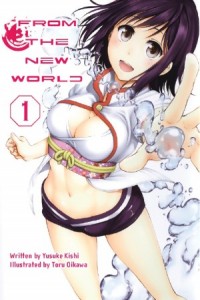
I posted two reviews here at Experiments in Manga last week. The first was for Yusuke Kishi’s novel of horror and survival The Crimson Labyrinth. Currently The Crimson Labyrinth is the only work by Kishi available in English, but Vertical will begin releasing the manga adaptation of his novel From the New World later this year. (The same From the New World recently had an anime adaptation, too.) I also posted my latest Blade of the Immortal review–Blade of the Immortal, Volume 25: Snowfall at Dawn. The last few volumes of Blade of the Immortal have been building up to the showdown between Shira and Manji; finally the time has arrived when they face each other.

There were a couple of interesting things that I came across online last week. First, there was an interview with Annaliese Christman, a freelance letterer for Viz Media. I didn’t know much about lettering, so I found it to be a very interesting read. The other item I wanted to mention was Dan Kanemitsu’s examination of the impact the upcoming Tokyo Olympics may have on censorship in Japan–Fear and Loathing in the Bold New Olympic Era. (Too long, didn’t read? CBLDF has a nice overview of the article with some additional commentary–Tokyo Olympics Emboldens Censors.)

Quick Takes

Fairy Tail, Volume 29Fairy Tail, Volume 29 by Hiro Mashima. This is only the second volume of Fairy Tail that I’ve had the opportunity to read in its entirety. At this point my general impression is that it’s a fun, but rather generic series. I just can’t seem to shake the feeling that I’ve seen it all before. I do like the variety of magic styles, though. Most of the twenty-ninth volume focuses on the battle between five young members of the Fairy Tail guild and Hades, the guild’s former grandmaster. Although not entirely unexpected, there were some great moments during fight that really show off the group’s teamwork. Fairy Tail moves along quickly with plenty of battles and action sequences. For the most part, Mashima’s art works nicely. However, all of the cuts and scratches that the characters end up with over the course of their fights make them look like they all have scales, which is a little odd. Although for some characters, like Natsu with his dragon abilities, it’s rather appropriate.

Nana, Volume 16Nana, Volumes 16-18 by Ai Yazawa. The more of Yazawa’s manga that I read, the more I am impressed by it. Nana is a fantastic series. The characters are complex and multilayered; the story is dramatic and absorbing without being overwrought. These particular volumes deal just a little less with the music industry and the bands as a whole. Instead, they delve more into the characters’ personal lives. Particularly important is the revelation of Nana and Shin’s pasts as well as their less than ideal family circumstances–something that proves to be very problematic. Also included in these volumes are two lengthy side stories. One shows Nobu and Nana’s relationship back when they were in school together. Similarly, Takumi’s complicated feelings for Reira is the focus of the other. The side stories are a really nice addition to Nana, giving the story even more depth. They show the importance of the characters’ relationships and how they developed over time to become what they are in the series proper. I’m really looking forward to reading the rest of Nana.

Saiyuki Reload, Volume 7Saiyuki Reload, Volumes 7-9 by Kazuya Minekura. While the early part of the series seemed directionless, by the end of Saiyuki Reload Minekura has a great narrative drive going. Some of the plot elements and storylines do unfortunately seem to have been dropped or forgotten (though perhaps she pulls them all back in for the finale) but the manga does benefit from having a stronger focus. What is particularly interesting about these volumes is that the yokai’s side of the conflict is shown in more detail. Although there have been exceptions, for the most part the yokai have simply been the series’ monsters. Minekura makes it very clear here that the yokai are really not all that different from humans and that it is the humans who are sometimes the real monsters. Looking back, this has actually been one of the recurring themes in the series. Although Saiyuki Reload is ten volumes long, only nine volumes were ever released in English. It’s particularly tragic since the ninth volume ends on one heck of a cliffhanger.

Smut PeddlerSmut Peddler by Various. Smut Peddler had its beginnings as a three-issue indie minicomic series back in 2003. In 2012, Smut Peddler returned as a full-length anthology collecting twenty-six short erotic comics. Smut Peddler is a phenomenal collection of sex-positive, lady- and queer-friendly comics. I was particularly happy to see the diversity included in the anthology, not only in terms of the characters’ various identities but in genre as well. Smut Peddler contains science fiction and fantasy as well as reality-based works, both historical and contemporary. The stories are short, sexy, and sweet. Some are more serious and others are more humorous, but they are all heartfelt. I was previously familiar with and already follow the work of many of the creators included in the anthology, but there were plenty of artists and writers who I was encountering for the first time. (I now have even more creators I want to seek out.) Work has already begun on a second Smut Peddler anthology, currently scheduled for release in 2014. I can’t wait.

Velveteen & MandalaVelveteen & Mandala by Jiro Matsumoto. Reading Velveteen & Mandala was a rather odd experience for me. I was consistently engaged while I was reading it, but I wasn’t sure that I actually liked it. But after finishing Velveteen & Mandala I couldn’t seem to get it out of my head which to me is a sign of a good manga. The more I think about it, the more I want to read it again–it’s like a lingering and intense fever-dream (or nightmare.) Velveteen & Mandala is a very strange horror manga with strong psychological elements, extremely black humor, frequent pop culture references, and characters who all seem to be at least slightly insane. The ending’s big twist was something that I suspected from the very beginning of Velveteen & Mandala but that doesn’t make it any less effective. Velveteen & Mandala easily earns it’s 18+ rating–it’s gruesome, violent, and sexually explicit. The manga’s off-beat, weird, and bizarre horror and humor definitely aren’t for everyone, but if you can stomach it Velveteen & Mandala is a strangely intriguing work.

Filed Under: FEATURES, My Week in Manga Tagged With: Ai Yazawa, comics, Fairy Tail, Hiro Mashima, Jiro Matsumoto, kazuya minekura, manga, nana, Saiyuki, Smut Peddler

Otome Games Review: Destiny Ninja and Pirates in Love

September 15, 2013 by Anna N

destinyninja

So I’ve always been leery of manga adaptations of Otome games, just because I find the plots a bit too formulaic. Even though I do have a strong fondness towards reverse harem scenarios, so far the Alice in the Country of franchise is the only Otome game manga where I’ve felt compelled to read more than a few volumes. I’ve been very busy recently and needing a new distraction, so when I saw that there was a game out called Shall We Date: Destiny Ninja, I decided to give that a try. Falling all the way down the Otome game rabbit hole, I also started playing Pirates in Love as well.


Shall We Date: Destiny Ninja is available for android and iphone.

I decided to start playing this because the name “Destiny Ninja” was hilarious. I was even more amused after sitting through a few minutes of the prologue, where the ninja are identified solely by their personality traits. The choices were Aggressive Pompous Ninja, Wicked Mean Ninja, Mischievous Masked Dark Ninja, Indifferent Merciless Stubborn Ninja, Mean But With an Angel Heart Brother Like Ninja, or Sexy Foreign Ninja. I decided to go with Mischievous Masked Dark Ninja at first.

Dark Ninja is Hyosuke, who seems to spend most of his time alternating between making jokes or indulging in cold and calculating revenge. He’s got a bit of a split personality.

Screenshot_2013-09-15-17-50-28

The heroine of the story wakes up with amnesia near a battlefield, with no clues to her identity other than the expensive clothing and necklace that she wears. She’s taken under the wing of a local lord and his shinobi, and one of the ninjas is assigned to protect her. The heroine slowly uncovers the clues to her identity while falling in love with her chosen ninja.

hyosuke1

Destiny Ninja
is free to play, but it has some cumbersome game elements that are basically designed to frustrate the player into spending actual money. You can only progress forward through each chapter if your ninja has energy. You can revive your ninja by feeding him rice cakes, which you can attain through purchasing or winning them in ninja lotteries, or getting more energy through leveling up. Each energy unit is only worth getting through about a couple dozen lines of text, so it takes a long time to get through several chapters. The energy units also fill up at a very slow pace without using rice cakes. Players can earn points and virtual money through befriending other players. There are stopping points and checkpoints along the way where you have to have extra items like shuriken and passes. You also have to accessorize your chosen ninja’s companion animal by giving it scarves and masks. While I think it would be entirely possible to progress in the game for free, you would have to have a great deal of patience.

kazemasa

The storyline is fairly standard, and when the characters end up going through a lot of ninja history plot exposition it cam be a tiny bit boring, but generally I was entertained. I’m almost at the end of the storyline with the first ninja I picked, and I started trying to play from the beginning again just to see how the story would differ with a different character. This time I picked the Indifferent Merciless Stubborn Ninja, who indeed seems to be both indifferent and merciless as advertized, although as the story progresses, he begins to seem less and less indifferent.

There’s a complicated love meter for the game where depending on the answers you give, you can get one of four endings with each ninja. This means that if you have an obsessive personality and actually want to experience all the endings, you will have to play through the game four times per character. There’s a “sweet happy ending” which is more emotional or a “lovey dovey” ending which is evidently more risque. In terms of general romantic content though, the entire game is about at the level of a slightly risque harlequin romance novel. The English translation for this game is also not very good, but you can still understand everything that’s happening.

The game interface for this game is a bit crowded, because there are so many little add-ons and extra tasks needed for you to complete the story. I found the visual clutter a bit endearing, although I did get frustrated at the slow rate of progression for the game, even after spending money on rice cakes to power up my ninja. It was so slow I decided to check out another game, Pirates in Love.

Pirates! In! Love!

Pirates in Love is available for android and iphone

This game requires you to pay for stories after a free introductory chapter. The interface for the game is smooth and easy to navigate, there’s some background music for the game that quickly becomes annoying, and the art looks less like clip art. With each decision point the heroine has three options, and there are no extra mini-games or tasks to complete. Pirates In Love functions pretty much like a classic choose your own adventure novel. It is easy to go through the storyline for a character in about an hour and a half or so.

I figured that when playing a game with pirate characters, one has to go for the guy in the eye patch.

Hello there.

Hello there.

As much as I enjoyed the looks of eye patch guy, whose name was Eduardo, I didn’t care very much for the storyline. He seemed to treat the heroine like a dim-witted mascot most of the time, and while certain aspects of Eduardo’s mysterious past were very interesting, there was a bit of a misogynistic vibe that I didn’t care for too much. By the end of the story he is much less of a creep, and he does get style points for the eye patch. I found the game interesting enough that I decided to play again with a different character, Russell the arrogant fencing pirate.

pirates2

This storyline focuses more on the hero gaining a more mature sense of his place in the world, and it wasn’t as complex as Eduardo’s journey where he deals with his past, eye patch, and various conflicts with other pirates. It was less annoying but also a bit less interesting than the first character I tried. This game does a good job of balancing appearances from all the characters in every story, so it is easy to start wondering about all the different outcomes if you tried to play through the game with yet another character.

For my third time through this game, I picked the womanizing borderline alcoholic pirate captain.

pirates3

Captain Morgan’s story involved ensuring an island’s water supply, mysterious twins, him being chased through a towm by all the woman in port that he wronged before, a hydra, and pirate captain political maneuvering. It was probably the most entertaining of the stories I’d tried so far in Pirates in Love, and of course the heroine cures him of his alcoholism and womanizing by the time the story is done.

Pirates in Love was much less frustrating to play than Destiny Ninja, because once you’ve bought a storyline you can play it until the end, and you can also go back and switch your answers to try to get a different ending without having to pay any extra. I actually played through three full stories in Pirates in Love for less money than I spend on buying rice cakes and other items in Destiny Ninja. Overall, I think Pirates in Love is a better value for what you get from the game, although I do find all the ninja quite amusing. I found my first foray into Otome gaming much more entertaining than I thought it would be. I’m going to continue with both of these games, as there are a couple characters with stories I’m still interested in from Pirates in Love. I might just adjust to the glacial pace of Destiny Ninja and play it more casually, as the lag time in normal game play makes it a bit frustrating to follow the stories closely.

If you do decide to give Destiny Ninja a try, my invite code is:CqWB9YLrSW (we both get bonus rice cakes!)

Who exactly are these pirates in love with?

Who exactly are these pirates in love with?

Filed Under: REVIEWS Tagged With: destiny ninja, otome game, pirates in love

Weekly Shonen Jump Recap: July 22 – September 2, 2013

September 15, 2013 by Derek Bown Leave a Comment

July 2 CoverWell, it’s been a while. I have to apologize for my long silence. Personal circumstances and a stressful stretch of months at work made it very difficult to get anything done outside of waking up, going to work, coming home, playing video games until I pass out, and then waking up to start it all over again. Now, to some that second to last part might sound like I was just being lazy. And yes, there was a certain element of laziness involved. But it was less motivated by being a slacker, rather it was because nine to eight hours a day working customer service will drain the desire to do anything, even something you enjoy, out of anyone.

But, with no real change in my situation in sight, rather than just give up, I’m going to just suck it up and pick back up where I left off. I love writing about manga, and if I don’t share my opinions here, then where else can I go that people will actually listen when I go off on an incoherent rant about Naruto, Bleach, and World Trigger?

Obviously covering the past month plus in detail would take too long. So instead I’m going to give a quick recap of what I’ve thought of the past few weeks of manga before getting back to producing this column at a weekly rate.

And because the order in which the chapters are posted changes from week to week, I will be posting my comments about each series in the order that I feel like talking about them. So, essentially it’ll be organized by what I liked most to what I liked least.

Cross Manage
It’s been a while so I can’t be certain, but I do believe I forgot to cover Cross Manage‘s final chapter. Astute readers may notice a correlation between the end of this manga and when I went on my extended hiatus. And yes, I would say that the two are connected. I really did fall in love with this series, and really do think it could have gone much further than it did. Sadly it would appear that the readers of Japan did not agree with me. And while this may just be a pipe dream, I hope that in the future our votes will matter in regards to which series will get cancelled. But, even if that does happen in the distant future, it won’t be enough to save this series.

Since it has been long enough since this series was cancelled, and my initial rage has subsided to a certain extent, I feel that now I can talk about this final chapter without making veiled and overt threats towards the Japanese readers for letting this series get cancelled.

And, like I had been saying, the ending really was satisfying. Sure there were some elements that didn’t get resolved, but it ended well by foregoing the “See, this is what you could have had route” that so many passive aggressive manga artists seem to go when their series is cancelled prematurely. As Viz brings out the digital volumes I’ll be reading the series again, so that I can at least enjoy one of the only sports manga I ever liked.

I know it’s a bit late, but please, I want to know how everyone else felt about this manga ending. Also, I feel it’s relevant to point out that I think there are certain series that have been going on for years with established fanbases that are making the rankings system extremely unfair towards new series. We know One Piece and Naruto are going to stick around, so why should anyone be voting for them? I say we need to take those series out of the voting pool, they will keep going no matter what, and open up the floor for new manga to get some votes. After all, beating series like One Piece, Toriko, Bleach, and Naruto is an insanely unfair requirement for new series.

Strong World Color Spread

One Piece
While I’ve been losing a good deal of my enthusiasm for Weekly Shonen Jump since the cancellation of Cross Manage, at least One Piece has been there for me all along (not counting those couple of weeks hiatus due to health reasons). And while the story has been great, with this last week revealing the nature of Don Chin Jao’s gripe against Garp in the most ludicrous way, I think events relating to Oda’s life have been far more significant. With his health issues it’s become clear that fans don’t mind Oda taking some time off. After all, if we have to go a couple weeks without new manga so that the series actually keeps going then that’s a small price to pay. It’s also helped to remind us that while a manga-ka’s schedule is insane and inhumanely punishing, the editors are also human and want their artists to stay healthy, as shown by how they’ve been insisting Oda take it easier and actually take scheduled breaks even after a month long hiatus.

While we love having weekly manga, I think the grueling schedule manga artists go through to provide us with manga is worth discussing. It makes the issue of piracy even more relevant, considering that so many of us are willing to take what they’re sacrificing their lives for for free. And granted there is distribution to keep in mind, after all how can one get manga that isn’t being officially translated, I think what we really need to do is spread the word about this magazine so that we not only get more series in this magazine, but so that other companies make it worth their while to start emulating Viz.

One Piece

Toriko
Toriko the past couple weeks has shown that I may not be the biggest fan of our protagonist. He’s not awful, but compared to all the other characters I can’t help but feel like Toriko is a bit…dull. This series is the definition of Cuckoo for Cocoa Puffs, so it’s a shame when the protagonist feels a bit samey with all the other protagonists in manga. Still, everything else has been amazing in that silly Toriko way. The power levels of the players keep ramping up in ways that sometimes make absolutely no sense but I’m inclined to forgive it because this series just does ridiculous so well.

Nisekoi
Nisekoi has been a bit hit and miss over the past month or so. I’ve been enjoying it, but some chapters were weaker than others. I particularly haven’t been a fan of the Haru heavy chapters, but there have been some great ones. The teacher leaving her job after getting married was problematic for me, but you can always listen to the podcast as to why I thought that. The most recent chapters get into the old amnesia shtick, but I find that it’s working so far if for no other reason that it’s being used to hang a lamp shade on harem series tropes. Particularly the unspoken reality that most harem protagonists would be considered scumbags in real life.

Nisekoi

One-Punch Man
The amazing thing about One-Punch Man is that it goes beyond just being funny. It has great action, and great characters. Sure Saitama is pretty one note, but he’s entertaining enough and the side characters, even brand new ones, get some pretty great moments to shine. I won’t lie, the Puri Puri Prisoner character is problematic in how it shows that Japan apparently has a ways to go in their social rights issues. Though it does make me chuckle to compare how most gays are portrayed in our media versus how they are portrayed in manga. Let’s just say that at least gays in our media aren’t being threatened with arrest for hitting on other men.

One-Punch Man

Bleach
Bleach has been off for most of the time that I’ve been gone. And no, this is not a case of correlation. I honestly could care less about this series as it is now. We’ll see where things go when it picks back up this week, but all that really needs to be said now is that this series has been dull for far too long. It better pick up with this finale, and I hope that Kubo is able to resolve things in a way that satisfies everyone. And if that isn’t possible than I at least hope he resolves everything in a way that satisfies me specifically.

Dragon Ball Z
Dragon Ball Z may not be the most sophisticated manga out there, but I can’t help but love its old fashioned simplicity. Sometimes all we need is a little punching and characters yelling out their attack names. Without all the extra complications. Granted Dragon Ball Z is hardly my favorite manga, but I really do enjoy reading these old chapters again.

Blue Exorcist
I love a good “traitor revealed” moment. And then I start questioning whether it actually makes sense. A month is a long time for me to suspend my disbelief, but we’ll see whether it actually makes sense this coming chapter. My best guess is that it’ll be a red herring. Or maybe I’m wrong and Blue Exorcist is about to be shaken up real well. Which would be really well done, considering that Kato was distracting us with the Rin, Yuki, and Shiemi triangle.

Naruto
I don’t like Naruto. I really don’t. And with so many other series to go over I don’t think it’s worth my time to list exactly why this series has been pissing me off of late. But don’t worry, we’ll go back to our regularly scheduled rants with this coming week.

Naruto

Jaco the Galactic Patrolman
Toriyama keeps saying that we probably won’t enjoy this since it doesn’t have the stuff he usually puts into his manga. And I keep saying that I agree with that statement. Jaco is a fun enough diversion, but hardly a work of art. But, considering how harmless it is I don’t see why I should waste any time complaining about things the author would probably just agree with anyway.

World Trigger
I hate this series for one reason and one reason only. It’s dull, it’s predictable, the characters are getting on my nerves. But the one reason is that I feel like this manga artist is wasting their time. So many better series have been cancelled, and this lousy series can’t be bothered to actually make an effort to stop sucking. And even when it does try to get some kind of direction it’s in a direction that was overused a decade ago. And even the fight scenes, while competent at places, spend most of the time being dull. It infuriates me that this series is still going when I can think of at least two that have been published in this magazine alone that should have kept going.


And that catches us up. Look forward to more consistent releases as I put my big boy pants on and actually get stuff done despite my work schedule.

If you want to hear more, check out the Manga^3 Podcast Archives.

Filed Under: FEATURES & REVIEWS, WSJA Recaps Tagged With: bleach, blue exorcist, Cross Manage, Dragon Ball Z, Jako The Galactic Patrolman, naruto, nisekoi, One Piece, toriko, world trigger

Strobe Edge, Vols 5 and 6

September 15, 2013 by Anna N

One of the reasons why I keep reading manga is that it still has the capacity to surprise me. I found the fifth volume of Strobe Edge exciting to read, because it went in a totally different direction from what I was expecting. I’d always expected that the love triangle between Ren, Mayuka, and Ninako would have to be resolved somehow, but I wasn’t expecting a big change to come from Mayuka this early in the series. Ren is deliberately holding himself back from developing feelings for Ninako due to his sense of duty towards Mayuka. She’s emotional fragile and stressed out with the demands of her modeling career, school, and her parents’ divorce. Ren has a finely honed sense of integrity and wouldn’t do anything to hurt another person, with the expense of actually subverting his own feelings in the process.

I always expect anyone in a shoujo manga with a modeling career to be evil, but Mayuka shows that she’s been slowly picking up on Ren’s distance, coming to terms with her own goals for how she wants to live her life, and she realizes that she’s the one who is going to have to take a big step forward on her own. The change in Ren and Mayuka’s relationship isn’t without pain on both sides, but everything is handled with a degree of emotional maturity and sensitivity that is notable. It is fun to read a shoujo series that explores the shifting relationships between characters with such nuance.

In the meantime Ninako and Ando are in the grips of adorable teenage awkwardness, as she attempts to bury her own feelings for Ren and Ando tries to show her that he’s the better choice for her. Ando’s shifted from the cheerful flirtations personality that he displayed in the first few volumes to showing Ninako just how much he cares about her. There was a fun bonus story in this volume that delved into the past friendship between Ren and Ando, and just where it went wrong. This is the type of bonus story that I really enjoy, as it gives the reader a glimpse of the characters in a slightly different context, and provides more background as the manga moves forward.

There’s emotional turmoil ahead in the sixth volume of Strobe Edge, as Ando’s antagonism towards Ren resurfaces and Ren is dealing with the aftermath of his breakup with Mayuka. The burden of popularity and extreme handsomeness weighs heavily on Ren, as he is girlfriendless for barely a day before the girls at school start circling him. Ninako assumes that Ren is sad, and doesn’t want to do anything to add to his stress. Even with Valentine’s day coming up, she doesn’t want to add to the mountain of chocolate he’s going to be receiving from all the other girls.

There are some fun action scenes as Ren and Ando (mostly Ando) work through some aggression on the basketball court. The antagonistic relationship between them takes a turn towards the hilarious as Ando gets injured and when he wakes up and spots Ren he yells “You’re what I have to wake up to?” If Strobe Edge was only focused on the relationship between Ninako and Ren, it has the potential to get boring fairly fast. But seeing Ren and Ando start to work through their issues feels like an important emotional breakthrough. Ando instructs Ren not to smile, and Ren assumes that it is because his smile is somehow hideous, but really Ando doesn’t like the inadvertent effect a smiling Ren has on all the people in his vicinity. The end of volume six offers the promise of a new beginning at the start of a new school year, with Ren and Ninako being assigned to the same class.

Strobe Edge is a good example of why sometimes it is good to give a manga series a few volumes to develop before giving up on it. I was a bit on the fence about this series after reading only the first volume even though I generally enjoyed it. I wouldn’t have thought from just the first volume that Sakisaka would have built up the interesting relationships between the characters and handled some emotional journeys without relying on some of the standard shoujo plot elements. In some ways Strobe Edge is a less angsty successor to We Were There, as both series explore similar nuanced psychological territory.

Review copy of vol 6 provided by the publisher.

Filed Under: REVIEWS Tagged With: shojo beat, Strobe Edge, viz media

Hayate the Combat Butler, Vol. 22

September 15, 2013 by Sean Gaffney

By Kenjiro Hata. Released in Japan as “Hayate no Gotoku!” by Shogakukan, serialization ongoing in the magazine Shonen Sunday. Released in North America by Viz.

This volume, and the two that follow it, are for me the high point of the entire run of Hayate the Combat Butler. Hata has a tendency to get sidetracked and lost in comedy asides, to the point where he’s started to parody his tendency to do so. Also, it’s becoming quite clear that someone is telling him that he has to keep the series going and can’t wrap things up. But that’s in Japan. Here, we’re finally getting to the good stuff. All the slow character development, glacial plot points, and G*ndam references lead to this confrontation in Greece.

hayate22

For all that Hayate is a wacky harem comedy, it has some dark tones at its core. Mostly it’s been about the horrible parents of Hayate, Wataru and Hina, and the absent/dead parents of Nagi and Athena. But there’s also been a sense of aiming for your dream and failing that’s come up several times with Hina’s alcoholic sister Yukiji. She’s in Italy because the teacher (and old high-school friend) who has a crush on her is trying to make grand gestures so that he doesn’t have to actually confess. After a chapter of misunderstandings and beatings, the now drunken teacher wonders out loud how the cool, guitar-playing Yukiji turned into the lazy, shiftless, aimless young woman we all know. And the answer is that life happens. It’s why people make wishes, and dream of fairy stories. And create magical luck stones, for that matter.

Speaking of which, we finally get the confrontation we’ve waited 10 years for… well OK, four volumes. Hayate sees Athena, and calls out to her. Unfortunately, she doesn’t know who he is. Or at least pretends she doesn’t know – as a very cute aftershot tells us, she is quite aware of Hayate but has some longer game, which involves that stone. The last volume gave us a few minor villains trying to get their hands on the stone, but now we move on to the more dangerous players. 16-year-old Athena looks like a dark queen, what with her black dress and princess curls (and healthy bust – clearly larger than any of the other girls in Hayate’s wannabe harem). We can only hope that she sides with her feelings over her need for that stone.

And so, having started the volume with Yukiji noting that sometimes things don’t work out, and dreams don’t come true, we end with the dinner date between Hayate and Hinagiku, who is determined to confess. Of course, Hina is mistakenly thinking that Hayate hates her because of her tsundere antics. And Hayate has worked out that Athena was lying, and is wondering what to do now and why meeting Athena is affecting him so much. So the dinner date is a masterpiece of distraction. Tragically, the two characters have revelations exactly at the WRONG time. Hina finally mans up her courage and starts to confess. And Hayate finally puts two and two together and realizes why he’s so devastated by Athena’s disfavor, and why he wants desperately to apologize: he loves her.

It’s an epic cliffhanger, to be sure. Hata certainly thought so, as Vols. 23 and 24 came out in Japan the same day. Sadly, that won’t happen here, where Hayate simply doesn’t have the sales. So we’ll have to check back in another six months to see how Hayate’s admission affects Hina, and whether it spurs him to return to Athena. The tension only gets higher from here.

Filed Under: REVIEWS

Blade of the Immortal, Volume 25: Snowfall at Dawn

September 13, 2013 by Ash Brown

Blade of the Immortal, Volume 25Creator: Hiroaki Samura
U.S. publisher: Dark Horse
ISBN: 9781595828835
Released: August 2012
Original release: 2009
Awards: Eisner Award, Japan Media Arts Award

Snowfall at Dawn is the twenty-fifth volume in the English-language release of Hiroaki Samura’s award-winning manga series Blade of the Immortal. Published by Dark Horse in 2012, Snowfall at Dawn collects the same chapters as the twenty-fourth volume of the original Japanese edition of Blade of the Immortal released in 2009. Blade of the Immortal first began serialization in 1993 and has covered a lot of ground since then. Starting as a story of revenge with a touch of the supernatural, the series mixes historical reality with the fantastic and later on even a healthy dose of horror. Snowfall at Dawn is part of the fifth and final major story arc of the series. With morally complex characters, dynamic artwork, and an engaging story, Blade of the Immortal continues to be one of my favorite manga series.

After their daring assault on Edō Castle, Baro Sukezane provides the diversion needed to allow his comrades Magatsu Taito and Anotsu Kagehisa, the leader of the Ittō-ryū sword school, to escape. They aim to rejoin the rest of the Ittō-ryū as quickly as possible while avoiding their pursuers. Among those trying to locate Anotsu are Asano Rin and Manji, her bodyguard and companion. Little do the pair know, but they are also being pursued. Shira, a sadistic murderer who holds a particularly intense grudge against Manji, is steadily getting closer to exacting his revenge. Accompanying Shira is Kawakami Renzō, a broken young man with his own reason for hating Manji. It’s only a matter of time before the four of them meet once again. The encounter is one that Shira has been preparing for and fantasizing about, taking great pleasure in anticipating and contemplating the pain and torment his plans will bring Manji and Rin.

The last few volumes have been building up to the confrontation between Shira and Manji. Unsurprisingly, their battle is the focus of Snowfall at Dawn. What did surprise me, however, is how comparatively tame it is physically when considering the perverse and barbaric nature of Shira’s past exploits and misdeeds. The potential for extreme physical violence between Shira and Manji is great. Shira is an unapologetic and twisted sadist while Manji is a man who is extraordinarily difficult to kill, making him an ideal victim and target. But Shira isn’t only interested in Manji’s physical suffering, he also takes great joy in causing mental anguish. Although there is still plenty of bodily harm and pain inflicted during the battle in Snowfall at Dawn, the psychological impact and agony caused by Shira’s attack on Rin and Manji is just as crucial to the fight. Out of all of the characters in Blade of the Immortal, Shira is easily the most unquestionably villanous and terrifying.

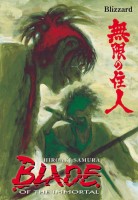
In addition to the showdown between Shira and Manji, Snowfall at Dawn also reveals Shira’s whereabouts during the long prison story arc as well as his involvement in the immortality experiments. Shira may be an utter bastard, but he’s had some unspeakable things done to him as well. As part of this, there is also a lengthy discourse in Snowfall at Dawn about the nature and limitations of Manji’s bizarre regenerative abilities. While vaguely interesting, it is largely unnecessary. Anyone who has been reading Blade of the Immortal should be well aware by this point that Manji’s immortality is imperfect; ample evidence can be found throughout the series. However, Samura hasn’t previously gone into such specific detail about it as he does in Snowfall at Dawn. Unfortunately, he has to interrupt the flow of the story in order to do so. Still, Samura soon returns to what really matters in Snowfall at Dawn–Manji and Shira’s battle, which will reach its conclusion in the next volume, Blizzard.

Filed Under: REVIEWS Tagged With: Blade of the Immortal, Dark Horse, Eisner Award, Hiroaki Samura, Japan Media Arts Award, manga

Manga the Week of 9/18

September 12, 2013 by Sean Gaffney, Michelle Smith, Ash Brown and MJ 3 Comments

SEAN: Three weeks this September have a huge pile of manga, one is merely a small pile. This is that week. (Though some may get Yen titles one week early via Diamond.)

Genshiken has continued to prove that if you have a good enough ensemble cast, it doesn’t matter who the ‘lead character’ or stars are. It rotates students in, it rotates students out. Well, OK, Madarame and his not-quite-harem continue to be the focus of the 2nd Season. Vol. 3 is out this week.

MICHELLE: I must admit that I have never read any Genshiken.

ASH: I haven’t read any of the second season yet, but I did rather enjoy the Genshiken omnibuses. Guess I’ll need to catch up!

MJ: I’ve always been interested in this title, but missed picking up the first season, so I’ve never managed to get into it. I would like to rectify that at some point!

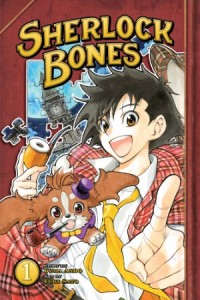
SEAN: The other Kodansha title, Sherlock Bones, you may at first glance think is meant for younger readers, especially once you see the premise “Sherlock Holmes reincarnated as a dog”. That said, I think there may be something I can do to tempt old-school mystery and manga fans to get this volume: “From the creator of Kindaichi Case Files.”

MICHELLE: … and also !!! That certainly tempts me!

MJ: What she said!

tropic

SEAN: Everyone knows that old-school manga titles are not really looked at by companies anymore. UNLESS… they’re by the late director Satoshi Kon, aka Perfect Blue, Tokyo Godfathers, etc. Tropic of the Sea was a single-volume manga he did for Kodansha’s Young Magazine in 1990, and it’s at the start of his career, before he became famous for other things. It promises to be riveting, from what I hear.

ASH: I’m really looking forward to Tropic of the Sea. That cover is simply gorgeous and the interior art I’ve seen is also striking.

MJ: I’m very interested in this as well.

SEAN: Bokurano: Ours must still have cast members to kill off in a tragic yet heartwarming and life-affirming way, as the series is still going. Here’s Vol. 9 from Viz, whose continued support of the SigIKKI line I will always appreciate.

MICHELLE: I’ve fallen somewhat behind on Bokurano: Ours, but I do like it.

SEAN: Lastly, Ooku: The Inner Chambers has a new volume. We’re caught up with Japan, and the series doesn’t come out all that rapidly anymore. But this just makes this alternate world tale of court intrigue a rare treat.

MICHELLE: Yay, more Ooku!

ASH: Indeed! Hooray for more Ooku!

MJ: Insert additional cheers here!

SEAN: What manga dost thou wish to acquire on the morrow?

Filed Under: FEATURES, manga the week of

Pretty Guardian Sailor Moon Short Stories, Vol. 1

September 12, 2013 by Sean Gaffney

By Naoko Takeuchi. Released in Japan as “Bishoujo Senshi Sailor Moon” by Kodansha, serialized in the magazine Run Run. Released in North America by Kodansha Comics.

There’s an important thing to keep in mind when reading this first of two collections of short stories that were interspersed throughout the series’ run: they didn’t run in Nakayoshi. They ran in a sister magazine, run Run, which was also home to Sailor V. Run Run no longer exists today, but I seem to recall when it was around that its core audience was girls about 2-3 years younger than the usual Nakayoshi audience. And that’s not even getting into the fact that these are quick side-stories Naoko dashed off in between chapters, so are naturally going to be a bit more comedic and fluffy than the core plotline.

sailormoonss1

If all of this sounds a bit defensive, well, let’s just say that ‘light and frothy’ doesn’t begin to describe this volume of Sailor Moon extras, most of which are very silly and not exactly lending themselves to deeper analysis. Four of the stories star Chibi-Usa and her friends (with occasional rescues from Sailors Moon and V), while three others detail the struggles of the Inners to pass high school exams. The first one is around the R continuity (Chibi-Usa has just arrived, and is meeting her very busty friend Momo… Ranma fans will immediately be reminded of Shampoo), but most of the stories take place around the SuperS continuity – indeed, a few of them were adapted into the SuperS anime – with the final one seeming to be around Stars, given it has Hotaru.

This is not to say I did not 100% enjoy these stories, as I did. I like Naoko’s style of blatant humor, and she has a knack for amusing caricature faces. The Chibi-Usa stories at the beginning are pure fun for kids, with the kids getting into danger and having to transform to get themselves out of it. The story at the end is slightly longer and attempts to have more depth, but there’s only so far you can go when you find out that Naru’s sister is not only a kogal but is also named Naruru. It’s good to know that Japan has horrible naming sense as well. (Also, kudos to Mari Morimoto for the translation of this chapter, which was filled with topical Japanese slang that Chibi-Usa and Hotaru pointed out and lampshaded throughout, thus making it virtually unadaptable. A very nice job.)

My favorite part of the book, I will admit, are the three stories focusing on the Inners. Makoto’s is probably the weakest, but we do get some amusing scenes of her procrastination through cooking and housework, and also hear about her late parents for what may be the only time in the manga OR anime canon. (They’re killed in a plane crash when Makoto was a little girl, which is used here as both an amusing gag and to have Mako gain sympathy points from her friends.) Ami’s First Love is probably the best written of the three, and it’s no surprise that the anime adapted this into a short film for theaters. Ami can be very tightly wound, so seeing her coming unglued at finding a student who’s just as perfect in studying as she is is hilarious, particularly when she gets so upset by this she seems to make herself ill.

And then there’s Rei and Minako. I’ve discussed how much I love this chapter before, silly as it is, and that hasn’t changed. The manga version of Rei – cool, collection, a bit ‘ice queen’ – is in such contrast to Minako’s extrovert that it makes sense that she’d want to see what Rei’s life at school is like – and yes, she’d want to ask if Rei farted. I think that Minako regards Rei as a bit too perfect, and this is just her own tactless way of trying to reassure herself that Rei is human after all. Of course, all that her visit to Rei’s perfect Catholic school ends up doing is tweaking Minako’s own insecurities – and that leads to Rei seeming genuinely upset at Minako getting angry, showing she *isn’t* the perfect ice princess. Rei is likely very lonely at that school where she only has admirers, and just can’t express her friendships in the way that Minako wants her to. Still, they manage to bond by… well, Rei being possessed and trying to kiss Minako. And afterwards being crankier than ever. But Minako’s feeling good again, and that’s what’s important. Bless these children.

So if the Sailor Moon series was a full-course meal, then this is dessert. Don’t go into it expecting anything more than delicious sweets that are easy on the eyes but not all that good for you, and you should be fine. Also, Rei has never farted. She is better than all of us.

Filed Under: REVIEWS

The Crimson Labyrinth

September 11, 2013 by Ash Brown

The Crimson LabyrinthAuthor: Yusuke Kishi
Translator: Masami Isetani and Camellia Nieh
U.S. publisher: Vertical
ISBN: 9781932234114
Released: October 2006
Original release: 1999

The Crimson Labyrinth, written by Yusuke Kishi, was first published in Japan in 1999. Prior to the novel’s release, Kishi had won two Japan Horror Association Awards. He continues to be a bestseller and award winner in Japan both for his horror and for his speculative fiction. The Crimson Labyrinth was released in English in 2006 by Vertical with a translation by Masami Isetani and Camellia Nieh. The novel was Kishi’s English debut and so far remains the only work of his that has been translated, although Vertical is scheduled to release Tōru Oikawa’s manga adaptation of Kishi’s novel From the New World in 2013. The Crimson Labyrinth was my introduction to Kishi and his work. I was particularly interested in reading The Crimson Labyrinth after seeing it compared to Koushun Takami’s Battle Royale, a personal favorite of mine. Also, I tend to enjoy just about everything that Vertical publishes.

Forty years old and unemployed, Yoshihiko Fujiki never expected that answering a job advertisement would end up with him being drugged and abandoned in the wild. He wakes up alone with only a small amount of food and water and a Pocket Game Kids handheld game console to keep him company. Soon he encounters Ai Otomo who is also wandering alone and who has been given similar provisions. Following the instructions provided by the game console, together they navigate the labyrinthine corridors and valleys of the bizarre landscape in which they find themselves. When they reach the first checkpoint indicated by the console they discover another group of people waiting there. All together there are nine Japanese men and women and no one seems to be certain of what is going on, where they are, who has stranded them or for what purpose. What they do know is that have become unwilling participants in a perverse game of survival. If they want to stay alive they may very well have to turn on each other.

The Crimson Labyrinth is heavily influenced by extreme reality television as well as classic, text-based role-playing games. And just like those RPGs, the decisions made by the characters early on in The Crimson Labyrinth are the most crucial and will determine how the rest of the game will play out. At first the group of nine works together, but their cooperation quickly disintegrates. The group fragments into four smaller teams, each following a different path outlined by the game: survival, self-defense, food, or information. Game theory might suggest how the competition will progress and what will lead to the ideal outcome for all involved, but as Fujiki points out, game theory is nearly useless in their situation. It depends on people making logical and rational decisions after considering all the information available to them. Humans are most certainly not rational creatures, especially when faced with the unknown, consumed by fear, and fighting for their lives.

Most of The Crimson Labyrinth takes place over the course of a few weeks. As events and the game unfold, the novel is seen exclusively from Fujiki’s perspective. For a large part of The Crimson Labyrinth he doesn’t interact much with anyone except Ai. This is a little unfortunate since the utter hell the other teams are going through can only be inferred. But as the novel and the game progress, Ai and Fujiki come across shocking evidence that the other players are having a very hard time of it and that it didn’t take long at all for violence to erupt. The wilderness is filled with its own dangers, but it’s really their fellow humans that they need to be wary of. Terrible things happen in The Crimson Labyrinth. What makes it even worse is the fact that so many of them could have been avoided if only people were able to bring themselves to trust each other and work together. In the end, no one is entirely innocent of the deaths that occur. A quick read, The Crimson Labyrinth is an absorbing novel of horror and survival.

Filed Under: REVIEWS Tagged With: Novels, vertical, Yusuke Kishi

  • « Go to Previous Page
  • Page 1
  • Interim pages omitted …
  • Page 376
  • Page 377
  • Page 378
  • Page 379
  • Page 380
  • Interim pages omitted …
  • Page 551
  • Go to Next Page »
 | Log in
Copyright © 2010 Manga Bookshelf | Powered by WordPress & the Genesis Framework