• Skip to primary navigation
  • Skip to main content
  • Skip to primary sidebar
  • Home
  • About Us
    • Privacy Policy
    • Comment Policy
    • Disclosures & Disclaimers
  • Resources
    • Links, Essays & Articles
    • Fandomology!
    • CLAMP Directory
    • BlogRoll
  • Features & Columns
    • 3 Things Thursday
    • Adventures in the Key of Shoujo
    • Bit & Blips (game reviews)
    • BL BOOKRACK
    • Bookshelf Briefs
    • Bringing the Drama
    • Comic Conversion
    • Fanservice Friday
    • Going Digital
    • It Came From the Sinosphere
    • License This!
    • Magazine no Mori
    • My Week in Manga
    • OFF THE SHELF
    • Not By Manga Alone
    • PICK OF THE WEEK
    • Subtitles & Sensibility
    • Weekly Shonen Jump Recaps
  • Manga Moveable Feast
    • MMF Full Archive
    • Yun Kouga
    • CLAMP
    • Shojo Beat
    • Osamu Tezuka
    • Sailor Moon
    • Fruits Basket
    • Takehiko Inoue
    • Wild Adapter
    • One Piece
    • After School Nightmare
    • Karakuri Odette
    • Paradise Kiss
    • The Color Trilogy
    • To Terra…
    • Sexy Voice & Robo
  • Browse by Author
    • Sean Gaffney
    • Anna Neatrour
    • Michelle Smith
    • Katherine Dacey
    • MJ
    • Brigid Alverson
    • Travis Anderson
    • Phillip Anthony
    • Derek Bown
    • Jaci Dahlvang
    • Angela Eastman
    • Erica Friedman
    • Sara K.
    • Megan Purdy
    • Emily Snodgrass
    • Nancy Thistlethwaite
    • Eva Volin
    • David Welsh
  • MB Blogs
    • A Case Suitable For Treatment
    • Experiments in Manga
    • MangaBlog
    • The Manga Critic
    • Manga Report
    • Soliloquy in Blue
    • Manga Curmudgeon (archive)

Manga Bookshelf

Discussion, Resources, Roundtables, & Reviews

Features & Reviews

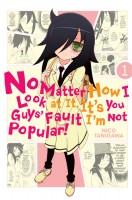
No Matter How I Look At It, It’s You Guys’ Fault I’m Not Popular!, Vol. 1

October 15, 2013 by Sean Gaffney

By Nico Tanigawa. Released in Japan as “Watashi ga Motenai no wa dō Kangaetemo Omaera ga Warui!” by Square Enix, serialized on the website Gangan Comics Online. Released in North America by Yen Press.

Despite a title longer than your arm, this new manga series is not, in fact, based on a light novel. It’s usually shortened to “WataMote” in fan discussions – indeed, I’ve used that tag for my Category on this review, rather than screw up the sidebar. Still, with a title like that, if you’re someone who’s been a fan of anime over the past few years, it comes with certain expectations even before you read it. High school slice-of-life, comedic misunderstandings, discussion of otaku interests. And indeed, all that is true. But it’s the heroine who drives this title, and Tomoko Kuroki is not going to simply lie back and be cute and moe.

watamote1

Tomoko gives new meaning to the term “socially awkward”. In her head, she’s got it all down – she’s starting high school, will make new friends, get a boyfriend, and her life will be wonderful. In reality, not only is she a cripplingly shy girl who can barely manage the most basic interaction, but she’s not even cute and adorable like most manga heroines with those issues. Tomoko can be hard to like. She emotionally manipulates her brother, is crass and opportunistic, and has an inability to see even basic human interaction and understand what it means.

Notably, she’s not bullied or picked on at all by any of her peers – they mostly just ignore her, but it’s not in a ‘she’s creepy’ way, she simply rarely registers on their radar. When occasional peers do speak to her, it tends to be friendly, and mostly the only time they rear back in awkward horror is when she says or does something incredibly inappropriate. Honestly, that’s a little unrealistic, but the mangaka doesn’t really want to go in a bullying direction here – Tomoko makes her own problems. We can’t even blame a poor family life – her mother and brother seem to be perfectly fine with social interaction, though her brother regards her as incredibly annoying and exhausting. And, well, he’s correct.

An anime adaptation of this aired over the summer, and many people kept asking themselves whether the intention of the work was to laugh at Tomoko’s foibles, feel pity for her attempts to bond with life and other people, or just feel incredibly uncomfortable at watching her existence? The answer, of course, is all three. We don’t want to be seen to laugh at someone like Tomoko, but honestly, some of the behavior here is pretty hilarious, and her snark is also pointed and amusing. That said, there aren’t real punchlines here, just a setup that goes off the rails. Instead of a punchline, we see Tomoko sitting on a park swing, looking miserable, as her brother silently stares at her. Or in a bathroom, ripping a pair of panties to shreds in a terror-stricken bout of mortification.

This manga seems to push against its own audience, which is otaku-oriented males. At one point, Tomoko talks to her one friend (who I hope we see more of), and is asked about the new anime season. Tomoko blithely responds that it’s all moeblob shows this year. This may be slice-of-life, but it’s no K-On! I do want to read more, but I am very grateful that it’s only coming out here every three months, as Tomoko is as exhausting and frustrating to read as she must be to live with. Definitely recommended, but be aware that this title pulls in several different directions at once, and deliberately doesn’t resolve any of them.

Filed Under: REVIEWS

A Dark Fable of the Forest, Vols. 1 and 2

October 14, 2013 by Anna N

A Dark Fable of the Forest Volumes 1 and 2 by Yuriko Matsukawa

As I started reading A Dark Fable of the Forest I thought that the art style looked pleasingly familiar, and then I remembered that I’d previously read Matsukawa’s other books published on emanga.com, Late Advent and two collections of short stories. While I enjoyed her other books, I think A Dark Fable of the Forest is my current favorite manga by this author, simply because there are some enjoyably gothic elements in the book that are getting me in the Halloween mood.

Dark Fable of the Forest Vol. 1 is available on emanga.com

df1

Alyssa is a student who works at a reporting agency that specializes in paranormal and unexplained happenings. As she’s hunting down a myth about a particular type of rare bird that lives in a forest in Austria where young children frequently disappear, a strange brooding man dressed all in black seems to observe her. Black birds and dark feathers are interspersed with panels showing Alyssa’s investigations, creating a bit of a foreboding air. Alyssa and her companion are rescued by the mysterious stranger, who remains silent as he hosts them in his house, taking time out now and then to brush the hair of an elaborate porcelain doll. Alyssa is determined to investigate the silently mysterious Chevalier Bayard Gran d’Or, but there are events happening in the forest that are being caused more by human greed than the supernatural.

As the story progresses, Alyssa begins to learn more about her mysterious protector as she continues with her investigations into other unexplained phenomena. The porcelain doll ends up actually being a sentient being named Pineau Rouge, but it is amusingly over the top to see the brooding Chevalier carrying around what looks like a miniaturized Victorian girl who has no problem expressing herself.

df2

A Dark Fable of the Forest Vol. 2 is available on emanga.com

The series settles into a well-executed monster of the week manga, as the Chevalier keeps popping up just when Alyssa needs him if she’s investigating murderous plants, unexplained appearances of saints on castle walls, or issues with her own relatives. The episodic nature of the manga is nicely balanced by the developing relationship between Alyssa and the Chevalier, and the suggestion that they may share a connection other than happening to be in the same place at the same time far too often for coincidence. Matsukawa’s illustrations are detailed and attractive, and the Chevalier has enough bird like characteristics in his character design to seem quite otherworldly. Alyssa actually becomes the very type of thing that she’s investigating towards the end of this series, as the monster of the week type story ends up morphing into a climatic battle between good and evil. The ending felt a bit rushed, but that’s often the case with two volume series. Still, I enjoy reading the occasional shorter series like this just because it is nice to be able to read a complete series in a couple days. This is a fun manga to read in October, as the gothic elements are both amusing and creepy. I’m glad to see emanga continuing to translate the occasional shoujo title, as it is nice to be able to stumble across a more quirky story like A Dark Fable of the Forest.

Filed Under: REVIEWS Tagged With: dark fable of the forest, digital manga publishing, emanga.com

My Week in Manga: October 7-October 13, 2013

October 14, 2013 by Ash Brown

My News and Reviews

I posted two in-depth reviews last week, one manga and one not. The first review was for Makoto Yukimura’s Vinland Saga, Omnibus 1. I was trying coordinate my review with the manga’s release, but unfortunately there was a delay through some distributors so not all of the books have yet arrived where they should. I’ve been hoping that Vinland Saga would be licensed in English for years. I wasn’t disappointed by the first omnibus and am looking forward the next one a great deal. The second review posted last week was for Laura Joh Rowland’s The Shogun’s Daughter. The novel is the seventeenth volume in her series of Tokugawa-era mystery and crime novels but the first one that I’ve actually read. I was annoyed by parts of the novel but the use of actual Japanese history is quite clever in The Shogun’s Daughter.

As for fun things found online, the most recent column of The Mike Toole Show, “Tiles Against Humanity,” focuses on mahjong anime and manga, particularly Akagi and Kaiji. I’ve professed my love of mahjong here at Experiments in Manga, so I’m always happy to come across others writing about the subject. This past weekend was the New York Comic Con and there were quite a few announcements to come out of it. My Manga Bookshelf cohorts have write-ups of the panels they attended: MJ’s can be found under the NYCC tag and Sean’s are listed in the NYCC/NYAF category.

Some of the licenses at NYCC that particularly caught my attention include (but are certainly not limited to) Black Rose Alice by Setona Mizushiro, Terra Formars, and the Battle Royale side story Angels’ Border from Viz (which should go nicely with Haikasoru’s recently announced Battle Royale materials); Kodansha picked up two Attack on Titan spin-offs, Before the Fall and No Regrets (yup, the shoujo one) in addition to the Attack on Titan Junior High gag manga and the guidebooks; Vertical is also getting in on the Attack on Titan action, picking up the Before the Fall light novel series, and has also licensed Moyoco Anno’s manga In the Clothes Named Fat.

Quick Takes

Nana, Volume 19Nana, Volumes 19-21 by Ai Yazawa. Wow, this is one heck of a place for Nana to leave off–the tragedy that has been alluded to for so long has finally occurred and it is absolutely devastating. More and more of the series has actually been devoted to the incident’s aftermath and how it continues to affect the characters even years later, but the twenty-first volume is all about its immediate consequences. Heartbreaking only begins to describe it. Nana is a phenomenal series with fantastic characterizations. After Shin’s arrest, both the Black Stones and Trapnest begin to fall apart and the band members’ individual problems start to spin out of control. It’s very dramatic but the progression of the story feels natural and the characters’ development, reactions, and behaviour are all believable. Even if the series is never finished, Nana is well worth reading. I continue to be extremely impressed by Yazawa’s work. I wish her all the best as she continues to recover her health.

Pretty Guardian Sailor Moon: Short Stories, Volume 1Pretty Guardian Sailor Moon: Short Stories, Volume 1 by Naoko Takeuchi. Though it is not my favorite series, I enjoy Sailor Moon and am happy to see it doing so well. Kodansha released the main series in twelve volumes and is collecting the related short stories and bonus manga into two additional volumes. That being said, the short stories don’t really stand on their own very well. Fans of Sailor Moon will definitely be interested in them, but their appeal probably won’t extend very far beyond that. The stories in the first volume all tend towards the sillier, more lighthearted side of the series, focusing more on the characters’ everyday lives and less on their monumental confrontations with those who would destroy humanity. Although, there is a some of that, too. And the Sailor Guardian’s daily lives can be pretty hectic. I found the first volume of short stories to be mostly entertaining, but I would sigh a little bit to myself every time there was a dig at someone becoming “chunky.”

Sengoku Basara: Samurai Legends, Omnibus 1Sengoku Basara: Samurai Legends, Omnibus 1 (equivalent to Volumes 1-2) by Yak Haibara. I tend to be fairly wary of video game manga and so I ended up enjoying the first omnibus of Sengoku Basara: Samurai Legends far more than I ever expected. Samurai Legends is based on Sengoku Basara 2, the second game in the Sengoku Basara series, but no prior knowledge of the franchise is needed to enjoy the manga. Inspired by prominent historical events and figures of the Warring States Period, the story begins with the death of Oda Nobunaga at the burning of Honnou Temple and then follows the resulting power struggle. With marvelously over-the-top and dynamic battles and duels, humorous anachronisms, larger-than-life characters, and attractive artwork and designs, Samurai Legends is a tremendous amount of fun. There’s even a tiny bit of legitimate history, too. Samurai Legends is pretty great; I’ll definitely be picking up the second and final omnibus.

Yuri Monogatari, Volume 3Yuri Monogatari, Volumes 3-4 by Various. Although it was the third Yuri Monogatari collection that was nominated for a Lambda Literary Award, out of these two volumes I actually much prefer the fourth. Yuri Monogatari is an anthology that collects short, lesbian-themed comics from Japan, America, and Europe. I am glad to have discovered Yuri Monogatari for no other reason than the series has introduced me to the work of Althea Keaton–whose contributions continue to be some of my favorites–but I enjoy the other comics included as well. I was particularly fond of Tomomi Nakasora’s “Kissing the Petal” which not only features an endearing lesbian couple but also their close friend Chii, a transman who’s looking for a girlfriend. Yuri Monogatari has a nice mix of speculative fiction as well as pieces that are based in reality. The artwork isn’t always the strongest, but the stories are consistently engaging. Some are sweet while others are more sorrowful, but they’re all generally positive in tone.

Attack on TitanAttack on Titan directed by Tetsurō Araki. I’m not at all surprised that Hajime Isayama’s manga Attack on Titan was selected for an anime adaptation–it almost seems to be begging for it. For people who can’t get past the varying quality of Isayama’s artwork but who are still interested in the series’ story, the anime makes a good alternative and the animation is much more consistent. Some of the events are revealed in a slightly different order–the anime tends to be more chronological and employs fewer extended flashbacks than the manga–but otherwise the anime series is a very faithful adaptation of the original. Established fans of the manga will find things to like, too. It’s very cool to see the three-dimensional maneuvering gear in action, which something that the manga can’t convey to the same extent. The music in the Attack on Titan anime is also suitably epic with sweeping orchestral and choral pieces effectively increasing the drama of the humans’ confrontations with the titans.

Filed Under: FEATURES, My Week in Manga Tagged With: Ai Yazawa, anime, attack on titan, comics, manga, nana, Naoko Takeuchi, sailor moon, Sengoku Basara, Yak Haibara, yuri monogatari

The Shogun’s Daughter

October 11, 2013 by Ash Brown

The Shogun's DaughterAuthor: Laura Joh Rowland
Publisher: St. Martin’s Press
ISBN: 9781250028617
Released: September 2013

The Shogun’s Daughter is the seventeenth volume in Laura Joh Rowland’s mystery series set in Tokugawa-era Japan and featuring Sano Ichirō as a main protagonist. Despite my interest in Japanese history and my enjoyment of mystery and crime fiction, somehow it wasn’t until I received The Shogun’s Daughter through LibraryThing’s Early Reviewers program that I became aware of Rowland’s Sano Ichirō novels. The series made its debut in 1994 with the novel Shinjū. Over the years, a few of the individual volumes in the series have been nominated for major genre awards for mystery and crime fiction. The Shogun’s Daughter was released in 2013 by the mystery and suspense imprint of St. Martin’s Press, Minotaur Books. (Minotaur also happens to be the publisher for Keigo Higashino’s Detective Galileo series in English, which I enjoy.) Even though I hadn’t previously read any of Rowland’s Sano Ichirō mysteries, I was still looking forward to reading The Shogun’s Daughter and giving the series a try.

In late 1703, a massive earthquake and accompanying tsunami devastated Edo, killing thousands of people. A few months later another death would also have a tremendous impact on the city. Tsuruhime, Shogun Tokugawa Tsunayoshi’s only child, dies of smallpox. However, some members of the government are convinced that her death wasn’t entirely natural. With Tsuruhime’s passing, the shogunate’s chain of succession has become even more precarious. The Shogun finally feels compelled to name his heir–Yoshisato, a young man claiming to be his long-lost son although many suspect that he’s actually the son of the official Yanagisawa Yoshiyasu. Yanagisawa is now in a position to control the shogunate through Yoshisato and it doesn’t take long for him to purge the government of those who would stand against him. Among them is Sano Ichirō, who once served as the Shogun’s right-hand man. But if Sano can prove that Yanagisawa is somehow connected to Tsuruhime’s death, he stands a chance of regaining his status and revealing Yanagisawa’s plot for power.

As Rowland has sixteen novels worth of material to cover, the beginning of The Shogun’s Daughter is understandably a little slow going. Those who have never read a Sano Ichirō mystery will be at a slight disadvantage, but the most critical points of the characters and their backstories are quickly established. It’s obvious that they all have quite a history with one another, though, particularly Yanagisawa and Sano with their ongoing rivalry. Occasionally an unclear reference is made to something that occurred earlier in the series, but generally The Shogun’s Daughter stands reasonably well on its own. The only major exception to this is the side-plot dealing with Hirata, one of Sano’s chief retainers, which feels terribly out-of-place with the rest of the novel. It contains the only supernatural elements to be found in The Shogun’s Daughter–Hirata is practitioner of the “mystical martial arts”–and has no direct impact on the main story. It seems to be a plot line carried over from the previous novels, and it leads into the next, but in The Shogun’s Daughter it mostly serves as an unwanted distraction.

It may take The Shogun’s Daughter some time to find its flow, but once it does the novel and mystery move along at a fairly rapid pace. Sano isn’t the only one who is involved with the investigation into Tsuruhime’s death–his wife, son, and even Hirata’s young daughter all help, making it something of a family affair. Their logic is a little shaky in places, but this can usually be explained by the younger characters’ inexperience, the stress of the situation as a whole, and government intrigue and political maneuverings. What I appreciated the most about The Shogun’s Daughter is how Rowland has used historical figures and events as a framework to craft her story. Sano and his family may be fictional, but many of the people they deal with, including Yanagisawa, are not. The natural disasters and recovery efforts as well as the trouble with the Tokugawa succession are all based on actual events. Unfortunately, the dialogue and some of the terminology used feels too modern and would throw me out of the setting. Otherwise, the time period is nicely established and Rowland quite cleverly weaves her characters and mystery into Japan’s history.

Thank you to St. Martin’s Press for providing a copy of The Shogun’s Daughter for review.

Filed Under: REVIEWS Tagged With: Laura Joh Rowland, Novels, Sano Ichiro

Manga the Week of 10/16

October 10, 2013 by Sean Gaffney, Michelle Smith, Ash Brown, MJ and Anna N 3 Comments

SEAN: Things are getting busy here with NYCC happening this week, but that doesn’t mean we can’t tell you about all the manga coming in once it’s over.

Kodansha has the 8th volume of Animal Land. I dropped this quickly due to its somewhat juvenile mood, but I’ve heard tell that I was wrong to do so as it matures later on. I should try to catch up.

ASH: Animal Land is such a quirky series. It took a volume or two for it to really grow on me, but I ended up quite liking it. Animal Land is cute, but it can also be very, very dark.

MJ: I tried getting into this and initially failed. Given Ash’s reaction, I wonder if I should give it another shot?

SEAN: By now Negima’s omnibuses have caught up with the translator changes, so the best reason to get this 8th volume is if you missed the series the first time around.

Seven Seas has its October titles coming out this week. First off, Alice in the Country of Joker has the 3rd volume of Circus and Liar’s Game, one of the more interesting spinoffs it puts out.

MICHELLE: I’ve reached my Alice saturation point, methinks.

ANNA: I still mean to get caught up on a couple of these series.

SEAN: Speaking of franchises, we have Dive in the Vampire Bund, a side story to Dance. Both Vol. 1 and Vol. 2 are out this week.

Haganai: I Don’t Have Many Friends is the title I’ve called the best by default of last fall’s otaku-oriented licenses, and I still enjoy it despite it still pandering much of the time. The 4th volume is already out digitally, but print waits a week.

loveinhell1Speaking of which, it’s fall again, so it’s time for a new series of Seven Seas licenses that make me raise an eyebrow. First of all, gotta love that cover for Love In Hell, with a demon in scanty leathers looking like she’d rather be anywhere but on the cover of this book. The synopsis notes it stars a regular guy who meets a whole bunch of crazy girls. What can I possibly say to top such originality?

And there’s also the first volume of Monster Musume, which is about a hapless regular guy and all the crazy sexy supernatural women who make his life… wait, did I get this mixed up with Love in Hell? No? Right, moving on…

MICHELLE: *snerk*

ASH: With Love in Hell, Monster Musume, and A Centaur’s Life I think Seven Seas has a corner on cute monster girl manga.

SEAN: I have occasionally been taken to task for forgetting that manwha exists, so best to note that there’s a new Jack The Ripper: Hell Blade (Vol. 5) from Seven Seas, as well as a new Omnibus of the Witch Buster, containing Books 5 and 6.

MJ: I only wish we were seeing more manhwa releases! (Or perhaps I should say, more manhwa releases I like.)

SEAN: Flowers of Evil has reached Volume 7, which means the cover design is all new. Not so sure if the content is less dark and seedy. I doubt it.

ASH: I think we get a time skip to go along with the new covers this time, too!

MJ: I’m looking forward to it!

SEAN: Knights of Sidonia 5 is out as well. I keep waiting for this to be the volume where I drop it for being too depressing, but it’s keeping me hooked.

MICHELLE: Yay for Sidonia!

ASH: I’m hooked on Sidonia, too.

MJ: What they said!

ANNA: Indeed!

SEAN: I’ve long since lost track of Afterschool Charisma, but it’s quietly reached Vol. 8, and is an Ikki title, so I automatically respect it. Has it run out of celebrity clones yet?

MICHELLE: I sincerely mean to catch up on this, but haven’t done so yet.

ANNA: Me too. I enjoyed the first few volumes.

uzumakiSEAN: It’s also time for Vol. 12 of Real, the basketball title for those who think Slam Dunk is too cute and girly.

MICHELLE: Super yay!

ASH: Real! One of my favorite series and I’m not even all that into basketball.

MJ: Mine, too! I’m so happy that it’s time for a new volume!

ANNA: You can never go wrong with Inoue.

SEAN: Lastly, the big re-release this week is an omnibus containing all three volumes of Uzumaki, by horror manga author Junji Ito. You’ll read it, you’ll love it, and the spiraling shape will make you go insane.

MICHELLE: Go on, give it a whirl!

ASH: Yes, do!

MJ: Indeed!

SEAN: That’s a lot of manga! Getting any of it?

Filed Under: FEATURES, manga the week of

Vinland Saga, Vol. 1

October 9, 2013 by Ash Brown

Vinland Saga, Omnibus 1Creator: Makoto Yukimura
U.S. publisher: Kodansha
ISBN: 9781612624204
Released: October 2013
Original release: 2005
Awards: Japan Media Arts Award, Kodansha Manga Award

Makoto Yukimura’s Vinland Saga is a manga series that I have been hoping would be licensed in English for years. Understandably, I was thrilled when Kodansha Comics announced that it would be publishing the series. Not only that, Vinland Saga is Kodansha’s first foray into deluxe, hardcover manga. Kodansha’s edition of Vinland Saga uses a larger trim size than its other manga, contains color pages, and is being released in an omnibus format. The first volume of Kodansha’s Vinland Saga, published in 2013, collects the first two volumes in the original Japanese edition of the series, both of which were released in 2005. Vinland Saga is a critically acclaimed, award-winning manga. In 2009, Yukimura earned a Japan Media Arts award for the series. Even more recently, Vinland Saga won a Kodansha Manga Award in 2012. Even if Vinland Saga wasn’t already so well received, I would still want to read it. Yukimura is a the creator of Planetes, which I love, and I also happen to have a particular interest in Iceland among other things.

When he was only six years old, Thorfinn’s father was killed before his very eyes. Thors was a great man and a great warrior, but that was a life he tried to leave behind in order to live with his family in peace in a small Icelandic village. Thors’ past is inescapable and ultimately leads to his death, but in the process he is able to protect what is most dear to him. Even at such a young age Thorfinn vows to avenge his father. Ten years later he has grown into a hostile and stubborn young fighter serving under the very man who was responsible for his father’s death. Askeladd is a shrewd and cunning leader, his band of mercenaries willing to take on any job for the right price. Their battle prowess is fearsome, relying not only on their sheer strength and power but on underhanded strategies and their willingness to be utterly ruthless. Askeladd and his men may be uncouth, but they are also a terrible force to be reckoned with.

Vinland Saga is historical fiction and the series is inspired by actual events and people as well as by Norse sagas. The great adventurer Leif Ericson plays a significant role in the first omnibus of Vinland Saga and Thorfinn himself is loosely based on another explorer–Thorfinn Karlsefni. Considering that the manga deals with eleventh-century warfare and Vikings, a northern Germanic group of seafarers notorious for raiding and pillaging, it’s probably not too surprising that Vinland Saga can be rather violent. The battles in Vinland Saga are particularly well done. Some of the physical feats may be astounding or even slightly exaggerated–there are some very good reasons that Askeladd’s mercenaries are so feared–but the flow of the battles are very realistic as are the resulting deaths and injuries. Yukimura hasn’t forgotten the use and limitations of technology and tactics in Vinland Saga and they are appropriate for the era being portrayed. In general Yukimura’s action sequences are very exciting and leave quite an impression.

Vikings are often depicted as savage, bloodthirsty invaders in fiction but this portrayal misses some of the nuances and complexities of the historical reality. Yukimura notes in the afterword of the first volume of Vinland Saga that he wanted to show more than just a stereotypical representation of Vikings in his story. I think he is very successful in that. Much of Vinland Saga, Omnibus 1 focuses on brutal skirmishes, battles, and duels, but the development of Thorfinn and his family–particularly his father, but his mother and sister, too–as well as their Icelandic village and the other people who live there is also very important. The exceptional events surrounding the outbreak of war may be some of the major driving forces behind the story but the more mundane affairs of everyday life, such as the concerns over the changing weather and the coming winter and disputes over land for grazing, provide additional depth and realism to the series. I thoroughly enjoyed the first Vinland Saga omnibus and am looking forward to the release of the second.

Filed Under: REVIEWS Tagged With: Japan Media Arts Award, kodansha, Kodansha Comics, Kodansha Manga Award, Makoto Yukimura, manga, Vinland Saga

Bookshelf Briefs 10/7/13

October 7, 2013 by Sean Gaffney, Anna N, Michelle Smith and MJ Leave a Comment

This week, Sean, Anna, MJ, & Michelle look at recent releases from Yen Press, Viz Media, SubBLime Manga, and Vertical, Inc.


bride5A Bride’s Story, Vol. 5 | By Kaoru Mori | Yen Press – The first half of this volume wraps up the wedding of the twins, who are adorable as they vacillate between wanting food, rest, and time to relax and wanting their wedding to be perfect and everyone to approve of them. The best part was probably the point when they leave, as it finally hits them that they’re leaving their family and have a minor breakdown. Luckily, their spouses are awesome. After this, we leave Mr. Smith on his way to Turkey and head back to see what’s going on with Amir, whose husband is still not quite grown up enough, despite her growing feelings for him. There’s a darker aspect to this plot that we’ve seen before with Amir’s family, but I also like the basic fact that she wants to be with her husband now as she really loves him, and the frustration is palpable. Nice volume, and Amir is finally growing on me. – Sean Gaffney

sidonia3Knights of Sidonia, Vol. 3 | By Tsutomu Nihei | Vertical, Inc. – I remember being surprised by Sean’s reviews as he was reading this series because he referenced some wacky sex comedy antics, and I could not picture how that would fit in with the more serious tone with all the giant mecha fighting disturbing blobby alien shape shifters. Sure enough, there are enough bathhouse scenes in this volume to make up for any perceived lack of them earlier on in the series. What I enjoyed most in this volume though was learning more about how hero Nagate Tanikaze was born and why he was raised in isolation from the rest of the ship. This series still manages to be very intriguing, and the combination of space fights and the horror elements invoked by the squishy and possibly sentient aliens still make for a unique reading experience. – Anna N

magi2Magi: The Labyrinth of Magic, Vol. 2 | By Shinobu Ohtaka | Viz Media – It’s funny how things happen sometimes. A little over two months ago, I knew nothing about Magi. Now, I wish the whole series was out already so that I could binge-read it (though it’s still ongoing in Japan, so I’d be left hanging either way). The promise evident in volume one is developed nicely in volume two, with all sorts of fun adventure and shounen friendships and everything that still manage to feel fresh and unique. To top it off, the story heads off in a new direction and some new layers of complexity are introduced that I find really intriguing. The characters are endearing, but not bereft of mystery, and even the villains can be sympathized with in the end. I think I might have found a new shounen favorite. Thank you, VIZ, for giving me something I didn’t know I needed! – Michelle Smith

nura17Nura: Rise of the Yokai Clan, Vol. 17 | By Hiroshi Shiibashi | Viz Media – In amongst all the shonen back and forth of the last few volumes, it’s been tricky to remember that these are all yokai tales, and that they can be quite scary. It’s a good thing we get this volume, then, which not only serves to set up our next villainous group, but also has some terrifying things going down. The conclusion of the Ripper storyline has schoolgirls with no faces… except the faces are also there, separate, crying out in pain and anguish. Then Rikuo’s friend Torii is captured, which is nothing new, but giving a yokai her form puts a nice creepy spin on things. In between we have the Keikain family investigating a haunted village, which is less interesting, but still has its shares of scares. Nura is at its best when it evokes mood rather than plot, which this volume does very well. – Sean Gaffney

toriko18Toriko, Vol. 18 | By Mitsutoshi Shimabukuro | Viz Media – As the manga has gone on, it’s gotten much better at giving Komatsu something to do besides look shocked at Toriko’s actions and cook yummy food. He’s finding foods that are the best kind for him to prepare, such as the Shining Gourami. He’s also not losing his moral sense, unlike his childhood friend who has become an even more popular chef through bribery and pandering. As for Toriko himself, we’re off to get a new food – this time it’s Meteor Garlic, which of course is much, much better than your ordinary variety. Naturally, this means we need more insane places to gawp at, insane food to drool over, and insane fights that Toriko and Coco (now back in the story after he placed 2nd in a poll and the author brought him back) can get into and look cool doing so. Not the smartest manga out there, but a lot of fun. – Sean Gaffney

sleepingmoon2Sleeping Moon, Vol. 2 | By Kano Miyamoto | SuBLime Manga – As volume one of this series brought to mind a favorite novel from my teens, volume two reminds me just how much I wish that BL series were regularly given the page count necessary to play themselves out as satisfyingly as novels can. This volume is just as compelling as the first, and the tension in its mystery and its relationships are everything a supernatural romance fan could hope for. But there’s also an unavoidable sense that we’re missing a few chapters that might have given the story’s climax more power. Don’t get me wrong—the story does come to a real conclusion, and overall this release is not to be missed. I just can’t help but think about what could have been. That said, I’ll be picking up anything I can find from this author from now on. Definitely recommended. – MJ

Filed Under: Bookshelf Briefs

My Week in Manga: September 30-October 6, 2013

October 7, 2013 by Ash Brown

My News and Reviews

It’s the beginning of one month and the end of another, which means it’s one of the slower weeks here at Experiments in Manga. I announced the winner of the Arisa manga giveaway. The post also includes a list of some of the manga available in English that feature twins. For those of you who are interested in the absurd amount of manga and other related materials that make their way into my home, September’s Bookshelf Overload was also posted. Finally, the honor of the first in-depth manga review for October goes to Satoshi Kon’s Tropic of the Sea. I thought it was fantastic. Hopefully it does well and more of Kon’s manga will be able to be released in English.

For anyone looking for more anime and manga blogs to follow, CryMore.Net (formerly known as Whiners.Pro) has put together the most comprehensive list of active sites that I’ve seen. (And yes, Experiments in Manga is included.) If you’re interested in yokai, Matthew Meyer recently launched a Kickstarter project for his most recent artbook/guide The Hour of Meeting Evil Spirits. It’s already met its goal (and I was one of the people to support it), but it’s still worth checking out if you like yokai. I reviewed Meyer’s previous book (also funded through Kickstarter) The Night Parade of One Hundred Demons: A Field Guide to Japanese Yokai and really enjoyed it. I’m looking forward to seeing more of his work in print.

Quick Takes

Battle Angel Alita: Last Order, Volume 18Battle Angel Alita: Last Order, Volume 18 by Yukito Kishiro. I could be wrong since I haven’t read the entire series, but I believe that the eighteenth volume of Battle Angel Alita: Last Order is the first volume to prominently feature Figure Four (the burly dude on the cover). A love interest in the original Battle Angel Alita manga, up until this point in Last Order he’s been mostly relegated brief references. The eighteenth volume concludes the fallout from the ZOTT combat tournament with the series’ titular chapter “Last Order” before jumping nearly a year back in time to follow Figure for the rest of the volume. He’s hard at work training in anti-cyber martial arts when he learns that Alita may be dead and so goes searching for both her and the truth. Sechs makes a brief, but important appearance in the volume, which made me happy since Sechs is one of my favorite characters in the series. And as a side note, Kishiro designs some really creepy cyborgs.

Dengeki Daisy, Volume 9Dengeki Daisy, Volumes 9-12 by Kyousuke Motomi. It’s been a while since I’ve read any of Dengeki Daisy. I’d forgotten how much I enjoy the series. Dengeki Daisy is kind of a strange manga, mixing rather mundane school life with hackers and cyber espionage, but I am consistently and highly entertained by it. I really like the quirkiness of characters in Dengeki Daisy. Motomi calls Dengeki Daisy a love comedy, which I suppose in the end it is, but in addition to being funny and occasionally romantic, the series also has a lot of action and drama. Kurosaki’s past and his guilt over it continues to be a major driving force behind the story. His disappearance is resolved fairly quickly, which surprised me, but that fact emphasizes how much he cares for Teru and how much Teru and the others care about him. Motomi has a tendency to use stereotypical shoujo plot devices but then completely turns them on their head. The fake-outs are both effective and refreshing.

Incubus, Volume 1Incubus, Volumes 1-3 by Yayoi Neko. The mythology in Incubus is fairly complex and the comic’s exposition can be somewhat long-winded, but I overall I’m liking this yaoi series. It has humor and drama, and I’m rather fond of the two leads–a college student named Judas and the surprisingly endearing half-demon Lennial. Judas’ dream sequences are great. In them, the different sides of his psyche try to make sense of what is going on around him as he is repeatedly confronted by demonic powers. The results are often amusing, but his emotional struggles can be heartbreaking. Judas has a very troubled past and what little good there was in it has been torn from him. Not everything has been revealed about his and Lenniel’s history together, but Neko seems to have a firm grasp on the series’ direction. Incubus is currently on hiatus due to the creator’s health–the first three volumes only cover the first half or so of the story–but I look forward to reading more of it if she is ever able to continue the series.

Sickness Unto Death, Volume 1Sickness Unto Death, Volume 1 written by Hikari Asada and illustrated by Takahiro Seguchi. I didn’t know much about Sickness Unto Death before picking it up, but I’m willing to give anything released by Vertical a try. Emiru is a frail young woman suffering from despair–a sickness of the spirit that is causing her body to fail. Kazuma has recently enrolled in college to pursue a career in clinical psychology. When he meets Emiru he not only wants to do all that he can to help her, but he falls in love with her as well. I found the manga’s basic premise intriguing, but in the end I was largely disappointed with the first volume of Sickness Unto Death, though I can’t seem to quite pinpoint why. However, I am still interested in reading the second half. The big reveal as to the cause of Emiru’s despair has been set up and I am very curious about it. I’ll admit that don’t have a lot of confidence, but I am hoping that it will be worth it and that it won’t be something too absurd or overblown.

FreeFree!: Iwatobi Swim Club directed by Hiroko Utsumi. I really enjoyed Free!, finding it to be both a fun and funny series. At times it even manages to be rather touching. The anime has a lot of self-aware goofiness in addition to a decent story and great animation. The swimming in particular is beautifully animated and, for the most part, realistically portrayed. (This also means that there are plenty of muscles to appreciate.) Although it is an important part of the series, Free! is actually less about swimming than it is about the relationships between its characters and their personal struggles and doubts. They all have their own reasons for swimming, but ultimately what brings them together is their desire to connect with one another–swimming just happens to be the way they go about doing it. A second season has been hinted at for the series; I certainly wouldn’t mind seeing more of Free! I’d also love to see it licensed for a physical release.

Filed Under: FEATURES, My Week in Manga Tagged With: anime, Battle Angel Alita, comics, Dengeki Daisy, Free, Hikari Asada, Incubus, Kyousuke Motomi, manga, Sickness Unto Death, Takahiro Seguchi, Yayoi Neko, Yukito Kishiro

Otome Games Review: Kiss of Revenge and Be My Princess

October 6, 2013 by Anna N

Kiss of Revenge

Kiss of Revenge is available on the iphone and on android.

This is another Voltage game like Pirates in Love which I reviewed previously. I’ve decided after playing this game that there was not nearly enough kissing or revenge, so the title was a bit misleading. Also, while the story is certainly going to appeal to fans of melodrama, I found the hospital setting to be not very interesting in the absence of pirates or ninjas. Perhaps I would have enjoyed this game more if it was a ninja hospital.

The storyline focuses on a young doctor who is determined to get her REVENGE after her mother was killed in a botched operation many years ago. She went to medical school and selected the hospital that was the site of her mother’s death in order to expose injustice and coldly execute her revenge. Unfortunately she is surrounded by a variety of handsome co-workers.

Screenshot_2013-09-18-00-07-55

The current director of the hospital was the surgeon who botched the operation many years ago, so one easy course for revenge on the part of the heroine is to target his son.

Although she is occasionally distracted by the presence of her childhood friend, who just happens to have a salesman job pushing medical supplies.

Screenshot_2013-09-18-00-09-33

While there are plenty of dramatic descriptions of close calls digging up ancient medical files and surgical preparations, I found the real world setting of this game to be a bit humdrum. Also, I was expecting more revengy antics earlier in the game but there’s more of a slow build to all of the emotional trauma that occurs in the later episodes. There’s also a narrative device that is interesting due to the branching storylines, but at the same time a bit annoying because it represents another set of episodes that has to be paid for. At one point in the story the heroine is prompted to chose revenge or give it up, and if you want to play the non-revenge ending (who wouldn’t choose revenge!) you have to buy those separate episodes.

The other thing that I found less than interesting about this game is that while there are other characters to play, clearly the one where the heroine concentrates on the son of the evil hospital director is going to be the most interesting one. I wasn’t all that invested in finding out what the story variations would be if I picked a different character. Overall, this game didn’t really capture my interest. The storyline also ensured that there wouldn’t be as much humor, and I wasn’t very entertained. If you enjoy more melodramatic stories with real world elements though, this might appeal to you.

Be My Princess

Be My Princess is available for itunes and android

This is a game that is actually fairly easy to play without spending any money on it, and after an attempt to buy game credit that didn’t show up in my account, I would really recommended that people do not even attempt to spend money on this game.

Be My Princess is the story of a young fashion designer who ends up in a tiny imaginary European country that seems to be bursting at the seams with princes! They all seem to be strangely attracted to her! They are also somewhat bland and fairly interchangeable, but their prince outfits have a hilarious amount of ruffles.

bemyprincess4

bemyprincess3

The storylines so far in this game are really not that interesting. So far I’ve played through three endings of a special event storyline, where the heroine runs off with a prince, and in each variation Their Love is not accepted so there’s an elopement scandal but it all works out in the end.

The virtual paper doll aspects of the game are probably the most entertaining aspect of it all. Here’s a screenshot of my character.

Screenshot_2013-10-06-01-41-18

And her extremely cluttered room.

Screenshot_2013-10-06-01-41-34

If you play this game you get five passes to read further along in each chapter that reset every morning. There are often checkpoints where you have to swap out your clothes for more elaborate clothes, and have to exchange your free virtual game money for a new handbag or dress. If you do not spend money on the game your closet and furniture storage is limited, thus you are Less Charming. I haven’t found this to be a tremendous hardship so far, although it sometimes led my character to have incredibly wacky outfits as she went through checkpoints. Overall, this game was fairly bland, and I wasn’t happy about the snafu that denied me the opportunity to buy more closet space. At the same time, it does seem to be ideally set up for very casual gaming. The plot might not be all that interesting, but it is entertaining enough to login for 10 minutes a day or so and progress through the princess rankings system.

Here are some random out of context screenshots from Pirates in Love, which I continued to play after my initial review.

Screenshot_2013-09-22-00-26-02

Screenshot_2013-09-22-00-27-29

Up next: the very entertaining Love Letter from Thief X, which is probably my favorite game so far.

Filed Under: REVIEWS Tagged With: otome games

Tropic of the Sea

October 5, 2013 by Ash Brown

Tropic of the SeaCreator: Satoshi Kon
U.S. publisher: Vertical
ISBN: 9781939130068
Released: September 2013
Original release: 1990

Satoshi Kon is probably best known as a phenomenal writer and director of anime, especially in the West, but he started his career working in manga. Tropic of the Sea, serialized in Young Magazine in 1990, was Kon’s first long-form manga. Vertical’s release of the English-language edition of Tropic of the Sea in 2013 marks the first, and hopefully not the last, of Kon’s manga to be translated into the language. The volume also includes an afterword by Kon excerpted from the ninth anniversary edition of Tropic of the Sea published in Japan in 1999. Vertical’s edition of Tropic of the Sea is actually based on an even later Japanese release of the manga from 2011. Already a fan of Kon’s work in anime, I was thrilled when Tropic of the Sea was licensed. I was even more excited for the manga’s release when I saw the absolutely gorgeous and captivating cover. Added to that the manga’s focus on legends and the sea and I was sold.

For generations, the small fishing village of Ade has been blessed by calm seas and bountiful catches. This good fortune has been attributed to a promise made between a mermaid and a priest–the village receives protection and in return he will worship the sea and care for the mermaid’s egg for sixty years before returning it to begin the cycle anew. But times are changing and very few people believe the old legend to actually be true. Yosuke Yashiro’s family is responsible for guarding the egg and its shrine, but his father does the unthinkable and reveals the secret of its existence to the world. The sacred relic has now become a draw for tourists, only the most recent example of the increased commercialization of Ade. Although there have been some good things to come from the village’s development, many people are upset with the extent of the changes that have been made and what they may be losing in exchange.

At first the pacing of Tropic of the Sea is fairly leisurely, appropriate for a story that takes place in a quiet seaside village, but as the manga progresses the pace steadily quickens. The role that Ozaki, Ade’s most prominent commercial developer, plays as the manga’s villain is somewhat predictable–desiring the mermaid’s egg for his own purposes while claiming to be interested in the good of humanity–but he does have slightly more to him than first appears. One of the greatest things about Tropic of the Sea from beginning to end is Kon’s artwork. A tremendous amount of attention has been give to the backgrounds and landscapes, granting the manga a very real sense of place which is crucial for the story. The illustrations also convey a feeling of mystery and wonder, awe and foreboding, surrounding the mermaids and the sea. Some of the scenes involving water are simply stunning, the realism strikingly rendered. The artwork in Tropic of the Sea is wonderful.

What impressed me the most about Tropic of the Sea, though, is how subtly complex and deceptively simple the narrative is for such a short work. Thematically, Tropic of the Sea has many overlapping layers and the story can be viewed through a number of different lenses. Tropic of the Sea explores generational dissonance, familial disputes, the values of modernity and tradition, the tension between science and religion and skepticism and belief, the human struggle both with and against nature, the power of legends and their impact on reality. (And that’s just to name a few of the many elements in play.) Any of these aspects of Tropic of the Sea can be focused on individually but they are all interconnected and influence one another to form an engaging story with a surprising amount of depth. Out of the various conflicts portrayed, no one side is ever entirely in the right. I enjoyed Tropic of the Sea a great deal. It may be an earlier work, but Kon’s talent was already evident.

Filed Under: REVIEWS Tagged With: manga, Satoshi Kon, vertical

Mobile Suit Gundam: The Origin, Vol. 3

October 5, 2013 by Sean Gaffney

By Yoshikazu Yasuhiko; Original Story by Yoshiyuki Tomino and Hajime Yatate; Mechanical Design by Kunio Okawara. Released in Japan by Kadokawa Shoten, serialized in the magazine Gundam Ace. Released in North America by Vertical, Inc.

In the first 2 volumes of this Gundam manga it’s been fairly easy to root for our heroes. They’re fighting against an empire with fascist tendencies, and the two main antagonists we’ve gotten so far are a smug schemer and a daddy’s boy who looks to be in over his head and is dispatched fairly easily at the end of the last volume. Char will no doubt continue to be a headache, but Garma is no more. Of course, this means we need a new minor villain, and it’s not going to be Char, as he’s too busy smirking. And so we get to the title character of this book, Ramba Ral.

gundam3

Make no mistake about it, Ramba Ral is exactly what this book needed at this point. Even if Char is a very popular character with fans, the fact is that the heroes and villains have been more black and white than they needed to be. This is particularly evident at Garma’s state funeral, which Gihren quickly starts using as a political rally to mobilize the troops. This, combined with the funeral choreography and the uniformed fascism, makes the Principality of Zeon look like Nazi and the Naztones to a degree. Ramba Ral is different, and reminds you that this isn’t “fighting aliens” – all of these people are ultimately human beings with human flaws and human virtues. He’s a captain who loves him men, loves to fight, and is very good at it. His wife is second in command and clearly much of the brains behind the operation. It’s a shame that the plot decrees his fate at the end of this book, as I’d much rather he have been the main antagonist.

And counterbalancing Ramba Ral being a villain who is easy to respect and admire, our heroes are having a very rough time of it. Amuro has always been a petulant teenager, but here his temper tantrums get dealt with in detail, and he runs away. Bright, meanwhile, is doing his best to try and think like a commander, but making decisions that are the right thing to do is proving to be unpopular… not only with his men, but with Mirai. As for Sayla, she’s finding that being a double agent is a lot harder than it looks, particularly when you’re not working for the villains. All three of these characters make somewhat dumb decisions, pay for them, and later learn to read people’s hearts to see what the better option is.

There’s still lots of what makes everyone love Gundam in the first place. The battles are taking up more and more space in the book, but are still very exciting. And the political back and forth and constant attempts to get the upper hand is even better. Char excels at this, of course, even when captured for insubordination. He’s just a man who wants his sunglasses. That’s all. Add in an afterward by Shimoku Kio, who draws the female cast, and has the Genshiken meet Amuro, and you have absolutely no reason not to pick this up. An excelletn volume.

Filed Under: REVIEWS

Manga the Week of 10/9

October 3, 2013 by Sean Gaffney, Ash Brown, Michelle Smith, Anna N and MJ 2 Comments

SEAN: The 2nd week of the month still has mostly Viz (and Viz-owned imprints), but other companies get to make an appearance as well!

Dark Horse has the Trigun Omnibus, collecting the start of the series before it shifted from shonen to seinen and the author effectively rebooted it. To be honest, I think I prefer these early stories to the Maximum years.

vinland1

The big release this week comes from Kodansha, with the long-awaited first omnibus of the epic history Vinland Saga. It’s an omnibus, with 2-in-1 hardcovers, and has some extras as well. People have been clamoring for this to be licensed for years, so they’d better buy it, or I’ll be very mad indeed.

ASH: I am one of those who have been clamoring for years. I’m thrilled that Vinland Saga is finally being released!

MICHELLE: While I haven’t exactly been clamoring, I am nonetheless grateful.

ANNA: Planetes was so wonderful, I am really looking forward to reading this. This is one of those titles that has been on my radar for a long time, and I’m happy Kodansha is bringing it out in English.

MJ: I’m extremely interested in this, and all your excitement here is amplifying that considerably!

SEAN: So much for non-Viz. Meanwhile, back with our manga overlords, there’s Vol. 2 of Sleeping Moon. Supernatural BL with a cover that not only doesn’t look like it was made using Photoshop but I would actually say is quite good? Sign me up! (Well, not me *personally*, but the rest of the MB team…)

ASH: I haven’t read the first volume yet, since I wanted to wait to read both volumes of Sleeping Moon at once, but I’ve enjoyed Miyamoto Kano’s work in the past.

MICHELLE: So have I.

ANNA: I have a feeling that I’d find supernatural BL more enjoyable to read than non-supernatural BL, I’m eager to hear what everybody thinks of this.

MJ: I absolutely loved the first volume of this little series, so this is a major draw for me this week.

tableau

SEAN: In addition, we have the 20th volume of Tableau Numero from SubLime… wait, no, scratch that, it’s the only volume of Tableau Numero 20, which is by Est Em, and is about painting and stuff, but admit it, you stopped to preorder it when I said ‘by Est Em’, didn’t you? Also, the cover is very nipple-ey.

ASH: I would totally buy twenty volumes of manga by Est Em! I was very happy when SuBLime picked Tableau numéro 20 up. I’m greedy and want even more of her work to be licensed in print, though.

MICHELLE: I actually had no idea there was more est em in the pipeline! Huzzah!

ANNA: I had NO IDEA this was coming out but I say Huzzah too! I’m assuming that this features deeply psychologically nuanced slice of life stories about bullfighting centaurs who are also fans of soccer and not wearing shirts.

MJ: I was completely surprised by this, too! Where have I been?? Also: YAY.

SEAN: Case Closed has hit Vol. 48. In Japan, it’s up to Vol. 80, and I’ve got a spoiler for you: Conan is still trapped in the body of a kid. (Or Jimmy, whatever, phooey to localized names.) Indeed, this volume came out 8 years ago in Japan. Which, to be fair, means they’re catching up – when it debuted, it was 10 years behind. In any case, expect some cool mysteries.

I hope I didn’t overhype Magi, which starts slow, as all Shonen Sunday series do. But I really love this type of Arabian Nights fantasy to bits, and it has some entertaining young kids as its leads. Vol. 2 is coming out. I hope it takes off here.

MICHELLE: I definitely enjoyed the first volume more than I expected to and am looking forward to seeing if that trend continues with volume two.

SEAN: Lastly, there’s not one, but *three* Tiger & Bunny books coming out. Tiger & Bunny 3 continues the manga adaptation of the hit anime, and Tiger & Bunny: The Beginning seems to be a 2-volume adaptation of the movie… I’m not even sure it’s a manga or some sort of anime screencap thing. I’m just about Tiger & Bunnied out, to be honest. Do they ever fight Panty & Stocking?

MICHELLE: I keep trying to really like the manga, but the most I can achieve so far is not hating it. Maybe the third volume will be the charm?

MJ: Let’s hope?

SEAN: What floats your Knarr this week? (Google it.)

Filed Under: FEATURES, manga the week of

Dropping Our Gaze Before the Glory of Nakayoshi

October 2, 2013 by Erica Friedman Leave a Comment

Nakayoshi-Oct13In a world of stories about and for Princesses, Nakayoshi is Queen.

Nakayoshi Magazine, published by Kodansha Publishing, is the oldest continuously-published manga magazine for girls. Begun in 1954, Nakayoshi sells 170,834 copies a month, according the the Japanese Magazine Publishers’ Association. Nakayoshi has disctictively colorful covers wrapped around 500 pages of stories that range from the most light-hearted magical girl to far more serious travails of love, life and even adventure.

In the 1990s, Nakyoshi branched out into anime. Sailor Moon, a popular series running in Nakayoshi at the time, is widely considered to be the catalyst that broke shoujo out of being a small, self-contained niche, into mainstream anime and manga awareness, both in Japan and the West. Now that Sailor Moon is on the verge of a revival for it’s 20th anniversary, the pages of Nakayoshi are once again filled with teasers, and themed goods for the series.

If you’ve been reading manga for more than a few years, I’d bet dollars to donuts that you’ve heard of, if not read, a Nakayoshi series. Sailor Moon, Card Captor Sakura, Magic Knight Rayearth and Saint Tail are all “gateway” series for folks who came to anime and manga in the 1990s. Recent popular series are Ghost Hunt by Inada Shiho,  Shugo Chara! by Peach Pit and Jigoku Shoujo and Jigoku Shoujo R (Published in English as Hell Girll) illustrated by Etou Miyuki.

Nakayoshi, like its competition in the girls’ manga market, comes packaged with “furoku;” small gifts, jewelry, accessories, stickers, etc., branded with series from the magazine, or with the Nakayoshi brand itself. The current issue, for instance, contains a paper stationary set. Nakayoshi has a website on which each series is given a page with character introductions, links to published volumes, available downloads and other typical website features. Trial chapters of current  manga is available on the website as are video trailers and promotions. Nakayoshi also has ongoing recruitment for new artists, a change from even a few years ago.

At 500 pages for 580¥ per volume, ($5.90 at time of writing,) Nakayoshi can surprise you with nearly every page. Following “DokiDoki Precure,” which as an extremely popular anime franchise in Japan, is a pretty straightforward magical girl story. “Watashi ni XXX Shinasai” is a comedy-romance, Andou Narumi returns with “Waltz no Jikan,” a love story built around that favorite of young girls everywhere…ballroom dancing. “Sabagebu~!” follows a transfer student who finds herself embroiled with the heavily armed Survival Game Club at her new school and has just been slated for 2014 anime. And even wildly popular music idols such as Vocaloids and AKB48  have a niche in Nakayoshi, as their manga runs in the pages. You really just never know what you’ll find in the pages of this Grand Old Dame of girls’ manga.

Nakayoshi Magazine from Kodansha Publishing: http://kc.kodansha.co.jp/magazine/index.php/01033

Filed Under: Magazine no Mori Tagged With: Erica Friedman, Kodansha Comics, Manga Magazine, Nakayoshi

Sickness Unto Death, Vol. 1

October 2, 2013 by Sean Gaffney

By Hikaru Asada and Takahiro Seguchi. Released in Japan as “Shi ni Itaru Yamai” by Hakusensha, serialized in the magazine Young Animal. Released in North America by Vertical.

This manga starts in right away telling you that it’s going to be a tragedy. The very first scene shows us our hero, as an adult, visiting the grave of the heroine. It’s very stark, especially considering how much emphasis the rest of the text puts on trying to save her from her inner demons and her despair. But given how the efforts to save her are, much of the time, exactly the wrong thing to do (or being handled by the wrong person), it shouldn’t come as too much of a surprise. This isn’t a romantic comedy, it’s ‘watching a car crash in slow motion’ manga. Still, that can be riveting, and it in here.

sickness1

We get most of the story, as I said, in flashback. Kazuma, a young man going to college so he can study psychology, answers an ad providing lodging for him if he could care for a sick person. Said person is Emiru, an emaciated young woman whose hair has turned white and who seems to exist in a perpetual state of “almost dying” without actually doing so. Kazuma is immediately attracted to her, and decides that he’s going to try his best to get her out of this gloom that her life has become. As I noted above, this is a giant mistake. Emiru’s butler, who should step in as a mature adult and say this, doesn’t say anything as he’s beholden to the family, and also gets conveniently written out. Kazuma’s teacher helps him understand the psychological aspects of Emiru’s mindset, but thinks he’s speaking in the abstract. And then things get more intimate…

I’ll be honest with you, it’s hard for me to read this work without thinking of another manga that revolves, supposedly, around despair. It doesn’t help that as an adult, Kazuma bears a distinct resemblance to Itoshiki-sensei, the lead teacher in Sayonara Zetsubou-sensei, and that manga too has him dealing with young women with psychological problems. This is an altogether darker work, though, and where it best succeeds is focusing on Emiru’s all-encompassing pain and despondency. It doesn’t help that we see flashbacks to her about two years ago, and she’s a cute, outgoing young high school student – the sort of girl who would be the love interest in some shonen harem manga. Now her hair has turned white, she’s so thin you can almost see through her, and she lives on the verge of despair. Of course, this is a two-volume series, so we don’t actually find out her tragic past till next volume, but I can hazard a few guesses…

I greatly enjoyed this volume, but I have to admit that a lot of the time I was screaming at Kazuma “No, no, don’t do that, argh, are you stupid?!” But hey, he’s a young smitten teenager who’s fallen for someone who seems to be drifting away from him even as he meets her. It’s no wonder he’s so desperate. And so here, in this volume, we have the Sickness. I can only presume Volume Two will bring the Death. It looks to be riveting.

Filed Under: REVIEWS

Weekly Shonen Jump Recap: September 23, 2013

October 1, 2013 by Derek Bown 1 Comment

Cover PageHey kids! Do you like rants!? You do? Well lucky you because we’ve got another classic comedy moment this week, all thanks to Kishimoto-sensei!

Fortunately everything else was actually okay otherwise I might have lost it this week.

Jaco The Galactic Patrolman Ch. 010
I was right about the rocket going down, not so much about Pants (or whatever her name is) dying. But I guess I should have expected as much, this is, after all, Toriyama, the man that figured out a way to kill every single one of his characters and bring them back anyway. I guess I was just hoping it would go a darker route. Still, with this being the second to last chapter of the series I still find myself more or less at a loss of what to say. I guess I enjoyed that the detective turned out to be reasonable, so at least we don’t have to worry about an irritatingly stubborn kind of antagonist. And I do admit that Jaco’s line at the end of the chapter was the best thing in existence. But, am I the only one that remembers there was supposed to be an upcoming alien invasion?

Naruto Ch. 647
For everything that Kishimoto does to make me maybe like Naruto again he then ruins it all with his awful sense of comedy. I’m almost speechless at how horrible his humor has gotten. What exactly was supposed to be funny about Karin’s scene? Here we had a decently tense scene and what does Kishimoto do? He brings his second worst character back and has her think something perverted. The world is about to be destroyed, this is no time for misplaced comedy. He keeps doing this too. Kishimoto used to be moderately funny, but it’s like he lost his mind. It’s almost like he became a father or something and lost all sense of humor. As all fathers inevitably do.

Is his editor not doing his job? Or is his sense of humor just as bad? At what point does any professional with a working brain think, “Hey, this tense moment? Let’s screw it up with bad comedy.” It probably wouldn’t be so bad if it weren’t Karin, who has become a poster child for everything wrong with Kishimoto’s writing. She was the first girl to escape from the dreaded “Sasuke Crush Syndrome” and the first character who actually went from “Well this is a stereotypical waste of space” to a character I actually kind of admired for finally learning that Sasuke is a raving lunatic. So what does Kishimoto do with her? He goes on to show that apparently Sasuke is so irresistible that even his attempted murder victims can’t help but fall in love with him again.

Naruto

What is going through his mind that makes him think this is okay? Sasuke would be perfectly fine, if he were a completely different character, but how exactly are we supposed to take anything he does seriously when women are falling for him left and right and won’t leave him be even when he tries to murder them. This isn’t a well written character, it’s a stinking harem series protagonist.

The rest of the chapter doesn’t even matter, because all I could think about was how terrible Kishimoto writes Karin and how he apparently has lost all understanding of what humor is. Reading this series is like reading something written by a space alien. They clearly are trying really hard, but they just don’t understand humans and can’t properly represent them in writing.

Toriko Ch. 250
Well then. I guess it doesn’t count as cannibalism if you feed your young to pigs and then eat the pigs, rather than just eating the young yourself. I…wow…yeah…

What is up with Toriko and randomly getting far darker than a series with such a goofy premise has any place being. Granted, I loved Midora’s back-story, it’s certainly unique, but I can’t focus on anything but this image of babies being fed to pigs. I…jeez…

I do like the explanation for how Midora’s power works. It’s not a, “I have this power because.” It actually ties in to the ability he’s already displayed. Which is solid writing. Now if only I could get that image out of my head.

Toriko

One-Punch Man Ch. 26
This is turning out to be the goriest week for shonen manga. First we’ve got pigs eating babies, and now Genos pretty much must have lost all his biological components to that acid.

I appreciate Mummen Rider’s scene. It may be mimicking previous scenes from this arc, but in this case I think it works better because we got rid of any illusion that “determination will win the day”. It’s very clear he’s not going to win this under any circumstances. And yet he fights, and this makes him even more sympathetic. I can only hope that he becomes the third member of Saitama’s group. He just seems like he’d be a lot of fun.

One-Punch Man

World Trigger Ch. 031
Aaaand I’m starting to hate this series again. Sure there were some good moments, such as Director Shinoda’s declaration, and the fact that he’s apparently the only sane person there. But anytime Kido does anything I keep thinking, “Why hasn’t the board removed him from power? The man is obviously imbalanced, somebody impeach the guy before he blows up a town!”

Pretty much most of the problems this series has can be symbolized with a picture of Kido’s face. The guy is obviously an antagonist, but he’s in a position of authority in what is clearly a militaristic/corporate setting. Do we not think that Bill Gates would have been kicked off the board at Microsoft if he’d decided to send a hit squad after the Genius Bar in the local apple store? There are just some things that don’t work in the real world, and the more a story relates its events to the real world the fewer leaps of logic and plot holes there can be.

Nisekoi Ch. 091
Yeah, uh, amnesia does not work that way. I’m pretty sure you don’t forget everything from the time you had amnesia when you remember everything before that. Well, I guess it works to further confuse the readers about what exactly happened in the past. As long as this series goes back to being funny I won’t complain. For someone that prefers a different girl with Raku this kind of chapter can be tedious or frustrating. Speaking as someone that prefers most of the girls over Chitoge I have to say this wasn’t my favorite chapter. And yet, it’s not like those Ryoga/Akari chapters from back in the day when I was reading Ranma 1/2, in that I can actually tolerate Chitoge’s presence and even enjoy her most of the time. So kudos, Naoshi, you’ve created my least favorite character and yet you’re able to keep me from hating her. Not sure how you did it, but you did.

Nisekoi

Bleach Ch. 549
Dammit manga artists, stop murdering/maiming children! First we got Toriko and now we’ve got this chapter. I may not have my own kids, but I’m certainly old enough for any violence against children to make me very uncomfortable. So please, knock it off!

And what exactly is up with Soi Fon mastering the Shunko because she doesn’t have her bankai? She specifically said, the first time she used it, that she doesn’t like her bankai because it’s the exact opposite of how she likes to fight. How exactly would having her bankai to rely on keep her from training her preferred method of fighting when she never wants to rely on it in the first place? It’s like a fist fighter not practicing his best punch because he has a knife to rely on. Sure a knife is more powerful, but if he’s better with his fists and prefers using his fists why would having a knife keep him from practicing his punches?

I understand what Kubo is doing, he wants his characters to find new power without relying on their trump cards. But Soi Fon is not the character to do that with, because she never relied on her bankai in the first place. In fact, why was she one of the ones to pull out her bankai during the Quincy invasion?

At least the Quincy aren’t going down so easily. Sure I’d like to just get to the conclusion of this series, but I’d prefer if we do it right rather than rushing through everything. So for now I’ll sit here, judging every move Kubo makes as if he were a beginner. Because there is a point where an experienced creator starts getting lazy and making rookie mistakes. If he can avoid those we might actually remember this series fondly after all.

Dragon Ball Z Ch. 032
Well, Nappa’s served his purpose and now it’s time for the main event. Nappa may not have been a very interesting character, but I always feel a bit of regret that he didn’t stick around for longer. Vegeta is fun and all, but I would have loved to have all the three Saiyan characters stick around together. It could have been a wacky sitcom.

Though, to be fair, most of my wish to keep Nappa around revolves entirely around the DBZ Abridged version of his character.


Not a good week to be a manga child. Not sure where the sudden violence against children is coming from, but let’s hope it doesn’t repeat next week. Besides that, the chapters were mostly okay to not so great. There was still enough to enjoy, but more than a few series chose this week to show off their weaknesses.

If you want to hear more, check out the Manga^3 Podcast Archives.

Filed Under: FEATURES & REVIEWS, WSJA Recaps Tagged With: bleach, blue exorcist, Dragon Ball Z, Jako The Galactic Patrolman, naruto, nisekoi, One Piece, one punch man, toriko, world trigger

  • « Go to Previous Page
  • Page 1
  • Interim pages omitted …
  • Page 374
  • Page 375
  • Page 376
  • Page 377
  • Page 378
  • Interim pages omitted …
  • Page 551
  • Go to Next Page »
 | Log in
Copyright © 2010 Manga Bookshelf | Powered by WordPress & the Genesis Framework