• Skip to primary navigation
  • Skip to main content
  • Skip to primary sidebar
  • Home
  • About Us
    • Privacy Policy
    • Comment Policy
    • Disclosures & Disclaimers
  • Resources
    • Links, Essays & Articles
    • Fandomology!
    • CLAMP Directory
    • BlogRoll
  • Features & Columns
    • 3 Things Thursday
    • Adventures in the Key of Shoujo
    • Bit & Blips (game reviews)
    • BL BOOKRACK
    • Bookshelf Briefs
    • Bringing the Drama
    • Comic Conversion
    • Fanservice Friday
    • Going Digital
    • It Came From the Sinosphere
    • License This!
    • Magazine no Mori
    • My Week in Manga
    • OFF THE SHELF
    • Not By Manga Alone
    • PICK OF THE WEEK
    • Subtitles & Sensibility
    • Weekly Shonen Jump Recaps
  • Manga Moveable Feast
    • MMF Full Archive
    • Yun Kouga
    • CLAMP
    • Shojo Beat
    • Osamu Tezuka
    • Sailor Moon
    • Fruits Basket
    • Takehiko Inoue
    • Wild Adapter
    • One Piece
    • After School Nightmare
    • Karakuri Odette
    • Paradise Kiss
    • The Color Trilogy
    • To Terra…
    • Sexy Voice & Robo
  • Browse by Author
    • Sean Gaffney
    • Anna Neatrour
    • Michelle Smith
    • Katherine Dacey
    • MJ
    • Brigid Alverson
    • Travis Anderson
    • Phillip Anthony
    • Derek Bown
    • Jaci Dahlvang
    • Angela Eastman
    • Erica Friedman
    • Sara K.
    • Megan Purdy
    • Emily Snodgrass
    • Nancy Thistlethwaite
    • Eva Volin
    • David Welsh
  • MB Blogs
    • A Case Suitable For Treatment
    • Experiments in Manga
    • MangaBlog
    • The Manga Critic
    • Manga Report
    • Soliloquy in Blue
    • Manga Curmudgeon (archive)

Manga Bookshelf

Discussion, Resources, Roundtables, & Reviews

Features & Reviews

Getting Used To The Renting Manga Service Renta!

September 2, 2014 by Justin Stroman 8 Comments

Way back in February this year, I wrote about all the legal manga sites people don’t seem to either know or want to talk about, for a multitude of reasons. Renta! was one of them. The description I gave it then was not very kind of the service.

Then, in my rant about the state of manga some months ago, I did notice that Renta! had undergone a…change:

Old Site

Old site.

New site!

New site!

And I admitted it looked way, way better and actually accessible than before.

Flash forward to now, and I ended up getting contacted about a potential follow up article to the service now that it’s been changed. Not surprisingly, I joined in! I ended up speaking to Jay Hoare, who is the English checker for Renta!, among other things he does for the site. He was hired in April along with another person on the English Renta! site, and they’ve been working with 6 other non-native speakers since. (Just for comparison, the JP Renta site has 50+ people working on it.) He shares a lot of what he knows at this time:

Justin: What would you say Renta! is all about?

Jay Hoare: In a nutshell, we’re a site where you can rent and read manga online. We offer a rental service so people can try out the manga, and give them the option to upgrade to “unlimited” if they want to keep reading it whenever they like. To make the reading experience as smooth as possible, we’ve put a lot of effort into our manga viewer, so people can read everything online without having to download anything. Also, in order to differentiate ourselves from other manga sites, we’re trying as much as possible to provide people with manga that can only be read on our site.

What has been the biggest challenge in marketing Renta!, including the notion that we rent manga instead of purchasing them?

Oh man, where to start!? I guess there’ve been three main challenges:

a) Increasing the awareness of manga.

It still amazes me that despite the abundance of great titles available, and the infiltration of Japanese culture in the West, a lot of people still don’t know what manga is. (When I told my parents that I’d found a job with a manga website, instead of getting the “Congratulations! You’re the best son in the entire world that’s ever existed ever ever” that I was expecting, they simply said, “What’s manga?”) There’s a small but loyal community who are really into manga, which is wonderful, but, in terms of marketing, it’s important to reach as many people as possible, which has been really difficult. We’ve had no choice but to charge forward as best we can in the quest to attract new manga lovers.

b) Getting users to pay for manga.

At present, pirate sites rule the manga seas: they have a lot of content available, including the bigger titles that have been made into anime. As such, a lot of manga readers head that way. To try and differentiate ourselves from those sites, first and foremost we’re trying to provide high-quality content. I’ve been working alongside another native-English speaker to proofread the manga we put on our site; recently, we employed a new team of frankly wonderful, dedicated and talented translators who I work close with. We also offer content that’s exclusive to our site, a cheap rental service, and a customer support service that can’t be found on pirate sites.

c) Getting people used to the idea of renting manga.

A lot of users are used to paying for and downloading content. When you say “ebooks”, people often think “Kindle”. As our site is a rental-based system, the content comes with a rental period (unless people choose to rent unlimited of course), which I think puts some people off. However, the benefit of renting on our site means that people can view their manga on any device, be it PC/laptop, tablet or smartphone, and it’s cheaper than buying manga. However, even though our user base continues to expand, convincing people that there are benefits to renting instead of purchasing continues to be tricky.

I noticed you guys brought over Sakigake Otokojuku, a Shueisha property (and an older title) to your service. Can you explain your relationship with manga publishers and how they are helping you with providing content?

We deal directly with the Japanese publishers. Basically, we tell them which manga we’d like to put on our site and they contact the author. Once we get the OK from them, we go from there.

Will Renta! serve as that service that provides older manga like Otokojuku or is this more exception than the norm?

One of the things we’re really trying to do is get as much content as we can that’s exclusive to Renta!. As well as old classics, we also try to get newer stuff, too. So, summarily speaking, if we think our users will like the content, it doesn’t matter when it’s published.

You were brought over to Renta! in order to smooth out the English, among other things. There has been a trend where JP companies start up a site but have poor English (Manga Anime Guardians as a recent example). Do you know why this seems to be the case, especially if they’re trying to appeal to the English market?

A lot of the more famous Japanese companies set up a company in the region they want to sell to; as such, they’re able to employ people directly from that region. Before internetland existed, it was a given that any company wanting to do business abroad would set up a branch over there. However, with the introduction of the internet, companies have been able to reach the rest of the world from the comfort of their own office space. This means that it’s overall a lot cheaper to conduct business, which is great news for Japan, as a lot of its companies don’t have a lot of spare cash. Unfortunately, this lack of cash means that they tend to use their Japanese staff to do a lot of their English translation to reduce costs. As a result, you get some really weird and difficult-to-understand sites. (As you know, Renta! has been guilty of the same thing in the past, but we’ve finally started to get on top of that now!)

I had included in my write up of Renta! a pic which showed the type of content Renta! seemed to be providing. It doesn’t look like that’s changed. Would you say the site caters more to those 18+ and over, or is this just a case where publishers allow you to publish this type of content?

If you look at our home page, we’re making an effort to include more manga besides just pure adult stuff. We’re adding more to our Romance, Seinen, Shounen and Shoujo manga sections every week. Because there was a lot of adult content on the site to begin with, it’s going to take a while to balance everything out, but we’ve gotten the ball rolling in a positive direction, so over the next few months you’ll start to see the change more.

Will Renta! be looking to publish Josei manga, or at least if it’s there, have the genre listed in the near future?

Genre-naming has proven to be a tricky thing. On the one hand you’ve got avid manga readers who understand what “shounen”, “shojo”, etc. mean; on the other hand, you’ve got people who think “Dragon Ball” is a medical condition and don’t know what manga is. As a result we’re still in the process of figuring out what to call certain genres.

Regarding Josei manga, we have romance, yaoi and love manga, so there’s a lot on the site for people wanting that sort of content. They’ve all proven popular, which is why we’ve expanded them into separate genres.

As a side note, we’re aware that to a Japanese person “comics for males” and “comics for females” is inherently implied by words like “shounen” (“boys”), “seinen” (“men”), “shoujo” (“girls”), etc.. However, we’re trying to avoid explicitly labelling content on our site as “for boys” or “for girls”. We did in the past, but dropped the idea, simply because we feel it unnecessarily limits the choice of our users.

Can you recommend some manga people should consider reading on Renta!’s service?

You ready? Deep breath! Eleven Soul has a lot of depth to it as well as skillfully-drawn action sequences. Jeanne D’Arc is a really well-told and beautifully illustrated manga. If you like gritty stories, Mad Bull is engrossing, and often surprisingly funny. Of course, if you want a laugh though, I have to recommend Sakigake Otokojuku. If you like motion comics, there’s Karasuma Kyoko no Jikenbo, which has been slicky presented. For romance fans, we have the crazily popular His Wedding Ring of Revenge, The Italian Prince’s Proposal and The Billionaire’s Bride of Convenience. For shojo-lovers, there’s the emotional A Second Love Is Full of Tears. If you’re a yaoi fan, I’d say give Peach-Colored Taxi — 801 Yen to Ride a read; it’s proving to be a hit with our users.

What shall we be expecting from Renta in the next few months or so?

More manga! Also, we’re working our asses off to try and make the site more user-friendly, as well as investing in making it display more quickly. On top of all that, we’re trying to improve our tablet and smartphone versions of the site too. We’re a small team, but we’re all putting a lot of effort in (and a lot of late nights!), so I personally am looking forward to seeing the fruits of our labor in the coming months. We’re by no means a perfect site, but we’re trying our best to improve, so, if anyone has any suggestions, we’d love to hear them! Yoroshiku!


Justin is the founder of Organization Anti-Social Geniuses. He’s desperately attempting to defeat his laziness every day. You can follow him on Twitter (@Kami_nomi)

Filed Under: FEATURES Tagged With: Legal Manga, Renta!, Renting manga?!?

Bookshelf Briefs 9/2/14

September 2, 2014 by Michelle Smith, MJ and Anna N Leave a Comment

This week, Michelle, MJ, & Anna look at recent releases from Viz Media & Yen Press.

blackbutler17Black Butler, Vol. 17 | By Yana Toboso | Yen Press – Ciel remains undercover at Weston, the Eton-inspired school where he has enrolled to look into student disappearances at the queen’s behest. In order to secure a meeting with the elusive headmaster, he must lead his house to victory on the Quidditch cricket pitch, which he does via ungentlemanly tactics. It’s a good thing I’m a sports manga fan, because otherwise this might’ve gone on too long, but I kind of liked the outrageousness of it. Unfortunately, it leads to a big reveal that made me feel absolutely nothing. And maybe that’s my main issue with Black Butler—it’s acceptably entertaining, but I just can’t really care. Was there someone, somewhere, who was thoroughly shocked by the final page? It’s hard to imagine that being the case. Anyway, I’ll probably keep reading out of idle curiosity. – Michelle Smith

Kodama_BLoodLad_V5Blood Lad, Vol. 5 | By Yuuki Kodama | Yen Press – Happy as I am to have this omnibus appear quicker than I thought it would, I am nonetheless kind of bummed that a promising new character doesn’t stick around for long. Instead, an old enemy becomes a super-powerful new enemy, and though it’s kind of cool to see the demon world united against a common foe, and to see our core group of protagonists looking for options to defeat him, it does still feel like we’ve been here before. Maybe I’m just grumpy ‘cos this volume wasn’t as funny as some others have been. Still, Blood Lad remains as compulsively readable as ever, even if I’m not entirely convinced that the overall trajectory of the series makes sense. As long as it remains enjoyable on an per-volume basis, I’ll keep reading. – Michelle Smith

ClareBaek_TheInfernalDevicesV3_TPThe Infernal Devices, Vol. 3: Clockwork Princess | By Cassandra Clare & Hyekyung Baek | Yen Press – Adapting full-length prose into graphic novels is always a tricky business, and when dealing with multi-volume series, it is inevitably trickier with time. Condensing a single prose novel such that it may squeeze itself into the much sparser skin of a single graphic novel may read as “efficient” or “fast-paced,” but three volumes in, the cumulative effect of this process is much more likely to resemble “rushed” or even “nonsensical.” Sadly, both of these things may be said of The Infernal Devices. After holding up relatively well over the course of its first two volumes, the weight of the third is finally too much for this format to bear. Fans of the prose series are likely to be frustrated by what’s missing, while the rest of us are left simply confused, and Baek’s pretty pictures are not quite enough to compensate. Not recommended. – MJ

loveless12Loveless, Vol. 12 | By Yun Kouga | Viz Media – It’s been over a year since the last volume of Loveless came out. My strongest memory of it was the scene in which Soubi obeys Seimei’s command to become his fighter once more, leaving Ritsuka behind, and I wanted volume twelve to explore this. Perhaps some scenes from Soubi’s perspective, showing remorse? That would do nicely. But instead, we get some backstory on Seimei’s other fighter/obedient minion, Nisei. And just when that’s starting to become legitimately intriguing and I start to sympathize with a really quite unsympathetic character, Kouga suddenly tosses in a whimsical chapter about one of Ritsuka’s dreams. I don’t mean to complain, because there were still many good moments in this volume, but it was overall a bit disjointed and didn’t pack the emotional wallop I was hoping for. – Michelle Smith

seraph2Seraph of the End, Vol. 2 | by Takaya Kagami and Yamato Yamamoto | Viz Media – This shonen series continues to put together a team for brash hero Yuichiro. As he trains to become a member of the Japanese Imperial Demon Army, he finds yet another classmate to antagonize in Shiho Kimizuki, a tall, glasses-wearing boy who easily academically outshines Yuichiro. The new recruits are eager to get their demon weapons and the unconventional Lieutenant Colonel Ichinose decides to simply throw his most promising students into a pit of demons and see who survives. In the meantime, we get a bit of background into what has been happening to Yuichiro’s former best friend and adoptive brother Mikaela among the vampires. There are flashes of cynical humor in this shonen title that I quite enjoy, and so far I’m enjoying this series. With the youthful team powered up and ready to take on some vampires, I’m looking forward to more action in the next volume. – Anna N

skipbeat33Skip Beat!, Vol. 33 | By Yoshiki Nakamura | Viz Media – Hooray for new Skip Beat! Unfortunately, because of the time lag between releases, it feels like we have been on this “Ren and Kyoko impersonate the Heel siblings” arc for ages. What’s significant here, though, is that Kyoko finally admits to herself that she is reacting to steamy moments not purely in character, but as herself, and that she’s committed the gravely stupid move of unlocking her heart. What I love is that she is desperate for Ren not to find out, lest he be disappointed in her, and how the actions of a smitten costar serve to remind her of how completely she lost herself in devotion to Sho. It took 33 volumes for her to realize she loves him… how many more until he’s actually aware of it? I’d happily sign up for 33 more, but please… let’s move along from this arc soon, okay? – Michelle Smith

Filed Under: Bookshelf Briefs

Sword Art Online, Vol. 2

September 2, 2014 by Sean Gaffney

By Reki Kawahara and abec. Released in Japan by ASCII Mediaworks. Released in North America by Yen Press.

The author of this novel admits in his afterword that the first book was an excellent stand alone, but did not really make for much of an ongoing series. So, in order to fix that, he’s going back and adding a few elements that might a) expand the cast and draw in a few more fans of those ‘types’, b) expand the world of Aincrad a bit more before everyone is free of it, and c) give a bit more depth to Kirito’s mental and emotional issues while continuing to show off how amazing he is (really, if Kirito bothers you as a super awesome guy, you should probably find some other series to read. I’ve no real issues with it.)

sao2

This novel consists of four short stories, and while they all achieve something, I’d have to see it’s the last two that hold more emotional weight and are better written. In the first story we meet Silica, a young girl who has a rare beast and has let it go to her head, with potentially tragic circumstances. Kirito straight up admits (though later he reveals that part of this was a ploy) that he’s helping her as she reminds him of his younger sister. Having read Fairy Dance’s manga, I don’t really see it, but again, ploy. We see a bit of how criminal activity works in the world of SAO, and also how a young girl on her own would have to deal with creepers – Silica is well-known, popular, and underage, a dangerous combination even in a MMORPG.

Next we meet Lisbeth, a blacksmith who is friends with Asuna and indeed shares many of her qualities. Kirito comes to her looking for a second sword, and so they have to go on a quest for the mystery metal that can make it. I found this the weakest story in a few ways, but it does manage to highlight what it must be like for an outsider on coming across the relationship between Kirito and Asuna. The author may be adding more cute girls to fall for Kirito (we get three in this book alone), but never lets us forget that Kirito and Asuna are THE couple, and Lisbeth, much as it hurts, can’t bring herself to try to come between them. (She also gets first person narration, the first we’ve seen that isn’t Kirito’s.)

The third story was my favorite, and not coincidentally focused on Kirito and Asuna right after they get married, when they come across a young girl in the forest. The manga adapted this, but I hadn’t realized how much it was compressed – here we meet several more cast, and it’s revealed that most of the young kids in the game are not leveling up like Silica, but just wanting to survive. Sasha corralling them is a definite good thing. It’s also nice seeing a romantic couple that isn’t the main one – Yuriel attempts to frame Thinker as her commanding officer, but it becomes clear early on she’s deeply in love with him. Mostly, though, this is the heartbreaking story of an AI who overcomes mental blocks to help her parents, and a coulpe that experience the exquisite pain of losing their child.

The last short story is the shortest, and is the only story in first-person Kirito narration. It expands on the story he’d told us in the first book about the guild he joined that was wiped out – in particular Sachi, the young woman he reassures but can’t quite save. This is Kirito at his darkest and most driven, and it’s stated several times that he’s in a suicidal state. It’s stark and emotional, though the actual guild and their fate is more of a catalyst than anything else – this is not about them, it’s about how Kirito can get over his grief and start to recover.

As you’d expect, this was a lot more uneven than the first book, but I enjoy its leads, and I like the expanded worldbuilding. Now that we’ve done that, hopefully Book 3 will show us Kirito and Asuna happily reuniting in the real world. Well, unless something goes horribly wrong…

Filed Under: REVIEWS

My Week in Manga: August 25-August 31, 2014

September 1, 2014 by Ash Brown

My News and Reviews

The most recent manga giveaway at Experiments in Manga is currently underway, and there is still time to enter for an opportunity to win Nana, Volume 1 by Ai Yazawa. All you have to do is tell me whether or not you’ve ever given a manga a second chance and what your experience was. I also posted two reviews last week. The first was for the third and final volume of Off*Beat by Jen Lee Quick, which I was very happy with. Nearly ten years after the series first began, fans finally have a chance to read its conclusion thanks to the efforts of Chromatic Press. The second review last week was for Keigo Higashino’s most recently translated mystery novel, Malice. I enjoy Higashino’s work tremendously and was not at all disappointed with Malice. The novel will be released in October and is recommended for readers who enjoy smart, clever mysteries. Although it was from a couple of weeks ago, my Spotlight on Masaichi Mukaide has been making the rounds and gaining some attention. I worked pretty hard on it, so I’m extremely pleased that people are finding the post interesting.

Elsewhere online, Organization of Anti-Social Geniuses has an interview with Vertical’s Ed Chavez, discussing the success of Knights of Sidonia. And speaking of Vertical, the Fall 2014’s reader survey and license request form has been launched. Comics Alliance has an interesting interview with Felipe Smith (whose series Peepo Choo was published by Vertical). Yen Press announced some new light novel and manga licenses. And for your enjoyment, one of Kate Beaton’s recent Hark! A Vagrant comics focuses on Natsume Sōseki’s classic novel Kokoro. (I actually really like Kokoro and reviewed it a few years ago.)

Quick Takes

Noragami: Stray God, Volume 1Noragami: Stray God, Volume 1 by Adachitoka. Yato is a god of war that everyone has forgotten, or maybe never even knew about to being with. He has no temples or shrines, no followers or worshipers, but he’s determined to change all of that. Unfortunately, his personality leaves a bit to be desired and even his servants don’t like him; he’s had to resort to doing odd jobs and spreading his name (and number) by graffitiing the walls of bathroom stalls and alleyways. The beginning of Noragami: Stray God is somewhat uneven in tone, but by the end of the first volume it seems to have found a nice balance between the manga’s humor and the more serious aspects of the story. The introduction of the series’ other lead character–Hiyori, a human girl who has a little trouble with her spirit leaving her body after a near-death experience–helps to achieve this balance. She also happens to be a fan of professional wrestling, which actually comes into play in the story instead of just being a character quirk. I quite enjoyed the first volume of Noragami, finding it to be amusing and even a bit charming, and look forward to reading more of the series.

Shattered: The Asian American Comics AnthologyShattered: The Asian American Comics Anthology edited by Jeff Yang, Parry Shen, Keith Chow, and Jerry Ma. The followup anthology to Secret Identities, Shattered collects forty-three short comics and pin-ups from seventy-five contributors. Whereas Secret Identities focused on superhero stories, Shattered also includes other genres of comics–fantasy, science fiction, martial arts, historical, contemporary fiction, and so on. The volume is intended to address and subvert five stereotypical representations of Asians and Asian-Americans in media: The Brute, The Temptress, The Brain, The Alien, and The Manipulator. Although there are some absolute gems in the collection–personal favorites include Tak Toyoshima’s “Occupy Ethnic Foods” and the precursor to Gene Luen Yang and Sonny Liew’s graphic novel The Shadow Hero–for me Shattered works better in concept than in execution. Many of the comics are either incomplete or feel as though they are pitches for a longer series instead of being finished works in their own right, making for a rather unsatisfying reading experience. However, I did appreciate the wide variety of comics and creators included in the volume.

Shinobu Kokoro: Hidden HeartShinobu Kokoro: Hidden Heart by Temari Matsumoto. Way back when, Shinobu Kokoro: Hidden Heart was one of the first boys’ love manga that I ever read. Had it been my only exposure to the genre, I might have given up on boys’ love because I didn’t enjoy Shinobu Kokoro much at all. And honestly I still don’t, despite there being a few elements that I like. Actually, it might be some of those elements that hinder my enjoyment of the manga. Two of the three couples in Shinobu Kokoro are ninja. When handled well, I generally like ninja. Sadly, they’re not handled particularly well in Shinobu Kokoro, or at least not believably. Subaru is so incredibly naive, I’m not sure how he’s managed to survive. Also because of this, the unbalanced power dynamics in his relationship with the head ninja come across as disconcerting rather than romantic. And it’s surprising that the ninja clan has continued to exist at all since Hiiragi and Asagi find it appropriate to take time to have sex while in the middle of an escape from a difficult mission. The third set of stories is about snow spirits, but I’ve since read better snow spirit stories, too. There is some nice artwork here and there, but overall I wasn’t especially impressed by Shinobu Kokoro.

Filed Under: FEATURES, My Week in Manga Tagged With: Adachitoka, comics, manga, Noragami, Temari Matsumoto

Malice

August 31, 2014 by Ash Brown

MaliceAuthor: Keigo Higashino
Translator: Alexander O. Smith and Elye Alexander
U.S. publisher: St. Martin’s Press
ISBN: 9781250035608
Released: October 2014
Original release: 1996

Ever since reading The Devotion of Suspect X I have steadily been devouring Keigo Higashino’s other novels available in English. I really enjoy his style of clever and unusual mysteries. I was thrilled to learn that Malice would be the next of his works to be translated. Technically, Malice is the fourth novel in Higashino’s series of books featuring Detective Kyoichiro Kaga. However, in English, it is the first volume of that particular series to be released. (Before Malice only select Detective Galileo novels and Himitsu, published in English as Naoko, had been translated.) But, as with many mystery series, it is not necessary to have read every volume in order to make sense of each installment; Malice holds up very well as its own work. Malice was originally published in Japan in 1996 while the English translation by Alexander O. Smith and Elye Alexander was released by the Minotaur Books imprint of St. Martin’s Press In 2014. When offered an early copy of the novel for review, I leapt at the chance to read it.

Kunihiko Hidaka is a best-selling, award-winning novelist who, soon before he moves from Japan to Canada, is murdered in his home. His body is found in his office behind a door locked from the inside. The house, too, is locked. Only three people are known to have seen Hidaka before his death: Rie Hidaka, his second wife; Osamu Nonoguchi, his friend and fellow author; and Miyako Fujio, the sister of a man who was vilified in one of Hidaka’s novels. All three have alibis and their motives, if they even exist, are unclear at best. Kyoichiro Kaga is one of the police detectives assigned to the investigation of Hidaka’s murder. It just so happens that he knows Nonoguchi. The two men used to be teachers at the same middle school before Kaga left to join the police force and Nonoguchi left to write full-time. Kaga’s intuition and his previous acquaintance with Nonoguchi correctly leads him to believe that something isn’t quite right with the other man’s story. Digging deeper he discovers that Nonoguchi and Hidaka’s relationship was much more complicated than it first appeared.

Higashino takes a different approach in each work, but much like the two Detective Galileo novels in English–The Devotion of Suspect X and Salvation of a Saint—who the murderer is in Malice becomes quite clear early on in the work. It doesn’t take very long at all for Nonoguchi to confess. The real mystery is the reason behind Hidaka’s murder and Nonoguchi’s motives. The confession is really all that the police department needs to close the case, but human curiosity demands to know the reasons why. To some extent, Nonoguchi is counting on this; he needs Kaga to investigate. Nonoguchi leads and misleads the detectives in order to create the narrative that he wants the world to believe about Hidaka and his murder. Malice is extraordinarily clever. Nonoguchi’s novelist mindset enables him to manipulate others in ways that are unexpected and yet completely reasonable. As an author he is quite skilled in creating fictions that people are willing to believe and knows how to play into their expectations.

As a whole, Malice is an extremely engaging mystery, but one of the most interesting and intriguing things about the novel is its structure. I’ve never come across something quite like it before. Some of the chapters are told by Nonoguchi, essentially forming a novel within a novel, while other chapters are devoted to Kaga’s notes on his investigation as well as the interviews he conducts as a part of it. Nonoguchi is an inherently unreliable narrator, freely mixing select facts into the fiction of his written account. Kaga’s task is to tease the truth out of Nonoguchi’s writing. Kaga is working with the same material that is presented to the readers of Malice; it is fascinating to see his thought processes and theories develop in response to the information that Nonoguchi is deliberately providing him. I’ve come to expect smart and clever writing from Higashino and I was not at all disappointed with Malice. I hope to see even more of his work translated, and perhaps even more stories featuring Kyoichiro Kaga, in the future.

Thank you to St. Martin’s Press for providing a copy of Malice for review.

Filed Under: REVIEWS Tagged With: Keigo Higashino, Kyoichiro Kaga, Novels

Off*Beat, Vol. 3

August 29, 2014 by Ash Brown

Off*Beat, Volume 3Creator: Jen Lee Quick
Publisher: Chromatic Press
ISBN: 9780991946648
Released: August 2014
Original run: 2013-2014

Nearly a decade after the series first began it’s finally here–the third and final volume in Jen Lee Quick’s Off*Beat. The first two graphic novels in the series were published by Tokyopop in 2005 and 2006, but the planned third volume never materialized and the first two volumes went out of print. For years fans were left languishing with one heck of a cliffhanger and with little hope of ever seeing the ending of Off*Beat. But then along comes a brand new publisher, Chromatic Press, to save the series, reprinting new editions of the first two volumes in 2013 and serializing the third in its digital multimedia magazine Sparkler Monthly. Off*Beat, Volume 3 made its debut in the first issue of Sparkler Monthly in 2013, reaching its conclusion in the ninth issue in 2014. The collected print edition of Off*Beat, Volume 3, which includes additional material not serialized online, was published later in 2014. As a long time fan of Off*Beat, I am absolutely thrilled to finally have the completed series.

With the next stage of the Gaia Project about to begin, Colin must make a decision. He knows that Tory has been spying on him–he even has one of Tory’s many notebooks recording his activities as proof–and despite Colin being drawn to the other young man, Tory seems to be lacking the attunement that Colin is hoping to find in another person. Though somewhat reluctant, Colin is preparing himself to end his strange relationship with Tory. As for Tory, what started out as a dubious obsession with his neighbor has grown into genuine affection. Although he is still intensely curious about the top-secret Gaia Project, he has begun to care less and less about it and more and more about Colin. He can’t seem to help himself. And so when Colin disappears without a word, Tory momentarily finds himself at a loss before applying all of his investigative skills into searching for him. He has very few clues to work with, but if nothing else Tory is meticulous and determined.

I really love the slow, natural development of Tory and Colin’s awkward relationship over the course of Off*Beat. It takes them all three volumes to recognize and come to terms with their complicated feelings for each other and matters are made even more difficult by Colin’s peculiar circumstances. They both have to figure out what to do about Colin’s devotion to the Gaia Project and how that will impact their budding relationship. One of the things that is never called into question in Off*Beat is the legitimacy of Colin and Tory’s liking each other–something about the series that makes me extraordinarily happy. If the two young men can somehow find a way to make their relationship work despite the strangeness of their situation, they have the ready support of family, friends, and classmates. That they would even be interested in another person romantically is what the drama stems from; a big deal is never made over the fact that they both happen to be guys. Their close relationships with the other characters in the series are another very important part of Off*Beat as well.

Off*Beat reaches a very satisfying conclusion with the third volume and yet at the same time it is open-ended enough that readers are left imagining all of the possibilities presented by the last few pages. Quick’s ending, like real life, is messy and complicated, but most of the plot threads are tied up in some fashion. Which is not to say that all of the questions have been answered–more has been revealed about the Gaia Project, but there is still plenty about it and about Colin himself that remains hidden and unknown even by the series’ end. The needed speculation may frustrate some readers, but I found it to be a believable and engaging aspect of the story. Despite all of the curious mysteries and top-secret projects, the characters’ relationships and feelings are both realistic and authentic. They all have their quirks, flaws, and strengths. It’s this beautifully strong human element in Off*Beat that really makes the series work. With the final volume of Off*Beat I find that I love the series more than ever. I am so incredibly happy to have finally been able to see the completion of such a wonderful story.

Filed Under: REVIEWS Tagged With: Chromatic Press, comics, Jen Lee Quick, off*beat

Manga the Week of 9/3

August 28, 2014 by Sean Gaffney, Ash Brown, Anna N, MJ and Michelle Smith 6 Comments

SEAN: Remember when I whined about so many titles coming out in August? Yeah, September is just as bad if not worse. Didn’t the manga boom end? Here’s what’s out the first week:

Dark Horse gives us the 2nd volume of the New, Modern-day Lone Wolf… no, wait, it’s the New Lone Wolf & Cub, but it’s still an old samurai manga. The lone wolf himself is new, though.

Gen Manga has the first volume of a series called Kamen, a word with much history in Japanese manga.

ASH: This is actually a new edition of a volume that was originally released in 2012 in preparation for the release of the rest of the series.

noragami1SEAN: If I say ‘ordinary middle school girl meets a god’ are you excited? No? Well, Noragami has that premise, but it’s apparently quite a coveted title, from the artists who brought you Alive, if you recall that old abandoned Del Rey series. Kodansha has Vol. 1 next week.

ASH: I got my hands on an early copy of Noragami and rather enjoyed it. I’m looking forward to reading more of the series.

ANNA: Hmm, I am a little curious about this.

MJ: Same.

MICHELLE: I recall hearing good things about Alive while it was ongoing, so consider me intrigued.

SEAN: The 2nd volume of Knight’s Knowledge, an Ace entry in the Country of Hearts series, is out. I thought vol. 1 was pretty good in showing that everyone just doesn’t gave in to the love interest of the arc. Hopefully it continues to interest.

ANNA: I need to pick up the first volume! Ace is my favorite. I also have no sense of direction and murderous urges.

SEAN: A Centaur’s Life has its fourth volume, and I think introduces us to a new cast member. My suspicion is this volume may deal with racism in a fantasy sort of way.

ASH: That it may.

SEAN: Mayo Chiki has its seventh and final volume, and further deponent sayeth not.

There’s also another volume of the 2nd part of the Zero’s Familiar series, Chevalier.

What Did You Eat Yesterday? has another volume of food and Shiro driving me crazy.

ANNA: I’m so happy this is being released in English! I am happy with every volume that comes out!

ASH: It makes me happy, too!

MJ: Hurray! Just when I thought this abundant week might not really have much for me… this is enough!

MICHELLE: Commence happy dance!

SEAN: Viz has a pile of releases, and a goodly number of them are omnibuses. Bleach, Naruto, and Dragon Ball all have 3-in-1 omnibuses for you to play catch up with.

midnight7Library Wars: Love & War had a fantastic action-packed 11th volume. Can this 12th volume keep things going? And will there be actual romantic progress?

ASH: I’m pretty sure I enjoy this series more than I should, but I can’t help it!

ANNA: I have read this volume and it features librarians kissing!!!!!

ASH: Oh, most excellent!

MICHELLE: Library Wars really has grown on me. I’m looking forward to this!

SEAN: Midnight Secretary comes to an end with the 7th volume. If you enjoyed it, no worries; Spell of Desire by the same author is out from Viz now. No vampires (yet), but it does have witches!

ANNA: This was a good conclusion to the series, and the bonus story included in this volume titled “Midnight Butler,” with a gender swapped couple consisting of a female vampire and human man is quite amusing.

MICHELLE: Spell of Desire also has kitties!

SEAN: Nisekoi has introduced a new antagonist to its harem, so I’m sure this 5th volume will be devoted to softening her antagonism a bit.

One Piece reaches its 72nd volume. 72! Will Luffy continue to advance in the tournament, or get distracted by shiny objects?

Phantom Thief Jeanne had quite a cliffhanger at the end of its third volume, and I suspect that a good chunk of the 4th will involve picking up the pieces.

ANNA: I don’t always greet reissues with glee, but this series more than deserves to be in print.

MJ: Clearly, I need to give this some attention.

MICHELLE: MJ, if there were ever an Arina Tanemura series you would love, I think this is the one. But seriously also read One Piece! :)

SEAN: A word of warning to those of weak constitutions: the 4th Ranma 1/2 omnibus introduces us to Happosai. Yes, I’m sad as well, but sometimes life just hands you lemons that you can’t even make lemonade from.

Seraph of the End has its second volume, and it’s probably not a good sign that I’m having trouble remembering what happened in the first already.

ANNA: I thought the first volume was intriguing and am looking forward to the second volume.

timekillersSEAN: Skip Beat! has reached Vol. 33, and it’s starting to creep up on the ‘longest running shojo manga in North America’ title.

ANNA: Skip Beat! is another favorite of mine. I’m also currently obsessed with the live action drama series based on the title.

MICHELLE: *happy sigh* Does Boys Over Flowers hold the title currently? That had 37 volumes, if you count Jewelry Box. Also, HOW DID I NOT KNOW THERE WAS A LIVE ACTION DRAMA SERIES?!

SEAN: For fans of Blue Exorcist, Viz has a short story collection from its author called Time Killers, collecting various one-shots done before she became a household word.

ASH: I’m looking forward to checking this one out.

ANNA: Me too!

MJ: I’m interested, I’m interested.

SEAN: Lastly, and I still don’t have anything to say about it, there’s the 6th volume of Yu-Gi-Oh 5Ds.

What kind of September are you trying to remember?

Filed Under: FEATURES, manga the week of

Manga Giveaway: Nana Giveaway

August 27, 2014 by Ash Brown

It’s that time again! Time for Experiments in Manga’s monthly manga giveaway! This month everyone will have a chance to win the first volume of Ai Yazawa’s fantastic series Nana as published by Viz Media. The series may not be finished, and it might never be, but it’s still well worth reading. The first volume actually stands very well on its own, too. As always, this giveaway is open worldwide!

Nana, Volume 1

Many, many years ago, before Experiments in Manga even existed, I read the first volume of Ai Yazawa’s Nana. I enjoyed it well enough, but didn’t initially get around to reading much beyond that. However, I kept seeing other people write about the series, expressing their love for the manga. And so a couple of years ago I decided to try reading the series again. And it floored me. (In a good way.) Who knows why at first Nana didn’t grab me? Maybe it was just bad timing, or maybe I was in a bad mood the day I read it. But I’m so glad that I gave the series a second look–it’s a tremendous work deserving all of the praise that has been bestowed upon it. Nana isn’t the only series that I’ve had a similar experience with. Take CLAMP’s X, for another example. I didn’t like the first volume at all, but gave the series a second chance when Viz began to release the beautiful omnibus edition. For whatever reason, the second time around X hooked me. Granted, in the case of X, it’s one of those manga that’s so bad it’s good as opposed to something like Nana which is just damn good.

So, you may be wondering, how can you win a copy of Nana, Volume 1?

1) Have you ever given a particular manga or series a second chance? If so, tell me about your experience in the comments below. If not, simply mention that and tell me why.
2) If you’re on Twitter, you can earn a bonus entry by tweeting, or retweeting, about the contest. Make sure to include a link to this post and @PhoenixTerran (that’s me).

There you have it! Each person can earn up to two entries for this giveaway and has one week to submit comments. If you prefer or have trouble with the comment form, entries may also be sent via e-mail to phoenixterran(at)gmail(dot)com. (The entry will then be posted in your name.) The giveaway winner will be randomly selected and announced on September 3, 2014. Best of luck!

VERY IMPORTANT: Include some way that I can contact you. This can be an e-mail address in the comment form, a link to your website, Twitter username, or whatever. If I can’t figure out how to get a hold of you and you win, I’ll just draw another name.

Contest winner announced–Manga Giveaway: Nana Giveaway Winner

Filed Under: FEATURES Tagged With: Ai Yazawa, manga, nana

The Heroic Legend of Arslan, Vol. 1

August 26, 2014 by Sean Gaffney

By Yoshiki Tanaka and Hiromu Arakawa. Released in Japan as “Arslan Senki” by Kodansha, serialization ongoing in the magazine Bessatsu Shonen Magazine. Released in North America by Kodansha Comics.

I must admit to being unfamiliar with the original Arslan fantasy novels this is based on. Published since the 1980s by Kadokawa, they also spawned a manga in the early 1990s, which ran in Asuka and was drawn by Chisato Nakamura, famous over here for many Harlequin manga adaptations. But now the series is being rebooted for a new generation, with the art being done by Hiromu Arakawa of Fullmetal Alchemist fame. This means that the action scenes are superbly handled, and also that our hero, Arslan, just happens to look like the child Ed and Winry would have had in FMA. Which is pretty much what you’d expect. If you hire an artist, you get their art style.

arslan1

The story itself is about a fantasy kingdom that seems to be defined as “not quite Persia”, and its young prince who is having difficulty living up to the expectations placed on him, particularly since he doesn’t get much love from either of his parents. He does have some awesome advisors, though, one or two of whom even survive past this first book. After a prologue showing him getting into a prolonged chase with an escaped prisoner from Lusitania, whose country is a bit more democratic and less dependent on slaves than Arslan’s own, we move forward to seeing Arslan at 14 or so, getting ready to fight in his first battle, not knowing how much of a disaster it will be.

As you’d expect for a fantasy series, much of this first volume is devoted to worldbuilding, though there’s also some healthy character development. Arslan has a bit of a complex about wanting to impress his stern and cold parents, neither of whom seem to hold him in much regard – there may be an answer for that, it’s hinted later, as Arslan may not be the King’s real son. He’s the sort of nice, earnest, naive protagonist you enjoy seeing grow to maturity in stories like these. His main ally seems to be Daryun, who is also stern but actually cares about Arslan, even if he has to be prodded to do so on occasion by his father.

I imagine that the next couple of volumes will be trying to figure out how to retake the kingdom now that it has fallen, and attempting to reassess their enemies. The enemies themselves don’t get much of a look-in here – the child who drags Arslan around in Chapter 1 did not return, much to my surprise, in the battle. As for the masked man who appears to be the main villain, he’s driven by a hatred of the King (who, I will admit, is not a caricatured bad King/bad father as I’d expected – he’s a decent King who likely is aware his wife is having affairs and that Arslan isn’t his, and this galls him, as it’s also clear he’d do anything for her). Like a lot of Volume 1s, this seems to be mostly setup, but I’m definitely on board with what is shaping up to be a thought-provoking and exciting new action series.

Filed Under: REVIEWS

Bookshelf Briefs 8/25/14

August 25, 2014 by Sean Gaffney, MJ, Anna N and Michelle Smith Leave a Comment

This week, Sean, MJ, Anna, & Michelle look at recent releases from Seven Seas, Viz Media, and Vertical, Inc.

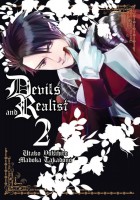
devils-realist2Devils and Realist, Vol. 2 | By utako Yukihiro and Madoka Takadono | Seven Seas – Much of the first volume of this series was the lead character being shown various demonic and fascinating things and simply refusing to accept them, attempting to find a rational example for everything. He’s still doing that to an extent here, but this volume is mostly dedicated to showing him that no matter how he defines what’s happening around him, the trouble is that everyone either wants him dead or making a decision for them. As such, there’s a lot more Devils than Realist here, and even the priests can’t be trusted. I’m hoping that starting soon William will find a way to introduce his own brand of rationalism into the demon world instead of shutting it out. – Sean Gaffney

Haganai8Haganai: I Don’t Have Many Friends, Vol. 8 | By Yomi Hirasaka and Itachi | Seven Seas – A lot of this volume is devoted to characters who are unable to have normal friendships managing to find something similar by pretending they are bitter rivals. Kobato and Maria, Maria and her sister Keito, who is also a Sister – a nun has some bad habits, so to speak – and between Sena and Yozora, which Kodaka realizes when he enters Sena’s room, which looks more like a shrine to Yozora than anything else. So much of Haganai is friendship via conflict that when we start to see the softer side of things – such as Kodaka and Sena’s growing attraction to each other, which comes to a head at a karaoke party – we also feel we don’t want to break up the chemistry of the group. Luckily, we’ve a ways to go. – Sean Gaffney

happymarriage7Happy Marriage?!, Vol. 7 | By Maki Enjoji | Viz Media – The conclusion of the previous volume found Chiwa feeling like she and Hokuto were finally “walking together at the same pace,” but they soon discover that even though they love each other, there’s one thing they can never agree about: Hokuto’s father. Hokuto is convinced his dad is responsible for the death of his mother, and refuses to visit his dying father in the hospital. Chiwa can’t bear to see Hokuto so heartless, and he ends up moving out for a while, but they soon realize that though they don’t know how to solve this problem, they still love each other. I thought this was actually a rather insightful thing for a couple to be fighting about in a manga, and though Happy Marriage&! certainly relies heavily on well-trod tropes for its drama, it’s occasionally a pleasant surprise. I’m glad I revisited it! – Michelle Smith

knights10Knights of Sidonia, Vol. 10 | By Tsutomu Nihei | Vertical, Inc. – There’s so much I could talk about with this volume of Sidonia. The ongoing oddball harem formed around Tanikaze, which is fine feeling like a family but gets very jealous when it comes to the man himself. There’s also the somewhat disastrous attempts to replicate what’s been done with Tsumugi, which almost ends in tragedy. There’s Izana’s ongoing relationship with her grandmother, who looks so similar to her they could almost be identical twins. Yet what I will most recall from this volume is seeing Tahiro, whose possession so disturbed me five volumes ago, blowing her brains out now that her usefulness to Ochiai is at an end. There’s still a good deal of horror left in Sidonia’s quiver. – Sean Gaffney

librarywars12Library Wars: Love and War, Vol. 12 | by Kiiro Yumi and Hiro Arikawa | Viz Media Sometimes the key emotional moments in a series seem to have more resonance if more time has been spent building up to them. Library Wars could be a bit hit or miss in earlier volumes, but I always loved the premise of an action oriented series about paramilitary librarians. This volume will be very satisfying to long-time readers, as Iku and Dojo finally go out on a date. Seeing Dojo’s calm and restrained reactions as Iku spazzes out a bit was quite adorable, but the part of this volume that made me want to stand up and cheer was the romance between Tezuka and Shibasaki. Shibasaki does a bit of traditional shoujo gender role switching, with stellar results. On the library side of things, the team is charged with protecting an embattled author, and there might be some more promising developments with Tezuka’s brother thanks to Shibasaki’s intervention. This continues to be a fun series. Anna N

loveless12Loveless, Vol. 12 | By Yun Kouga | Viz Media – One of the downsides of consuming something in bulk, is that it’s difficult to top that kind of immersive experience, or even come close to matching it. This is certainly the case with Loveless, with which my own series of omnibus binges could best be described as a soul-consuming love affair. After all that, how could any single volume possibly live up? It couldn’t. It doesn’t. I’d be lying if I suggested otherwise. What the series’ twelfth volume does offer, however, is proof that the series can hold up even without the fervor of new love. While the volume contains a bit more non-linear fluff that I’d ideally prefer, it also provides a lot of substance, especially as regards Ritsuka’s supposed personality change and Seimei’s controlling relationship with his fighter, Nisei. These sections are honestly riveting, and I’m left desperate for more. Just as it should be. Still recommended. – MJ

spellofdesireSpell of Desire, Vol. 1 | By Tomu Ohmi | Viz Media – There’s a lot that’s swirling around the first volume of this new josei-only-not series from the creator of Midnight Secretary. Repression and control as both a positive and negative thing, and when it feels all right to give in to your passions, especially when you haven’t ever had to deal with them before. Tying this into witchcraft helps to make it at least a bit more metaphorical, and while the male lead hasn’t really done’ anything for me yet, I do quite like Kaoruko. The premise of the series seems to hint that we’ll eventually meet her missing mother as well, which promises to deliver some thrills. This first volume still feels a bit incomplete in the end, however. I hope future volumes will give it some solidity. – Sean Gaffney

Filed Under: Bookshelf Briefs

My Week in Manga: August 18-August 24, 2014

August 25, 2014 by Ash Brown

My News and Reviews

Last week–last Monday, to be exact–Experiments in Manga celebrated its fourth anniversary. I’ve taken to writing what usually ends up being a rather lengthy anniversary post every year in which I reflect on the past three-hundred-sixty-five days, and this year was no different. I also posted a review last week of The World of the Shining Prince: Court Life in Ancient Japan, Ivan Morris’ classic study of Heian-era Japan and The Tale of Genji. The work was originally published in 1964 and it’s still a great read. Finally, for something a little different, I posted a Spotlight on Masaichi Mukaide who, in the late 1970s, became one of the first Japanese comics artists to be released in English. I rather enjoyed investigating this bit of comics history; I hope other people find it interesting as well.

While working on my random musings about Masaichi Mukaide, I discovered that the three short manga currently believed to be the earliest manga to have been translated into English (Akasegawa Genpei’s “Sakura Illustrated,” Shirato Sampei’s “Red Eyes,” and Tsuge Yoshiharu’s “The Stopcock”) are available online to read digitally. Another interesting piece of reading that I came across last week was Ryan Holmberg’s article on manga, art history, and Seiichi Hayashi at The Comics Journal. Elsewhere online, Sean at A Case Suitable for Treatment looks at some of the latest offerings from Crunchyroll Manga and Justin at Organization Anti-Social Geniuses was able to get some of the manga publishers to weigh in on their approaches to the last pages of manga volumes.

Quick Takes

Food Wars!: Shokugeki no Soma, Volume 1Food Wars!: Shokugeki no Soma, Volume 1 written by Yuto Tsukuda and illustrated by Shun Saeki. Soma Yukihira wants nothing more than to surpass his father in the kitchen, but his goal of becoming the ultimate chef becomes a little more difficult when his father closes up the family restaurant for three years. In the meantime, Soma is expected to transfer into the most elite and competitive culinary school in Japan. The other students aren’t very welcoming of the son of a low-end family restaurant, so it’s entirely up to the arrogant and uncouth Soma to prove that his cooking is just as impressive as their high-class cuisine. Overall, the artwork in Food Wars is great. The illustrations of the food in particular are incredibly sumptuous. And then there are the reaction shots–those who taste Soma’s cooking often fall into nearly orgasmic ecstasy which is accompanied by highly sexualized imagery. This does include such things as young women being molested by tentacles, which will certainly not appeal to every reader. Personally, I was for the most part rather amused by the ridiculous levels and absurdity of the occasional fanservice.

The Prince of Tennis, Volume 1The Prince of Tennis, Volumes 1-7 by Takeshi Konomi. While recently reading The Princess of Tennis, a memoir written by one of Konomi’s assistants, I came to the realization that I had never actually read any of The Prince of Tennis. The series is one of the most successful and popular sports manga in Japan, growing into a fairly substantial franchise. The Prince of Tennis is an oddly addictive series–I tore through the first seven volumes very quickly–but to some extent it’s also a bit frustrating. There is virtually no story or character development, simply game after game of tennis and middle school trash talk. Some of the most important games, the ones that actually impact the characters’ growth (what little there is) happen almost entirely off-page. All of the players are very strong to begin with, so there hasn’t been much evolution in their performance or skill levels, either. But the various games are interesting and entertaining, if a little over-the-top. There are a lot of good-looking characters of various types, too, which is probably a large part of the series’ appeal. I’m not in a rush to read more, but I did enjoy the first seven volumes.

Filed Under: FEATURES, My Week in Manga Tagged With: food wars, manga, Prince of Tennis, Shun Saeki, Takeshi Konomi, Yuto Tsukuda

Attack on Titan, Vol. 13

August 24, 2014 by Sean Gaffney

By Hajime Isayama. Released in Japan by Kodansha, serialization ongoing in the magazine Bessatsu Shonen Magazine. Released in North America by Kodansha Comics.

For a while there Attack on Titan was able to keep its readership breathless, with a chase sequence and rescue that went over multiple volumes, following a long extended siege that revealed stunning information about half of our cast. There’s been no time to catch your breath and think about what’s really going on. And that’s this volume’s job, to try to take a step back and work out what everyone is fighting for and why. And the answer is not really one that anyone is going to find pleasant. Levi notes it himself while discussing things with the team – this has been a horrible, twisted world for 100 years now, and there’s no sense that even stopping the Titans will really fix anything. Do we really want the good guys to win if the leadership in place is so rotten?

attack13

The whole Survey Corps team, minus the four obvious ones, are now back together again and part of Levi’s new squad. Sasha has returned relatively unharmed from her trip to the north, and attempts to bring a certain levity with her – her interactions with Jean about food are meant to be reminiscent of the first few volumes. Even here, though, we cut from the comedic scenes to Levi staring into space, overlaying his old squad – now all dead – with the new team he’s in charge of. Levi is not the most personable guy in the world – between him and Hange, who’s wildly mood swinging through this entire volume, we might almost have a functioning human – but I think he’s good at knowing how to get what he needs, and right now that means he has to be mean to Eren, as being driven into a corner seems to be the only thing that allows Eren to control his Titan abilities.

Then there’s Historia, whose past comes into play here. She explains her childhood to the squad, and it is, needless to say, horrible. Living her life as best she can, and only realizing once she starts reading books and other stories how truly terrible it is. Abused by the other children, and her own mother despises her. Then she’s almost killed, only saved at the last minute by her father denying her own existence. What makes it worse is that there are also bits she can’t recall, as a mysterious young woman, the only person who ever shows her any love and affection (besides Ymir, and trust me she’s cut up about that as well), erases her memory every time they met as kids. This is actually the most plot specific part of the volume, as Eren is also dreaming about that young woman, who may be related to both of them? Who knows.

Meanwhile, back in the city, Pastor Nick has been tortured and killed by the military police, once again showing us how it’s the Survey Corps versus the world here. Erwin is doing his best to try to get on top of things, and in the end makes the decision that the royal government has proven itself unfit to lead, and needs to be overthrown. Which is all very well and good, but he says that at the same time as we cut to Levi and Hange, about to torture the same MP who tortured Pastor Nick. Replacing one group who advocates torture to get results with another one does not fill me with glee, though I may have to save that subject for the next volume.

This has never exactly been a fun series to read, but this volume in particular is grim and grimy, helped along by Isayama’s art, which has improved to “OK” but that’s still a step below most manga artists, including the ones who draw his spinoff stories. I also disliked everything about the subplot with Armin being threatened with rape by a member of Reeves Company, particularly as, seeing some of the cast laughing about it later, I think we’re supposed to see it as a funny interlude rather than disgustingly awful. Attack on Titan is still one of the most compelling series out there, and you’ll want to see what happens next. But when the fighting slows and you start to deal with the city, its citizens, and our heroes, you can’t help but feel weary.

Filed Under: REVIEWS

Dawn of the Arcana Vol 13 and Midnight Secretary Vol 7

August 23, 2014 by Anna N

These are both great series from the Shojo Beat line that are concluding! I always feel a bit wistful when reading final volumes, but fortunately I am quickly distracted by new manga series.

Dawn of the Arcana Vol 13 by Rei Toma

In this volume of Dawn of the Arcana, Nakaba and Caesar are reunited, while Loki makes an unexpected demand – to be given the kingdom of Senan so humans and Ajin can live separately. Nakaba is absolutely against this, seeing a way for her and Caesar to bring both people together, but Loki leaves, determined to secure a kingdom for the Ajin. Nakaba is heartbroken, starting to adjust to life in Belquat as Caesar’s queen yet again. She closes herself off from her magical powers, not wanting to suffer again if she sees Loki in a vision. One of the things that I’ve always liked about this series is that it is a bit more about the world the characters live in than the romantic issues that they need to work through. So Nakaba and Caesar set to rebuilding their world without Ajin, as the country of Senan becomes more closed off and mysterious. When an almost grown-up Rito shows up with a message from Senan, this sets off a series of surprising revelations that can change how readers interpreted the story from the very beginning. I have to admit, I was genuinely surprised by this concluding plot twist.

Dawn of the Arcana
was one of those series that grows on readers gradually. I remember enjoying but feeling slightly ambivalent about the first volume, but after reading a few more I knew I’d be reading the rest of the series. While there is plenty of romantic angst, the focus on world buliding, geopolitics, and human-Ajin race relations made the story seem more expansive than usual for a shoujo fantasy series.

Midnight Secretary Vol 7 by Tomu Ohmi

Seven volumes seems like just the right length for this manga about a dedicated secretary and her vampire boss. In this volume Kyohei is formally banished from the vampire clan because he refuses to part from Kaya. But as they start to figure out how to live on their own, they have to start working on ways to deal with complications like Kyohei’s regular blood supply and the loss of business that occurs when Kyohei’s new company starts running into trouble. There’s an additional issue as Kaya’s blood starts to turn toxic to Kyohei, further straining their relationship. There’s never any doubt that this manga is headed to a happily ever ending for this unconventional couple, and readers wanting to see Kaya and Kyohei set up as a strong couple facing their future together won’t be disappointed. There’s an extra bonus chapter that flips the gender dynamics of the whole book, as vampire Marika finds her “Midnight Butler.” This was a great bonus story, and it was interesting to see Marika in a different context, because she’d only showed up as a friend of Kyohei’s before. Overall, this was an extremely satisfying josei-disguised-as-shoujo-series, and I’m delighted that I can now switch over to Ohmi’s Spell of Desire for similar supernatural romance!

Review copies provided by the publisher

Filed Under: REVIEWS Tagged With: dawn of the arcana, midnight secretary, shoujo

Random Musings: Spotlight on Masaichi Mukaide

August 22, 2014 by Ash Brown

Star Reach, Issue 7

Star Reach #7

While reading Comics: A Global History, 1968 to the Present, I encountered a single sentence that particularly caught my attention: “Star Reach was also notable for printing the first Japanese comics to be translated into English, two short pieces by Masaichi Mukaide; the style displayed was not characteristically Japanese, however, and failed to ignite any further interest in importing manga for the time being.”

Masaichi Mukaide. Though at that point I was unfamiliar with Star Reach, I was pretty sure that I had come across Mukaide’s name somewhere before. And so I decided to investigate.

Star Reach was an influential independent American comics anthology that focused on science fiction and fantasy stories. Mike Friedrich, who was once an editor and writer at both DC Comics and Marvel, established his own press in order publish Star Reach, which began in 1974. In 1978, he also started to release Star Reach‘s sister publication Imagine. At one point or another, both of those magazines included short works by Mukaide. Some of the comics were entirely his own creation while others were collaborations with different writers, both Japanese and American–notably Lee Marrs and Steven Grant. The first of Mukaide’s comics to appear in English, “The Bushi,” was written by Satoshi Hirota and was published in the seventh issue of Star Reach January 1977.

In an interview with Friedrich included in the Star Reach Companion, Richard Arndt asked how it came about that Star Reach published the first manga to appear in America. Friedrich replied:

I’ve never met the Japanese artist I published, although we did present a fair amount of his work. Oddly enough, he’s not a comic book artist in Japan. He was basically a fan artist over there. He could not make his living as an artist in Japan because his work was considered too American! If you look at it now, it was probably the first combination of manga and American comics. His work didn’t quite fit anywhere. But, yeah, there’s a book, Manga! Manga!, which certifies that the first appearance of manga in the United States was in Star Reach. I had no idea that was true.

Well, it turns out that technically isn’t true–Ryan Sands has noted that a 1971 issue of Concerned Theatre Japan included three short manga in translation–but for all intents and purposes, Mukaide’s work was the first exposure that the average comics reader in the United States had to manga.

Try as I might, I’ve been unable to find very much information about Mukaide himself. The best clue that I’ve discovered comes from Friedrich’s editor’s note accompanying Star Reach #18, the magazine’s final issue:

A friend of Masaichi Mukaide dropped by the other day and I found out a bit more about our distant Japanese contributor. He’s a law school graduate who opted out of a legal career to enter the publishing world and keep up his art. His wife is also an artist, working on the local comics (I believe I was told).

However, that’s not the last that was seen of Mukaide in English. Sometime between 1980 and 1982 a volume simply called Manga was released. (ISBN 4946427015 for those who are interested in trying to track down a copy.) This collection is the reason that Mukaide’s name seemed familiar to me–his comic, “The Promise,” concludes the volume. He was also the editor of the collection. Looking more closely at Manga‘s credits, there are also some other names that I now recognize: Friedrich served as the consulting editor, Hirota was the associate editor, and Marrs was a contributing writer.

Manga was one of the first collections deliberately crafted in order to introduce Japanese comics to Western audiences: “Our purpose in publishing Manga is to give the non-Japanese reading public a visual taste of Japan and the creative talents that exist there. Nothing would give us greater pleasure, however, if in doing so we are able to boost the cultural understanding in the west about Japan.”

The Bushi

“The Bushi”

As already mentioned, the first work by Mukaide to appear in English was “The Bushi,” which was written by Satoshi Hirota. Were it not for the historical Japanese setting, there is very little to indicate that the creators themselves were also Japanese. Mukaide’s artwork is not all that different from many of the other comics found in Star Reach. The story is set during the tumultuous time between the age of myth and legends and the age of humans. A young warrior confronts and battles with a demon, seeking revenge for the slaughter of his family, only to become a demon himself.

“The Spider Thread” is based on the well-known short story “The Spider’s Thread” written by Ryūnosuke Akutagawa in 1918. In it, a sinner is given the chance to escape hell because he once saved the life of a spider–the only good deed that he ever committed. However, Mukaide gives his own little twist to the tale at the end of the comic. Considering the seriousness and drama of the story–it almost entirely takes place among the tortured souls in hell–the final panel is surprisingly humorous, turning the comic into a joke. “The Spider Thread” also contains what is probably my favorite single page composed by Mukaide.

Mukaide’s first collaboration with writer Lee Marrs, “The Awakening of Tamaki,” was apparently intended to be the start of a series which would follow the trials of a young woman named Tamaki. After her family is killed, Tamaki is raised in seclusion by her sole-surviving uncle. When he dies as well she must make her own way in the world, disguised as a boy for the sake of her safety. Thanks to her uncle’s training, Tamaki is an excellent swordswoman with exceptional moral strength. As far as I know, there were never any more installments in the series, which is a shame; I really liked the comic.

The Spider Thread

“The Spider Thread”

“The Mission” was Mukaide’s second collaboration with Marrs. Whereas I was very fond of “The Awakening of Tamaki,” “The Mission” is probably my least favorite of Mukaide’s comics in English. It seems like it should be a something that I would enjoy, but it just didn’t grab me. Despite the numerous twists and turns the story takes within its few pages, despite the lies and betrayals, despite the quick pace and all of the action and fighting, for some reason “The Mission” simply strikes me as somewhat generic ninja adventure. Ninja doesn’t even have a name; he’s just Ninja.

When compared to the rest of Mukaide’s English-language comics,  the two-paged “Salvation” stands out because the artwork and story is so simple. Backgrounds are almost nonexistent and the shading and detail of the illustrations are limited as well. The story follows a drunkard who keeps getting kicked out of drinking establishments. He causes a panic by claiming that a doomsday flood is coming in order to sneak back into the bars after everyone else has fled. It’s an amusing and silly short comic that, like most of Mukaide’s other comics, has a bit of a twist at the end.

“The Soldier Who Guards the Gate of the City Freedom” is another two-paged comic by Mukaide, although it is more of a historical allegory instead of a humorous gag like “Salvation.” A young soldier, a man of honor, has the lonely duty of guarding the city gates. He does so willingly, though the eventual enemy attack is a long time in coming. Mukaide’s emphasis on the soldier’s loneliness is the key to the impact of the brief comic. The steady passage of time, too, is important. Mukaide captures this through the use of a very regular progression of narrow panels which are all of the exact same size.

“Crashing,” which was written by Steven Grant, is the only example of Mukaide’s work in the genre of science fiction. All of his other comics published in English are historical in nature, generally with touches of the fantastic. Mukaide’s artwork in “Crashing” is not at all dissimilar to American science fiction comics of the era. It’s a somewhat confusing story, but this is exceedingly appropriate as the comic’s protagonist has gone insane. Mukaide’s artwork supports this as well–the illustrations can be somewhat hallucinogenic and the page layouts are often fragmented.

The Awakening of Tamaki

“The Awakening of Tamaki”

“The Promise,” the last of Mukaide’s comics to be translated, is his rendition of the legend of the Yuki-onna, or the Snow Woman. Lafcadio Hearn’s telling of the story in Kwaidan is probably the version with which English-language audiences are most familiar. Mukaide’s tale incorporates many of the same elements as Hearn’s, but he adds his own touches as well. “The Promise” also shares some similarities with “The Bushi,” especially in style, although “The Promise” tends to be stronger overall. However, the two comics bookend Mukaide’s excursion into English particularly nicely because of their parallels.

After that, Mukaide seems to disappear. I have no idea what happened to him or if he’s even still creating comics. Perhaps he went back to working in law. Either way, a small corpus of Mukaide’s comics released in English in the late 1970s and early 1980s does exist. What particularly strikes me about these works are the changes and adjustments that he makes to his art style and page layouts to better suit each story being told. Although each comic is definitely its own work, there are some common elements as well. For example, his narratives and artwork frequently draw inspiration from traditional stories, tales, and legends. Interestingly, although many of his comics take place within a vaguely historical Japanese setting, he does not exclusively limit himself to Japanese sources. Instead, Mukaide’s work blends together both Eastern and Western influences, which seems oddly fitting for one of the first Japanese comics creators to be released in English.

Masaichi Mukaide Bibliography

  • “The Awakening of Tamaki” written by Lee Marrs and illustrated by Masaichi Mukaide (Imagine #4, October 1978)
  • “The Bushi” written by Satoshi Hirota and illustrated by Masaichi Mukaide (Star Reach #7, January 1977)
  • “Crashing” written by Steven Grant and illustrated by Masaichi Mukaide (Star Reach #18, October 1979)
  • “The Mission” written by Lee Marrs and illustrated by Masaichi Mukaide (Star Reach #15, December 1978)
  • “The Promise” written and illustrated by Masaichi Mukaide (Manga, 1980/1982?)
  • “Salvation” written and illustrated by Masaichi Mukaide (Imagine #6, June 1979)
  • “The Soldier Who Guards the Gate of the City Freedom” written and illustrated by Masaichi Mukaide (Star Reach #18, October 1979)
  • “The Spider Thread” written and illustrated by Masaichi Mukaide (Imagine #3, July 1978)
Salvation

“Salvation”

Further Reading
Comics: A Global History, 1968 to the Present by Dan Mazur and Alexander Danner
Early Manga: A Chronology by Ryan Sands
Incredible First-Ever Manga Translated in 1971 by Ryan Sands
Manga and Mega Comics by Jason Thompson
Manga in the USA by Michael Toole
My Life is Choked with Comics #19a: Manga by Joe McCulloch
My Life is Choked with Comics #19b: Manga by Joe McCulloch
Star Reach Companion by Richard Arndt

Filed Under: FEATURES Tagged With: comics, manga, Masaichi Mukaide

Manga the Week of 8/27

August 21, 2014 by Sean Gaffney, Michelle Smith, Ash Brown and Anna N Leave a Comment

SEAN: The final week of this brutal August, at least before we arrive at a brutal September with just as many books. Yen for once is being fairly quiet, but that’s all right, Kodansha’s here to pitch in.

Dark Horse brings us the 6th Blood Blockade Battlefront, blocked out by the brigand who brought us Brigun!… OK, Trigun. That sort of fell apart at the end there.

MICHELLE: *snerk*

hatsunemix

SEAN: There is also the Hatsune Miku Unofficial Hatsune Mix, a manga compilation about the Vocaloid personality.

Kodansha gives us the 13th Attack on Titan volume, which delves further into Historia’s background, and brings the action back to the Town – for better and worse.

Cage of Eden 15 will no doubt continue its descent into the pyramid of EVIL.

No. 8 is up to Vol. 6… um, I mean No. 6 is up to Vol. 8… guh. Ash, take over.

ASH: Indeed! No. 6 has reached its eighth, and penultimate volume. Also, as a bonus, Kodansha has included a 16-page color illustration gallery in this volume as a thanks to readers for supporting the series.

SEAN: Sankarea is also up to Vol. 8, and continues to try to answer the question “will this romantic harem comedy end with everyone brutally slaughtered?” Actually, that could apply to Cage of Eden as well.

No murders in Say “I Love You” yet, but plenty of teenage trauma and dealing with budding sexualities. Will things get lighter in Vol. 3?

MICHELLE: I look forward to finding out!

ANNA: Me too! this is the only manga I have my eye on this week, which should theoretically give me a chance to catch up with the many piles of unread manga I have stashed around my house.

SEAN: And The Wallflower 33, whose volume arrives a lot faster than 32, and yes, is still coming out in Japan with no signs of ending soon.

Vertical has the 3rd Cardfight!! Vanguard, in which I assume there will be fighting. With cards. And excessive punctuation.

sao2

Yen On brings us the second volume of the Sword Art Online novels. This does not pick up after the end of the first novel, but doubles back to introduce a few more regulars and tell some Aincrad short stories.

Fanservice Overload #1: the 7th volume of BTOOOM!, which still has people to blow up and cleavage to show off.

Fanservice Overload #2: The 2nd High School DxD, where a harem continues to form. Which, given this is a harem manga, is as it should be.

A brief interlude with the penultimate volume of the Melancholy of Haruhi Suzumiya manga. The novel is awaiting a new volume from its writer-blocked author, so the manga ends with Vol. 20 while we see if there will be any more. This, however, is merely Vol. 19, so expect a lot of Sasaki.

Fanservice Overload #3: Triage X Volume 7, which… what the hell is even HAPPENING on that cover?

MICHELLE: Yeah, these fanservice titles are so not for me.

SEAN: Will you be getting fanservice next week? (And honestly, Cage of Eden should be in there as well.) If not, what will you be checking out?

Filed Under: FEATURES, manga the week of

  • « Go to Previous Page
  • Page 1
  • Interim pages omitted …
  • Page 347
  • Page 348
  • Page 349
  • Page 350
  • Page 351
  • Interim pages omitted …
  • Page 551
  • Go to Next Page »
 | Log in
Copyright © 2010 Manga Bookshelf | Powered by WordPress & the Genesis Framework