• Skip to primary navigation
  • Skip to main content
  • Skip to primary sidebar
  • Home
  • About Us
    • Privacy Policy
    • Comment Policy
    • Disclosures & Disclaimers
  • Resources
    • Links, Essays & Articles
    • Fandomology!
    • CLAMP Directory
    • BlogRoll
  • Features & Columns
    • 3 Things Thursday
    • Adventures in the Key of Shoujo
    • Bit & Blips (game reviews)
    • BL BOOKRACK
    • Bookshelf Briefs
    • Bringing the Drama
    • Comic Conversion
    • Fanservice Friday
    • Going Digital
    • It Came From the Sinosphere
    • License This!
    • Magazine no Mori
    • My Week in Manga
    • OFF THE SHELF
    • Not By Manga Alone
    • PICK OF THE WEEK
    • Subtitles & Sensibility
    • Weekly Shonen Jump Recaps
  • Manga Moveable Feast
    • MMF Full Archive
    • Yun Kouga
    • CLAMP
    • Shojo Beat
    • Osamu Tezuka
    • Sailor Moon
    • Fruits Basket
    • Takehiko Inoue
    • Wild Adapter
    • One Piece
    • After School Nightmare
    • Karakuri Odette
    • Paradise Kiss
    • The Color Trilogy
    • To Terra…
    • Sexy Voice & Robo
  • Browse by Author
    • Sean Gaffney
    • Anna Neatrour
    • Michelle Smith
    • Katherine Dacey
    • MJ
    • Brigid Alverson
    • Travis Anderson
    • Phillip Anthony
    • Derek Bown
    • Jaci Dahlvang
    • Angela Eastman
    • Erica Friedman
    • Sara K.
    • Megan Purdy
    • Emily Snodgrass
    • Nancy Thistlethwaite
    • Eva Volin
    • David Welsh
  • MB Blogs
    • A Case Suitable For Treatment
    • Experiments in Manga
    • MangaBlog
    • The Manga Critic
    • Manga Report
    • Soliloquy in Blue
    • Manga Curmudgeon (archive)

Manga Bookshelf

Discussion, Resources, Roundtables, & Reviews

Blog

Higurashi: When They Cry, Vols. 4-5

March 2, 2010 by Megan M. 2 Comments

Guest Review
Higurashi: When They Cry, Vols. 4-5
By Ryukishi 07, Yutori Houjyou, and Jiro Suzuki
Published by Yen Press

Review by Megan M.

Buy This Book Buy This Book</td

A newcomer to the small hamlet town of Hinamizawa, Keiichi Maebara makes friends quickly among the students at his new school. He also learns that the town has a history of grisly murders occurring on the night of the local Cotton Drifting. What’s more, some of his new friends seem to be intimately (and tragically) involved in the town’s gruesome history.

Based on a popular murder mystery game, Higurashi: When They Cry depicts multiple versions of a single story, drawn by various artists. Volume four wraps up the “Cotton Drifting” arc and volume five begins the “Curse Killing” arc. The difference in approach between these two volumes is most easily demonstrated by discussing their art styles. Yutori Houjyou’s art in “Cotton Drifting” is a fairly standard in terms of character design, but dark, creepy, and occasionally shocking. Her characters, even the more lighthearted ones, have a depressing air of gravity to them. Jiro Suzuki’s art in “Curse Killing,” on the other hand, is in broad slapstick, featuring plenty of visual humor and moe character designs (along with the usual fanservice). I found the adjustment jarring, and volume five’s borderline-inappropriate comedy kept me from being able to care about the tragedy surrounding the characters.

One interesting note: unlike similar stories, which tend toward gratuitous display of female corpses, Higurashi doesn’t play gender favorites when it comes to victims. Though it’s true there are more female corpses than there are male, there are also far more female characters overall.

I consider it to almost be a crime to watch Clue (a brilliant black comedy from the 1980s) without watching all the endings, so I’m intrigued by a canon that centers around different possibilities in a single story. Unfortunately, this one didn’t quite work for me. Though Higruashi: When They Cry is by no means bad manga, I don’t think it’s a series for me.

Review copies provided by the publisher.

Filed Under: REVIEWS Tagged With: higurashi when they cry, manga

Osamu Tezuka’s MW

March 1, 2010 by Katherine Dacey

Invoke Tezuka’s name, and most readers immediately think of Astro Boy, Buddha, and Princess Knight. But there’s a darker side to Tezuka’s oeuvre that dates back to 1953, the year in which he brought Dostoevsky’s tormented Raskolnikov to life in a manga-fied version of Crime and Punishment. It’s this side of Tezuka — the side that acknowledges the human capacity for violence, greed, and deception — that’s on display in MW, a twisty thriller about a sociopath and the priest who loves him.

The central event of MW is a military cover-up. “Nation X,” which maintains a base on Okinawa Mafune, has been stockpiling a top-secret chemical weapon known as MW.1 An explosion releases a poisonous cloud, killing everyone on the island except for two visitors, Iwao Garai and Michio Yuki. Though Garai and Yuki are equally traumatized by this holocaust, their lives diverge wildly over the next fifteen years. Garai embraces the light, becoming a Roman Catholic priest, while Yuki embraces the darkness, embarking on a spree of kidnappings, murders, and extortion schemes meant to punish the politicians, businessmen, and military officials who profited from the subsequent cover-up.

Superficially, Yuki’s plans might be understood as an eye for an eye, but Yuki is no righteous avenger. He’s a serial killer who relishes torturing his victims, who exploits the secrecy of the confessional to torment Garai with details of his crimes, who uses his androgynous sex appeal to seduce both men and women, and who impersonates his female victims with the skill of a kabuki actor. (And just in case we haven’t yet grasped the true extent of Yuki’s depravity, Tezuka suggests that Yuki has a rather intimate bond with his dog Tomoe.) Even Yuki’s motivation for exposing the MW scandal is purely selfish: Yuki is dying from its lingering effects, and wishes to take millions of people with him to the grave. Though Father Garai hopes to redeem Yuki, he lacks Yuki’s certitude, instead violating his priestly vows — especially that pesky oath of celibacy — as he tries to prevent Yuki from harming anyone else.

MW can certainly be enjoyed as a potboiler. Tezuka spins an entertaining, slightly preposterous yarn, serving up more plot twists, car chases, and gender-bending costume changes than Dressed to Kill and The Manchurian Candidate combined. But it’s also very talky. Characters frequently describe their plans at length instead of just carrying them out; voice-overs interrupt the action to educate us on the history of chemical warfare; and thought balloons reveal little about the interior lives of the characters that couldn’t be inferred from their actions.

MW can be more profitably understood as a meditation on US-Japanese relations during the Vietnam War. The gas attack takes place around 1960, the year the Japanese Diet ratified the Treaty of Mutual Cooperation and Security2, while most of the action takes place in the 1970s, as left-wing student groups were taking to the streets to protest American military presence in Japan. Though MW does include a few demonstrations, Tezuka doesn’t try to dramatize the left wing’s activities so much as the spirit of the movement: “Debunk false democracy!” The politicians in MW are greedy, foolish, and entirely too cozy with “Nation X” military brass. Yet the student radicals don’t fare so well, either; Tezuka renders them as an ineffectual lot whose agenda is riddled with inconsistencies. Only in the ambivalent Father Garai, who desperately wishes to enlighten the public about MW, does Tezuka present a decent, sympathetic figure, someone struggling mightily against hypocrisy and deceit, even as he succumbs to his own sexual demons.

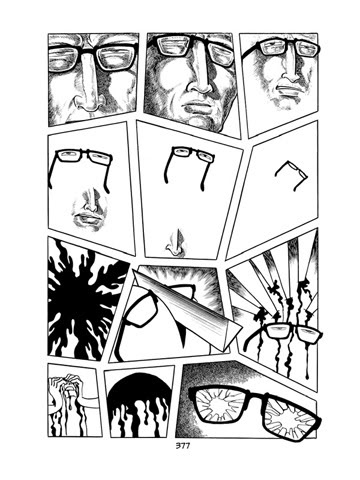
Of course, there’s another level on which MW can be appreciated as well: the artwork. MW is Tezuka at his most restrained; there are no doe-eyed critters, no slapstick, no characters breaking the fourth wall to crack wise about cartooning conventions. (To be sure, there are moments of playfulness: in one memorable sequence, reminiscent of the grand parade in Cleopatra, Yuki impersonates the great gorgons of Aubrey Beardsley’s work, from Salome to the Lady in the Peacock Skirt.) Most of the pages have a surprisingly direct, clean presentation, a neat and orderly progression of squares and rectangles that run in counterpoint to the orgies, bank robberies, high-speed boat chases, and fist-fights they contain. From time to time, however, Tezuka thinks outside the grid, with dramatic results. When Gari and Yuki find themselves on Okinawa Mafune, for example, Tezuka doesn’t depict the actual gas attack. Instead, Tezuka shows us only what Garai and Yuki see after the cloud has dissipated: a mosaic of faces, each contorted into a grotesque death-mask. It’s a potent, haunting moment that suggests both the survivors’ horror upon discovering the bodies and the victims’ excruciatingly painful deaths.

As with all of Tezuka’s works, MW is sprinkled with characters and scenes that may make contemporary readers uncomfortable. The women of MW, for example, are either passive victims — one is rendered an emotional and physical invalid after Yuki rapes her — or venal shrews, with only a brief appearance by a sane lesbian newspaper editor to balance the parade of unflattering female stereotypes. Tezuka’s depiction of homosexuality is similarly frustrating. On the one hand, the newspaper editor refuses to embarrass Garai by outing him in the press, telling him that “gay love is accepted outside Japan”; on the other hand, Garai’s relationship with Yuki has a strong whiff of pedophilia — at least in the opening pages — as Garai is an adult and Yuki a boy at the time of their first encounter. Similar issues dog Apollo’s Song and Swallowing the Earth, yet in MW, Tezuka’s decision to focus exclusively on the problems of Japanese society prevents the story from spinning out of control or sinking under the weight of a few ill-informed portrayals.

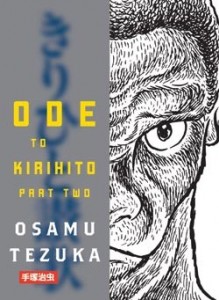
Fans of Apollo’s Song, Buddha, and Ode to Kirihito won’t be surprised to learn that Vertical has done a fine job of showcasing Tezuka’s work with a crisp translation, quality binding, and signature Chip Kidd dustjacket. MW won’t be everyone’s cup of tea, but if the thought of Tezuka channeling Brian DePalma and John Frankenheimer sounds appealing, you’ll want to add it to your library.

1 MW is pronounced “moo.”
2 The treaty reaffirmed the US military’s commitment to defending Japan against hostile forces, pledged to return captured territories, and extended the US occupation of Okinawa for an additional ten years.

This is a revised version of a review that appeared at PopCultureShock on October 29, 2007. Click here for the original text.

MW • BY OSAMU TEZUKA • VERTICAL, INC. • 582 pp. • RATING: OLDER TEEN (16+)

Filed Under: Manga, Manga Critic, REVIEWS Tagged With: Classic, Osamu Tezuka, Thriller, Vertical Comics

Osamu Tezuka’s MW

March 1, 2010 by Katherine Dacey

mw_coverInvoke Tezuka’s name, and most readers immediately think of Astro Boy, Buddha, and Princess Knight. But there’s a darker side to Tezuka’s oeuvre that dates back to 1953, the year in which he brought Dostoevsky’s tormented Raskolnikov to life in a manga-fied version of Crime and Punishment. It’s this side of Tezuka — the side that acknowledges the human capacity for violence, greed, and deception — that’s on display in MW, a twisty thriller about a sociopath and the priest who loves him.

The central event of MW is a military cover-up. “Nation X,” which maintains a base on Okinawa Mafune, has been stockpiling a top-secret chemical weapon known as MW.1 An explosion releases a poisonous cloud, killing everyone on the island except for two visitors, Iwao Garai and Michio Yuki. Though Garai and Yuki are equally traumatized by this holocaust, their lives diverge wildly over the next fifteen years. Garai embraces the light, becoming a Roman Catholic priest, while Yuki embraces the darkness, embarking on a spree of kidnappings, murders, and extortion schemes meant to punish the politicians, businessmen, and military officials who profited from the subsequent cover-up.

…

Read More

Filed Under: Manga Critic Tagged With: Osamu Tezuka, Seinen, vertical

Countdown to Banana Fish Roundtable!

March 1, 2010 by MJ 10 Comments

Calling all fans (and future fans) of Akimi Yoshida’s shojo classic Banana Fish! Coming up later this month, I’ll begin hosting an ongoing Banana Fish roundtable, featuring a number of my favorite manga critics. As with The NANA Project at CSBG, we’ll be discussing two volumes at a time, every two months. Why am I telling you this now? So you have time to track down the books for yourselves!

If you’re not certain about Banana Fish, check out this post for (hopefully) persuasive discussion, including a short preview of the series. If I can’t convince you, maybe Shaenon Garrity can. If you were addicted to S.E. Hinton novels as a teen, you may love Banana Fish. If you’re into current manga series like Wild Adapter or manhwa epics like One Thousand and One Nights or Let Dai, you may love Banana Fish. …

Read More

Filed Under: NEWS Tagged With: banana fish, manga

Manhwa Monday: March Releases

March 1, 2010 by MJ 1 Comment

Welcome to another Manhwa Monday! I’ll get to the reviews in a moment, but first let’s take a look at some of this month’s upcoming releases. It’s all Yen Press this month (at least in print) but they are giving us plenty to look forward to. In March, we’ll see new volumes of Angel Diary, Very! Very! Sweet, Raiders, You’re So Cool, The Antique Gift Shop, and Time and Again.

My personal picks from the lot would be the next installment in JiUn Yun’s Time and Again (see my review of volume one here) and new installments of JiSang Shin and Geo’s Very! Very! Sweet and Lee Young-hee’s You’re So Cool, both in their sixth (and final, in the case of YSC) volume.

Meanwhile, NETCOMICS will be offering at least one new chapter of Sooyeon Won’s Full House (see my reviews of chapters one and two) and Youngran Lee’s There’s Something About Sunyool, both due on March 5th. …

Read More

Filed Under: Manhwa Bookshelf Tagged With: manhwa, Manhwa Bookshelf

Confessions of a Former Scan Junkie

February 28, 2010 by MJ 83 Comments

I’m sure by now everyone has heard the news about Nick Simmons’ alleged (and meticulously documented) plagiarism in his fledgling comic, Incarnate. For those who haven’t, Deb Aoki has a collection of links and Twitter conversations here in her blog. As you’ll see from her post, discussion of plagiarism has segued into discussion of piracy. I was foolish enough to wade into the comments section yesterday evening, which turned out to be frustrating, exhausting, and really nothing else.

As I mentioned to someone later on Twitter, I was not nearly as anti-scanlation when I entered the conversation as I was when I left. In the end, the pro-scanlation crowd had turned me against them to the point where I not only could no longer see any merit in what they were saying, but was frankly disgusted by the idea of being part of the same fan community. I have some examples to share, but first, a confession: …

Read More

Filed Under: FEATURES Tagged With: manga, piracy, scanlations

Excel Saga Volume 2

February 27, 2010 by Sean Gaffney

By Rikdo Koshi. Released in Japan by Shonen Gahosha, serialization ongoing in the magazine Young King OURS. Released in North America by Viz.

Volume 2 of Excel Saga starts to spin a bit more of its actual plot, though things are still in the beginning stages. (By the way, Viz and Rikdo Koshi have done original cover art for the first 4 volumes of the manga, ostensibly to help them sell. When presumably they didn’t sell, Viz reverted to simply using the original Japanese covers, starting with Volume 5.)

es2

The good news is we meet two more of our main cast in this volume. Dr. Kabapu makes an immediate impression. He looks odd, and he is odd. But he’s also immediately shown to be morally bankrupt, and willing to be an utter jerk for his own ends. If you ask me, he’s more of a villain throughout the series than Il Palazzo is, even though he is ostensibly ‘protecting the city’. (Of course, once Miwa Rengaya shows up, you get the feeling she’ll soon overtake both of them).

And then there’s Misaki Matsuya, who plays the resident ‘sensible’ woman throughout the manga. Rikdo Koshi is not generally above letting anyone, at any time, play the boke or tsukkomi as events warrant, and indeed the liner notes for Volume 2 note that Excel and Hyatt alternate boke and tsukkomi depending on the situation. Likewise, while Watanabe (at first) and Sumiyoshi CAN be sensible and level-headed, it’s Misaki who carries the brunt of whacking idiots and pointing out stupid things. In a manga with as many weirdos and idiots as this one, it’s welcome.

A couple of other things to note about her introduction: we see her briefly with a cute keychain plushie. Misaki’s addiction to cute plushies, besides being a nice break in her otherwise ‘perfect independent and strong woman’ persona, will continue in future volumes. It’s generally a way for Rikdo to make references to other series that are running alongside Excel Saga in Young King OURS. The other thing is that it’s revealed that she and Iwata were classmates in college. He’s far too informal with her, and she beats him constantly for calling her Misaki, with no honorific. Stay tuned for a lot more on these two…

Meanwhile, our heroines are doing what they do best. Working odd jobs, hailing Il Palazzo, making pathetic attempts to take over the city for the glory of ACROSS, and occasionally sniping at each other. That last is somewhat of a surprise, and won’t last; in a volume or two, Hyatt and Excel will have warmed up to each other, and Hyatt will end up being utterly deferential. (Excel’s true sniping partner will arrive in Volume 8.) Amusing gags here include Hyatt’s inability to not steal medicine, couples with Excel’s inability to resist the word ‘conquer’; yet another insane appearance by the Black Jack-esque doctor and his nurse; and Hyatt’s mysterious ability to avoid setting off any mines while walking through a minefield.

This leads us to the two major plot points that will become important over the whole series. The first is Excel’s superhuman endurance and abilities. At first, you think that it might be merely manga exaggeration – this is a comedy, after all. But gradually, as Excel gets blown into the air by mines, drowned in the middle of oceans, and forced to lift unconscious robots, that she’s simply more than a mere insane human.

The other thing that is introduced here is Il Palazzo suffering from what appears to be multiple personalities. There’s voices talking to him in his head yelling at him about enemies, and he sends Excel and Hyatt on missions and then seems to be completely ignorant of what he’s done. This too will be important later on, and was in fact also used in the anime version (though it was taken in a different direction). This is probably a good thing, as Il Palazzo on his own tends to be fairly drab, spouting rhetoric and pulling ropes on trapdoors. An air of mystery adds to his character.

And of course there are endnotes by Carl Horn. I know fans who buy manga sight unseen just for Carl’s notes.

This is a fun, funny manga, with weird wacky situations, and you get the sense that a big confrontation is set up. To be continued!

Filed Under: UNSHELVED

Presenting NANA Project #5!

February 23, 2010 by MJ 2 Comments

Today I’d like to point you to the latest installment of The NANA Project, in which Danielle Leigh, Michelle Smith, and I dig into NANA volumes 9 & 10! I can honestly say I have never had more much fun with this project than I did this time around, and that’s saying a lot. From Danielle’s introduction: “This time around we all discuss the harsh world of fame, MJand I then subject the character of Yasu to relentless psychoanalysis, while Michelle awes us all with her new “hair theory” of NANA!”

While participating in this month’s discussion, I was reminded more than ever just how emotionally resonant this series is and how true-to-life its characters are. I think the fact that the conversation gets a bit heated here in installment #5 is a real testament to that. Must performing artists choose between career and love? Is “want” an essential element of happiness? Check out NANA Project #5 for all this and more! …

Read More

Filed Under: NEWS Tagged With: manga, nana, nana project

Kamichama Karin Chu vs. Shugo Chara!

February 22, 2010 by MJ 1 Comment

I have a review offsite this morning in today’s Manga Mini’s column, for the final volume in Koge-Donbo’s Kamichama Karin Chu, published by Del Rey. Though I have found plenty to enjoy in this series during its run, things fell apart a bit over the last few volumes, limiting its appeal for adult readers, in my view.

What this series mainly suffers from, however, is inevitable comparisons between it and Del Rey’s other currently-running magical girl series, Shugo Chara! which unfortunately blows it away on pretty much every front–plot, characterization, art, you name it. Perhaps the most obvious disparity between the two, however, is in its depth of messaging, especially for female readers.

Karin’s focus throughout the series is to grow up to be a wife and mother… and a powerful god, of course, but a wife and mother first. Even in this volume’s final side story, she is portrayed as a poor student who strives to bring up her grades only so that she can get into the same high school as her future husband. Shugo Chara!‘s Amu, on the other hand, is focused on discovering her own talents and desires, torn between the many paths open to her, none of which ultimately have to do with boys. Don’t get me wrong, here. There’s nothing objectionable about a woman being a wife and mother, and certainly homemaking is one of Amu’s options as well. I think offering girls a variety of choices, however, is a much stronger way to go and much more in tune with the dreams of young girls today.

Interestingly, too, though Amu fights alongside the Guardians, a group made up of both boys and girls, Karin’s fellow gods are all boys whose help she requires in nearly every battle. While I appreciate messages of cooperation (teaching kids that they should fight all their battles alone is supremely unhelpful), it really does matter that Amu’s backup is consistently mixed-gender and I think that sends a much healthier message to both girls and boys.

Am I trying to paint Shugo Chara! as a feminist series? No. I’m really not. But I do think it offers a great deal more depth in its portrayal its young female protagonist and the world around her than can be found in Kamichama Karin Chu, by a lot.

Thoughts? Disagreement? Please feel free to comment!

Filed Under: NEWS Tagged With: kamichama karin chu, manga, shugo chara!

Kamichama Karin Chu, Vol. 7

February 22, 2010 by MJ Leave a Comment

By Koge-Donbo
Del Rey, 176 pp.
Rating: T (13+)

Karin and Michiru traveled to the future in volume six to try to stop Kirihiko Karasuma (in Jin Kuga’s body) from creating the future they’ve worked so hard to avoid. As they arrive in volume seven, they discover that Kazune has come along as well, despite the loss of his Apollo ring. Together, the three of them face Kirihiko in a final battle to save their futures and bring everyone together again, including loved ones who have been fighting against them.

Time travel is a messy thing indeed and though it has been a major element in the story all along, things begin to unravel here with Karin meeting up with her future self and the Chronos Clocks suddenly taking on new power that seems a bit too conveniently manipulated to make things turn out just right. Everything about this volume feels strained, from its rushed romantic moments to its anticlimactic final battle, as though mangaka Koge-Donbo was forced to wrap things up just a bit too quickly.

Though this series has declined toward the end, diminishing its adult appeal, it is still a fun, whimsical choice for younger readers with a fairly powerful message about making one’s own fate. “We are all little gods,” reads the final page of the series proper. “Sometimes, we can even change destiny.”

Review copy provided by the publisher. Review originally published at PopCultureShock.
Filed Under: MANGA REVIEWS Tagged With: kamichama karin chu

  • « Go to Previous Page
  • Page 1
  • Interim pages omitted …
  • Page 948
  • Page 949
  • Page 950
  • Page 951
  • Page 952
  • Interim pages omitted …
  • Page 1047
  • Go to Next Page »
 | Log in
Copyright © 2010 Manga Bookshelf | Powered by WordPress & the Genesis Framework