I decided to steal an idea from Bully and start a regular Saturday morning cartoon feature. To kick things off, let’s go back a few years and appreciate the gloriousness that is found in the ending credits to FFLCL. I saw this anime some time ago, so it is just a jumbled mess in my head of robots, vespas, aliens, and an inexplicable giant iron. One of the most memorable things about this show was the sound track, provided by The Pillows. I don’t think you can listen to “Ride On Shooting Star” and not feel a little bit happier by the end of the song.
Blog
I Wish I Wrote That!
Welcome to the second of my new, recurring Friday features, “I Wish I Wrote That!” (concept thanks to the awesome Deb Aoki) in which I highlight manga discussion and criticism so awesome I wish I’d written it myself.
Since this is my very first stab at this feature, I’m going to let myself talk about some pieces that aren’t necessarily new, and even one that has nothing to do with manga.
 First off, wow, do I wish I’d taken part in the wonderful AXed Twitter roundtable. Besides being great conversation, it was a wonderfully creative use of the medium. Here are links to parts one and two, and a bit of an excerpt:
| MangaCur Let’s start with the stories, in order: “The Watcher,” by Osamu Kanno.
That piece felt very much like a “Chef may use peanuts in some recipes” kind of warning, if that makes sense. Not that every story is going to have kind of ugly art, dogs peeing into skull wounds, and creepy nudity, but some do, so… Or if not precisely set the tone, at least made sure nobody would be surprised that the collection would go weird places. debaoki Yes, that’s true – like the first song in an soundtrack or concept album, “The Watcher” set a certain tone as the first story in AX. I didn’t really get what Osamu Kanno was going for with The Watcher, other than to make fun of selfish suburbanites Toukochan Bleah. It seems Japan also has what I dislike about indie comics in its own manga. The art in The Watcher reminded me of Leo and Diane Dillon’s work for Dangerous Visions, for some reason. factualopinion “The Watcher”: probably one of the best last panels of all the stories available. Little too long, i’d say. |
 The latest installment of the Manga Moveable Feast, this time hosted by Sean Gaffney, led Manga Curmudgeon David Welsh to repost his older review of Setona Mizushiro’s After School Nightmare. After reading that review, I realized that I never need to move beyond my own first volume review. I’ll simply point people to David’s. An excerpt:
| In a lot of manga aimed at an adolescent audience, the characters’ objectives are sunny and straightforward. Do your best! Be true to yourself! Learn! Grow! Befriend! Love! You can dress those objectives up however you like and contextualize them in sports or sorcery or pop stardom, but the bottom line is basically the pursuit of happiness.
What makes a book like Setona Mizushiro’s After School Nightmare (Go! Comi) so alluring is that it’s about the aversion of unhappiness. The objectives here are just as straightforward, but they’re bleaker and probably more honest. Keep your secrets. Hide your flaws. Try not to hurt anyone more than you can avoid, but a teen’s got to do what a teen’s got to do. |
 Speaking of be-all and end-all reviews, I made the mistake of reading Kate Dacey’s wonderful review of Moto Hagio’s A Drunken Dream and Other Stories and it’s stymied me ever since. I can’t imagine being able to write about it so beautifully, and I certainly don’t have the background Kate provides at the beginning of the piece which informs her analysis throughout.
| Perhaps the best compliment I can pay Hagio is praising her ability to make the ineffable speak through pictures, whether she’s documenting the grief that a young woman feels after aborting her baby (“Angel Mimic”) or the intense longing a middle-aged man feels for the college friends who abandoned him (“Marie, Ten Years Later”). Nowhere is this more evident than in the final story, “The Willow Tree.” At first glance, the layout is simple; each page consists of just two large, rectangular panels in which a woman stands beneath a tree, watching a parade of people — a doleful man and a little boy, a group of rambunctious grade-schoolers, a teenager wooing a classmate — as they stroll on the embankment above her. A careful reading of the images, however, reveals a complex story spanning many years; Hagio uses subtle cues — light, weather, and the principal character’s body language — to suggest the woman’s relationship to the people who walk past the tree. The last ten panels are beautifully executed; though the woman never utters a word, her face suddenly registers all the pain, joy, and anxiety she experienced during her decades-long vigil. |
 Finally, because you know I like to cheat, I’ll throw in one piece of criticism that isn’t about manga at all, but that kept me thinking for days after I’d read it. That would be Shaenon Garrity’s piece on Cathy Guisewite’s Cathy, posted shortly after Guisewite announced her retirement from the strip. “I wish I wrote that” is a sentiment I can apply to nearly everything of Shaenon’s, but this is the section that really stuck with me:
| After decades of mainstream popularity, Cathy is still widely disliked by pop-cult elites like you and me. It whirls eternally between the Scylla and Charybdis of gender essentialism: men don’t like it because it’s about girly stuff, and feminist women don’t like it because it’s about girly stuff. Anti-feminists don’t have reason to like it either, what with the single-career-woman heroine who’s always been as open as newspaper syndication will allow about her casual sex life. That leaves just one demographic: women who are all for liberation and being your own woman and all that, but can’t quite figure out how to reconcile it with their actual lives. Women who never stopped feeling the pressure to cook like Betty Crocker and look like Donna Reed, and just added to it the pressure to change the world like Gloria Steinem. In other words, almost every woman of the Baby Boom generation. |
When I think about some of the other, mostly-unflattering sentiments I read about Cathy around that time, like this horrifying essay from Tim Kreider at The Comics Journal (Kreider lets us know where he’s coming from with the title alone), it really highlights everything I’ve come to despise about the way so many men write about women’s comics. If they can’t relate to it, it must be crap, right? That’s the overwhelming message of Kreider’s essay and half the writing I see spewing from the keyboards of male comics critics online (kudos and gratitude to the other half, seriously, you have no idea). Thankfully there are women as brilliant and funny as Shaenon Garrity out there to create some balance.
PR: Free Preview of Hetalia Volume 2 on Comixology on Oct 24
Since I have drunk the iPad kool-aid, I am enjoying reading online comics on it using Comixology. So I was psyched to see that Tokyopop is offering a sample chapter of the next Hetalia chapter on Comixology on Oct 24th. Here’s the link provided for the download.
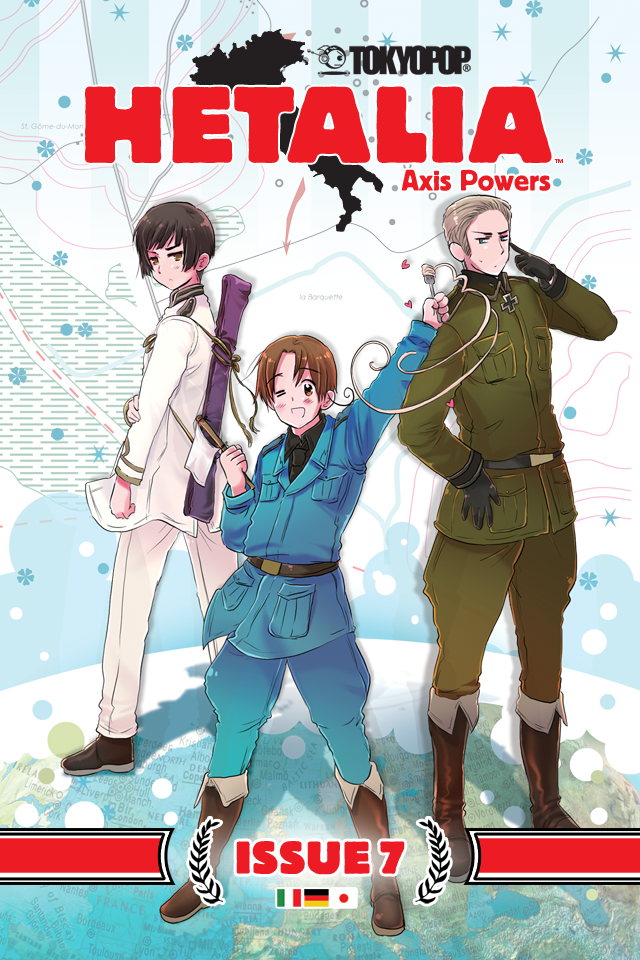
I wonder if Italy will be waving his surrender flag again. Oh, that wacky Italy!
3 Things Thursday: Love in Disguise
Yesterday, Deb Aoki posted a transcript of a panel from this year’s New York Anime Festival, Gay for You? Yaoi and Yuri Manga for GBLTQ Readers, featuring Erica Friedman (Okazu/ALC Publishing), Leyla Aker (Viz Media), Alex Wooflson (Yaoi911), librarian Scott Robins, and Christopher Butcher (Comics212), moderated by author/super-librarian Robin Brenner. It was the most compelling and informative panel I attended all weekend, and the only negative thing I can say about it was that I wish it had been scheduled for two hours instead of one.
One of the things I found most surprising during the panel, was how willing its panelists were to recommend yaoi and yuri manga to GBLTQ readers here in the west. Though I can’t speak much to the yuri question (not too surprisingly, I guess, since Erica’s recommendations make it pretty clear that most of the best yuri has yet to be translated into English), I’ve been a guilt-ridden BL fan for several years now, enjoying more than a few books within the genre while cringing at its frequent elements of misogyny and a level of fetishization that sometimes even reads as homophobia. But while the panelists made it clear that they wouldn’t recommend every BL series (as Chris Butcher said, “I recommend comics, but i don’t recommend shitty comics.”), it was clear that they felt that representation, even representation without identity, was too important and too rare to scoff at.
At one point in the panel, Robin, who had conducted quite a bit of research for an upcoming publication, said, “One of my favorite responses that I got from the survey was from a young gay man who said he liked reading yaoi because it made him think that one day he’d get a cute boyfriend too.” It’s pretty hard to argue with that.
Panelists also made it clear that cultural differences could not be ignored, that there were reasons behind the way that BL and yuri are presented as they are in Japan, and that we can’t expect those things to change anytime soon. Still, as a reader, I found myself wishing–wishing that the kind of stories I’d like to see might one day come to be. I love romance, don’t get me wrong. I want romance. But my favorite kind of romance is also so much more. I want action, adventure, mystery, fantasy, or even just really good epic soap-opera. Thing is, these kinds of stories already exist, and some of them even appear to be same-sex love stories of one sort or another. They just don’t quite go there, at least not yet.
So finally, I get to my point. :)
For this week’s 3 Things, I’d like to talk about three same-sex love stories I wish would actually go and BE LOVE STORIES.
 1. Banana Fish | Akimi Yoshida | Viz Media – Listed just last week as one of my three favorite “classic” shojo series, it’s too late for 1980s manga Banana Fish to become the love story it might have been, but that doesn’t stop me from indulging in the dream. Though the series doesn’t necessarily shy away from discussion of homosexuality, the close, tender relationship between its two male leads remains chaste and ambiguous to the end.
Yoshida attempts to clarify things a bit in her later side-story Garden of Light (“But they did love each other…maybe the way lovers do”) and her Angel Eyes art book is not terribly shy about it either. But what kind of story might she have written if she’d been comfortable enough (or allowed) to turn Banana Fish‘s generous subtext into actual text? I’d have liked to read that story. I’d have liked to read that a lot.
 2. Wild Adapter | Kazuya Minekura | Tokyopop – “But wait!” you protest. “Wild Adapter is BL! It’s published in a BL magazine!” Sure, that’s true, I’d respond, and certainly there’s more overt sexuality in WA than in something like Banana Fish, but six volumes in, I still haven’t seen it. I’m not talking about sex, either. I’m talking about any kind of genuine acknowledgement of the apparently romantic relationship between its two leads.
Obviously this series is still running (and there may truths already revealed in the Japanese chapters that haven’t yet made it over), and its presence in a BL magazine does give one hope. But from what we’ve seen in English so far, Wild Adapter is still a love story that refuses to admit it’s a love story.
So bring it on, Minekura. I’m dying to see it.
 3. NANA | Ai Yazawa | Viz Media – Now, most of us who love this series have long reconciled with the fact that we’re never going to see its two title characters finally shake off the screwed-up men in their lives and really shack up together (and at this point, frankly, we’re just hoping against hope we’ll see it finished at all). Still, there’s a corner of every NANA fan’s heart that wishes it might be so. Don’t get me wrong–I adore some of those screwed-up men. But Nana/Nana is the ultimate ‘ship that will never be, leaving us to subsist only on a few voiced fantasies and some super-romantic narration.
“The hand that I was holding then… was the only one I wanted to hold… that night… and forever.”
I mean, come on. *Sigh*
So, time to open up the floor! Readers, what are your favorite love stories in disguise? Respond in comments or in your own blog!
In the Walnut 1-2 by Toko Kawai: B+
 More mystery than romance, this BL series features some unremarkable “cases” but a pair of interesting leads who are already an established couple when the story begins! Shocking!
You can find my review for Manga Bookshelf here.
In the Walnut is published in English by Digital Manga Publishing. The series is still ongoing in Japan; the third volume was just released there on October 9th.
Review copies provided by the publisher.
BL Bookrack: October Mix
Welcome to the October installment of BL Bookrack, a monthly feature co-written with Soliloquy in Blue‘s Michelle Smith.
First up this month, I take a short look at two one-shots, Baseball Heaven from BLU Manga and Deeply Loving a Maniac from DMP’s 801 Media. Then Michelle provides the real meat of this installment, with a thoughtful look at DMP/Juné’s In the Walnut.
 Baseball Heaven | By Ellie Mamahara | Published by BLU | Rated Mature – Tokyo Elephants shortstop Chiaki Ogata is concerned when otherwise friendly rookie pitcher Eiji Uno seems to like everyone but him. It comes as a surprise to Ogata, then, when he discovers that Uno actually believes himself in love with him. Unable to consider getting involved with a much younger teammate, Ogata declares he won’t sleep with Uno until he pitches a perfect game, hoping to delay any need for decision. Can Uno stay interested under these conditions?
Romance manga is a tricky thing. Even the most realistic example of the genre must contain some element of fantasy in order to fulfill the expectations of its readers. On the other hand, the genre also provides an opportunity for complete immersion in a fantasy space for authors who wish to explore their readers’ more unlikely desires. Where writers most often stumble is in achieving believability within the construct of this fantasy, and unfortunately that is exactly the problem with Baseball Heaven.
Though there are plenty of scenarios, even in the workplace, in which an author might reasonably insert middle-school-quality romantic comedy, complete with wacky misunderstandings, wide-eyed confessions, chaste kisses, and blushing embraces, the world of professional baseball is simply not one of them.
Had Mamahara chosen a lighter, more commonplace fictional universe–a restaurant, perhaps, or a supernatural detective agency (for that fantasy touch)–her sweet (if mundane) romance might have gained a little traction. As it is, however, the incongruity of the story’s setting and its characterization is just too great to be satisfying for anyone. Readers looking for fantasy will be distracted by the intrusion of stony-voiced baseball announcers, while those with any knowledge of or interest in baseball will just feel embarrassed and sad.
Could there be a great BL baseball manga out there? I surely hope so. Unfortunately, Baseball Heaven is not it.
-Review by MJ
 Deeply Loving a Maniac | By You Higashino | Published by 801 Media | Rated Mature (18+) – Morita is a dedicated otaku, who up until recently had spent all his waking hours buried in magazines filled with drawings of scantily-clad anime girls. This was before he met Sakura, a sexy, gay classmate and his first true love. Though trading in endless 2D girls for one hot 3D boy comes pretty naturally to Morita, he’s worried about what Sakura must think of him as a sex-obsessed otaku with no interests other than him. Can joining the track team make him into a more desirable man?
The answer is, hilariously, “yes,” a sentiment that might be applied to nearly everything in this oddly realistic piece of cracktastic pornography. Though perhaps this is due more to the high school yaoi genre’s predisposition to saccharin romance than it is to You Higashino’s actual skill, there is something incredibly refreshing about a story featuring two high school guys who simply admit to being total horndogs.
Really, though, it’s not just that. While the manga is steeped in explicit sexual fantasy, even from its very first pages, it is, overall, one of the most realistic depictions of actual high school boys I’ve yet to see in this genre. Though they each have their own urgent emotional concerns (Sakura’s worried that Morita’s new athletic-induced hotness will turn him back onto girls, and Morita wonders whether his obsession with a Sakura-like anime figure constitutes “cheating”) they are unable to communicate any of it to each other in a remotely coherent way. Sakura rages, Morita spaces out, and if they’re not really successful at anything but sex, that’s okay, since it’s all they’re really thinking about anyway.
Higashino’s artwork is filled with over-the-top BL imagery that manages to be genuinely sexy even as it pokes fun at the genre’s most ridiculous tropes. Her voice is satirical but never cutting, and she’s careful to skewer her characters (and readers!) with love. And for that we love her right back.
For suprising mix of otaku humor, hot porn, and unexpected realism, check out Deeply Loving a Maniac.
-Review by MJ
 In the Walnut, Vols. 1-2 | By Toko Kawai | Published by Juné | Rated YA (16+) – The back cover of In the Walnut‘s second volume describes the series as “light and quirky.” While both are true at times, that makes it sound a lot more frivolous than it really is.
In what is a welcome departure from the typical BL formula, the leads are an established couple: sloppy and enigmatic Hideo Tanizaki, who has inherited a gallery (the titular In the Walnut) from his grandfather, and Sohei Nakai, a cheerful aspiring filmmaker. In the Walnut is known as a gallery that doesn’t ask too many questions, so Tanizaki is constantly fielding requests that seem a bit shady.
In the Walnut reads more like a mystery than a romance, as Tanizaki encounters a new art-related puzzle each chapter and must figure out what’s going on. Coincidence plays a huge factor in these “cases,” like when Tanizaki is asked to restore a battered old painting only to have a customer offer him its twin later the same day, or the way Tanizaki solves the mysteries—in a manner reminiscent of the TV show House—thanks to Nakai saying or doing something that sparks a realization.
While the cases themselves really are not that interesting, the same can’t be said for the characters. Eventually we do go back in time to see how Tanizaki and Nakai met, and while their current-day relationship seems rather casual, the depth of their feelings for one another becomes more clear as the series progresses. I also love that they talk to each other about things other than their relationship—if there were such a thing as a BL Bechdel Test, this would pass! True, Nakai, being the cheerful one who “grew up among goats” in Hokkaido, doesn’t really get fleshed out too much, but Tanizaki is a delightfully complicated character.
In early chapters, Tanizaki does a few things that might be construed as wrong but which have beneficial results for his customers. From this, we conclude that he’s a good man. Nakai reaches the same conclusion, and when he tells Tanizaki so, the latter is surprisingly affected, thinking, “I needed to know that I’m not evil.” But! It turns out things aren’t so cut and dry after all when, in the second volume, Tanizaki sells a painting to a young woman who lacks artistic knowledge for nearly six times its worth and later fails to tell another customer the full story behind what appears to be a cheap souvenir. He does do good, but sometimes his actions are spurred by greed rather than benevolence, which is a dichotomy I find intriguing.
Ultimately, I enjoyed In the Walnut quite a lot and it’ll be a sad wait until the third volume (just released in Japan earlier this month) finally makes its way here. Hopefully then we’ll learn more about Nakai!
-Review by Michelle Smith
Review copies provided by the publishers.
Cross Game 1 by Mitsuru Adachi: A-
 When the first volume of Cross Game arrived at my house, I’m pretty sure my exact words were, “Eee!” Happily, I liked it every bit as I thought I would.
The back cover really says it best: “Cross Game is a moving drama that is heartfelt and true, yet in the brilliant hands of manga artist Mitsuru Adachi, delightfully flows with a light and amusing touch. The series centers around a boy named Ko, the family of four sisters who live down the street and the game of baseball. This poignant coming-of-age story will change your perception of what shonen manga can be.”
Warning: it’s impossible to discuss one of the nicest aspects of this series without revealing a major spoiler. Proceed at your own risk.
The first of the three volumes of Cross Game that VIZ has bundled together in an attractive omnibus serves as a prologue, of sorts. We meet protagonist Ko Kitamura when he’s in fifth grade, a mischievous and lazy kid whose parents run a sporting goods shop. Nearby, Mr. Tsukishima runs a batting center and his four daughters are a part of Ko’s life, though none more so than sunny Wakaba, who was born the same day as Ko and who alone has the power to motivate him. She’s a very special girl, with a knack for befriending other kids despite their appearance or reputation; the influence her acceptance has on her classmate Akaishi, commonly regarded as somewhat of a hoodlum, is destined to be lifelong.
Tragedy strikes at swimming camp when Wakaba attempts to save someone else and ends up drowning herself. Despite her physical absence from the story after this point, Wakaba’s presence remains a palpable one. As the story jumps ahead four years, we find Ko still continuing to perform the daily workout he promised her he would do as a means of improving his baseball skills and Akaishi leading the junior high baseball team (and staying out of trouble). Ko hasn’t joined the team because of some jerks that were on it when he was a first year, but once Akaishi tells him that on the last morning of her life, Wakaba passed by his parents’ store and mentioned that she’d dreamed about Akaishi and Ko going to Koshien together, he begins training without another word necessary. Ko may be a slacker if left to his own devices, but if it’s something Wakaba wanted, he is going to make sure it becomes reality, no matter what. It’s clear Akaishi feels the same.
The boys move into high school, where the interim principal has hired an unprincipled baseball coach with a good record at Koshien. Ko, Akaishi, and their friend Nakanishi don’t want to play for such a fellow and opt to remain on the junior varsity team; as the volume ends they’re preparing to show up the varsity team in an upcoming scrimmage game. Tying in with this is the sad story of Aoba, Wakaba’s younger sister. Aoba is passionate about baseball and is even the captain of the junior high team. Unfortunately, because she’s a girl she can only ever pitch in practice games and can never be deemed more than a devoted fan. Aoba and Ko clash personally, as well, as she still resents him for the closeness he shared with Wakaba, though it’s clear they’re destined to end up together.
Cross Game is a pretty low-key story that’s part slice-of-life and part sports manga. Typically, the protagonists in the latter don’t have such a touching reason for wanting to excel at their sport, and neither do they feature two guys nurturing a bittersweet memory of the same beloved girl in their hearts. The characters really grow on you—Ko seems a little bratty at first, but shows time and again that he’s a good person, particularly in how he treats Momiji, Wakaba and Aoba’s little sister—and I love that Ko’s two best friends are kind of burly and unattractive. You don’t see that a lot in manga.
I have two minor complaints, but I’ve been given to understand that they’re both common attributes of Mitsuru Adachi’s manga. The first is that some of the character designs—particularly of children—are positively dumpy. Too, a lot of the recurring characters have faces that are difficult to remember, though this is not the case at all for the primary players. Secondly, the fourth wall gets broken all the time. Adachi himself appears and the characters are often shown reading his manga. The story doesn’t take itself too seriously, so this is not as glaring as similar moments in NANA, for example, but I found it kind of irksome all the same.
The second omnibus of Cross Game, this time containing volumes four and five of the original Japanese releases, is due in January. I am looking forward to that scrimmage game—and Ko finally getting to show off his amazing baseball abilities—so much that it isn’t even funny.
Cross Game is published in English by VIZ, who is bundling the seventeen-volume series into eight chunky tomes. This one is comprised of the first three volumes and the others will contain two each.
This review was originally published at Comics Should Be Good.
Review copy provided by the publisher.
Rescue Manga poll results
I threw together a poll about manga on hiatus over on Manga Views and thought the results were interesting. I didn’t include every stalled manga series that I knew of because I was trying to represent a few different publishers. So it was interesting to see from the small section of the mangasphere that voted that the love for Even a Monkey Can Draw Manga remains so strong. I also had no idea how fervently people missed Nodame Cantible. I read the first few volumes of that series but lost steam a little bit. There were some good additions in the comments with votes for some horror and seinen manga, which tend to not be on my radar very much.
I miss many of the series listed on the poll, but I voted for Crown over Swan, just because Crown is so goofy, and I’m determined to just buy the rest of Swan in Japanese sometimes and at least enjoy the pretty pictures even if I can’t really tell what’s going on. Swan is one of those series that is so visual in its storytelling I think I’d enjoy reading it even in the absence of a translation.
Two from emanga: The Cinderella Inheritance and The Cinderella Solution
Harelequin manga might be a little bit on the disposable side – I don’t know if I’ve read any that I know I’d want to reread but I’m just getting over a cold and there is really no better manga to read while you have a stuffy head. So here are quick takes on two Harlequin manga that have the word Cinderella in their titles. One manga was good, and one was not so good.
The Cinderella Inheritance by Carolyn Zane and Mon Ito
Cynthia has worked as the personal secretary to the patriarch of a rich family, Alfred Wingate. She’s engaged to his womanizing grandson Graham, but decides that she has to call the engagement off because Graham is a pathological cheater. Things get complicated when Alfred dies and leaves his mansion to Cynthia, along with the qualification that she can’t give the mansion back to the WIngate family. If she doesn’t take it, it has to go to charity. Graham’s long lost brother Rick shows up for the reading of the will, and promptly decides that Cynthia is a scheming woman who got close to his family in order to grab her share of the Wingate fortune.
The quality of these Harlequin manga can be erratic. Sometimes they are good in a brain candy type of way, but other times they really seem rushed. Some of the transitions between scenes in The Cinderella Inheritance seemed a little jerky and the plot elements were introduced randomly, without a real connection to the character’s emotions or backgrounds. I’m never entirely sure if these execution problems are due to issues with the adaptation or the source material because let’s face it, we’re talking about harlequin romance novels here. Of course, Rick and Cynthia fall in love with each other while she’s jugging the expectations of the Wingates that she marry Graham so the mansion will stay in the family. Of course she’s just a good girl who is working her way for college, and while Rick is initially suspicious he finds himself falling in love with her despite his better judgment. I didn’t find Ito’s character designs very appealing, and the art was static. The characters just seemed like paper dolls put through the paces to satisfy a fairly predictable plot.
This title is skipable, but I enjoyed the other Harlequin Manga with Cinderella in the title much much more.
The Cinderella Solution by Kyoko Sagara and Cathy Yardly
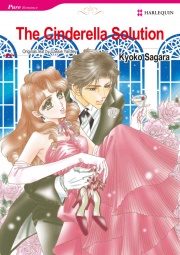
Charlotte and Gabe are best friends. She’s a bit of a tomboy and she goes along with Gabe to all of his typical guy-like activities like poker and football games. He even takes her out to a bachelor party right before she’s supposed to be the maid of honor at his sister’s wedding. They constantly compete with each other by making stupid bets. Charlotte has a bit of a psychological complex where she thinks of herself as unfeminine, which is absolutely ridiculous because Sagara draws her as a classic shoujo heroine with shining eyes and glossy hair. I guess the thing that signals that she isn’t very girly is the fact that she always has her hair pulled back in a ponytail.
I’ve decided that I enjoy these Harlequin manga the most when the art is extra super-girly and this manga didn’t disappoint in that category. Take a look at the cover where our cute couple is surrounded by both roses and weird blobby sparkly things. The character designs are cute, with bee-stung lips and perfect hair. The only odd thing is that Sagara tends to draw her men with extra long eyebrows, which sometimes gave Gabe a vaguely insectoid appearance. But, unlike the flat personalities in the previous manga, The Cinderella Solution really takes the time to establish the bickering relationship between Gabe and Charlotte. She’s in agony performing her bridesmaid duties at the wedding and Gabe is the master of casually cruel comments like “Do you think Charlotte is the wife type? She’ll be just fine single for the rest of her life.” Goaded beyond her limits, Charlotte bets Gabe $1000 that she’ll find someone to propose marriage to her in a month. She embarks on a makeover campaign, and soon finds a potential suitor when an eligible bachelor moves next door. Gabe is surprised by his growing feelings of jealousy as he sees other men notice his best friend. Charlotte uses the bet as a way of gaining more self confidence, and Gabe is soon confronted with the decision that he might have to give up platonic friendship for romance or lose her forever.
The Cinderella Solution was an enjoyable read simply because the characters were more fully developed, so I was interested in seeing the conclusion of their story. I tend to like romances more when some funny moments are incorporated, so I appreciated Charlotte inadvertently introducing herself to her neighbor while wearing a mud pack on her face and Gabe’s unique approach to formal wear when he goes to spy on Charlotte and her wanna-be boyfriend at a party. This was definitely a better than average Harlequin manga title.
Access to electronic copies provided by the publisher
Pick of the Week: Pandora Hearts
 Wow, it’s a tough week here for choosing a Pick, though for a much different reason than last time around. Looking at this week’s new manga from Midtown Comics, we’ve got the new omnibus of Cardcaptor Sakura, a second volume of Alice the 101st, Double Cast, 13th Boy (one of my favorite manhwa series), the adorable third volume of previous Pick Chi’s Sweet Home, new Nightschool, new 20th Century Boys… it’s a great week for manga.
All that said, I’m going to go with the third volume of one of my favorite current shonen series, Pandora Hearts from Yen Press. Here are a few bits from my review of volume one:
That’s a lot of plot to spell out in a single review, though it really only scratches the surface of this whirlwind shonen fantasy. Impressively, though the story races along at an exceptionally fast pace, it is very easy to follow and its characters immediately take shape, evoking both sympathy and great interest from the beginning. Both Oz, whose carefree attitude hides significant intelligence and compassion, and Alice, whose aggressive, fearsome persona seems crafted to protect the psyche of a very damaged young girl, are immediately compelling …
Mochozuki’s art is central to the atmosphere of this manga, with its detailed character designs and settings. Much inspiration is taken from John Tennial’s vision of Lewis Carroll’s Wonderland, with the addition of Mochizuki’s own style which excels particularly in the story’s creepiest moments, such as Oz’s adventure in The Abyss … The story’s action sequences are unusually coherent and easy to follow, with a very dramatic use of contrast and paneling, matching its surreal setting beautifully.
As with any story as elaborately set up as this one, the real question at the end of a strong first volume is whether or not the author can effectively follow through with what’s been put into play. The series has offered more questions than answers at this point, relying mainly on the strength of its characters to hold the reader’s attention through the din. That said, there is enough promise in this fun, mysterious fantasy to ease all doubts for the moment and simply anticipate. Fast-paced, enigmatic, and attractive to the eye, Pandora Hearts is easy to recommend.
For reviews of volumes two and three, check out the tag, pandora hearts. All three volumes are available now.