• Skip to primary navigation
  • Skip to main content
  • Skip to primary sidebar
  • Home
  • About Us
    • Privacy Policy
    • Comment Policy
    • Disclosures & Disclaimers
  • Resources
    • Links, Essays & Articles
    • Fandomology!
    • CLAMP Directory
    • BlogRoll
  • Features & Columns
    • 3 Things Thursday
    • Adventures in the Key of Shoujo
    • Bit & Blips (game reviews)
    • BL BOOKRACK
    • Bookshelf Briefs
    • Bringing the Drama
    • Comic Conversion
    • Fanservice Friday
    • Going Digital
    • It Came From the Sinosphere
    • License This!
    • Magazine no Mori
    • My Week in Manga
    • OFF THE SHELF
    • Not By Manga Alone
    • PICK OF THE WEEK
    • Subtitles & Sensibility
    • Weekly Shonen Jump Recaps
  • Manga Moveable Feast
    • MMF Full Archive
    • Yun Kouga
    • CLAMP
    • Shojo Beat
    • Osamu Tezuka
    • Sailor Moon
    • Fruits Basket
    • Takehiko Inoue
    • Wild Adapter
    • One Piece
    • After School Nightmare
    • Karakuri Odette
    • Paradise Kiss
    • The Color Trilogy
    • To Terra…
    • Sexy Voice & Robo
  • Browse by Author
    • Sean Gaffney
    • Anna Neatrour
    • Michelle Smith
    • Katherine Dacey
    • MJ
    • Brigid Alverson
    • Travis Anderson
    • Phillip Anthony
    • Derek Bown
    • Jaci Dahlvang
    • Angela Eastman
    • Erica Friedman
    • Sara K.
    • Megan Purdy
    • Emily Snodgrass
    • Nancy Thistlethwaite
    • Eva Volin
    • David Welsh
  • MB Blogs
    • A Case Suitable For Treatment
    • Experiments in Manga
    • MangaBlog
    • The Manga Critic
    • Manga Report
    • Soliloquy in Blue
    • Manga Curmudgeon (archive)

Manga Bookshelf

Discussion, Resources, Roundtables, & Reviews

Katherine Dacey

Swallowing the Earth

July 9, 2009 by Katherine Dacey

swallowingearthcoverNineteen sixty-eight was a critical year in Osamu Tezuka’s artistic development. Best known as the creator of Astro Boy, Jungle Emperor Leo, and Princess Knight, the public viewed Tezuka primarily as a children’s author. That assessment of Tezuka wasn’t entirely warranted; he had, in fact, made several forays into serious literature with adaptations of Manon Lescaut (1947), Faust (1950), and Crime and Punishment (1953). None of these works had made a lasting impression, however, so in 1968, as gekiga was gaining more traction with adult readers, Tezuka adopted a different tact, writing a dark, erotic story for Big Comic magazine: Swallowing the Earth.
Like MW (1976-78), which was also serialized in Big Comic, Swallowing the Earth is an overripe, overstuffed period piece that’s both entertaining and frustrating for modern readers. The basic plot is simple: seven beautiful young women seek to avenge the untimely death of their mother by wrecking havoc on the political, social, and economic systems that robbed Zephryus of her money and her home. The only thing standing in their way is Gohonmatsu, a perpetually drunken longshoreman who’s immune to their charms.

Tezuka’s presentation of the story, however, is anything but straightforward, as he employs flashbacks, subplots, and red herrings galore to sustain the reader’s interest. Some of these gambits are so ridiculous and nervy they work. Zephyrus’ daughters, for example, team up with a female scientist to produce Dermoid Z, a synthetic skin that can completely transform a person’s appearance. From a manga-ka’s standpoint, Dermoid Z is a brilliant device, as it allows him to plausibly conceal his characters’ identities from the reader and the other actors in the drama, giving him latitude to do just about anything.

Other gambits flat fall, as they rely on outdated notions of gender and race for their dramatic impact. When Dermoid Z arrives in the United States, for example, African-Americans begin buying white “skins” in vast quantities, donning them to commit crimes, enjoy privileges that had been denied them, and exact retribution on their oppressors. White retaliation is swift and brutal, plunging American cities into a race war that destroys the very fabric of society. Lacking a deep understanding of American history, or the underlying causes of the 1968 riots that erupted after Martin Luther King, Jr. was assassinated, Tezuka’s subplot feels like a crude attempt to be topical. He’s grasped the basic injustice of segregation, yet he never humanizes his black characters; they remain a violent, faceless mob throughout this unfortunate episode.

Tezuka’s treatment of women is likewise muddled. He clearly recognizes that men have treated women as property throughout human history, a point he illustrates both through Zephryus’ story (which unfolds in Nazi-occupied France) and through an interlude in the South Seas, where a tribal chief barters with Gohonmatsu for a downed airplane, offering his two daughters in exchange for the machine. Yet Tezuka’s own notions of female sexuality frequently undermine his critique of male privilege. He depicts Gohonmatsu’s South Seas brides as sexual grotesques, with bodies as roundly deformed as the Venus of Willendorf’s and libidos that verge on nymphomania. Women from the developed world don’t fare much better, as Tezuka neatly divides them into two camps: man-hating hysterics (e.g. Zephyrus’ daughters) and tormented victims (e.g. a beautiful aphasiac who lost her ability to speak after she was raped).

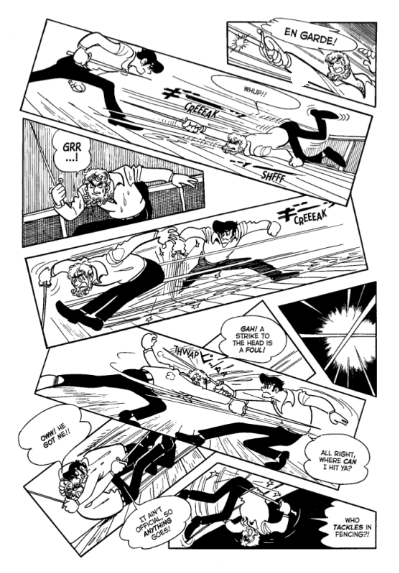
However dated Swallowing the Earth‘s racial and sexual politics may be, it’s hard to deny the sheer exuberance of Tezuka’s artwork. His imagination yields some stunning — and stunningly weird — images. Zephyrus’ palace, in particular, is a marvelous creation, an Art Deco ziggeraut filled with enormous cat statues that look like they were swiped from Cleopatra’s tomb. Tezuka frequently experiments with the layout, varying the shape of the panels to suit the pace and intensity of the action, or to suggest the simultaneity of two events. One of the best examples occurs early in the story, when Gohonmatsu duels a handsome Spanish count on the deck of a tugboat:

fightscene

Tezuka uses diagonal panels to mimic the rocking motion of a ship anchored in choppy water. The shape of the panels also demonstrate just how difficult it is for both characters to find their footing on the slippery deck — a small but tricky detail that isn’t easy to capture in a static image.

In an excellent companion essay to the English-language edition, manga scholar Frederick Schodt acknowledges Swallowing the Earth‘s myriad flaws — its surfeit of plotlines, its racial caricatures — while celebrating the almost anarchic way in which the story unfolds. He encourages readers to enjoy Earth as a “wild ride” and a window into a critical period in Tezuka’s development, showing us “how he began to make the transition from a children’s artist to someone who could push the manga medium in every genre, even for adult readers.” It’s in this spirit that I recommend Swallowing the Earth, as testament to Tezuka’s fertile imagination, and his ability to grow as an artist and a storyteller.

SWALLOWING THE EARTH • BY OSAMU TEZUKA • DMP • 516 pp. • RATING: OLDER TEEN (16+)

Filed Under: Manga Critic Tagged With: Classic, DMP, Osamu Tezuka

Swallowing the Earth

July 9, 2009 by Katherine Dacey

Nineteen sixty-eight was a critical year in Osamu Tezuka’s artistic development. Best known as the creator of Astro Boy, Jungle Emperor Leo, and Princess Knight, the public viewed Tezuka primarily as a children’s author. That assessment of Tezuka wasn’t entirely warranted; he had, in fact, made several forays into serious literature with adaptations of Manon Lescaut (1947), Faust (1950), and Crime and Punishment (1953). None of these works had made a lasting impression, however, so in 1968, as gekiga was gaining more traction with adult readers, Tezuka adopted a different tact, writing a dark, erotic story for Big Comic magazine: Swallowing the Earth.

Like MW (1976-78), which was also serialized in Big Comic, Swallowing the Earth is an overripe, overstuffed period piece that’s both entertaining and frustrating for modern readers. The basic plot is simple: seven beautiful young women seek to avenge the untimely death of their mother by wrecking havoc on the political, social, and economic systems that robbed Zephryus of her money and her home. The only thing standing in their way is Gohonmatsu, a perpetually drunken longshoreman who’s immune to their charms.

Tezuka’s presentation of the story, however, is anything but straightforward, as he employs flashbacks, subplots, and red herrings galore to sustain the reader’s interest. Some of these gambits are so ridiculous and nervy they work. Zephyrus’ daughters, for example, team up with a female scientist to produce Dermoid Z, a synthetic skin that can completely transform a person’s appearance. From a manga-ka’s standpoint, Dermoid Z is a brilliant device, as it allows him to plausibly conceal his characters’ identities from the reader and the other actors in the drama, giving him latitude to do just about anything.

Other gambits flat fall, as they rely on outdated notions of gender and race for their dramatic impact. When Dermoid Z arrives in the United States, for example, African-Americans begin buying white “skins” in vast quantities, donning them to commit crimes, enjoy privileges that had been denied them, and exact retribution on their oppressors. White retaliation is swift and brutal, plunging American cities into a race war that destroys the very fabric of society. Lacking a deep understanding of American history, or the underlying causes of the 1968 riots that erupted after Martin Luther King, Jr. was assassinated, Tezuka’s subplot feels like a crude attempt to be topical. He’s grasped the basic injustice of segregation, yet he never humanizes his black characters; they remain a violent, faceless mob throughout this unfortunate episode.

Tezuka’s treatment of women is likewise muddled. He clearly recognizes that men have treated women as property throughout human history, a point he illustrates both through Zephryus’ story (which unfolds in Nazi-occupied France) and through an interlude in the South Seas, where a tribal chief barters with Gohonmatsu for a downed airplane, offering his two daughters in exchange for the machine. Yet Tezuka’s own notions of female sexuality frequently undermine his critique of male privilege. He depicts Gohonmatsu’s South Seas brides as sexual grotesques, with bodies as roundly deformed as the Venus of Willendorf’s and libidos that verge on nymphomania. Women from the developed world don’t fare much better, as Tezuka neatly divides them into two camps: man-hating hysterics (e.g. Zephyrus’ daughters) and tormented victims (e.g. a beautiful aphasiac who lost her ability to speak after she was raped).

However dated Swallowing the Earth‘s racial and sexual politics may be, it’s hard to deny the sheer exuberance of Tezuka’s artwork. His imagination yields some stunning — and stunningly weird — images. Zephyrus’ palace, in particular, is a marvelous creation, an Art Deco ziggeraut filled with enormous cat statues that look like they were swiped from Cleopatra’s tomb. Tezuka frequently experiments with the layout, varying the shape of the panels to suit the pace and intensity of the action, or to suggest the simultaneity of two events. One of the best examples occurs early in the story, when Gohonmatsu duels a handsome Spanish count on the deck of a tugboat:

fightscene

Tezuka uses diagonal panels to mimic the rocking motion of a ship anchored in choppy water. The shape of the panels also demonstrate just how difficult it is for both characters to find their footing on the slippery deck — a small but tricky detail that isn’t easy to capture in a static image.

In an excellent companion essay to the English-language edition, manga scholar Frederick Schodt acknowledges Swallowing the Earth‘s myriad flaws — its surfeit of plotlines, its racial caricatures — while celebrating the almost anarchic way in which the story unfolds. He encourages readers to enjoy Earth as a “wild ride” and a window into a critical period in Tezuka’s development, showing us “how he began to make the transition from a children’s artist to someone who could push the manga medium in every genre, even for adult readers.” It’s in this spirit that I recommend Swallowing the Earth, as testament to Tezuka’s fertile imagination, and his ability to grow as an artist and a storyteller.

SWALLOWING THE EARTH • BY OSAMU TEZUKA • DMP • 516 pp. • RATING: OLDER TEEN (16+)

Filed Under: Manga, Manga Critic, REVIEWS Tagged With: Action/Adventure, Classic, DMP, Osamu Tezuka

Bamboo Blade, Vol. 1

July 6, 2009 by Katherine Dacey

bamboo_coverDangerous Minds, Dead Poets Society, Stand and Deliver, and To Sir, With Love all depict teachers who are heroic in their self-sacrifice, renouncing money, family ties, and even their reputations in order to inspire students. Kojiro Ishido, the anti-hero of Bamboo Blade, won’t be mistaken for any of these noble educators. He’s bankrupt, morally and financially, and so eager to dig himself out of debt that he’d exploit his students in a heartbeat.

Kojiro’s troubles begin when he enters a bet with his old friend and sparring partner Toryah, an accomplished martial artist. If Kojiro can lead his school’s kendo club to victory over Toryah’s, Toryah will provide him with a year’s worth of free sushi from a top-notch restaurant. If Kojiro fails, he must surrender a personal treasure: the trophy he won for defeating Toryah at the 26th annual Shoryuki High School Kendo Meet. Making Kojiro’s job more challenging is the fact that Toryah coaches an all-girls’ squad; Kojiro’s co-ed team has but one female member, so he must recruit at least four more girls in order to scrimmage with Toryah’s crew. The few students who aren’t scared off by Kojiro’s acute desperation include Kirino, the club’s captain; Eiga, a plump boy who’d rather play ping pong; Nakata, Eiga’s best friend; Miya-Miya, a beautiful ditz; and Tamaki, an experienced swordswoman who initially rebuffs Kojiro’s entreaties to join the club.

…

Read More

Filed Under: Manga Critic Tagged With: Kendo, Seinen, yen press

Bamboo Blade, Vol. 1

July 6, 2009 by Katherine Dacey

Dangerous Minds, Dead Poets Society, Stand and Deliver, and To Sir, With Love all depict teachers who are heroic in their self-sacrifice, renouncing money, family ties, and even their reputations in order to inspire students. Kojiro Ishido, the anti-hero of Bamboo Blade, won’t be mistaken for any of these noble educators. He’s bankrupt, morally and financially, and so eager to dig himself out of debt that he’d exploit his students in a heartbeat.

Kojiro’s troubles begin when he enters a bet with his old friend and sparring partner Toryah, an accomplished martial artist. If Kojiro can lead his school’s kendo club to victory over Toryah’s, Toryah will provide him with a year’s worth of free sushi from a top-notch restaurant. If Kojiro fails, he must surrender a personal treasure: the trophy he won for defeating Toryah at the 26th annual Shoryuki High School Kendo Meet. Making Kojiro’s job more challenging is the fact that Toryah coaches an all-girls’ squad; Kojiro’s co-ed team has but one female member, so he must recruit at least four more girls in order to scrimmage with Toryah’s crew. The few students who aren’t scared off by Kojiro’s acute desperation include Kirino, the club’s captain; Eiga, a plump boy who’d rather play ping pong; Nakata, Eiga’s best friend; Miya-Miya, a beautiful ditz; and Tamaki, an experienced swordswoman who initially rebuffs Kojiro’s entreaties to join the club.

Whether or not they’ll come together to form a proper team remains to be seen, but readers will be forgiven for bailing out before that point in the story, as Bamboo Blade quickly sinks under the weight of stale jokes and one-note characters. Kojiro, in particular, is a repellent creation: he’s mean, loud, and dumb, utterly lacking in the self-awareness or humility that would make him a sympathetic figure. A skillful writer might have found a way to make Kojiro’s nastiness funny — say, by making him more sardonic, or by drawing a sharper contrast between his pessimism and Kirino’s relentless optimism. Instead, Kojiro comes across as a crashing bore, a bully who’s incapable of speaking at conversational decibel levels or thinking of anything but his growling stomach. (He subsists on instant noodles and student handouts.)

The swordplay isn’t much better. Artist Aguri Igarashi’s fight scenes are impressionistic at best, employing speedlines to such a degree that it’s almost impossible to tell what’s happening in many panels; if anything, these scenes look like a forgotten Giacomo Balla painting: Kendo Fighters No. 1. I wished Igarashi had been more meticulous in showing how, exactly, a fight unfolds, from where the opponents strike one another to how they move across the floor, as there’s very little information about kendo anywhere in the story or the translation notes.

Given how exciting it is to watch a real kendo match, I’m convinced there’s a great story lurking deep within Bamboo Blade; I’m just not sure that Masahiro Totsuka and Aguri Igarashi are the right folks for the job. Sports junkies and fans of the Bamboo Blade anime may find something to like here, but rookies should avoid this team of losers.

BAMBOO BLADE, VOL. 1 • STORY BY MASAHIRO TOTSUKA, ART BY AGURI IGARASHI • YEN PRESS • 228 pp. • RATING: OLDER TEEN (16+)

Filed Under: Manga, Manga Critic, REVIEWS Tagged With: Comedy, Kendo, Sports Manga, yen press

Short Takes: The Big Adventures of Majoko, The Magic Touch and The Manzai Comics

July 2, 2009 by Katherine Dacey

With the Fourth of July right around the corner, I decided to keep things light and sparkly here at The Manga Critic by reviewing three humorous shojo titles: The Big Adventures of Majoko (UDON Entertainment), an all-ages title about an inept witch; The Magic Touch (VIZ), a comedy about a group of high school students who aspire to be professional masseuses; and The Manzai Comics (Aurora Publishing), a dramedy about a shy young man who becomes half of an Abbott-and-Costello comedy team.

THE BIG ADVENTURES OF MAJOKO, VOL. 1

BY MACHIKO FUJI AND TOMOMI MIZUNA • UDON ENTERTAINMENT • 200 pp. • RATING: KIDS (7+)

Like Fairy Idol Kanon and Ninja Baseball Kyuma!, The Big Adventures of Majoko uses magic and humor to teach kids the importance of telling the truth, doing their best, and treating each other respectfully. The story focuses on Nana, an ordinary eight-year-old, and Majoko, a young witch who’s still learning the ropes when it comes to flying and casting spells. Thanks to a magic diary, Nana can summon Majoko whenever she wishes. The two embark on a variety of missions, from assisting a mermaid to finding a lost necklace, relying on pluck and smarts when Majoko’s magic fails — a frequent occurence. While a few of the stories are didactic, most employ a light touch, keeping the pious sentiments to a minimum and focusing instead on adventure, as the girls battle one-eyed monsters, pursue a rainbow thief, and journey to the bottom of the sea.

…

Read More

Filed Under: Manga Critic Tagged With: Aurora, shojo, Udon Entertainment, VIZ

The History of the West Wing

June 29, 2009 by Katherine Dacey

westwingThough its name evokes images of the White House — and maybe even the unctuous Josiah Bartlett — The History of the West Wing is, in fact, an adaptation of a twelfth-century play by the Moliere of China, Wang Shifu.

The story follows Chen Yuqing, a handsome young man who wanders aimlessly from town to town. While staying at a monastery, he hears rumors of a beautiful young girl living in the building’s west wing. Yuqing steals into the temple garden to catch a glimpse of her and is immediately smitten, sending Pianpian an impassioned letter asking her to meet him. The two begin a brief but clandestine courtship, then petition Pianpian’s mother for permission to marry — a request that Madame Ye initially refuses, as Pianpian has been promised to the scion of a prominent family. When bandits kidnap Pianpian, however, Madame Ye appeals to the townsfolk for Pianpian’s safe return, offering her daughter’s hand in marriage as a reward. Yuqing succeeds, only to have Madame Ye qualify her assent by making an additional demand of him: he must earn the highest score on the imperial civil service exam. (For a little historical context, Madame Ye’s demand is a bit like an overzealous parent making a score of 1600 on the SATs a pre-requisite for taking her daughter to the prom.)

…

Read More

Filed Under: Manga Critic Tagged With: yen press

Short Takes: The Kurosagi Corpse Delivery Service and Oishinbo A la Carte: Japanese Cuisine

June 24, 2009 by Katherine Dacey

This week’s Short Takes examines two manga aimed at adult audiences. (Notice I didn’t say “adult manga,” which is a different kettle of fish altogether, and not the sort of thing I typically review. Just sayin’.) The first is The Kurosagi Corpse Delivery Service (Dark Horse), a macabre series about a five oddballs who work with the recently departed; the second is Oishinbo a la Carte: Japanese Cuisine (Viz), a mouth-watering look at Japanese cuisine, from sushi and sake to ramen.

…

Read More

Filed Under: Manga Critic Tagged With: Dark Horse, Seinen, VIZ

The Cat in the Coffin

June 22, 2009 by Katherine Dacey

catcoffincoverThe year is 1955. Twenty-year-old Masayo, an aspiring painter from Hakodate, apprentices herself to Goro Kawabuko, a handsome widower who teaches at a Tokyo art college. In exchange for a weekly lesson, Masayo agrees to keep house for Goro and tutor his daughter Momoko, a strange, withdrawn child whose only companion is a regal white cat named Lala.

Masayo, who comes from a humble background, finds the Kawabuko household enchanting. Or, more accurately, she finds Goro enchanting. Goro epitomizes urban chic, hosting lavish parties, listening to jazz, and wearing the latest Western fashions. Realizing that Goro is beyond her reach, Masayo instead focuses on Momoko; if she can gain the girl’s confidance, perhaps she’ll have a claim on Goro’s heart as well. Masayo must first demonstrate her affinity for Lala, however, as the cat exerts an almost maternal power over Momoko, responding to her mistress’ quicksilver moods with an emotional intelligence that borders on human.

…

Read More

Filed Under: Manga Critic Tagged With: Animals, Mystery/Suspense, vertical

The Cat in the Coffin

June 22, 2009 by Katherine Dacey

The year is 1955. Twenty-year-old Masayo, an aspiring painter from Hakodate, apprentices herself to Goro Kawabuko, a handsome widower who teaches at a Tokyo art college. In exchange for a weekly lesson, Masayo agrees to keep house for Goro and tutor his daughter Momoko, a strange, withdrawn child whose only companion is a regal white cat named Lala.

Masayo, who comes from a humble background, finds the Kawabuko household enchanting. Or, more accurately, she finds Goro enchanting. Goro epitomizes urban chic, hosting lavish parties, listening to jazz, and wearing the latest Western fashions. Realizing that Goro is beyond her reach, Masayo instead focuses on Momoko; if she can gain the girl’s confidance, perhaps she’ll have a claim on Goro’s heart as well. Masayo must first demonstrate her affinity for Lala, however, as the cat exerts an almost maternal power over Momoko, responding to her mistress’ quicksilver moods with an emotional intelligence that borders on human.

Masayo’s tenure is threatened by the arrival of Chinatsu, a beautiful sophisticate who seems intent on marrying Goro. Chinatsu competes with Masayo for Momoko’s affections, touching off a battle royal between the two women. Watching their struggle unfold, we begin to see through Masayo’s guileless pose: she’s as masterful a manipulator as Chinatsu, using her relationship with Momoko to drive a wedge between Goro and his fiancee:

For a wicked moment, I savored the momentary discomfiture that flickered across the faces of Goro and Chinatsu. Momoko had shown precious little interest in Chintasu; indeed, she had all but ignored her. And then she came running to me. It occurred to me then that aside from Goro, nobody was closer to Momoko than I was. That thought made me feel even more elated.

Like Henry James’s “The Turn of the Screw,” The Cat in the Coffin draws its power from “the strange and sinister embroidered on the very type of the normal and easy,” presenting itself as a domestic drama about a naive young woman who falls for her worldly employer. Yet the book has an oppressive, eerie quality that lends itself to several tantalizing readings: that Lala may be possessed by Momoko’s dead mother, that Momoko herself is a bad seed. By the novel’s end, the reader may believe Masayo’s account of events — and even feel great compassion for her — while questioning her involvement in them.

It’s this level of narrative complexity that elevates The Cat in the Coffin from romantic pot boiler to literature: we’re seduced by Masayo’s modest, self-effacing comments before we recognize that she’s an unreliable witness. One can certainly read The Cat in the Coffin as an atmospheric mystery, but it works on many other levels as well: as a meditation on jealousy, as a young woman’s sexual awakening, as a portrait of life in occupied Japan, as a parody of the Victorian governess novel. I’d love to see Vertical translate more work by Mariko Koike, as she brings an uncommon level of wisdom and literary sophistication to a pulpy genre.

Review copy provided by Vertical, Inc.

THE CAT IN THE COFFIN • BY MARIKO KOIKE, TRANSLATED BY DEBORAH BOLIVER BOEHM • VERTICAL, INC. • 190 pp.

Filed Under: Books, Manga Critic, REVIEWS Tagged With: Animals, Mystery/Suspense, Novel, Vertical Comics

The Adventures of Johnny Bunko: The Last Career Guide You’ll Ever Need

June 16, 2009 by Katherine Dacey

johnny-bunko-coverGiven the current economic climate, any book with the subtitle The Last Career Guide You’ll Ever Need sounds like a worthwhile investment. Job seekers should be warned, however, that The Adventures of Johnny Bunko isn’t about crafting the perfect resume, networking, or nailing the interview, but finding a career path that suits your strengths and personal values. Readers should also note that Johnny Bunko’s format defies easy categorization, straddling the fence between graphic novel and self-help book. Some readers may find Johnny Bunko’s mixture of slapstick humor and advice charming, while others may find the presentation too gimmicky for their tastes.
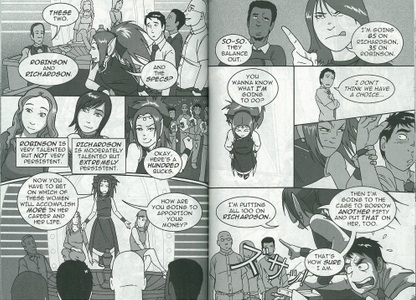
The story follows Johnny, a recent college graduate toiling in anonymity at a large company. Thanks to a set of magical chopsticks, he acquires an unorthodox career counselor who talks like a drill sargeant but dresses like a genie. Johnny hopes that Diana will give him insider tips for getting ahead, but instead she offers six, Yoda-esque rules that run the gamut from “There is no plan” (meaning that it’s impossible to map out your entire career) to “Persistence trumps talent” (meaning that a strong work ethic is a better predictor of success than intelligence or talent). Each chapter addresses one of these six rules, showing us how Johnny’s mistakes prevent him from being successful in the workplace by playing it safe, working a job that taxes his weaker skills, and bypassing his supervisor to pitch an idea to the head honcho.

…

Read More

Filed Under: Manga Critic Tagged With: How-To

The Adventures of Johnny Bunko: The Last Career Guide You’ll Ever Need

June 16, 2009 by Katherine Dacey

Given the current economic climate, any book with the subtitle The Last Career Guide You’ll Ever Need sounds like a worthwhile investment. Job seekers should be warned, however, that The Adventures of Johnny Bunko isn’t about crafting the perfect resume, networking, or nailing the interview, but finding a career path that suits your strengths and personal values. Readers should also note that Johnny Bunko’s format defies easy categorization, straddling the fence between graphic novel and self-help book. Some readers may find Johnny Bunko’s mixture of slapstick humor and advice charming, while others may find the presentation too gimmicky for their tastes.

The story follows Johnny, a recent college graduate toiling in anonymity at a large company. Thanks to a set of magical chopsticks, he acquires an unorthodox career counselor who talks like a drill sargeant but dresses like a genie. Johnny hopes that Diana will give him insider tips for getting ahead, but instead she offers six, Yoda-esque rules that run the gamut from “There is no plan” (meaning that it’s impossible to map out your entire career) to “Persistence trumps talent” (meaning that a strong work ethic is a better predictor of success than intelligence or talent). Each chapter addresses one of these six rules, showing us how Johnny’s mistakes prevent him from being successful in the workplace by playing it safe, working a job that taxes his weaker skills, and bypassing his supervisor to pitch an idea to the head honcho.

Daniel Pink’s advice may seem glib to recent college graduates without jobs. After all, Johnny is employed; he just doesn’t like what he’s doing. Folks in their mid-to-late twenties are a better audience for Johnny Bunko, as they’re more likely to be questioning their career path—should I go back to school for a graduate degree? why didn’t I get the promotion I deserve?—than those struggling to find an entry-level position.

page_layout

Whether twenty-something readers will warm to the presentation, however, is another question. Artist Robert Ten Pas, winner of Tokyopop’s Rising Stars of Manga contest, employs a style that blends Eastern and Western influences. This synthetic approach doesn’t quite work, producing a jumbled, dark layout that’s overly toned, a flaw compounded by the thin, greyish paperstock. Pas’ character designs are also problematic: though he draws realistic, animated faces, his characters’ bodies often look stiff, like dolls whose limbs have been bent into slightly unnatural positions.

If The Adventures of Johnny Bunko carried a lower price tag—say, $7.99—I wouldn’t hesitate to recommend it, as Daniel Pink offers the kind of sensible advice that most of us never got from parents, college career counselors, or co-workers. At $15.00, however, Johnny Bunko seems overpriced, both for the paucity of content and the poor production values. Self-help books don’t need to be long to be useful, of course, but when the book’s main talking points could be reduced to a good blog post, budget-conscious readers may prefer to obtain their copy through a used bookstore or library, as I did.

THE ADVENTURES OF JOHNNY BUNKO: THE LAST CAREER GUIDE YOU’LL EVER NEED • BY DANIEL PINK, ART BY ROB TEN PAS • RIVERHEAD BOOKS • 160 pp. • NO RATING

Filed Under: Comics, Manga Critic, REVIEWS Tagged With: Career Advice, How-To

Night of the Beasts, Vols. 1-6

June 8, 2009 by Katherine Dacey

notb1Night of the Beasts may not be Chika Shiomi’s best work, but it’s certainly her most ambitious, a sweeping horror-fantasy with detailed artwork and nakedly emotional dialogue reminiscent of CLAMP’s Tokyo Babylon and X/1999 .

When we first meet Aria, Night’s tough-talking, high-kicking heroine, she’s engaged in her favorite activity: beating up boys. Nasty boys, to be precise—Aria has a reputation for defending other girls from perverts, bullies, and overzealous flirts, both at school and on the streets of Tokyo. A self-professed man-hater, Aria blames her mother’s untimely death on her ne’er-do-well father—who abandoned the family shortly after Aria’s birth—and on her mother’s lecherous co-workers—who hassled the poor woman into an early grave. (What, exactly, Aria’s mom did for a living is never spelled out, and by volume two, Shiomi seems to have forgotten about the character altogether.)

…

Read More

Filed Under: Manga Critic Tagged With: Chika Shiomi, Go! Comi, shojo

Canon, Vols. 1-4

June 5, 2009 by Katherine Dacey

canon1The eponymous heroine of Canon is a smart, tough-talking vigilante who’s saving the world, one vampire at a time. For most of her life, Canon was a sickly but otherwise unremarkable human — that is, until a nosferatu decided to make Lunchables™ of her high school class. Canon, the sole survivor of the attack, was transformed into a vampire whose blood has an amazing property: it can restore other victims to their former human selves. She’s determined to rescue as many human-vampire converts as she can, prowling the streets of Tokyo in search of others like her. She’s also resolved to find and kill Rod, the handsome blonde vampire whom she believes murdered her friends. Joining her are two vampires with agendas of their own: Fuui, a talking crow who’s always scavenging for blood, and Sakaki, a half-vamp who harbors an even deeper grudge against Rod for killing his family.

By the middle of volume two, however, nothing is quite how it initially seemed. Canon finds herself embroiled in an all-out war between full-blooded vampires and half-breeds like Sakaki (he had a human mother and vampire father), as well as an internal power struggle among the undead’s elite. Though she’s drawn to Sakaki — he’s handsome in a broad-shouldered, Seishiro Sakurazawa kind of way — she questions his truthfulness: was Rod really responsible for slaughtering her friends, or does Sakaki know more than he’s telling?

…

Read More

Filed Under: Manga Critic Tagged With: Chika Shiomi, cmx, shojo, Vampires

Queen of Ragtonia, Vol. 1

June 4, 2009 by Katherine Dacey

ragtonia_coverThough some authors get it right on their very first try – say, Ralph Ellison or Harper Lee – most take a few books to develop their voice and storytelling chops. Chika Shiomi is no exception to this rule, as Queen of Ragtonia, an early series, demonstrates.

The plot is standard-issue fantasy. Falna, a feisty young princess, is on a quest to save her kingdom from the Necromancer, an evil sorcerer who assassinated her family and unleashed a demon horde into the Pharsian countryside. She has her work cut out for her, however, as the Necromancer stole her left eye and her legs. With the help of a muscle-bound warrior named Cadmus and a magical sword called The Igliese, Falna sets out to reclaim her missing body parts and her once-beautiful homeland.

Though the art is polished, the creaky plot mechanics and tone-deaf script are hallmarks of an amateur work. There’s almost no tension in the story, as every potentially difficult situation is neatly resolved by the sudden arrival of a new character or convenient discovery of a new weapon. Nothing is revealed in an organic fashion; characters frequently resort to explaining terms and phenomena to one another as if they were studying for a history exam, not holding a casual conversation. Worse still, many of these explanations don’t make much sense and do little to advance the story.

…

Read More

Filed Under: Manga Critic Tagged With: Aurora, Chika Shiomi, shojo

Rasetsu, Vol. 1

June 3, 2009 by Katherine Dacey

rasetsu_coverRasetsu is a popcorn movie in manga form, a tasty mix of suspense, humor, and sexual tension with a sprinkling of supernatural elements. Though billed as a sequel to Yurara, Chika Shiomi’s five-volume series about a trio of high school students who see dead people, Rasetsu works equally well on its own terms, providing just enough background to bring newcomers up to speed without testing the patience of folks already familiar with the series’ protagonist, Yako Hoshino.

The new series catches up with Yako about eight years after the events in Yurara. Now a graduate of a prestigious university, Yako works in a library that has an unusual problem: one of its books is haunted by the spirit of its original owner, and is siphoning demonic energy from the other titles in the library’s collection. Though Yako possesses some ghost-busting powers of his own, he can’t quite exorcise the demon, so his boss dispatches him to the Hiichiro Amakwa Agency to enlist professional help. There, Yako finds a comely, if eccentric, crew of mediums: Kuryu, the kotodama specialist and resident clothes horse; Amakwa, the agency’s owner and psychic-in-chief; and Rasetsu, a smart-mouthed eighteen-year-old who bears a striking resemblance to Yako’s old flame Yurara. Through a plot contrivance that’s both amusing and ridiculous, Yako loses his gig at the library and joins the Amakawa Agency.

Enlivening the series’ demon-of-the-week plotting is the budding relationship between Yako and Rasetsu. Rasetsu, we learn, was attacked by a malicious spirit when she was fifteen. That spirit left a rose-shaped mark on her chest and vowed to return on her twentieth birthday to make her “his,” a reclamation with deadly consequences for Rasetsu. There’s an out, however: Rasetsu need only find true love before she turns twenty, a solution that’s heretofore proven elusive thanks to her abrasive personality and uncouth eating habits. It’s too early to tell if Yako will save Rasetsu from her fate, though it certainly wouldn’t be unexpected, given the strong undercurrent of sexual attraction that informs their bickering.

Of all Shiomi’s licensed works, Rasetsu boasts the best art and most accomplished storytelling. That’s hardly a surprise, given the story’s vintage; Rasetsu began serialization in Bessatsu Hana to Yume in 2006, whereas Shiomi’s other licensed titles — Canon, Night of the Beasts, Queen of Ragtonia — represent an earlier stage in her development. Though I’m partial to her High Baroque style, characterized by big shoulder pads, big hair, and unnecessarily elaborate outfits, Rasetsu has a cleaner, more contemporary feel than Canon or Night of the Beasts. The character designs are more refined, and the costumes, though stylish, no longer dominate the composition.

Shiomi’s narrative command is similarly improved. Gone are the creaky, expository passages found in Canon and Night of the Beasts, in which characters explain key plot points in excruciating detail. Instead, Shiomi shows rather than tells, using body language and wordless panels to fill us in on Rasetsu’s backstory.

Though Rasetsu covers some well-worn ground, Shiomi’s polished art and expert pacing make this series perfect summer reading, blending the unabashed romanticism of The Ghost Whisperer with the supernatural silliness of Ghostbusters to good effect. Highy recommended.

Review copy provided by VIZ Media, LLC.

RASETSU, VOL. 1 • BY CHIKA SHIOMI • VIZ MEDIA • 192 pp. • RATING: OLDER TEEN (16+)

Filed Under: Manga Critic Tagged With: Chika Shiomi, shojo, shojo beat, VIZ

  • « Go to Previous Page
  • Page 1
  • Interim pages omitted …
  • Page 85
  • Page 86
  • Page 87
  • Page 88
  • Page 89
  • Go to Next Page »
 | Log in
Copyright © 2010 Manga Bookshelf | Powered by WordPress & the Genesis Framework