In the year 2346 A.D., humans have colonized the Vulcan solar system, a region so inhospitable that the average life span is a mere thirty years. Rai and Thor, whose parents belong to Vulcan’s ruling elite, enjoy a life of rare privilege — that is, until a political rival executes their parents and exiles the boys to Kimaera, a penal colony reserved for violent criminals. To say Kimaera’s climate is harsh understates the case: daylight lasts for 181 days, producing extreme desert conditions and water shortages, while nighttime plunges Kimaera into arctic darkness for an equal length of time. Making the place even more treacherous is the flora, as Kimaera’s jungles team with carnivorous plants capable of eating men whole.
On the planet’s surface, Rai and Thor discover a tribal society based on physical strength and skin color. Four tribes, or “rings,” as they’re known, provide their members food and protection from the extreme climate, but there’s a catch: each person must prove himself strong enough to defend the ring from encroachment by rival factions. The strife within rings is mirrored in the uneasy relationship among the tribal leaders, a motley assortment of criminals, ex-military men, and native Kimaeran women. The ring leaders compete to become the Beast King, Kimaera’s official representative in the Vulcan government and the only person allowed to leave the planet’s surface.
Sensing an opportunity to upset the uneasy truce that exists among the Blanc, Noir, Ochre, and Sun Rings, several unscrupulous figures encourage Thor to fight his way up the ranks to become the Beast King — his best (and perhaps only) opportunity for escaping Kimaera and finding out why his parents were murdered. Aiding him is Tiz, a tough, resourceful Kimaeran girl who wants Thor for a mate. (In a nice change of pace, women choose their partners, a request men can’t decline.)
Natsumi Itsuki does a superb job of world-building in volume one, striking the right balance between exposition and action. The plot twists come fast and furious, but they feel like a natural outgrowth of the situations the characters find themselves in, rather than an arbitrary decision to move the story in a particular direction. Only in the third and final volume do things begin to fall apart; the first hundred pages are filled with talking heads explaining Kimaera’s true purpose (hint: it involves evil scientists), revealing Thor’s identity, and waxing philosophic about whether mankind should be allowed to become extinct. Perhaps sensing that the story was beginning to sag under the weight of its own pretentiousness, Itsuki then stages a lengthy, exciting battle that pits Thor against those infamous, man-eating plants and a super-computer of HAL-like malevolence.
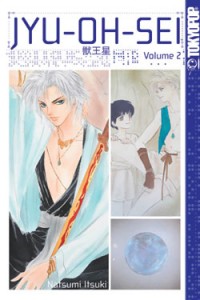 Though the story is well-executed, the artwork is something of a disappointment. Itsuki goes to great pains to create a diverse cast — a task at which she’s generally successful — but her character designs are generic and dated; I’d be hard-pressed to distinguish the Kimaerans from, say, the cast of RG Veda or Basara. Itsuki also struggles with skin color; her dark-skinned women bear an unfortunate resemblance to kogals, thanks to Itsuki’s clumsy application of screentone.
More disappointing are Itsuki’s fight scenes: they register as scratchy messes, thanks to her over-reliance on speedlines and trapezoidal panels. The third volume, for example, consists of several lengthy scenes of hand-to-hand combat in which all of the action is suggested by superimposing horizontal lines on close-ups of contorted faces; we never get a clear sense of where the characters are standing in relation to one another, nor do we always have a clear sense of where the action is unfolding.
Tokyopop has done a good job of presenting Jyu-Oh-Sei. The manga was originally released in five volumes; Tokyopop wisely repackaged the story in omnibus format to allow Jyu-Oh-Sei‘s lengthy and complicated story arcs to unfold without significant interruption. The translation is clear and idiomatic, even when the characters are called upon to speak in unadulterated Science Fiction. The only downside to Tokyopop’s presentation is the paperstock: as many readers have observed, it’s thin and greyish, like newsprint, and allows images to bleed through the page.
Aside from a third-act detour into sci-fi pomposity, Jyu-Oh-Sei is a solid, entertaining read: think B-movie in manga form. Like Invasion of the Body Snatchers and District 9, Jyu-Oh-Sei addresses social taboos — race, gender roles — and scientific issues — genetic engineering, environmental devastation — while serving up generous portions of what audiences crave: action, romance, monsters, explosions. Best of all, Jyu-Oh-Sei comes in a neat, three-volume package that’s long enough to allow for world-building and character development but short enough to stay fresh and surprising until the end. It’s the perfect summer escape, minus the sticky floors, endless previews, and seven dollar buckets of popcorn.
This review is an expanded version of an earlier review posted at PopCultureShock. My original review of volume one can be found here.
Review copy of volume one provided by Tokyopop.
JYU-OH-SEI, VOLS. 1-3 • BY NATSUMI ITSUKI • TOKYOPOP • RATING: TEEN
 Tegami Bachi has all the right ingredients to be a great shonen series: a dark, futuristic setting; rad monsters; cool weapons powered by mysterious energy sources; characters with goofy names (how’s “Gauche Suede” grab you?); and smart, stylish artwork. Unfortunately, volume one seems a little underdone, like a piping-hot shepherd’s pie filled with rock-hard carrots.
 The ocean occupies a special place in the artistic imagination, inspiring a mixture of awe, terror, and fascination. Watson and the Shark, for example, depicts the ocean as the mouth of Hell, a dark void filled with demons and tormented souls, while The Birth of Venus offers a more benign vision of the ocean as a life-giving force. In Children of the Sea, Daisuke Igarashi imagines the ocean as a giant portal between the terrestrial world and deep space, as is suggested by a refrain that echoes throughout volume one: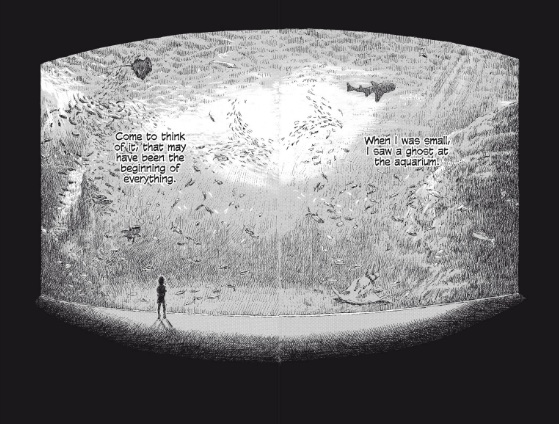
 If Phoenix is Tezuka’s Ring Cycle, Wagnerian in scope, form, and seriousness, then Dororo is Tezuka’s Don Giovanni, a playful marriage of supernatural intrigue and lowbrow comedy whose deeper message is cloaked in shout-outs to fellow artists (in this case,
 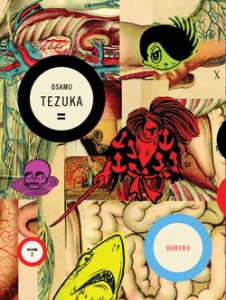 Though much of the devastation that Hyakkimaru and Dororo witness is man-made (Dororo takes placed during the Sengoku, or Warring States, Period), demons exploit the conflict for their own benefit, holding small communities in their thrall, luring desperate travelers to their doom, and feasting on the never-ending supply of human corpses. Some of these demons have obvious antecedents in Japanese folklore — a nine-tailed kitsune — while others seem to have sprung full-blown from Tezuka’s imagination — a shark who paralyzes his victims with sake breath, a demonic toad, a patch of mold possessed by an evil spirit. (As someone who’s lived in prewar buildings, I can vouch for the existence of demonic mold. Lysol is generally more effective than swordplay in eliminating it, however.) Hyakkimaru has a vested interest in killing these demons, as he spontaneously regenerates a lost body part with each monster he slays. But he also feels a strong sense of kinship with many victims — a feeling not shared by those he helps, who cast him out of their village as soon as the local demon has been vanquished.
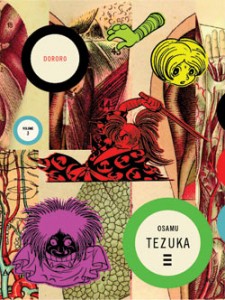 For folks who find the cartoonish aspects of Tezuka’s style difficult to reconcile with the serious themes addressed in Buddha, Phoenix, and Ode to Kirihito, Dororo may prove a more satisfying read. The cuteness of Tezuka’s heroes actually works to his advantage; they seem terribly vulnerable when contrasted with the grotesque demons, ruthless samurai, and scheming bandits they encounter. Tezuka’s jokes — which can be intrusive in other stories — also prove essential to Dororo‘s success. He shatters the fourth wall, inserts characters from his stable of “stars,” borrows characters from other manga-kas’ work, and punctuates moments of high drama with low comedy, underscoring the sheer absurdity of his conceits… like sake-breathing shark demons. Put another way, Dororo wears its allegory lightly, focusing primarily on swordfights, monster lairs, and damsels in distress while using its historical setting to make a few modest points about the corrosive influence of greed, power, and fear.
 Since childhood, Misao has been cursed with an unlucky gift: the ability to see ghosts and demons. As her sixteenth birthday approaches, however, Misao’s luck begins to change. Isayama, the star of the tennis team, asks her out, and Kyo, a childhood friend, moves into the house next door, pledging to protect Misao from harm. Kyo’s promise is quickly put to the test when Isayama turns out to be a blood-thirsty demon who’s intent on killing — and eating — Misao. Just before Isayama attacks Misao, he tells her that she’s “the bride of prophecy”: drink her blood, and a demon will gain strength; eat her flesh, and he’ll enjoy eternal youth; marry her, and his whole clan will flourish. Kyo rescues Misao, revealing, in the process, that he himself is a tengu (winged demon) who’s also jonesing for her blood. Kyo then offers her a choice: marry him or die. Actually, Kyo is less tactful than that, telling Misao, “You can be eaten, or you can sleep with me and become my bride.”
 When I was applying to college, my guidance counselor encouraged me to compose a list of amenities that my dream school would have — say, a first-class orchestra or a bucolic New England setting. It never occurred to me to add “pet-friendly dormitories” to that list, but reading Yuji Iwahara’s Cat Paradise makes me wish I’d been a little more imaginative in my thinking. The students at Matabi Academy, you see, are allowed to have cats in the dorms, a nice perk that has a rather sinister rationale: cats play a vital role in defending the school against Kaen, a powerful demon who’s been sealed beneath its library for a century.
 Nineteen sixty-eight was a critical year in Osamu Tezuka’s artistic development. Best known as the creator of Astro Boy, Jungle Emperor Leo, and Princess Knight, the public viewed Tezuka primarily as a children’s author. That assessment of Tezuka wasn’t entirely warranted; he had, in fact, made several forays into serious literature with adaptations of Manon Lescaut (1947), Faust (1950), and Crime and Punishment (1953). None of these works had made a lasting impression, however, so in 1968, as gekiga was gaining more traction with adult readers, Tezuka adopted a different tact, writing a dark, erotic story for Big Comic magazine: Swallowing the Earth.
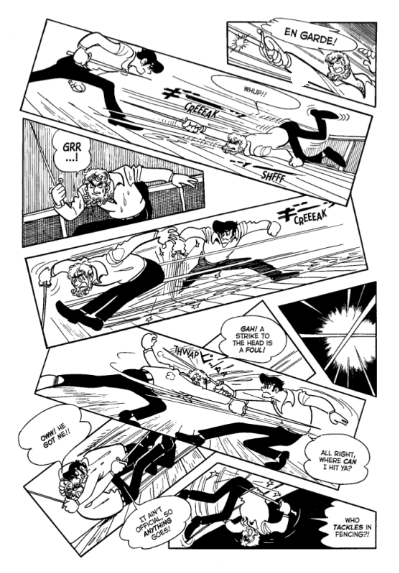
 Dangerous Minds, Dead Poets Society, Stand and Deliver, and To Sir, With Love all depict teachers who are heroic in their self-sacrifice, renouncing money, family ties, and even their reputations in order to inspire students. Kojiro Ishido, the anti-hero of Bamboo Blade, won’t be mistaken for any of these noble educators. He’s bankrupt, morally and financially, and so eager to dig himself out of debt that he’d exploit his students in a heartbeat.