 Oh, Natsume Ono, I just can’t quit you! I was not wild about not simple, but try as I might, I couldn’t dismiss you as just another overrated indie artist. I couldn’t shake the memory of how I felt when I read the first few chapters of House of Five Leaves — that incredible sensation of discovering a new voice with something fresh to say, of having my love for manga validated all over again. So I picked up Ristorante Paradiso with high hopes. I’m happy to report I felt butterflies and excitement, just like the first time, and am firmly back on Team Ono.
Not that you didn’t test my patience — those first twenty pages were a slog, filled with the kind of amateurish moments that I might expect in a freshman effort. We learn that Casetta dell’Orso is popular because a character says it is; that the waiters are handsome because a character comments on how good-looking they are; that the loyal female clientele comes for the help not the food, again, because a character states it as a fact. In short, you have a bad case of telling instead of showing, of not trusting your artwork to demonstrate the restaurant’s popularity or the studliness of the wait staff. I nearly demanded the check.
…
 At first glance, Shirley looks like a practice run for Emma, a collection of pleasant, straightforward maid stories featuring prototype versions of William, Eleanor, and Emma. A closer examination, however, reveals that Shirley is, in fact, a series of detailed character sketches exploring the relationships between three maids and their respective employers. And while some of these sketches aren’t entirely successful — Kaoru Mori cheerfully describes one as “an extremely cheap story about a boy and an animal” — the five chapters focusing on thirteen-year-old Shirley Madison and her independent, headstrong employer are as good as any passage in Emma.
 Invoke Tezuka’s name, and most readers immediately think of Astro Boy, Buddha, and Princess Knight. But there’s a darker side to Tezuka’s oeuvre that dates back to 1953, the year in which he brought Dostoevsky’s tormented Raskolnikov to life in a manga-fied version of Crime and Punishment. It’s this side of Tezuka — the side that acknowledges the human capacity for violence, greed, and deception — that’s on display in MW, a twisty thriller about a sociopath and the priest who loves him.
 10. THE DREAMING
 9. OFF*BEAT
 8. BLUE MONDAY
 7. JAPAN AI: A TALL GIRL’S ADVENTURES IN JAPAN
 6. EMPOWERED
 5. 12 DAYS
 4. KING CITY
 3. YOKAIDEN
 2. NIGHTSCHOOL: THE WEIRN BOOKS
 1. SCOTT PILGRIM
 There are two things to know about Bride of the Water God before you begin reading: first, the artwork is stunningly beautiful, and second, the story takes frequent, confusing detours that are almost impossible to explain, given what we know about the characters. If you find yourself vacillating between “Oh, so pretty!” and “Sweet Jesus, that makes no sense!”, know that you’re not alone.
 First published in 1964, Harriet the Spy featured a radically different kind of heroine than the sweet, obedient girls found in most mid-century juvenile lit; Harriet was bossy, self-centered, and confident, with a flair for self-dramatization and a foul mouth. She favored fake glasses, blue jeans, and a “spy tool” belt over angora sweaters or skirts, and she roamed the streets of Manhattan doing the kind of reckless, bold things that were supposed to be off-limits to girls: peering through skylights, hiding in alleys, concealing herself in dumbwaiters, filling her notebooks with scathing observations about classmates and neighbors. Perhaps the most original aspect of Louise Fitzhugh’s character was Harriet’s complete and utter commitment to the idea of being a writer; unlike Nancy Drew, Harriet wasn’t a goody-goody sleuth who wanted to help others, but a ruthless observer of human folly who viewed spying as necessary preparation for becoming an author.
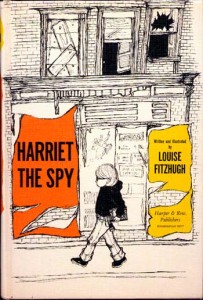 First published in 1964, Harriet the Spy featured a radically different kind of heroine than the sweet, obedient girls found in most mid-century juvenile lit; Harriet was bossy, self-centered, and confident, with a flair for self-dramatization and a foul mouth. She favored fake glasses, blue jeans, and a “spy tool” belt over angora sweaters or skirts, and she roamed the streets of Manhattan doing the kind of reckless, bold things that were supposed to be off-limits to girls: peering through skylights, hiding in alleys, concealing herself in dumbwaiters, filling her notebooks with scathing observations about classmates and neighbors. Perhaps the most original aspect of Louise Fitzhugh’s character was Harriet’s complete and utter commitment to the idea of being a writer; unlike Nancy Drew, Harriet wasn’t a goody-goody sleuth who wanted to help others, but a ruthless observer of human folly who viewed spying as necessary preparation for becoming an author.
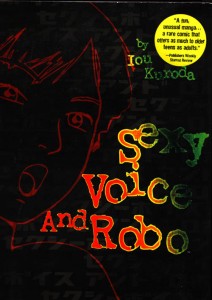 Nico Hayashi, code name “Sexy Voice,” is a bit older than Harriet — Nico is 14, Harriet is 11 — but she’s cut from the same bolt of cloth, as Sexy Voice and Robo amply demonstrates. Like Harriet, Nico entertains fanciful ambitions: “I want to be a spy when I grow up, or maybe a fortune teller,” she informs her soon-to-be-employer. “Either way, I’m in training. A pro has to hone her skills.” Nico, too, has a spy outfit — in her case, comprised of a wig and falsies — and an assortment of “spy tools” that include her cell phone and a stamp that allows her to forge her parents’ signature on notes excusing her from school. Like Harriet, Nico hungers for the kind of adventure that’s supposed to be off-limits to girls, skipping school to pursue leads, analyzing a kidnapper’s ransom call, luring bad guys into traps. Most importantly, both girls are students of adult behavior. Both Harriet the Spy and Sexy Voice and Robo include a scene in which the heroine constructs detailed character profiles from a few snippets of conversation. The similarities between these moments are striking. In Fitzhugh’s book, Harriet visits a neighborhood diner, nursing an egg cream while listening to other customers’ conversations:
 A few weeks ago, Salon columnist Laura Miller offered
  The scene: a country road in twelfth-century Japan. The players: Yamato, a bandit with a Robin Hood streak; Dr. Dunstan, a Westerner in sunglasses and a flashy yukata; and Yamato’s gang. The robbers surround Dunstan to search his cart for anything of worth, settling on two large crates. Though Dunstan warns them that the consequences of opening the boxes will be dire — “if you wake them, you will die,” he explains — Yamato ignores his advice, prying off the lids to discover what look like two porcelain boys. Both figures spring to life, with Vice — the “ultimate evil one,” in case you didn’t guess from his name — slaughtering six robbers in short order. Though Yamato is badly outclassed — he has a sword, Vice has a variety of lethal powers that would be the envy of the US military — he vows to defend his friends. Yamato’s brave gesture gives the second doll, Ultimo, an opening to jump into the battle and send Vice packing.
 If I’ve learned anything from my limited study of horror films, it’s this: zombies come in two flavors. The first type are slow, shambling, and stupid, posing little threat to the hero until they reach a critical mass — say, enough to surround the pub or shopping mall where the hero has hunkered down to await help. The second type are swift of foot and mind, making them a far greater menace to humanity. Raiders is positively crawling with the second type, giving this preposterous yet entertaining story a jolt of visceral energy. Figuratively and literally.
 Two Guys, a Girl, and a Pastry Shop might be a better title for this rom-com about a teen who waits tables at the neighborhood bakery, as the characters are so nondescript I had trouble remembering their names. The girl, Uru, is as generic as shojo heroines come: she’s a spunky, klutzy high school student who blushes and stammers around hot guys, bemoans her flat chest, and wins people over with her intense sincerity. The two guys — Shindo, a moody jerk whose boorishness masks a kind nature, and Ichiro, a cheerful slacker — are just as forgettable, despite the manga-ka’s efforts to assign them novel tics and traits. Shindo, for example, turns out to be a genius who finished high school at fifteen, while Ichiro suffers from hunger-induced narcolepsy, keeling over any time his blood sugar drops.