Last weekend, I had an opportunity to visit the San Francisco Public Library, which is mounting a small but meticulously curated exhibit exploring the relationship between politics, censorship, and manhwa in post-war Korea. Called “Korean Comics: A Society Through Small Frames,” the exhibit features twenty-one of Korea’s best-known cartoonists, from Kim Won Bin, creator of Fist Boss, to Hwang Mina, a sunjong (girls’) pioneer. For a Western reader whose primary knowledge of manhwa comes from titles such as Goong: The Royal Palace, the exhibit will be revelatory, as almost none of the series on display look like the Korean comics that have been licensed for the US market; if anything, the curators have gone out of their way to choose titles that challenge the commonly-held Western notion that manhwa is simply the “Korean form” of manga.[1] Styles range from the cartoonish (Baby Dinosaur Tuli, Madame Vicious) to the naturalistic (The Picture Diary of Puja), while the story lines explore topics as varied as ancient Korean history (Kojudo: Three Kingdoms), homelessness in Seoul (We Saw a Pity Bird Who Lost Its Way), Korean involvement in the Vietnam War (Yellow Bullets), and sumo champion Rikidozan, who is credited with introducing Japanese and Korean audiences to modern professional wrestling.[2]
Throughout the exhibit, curators have gone to great pains to illustrate the complex relationship between cartoonists and the Korean government, noting when a particular title elicited criticism from officials or earned praise for its depiction of Korean life. Visitors unfamiliar with recent Korean history may be surprised to discover the degree to which propaganda and censorship shaped the development of manhwa in South Korea. Hwang Mina’s We Saw a Pity Bird, for example, caused a stir when Seoul was preparing to host the 1986 Pan-Asian Games; the government attempted to ban the work for depicting poverty and homelessness in urban settings, fearing that Pity Bird would make South Korea look economically backwards. Other works, such as Kim Seong Hwan’s Koban, a long-running newspaper strip, ran afoul of Park Chung Hee’s censors for depicting student unrest and changing social mores in the 1960s.[3]
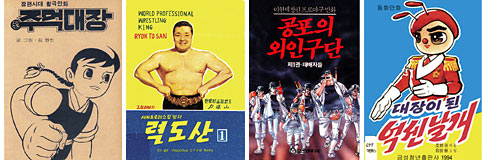
Not surprisingly, the exhibit’s most dramatic illustration of the relationship between comics and politics comes from North Korea. The Great General Mighty Wing debuted in 1994, shortly after Kim Jong Il succeeded his father. Like Soviet novels of the 1920s and 1930s, and Chinese model operas of the 1960s, The Great General Mighty Wing is intended both as entertainment and education, employing a popular medium to teach Communist values, assert the importance of the collective, and reassure readers of their leader’s benign, parental authority. Using the metaphors of the garden and the hive (both Communist staples), the story depicts a conflict between honeybees and wasps for control of two vital resources: water and flowers. The full-color artwork is a synthesis of mid-1950s Korean and Japanese styles (Fist Boss is cited as one important influence), while the script is pure agit-prop, with characters speaking in Communist slogans and heroic, selfless pronouncements.
One of the subtler affects of censorship — artistic isolation and stagnation — is addressed briefly but effectively in the few examples of sunjong manhwa on display. Korea experienced a brief shojo manga boom in the 1970s, when pirates flooded the Korean market with unauthorized versions of popular Japanese titles. The Magnificent 49ers’s style, in particular, had a profound influence on artists writing for the girls’ market. After the government cracked down on Japanese imports, however, Korean artists who had drawn inspiration from the 49ers no longer had access to current shojo manga; as a result, variations on the starry-eyed heroines and long-haired princes of The Rose of Versailles flourished in Korean manhwa long after they’d fallen out of fashion in Japan.[4]
If I had one complaint about the exhibit, it’s that visitors whose entire knowledge of Korea is rooted in the present may not appreciate the degree to which the displayed comics reflect the social and political upheaval of the past eighty years. A small timeline of major events, or even a pamphlet providing a brief overview of Korean history from 1939 to the present, would have been a valuable asset to the exhibit. (A quick glance at the Wikipedia articles on Korea, North Korea, and South Korea are strongly suggested if you don’t know much about the region.) That said, “Korean Comics” is a thoughtful and thought-provoking show that will challenge readers’ notions of what manhwa is, offer them a window into Korean society during some of its most turbulent periods, and introduce them to twenty-one brilliant artists, all of whom deserve greater recognition outside their home country.
“Korean Comics: A Society Through Small Frames” runs now through June 13, 2010 at the Main Branch of the San Francisco Public Library. Admission is free. For hours and directions to the library, click here. The exhibit is a joint effort by the San Francisco Public Library and the Korea Society.
Suggested Reading
“100 Years of Korean Manhwa,” Park In-Ha. List: Books from Korea (Vol. 4, Summer 2009). (Accessed April 9, 2010.)
“Great General Mighty Wing,” Cho Pyong Kwan; translated by Heinz Insu Fenkl. Words Without Borders: The Online Magazine for International Literature (February 2, 2008). (Accessed April 8, 2010.)
Manhwa 100: The New Era for Korean Comics. NETCOMICS (2008). Available through Amazon and other retailers.
A Study of the Development of Sunjong Manhwa by Hwang Mina, Kim Hyerin, and Choi In-sun, Yeewon Yoon. Master’s thesis, University of British Columbia (2002). Available through the UBC Retrospective Theses Digitization Project [http://www.library.ubc.ca/archives/retro_theses/]. (Accessed April 9, 2010.)
Notes
1.This disparity is reflected in the library’s suggested reading list, which features a number of contemporary works such as The Antique Gift Shop, Honey Mustard, Moon Boy, and Priest but none of the works feature in the show. The SFPL’s collection does include a few Korean-language titles, which are listed in the bibliography.
2. Rikidozan is mentioned in Yoshihiro Tatsumi’s A Drifting Life (2009; Drawn & Quarterly), in which Rikidozan is presented as a Japanese hero for defeating American wrestlers in the ring. See pages 261-63.
3. Kim Seong Hwan produced 14,319 Koban strips over its 50+ year run in Korean newspapers.
4. NETCOMICS, a Korean publisher which has been translating manhwa for the American market, has released a number of sunjong titles from the 1980s and early 1990s that suggest the continued influence of 1970s shojo styles on Korean artists. The early work of Kyungok Kang provides an instructive example. See In the Starlight and Narration of Love at 17 for two such examples; her later work, such as Two Will Come, has a distinctly different look.
 “When he heard his cry for help, it wasn’t human” — so went the tagline for Ken Russell’s Altered States (1980), a bizarre fever-dream of Nietzchean philosophy, horror, and mystical hoo-ha in which a scientist’s experiments result in his spontaneous devolution. That same tagline would work equally well for Osamu Tezuka’s Ode to Kirihito (1970-71), a globe-trotting medical mystery about a doctor who takes a similar step down the evolutionary ladder from man to beast. In less capable hands, Kirihito would be pure, B-movie camp with delusions of grandeur — as Altered States is — but Tezuka synthesizes these disparate elements into a gripping story that explores meaty themes: the porous boundaries between man and animal, sanity and insanity, godliness and godlessness; the arrogance of scientists; and the corruption of the Japanese medical establishment.
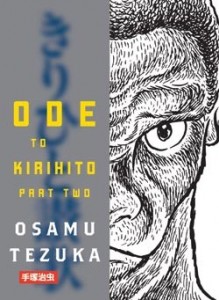 At a deeper level, however, Ode to Kirihito is an extended meditation on what distinguishes man from animal. Kirihito’s physical transformation forces him to the very margins of society; he terrifies and fascinates the people he encounters, as they alternately shun him and exploit him for his dog-like appearance. (In one of the manga’s most engrossing subplots, an eccentric millionaire kidnaps Kirihito for display in a private freak show.) The discrimination that Kirihito faces — coupled with Monmow’s dramatic symptoms, such as irrational aggression and raw meat cravings — lead him to question whether he is, in fact, still human. Throughout the story, he wrestles with a strong desire to abandon reason and morality for instinct; only his medical training — and the ethics thus inculcated — prevent him from embracing the beast within.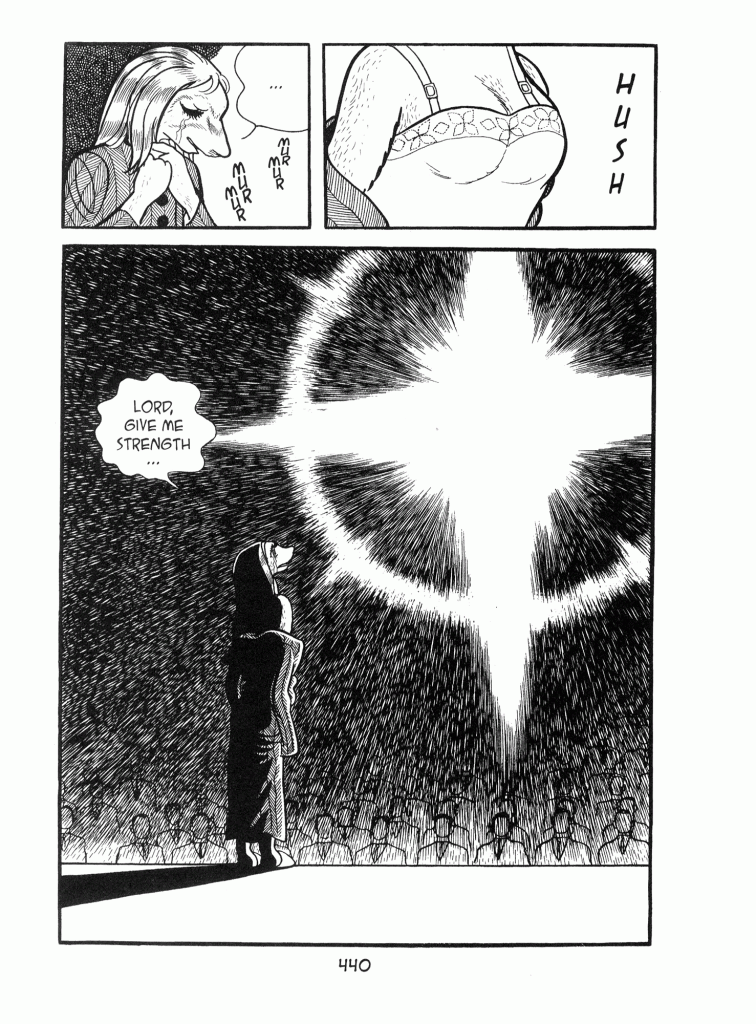
 As a feminist, yaoi puts me in a difficult position. On the one hand, I love the idea of women creating erotica for other women, of creating a safe and fun space where female readers can explore their sexual fantasies. (I don’t know about you, but Ron Jeremy has never factored into any of mine.) On the other hand, I’m often uncomfortable by the way in which rape is conflated with extreme romantic desire in yaoi; it’s disappointing to see the “you’re so irresistible, I couldn’t help myself!” defense trotted out as a justification for sexual violation. To be sure, the rape-as-love trope abounds in romance novels and mainstream pornography as well, but as a feminist, it makes me just as uncomfortable to encounter it in yaoi as it does to encounter it in an episode of General Hospital. Then, too, there’s the issue of the characters’ homosexuality, which is sometimes trivialized (i.e., they’re not gay, they’re just so good-looking they couldn’t help themselves!), ignored, or “explained” by a character’s tragic past, as if sexual orientation were a simple, situational decision.
 Oh, Natsume Ono, I just can’t quit you! I was not wild about
  At first glance, Shirley looks like a practice run for Emma, a collection of pleasant, straightforward maid stories featuring prototype versions of William, Eleanor, and Emma. A closer examination, however, reveals that Shirley is, in fact, a series of detailed character sketches exploring the relationships between three maids and their respective employers. And while some of these sketches aren’t entirely successful — Kaoru Mori cheerfully describes one as “an extremely cheap story about a boy and an animal” — the five chapters focusing on thirteen-year-old Shirley Madison and her independent, headstrong employer are as good as any passage in Emma.
 Invoke Tezuka’s name, and most readers immediately think of Astro Boy, Buddha, and Princess Knight. But there’s a darker side to Tezuka’s oeuvre that dates back to 1953, the year in which he brought Dostoevsky’s tormented Raskolnikov to life in a manga-fied version of Crime and Punishment. It’s this side of Tezuka — the side that acknowledges the human capacity for violence, greed, and deception — that’s on display in MW, a twisty thriller about a sociopath and the priest who loves him.
 10. THE DREAMING
 9. OFF*BEAT
 8. BLUE MONDAY
 7. JAPAN AI: A TALL GIRL’S ADVENTURES IN JAPAN
 6. EMPOWERED
 5. 12 DAYS
 4. KING CITY
 3. YOKAIDEN
 2. NIGHTSCHOOL: THE WEIRN BOOKS
 1. SCOTT PILGRIM
 There are two things to know about Bride of the Water God before you begin reading: first, the artwork is stunningly beautiful, and second, the story takes frequent, confusing detours that are almost impossible to explain, given what we know about the characters. If you find yourself vacillating between “Oh, so pretty!” and “Sweet Jesus, that makes no sense!”, know that you’re not alone.
 First published in 1964, Harriet the Spy featured a radically different kind of heroine than the sweet, obedient girls found in most mid-century juvenile lit; Harriet was bossy, self-centered, and confident, with a flair for self-dramatization and a foul mouth. She favored fake glasses, blue jeans, and a “spy tool” belt over angora sweaters or skirts, and she roamed the streets of Manhattan doing the kind of reckless, bold things that were supposed to be off-limits to girls: peering through skylights, hiding in alleys, concealing herself in dumbwaiters, filling her notebooks with scathing observations about classmates and neighbors. Perhaps the most original aspect of Louise Fitzhugh’s character was Harriet’s complete and utter commitment to the idea of being a writer; unlike Nancy Drew, Harriet wasn’t a goody-goody sleuth who wanted to help others, but a ruthless observer of human folly who viewed spying as necessary preparation for becoming an author.