Though Vertical has published two series by Keiko Takemiya, the Magnificent 49ers’ work remains largely unavailable in English, with a few exceptions: Yasuko Aoike’s From Eroica With Love (which debuted in 1976 in Akita Shoten), and Moto Hagio’s short stories “A, A’ [A, A Prime],” “4/4 [Quatre/Quarts],” “X+Y,” and “They Were Eleven.”* These four stories comprise a mere 330 pages of material, but they offer readers a window into a key stage in shojo manga’s development, when women artists began pushing the medium in new directions, visually and thematically. Hagio’s work, like Takemiya’s, is unabashedly Romantic, filled with yearning characters who are struggling to uncover their true selves, even when that quest puts them at odds with societal norms. Though there is an intense, adolescent sensibility to some of her stories, that — for me, at least — is part of their beauty; Hagio clearly remembers what it feels like to be sixteen or eighteen, yet the way she frames those emotions is so exquisite and refined that the reader can appreciate her craft, even if the drama seems a little overripe from an adult perspective.
If you’ve been curious about what Takemiya’s peers were doing while she was writing To Terra and Song of the Wind and the Trees, or are wondering what to expect if you purchase Hagio’s A Drunken Dream this fall, read on.
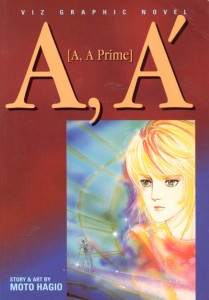 A, A’ [A, A Prime]
This sometimes lyrical, sometimes bizarre anthology contains three interrelated stories. In the first, “A, A’, [A, A Prime],” a group of researchers struggle to accept Addy, a new team member who is, in fact, the clone of a colleague who perished several years earlier; in the second, “4/4 [Quatre/Quarts],” Mori, a telepath, becomes obsessed with Trill, a strange young woman who’s virtually mute; and in the third, “X+Y,” a now-older Mori falls in love with Tacto, an androgynous young man who resembles Trill. Addy, Trill, and Tacto are Unicorns, a humanoid species bred for deep-space travel. Though Unicorns share common physical characteristics — most notably a shock of red hair running down the center of their heads — and high IQs — their original purpose was to serve as computer technicians on long space missions — they have a hard time negotiating the human world: emotions baffle them, and the act of forming deep attachments to other people can destabilize their personalities.
Though Hagio rehearses some time-honored sci-fi tropes — especially the danger of genetic tampering — one of her most striking themes is the relationship between memory and identity. Addy, for example, is born with all of her predecessor’s memories of childhood, but none of her predecessor’s memories of Proxima, the remote ice world where the original Addy worked for three years before dying in an accident. That gap in Addy’s memory proves especially difficult for her co-worker Regg, who had been romantically involved with Addy’s predecessor. Addy has no idea who he is, and is bewildered that Regg knows about events from her “childhood” — events that Addy hasn’t discussed with anyone. More troubling still, these “memories” are deeply upsetting, even though Addy knows she isn’t reliving her own history.
Tacto, on the other hand, teeters on the verge of a breakdown because his memory is incomplete. As a young child, he stumbled across a gruesome sight, one which his father attempted to erase from Tacto’s memory. That seemingly humane gesture backfired, however, leaving Tacto with only an emotional echo of the traumatic event and no concrete information about what he’d actually seen; only by recovering those painful memories does Tacto escape his emotional paralysis and embrace Mori’s love for him.
Hagio’s artwork supports the intensely Romantic quality of all three stories, as she represents her characters’ memories with symbolically rich imagery. In “4/4,” for example, Trill is haunted by a recurring vision of corpses, each fastened to the floor with a lepidopterist’s pin — Trill’s memory of numerous, unsuccessful attempts to clone her. (Dr. Sazzan, her caretaker, is obsessed with breeding more Unicorns.) Tacto’s unformed memory of his childhood resembles the nightmare paintings of John Fuselli; Tacto sees a disembodied, demonic face emerge from the rocky surface of an asteroid, a swirling black cloud with eyes and a terrible mouth.
That dream-like quality extends to the settings as well, which mirror the characters’ turbulent emotional states. Trill and Mori, for example, visit a spectacular aviary aboard a space station; it’s a lush, erotically charged setting evocative of a Rousseau painting, and one that suggests the intensity of Mori’s desire for Trill. Hagio performs a similar trick in this sequence, transforming an interstellar reconnaissance mission into an intimate windsailing expedition through the stars:
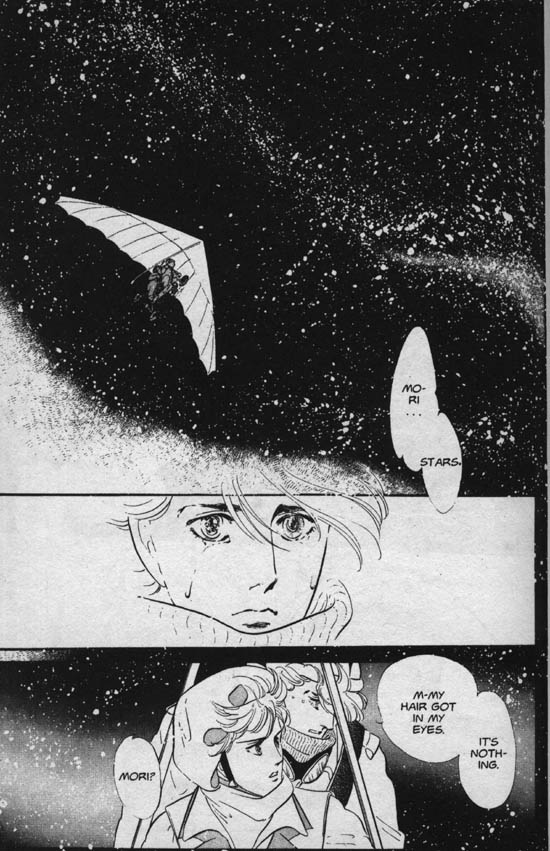
Lest A, A’ sound like The Unbearable Lightness of Being in Space, let me assure you that Hagio demonstrates a unique ability to mix the sublime with the ridiculous. Her characters’ names, for example, are just about as goofy as they come: Dr. Wright Moonsault. Regg Bone. Marble. Professor Sazzan. Their costumes, too, have the same overripe quality as the names, with men sporting headbands, half capes, tall boots, and Renn Fair hats, and women clad in off-the-shoulder jumpsuits. The subplots take the cake, however, for their sheer moonbattiness: in “X+Y,” for example, Tacto’s father invents a temporary sex change drug that enables a male colleague to become pregnant, a subplot that actually holds the key to unlocking Tacto’s past.
Now out of print, VIZ originally released A, A’ in 1997. Expect to pay about $25.00 for a decent used copy if you choose to buy it online through ALibris or Amazon’s network of retailers. You might also try the library or your local comic shop’s bargain bin.
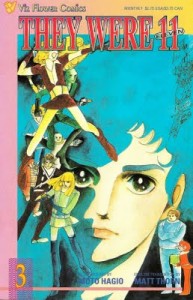 THEY WERE ELEVEN
Ten cadets at an interstellar space academy are dispatched to a decommissioned ship. Their task: remain on board for 53 days without pressing the panic button; if they persevere, all ten will pass their final exam. Once aboard the ship, however, the cadets realize something is amiss. Not only do they have an extra crew member, but a series of mechanical failures and explosions threaten to send the ship hurtling into the surface of a neighboring star.
Though the premise could be spun out in the manner of, say, Event Horizon, Hagio favors a Gene Rodenberry approach, emphasizing character development and social commentary over gunplay, robots, or totally icky alien life forms. (You know the kind: they embed themselves in your chest cavity, hunt you down like a rabbit, or just spray toxic venom in your face.) Like the good astronauts of the starship Enterprise, They Were Eleven‘s cast are humanoids of various shapes and sizes. A few seem empathic; one has remarkable healing powers; another is tall and scaly; yet another looks like a distant relative of The Thing; and one pretty character has yet to decide whether it will develop into a man or woman. The dilemmas the cadets face — technical, social, and medical — also place us firmly in Star Trek territory, inspiring the characters to ruminate on issues as varied as gender roles and the ethics of sacrificing an individual for the good of the collective.
In fact, the exploration of gender is one of They Were Eleven‘s most interesting subplots; Frol, the sexually indeterminate member of the crew, is furious that her shipmates construe her as female. “I hate women!” she shouts. “Women are nothing but a waste of space!” Midway through the story, Hagio reveals the source of Frol’s misogyny: her parents want her to become the ninth wife of a prominent nobleman. If Frol passes the Galactic Academy exam, however, she will earn the right to become a man, a privilege usually reserved for a family’s eldest child. (Frol’s people are born hermaphrodites, becoming male or female only in adulthood.) Hagio’s critique of gender roles is both obvious and sly — obvious, in that Frol’s objection to being a woman stems from the division of labor on her home world (men rule the roost; women do all the work and bear lots of children) and sly, in that Hagio uses primogeniture as a metaphor for the broader sense of entitlement that comes with being born male.
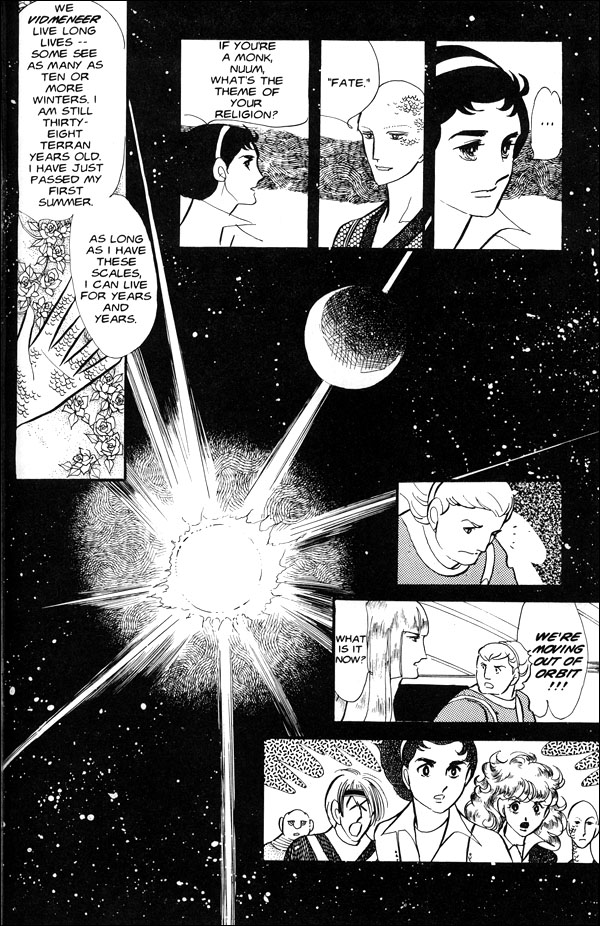
If Hagio’s aliens are strictly by the Star Trek book, all funny foreheads and funky hides, her layouts are stunning, punctuated by several arresting, full-page images: an enormous hall of cadets taking their exams (each in a groovy, womb-like isolation pod to prevent cheating), a picture of the dying star around which the test ship is orbiting, a character’s profile dissolving into a trail of stars. Hagio juxtaposes these expansive images with long, almost claustrophobically tight scenes of shipmates bickering and coping with the latest mechanical failures. It’s a neat trick, giving us a sense of how tight quarters really are aboard the White, and suggesting how that small space exacerbates tensions among the crew. And oh, those interiors! Like Takemiya, Hagio loves to draw detailed banks of computers and rows of tubes and wires and pipes, bringing the ship to vivid life. (Or, perhaps more accurately in the case of They Were Eleven, showing the ship in all its decrepitude.)
Much as I would like to recommend They Were Eleven, the story is out of print in English. In the mid-1990s, VIZ issued it in two forms: as a four-issue comic (1995), and in the anthology Four Shojo Stories (1996). Used book dealers have gotten wise to the scarcity of this title; copies of Four Shojo Stories generally retail for $60 and up. Though I didn’t have too much difficulty scaring up the old VIZ Flower floppies on eBay (and I rather enjoyed the American-style presentation), it would be great to see this chestnut re-issued for a generation of readers who think that Black Bird is the first and last word in girls’ comics.
* Hagio’s story “Hanshin” was reprinted in The Comics Journal‘s shojo manga issue from 2005 (no. 269). For the purposes of this essay, I’m focusing on Hagio’s commercially available work. And speaking of work by pioneering shojo artists, Swan, which ran in Margaret from 1976 to 1981, is also available in English (CMX), and is the work of artist Kyoko Ariyoshi, who was born in 1950.
This an expanded version of a review that originally appeared at PopCultureShock on 1/20/07.
 Ah, Keiko Takemiya, how I love your sci-fi extravaganzas! The psychic twins. The giant spiderbots. The evil, omniscient computers. The sand dragons. The fantastic hairdos. Just think how much more entertaining The Matrix might have been if you’d been at the helm instead of the dour, self-indulgent Wachowski Brothers! But wait… you did create your very own version of The Matrix: Andromeda Stories. Your version may not be as slickly presented as the Wachowski Brothers’, but you and collaborator Ryu Mitsuse engage the mind and heart with your tragic tale of doomed love, lost siblings, and machines so insidious that they’ll remake anything in their image—including the fish.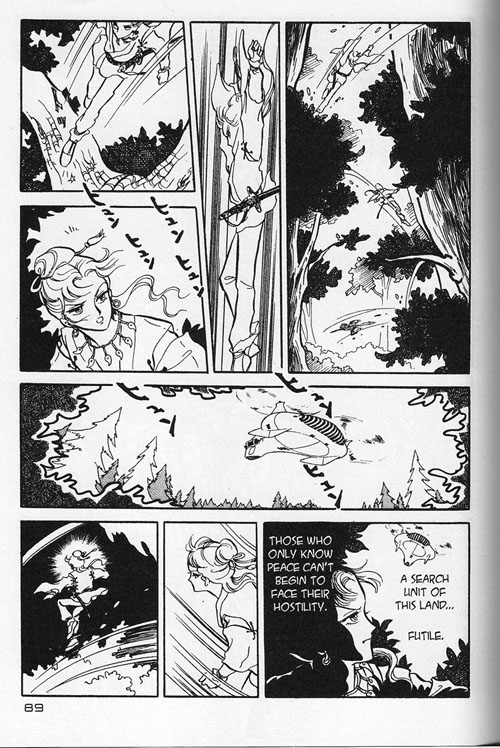


 To Terra unfolds in a distant future characterized by environmental devastation. To salvage their dying planet, humans have evacuated Terra (Earth) and, with the aid of a supercomputer named Mother, formed a new government to restore Terra and its people to health. The most striking feature of this era of Superior Domination (S.D.) is the segregation of children from adults. Born in laboratories, raised by foster parents on Ataraxia, a planet far from Terra, children are groomed from infancy to become model citizens. At the age of 14, Mother subjects each child to a grueling battery of psychological tests euphemistically called Maturity Checks. Those who pass are sorted by intelligence, then dispatched to various corners of the galaxy for further training; those who fail are removed from society.
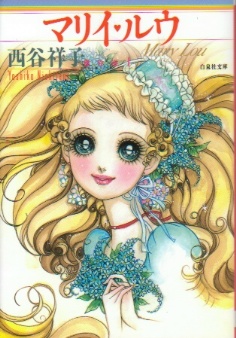 In the mid-1960s, pioneering female artist Yoshiko Nishitani began writing stories aimed at a slightly older audience. Nishitani’s Mary Lou, which made its debut in Weekly Margaret in 1965, was one of the very first shojo manga to document the romantic longings of a teenage girl. (As Thorn notes in
  The next time someone dismisses manga as a “style” characterized by youthful-looking, big-eyed characters with button noses, I’m going to hand them a copy of AX, a rude, gleeful, and sometimes disturbing rebuke to the homogenized artwork and storylines found in mainstream manga publications. No one will confuse AX for Young Jump or even Big Comic Spirits; the stories in AX run the gamut from the grotesquely detailed to the playfully abstract, often flaunting their ugliness with the cheerful insistence of a ten-year-old boy waving a dead animal at squeamish classmates. Nor will anyone confuse Yoshihiro Tatsumi or Einosuke’s outlook with the humanism of Osamu Tezuka or Keiji Nakazawa; the stories in AX revel in the darker side of human nature, the part of us that’s fascinated with pain, death, sex, and bodily functions.
 Reading The Times of Botchan reminded me of watching Alexander Sakurov’s cryptic 2002 film
  If I’ve learned anything from my long love affair with science fiction, it’s this: there’s no place like home. You can boldly go where no man has gone before, you can explore new worlds and new civilizations, and you can colonize the farthest reaches of space, but you risk losing your way if you can’t go back to Earth again.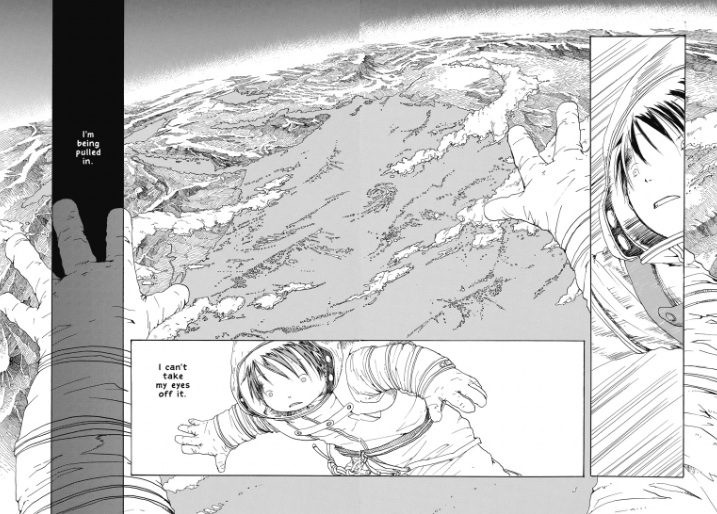
 The frog who appears to be a prince is a staple character in romantic comedies: what Jane Austen novel didn’t feature a handsome, wealthy suitor who, in the final pages of the story, turned out to be ethically challenged, penniless, or engaged to someone else? My Girlfriend’s a Geek offers a more up-to-the-minute version of Mr. Willoughby, this time in the form of a nice young woman who looks like a dream and holds down a responsible job, but has some rather unsavory habits of mind.