After last week’s drought, this week brings riches, with a whole slew of new titles expected in at Midtown Comics. Check out this week’s Picks from the Manga Bookshelf bloggers and special guest Michelle Smith!
 MICHELLE: Although it’s a month late appearing on Midtown’s list—it actually came out on March 1st!—my pick this week is the second and final volume of Masami Tsuda’s Eensy Weensy Monster. Over twelve chapters (each covering one month), this charming shoujo series tells the year-long story of the developing relationship between two likable characters. It’s well crafted, employing many of the technical aspects that made Tsuda’s longer and more famous Kare Kano so special, and also super cute. In addition, it’s been nominated for the 2012 list of Great Graphic Novels for Teens so what’s not to like?
 MJ: There are a number of compelling titles coming in to Midtown Comics this week, particularly new volumes of Demon Sacred and Seiho Boys’ High School, both of which I think have made this list before. But I’m going to throw my vote in for the debut volume of Yu Aikawa’s Butterfly, new this week from TOKYOPOP. This is a quirky little supernatural manga involving an emotionally damaged teen who reluctantly teams up with an elementary school-aged con artist. From my review: “As weird as this series is, it’s also really interesting. The characters are all filled with dark little nooks and crannies they’re struggling to hide from everyone else. It’s just the strangest little story, but I really can’t wait to read more.” Also, it’s got Squeakears. Need I say more?
 DAVID: In spite of the fact that it has one of the most unpromising first chapters of any series of recent vintage, I’m going to give my nod to Kazue Kato’s Blue Exorcist from Viz. Kato corrects her shortcomings so quickly that it’s worth picking up just to see her manage that, but it also offers a very promising story and an interesting relationship between its twin protagonists. One brother, Rin, is the chosen heir of Satan, and the other, Yukio, is a prodigy in the field of exorcism. Rin decides he’d rather fight demons than rule them, and Yukio steps up to train Rin (and make sure he doesn’t inadvertently follow in their father’s footsteps). If course-correction spectacle isn’t your cup of tea, you could skip the first chapter entirely and move right on to the good stuff.
 KATE: I’m voting for volume four of Demon Sacred, which is shojo manga at its crack-tastic best: who but Natsumi Itsuki could weave demons, dinosaurs, pop idols, unicorns, and handsome scientific geniuses into a storyline that’s as fun to read as that list implies? I’d be the first to admit that Itsuki seems to be making things up as she goes along, but the story unfolds in such a feverish, breathless fashion that it’s hard not to get caught up in it, even when it’s patently ridiculous.
So, readers, what are your Picks this week?


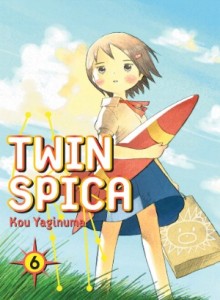

 KATE: I’m glad I’m going first this week, because that allows me to recommend a Manga Bookshelf staff favorite:
  MJ: I’m going to go in a bit of an unexpected direction here and recommend
  DAVID: My pick is a book that seemed to slide in under the radar: Oji Suzuki’s


 DAVID: It’s a good week for Yen Press at
  MICHELLE: It is indeed a good week for Yen Press. While I have no doubt that Bunny Drop is thoroughly awesome, I am going to have to cast my vote for the fifth volume of
  MJ: As most of our readers probably have heard, the


