• Skip to primary navigation
  • Skip to main content
  • Skip to primary sidebar
  • Home
  • About Us
    • Privacy Policy
    • Comment Policy
    • Disclosures & Disclaimers
  • Resources
    • Links, Essays & Articles
    • Fandomology!
    • CLAMP Directory
    • BlogRoll
  • Features & Columns
    • 3 Things Thursday
    • Adventures in the Key of Shoujo
    • Bit & Blips (game reviews)
    • BL BOOKRACK
    • Bookshelf Briefs
    • Bringing the Drama
    • Comic Conversion
    • Fanservice Friday
    • Going Digital
    • It Came From the Sinosphere
    • License This!
    • Magazine no Mori
    • My Week in Manga
    • OFF THE SHELF
    • Not By Manga Alone
    • PICK OF THE WEEK
    • Subtitles & Sensibility
    • Weekly Shonen Jump Recaps
  • Manga Moveable Feast
    • MMF Full Archive
    • Yun Kouga
    • CLAMP
    • Shojo Beat
    • Osamu Tezuka
    • Sailor Moon
    • Fruits Basket
    • Takehiko Inoue
    • Wild Adapter
    • One Piece
    • After School Nightmare
    • Karakuri Odette
    • Paradise Kiss
    • The Color Trilogy
    • To Terra…
    • Sexy Voice & Robo
  • Browse by Author
    • Sean Gaffney
    • Anna Neatrour
    • Michelle Smith
    • Katherine Dacey
    • MJ
    • Brigid Alverson
    • Travis Anderson
    • Phillip Anthony
    • Derek Bown
    • Jaci Dahlvang
    • Angela Eastman
    • Erica Friedman
    • Sara K.
    • Megan Purdy
    • Emily Snodgrass
    • Nancy Thistlethwaite
    • Eva Volin
    • David Welsh
  • MB Blogs
    • A Case Suitable For Treatment
    • Experiments in Manga
    • MangaBlog
    • The Manga Critic
    • Manga Report
    • Soliloquy in Blue
    • Manga Curmudgeon (archive)

Manga Bookshelf

Discussion, Resources, Roundtables, & Reviews

Katherine Dacey

PotW: Bunny Drop & Time and Again

March 21, 2011 by David Welsh, Katherine Dacey, Michelle Smith and MJ 6 Comments

Finally a great week for manga and manhwa! Check out this week’s Picks from the Manga Bookshelf bloggers and special guest Michelle Smith!


DAVID: It’s a good week for Yen Press at Midtown Comics, with several appealing titles on the way, but I have to cast my lot with the third volume of Yumi Unita’s Bunny Drop. It’s about a single guy who takes in his grandfather’s young, orphan daughter, and it’s got a wonderful, smart, slice-of-life approach to the subject matter. Unita really finds the emotional core of everyday moments, and the characters are great. This was one of the great debuts of 2010, and new volumes seem to arrive painfully slowly, so it’s always a joyous occasion.

KATE: I second David’s recommendation! One of the things I like best about Bunny Drop is that Unita doesn’t go for the obvious laughs that are characteristic of the single-guy-becomes-instant-dad genre. Not that the series isn’t humorous; there’s some exquisitely funny material in volume one, for example, as Daichi questions Rin about a favorite stuffed animal. (He thinks it’s a dog, Rin insists it’s a rabbit.) But Unita is more interested in tracking Daichi’s development as a parent than in setting him up to be the straight man for a little kid, a decision that goes a long way to making the story believable.

MICHELLE: It is indeed a good week for Yen Press. While I have no doubt that Bunny Drop is thoroughly awesome, I am going to have to cast my vote for the fifth volume of Time and Again. Though this manhwa is full of intriguing supernatural stories, the most compelling thing about it is the bond between its main characters. Exorcist Baek-On and his bodyguard Ho-Yeon are both attempting to atone for something in their past, and recent volumes have begun exploring those painful memories as well as showing how the men are helping each other to heal. It’s wonderful stuff, and I can’t wait to read more!

MELNDA: This is a really tough choice for me, and though it’s not quite as tough as it might be if I didn’t know that Midtown’s listing of Hikaru no Go 22 is a lie (I bought it myself when it came out in January!), I’m still faced with quite an array of fantastic manga and manhwa. In the end, I’m going to have to be a wimp and agree with all my cohorts above. I simply can’t choose between Bunny Drop and Time and Again. Like Hikaru no Go, actually, both are examples of series I think are richer, quirkier, and more elegantly written than their respective genres necessarily command. In the spirit of Robot 6’s Food or Comics? this week I have to go with comics.


Readers, what are your Picks this week?

Filed Under: PICK OF THE WEEK Tagged With: bunny drop, time and again

Manga Bookshelf talks Sailor Moon

March 19, 2011 by MJ, Michelle Smith, Katherine Dacey and David Welsh 21 Comments

Join the Manga Bookshelf bloggers and special guest Michelle Smith in our spontaneous Sailor Moon squee roundtable!


MJ: As most of our readers probably have heard, the big news yesterday in the manga blogosphere was that Kodansha USA is re-releasing Naoko Takeuchi’s Sailor Moon. I was pretty excited when I got the press release (there may have been a caps-locked e-mail), but I admit when I examine that, I’m not exactly sure why.

I’m thrilled at the prospect of being finally introduced to a series that was so key in bringing shoujo manga to the US, but beyond that I’m a little bit lost. My only personal experience with the series is a couple of episodes of the anime adaptation that Michelle showed me last year, and from that alone, I don’t feel like I have any real basis for understanding why the series means so much to its American fans.

I think Kate may be in a similar position, so I’m hoping that our squeeful cohorts can shine some light on the subject. Why do you love Sailor Moon, and why will we?

DAVID: I should jump in and admit that my familiarity with the series is entirely based on the anime, though I was quite charmed by it. This was decades ago when it would just randomly be aired on those third-tier non-networks, and I was always game for a half an hour with these girls. This might have been because I was a huge fan of super-hero teams at the time and had a particular weakness for super-heroines who also had rich emotional lives.

While I always loved comics like The Avengers and The Uncanny X-Men, part of me always muttered about the fact that there were too many boys hogging the glory. Every team had its own version of “the girl,” and sometimes they’d even have two, but it was always clear that she was “the girl.” Sailor Moon was such a nice change of pace for that reason — all of the really important, powerful characters were girls, and they had lives outside of the big battles.

MICHELLE: It seems I’m the only one of us, then, who’s read the manga before (albeit with the help of fan-made translations). I was introduced to the anime first, specifically the third or ‘S’ season, and though I probably thought it was a little silly and episodic at first, I was new at the time to the concept of gender-bending characters, so fell hard for the allure of the older sailor senshi, Uranus and Neptune. Perhaps because it was one of the first shoujo anime I ever saw, it holds a very special place in my heart, and really exemplified—especially in its dramatic conclusion, at which all Sailor Moon seasons excel—how different that genre is from American cartoons.

The manga is fun, too, and definitely worth squeeing about, but in some ways I prefer the anime, especially as it allows more time with some of my favorite characters, like Fish-Eye (a villain from Super S) and the Sailor Starlights, and also plays up the flirtatious angle between Uranus and Neptune.

Rereading this response, it seems that I may love Sailor Moon primarily for its gender hijinks, but the drama really is the best part.

KATE: My interest in Sailor Moon is the same as MJ’s — as a historically important shojo manga that introduced a generation of female readers to Japanese comics. What little I’ve seen of the art suggests that I’ll probably be reading the manga as a historian more than a fan, as it’s the kind of wide-eyed, sparkle-riffic style that doesn’t really speak to me. I’m keeping an open mind, however, as the series’ gender politics sound genuinely subversive.

I’m glad that Kodansha decided to re-issue the series. The nostalgia factor will undoubtedly fuel sales, especially among women who want to share Sailor Moon with daughters and nieces, but I also think there’s a new audience for Sailor Moon as well. As David points out, there’s still a dearth of stories about super-powered women (or girls) banding together to save the day. When I was eight or ten years old, that kind of fantasy would have had irresistible appeal, as it was never much fun to fight with female friends over who got to play the token female character when we re-enacted the latest Superfriends episode or favorite scenes from Star Wars.

MJ: I’d love to hear more about the gender politics, actually, should anyone care to elaborate. Squee optional.

MICHELLE: Jason Thompson talks some about that in his excellent piece on Sailor Moon for his House of 1000 Manga column. To quote him:

“But amazingly, years later, when I reread Sailor Moon, I realized it’s actually not even that shojo. Oh sure, it’s got hearts and kisses and accessories, but it’s also got a heavy dose of shonen manga, from the melodramatic fights and deaths and reincarnations to the earth-shattering explosions to the touching friendships. Sailor Moon is shojo for the era of Dragon Ball Z and Saint Seiya. The heroines of series like Wedding Peach and Tokyo Mew Mew can’t match the Sailor Scouts for self-discipline and steely fighting power. By the standards of magical girl manga, that ever-popular genre of manga which is part girl power and part short skirts and pink things, Sailor Moon is butch.”

Plus, in this case it’s the “hero” of the piece, Sailor Moon’s boyfriend, who is chiefly there to look handsome and be rescued.

KATE: That low, throaty sound you just heard? That’s me squeeing. Sign me up!

MJ: I’m with Kate!

Though, interestingly, as a big fan of 1980s & 90s shoujo, I have to say I already associate things like melodramatic fights, deaths, reincarnations and so on with shoujo manga. I guess those things are less common now (at least in the titles we see coming over), but when I think of the stuff that defines “shoujo” for me, those things are a big part of it. Glancing at the section of my bookshelf that is populated with titles from Viz’s old shôjo imprint (Banana Fish, Basara, Please Save My Earth, X/1999), they’re filled with elements like that.

All of you are more knowledgeable about manga history than I am–where does Sailor Moon fall in terms of the evolution of shoujo in Japan?

DAVID: I don’t know that it broke any new ground, but Paul (Manga: Sixty Years of Japanese Comics) Gravett credits it with revitalizing the magical-girl genre, which is pretty significant when you consider how much of a staple that genre is, especially in terms of the kind of books that got licensed in the early wave of manga in translation. And it’s generated an enduring franchise, with all kinds of spin-offs and a merchandising empire. Again, that’s not unique, but properties that manage that are always worth noting.

MJ: That’s a great point, David.

Let’s talk magical girl for a moment… I admit it isn’t my favorite shoujo genre. In fact, I can only think of one manga title in that vein I genuinely love. In some ways, I think that is probably what makes Sailor Moon a tougher sell with me (outside of its historical significance) than other older shoujo might be. Do I have a skewed view of the genre?

MICHELLE: I don’t think so, at least given what’s been made available here. Compared to something saccharine like Tokyo Mew Mew, for example, Sailor Moon is by far the better series. Compared to something like Cardcaptor Sakura, though… That’s a tougher choice.

I will say that, while in other series the whole “donning the costume” bit is usually cheesy, I kind of love it whenever it happens in Sailor Moon. I can’t really explain why. In this series, I like their different-colored costumes and various powers, whereas in other series I couldn’t possibly care less. Is some of this nostalgia speaking? Quite possibly. I’m not sure how this would play to a seasoned manga reader who is encountering it for the first time.

DAVID: I think those transformations are so important, like the ones in the Lynda Carter Wonder Woman. Instant, empowering makeover, style plus power.

KATE: For me, my reluctance to embrace magical-girl manga is a direct reflection of the advanced age at which I started reading comics. I found tough, adult women more appealing as avengers, enforcers, and butt-kickers than teenage girls because they were a lot closer to me in age than the heroines in Sailor Moon and Cardcaptor Sakura.

MICHELLE: If you want tough, determined enforcer types, then you will probably like Sailor Uranus. I mean, these aren’t just a bunch of girls in cute, matching outfits. They have individual personalities, though I do think these are probably more fully explored in the anime. Some of the girls are more frivolous (Minako is actually more serious in the manga, if I recall rightly), but the older senshi in particular are pretty poised and mature. One of them is a college student studying physics, for example.

KATE: That’s good to hear, Michelle! The few magical girl manga I’ve read just made me feel hopelessly old, you know?

MJ: I’m glad you mentioned age, Kate, because though I find I still personally identify with my long-gone teenaged self much more than a woman my age should, I think my age might have something to do with my reaction to most magical girl manga. I’m ashamed to say, though, that even more of it may have to do with the point Michelle and David brought up, and that would be… the clothes. Heh.

This is something I’m struggling to reconcile in myself, actually. I look at this cover, for instance, and I have two negative reactions immediately. One is to seeing a character I know is supposed to be a warrior of sorts in a tiny little skirt, and the other is to the use of the word “pretty.” There’s a part of me that really hates for these things to be important. I know none of this is unique to magical girl manga (or even manga in general) and it’s not that I have a problem with style. I just want it to be less important than other things. Yet, I know that when I was a young girl, I would have loved that little skirt and thought it was the prettiest thing in the world! I also actually quite like the color pink. I’m a mess of contradictions, really. But is it just me?

DAVID: Obviously not. I contradict myself constantly. And I’ll do so again by saying I’d love to see a josei take on this genre.

KATE: Oh no — me, too, MJ! I love me a nice dress and pair of shoes as much as the next gal, but my inner warrior chafes at popular entertainment that unironically packages strength, intelligence, and competence in frills and sparkles. At the same time, however, I’d have to concede that looking good can be a powerful confidence-booster. Even though I dress like a slob when I go for a run, I always make an effort to look smartly coordinated when I participate in a road race.

I guess I’m a confused hypocrite, too.

MICHELLE: Does it help if I say these girls aren’t sexualized at all even though they wear these outfits? And it’s Sailor Moon who declares herself pretty. It’s kind of empowering, actually.

MJ: Michelle, that does help a bit. And David and Kate, I’m grateful to hear I’m not the only self-contradictory soul in the room. David, I love the idea of a josei “magical woman” series. That’s something we really haven’t seen over here have we? Would you put Wonder Woman in the western version of that category? Or is she too much written for male readers?

MICHELLE: Oh, I’d love to see a josei magical woman series. There’d be so many extra complications. I think Fumi Yoshinaga should write it.

KATE: I love the idea of josei Wonder Woman — I would totally read that!

Actually, Wonder Woman’s costume is just as absurd as the Sailor Moon girls’, though I loved Jim Lee’s recent WW makeover. Her new outfit is sleek and sexy, but still conveys WW’s physical strength. Plus it actually looks like something that a real female athlete could wear while she was running or jumping, something I can’t say for most superhero or magical-girl costumes.

MJ: I think one of the things that always gets me about these types of costumes is all the bare flesh. And I don’t mean that in terms of how revealing they might be. I just keep thinking how horribly scraped and bloodied up a person would get, fighting with bare legs. Human skin is so fragile!

MICHELLE: I seem to recall them getting scraped up a little, but most of the enemies’ attacks are of the energy-draining variety, so there’s very little close combat going on.

DAVID: I have to admit that I always found the battles in the anime to be amusingly baffling. Maybe it’s because I didn’t watch it from start to finish in a coherent order, but the combat moves, the announcing of everything that was happening, the sparkly visual effects… I’m obviously used to that sort of thing now, but back then, it was almost hallucinogenic.

KATE: Switching gears a bit, do you agree with me that there’s a new audience out there just waiting to discover Sailor Moon, or is its appeal strictly nostalgic? If there is a new audience for Sailor Moon, do you think the series will play a critical role in bringing new readers to the medium again, or will it be a blip on the manga radar?

DAVID: I was wondering the same thing, but one thing I’ve noticed in the responses I’ve seen to the news is excitement over the chance to give it to a new generation of readers. It seems like there’s an army of Sailor Moon fans from its original run waiting to hand it off to their daughters and nieces and little sisters and so on. I don’t know if that guarantees commercial success, but I think it will help. And the fact that this is a different, by all accounts more attractive package with a sure-to-be-excellent translation from William Flanagan suggests to me that the original audience will also be going back to the well.

kATE: I also wonder if Sailor Moon will look too dated to teens — the artwork in Sailor Moon isn’t as radically different from what VIZ and Tokyopop are licensing now as, say, Swan or From Eroica With Love, but it definitely has its own look and feel. Teens tend to be pretty ruthless critics when it comes to judging manga artwork, especially if the characters’ clothing or hairstyles obviously belong to another era.

MJ: I’d like to think there could be a new audience. Tween girls in particular I think would be less turned off by the series’ dated look than teens might. I know I never noticed things like that when I was their age. Those girls would be its best chance of bringing new readers to the medium, I think. The other new audience is perhaps readers like you and me, Kate, who missed out on the manga when it was released by Tokyopop, and would be looking at it as a significant historical specimen. But we’re already manga readers, of course.

DAVID: I know I pick on her a lot, but Arina Tanemura’s manga seems to do okay with a contemporary audience, and I don’t think her aesthetic is that far away from Naoko Takeuchi’s, though Takeuchi’s seems to possess more clarity. (It would have to.) It does raise the good question of whether or not to brand the book as a classic, relatively speaking. “Your mom loved it when she was your age” may not be the best incentive for certain consumers.

KATE: Good point — a lot of Tanemura’s hardcore fans love her primarily for her distinctive artwork and elaborate costume designs, so maybe the art will be a selling point for Sailor Moon.

MICHELLE: Somehow I missed the fact that William Flanagan is doing the translation! Now I’m even more excited!

I, too, would hope that the influence of mothers and other fans upon the younger generation will help guide them in that direction. The beautiful new covers, too, ought to help temper the more dated interior artwork, and make the series something that beckons from the shelf.

MJ: I know when I was young, the secret to “classics” for me was to discover them myself. I might not have loved something that adults were actively pushing on me, but if I found it in the library or a box in the basement, that was pure gold. Obviously these books aren’t going to be in the basement, but if just a few tweens and teens discovered them on their own, they’d be the best ambassadors to other girls their age.

Before we wrap up, I’d like to open the floor for any general squee that’s been suppressed here in this very orderly, grownup conversation. Got any?

MICHELLE: I think I pretty much exhausted my supply of squee yesterday, like when I proposed marriage (bigamy, really) to Kodansha on Twitter, but I admit that I am really looking forward to how others are going to react to this manga. I hope I haven’t hyped it up too much because, again, it’s not flawless or anything, but it really is fun. I’m especially keen to see the reaction to those incantations David mentioned, because some of them are… special. My own beloved Seiya has a doozy in “Star Serious Laser,” but there is one that surpasses that which I will allow you two to discover on your own.

Okay, in thinking about that, I found a hidden reserve of squee. Here goes: OMG, THE SAILOR STARLIGHTS!

MJ: Okay, given what I’ve already said in this discussion, I am definitely not supposed to love those outfits. BUT I DO.

MICHELLE: I love the Starlights so much that even when I thought I had calmed my squee, they proved me wrong.

DAVID: I just want to say that I was uninspired by Kodansha’s initial announcements, but this gives me reassurance that they’re going to be ambitious from time to time, and that makes me squee.

KATE: I’m not much for squeeing, but I’m also delighted that Kodansha is digging into its back catalog; it gives me hope that they’ll take a risk on even older material like Haikara-san ga Toru.

MICHELLE: And, actually, maybe Sailor Moon will help fund some less commercially successful titles, like a continuance of Nodame Cantabile, perhaps! And I’ll still hold out hope for Hataraki Man.

MJ: I share all your hopes, indeed. Thanks everyone, for joining me in this conversation today!

Filed Under: FEATURES Tagged With: kodansha usa, roundtables, sailor moon

Manga Artifacts: Memories

March 18, 2011 by Katherine Dacey 20 Comments

Given the speed with which DC Comics shuttered CMX Manga last year, it’s easy to forget that both DC and Marvel actually wanted to publish manga back in the day. Marvel’s manga output paled in comparison with DC’s, but is notable nonetheless, as Marvel helped introduce American readers to one the most influential manga-ka of the last thirty years: Katsuhiro Otomo.

Like Dark Horse, Eclipse Comics, and other companies who dabbled in manga publishing in the 1980s and 1990s, Marvel licensed work that it believed would appeal to the direct market. Marvel’s first acquisition was Katsuhiro Otomo’s dystopian epic AKIRA. Between 1988 and 1995, Marvel published the story in thirty-eight issues, each colorized and flipped in a calculated bid to woo American sci-fi fans. Though Marvel never finished collecting the original issues into bound editions, AKIRA proved important nonetheless, offering many American readers their first exposure to Japanese comics.

Marvel licensed work from other countries as well — including Airtight Garage and Blueberry, both by French artist Moebius — but never developed a substantial manga catalog; aside from AKIRA, the only manga it published were two short, stand-alone stories from early in Otomo’s career: “Memories” and “Farewell to Weapons.” “Memories” was issued in two forms: the first, in 1992, was a standard, thirty-two-page pamphlet with flipped, colorized artwork. The second, in 1995, was only released in the UK; Mandarin Books re-printed “Memories” and “Farewell to Weapons” as part of a longer anthology of Otomo’s short stories. (That anthology is called Memories and is out-of print; the ISBN is 0749396873.)

Plot-wise, “Memories” is simple but effective: a three-man salvage crew accepts a job clearing the “Sargasso Sea,” a debris field in deep space. They begin receiving a mysterious transmission from a large, rose-shaped ship inside the field, and decide to investigate. Once aboard, the crew makes an astonishing discovery: the interior resembles an English manor house with a formal dining room, an immense library, and a mysterious hallway guarded by robot sentries. As the men begin searching the ship for clues to the owner’s identity, a constellation of forces — including a fierce magnetic storm — threaten to compromise their mission.

It’s a tried-and-true sci-fi plot that’s enlivened by the efficiency of the set-up and the specificity of the art. Otomo wastes few pages establishing the crew members’ personalities and reasons for accepting the assignment. Though he teases the reader with hints about what awaits the men aboard the ghost ship, Otomo doesn’t belabor the introduction, swiftly transferring the action from the salvage vessel to the “magnetic rose.” The contrast between the ships is arresting; the Disposer is cramped, with plain steel walls and banks of computers, while the ghost ship is opulent and cavernous, festooned in elk heads, gilt-framed oil paintings, mirrors, and the kind of expensive bric-a-brac one might expect to find at Thornfield or Chesney Wold.

Normally, I’m a purist about black-and-white imagery, but Steve Oliff’s expert coloring brings clarity and emotion to the work that might otherwise be absent. Many of Otomo’s finer details — the pattern in an elaborate rug, for example, or the grain in a wood panel — pop with the judicious use of color, giving the ghost ship’s interior a more palpable feel. The use of rich reds, purples, and golds colors further reinforces strangeness of the environment; we, too, want to know why this lavish ship is adrift inside a cloud of metal, glass, and machine parts. Most importantly, however, Oliff uses color to underscore the characters’ emotional state, using an intense, disturbing green backdrop in the final pages of the story to suggest their growing state of panic as they discover the ship’s true purpose.

Readers curious about “Memories” won’t have any difficulty scaring up inexpensive copies on eBay; I paid less than a dollar for a bagged and boarded one in great condition. Anime fans may prefer to seek out the big-screen adaptation, which is longer and more detailed than the source material. (More information about the anime can be found here.) In either format, this short story is surprisingly eerie and graceful, proof that even the most familiar plot lines can acquire new power in the hands of an expert storyteller.

Manga Artifacts is a monthly feature exploring older, out-of-print manga published in the 1980s and 1990s. For a fuller description of the series’ purpose, see the inaugural column.

MEMORIES • BY KATSUHIRO OTOMO • EPIC COMICS (MARVEL) • 32 pp. • NO RATING

Filed Under: Manga Critic Tagged With: Classic, Katsuhiro Otomo, Marvel Comics

Manga Artifacts: Memories

March 18, 2011 by Katherine Dacey

Given the speed with which DC Comics shuttered CMX Manga last year, it’s easy to forget that both DC and Marvel actually wanted to publish manga back in the day. Marvel’s manga output paled in comparison with DC’s, but is notable nonetheless, as Marvel helped introduce American readers to one the most influential manga-ka of the last thirty years: Katsuhiro Otomo. Like Dark Horse, Eclipse Comics, and other companies who dabbled in manga publishing in the 1980s and 1990s, Marvel licensed work that it believed would appeal to the direct market. Marvel’s first acquisition was Katsuhiro Otomo’s dystopian epic AKIRA. Between 1988 and 1995, Marvel published the story in thirty-eight issues, each colorized and flipped in a calculated bid to woo American sci-fi fans. Though Marvel never finished collecting the original issues into bound editions, AKIRA proved important nonetheless, offering many American readers their first exposure to Japanese comics.

Marvel licensed work from other countries as well — including Airtight Garage and Blueberry, both by French artist Moebius — but never developed a substantial manga catalog; aside from AKIRA, the only manga it published were two short, stand-alone stories from early in Otomo’s career: “Memories” and “Farewell to Weapons.” “Memories” was issued in two forms: the first, in 1992, was a standard, thirty-two-page pamphlet with flipped, colorized artwork. The second, in 1995, was only released in the UK; Mandarin Books re-printed “Memories” and “Farewell to Weapons” as part of a longer anthology of Otomo’s short stories. (That anthology is called Memories and is out-of print; the ISBN is 0749396873.)

Plot-wise, “Memories” is simple but effective: a three-man salvage crew accepts a job clearing the “Sargasso Sea,” a debris field in deep space. They begin receiving a mysterious transmission from a large, rose-shaped ship inside the field, and decide to investigate. Once aboard, the crew makes an astonishing discovery: the interior resembles an English manor house with a formal dining room, an immense library, and a mysterious hallway guarded by robot sentries. As the men begin searching the ship for clues to the owner’s identity, a constellation of forces — including a fierce magnetic storm — threaten to compromise their mission.

It’s a tried-and-true sci-fi plot that’s enlivened by the efficiency of the set-up and the specificity of the art. Otomo wastes few pages establishing the crew members’ personalities and reasons for accepting the assignment. Though he teases the reader with hints about what awaits the men aboard the ghost ship, Otomo doesn’t belabor the introduction, swiftly transferring the action from the salvage vessel to the “magnetic rose.” The contrast between the ships is arresting; the Disposer is cramped, with plain steel walls and banks of computers, while the ghost ship is opulent and cavernous, festooned in elk heads, gilt-framed oil paintings, mirrors, and the kind of expensive bric-a-brac one might expect to find at Thornfield or Chesney Wold.

Normally, I’m a purist about black-and-white imagery, but Steve Oliff’s expert coloring brings clarity and emotion to the work that might otherwise be absent. Many of Otomo’s finer details — the pattern in an elaborate rug, for example, or the grain in a wood panel — pop with the judicious use of color, giving the ghost ship’s interior a more palpable feel. The use of rich reds, purples, and golds colors further reinforces strangeness of the environment; we, too, want to know why this lavish ship is adrift inside a cloud of metal, glass, and machine parts. Most importantly, however, Oliff uses color to underscore the characters’ emotional state, using an intense, disturbing green backdrop in the final pages of the story to suggest their growing state of panic as they discover the ship’s true purpose.

Readers curious about “Memories” won’t have any difficulty scaring up inexpensive copies on eBay; I paid less than a dollar for a bagged and boarded one in great condition. Anime fans may prefer to seek out the big-screen adaptation, which is longer and more detailed than the source material. (More information about the anime can be found here.) In either format, this short story is surprisingly eerie and graceful, proof that even the most familiar plot lines can acquire new power in the hands of an expert storyteller.

Manga Artifacts is a monthly feature exploring older, out-of-print manga published in the 1980s and 1990s. For a fuller description of the series’ purpose, see the inaugural column.

MEMORIES • BY KATSUHIRO OTOMO • EPIC COMICS (MARVEL) • 32 pp. • NO RATING

Filed Under: Manga, Manga Critic, Recommended Reading, REVIEWS Tagged With: Classic, Katsuhiro Otomo, Marvel Comics

PotW: Twin Spica, Young Avengers, Toradora!

March 14, 2011 by MJ, David Welsh and Katherine Dacey 10 Comments

Slim pickin’s at Midtown Comics means a bit of cheating this week. Thankfully, the Manga Bookshelf bloggers find ways to spend money under any conditions.


From MJ: I’m at a bit of a loss looking at this week’s list from Midtown, so I think I’ll cheat and pull from last week’s ComicList as quoted by David in his Upcoming post, especially since Midtown missed this book’s actual release! That would be volume six of Twin Spica, one of my picks for best new manga of 2010, and an ongoing favorite as well. I’m a few volumes behind (I’ve just bought volume four) but this is a great time to finally catch up. From my review of volume three, “Everyone in this series has suffered loss of some kind, but what is rare in a story with a teenaged protagonist is that the pain and loss of the story’s adult characters is given the same weight as the pain of its teens … By the end of this volume, I had tears running down my face, and I challenge any reader to avoid the same fate, adult or teen.”

From David: Choices are thin on the ground, aren’t they? Since you went with Twin Spica, I’m forced to cheat even harder and go with a comic from Marvel: Avengers: Children’s Crusade: Young Avengers. (That’s a lot of punctuation for a comic, isn’t it?) I’ll try and describe this succinctly: the Avengers are one of Marvel’s long-running teams of super-heroes, which means horrible things have happened to them, both in narrative and creative terms. During a period when they’d disbanded, possibly out of shame over their last crossover, a young group of heroes tried to fill the gap. These interesting teens starred in a few very enjoyable comics, but they had to mark a lot of time while the writer, Allan Heinberg, did other stuff. Now they have a mini-series where one of their members, an adorable gay super-teen named Wiccan, is looking for his amnesiac mother, and this comic is apparently related to that somehow. It’s drawn by Alan Davis, who is one of my favorite super-hero artists, and it features adorable gay super-heroes. (Wiccan has a boyfriend named Hulkling. Ignore the names and focus on the adorableness.)

From Kate: I’m going to order off the menu this week and go with volume one of Toradora! Imagine a shonen version of Kimi ni Todoke, and you have a good idea of what this romantic comedy is all about: its hero, Ryuchi, is a high school student whose scary face has doomed him to social obscurity. When he crosses paths with the class firecracker, however, his life is turned upside down, as his classmates wrongly assume he’s dating Taiga. (Do I even need to say, “Wacky hijinks ensue”?) Toradora! isn’t perfect by any means — the female characters are either relentlessly perky or relentlessly bossy — but a smart script and appealing hero make it enjoyable nonetheless.


Readers, what are your Picks this week?

Filed Under: PICK OF THE WEEK

The Manga Hall of Shame: Wounded Man

March 8, 2011 by Katherine Dacey 41 Comments

Nicholas Cage, I have a swell idea for your next project: option the rights to Wounded Man. This mid-eighties schlockfest is tailor made for you. It has a hero with extravagantly bad hair, bad guys so charismatic they beg for Christopher Walken or Sharon Stone to play them, and copious amounts of acrobatic sex and violence. And while it lacks the evil Nazis and mad scientists of Offered, another Kazuo Koike gem set in South America, Wounded Man does Offered one better: the series’ main villain is a pornographer. But not the sleazy, sad-sack type who might be the prime suspect on a Law & Order: SVU episode — no, the chief villain in Wounded Man runs a studio called God’s Pornographic X-Rated Films, a.k.a. GPX. She also wears a caftan and carries a parasol.

You know she’s evil.

Wounded Man begins in Brazil, where Yuko Kusaka, an ambitious young NHK reporter, is pursuing a story about a modern-day gold rush in the Amazon basin. Yuko is intent on finding “Rio Baraki,” a prospector who’s rumored to be Japanese. Baraki finds her first, however, savagely attacking her in a city park. “You’d better thank me because this could be much worse!” he tells Yuko. “Go back to Japan if you don’t want anymore trouble!” (He also talks to her at great length about the unsavory eating habits of Amazonian fish, dialogue that’s so unsafe for work I’ll do the honorable thing and not reprint it here.)

What Baraki doesn’t count on is that Yuko falls madly in love with him, following him deep into the jungle in spite of his dire warnings. She and her camera crew are ambushed by bandits, tied up, and sexually tortured; Baraki rescues them. She then jettisons her crew and tags along with Baraki. Once again, she’s ambushed, tied up, and sexually tortured; once again, Baraki rescues her. Baraki and Yuko then fight; they have sex; and Baraki tells Yuko his sad story, a story even more screwed up than all crazy, non-con antics that preceded it.

Baraki, it turns out, was once Keisuke Ibaraki, star quarterback at USC. After a big game, a group of thugs kidnapped him and his high school sweetheart, threatening them with death if Baraki refused to make an X-rated film with a famous female tennis player. Baraki turned GPX down; his heart belonged to Natsuko, and no amount of money would compromise his resolve. Not even the prospect of starvation undermined his commitment to Natsuko — naked and locked in a dungeon, the two survived by drinking each other’s urine before Natsuko finally died. Baraki lived, and has been plotting his revenge ever since he escaped GPX’s clutches.

I’m not making this up.

You’d be forgiven for thinking that a couple of porn-addled teenagers were responsible for the script, however; the whole story feels like something concocted by Dirk Diggler in one of his pitiful bids for movie-actor legitimacy. Though the ostensible genre is action/adventure, the story’s epic sex scenes take up more than half the first volume alone, with only the occasional fist-fight or manly swim through piranha-infested waters to relieve the tedium. The most reprehensible aspect of all the fornicating, however, is how little of it is genuinely consensual. Yuko is molested by Baraki, by random smugglers and poachers, even by members of her own television crew in a scene unpleasantly reminiscent of Deliverance, yet Koike and artist Ryochi Ikegami play these episodes for maximum titillation, trotting out one of the hoariest, most offensive cliches from the rape culture playbook: the victim who falls for her attacker because the sex is so amazing.

I wish I were making this up.

Koike and Ryoichi Ikegami find other ways to offend as well. The Brazilian characters are drawn as crude caricatures, with hulking physiques, gap-toothed smiles, and leering eyes; their primary role in the story is menacing Yuko. The few female characters are equally ridiculous, shunning clothing the way six-year-olds shun brussell sprouts; I’ve never seen so much laughably gratuitous nudity in a manga before. (The naked tennis player is kind of disconcerting, however, as she looks an awful lot like Martina Navatarola.)

The series’ greatest offense, however, is the way Yuko is portrayed. She may be a judo champ, capable of delivering a high-flying kick, and a rising star at the NHK, scoring high ratings with her investigative journalism, but her behavior is so petulant, so dumb, and so completely contradictory that Koike undermines her identity as a competent, strong woman. “That’s right, I hate you,” she tells Baraki during one of their numerous fights. “But at the same time, I love you so much! I’m so in love with you and I get so weak just being touched by you.” Her frequent hysterical outbursts would be comical if they didn’t serve to infantilize and diminish her, robbing her of any meaningful agency or identity outside of sex object.

Really, I wish I were making this up.

I’d be the first to admit that Wounded Man is luridly fascinating. It’s hard to imagine who thought any of it was a good idea, though it unfolds in such a fast, furious, and utterly unironic fashion that readers may be swept up in the story despite their better judgment. In short, Wounded Man is perfect fodder for a Nick Cage movie. Agents, are you listening?

WOUNDED MAN, VOLS. 1-9 • STORY BY KAZUO KOIKE, ART BY RYOICHI IKEGAMI • COMICSONE • RATING: MATURE (COPIOUS NUDITY AND VIOLENCE, VIOLENCE AGAINST WOMEN, STRONG LANGUAGE, INANE PLOT TWISTS)

Filed Under: Manga Critic Tagged With: Bad Manga, ComicsOne, Kazuo Koike, Seinen

The Manga Hall of Shame: Wounded Man

March 8, 2011 by Katherine Dacey

Nicholas Cage, I have a swell idea for your next project: option the rights to Wounded Man. This mid-eighties schlockfest is tailor made for you. It has a hero with extravagantly bad hair, bad guys so charismatic they beg for Christopher Walken or Sharon Stone to play them, and copious amounts of acrobatic sex and violence. And while it lacks the evil Nazis and mad scientists of Offered, another Kazuo Koike gem set in South America, Wounded Man does Offered one better: the series’ main villain is a pornographer. But not the sleazy, sad-sack type who might be the prime suspect on a Law & Order: SVU episode — no, the chief villain in Wounded Man runs a studio called God’s Pornographic X-Rated Films, a.k.a. GPX. She also wears a caftan and carries a parasol.

You know she’s evil.

Wounded Man begins in Brazil, where Yuko Kusaka, an ambitious young NHK reporter, is pursuing a story about a modern-day gold rush in the Amazon basin. Yuko is intent on finding “Rio Baraki,” a prospector who’s rumored to be Japanese. Baraki finds her first, however, savagely attacking her in a city park. “You’d better thank me because this could be much worse!” he tells Yuko. “Go back to Japan if you don’t want anymore trouble!” (He also talks to her at great length about the unsavory eating habits of Amazonian fish, dialogue that’s so unsafe for work I’ll do the honorable thing and not reprint it here.)

What Baraki doesn’t count on is that Yuko falls madly in love with him, following him deep into the jungle in spite of his dire warnings. She and her camera crew are ambushed by bandits, tied up, and sexually tortured; Baraki rescues them. She then jettisons her crew and tags along with Baraki. Once again, she’s ambushed, tied up, and sexually tortured; once again, Baraki rescues her. Baraki and Yuko then fight; they have sex; and Baraki tells Yuko his sad story, a story even more screwed up than all crazy, non-con antics that preceded it.

Baraki, it turns out, was once Keisuke Ibaraki, star quarterback at USC. After a big game, a group of thugs kidnapped him and his high school sweetheart, threatening them with death if Baraki refused to make an X-rated film with a famous female tennis player. Baraki turned GPX down; his heart belonged to Natsuko, and no amount of money would compromise his resolve. Not even the prospect of starvation undermined his commitment to Natsuko — naked and locked in a dungeon, the two survived by drinking each other’s urine before Natsuko finally died. Baraki lived, and has been plotting his revenge ever since he escaped GPX’s clutches.

I’m not making this up.

You’d be forgiven for thinking that a couple of porn-addled teenagers were responsible for the script, however; the whole story feels like something concocted by Dirk Diggler in one of his pitiful bids for movie-actor legitimacy. Though the ostensible genre is action/adventure, the story’s epic sex scenes take up more than half the first volume alone, with only the occasional fist-fight or manly swim through piranha-infested waters to relieve the tedium. The most reprehensible aspect of all the fornicating, however, is how little of it is genuinely consensual. Yuko is molested by Baraki, by random smugglers and poachers, even by members of her own television crew in a scene unpleasantly reminiscent of Deliverance, yet Koike and artist Ryochi Ikegami play these episodes for maximum titillation, trotting out one of the hoariest, most offensive cliches from the rape culture playbook: the victim who falls for her attacker because the sex is so amazing.

I wish I were making this up.

Koike and Ryoichi Ikegami find other ways to offend as well. The Brazilian characters are drawn as crude caricatures, with hulking physiques, gap-toothed smiles, and leering eyes; their primary role in the story is menacing Yuko. The few female characters are equally ridiculous, shunning clothing the way six-year-olds shun brussell sprouts; I’ve never seen so much laughably gratuitous nudity in a manga before. (The naked tennis player is kind of disconcerting, however, as she looks an awful lot like Martina Navratilova.)

The series’ greatest offense, however, is the way Yuko is portrayed. She may be a judo champ, capable of delivering a high-flying kick, and a rising star at the NHK, scoring high ratings with her investigative journalism, but her behavior is so petulant, so dumb, and so completely contradictory that Koike undermines her identity as a competent, strong woman. “That’s right, I hate you,” she tells Baraki during one of their numerous fights. “But at the same time, I love you so much! I’m so in love with you and I get so weak just being touched by you.” Her frequent hysterical outbursts would be comical if they didn’t serve to infantilize and diminish her, robbing her of any meaningful agency or identity outside of sex object.

Really, I wish I were making this up.

I’d be the first to admit that Wounded Man is luridly fascinating. It’s hard to imagine who thought any of it was a good idea, though it unfolds in such a fast, furious, and utterly unironic fashion that readers may be swept up in the story despite their better judgment. In short, Wounded Man is perfect fodder for a Nick Cage movie. Agents, are you listening?

WOUNDED MAN, VOLS. 1-9 • STORY BY KAZUO KOIKE, ART BY RYOICHI IKEGAMI • COMICSONE • RATING: MATURE (COPIOUS NUDITY AND VIOLENCE, VIOLENCE AGAINST WOMEN, STRONG LANGUAGE, INANE PLOT TWISTS)

Filed Under: Manga, Manga Critic, REVIEWS Tagged With: Bad Manga, ComicsOne, Kazuo Koike

PotW: Rin-Ne, Rasetsu, Dogs: Bullets & Carnage

March 7, 2011 by Katherine Dacey, Michelle Smith, MJ and David Welsh 11 Comments

Check out the week’s Picks from the Manga Bookshelf bloggers and special guest Michelle Smith!


From Kate: I’d be the first to admit that Rin-ne has been a hit-or-miss affair. Writing about the second volume, for example, I called it “an unmitigated disaster, filled with clunky exposition, lame adventures, and embarrassingly transparent voice-overs of a ‘Oh, so that’s why no one can see him — he’s wearing the robe that makes him invisible!’ nature.” Yet the first and third volumes were totally charming, filled with inspired comic bits and classic Takahashian characters; anyone who liked Lum: Urusei Yatsura, Ranma 1/2, or InuYasha would find the prickly collaboration between Rinne and Sakura as pleasantly comforting as a bowl of mac and cheese. I’m in the mood for manga mac and cheese this week, so I’m picking volume five of Rin-ne and hoping it’s as solid as volumes one and three.

From Michelle: This week’s pickings include new volumes of several series that I am determined to read in the near future even though I’m woefully far behind. Though I’ll definitely be picking up Arata: The Legend and Rasetsu, it’s the fifth volume of Dogs: Bullets & Carnage I am most determined to acquire. I simply must read this series soon—I’ve been borrowing the early volumes from a friend for far too long!—and slick sci-fi adventure set in a dark future seems awfully appealing right about now.

From MJ: My pick this week is decidedly volume eight of Rasetsu, a supernatural romance series I’ve been enjoying much, much more than I ever expected. In volume seven, things heated up quite a bit in the romance department. This continues in volume eight, but with the stakes rising and a big surprise in store for Rasetsu regarding her personal doom, it’s clear we’re ramping up for a supernatural showdown in the series’ final volume. I’ve been genuinely surprised by how fresh this series manages to feel, especially after its fairly slow start. I wouldn’t miss its penultimate volume for the world. It’s great shoujo fun.

From David: I’m going to second Kate’s choice of Rin-ne for essentially the same reasons — it’s nice to be able to pick up a volume and immerse yourself in Takahashi’s very familiar sensibility. You know there will be endearing characters, good-natured comedy, and a bit of supernatural adventure. As Greg (Read About Comics) McElhatton said in his review, “Even Takahashi on autopilot isn’t bad.” As a bonus, it’s nice to be able to recommend a series where readers can sample so much of it for free.


Amazon.com Widgets

Readers, what are your Picks this week?

Filed Under: PICK OF THE WEEK Tagged With: dogs: bullets & carnage, rasetsu, rin-ne

The Best Manga You’re Not Reading: Qwan

March 3, 2011 by Katherine Dacey 33 Comments

I have a bad habit of falling in love with commercially doomed series. Satsuma Gishiden, for one: Dark Horse published the first three volumes of this manly-man samurai manga, only to put the series on ice in 2007. Duck Prince, for another: Ai Morinaga’s awesomely weird comedy also bit the dust three volumes into its run, a victim of CPM’s perpetual cash flow problems.

I’m dedicating today’s column to another lost cause: Qwan, a fantasy-adventure that draws heavily on Chinese history and folklore for its inspiration. Between 2005 and 2007, Tokyopop released four volumes of what would eventually be a seven-volume series in Japan. After the English-language edition caught up with the Japanese, Qwan went on hiatus. The series never resumed production, however, leaving its few ardent fans stranded in the middle of a crucial story arc.

Normally, I shy away from recommending incomplete series; there’s nothing quite as frustrating as beginning a manga with the knowledge that you will never, ever know how the story ends. I’m going to recommend Qwan anyway, because the four volumes that were published are awesome — Scout’s honor.

The story focuses on Qwan, a child-like figure whose naivete and enthusiasm belie super-human strength and speed. Though Qwan realizes he isn’t human, he’s never questioned his origins or abilities — that is, until he meets Shaga, a courtesan who urges him to seek the Essential Arts of Peace, a sutra that will reveal where Qwan came from and why he was sent to live among humans. He’s not the only one who wants the sutra, however; various political factions vie for the scrolls, hoping to unlock the scrolls’ power and hasten the Han Dynasty’s demise.

Questing boys and magical scrolls are de rigeur in fantasy-adventure stories, but Qwan distinguishes itself in two crucial areas. The first: well-rounded characters. Qwan isn’t a classic Shonen Jump hero, kind-hearted and dedicated to self-improvement, but a more ambiguous figure; he’s guileless and self-centered in the manner of a nine- or ten-year-old, unable to feel genuine sympathy for others. Early in volume one, for example, Qwan encounters a mysterious girl traveling in the company of a demon. Daki proves more a formidable opponent than Qwan anticipates, successfully countering his attack with powerful insect magic. Though it’s clear to the reader that Daki, like Qwan, is a supernatural being, caught between the human and demon worlds, Qwan himself never sees the parallels between their situations, repeatedly attacking Daki until he resigns himself to the futility of his efforts.

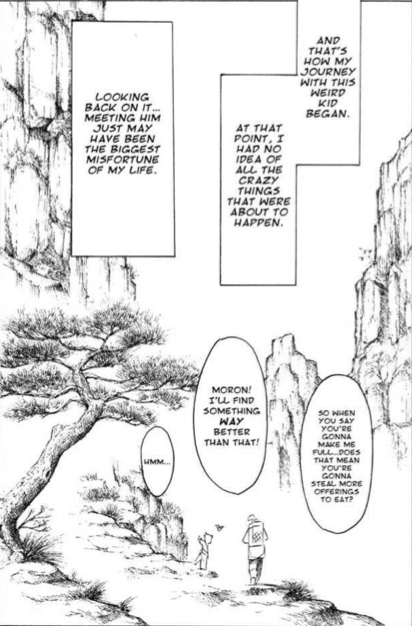
The second distinguishing feature of Qwan is Aki Shimizu’s gorgeous artwork, which draws on anime, guo hua (classical Chinese painting), and wuxia films for its aesthetic. Though Shimizu usually blends these different styles into a seamless whole, she occasionally makes explicit, almost self-conscious quotations of her influences. In this panel, which appears in the very first chapter, she gracefully echoes the undulating lines and shapes of Chinese landscape paintings, even adding a delicately stylized pine tree in the foreground:

Her fight scenes, too, are steeped in Chinese influences. Using dramatic angles, she makes her characters look as weightless as the wire-fu acrobats in Curse of the Golden Flower and House of Flying Daggers; her fight scenes verge on ballet, beautifully choreographed sequences of tumbling bodies and arcing swords. In this sequence, for example, Qwan goes mano-a-mano with a tiger demon, eventually gaining the upper hand by vaulting onto the monster’s back:

Qwan then consumes the demon at the end of their protracted battle, the demon’s body dissolving into an inky swirl:

Oh, and Shimizu draws some pretty nifty monsters, too. This one suggests a Maltese-water buffalo hybrid with prehensile toes:

So why wasn’t Qwan a bigger hit? I think narrative complexity was a factor. Though the story is a rich tapestry of political history and myth, Shimizu refuses to spoon feed information to the reader; we’re just as confused and disoriented as Qwan himself is. That kind of reading experience can be quite rewarding, but the absence of an omniscient narrator demands more of the audience, forcing us to pore over the text and make connections on our own. Shimizu’s artwork and characterizations are up to the task, but impatient readers will easily miss crucial details in their haste to get to the fight scenes.

I also think timing was a factor: Qwan‘s fourth volume appeared in 2007, at the height of the manga boom. If you remember that heady period, publishers were releasing more than 1,200 new volumes of manga per year. Titles that didn’t have an obvious hook — say, a popular anime adaptation or a cast of hot male vampires — faced an uphill battle, with bookstores unwilling to continue stocking series whose first or second volumes sold poorly. With little support from the publisher, and few fans blogging about it, Qwan was all but consigned to the remainder bin.

I’m under no illusion that my paean to Qwan will save it from licensing purgatory; for every Yotsuba&!, there are two Tactics, manga that didn’t gain much traction even after a well-publicized rescue. But Qwan is so good that I can’t help but wish that someone will complete the series — perhaps in a digital-only format, or print-on-demand, or an author-sanctioned scanlation. It’s a manga for readers — for people who love great stories and vivid characters, who care more about the quality of the storytelling than the coolness of the concepts and costumes.

QWAN, VOLS. 1-4 • BY AKI SHIMIZU • TOKYOPOP • RATING: OLDER TEEN (16+)

Filed Under: Manga Critic Tagged With: Aki Shimizu, Shonen Jump, Tokyopop

The Best Manga You’re Not Reading: Qwan

March 3, 2011 by Katherine Dacey

I have a bad habit of falling in love with commercially doomed series. Satsuma Gishiden was my first great disappointment: Dark Horse published three volumes of this manly-man samurai manga, only to put the series on ice in 2007. Duck Prince was another, with Ai Morinaga’s awesomely weird comedy getting the axe midway through its run, a victim of CPM’s perpetual cash flow problems. But the cancellation that really broke my heart was Qwan, a fantasy-adventure that drew heavily on Chinese history and folklore for its inspiration. Between 2005 and 2007, Tokyopop released four volumes before putting the series on hiatus, leaving Qwan‘s few die-hard fans stranded in the middle of a crucial story arc.

While I’d be the first to admit that reading an unfinished story can be an exercise in frustration, I’m going to recommend Qwan anyway because the four volumes that were published are awesome — Scout’s honor.

The story focuses on Qwan, a child-like figure whose naivete and enthusiasm belie super-human strength and speed. Though Qwan realizes he isn’t human, he’s never questioned his origins or abilities — that is, until he meets Shaga, a courtesan who urges him to seek the Essential Arts of Peace, a sutra that will reveal where Qwan came from and why he was sent to live among humans. He’s not the only one who wants the sutra, however; various political factions vie for the scrolls, hoping to unlock the scrolls’ power and hasten the Han Dynasty’s demise.

Questing boys and magical scrolls are de rigeur in fantasy-adventure stories, but Qwan distinguishes itself in two crucial areas. The first is well-rounded characters. Qwan isn’t a classic Shonen Jump hero, kind-hearted and dedicated to self-improvement, but a more ambiguous figure; he’s guileless and self-centered in the manner of a nine- or ten-year-old, unable to feel genuine sympathy for others. Early in volume one, for example, Qwan encounters a mysterious girl traveling in the company of a demon. Daki proves more a formidable opponent than Qwan anticipates, successfully countering his attack with powerful insect magic. Though it’s clear to the reader that Daki, like Qwan, is a supernatural being, caught between the human and demon worlds, Qwan himself never sees the parallels between their situations, repeatedly attacking Daki until he resigns himself to the futility of his efforts.

The second distinguishing feature of Qwan is Aki Shimizu’s gorgeous artwork, which draws on anime, guo hua (classical Chinese painting), and wuxia films for its aesthetic. Though Shimizu usually blends these different styles into a seamless whole, she occasionally makes explicit, almost self-conscious quotations of her influences. In this panel, which appears in the very first chapter, she gracefully echoes the undulating lines and shapes of Chinese landscape paintings, even adding a delicately stylized pine tree in the foreground:

Her fight scenes, too, are steeped in Chinese influences. Using dramatic angles, she makes her characters look as weightless as the wire-fu acrobats in Curse of the Golden Flower and House of Flying Daggers; her fight scenes are balletic, beautifully choreographed sequences of tumbling bodies and arcing swords. In this sequence, for example, Qwan goes mano-a-mano with a tiger demon, eventually gaining the upper hand by vaulting onto the monster’s back:

Qwan then consumes the demon at the end of their protracted battle, the demon’s body dissolving into an inky swirl:

Oh, and Shimizu draws some pretty nifty monsters, too. This one suggests a Maltese-water buffalo hybrid with prehensile toes:

So why wasn’t Qwan a bigger hit? I think narrative complexity was a factor. Though the story is a rich tapestry of political history and myth, Shimizu refuses to spoon feed information to the reader; we’re just as confused and disoriented as Qwan himself is. That kind of reading experience can be quite rewarding, but the absence of an omniscient narrator demands more of the audience, forcing us to pore over the text and make connections on our own. Shimizu’s artwork and characterizations are up to the task, but impatient readers will easily miss crucial details in their haste to get to the fight scenes.

I also think timing was a factor in Qwan’s cancellation, as Qwan‘s fourth volume appeared in 2007 at the height of the manga boom. If you remember that heady period, publishers were releasing more than 1,200 new volumes of manga per year. Titles that didn’t have an obvious hook — say, a popular anime adaptation or a cast of hot male vampires — faced an uphill battle, with bookstores unwilling to stock series whose first or second volumes sold poorly. With little support from the publisher, and few fans blogging about it, Qwan was all but consigned to the remainder bin.

I’m under no illusion that my paean to Qwan will save it from licensing purgatory; for every Yotsuba&!, there are two Tactics, manga that didn’t gain much traction even after a well-publicized rescue. But Qwan is so good that I can’t help but wish that someone will complete the series. It’s a manga for people who love great stories and vivid characters, who care more about the quality of the storytelling than the coolness of the concepts and costumes.

QWAN, VOLS. 1-4 • BY AKI SHIMIZU • TOKYOPOP • RATING: OLDER TEEN (16+)

Filed Under: Manga, Manga Critic, Recommended Reading, REVIEWS Tagged With: Aki Shimizu, Shonen Jump, Tokyopop

Pick of the Week: Kiss, Taro, Teacher

February 28, 2011 by MJ, David Welsh, Katherine Dacey and Michelle Smith 5 Comments

It’s a Viz-centric week according to Midtown:

From David: My pick this week is the second volume of Julietta Suzuki’s Kamisama Kiss (Viz). I wasn’t very inspired by the notion of this book until I read some of Suzuki’s Karakuri Odette (Tokyopop) for a recent Manga Moveable Feast and was very taken with Suzuki’s quirky, thoughtful writing. As I noted about the first volume, “It’s got grumpy, likeable leads, a solid premise, and an endearing look to it.” And Kate noted something very central to the appeal of the series and its protagonists in her review of the first two volumes: “Making those tart exchanges more entertaining is the fact that Nanami and Tomoe are equally matched.”

From Kate: Once again, I’m going to wear my Good Comics for Kids hat and recommend a title for the under-ten crowd: Taro and the Terror of Eats Street, which is published by VIZKids. The series focuses on Taro, a young cartoonist, who creates the fictional world of Doodledom. When an eraser-wielding maniac threatens Taro’s characters, he uses a magic pencil to leap into the page and join the fight, drawing weapons and cool getaway vehicles whenever he’s in a pinch. The first volume of the series, Taro and the Magic Pencil, was so imaginative, funny, and fast-paced that I’m willing to bet that Eats Street will be a winner, too. Like the Panda Man books, Taro and the Terror of Eats Street also includes games and puzzles. The fun part: those activities are actually part of the story, not an afterthought, making for a more interactive reading experience for elementary school readers.

From Michelle: Although I am very keen to read the second volume of Kamisama Kiss, I am going to go with Oresama Teacher for my pick this week. It’s a new Shojo Beat series about a girl with a delinquent past who’s been given a chance to start over at a new school. Best of all, she seems inclined to seize the opportunity to change, which reminds me of Very! Very! Sweet, a manhwa I enjoy a lot. Of course, this is by the same author of Magic Touch, about which I heard mixed opinions, but I’m hopeful that it will be as fun as it looks.

From MJ: I’m going to bring this mini-roundtable full circle and agree with David. Volume two of Kamisama Kiss is my Pick of the Week. Here’s a bit from my review of the first volume: “What I especially appreciate about this series, is that regardless of Tomoe’s tremendous superiority complex, he’s far too lazy to be controlling like so many shoujo love interests, and even his surliness is kept staunchly at bay thanks to Nanami’s power of kotodama, which forces him to do her bidding whether he wants to or not. In a way, Kamisama Kiss is everything that Black Bird could have been if not for its heavy misogynist overtones. Like Misao, Nanami’s surrounded by yokai who would just as soon eat her if they had the chance, but unlike Misao, Nanami has agency, and that makes all the difference in the world.”


So, readers, what are your Picks this week?

Filed Under: PICK OF THE WEEK Tagged With: kamisama kiss, oresama teacher, taro and the terror of eats street

Kamisama Kiss, Vols. 1-2

February 27, 2011 by Katherine Dacey 14 Comments

Has Japan experienced a recent surge in pachinko-related child abandonment? I ask because Kamisama Kiss is, by my count, the fourth manga I’ve read in which a parent (a) racks up gambling debt (b) angers his creditors and (c) skips town, leaving his son or daughter to deal with the consequences. Nanami, Kamisama‘s plucky heroine, comes home from school to discover an eviction notice on the kitchen table alongside a hastily scrawled letter: “I’m going on a trip. Sorry. Don’t look for me. Dad.”

With no place to go — apparently, she has no relatives or friends with a couch — Nanami begins camping out in a local park, where she rescues a nervous man from an aggressive dog. As an expression of gratitude for “saving” him, Mikage offers Nanami a place to stay. What Nanami doesn’t know is that Mikage is the deity of a small, decrepit shrine, and is responsible for maintaining it, hearing visitors’ prayers, and warding off evil spirits — responsibilities he passes on to Nanami by planting a kiss on her forehead.

Once ensconced in the shrine, Nanami meets Mikage’s familiar, a haughty fox demon named Tomoe. You don’t need a PhD in Manga to guess what sort of chap Tomoe is: he’s good-looking, perpetually cranky, and quick to insult his new boss. The two bicker constantly about issues great and small, from Tomoe’s snotty tone of voice to Nanami’s inability to defend herself against demons. Over time, however, the two form a reluctant partnership, pledging to protect the shrine together.

If the story feels a little shopworn, the characterizations are vivid and engaging. Julietta Suzuki does a credible job of showing us how Nanami and Tomoe discover that they’re more alike than different; as their antagonistic banter reveals, both are stubborn, loyal, and concerned with other people’s welfare. Making those tart exchanges more entertaining is the fact that Nanami and Tomoe are equally matched; Nanami isn’t as verbally adroit as Tomoe, but she’s perfectly capable of tricking or browbeating him into following her orders.

Where Kamisama Kiss runs aground is in the predictability of its plotting. Every crisis — a threat to the shrine, the introduction of a romantic rival — builds to a crucial moment in which one character realizes that he or she can’t do without the other. Of course, neither is willing to label those feelings as love, forcing the story into an indefinite holding pattern in which the leads teeter on the brink of romance for dozens of chapters. Even the introduction of demonic rivals doesn’t do much to distract from the obvious plot turns, though it does provide Suzuki a swell excuse to draw fancy kimonos, angel wings, and androgynous boys. (I particularly liked the tengu who hid in plain sight by pretending to be a teen idol. Now I’d read a manga about him.)

I liked Kamisama Kiss, but found it totally forgettable — the umpteenth story in which characters from two very different worlds fall in love in spite of their differences. To be sure, there’s a certain pleasure in seeing an author put her romantic leads through their paces, but Suzuki adheres so strictly to the opposites-attract formula that the story practically writes itself.

Review copies provided by VIZ Media, LLC. Volume two will be released on March 2, 2011.

KAMISAMA KISS, VOLS. 1-2 • BY JULIETTA SUZUKI • VIZ • RATING: TEEN (13+)

Filed Under: Manga Critic Tagged With: Julietta Suzuki, shojo, shojo beat, VIZ, Yokai

Kamisama Kiss, Vols. 1-2

February 27, 2011 by Katherine Dacey

Has Japan experienced a recent surge in pachinko-related child abandonment? I ask because Kamisama Kiss is, by my count, the fourth manga I’ve read in which a parent (a) racks up gambling debt (b) angers his creditors and (c) skips town, leaving his son or daughter to deal with the consequences. Nanami, Kamisama‘s plucky heroine, comes home from school to discover an eviction notice on the kitchen table alongside a hastily scrawled letter: “I’m going on a trip. Sorry. Don’t look for me. Dad.”

With no place to go — apparently, she has no relatives or friends with a couch — Nanami begins camping out in a local park, where she rescues a nervous man from an aggressive dog. As an expression of gratitude for “saving” him, Mikage offers Nanami a place to stay. What Nanami doesn’t know is that Mikage is the deity of a small, decrepit shrine, and is responsible for maintaining it, hearing visitors’ prayers, and warding off evil spirits — responsibilities he passes on to Nanami by planting a kiss on her forehead.

Once ensconced in the shrine, Nanami meets Mikage’s familiar, a haughty fox demon named Tomoe. You don’t need a PhD in Manga to guess what sort of chap Tomoe is: he’s good-looking, perpetually cranky, and quick to insult his new boss. The two bicker constantly about issues great and small, from Tomoe’s snotty tone of voice to Nanami’s inability to defend herself against demons. Over time, however, the two form a reluctant partnership, pledging to protect the shrine together.

If the story feels a little shopworn, the characterizations are vivid and engaging. Julietta Suzuki does a credible job of showing us how Nanami and Tomoe discover that they’re more alike than different; as their antagonistic banter reveals, both are stubborn, loyal, and concerned with other people’s welfare. Making those tart exchanges more entertaining is the fact that Nanami and Tomoe are equally matched; Nanami isn’t as verbally adroit as Tomoe, but she’s perfectly capable of tricking or browbeating him into following her orders.

Where Kamisama Kiss runs aground is in the predictability of its plotting. Every crisis — a threat to the shrine, the introduction of a romantic rival — builds to a crucial moment in which one character realizes that he or she can’t do without the other. Of course, neither is willing to label those feelings as love, forcing the story into an indefinite holding pattern in which the leads teeter on the brink of romance for dozens of chapters. Even the introduction of demonic rivals doesn’t do much to distract from the obvious plot turns, though it does provide Suzuki a swell excuse to draw fancy kimonos, angel wings, and androgynous boys. (I particularly liked the tengu who hid in plain sight by pretending to be a teen idol. Now I’d read a manga about him.)

I liked Kamisama Kiss, but found it totally forgettable — the umpteenth story in which characters from two very different worlds fall in love in spite of their differences. To be sure, there’s a certain pleasure in seeing an author put her romantic leads through their paces, but Suzuki adheres so strictly to the opposites-attract formula that the story practically writes itself.

Review copies provided by VIZ Media, LLC. Volume two will be released on March 2, 2011.

KAMISAMA KISS, VOLS. 1-2 • BY JULIETTA SUZUKI • VIZ • RATING: TEEN (13+)

Filed Under: Manga, Manga Critic, REVIEWS Tagged With: Julietta Suzuki, shojo, shojo beat, VIZ, Yokai

7 Short Series Worth Adding to Your Manga Bookshelf

February 23, 2011 by Katherine Dacey 37 Comments

I like getting lost in a long, twisty story as much as the next person, but I often lose interest in a manga around the five- or ten-volume mark. As a service to other people afflicted with Manga ADHD, therefore, I’ve compiled a list of seven shorter series that enjoy pride of place on my shelves.

There were a few ground rules that guided my list-making. First, the series needed to be complete in five volumes or fewer. Second, every volume of the series needed to be readily available through a major retailer like Amazon. Third, the list needed to be diverse, covering a range of genres and demographics. Had I expanded the list to include out-of-print favorites — Antique Bakery, Apocalypse Meow, Club 9, Domu: A Child’s Dream, The Name of the Flower, Planetes — it would have been an unwieldy beast, and one sure to disappoint: why recommend a book that’s selling for $100 on eBay?

So without further ado… here are seven short series worth adding to your manga bookshelf.

A DISTANT NEIGHBORHOOD

JIRO TANIGUCHI • FANFARE/PONENT MON • 2 VOLUMES

A Distant Neighborhood is a wry, wistful take on a tried-and-true premise: a salaryman is transported back in time to his high school days, and must decide whether to act on his knowledge of the past or let events unfold as they did before. We’ve seen this story many times at the multiplex — Back to the Future, Peggy Sue Got Married — but Taniguchi doesn’t play the set-up for laughs; rather, he uses Hiroshi’s predicament to underscore the challenges of family life and the awkwardness of adolescence. (Hiroshi is the same chronological age as his parents, giving him special insight into the vicissitudes of marriage, as well as the confidence to cope with teenage tribulations.) Easily one of the most emotional, most intimate stories Taniguchi’s ever told. (A Distant Neighborhood was one of my picks for Best Manga of 2009; click here for the full list.)

ICHIGENME… THE FIRST CLASS IS CIVIL LAW

FUMI YOSHINAGA • DMP • 2 VOLUMES

One of the things that distinguishes Fumi Yoshinaga’s work from that of other yaoi artists is her love of dialogue. In works like Antique Bakery and Solfege, she reminds us that conversation can be an aphrodisiac, especially when two people are analyzing a favorite book or confessing a mutually-shared passion for art, cooking, or manga. True to form, the sexiest scenes in Ichigenme: The First Class Is Civil Law are conversations between law professors and their students. We feel the erotic charge of more experienced scholars engaging their proteges in intense debates over legal procedure and philosophy, even when the topics themselves are rather dry. Not that Yoshinaga skimps on the smut: there’s plenty of bedroom action as the carefree Tohdou helps his uptight, closeted classmate Tamiya explore his sexuality, but the series’ best moments are fully clothed. An entertaining manga that gets better with each reading. (Reviewed at PopCultureShock on 3/14/08.)

ODE TO KIRIHITO

OSAMU TEZUKA • VERTICAL, INC. • 2 VOLUMES

While investigating an outbreak of a mysterious disease, an earnest young doctor contracts it himself, becoming a hideous dog-man who craves raw meat. Kirihito’s search for the cause — and the cure — is the backbone of this globe-trotting adventure, but Kirihito’s quest to reclaim his humanity is its heart and soul; his travels bring him into contact with hustlers, racists, and superstitious villagers, each of whom greets him with a mixture of suspicion and fear. As its dog-man premise suggests, Ode to Kirihito is Tezuka at his bat-shit craziest: in one storyline, for example, Kirihito befriends a nymphomaniac circus performer who transforms herself into human tempura. But for all its over-the-top characters and plot developments (see “nympho human tempura,” above), Ode to Kirihito is one of Tezuka’s most moving stories, a thoughtful meditation on the the fluid boundaries between man and animal, sanity and insanity, good and evil. (Reviewed at The Manga Critic on 4/7/10.)

THE SECRET NOTES OF LADY KANOKO

RIRIKO TSUJITA • TOKYOPOP • 3 VOLUMES

Kanoko, the sardonic heroine of The Secret Notes of Lady Kanoko, is a student of human behavior, gleefully filling her notebooks with detailed observations about her classmates. Though Kanoko would like nothing more than to remain on the sidelines, she frequently becomes embroiled in her peers’ problems; they value her independent perspective, as Kanoko isn’t the least bit interested in dating, running for student council, or currying favor with the alpha clique. Kanoko’s sharp tongue and cool demeanor might make her the mean-girl villain in another shojo manga, but Ririko Tsujita embraces her heroine’s prickly, opinionated nature and makes it fundamental to Kanoko’s appeal. The perfect antidote to shojo stories about timid good girls and boy-crazy spazzes. UPDATE 4/16/11: TOKYOPOP announced that it would be shutting down its US publishing operations on May 31, 2011. Unfortunately, that means that Lady Kanoko will likely remain incomplete at two volumes. The stories are largely self-contained, so it is still possible to enjoy Lady Kanoko without reading the last volume.

7 BILLION NEEDLES

NOBUAKI TADANO • VERTICAL, INC. • 4 VOLUMES

Nobuaki Tadano gives Hal Clement’s Needle a manga makeover, moving the action from a remote island in the South Seas to Japan, and replacing Clement’s wholesome, Hardy Boy protagonist with a sullen teenage girl who’s none too pleased to discover that an alien bounty hunter has taken control of her body. The decision to make Hikaru a troubled loner with a difficult past is a stroke of genius; her social isolation proves almost as formidable an obstacle for her to overcome as the monster that she and Horizon (as the bounty hunter is known) are pursuing. Her personal struggles also add a level of raw, emotional authenticity to the story — something that was largely absent from the fascinating, though clinically detached, original. Oh, and the monster? It’s a doozy. (7 Billion Needles was one of my picks for Best Teen-Friendly Comic of 2010; see Good Comics for Kids for the full list. Volumes one and two were reviewed at The Manga Critic on 11/21/10; volume three was reviewed on 2/17/11. The fourth and final volume will arrive in stores on April 26, 2011.)

TO TERRA

KEIKO TAKEMIYA • VERTICAL, INC. • 3 VOLUMES

If Richard Wagner wrote space operas, he might have composed something like Keiko Takemiya’s To Terra, an inter-generational drama about a race of telepathic mutants who’ve been exiled from their home world. Under the leadership of the charismatic Jomy Marcus Shin, the Mu embark on a grueling voyage back to Terra to be reunited with their human creators. Their principle foe: an evil supercomputer named Mother. Takemiya’s richly detailed artwork makes To Terra an almost cinematic experience, suggestive of 2001: A Space Odyssey and Star Wars. But don’t be fooled by those blinking computers and blazing starships: To Terra is an unabashedly Romantic saga about two ubermensch locked in a struggle of cosmic proportions. No doubt Richard would approve. (To Terra was one of my picks for Best Manga of 2007; read the full list at PopCultureShock. For more information on To Terra‘s history, click here.)

TOTO! THE WONDERFUL ADVENTURE

YUKO OSADA • DEL REY • 5 VOLUMES

Shonen series often run to 10, 20, or 40 volumes, but Toto! The Wonderful Adventure proves that good stories come in shorter packages, too. Yuko Osada brazenly steals ideas from dozens of other sources — Castle in the Sky, One Piece, Last Exile, The Wizard of Oz — to produce a boisterous, fast-paced story about a tyro explorer who crosses paths with sky pirates, military warlords, and a high-kicking senjutsu expert named Dorothy. Though the jokes are hit-or-miss, Toto! boasts crisp artwork, strong female characters, and an infectious sense of bonhomie among the series’ protagonists; Kakashi and his traveling companions are impossible to dislike. (Reviewed at The Manga Critic on 9/16/10.)

HONORABLE MENTIONS

CAT-EYED BOY (Kazuo Umezu • VIZ • 2 volumes): Readers looking for an introduction to Kazuo Umezu’s work could do a lot worse than this two-volume collection of stories about a strange little boy who’s half-human, half-demon. Umezu gives free reign to his imagination, conjuring some of the most bizarre monsters in the J-horror canon. The results aren’t always as shocking as they might be, but Cat-Eyed Boy is by turns funny, scary, and sad. (Reviewed at The Manga Critic on 10/3/10.)

LADY SNOWBLOOD (Kazuo Koike and Kazuo Kimimura • Dark Horse • 4 volumes): Now that everyone’s forgotten Kill Bill, the epic mess “inspired” by Kazuo Koike’s Lady Snowblood, it’s possible to read this series for what it is: a deliciously trashy story about a beautiful assassin who manipulates, cajoles, seduces, and stabs her way through Meiji-era Japan. Expect copious nudity, buckets of blood, and fight scenes so outrageous they have to be seen to be believed.

ONE POUND GOSPEL (Rumiko Takahashi • VIZ • 4 volumes): In this charming sports comedy, a struggling boxer is torn between his love for food and his love for a pretty young nun who wants him to lay down his fork, lose some weight, and win a few matches. The series is a little episodic (Takahashi published new chapters sporadically), but the dialogue and slapstick humor have a characteristically Takahashian zing.

For additional suggestions, see:

  • 5 Underrated Shojo Manga, which includes Setona Mizushiro’s X-Day;
  • My 10 Favorite CMX Titles, which includes such short series as Astral Project, Chikyu Misaki, Kiichi and the Magic Books, The Name of the Flower, and Presents. Note that many of these series are out of print and may be hard to find through retailers like Amazon;
  • My 10 Favorite Spooky Manga, which includes such short series as Dororo, Gyo, Mail, and School Zone.

Filed Under: Manga Critic Tagged With: Dark Horse, del rey, DMP, fumi yoshinaga, Historical Drama, Horror/Supernatural, Kazuo Koike, Kazuo Umezu, Keiko Takemiya, Osamu Tezuka, Romance/Romantic Comedy, Rumiko Takahashi, Sci-Fi, Seinen, shojo, Shonen, Tokyopop, vertical, VIZ, Yaoi

7 Short Series Worth Adding to Your Manga Bookshelf

February 23, 2011 by Katherine Dacey

I like getting lost in a long, twisty story as much as the next person, but I often lose interest in a manga around the five- or ten-volume mark. As a service to other people afflicted with Manga ADHD, therefore, I’ve compiled a list of seven shorter series that enjoy pride of place on my shelves.

There were a few ground rules that guided my list-making. First, the series needed to be complete in five volumes or fewer. Second, every volume of the series needed to be readily available through a major retailer like Amazon. Third, the list needed to be diverse, covering a range of genres and demographics. Had I expanded the list to include out-of-print favorites — Antique Bakery, Apocalypse Meow, Club 9, Domu: A Child’s Dream, The Name of the Flower, Planetes — it would have been an unwieldy beast, and one sure to disappoint: why recommend a book that’s selling for $100 on eBay?

So without further ado… here are seven short series worth adding to your manga bookshelf.

A Distant Neighborhood
By Jiro Taniguchi • Fanfare/Ponent Mon • 2 volumes
A Distant Neighborhood is a wry, wistful take on a tried-and-true premise: a salaryman is transported back in time to his high school days, and must decide whether to act on his knowledge of the past or let events unfold as they did before. We’ve seen this story many times at the multiplex — Back to the Future, Peggy Sue Got Married — but Taniguchi doesn’t play the set-up for laughs; rather, he uses Hiroshi’s predicament to underscore the challenges of family life and the awkwardness of adolescence. (Hiroshi is the same chronological age as his parents, giving him special insight into the vicissitudes of marriage, as well as the confidence to cope with teenage tribulations.) Easily one of the most emotional, most intimate stories Taniguchi’s ever told. (A Distant Neighborhood was one of my picks for Best Manga of 2009; click here for the full list.)

Ichigenme: The First Class
By Fumi Yoshinaga • DMP • 2 volumes
One of the things that distinguishes Fumi Yoshinaga’s work from that of other yaoi artists is her love of dialogue. In works like Antique Bakery and Solfege, she reminds us that conversation can be an aphrodisiac, especially when two people are analyzing a favorite book or confessing a mutually-shared passion for art, cooking, or manga. True to form, the sexiest scenes in Ichigenme: The First Class Is Civil Law are conversations between law professors and their students. We feel the erotic charge of more experienced scholars engaging their proteges in intense debates over legal procedure and philosophy, even when the topics themselves are rather dry. Not that Yoshinaga skimps on the smut: there’s plenty of bedroom action as the carefree Tohdou helps his uptight, closeted classmate Tamiya explore his sexuality, but the series’ best moments are fully clothed. An entertaining manga that gets better with each reading. (Reviewed at PopCultureShock on 3/14/08.)

Ode to Kirihito
By Osamu Tezuka • Vertical, Inc. • 2 volumes
While investigating an outbreak of a mysterious disease, an earnest young doctor contracts it himself, becoming a hideous dog-man who craves raw meat. Kirihito’s search for the cause — and the cure — is the backbone of this globe-trotting adventure, but Kirihito’s quest to reclaim his humanity is its heart and soul; his travels bring him into contact with hustlers, racists, and superstitious villagers, each of whom greets him with a mixture of suspicion and fear. As its dog-man premise suggests, Ode to Kirihito is Tezuka at his bat-shit craziest: in one storyline, for example, Kirihito befriends a nymphomaniac circus performer who transforms herself into human tempura. But for all its over-the-top characters and plot developments (see “nympho human tempura,” above), Ode to Kirihito is one of Tezuka’s most moving stories, a thoughtful meditation on the the fluid boundaries between man and animal, sanity and insanity, good and evil. (Reviewed at The Manga Critic on 4/7/10.)

The Secret Notes of Lady Kanoko
By Ririko Tsujita • Tokyopop • 3 volumes
Kanoko, the sardonic heroine of The Secret Notes of Lady Kanoko, is a student of human behavior, gleefully filling her notebooks with detailed observations about her classmates. Though Kanoko would like nothing more than to remain on the sidelines, she frequently becomes embroiled in her peers’ problems; they value her independent perspective, as Kanoko isn’t the least bit interested in dating, running for student council, or currying favor with the alpha clique. Kanoko’s sharp tongue and cool demeanor might make her the mean-girl villain in another shojo manga, but Ririko Tsujita embraces her heroine’s prickly, opinionated nature and makes it fundamental to Kanoko’s appeal. It’s the perfect antidote to shojo stories about timid good girls and boy-crazy klutzes.

7 Billion Needles
By Nobuaki Tadano • Vertical, Inc. • 4 volumes
Nobuaki Tadano gives Hal Clement’s Needle a manga makeover, moving the action from a remote island in the South Seas to Japan, and replacing Clement’s wholesome, Hardy Boy protagonist with a sullen teenage girl who’s none too pleased to discover that an alien bounty hunter has taken control of her body. The decision to make Hikaru a troubled loner with a difficult past is a stroke of genius; her social isolation proves almost as formidable an obstacle for her to overcome as the monster that she and Horizon (as the bounty hunter is known) are pursuing. Her personal struggles also add a level of raw, emotional authenticity to the story — something that was largely absent from the fascinating, though clinically detached, original. Oh, and the monster? It’s a doozy. (Volumes one and two were reviewed at The Manga Critic on 11/21/10.)

To Terra
By Keiko Takemiya • Vertical, Inc. • 3 volumes
If Richard Wagner wrote space operas, he might have composed something like Keiko Takemiya’s To Terra, an inter-generational drama about a race of telepathic mutants who’ve been exiled from their home world. Under the leadership of the charismatic Jomy Marcus Shin, the Mu embark on a grueling voyage back to Terra to be reunited with their human creators. Their principle foe: an evil supercomputer named Mother. Takemiya’s richly detailed artwork makes To Terra an almost cinematic experience, suggestive of 2001: A Space Odyssey and Star Wars. But don’t be fooled by those blinking computers and blazing starships: To Terra is an unabashedly Romantic saga about two ubermensch locked in a struggle of cosmic proportions. No doubt Richard would approve. (To Terra was one of my picks for Best Manga of 2007; read the full list at PopCultureShock. For more information on To Terra‘s history, click here.)

Toto! The Wonderful Adventure
By Yuko Osada • Del Rey • 5 volumes
Shonen series often run to 10, 20, or 40 volumes, but Toto! The Wonderful Adventure proves that good stories come in shorter packages, too. Yuko Osada brazenly steals ideas from dozens of other sources — Castle in the Sky, One Piece, Last Exile, The Wizard of Oz — to produce a boisterous, fast-paced story about a tyro explorer who crosses paths with sky pirates, military warlords, and a high-kicking senjutsu expert named Dorothy. Though the jokes are hit-or-miss, Toto! boasts crisp artwork, strong female characters, and an infectious sense of bonhomie among the series’ protagonists; Kakashi and his traveling companions are impossible to dislike. (Reviewed at The Manga Critic on 9/16/10.)

HONORABLE MENTIONS

Cat-Eyed Boy (Kazuo Umezu • VIZ • 2 volumes): Readers looking for an introduction to Kazuo Umezu’s work could do a lot worse than this two-volume collection of stories about a strange little boy who’s half-human, half-demon. Umezu gives free reign to his imagination, conjuring some of the most bizarre monsters in the J-horror canon. The results aren’t always as shocking as they might be, but Cat-Eyed Boy is by turns funny, scary, and sad. (Reviewed at The Manga Critic on 10/3/10.)

Lady Snowblood (Kazuo Koike and Kazuo Kimimura • Dark Horse • 4 volumes): Now that everyone’s forgotten Kill Bill, the epic mess “inspired” by Kazuo Koike’s Lady Snowblood, it’s possible to read this series for what it is: a deliciously trashy story about a beautiful assassin who manipulates, cajoles, seduces, and stabs her way through Meiji-era Japan. Expect copious nudity, buckets of blood, and fight scenes so outrageous they have to be seen to be believed.

One Pound Gospel (Rumiko Takahashi • VIZ • 4 volumes): In this charming sports comedy, a struggling boxer is torn between his love for food and his love for a pretty young nun who wants him to lay down his fork, lose some weight, and win a few matches. The series is a little episodic (Takahashi published new chapters sporadically), but the dialogue and slapstick humor have a characteristically Takahashian zing.

For additional suggestions, see:

  • 5 Underrated Shojo Manga, which includes Setona Mizushiro’s X-Day;
  • My 10 Favorite CMX Titles, which includes such short series as Astral Project, Chikyu Misaki, Kiichi and the Magic Books, The Name of the Flower, and Presents. Note that many of these series are out of print and may be hard to find through retailers like Amazon;
  • My 10 Favorite Spooky Manga, which includes such short series as Dororo, Gyo, Mail, and School Zone.

Filed Under: Manga, Manga Critic, Recommended Reading Tagged With: Dark Horse, del rey, DMP, fumi yoshinaga, Historical Drama, Horror/Supernatural, Kazuo Koike, Kazuo Umezu, Keiko Takemiya, Osamu Tezuka, Romance/Romantic Comedy, Rumiko Takahashi, Sci-Fi, Tokyopop, Vertical Comics, VIZ

  • « Go to Previous Page
  • Page 1
  • Interim pages omitted …
  • Page 69
  • Page 70
  • Page 71
  • Page 72
  • Page 73
  • Interim pages omitted …
  • Page 89
  • Go to Next Page »
 | Log in
Copyright © 2010 Manga Bookshelf | Powered by WordPress & the Genesis Framework