 From the back cover:
There are lots of children on Hill Street, but no little girls Betsy’s age. So when a new family moves into the house across the street, Betsy hopes they will have a little girl she can play with. Sure enough, they do—a little girl named Tacy. And from the moment they meet at Betsy’s fifth birthday party, Betsy and Tacy become such good friends that everyone starts to think of them as one person—Betsy-Tacy.
Betsy and Tacy have lots of fun together. They make a playhouse from a piano box, have a sand store, and dress up and go calling. And one day, they come home to a wonderful surprise—a new friend named Tib.
Review:
Although I’ve been meaning to read the Betsy-Tacy series for several years, I didn’t really know what to expect. That is, I knew it was the story of two life-long friends, but I didn’t know that it would be written so fondly, so amusingly, or depict life as anything but rosy for these two girls.
Betsy Ray has no girls her age to play with until bashful Tacy Kelly moves in across the street. Tacy’s shyness prevents them from becoming friends immediately, but once they bond at Betsy’s fifth birthday party, they’re inseparable. A lot of the book is devoted to the various imaginative ideas they come up with to entertain themselves, whether it’s coloring sand to sell to other children or pretending to drive the family surrey to the exotic realm of… Milwaukee.
Much of the book is quite amusing, especially the stories Betsy makes up. I’m particularly fond of the one featuring a talking horse with a hankering for some doughnuts. I was pleasantly surprised when things took a more serious turn: Tacy is one of many children and the youngest, “Baby Bee,” dies after an illness. There’s a really wonderful scene where Betsy’s storytelling abilities help cheer Tacy up. Later, when Betsy is upset over the birth of a new, “perfectly unnecessary” sibling, Tacy takes up the role of comforter. It might not sound like much by way of drama, but both instances manage to be charming and a little bittersweet at the same time.
Betsy-Tacy would be a great book to read aloud to elementary students, particularly an audience comprised of girls. My brother and his fiancée need to hurry up and give me a niece so I can read this to her.


 Move over, Chucky — there’s a new doll in town.


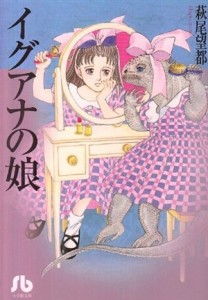 The emotional core of A Drunken Dream — for me, at least — is Hagio’s 1991 story “Iguana Girl.” Rika, the heroine, is a truly grotesque figure — not in the everyday sense of being ugly or unpleasant, but in the Romantic sense, as a person whose bizarre affliction arouses empathy in readers. Born to a woman who appears human but is, in fact, an enchanted lizard, Rika is immediately rejected by her mother, who sees only a repulsive likeness of herself. Yuriko’s disgust for her daughter manifests itself in myriad ways: withering put-downs, slaps and shouts, blatant displays of favoritism for Rika’s younger sister Mami. As Rika matures, Hagio gives us tantalizing glimpses of Rika not as an iguana, but as the rest of the world sees her: a lovely but reserved young woman. As with “The Child Who Comes Home,” the heroine’s appearance could be interpreted literally, as evidence of magical realism, or figuratively, as a metaphor for the way in which children mirror their parents’ own flaws and disappointments; either way, Rika’s quest to heal her childhood wounds is easily one of the most moving stories I’ve read in comic form, a testament to Hagio’s ability to make Rika’s fraught relationship with her mother seem both terribly specific and utterly universal.
 The emotional core of A Drunken Dream — for me, at least — is Hagio’s 1991 story “Iguana Girl.” Rika, the heroine, is a truly grotesque figure — not in the everyday sense of being ugly or unpleasant, but in the Romantic sense, as a person whose bizarre affliction arouses empathy in readers. Born to a woman who appears human but is, in fact, an enchanted lizard, Rika is immediately rejected by her mother, who sees only a repulsive likeness of herself. Yuriko’s disgust for her daughter manifests itself in myriad ways: withering put-downs, slaps and shouts, blatant displays of favoritism for Rika’s younger sister Mami. As Rika matures, Hagio gives us tantalizing glimpses of Rika not as an iguana, but as the rest of the world sees her: a lovely but reserved young woman. As with “The Child Who Comes Home,” the heroine’s appearance could be interpreted literally, as evidence of magical realism, or figuratively, as a metaphor for the way in which children mirror their parents’ own flaws and disappointments; either way, Rika’s quest to heal her childhood wounds is easily one of the most moving stories I’ve read in comic form, a testament to Hagio’s ability to make Rika’s fraught relationship with her mother seem both terribly specific and utterly universal.

