• Skip to primary navigation
  • Skip to main content
  • Skip to primary sidebar
  • Home
  • About Us
    • Privacy Policy
    • Comment Policy
    • Disclosures & Disclaimers
  • Resources
    • Links, Essays & Articles
    • Fandomology!
    • CLAMP Directory
    • BlogRoll
  • Features & Columns
    • 3 Things Thursday
    • Adventures in the Key of Shoujo
    • Bit & Blips (game reviews)
    • BL BOOKRACK
    • Bookshelf Briefs
    • Bringing the Drama
    • Comic Conversion
    • Fanservice Friday
    • Going Digital
    • It Came From the Sinosphere
    • License This!
    • Magazine no Mori
    • My Week in Manga
    • OFF THE SHELF
    • Not By Manga Alone
    • PICK OF THE WEEK
    • Subtitles & Sensibility
    • Weekly Shonen Jump Recaps
  • Manga Moveable Feast
    • MMF Full Archive
    • Yun Kouga
    • CLAMP
    • Shojo Beat
    • Osamu Tezuka
    • Sailor Moon
    • Fruits Basket
    • Takehiko Inoue
    • Wild Adapter
    • One Piece
    • After School Nightmare
    • Karakuri Odette
    • Paradise Kiss
    • The Color Trilogy
    • To Terra…
    • Sexy Voice & Robo
  • Browse by Author
    • Sean Gaffney
    • Anna Neatrour
    • Michelle Smith
    • Katherine Dacey
    • MJ
    • Brigid Alverson
    • Travis Anderson
    • Phillip Anthony
    • Derek Bown
    • Jaci Dahlvang
    • Angela Eastman
    • Erica Friedman
    • Sara K.
    • Megan Purdy
    • Emily Snodgrass
    • Nancy Thistlethwaite
    • Eva Volin
    • David Welsh
  • MB Blogs
    • A Case Suitable For Treatment
    • Experiments in Manga
    • MangaBlog
    • The Manga Critic
    • Manga Report
    • Soliloquy in Blue
    • Manga Curmudgeon (archive)

Manga Bookshelf

Discussion, Resources, Roundtables, & Reviews

Archives for October 2009

The Daughter of Time by Josephine Tey: A

October 20, 2009 by Michelle Smith

daughtertimeFrom the back cover:
Confined to a hospital bed, Scotland Yard’s Inspector Grant is engrossed with a portrait of Richard III. How is it possible, he wonders, that such a sensitive-appearing soul could have been the odious villain, the Wicked Uncle responsible for the murder of his own nephews to secure the British crown for himself? Grant reconsiders 500-year-old evidence and brilliantly arrives at a compelling new answer to one of the most intriguing mysteries in history: who really murdered the Princes in the Tower.

“For truth is rightly named the daughter of time, not of authority.” – Sir Francis Bacon

Review:
After an embarrassing accident, Inspector Grant faces an extended convalescence in a hospital bed. Helpfully minded friends have dropped off some novels, but they hold no appeal. It’s only when Grant’s friend Marta, knowing his interest in faces, brings by a selection of historical portraits that the irksome prickles of boredom begin to fade. Particularly captivating is the portrait of Richard III, whose sensitive expression speaks more of illness and suffering than the villainy for which he is chiefly remembered. His police instincts roused, and together with a research assistant (also supplied by Marta) to do the necessary leg work, Grant sets about proving whether Richard III really did murder his nephews as history claims.

Ever since reading Sharon Kay Penman’s The Sunne in Splendour, I’ve had an interest in Richard III and, if pressed, would count myself among those who believe in his innocence. The Daughter of Time comes to the same conclusion, eschewing the hearsay accounts that fill the history books—often penned by historians from the Tudor years who did not like to write too favorably about the Plantagenets—in favor of contemporary sources and, when that isn’t available, a basic understanding of human nature. Taking it one step further, Grant examines the question of who had the most to gain by the princes’ deaths, and ends up making the case that Henry VII was ultimately responsible.

The wealth of historical information required to make these points is presented in a way that’s anything but dry; on the contrary, I found it fascinating. What makes The Daughter of Time so great, though, is that the storyline in the present is also fun. In what other novel does the protagonist spend the whole of the book confined to bed, his mind challenged and engaged but his body immobile? Anyone who ventures into Grant’s room is liable to be subjected to questioning on the topic of Richard III, and indeed, it’s a member of the hospital staff whose change in opinion regarding the much-maligned monarch is the first triumph of the inspector’s efforts.

Now that I’ve read something so pro-Richard, I feel the need to achieve a balanced view by reading an account that casts him as the murderer. Look, therefore, for a review of Alison Weir’s The Princes in the Tower in the near future.

Filed Under: Books Tagged With: Josephine Tey

xxxHolic, Volume 14

October 20, 2009 by MJ 6 Comments

xxxholic14Today I have a short review of xxxHolic, Vol. 14 in a special Tuesday edition of Manga Minis. This series is so wonderfully rich and there is much I might have said about this volume, given more space. I’ll try to include some of it here.

First of all, one of the things I discussed in my mini is the level of warmth this series has taken on. The “sweet” moment I mention between Watanuki and Mokona, for instance, is so adorable one could die, and when Kohane asks Doumeki why he remains with Watanuki, the image Doumeki calls forth–Watanuki by the river on a particular rainy day–is enough to break one’s heart. That this is followed by Kohane asking Doumeki to “Take care of Kimihiro-kun… please?” is truly the final nail in the coffin.

It is here, too, that I must mention CLAMP’s effective use of paneling, because it is not so much the dialogue that does the work here, but the imagery. Doumeki doesn’t respond to Kohane with anything more than the squeeze of a hand, but the way that moment is built up–with a flashback to Yuuko’s ominous words about hesitation, individual profiles (cut narrowly within wide horizontal panels) of Doumeki and then Kohane, then a single page consisting only of a larger, fuller profile of Doumeki followed by a close-up of his hand squeezing Kohane’s–draws out the moment perfectly, giving it enormous emotional weight. Similarly effective means are used in the story’s next scene too, in which Watanuki confesses his new resolve to remain in this world. The panels are clean and heavy on contrast as is usual for CLAMP (especially in this series) and this deceptive visual simplicity, much like simplicity of language, allows for stronger statements than could ever be made with more verbose visual language.

This volume is filled with foreshadowing, which I suppose is no different than the rest of the series to this point, but at this point the foreshadowing contains a sense of urgency and immediacy that has not been present before, at least to this extent. That a customer arrives in the middle of it all–something we haven’t seen for quite some time–might appear to break the momentum, but it actually seems to be a part of it somehow, with Watanuki taking on Yuuko’s usual role. A later scene with the voices (but not the bodies) of Maru and Moro only strengthens this feeling, and the book’s final scene sets an uneasy, anticipatory tone for the next volume, despite the unearthly calm of its participants. Will it be Watanuki who is able to grant Yuuko’s wish after all, just as he has hoped to do? It seems likely that we will find out soon.

What read as cold philosophy at the beginning of this series has become intimate personal drama fourteen volumes in, and even Yuuko can’t pretend to be detached from the story’s outcome, particularly as concerns Watanuki, whom she obviously loves. Though I think it goes without saying at this point that reading Tsubasa: Reservoir Chronicle has become an essential part of understanding this series, there is something deep at the core of xxxHolic that stands entirely on its own, and nowhere is that clearer than in this volume.

Click here to read my miniaturized thoughts on the subject (I’m not lying about the food thing; I made rice balls immediately after reading this volume). And please, read xxxHolic. It is truly a thing of beauty.

Review copy provided by the publisher.

Filed Under: MANGA REVIEWS Tagged With: manga, xxxholic

Boys Over Flowers Jewelry Box

October 19, 2009 by MJ 2 Comments

Boys Over Flowers Jewelry Box
By Yoko Kamio
Published by Viz Media

BoysOverFlowers_JB_500
Buy This Book

Though Boys Over Flowers‘ main story finally concluded after 36 volumes, neither fans nor mangaka Yoko Kamio were quite content, thus the release of Boys Over Flowers Jewelry Box featuring two side stories set after the series’ final volume. The first of these follows heroine Tsukushi Makino, now out of high school and working as a clerk in a real estate office to pay her family’s bills. With boyfriend Tsukasa still in New York, former love interest Rui has taken to visiting Tsukushi’s family regularly, becoming so familiar he even addresses her father as “dad.” When the whole group is assembled in Paris to witness the wedding of Rui’s former crush, Shizuka, Tsukasa clearly demonstrates his jealousy by asserting control and throwing money (and insults) at Tsukushi, as usual. The second story focuses on Rui, his uncertainty over his future, and his difficulty letting go long-held feelings for Tsukushi.

Unlike many fans, I felt quite satisfied with the way things were left at the end of volume 36, with true love finally settled (at least for Tsukushi and Tsukasa) but not so settled that the character’s futures were unnecessarily narrowed. After all, the story’s heroine was still in high school at the end of the series, and I think I’d have felt incredibly uncomfortable if things had been left any more certain than they were. That said, there is something decidedly comforting about sneaking a peek into Tsukushi and Tsukasa’s future lives and seeing them still bumbling along in their fiery-yet-conservative romance, as awkward and volatile as ever. Though it is disconcerting to see Tsukasa falling back into his worst, most controlling self at the first twinge of insecurity, demonstrating very little personal growth since the end of the series proper, if there’s one thing that has been made clear over the course of the series, it is that Tsukushi can handle herself regardless of his behavior.

Even nicer is the look into Rui’s world, something that remained largely mysterious throughout the series particularly in terms of his feelings for Tsukushi and, really, women in general. With its thoughtful, melancholy look at Rui and his place both in Tsukushi’s life and within the F4, this volume’s second story is quite plainly the best reason to buy it. I’d consider it a must-read for any fan.

Though this manga offers nothing on the level of Boys Over Flowers‘ greatest drama, that is perhaps the secret to its charm. Short but not too sweet, Boys Over Flowers Jewelry Box provides a nicely quiet postscript to this deliciously melodramatic epic.

Review copy provided by the publisher.

Filed Under: MANGA REVIEWS Tagged With: boys over flowers, manga

Rin-Ne, Vol. 1

October 18, 2009 by Katherine Dacey

I read a Rumiko Takahashi manga for the same reason I watch an Alfred Hitchcock thriller: I know exactly what I’m going to get. Certain plot elements and motifs recur throughout each artist’s work — Hitchcock loves pairing a brittle blond with a rakish cad on the run from authorities, for example, while Takahashi loves pairing a female “seer” with a demonically-tinged boy — yet the craft with which Hitchcock and Takahashi develop such tropes prevents either artist’s work from feeling stale or repetitive. Takahashi’s latest series gives ample proof that while she may have a limited repertory, she’s the undisputed master of the supernatural mystery.

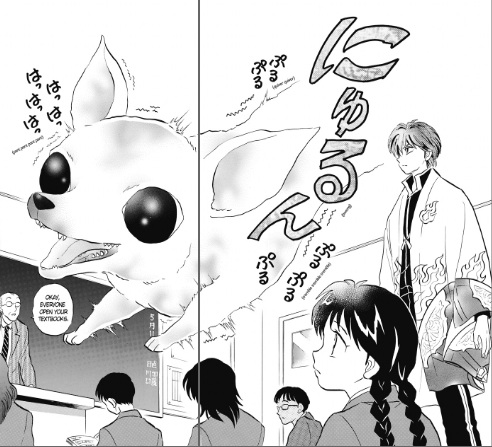
Sakura Mamiya and Rinne Rokudo, Rin-ne‘s oil-and-water leads, are a classic Takahashi pair: Sakura is a seemingly ordinary teenager with the ability to see ghosts, while Rinne is a hot-headed boy who’s part human and part shinigami. The two meet cute in Sakura’s tenth-grade classroom when Rinne arrives to claim his long-empty seat. “Looks like he made it,” Sakura whispers to a friend before realizing that she’s the only person who can see the tall, flame-haired boy in a fancy ceremonial robe. Sakura then watches Rinne  attempt to banish an enormous Chihuahua demon to the afterlife — an exorcism that goes horribly (and comically) awry when the dog’s spirit merges with the spirit of a love-starved teen. Now forced to contend with an even more powerful, angry ghost, Rinne uses Sakura to lure it to the Wheel of Reincarnation, an enormous portal that separates the material and spirit worlds.

rinne_chihuahua

After their dramatic introduction, Sakura and Rinne forge a reluctant partnership. Sakura provides material assistance and ethical guidance to Rinne, while Rinne banishes the spirits that plague Sakura’s high school. Sakura soon learns that Rinne’s grandmother, a shinigami, fell in love with a young man whose spirit she was sent to collect. In exchange for extending his life by fifty years, Rinne’s grandmother agreed to “fulfill her shinigami duties at ten times her usual quota.” When she failed to reach that target, Rinne was forced to enter the family trade, operating on the fringes of both the human and spectral worlds with limited ability to function in either realm — hence his weak exorcism skills.

Where, exactly, Takahashi plans to take the story is still something of a mystery. As she did with InuYasha, she’s using the first few volumes to establish the premise, explain how the Wheel of Incarnation works, and develop the chemistry between her lead characters by subjecting them to a host of unhappy spirits. The first eight chapters have a pleasant, spook-of-the-week feeling, as Sakura and Rinne tangle with a ghostly cell phone caller, a damashigami (a shinigami who meets his quota by luring innocent people to their deaths), and an ochimusa (a disgraced warrior). At the same time, however, Takahashi is clearly laying the groundwork for a more extended storyline, introducing several supporting characters, leaving key questions about Sakura’s past unanswered, and creating space for a Naraku-esque villain to fill.

The first volume’s leisurely pace also allows Takahashi plenty of room to showcase her comedic talents. Though InuYasha, Mermaid Saga, and Rumic World have canted more strongly towards horror, Rin-ne is decidedly humorous, incorporating supernatural elements into everyday settings in delightfully absurd ways. Takahashi’s demon Chihuahua is a great example: the demon continues to behave like a nervous, short-haired toy even after it grows to enormous size, and remains susceptible to the savory appeal of milk bones. Rinne’s grandfather is another example of the supernatural made ridiculous; as Rinne’s grandmother wistfully notes, her husband was reincarnated as a mackerel — the destiny for which he was slated when she fell in love with him.

Though utterly enjoyable, Rin-ne has its flaws. Takahashi relies a little too heavily on interior monologues to cue us into what’s happening; Sakura is frequently called upon to mutter, “So that’s why no one can see him!” even when the illustrations make it plain that Rinne is invisible to humans when he dons his flame-patterned haori. Takahashi isn’t above recycling bits from other works, either; Rokumon, a familiar introduced in chapter six, bears a strong resemblance to InuYasha‘s Shippo in both appearance and plot function, comic relief in the form of a child-like animal spirit. Sakura, too, seems more like a Kagome clone than a character in her own right, though she’s a little edgier and more skeptical than her jewel-seeking predecessor.

Still, it’s hard to dismiss a manga that’s crafted with as much skill and good humor as Rin-ne. The story and characters may remind readers of other works in the Takahashi canon, but that strikes me as a good thing — yet another opportunity to spend time with the kind of spunky heroines, rash-but-kind heroes, and oddball supporting characters that give Takahashi’s work its distinctive flavor.

Review copy provided by VIZ Media, LLC. Volume one of Rin-ne will be available on October 20, 2009.

RIN-NE, VOL. 1 • BY RUMIKO TAKAHASHI • VIZ • 182 pp. • RATING: OLDER TEEN (16+)

Filed Under: Manga, Manga Critic, REVIEWS Tagged With: Action/Adventure, Rumiko Takahashi, shonen sunday, VIZ

Rin-Ne, Vol. 1

October 18, 2009 by Katherine Dacey

rinne1_coverI read a Rumiko Takahashi manga for the same reason I watch an Alfred Hitchcock thriller: I know exactly what I’m going to get. Certain plot elements and motifs recur throughout each artist’s work — Hitchcock loves pairing a brittle blond with a rakish cad on the run from authorities, for example, while Takahashi loves pairing a female “seer” with a demonically-tinged boy — yet the craft with which Hitchcock and Takahashi develop such tropes prevents either artist’s work from feeling stale or repetitive. Takahashi’s latest series gives ample proof that while she may have a limited repertory, she’s the undisputed master of the supernatural mystery.

Sakura Mamiya and Rinne Rokudo, Rin-ne‘s oil-and-water leads, are a classic Takahashi pair: Sakura is a seemingly ordinary teenager with the ability to see ghosts, while Rinne is a hot-headed boy who’s part human and part shinigami. The two meet cute in Sakura’s tenth-grade classroom when Rinne arrives to claim his long-empty seat. “Looks like he made it,” Sakura whispers to a friend before realizing that she’s the only person who can see the tall, flame-haired boy in a fancy ceremonial robe. Sakura then watches Rinne  attempt to banish an enormous Chihuahua demon to the afterlife — an exorcism that goes horribly (and comically) awry when the dog’s spirit merges with the spirit of a love-starved teen. Now forced to contend with an even more powerful, angry ghost, Rinne uses Sakura to lure it to the Wheel of Reincarnation, an enormous portal that separates the material and spirit worlds.

…

Read More

Filed Under: Manga Critic Tagged With: Rumiko Takahashi, Shonen, shonen sunday, VIZ

The Gentlemen’s Alliance Cross 10 by Arina Tanemura: C

October 16, 2009 by Michelle Smith

gentlemen's10After resolving some convoluted-sounding subplots involving Haine’s family—featuring maternal amnesia, uncertain paternity, and mansions afire—The Gentlemen’s Alliance Cross moves into the home stretch as Haine is pressed to finally choose between the identical twins with whom she is in love. Alas, just when she finally grasps the idea that the nice twin (Takanari) is probably a better choice than the scheming git (Shizumasa), he’s captured by his brother’s minions and imprisoned. Like any self-respecting shojo heroine, Haine vows to rescue him.

Being the penultimate volume of the series, volume ten offers a variety of dramatic moments and revelations, including arranged marriages, envelopes with surprising contents, and a tale of childhood betrayal that explains the current animosity between the twins. My favorite, though, is the surprise leukemia.

The end product of all these dire events tumbling one atop the other can be described as little else than a mess, and I was much more compelled to snicker at the ridiculous developments than sympathize with anyone involved. Still, I was pretty impressed by how easy it was to jump in and follow the story at this point and ended up liking Takanari, too, though I must question his taste in girls.

Review copy provided by the publisher. Review originally published at Manga Recon.

Filed Under: REVIEWS Tagged With: Arina Tanemura, shojo beat, VIZ

Rasetsu, Vol. 2

October 16, 2009 by MJ Leave a Comment

By Chika Shiomi
Viz, 192 pp.
Rating: T+ (Older Teen)

Marked by a demon as a young teen, tough eighteen-year-old Rasetsu Hyuga has two years left of her life before the demon claims her as his own, unless she is able to meet her own true love before her time is up. She is also a gifted exorcist who was taken in and nurtured by the head of the Hiichiro Amakawa Agency (a man referred to mainly as “Chief”), a company that offers exorcisms for a fee. Rasetsu is joined in her work by Kuryu, a master of koto dama, the power of words, and eventually by Yako, a former librarian with his own spiritual powers who was manipulated into joining the agency in the first volume. In volume two, Rasetsu’s terror of her fate shines through in a rare moment of vulnerability, prompting Yako to promise to be there for her on the fated day. Later, Kuryu plays around with his ability in an unusually insensitive way while also unintentionally revealing to Yako that he is much more powerful than he pretends to be.

Though the premise of this series is fairly unoriginal and its character development even less so, there is a certain comfort to watching its familiar scenarios play out that lends a particular charm and with the first volume’s exposition out of the way, Rasetsu is able to relax right into the task. It seems obvious that Yako is intended to be Rasetsu’s “true love” (Rasetsu even resembles his first love, guardian spirit Yurara from the series of the same name) and there are traces of this emerging already in volume two, at least on Rasetsu’s side. Kuryu, with his harmless, puppy-dog front hiding a potentially sinister power, is reminiscent of Tokyo Babylon‘s murderous veterinarian, Seishiro, casting a suspicious light on him immediately, especially after this volume in which he accidentally shows his hand. The series’ other characters, mysterious chief Hiichiro and cheerful office boy Aoi, are shojo staples as well, but quite fun and appealingly rendered, skipping off to enjoy rides at an amusement park while everyone else is working.

Fans of supernatural romance may not find anything new in Rasetsu, but tried-and-true formulas are alive, well, and downright agreeable here in its second volume.

Review copy provided by the publisher. Review originally published at PopCultureShock.

Filed Under: MANGA REVIEWS Tagged With: rasetsu

NANA Project #3!

October 16, 2009 by MJ Leave a Comment

nana6Just a couple of quick links this morning as I sit in the Salt Lake City airport waiting for my flight home. First of all, the third installment of the NANA Project is up, in which Danielle Leigh, Michelle Smith and I discuss volumes five and six of NANA. In this installment, we focus heavily on the addition of Trapnest to the regular cast of characters, and particularly Hachi’s involvement with Takumi. If you’re new to the Project, check out our discussion of volumes one, two, three, & four and please, join us in comments!

In other offsite news, check out my review of Kamichama Karin Chu, volume 4 in this week’s manga minis, and look for my review of the second volume of Rasetsu soon in an upcoming On The Shojo Beat column to be posted over the next couple of days. (ETA: Rasetsu review is up!)

Homeward bound!

Filed Under: NEWS Tagged With: kamichama karin chu, manga, nana, nana project, rasetsu

Flashforward by Robert J. Sawyer: C-

October 14, 2009 by Michelle Smith

It’s possible that this review contains spoilers for FlashForward the TV show, but unless the show plans to alienate viewers by being really, really boring, I rather doubt it. Still, proceed at your own risk.
…

Read More

Filed Under: Books

Legend, Volume 6

October 14, 2009 by MJ 2 Comments

Legend, Vol. 6
By Kara & Woo SooJung
Published by Yen Press

legend6
Buy This Book

As the confrontation between No-Ah and Toh (the fourth blade of the Seven Blade Sword) continues, Toh reveals his true mission–to keep the blades of the Sword from being collected together, thus preventing world chaos, a consequence of which No-Ah was previously unaware. When Eun-Gyo arrives in the middle of it all, it becomes clear that she is not herself but instead Joo-Ji, the central blade of the Sword, who chose to be reborn as human in order to be reunited with her lover, which unexpectedly turns out to be No-Ah. When No-Ah meets her, however, he is only concerned about what has happened to Eun-Gyo, whom he is determined to protect in this life. Meanwhile, Ho-Dong searches frantically for Eun-Gyo, revealing his own past-life agenda–to reunite with Joo-Ji before No-Ah can steal her away from him again–as well as his current allegiance as a spy working for the same side as trickster Poong. Horrified to discover that No-Ah has reached her before he could, Ho-Dong reverts into a young man, the true form he has been hiding all along. As the volume continues, the web of past loves becomes even more tangled when the true identity of No-Ah’s sister, Seo-Hee, is revealed.

This volume is simply packed with new revelations, each contributing to this series’ sudden burst of new life. After several somewhat tepid volumes, this series is finally coming together and the effect is quite stunning. Each of the characters has gained new depth with further revelations regarding their past lives, particularly No-Ah and Ho-Dong who are being pulled in multiple directions by the often-conflicting motivations of their past and present selves. No-Ah’s lack of clear memory makes his position particularly complex, while Ho-Dong’s clear, painful memories make his especially poignant. “You must be more furious than sad,” teases the ever-smug Poong upon Ho-Dong’s return to his original form, “Isn’t that why you’ve decided to stop being a spy? You want to try to steal Miss Eun-Gyo from No-Ah, right?” adding cruelly, “Didn’t have the confidence to seduce her as a kid?”

Both No-Ah and Ho-Dong are in unenviable positions–No-Ah becoming more and more aware of the fact that the quest necessary to save his sister may have grave, far-reaching consequences and Ho-Dong being continuously faced with the same heartbreak time and time again–and with the lines between “sides” blurring further with each chapter it’s difficult to judge either of them by their choices. That the story’s creators have managed to paint all of this in such varied shades of gray is largely responsible for the success of this volume, and though their decision to withhold so much until this far in may have cost them some readers earlier on, the payoff is substantial. Even Eun-Gyo’s dense single-mindedness has taken on a newly rich tone as it becomes clear that she is, on some level, being manipulated by emotions generated by her past life. Only No-Ah, from his unique perspective of being both aware of and detached from his past life, is able to truly separate the feelings of his past self from his own, giving him a peculiar advantage over most everyone else.

After waffling on this series for so long, it is a pleasure to be able to finally recommend Legend. Though it gets off to a slow start, this series is a great choice for fans of shojo adventure manga and may appeal especially to those who have had difficulty embracing the art style in much of Yen Press’ manhwa catalogue. Though I personally prefer the clean, solid look of manhwa titles like Goong and One Thousand and One Nights, or even the quasi-alien look of something like 13th Boy, many manga fans consider those style to be hard or flat–words that could not possibly be used to describe Kara’s artwork here. With its flowing, wispy, undeniably cute art style and new air of romantic drama, Legend finally establishes a strong place for itself in Yen’s current lineup of girls’ manhwa.

Review copy provided by the publisher.

Filed Under: REVIEWS Tagged With: legend, manhwa

Vampire Knight 1-4 by Matsuri Hino: B-

October 14, 2009 by Michelle Smith

vampireknight1The first memory Yuki Cross can remember happened ten years ago when she was five: she’s attacked by one vampire but saved by another, the beautiful and pureblooded Kaname. Kaname brings the human girl to the home of a human he knows and his frequent visits throughout her childhood result in her growing very attached to him. Six years later, the introduction of a boy named Zero, sole survivor of a vampire attack against his vampire-hunting family, diverts Yuki’s attentions from Kaname somewhat, since she’s compelled to try to cure Zero of his misery and hatred. When Yuki’s adopted father decides to open Cross Academy as a way to foster peaceful relations between humans (the day class) and vampires (the night class), the three central characters attend, with Zero and Yuki serving as the disciplinary committee (tasked with keeping the peace as well as the secret about the true nature of the students in the night class) and Kaname as the main draw for the vampire contingent, since it turns out purebloods inspire devotion amongst their brethren.

vampireknight2Yuki still carries a torch for Kaname, even confesses to yearning for him, but she’s also very protective of Zero, especially when she learns his secret: as a result of the pureblood’s bite he suffered as a child, he’s turning into a vampire. What’s more, vampires that used to be humans are fated to go insane, at which time they’re hunted down by the vampire elite. Yuki, in earnest shoujo heroine fashion, declares that she will not let this happen and offers Zero her blood so that he may satisfy his cravings without preying on others. Kaname isn’t keen on this arrangement—uttering the gem of a line, “I can’t keep my composure when my dear girl has been pierced by someone else”—and knows he should rightly be preparing to hunt Zero down, but looks the other way because Zero’s the only one in the day class who could protect Yuki if danger should ensue. Aside from the introduction of the vampire responsible for killing Zero’s family, this is essentially where matters stand at the end of the fourth volume.

vampireknight3Thus far, Vampire Knight is an exceptionally pretty bowl of angsty soup that offers a sprinkling of legitimately good scenes amidst a broth of cheesy and/or eyeroll-inducing ones. Yuki is a big problem, since she is completely and totally ineffectual. She’s one of those types who’ll rush headlong into a dangerous scene, usually intent on helping, and make matters worse by getting attacked or having her anti-vampire gun plucked from her grasp within two seconds of her arrival. She’s got a special weapon—the Artemis Rod—and occasionally demonstrates feats of athletic prowess, but proves incapable of saving herself time and time again. One wonders why on earth this dismally dim girl has two hot vampire boys competing for her affections.

The boys are somewhat more compelling, though not exactly likable. Zero is perpetually unhappy and often sour in disposition, though Yuki’s fretting on his behalf occasionally inspires brief displays of affection. I don’t begrudge him his angst—he is turning into the thing he hates, after all—but his seemingly constant vampireknight4dilemma about whether to give up or try to keep living for Yuki’s sake doesn’t do much for me. Kaname, for his part, is refined yet inscrutable. Even dialogue like, “I can’t bear losing you. Ever.” doesn’t manage to convince me that he’s in any sort of real emotional turmoil. The enjoyable flashbacks in volume three help somewhat to establish his connection with Yuki, though not greatly.

And yet, Vampire Knight possesses attributes that make it not only readable, but also somewhat of a guilty pleasure. For one, the art is very lovely, with bishounen eye candy galore. It’s slathered with screen tone, something I don’t normally like, but that ultimately works well in cultivating a gloomy and oppressive mood. Too, Hino occasionally creates scenes of surprising sexiness and drama, like the first time Zero drinks Yuki’s blood or the shocking final pages in volume four. This series may be blatantly silly at times, but as long as my (awesome) local library continues to carry it, I’m likely to keep reading.

Filed Under: REVIEWS Tagged With: Matsuri Hino, shojo beat, VIZ

Kamichama Karin Chu, Vol. 5

October 12, 2009 by MJ Leave a Comment

By Koge-Donbo
Del Rey, 176 pp.
Rating: T (13+)

Karin, Kazune, and Michiru are cast as the Three Musketeers in the school play, which Karin hopes will be her chance to bring Micchi back into the fold as a noble god. Things don’t quite go as planned, but thanks to some help from Jin Kuga, who steps in as an understudy at a crucial moment, and the somewhat fortuitous appearance of a chaos seed, Micchi eventually realizes his true place is as a god. Reunited, the three young gods are lured to the beach by their enemy, Kirio Karasuma, where Suzune reveals an unexpected new form during a close call with a swarm of jellyfish. Unfortunately, that’s not the only surprise waiting at the beach, and the second is much darker, both for the gods and for Jin.

This volume gets off to a weak start with the Three Musketeers storyline, which brings Micchi back into the group much too quickly and easily to be believed. The second half of the book is much stronger, however, moving the plot forward and stressing the urgency of the gods’ unity, as well as providing some very touching moments between Karin, Kazune, and their future son, Suzune. The way this story plays with time—the strong glimpses these young characters are given of both their past lives and their future selves—is what maintains its emotional core, and it is incidents like the one with Suzune in this volume that most touch the heart and make the story into something more than its many clichés might suggest.

At its best, Kamichama Karin Chu is a delightful marriage of magical-girl formula and true pre-pubescent fantasy, straight out of the mind of any imaginative young girl. Though this volume falls just short of its best, its strong final chapters prove that this fantasy is still alive and well.

Review copy provided by the publisher. Review originally published at PopCultureShock.

Filed Under: MANGA REVIEWS Tagged With: kamichama karin chu

Summit of the Gods, Vol. 1

October 12, 2009 by Katherine Dacey

On a brilliant summer day in 1924, British explorer George Mallory began what would be his third and final attempt to climb Mt. Everest. Armed with oxygen tanks and masks, he and fellow mountaineer Andrew Irvine began their approach to the summit on the morning of June 8th, reaching the Northeast Ridge around one o’clock in the afternoon — a potentially fatal mistake, as they had barely enough time to reach the peak and return safely to camp before nightfall. Noel Odell, another member of Mallory’s expedition, spotted the pair ascending the so-called “steps,” three rock formations located 2,000 vertical feet below the top. As he would recall in the 1924 book The Fight for Everest, Odell caught a brief glimpse of his mates through a break in the cloud cover:

I saw the whole summit ridge and final peak of Everest unveiled. I noticed far away on a snow slope leading up to what seemed to me to be the last step but one from the base of the final pyramid, a tiny object moving and approaching the rock step. A second object followed, and then the first climbed to the top of the step. As I stood intently watching this dramatic appearance, the scene became enveloped in cloud once more, and I could not actually be certain that I saw the second figure join the first. (p. 130)

Odell was the last to see either man alive; for the next 75 years, Mallory and Irvine’s fate remained a mystery, though a few tantalizing clues — Irvine’s ice axe, Mallory’s discarded oxygen canister — suggested that neither had reached the top. In 1999, a joint American-British expedition recovered Mallory’s body not far from where Irvine’s axe was discovered, spurring new questions about their climb: had Odell, in fact, watched the men descending the Steps after a successful trip to the summit? Had Irvine and Mallory become separated on the mountain face, or did they fall together to their deaths? And where was Irvine’s body?

The mystery surrounding Mallory’s disappearance forms the core of Yumemakura Baku and Jiro Taniguchi’s award-winning series The Summit of the Gods. Based on a 1998 novel by Baku, Summit focuses on Makoto Fukamachi, a photographer who picks up Mallory’s trail in Kathmandu, where a 1924 Vestpocket Autographic Kodak Special — the camera Mallory supposedly carried up Everest — turns up in a second-hand store frequented by climbers and sherpas. As Fukamachi tracks the camera’s descent from Everest to Kathmandu, he crosses paths with Jouji Habu, a taciturn Japanese climber who knows more about the camera than he’s willing to reveal. Fukamachi begins trailing Habu, interrogating Habu’s acquaintances and climbing partners in hopes of learning what Habu is doing in Kathmandu. Though Fukamachi expects his questions will lead him to the camera’s source, he discovers instead that he and Habu have similarly haunting pasts: Fukamachi watched — and documented — two climbers fall to their deaths on an Everest glacier, while Habu tried — and failed — to rescue a climbing partner who lost his footing and plunged one hundred feet over a cliff in the Japanese Alps.

summit3

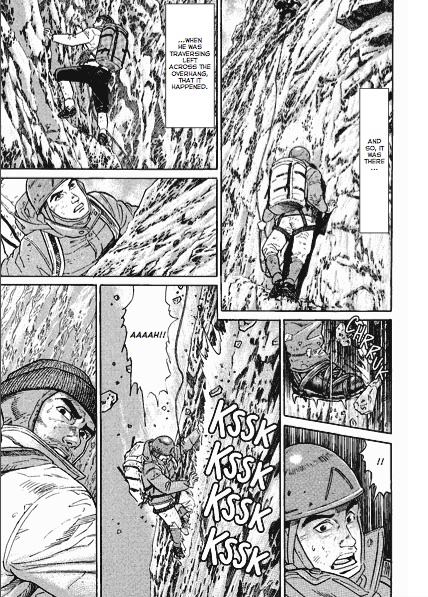
Both characters’ backstories are as harrowing as any passage from Jon Krakauer’s Into Thin Air, thanks to Taniguchi’s impeccable illustrations. Taniguchi captures the mountains’ desolation and danger with his meticulous renderings of rock formations, glaciers, and quick-changing weather patterns; one could be forgiven for wanting to clip into a securely anchored harness before reading volume one. Taniguchi’s talent for evoking the mood and energy of a landscape is also evident in his depiction of Kathmandu, a maze-like city filled with dead ends, bazaars, billboards, temples, and con artists eager to hustle European tourists. Through intricately detailed backgrounds juxtaposing squalid, overcrowded  neighborhoods with sleek, modern buildings, Taniguchi suggests the city’s almost uncontainable energy.

The sheer beauty and power of these scenes distracts from the series’ biggest flaw: the omniscient narrator. In the afterward to volume one, Baku explains that he felt that Taniguchi was “the only artist” who could do justice to “the overwhelming massiveness of the mountains, the details of the climbing, the depictions of the characters.” In adapting his novel for a graphic medium, however, Baku never fully entrusts the artwork with the responsibility of telling the story; too often, Baku inserts unnecessary explanations into gracefully composed panels. In one scene, for example, Fukamachi dreams that he’s trailing a silent, mysterious figure up the summit of Everest, his calls going unheeded. To the reader, it’s obvious that Fukamachi is dreaming about Mallory, as Fukamachi has spent three days locked in his hotel room reading accounts of Mallory’s final climb. Yet the sequence is heavily scripted, with Baku decoding all of Taniguchi’s images rather baldly; it’s as if Baku is narrating the scene for someone who can’t see the pictures.

That Summit of the Gods remains compelling in spite of such editorial interventions is testament both to Taniguchi’s skill as a visual storyteller and to the story’s alluring location; as anyone who’s read Into Thin Air will tell you, the extreme conditions on Everest — the weather, the terrain, the frigid temperatures, the remoteness of the mountaintop — all but guarantee drama, even when the climbers are experienced and the weather cooperative. How Makafuchi and Habu will cope with these challenges remains to be seen, but it’s a sure bet that there will be plenty of nail-biting moments on the way to unraveling the mystery of what happened to George Mallory on that bright June day in 1924.

THE SUMMIT OF THE GODS, VOL. 1 • SCRIPT BY YUMEMAKURA BAKU, ART BY JIRO TANIGUCHI • FANFARE/PONENT MON • 328 pp. • NO RATING

Filed Under: Manga, Manga Critic, REVIEWS Tagged With: Action/Adventure, Fanfare/Ponent Mon, Jiro Taniguchi, Mt. Everest

Summit of the Gods, Vol. 1

October 12, 2009 by Katherine Dacey

On a brilliant summer day in 1924, British explorer George Mallory began what would be his third and final attempt to climb Mt. Everest. Armed with oxygen tanks and masks, he and fellow mountaineer Andrew Irvine began their approach to the summit on the morning of June 8th, reaching the Northeast Ridge around one o’clock in the afternoon — a potentially fatal mistake, as they had barely enough time to reach the peak and return safely to camp before nightfall. Noel Odell, another member of Mallory’s expedition, spotted the pair ascending the so-called “steps,” three rock formations located 2,000 vertical feet below the top. As he would recall in the 1924 book The Fight for Everest, Odell caught a brief glimpse of his mates through a break in the cloud cover:

I saw the whole summit ridge and final peak of Everest unveiled. I noticed far away on a snow slope leading up to what seemed to me to be the last step but one from the base of the final pyramid, a tiny object moving and approaching the rock step. A second object followed, and then the first climbed to the top of the step. As I stood intently watching this dramatic appearance, the scene became enveloped in cloud once more, and I could not actually be certain that I saw the second figure join the first. (p. 130)

Odell was the last to see either man alive; for the next 75 years, Mallory and Irvine’s fate remained a mystery, though a few tantalizing clues — Irvine’s ice axe, Mallory’s discarded oxygen canister — suggested that neither had reached the top. In 1999, a joint American-British expedition recovered Mallory’s body not far from where Irvine’s axe was discovered, spurring new questions about their climb: had Odell, in fact, watched the men descending the Steps after a successful trip to the summit? Had Irvine and Mallory become separated on the mountain face, or did they fall together to their deaths? And where was Irvine’s body?

…

Read More

Filed Under: Manga Critic Tagged With: Fanfare/Ponent Mon, Jiro Taniguchi, Seinen

NANA, Volume 18

October 12, 2009 by MJ 12 Comments

NANA, Volume 18
By Ai Yazawa
Published by Viz Media

nana18
Buy This Book

After a quick opening set in the future, where Hachi, Yasu, Nobu, and Shin contemplate how best to track down Nana whom they’ve determined must be in England, the story returns to the present where everything is finally coming together the day before Blast’s tour is ready to launch. Nana is pumped, her voice is solid, she’s got Hachi in her corner, and even her home life with Ren, newly returned from recording overseas, is humming along nicely. Unfortunately, Shin’s personal turmoil is taking a toll, driving him into the arms of sugar mama Ryoko, with whom he gets arrested for marijuana possession, causing the tour to be canceled at the last minute. The rest of the volume focuses mainly on the aftermath of this–how the members of Blast will move on, particularly Nana, whose newly re-established easiness with Ren collapses quickly under the stress. Meanwhile, Takumi tries to figure out how to help Reira deal with the situation, finally addressing her relationship with Shin in a realistic way, in a scene that is tied closely to the Takumi-centric side story included at the end of the volume.

One thing that is particularly striking in this volume is that the forced breakup of Blast and subsequent events places Nana in an isolated enough position that the gap between the present and the future narration suddenly seems much less wide than it has up to this point. Also, with implications made about Shin in the opening “future” chapter (in which Yasu tells him he should be grateful his agency let him back in the business) being explained in this very volume, it really feels like the series of events immediately related to Nana’s eventual disappearance are finally unfolding before our very eyes.

There are a few really interesting reactions amongst the characters here in this volume, which feel unexpected and completely realistic all at once. Displaying just how well-suited she is to Yasu, Miu, tasked with giving the news to Hachi and Takumi, is the voice of reason, dispensing rock-solid advice to Nana (and harsh truth to Takumi) when it is most needed. Takumi, usually poised to step up in any kind of crisis, actually seems rather sad and helpless when he’s faced with the demise of Blast, despite the fact that it isn’t even his band. He is unusually warm throughout this volume, watching other people’s worlds falling apart around him, and his offer to help Reira find a place where she can meet up with Shin after he is freed is almost touching. “It’s not your fault. I drove you to it. I drove Shin into it,” he says to her with uncharacteristic emotion and candor. “But I didn’t mean to take away your happiness. I didn’t start Trapnest to do that to you guys!”

Almost comical is the reaction of the sleazy press guys, who seem to feel somehow hurt by the whole situation, as though they have an actual stake in the success of Blast whose members they’ve tormented with threat of scandal since the beginning. Nana waffles between selfish (if understandable) anger, regret, raw ambition, and abject terror over the prospect of being on her own as a performer. That she is eventually able to recognize that Yasu’s pain over it all must be as great or greater than her own and is able to actually act on that realization (by determining to go solo to keep not just herself but Blast in the public consciousness) is a huge sign of growth for her.

This entire volume contains enough emotional complexity to inspire an essay almost as long as the volume itself, but perhaps the most compelling bit of all is the Takumi side story at the end. He’s always been a character who is pretty easy to hate, particularly for readers who identify strongly with Hachi, and though the side story does not ease any of that Hachi-related resentment (and in fact, makes it quite a bit worse) it does humanize him in a way I would not have thought possible, making sense of his actions, even the worst ones (perhaps especially the worst ones). This side story, more than any of the others that have been included so far, is crucial to understanding the deep disfunction at the core of Trapnest and provides a huge amount of insight into Takumi, Reira, and even Yasu, and how their mutual history continues to shape the present.

The more I examine the way Ai Yazawa has conceived and developed these characters and the complex web of love and pain that binds them all together, the more impressed I become. This series remains fantastic and utterly addictive in the best way possible.

Review copy provided by the publisher.

Filed Under: MANGA REVIEWS Tagged With: manga, nana

  • « Go to Previous Page
  • Page 1
  • Page 2
  • Page 3
  • Go to Next Page »
 | Log in
Copyright © 2010 Manga Bookshelf | Powered by WordPress & the Genesis Framework