• Skip to primary navigation
  • Skip to main content
  • Skip to primary sidebar
  • Home
  • About Us
    • Privacy Policy
    • Comment Policy
    • Disclosures & Disclaimers
  • Resources
    • Links, Essays & Articles
    • Fandomology!
    • CLAMP Directory
    • BlogRoll
  • Features & Columns
    • 3 Things Thursday
    • Adventures in the Key of Shoujo
    • Bit & Blips (game reviews)
    • BL BOOKRACK
    • Bookshelf Briefs
    • Bringing the Drama
    • Comic Conversion
    • Fanservice Friday
    • Going Digital
    • It Came From the Sinosphere
    • License This!
    • Magazine no Mori
    • My Week in Manga
    • OFF THE SHELF
    • Not By Manga Alone
    • PICK OF THE WEEK
    • Subtitles & Sensibility
    • Weekly Shonen Jump Recaps
  • Manga Moveable Feast
    • MMF Full Archive
    • Yun Kouga
    • CLAMP
    • Shojo Beat
    • Osamu Tezuka
    • Sailor Moon
    • Fruits Basket
    • Takehiko Inoue
    • Wild Adapter
    • One Piece
    • After School Nightmare
    • Karakuri Odette
    • Paradise Kiss
    • The Color Trilogy
    • To Terra…
    • Sexy Voice & Robo
  • Browse by Author
    • Sean Gaffney
    • Anna Neatrour
    • Michelle Smith
    • Katherine Dacey
    • MJ
    • Brigid Alverson
    • Travis Anderson
    • Phillip Anthony
    • Derek Bown
    • Jaci Dahlvang
    • Angela Eastman
    • Erica Friedman
    • Sara K.
    • Megan Purdy
    • Emily Snodgrass
    • Nancy Thistlethwaite
    • Eva Volin
    • David Welsh
  • MB Blogs
    • A Case Suitable For Treatment
    • Experiments in Manga
    • MangaBlog
    • The Manga Critic
    • Manga Report
    • Soliloquy in Blue
    • Manga Curmudgeon (archive)

Manga Bookshelf

Discussion, Resources, Roundtables, & Reviews

yen press

Is This A Zombie?, Vol. 1

March 9, 2012 by Katherine Dacey

Here’s a tip for aspiring manga artists: if you’re going to spoof a genre, your jokes should be poking fun at said genre’s conventions, not slavishly adhering to them. Is This a Zombie? wants to be a send-up of magical girl manga and harem comedies, but focuses so heavily on panty shots, “accidental” nudity (of the “whoops, my clothes disintegrated!” variety), and girl fights that it’s easy to forget that the story is supposed to be a cheeky riposte to Cutie Honey, Sailor Moon, Love Hina, and Negima!

The other great problem plaguing Is This a Zombie? is focus. From the opening pages of volume one, a reader might reasonably conclude that the main plot revolves around teenager Ayumu Aikawa’s quest to find out who killed him. The sudden arrival of Haruna, a self-proclaimed “magikewl girl” who wears a maid’s costume and carries a pink chainsaw, complicates the picture, however. By means never fully explained, Haruna’s powers are accidentally transferred to Ayumu, who undergoes a full Sailor Moon-style transformation into a dress-wearing, weapon-wielding magical girl in the presence of other supernatural beings.

If Haruna’s arrival provided genuine comic relief, or advanced the plot in a meaningful way, the resulting horror-magical girl mishmash might not seem so incongruous. The lame cross-dressing jokes, however, do almost nothing for the story except reveal Shinichi Kimura’s steadfast belief that if a man in a frilly dress is hilarious, then a male magical girl in a frilly dress is exponentially funnier. And if the guy-in-a-dress gags weren’t tired enough, Kimura gives Ayumu a full-fledged harem that includes Eu, a necromancer, and Sera, a vampire ninja. True to harem comedy form, the three girls live with Ayumu, clamoring for Ayumu’s attention, bickering with each other during meals, and seeking his approval on outfits. Whatever “comedy” results from their competition is of a meager sort; Kimura seems to think that that the girls’ catty put-downs have sufficient zing to generate laughs. (They don’t.)

The artwork does little to enhance the story’s comedic tone. Ayumu is as generic a hero as they come, with a carefully tousled mop of hair, a standard-issue high school uniform, and a nose that’s ever-so-slightly larger than the female characters’. Of the three magical girls, only Sera is drawn as a mature teen; Eu and Haruna each look about ten or eleven years old. The girls’ youthful appearance would be less unsettling if they kept their clothing on, but Haruna’s frequent costume failures put an icky, exploitative spin on a sight gag that’s clearly meant to be sexy.

The backgrounds and action scenes have the same perfunctory quality as the character designs. All of the settings — cemeteries, schoolrooms, apartments — look the same, a collection of simple, square shapes that barely establish the location. And while that means the fight scenes are lean and mean, unburdened with excessive detail, it also means that the combat seems to be taking place in an alternate universe from the main story, one that lacks any meaningful visual continuity with the other scenes.

I wish I could find something to like about Is This a Zombie?, as the story wants to be the Naked Gun of manga spoofs, a naughty but good-natured comedy that invites readers to laugh at tired tropes. The resulting story, however, feels a lot more like Epic Movie, a scattershot, semi-exploitative grab-bag of superhero jokes, Pirates of the Caribbean gags, and sword-and-sandal send-ups; substitute “zombie manga,” “harem comedies,” and “magical-girl manga” for the aforementioned genres, and you’d have Is This a Zombie? in all its awfulness.

Review copy provided by Yen Press. Volume one will be available on March 27th.

IS THIS A ZOMBIE?, VOL. 1 • STORY BY SHINICHI KIMURA, ART BY SACCHI, CHARACTERS BY KOBUICHI – MURIRIN • YEN PRESS • 172 pp. • RATING: MATURE (NUDITY, LANGUAGE, VIOLENCE)

Filed Under: Manga, Manga Critic, REVIEWS Tagged With: Harem Manga, Magical Girl Manga, yen press, Zombies

Comic Conversion: Soulless

March 9, 2012 by Angela Eastman 2 Comments

Soulless | Novel: Gail Carriger / Orbit Books | Manga: REM / Yen Press

Twenty-five-year-old spinster Alexia Tarabotti has a a few problems. First, she’s a spinster, and being a half-Italian in Victorian England isn’t helping. Second, she’s a preternatural, a human without a soul. And third, a vampire has just died–and it might be her fault! Alexia finds herself in the middle of a mystery involving vampire hives, royalty, and scientists, as rove vampires and lone werewolves are disappearing. In the midst of it all, Lord Maccon, the werewolf pack leader and head of the Bureau of Unnatural Registry, is taking a decided interest in her, and not just because of her preternatural powers. It’s enough to overwhelm any lady–but Alexia is out to prove that she’s much more formidable than that.

Soulless, written by Gail Carriger, is the first novel in the Parasol Protectorate, a paranormal romance/mystery series from Orbit Books. The story takes place in a Victorian England where werewolves, vampires and ghosts are not only real, but are a part of every day society. Last July, Yen Press debuted the manga adaptation of this series in Yen Plus magazine, and has just recently released the first volume in the series, trusting the artist REM (Vampire Kisses) to bring Carrriger’s steam punk supernatural romance to life.

Two pages into the Soulless novel I found myself utterly delighted with the prose. Taking on a distinct Victorian tone, Carriger uses the slight sarcasm you get from a Jane Austen novel to describe a surprise vampire battle. This creates some hilariously fancified lines (“For his part, the vampire seemed to feel that their encounter had improved his ball experience immeasurably.”) and amusing quips (“to put the pudding in the puff”) that plastered a grin on my face from the start. Of course, it pretty quickly feels like Carriger’s laying it on too thick, but luckily she seems to find a happy medium, and the tone evens out.

Soulless is a pretty steamy book, and while like most romances the “amorous activities”, as Alexia calls them, can get out of hand (making out in a jail cell? Really?) the love story never completely overshadows the mystery. The characters themselves are a treat: Alexia is smart and sharp-tongued, and despite the historical and cultural hindrances is a pretty inspiring female character. Lord Maccon is a little more one-dimensional as a gruff werewolf with a soft spot for a certain spinster, but it’s adorable to watch him fumble with human vs. werewolf courting. Members of Alexia’s immediate family fall flat: her sisters are foolish, her step-father is disconnected, and her mother is arrogant (by the end I don’t see why she would stoop to marrying an Italian in the first place). But other side characters liven up the story, with the flamboyant-but-formidable vampire Lord Akeldama, Alexia’s mildly eccentric friend Miss Hisselpenny, and Maccon’s perceptive Beta Professor Lyall, allowing our main pair to vent their thoughts while still showing plenty enough personality to make them interesting on their own.

The characters are just as appealing in the manga, with REM’s art style helping to enhance that. Akeldama is still exceptionally flamboyant, with outfits and mannerisms just as fancy and theatrical as I imagined. His exuberant, italicized dialogue is cut down a bit, but his sly smiles and occasional shift to a super-deformed look gives him the energetic feel of a mischievous child. Lord Maccon maintains his roughness in dialogue, though REM gives him a cleaner look than I would have pictured. Still, his care and interest in Miss Tarabotti is both more amusing (an arrow leads his gaze right down Alexia’s cleavage), and more endearing. REM also seems to know enough not to let text boxes overwhelm the art. Because of this, the occasional heavy-handedness of Carriger’s Victorian prose is eliminated, leaving us only with the delightful bits (“I say!” says Alexia as a vampire tries to kill her. “We have not been introduced!”).

The pacing of the comic is generally very even, with a good balance between the supernatural mystery and the romantic plot. On a couple of occasions REM chose to cut scenes out. Much of the deletion has little affect on either the flow or understanding of the story, like when Alexia’s mother and half-sisters return from a shopping trip: while it’s interesting in that it deepens the reasons for Alexia’s dislike of her own family, all this scene does is emphasize her sisters’ frivolousness and her mother’s condescension, things we’ve picked up on well enough. This scene is not missed, but another, when pudgy scientist Mr. MacDougal takes Alexia on a carriage ride, is a little more noticeable. While the book has him taking her around town as he explains his scientific theories, the comic only shows the end of the ride, when he drops Alexia off, and she merely comments that he had some “interesting theories on the soul.” Readers may be able to guess the conversation based on the dinner from a few pages earlier, but the main problem lies in the abruptness of the scene, giving the distinct feeling of something having been hacked out.

Both versions of Soulless had a couple of missteps in pacing that momentarily jarred me out of the story, and the romance scenes didn’t always have the best timing, considering the other tensions going on. But I easily jumped right back into the flow, and the romance is sexy enough to make up for the occasional poor placement. Soulless could have gone the route of many a paranormal romance novel, making the supernatural plot nothing more than a cheap gimmick, but Carriger manages to create not only an enticing romance but also an engrossing mystery and a fleshed out, believable fantasy world. REM’s art style and sense of panel layout gives us an adaptation that’s just as enjoyable, so in this case I say pick your favorite medium – you can’t go wrong either way.

Filed Under: Comic Conversion Tagged With: Grace Carriger, manga, Orbit Books, Rem, Soulless, yen press

Soulless: The Manga, Vol. 1

February 18, 2012 by Katherine Dacey 17 Comments

Soulless is saucy in the best possible sense of the word: it’s bold and smart, with a heroine so irrepressible you can see why author Gail Carriger couldn’t tell Alexia Tarabotti’s story in just one book.

As fans of Carriger’s Parasol Protectorate novels know, Alexia is a sharp-tongued woman living in Victorian London — or rather, a steampunk version of Victorian London in which vampires and werewolves co-exist with the “daylight” (read: “human”) world. As she would in the real nineteenth-century England, Alexia faces pressure to marry, a prospect complicated by her age — she’s twenty-six — her ethnicity — her father was Italian — and her prodigious intellect. Alexia has one additional strike against her, albeit one that doesn’t affect her marriageability: she’s soulless, a “preternatural” being who can neutralize the vampires and werewolves’ power, temporarily reducing them to mortal form.

Plot-wise, Soulless is an agreeable mishmash of Young Sherlock Holmes, Underworld, and Mansfield Park, with a dash of Jules Verne for good measure. The basic storyline is a whodunnit: Alexia becomes the prime suspect in a string of supernatural disappearances around London, and must collaborate with Lord Collan Maccon, a belligerent werewolf detective, to clear her name. What they discover in the course of their investigation is a grand conspiracy worthy of an Indiana Jones movie, complete with evil scientists, vampire “hives,” sinister-looking laboratories, and a golem; all that’s missing is the Ark of the Covenant and a few Nazi generals.

At the same time, Soulless is a romance. Alexia would make a swell Austen heroine, as she faces the kind of obstacles to marriage that would elicit sympathy from the Dashwood girls and Fanny Price. The greatest of these hurdles isn’t her name or her age, however; it’s Alexia’s firm conviction that marriage should not be a socially or financially expedient union, but a true partnership. Paging Elizabeth Bennett!

Given how many genres are present in the text — it’s a crime procedural, a thriller, an urban fantasy, a comedy of manners, and a bodice ripper — it’s astonishing how well all the tropes mesh. Some of that success can be attributed to the dialogue. The characters’ peppery exchanges are an affectionate parody of British costume dramas; substitute “soulless” for “penniless,” and Alexia could easily be a character in Sense and Sensibility. A few passages strain too hard for effect — would anyone have really chosen “comestibles” over “food” when complaining about a party? — but for the most part, Carriger finds a convincing tone that’s neither faux-archaic nor casually contemporary.

Soulless’ other great strength is its appealing cast of characters. Alexia and Maccon are clearly the stars of this imaginary universe; anyone who’s read Middlemarch or Emma will immediately recognize that Alexia and Maccon are The Main Couple, as they spend most of volume one denying their mutual attraction and trading zingers. (“I may be a werewolf and Scottish, but despite what you may have read about both, we are not cads!” Maccon declares in a fit of Darcy-esque pique.) In the spirit of the best nineteenth-century novels, however, Carriger situates her lovebirds inside a vibrant community, albeit one inhabited by grumpy werewolves and flamboyant vampires in lieu of parsons, baronets, and virtuous maidens. Though these supporting characters don’t always get the screen time they deserve, Lord Akeldama, Professor Lyall, and Ivy Hisselpenny enliven the narrative with sharp observations and sound advice for Alexia and Maccon.

Manga artist Rem, best-known for her work on Vampire Kisses, does a fine job of translating Carriger’s prose into pictures. Though Rem’s attention to period detail is evident in the characters’ sumptuous costumes and lavishly furnished parlors, her meticulousness extends to the action sequences as well. An early fight between Alexia and a vampire is expertly staged, making effective use of dramatic camera angles and overturned furniture to capture the intensity of their struggle. Rem also manages to fold many of Carriger’s steampunk flourishes — zeppelins, steam-powered carriages, “glassicals” — into the story without overwhelming the eye; if anything, I found the subtlety of the steampunk elements an improvement on the novel, where the object descriptions sometimes felt like tangents.

The only drawback to the artwork is Alexia herself. In the novels, Carriger describes her as plain and full-figured; in the manga, however, Rem depicts Alexia as a buxom, wasp-waisted babe with a pouty mouth and a pretty face. That transformation is certainly in keeping with manga aesthetics — even the plainest young characters are usually pleasing to the eye — but not with the source material; as a reader, one of the real pleasures of Soulless is watching the heroine triumph on the strength of her character and brains, not the size of her bust.

On the whole, however, Rem has succeeded in taking a justifiably popular novel and making it work in a different medium on its own terms; readers new to Carriger’s work will be as enchanted with this cheeky, fun adaptation as her hardcore fans. Recommended.

Review copy provided by Yen Press. Volume one of Soulless: The Manga will be released in March 2012.

SOULLESS: THE MANGA, VOL. 1 • STORY BY GAIL CARRIGER, ART AND ADAPTATION BY REM • YEN PRESS •  208 pp. • RATING: OLDER TEEN (VIOLENCE, SEXUAL SITUATIONS, NUDITY)

Filed Under: Manga Critic Tagged With: Gail Carriger, Rem, Soulless, steampunk, Vampires, Werewolves, yen press

Soulless: The Manga, Vol. 1

February 18, 2012 by Katherine Dacey

Soulless is saucy in the best possible sense of the word: it’s bold and smart, with a heroine so irrepressible you can see why author Gail Carriger couldn’t tell Alexia Tarabotti’s story in just one book.

As fans of Carriger’s Parasol Protectorate novels know, Alexia is a sharp-tongued woman living in Victorian London — or rather, a steampunk version of Victorian London in which vampires and werewolves co-exist with the “daylight” (read: “human”) world. As she would in the real nineteenth-century England, Alexia faces pressure to marry, a prospect complicated by her age — she’s twenty-six — her ethnicity — her father was Italian — and her prodigious intellect. Alexia has one additional strike against her, albeit one that doesn’t affect her marriageability: she’s soulless, a “preternatural” being who can neutralize the vampires and werewolves’ power, temporarily reducing them to mortal form.

Plot-wise, Soulless is an agreeable mishmash of Young Sherlock Holmes, Underworld, and Mansfield Park, with a dash of Jules Verne for good measure. The basic storyline is a whodunnit: Alexia becomes the prime suspect in a string of supernatural disappearances around London, and must collaborate with Lord Collan Maccon, a belligerent werewolf detective, to clear her name. What they discover in the course of their investigation is a grand conspiracy worthy of an Indiana Jones movie, complete with evil scientists, vampire “hives,” sinister-looking laboratories, and a golem; all that’s missing is the Ark of the Covenant and a few Nazi generals.

At the same time, Soulless is a romance. Alexia would make a swell Austen heroine, as she faces the kind of obstacles to marriage that would elicit sympathy from the Dashwood girls and Fanny Price. The greatest of these hurdles isn’t her name or her age, however; it’s Alexia’s firm conviction that marriage should not be a socially or financially expedient union, but a true partnership. Paging Elizabeth Bennett!

Given how many genres are present in the text — it’s a crime procedural, a thriller, an urban fantasy, a comedy of manners, and a bodice ripper — it’s astonishing how well all the tropes mesh. Some of that success can be attributed to the dialogue. The characters’ peppery exchanges are an affectionate parody of British costume dramas; substitute “soulless” for “penniless,” and Alexia could easily be a character in Sense and Sensibility. A few passages strain too hard for effect — would anyone have really chosen “comestibles” over “food” when complaining about a party? — but for the most part, Carriger finds a convincing tone that’s neither faux-archaic nor casually contemporary.

Soulless’ other great strength is its appealing cast of characters. Alexia and Maccon are clearly the stars of this imaginary universe; anyone who’s read Middlemarch or Emma will immediately recognize that Alexia and Maccon are The Main Couple, as they spend most of volume one denying their mutual attraction and trading zingers. (“I may be a werewolf and Scottish, but despite what you may have read about both, we are not cads!” Maccon declares in a fit of Darcy-esque pique.) In the spirit of the best nineteenth-century novels, however, Carriger situates her lovebirds inside a vibrant community, albeit one inhabited by grumpy werewolves and flamboyant vampires in lieu of parsons, baronets, and virtuous maidens. Though these supporting characters don’t always get the screen time they deserve, Lord Akeldama, Professor Lyall, and Ivy Hisselpenny enliven the narrative with sharp observations and sound advice for Alexia and Maccon.

Manga artist Rem, best-known for her work on Vampire Kisses, does a fine job of translating Carriger’s prose into pictures. Though Rem’s attention to period detail is evident in the characters’ sumptuous costumes and lavishly furnished parlors, her meticulousness extends to the action sequences as well. An early fight between Alexia and a vampire is expertly staged, making effective use of dramatic camera angles and overturned furniture to capture the intensity of their struggle. Rem also manages to fold many of Carriger’s steampunk flourishes — zeppelins, steam-powered carriages, “glassicals” — into the story without overwhelming the eye; if anything, I found the subtlety of the steampunk elements an improvement on the novel, where the object descriptions sometimes felt like tangents.

The only drawback to the artwork is Alexia herself. In the novels, Carriger describes her as plain and full-figured; in the manga, however, Rem depicts Alexia as a buxom, wasp-waisted babe with a pouty mouth and a pretty face. That transformation is certainly in keeping with manga aesthetics — even the plainest young characters are usually pleasing to the eye — but not with the source material; as a reader, one of the real pleasures of Soulless is watching the heroine triumph on the strength of her character and brains, not the size of her bust.

On the whole, however, Rem has succeeded in taking a justifiably popular novel and making it work in a different medium on its own terms; readers new to Carriger’s work will be as enchanted with this cheeky, fun adaptation as her hardcore fans. Recommended.

Review copy provided by Yen Press. Volume one of Soulless: The Manga will be released in March 2012.

SOULLESS: THE MANGA, VOL. 1 • STORY BY GAIL CARRIGER, ART AND ADAPTATION BY REM • YEN PRESS •  208 pp. • RATING: OLDER TEEN (VIOLENCE, SEXUAL SITUATIONS, NUDITY)

Filed Under: Manga, Manga Critic, REVIEWS Tagged With: Gail Carriger, Rem, Soulless, steampunk, Vampires, Werewolves, yen press

Durarara!!, Vol. 1

January 14, 2012 by Michelle Smith

Story by Ryohgo Narita, Art by Akiyo Satorigi, Character Design by Suzuhito Yasuda | Published by Yen Press

Here is the sum total of my Durarara!! knowledge prior to reading volume one of the manga:

1. It is based on light novels.
2. There is an anime.
3. People were really excited about the license.

It turns out that those light novels are by the creator of Baccano!, another exclamatory property with an anime that I’ve never seen, but which has been praised by various reputable sources. So, even though I knew nothing about Durarara!! itself, I was definitely curious.

In the space of six pages, three concepts and one narrative conceit are efficiently introduced. Time for another list!

1. Inside a pharmaceutical laboratory, a speaker (presumably male) promises a girl in a tank that he will “get us out of here.”
2. A trio of anonymous hands chat about the Tokyo neighborhood of Ikebukuro and the twenty-year-old urban legend of the Black Rider.
3. Timid fifteen-year-old Mikado Ryuugamine moves to Ikebukuro to reconnect with a childhood friend and attend high school.

Each of these threads will be developed and expanded upon in the volume to come, with some slight overlap but so far not much. Because of that, I’ll address them separately.

1. We learn the least about this subplot in this volume, but it appears to have something to do with Seiji, a boy in Mikado’s class, who lives with his possibly evil sister. Seiji briefly has a stalker who sees something she shouldn’t, and I wonder if that doesn’t tie in with the next item on our list.

2. We see the anonymous chatters a few times throughout the volume and it soon becomes clear that Mikado is one of them and I’m pretty sure the Black Rider is another. Seriously, the Black Rider is the most awesome thing about the volume. A competent fighter with a body seemingly comprised of shadows, the Black Rider takes courier jobs around Ikebukuro, dispatches thugs efficently, and lives with a “shut-in doctor” who would not be averse to a romantic relationship even though the Black Rider has no head.

3. Mikado, alas, is not so interesting, though the fact that he came to town because he wanted something strange and exciting to happen to him is at least somewhat encouraging. He reconnects with his friend, Kida, meets some of Kida’s otaku friends, and is warned against associating with various unsavory people, including someone named Shizuo, who hasn’t really appeared yet but looks kind of awesome, and Izaya, an informant with bleak ideas about the afterlife who extorts money from those who intend to kill themselves.

There are some series that bombard one with so much information that one ends up frustrated. If I were more astute, I might be able to pinpoint how, exactly, the creators of Durarara!! manage to avoid this pitfall, but they do. Granted, there is a lot going on, but the exposition is sure-handed, leaving one with the expectation that all will eventually make sense. Perhaps it’s the light-novel foundation that inspires this confidence, though that is certainly no guarantee of quality.

“Weird but intriguing” is my ultimate verdict for this volume, and I look forward to the second volume very much. It’s a stylish title, one that’s more cool than profound at this stage, and I realize that won’t be everyone’s cup of tea, but it pushed the right buttons for me so I’ll definitely be back for more.

Durarara!! is published in English by Yen Press. The series is complete in Japan with four volumes.

Review copy provided by the publisher.

Filed Under: REVIEWS Tagged With: yen press

The Best Manga of 2011: The Manga Critic’s Picks

December 31, 2011 by Katherine Dacey 27 Comments

The usual gambit for introducing a year-end list is to remark on the abundance of good titles, acknowledge the difficulty in choosing just ten (or five, or three), and comment on the overall state of the industry. And while I certainly debated what to include on my list, I’ll be honest: 2011 yielded fewer contenders for Best Manga than any other year I’ve covered. The dearth of new titles was attributable to publishers’ financial prudence; companies released fewer books, licensed fewer series, and focused on repackaging older content for budget-conscious consumers. And though I selfishly wish that more new material had been released this year, I think manga publishers have done an excellent job of responding to their biggest challenges: a sluggish economy, digital piracy, and Borders’ bankruptcy.

So what titles made my 2011 list? My top ten are below, along with my list of favorite continuing series, favorite finales, and favorite guilty pleasures.

10. BREATHE DEEPLY (Yamaaki Doton; One Peace Books)

Part sci-fi thriller, part coming-of-age story, this engrossing drama examines the relationship between two young men: Sei, who grew up in a world of privilege, and Oishi, a boy from the wrong side of the tracks. Both Sei and Oishi fall in love with Yuko, a sickly girl whose incurable illness inspires her suitors to become medical researchers. In less capable hands, Breathe Deeply might have been a mawkish paean to the purity of young love, but the husband-and-wife team of Yamaaki Doton have a keen ear for dialogue; the interactions between Yuko and her two suitors are tinged with an authentic mixture of adolescent anxiety, sexual longing, and braggadocio. Clean, expressive artwork and well-rounded characters help sell the story, especially in its final pages. One of 2011’s best surprises.

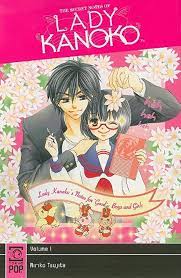
9. THE SECRET NOTES OF LADY KANOKO (Ririko Tsujita; Tokyopop)

Kanoko, the sardonic heroine of The Secret Notes of Lady Kanoko, is a student of human behavior, gleefully filling her notebooks with detailed observations about her classmates. Though Kanoko would like nothing more than to remain on the sidelines, she frequently becomes embroiled in her peers’ problems; they value her independent perspective, as Kanoko isn’t the least bit interested in dating, running for student council, or currying favor with the alpha clique. Kanoko’s sharp tongue and cool demeanor might make her the mean-girl villain in another shojo manga, but Ririko Tsujita embraces her heroine’s prickly, opinionated nature and makes it fundamental to Kanoko’s appeal. It’s a pity TOKYOPOP didn’t survive long enough to finish this three-volume series, as it’s one of the best shojo titles in recent memory.

8. WANDERING SON (Takako Shimura; Fantagraphics)

In her thoughtful review of volume one, Michelle Smith praised Takako Shimura’s deft use of perspective: “The main thing I kept thinking about while reading Wandering Son… is how things that seem insignificant to one person can be secretly, intensely significant to someone else.” Shimura’s ability to dramatize each character’s unique point of view is one of the reasons Wandering Son never feels preachy, even though the topic suggests an Afterschool Special; we are always exquisitely aware of the subtle but important changes in the way each character views herself, as well as her fears and hopes.

7. PRINCESS KNIGHT (Osamu Tezuka; Vertical, Inc.)

What Osamu Tezuka’s New Treasure Island (1946) was to shonen, his Princess Knight (1953-56) was to shojo: both were long-form adventure stories with cinematic flair. Neither could be said to be the “first” shonen or shojo manga, but both had a profound influence on the artists who came of age in the 1940s and 1950s, offering a new storytelling model for them to emulate. Viewed through a contemporary lens, Princess Knight hasn’t aged quite as well as New Treasure Island, as it’s saddled with some woefully antiquated notions of gender. At the same time, however, it’s easy to see why this story appealed to several generations of Japanese girls: Sapphire gets to eat her cake and have it too, having swashbuckling adventures *and* winning the hand of Prince Charming. –Reviewed at Manga Bookshelf on 11/21/11 and The Manga Critic on 12/19/10

6. TANK TANKURO: GAJO SAKAMOTO, MANGA’S PRE-WAR MASTER, 1934-35 (Gajo Sakamoto; Press Pop)

Almost twenty years before Osamu Tezuka’s Astro Boy took flight in the pages of Shonen Kobunsha magazine, Gajo Sakamoto’s Tank Tankuro enchanted Japanese youngsters with his monster-fighting exploits and cool gadgets. Though the series’ propaganda intent is impossible for contemporary readers to ignore — Tank fights the Chinese, who are portrayed in less-than-flattering terms — Presspop’s new anthology demonstrates that Sakamoto’s artistry has aged more gracefully than his storylines. Sakamoto’s work is packaged in a handsome, hardcover edition that includes thoughtful extras: a contextual essay by translator Sunsuke Nakazawa, an interview with Sakamoto’s son, and an article by Sakamoto himself, discussing the character’s origin.

5. STARGAZING DOG (Takashi Murakami; NBM/Comics Lit)

Consider yourself warned: Stargazing Dog is a five-hanky affair. The two interconnecting vignettes that comprise this slim volume explore the bond between Happie, a shiba inu, and Daddy, his owner. When Daddy loses his job, his home, and his family, he and Happie hit the road in search of a new life. Though the outcome of Happie and Daddy’s journey is never in doubt — we learn their fate in the opening pages of the book — Murakami draws the reader into their story with an honest and unsparing look at the human-dog compact that may remind cinephiles of Vittorio de Sica’s Umberto D. —Reviewed at The Manga Critic on 12/23/11

4. ONWARDS TOWARD OUR NOBLE DEATHS (Shigeru Mizuki; Drawn & Quarterly)

In this blistering indictment of Japanese militarism, Shigeru Mizuki draws on his own experiences during World War II to tell the story of a platoon stationed in Papua New Guinea. The soldiers face a terrible choice: fight a hopeless battle, or face execution for treason. Like many war stories, Onwards Toward Our Noble Deaths documents the tremendous human sacrifice of modern armed conflict: gruesome injuries, senseless deaths, devastated landscapes. What lends Mizuki’s narrative its special potency is his depiction of the senior officers; their perverse dedication to their mission turns them into tyrants, more concerned with saving face than saving their own soldiers’ skins. Essential reading for anyone interested in World War II.

3. THE DROPS OF GOD (Tadashi Agi and Shu Okimoto; Vertical, Inc.)

As Oishinbo handily demonstrated, a skilled writer can fold a considerable amount of educational detail into a story without reducing it to a textbook. The Drops of God follows a similar template, imparting highly specialized information about wine with the same natural ease that Law & Order illustrates the inner workings of a crime investigation. At the same time, however, Drops is a delicious soap opera, filled with domineering fathers, mustache-twirling villains, evil beauties, eccentric oenophiles, and down-on-their-luck restauranteurs. Even if the reader isn’t the least bit interested in wine, he’ll find the drama as irresistible as an episode of Dynasty. –Reviewed at The Manga Critic on 12/16/11

2. A ZOO IN WINTER (Jiro Taniguchi; Fanfare/Ponent Mon)

Drawing on his own experiences, Jiro Taniguchi spins an engaging tale about a young man who abandons a promising career in textile design for the opportunity to become a manga artist. Though the basic plot invites comparison with Bakuman, Taniguchi does more than just document important milestones in Hamaguchi’s career: he shows us how Hamaguchi’s emotional maturation informs every aspect of his artistry — something that’s missing from many other portrait-of-an-artist-as-a-young-man sagas, which place much greater emphasis on the pleasure of professional recognition than on the satisfaction of mastering one’s craft. Lovely, moody artwork and an appealing cast of supporting characters complete this very satisfying package.  —Reviewed at The Manga Critic on 5/28/11

1. A BRIDE’S STORY (Kaoru Mori; Yen Press)

A Bride’s Story, which takes place on the banks of the Caspian Sea, explores the relationship between Amir Halgal, a nineteen-year-old nomad, and Karluk Eihon, the eldest son of sheep herders. Though their marriage is one of political expedience, Amir is determined to be a good wife, doing her utmost to learn her new family’s customs, befriend the members of their extended clan, and earn her new husband’s respect. Kaoru Mori is as interested in observing Amir’s everyday life as she is in documenting the growing conflict between the Halgal and Eihon clans, yet A Bride’s Story is never dull, thanks to Mori’s smart, engaging dialogue; as she demonstrated in Emma and Shirley, Mori can make even the simplest moments revealing, whether her characters are preparing a manor house for the master’s return or skinning a freshly killed deer. By allowing her story to unfold in such a naturalistic fashion, A Bride’s Story manages to be both intimate and expansive, offering readers a window into life along the Silk Road. –Reviewed at The Manga Critic on 5/24/11

HONORABLE MENTIONS

As in previous years, I had difficulty limiting myself to just ten titles, so I compiled a list of manga that didn’t quite make my best-of list, but were thoroughly enjoyable:

  • OTHER AWESOME DEBUTS: The Book of Human Insects (Vertical, Inc.), Tesoro (VIZ)
  • BEST CONTINUING SERIES: 20th Century Boys (VIZ), Bunny Drop (Yen Press), Chi’s Sweet Home (Vertical, Inc.), Cross Game (VIZ), Ooku: The Inner Chambers (VIZ), Twin Spica (Vertical, Inc.)
  • BEST NEW GUILTY PLEASURE: Blue Exorcist (VIZ), Oresama Teacher (VIZ)
  • BEST REPRINT EDITION: Magic Knight Rayearth (Dark Horse), Pretty Guardian Sailor Moon (Kodansha Comics)
  • BEST MANGA I THOUGHT I’D HATE: Cage of Eden (Kodansha Comics)
  • BEST FINALE: Black Jack, Vol. 17 (Vertical, Inc.)

So now I turn the floor over to you, readers: what were your favorite new manga of 2011?

Filed Under: Manga Critic Tagged With: Drawn & Quarterly, Fanfare/Ponent Mon, fantagraphics, Gajo Sakamoto, Jiro Taniguchi, Kaoru Mori, NBM/Comics Lit, One Peace Books, Osamu Tezuka, PressPop, Shigeru, Tokyopop, vertical, yen press

The Best Manga of 2011: The Manga Critic’s Picks

December 31, 2011 by Katherine Dacey

The usual gambit for introducing a year-end list is to remark on the abundance of good titles, acknowledge the difficulty in choosing just ten (or five, or three), and comment on the overall state of the industry. And while I certainly debated what to include on my list, I’ll be honest: 2011 yielded fewer contenders for Best Manga than any other year I’ve covered. The dearth of new titles was attributable to publishers’ financial prudence; companies released fewer books, licensed fewer series, and focused on repackaging older content for budget-conscious consumers. And though I selfishly wish that more new material had been released this year, I think manga publishers have done an excellent job of responding to their biggest challenges: a sluggish economy, digital piracy, and Borders’ bankruptcy.

So what titles made my 2011 list? My top ten are below, along with my list of favorite continuing series, favorite finales, and favorite guilty pleasures.

10. Breathe Deeply
By Yamaaki Doton • One Peace Books
Part sci-fi thriller, part coming-of-age story, this engrossing drama examines the relationship between two young men: Sei, who grew up in a world of privilege, and Oishi, a boy from the wrong side of the tracks. Both Sei and Oishi fall in love with Yuko, a sickly girl whose incurable illness inspires her suitors to become medical researchers. In less capable hands, Breathe Deeply might have been a mawkish paean to the purity of young love, but the husband-and-wife team of Yamaaki Doton have a keen ear for dialogue; the interactions between Yuko and her two suitors are tinged with an authentic mixture of adolescent anxiety, sexual longing, and braggadocio. Clean, expressive artwork and well-rounded characters help sell the story, especially in its final pages. One of 2011’s best surprises.

9. The Secret Notes of Lady Kanako
By Ririko Tsujita • Tokyopop
Kanoko, the sardonic heroine of The Secret Notes of Lady Kanoko, is a student of human behavior, gleefully filling her notebooks with detailed observations about her classmates. Though Kanoko would like nothing more than to remain on the sidelines, she frequently becomes embroiled in her peers’ problems; they value her independent perspective, as Kanoko isn’t the least bit interested in dating, running for student council, or currying favor with the alpha clique. Kanoko’s sharp tongue and cool demeanor might make her the mean-girl villain in another shojo manga, but Ririko Tsujita embraces her heroine’s prickly, opinionated nature and makes it fundamental to Kanoko’s appeal. It’s a pity TOKYOPOP didn’t survive long enough to finish this three-volume series, as it’s one of the best shojo titles in recent memory.

8. Wandering Son
By Takako Shimura • Fantagraphics
In her thoughtful review of volume one, Michelle Smith praised Takako Shimura’s deft use of perspective: “The main thing I kept thinking about while reading Wandering Son… is how things that seem insignificant to one person can be secretly, intensely significant to someone else.” Shimura’s ability to dramatize each character’s unique point of view is one of the reasons Wandering Son never feels preachy, even though the topic suggests an Afterschool Special; we are always exquisitely aware of the subtle but important changes in the way each character views herself, as well as her fears and hopes.

7. Princess Knight
By Osamu Tezuka • Vertical, Inc.
What Osamu Tezuka’s New Treasure Island (1946) was to shonen, his Princess Knight (1953-56) was to shojo: both were long-form adventure stories with cinematic flair. Neither could be said to be the “first” shonen or shojo manga, but both had a profound influence on the artists who came of age in the 1940s and 1950s, offering a new storytelling model for them to emulate. Viewed through a contemporary lens, Princess Knight hasn’t aged quite as well as New Treasure Island, as it’s saddled with some woefully antiquated notions of gender. At the same time, however, it’s easy to see why this story appealed to several generations of Japanese girls: Sapphire gets to eat her cake and have it too, having swashbuckling adventures *and* winning the hand of Prince Charming. —Reviewed at Manga Bookshelf on 11/21/11 and The Manga Critic on 12/19/10

6. Tank Tankuro: Gajo Sakamoto, Manga’s Pre-War Master, 1934-35
By Gajo Sakamoto • Press Pop
Almost twenty years before Osamu Tezuka’s Astro Boy took flight in the pages of Shonen Kobunsha magazine, Gajo Sakamoto’s Tank Tankuro enchanted Japanese youngsters with his monster-fighting exploits and cool gadgets. Though the series’ propaganda intent is impossible for contemporary readers to ignore — Tank fights the Chinese, who are portrayed in less-than-flattering terms — Presspop’s new anthology demonstrates that Sakamoto’s artistry has aged more gracefully than his storylines. Sakamoto’s work is packaged in a handsome, hardcover edition that includes thoughtful extras: a contextual essay by translator Sunsuke Nakazawa, an interview with Sakamoto’s son, and an article by Sakamoto himself, discussing the character’s origin.

5. Stargazing Dog
By Takashi Murakami • NBM/Comics Lit
Consider yourself warned: Stargazing Dog is a five-hanky affair. The two interconnecting vignettes that comprise this slim volume explore the bond between Happie, a shiba inu, and Daddy, his owner. When Daddy loses his job, his home, and his family, he and Happie hit the road in search of a new life. Though the outcome of Happie and Daddy’s journey is never in doubt — we learn their fate in the opening pages of the book — Murakami draws the reader into their story with an honest and unsparing look at the human-dog compact that may remind cinephiles of Vittorio de Sica’s Umberto D. —Reviewed at The Manga Critic on 12/23/11

4. Onwards Towards Our Noble Deaths
By Shigeru Mizuki • Drawn & Quarterly
In this blistering indictment of Japanese militarism, Shigeru Mizuki draws on his own experiences during World War II to tell the story of a platoon stationed in Papua New Guinea. The soldiers face a terrible choice: fight a hopeless battle, or face execution for treason. Like many war stories, Onwards Toward Our Noble Deaths documents the tremendous human sacrifice of modern armed conflict: gruesome injuries, senseless deaths, devastated landscapes. What lends Mizuki’s narrative its special potency is his depiction of the senior officers; their perverse dedication to their mission turns them into tyrants, more concerned with saving face than saving their own soldiers’ skins. Essential reading for anyone interested in World War II.

3. The Drops of God
By Tadashi Agi and Shu Okimoto • Vertical, Inc
As Oishinbo handily demonstrated, a skilled writer can fold a considerable amount of educational detail into a story without reducing it to a textbook. The Drops of God follows a similar template, imparting highly specialized information about wine with the same natural ease that Law & Order illustrates the inner workings of a crime investigation. At the same time, however, Drops is a delicious soap opera, filled with domineering fathers, mustache-twirling villains, evil beauties, eccentric oenophiles, and down-on-their-luck restauranteurs. Even if the reader isn’t the least bit interested in wine, he’ll find the drama as irresistible as an episode of Dynasty. —Reviewed at The Manga Critic on 12/16/11

2. A Zoo in Winter
By Jiro Taniguchi • Fanfare/Ponent Mon
Drawing on his own experiences, Jiro Taniguchi spins an engaging tale about a young man who abandons a promising career in textile design for the opportunity to become a manga artist. Though the basic plot invites comparison with Bakuman, Taniguchi does more than just document important milestones in Hamaguchi’s career: he shows us how Hamaguchi’s emotional maturation informs every aspect of his artistry — something that’s missing from many other portrait-of-an-artist-as-a-young-man sagas, which place much greater emphasis on the pleasure of professional recognition than on the satisfaction of mastering one’s craft. Lovely, moody artwork and an appealing cast of supporting characters complete this very satisfying package.  —Reviewed at The Manga Critic on 5/28/11

1. A Bride’s Story
By Kaoru Mori • Yen Press
A Bride’s Story, which takes place on the banks of the Caspian Sea, explores the relationship between Amir Halgal, a nineteen-year-old nomad, and Karluk Eihon, the eldest son of sheep herders. Though their marriage is one of political expedience, Amir is determined to be a good wife, doing her utmost to learn her new family’s customs, befriend the members of their extended clan, and earn her new husband’s respect. Kaoru Mori is as interested in observing Amir’s everyday life as she is in documenting the growing conflict between the Halgal and Eihon clans, yet A Bride’s Story is never dull, thanks to Mori’s smart, engaging dialogue; as she demonstrated in Emma and Shirley, Mori can make even the simplest moments revealing, whether her characters are preparing a manor house for the master’s return or skinning a freshly killed deer. By allowing her story to unfold in such a naturalistic fashion, A Bride’s Story manages to be both intimate and expansive, offering readers a window into life along the Silk Road. —Reviewed at The Manga Critic on 5/24/11

HONORABLE MENTIONS
As in previous years, I had difficulty limiting myself to just ten titles, so I compiled a list of manga that didn’t quite make my best-of list, but were thoroughly enjoyable:

  • Other Awesome Debuts: The Book of Human Insects (Vertical, Inc.), Tesoro (VIZ)
  • Best Continuing Series: 20th Century Boys (VIZ), Bunny Drop (Yen Press), Chi’s Sweet Home (Vertical, Inc.), Cross Game (VIZ), Ooku: The Inner Chambers (VIZ), Twin Spica (Vertical, Inc.)
  • Best New Guilty Pleasure: Blue Exorcist (VIZ), Oresama Teacher (VIZ)
  • Best Reprint Edition: Magic Knight Rayearth (Dark Horse), Pretty Guardian Sailor Moon (Kodansha Comics)
  • Best Manga I Thought I’d Hate: Cage of Eden (Kodansha Comics)
  • Best Finale: Black Jack, Vol. 17 (Vertical, Inc.)

So now I turn the floor over to you, readers: what were your favorite new manga of 2011?

Filed Under: Manga Critic, Recommended Reading Tagged With: Drawn & Quarterly, Fanfare/Ponent Mon, fantagraphics, Gajo Sakamoto, Jiro Taniguchi, Kaoru Mori, NBM/Comics Lit, One Peace Books, Osamu Tezuka, PressPop, Tokyopop, Vertical Comics, yen press

Comic Conversion: Witch & Wizard

December 9, 2011 by Angela Eastman 9 Comments

Witch & Wizard | Novel: James Patterson and Gabrielle Charbonnet / Grand Central Publishing | Manga: Svetlana Chmakova / Yen Press

One minute Whit Allgood is falling asleep in front of the TV, the next an army is breaking down his door, brandishing guns and dragging his sister Wisty out of her bed. But the biggest shock for Whit and Wisty comes when they’re accused of being a wizard and a witch by the New Order—the all new government that’s taken over the whole country—and are sentenced to death. As they struggle to survive in their jail cell, the siblings discover that they do have special powers, from telekinesis to bursting into flames. Even after they manage to break out, thanks to the help of a ghostly friend, Whit and Wisty still have to find their parents, and they might have to break back into jail to do it.

Witch & Wizard is one of the latest series to come out of the James Patterson novel mill, this time written in conjunction with Gabrielle Charbonnet. Though there was already a graphic novel adaptation from IDW, Yen Press decided to come out with their own version of the dystopian novel using artist Svetlana Chmakova, creator of Dramacon and Night School, to create Witch & Wizard: The Manga. Both versions of the story have their flaws, but one might be more worth your time than the other.

Let’s start with the novel. One good thing you can immediately say about Witch & Wizard is that it gets right into the action. The story has barely started before the New Order troops are breaking down the Allgoods’ door. It doesn’t slow down much from there, even when the siblings are locked in prison, as they deal with sadistic jailers and have to fight a pack of mad dogs for food and water. The short chapters (most only last 1 or 2 pages) help create the illusion that you are speeding through the book. But even with all the rapid action, the story can get pretty clunky at times. You’ll start the next chapter, and suddenly Whit and Wisty are somewhere else, or there’s someone new in the scene who wasn’t there before. And the short chapters, while helping you feel like the book is a fast read, hurt the overall smoothness of the longer, more dramatic scenes.

Whit and Wisty are certainly fun characters, with their wisecracks, determination, and magical powers. Wisty in particular has an entertaining, sarcastic tone. But unfortunately, it’s all surface. Though the story is in first person for both characters, you never feel like you get truly, deeply in their heads. Even when the story pauses for inner thoughts it’s pretty generic, like how awful or cool or sad something is. Then there is the villain, The One Who Is The One, who should be dark and terrifying… but for some reason, Patterson and Charbonnet have him spouting some of the weirdest lines. They range from awkward – “I can even shut your sister up!” – to just plain goofy – “TRICKS ARE FOR KIDS!” – and really diminish the fear readers should have of this all-powerful villain.

Now we come to Yen Press’s manga adaptation by Svetlana Chmakova. The visual aspect of the comic actually helps with the clunky-ness in the book. New character appearances are less sudden, and we see the transition from one place to another, so there’s no flipping back a page to see how Whit and Wisty suddenly got from point A to point B. Chmakova’s art also helps to brighten up some of the less-than-stellar character personalities. Sure, the villains are just as one-dimensional as in the novel, with their little dark beetle eyes, but other characters seem more human in her hands. Whit wears a blank look of shock when he discovers that Celia is a ghost, and Wisty’s range of expressions, from cartoonish excitement at living in a fancy department store to the dark, narrow-eyed look when she casts her angry spells, make this witch even more fun and exciting than her novel version.


Despite the pace of the original, cuts were needed to fit the whole story into a single graphic novel. We miss out on some interesting shows of magic, like when Wisty floats in her sleep, or Whit speeds himself up to handily defeat some guards. But the comic also does away with some bits I didn’t care for, most obviously The One’s horrible, cheesy lines. The One still isn’t as dark and foreboding as I would like (you can always go creepier) but at least his dialogue doesn’t make me cringe.

The Witch & Wizard novel has a lot of problems that I have a hard time overlooking. While the pacing is nice and quick, the novel persistently trips itself up with awkward breaks and sudden shifts in location. And the plot, while a decently done fight-the-power dystopian, can get repetitive, takes unnecessary turns, and ends so abruptly I’m honestly surprised Patterson and Charbonet didn’t add in a couple more chapters to smooth things out. Chmakova’s adaptation doesn’t escape the plot issues of the original, but in streamlining the plot to fit into a single graphic novel she manages to toss out some of the minor chinks, resulting in an easier flow. When you combine that with art that is much more expressive than Patterson’s prose, overall you get a more enjoyable read. It’s still not perfect, but Witch & Wizard the manga improves enough on the original to be worth your money.

Filed Under: Comic Conversion, FEATURES Tagged With: graphic novel, manga, Novel, Teen Lit, Witch & Wizard, yen press

My Girlfriend’s a Geek, Vols. 1-3

October 4, 2011 by Michelle Smith

By Rize Shinba (manga) and Pentabu (story) | Published by Yen Press

The good news is that I liked My Girlfriend’s a Geek more than I expected to. The bad news is that I’m not sure if I should feel particularly good about that.

Taiga Mutou is a penniless college student in need of a part-time job. When he spots Yuiko Ameya—who fits his ideal of the “big sis-type”—in the office of one prospective employer, he devotes himself to getting hired and thereafter attempts to find opportunities to engage her in conversation. He’s largely unsuccessful until a bit of merchandise goes missing and she helps him look for it. They talk a bit more after that, but it’s not until she sees him in a pair of glasses that she really begins to take notice.

At first, Taiga is puzzled but pleased that certain things about him meet with Yuiko’s approval—in addition to the glasses she also appreciates his cowlick and has an unusual level of interest in his methods for marking important passages in his textbooks. When he finally asks her out and she confesses that she’s a fujoshi (“Is that okay with you?”) he’s so exuberant that he agrees without really understanding what that entails.

From that point on, My Girlfriend’s a Geek is essentially a series of situations in which Yuiko’s fujoshi ways make Taiga uncomfortable, and here is where my conflicted feelings begin. On the one hand, it’s absolutely true that Yuiko did try to warn him and that she shouldn’t have to pretend to be someone she isn’t. On the other hand, she is so caught up in her BL fantasizing that she never considers Taiga’s feelings, and even ceases to refer to him by his actual name. Taiga is always the one doing the compromising, and when it seems like Yuiko might be on the verge of doing something nice for him, it usually turns out that she has some self-serving motive.

And what if Yuiko’s character was male? How would this read then? She frequently concocts scenarios in which Taiga is getting it on with his friend Kouji and expresses the desire to take pictures of them together. If she was a male character saying such things to his girlfriend this would be the epitome of skeavy behavior! I seriously wonder whether she likes Taiga for himself at all, but that’s not to say he’s blameless here, either, because it’s hard to see what he could like about her except that she fits the bill for the cute older woman he’s always wanted to date.

All that said, there is still quite a bit to like about this series. For one thing, it’s often quite amusing, especially Taiga’s reactions to Yuiko’s flights of fangirl and the fictional shounen sports manga (with shades of Hikaru no Go and The Prince of Tennis) that Yuiko is obsessed with. For another, it does occasionally touch on what it’s like to discover that someone you fancy has this bizarre secret that you’ve got to try to cope with if you want to stay together. Taiga occasionally laments how far apart they are emotionally, and though we’ve yet to really see inside Yuiko’s head, her attempts to sustain a real-life relationship remind me some of Majima in Flower of Life, another hard-core otaku with a moe fixation.

There’s only two more volumes of this series and I plan to keep reading, but I hope that these characters will manage to achieve more of an equal relationship. Even if Yuiko could just learn to see Taiga’s exasperation and take some genuine step to engage him on a serious personal level, then I’d be happy.

My Girlfriend’s a Geek is published in English by Yen Press. The fourth volume has just come out (to be featured in this week’s Off the Shelf!) and the fifth and final volume is due in December 2011. They have also released the two-volume novel series upon which the manga is based.

Review copies provided by the publisher.

Filed Under: REVIEWS Tagged With: Rize Shinba, yen press

Bloody Monday, Vol. 1

August 30, 2011 by Katherine Dacey

To judge from all the shonen manga I’ve read, the fate of the world rests in teenage boys’ hands: not only do they have the power to kill demons and thwart alien invasions, they’re also blessed with the kind of superior intelligence that makes them natural partners with law enforcement. Bloody Monday is a textbook example of the teen-genius genre: high school student Fujimaru Takagi dabbles in crime-solving, hacking into secure networks and decoding encrypted files on behalf of the Public Security Intelligence Agency. (Naturally, he works for the PSIA’s super-secret “Third-I” division, which is “comprised solely of elites.”) Fujimaru’s deductive skills are put to the ultimate test when his father is falsely implicated in a murder. To find the real killer, Fujimaru must uncover the connection between his father and the “Christmas Massacre,” a terrorist attack that left thousands of Russian civilians dead, their bodies covered in boils.

In the right hands, Bloody Monday might have been good, silly fun, 24 for the under-twenty-four crowd. The script, however, is pointed and obvious, explaining hacker culture and internet technology to an audience that has grown up on the world-wide web: are there any fifteen-year-olds who don’t grasp the basics of computer viruses? The characters, too, seem impossibly dim, thinking out loud, missing obvious connections, and reminding each other how they’re related, whether they’re fellow reporters for the school newspaper or siblings. Small wonder they don’t realize that their school has been infiltrated by an enemy agent.

The art is more skillful than the script, with polished character designs and detailed backgrounds. The adults actually look like adults, not teenagers with unfortunate laugh lines, while the scenes aboard the Transsiberian Railroad convey the harshness of the Russian landscape. Though artist Kouji Megumi nevers misses an opportunity to show us an attractive woman in her underwear — and really, what well-trained assassin doesn’t snuff a target or two while wearing only a matching bra-and-panty set? — the fanservice never overwhelms the plot. The action sequences, too, are well-staged, using swift cross-cuts and imaginative camera angles to heighten the suspense.

In the end, however, the slick visuals aren’t enough to compensate for the flat-footed storytelling. A plot as potentially interesting and complex as Bloody Monday‘s should challenge the reader to arrive the solution independently, not spoon-feed it; too often, the story seems to have been written in boldface, depriving the reader of an opportunity to guess the outcome of the story for herself.

BLOODY MONDAY, VOL. 1 • STORY BY RYOU RYUMON, ART BY KOUJI MEGUMI • KODANSHA COMICS USA • 200 pp. • RATING: TEEN (13+)

Filed Under: Manga, Manga Critic, REVIEWS Tagged With: Action/Adventure, Bloody Monday, yen press

Cage of Eden, Vol. 1

August 25, 2011 by Katherine Dacey

Stop me if you’ve heard this one before: a trans-Pacific flight encounters turbulence, and before any of the passengers can shout “J.J. Abrams!” — or “William Golding!” for that matter — the plane crash-lands an uninhabited tropical island, far from civilization’s reach. In some variations of the story, the island itself poses the greatest danger to survivors, harboring monsters or malevolent spirits. In other versions, the survivors’ own fear and narcissism proves more deadly than any jungle-dwelling creatures, as the rude wilderness strips away the survivors’ veneer of humanity.

In Cage of Eden, Yoshinobu Yamada combines these two survival narratives to tell the story of a high school holiday gone horribly wrong. Cage’s teen heroes crash-land in a prehistoric forest populated by long-extinct animals: saber-toothed tigers, horse-sized birds. These big, hungry predators aren’t the only threat to the students’ safety, however. Yarai, the class delinquent, seizes the opportunity to act on his darkest impulses, terrorizing his peers and the doomed flight’s captain. Only Akira, a small, self-described loser, and Mariya, a bespectacled, anti-social genius, have the skills and the smarts to outwit both enemies.

Though the story unfurls at a good clip, the execution is a little creaky. The opening chapter is a choppy information dump, as Yamada introduces the principal characters, delineates their relationships, and reveals the purpose of their plane trip. Once on the island, Mariya’s computer proves shockingly durable — it boots up without protest, despite plunging 35,000 feet — and helpfully equipped with a searchable database of extinct animals. (“Even without internet, I can still access program files,” Mariya solemnly informs an incredulous Akira.) The characters speak fluent exposition, frequently explaining things to one another that are readily obvious from Yamada’s crisply executed drawings. Worse still, the intelligent dialogue is reserved for the male characters; the few female characters’ primary role is to be menaced, rescued, and ogled, though not necessarily in that order.

However obvious the script or ubiquitous the cheesecake — and yes, the fanservice is executed with all the subtlety of a tap-dancing hippopotamus — Cage of Eden has a cheerful, B-movie vibe that’s hard to resist. The monsters are rendered in loving detail, down to their sinews and feathers and claws; as they tear across the page, it’s not hard to imagine how terrified the characters must be, or how fast they need to run in order to escape. The setting, too, is a boon, offering Yamada numerous places to conceal a dangerous animal or booby trap. Even the characters are effective. Though drawn in broad strokes, Akira is a sympathetic lead; he’s prone to self-doubt after years of being a bench warmer, an academic failure, a mama’s boy, and a second banana to the most popular student in his class. That the island provides him a chance to prove his worth isn’t surprising — that’s de rigeur for the genre — but Akira’s mixture of humility and bravery is refreshing, helping distract the reader from the absurdity of his action-movie heroics.

I won’t make any grand claims for Cage of Eden: on many levels, it’s dumber than a peroxide blonde, with characters doing and saying things that defy common sense. Yet Yoshinobu Yamada demonstrates a genuine flair for writing popcorn-movie manga, populating the island with scary-looking monsters and staging thrilling action sequences that temporarily erase the memory of the clumsy dialogue and panty shots. Cage of Eden is the perfect beach read for the final days of August: it’s fun and fast-paced, placing few demands on the sun-addled reader.

CAGE OF EDEN, VOL. 1 • BY YOSHINOBU YAMADA • KODANSHA COMICS USA • 200 pp. • RATING: OLDER TEEN (16+)

Filed Under: Manga, Manga Critic, REVIEWS Tagged With: Cage of Eden, Horror/Supernatural, Sci-Fi, yen press

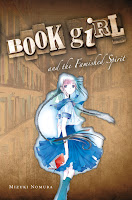
Book Girl and the Famished Spirit

August 10, 2011 by Ash Brown

Author: Mizuki Nomura
Illustrator: Miho Takeoka

Translator: Karen McGillicuddy
U.S. publisher: Yen Press
ISBN: 9780316076920
Released: January 2011
Original release: 2006

Book Girl and the Famished Spirit is the second book in Mizuki Nomura’s sixteen-volume light novel series Book Girl, illustrated by Miho Takeoka. Originally published in Japan in 2006, the book was released in English in 2011 by Yen Press. Once again, Karen McGillicuddy serves as the translator for the series. I read the first volume, Book Girl and the Suicidal Mime not too long ago and absolutely loved it. The book more or less made me an instant fan and so there was no question that I would be picking up Book Girl and the Famished Spirit. I am still quite fond of the premise of a “book girl,” a yōkai that devours the written word instead of food. Even though this story element is often relegated to the background, it is still important and I find it to be utterly delightful. Because I enjoyed Book Girl and the Suicidal Mime so much, I was really looking forward to reading Book Girl and the Famished Spirit.

Despite insisting she doesn’t believe in them, Tohko, the self-proclaimed “book girl,” is afraid of ghosts. Normally this wouldn’t be such a problem, but someone has been leaving encoded messages in the literature club’s mailbox. Messages that seem to be similar to the ones rumored to be left all over the school by a wandering ghost. But whether a prank pulled by a classmate or a legitimate spirit (book girls exist after all, so why not ghosts?), one thing is clear—the notes are asking for help. Tohko intends to investigate the incidents, assuming that Konoha, her underclassman and the only other member of the literature club, will be willing to assist her. But he’s reluctant, especially as the notes become more threatening. He hopes that she will just leave the whole matter alone.

While Book Girl and the Suicidal Mime was heavily influenced by Osamu Dazai’s No Longer Human, Book Girl and the Famished Spirit takes its inspiration from Emily Brontë’s Wuthering Heights. In some ways the story is actually more cruel than the original. If you’ve never read Wuthering Heights, don’t worry. If there’s one thing that Tohko likes to do besides eating literature, it’s talking about it and she provides a very nice summarization of the novel. Throughout the series she frequently launches into tirades about books, even at seemingly inappropriate moments. This is part of her charm although it can come across as tangential. Nomura is constantly dropping references to various works and authors, some more well known than others. But my favorite thing about Book Girl and the Famished Spirit was the introduction of Ryuto. I almost hope that he also turns out to be some sort of yōkai, but I’d still be happy even if it turns out he’s just simply a masochist.

For the most part, Book Girl and the Famished Spirit can stand fairly well on its own and it’s not absolutely necessary to have read Book Girl and the Suicidal Mime. The main mystery is almost completely separate with only a few minor references to the previous one. However, more information is given about Konoha and Tohko. To be honest, it is their backgrounds that intrigue me the most at this point. Konoha’s past in particular is slowly being introduced, piece by piece, within the context of the incidents he and Tohko get caught up in. It’s an interesting but effective technique. Although I enjoyed Book Girl and the Famished Spirit, I didn’t like it nearly as well as I did the first book. I’m not really sure why; maybe it’s just that I happen to prefer No Longer Human over Wuthering Heights. Regardless, I still intend to continue the series with the next volume, Book Girl and the Captive Fool.

Filed Under: REVIEWS Tagged With: book girl, Light Novels, Miho Takeoka, Mizuki Nomura, Novels, yen press

Kobato., Vols. 1-3

July 31, 2011 by Michelle Smith

By CLAMP | Published by Yen Press

The plot of Kobato. sounds like a typical shoujo magical girl story. A dim-witted and clumsy heroine, who also happens to be guileless and compassionate, is tasked with filling a magic bottle with wounded hearts so that her dearest wish can be granted. But Kobato. isn’t shoujo.

If anything, it’s seinen, as it ran for seven chapters in Sunday GX before going on hiatus and reemerging in Newtype magazine. I’m guessing that the target audience, presumed to be young men with an appreciation for moe, is the reason why Kobato commences flailing, chibified panic mode on page two and falls down approximately fifteen times per chapter. (I may be exaggerating there, but honestly not by much.) The latter gag is run into the ground so relentlessly that I refuse to consider that anyone finds it funny, so CLAMP must be trying to inspire feelings of “Aww, she’s so cute and/or hopeless.”

The first volume of Kobato. is not very good. Kobato’s incompetency grates as does the constant browbeating she receives from Ioryogi, some sort of supernatural being currently dwelling in the form of a stuffed dog, who is testing her ability to “act according to the common-sense rules of this place.” If she passes, she earns the magic bottle. These tests—mainly centered around holidays—include taking out the trash, making nabe, and spending New Year’s day playing traditional games with an elderly woman.

Things improve somewhat in the second volume. Kobato’s got her bottle now and is ready to heal some wounded hearts. After moving into the same apartment building seen in Chobits, she starts work as a helper at Yomogi Kindergarten. The head of the school, Sayako-sensei, seems to have a heart in need of some healing, as does her hard-working part-time employee, Fujimoto. With Ioryogi’s assistance, Kobato tries to discover how best to help them, and gradually learns that Sayako is working to pay off a debt her father was tricked into incurring, that Sayako’s soon-to-be-ex husband is threatening harm to the school unless she pays up, and that Fujimoto is working himself to the point of exhaustion to earn money to contribute. They seem suspicious of Kobato at first, but her genuine sincerity eventually wins over even grumpy Fujimoto.

This is definitely an improvement over the first volume, but the kindergarten-in-peril storyline still seems to be occupying a great deal of space in what looks to be only a six-volume series. (Kobato. just recently came to an end.) There is a lot of room left in Kobato’s bottle, so I wonder how she will end up filling it after spending so much time working on these two hearts in particular.

Now that I’ve finished my litany of complaints, there are some intriguing questions about Kobato. that leave me inclined to stick with the series until the end. Where is Kobato from, exactly? What is her wish? How did she and Ioryogi meet? What is Ioryogi? (We’ve learned already that if he helps Kobato grant her wish, he may be able to get his original body back.) And, most peculiarly of all, why is it that Kobato is not allowed to take off her hat?

Kindergarten peril I can do without, but I really do want to know what’s up with the hat thing.

Review copies provided by the publisher.

Filed Under: REVIEWS Tagged With: clamp, yen press

Pandora Hearts 2-5 by Jun Mochizuki

July 13, 2011 by Michelle Smith

Reading Pandora Hearts is like mentally treading water. There is so much going on that one is constantly churning the plot waters, trying to stay afloat. It’s not that I’m saying this is a bad thing or that I object to thinking—far from it!—but that I never appreciated episodic lulls so much as when they weren’t around to give me a chance to understand and process what just happened.

The first volume introduced readers to fifteen-year-old Oz Vessalius, who is banished to a mysterious dimension known as “the Abyss” during his coming-of-age ceremony. He escapes by entering into a contract with a “chain” (denizen of the Abyss) named Alice, who wants to search for her scattered memories in the real world. When they arrive, ten years have passed and they are welcomed by a strange trio, one of whom (Raven) bears a striking resemblance to Oz’s childhood friend, Gilbert.

The search for Alice’s memories begins in the second volume, with strong hints that the answer Oz seeks—what was the “sin” that led to his banishment?—lies within them. Oz and Alice have agreed to help an organization known as Pandora (which has several goals regarding investigating and gaining control over the Abyss) and have been assigned by one of its employees, the eccentric Xerxes Break, to take down an illegal contractor whose chain is devouring humans.

Now, at this point, I was thinking, “Okay, here’s our episodic gimmick. Oz and Alice deal with the dangerous contractors and collect memories and it’ll be a sort of basic shounen fantasy.” But that’s actually not how it turns out. Any time Xerxes arranges some sort of encounter with a contractor or chain, it always leads to major plot developments. Sometimes this involves answering some questions—the identity of the braided man we keep seeing in Alice’s memories, for example—but just as often generates several more. I considered keeping a scorecard of questions raised and questions answered so that I could keep track of what issues were still outstanding.

Mangaka Jun Mochizuki also skillfully employs flashbacks to flesh out our understanding of Oz, who is far more complex (and clever and resilient) than he initially appears. His affinity for and faith in Alice, for example, persists despite various people advising him not to trust her, and we gradually learn that this is because he sees a lot of himself in her. Both he and Alice have cause to question why they exist, and since he, as a child, was afraid to pursue the truth regarding his father’s animosity towards him, he admires that Alice is fearlessly pursuing the recovery of her memories. Too, Oz displays an almost alarming equanimity about his situation, which can again be traced back to his father’s coldness, when Oz learned to “accept everything as it is.”

The end result is a story that combines a non-stop spooling out of multi-layered plot threads with some genuinely affecting character work. I particularly appreciate that the female leads—Alice and Sharon, a Pandora employee—are not the character types they initially seem to be (tsundere and meek girl, respectively) and just about any scene wherein Alice feels left out at the signs of affection between Oz and others or just vulnerable in general is a big favorite of mine.

Another aspect of Pandora Hearts that I must commend is the artwork, which, as MJ amply illustrated in a Fanservice Friday post on Manga Bookshelf, is definitely fujoshi-friendly. Consider the evidence:

Shallow confession: although I really like Raven for himself, I admit that I also enjoy just looking at him. It’s not all pretty fellows, though, as Mochizuki’s renderings of the Abyss are creepy and imaginative, and the inhabitants even more so. There are a few references to Alice in Wonderland scattered throughout, too, but it’s nothing that even comes close to dominating the story or its landscape.

As of the fifth volume, Pandora officials have vowed to protect Oz, who is destined to play a major role in their conflict with the Baskervilles, remnants of a clan that battled the four great families (who eventually formed Pandora) 100 years ago and sacrificed the capital city as an offering to the entity in control of the Abyss (not to mention being responsible for sending Oz there in the first place). Plus, Sharon has been abducted and someone just may be in league with the enemy. Many other questions—about both past and future—abound, which ensure that I will keep reading (and hoping everything is ultimately resolved) to the very end.

I hope I haven’t given the impression that Pandora Hearts is a slog, because it truly isn’t. It’s engaging, intriguing, and sometimes even funny. What it never is is tranquil or relaxing, so be sure to save it for a time when your brain needs a little exercise.

Review copies for volumes three through five provided by the publisher.

Filed Under: REVIEWS Tagged With: yen press

Time and Again 6 by JiUn Yun

July 5, 2011 by Michelle Smith

From the back cover:
As war rips through the Tang Dynasty, leaving chaos and destruction in its wake, Baek-On and Ho-Yeon continue to eke out a living as traveling exorcists. While confronting vengeful grudges and putting to rest the lingering spirits of those long dead, Baek-On reflects on the tragic curse that led him to turn his back on the company of the living and follow in his father’s footsteps. While the world seems to crumble around him, Baek-On strives to keep moving forward, even if he must do so alone.

Follow Ho-Yeon and Baek-On as they journey on in the final volume of Time and Again.

Review:
I’m always a little wary of the final volume of a series I have really enjoyed. Will it disappoint? Or will it be exactly what I had hoped? Happily, volume six of Time and Again caps the series in a perfect way, which is to say “in a way that is simultaneously melancholy and hopeful.”

Baek-On has yet to recover from his crisis of self-doubt in the previous volume, in which his decision to force a man to see the truth about his inhuman wife had tragic consequences. He’s been holed up in his mother’s house for months, refusing all customers, but when a young woman arrives with a case that seems both simple and desperate, Ho-Yeon ushers her into Baek-On’s presence. Baek-On is rude at first, and it takes a threat of eviction before he actually begins to listen attentively to the girl, but he eventually goes to her home and deals compassionately with the ghost of a jilted girl who has been appearing there.

It’s clear that the words he uses when appeasing the spirit are what he would say himself to the girl in his own past—“I didn’t leave you. I’ve never left you.”—which leads to a gloriously long chapter that reveals the whole story of what happened with the girl (Wan) and why, and how it led to Baek-On being the person he is today. JiUn Yun handles this in a lovely way, because she doesn’t dwell on the pain of it all. Oh, it’s exceedingly painful for Baek-On, and awful and sad and all of those things that make for a great backstory, but it isn’t milked for melodrama. I shan’t spoil the details, but it’s this experience that motivates Baek-On to become an exorcist and to live and die alone.

The final chapter takes place after further time has elapsed. Baek-On and Ho-Yeon continue to travel together after a war has ravaged the country. Big things have happened, and yet they must continue on as usual, driving evil spirits out of children and chickens (really) and confronting the truth that animal spirits don’t seem to be all that innocent of the ways of humans. Baek-On realizes that his famous father was likely as uncertain as he is, which brings some peace, though he still intends to live his life alone and leave no descendants upon whom a spirit might inflict a grude. Ho-Yeon is also alone, having lost the last person he loved to the war, and the series ends with them pledging to carry on as they have been. Alone. And together.

Okay, yes, I totally spoiled that part, but it’s so absolutely perfect a conclusion for the series that I just had to wax rhapsodic about it. Time and Again has become one of my favorite manhwa series and, now that I know for what Baek-On has been seeking atonement all this time, I look forward to rereading it someday with the benefit of new insight.

Review copy provided by the publisher.

Filed Under: REVIEWS Tagged With: yen press

  • « Go to Previous Page
  • Page 1
  • Interim pages omitted …
  • Page 3
  • Page 4
  • Page 5
  • Page 6
  • Page 7
  • Interim pages omitted …
  • Page 10
  • Go to Next Page »
 | Log in
Copyright © 2010 Manga Bookshelf | Powered by WordPress & the Genesis Framework