• Skip to primary navigation
  • Skip to main content
  • Skip to primary sidebar
  • Home
  • About Us
    • Privacy Policy
    • Comment Policy
    • Disclosures & Disclaimers
  • Resources
    • Links, Essays & Articles
    • Fandomology!
    • CLAMP Directory
    • BlogRoll
  • Features & Columns
    • 3 Things Thursday
    • Adventures in the Key of Shoujo
    • Bit & Blips (game reviews)
    • BL BOOKRACK
    • Bookshelf Briefs
    • Bringing the Drama
    • Comic Conversion
    • Fanservice Friday
    • Going Digital
    • It Came From the Sinosphere
    • License This!
    • Magazine no Mori
    • My Week in Manga
    • OFF THE SHELF
    • Not By Manga Alone
    • PICK OF THE WEEK
    • Subtitles & Sensibility
    • Weekly Shonen Jump Recaps
  • Manga Moveable Feast
    • MMF Full Archive
    • Yun Kouga
    • CLAMP
    • Shojo Beat
    • Osamu Tezuka
    • Sailor Moon
    • Fruits Basket
    • Takehiko Inoue
    • Wild Adapter
    • One Piece
    • After School Nightmare
    • Karakuri Odette
    • Paradise Kiss
    • The Color Trilogy
    • To Terra…
    • Sexy Voice & Robo
  • Browse by Author
    • Sean Gaffney
    • Anna Neatrour
    • Michelle Smith
    • Katherine Dacey
    • MJ
    • Brigid Alverson
    • Travis Anderson
    • Phillip Anthony
    • Derek Bown
    • Jaci Dahlvang
    • Angela Eastman
    • Erica Friedman
    • Sara K.
    • Megan Purdy
    • Emily Snodgrass
    • Nancy Thistlethwaite
    • Eva Volin
    • David Welsh
  • MB Blogs
    • A Case Suitable For Treatment
    • Experiments in Manga
    • MangaBlog
    • The Manga Critic
    • Manga Report
    • Soliloquy in Blue
    • Manga Curmudgeon (archive)

Manga Bookshelf

Discussion, Resources, Roundtables, & Reviews

manga

Usamaru Furuya Manga Moveable Feast: An Introduction

January 22, 2012 by Ash Brown

© Usamaru Furuya

Welcome, everyone, to the Usamaru Furuya Manga Moveable Feast!

The first Manga Moveable Feast of the year begins today, January 22, and will end next Sunday, January 29. The Feast gives the manga blogging community an opportunity to explore and examine together a particular manga or creator. This month we will be focusing on mangaka Usamaru Furuya and his works and Experiments in Manga will be hosting.

Who is Usamaru Furuya?
Usamaru Furuya was born on January 25, 1968 in Tokyo. (That’s right! His birthday is Wednesday, so let’s throw a great Feast in his honor.) He made his manga debut in 1994 with Palepoli which was serialized in the monthly alternative manga magazine Garo.

Furuya was interested in creating manga since his childhood, even enrolling in Osamu Tezuka Manga Correspondence School and submitting to the portrait section of Shōnen Gaho. But in high school, his focus shifted to oil painting. He went on to study art at Tama Art University where he also developed an interest in drama, sculpture (particularly abstract three-dimensional figures), and butoh dance. For a time, Furuya was a member of the butoh performance groups Karas and Sankai Juku. After graduating from Tama Art University, Furuya worked as a high school art teacher before returning to manga, bringing his fine arts background with him.

Furuya has also worked a bit in the film industry. After creating the manga adaptation of Sion Sono’s 2002 cult classic Suicide Club, Furuya would play a role (“the man in the cafe”) in the film’s 2006 sequel Noriko’s Dinner Table. He also acted in another of Sono’s films, 2008’s Love Exposure, playing the part of Miyanishi. Furuya was also involved with the 2005 film adaptation of Otsuichi’s horror short story collection Zoo (which I have reviewed here). He was responsible for the screenplay, storyboard, and character design for the story “Hidamari no Shi” (translated as “Song of the Sunny Spot” in the English short story collection), the only animated short in the collection. There very well may be other examples, but these are the instances I am familiar with.

Blog: 古屋兎丸ブログ「ウサギ☆ひとりクラブ
Twitter: @usamarus2001

Furuya’s Manga in English
Usamaru Furuya’s official introduction to English-reading audiences was all thanks to Viz Media. First came excerpts from Palepoli in Japan Edge in 1999 and then in Secret Comics Japan in 2000. (Regrettably, the entirety of Palepoli has never been released in English, although the selections in the previously mentioned volumes are different from each other.) Furuya’s series Short Cuts was serialized in Viz’s now defunct manga magazine PULP before the two individual volumes were collected in 2000 and 2003, respectively.

CMX Manga announced in 2009 the licensing of Furuya’s 51 Ways to Save Her. Unfortunately (or perhaps fortunately) the company folded before any of the series made it into in English. The recent resurgence of Furuya’s manga in English began in 2010 with Viz Media’s publication of the first volume of Genkaku Picasso. The final two volumes of the series were released in 2011.

2011 also saw Vertical stepping up with some Furuya manga, beginning with the one-volume Lychee Light Club, based on the Tokyo Grand Guignol’s theater piece. (Vertical has also expressed interest in licensing the prequel Our Light Club.) Most recently, Vertical began the publication of Furuya’s No Longer Human, a manga adaptation of Osamu Dazai’s novel by the same name (which I have reviewed here). The third and final volume is currently scheduled to be released next month.

Who knows what the future may hold, but I sincerely hope it includes more of Furuya’s works being licensed and released in English.

Feasting at Experiments in Manga
This is the first time that Experiments in Manga has hosted the Feast, so what should you expect? There will be new content related to the Feast posted every day. Mostly, the posts will consist of my own in-depth reviews of Furuya’s manga, so nothing too terribly exciting. I’ve previously reviewed Lychee Light Club, so for the Feast I’ll mostly be focusing on the first volumes of Furuya’s series. There should also be at least one guest post to look forward to! (Another first for Experiments in Manga.) Also, my monthly manga giveaway will begin on Wednesday and you’ll be able to enter for a chance to win Furuya’s Genkaku Picasso, Volume 1.

There will be three roundup posts during the Feast—one each on Tuesday, Thursday, and Saturday—as well as a final send-off on Sunday. These posts will highlight other participants’ contributions to the Feast. I will also be updating the archive page throughout the Feast. (I’ve already populated it with a ton of pre-Feast reviews and articles, so check it out.)

It will be very boring if I’m the only person posting content, so I encourage you all to take part in the Feast. Simply notify me of your contributions by e-mail at phoenixterran(at)gmail(dot)com or through my Twitter account @PhoenixTerran and I’ll make sure that you’re included in the roundups and archive.

Please enjoy the Feast!

Filed Under: UNSHELVED Tagged With: manga, Manga Moveable Feast, Usamaru Furuya

Introduction to Shoujo I’m Scared Of

January 19, 2012 by Phillip Anthony 28 Comments

Hi everybody! My name is Phillip and some of you will know me from writing on my site Eeeper’s Choice for the Manga Movable Feast and also for writing for Otaku News. MJhas kindly invited me to write a monthly column on Manga Bookshelf, after I read and replied to her call for contributors.

The column is being called “Shoujo I’m Scared Of,” and it refers to a problem I’ve been having reading manga for a few years now. On my own site I once declared that I would read anything, that nothing was out of bounds. But in my heart of hearts, I wasn’t telling the entire truth of the matter. I should have said I would read anything that was recommended to me, but if left to my own devices I wouldn’t seek certain titles out. Some of the those titles are shoujo titles. While shoujo enjoys and continues to enjoy a mix of male and female readers, I have always been put off by shoujo, partly because I was nervous about taking on huge franchises of shoujo properties, and partly because I think I didn’t want to like them. If I did, then my more manly genre favourites would be put by the wayside. Plus I was deathly afraid of screwing up in front of the internet. In short, I was scared of shoujo and didn’t know how to approach it.

This, dear readers, is not how a grown man should act. After reading MJ’s request, I began to think of an idea that I could pitch. After rejecting a few dozen ideas, I started to realise what I could write about. I remembered some of Kate Dacey’s coverage and reviews about Sailor Moon’s forthcoming re-release in North America. Sailor Moon has always scared me. The title alone was always marketed in my neck of the woods as just for girls, and the fanbase was made it sound like the story was the greatest thing ever.

In my mind, Sailor Moon represents the best example of shoujo that I can think of. If I could get through every volume of Sailor Moon (I checked and there are 13 volumes of the Japanese editions) and give it an honest, balanced, take-it-apart view, I reckoned I stood a pretty good chance of curing my irrational fear of the genre. But I don’t plan to tackle just Sailor Moon. Codename: Sailor V lurks by the stage curtains, as does Princess Knight and a few others. While I’m still afraid of messing up, I reason that the best place for me to be if it does happen is doing something I enjoy doing. I hope you enjoy me trying to justice to the titles I’ll tackle.

I do have a request of all the potential readers of the column: if you know of any shoujo titles that are available in English, I want to hear from you even if they are out of print. I’ll add them to the pile of things to do. Please note, I’ve only got a limited income so if I don’t get around to your recommended title for some time, then I apologise in advance and ask that you be patient with me. If you have any comments or questions please send an email to me at eeeperschoice -at- gmail -dot- com

Filed Under: UNSHELVED Tagged With: manga

Adventures in the Key of Shoujo: Sailor Moon, Vol.1

January 19, 2012 by Phillip Anthony 4 Comments


Pretty Guardian Sailor Moon, Vol. 1 | By Naoko Takeuchi | Published by Kodansha Comics USA | Rated: T, Ages 13+

“I’m… the pretty guardian in a sailor suit! Guardian of love and justice! Sailor Moon!”

Working on a simple premise… (Follow my logic, would you?) If you took a squad of girls, magical powers, tokusatsu-style fighting, and a viciously unassuming story arc and threw them into a blender, what would you get? My-Hime, that’s what. But before My-Hime—before all that—there was Sailor Moon, an archetypal series that influenced the entire genre of magical girls within manga and anime. To this day, Fred Patten states that it introduced the idea of the magical girl team into the medium’s subconscious. The brainchild of artist Naoko Takeuchi, the sheer weight of its importance leans heavily on everything that came after it.

Simply put, the Great Ruler of the Dark Kingdom wants energy leeched from humans and the Legendary Silver Crystal that goes with it. With that, they can rule the world. All that stands between them and success is a small, black cat called Luna (who can talk and has a mark on her head in the shape of a crescent moon) and a team of fourteen-year-old girls who wear exaggerated versions of Japanese school sailor outfits and have magical powers, and whose code names are taken from the names of the planets in the solar system. Leading the team is a complete klutz named Usagi Tsukino who takes on the persona of Sailor Moon. Also into the mix goes Tuxedo Mask, a young man who dresses in a gentleman’s evening attire and wears (you guessed it) a mask. He likes to help Sailor Moon, but he has his own reasons as well. The girls are soldiers (or senshi) in a war against the enemies of love, truth and justice. And so the board is set, the players are moving, and the game can begin.

So why has it taken this long to write the review, seeing as I received the manga over two weeks ago? I think it’s the awe in which the series is held. Sailor Moon has a fanbase that rivals even Dragonball or Evangelion. Dragonball is an interesting title to compare, in terms of its Western audience. For the most part, the perception is that Dragonball found a large male audience and Sailor Moon, a large female audience. I say “perception” because market analysis can only tell you so much. But it’s unfair to label Sailor Moon as Dragonball for girls, as I once did. The two series are worlds apart in their execution, tone and setting. Yet, I cannot discount the idea that each gender can find something in both stories that resonates with them.

My failing was that I decided that girls could like Dragonball but boys couldn’t like Sailor Moon, because there was nothing there for them to latch onto. I think what set me on that foolish path was the God-awful treatment that Sailor Moon received at the hands of DIC Entertainment when the animated version of the story came to European English-speaking shores. DIC made it sound like the most girly of enterprises (something no self-respecting angsty teenager would be caught dead liking), where the girls were all airheads and the villains were dead simple. The show was never going to attract a boy who had grown up with He-Man. It was not going to happen for me. And so, I ignored it.

But the fanbase, as I’ve said, is relentless. Every time you look at cosplayers, someone is dressed as Sailor Moon. So I would speak with people who talked about the story as if it was manna from Heaven. They ranged from cosplayers who said the series was their gateway into anime, to those who had been reading the manga since the 1990s TOKYOPOP editions. Interestingly, the anime breaking into North America is credited by many as the event that destroyed the grip the male, 15-25 demographic had on driving anime sales in America since the 1980s. Today, the market leans more heavily toward female fans than male fans of anime, manga, and J-Culture, so it’s a testament to the series that it had and still has that effect on the fans.

Still, I’m confused about Sailor Moon. Mostly because I cannot figure out where Takeuchi is going with it in this first volume, or indeed if she’s got some kind of plan going even here in the opening act. On the surface, Usagi is a airhead more concerned with being a girly girl, hanging out with her friends, and playing video games at the local arcade than entertaining the notion that she should be doing anything to save the world. Even when she accepts being Sailor Moon, she still doesn’t want to be put into scary situations by Luna. It makes for a nice intro to the character for whom we will ostensibly be rooting for the next however many volumes. The spoken-diary entries that Usagi has are something to behold. She tells us every single time a new chapter starts who she is, where she is from, what recently happened, and what is happening now. I know that this is because of the fact that Sailor Moon was serialized in Nakayoshi Magazine—to keep new readers in the loop, Takeuchi wrote those in—but the aftereffect is that Usagi comes across as even more bubbly, and this is a good thing.

The tone of the fight that the Sailors are in and the opposition that the author sets is one of innocence that can only be derived from a teenager’s perspective. When I was 14, the people who had it in for me in school wanted to beat me up and throw water over me, but they didn’t want me dead. For all the Dark Kingdom’s mwah-ha-ha-ha and general evilness, I cannot take them seriously. They are defeated by a dunderhead every single time. Then the dunderhead gets her own team of crack commandos and the bad guys get trounced, again and again, by a bunch of fourteen-year-olds who only got their powers recently. Even when they are vanquished, the villains treat it like “Bah! Another setback!”

Some people would argue that Sailor Moon has a lot of evidence of plot conveniences for the sake of convenience; I counter the argument because the same evidence is rather exculpatory in nature. To explain, while I want to say that the whole “You are destined to become a team of magical fighting girls!” thing is a little too convenient, the truth is that’s how all good quest stories start and since I don’t really have a problem with them, I don’t have a really big problem with Sailor Moon doing it, either. So the girls are destined to be a team of superheroes not because they were destined to be so, but because Luna had been keeping an eye on all of them. The same can be said for the items that the senshi use to defeat the forces of darkness. Usagi, we have established, plays video games at the arcade. She gets prizes every time she gets a high score. These items look very suspicious and don’t look like the usual tat, if you get my meaning. However, throughout this smoke-and-mirrors routine I can see a kind of epic gathering of heroes (the girls being recruited) and figures of cruelty and infamy (Dark Kingdom’s minions) moving around and cannot wait to see what happens next.

Artwork-wise, I cannot say enough good things about it. From Usagi’s transformation sequence to Luna’s little interstitial at the start of one of the chapters telling us who’s in the team, its biographical details and any allies and enemies, the art is really sweet and genuine to look at. Graceful and elegant, it still has its quick thumbnail drawings of our heroes and heroines to speed us through a page. There are real examples in the pages that Takeuchi is using mise-en-scène* to build a colorful and coherent stage that her actors are moving around. The whirling fog that surrounds our heroes when the enemy has the upper hand or when the senshi reveal to the villain (and, by extension, the audience) their power and become light-filled are but two such examples. The moments of tranquility when Tuxedo Mask dances with and around Sailor Moon are wonderful. Even as a battle-hardened, knowledgeable young man of 30, I can understand the feeling of falling for someone and feeling like the whole world stopped for that moment. Takeuchi gives her leads a distinctive look and you’d never confuse one Sailor Senshi for another, even in their uniforms. Plus, she never makes the fact that they dress in sailor outfits into something crass. With the supporting cast it’s a little more difficult to keep an eye on who’s who but I don’t mind that so much at this point, as they don’t contribute much.

It’s interesting, both in terms of storytelling and, of course, artwork, to see the different types of girls who get recruited into being Sailor Senshi become staples of magical girl stereotypes. There’s the ditzy girl, the smart girl, and the girl who works at the shrine. I don’t doubt that I’ll see even more types emerge as the series goes on. While Sailor Moon didn’t invent these types for the most part, it perfected them. The chief bad guys are also designed this way: they have been around before but never in this context and setting. The more I reread this volume, the more I wonder if I’ve been wrong about a great number of shows and manga that I’ve passed by simply by having a prejudiced opinion. As an aside, the translation by William Flanagan is spot-on and I’m, as always, grateful for the liner notes at the back to make sense of the nuances within Japanese culture.

Ultimately, Sailor Moon works because you get swept up by the story. The idea of battling evil-doers over rooftops or in exotic locations with brave allies and with nothing more than the power you have inside of you is something we know from when we were little and read fairy tales. Later we dismiss such stories as mere whimsy. Usagi and her friends are living in a fairy tale and I can and will wholeheartedly continue to embrace this whimsy for as long as it lasts.

* Mise-en-scène is a French term which literally means “placing on stage” and refers to the art of placing elements (actors, props, sets, lighting) in front of the viewer in order to immerse them in the story. Where the actors are placed within a scene and how they move in the scene are also elements within mise-en-scène.

Review copy bought by reviewer

Filed Under: Adventures in the Key of Shoujo, MANGA REVIEWS, REVIEWS Tagged With: kodansha, Kodansha Comics, kodansha usa, manga, shojo

Combat Commentary: Naruto Vol. 2, Ch. 12–15

January 17, 2012 by Derek Bown 5 Comments

Fight scenes are practically synonymous with manga and anime. Few people can think of anime without thinking of two over-muscled men throwing energy beams and punches at each other while screaming for minutes on end.

These people are wrong, and most likely stopped paying attention to anime and manga back when Dragonball Z first came out in the west. Not only is there obviously much more to manga than fighting, but even shounen manga, the posterboys for fighting series, go beyond two muscled mastodons beating the crap out of each other.

Fight scenes in manga can range from straightforward, brutal beatings to calculated strategic encounters between two opponents. The purpose of this column is to explore the many flavors of fight scenes found in shounen manga, as well as some shoujo and seinen manga.

For many manga fans, Naruto was one of the first series they ever read. And while the series’ value is hotly debated among the various camps of manga fans, it cannot be denied that in its early run, Naruto was very different from the typical shounen battle manga. Fights were developed and executed in a much more cerebral way, making them far more interesting to read.

(click images to enlarge)

The most indicative of this style is in volume two, chapters twelve to fifteen—the first fight against Zabuza. The fight begins with Zabuza being set up as a serious threat, both through his actions and the words of others. He is shown as being on par with (and momentarily superior to) Kakashi, who until this point has been the strongest ninja in the series. With Kakashi (a ninja who has already bested Naruto and his team) incapacitated, the protagonists find themselves facing an opponent they cannot best physically.

So they do what they did not do when fighting Kakashi; they use teamwork and tactics. The climax of the fight involves Naruto using a complex strategy involving turning into a throwing star to get get behind Zabuza and free Kakashi.

Some might say that Naruto and Sasuke failed, as Zabuza was taken down by Kakashi in the end. And they would be correct, if not for the fact that the purpose of the fight was not to defeat Zabuza, but instead to free Kakashi so that he could defeat Zabuza. With this goal accomplished, the fight was a success for Naruto and Sasuke. And since two twelve year olds taking out an adult is ludicrous, this is essentially one of the only ways to have resolved the fight while remaining believable, or as believable as any shounen manga ever gets. Masaki Kishimoto understood his characters’ limitations, and set up a battle in which they could be victorious while still remaining true to those limitations.

The fight focuses on intelligence over brute force, and if one thinks of fight scenes as a mystery plot in which the mystery to be solved is how the opponent can be defeated, then it becomes easier to determine what makes a good fight scene. No one would ever consider a mystery story where the protagonist stumbles upon the answer rather than working it out for themselves to be a good example of the genre.

Likewise, sudden powerups only work to a fight’s detriment. What sets Naruto apart in the early chapters is that most of the fight scenes progress like the fight against Zabuza did, with focus being given to fighting tactics rather than power levels. The way opponents are defeated involves intelligent solutions more often than not, which makes the fights more intellectually stimulating than their cousins.

Derek Bown writes anime and manga reviews at Burning Lizard Studios. If you have any fight scenes from manga you want him to look at, mention them in the comments. 

Filed Under: Combat Commentary, FEATURES Tagged With: Combat Commentary, manga, naruto, Shonen, Shonen Jump, VIZ

Usamaru Furuya Manga Moveable Feast: Archive

January 1, 2012 by Ash Brown

© Usamaru Furuya

The January 2012 Manga Moveable Feast (January 22-January 29), hosted right here at Experiments in Manga, features Usamaru Furuya and his works. This page serves as the Feast’s archive and will link to posts contributed to the Feast.

Call for Participation
An Introduction
Roundup One
Roundup Two
Roundup Three
An Epilogue
A Final Farewell

Reviews:
The Children’s Crusade, Volumes 1-2 (Completely Futile)
Genkaku Picasso, Volume 1 (Experiments in Manga)
Genkaku Picasso, Volume 1 (Manga Xanadu)
Genkaku Picasso, Volumes 2-3 (BookDragon)
Genkaku Picasso, Volumes 1-3 (Otaku Ohana)
No Longer Human, Volume 1 (Experiments in Manga)
No Longer Human, Volume 2 (Comic Attack)
No Longer Human, Volume 2 (Organization Anti-Social Geniuses)
No Longer Human, Volume 2 (Slightly Biased Manga)
No Longer Human, Volumes 1-2 (Manga Bookshelf)
No Longer Human, Volumes 1-2 (Manga Connection)
No Longer Human, Volumes 1-2 (Manga Xanadu)
Secret Comics Japan (Experiments in Manga)
Short Cuts, Volume 1 (Experiments in Manga)
Short Cuts, Volumes 1-2 (A Case Suitable for Treatment)

Other contributions:
English, Please!: Palepoli (Slightly Biased Manga)
An Examination and Appreciation of the Works of Usamaru Furuya (Experiments in Manga)
Manga Giveaway: Genkaku Picasso Giveaway (Experiments in Manga)
My Limited Exposure with Usamaru Furuya (Animemiz’s Scribblings)
My Week in Manga (Experiments in Manga)
Usamaru Furuya’s Genkaku Picasso & Why It’s Currently the Only Shounen Manga on My Shelves (All About Manga)

From the archives (pre-Feast content):
Interview with Usamaru Furuya (Shonen Jump Magazine)
Met Usamaru Furuya in Toronto! (Same Hat!)
A Short Appreciation of Manga-ka Usamaru Furuya (Comics 212)
TCAF 2011: Spotlight on Usamaru Furuya (Kuriousity)
This Genius’s Horror Edition of MMF: Usamaru Fuyura (Organization Anti-Social Geniuses)
Usamaru Furuya TCAF 2011 Autograph Signing Session (Flash Frame Omake)

Flowers
Flowers (Completely Futile)

Garden
Garden (Completely Futile)

Genkaku Picasso
Genkaku Picasso, Volume 1 (About.com: Manga)
Genkaku Picasso, Volume 1 (Anime News Network)
Genkaku Picasso, Volume 1 (BookDragon)
Genkaku Picasso, Volume 1 (Burning Lizard Studios)
Genkaku Picasso, Volume 1 (A Case Suitable for Treatment)
Genkaku Picasso, Volume 1 (Comic Attack)
Genkaku Picasso, Volume 1 (Hooded Utilitarian)
Genkaku Picasso, Volume 1 (The Manga Critic)
Genkaku Picasso, Volume 1 (The Manga Curmudgeon)
Genkaku Picasso, Volume 1 (Organization Anti-Social Geniuses)
Genkaku Picasso, Volume 1 (Mania.com)
Genkaku Picasso, Volume 1 (Read About Comics)
Genkaku Picasso, Volume 1 (Slightly Biased Manga)
Genkaku Picasso, Volume 2 (A Case Suitable for Treatment)
Genkaku Picasso, Volume 2 (Comic Attack)
Genkaku Picasso, Volume 2 (The Manga Critic)
Genkaku Picasso, Volume 2 (Slightly Biased Manga)
Genkaku Picasso, Volume 3 (A Case Suitable for Treatment)
Genkaku Picasso, Volume 3 (Comic Attack)
Genkaku Picasso, Volume 3 (The Fandom Post)
Genkaku Picasso, Volume 3 (Slightly Biased Manga)
Genkaku Picasso, Volumes 1-3 (Good Comics for Kids)
Genkaku Picasso, Volumes 1-3 (Graphic Novel Reporter)
Genkaku Picasso, Volumes 1-3 (Mama Reads Manga)
Genkaku Picasso, Volumes 1-3 (Manga Report)
Genkaku Picasso, Volumes 1-3 (Manga Worth Reading)
Genkaku Picasso, Volumes 1-3 (Reading Is Delicious)

Lychee Light Club
Lychee Light Club (Ani-Gamers)
Lychee Light Club (A Case Suitable for Treatment)
Lychee Light Club (Comics-and-More)
Lychee Light Club (Experiments in Manga)
Lychee Light Club (The Fandom Post)
Lychee Light Club (Genji Press)
Lychee Light Club (Graphic Novel Reporter)
Lychee Light Club (Kimi-chan Experience)
Lychee Light Club (The Manga Curmudgeon)
Lychee Light Club (Manga Worth Reading)
Lychee Light Club (Manga Village)
Lychee Light Club (Manga Widget)
Lychee Light Club (Organization Anti-Social Geniuses)
Lychee Light Club (Otaku USA)
Lychee Light Club (Slightly Biased Manga)

The Music of Marie
The Music of Marie, Volumes 1-2 (Completely Futile)
The Music of Marie, Volumes 1-2 (Organization Anti-Social Geniuses)
The Music of Marie, Volumes 1-2 (Ryu’s Dreams)

No Longer Human
Dehumanizer Dept. (Genji Press)
No Longer Human, Volume 1 (A Case Suitable for Treatment)
No Longer Human, Volume 1 (Comic Attack)
No Longer Human, Volume 1 (Comics-and-More)
No Longer Human, Volume 1 (The Fandom Post)
No Longer Human, Volume 1 (Genji Press)
No Longer Human, Volume 1 (Kuriousity)
No Longer Human, Volume 1 (The Manga Critic)
No Longer Human, Volume 1 (Manga Maniac Cafe)
No Longer Human, Volume 1 (Otaku Champloo)
No Longer Human, Volume 1 (Otaku USA)
No Longer Human, Volume 1 (Slightly Biased Manga)
No Longer Human, Volume 2 (Genji Press)
No Longer Human, Volume 2 (Otaku USA)
No Longer Human, Volumes 1-2 (BookDragon)

Love Exposure
Love Exposure (Animemiz’s Scribblings)

Plastic Girl
Plastic Girl (Completely Futile)

Secret Comics Japan
Looking Back at Secret Comics Japan (Same Hat!)
Secret Comics Japan (Comics-and-More)
Secret Comics Japan (Slightly Biased Manga)

Short Cuts
Short Cuts, Volume 1 (Slightly Biased Manga)
Short Cuts, Volume 2 (Slightly Biased Manga)
Short Cuts, Volumes 1-2 (The Manga Critic)

Suicide Club
Suicide Club (Completely Futile)
Suicide Club (Organization Anti-Social Geniuses)

Other Feast Archives

Filed Under: Usamaru Furuya Manga Moveable Feast Tagged With: manga, Manga Moveable Feast, Usamaru Furuya

My Week in Manga: December 5-December 11, 2011

December 12, 2011 by Ash Brown

My News and Reviews

Last week I posted December’s first in-depth manga review: Breathe Deeply by wife and husband creative team Doton Yamaaki. It’s the second manga to be published by One Peace Books. I quite enjoyed it and look forward to future manga releases by the publisher. I also posted the Give Me Some Gin Tama! Winner. The entry also includes a great list of recommended manga titles to make you laugh. And finally, apologies for the exceptionally brief news section this week! I’m still trying to get back into the groove of things after whatever bizarre illness I had.

Quick Takes

The Beautiful Skies of Houou High, Volume 1 by Arata Aki. I’m not as offended by The Beautiful Skies of Houou High as I know some people are, but I can’t say I particularly enjoyed the first volume of the manga, either. Kei Saeba, who literally gets sick in the presence of men, has been enrolled in a prestigious all-boys school by her mother after being dumped by her girlfriend in order to “fix” her daughters preferences. Even worse than that, if anyone discovers that she’s a girl while attending the school, Kei will find herself “disappeared.” I like that Kei likes girls; I like her bifauxnen character design. But that’s most of what I like about the manga. I’m not really enjoying the actual story at this point.

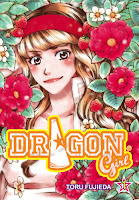
Dragon Girl, Omnibus 1 (equivalent to Volumes 1-3) by Toru Fujieda. Rinna Aizen’s dream is to lead Shoryu Senior High School’s ōendan, or cheering squad (not to be confused with a cheerleading squad). Fortunately for her, the all-boys school has recently gone co-ed. Nothing really stood out for me about Dragon Girl. Rinna and her friends are likeable enough, but the manga uses so many cliches and doesn’t do anything new with them that I actually found it to be rather boring. Long lost childhood love interest? Check. Evil student council? Check. (I could keep going, but I won’t.) However, I would like to thank Fujieda for introducing me to ōendan. That’s some cool stuff right there.

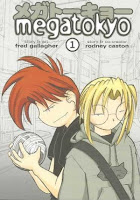
Megatokyo, Volumes 1-3 by Fred Gallagher and Rodney Caston. Megatokyo is a webcomic that began way back in 2000 and is still going. (You can read it here.) Personally, I prefer reading Megatokyo in print. I’ve been following Megatokyo for quite some time, but it’s been a while since I’ve gone back to the beginning. I now realize how many of the Japanese pop culture references went completely over my head the first time I read the comic. I get them now, but even if you don’t, Megatokyo is still great entertainment. Gallagher actually lives in the next town over from me and I’ve even met him on a couple of occasions. I like supporting local creators, which is yet another reason I appreciate Megatokyo.

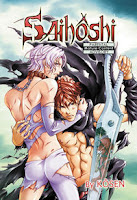
Saihôshi: The Guardian Omnibus by Kôsen. Saihôshi is probably my favorite publication by Yaoi Press that I’ve read so far. Sure, there is plenty ridiculous about the comic, including odd clothing design choices, gratuitous magic tattoos, and one of the main character’s weapon of choice is basically a giant pair of scissors, but to me that is part of its charm. I’m not sure if it’s intentional or not, though. There are a few brief sex scenes, but Saihôshi‘s focus is on the story. Many of the fantasy elements used are fairly typical, but the plot is actually pretty decent. There was more humor in Saihôshi than I was expecting, too. High art it is not, but I honestly enjoyed Saihôshi. Kôsen is a two-person creative team from Spain made up of Aurora García Tejado and Diana Fernández.

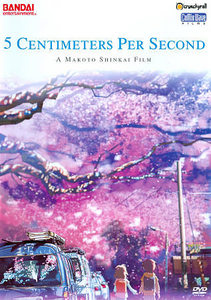
5 Centimeters Per Second directed by Makoto Shinkai. 5 Centimeters Per Second is a gorgeous film. The animation is beautiful and frequently breathtaking—the snow, the rain, the sky, the cherry blossoms, the color and lighting, everything. The film is just over an hour long and consists of three shorts with Takaki Tōno at their heart: “Cherry Blossom,” “Cosmonaut,” and “5 Centimeters Per Second.” 5 Centimeters Per Second is suffused with melancholy and loneliness as its characters deal with intense emotions of love, longing, and loss. Be warned, if you’re looking for resolution and closure, you won’t find it here. 5 Centimeters Per Second left quite an impression on me; I wouldn’t hesitate to recommend it.

Filed Under: My Week in Manga Tagged With: 5 centimeters per second, anime, Arata Aki, Beautiful Skies of Houou High, comics, dragon girl, Fred Gallagher, Kôsen, makoto shinkai, manga, Megatokyo, Rodney Caston, Saihôshi, Toru Fujieda

Comic Conversion: Witch & Wizard

December 9, 2011 by Angela Eastman 9 Comments

Witch & Wizard | Novel: James Patterson and Gabrielle Charbonnet / Grand Central Publishing | Manga: Svetlana Chmakova / Yen Press

One minute Whit Allgood is falling asleep in front of the TV, the next an army is breaking down his door, brandishing guns and dragging his sister Wisty out of her bed. But the biggest shock for Whit and Wisty comes when they’re accused of being a wizard and a witch by the New Order—the all new government that’s taken over the whole country—and are sentenced to death. As they struggle to survive in their jail cell, the siblings discover that they do have special powers, from telekinesis to bursting into flames. Even after they manage to break out, thanks to the help of a ghostly friend, Whit and Wisty still have to find their parents, and they might have to break back into jail to do it.

Witch & Wizard is one of the latest series to come out of the James Patterson novel mill, this time written in conjunction with Gabrielle Charbonnet. Though there was already a graphic novel adaptation from IDW, Yen Press decided to come out with their own version of the dystopian novel using artist Svetlana Chmakova, creator of Dramacon and Night School, to create Witch & Wizard: The Manga. Both versions of the story have their flaws, but one might be more worth your time than the other.

Let’s start with the novel. One good thing you can immediately say about Witch & Wizard is that it gets right into the action. The story has barely started before the New Order troops are breaking down the Allgoods’ door. It doesn’t slow down much from there, even when the siblings are locked in prison, as they deal with sadistic jailers and have to fight a pack of mad dogs for food and water. The short chapters (most only last 1 or 2 pages) help create the illusion that you are speeding through the book. But even with all the rapid action, the story can get pretty clunky at times. You’ll start the next chapter, and suddenly Whit and Wisty are somewhere else, or there’s someone new in the scene who wasn’t there before. And the short chapters, while helping you feel like the book is a fast read, hurt the overall smoothness of the longer, more dramatic scenes.

Whit and Wisty are certainly fun characters, with their wisecracks, determination, and magical powers. Wisty in particular has an entertaining, sarcastic tone. But unfortunately, it’s all surface. Though the story is in first person for both characters, you never feel like you get truly, deeply in their heads. Even when the story pauses for inner thoughts it’s pretty generic, like how awful or cool or sad something is. Then there is the villain, The One Who Is The One, who should be dark and terrifying… but for some reason, Patterson and Charbonnet have him spouting some of the weirdest lines. They range from awkward – “I can even shut your sister up!” – to just plain goofy – “TRICKS ARE FOR KIDS!” – and really diminish the fear readers should have of this all-powerful villain.

Now we come to Yen Press’s manga adaptation by Svetlana Chmakova. The visual aspect of the comic actually helps with the clunky-ness in the book. New character appearances are less sudden, and we see the transition from one place to another, so there’s no flipping back a page to see how Whit and Wisty suddenly got from point A to point B. Chmakova’s art also helps to brighten up some of the less-than-stellar character personalities. Sure, the villains are just as one-dimensional as in the novel, with their little dark beetle eyes, but other characters seem more human in her hands. Whit wears a blank look of shock when he discovers that Celia is a ghost, and Wisty’s range of expressions, from cartoonish excitement at living in a fancy department store to the dark, narrow-eyed look when she casts her angry spells, make this witch even more fun and exciting than her novel version.
Despite the pace of the original, cuts were needed to fit the whole story into a single graphic novel. We miss out on some interesting shows of magic, like when Wisty floats in her sleep, or Whit speeds himself up to handily defeat some guards. But the comic also does away with some bits I didn’t care for, most obviously The One’s horrible, cheesy lines. The One still isn’t as dark and foreboding as I would like (you can always go creepier) but at least his dialogue doesn’t make me cringe.

The Witch & Wizard novel has a lot of problems that I have a hard time overlooking. While the pacing is nice and quick, the novel persistently trips itself up with awkward breaks and sudden shifts in location. And the plot, while a decently done fight-the-power dystopian, can get repetitive, takes unnecessary turns, and ends so abruptly I’m honestly surprised Patterson and Charbonet didn’t add in a couple more chapters to smooth things out. Chmakova’s adaptation doesn’t escape the plot issues of the original, but in streamlining the plot to fit into a single graphic novel she manages to toss out some of the minor chinks, resulting in an easier flow. When you combine that with art that is much more expressive than Patterson’s prose, overall you get a more enjoyable read. It’s still not perfect, but Witch & Wizard the manga improves enough on the original to be worth your money.

Filed Under: Comic Conversion, FEATURES Tagged With: graphic novel, manga, Novel, Teen Lit, Witch & Wizard, yen press

Manga Giveaway: Happy Hallowe’en! Winner

November 2, 2011 by Ash Brown

And the winner of the Happy Hallowe’en giveaway is…Maxy Barnard!

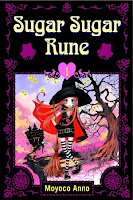
As the winner, Maxy Barnard will be receiving the first volume in Moyoco Anno’s marvelous fantasy series Sugar Sugar Rune! For this giveaway, I asked entrants to tell me about some manga that got them in the mood for Hallowe’en. I received some great responses, so please check out the comments for more details. Thank you to everyone who participated and spread the word about the giveaway. I hope to see you all again for next month’s giveaway, too!

And now, without further ado, a brief list of manga to get you into the Hallowe’en spirit (in one way or another):

Berserk by Kentaro Miura
Demonbane written by Nitroplus and Takashi Tanegashima, illustrated by Yūki Tanaka
Franken Fran by Katsuhisa Kigitsu
Goth written by Otsuichi, illustrated by Kendi Oiwa
InuYasha by Rumiko Takahashi
Mushishi by Yuki Urushibara
Nightmare Inspector: Yumekui Kenbun by Shin Mashiba
Rosario+Vampire by Akihisa Ikeda
Shaman King by Hiroyuki Takei
Sugar Sugar Rune by Moyoco Anno
Vampire Princess Miyu by Narumi Kakinouchi and Toshiki Hirano
Vampire Princess Yui by Narumi Kakinouchi
The Wallflower by Tomoko Hayakawa
The Wanderer by Narumi Kakinouchi

Filed Under: UNSHELVED Tagged With: manga

Magazine no Mori

July 21, 2011 by Erica Friedman 2 Comments

Welcome to the newly named Magazine no Mori, where I will try to guide you through the dark tangled forest of Japanese Manga magazines and, hopefully, we’ll discover some wondrous manga truffles along the way. (Was that pushing the metaphor a little too far? I think it might have been.)

As much as I consume a ridiculous amount of manga and of manga magazines, my tastes run to the fringes of all typical categories of manga. Of shounen, shoujo, seinen and josei, the manga I read the least is the most popular – the shounen.

So it was some suprise to me that Shounen Sunday really is all that and a bag of chips.^_^

Of course I had heard of Shounen Sunday. I just hadn’t ever given it any thought. When I finally cracked the covers, I was instantly greeted by series that I, and you, will be familiar with.

First published in 1959, Shounen Sunday has a 2010 monthly circulation of 678,917. At a cover price of 260 yen per volume ($3.31 at the time of writing) for more than 450 pages, you’re getting a page and a half of manga per cent spent.

And, oh, what you are spending those cents on! The names that write for Shounen Sunday are, well, legendary. Prominent among them are Adachi Mitsuru (Asaoka Kouko Yakyuubu Nisshi), Takahashi Rumiko (Rinne), Watase Yuu (Arata Kangatari ~Engaku Kougatari~). These run alongside series that are probably better known over here by title than by their creators’ names, such as Takashi Shiina’s Zettai Karen Children, Hata Kenjiro’s Hayate no Gotoku (known in the west as Hayate the Combat Butler), Wakaki Tamiki’s Kami nomi zo Shiru Sekai (known as The World Only God Knows) and Aoyama Gosho’s Detective Conan (known here as Case Closed).

Weekly Shounen Sunday has a website in Japanese with news, interviews and “backstage” with the manga artists, links to collected volumes, and other typical magazine “stuff.” In addition, Viz has an English-language site for “Shonen Sunday” where you can find downloads, creator profiles and series synopses.

Despite the somewhat irksome persistence of misogynistic “service” (breast groping, nipples visible under clothes and crotch shots), this magazine is undoubtedly targeted to boys who plan on becoming immature man-boys in the future. I’d love to love Sunday, but it’s hard to see past the “Boys Only, Girlz Stay Away” sign on the treehouse door.

This is particularly frustrating, as Sunday’s pages are replete with very cool baseball, soccer and other non-dating sim-esque manga inside. If the service was notched back a few degrees, I might add this to my monthly rotation. As it is, I think I’ll pass.

As a box of chocolates, while there are a whole lot of caramel and peanut treats inside, there’s just a few too many yucky jellies for my taste. But your taste may vary. ^_^

Weekly Shounen Sunday, by Shogakukan

Filed Under: Magazine no Mori Tagged With: manga, Manga Magazine, Shounen, VIZ

My Week in Manga: January 17-January 23, 2011

January 24, 2011 by Ash Brown

My News and Reviews

The Manga Moveable Feast for Karakuri Odette finished up yesterday. I was pleased to contribute not one, but two posts this time around (three if you count my quick take of the entire series). This probably won’t happen very often, but we’ll see what I can do. My first post was an in-depth review of the first volume of Karakuri Odette. This is the second in-depth manga review for January, so I’ve met my goal for another month, hooray! I also took a closer look at the androids of Karakuri Odette to see how they measured up to Isaac Asimov’s Three Laws of Robotics. It’s kind of silly, but I had fun with it.

Did you get a chance to see the live-action Gantz film last week? Or maybe you just heard about it? Or perhaps you have no idea what I’m talking about? Regardless, there’s been an increased interest in the manga series it was based on, so I’ll be giving away a brand new copy of Gantz, Volume 1 by Hiroya Oku. The contest will begin this coming Wednesday, January 26 and will run for a week.

Quick Takes

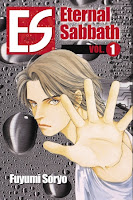
ES: Eternal Sabbath, Volumes 1-8 by Fuyumi Soryo. I originally read the first four volumes of Eternal Sabbath from the library, but I liked the series so well that I picked up an entire set for myself. Shuro’s development as a character was particularly interesting. Incredibly intelligent and mature for his age, he is inexperienced emotionally and has to come to grips with this. And he isn’t the only character to grow and change throughout the series. The story itself explores some tough moral questions. The ending was a bit abrupt and parts of it were a little disappointing–Soryo probably could have used a couple more volumes finish–but I still really enjoyed the series.

Gantz, Volumes 1-5 by Hiroya Oku. The artwork is gloriously graphic and slightly disconcerting, but I do like it. However, there is bit more fan-service and misogyny than is necessary, although some of it is appropriate to the story. Gantz is dark. Gantz is violent. Gantz is edgy. It’s hard to say where Oku is going to go with the series and what the aim is or if there is some deeper meaning, but so far the examination of the human psyche is very interesting. The willingness that some characters show to participate in a deadly “game” that they don’t even understand is fascinating. I’ll probably keep with the series for a bit longer; I’d really like to know what is going on and there’s a lot of potential.

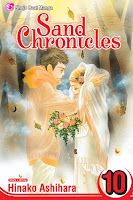
Sand Chronicles, Volume 10 by Hinako Ashihara. This is the final volume of Sand Chronicles which remains one of my favorite shoujo series. The main story ended with the eighth volume; volume ten is a side story that takes place when the main characters are in their thirties. They still struggle to accept and deal with their pasts which is not at all an easy thing. The emotional authenticity of Sand Chronicles has been one of its highlights throughout the series and the final volume is no exception. It provides a very satisfying conclusion (and continuation) to the series. The focus this time is on Daigo and it’s nice to see a bit more of the story from his perspective.

Under Grand Hotel, Volumes 1-2 by Mika Sadahiro. Incredibly intense, Under Grand Hotel is fiercely passionate and violent. Turn to a random page and you’ll most likely end up in the middle of a sex scene, but I was okay with that. Taking place in an underground prison, the manga is certainly a fantasy but a completely developed one. Sword is the shot-caller at UGH and Sen becomes his cellmate and lover for protection. At first it’s simply a convenient arrangement, but it soon becomes more. It’s not really a romantic love that is fostered, but instead the two men become mutually dependent upon one another and their lives are intertwined to such an extent that they can’t break free.

Departures directed by Yōjirō Takita. Departures won an Oscar for Best Foreign Language Film in 2009, an honor that is well deserved, among many, many other awards. Daigo lands his dream job as a cellist just before the orchestra is dissolved. (As a fellow “failed” musician, I completely understand what he is going through.) He returns to his hometown and, mostly by chance or fate, becomes the assistant to an encoffiner. It’s a misunderstood a job that isn’t looked well upon, and so he tries to hide it from his wife and is unsure about pursuing it himself. Departures is a beautiful film that faces life and death head on without getting too heavy.

Gantz (World Premiere Live Event) directed by Shinsuke Sato. It was really unfortunate that they decided to screen this with an English dub rather than subtitles. Otherwise, the films seem to be a fairly decent adaptation of the manga so far and the visuals are great. The suits in particular are fantastic. However, for as much action and violence that is in the movie, the pacing seems to drag quite a bit. It also seems to be missing some of the intensity and edge present in the manga. I did enjoy Kenji Kawai’s score and the music was just the right mixture of creepy and driving. The actors did a fine job, particularly Kenichi Matsuyama, and I’m interested in seeing the second part of Gantz when it is released latter this year.

Filed Under: My Week in Manga Tagged With: Eternal Sabbath, film, Fuyumi Soryo, gantz, Hinako Ashihara, Hiroya Oku, manga, Mika Sadahiro, sand chronicles, Shinsuke Sato, under grand hotel, Yōjirō Takita

Hey, Sensei?

June 13, 2010 by Ash Brown

Creator: Yaya Sakuragi
U.S. publisher: Digital Manga
ISBN: 9781569700471
Released: April 2009
Original run: 2007

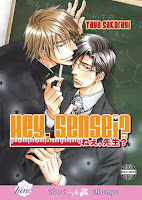
It is almost entirely the fault of Yaya Sakuragi’s Hey, Sensei? that I am now gladly suffering from an addiction to yaoi. Before Hey, Sensei?, I had never read yaoi. I had a basic understanding of the genre, but for whatever reason I had never tried it. (It actually really surprises me how long it took me to get around to reading any.) So, when I came across a review on Graphic Novel Reporter praising Hey, Sensei?, especially for not falling into some of the traps of the genre, I figured “Hey, why not? I gotta start somewhere.” I tracked down a copy with a little bit of difficulty and when it finally arrived I only allowed myself one chapter a day to make it last. Since then I’ve read plenty more yaoi and continue to do so but Hey, Sensei? remains one of my favorites—not just because it was my first yaoi manga, but because it is really quite good.

Hey, Sensei? actually contains two stories: the main story “Hey, Sensei?” which is four acts and an epilogue, and “Unbreakable Bones,” which is a one-shot. In “Hey, Sensei?”, high school math teacher Isa is taken aback when his ex-girlfriend’s younger brother, now one of his students, makes a pass at him during a review lesson. Isa can hardly take the situation seriously—what could Homura possibly see in a guy ten years older than him? The age difference will cause some difficulties, and they communicate terribly, but the two men have fallen hard for each other. In “Unbreakable Bones” two childhood friends are unexpectedly reunited after fourteen years. After growing apart, Yuji became a juvenile delinquent although he’s turned his life around and is now working in a ramen shop, while Manabu has become the small town’s local policeman. Yuji hates the idealized memories Manabu has of him, only to realize that he’s the one stuck in the past.

I really enjoy Sakuragi’s art style. Her men are distinctive and handsome and are unmistakably male. Her figures are elongated and angular, particularly noticeable in the hands and fingers and in the long, lanky legs when standing. These slightly odd proportions may bother some people, but I quite like the effect and love her character designs. Sakuragi also does a fantastic job with facial expressions, especially with the eyes; the characters don’t always come out and say what they’re feeling but it’s pretty apparent just by looking at them. She is also skilled in showing the same character at different ages and make the changes look natural while still being identifiable. One issue that I did have with the art was that the genitals were blurred out or erased. However, I’m not sure if this is the case in the original Japanese version or if the art has been censored for the United States which does happen. Either way, I found it distracting and feel that it calls more attention to itself that way.

While the stories in Hey, Sensei? may not be particularly original, Sakuragi makes up for it with the depth of her characters and their feelings for one another. Homura is immature, hot-tempered and brash but ultimately very sincere while Isa is inexperienced, sensitive and reserved but very capable of being stern when necessary; Yuji and Manabu’s relationship is also very sweet. The translation has an occasional awkward moment but overall is very good. In addition to Hey, Sensei? becoming a favorite, I have also become a huge fan of Yaya Sakuragi—I’ve also read and loved her Tea for Two series—and will pick up anything that she has worked on. However, Hey, Sensei? will always hold a special place for me. It’s one manga, yaoi or not, that I come back to again and again.

Filed Under: REVIEWS Tagged With: Digital Manga, Juné, manga, Yaya Sakuragi

To Terra… Vols. 1-2

May 27, 2010 by MJ 4 Comments

To Terra… Vols. 1-2
Written by Keiko Takemiya
Published by Vertical, Inc.

Sometime in the distant future, human beings, having conquered their enemies (natural and otherwise) have destroyed their environment beyond repair. Despite the development of warp-speed travel, humankind’s attachment to their home planet is so strong, even the establishment of a strict totalitarian society is preferable to leaving their beloved Terra. Thus the “Superior Domination” (“S.D.”) era is born–a social order intended to slowly bring the planet back to life.

The S.D. method for rejuvenation of its environment involves the development of a society made up of perfectly mature (read: obedient) adults–a circumstance it strives to create by removing biologically created families from the planet altogether. Under a new system mandating test-tube birth, the S.D. young are placed with government-chosen foster parents who provide ideal upbringing on Ataraxia, a planet used only for child-rearing. Once a child reaches the age of 14, he or she must undergo a psychically-administered “maturity test” to determine his or her suitability for adult life on Terra. Passing students will have their memories erased before being transferred to computer-run educational stations, where mental and psychological progress will determine their future employment and social standing as adults on Terra. Failures are unceremoniously eliminated.

The story’s primary characters are Jomy, a human who discovers he is actually “Mu,” a mutated species possessing strong psychic abilities whose members have been driven into hiding, and Keith Anyan, a model student from the S.D. educational system whose role as a Terran elite is to hunt down and destroy the Mu. Over the course of the series’ first two volumes, these characters will plot, scheme, and fight, but though the narrative is compelling, it’s hardly the point.

Two things make To Terra… special. The first is its beauty. Created by Magnificent 49er Keiko Takemiya, the series is filled with lush backgrounds, inspired panel designs, and an expressive sensibility unusual for shonen manga. Interestingly, when compared with the artwork and narrative style of fellow 49er Moto Hagio’s short science fiction series, They Were Eleven (which ran in Shojo Comic in 1975) it’s To Terra… that comes out feeling more typically shojo, with its heart-wrenching internal monologues, bishonen heroes, and boys’ love undercurrents.

Secondly, the series is distinguished by its author’s ambition. Having established her elaborate universe in meticulous, hard sci-fi detail, Takemiya tackles environmentalism, genetic engineering, fascism, ethnic persecution, and even the very nature of human identity, all in three oversized volumes. From a narrative standpoint, this seems doomed to failure. From emotional and visual perspectives, it’s absolutely stunning to behold.

Takemiya’s universe is fraught with emotion–intense psychological pain, brutal terror, soothing comfort, intense loyalty, and a longing for home so deep that it is able to control the fate of societies on two sides of a war. The story’s primary rivals (Jomy and Keith) are both relatable and heroic, each hindered by the biases of his people but special enough to envision something outside what he’s been taught.

Yet for all her characters’ deep thought and sympathetic tendencies, Takemiya keeps her readers at arm’s length. By refusing to choose a clear hero (at least over the course of the first two volumes), Takemiya keeps the door closed to personalization or self-insertion, safely encasing her beautiful, fiery universe within smooth plates of glass.

This is not a bad thing by any means. On the contrary, it’s this impersonal sheen that prevents the story’s melodrama from overwhelming its craft, which is so masterful on an aesthetic level, it would be a tragedy to miss. Though this lack of intimacy feels a bit jarring in the midst of such shojo-flavored visuals, it is the key component in saving the series from collapsing under its own weight.

Can To Terra… succeed in its quest to pinpoint the source of humanity’s fatal flaw or define the nature of identity? Most likely not. Does it matter? Not in the slightest. From its opening pages, To Terra… is an intricate, sci-fi beauty, not to be missed.

Review written as part of the Manga Moveable Feast.

Filed Under: MANGA REVIEWS Tagged With: manga, Manga Moveable Feast, to terra

Manga: who’s buying?

May 27, 2010 by MJ Leave a Comment

That’s the question I ask today at Examiner.com. In the midst of the manga blogosphere’s recent (understandable) doom and gloom, it seems like everyone’s talking about who’s not buying manga, but few are talking about who is.

Watch as I muse on current events, treat anecdotal evidence as scientific theory, and misspell the name of Boston’s only serious manga seller! Whee?

In all seriousness, though, I do think there’s some truth in my (tentative) assertion that adults are buying manga. From Viz’s new commitment to its SigIKKI line to Vertical’s wealth of new licenses, what’s clear to me is that though publishers are staying cautious, they’re not backing off. My “to be reviewed” stack has more seinen (and even josei) in it than I would have imagined just a year ago. So what does this mean? Check out my post and let me know what you think!

Filed Under: NEWS Tagged With: examiner.com, manga

Breaking Down Banana Fish, Vols. 3-4

May 25, 2010 by MJ, Connie C., Michelle Smith, Katherine Dacey, Eva Volin, Robin Brenner and Khursten Santos 24 Comments

Welcome to the second installment of the Banana Fish roundtable!

This month, we discuss volumes three and four of this classic shojo series, in which Ash gets out of jail, Eiji and Ibe overstay their visas, and everyone ends up on an ill-considered road trip to L.A., just in time to fall into the hands of a Chinese mafia family’s secret weapon. Topics this round include what makes a shojo manga, thoughts on the series’ few female characters, and everyone’s take on new bad guy, Yut-Lung.

Once again, I’m joined by Michelle Smith (Soliloquy in Blue), Khursten Santos (Otaku Champloo), Connie (Slightly Biased Manga), Eva Volin (Good Comics For Kids), Robin Brenner (No Flying, No Tights), and Katherine Dacey (The Manga Critic), all of whom graciously found time in their incredibly cramped schedules to indulge me in this discussion. …

Read More

Filed Under: FEATURES Tagged With: banana fish, breaking down banana fish, manga, roundtables

New at Examiner.com

May 24, 2010 by MJ Leave a Comment

Here’s a quick post to let you know what’s new so far this week from your Boston Manga Examiner.

On Monday, I posted my (now) weekly rundown on weekend manga talk from local bloggers, Latest links from local manga critics, featuring items such as Kate Dacey’s intro to To Terra for this month’s Manga Moveable Feast, the Good Comics for Kids smackdown of DC Comics, and Katherine Hanson’s new review of unlicensed yuri series, Otsu Hiyori’s Mizu-iro Cinema.

Look for my contribution to the To Terra celebration here at Manga Bookshelf sometime over the next couple of days.

Next, a short commentary on the current state of classic shojo from North American publishers, The plight of classic shojo, inspired both by disappointing losses via the shutdown of CMX and exciting recent licenses from DMP and Fantagraphics. …

Read More

Filed Under: NEWS Tagged With: examiner.com, manga

  • « Go to Previous Page
  • Page 1
  • Interim pages omitted …
  • Page 36
  • Page 37
  • Page 38
  • Page 39
  • Page 40
  • Interim pages omitted …
  • Page 60
  • Go to Next Page »
 | Log in
Copyright © 2010 Manga Bookshelf | Powered by WordPress & the Genesis Framework