• Skip to primary navigation
  • Skip to main content
  • Skip to primary sidebar
  • Home
  • About Us
    • Privacy Policy
    • Comment Policy
    • Disclosures & Disclaimers
  • Resources
    • Links, Essays & Articles
    • Fandomology!
    • CLAMP Directory
    • BlogRoll
  • Features & Columns
    • 3 Things Thursday
    • Adventures in the Key of Shoujo
    • Bit & Blips (game reviews)
    • BL BOOKRACK
    • Bookshelf Briefs
    • Bringing the Drama
    • Comic Conversion
    • Fanservice Friday
    • Going Digital
    • It Came From the Sinosphere
    • License This!
    • Magazine no Mori
    • My Week in Manga
    • OFF THE SHELF
    • Not By Manga Alone
    • PICK OF THE WEEK
    • Subtitles & Sensibility
    • Weekly Shonen Jump Recaps
  • Manga Moveable Feast
    • MMF Full Archive
    • Yun Kouga
    • CLAMP
    • Shojo Beat
    • Osamu Tezuka
    • Sailor Moon
    • Fruits Basket
    • Takehiko Inoue
    • Wild Adapter
    • One Piece
    • After School Nightmare
    • Karakuri Odette
    • Paradise Kiss
    • The Color Trilogy
    • To Terra…
    • Sexy Voice & Robo
  • Browse by Author
    • Sean Gaffney
    • Anna Neatrour
    • Michelle Smith
    • Katherine Dacey
    • MJ
    • Brigid Alverson
    • Travis Anderson
    • Phillip Anthony
    • Derek Bown
    • Jaci Dahlvang
    • Angela Eastman
    • Erica Friedman
    • Sara K.
    • Megan Purdy
    • Emily Snodgrass
    • Nancy Thistlethwaite
    • Eva Volin
    • David Welsh
  • MB Blogs
    • A Case Suitable For Treatment
    • Experiments in Manga
    • MangaBlog
    • The Manga Critic
    • Manga Report
    • Soliloquy in Blue
    • Manga Curmudgeon (archive)

Manga Bookshelf

Discussion, Resources, Roundtables, & Reviews

Kodansha Comics

Vinland Saga, Vol. 1

October 9, 2013 by Ash Brown

Vinland Saga, Omnibus 1Creator: Makoto Yukimura
U.S. publisher: Kodansha
ISBN: 9781612624204
Released: October 2013
Original release: 2005
Awards: Japan Media Arts Award, Kodansha Manga Award

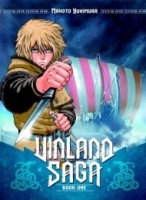
Makoto Yukimura’s Vinland Saga is a manga series that I have been hoping would be licensed in English for years. Understandably, I was thrilled when Kodansha Comics announced that it would be publishing the series. Not only that, Vinland Saga is Kodansha’s first foray into deluxe, hardcover manga. Kodansha’s edition of Vinland Saga uses a larger trim size than its other manga, contains color pages, and is being released in an omnibus format. The first volume of Kodansha’s Vinland Saga, published in 2013, collects the first two volumes in the original Japanese edition of the series, both of which were released in 2005. Vinland Saga is a critically acclaimed, award-winning manga. In 2009, Yukimura earned a Japan Media Arts award for the series. Even more recently, Vinland Saga won a Kodansha Manga Award in 2012. Even if Vinland Saga wasn’t already so well received, I would still want to read it. Yukimura is a the creator of Planetes, which I love, and I also happen to have a particular interest in Iceland among other things.

When he was only six years old, Thorfinn’s father was killed before his very eyes. Thors was a great man and a great warrior, but that was a life he tried to leave behind in order to live with his family in peace in a small Icelandic village. Thors’ past is inescapable and ultimately leads to his death, but in the process he is able to protect what is most dear to him. Even at such a young age Thorfinn vows to avenge his father. Ten years later he has grown into a hostile and stubborn young fighter serving under the very man who was responsible for his father’s death. Askeladd is a shrewd and cunning leader, his band of mercenaries willing to take on any job for the right price. Their battle prowess is fearsome, relying not only on their sheer strength and power but on underhanded strategies and their willingness to be utterly ruthless. Askeladd and his men may be uncouth, but they are also a terrible force to be reckoned with.

Vinland Saga is historical fiction and the series is inspired by actual events and people as well as by Norse sagas. The great adventurer Leif Ericson plays a significant role in the first omnibus of Vinland Saga and Thorfinn himself is loosely based on another explorer–Thorfinn Karlsefni. Considering that the manga deals with eleventh-century warfare and Vikings, a northern Germanic group of seafarers notorious for raiding and pillaging, it’s probably not too surprising that Vinland Saga can be rather violent. The battles in Vinland Saga are particularly well done. Some of the physical feats may be astounding or even slightly exaggerated–there are some very good reasons that Askeladd’s mercenaries are so feared–but the flow of the battles are very realistic as are the resulting deaths and injuries. Yukimura hasn’t forgotten the use and limitations of technology and tactics in Vinland Saga and they are appropriate for the era being portrayed. In general Yukimura’s action sequences are very exciting and leave quite an impression.

Vikings are often depicted as savage, bloodthirsty invaders in fiction but this portrayal misses some of the nuances and complexities of the historical reality. Yukimura notes in the afterword of the first volume of Vinland Saga that he wanted to show more than just a stereotypical representation of Vikings in his story. I think he is very successful in that. Much of Vinland Saga, Omnibus 1 focuses on brutal skirmishes, battles, and duels, but the development of Thorfinn and his family–particularly his father, but his mother and sister, too–as well as their Icelandic village and the other people who live there is also very important. The exceptional events surrounding the outbreak of war may be some of the major driving forces behind the story but the more mundane affairs of everyday life, such as the concerns over the changing weather and the coming winter and disputes over land for grazing, provide additional depth and realism to the series. I thoroughly enjoyed the first Vinland Saga omnibus and am looking forward to the release of the second.


Filed Under: REVIEWS Tagged With: Japan Media Arts Award, kodansha, Kodansha Comics, Kodansha Manga Award, Makoto Yukimura, manga, Vinland Saga

Dropping Our Gaze Before the Glory of Nakayoshi

October 2, 2013 by Erica Friedman Leave a Comment

Nakayoshi-Oct13In a world of stories about and for Princesses, Nakayoshi is Queen.

Nakayoshi Magazine, published by Kodansha Publishing, is the oldest continuously-published manga magazine for girls. Begun in 1954, Nakayoshi sells 170,834 copies a month, according the the Japanese Magazine Publishers’ Association. Nakayoshi has disctictively colorful covers wrapped around 500 pages of stories that range from the most light-hearted magical girl to far more serious travails of love, life and even adventure.

In the 1990s, Nakyoshi branched out into anime. Sailor Moon, a popular series running in Nakayoshi at the time, is widely considered to be the catalyst that broke shoujo out of being a small, self-contained niche, into mainstream anime and manga awareness, both in Japan and the West. Now that Sailor Moon is on the verge of a revival for it’s 20th anniversary, the pages of Nakayoshi are once again filled with teasers, and themed goods for the series.

If you’ve been reading manga for more than a few years, I’d bet dollars to donuts that you’ve heard of, if not read, a Nakayoshi series. Sailor Moon, Card Captor Sakura, Magic Knight Rayearth and Saint Tail are all “gateway” series for folks who came to anime and manga in the 1990s. Recent popular series are Ghost Hunt by Inada Shiho,  Shugo Chara! by Peach Pit and Jigoku Shoujo and Jigoku Shoujo R (Published in English as Hell Girll) illustrated by Etou Miyuki.

Nakayoshi, like its competition in the girls’ manga market, comes packaged with “furoku;” small gifts, jewelry, accessories, stickers, etc., branded with series from the magazine, or with the Nakayoshi brand itself. The current issue, for instance, contains a paper stationary set. Nakayoshi has a website on which each series is given a page with character introductions, links to published volumes, available downloads and other typical website features. Trial chapters of current  manga is available on the website as are video trailers and promotions. Nakayoshi also has ongoing recruitment for new artists, a change from even a few years ago.

At 500 pages for 580¥ per volume, ($5.90 at time of writing,) Nakayoshi can surprise you with nearly every page. Following “DokiDoki Precure,” which as an extremely popular anime franchise in Japan, is a pretty straightforward magical girl story. “Watashi ni XXX Shinasai” is a comedy-romance, Andou Narumi returns with “Waltz no Jikan,” a love story built around that favorite of young girls everywhere…ballroom dancing. “Sabagebu~!” follows a transfer student who finds herself embroiled with the heavily armed Survival Game Club at her new school and has just been slated for 2014 anime. And even wildly popular music idols such as Vocaloids and AKB48  have a niche in Nakayoshi, as their manga runs in the pages. You really just never know what you’ll find in the pages of this Grand Old Dame of girls’ manga.

Nakayoshi Magazine from Kodansha Publishing: http://kc.kodansha.co.jp/magazine/index.php/01033

Filed Under: Magazine no Mori Tagged With: Erica Friedman, Kodansha Comics, Manga Magazine, Nakayoshi

Sherlock Bones, Vol. 1

September 21, 2013 by Ash Brown

Sherlock Bones, Volume 1Author: Yuma Ando
Illustrator: Yuki Sato

U.S. publisher: Kodansha
ISBN: 9781612624440
Released: September 2013
Original release: 2012

Sherlock Bones is currently a seven-volume manga series written by Yuma Ando and illustrated by Yuki Sato. The first volume was originally released in Japan in 2012 while the English-language edition was published by Kodansha Comics in 2013. I didn’t realize it at first, but I was already familiar with Sato and Ando’s previous works in English. Sato is the creator of Yokai Doctor and Ando (one of many pen names used by Shin Kibayashi) worked on Bloody Monday and Drops of God. More thematically relevant, Ando was one of the original creators of The Kindaichi Case Files. Sir Arthur Conan Doyle’s Sherlock Holmes is a well-loved and well-known detective worldwide and this is no exception in Japan. Sherlock Bones is only one Japanese work among many that is directly inspired by Doyle’s stories. I was vaguely curious about the series when it was licensed, but it wasn’t high on my list of manga to acquire. Happily, Kodansha sent me a review copy of Sherlock Bones, Volume 1, so I was able to give the series a try sooner rather than later.

When Takeru Wajima adopted a puppy from the local animal shelter, he had no idea what he was getting into. Most new pet owners have to worry about things like house and obedience training, but Takeru has an entirely different problem to deal with–Sherdog is the reincarnation of none other than the brilliant detective Sherlock Holmes. Oh, and Sherdog can speak (at least to Takeru, that is) and he is certain that his new owner is the reincarnation of his dear friend and faithful assistant Dr. John H. Watson. It’s not as if the two of them go out looking for mysteries to solve, but Sherdog and Takeru seem to be drawn into criminal investigations. When one of Takeru’s classmates is killed, and Sherdog is the only witness to the crime, they must find a way to prove the guilt of the murderer. Sherdog may have the brains to determine a solution, but it will be up to Takeru to do all of the legwork. After all, who else would belive, let alone understand, a dog.

I’ll admit, I was more than a little skeptical going into Sherlock Bones. I thought that the premise–Sherlock Holmes reincarnated as an adorable puppy–would be silly at best. And it is silly, but it also ends up being a good deal of fun. I was honestly surprised by how much I enjoyed the first volume of Sherlock Bones. Its mix of goofiness and seriousness is entertaining even if it is rather ridiculous. So far, though, it seems to work. There’s Sherdog himself–appalled that he’s a canine, though on occasion he will deign to use it to his advantage–and then there’s Takeru, who seems to be a good kid even if he’s understandably a bit befuddled by the whole situation and less than convinced that he’s Watson’s reincarnation. I also like that the entire Wajima family is made up of police officers and investigators–father, mother, and sister–so Takeru’s poking around into various criminal goings-on doesn’t seem too out-of-place.

As for the central case in Sherlock Bones, Volume 1, the mystery doesn’t lie within who killed the unfortunate student. Even why the murder took place can be fairly easily deduced. The trick is in how the culprit establishes an alibi and then carries out the deed. In part this is where Sato’s artwork plays an important role–the major clues that help Sherdog and Takeru crack the cases in Sherlock Bones, Volume 1 can be found right there on the page even before they solve the mysteries, waiting for observant readers to notice. I appreciate this sort of potential for engagement in the mystery fiction that I read, and so was happy to see it included in Sherlock Bones. Granted, not all of the clues are revealed in this way, especially when things like color come into play, but overall I was pleased with how the story and art worked together to form a cohesive whole. Sherlock Bones was a pleasant surprise for me and I look forward to reading more of the series.

Thank you to Kodansha for providing a copy of Sherlock Bones, Volume 1 for review.

Filed Under: REVIEWS Tagged With: kodansha, Kodansha Comics, manga, Sherlock Bones, Yuki Sato, Yuma Ando

No. 6, Vol. 2

September 18, 2013 by Ash Brown

No. 6, Volume 2Creator: Hinoki Kino
Original story: Atsuko Asano

U.S. publisher: Kodansha
ISBN: 9781612623566
Released: August 2013
Original release: 2011

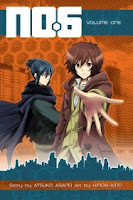
My introduction to Atsuko Asano’s No. 6 was through the anime adaptation of the original novels. I enjoyed the setting and characters, but was disappointed in the anime’s rushed, original ending. Asano’s No. 6 novels are unlikely to be released in English, so I was glad when Kodansha licensed Hinoki Kino’s manga adaptation of the series. The second volume of the No. 6 manga, originally published in Japan in 2011, was released in English in 2013. Although Kino’s character designs are based on the same ones used for the anime and many of the underlying elements are the same (they are both adaptations of the No. 6 novels after all), Kino’s version of the story is different. The first volume of the manga was a little too quickly paced for my taste, but for the most part I still enjoyed it. However, I did have hopes that the second volume would slow down a bit after the first volume‘s rush to establish the characters, story, and setting.

After barely escaping from the holy city of No. 6, Shion is now a fugitive hiding in West Block, a dangerous area outside of the city walls and No. 6’s dumping grounds. Although he is out of immediate danger, he still has a lot to learn about West Block if he hopes to survive there. The violent and bleak conditions outside the city are very different from the peaceful and pampered life that Shion led in No. 6. The only reason he’s made it this far is thanks to the help of Rat, the young man whose life Shion once saved as a boy. The two make an unusual pair. Shion is altruistic and slow to doubt people, characteristics which could get him into big trouble in West Block, while Rat only looks out for himself and is much more wary of others. Saving Shion’s life was a way for Rat to repay his debt, but in the process he has begun to open up to another person. For the time being Rat persists in watching over the other young man, but he is also capable of turning on Shion at any moment.

One of my favorite things about the No. 6 anime was the relationship between Rat and Shion. I’ve happily found this to be the case with the manga as well. Even though it’s only the second volume, there has already been some very nice character development. Both Shion and Rat are beginning to change due to the circumstances surrounding Shion’s escape from No. 6 and their continued association with each other. As Shion is faced with the harsh realities of living in West Block and Rat’s seemingly uncaring attitude, he is learning to stand up for himself and what matters to him. In turn, Shion is also influencing Rat to a much greater extent than either of them at first realize. When it comes to Shion, Rat finds himself acting out of character and letting his guard down. It understandably bothers and worries him, but it’s also rather touching from an outsider’s perspective. I’m really enjoying watching their relationship evolve in No. 6.

In addition to character development, the second volume of the No. 6 manga also reveals more about No. 6 and West Block. As Shion experiences West Block first hand, nearly getting killed in the process, the readers are also introduced to the world in which he now lives through the people he meets–the children who are starving, the marketplace vendors who are quick to pull guns on thieves, the prostitutes and pimps. Everyone is struggling to get by in any way that they can. It also reveals in part why Rat has the personality that he does. To survive in West Block requires people to place their own needs above those of others. Simply trusting another person means taking a huge risk. It’s a hard lesson for Shion with his innocent nature and privileged upbringing. The second volume of No. 6 does build and improve on the first in its pacing, characterization, and world-building. I can honestly say that I’m looking forward to the next volume of Kino’s adaptation.

Filed Under: REVIEWS Tagged With: Atsuko Asano, Hinoki Kino, kodansha, Kodansha Comics, manga, no. 6

No. 6, Volume 1

June 8, 2013 by Ash Brown

Creator: Hinoki Kino
Original story: Atsuko Asano

U.S. publisher: Kodansha
ISBN: 9781612623559
Released: June 2013
Original release: 2011

Hinoki Kino’s manga adaptation of No. 6 is the second adaptation of Atsuko Asano’s nine-volume series of science fiction novels to be released in English. The first, and my introduction to No. 6, was the 2011 anime adaptation directed by Kenji Nagasaki. While I largely enjoyed the anime, the rushed and fumbled ending left me disappointed. The first volume of the No. 6 manga was originally published in Japan in 2011, a few months before the anime began airing. Kodansha’s English-language edition of No. 6, Volume 1 was released in 2013. It’s highly unlikely that Asano’s original novels (which are really what I would like to read) will ever be licensed in English, and so I was intrigued when Kodansha announced that Kino’s manga adaptation would be published. Since the series is still currently being serialized in Japan, I’m hoping that the story will have a properly executed ending this time around.

On the surface, the city of No. 6 appears to be an ideal, utopic society. The crime rate is negligible. Medical and technological advancements offer its citizens unprecedented comfort and care. Shion is among the elite of the elite. Identified at a young age as a prodigy with a particular affinity for medicine and ecology, he and his mother have their every need provided for by the city. But when Shion saves the life of a young fugitive named Rat, helping him to escape, Shion is stripped of his status and special privileges. He has seen a brief glimpse of the darker side of No. 6. Four years later he’ll see even more when he stumbles upon a pair of bizarre deaths and he becomes the perfect scapegoat for the supposed murders. With his own life now in danger, Shion has a decision to make: flee No. 6 and the only life he knows or remain in a city that no longer considers him human.

The first volume of No. 6 does a nice job of establishing the series’ two main protagonists: Shion and Rat. Although the two young men share an important connection with each other, they come from very different backgrounds and have very different personalities. Shion is intelligent but sheltered and there’s a certain innocence about him. He comes across as a bit naive and socially awkward, but he is intensely curious and searches for the significance behind things. Even though most of Rat’s past hasnt’ been revealed, it is quite clear by the end of the first volume of No. 6 that he has had a much rougher time of it. He is quick-witted but world-weary and cynical. The underlying meaning of a situation isnt’ nearly as important to him as is the immediate reality. It’s simply a matter of survival. In part because they are so different, Rat and Shion find themselves drawn to each other.

After only one volume, No. 6 has yet to really distinguish itself from other dystopian fiction. It’s a fairly standard set up with a seemingly perfect society that’s not quite everything it appears to be. The manga itself often feels very rushed in places and lacking in details in others. There were a few scenes that had I not previously seen the anime would have left me momentarily confused. In the afterword Kino admits to having had to cut much more from the manga than was ideal in order not to surpass page limits. Even so, No. 6, Volume 1 provides the needed introduction to the story and outlines the world in which it takes place. I hope that now that the stage has been set that the manga will have room to breath and slow down a little. It is a different version of the story than was seen in the anime; I’m looking forward to seeing where Kino takes it.

Filed Under: REVIEWS Tagged With: Atsuko Asano, Hinoki Kino, kodansha, Kodansha Comics, manga, no. 6

Adventures in the Key of Shoujo: Sailor Moon, Vol.7

April 20, 2013 by Phillip Anthony Leave a Comment

sm7Pretty Guardian Sailor Moon, Vol. 7 | By Naoko Takeuchi | Published by Kodansha Comics USA | Rated: T, Ages 13+

What a difference a day makes, 24 little hours! I was going to write down a red hot review after finally, FINALLY getting through volume 7 of Sailor Moon. Then sleep and fatigue set in and I had a think about it. So now I’ll temper my steel as some of my thoughts last night don’t make a whole lot of sense the day after. So let’s begin!

We find our heroes recovering from their last battle and wondering about the mystery behind the Mugen Academy—specifically why the new Sailor Senshi Sailors Neptune and Uranus are so antagonistic toward the rest. Meanwhile, Chibi-Usa is starting to worry about her new friend Hotaru Tomoe, a girl whom we met briefly in volume 6. Hotaru is the daughter of Professor Tomoe who runs the Mugen Institute, which is part of the Mugen Academy. Are you following me so far? Because I can help matters by telling you that Mugen Academy is evil. We know this because Master Pharaoh 90 and her/his (I don’t want to guess at this point) minions, the Death Busters, are in cahoots with Professor Tomoe. See, the ol’ Prof is attempting to build the perfect life form, and he thinks the best way of doing this is by bonding life energy onto creatures of Tomoe’s design. What Chibi-Usa doesn’t know is that Hotaru is hiding a secret. I like how Hotaru clearly understands that her father’s work and she herself are dangerous, and that she tries to shield Chibi-Usa from the truth while trying to have a life. The poor girl just wants to be normal, but because of who and what she is, anyone innocent around her is in danger.

The thing that annoyed me about the last volume is the change in tone for Neptune and Uranus. Before, they were playful and a bit mysterious but now they are openly hostile toward Usagi and the rest of the team. They believe as protectors of Silver Millenium (the kingdom on the moon that Usagi and the rest once lived on) that they have to go ahead of Usagi who, as the future Queen, is in their care. They want to stop the ascension of Sailor Saturn who is only supposed to arrive on the scene when the world must be destroyed. This presents me with an interesting conundrum: if the two Sailor Senshi wish to prevent the destruction of, well, everything then they have to kill another Sailor Saturn before she can become a Senshi, then doesn’t that mean that they knew they would have to kill her from the get go? Plus, wouldn’t killing her go against being a team? It’s not really explained, so I’m left with these questions. Thankfully, Takeuchi doesn’t confuse the issue by having them explain the whole nature of the Silver Millenium and the pre-destiny of the Senshi. Still, Usagi’s constant cries of “Let us help you and work together!” and the Outer Senshi’s replies of “NOOOO! WE have to do this on our own! IT’S FOR YOUR OWN GOOD!!!” are confusing, as they are unnecessary.

One of my favourite characters from earlier volumes is Sailor Pluto. Sailor Pluto met her end in a previous volume and I missed her, because while she came across as very formal, her love for Chibi-Usa allowed a crack in her armor; she became my secret favourite Senshi (don’t tell Sailor Venus). Now, we spotted her in a reincarnated form at the end of volume six, and here she turns up again as Setsuna Meio, a researcher of all things. That’s not important because she’s back as Sailor Pluto as well. Strangely, while the other Senshi all became their alter-egos after coming into contact with Usagi, Pluto, along with Neptune and Uranus, already know that they are Sailor Senshi. This means they already know their jobs better than the others and they sometimes come across as older sister types despite being the same age. Pluto’s personality isn’t as full-on as the other two, but she’s not the same Pluto as the original version. The formality isn’t quite there yet, and she does love the other Senshi, but she feels as Neptune and Uranus do and wants to deal with the Mugen Academy without the Inner Senshi.

As for the fight with Mugen itself, the team receives a new power level and Usagi becomes Super Sailor Moon and lays a Chuck Norris-style beatdown on the minions of Master Pharaoh 90 (what’s with these ridiculous names!?). The others do try and fight against Mugen but they are quickly overwhelmed by the bad guys and Professor Tomoe (who goes all Dr. Jekyll and becomes a monster using his own research). He gets put down in the blink of an eye, so there’s something to be said for planning ahead. The greatest danger the team and Usagi are up against is something that I’ve been meaning to talk about since the character of Chibi-Usa was introduced. Hotaru goes mad with the creature that is inside of her and the creature, in lashing out, accidently absorbs the crystal energy that Usagi and Chibi-Usa both share. Chibi-Usa, being Usagi’s daughter, carries this ’round in the form of a crystal avatar. When it is removed, Chibi-Usa becomes fatally ill. Mamoru stays with her while Usagi goes to bring the smackdown on Mugen and get Chibi-Usa’s energy back. Now, this leads to said point of order. How does Usagi view Chibi-Usa? She and Mamoru ARE Chibi-Usa’s parents in the future so Mamoru clearly has paternal instincts toward his future daughter. But Usagi seems to fight for Chibi-Usa at every turn without showing any sign that she sees her as a daughter. It’s not like when she fights for the other Senshi—she fights for them in her own way. When Chibi-Usa is threatened, Usagi pulls out the big guns and not in a proactive way. When Usagi powers up and saves Chibi-Usa, she finds strengths and powers that she didn’t realize she had. Maybe this is her way of saying “this is my daughter, evil-doers, and I will kick your arse if you threaten her!”

The end of the manga calls for a showdown between the remains of Hotaru and Usagi. Whatever is left of Hotaru’s physical body is under the direct control of Master Pharaoh 90 and has destroyed the lab, the buildings and the academy. I don’t know how they’ll cover this up come the morning! Something happened to Hotaru’s spirit which leads me to believe she will be quickly resurrected in the next couple of volumes. I know I’m giving somewhat short answers here but this stuff literally comes up at the last second in the volume so I have no information to go on. Whatever happens, Sailor Moon is as always a mixture of the good, the bad and the unexplained.

Filed Under: Adventures in the Key of Shoujo Tagged With: Kodansha Comics, sailor moon, shoujo

Adventures in the Key of Shoujo: Sailor V, Vol.2

November 2, 2012 by Phillip Anthony 2 Comments


Codename: Sailor V, Vol. 2 | By Naoko Takeuchi | Published by Kodansha Comics USA | Rated: T, Ages 13+

Oh, ho. What a difference a few months make. I had planned to review the second volume of Codename: Sailor V right after I reviewed the first. Then, Sailor Moon became more important to read and review, so Minako’s final solo mission was put to one side. Now that I’m officially taking a breather from Sailor Moon (it’ll be back later this month) and making time for other stuff, I want to get Sailor V out of the way first. Not that it’s a chore to read it—in many ways it is like its sister series in terms of execution—but the tone is different between the two leads.

In our last volume with Sailor Venus, a twofold structure is in place. One constitutes the bulk of the volume and is completely deceptive as to the volume’s true intentions. The other is examined near the end of the book and sets up the story to be continued on a grander scale. To explain, we get Mina fighting crime and villains for the most part—and yes, whether it’s DeVleene with her evil fattening chocolates (shame on thee!) or the Atavistic family of Nyan-Nyan, Wan-Wan and Chu-Chu (some mothers do have them), she dishes out the smite most excellently. She takes all of this in stride, all the while whining and complaining to Artemis, her familiar, about everything. At the end of the DeVleene chapter, we get a glimpse of a character who will trigger the other plot restructuring, Phantom Ace. As the final chapters started, I had no idea that Takeuchi would pull the rug from under me and ramp up some drama and heartstrings being pulled. She hadn’t done it for the whole of the other volume, so I wasn’t paying attention. When she showed Phantom Ace looking like Tuxedo Mask, I should have known what she was up to.

In many ways, I wish that Sailor V had been like this from the beginning, with some kind of gravitas to anchor the story. But then I remember that before Venus (spoilers) joins the rest of the Sailor Senshi in Sailor Moon, the girls treat Sailor V as a hero and a very serious character. So without having the Sailor V series be goofy by default, it would have been weird for Takeuchi NOT to portray Venus as a goofball to begin with and then, as she matures, the serious girl that she is. Plus when the aforementioned serious arc starts in Sailor V, all of Mina’s notions about what exactly she is destined for change for the better, but not without a bittersweet cruelty to proceedings. Mina HAS to have these challenges or what does she want to fight for? Certainly not for boys or fame, both of which she chased and lost and laughed off—but only at the end of her journey does she see how far she’s come.

This made me ask the question, to myself at least, what is the heroine/hero in a story of destiny? Is she the instrument of destiny or the catalyst of destiny? Where does her free will stop and the path of the “chosen one” come into play? If Mina had not found Artemis that day, would Artemis have sought her out anyway? If the Boss (whom we never meet at all, strange that) had not pushed Artemis to accept Mina despite her spacey moments and her reckless attitude, would Mina have succeeded? I suspect that that Mina would have become a Sailor Senshi anyway, but her journey would have been longer. She has all the talents to be one; all she needed was to accept her destiny. In the end, though, she has to make the decision to accept it. This brings me to the destiny that is revealed to her at the end. It’s not as bad a destiny as some shoujo heroines get saddled with. Certainly it sets her up for the awesome nature of being a Sailor Guardian. But still, the mantle of responsibility has a downside.

Artwork-wise, I find that Takeuchi has clean lines and excellent design work especially when she has Mina transform into whatever disguise she needs to use and with the costumes the villains wear. Things get a little busy in the crowds scenes and yes, I still have difficulty following some of the action, but it’s more manageable than in Sailor Moon. The translations by William Flanagan are excellent and he gives us a healthy dose of reference notes at the end of the book. I’m really spoiled by the level of the work.

In the end, I would say that in order to get a complete picture of the whole Sailor Moon manga experience, Codename: Sailor V is required reading. It sets up parts of the story that the reader will recognize from the main series. It also provides a fully detailed origin story for a team member other than Usagi. Not that Usagi’s origin is more or less important than Mina’s. But this is Mina’s story, full stop. You don’t need to read it to enjoy Sailor Moon—the other saga being self contained. But this is a nice arc for a character who starts out as slightly ditzy and a klutz but who takes on the whole ball of wax in regards to knowing what her path looks like and what it will take to walk it. It’s definitely not what it appeared to be in its first volume and it is a rare thing indeed for me to find a manga where I kinda liked the main character but totally got them after only two volumes. Still, however serious the last parts become, the title remains fun until the end. Mina makes me laugh as she commits crimes against basic logic and sense. As I sit reading while my family and friends talk or move around me, Mina’s silliness lets me forget my troubles for awhile. I laugh at Mina, reply to a question someone in the room asked me, and then go back eagerly to see what Mina’s going to do next. My advice: buy the two volumes, have fun and go from there.

Filed Under: Adventures in the Key of Shoujo Tagged With: kodansha, Kodansha Comics, kodansha usa, manga, shoujo

Adventures in the Key of Shoujo: Sailor Moon, Vol. 6

October 3, 2012 by Phillip Anthony Leave a Comment

Pretty Guardian Sailor Moon, Vol. 6 | By Naoko Takeuchi | Published by Kodansha Comics USA | Rated: T, Ages 13+

A curious thing happened to me the other night. After reading the sixth volume of Sailor Moon, I looked back over the earlier volumes of the series, and I came to the inescapable conclusion that the Sailor Senshi could be confused with a murderous vigilante gang. Now, before you laugh, let me explain it this way. In this volume, the girls find themselves tangling with the Mugen Group and their master, Pharaoh 90. The entire clan of bad guys all live in an evil-looking tower and seem to be happy drawing in unsuspecting minions rather than going out to destroy. Oh, and no, I’m not kidding about the evil tower part, several characters mention the fact that they get a weird feeling just looking at it. Therefore it becomes evil, the Trashheap has spoken on the matter.

As I was saying, the Mugen group are turning their students into monsters with the aid of some questionable science, at best, and then said monsters go on a rampage. The Senshi turn up and vaporize the bad guy and everything’s all right with the world. But if you viewed it another way, the Senshi have been going around destroying public property, causing mass panics and riots to break out, and killing any God’s amount of singers/idols/famous people because they were in league with that month’s chief villain. Isn’t anyone going to notice they’re, I dunno, dead? Or that there seems to be an abnormal amount of incidents around this particular part of Tokyo? Don’t get me wrong, I’m as OK with suspension of disbelief as the next person but does Takeuchi expect us to believe that nobody has noticed anything, at all? One of these days, I’ll get an answer, I just don’t think it’ll come from Sailor Moon. Not that I mind, because in this volume, we are introduced to Sailors Neptune and Uranus, two of the more interesting Senshi. I only know of these two by internet reputation so in that respect, I’m kind of trying to walk around spoiler territory for myself here. Haruka (Uranus) is interesting in that she is presented as a girl and a fella. There’s no ambiguity with her/him when they interact with other people. Strangely, the only person who is confused and states that she is confused is Usagi but that’s because Uranus kisses her in her male persona. There’s something familiar about Haruka to Usagi and it upsets her to think about it. Curiouser and curiouser. Michiru as Neptune is not as exciting but she definitely is more mysterious. I think because of her lower profile, I worry that Takeuchi will give all the revelations to Uranus, and that would be not so good.

Also, we are introduced to Hotaru Tomoe, a person whom I’ve heard about but know nothing about. Hotaru is a sick young girl whose father works for the Mugen group in their laboratory. He’s kind of like the Josef Mengele of the Mugen group insofar that nobody he knows specifically is being hurt by what he’s doing. In the meantime, eh, what do a couple of students matter? How do people like Professor Tomoe get college educations? Does nobody notice when his report cards read “COULD WORK HARDER. COULD APPLY HIMSELF. COULD BE LESS EVIL.”? Whatever his problem, Hotaru looks like she needs a friend, and she gets one in the form of Chibi-Usa. After stumbling into her in front of the Tomoe lab, Chibi-Usa decides to hang out with her. Is this going to end well? I don’t know but I’m happy that Takeuchi has decided to give Chiba-Usa something to do other than hang out with Usagi and Mamoru and monopolise their time together.

One of the wildest moments for me in this volume is the amount of bad guys who get vapourised by the Senshi. Sweet Christmas, they get enough time to say things like (and I’m paraphrasing here) “Sailor Mars! Sailor Jupiter! You won’t stop me or my master, Pharaoh 90! I’ll defeat-AARGGGHHHH!!!” before being turned into crispy critters. They even have their power levels displayed above their heads at one point and I was thinking going from head to head, “One round, one round, two round, end of level boss.” I am telling you, reading manga shouldn’t be this much fun. Every time a new villain is introduced to the series, I keep thinking of Col. Trautman saying to the Sheriff in Rambo that if he (the Sheriff) wants to send that many men to deal with the problem to not forget a supply of body bags. It’s almost like there’s no reason to give any credence to these lieutenants, they are literally not going to be in the book long enough to like or hate. Their job is to advance the plot or the characters or both. I’m not disparaging the practice, I’m just saying that you should be aware going into the series.

William Flanagan’s translation notes return in full and as always they are fun but not exhaustive. Things like naming structures and meanings of places and things always help me whenever I read manga so I was missing them in the previous volume. Kodansha continues to put out an excellent book with it being just the right size for me when I’m trying to find my groove at home (I would never read Sailor Moon out on the streets of Dublin. I value my life more!)

We are just around the halfway point in the manga and yes, we have a new villain who is in the Bwa-Ha-Ha mode again but this time, we don’t know if the new Senshi are friend or foe. This complicates matters and makes for an interesting interlude

Filed Under: Adventures in the Key of Shoujo Tagged With: kodansha, Kodansha Comics, kodansha usa, manga, MANGA REVIEWS, shojo, shoujo

Adventures in the Key of Shoujo: Sailor Moon, Vol. 5

September 26, 2012 by Phillip Anthony 1 Comment

Pretty Guardian Sailor Moon, Vol. 5 | By Naoko Takeuchi | Published by Kodansha Comics USA | Rated: T, Ages 13+

I’m trying to put into words the ideas I’ve discovered with this volume of Sailor Moon. In this volume, the fight between Wiseman and his Malefic Black Crystal and our heroes reaches its crescendo. Some of our heroes are not going to be returning, I’m sad to say, and one character who only recently got introduced is for the chop. As I said, it’s not easy trying to explain the ideas I’ve had bouncing around since I finished the volume. I guess if we’re boiling it down, it’s the idea of infinity and eternity. In my mind, Sailor Moon and her friends embody the idea of infinity. The idea of infinity is that there is no end to it, stretching out into an endless horizon. The Sailor Senshi are that concept in action. On first inspection there seem to be limits to their powers. Even after three of them being captured, Sailor Moon still finds an unending horizon of strength to fight back against the power of Wiseman and his planet, Nemesis.

As the fight against Wiseman heats up to include fighting against one of their own, the team has to—has to—find the inner strength to defeat an enemy who just won’t stop. And in turning to eternity, we see the concept in Wiseman. Here is an enemy who has been waiting for so long to destroy Neo Queen Serenity, 30th Century Crystal Tokyo, and the Earth in general that he has been bleached by the universe until only the hate remains. He could wait forever for his revenge, he just doesn’t want to. In this volume, despite the team fighting their hardest fight, Wiseman and his cronies just keep coming.

The core of this volume is the maturing of Chibi-Usa into a girl who isn’t just the daughter of the King and Queen of Crystal Tokyo. She drops the bratty act in this volume and becomes a person who has only an idea about who she wants to be. The people around her only want the best for her but if she doesn’t recognize that, events will destroy the people she loves. The way Takeuchi writes the relationship between Usagi and Chibi-Usa, initially I despaired that it would degenerate into catty, screaming sessions between them. But Usagi starts seeing her as her daughter rather than the Queen’s daughter (Usagi has, up until this point, been viewing Chibi-Usa as another person’s daughter and not hers) and this causes her to risk everything. The person who helps her see this, surprisingly, is Mamoru. Without his character taking the risk to trust Chibi-Usa, the way Takeuchi is going with this wouldn’t work.

That’s not to say there aren’t problems with this volume. The other Senshi get pretty much pushed to one side and I thought they were treated as kind of “We need Sailor Magic artillery! Quick, call up our reserves!” And after I’ve been introduced to them properly over the last little while, it felt a bit jarring. Another problem is Demande (yeah, remember him?). We’ve been given hints that he’s really unsettled by something about Wiseman. When his suspicions are confirmed, he quickly descends into madness. Completely. Totally. I really mean this, he just goes crazy and does the whole Andross from StarFox: “If I go down, I’m taking you with me!” After watching him be so measured for the last few volumes, his spiral into CrazyTown is positively Shakespearean.

The destiny angle comes up again in this volume and I must say, I’m trying hard to figure out if Takeuchi will ditch putting Usagi in peril anymore. The reason I say that is because we know she becomes Neo Queen Serenity, so putting her in danger doesn’t make any sense since we know she’ll be ok. Yes, I know that she could be put into a pocket dimension or into the far future but still, I would feel kind of insulted if the author tried to do this.

If nothing else, normally I should hate the fact that Takeuchi keeps trapping me in endless cycles of “New enemy! Even more effeminate than the last! Another Senshi is kidnapped! Another massive fight! Another defeat for the Senshi! Another stand-alone fight between the big Evil Cheese and Sailor Moon!” I really should be annoyed because she hasn’t changed the record once, but really the parts I like the most about the fights are the little moments when Usagi and Mamoru try and reconnect with each other. They’re the parts that reveal the most about these two lovers and the lengths either will go for the other. It takes skill to pull the wool over my eyes like that and still get me to come back. Yeah, like I’m that important, right?

No translation notes this time around but that’s OK, there weren’t really any moments that confused me. One thing I wanted to ask you guys about. A few of the pages in the book are blurry and smudged. Dialogue is also blurred, so it’s a printing issue. Is this affecting anybody else’s copies? Let me know, would you?

We are nearing the halfway point of the series and while I’m enjoying myself, the fact is that little voice in the back of my head is whispering “It’s almost half over!” This makes me a little sad because I don’t want the merry-go-round to stop. It has to, I know, still here I am. This is a fine entry and I can’t say anything more praiseworthy in life than that.

(After a two month hiatus, I’m back on the column! Apologies if you were wondering where I had gone. The Kurosagi Corpse Delivery Service MMF kept me busy so I decided to skip doing a column post for August. I’m up at full speed again and I’d like to know if there are any immediate recommendations you would suggest for after I end covering Sailor Moon.)

Filed Under: Adventures in the Key of Shoujo Tagged With: kodansha, Kodansha Comics, kodansha usa, manga, MANGA REVIEWS, shojo, shoujo

Adventures in the Key of Shoujo: Sailor Moon Vol. 4

May 14, 2012 by Phillip Anthony Leave a Comment

Pretty Guardian Sailor Moon, Vol. 4 | By Naoko Takeuchi | Published by Kodansha Comics USA | Rated: T, Ages 13+

After my aggravation over volume 3, in this volume, things start taking on a more serious angle with the remains of the team trying to make sense of new villains (Black Moon), and the kidnappings of Sailors Mars and Mercury. Chibiusa’s backstory begins to be fleshed out and Usagi starts to buckle under the stress of having all her friends snatched away from her. I was really frustrated by the previous story’s lack of tension despite all the danger they were in, but Takeuchi re-applies the pressure by bringing more people in on the fact that the Sailor Senshi are missing. So now things are moving faster, and this is better for the narrative in my humble opinion.

I find that despite Usagi discovering her royal lineage, she proves she’s still a teenager with her jealousy over Chibiusa hanging out with Mamoru so much. But as we learn more about Chibiusa, we discover that Usagi and she are more alike than they realize. Turns out Chibiusa and Usagi are related to each other and Chibiusa is from the thirtieth century. Using the two girls as a sounding board, I often wonder what would happen if I met my future descendants. Would I have anything in common with them? Or more importantly, if they were in trouble, would I fight for them? It’s interesting to speculate, especially since I had previously derided Usagi’s somewhat childish behaviour towards Chibiusa. Does this completely absolve Usagi? No, she can still go over her boundaries into somewhat irrational territory but I’ll give her a pass from now on, within reason.

A little window gets opened in relation to Sailor Jupiter. Since she was introduced, I haven’t seen sight nor hair of the poor girl, except when she’s needed to defeat evil, blah, blah, blah. But I get an teeny tiny window into her thoughts and how important the others have become to her, and she then perfectly articulates why the rest of the girls and Mamoru don’t look (on the surface at least) to be all that concerned about their missing comrades. Also, we see her and Motoki have a tender, quiet moment only to have it snatched away without Motoki knowing it’s happened. Is this a comment on the attrition of war and its effect on its soldiers? It would be interesting if I could confirm this. The manga runs its usual wire-thin line between tragedy and comedy, so all bets are off in this volume as to where Takeuchi takes this.

In my quest to understand what theories you could derive from Sailor Moon, I’m looking at the concept of Black Moon as villains. For the most part, the individuals fall into the Dark Kingdom’s mold of villainy for villainy’s sake. But the overarching idea behind them (and I’m trying to stay out of spoiler zones here) is they are rebelling against the established order. They don’t want to simply accept that this is how society has gone and they won’t agree with it. The problem for them is, like all rebellions, there’s nothing inherently wrong with not wanting to go with the rest of society, just that once you get out of talking and protesting about your ideals, you reach an impasse. You can either accept that change will take time and get into the trudge of eventually changing things, or you decide more drastic measures are required. Black Moon falls into the latter category. So they murdered and maimed their way to the top of Chibiusa’s world and now want to do the same to the present. So in this way, I would surmise, the lesson here is you can get what you want, the only thing you’ve got to do is not mind stepping on people to do it. It would be fantastic to think Takeuchi was trying to say something about the manga industry but I fear I’m grasping at straws here.

Another thing that pops up is the idea of pre-destiny. For those who do not know, predestiny is the idea that all the major events in your life were pre-ordained before you ever existed and continue after you’re gone. Two people suffer this problem: Chibiusa and Mamoru. Mamoru is in a brief (and I’m stumbling for the next word) spiritual conference with his dead lieutenants—the ones who were Queen Beryl’s resurrected minions but who later came to see the folly of their ways. He wonders why he was even reincarnated if he can’t protect Usagi. Was he fated to fail? No, say his lieutenants, because you’re here means that Usagi will be Queen and you King. While Mamoru begins to understand from that point on, it’s not decided or explained by the author whether Mamoru’s men know this truth about him because it is a truth or because they have advanced knowledge. Is it predestiny if it’s imparted by a person outside the need for a personal destiny? On Chibiusa’s side, was she always fated to find Usagi and the Sailor Senshi? Is the fact that she’s related to Usagi a deciding factor in her arrival in our present? Again, no answers, just concepts.

I have to say this volume has me thinking, rethinking and over-thinking the plot and concepts it brings with it. We haven’t even talked about the amount of pressure Usagi—that she alone finds herself under by the end of the volume. Things get very grim for our heroes—decidedly so. While I’m sure there’s an inner light or a new spell to call upon, I find myself hammering away at the cogs of the machine rather than the machine itself.

Hey, I’ve a homework assignment for all of you, if you’re interested. Can you tell me what part of Sailor Moon got you thinking beyond the page? What ideas or theories did it throw up? If not Sailor Moon, you can use any shoujo manga you like. I’ll print whatever you send me in next month’s Sailor Moon post. If your comment has spoilers for SM, then I’ll ask MJto post them for me so I don’t read them ^-^!

After my blood pressure problems with dealing with volume 3, I should be equally angry with this volume, but that one conversation with Sailor Jupiter took the wind right out of my sails. So is the series getting better for me? Certainly, and my initial hangups about the series (it’s too girly, the villains are wishy-washy) have largely evaporated due to Takeuchi’s layering of plot on plot, dialogue over dialogue as we start to see the whole thing start to coalesce into something close to a concept in motion. This series, despite the occasional landmine, continues to shine and hold my attention.

Filed Under: Adventures in the Key of Shoujo Tagged With: kodansha, Kodansha Comics, kodansha usa, manga, MANGA REVIEWS, shojo, shoujo

Adventures in the Key of Shoujo: Sailor Moon Vol. 3

April 19, 2012 by Phillip Anthony 4 Comments

Pretty Guardian Sailor Moon, Vol. 3 | By Naoko Takeuchi | Published by Kodansha Comics USA | Rated: T, Ages 13+

Escalation and dissipation could be the by-words of this volume of Sailor Moon and oh, Lordy, is it interesting! To illustrate my point, I use science, specifically stellar physics. In some stars, after a star has used up its fuel, which it burns through Hydrogen to produce a nuclear fusion reaction, it will start to bloat as the star fuses helium to carbon and oxygen. The pressure within this star has been building since fusion stopped and now it’s reached its breaking point. Solar layer upon layer will violently blow itself off until all that is left is a white dwarf, a smaller, brighter version of the original, full of its own mysteries.

It is this analogy that works for me in my attempt to explain the events of this volume. We have the conclusion of the fight with the Dark Kingdom. Queen Metalia and Queen Beryl (how many queens can you have?) are in the ascendant. The team is desperately trying to save Usagi from a brainwashed Mamoru, who has grabbed her in an attempt to get the Legendary Crystal. Their attempts cause the team to travel to the frozen wastes of the Arctic circle.

For her part, Usagi is trapped inside the Legendary Crystal. After sacrificing herself to free Mamoru, Usagi finds herself in possession of a newfound energy with which to defeat the rulers of the Dark Kingdom. I have to say I like how it’s resolved—not in a rush nor ponderous fashion, just somewhere in between. Takeuchi ties up most of the elements from this arc, sets them into motion for the next arc, all while allowing fans who’ve wanted a resolution to get it without going “OK, show’s over folks! Goodnight!”

Now, I have problems with the next arc’s beginning. We are introduced to the new villains, Black Moon, who’s plan is to… I don’t have a clue. (Really, the villains in this series sometimes give the appearance of “Bwa-ha-ha-ha! Champions of Justice, fear me, for I am…!” being villainous just for the sake of being villainous) During a battle with the Senshi, they kidnap Sailor Mars. And then don’t do anything remotely villainous with her. Or attack the team again. Wait, what? I don’t mind the idea of dissipation, it’s just that the team lose all momentum. Even with Mars missing, they don’t seem that pushed, at least in my mind. They even deflect questions in school as to where Mars is. Doesn’t this girl have friends or family outside of the Sailor Senshi? Has anyone filed an APB or what? Am I being too critical? Am I only one who feels that this kind of dissipation after such an epic fight is kind of a letdown? I understand that we have a change of pace after the Dark Kingdom’s “Bwa-ha-ha-ha!” methodology but there’s no reason to suspect or even hint that the bad guys are mistreating Mars for their own purposes. At least, Beryl brainwashes Mamoru.

But the most glaring problem I have got is with Chibi-Usagi (or Chibiusa as she’s later to be know as). She’s a smaller version of Usagi who appears out of, literally, thin air, holding a gun (!) to Usagi’s head and demanding the Legendary Crystal from her. To top things off, she’s clingy towards Mamoru, brainwashes Usagi’s parents into letting her stay with them, has a magical key to something that nobody knows anything about. Luna says she’ll investigate but that she doesn’t suspect that Chibiusa is dangerous. Wait, what? Luna was intensely distrustful of Mamoru when he first appeared as Tuxedo Mask, and tried to stop Usagi from seeing him. But Chibiusa is just fine, no trouble. Oh, my brain hurts so badly. If Takeuchi’s plan was to confuse and annoy me, she’s been successful. Is this confusing to anyone else? What is the point of introducing a new adversary, knocking out a member of the team and then introducing a (frankly) baffling new character, inside half a tankoban? How does this help anyone? I am prepared to suspend judgement until I read the next volume but something has to give. I am starting to fray at the edges and I can only give so much leeway.

On a more positive note, the deranged second half also allows me to get some perspective on the overall view of the series. We’re nearly a quarter into the book’s run and we’re still no closer to even a hint at where the series is headed. I like this insofar as I can understand if Takeuchi wants to take time out to set up the next chess battle. Where I think the series’ strength lies is in the backstory. We now know that the Senshi and Mamoru are reincarnations of the People of the Moon and the Prince of Earth (Prince Endymion) respectively. But even after learning all that, we still don’t know their origins as Moon citizens (I never thought I would write that outside of a Gerry Anderson review). But the nicest part of the whole Moon Kingdom is when Usagi chooses to send all of them back to Earth instead of living on the now rebuilt Royal Castle grounds. They’ve got family who love them, back on Earth, so Usagi doesn’t want then to give that up. So it’s back to the only life they’ve known. It’s a nice touch, I like it.

It’s frustrating to read such excellent character development in one part and be baffled by another. I know Takeuchi isn’t doing it deliberately but I’m left asking why she makes her cast take on near insurmountable obstacles then act like total dopes the minute things hit easy street. And by the bye, things haven’t hit easy street because Sailor Mars is still missing!

Artwise, I still am impressed by Takeuchi and her ability to mix the sublime with the ordinary. Even if I don’t like Chibiusa, she’s an interesting character from a design point of view. She looks like a younger version of Usagi, naturally. But unlike more modern young characters in anime/manga, she’s not done from a fetish view. Maybe I’m just seeing what I want to see, but it’s nice to see someone have a higher sense of decorum (God, when did I start sounding like my parents?). Also, I’m happy to report that I finally am starting to be able to tell the difference between the Senshi! Maybe it’s me becoming accustomed to Takeuchi’s art style or maybe it was the handy inside pages at the beginning of the manga telling us who everyone is. I think Sailor Venus and Sailor Jupiter gave me the most trouble as they have similar hairstyles. But it’s becoming clearer—I’m starting to learn the importance of sticking with a series and its inherent value of having names to the faces.

Sailor Moon is great but this volume was trying for me, more specifically the second half with its stop-start-stop plotting. But that’s the nature of the beast, it seems. I’m learning pacing structure within a multi-volume series (something I could never be bothered to do before) and also that for every step you take forward as a reader you must be prepared to take a few steps back, occasionally, (or a lot, if you’re a person who has ever read Stephanie Meyer) at the behest of the author. With a few gripes, minor ones given my overall enjoyment of the series, I will recommend to you, Sailor Moon Volume 3.

In some respects, a white dwarf’s life is more interesting then its previous one. As a normal star it’s only concern is keeping itself going. But as a white dwarf, it faces an eternity as it burns brightly. It will fade one day as all things do. But until it does it will be a shining beacon in space, drawing in people as they gaze at it in wonder.

Filed Under: Adventures in the Key of Shoujo Tagged With: kodansha, Kodansha Comics, kodansha usa, manga, MANGA REVIEWS, shojo, shoujo

Going Digital: March 2012

March 25, 2012 by MJ and Sean Gaffney 6 Comments

Welcome to the latest Going Digital, Manga Bookshelf’s monthly feature focusing on manga available for digital viewing or download. Each month, the Manga Bookshelf bloggers review a selection of comics we’ve read on our computers, phones, or tablet devices, to give readers a taste of what’s out there, old and new, and how well it works in digital form.

This month, MJchecks in on the iPad manga scene, while Sean takes a look a a recent JManga release for your web browser. Device, OS, and browser information is included with each review as appropriate, to let you know exactly how we accessed what we read.


iOS

Manga on the iPad: 18 month check-in

It’s been a year and a half since New York Comic Con 2010, where Yen Press announced the launch of their new iPad app. Viz followed soon after, and quickly rose to the head of the class thanks to their quickly growing catalogue and significantly lower pricing. Fast forward to NYCC 2011, where Kodansha USA finally joined the game, followed by Digital Manga Publishing a few months later.

For me, the success (or failure) of any manga app can be boiled down to three basic components: functionality, selection, and price. So now, 18 months after manga first began trickling onto the iPad, how are publishers faring on these three key issues?

Functionality

All four of the major manga apps began with strong functionality right out of the gate. Their (very similar) layouts are all fairly intuitive, with easy access to each publisher’s catalogue as well as the user’s own library of purchased manga. Each app offers high-quality images, and the ability to read in single or double page-view, as well as the ability to zoom in on (and out from) any single panel with ease. Of these apps, only Kodansha Comics’ displayed any functionality issues at launch time, with its progressive images that stall readability from page to page. Unfortunately, this issue appears to remain unresolved at the time of this writing, making Kodansha Comics’ app the least visually attractive of the manga apps to-date.

It’s worth noting here, too, that while both Viz and DMP both have browser-based stores as well, so far only Viz’s app allows for cross-platform purchases, while eManga customers must buy again to read their purchased volumes on the iPad.

Selection

Viz far outshines its mainstream competitors in this category, with over fifty titles available to-date (and more being added all the time), including super-popular titles like Naruto and One Piece, as well as more eclectic fare like House of Five Leaves and Saturn Apartments. Though I’m still hoping to see some of Viz’s out-of-print shoujo licenses show up here one day (e.g. Please Save My Earth, Banana Fish, Basara) there’s no denying that Viz is blowing everyone else away when it comes to selection on this platform. Recent additions like Hikaru no Go suggest that Viz indeed views its various digital platforms as a means for introducing long-running, completed series to new readers, and I certainly hope to see that continue.

DMP started out with a very strong catalogue, particularly for fans of its Juné and Digital Manga Guild imprints, but new additions have stalled since their recent issues with Apple censors, and it’s difficult to know at this point what the future of their app might be. BL fans can still pick up over fifty different titles (several with multiple volumes) at the time of this writing, ranging from newer releases like An Even More Beautiful Lie, Seven Days, and Blue Sheep Reverie, to older titles like Maiden Rose and Il Gatto Sul G. Though many more DMP/DMG titles are currently available to iPad readers by way of Amazon’s Kindle app (which has had its rocky moments, too), issues like image quality and reading direction make this option less than ideal.

While Yen Press’ catalogue is relatively small (25 titles as of this writing), it does have the advantage of being the only real source for Korean manhwa among these publishers to-date. Manga Bookshelf favorites like Time and Again and 13th Boy are both being released by Yen Press on this platform, and I certainly hope this will be a continuing trend. Though Yen’s manhwa licensing seems to have come to a halt over the past year or so, it would be a real treat to see series like Forest of Gray City or Very! Very! Sweet make a reappearance on the iPad so that they can be discovered by new readers. OEL series are another highlight of Yen’s app, including critical successes like Nightschool and Soulless: The Manga. Yen’s manga selection is less impressive, with titles Yotsuba&! and The Melancholy of Haruhi Suzumiya standing as its heaviest hitters.

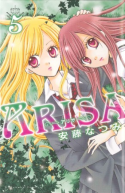
Bringing up the rear in this category again is Kodansha Comics, whose catalogue has still not expanded beyond the four series it launched with (Arisa, Fairy Tail, Sayonara, Zetsubou-Sensei, and Until the Full Moon) even after six months.

Price

Here, again, Viz leads the pack, with prices starting at $4.99 a volume for Shonen Jump and Shojo Beat series, $5.99 for IKKI and Signature series, and between $6.99-$8.99 for oversized or omnibus releases. Though I still think that $5 a volume is too high to encourage real bulk purchases, it remains the best price out there for manga on the iPad. Kodansha Comics’ volumes sell for $4.99 apiece as well, though it’s worth mentioning that they ran a $2.99 special for Fairy Tail when the app first launched—a price I absolutely would pay for bulk purchases of a series I had interest in reading.

Both Yen Press and DMP lag in this category, with single volumes going for $6.99-$8.99 apiece—sometimes significantly more than print prices online—and $12.99 for larger volumes. Though BL readers, in particular, are accustomed to paying more for their habit, thrifty shoppers who are willing to put up with the downsides of the Kindle app can pretty much always get the same books for less by going that route—and have their purchase available on their other compatible devices as well, including their computers. I will admit that though I was fairly depressed not to be able to purchase Keiko Kinoshita’s You & Tonight through DMP’s far superior iPad app, it’s awfully nice to have it available on both my iPad and my laptop via Amazon’s Kindle app.

Bottom Line

Viz is the clear winner on the iPad overall, performing well in all three categories of functionality, selection, and price. DMP’s app is promising, and should they manage to resolve their issues with Apple and find a way to better serve cross-platform customers, they could become a digital powerhouse for BL fans, despite a significantly less attractive price point. Yen Press’s app lags in both selection and price, though it does hold a particular allure for manhwa fans. (Will we ever see NETCOMICS in the iPad app game?) And though Kodansha Comics does well when it comes to pricing, its dinky selection and less-than-optimum readability diminish its worth significantly.

What do you suppose this year’s New York Comic Con will bring? – MJ


Web Browser

Anesthesiologist Hana Vol. 2 | By Nakao Hakua and Kappei Matsumoto | Futabasha, Manga Action | JManga.com | Windows XP, Firefox 11.0
Volume Two of this medical series continues to pummel our heroine with exhausting daily living. I’d say crises, but she’s an anesthesiologist, so to a certain degree this is what she does. She has professors teaching a class putting her on the spot to embarrass her, the hospital changing to more of a trauma unit center (meaning longer hours), and most of all a new doctor in the unit, Hiura, who is a complete and utter jerk to her He’s constantly yelling at her and forcing her to step up her game, and is rude to her other colleagues… especially Dr. Kobayakawa, the troubled young doctor Hana hit it off with last volume. Of course, those familiar with this type of manga will know immediately that he is the sort of person that doesn’t suffer fools gladly. He dislikes Kobayakawa for his fear and wasted potential, and is so hard on Hana because of her increasing skills and pluck – he teaches by rudeness, basically.

He also, in yelling at Hana, basically notes that her breasts are big, something this manga never really allows us to forget. There’s no gratuitous shower scene here, but instead we get a new trauma doctor, Kenshi, who simply walks up, marvels at her breasts, and starts to fondle them. My jaw dropped briefly, and I am once again reminded of the huge sexual harassment gulf between here and Japan, in that Hana didn’t slug him. Yes, this is supposed to take place in the mid-90s rather than the time it was written, but sheesh. This doctor later gets a nice moment where he tries to teach Hana a basic truth – patients die, and that doctors simply have to accept this and try to save the next one just as hard – but he can’t read her as well as Hiura, so it doesn’t really take. In any case, if his schtick of groping Hana becomes his running gag, I can’t say I’ll be too fond of him.

There’s a lot of medical stuff going on here, and like the first volume if the reader doesn’t want to wade through some jargon they may be in trouble..That said, it’s not too difficult, and the basic premise remains the same – a doctor’s life is very hard, and every day is a struggle to wonder if it’s worth it. Especially given that these are anesthesiologists, so they don’t have the ‘these are my life-saving hands!’ aspect that, say, heart surgeons would. Hana, like the heroine of Nao Go Straight, can be too empathic at times – something contrasted with the new trauma doctors introduced towards the end. The best chapters were the two-parters, one dealing with the patient who loses his life, as I’d mentioned, and the other with how anesthesiologists have immense trouble with morbidly obese people. Hiura wants to harness Hana’s passion, and avoid having her become like Kobayakawa. Can he do it? To be continued! -Sean Gaffney


Disclosure: MJ is currently under contract with Digital Manga Publishing’s Digital Manga Guild, as necessitated for her ongoing report Inside the DMG. Any compensation earned by MJin her role as an editor with the DMG will be donated to the Comic Book Legal Defense Fund.

Filed Under: FEATURES, Going Digital Tagged With: DMP, iPad, JManga, Kodansha Comics, VIZ, yen press

Adventures in the Key of Shoujo: Sailor Moon, Vol.2

March 20, 2012 by Phillip Anthony Leave a Comment

Pretty Guardian Sailor Moon, Vol. 2 | By Naoko Takeuchi | Published by Kodansha Comics USA | Rated: T, Ages 13+

“Pretty Guardian of Love and Justice in a Sailor Suit! Sailor Moon has arrived!!”
I would be lying if i said I haven’t been looking forward to this review. Specifically, because around fifty pages into this volume we are introduced (reintroduced?) to Sailor Venus, aka Minako Aino, the first Sailor Senshi. Her adventures are chronicled in two volumes of Codename: Sailor V. When she popped up, I had only started on the first volume of Sailor V, so on the advice of a friend, I stopped reading Sailor Moon until such time as I finished Sailor V. Well, I’m glad I did, but I would caution that you don’t need to do the same in order to enjoy the second volume of Sailor Moon. Returning to my original point, the reason I’m looking forward to this volume is that the team building is over, the villains are known, and now we are ready for the real fights to begin.

This volume explores the concept of pre-destiny, particularly in regards to the finding of the Princess and the Legendary Crystal. Turns out that our heroes have done this sort of work before. I will endeavour to explain without ripping the lid off the plot. Usagi finally understands why she’s been thinking the way that she has about Tuxedo Mask, and her worldview is shattered as a result. The team is in the middle of a battle with the Dark Kingdom’s latest flunky, Zoisite, when one of their allies is injured. This causes the Moon Kingdom’s Princess Serenity to appear at which time she displays an enormous amount of energy. When the dust has settled, the team is changed forever and only a trip to the moon with Luna’s and Artemis’ (Sailor Venus’ familiar) help will answer their questions. But even after that clarification, the team is still fighting above their weight. I like how they stay together inside and outside the battlefield. They might be reeling from the blows, but they’re still standing. I can’t help feeling that this is a different fight they face due to Sailor V’s warnings and her emphatic statement that this evil must be destroyed for good. This theory is backed up by what the team learns on the moon. It’s a lot to take in, but Takeuchi keeps things moving fast. About two-thirds into the book there’s a brief respite, but it’s short-lived.

Looking at this from a guy perspective, I would say that I feel for Usagi and Mamoru so badly. They are tentatively trying to find their way toward how they feel about one another, but their intertwined destines keep being thwarted. I get now why people used to say to me that I was too dismissive of the series. For me, as someone who likes to write creatively, I think I understand where Takeuchi might be going with this. The path to true love is never easy in real life, harder in the realm of fiction, and almost impossible when it involves the fate of the world in the balance. So is Mamoru and Usagi’s love doomed to the void? Possibly, but I think the idea behind this volume might be that true love cannot be stopped, merely diverted. Also, if I’m going for broke, I would say the idea behind the first volume would be that big things start with something small and/or you are not as unimportant as you believe yourself to be. But, returning to the story, Takeuchi seems to be saying in this volume that not only are the Senshi going to have to deal with setbacks but also, potentially, casualties as well.

I wonder, though, how meaningful it is for me to write about Sailor Moon, given that I’ve been aware of the title for ten plus years but never really got into it. I am trying to imagine how young girls (and indeed guys) reading this in Japan at the time might have felt. Add to that my differing cultural heritage and the gulf gets wider by the minute. But my quest is not in vain, I hope. Alexandre Dumas wrote more than 150 years ago of the value of friendship with comrades in arms, Gandhi wrote and spoke of the fact that tyrants, while invincible for a time, always fall, and a Canadian filmmaker once commented that there is no fate but what we make for ourselves. The Sailor Senshi face a difficult task but the battles they face are universal and common. They have happened before in reality and fiction, they are happening now, and they will happen again.

Nearly seventy years ago, my grandfather’s brother stood on the beaches of France. He was fighting in a foreign army for a cause he believed in. When the ramps dropped and his squad ran onto the beach, he did so knowing what was asked of him. At a critical moment, however, the enemy directed a heavy machine gun at his squad mates. Without any thought for himself, he stood and took the hail of bullets. I presume that afterwards his squad returned fire. As to how accurate that account is, I have to trust the report my grandfather’s family received. In Sailor Moon, Usagi stands in front of the enemy protecting Tuxedo and her friends and laying down a burst of energy at her opponent. She does so because the thought of losing her friends and the one she loves is too much to bear. It is there that she discovers her inner light and does what it is her heart requires—much like a soldier taking the brunt for his team because the thought of losing his friends and failing his loved ones is too much for him to bear.

It’s funny how 200 pages of printed paper with drawings and letters can stir things in you that you had never considered. The weaknesses of this volume, such as the massive amounts of exposition, the somewhat Jason and the Argonauts-esque level of “Kill! Kill! Kill them all!!” of Queen Beryl and the Dark Kingdom, and the fact we still haven’t seen much character development for the other girls can be negated by the fact this is (or feels like) the opening salvo for the war that’s coming. I suspect it will be fought with the population being unaware, and that makes me appreciate Takeuchi even more as a writer. To fight for people and have them know of your achievement is one thing. It is another to do so without the issuing or request of acknowledgement. The question I pose myself is: would I do the save if the situation called for it? Would you?

As I’ve said, I love the artwork and I can’t fault it. If these pages were pastels or watercolours, I would happily have them on my wall. Just as the first volume has a lot of serene moments this one does too, but now they are happening within the story-building moments and the action scenes. It’s a hard act to follow. The Internet continues to punish me for not discovering Sailor Moon sooner, as original art books by Takeuchi-sensei command higher than normal prices. Even if I weren’t broke, I would still be unable to afford some of them.

There aren’t as many liner notes from the translator this time around. I chalk this up to the pace of the story. Thanks for the crisp job, Kodansha. This volume maintains my high opinion of the series and moves into a new direction. If proof is required of my enjoyment of the series, I start volume three tonight and have ordered volumes four and five. So far my experiment at this shoujo malarkey seems to be working.

Filed Under: Adventures in the Key of Shoujo Tagged With: kodansha, Kodansha Comics, kodansha usa, manga, MANGA REVIEWS, shojo, shoujo

Adventures in the Key of Shoujo: Codename: Sailor V, Vol.1

March 9, 2012 by Phillip Anthony 1 Comment


Codename: Sailor V, Vol. 1 | By Naoko Takeuchi | Published by Kodansha Comics USA | Rated: T, Ages 13+

“Champion of Justice! The Pretty Guardian in a Sailor Suit! Sailor Venus has arrived!!”

Did you ever have that dream with the sensation that you’re falling, but you’re just not sure in which direction, and yet you’re perfectly safe doing so? The is the feeling I get from Codename: Sailor V, coupled with a curious feeling that I’m being led somewhere familiar, yet I’ve never been there. After diving into Pretty Guardian Sailor Moon, I also picked up Codename: Sailor V as well, as I had heard it was a prequel to Sailor Moon. But while it was published at roughly the same time as Sailor Moon and it IS set in the same universe, tonally, this is a different tempo.

First of all, while it does have a girl becoming a magical champion of justice, the difference here is that Minako Aino is on her own. She has a familiar (a male cat named Artemis) and she answers to someone called “Boss.” However, there is no team to help her, so Mina must face all the agents of evil alone. In many ways, that makes this first outing both flat and exciting. It’s flat because if you didn’t like the formula of “Girl gains magical powers, fights a villain every chapter, overcomes and adapts, then triumphs” espoused by Sailor Moon, this is more of the same. So we are there for all the blundering Mina does, every goofy joke, every stock bad guy, and every cliché. While this might be bad for some, I’m glad of it, as it means I don’t have to keep remembering every chapter and can focus on the narrative (Confession: as I recently came into Sailor Moon, a lot of characters’ names and faces didn’t stick right away, thus I have to keep rereading to imprint the important stuff).

Secondly, I don’t get a sense of an impending apocalypse with Codename: Sailor V that I got with Sailor Moon. In that, there’s a goal: finding the princess, finding the crystal. In Codename: Sailor V, there are the main villains (the Dark Agency) but we don’t know what they want, save to take over the world. And while we know the agency is being controlled by a higher intelligence, we’re just not told who that is. This fog is either Takeuchi being sly or she really doesn’t know what she’s doing. Now, I could buy that last point except both Sailor Moon and Codename: Sailor V were published at around the same time. I’d like to know what the frequency of the chapters for both were, but I don’t have that information. Since there are only two volumes of Codename: Sailor V and there are twelve plus volumes of Sailor Moon, I am curious to say the least.

Using Sailor Moon as a guide, while there are much the same types of characters, as there’s not such a large cast, I can focus on the them better. Mina’s relationship with Artemis is much more antagonistic than Usagi’s and Luna’s, but this is borne for the most part out of the fact that Mina is a complete slacker who does well in athletics but is poor at academics. Even her mother can’t stand the fact that she bunks off her responsibilities whenever she feels like it! Equally her friends, including her bezzie mate Hikaru, just roll with it. Though the background characters in this are so-so, I do like the police Inspector General who is in love with “V-Chan,” as she keeps calling her. If I had a gripe, it would be that the villains get whipped senseless in this. Unlike Sailor Moon, here the villains just turn up, take over and then get belted by Sailor V, who usually gets shoujo-medieval on their rump. Full marks every time Mina turns them into crispy critters.

Mina is even more of a girly-girl (is there such a thing, really?) than Usagi. She has all the problems that go with being a pubescent, amplified due to her identity as Sailor V. She wants her first love, first kiss, first crush, first holiday, and so on to be just so. But sometimes, I feel that she could do with someone like Tuxedo Mask in her life. Tuxedo gives Sailor Moon something to look forward to as a goal. And Mamoru gives Usagi’s heart a fluttery feeling whenever he’s around. Mina has no such person in her life. It would be interesting to see what she would do if such was the case. But that doesn’t detract from her character—far from it. It makes me wonder if she’s holding back her potential because she doesn’t seem to feel the same peril that Usagi and Co. get into. Would this make her a more flawed character, and therefore more sympathetic to us? Maybe, but I have a hunch that there’s enough of this coming down the pipeline for Sailor Moon, and if it happened to Mina in the same way, I would feel a cloning issue arise.

Artwork-wise, Takeuchi gives her characters an energy that is hard to define. If I had to place a finger on it, I would say they look alive in the sense that they are animated, lively and effervescent. Mina has a smile that goes through different stages. Her carefree one (used mostly for her friends), her dreamy one when she’s thinking about a boy, and finally her smile that only the readers get to see. This is a special kind of smile—one that shows the confidence of someone who could, literally, move mountains if she tried. The smile I refer to is the one she wears when she defends the characters and us, the audience, from all the nasties in the world, whether it be a sexist git who doesn’t want girls in his electronic man-cave or the Iago-like Dark Agency who would steal our lifeforce energy for its own nefarious uses. This smile will protect anyone or anything standing behind it. This smile would die rather than admit defeat. It’s amazing how much enjoyment you can derive from a smile. Maybe I’ve uncovered another of Takeuchi’s talents? Or is it one of Sailor Venus’?

Translation-wise, William Flanagan keeps it quick, coherent and easy to read. I’ve never read any scanlations or the first TOKYOPOP versions, so I will withdraw from speaking as to their accuracy. All I will say is Mr. Flanagan has a lot of text to deal with and manages to make sense of it and put it into a kind of literary tempo. He and Kodansha have their usual liner notes at the back of the book. Thanks are extended for the explanations.

As an aside, since I keep bringing up Sailor Moon in this review, I’ve got one or two wee problems. You see, in Codename: Sailor V, Mina runs by—is drawn running by or whatever—next to Usagi and Ami, leading us to believe that the events of Sailor Moon can’t be far behind. My confusion is that I don’t know within what time frame this story takes place. Is it at the same time as Sailor Moon? Before or after it? This perplexes me and I can only hope there’s some clarification soon. Another thing I’ve noticed is that the characters that Mina is friends with don’t get nearly enough time to develop on their own. I realise that Mina is the focus, but still I can’t help feel that I’m running out of time to get to know them. Other than that, this is a great first volume, and if you are wary of getting into Sailor Moon because of its length, there are only two volumes of this, so you should be fine.

This last point is also a source of sadness for me. In this single volume I’ve grown to like Mina, Artemis and even the Inspector General and the fact that the next volume will be the last that focuses on these characters is an unhappy one for me. Don’t get me wrong, I know that Mina plays a part in Sailor Moon but still, I’m going to miss them. Oh well, one more volume to go, I suppose. But knowing Takeuchi-sensei, she’ll have them go out in a blast. Oh, I cannot wait!

On a personal note, I wanted to say thanks to everyone who emailed me or left comments on Manga Bookshelf in regards to the column. I really appreicate the thoughts and suggestions and while I can’t say I will pick up all the titles suggested, I enjoyed getting such an enthusiastic response. Also, I wanted to thank MJ, Kate Dacey and all the people on their own blogs and on Twitter who mentioned the column.

Review copy bought by reviewer

Filed Under: Adventures in the Key of Shoujo Tagged With: kodansha, Kodansha Comics, kodansha usa, manga, shoujo

Tidbits: A Trio of Kodansha Shoujo

January 21, 2012 by Michelle Smith

I’m catching up on three of Kodansha’s currently running shoujo series, so I thought I’d group them all together here for a Tidbits post! First up are volumes four and five of Natsumi Ando’s suspenseful Arisa, followed by the second and final volume of Naoko Takeuchi’s Codename: Sailor V, with the second volume of Pretty Guardian Sailor Moon bringing up the rear. Tidbit power, make up!

Arisa, Vols. 4-5 by Natsume Ando
Tsubasa Uehara continues to attend school in the guise of her sister, Arisa, as she endeavors to find the identity of the King who is fulfilling wishes from chosen students in dangerous ways. Her spirits flag when it seems she’s been unsuccessful in protecting the latest target, but when it turns out her efforts actually prevented the girl from sustaining permanent injury, her spirits rise. Alas, a friend’s betrayal is followed by an explanation of divided loyalties and the introduction of a pivotal new character with kind feelings towards Tsubasa but a burning hatred for Arisa.

So, there are several characters at this point who could be the King, but the strongest possibility seems to be Kudo, a transfer student who I had forgotten about entirely after reading volume three, so that tells you how memorable of a guy he is. Manabe doesn’t seem like the culprit, and neither does Arisa’s boyfriend, Midori, but it’s not out of the question. Mostly we see the King as a shadowy figure, grinning in a dastardly fashion as he does things like arrange for Tsubasa to fall off a cliff. (Side note: any time the female lead of a shoujo manga goes out into the woods at night, she is going to fall off a cliff. It’s, like, the law.) New character Shizuka seems like a potential candidate, until it’s revealed that the King is manipulating her into making wishes that will harm Arisa/Tsubasa.

All of this makes for a fast-paced and suspenseful read, but it does cause me to wonder whether Ando’s just making up all of this as she goes along. Does she really have a plan for who the King is, or is she keeping readers suspicious of everyone until inspired to take the story in a specific direction? I’m not exactly complaining—because, again, it is a fun read—but the lack of any kind of permanent gain is a little bit frustrating. I just hope there’s a satisfying and dramatic payoff in the end!

Codename: Sailor V, Vol. 2 by Naoko Takeuchi
It’s rather hard to like Minako for the majority of this volume, as several of the stories play up her shallow side. First she gets fat by eating too much evil chocolate, then she must contend with a trio of animal-themed siblings who unleash energy-sucking cats, dogs, and mosquitoes upon the populace. Minako slacks off frequently and makes various unkind comments to her long-suffering feline companion, Artemis. She also meets the latest idol sensation, handsome and mysterious Phantom Ace, and becomes one of his biggest fans.

There’s not really a whole lot to recommend these chapters except more of Sailor V’s amusing speeches, like this one, which occurs as she’s foiling the enemy’s scheme to collect energy via blood donation:

You have used clever words to abscond with a precious tribute of blood from weakened hospital patients! That is your crime!

And to add to it, you have sullied a woman’s simple joy of collecting stamps!

Worse, you forgot to give me my reward for donating blood to the tune of 800cc! And that crime is grave!

Luckily, though the premise of the final two chapters is just as silly as what’s come before—Minako is ordered to win the part of Ace’s leading lady in his latest project, filming in China, so that she can observe his potentially evil production company—it doesn’t preclude genuine dramatic impact. Though Minako entertains fantasies of marrying Ace and retiring, when he professes his to love her, she realizes that it’s not what she wants. She loves being Sailor V and, furthermore, remembers making a promise to protect an important person. Eventually, her memories fully awaken and her Sailor V costume is replaced by one matching the design of the other senshi. It’s kind of goosebump-inducing.

Though I’ve read this series before (with translations), I had completely forgotten that Ace had any connection at all to Minako’s past life, so was pleasantly surprised by that revelation as well as by this awesomely grim quote:

Your love will never be granted, for all eternity… Your love or your duty… now you can live the rest of your life never having to worry about the tortures of deciding between them. Your fate is to battle on. Because your true battle starts now.

How could I have forgotten that?! Minako is a girl who is always falling (if superficially) in love, so she can’t welcome this news, but neither does she shirk from her destiny. Ever irrepressible, she ends the series on an upbeat note, poised to show (if I recall rightly) greater maturity and determination when she joins the others in the main series.

Ultimately, Codename: Sailor V is worthwhile despite its flaws. We never learn what the enemy was hoping to achieve, nor the identity of “Boss” (though the second volume of Pretty Guardian Sailor Moon provides some insight on the matter), but we do meet a special, spunky girl as she comes to accept her unique destiny, and that can never be a bad thing.

Pretty Guardian Sailor Moon, Vol. 2 by Naoko Takeuchi
A lot happens in this volume, which I shall attempt to quickly summarize. When facing off against Zoisite, the girls are rescued by the timely arrival of Sailor Venus. Minako is now in her second year of middle school and comes across as very mature, competent, and serious about her duty. She’s been monitoring Usagi through the Sailor V game and has also been researching the enemy. She provides all sorts of information about the Dark Kingdom and also claims (well, Artemis claims) that she is Princess Serenity. Her proximity triggers some past-life memories in the others, as well.

However, Usagi starts having dreams that suggest that she was actually Serenity, and when Mamoru is injured protecting her from one of Kunzite’s attacks, one of her tears transforms into the Legendary Silver Crystal and her true identity is revealed. (The bit with Venus was evidently a ruse to direct enemy attacks onto a more experienced Guardian.) Mamoru is subsequently kidnapped by the Dark Kingdom and eventually used as Queen Beryl’s pawn, securing the crystal for her by volume’s end.

So, all of this is very dramatic and shoujo-tastic while it occurs and I honestly loved every minute of it. There are a couple of things that I found especially interesting, though. The first is how much information we get on the enemy compared to the dearth of intel provided in Codename: Sailor V. We see, for example, a flashback to the moment in which Beryl was “irresistibly drawn to” the North Pole, where she discovered the remains of the Dark Kingdom. This made me wonder… was Beryl reborn on Earth as a regular human, just like the Guardians? And did she waken to her past memories as the seal imprisoning Metalia faded?

We also learn a bit about the Four Kings of Heaven, who were generals to Endymion (Mamoru’s past identity) that were swayed into becoming Metalia’s devotees. I’m not exactly sure about this, but it seems as if their bodies had been converted into crystals and recently awakened into human form at Metalia’s whim, and that they can be revived as many times as necessary. Somehow this is sadder and more sympathetic than if they had just been some regular guys suddenly remembering their previous lives.

The second thing that struck me was how much certain elements of the story remind me of Please Save My Earth. Usagi and friends living on the moon in their past lives is the most obvious resemblance, but there’s also the fact that Usagi is troubled by questions of identity brought on by these recollections (“Am I becoming the princess? It’s like I’ve stopped being me…”) and that the residents of the Moon Kingdom were tasked with fondly watching over Earth and helping it to evolve in the best manner possible. They actually travel to the moon to listen to a computerized incarnation of Queen Serenity tell them about the tragic events of the past and how Metalia must be sealed away for good. (She was also responsible for waking Artemis and Luna from the stasis they entered after the destruction of the Moon Kingdom, which makes me suspect that she is “Boss.”)

I could probably go on for another five hundred words, which just goes to show how engaging this story is. It wouldn’t be a Kodansha review if I didn’t complain about the typos—seeing the word “it’s” used instead of “its” is even more painful when it’s part of genius Ami’s dialogue—but even their irksome presence does not detract from the enjoyment I derive from reading this series.

Filed Under: REVIEWS Tagged With: Kodansha Comics, Naoko Takeuchi

  • « Go to Previous Page
  • Page 1
  • Interim pages omitted …
  • Page 4
  • Page 5
  • Page 6
  • Page 7
  • Go to Next Page »
 | Log in
Copyright © 2010 Manga Bookshelf | Powered by WordPress & the Genesis Framework