• Skip to primary navigation
  • Skip to main content
  • Skip to primary sidebar
  • Home
  • About Us
    • Privacy Policy
    • Comment Policy
    • Disclosures & Disclaimers
  • Resources
    • Links, Essays & Articles
    • Fandomology!
    • CLAMP Directory
    • BlogRoll
  • Features & Columns
    • 3 Things Thursday
    • Adventures in the Key of Shoujo
    • Bit & Blips (game reviews)
    • BL BOOKRACK
    • Bookshelf Briefs
    • Bringing the Drama
    • Comic Conversion
    • Fanservice Friday
    • Going Digital
    • It Came From the Sinosphere
    • License This!
    • Magazine no Mori
    • My Week in Manga
    • OFF THE SHELF
    • Not By Manga Alone
    • PICK OF THE WEEK
    • Subtitles & Sensibility
    • Weekly Shonen Jump Recaps
  • Manga Moveable Feast
    • MMF Full Archive
    • Yun Kouga
    • CLAMP
    • Shojo Beat
    • Osamu Tezuka
    • Sailor Moon
    • Fruits Basket
    • Takehiko Inoue
    • Wild Adapter
    • One Piece
    • After School Nightmare
    • Karakuri Odette
    • Paradise Kiss
    • The Color Trilogy
    • To Terra…
    • Sexy Voice & Robo
  • Browse by Author
    • Sean Gaffney
    • Anna Neatrour
    • Michelle Smith
    • Katherine Dacey
    • MJ
    • Brigid Alverson
    • Travis Anderson
    • Phillip Anthony
    • Derek Bown
    • Jaci Dahlvang
    • Angela Eastman
    • Erica Friedman
    • Sara K.
    • Megan Purdy
    • Emily Snodgrass
    • Nancy Thistlethwaite
    • Eva Volin
    • David Welsh
  • MB Blogs
    • A Case Suitable For Treatment
    • Experiments in Manga
    • MangaBlog
    • The Manga Critic
    • Manga Report
    • Soliloquy in Blue
    • Manga Curmudgeon (archive)

Manga Bookshelf

Discussion, Resources, Roundtables, & Reviews

Comedy

Again!!, Vol. 2

May 29, 2018 by Katherine Dacey

The phenomenal success of Yuri!!! On ICE turned out to be a boon for manga fans, too, as American publishers snapped up two of Mitsurou Kubo’s better-known comics: Moteki: Love Strikes!, a seinen romance about a thirty-something loser who reconnects with women from his past, and Again!!, a time-travel comedy about two teenagers who get a second chance at high school. I won’t lie: Again!! was my hands-down favorite of the two, both for its raw honesty and its sharply observed characters.

Again!! avoids the sophomore slump by briskly advancing the plot without sacrificing the humor or heart that made the first chapters so appealing. Kinichiro and Fujieda both get a turn in the spotlight, with Kinichiro discovering the pleasures of cheering, and Fujieda experiencing loneliness for the first time. Volume two also introduces three new characters, all of whom used to belong to the ouendan: Okuma, the drummer; Masaki, the vice-captain; and Suga, the cheer sergeant. Although the trio’s ostensible role is comic relief, their real function is helping us understand why the ouendan failed, revealing the degree to which their unwanted advances, passivity, and flagrant sexism undermined Usami’s authority as captain and poisoned group morale.

While this information is crucial to the story, it also points to Again!!‘s biggest problem: Usami. Mitsurou Kubo is frank about why Usami resorts to shouting, scolding, and shaming to prove that she’s “man” enough to lead the ouendan — a compassionate insight into a character who often seems more harridan than human. Yet Usami’s actual personality remains a mystery. Everything we learn about her is revealed through other characters, whether they’re discussing her beef with Abe, the head cheerleader, or describing the flurry of media interest in Usami when she first joined the ouendan. We don’t know how Usami feels about her teammates, or why she’s so passionately interested in cheering — two questions that need to be addressed if she’s to become a full-fledged character.

Despite these flaws, Again!! manages to wring fresh laughs from its time-travel premise while depicting high school in all its unpleasantness. Fujieda, for example, vacillates between trying to profit from her knowledge of the future and lamenting her lack of friends. Kinichiro also is caught between past and present: he’s angry that his first kiss didn’t go as planned, and deeply self-conscious after a loud, public declaration of how miserable he feels — an exquisitely awful scene that acknowledges the depth of his pain while recognizing that his brusque behavior directly contributes to his sense of isolation and victimhood. It’s this kind of insight that makes Again!! such a compelling story, reminding us that our memories of being shunned, wronged, or ridiculed can be so one-sided that we’d make the same mistakes if given the opportunity to relive our teenage years. Recommended.

Again!!, Vol. 2
By Mitsurou Kobu
Translated by Rose Padgett
Rated OT, for Older Teens (16+)
Kodansha Comics
Filed Under: Manga, Manga Critic, REVIEWS Tagged With: Again!!, Comedy, Kodansha Comics, Mitsurou Kubo, Ouendan, Shonen, Sports Manga

Kenka Bancho Otome: Love’s Battle Royale, Vol. 1

April 6, 2018 by Katherine Dacey

For a manga based on a dating game, Kenka Bancho Otome is far better than it ought to be. It’s a fast-paced, loose-limbed story that’s both cheerfully stupid and mildly subversive, buoyed by its deliciously queer premise: a girl goes undercover in an all-boys’ high school where her androgynous beauty and lethal karate chops inflame her classmates’ hearts.

The plot is set in motion by an accidental encounter between Hinako Nakayama, an orphan, and her long-lost twin Hikaru, whom she rescues from the path of an oncoming car. In the aftermath of the accident, Hikaru cajoles his sister into impersonating him for a day, lending her his school uniform and dropping her at the campus gates. Hinako soon realizes the folly of her brother’s request, however; Shishiku Academy is more like Rock ’n’ Roll High School than prep school, as its entire curriculum—if one could call it that—centers on fighting. Making matters worse is that everyone wants to fight Hinako because they believe she’s the heir apparent to the Onigumo crime family. She isn’t, of course, but Hikaru is, a detail he conveniently omitted when roping her into his charade. 

If you’ve read more than one shojo comedy, you know what happens next: Hinako befriends and beguiles the best-looking delinquents at the school, from Totomaru, an earnest cutie who’s prone to nosebleeds and blushing, to Kira, a tousle-haired bishonen with a sensitive side. Author Chie Shimada has the good graces to keep the hot guys and fist-fights coming — the better to distract from the thinness of the plot —and the imagination to add small but delightful quirks to her main characters’ personalities. Her best running gag is Hikaru, who seems more at home impersonating his sister than inhabiting his own skin; though his temper suggests he’d be a ruthless crime boss, his obvious joy in looking pretty and flirting with Miraku, Shinsiku Academy’s resident idol, add a fresh dimension to the identity-swapping formula. 

As you might expect, the artwork is more serviceable than memorable. Shimada proves capable of drawing a variety of familiar bishonen types — lanky guys with ponytails, serious guys with glasses — though the pro forma nature of the character designs occasionally makes it difficult to parse the fight scenes. (All those artfully coiffed young men have the same lanky, spike-haired silhouette.) Then, too, there are riotously busy pages where Shimada’s screentone is so thick and smudgy it’s almost palpable; the phrase “applied with a trowel” comes to mind.

Still, the Shishiku gang’s bonhomie is hard to resist, carrying the reader past the story’s creakier moments. So, too, is Hinako’s sincerity; her journey towards self-actualization is both touching and amusing, as she discovers that she might, in fact, be a more natural bancho than her twin. That she wins her fellow delinquents’ admiration with a mean right hook and a roundhouse kick is less important than the fact they appreciate her for her pluck, kindness, and thirst for justice — a nuance that elevates Kenka Bancho Otome from otome rehash to actual story. Recommended.

KENKA BANCHO OTOME: LOVE’S BATTLE ROYALE, VOL. 1 • STORY AND ART BY CHIE SHIMADA • ORIGINAL CONCEPT BY SPIKE CHUNSOFT • VIZ MEDIA • 194 pp. • RATED T, FOR TEENS (13+)

Filed Under: Manga, Manga Critic, REVIEWS Tagged With: Comedy, Otome, shojo, shojo beat, VIZ

CITY, Vol. 1

April 3, 2018 by Katherine Dacey

CITY, Keiichi Arawi’s latest series, charts the misadventures of Midori, a feckless undergrad who’s behind on the rent, in debt to her roommate, and surrounded by “not-quite-ordinary people.” In a last-ditch effort to stay in her apartment, she hatches several get-rich schemes — betting on horses, entering a photography contest — all of which backfire in spectacular fashion. That premise sounded ripe with comic potential, so I decided to pick up a copy of volume one.

I’ll be honest: I had a hard time reviewing CITY, a manga that seems to be tickling everyone else’s funny bone but mine. Though I could appreciate the skill and imagination behind Keiichi Arawi’s work, I found CITY too frantic to be amusing, thought-provoking, or interesting. My frustration boiled down to two basic observations about Arawi’s methods — first, his unwavering belief that repeating gags is a surefire strategy for laughs, and second, his unwavering belief that certain types of jokes subvert convention when, in fact, they’re just as cliche as the conventions they’re spoofing. Nowhere are those two tendencies more pronounced than in his depiction of Midori’s landlady, a feisty old broad who goes to violent lengths to collect the rent. A karate-chopping grandma sounds hilarious in the abstract, but you’ve seen this gag done better elsewhere, most spectacularly in Kung Fu Hustle, where the regal and ridiculous Yuen Qi steals the show from under Stephen Chow’s nose  — something that can’t be said of Midori’s landlady, whose shouting and punching barely distinguishes her from her equally batshit neighbors.

It’s only in the quieter interludes, when the focus shifts from Midori to her neighbors that Arawi’s flair for the absurd manifests itself. In “Officer,” for example, a neighborhood patrolman finds himself under citizen’s arrest for a theft he was asked to investigate. The officer’s placid expression and deadpan delivery contrast sharply with the physical and emotional indignities of his job, his beatific expression unbroken by the ordeal of being hog-tied by an overzealous mob. Another modestly amusing interlude — “Wako Izumi” — focuses on a control freak who’s distraught by the loss of a restaurant point card. Like the officer, Wako proves an unreliable narrator, her impulsive, weird behavior contradicting the Sgt. Friday-esque tone of her internal monologue. These moments of surrealism aren’t funny, exactly, but they at least feel original, something that can’t be said of the tired slapstick jokes and strenuously unpleasant main characters.

Verdict: Your mileage will vary. See my colleague Sean Gaffney’s review for a different perspective on CITY.

CITY, Vol. 1
Art & Story by Keiichi Arawa
Translated by Jenny McKeon
Vertical, Inc., 166 pp.
No rating

Filed Under: Manga, Manga Critic, REVIEWS Tagged With: CITY, Comedy, Keiichi Arawi, Seinen, Vertical Comics

Silver Spoon, Vol. 1

March 25, 2018 by Katherine Dacey

The title of Hiromu Arakwa’s latest series is a pointed reference to Kansuke Naka’s The Silver Spoon: Memoir of a Japanese Boyhood. First serialized in the pages of the Asahi Shimbun in 1913, The Silver Spoon traced Naka’s journey from childhood to adolescence through a series of vignettes that recalled turn-of-the-century Tokyo in vivid detail, describing both the bustle of its modern neighborhoods and the rustic isolation of its western regions, a contrast underscored by one of the book’s most important events: Naka’s move to rural Tokyo. “For me to be born in the midst of Kanda was as inappropriate as for a kāppa to be hatched in a desert,” he declares, viewing the country as a place of rebirth.

Yuugo Hachiken, the fictional protagonist of Arakawa’s Silver Spoon, undertakes a similar journey, moving from Sapporo to the Hokkaido countryside, where he enrolls at at Ooezo Agricultural High. Though his peers chose the school for its curriculum, Hachiken chose it to escape the college prep grind — cram schools and high-stakes tests — and his parents, who seem indifferent to his misery. His competitive streak remains intact, however; he assumes that he’ll be the top student at Ezo AG, sizing up his classmates’ mastery of English and geometry with all the condescension of a prep school boy in a backwoods schoolhouse.

Hachiken’s path to redemption predictably begins with a rude awakening: there’s no spring break and no sleeping in at Ezo AG, where students rise at 4:00 am to muck stalls and harvest eggs. Adding insult to injury, his cosmopolitan prejudices are challenged by his peers, who are more ambitious, motivated, and knowledgable than he is; in one of the volume’s best scenes, Hachiken’s elation turns to despair when he overhears his classmates discussing the transformative effect of somatic cell cloning on the Japanese beef market. “Are they speaking in tongues!!?” he fumes, rivers of sweat pouring down his ashen face. “Are you guys smart or stupid? Make up your minds!!”

After a series of humiliating trials, Hachiken makes tentative steps towards fitting into the community and finding his purpose. His incentive for trying a little harder is, unsurprisingly, a girl — specifically Aki Mikage, a pragmatic, cheerful soul whose horse-wrangling skills, can-do attitude, and endless patience with dumb questions endear her to Hachiken. Though she’s instrumental in persuading Hachiken to join the equestrian club, her main role in volume one is to help Hachiken overcome his sentimental ideas about farm life, encouraging him to see the farm as a factory or business rather than a collection of cute animals.

This bracing dose of reality is one of the manga’s strengths, preventing the story from devolving into a string of sight gags and super-deformed characters screaming and flapping their arms at the sight of poop. Near the end of volume one, for example, Mikage invites Hachiken and fellow classmate Ichirou Komaba to the Ban’ei Racetrack to watch a draft horse pull, an outing that quickly turns somber when they stumble upon a horse funeral in progress. “Some souls are thrust into a cruel existence where there are only two options, life or death, simply because they happen to be born livestock,” Mikage’s uncle observes — a statement that makes a deep impression on Hachiken, who’s just beginning to realize that many of the piglets and chickens he’s raising will be on someone’s dinner table in a matter of months.

The racetrack episode also highlights Silver Spoon‘s other secret weapon: its terrific supporting cast. Though Hachiken, Komaba and Mikage’s more serious conversations dominate the chapter, one of the series’ most memorable personalities — Nakajima, the equestrian club supervisor — makes a cameo appearance as well. Nakajima exemplifies Arakawa’s gift for creating visually striking characters whose goofy, exaggerated appearances belie their true nature. He looks like a Bodhisattva but acts like a gambler, a tension that plays out almost entirely on his face. When riding a horse or encouraging Hachiken to join the equestrian club, for example, his eyes are half-open, framed by two semi-circular brows that suggest a meditative state, but when he visits the race track, the thrill of betting brings a maniacal gleam to his eyes, pulling his eyebrows into two sharp peaks. He even dresses the part of a Saratoga regular, trading his pristine riding outfit for a trenchcoat — collar popped, of course — and low-slung fedora.

As this comic interludes suggests, the twists and turns of Hachiken’s evolution from sullen teen to happy young man are dictated more by shonen manga convention than fidelity to Naka’s The Silver Spoon — there are 200% more jokes about cow teats and chicken anuses — but the sincerity with which Arakawa captures the emotional highs and lows of adolescence shows affinity with Naka’s writing. Hachiken’s mopey interior monologues and fumbling efforts to connect with his classmates are as authentic as Naka’s own reminiscences; both convey youthful angst without irony, embarrassment, or “the layered remembrances of adulthood” (Kosaka). And for readers more interested in laffs than literary references, there are plenty of those, too; Hachiken spends as much time hanging out with ornery ruminants as he does ruminating, all but ensuring a bumper crop of manure gags in volume two. Highly recommended.

Works Cited:

Arakawa, Hiromu. Silver Spoon, Vol. 1, translated by Amanda Haley, Yen Press, 2018.

Kosaka, Kris. “A misanthropic memoir from Meiji Era Tokyo.” The Japan Times, 26 Sep. 2015, https://www.japantimes.co.jp/culture/2015/09/26/books/misanthropic-memoir-meiji-era-tokyo/#.Wres_5PwY1g. Accessed 24 Mar. 2018.

Filed Under: Manga, Manga Critic, REVIEWS Tagged With: Agricultural Manga, Comedy, Hiromu Arakawa, Silver Spoon, yen press

Again!!, Vol. 1

March 10, 2018 by Katherine Dacey

There are no second chances in life, but there are in manga — think A Distant Neighborhood, Erased, and orange. The latest entry in the second-chance sweepstakes is Again!!, a dramedy about Imamura Kinichirou, a loner who tumbles down a flight on stairs at his high school graduation and wakes up on the first day of freshman year. Doomed to repeat the worst three years of his life, Imamura impulsively signs up for the school’s ouendan, but quickly runs afoul of prickly captain Yoshiko Usami, whose dedication to the struggling club proves more deterrent than draw for would-be members.

Imamura isn’t the only time-traveler; joining him on his temporal odyssey is Akira Fujieda, a perky classmate who also tumbles down a flight of stairs at graduation. Unlike Imamura, Akira greets this development with enthusiasm, but her fond memories of high school make her too quick to assume that everything will unfold the same way twice: she propositions her not-yet-boyfriend too boldly (he turns her down) and dismisses a would-be friend’s taste in music. (“It’s too bad Cara Mana broke up so soon,” Akira declares. “It didn’t take me long to get sick of them, though, since all their songs sort of sound the same.”) Crushed by the double rejection, Akira becomes Imamura’s reluctant ally in the quest to restore the ouendan to its former glory.

Whether you cotton to Again!! depends on how you react to the principal characters. I found Usami’s fierce commitment to tradition exhausting; she bellows, belittles, complains, accuses, and sobs, but seems fundamentally unable to have a normal conversation. Her bluster is meant to suggest her sincerity and vulnerability, I think, but has the opposite effect, reducing her to a one-note character. More convincing is Imamura, who decides that a do-over isn’t as terrible as he’d imagined. (I particularly enjoyed his nonchalant turn at the board in his math class; his classmates’ reaction to his display of mathematical acumen is priceless.) Imamura even flirts with the possibility of a social life: when the girls’ cheer squad mobilizes against Usami, for example, Imamura conspires with Akira and Reo, a pretty classmate, to undermine the cheerleaders’ plan.

Akira, too, is a pleasant surprise, a busybody who’s suddenly relegated to the margins of freshman life. Though her sense of the school’s pecking order remains unchanged, she can’t resist the opportunity to advise the once-lowly Imamura on how best to manipulate the cheerleading squad — it’s her chance to demonstrate her expertise, and perhaps to reclaim her former Queen Bee status by engineering a major social coup. As one might expect, Akira gets the sauciest lines, but she also learns the hardest lesson of the three principal characters: serendipity plays as big a role in popularity as personality and looks.

Mitsurou Kubo’s art plays a vital role in helping us understand Imamura and Akira’s predicament. In the first two chapters, Kubo does an excellent job of distinguishing past from present with subtle details: Imamura’s mom, for example, is a little plumper, while Akira is shorter and less physically developed. (Akira realizes something is amiss when she realizes that her breasts are smaller.) Equally impressive is the care with which Kubo reconstructs the same sequence of events that precede the time jump, showing us Imamura’s memories of the day and then Akira’s. Here again, it’s the little details — a snippet of conversation, a minor change in hairstyle — that convey whose perspective is represented, and how that character’s personality influences what we’re seeing and hearing.

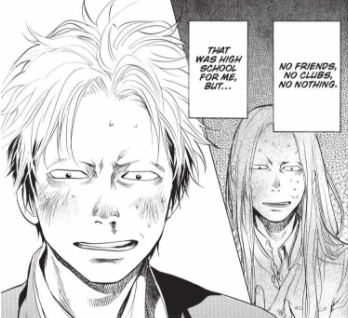
Kubo’s facial drawings show the same degree of meticulousness as her handling of the time travel sequences. Her reaction shots do more than just capture a character’s immediate response to a new development; they convey the emotions and experiences that underlie that reaction. Consider this split-screen image of Imamura:

This panel appears at the end of chapter one, as Imamura stands at a temporal and figurative crossroads: he can change his future by joining the ouendan, or recede into the background and be a loner once again. Imamura’s furrowed, sweaty brow and crestfallen expression capture his sense of helplessness; he has the look of someone who’s actively reliving a terrible experience moment by moment, contemplating the real possibility that nothing will change the second time around.

It’s this level of nuance that makes Again!! worth reading, even when the plot mechanics are creaky and the characters too strident. Watching Imamura forge new connections on his own terms is both funny and poignant, a reminder that we always have the potential to change our destiny, even when it seems preordained. I’m curious to see how Imamura and Akira grow and change, and how their behavior influences the future. Count me in for volume two.

AGAIN!!, VOL. 1 • STORY AND ART BY MITSUROU KUBO • TRANSLATED BY ROSE PADGETT • KODANSHA COMICS • 208 pp. • RATED TEEN (13+)

Filed Under: Manga, Manga Critic, REVIEWS Tagged With: Again!!, Comedy, Kodansha Comics, Mitsurou Kubo, Ouendan, Sports Manga

Kigurumi Guardians, Vol. 1

December 23, 2017 by Katherine Dacey

The first ten or so pages of Kigurumi Guardians are a gas. Hakka, a cheerful fifteen-year-old, comes home from school to find a kigurumi (animal mascot) in her kitchen. Though Ginger looks like the product of a Holstein/penguin tryst, no one in Hakka’s family is fazed by Ginger’s appearance, treating him like one of Hakka’s classmates. And if the Sasakuras’ warm embrace of Ginger wasn’t strange enough, Ginger’s method of communication puts things over the top: he’s reduced to scrawling short messages on cue cards since he can’t speak. Not until Hakka attends a school council meeting does she learn that Ginger is one of three animal-shaped guardians defending Earth from a race of puppet masters, and she’s his new handler.

So far, so good: the oddball premise, brisk pacing, and tart exchanges between Hakka and Ginger are executed with comic zest. As Hoshino begins laying the groundwork for the magical combat, however, it becomes clear that she’s making it up as she goes along. That tendency is most pronounced in the fight scenes, which are devoid of any tension, surprise, or humor, since it’s a forgone conclusion that Hoshino will think of a new rule or magical power that helps her heroes win the day.

More problematic is the dynamic between Hakka and Ginger. Bickering leads are a staple ingredient of romantic comedies, but the main point of contention between girl and mascot gets hammered into the ground by the end of chapter three. That joke — if one can call it a joke — is that Hakka must kiss Ginger to activate his magical powers; when she does, he immediately transforms into a dashing young warrior. Hakka hates kissing Ginger, but is repeatedly forced to go against her own wishes because, y’know, Earth’s future hangs in the balance. In our current #MeToo moment, this gag is an unpleasant reminder of how many books, movies, television shows, and manga reinforce the idea that women who refuse unwanted hugs and kisses are difficult, confused, or selfish.

It’s a shame that this gag is so central to the story, as Hoshino clearly intends Guardians to be naughty fun for teen girls — why else would all three mascots transform into tousle-haired bishonen?— but gets too caught up in drawing costumes and mascots to pay careful attention to the plot or consider the full implications of Hakka and Ginger’s relationship. By the end of volume one, the story has traded wacky hijinks for messy fight scenes and sappy conversations, losing its screwball zing in the process.

The verdict: File under D, for disappointment, and S, for squandered potential.

KIGURUMI GUARDIANS, VOL. 1 • STORY AND ART BY LILY HOSHINO • KODANSHA COMICS • RATED: TEEN (13+) • 160 pp.

Filed Under: Manga, Manga Critic, REVIEWS Tagged With: Comedy, Kigurumi, Kodansha Comics, Lily Hoshino, Magical Girl Manga

A Polar Bear in Love, Vol. 1

December 5, 2017 by Katherine Dacey

Don’t be fooled by the cute cover: A Polar Bear in Love is neither gag strip nor conventional rom-com about an improbable couple overcoming their differences. It’s a fitfully amusing, sometimes melancholy reflection on what it’s like to fall in love for the first time, filled with the awkward moments and misunderstandings that all dating newbies experience.

The set-up is simple: Polar Bear falls head-over-paws for Lil’ Seal. Lil’ Seal, for his part, is understandably terrified by Polar Bear’s declaration of love and suffers violent tremors and visions of his imminent demise. Author Koromo complicates this one-joke premise, however, by revealing that both Polar Bear and Lil’ Seal are male, and that neither of them are old enough to understand what it means to be in an adult relationship. Polar Bear, for example, labors under the impression that it’s normal for people to eat their loved ones. While that sounds like a cutesy, kids-believe-the-darndest-things punchline, Polar Bear’s belief is rooted in a fundamental law of the Arctic: the strong eat the weak. His own experiences with love, loss, and scavenging tug — OK, yank — on the heartstrings in an unexpected way, revealing the extent to which his carnivorous instincts are complicated by his desire for friendship.

The art, too, is deceptively minimalist. Both Polar Bear and Lil’ Seal are rendered as thick outlines against a wintery landscape, an artistic decision that allows Koromo to deform her characters for maximum humorous effect, but also underscores the fact that their white fur coats are intended to camouflage them from one another. Though the characters’ conversations are distinctively human, their physical movements are not; even when Polar Bear clasps Lil’ Seal to his chest in a tender embrace — a seemingly anthropomorphic moment — Koromo poses Polar Bear firmly on his haunches, capturing the muscular weight of his enormous hind quarters, and emphasizing the disparity between his size and Lil’ Seal’s.

But is it good, you ask? I’m not sure. There’s a brisk efficiency in Koromo’s artwork and a few delightfully absurd moments that illustrate the major gap between what Polar Bear says and what Lil’ Seal hears — an apt metaphor for what happens when two people try sorting out their feelings for one another. The story never finds a consistent rhythm or tone, however, lurching between somber reflections on arctic survival and antic scenes of Polar Bear glomping Lil’ Seal. The same is true of the characters; in some scenes, their chatter pegs them as worldly seven- or eight-year-olds, while other conversations make them seem like jejune high schoolers.

What I can say, however, is that I was genuinely surprised by A Polar Bear in Love. The manga didn’t follow any obvious formula, and wasn’t afraid to explore dark or weird emotional terrain in the service of character development. I wish I’d laughed more, or found the narrative less circular, but I won’t lie: a few scenes made me sniffle and feel protective of Polar Bear, despite his penchant for over-the-top pronouncements and bone-crushing hugs. His sincerity carried me past volume one’s weaker moments, and made me curious about what’s next for him and his harp seal pal.

A POLAR BEAR IN LOVE, VOL. 1 • STORY AND ART BY KOROMO • TRANSLATED BY TAYLOR ENGEL • YEN PRESS • 160 pp. • RATED A, FOR ALL AGES

Filed Under: Manga, Manga Critic, REVIEWS Tagged With: Comedy, Koromo, Polar Bear, yen press

Elegant Yokai Apartment Life, Vol. 1

September 18, 2017 by Katherine Dacey

Elegant Yokai Apartment Life suffers from multiple personality disorder, lurching awkwardly from one situation to the next without comfortably settling into one storytelling mode long enough for the reader to decide if it’s a sitcom, a soap opera, or a horror show.

In fairness to creators Hinowa Kouzuki and Waka Miyama, few stories purely embody a single genre; the labels that the publishing and entertainment industries have coined — rom-com, dramedy — give ample proof that hybridization is a common strategy for enlivening familar plots. For such hybrid forms to work, however, the tonal shifts must be intrinsic to the story, arising naturally from the interactions between the characters and their environment. Elegant Yokai‘s narrative swerves, however, feel more like a desperate attempt to appeal to as many different constituencies as possible: there’s fanservice for guys (a female ghost who wears only panties and a well-placed towel) and girls (a hot onmyoji with a ponytail and a silver fox with an eye patch), yokai drawn from folklore and urban myth, a potential love interest for the hero, a raft of comic-relief characters who get brief turns in the spotlight, a subplot borrowed from a 1983 Afterschool Special, and tragic backstories for several characters just in case the idea of a “ghostly boarding house” doesn’t tickle your funny bone.

The most frustrating part of this narrative abundance is that so much of it feels… extra. Any one of these elements could be excised from the story without fundamentally changing the premise, making room for more character development. That point is crucial: Elegant Yokai‘s lead is less a person than a reader surrogate, walking from one situation to another in a state of mild befuddlement about his supernatural neighbors. Author Hinowa Kouzuki has saddled Inaba with motivations that explain how he ended up rooming with yokai, but hasn’t actually given him any discernible personality traits. Kouzuki and Miyama’s few attempts to flesh out Inaba’s character are clumsy and, frankly, illogical: what well-adjusted person marks his middle school graduation by fighting his BFF in an abandoned lot because he’s “always wanted to do that”? (Shouldn’t Inaba quote one of the rules of Fight Club or something?)

The artwork suffers from a similarly overdetermined quality. The human characters are less drawn than assembled from bits and pieces of other artists’ work — a dash of CLAMP here, a bit of Yuu Watase there — while the yokai have been shamelessly copied from Rumiko Takahashi and Hayao Miyazaki’s oeuvre. Making deliberate allusions to other artists’ work is, of course, a time-honored tradition, but here, these nods feel less like tribute and more like theft; readers tempted to compare Miyama’s art with Miyazaki’s are bound to find hers a poor substitute.

It’s only in the final chapter of volume one that we get a glimpse of what Elegant Yokai might have been. The story trains the spotlight on Inaba’s fellow apartment dwellers Kuga and Shiro, a boy and his dog who were murdered by Kuga’s mother. Once a month, Kuga’s mother — also a ghost — shows up at the apartment building to reclaim her son. Over time, however, her human form has deteriorated and memories have faded, reducing her to a pitiful demonic state, more scribble monster than angry wraith. The frankness with which Kouzuki and Miyama depict her crime prevents these scenes from descending into bathos; these moments are the only ones that elicit an authentic emotional response from the reader, not least because Kuga and Shiro’s predicament has a demonstrable effect on the other characters. Too bad the rest of volume one is such a frantic, disjointed mess.

ELEGANT YOKAI APARTMENT LIFE, VOL. 1 • STORY BY HINOWA KOUZUKI, ART BY WAKA MIYAMA • TRANSLATED BY ADAM HIRSCH • 206 pp. • RATED T (13+)

Filed Under: Manga, Manga Critic, REVIEWS Tagged With: Comedy, Horror/Supernatural, Kodansha Comics, Yokai

The Emperor and I

May 10, 2017 by Katherine Dacey

The Emperor and I reads like a Sunday comic strip: it has a faintly absurd premise that’s easy to grasp, a small cast of characters, and a well-honed repertoire of jokes that it trots out with clockwork precision.

The story begins with Kaho, an ordinary teenage girl, discovering an extraordinary thing in the refrigerator: a penguin. Without a second thought, she coaxes him out of the crisper drawer, feeds him a snack, and persuades her mom to let him stay. Emperor turns out to be less a pet than a weird houseguest, however, doggedly pursuing penguin behaviors — carrying eggs on his feet, sliding across the floor on his belly — while assiduously ignoring his human companions.

What gives the series its odd comic energy is the artist’s fierce commitment to depicting Emperor as a wild animal. Emperor doesn’t talk or have a winsome face with big, soulful eyes; he’s a silent, hulking presence who molts and sleeps standing up. The gulf between Emperor and his human hosts is further underscored by the full-color artwork. As Mato draws him, Emperor looks like an illustration from a biology textbook, with every patch of orange and feather rendered in meticulous detail. By contrast, Kaho and her family look like stock characters from a Shonen Sunday manga; you’d be forgiven for thinking they were part of Kagome Higurashi’s extended clan. Color also enables Mato to conceal Emperor in plain sight so that he’s visible to the reader but plausibly hidden from the characters, a gimmick that proves essential to one of the series’ better running gags: Emperor’s talent for disappearing inside Kaho’s very small house. (That’s no small feat, considering he stands four feet tall and reeks of mackerel.)

Perhaps the best thing about The Emperor and I is that it wears its conceit lightly. We learn a lot about penguin behavior and anatomy over the course of the series, but other critical details are left to the readers’ imagination. Although Kaho and her family acknowledge the bizarreness of their situation — remember, they found a penguin in the crisper drawer — none of them seem particularly bothered by it, or curious to discover how Emperor arrived there. By keeping the focus on Emperor’s natural avian behaviors, Mato mines a richer comic vein of material, highlighting the incongruity between the setting and Emperor’s attempts to carry on as if he were still living in Antarctica.

Like any Sunday strip, The Emperor and I is best in small doses, as the “Where’s Emperor?” jokes grow tiresome when read in rapid succession. Consumed in weekly doses of three to nine pages, however, The Emperor and I works well; the routine jokes have a pleasantly familiar ring that brings the genuinely novel gags into sharper relief. You won’t forget the silent encounter between Emperor and a neighborhood cat, or Kaho’s frantic efforts to turn her bathtub into a salt-water pool, even if the comic bits that surround these sequences are pat.

How to read The Emperor and I: VIZ is serializing this manga on its website, making a new chapter available every week. Access is free, though expect to see at least one or two pop-up ads for VIZ’s digital edition of Weekly Shonen Jump.

THE EMPEROR AND I • BY MATO • VIZ MEDIA • RATING: ALL AGES

Filed Under: Manga, Manga Critic, REVIEWS Tagged With: Comedy, mato, Penguin, VIZ

Flying Witch, Vol. 1

April 25, 2017 by Katherine Dacey

If you’ve dipped a toe in the online dating world, you’ve undoubtedly arranged a date with someone who turned out to be pleasant, polite, and attractive, but not terribly interesting. I had a similar experience with volume one of Flying Witch, a manga that looked promising but lacked the necessary spark of weirdness or wit to make it worth a second chance.

Flying Witch has a simple but fertile premise: Makoto Kowata, a teenage witch-in-training, moves from Yokohama to her cousins’ farm and enrolls in the local high school. Though Makoto’s parents warned her not to reveal her true identity to other people, Makoto blithely confesses her avocation to peers and strangers alike, almost always without prompting.

That running gag is indicative of what works — and what doesn’t — in Flying Witch. In the manga’s best scenes, artist Chihiro Ishizuka wryly juxtaposes the banality of the setting with the strangeness of Makoto’s witchcraft, whether Makoto is test-driving brooms at the local supermarket or pulling up a mandrake from an abandoned field. In these moments, Makoto’s enthusiasm overwhelms her desire to escape detection; she’s astonished that her classmate Nao recoils from the noisy, squirming mandrake, and begins regaling Nao with a list of its medicinal uses in an effort to explain why mandrakes, are in fact, awesome gifts.

In other scenes, however, the punchline is toothless, coming at the end of a long monologue about witchcraft or a chance encounter with a villager who isn’t the least bit scandalized by Makoto’s true calling. Makoto’s blushing and stammering is overplayed to diminishing returns; any reasonable person would wonder why Makoto hasn’t realized that her big secret isn’t a big deal. The same is true for other recurring “jokes” about Makoto’s terrible sense of direction, which are as unfunny on the third or sixth iteration as they were on the first.

The artwork, like the script, is lackluster. Though Ishizuka’s lines are clean and her layouts easy to read, the characters’ blank faces do little to sell the jokes. Chinatsu, Makoto’s ten-year-old cousin, is one of the few characters to register any emotional response to Makoto’s behavior, reacting with a mixture of saucer-eyed fear and astonished exuberance. The rest of the characters drift through the story without much purpose, functioning more like props or set decoration than actual people. Only cameo appearances by the aforementioned mandrake root and the Harbinger of Spring inject the proper note of piquant strangeness to the proceedings, reminding us that Makoto’s existence straddles the fence between the ordinary and the supernatural.

I wish I liked Flying Witch more, as it has all the right ingredients to be a quirky, fun series. Alas, reading Flying Witch is like having dinner with a handsome bore who collects vintage lunch boxes or builds crystal radios; you just know there’s a good story there, but it never comes across in the telling.

FLYING WITCH, VOL. 1 • BY CHIHIRO ISHIZUKA • VERTICAL COMICS • NO RATING (SUITABLE FOR ALL AGES)

Filed Under: Manga, Manga Critic, REVIEWS Tagged With: Chihiro Ishizuka, Comedy, Flying Witch, Vertical Comics

Handa-Kun, Vol. 1

January 6, 2017 by Katherine Dacey

By the time we meet Sei Handa in the first pages of Barakamon, he’s a twenty-something jerk who bristles at criticism, resents authority, and resists overtures of friendship. The tenth-grader we meet in Handa-kun isn’t as curmudgeonly, but he has a problem: he constantly misreads other people’s motives, whether he’s interpreting a love letter as a threat or perceiving a job offer as a “shady” attempt to unload stolen clothing. For all his weirdness, however, Handa’s classmates worship him, viewing his odd behavior and sharp calligraphy skills as proof of his coolness.

Author Satsuki Yoshino wrings a surprising number of laughs from this simple premise by populating the story with a large, boisterous cast of supporting players. Though the outcome of every chapter is the same–female suitors and male rivals alike profess their sincere admiration for Handa–the path to each character’s epiphany takes unexpected turns. Yoshino complements these humorous soliloquies with expressive, elastic artwork that sells us on the characters’ transformations.

In the volume’s best chapter, for example, Yoshino pits Handa against a bespectacled nerd named Juniichi. Juniichi’s entire self-image is rooted in his years of service as class representative–that is, until one of his peers nominates Handa for the honor. Yoshino makes us feel and smell Juniichi’s desperation by showing us how Juniichi sweats, grimaces, and paces his way through the vote-counting process, flagging or rallying with each ballot. By chapter’s end, Juniichi’s cheerful declaration that “Right now, I feel the best I have ever felt in my life” seems like the natural culmination of this fraught emotional journey–even though, of course, his feeling is rooted in a false sense of Handa’s moral rectitude.

My primary concern about Handa-kun is that the series will overstay its welcome. Handa seems fundamentally unable to learn from his interactions with peers, and his classmates seem just as clueless in their blind adoration of him. If Yoshino doesn’t take steps to change this dynamic–perhaps by introducing a character who is genuinely unimpressed with Handa–the series risks settling into a predictable routine. For a few volumes, however, the current set-up will do just fine, offering the same brand of off-kilter humor as Haven’t You Heard? I’m Sakamoto.

The bottom line: The first volume is funny enough to appeal to newbies and die-hard Barakamon fans.

Handa-kun, Vol. 1
By Satsuki Yoshino
Rated T, for teens
Yen Press, $15.00

This review originally appeared at MangaBlog on February 26, 2016.

Filed Under: Manga, Manga Critic, REVIEWS Tagged With: Barakamon, Comedy, Handa-kun, Satsuki Yoshino, yen press

Behind the Scenes!!, Vol. 1

January 6, 2017 by Katherine Dacey

Behind the Scenes!! embodies what’s good–and not so good–about Bisco Hatori’s storytelling. In the plus column, Hatori has a knack for writing ensemble pieces in which the principal characters exhibit a genuine fondness for one another. The stars of her latest series are Shichikoku University’s Art Squad, a scrappy outfit that makes props for the Film Club–or, more accurately, clubs, as there are several students groups competing for the Art Squad’s services, each with their own aesthetic objectives. Ranmaru, the series’ protagonist, gets a crash course in film making when he stumbles into the middle of an Art Squad project: a low-budget horror flick. As penance for disrupting the shoot, Ranmaru joins the Art Squad and is quickly pressed into service painting props, folding paper cranes, and building a fake hot spring.

These scenes–in which Ranmaru and the gang tackle set-design challenges–are among the series’ most enjoyable. Not only do they give us a sneak peek at the movie-making process, they also show us how the club members’ friendly overtures embolden the timid, self-doubting Ranmaru to let go of his painful childhood and become part of a community. In one exchange, for example, Ranmaru tells a fellow squad member about a black-and-white film that made a powerful impression on him. Hatori cuts between scenes from this imaginary film and Ranmaru’s face, registering how powerfully Ranmaru identified with the film’s principal character, a toy robot who dreams of flying. The symbolism of the toy is hard to miss, but the directness and simplicity with which Hatori stages the moment leavens the breezy tone with a note of poignancy.

In the minus column, Hatori often strains for comic effect, overwhelming the reader with too many shots of characters mugging, shouting, and flapping their arms. The Art Squad’s interactions with various student directors give Hatori license to indulge this tendency; the auteurs’ snits and whims frequently force the Art Squad members to behave more like the Scooby Doo gang–or Hollywood fixers–than actual college students juggling coursework and extra-curriculars. (The Art Squad even has a goofy dog mascot.)

At the same time, however, these wannabe Spielbergs bring out the best in Hatori’s draftsmanship. Each one’s personality is firmly established in just a single panel: one looks like a refugee from Swingin’ London (or perhaps an Austin Powers film); another dresses like a Taisho-era author, swanning around campus in a yukata; and a third sports a shaggy mane, Buddy Holly glasses, and a female entourage. The efficiency with which Hatori introduces these characters, and the range of personalities they embody, demonstrate just how crisp and distinctive her artwork can be. That Hatori’s heroes are visually bland by comparison says less about her skills, I think, than it does her desire to make Ranmaru’s new “family” seem normal–well, as normal as anyone who specializes in making fake zombie guts can be.

The bottom line: Tentatively recommended. If Hatori can tone down her characters’ antic behavior, Behind the Scenes!! could be a winner.

Behind the Scenes!!, Vol. 1
By Bisco Hatori
Rated T, for teens
VIZ Media, $9.99

This review originally appeared at MangaBlog on February 8, 2016.

Filed Under: Manga, Manga Critic, REVIEWS Tagged With: Bisco Hatori, Comedy, shojo, VIZ

Junji Ito’s Cat Diary: Yon & Mu

January 6, 2017 by Katherine Dacey

On the surface, Junji Ito’s Cat Diary is a gag manga. J-Kun–a lightly fictionalized version of the author–reluctantly agrees to let his fiancee bring two cats into their home: Yon, a black-and-white cat with sinister markings on his back, and Mu, a Norwegian forest cat with a cute face and a wicked bite. Each story depicts Yon and Mu doing normal cat things, from coughing up hairballs to resisting unsolicited human affection.

Readers familiar with Ito’s previous manga will get a chuckle at J-Kun’s over-the-top reactions to cat poop, scratched floors, and feather wands, as his grotesque facial expressions have been swiped from the pages of Gyo and Uzumaki. Surprisingly, these grimaces work just as well in the context of a domestic comedy, capturing the mixture of revulsion and love that cat behavior elicits. The uninitiated reader may also find these scenes amusing, if a bit excessive; surely a grown man realizes that cats can be jerks?

On a deeper level, however, Cat Diary is a meditation on human relationships. Though the ostensible plot focuses on J-Kun’s struggle to overcome his dislike of cats, the real story is Yon and Mu’s role in bringing J-Kun closer to his fiancee. J-Kun comes to love the cats–spoiler alert!–but the way in which he expresses those feelings demonstrates his journey from “me” to “we,” as his selfish concerns about the house give way to a shared sense of responsibility for the cats’ welfare. This human dimension of Cat Diary infuses it with a warmth that’s frequently missing from Ito’s work, and prevents the stories from reading like a collection of cat GIFs. (I can haz laffs now!)

On a totally shallow note, reading Cat Diary made me want to get my own Norwegian forest cat. I’m not sure if that’s an endorsement of Ito’s comedy chops, but it’s proof that he can draw the hell out of cute, furry things.

The verdict: You don’t need to be a cat person–crazy or otherwise–to enjoy this idiosyncratic manga, though a healthy respect for cats definitely helps.

Junji Ito’s Cat Diary: Yon & Mu
By Junji Ito
Rated T, for readers 13+
Kodansha Comics, $10.99

This review originally appeared at MangaBlog on December 12, 2015.

Filed Under: Manga, Manga Critic, REVIEWS Tagged With: Cats, Comedy, Junji Ito, yen press

Short Takes: Back to School Edition

January 6, 2017 by Katherine Dacey

My inbox is overflowing with emails touting back-to-school deals on everything from sneakers to school supplies–a sure sign that the fall semester is right around the corner, and a nice reminder that Seven Seas, VIZ, and Vertical all have new (well, new-ish) school-themed comedies arriving in stores this month. Today, I take a look at Haven’t You Heard? I’m Sakamoto, a comedy about the World’s Most Fascinating High School Student; My Hero Academia, a shonen adventure about a teen who’s studying to become a superhero; and My Neighbor Seki, a gag series about a slacker who elevates procrastination to an art form.

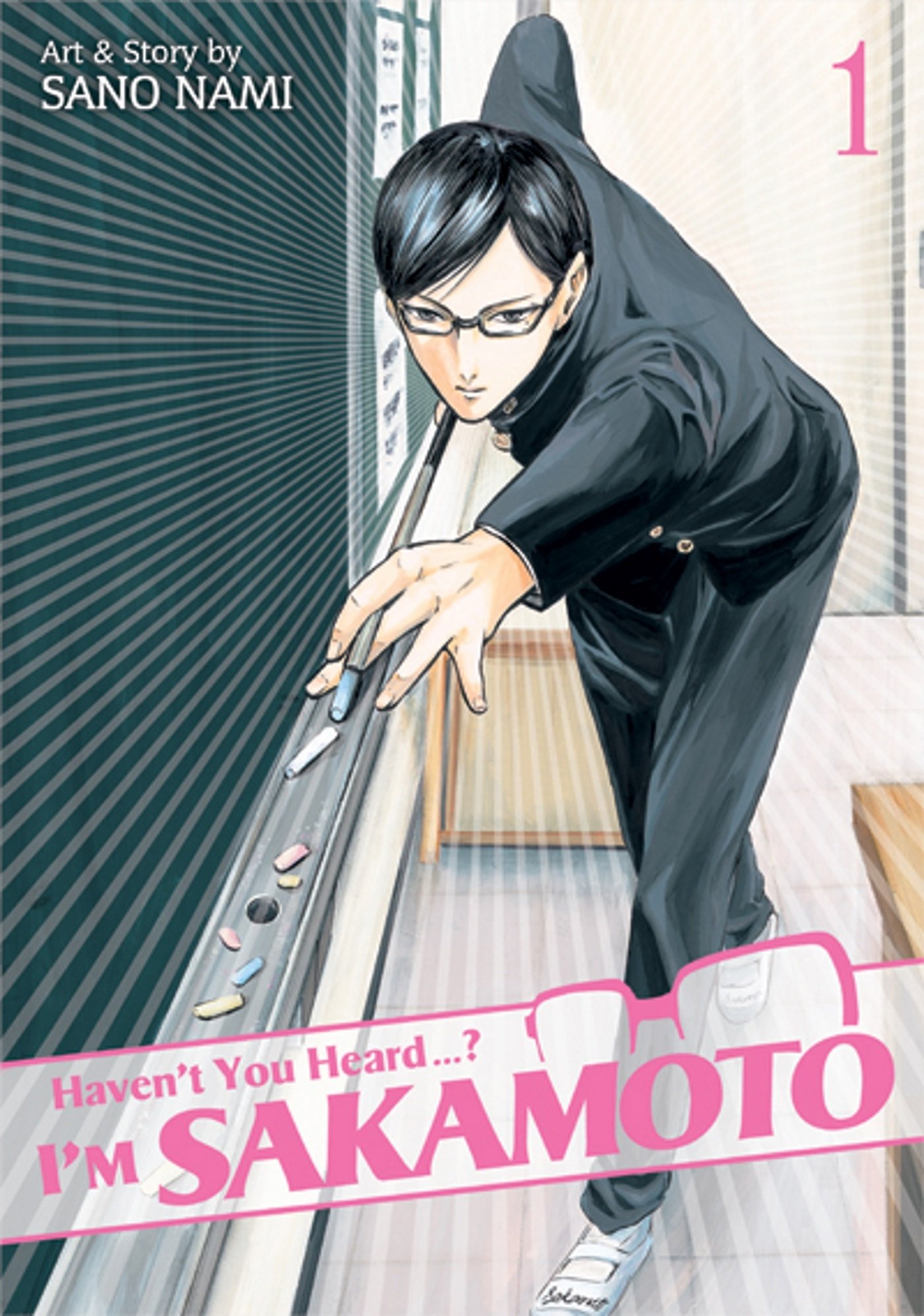
sakamotoHaven’t You Heard? I’m Sakamoto, Vol. 1
By Miki Sano
Rated Teen
Seven Seas, $12.99

Haven’t You Heard? I’m Sakamoto is “The Aristocrats” of manga, a basic joke that yields endless variations, each more baroque than the last. The premise is simple: transfer student Sakamoto is handsome, brilliant, and athletic, making him a natural target for bullies and lovelorn girls. Any time a challenging situation arises–a bee in a classroom, a classmate injured by a softball–Sakamoto effortlessly meets that challenge, in the process revealing a previously undisclosed talent.

In the hands of a less imaginative storyteller, Sakamoto might be a wish-fulfillment character for every teenager who’s ever been tongue-tied or harassed by other students. Nami Sano puts a distinct spin on the material, however, portraying Sakamoto as so calculating and unflappable that he’s genuinely creepy; Sakamoto never smiles, laughs, or shows any discernible human emotion, even when confronted with other people’s tears or anger. (The real joke seems to be that everyone admires Sakamoto anyway.) I’m not sure that I LMAO, but Sakamoto’s odd persona and equally odd talents are a welcome rebuke to the school council presidents and earnest strivers who populate most teen-oriented manga; I’d much rather spend time with him than a standard-issue shonen prince.

The verdict: You’ll either find Sakamoto’s antics inspired or too weird to be amusing.

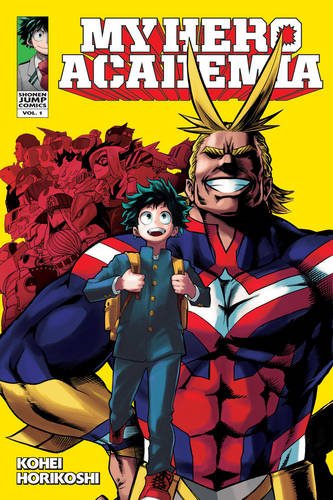
academiaMy Hero Academia, Vol. 1
By Kohei Horikoshi
Rated T, for teens
VIZ Media, $9.99

Meet Izuku Midoriya: he’s an ordinary teen living in a world where 80% of humanity possesses a super power. That doesn’t stop Izuku from aspiring to become a professional hero, however; since childhood, he’s dreamed about the day he might gain admission to prestigious U.A. High School, a training ground for future crime-fighters. A chance encounter with All Might, a celebrity superhero, gives Izuku a chance to prove his mettle and get the coaching he needs to pass the U.A. entrance exam.

Though the plot twists are unsurprising, and Izuku’s classmates familiar types (e.g. the Bully, the Spazzy Enthusiast), the breezy script propels My Hero Academia past its most hackneyed moments. The clean linework, playful superhero costumes, and artfully staged combat further enhance the series’ appeal; Kohei Horikoshi could give a master class on the reaction shot, especially when a supervillain is wrecking havoc on a downtown skyline. Most importantly, Horikoshi respects the sincerity of Izuku’s ambitions without letting the character’s earnest intensity cast a pall over the fun–in essence, it’s a Silver Age comic in modern shonen drag, with all the corny humor and fist-pumping action of Stan Lee and Steve Ditko’s best work on Spider-Man.

The verdict: My Hero Academia is as predictable as death and taxes, but a smart script and crisp artwork help distinguish it from other titles in the Shonen Jump catalog.

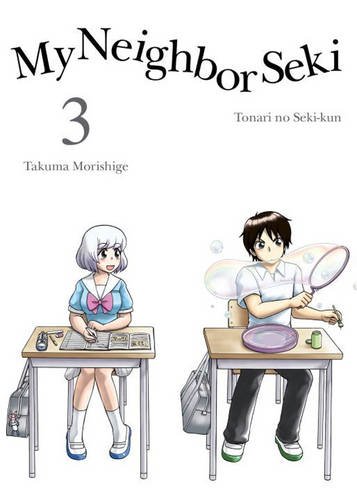
sekiMy Neighbor Seki, Vols. 1-3
By Takuma Morishige
Unrated
Vertical Comics, $10.95

Like Haven’t You Heard? I’m Sakamoto, My Neighbor Seki is a one-joke series: middle-school student Seki goofs off during class, much to the consternation of his seat mate Rumi. Seki isn’t just doodling in his notepad, however. He pets kittens, builds elaborate sculptures from shoji pieces, runs an intraschool mail service, and hosts a tea ceremony. To vary the rhythm of the joke-telling, artist Takuma Morishige occasionally transplants the action from the schoolroom to the playground, though the set-up remains the same; Seki does something outrageous and Rumi reacts, prompting the teacher to scold Rumi for not paying attention.

Given Seki‘s slender premise, it’s not surprising that each volume is a hit-and-miss affair. In volume one, for example, Seki knits a cactus plushie using a double-ended afghan hook. Rumi initially scoffs at his choice of tool; as she observes, “The hallmark of afghan knitting is its unique thickness and softness. It’s a texture best utilized when making sweaters,” not stuffed animals. When she sees the final results, however, she concedes that Seki has chosen the perfect technique and materials for his cactus, sending her into a rapturously funny meditation on yarn. Not all the gags are as successful: Seki’s penchant for staging elaborate scenes with action figures is moderately amusing at first, but grows more tiresome with each new and less imaginative iteration. Still, it’s impossible to deny the energy, creativity, and specificity with which Morishige brings Seki’s exploits to life, making this series more “win” than “fail.”

The verdict: My Neighbor Seki is best enjoyed in one or two chapter installments; when read in large bursts, some scenarios read like 4-koma strips stretched to epic and unfunny proportions.

These reviews originally appeared at MangaBlog on August 7, 2015.

Filed Under: Classic Manga Critic, Manga, Manga Critic, REVIEWS Tagged With: Comedy, My Hero Academia, Seven Seas, Shonen Jump, vertical, VIZ

One-Punch Man, Vols. 1-2

January 6, 2017 by Katherine Dacey

In a scene that would surely please Jack Kirby, One-Punch Man opens with a pow! splat! and boom!, as Saitama, the eponymous hero, goes mano-a-mano with the powerful Vaccine Man, a three-story menace with razor-sharp claws. Though Vaccine Man is formidable, he has a pronounced Achilles’ heel: chattiness. “I exist because of humankind’s constant pollution of the environment!” he tells Saitama. “The Earth is a single living organism! And you humans are the disease-causing germs killing it! The will of the earth gave birth to me so that I may destroy humanity and their insidious civilization!” Vaccine Man is so stunned that Saitama lacks an equally dramatic origin story that he lets down his guard, allowing Saitama to land a deadly right hook.

And so it goes with the other villains in One-Punch Man: Saitama’s unassuming appearance and matter-of-fact demeanor give him a strategic advantage over the preening scientists, cyborg gorillas, were-lions, and giant crabmen who terrorize City Z. Saitama’s sangfroid comes at a cost, however: the media never credit his alter ego with saving the day, instead attributing these victories to more improbable heroes such as Mumen Rider, a timid, helmet-wearing cyclist. Even the acquisition of a sidekick, Genos, does little to boost Saitama’s visibility in a city crawling with would-be heroes and monsters.

If it sounds as if One-Punch Man is shooting fish in a barrel, it is; supermen and shonen heroes, by definition, are a self-parodying lot. (See: capes, spandex, “Wind Scar.”) What inoculates One-Punch Man against snarky superiority is its ability to toe the line between straightforward action and affectionate spoof. It’s jokey and sincere, a combination that proves infectious.

Saitama is key to ONE’s strategy for bridging the action/satire divide: the character dutifully acknowledges tokusatsu cliches while refusing to capitulate to the ones he deems most ridiculous. (In one scene, Saitama counters an opponent’s “Lion Slash: Meteor Power Shower” attack with a burst of “Consecutive Normal Punches.”) ONE’s script is complemented by bold, polished artwork; even if the outcome of a battle is never in question, artist Yusuke Murata dreams up imaginative obstacles to prevent Saitama from defeating his opponents too quickly, or rehashing an earlier confrontation.

Is One-Punch Man worthy of its Eisner nomination? Based on what I’ve read so far, I’d say yes: it’s brisk, breezy, and executed with consummate skill. It may not be the “best” title in the bunch–I’d give the honor to Moyocco Anno’s In Clothes Called Fat–but it’s a lot more fun than either volume of Showa: A History of Japan… Scout’s honor.

The verdict:  Highly recommended.

One-Punch Man, Vols. 1-2
Story by ONE, Art by Yusuke Murata
Rated T, for teens
VIZ Media, $6.99 (digital)

This review originally appeared at MangaBlog on June 12, 2015.

Filed Under: Manga, Manga Critic, REVIEWS Tagged With: Comedy, one punch man, Shonen Jump, VIZ

  • « Go to Previous Page
  • Page 1
  • Page 2
  • Page 3
  • Page 4
  • Go to Next Page »
 | Log in
Copyright © 2010 Manga Bookshelf | Powered by WordPress & the Genesis Framework