• Skip to primary navigation
  • Skip to main content
  • Skip to primary sidebar
  • Home
  • About Us
    • Privacy Policy
    • Comment Policy
    • Disclosures & Disclaimers
  • Resources
    • Links, Essays & Articles
    • Fandomology!
    • CLAMP Directory
    • BlogRoll
  • Features & Columns
    • 3 Things Thursday
    • Adventures in the Key of Shoujo
    • Bit & Blips (game reviews)
    • BL BOOKRACK
    • Bookshelf Briefs
    • Bringing the Drama
    • Comic Conversion
    • Fanservice Friday
    • Going Digital
    • It Came From the Sinosphere
    • License This!
    • Magazine no Mori
    • My Week in Manga
    • OFF THE SHELF
    • Not By Manga Alone
    • PICK OF THE WEEK
    • Subtitles & Sensibility
    • Weekly Shonen Jump Recaps
  • Manga Moveable Feast
    • MMF Full Archive
    • Yun Kouga
    • CLAMP
    • Shojo Beat
    • Osamu Tezuka
    • Sailor Moon
    • Fruits Basket
    • Takehiko Inoue
    • Wild Adapter
    • One Piece
    • After School Nightmare
    • Karakuri Odette
    • Paradise Kiss
    • The Color Trilogy
    • To Terra…
    • Sexy Voice & Robo
  • Browse by Author
    • Sean Gaffney
    • Anna Neatrour
    • Michelle Smith
    • Katherine Dacey
    • MJ
    • Brigid Alverson
    • Travis Anderson
    • Phillip Anthony
    • Derek Bown
    • Jaci Dahlvang
    • Angela Eastman
    • Erica Friedman
    • Sara K.
    • Megan Purdy
    • Emily Snodgrass
    • Nancy Thistlethwaite
    • Eva Volin
    • David Welsh
  • MB Blogs
    • A Case Suitable For Treatment
    • Experiments in Manga
    • MangaBlog
    • The Manga Critic
    • Manga Report
    • Soliloquy in Blue
    • Manga Curmudgeon (archive)

Manga Bookshelf

Discussion, Resources, Roundtables, & Reviews

Manga Critic

Days on Fes, Vol. 1

April 9, 2021 by Katherine Dacey

Like many Gen-Xers, I cut my musical teeth at rock concerts. I didn’t have much experience going to festivals—they were rare in the 1980s—but I did catch the first Lollapalooza tour as it passed through the Boston area in 1991. My memories of that day are impressionistic; it was hot, dirty, and loud, and I considered leaving when I learned that Siouxsie and the Banshees had cancelled their appearance. I’m glad I didn’t, though, as the festival helped expand my musical horizons, introducing me to the sound of rap-metal and the Rollins Band, and reminding me just how phenomenal Living Colour was. Reading Days on Fes reminded me of that formative experience, though not in the way I’d expected. I imagined that a manga about rock festivals would focus on the music, but Days on Fes is equally concerned with food stalls, merch, and concert-going logistics, even dedicating one chapter to finding the perfect campsite at an outdoor festival.

The first volume follows two characters: Otoha, a goofy high school student, and Gaku, her thirty-something brother. In the first half of the book, Otoha persuades her classmate Kanade to attend the Meteorock Festival with her, while in the second Gaku drags his Eeyore-esque employee Ritsuru to the Fries & Sushi Festival. Both siblings face predictable hurdles in getting to the venue, from lack of interest—Kanade confesses that she doesn’t like rock—to lack of funds—Ritsuru bemoans the fact that he’s too poor to afford a ticket. Once at the festivals, however, both Kanade and Ritsuru succumb to the excitement of eating good food, wandering the grounds, drinking beer, sleeping under the stars, and—yes—hearing some concerts.

The most satisfying passages in volume one focus on getting ready for a festival. Oka vividly captures the feeling of pre-concert anticipation, carefully documenting the small but important rituals that festival-goers observe, from picking out an outfit to deciding what to bring; he even includes a two-page spread detailing the contents of Kanade and Otoha’s backpacks. Though this illustration serves a legitimate educational purpose, showing the festival n00b what they’ll need—suncreen, snacks—it also speaks volumes about the two girls’ personalities and expectations for the festival itself. Less satisfying are the performances. Oka relies on reaction shots and close-ups of musicians’ faces to convey the excitement of hearing live music, but the blandness of the illustrations undercuts the efficacy of this time-honored strategy for showing what can’t be heard: whoops, claps, whistles, boos, sing-alongs. The dialogue provides the only clue that these performances were good; characters spend more time talking and thinking about how the music effects them then they do listening to music.

For anyone old enough to remember the original Lollapalooza tour, the contrast between the lackluster performance scenes and the rhapsodic discussions of festival foods may be jarring; it often feels like Oka has channeled too much energy into depicting the things you can buy and do at a festival rather than what you might hear. For younger readers, however, Days on Fes offers a safe but tantalizing glimpse of what it might be like to attend Coachella or Bonnaroo, as well as a down-to-earth reminder that festivals are an expensive habit—a message that’s sure to be music to parents’ ears.

DAYS ON FES, VOL. 1 • ART AND STORY BY KANAKO OKA • TRANSLATED BY AJANI OLOYE • LETTERING BY ALEXIS ECKERMAN • YEN PRESS • RATED TEEN • 208 pp.
Filed Under: Manga, Manga Critic, REVIEWS Tagged With: Musical Manga, Rock, yen press

Downfall

March 19, 2021 by Katherine Dacey

Downfall is the story of Karou Fukazawa, a deeply flawed, forty-something manga artist whose career has stalled, marriage has soured, and self-esteem has curdled into a toxic form of self-pity. He lies; he procrastinates; he cheats on his wife; he berates his assistants. Though he eventually finds a path forward, his journey is not one of self-discovery or personal growth, but of resignation, of realizing that the life he’d imagined for himself turned out to be deeply disappointing.

Inio Asano underscores the depth of Fukuzawa’s self-loathing in the way he depicts Downfall‘s female characters. Fukazawa’s wife Nozomi, for example, is a successful manga editor in her own right, but she carries herself like a remorseful child, shoulders slumped, eyes downcast, and lips pursed. Fukuzawa complains that Nozomi devotes too much time to her job, criticizing her for paying more attention to the artists in her portfolio than to him, and excoriating her for not supporting him. His sense of entitlement is so powerful, in fact, that he coerces her into sex during a particularly nasty argument, a scene that’s so visceral, awkward, and claustrophobic that it’s genuinely hard to read, not least because it is such an unflinching portrayal of his narcissism.

Other female characters fare worse than Nozomi. Yunbo and Marimekko, two sex workers whom Fukazawa visits, are drawn in the same grotesque fashion as the pompous, foolish, and hypocritical characters in Dead Dead Demon’s Dedededestruction and Goodnight, Punpun. Fukazawa’s contempt for these women is thrown into sharp relief when contrasted with Chifuyu, an escort who reminds Fukazawa of an old girlfriend. Chifuyu is a gamine figure, with stylishly cropped hair, cat-like eyes, and a lithe body—a symbol of youth, possibility, and sexual desirability, unburdened by years of marital and professional disappointments—whereas Yunbo and Marimekko are awkward and unattractive, less individuals than vessels for Fukuzawa’s rage, and reminders of how much shame he feels over his faltering career.

As damning as all this sounds, Downfall isn’t simple misery porn. Fukuzawa is a rotten person, to be sure, but his ennui is genuine, rooted in the question of what it really means to turn one’s passion into a career. For Fukuzawa, that question is all-consuming, as he wrestles with the difficulty of making art in the context of the commercial publishing industry, where deadlines, reader surveys, and fickle fans exact their tolls. Fukuzawa also struggles with the manga industry’s voracious appetite for new talent, as he watches his book sales plunge while young, inexperienced artists find the kind of readership and acclaim that he himself once enjoyed. Even as I recoiled from Fukazawa’s sourness and misogyny, his professional dilemma resonated with me as a fellow forty-something with a career in the arts. What is the emotional and creative cost of making art on demand? How do you continue telling a story, creating art, or writing music when you are fundamentally disillusioned with the process? If you allow work to consume you in the name of becoming an expert, what remains when you reach those benchmarks of success? 

To explore these questions, Asano eschews a conventional narrative form, instead juxtaposing past and present in a rondo-like fashion (ABACA). The “B” and “C” sections take place in the present, unfolding in a linear manner, while the “A” section revisits a specific moment in Fukuzawa’s past: a youthful relationship that ended when Fukuzawa’s girlfriend declared, “As long as you keep drawing manga… you’ll keep on hurting people.” Asano is particularly adept at capturing the way in which the past and present sit side by side in the mind of an agitated person, rendering Fukuzawa’s memories as vividly as the present-day scenes, with consummate attention to small but meaningful details. From the way Fukazawa remembers this relationship—reciting the same observations about his girlfriend over and over again—it’s clear that he views this moment as a turning point in his life, and an explanation for who he has become. 

Yet these final pages feel less like a condemnation of Fukuzawa’s selfishness than a plea to understand his behavior: I renounced love for art. For me, at least, that feels like a cop-out, a way for Fukuzawa—and perhaps Asano—to tacitly acknowledge the character’s monstrous behavior while suggesting that it was somehow inevitable, pre-ordained, or natural. Viewed from a feminist perspective, though, it’s awfully hard to muster sympathy for a character who justifies his tantrums, violence, and vicious remarks as necessary to his art, especially when so much of his vitriol is directed at women. Your mileage may vary.

DOWNFALL • STORY AND ART BY INIO ASANO • TRANSLATED BY JOCELYNE ALLEN • EDITED BY PANCHA DIAZ • TOUCH-UP ART AND LETTERING BY JOHANNA ESTEP • VIZ MEDIA • 246 pp. • RATED MATURE (sexual situations, violence)

Filed Under: Manga, Manga Critic, REVIEWS Tagged With: Inio Asano, VIZ Signature

Zom 100: Bucket List of the Dead, Vol. 1

March 2, 2021 by Katherine Dacey

If your chief criticism of King of Eden was “not enough boobs,” have I got the manga for you: Zom 100: Bucket List of the Dead, a comedy about a corporate drone whose life is transformed by the onset of a zombie plague. Its hero, Akira Tendo, sees opportunity where others see only chaos, and decides to make a bucket list of 100 things he wants to do before he, too, becomes one of the walking dead. His top priorities? Telling his voluptuous co-worker Ohtori how much he likes her—even if she is the “boss’ side piece”—and tracking down a mysterious hottie he encounters in a convenience store.

While Akira’s quest doesn’t sound particularly memorable, his new-found optimism makes him an agreeable guide through a Tokyo overrun by zombies. His palpable joy in quitting a soul-crushing job is infectious—if you’ll pardon the expression—as he finds pleasure in small things: riding a motorcycle for the first time, scavenging for his favorite beer, playing video games during normal business hours. No matter how much carnage he encounters, or how many of his bucket-list errands don’t go according to plan, Akira’s can-do spirit remains undiminished. So, too, is his loyalty to others, as evidenced by his willingness to rescue his childhood friend Tencho from a hotel overrun by zombies.

The hotel scene is indicative of what’s good and not so good about Zom 100. On the one hand, the friends’ shared ordeal leads to a heartfelt exchange in which they discuss why they drifted apart after college. Their dialogue is a little on-the-nose—“I got jealous of how successful you were and took my anger out on you,” Akira confesses in a torrent of tears and snot—but the characters’ sincerity makes Akira and Tencho’s reconciliation feel like a genuine moment of maturity.

On the other hand, the main reason this scene begins in a hotel—specifically, a love hotel—is to offer some good old-fashioned fan service, as Kencho is trapped in a bondage chamber with an irate, naked zombie who’s been chained to the wall. The zombie is drawn in loving detail, right down to her perky breasts, but serves no real dramatic purpose; she exists mainly to make young male readers gawp at Kencho’s predicament. The same goes for several other gratuitous moments of nudity and pin-up posturing, none of which feel necessary or demonstrate artist Kotaro Takata’s skill at drawing attractive, anatomically correct women. (All of his figures seem to have a few extra vertebrae.)

The fan service is indicative of a deeper problem as well: the zombies—or the boobs, for that matter—don’t feel essential to Akira’s story. Almost any catastrophe or life-altering event could have set the plot in motion, whether it was a devastating medical diagnosis or Earth’s impending collision with a meteor. Equally disappointing is that Akira’s quest feels more like a to-do list than a real emotional journey; even he seems disappointed in his inability to come up with a sufficiently long or imaginative bucket list. As a result, Akira seems like just another standard-issue shonen lead, blessed with an optimism that sometimes makes him seem a little dim, a superhuman ability to escape life-threatening situations, and an uncanny knack for stumbling into situations with hot women. I don’t know about you, but I would have enjoyed this series 100% more if the gender roles had been reversed, if only for the sight of a former office lady cheerfully riding a Harley through a zombie horde on her way to score a few brews.

To read a brief excerpt of Zom 100: Bucket List of the Dead, click here.

ZOM 100: BUCKET LIST OF THE DEAD, VOL. 1 • STORY BY HARO ASO • ART BY KOTARO TAKATA • TRANSLATION BY NOVA SKIPPER • TOUCH-UP ART & LETTERING BY VANESSA SATONE • EDITED BY KARLA CLARK • VIZ MEDIA • RATED: OLDER TEEN (PARTIAL NUDITY, GORE, VIOLENCE) • 159 pp.

Filed Under: Manga, Manga Critic, REVIEWS Tagged With: Comedy, Horror/Supernatural, VIZ, VIZ Signature, Zombies

Korea as Viewed by 12 Creators

November 28, 2020 by Katherine Dacey

This anthology of twelve short stories, six by Korean artists and six by French, follows the same basic template as Japan As Viewed by 17 Creators, offering brief, impressionistic scenes of contemporary Korean life. Though 17 Creators is a uniformly excellent work, its companion volume is not; the stories run the gamut from pedestrian to brilliant, with the Korean artists making the strongest contributions.

The unevenness of the collection is attributable, in part, to a home field advantage. Artists such as Choi Kyu-sok and Byun Ki-hyun tackle deeper, more penetrating topics than their French counterparts, exploring homelessness (“The Fake Dove”), sexual discrimination and violence (“The Rabbit”), and the decay of traditional social networks (“The Rain That Goes Away Comes Back”). Though the artists’ ambition sometimes outstrips their allocated space, all three stories boast beautiful, detailed artwork that suggests the rhythm and feeling of modern urban life. The French contributions, by contrast, are travelogues of one sort or another: in “Beondegi,” for example, Mathieu Sapin imagines what it would be like for a French-Korean woman to return to her parents’ home country, while in “Letters From Korea,” Igort offers brief descriptions of places he visited in Seoul. The weakest of the collection is Catel’s “Dul Lucie,” an uneventful travel diary filled with observations about “doll-like” and “sensual” Koreans that — in English, at least — leave a bad aftertaste of exoticism. Though the other French artists are not as patronizing, the stories feel shallow; imagine an essay about New York City written by someone who only visited Times Square, and you have some idea of how superficial these artists’ appreciation of Korea seems to be.

Two stories make this collection a worthwhile investment. The first is “Solgeo’s Tree,” by Lee Doo-hoo, in which a monk paints a mural so life-like that birds attempt to perch in its branches. Told with almost no dialogue, the story relies heavily on Lee’s exquisite pen-and-ink drawings to impart its Buddhist moral. The second is “A Rat in the Country of Yong,” Herve Tanquerelle’s playful, wordless story about a mouse visiting Seoul. The surrealistic imagery — skies full of dragon transports, streets filled with animal-eared people, pools inhabited by monstrous carp — and Chaplin-esque physical comedy evoke the strangeness and excitement of visiting a new city without falling into the trap of essentializing its people. Both comics attest to the vitality and richness of the “as viewed by” concept, and suggest what might have emerged from this sometimes insightful, sometimes banal French-Korean collaboration.

This review was originally published on September 6, 2010.

Korea as Viewed by 12 Creators
Edited by Nicholas Finet
Fanfare/Ponent Mon, 222 pp.
No rating

Filed Under: Manga Critic, Manhwa, REVIEWS Tagged With: Fanfare/Ponent Mon

King of Eden, Vol. 1

November 11, 2020 by Katherine Dacey

Is it too soon to enjoy a pandemic-themed manga? That question was foremost in my mind as I read King of Eden, a new thriller that pits a group of globe-trotting scientists against an assortment of terrorist organizations that have weaponized a lethal virus. I’m happy to report that King of Eden didn’t remind me of the COVID crisis, but it did something arguably worse: it bored me.

The dullness of the story is all the more surprising for a series written by Takashi Nagasaki, Naoki Urasawa’s collaborator on such entertaining pot-boilers as Monster, Master Keaton, and 20th Century Boys. All of Nagasaki’s worst tendencies are on display in King of Eden: there are pointless flashbacks to the main characters’ childhoods, solemn monologues about the Old Testament, long-winded conversations about global terrorism, and an interminable lecture on the ancient Scythians that name-checks Herodotus because… why not? Though the first volume introduces a dizzying number of characters, Nagasaki barely fleshes them out. Even leads Rua Itsuki and Teze Yoo feel more like skill sets than actual people, as evidenced by an on-the-nose exchange in which a bureaucrat recites Dr. Itsuki’s resume and reminds her that she “hold[s] a black belt in Tae Kwon Do” and is “proficient in the Israeli martial art of Krav Maga” as if she didn’t know these things about herself.

None of this would matter, of course, if King of Eden were entertaining, but Nagasaki is so intent on world-building that he overwhelms the reader with information, all delivered in such earnest, exhaustive detail it saps the narrative momentum. Itsuki and Yoo cross paths with MI-6 agents, WHO officials, IRA terrorists, crazy archaeologists, Interpol officers, and zombies—ZOMBIES, for Pete’s sake!—yet none of these encounters are memorable. Had Nagasaki placed more trust in artist SangCheol Lee (a.k.a. Ignito), King of Eden might have been a brisker, more imaginative entry in the zombie canon.

The first chapter offers a tantalizing glimpse of that potential partnership. Gone are the long-winded speeches; instead, Lee drops the reader into the action alongside two police officers who stumble across a baffling, gruesome scene. After the officers arrest a potential suspect, Lee skillfully cross-cuts between two spaces at the local precinct—an interrogation room and the morgue—allowing us to glimpse what’s unfolding in each room, and to feel the policemen’s growing unease. Lee’s crack pacing keeps the reader invested in the characters’ fate, building to a satisfying reveal of the carnage’s true source: a hideous, lantern-jawed creature that’s part werewolf, part zombie.

Alas, that cinematic flair disappears as soon as the characters begin talking; the next two chapters consist of information dumps punctuated by the occasional fist fight or car chase. By the time Nagasaki and Lee introduce a vampire arms dealer near the end of volume one, it barely registers as a major development. And that, in a nutshell, is what’s wrong with King of Eden: the story is so overstuffed with characters and events that I couldn’t muster the energy for another 15 or 100 chapters of talking heads explaining zombie behavior or Scythian culture just to figure out who this vampire is, and why he matters.

Yen Press provided a review copy of volume one.

KING OF EDEN, VOL. 1 • STORY BY TAKASHI NAGASAKI • ART BY IGNITO • TRANSLATED BY CALEB COOK • LETTERING BY ABIGAIL BLACKMAN • RATED OLDER TEEN (16+) • 384 pp.

Filed Under: Manga, Manga Critic, REVIEWS Tagged With: Horror/Supernatural, Takashi Nagasaki, yen press, Zombies

A First Look at YashaHime: Demon Half-Princess

October 11, 2020 by Katherine Dacey

For a brief moment in the early 2000s, Rumiko Takashashi’s InuYasha was the shonen franchise in America. It was a constant presence on cable television, where it anchored Cartoon Network’s Adult Swim line-up, and a commercial success for VIZ Media, which issued and re-issued the series in formats ranging from flipped floppies to deluxe, three-in-volumes. By the time InuYasha finished its run in 2008, readers had moved on to other franchises, but InuYasha was an important series for the North American comics market, as it helped reveal an underserved population of teens who weren’t particularly interested in Batman or Captain America, but were interested in reading comics about characters their own age.

InuYasha also demonstrated that teen girls were just as enthusiastic about action, adventure, and horror comics as their male counterparts, especially if the series featured well-rounded female characters. To be sure, plenty of shonen manga included at least one Tough Female Character™, but InuYasha’s three female leads were defined as much by their frustrations, insecurities, and smarts as they were their ass-kicking capabilities. Equally important, Kagome, Sango, and Kikyo weren’t drawn for the male gaze; they were depicted as normal young women, making it easier for teen girls to identify with the characters’ struggles and triumphs.

It seems fitting, then, that the new InuYasha spin-off puts girls front and center. YashaHime: Princess Half-Demon is a “next generation” sequel that focuses on the original characters’ offspring—in this case, the teenage daughters of InuYasha and his big brother Sesshomaru. This time around, however, Sesshomaru’s twins Towa and Setsuna are the leads and InuYasha’s kid Moroha is the brash, impetuous foil to her sterner, more reticent cousins.

The good news is that YashaHime faithfully adheres to the spirit of the original series, with its characteristic mixture of romance, slapstick, horror, and action; anyone worried that the new series might try too hard to differentiate itself from InuYasha will be happy to see that the new show keeps the focus on demon-fighting, quests, and camaraderie. The bad news is that the first episode is so compressed that the new heroines barely make an impression on the viewer, as their introductions are overshadowed by clumsy bits of exposition, cameo appearances by the original series’ main characters, and a showdown between a demon and the old gang.

In an effort to create more continuity between the original series and the sequel, the second episode reveals that Towa was raised by Kagome’s younger brother Sota in present-day Tokyo. Towa’s introductory scenes are so focused on explaining her backstory that her distinctive choice of clothing—a schoolboy’s uniform—initially seems like an afterthought: “better for fighting,” Towa tells us in a voice-over. That detail turns out to be an important clue about how Towa sees herself, as she complains that “girls must be feminine and boys must be masculine,” a distinction that Towa finds as restrictive as the clothes she’s expected to wear. Towa’s gender presentation is addressed in a ham-fisted way—her younger sister pleads with Towa to be more “girly” and “cute”—but the writers’ willingness to address Towa’s fierce rejection of gender binaries suggests that YashaHime may explore some interesting new thematic territory.

The only truly disappointing aspect of YashaHime is the animation, a flaw that’s most evident in its stiffly executed fight scenes. The animators never create a persuasive illusion of people jumping, flying, and running through three-dimensional space; all the characters look like paper cut-outs superimposed on unimaginative backgrounds. The flatness of the imagery is even more obvious when YashaHime and InuYasha are viewed side-by-side, as InuYasha’s softer, more nuanced color palette gave the picture plane more depth and the characters’ bodies more weight. The one bright spot is YashaHime‘s character designs: Moroha, Towa, and Setsuna bear just enough resemblance to their parents to make it easy for the viewer to grasp the father-daughter connection, even though each girl has her own unique look. That attention to detail extends beyond their physical appearance, too, influencing the way they move, talk, and twitch their noses when they catch wind of a demon.

If I sound a little ambivalent about YashaHime, I am: it shows considerable promise, but hasn’t quite escaped the long shadow of its parent series or found the right pacing for the kind of stories it wants to tell. I’m reserving final judgment until the relationships between Towa, Setsuna, and Moroha are more clearly delineated—after all, it was the complex web of feelings and friendships that made InuYasha compelling as much as its demon-of-the-week adventures. Here’s hoping the sequel will embrace that approach, too.

Episodes 1-2 of YashaHime: Princess Half-Demon are currently streaming on Crunchyroll, Funimation, and Hulu. New episodes air on Saturdays.

Filed Under: Manga Critic, Movies & TV, REVIEWS Tagged With: anime, inuyasha, VIZ, YashaHime

The Girl with the Sanpaku Eyes, Vol. 1

August 24, 2020 by Katherine Dacey

Google the term sanpaku, and you’ll quickly discover why the word resists easy translation. In its most basic sense, sanpaku means “three whites,” a condition in which the iris sits a little higher or lower in the eye than normal, exposing more of the schlera. The significance of having sanpaku eyes, however, seems hotly contested, with some websites proclaiming it a curse and others declaring it evidence of great emotional turmoil. The heroine of Denpa Books’ newest series is neither doomed nor crazy, just deeply frustrated that her chronic Resting Bitch Face makes it difficult to show Katou, her crush, how cool and awesome she thinks he is.

Perhaps the most surprising aspect of The Girl with the Sanpaku Eyes is the artwork. The illustrations are rendered in a warm, pink palette that captures Amane’s agitation more effectively than deformations and sweat drops alone could do. The character designs are somewhat generic—Katou is a standard-issue shojo prince, right down to his mega-watt grin—but Amane and her siblings are drawn with genuine individuality, revealing their shared family curse: all three look meaner than they are. Amane, in particular, stands apart from her galaxy-eyed peers with her cat-like pupils and scowling expression that make her look more like a bosozoku gang member than a sweet, timid high school student.

Though artist Shunsuke Sorato convincingly shows us how flustered Amane becomes in Katou’s presence, there’s almost no dramatic or comedic tension in this series; by chapter three, it’s obvious that the sweetly hunky Katou likes Amane, too, and is eager to reciprocate her affection. Therein lies the biggest problem with The Girl with the Sanpaku Eyes: the story is so one-sided and predictable that it barely registers as a rom-com, since there’s almost nothing at stake in Amane and Katou’s exchanges. For middle-school readers navigating a first crush, Sorato’s storytelling approach will feel reassuring, but for older teens The Girl with the Sanpaku Eyes may be too anodyne to be truly engaging.

A review copy was provided by Denpa Books. Volume one will be released digitally on August 25th at the Denpa Books website and September 1st on additional digital platforms. The print edition will be released on September 15th.

THE GIRL WITH THE SANPAKU EYES • ART & STORY BY SHUNSUKE SORATO • TRANSLATED BY DAVID GOLDBERG • LETTERING BY GLEN ISIP • DENPA BOOKS • 128 pp. • NO RATING (SUITABLE FOR READERS AGED 10+)

Filed Under: Manga, Manga Critic, REVIEWS Tagged With: Denpa Books, Romance/Romantic Comedy

The Way of the Househusband, Vols. 2-3

July 11, 2020 by Katherine Dacey

The Way of the Househusband has the rhythms of a good sitcom: it has a simple, well-defined premise, a few lead characters with strong personalities, and an episodic formula that’s flexible enough to create endless opportunities to tell the same joke in new and surprising ways. In the first volume, for example, almost every storyline revolved around Tatsu’s fanatical dedication to his role as stay-at-home spouse, whether he was bargain hunting at the grocery store or racing to the train station with his wife’s lunchbox. The mere sight of him in an apron, track suit, and aviator glasses was a good sight gag made better by Tatsu’s sheer cluelessness; he never seemed to realize that people were staring at him in the checkout line and the butcher’s shop.

Volumes two and three find Tatsu in equally incongruous situations. In chapter 10, for example, he joins the neighborhood housewives’ aerobics class, flashing his terrifying yakuza sneer every time the instructor commands her charges to “smile,” while in chapter 16, Tatsu demonstrates a hidden talent for spiking and setting when he joins the ladies’ volleyball team. The volleyball game is a great variation on the series’ best running joke. Though most civilians find him a terrifying oddity, the neighborhood ladies’ association looks at Tatsu as one of their own; they include him in activities, offer him tips on how to run his household more efficiently, and even help him impress a former boss with an impromptu display of culinary prowess.

Perhaps the most important development in volumes two and three, however, is the introduction of Tatsu’s old enemies, all of whom are genuinely bewildered by his retirement from the knee-capping business. These exchanges thrum with the comic energy of a Damon Runyon story as Tatsu schools his fellow yakuza on stain removal and dessert making. That Tatsu discusses his career change without apology or explanation is a nice touch, as it throws his opponents off their game and reinforces the idea that he likes being a stay-at-home husband.

My only concern about The Way of the Househusband is that Tatsu’s wife is more a collection of moods and preferences than a fully persuasive character. Miku is marked by extremes: she has an intense, child-like obsession with Poli-Cure, an anime whose core fanbase is about ten years old, but is also a fierce workaholic whose resists Tatsu’s efforts to pamper her with scented candles and scalp massages. Though the gags built around her personality usually land, it sometimes feels like they’d be funnier if we understood a little more about how Miku and Tatsu met, or what keeps them together. From time to time, author Kousuke Oono hints the two have more in common than meets the eye–Miku is handy with a knife and a bat, too–but a little more attention to her character would be welcome.

That said, The Way of the Househusband remains consistently funny three volumes into its run, offering a fresh take on that most timeless of sitcom premises: the fish out of water. Recommended.

VIZ Media provided a review copy of volume two.

THE WAY OF THE HOUSEHUSBAND, VOLS. 2-3 • STORY AND ART BY KOUSUKE OONO • TRANSLATION BY SHELDON DRZKA AND AMANDA HALEY, ADAPTATION BY JENNIFER LEBLANC • VIZ MEDIA, LLC • RATED T+, FOR OLDER TEENS (SUGGESTED VIOLENCE, YAKUZA JOKES)

Filed Under: Manga, Manga Critic, REVIEWS Tagged With: Comedy, VIZ, VIZ Signature, Way of the Househusband, Yakuza

A Man & His Cat, Vol. 1

February 13, 2020 by Katherine Dacey

As someone who’s suffered a lifetime of embarrassment over my tendency to cry at movies and books about animals—even ones with happy outcomes—I realize that that my reaction to A Man and His Cat may not, in fact, be warranted by the quality of the storytelling or artwork. I should also disclose that I’m almost 50, so I’m hungry for stories about people old enough to have a few grey hairs and wrinkles. And I should probably mention that I live with two cats, one of whom is contentedly snoozing by my feet as I type.

Reader, I loved it.

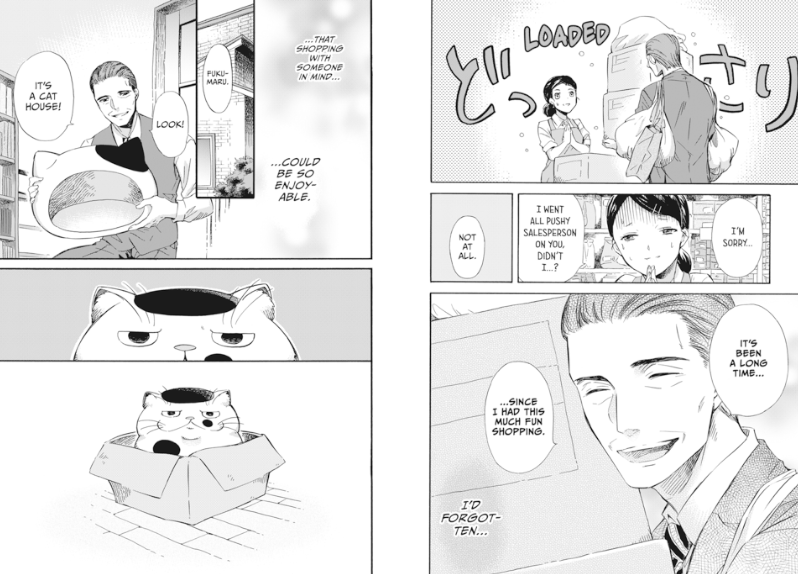
There’s no real plot to speak of; the most dramatic event unfolds in the opening pages, when Fukumaru, a grumpy-faced cat, is adopted from the pet store where he’s spent a lonely year waiting for an owner. His knight in shining armor is Mr. Kanda, a middle-aged music teacher and empty nester who exudes an aura of sadness, despite his outward composure. Though Fukumaru frets that Kanda might suffer buyer’s remorse, Kanda is thoroughly smitten with Fukumaru, throwing himself into cat ownership with abandon, buying toys and collars, and taking selfies with Fukumaru. These scenes are engineered to elicit a strong, uncomplicated emotional response from the reader; Umi Sakurai doesn’t pluck or tug at the heartstrings so much as tear and rend them, giving Fukumaru a running interior monologue about his fears and hopes. And if seeing a cat worry about being returned to the pet store isn’t enough to make your lip tremble even a little, Fukumaru’s speech is peppered with feline-specific pronouns that underscore his plight in a shamelessly sentimental fashion: who but the most jaded reader could laugh at a chubby cat who worries that he might “go meowy whole life without a name?”

Fukumaru’s vulnerability is further amplified by Sakurai’s depiction of him as round and awkwardly proportioned, with an enormous face and stumpy legs. (One character helpfully describes him as “ugly-cute.”) Though Fukumaru’s penchant for tearing up is chalked up to his breed—the pet shop labels him a “short-haired exotic”—almost every kind gesture, separation, reunion, and potential setback makes Fukumaru’s eyes glisten with great, beady tears. Kanda, on the other hand, is drawn in a somewhat stiff, bland fashion with a few perfunctory laugh lines to suggest his age. The contrast between Fukumaru—who looks like the kind of off-brand stuffed animal you might win at a carnival—and his slim, be-suited owner is an interesting artistic choice, as it makes it easier for the reader to understand why Fukumaru initially feels such trepidation about Kanda. (It’s also a pretty amusing visual gag, too.)

By now, reader, you’re probably wondering, but would I like it? That’s a question I can’t really answer, since this manga’s wholesome sentimentality appealed to me against my better judgment. But if there’s a cat in your lap as you read this review, or you share your house with a pet you rescued from a shelter, I think you might appreciate the warm dynamic between Kanda and Fukumaru, as watching these two wounded souls revel in each other’s company is a genuinely heartwarming experience. Recommended.

Square Enix provided a review copy.

A MAN & HIS CAT, VOL. 1 • BY UMI SAKURAI • TRANSLATED BY TAYLOR ENGEL • SQUARE ENIX MANGA & BOOKS • 146 pp.

Filed Under: Manga, Manga Critic, REVIEWS Tagged With: Cats, square enix

Saint Young Men, Vol. 1

January 15, 2020 by Katherine Dacey

Saint Young Men sounds like the set-up for a George Carlin routine: Jesus and Buddha spend a “gap year” on Earth, sharing an apartment in present-day Tokyo while wrestling with the temptations and banalities of modern life. The manga’s prevailing tone, however, is more silly than satirical, focusing not on big theological or philosophical questions, but mundane ones: how to stretch a monthly budget, where to find the best souvenirs, how to fend off drunken commuters.

Most of the humor stems from Hikaru Nakamura’s portrayal of Jesus and Buddha as opposites, with Jesus as a cheerful spendthrift with a fondness for t-shirts and tschotkes, and Buddha as a frugal “big brother” who agonizes over every purchase. The two have a kind of Ernie-and-Bert dynamic in which Buddha frequently chastises Jesus for his impulsive behavior, whether Jesus has purchased a “shinsengumi set” or wants to wear a pair of Mickey Mouse ears in public. Though their bickering provides most of the series’ comic fodder, there are also jokes about walking on water and turning water into wine, as well as a few sly pokes at Osamu Tezuka’s Buddha.

Anyone hoping to be outraged by Saint Young Men will be sorely disappointed, since its most blasphemous idea is that even Jesus and Buddha can’t resist the temptations of social media and shopping for melon bread. Anyone hoping for more insight into the human condition will likewise be disappointed, as Nakamura settles for easy laughs in lieu of real insight or religious critique—a missed opportunity, I think, since her premise offers plenty of latitude to reflect on Buddhist and Christian teachings, or the perils of modern-day materialism. A few good sight gags land well, but the manga’s eagerness to please blunts the edge of its best ideas. Your mileage may vary.

SAINT YOUNG MEN, VOL. 1 • STORY AND ART BY HIKARU NAKAMURA • TRANSLATION BY ALTHEA AND ATHENA NIBLEY • KODANSHA COMICS • 152 pp.


Filed Under: Manga, Manga Critic, REVIEWS Tagged With: Comedy, Hikaru Nakamura, Kodansha Comics, Saint Young Men

Chainsaw Man

January 13, 2020 by Katherine Dacey

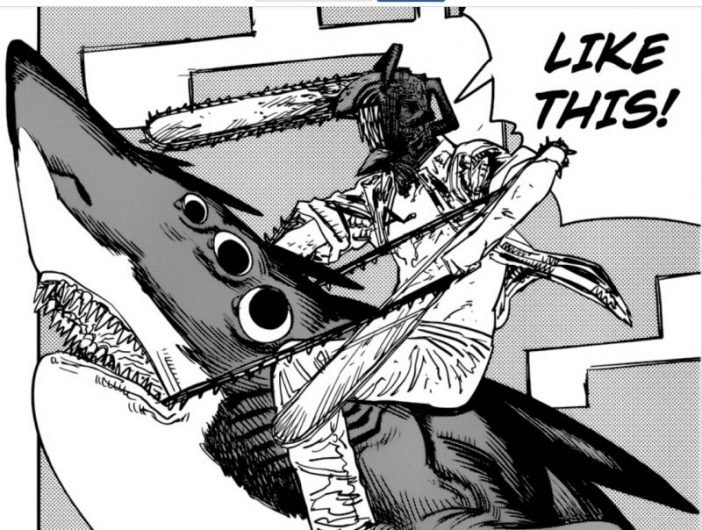
There comes a moment in every manga reader’s journey when they’re no longer dazzled by the sheer variety of genres, styles, or outrageous storylines that an issue of Weekly Shonen Jump or Big Comic Spirits offers—the moment when a manga about killer goldfish or a warrior with lethal nose hair sounds more exhausting than awesome. I reached that milestone around the time I read The Qwaser of Stigmata, a manga so lewdly preposterous I felt uncomfortable even summarizing the plot in my review. So when I heard about Chainsaw Man, a series whose premise is pretty much summed up in the title, I was pretty sure I wasn’t interested in reading it. Then I saw this image:

My first thought was whoa. And then: cool. And so began my Chainsaw Man read-a-thon, an attempt to understand the appeal of this blood-and-testosterone-soaked battle manga.

The character atop the shark is Denji, who begins the story as an ordinary young man struggling to pay off his father’s gambling debts. His only friend is the sweet-faced Pochita, a dog demon with a chainsaw blade where his snout should be. After local mobsters brutally attack Denji, Pochita transfers his demonic powers to Denji, thus enabling Denji to transform from scrawny teen to chainsaw-wielding menace with the pull of a cord. His remarkable abilities attract the interest of Makima, a professional Devil Hunter who recognizes Denji’s potential value as a weapon. Through a mixture of flirtation, cajoling, and threats, Makima recruits Denji for the Public Safety Council, dispatching him to kill monsters.

Going into Chainsaw Man, I was fully prepared for carnage and mayhem and three-eyed sharks. What I didn’t expect were moments of genuine pathos. The interactions between Denji and Pochita, however, are sniffle-inducing, underscoring the poignancy of Pochita’s decision to sacrifice himself for Denji. Later chapters set up an interesting parallel between Denji’s relationship with Pochita and his relationship with Makima, who refers to him as her “dog.” When Denji chafes against the conditions Makima has imposed on their partnership, it spurs a moment of self-reflection about his own treatment of Pochita, making him realize just how much he took Pochita’s companionship for granted.

Of course, no one is reading Chainsaw Man for these kind of emotional beats; they’re hoping for outrageous displays of gore and violence, and on that front, Tatsuki Fujimoto does his utmost to push the boundaries of good taste. Every time Denji reverts to his demonic form, chainsaw blades burst through his chest and head with great clouds of arterial spray, a preview of the even bloodier manner in which he kills his enemies. Though some of the demons are uninspired—how’s a giant bat grab you?—Fujimoto’s most memorable creations are clearly designed to elicit an appreciative “ewww”; the first monster Denji kills, for example, is an enormous tomato devil who looks like something that’s been moldering in the crisper drawer for weeks.

Between the action scenes, Fujimoto peppers the script with crude jokes to remind us that Denji is a teenage boy whose primary motivation for fighting demons is to impress Makima and earn enough money to eat junk food. In that respect, Denji is a more honest shonen hero than the typical Jump lead; he thinks and acts like a real teenage boy, right down to his self-absorption and total objectification of women. (There’s even a chapter called “A Way to Touch Some Boobs.” Yes, really.) I can’t say I ever warmed to Denji as a lead character, but I finished my read-a-thon with a grudging respect for Fujimoto’s excessive, ridiculous creation, which entertained and repelled me in equal measure. Your mileage will vary.

Chapters 1-53 of Chainsaw Man are available at the VIZ website. 

CHAINSAW MAN • STORY AND ART BY TATSUKI FUJIMOTO • VIZ MEDIA


Filed Under: Manga, Manga Critic, REVIEWS Tagged With: Action/Adventure, Chainsaw Man, Horror/Supernatural, Shonen Jump

The Wize Wize Beasts of the Wizarding Wizdoms

January 9, 2020 by Katherine Dacey

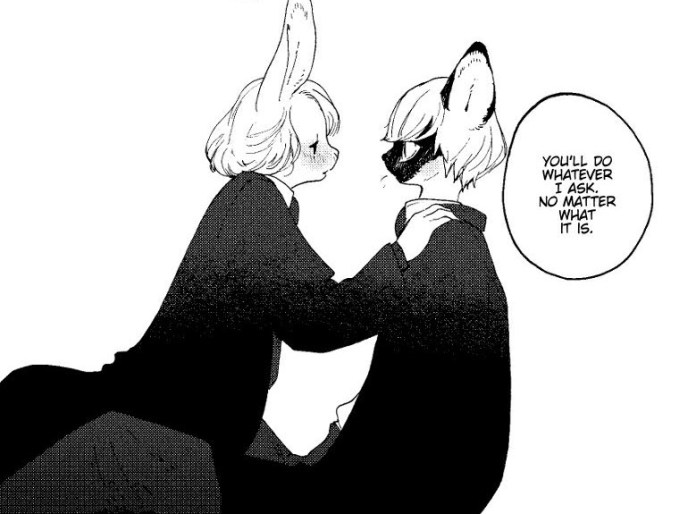
“Whimsical tales of anthropomorphic beasts in love”—or so the dust jacket of The Wize Wize Beasts of the Wizarding Wizdoms promises. The eight stories in this collection do feature a race of half-animal, half-human creatures who behave like boys at a British boarding school, forming intense friendships that sometimes cross the line into romance. I’m a little reluctant to call these stories “whimsical,” however, as that word implies a certain degree of playfulness that was lacking in most of the stories, some of which were intensely sincere, and some of which raised legitimate questions about boundaries and consent.

Wize Wize Beasts unfolds at a special academy “dedicated to the study of wizardry,” where demi-humans of every imaginable type peacefully co-exist as they learn the arts of potion-making, spell-casting, and alchemy. Each story centers on a pair of opposites: prey and predator, teacher and student, mammal and reptile, smart and average. Most of their relationships fall under the general heading of “unrequited love,” in which one demi-human pines for his opposite, but can’t muster the courage to say how he feels.

In the most enjoyable chapters—”Marley & Collette,” “Cromwell & Benjamin”—Nagabe explores the healthier side of attraction, showing how strong feelings of admiration and concern can bring out the best in friends, allowing for moments of tenderness, warmth, and emotional honesty even when the friendship remains platonic. My favorite, “Mauchly & Charles,” read like an irresistible mash-up of Winnie the Pooh and The Girl from the Other Side, focusing on a bear (Mauchly) and the human he rescued (Charles) from a dark, rainy forest. After Charles returns to his own world, he and Mauchly hold an annual reunion, using this ritual as an opportunity to reflect on what’s changed in the ensuing year. The emotional vulnerability and candor of their interactions is genuinely astonishing—not because men don’t have close friendships, but because the kind of physical intimacy and gentleness that defines Mauchly and Charles’ friendship is seldom depicted in popular culture.

The weakest stories in the collection, by contrast, often conflate possessive or coercive behavior with romantic attraction, justifying one character’s actions by suggesting his feelings were so intense that they compelled him to transgress social norms. In “Doug & Huey,” for example, a crow (Doug) carries a torch for his handsome friend Huey, who—natch—is a peacock. Though Huey spends most of his time chasing girls, Doug’s devotion to him is unwavering—so much so, in fact, that Doug sabotages Huey’s efforts to land a girlfriend so that Huey will “never be closer to someone else.” Huey, for his part, is so deeply narcissistic that he doesn’t recognize Doug’s controlling behavior, creating a deeply toxic bond between them that is presented as a simple case of unrequited love.

The issue of consent lingers over other chapters in Wize Wize Beasts as well. “Alan & Eddington,” for example, depicts the friendship between a brilliant Siamese (Alan) and a hardworking rabbit (Eddie) who’s dazzled by his classmate’s effortless mastery of complex subjects. Afraid that Alan will reject his advances, Eddie concocts and serves him a love potion. While under the influence of Alan’s spell, Eddie compels Alan to kiss him and profess his love for him—a scene that’s meant to be a little naughty, I think, but instead registers as squicky. Alan confronts Eddie about the incident, but then invites Eddie to “start over” without a magical aide, undercutting the power of his previous speech about Alan’s “cowardly” behavior.

If I was sometimes ambivalent about the content, I found Nagabe’s crisp illustrations thoroughly enchanting. His anthropomorphic character designs capture the essential animal natures of each character while retaining just enough human features for Nagabe to plausibly swathe them in flowing capes and tweedy trousers. Nagabe’s command of light, shadow, and line is superb, creating a strong sense of place without excessive reliance on screentone or tracing; his characters inhabit a well-defined world that has been vividly and imaginatively rendered on the page.

In the afterword to Wize Wize Beasts, Nagabe cheerfully jokes about “winning” readers over to his particular fandom. “I’d be deeply honored if this work exposes more people to non-human characters,” he notes. “And if you start to think, ‘Wow, non-human characters are awesome,’ go on. Get in there up to your neck.” I can’t say that Wize Wize Beasts made me a convert, but I did admire Nagabe’s creativity, sincerity, and honesty, as well as his willingness to take narrative risks that might not pay off with all readers. Your mileage may vary.

THE WIZE WIZE BEASTS OF WIZARDING WIZDOMS • STORY AND ART BY NAGABE • TRANSLATED BY ADRIENNE BECK • SEVEN SEAS • RATED TEEN • 228 pp.

Filed Under: Manga, Manga Critic, REVIEWS Tagged With: LGBTQ, Nagabe, Seven Seas

Star Wars: Episode I – The Phantom Menace

January 5, 2020 by Katherine Dacey

As The Rise of Skywalker brings the Star Wars saga to its official close, now seems like the right time to revisit the very first chapter in the series, The Phantom Menace. Episode I debuted in 1999, making the leap from screen to print the following year with Kia Asamiya providing the illustrations. Readers familiar with Asamiya’s Silent Möbius will immediately understand why he was tapped for this project: he has a penchant for drawing detailed space ships and cityscapes, two important qualifications for translating George Lucas’ vision into a compelling comic.

Alas, Asamiya was also saddled with Lucas’ original script, leaving him little room to make the story more interesting on the page than it was on the screen. Asamiya faithfully preserves the film’s most frustrating elements—the tin-eared dialogue, the unfortunate minstrelsy of JarJar Binks—as well as its surfeit of plot points, secondary characters, and clumsy discussions of Federation trade policy. To his credit, Asamiya’s version is brisk and streamlined in contrast with Lucas’, marching from one scene to the next with a sense of urgency that’s often lacking from the film. Some of the film’s most tedious scenes—the blockade of Naboo, the first interactions between Padme and Anakin, the Imperial Senate’s deliberations—have been telescoped, giving Asamiya room for more detailed treatments of chases, light saber fights, and space battles.

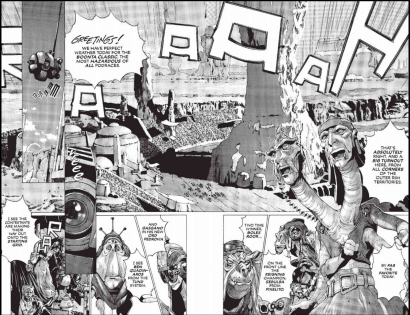
The artwork, on the other hand, is a hit-or-miss affair. Asamiya’s skill at drawing aliens, robots, space craft, and futuristic cities is unquestionable; his evocation of Otoh Gunga and Coruscant do justice to the complexity and specificity of Lucas’ original designs, while Asamiya’s establishing shots of Naboo convincingly evoke the planet’s lush jungles and Greco-Roman palaces without the added benefit of color. His ability to compress lengthy action sequences is likewise impressive; in just a few artfully constructed pages, for example, he captures the excitement and danger of Anakin Skywalker’s pod race, using panels-within-panels to juxtapose the racers’ progress with the crowd’s ecstatic reaction to the event:

Asamiya’s human characters, by contrast, are as expressionless as their big-screen counterparts—a key failing, as the characters register as pawns, not people, dutifully shuttled from one scenario to the next with almost no sense of how the violence and chaos they’ve encountered has affected them. Only the two principle non-human characters—JarJar Binks and C3PO—are drawn in an animated fashion, providing the series’ few moments of genuine emotion and surprise.

And that, in a nutshell, is why Asamiya’s take on The Phantom Menace is so frustrating: it improves on certain aspects of the source material while emphasizing its fatal flaws, making for an efficient but affectless gloss on Lucas’ original story that reads a lot like Cliff Notes. Not recommended.

STAR WARS: EPISODE I – THE PHANTOM MENACE, VOLS. 1-2 • ART BY KIA ASAMIYA • MARVEL COMICS • NO RATING (SUITABLE FOR READERS 10 AND UP)

Filed Under: Manga, Manga Critic, REVIEWS Tagged With: Kia Asamiya, Marvel Comics, Sci-Fi, star wars

Skull-Face Bookseller Honda-san, Vol. 1

January 4, 2020 by Katherine Dacey

If you’ve ever worked a thankless retail job, you’ll appreciate Skull-Face Bookseller Honda-san, a candid, fitfully funny series about working in the customer service industry. The titular character works in the manga section of a large Tokyo bookstore, helping buyers find the perfect series, taking inventory, and meeting with representatives from major publishers.

Some of her adventures are genuinely amusing, as when a handsome male customer requests explicit doujinshi for his daughter, or an American fujoshi explains her penchant for a particular seme-uke dynamic; other chapters are more matter-of-fact, conveying the difficulties of keeping popular titles in stock, or documenting the social and professional interactions among the staff members. Though none of its is laugh-out-loud funny, the artwork is terrific, capturing Honda-san’s sweaty anxiety every time a customer or colleague makes an uncomfortable request of her—no mean feat, given that the artist has depicted herself with a skeleton head and androgynous, apron-clad body. (Her colleagues’ identities have been camouflaged in a similar fashion: one has a paper bag for a head, and another wears a gas mask.) Amanda Haley’s thoughtful translation complements Honda’s crisp illustrations, offering useful context for understanding the unique challenges of selling manga to the general public, and plenty of footnotes to decode the insider shop-talk.

Yet for all the craft with which Skull-Face Bookseller is written, I never fully succumbed to its charms. I found the pacing uneven and the publishing-focused chapters long-winded, especially when contrasted with the snappy staging of Honda-san’s encounter with the international BL brigade. I’m still curious about the series, but would put Skull-Face Bookseller in the same category as Saint Young Men: a comedy that’s better in principle than in practice. Your mileage may vary.

SKULL-FACE BOOKSELLER HONDA-SAN, VOL. 1 • STORY AND ART BY HONDA • TRANSLATION BY AMANDA HALEY • YEN PRESS • NO RATING • 166 pp.

Filed Under: Manga, Manga Critic, REVIEWS Tagged With: Comedy, Skull-Face Bookseller, yen press

Ms. Kozumi Loves Ramen Noodles, Vol. 1

January 3, 2020 by Katherine Dacey

Ms. Kozumi Loves Ramen Noodles is pretty much what you’d expect from the title: a manga about a high school student whose interest in noodles crosses the line from simple enthusiasm into full-blown mania. While Kozumi’s peers go to the mall or the malt shop, she visits out-of-the-way restaurants to sample every conceivable type of ramen, from spicy to sour to sweet. Her passion is so extreme, in fact, that she ditches school for a 200-mile trip to Iwaki just to taste a local specialty: no-bake natto ramen. Though Kozumi is uninterested in socializing with her classmates, three girls—Yu, Misa, and Jun—find Kozumi’s reticence an irresistible challenge, and repeatedly seek her company outside of school. Yu, in particular, is one of those only-in-manga characters whose cheerfully inappropriate behavior would be considered creepy in almost any other context, as she follows Kozumi to ramen joints around Tokyo, copying Kozumi’s behavior and—more egregiously—her orders. When Yu’s pals befriend Kozumi before she does, she flies into a jealous tizzy, and doubles down on her efforts to show Kozumi that she, too, appreciates ramen.

These scenes are clearly intended to be funny, but the social dynamic among the four principal characters is too strained to elicit laughter, as it relies almost entirely on the characters behaving idiotically for effect. The artwork, too, leaves something to be desired, juxtaposing hyper-realistic drawings of food and condiments with ultra-cutesy character designs that seem ready-made for key chains and body pillows. The cuteness would be less off-putting if the characters weren’t frequently drawn in rapturous close-up, sucking down noodles while suggestive trickles of broth dangled from their lips—a potent reminder that Ms. Kozumi runs in a seinen magazine and not, say, Bessatsu Friend.

The shop talk, by contrast, is genuinely enlightening. If your primary experience with ramen has been limited to steaming bowls of noodles, scallions, and chicken broth, the sheer range of dishes will come as a revelation; in one sequence, for example, Kozumi describes a form of ice cream ramen, while in another, Jun discovers the savory pleasures of a salted pineapple ramen bowl. A solid translation by Ayumi Kato Blystone helps convey what’s distinctive about each dish, and offers good insight into how dishes are prepared—more so, in fact, than many ostensibly “serious” food manga. So on that front, at least, Ms. Kozumi succeeds in communicating why the title character likes ramen so much; too bad the reader has to soldier past so much resolutely unfunny slapstick to enjoy the tastiest bits. Your mileage may vary.

MS. KOZUMI LOVES RAMEN NOODLES, VOL. 1 • ART AND STORY BY NARU NARUMI • TRANSLATED BY AYUMI KATO BLYSTONE • DARK HORSE COMICS • 136 pp. • NO RATING

Filed Under: Manga, Manga Critic, REVIEWS Tagged With: Comedy, Cooking and Food, Dark Horse

  • « Go to Previous Page
  • Page 1
  • Page 2
  • Page 3
  • Page 4
  • Interim pages omitted …
  • Page 39
  • Go to Next Page »
 | Log in
Copyright © 2010 Manga Bookshelf | Powered by WordPress & the Genesis Framework