Ikigami: The Ultimate Limit, Vol. 2
By Motoro Mase
Published by Viz Media


Fujimoto is becoming accustomed to his job as the harbinger of people’s doom, but he’s not sure if that’s a good thing. The volume opens as his girlfriend tells him she’s leaving him because she feels crushed by the weight of his work. Meanwhile, the work goes on and this volume introduces two new victims of the government’s Social Welfare Act. Both stories are tragic, of course, perhaps even more so than those told in the first volume, though both victims also end up changing other people’s lives for the better, one through the work he’s able to during his short life, and the other, sadly, through her death.
Despite whatever “good” has been done by these individuals, however, there is still no evidence that the government’s systematic murder of its citizens is actually a positive thing at all. One emerges from this volume hoping against hope that Fujimoto might find the stomach to start a rebellion of some kind, not that he’s yet demonstrated anything approaching that kind of fortitude. His deepest conflict right now is whether to let himself grow colder still toward the unfortunate souls he must visit (on the way to one last-minute Ikigami delivery, he asks his driver to make a stop at the video store so that he can avoid paying a late fee) or whether he should try to discover some philosophy of life and death that he can use to help heal their pain. This is the extent of what he can manage emotionally at this point.
I found the individual stories in this volume even more compelling than those in the last, which is certainly something that will keep me reading. I do hope the story will find a new direction to explore before the manga’s current formula becomes tedious, as it undoubtedly will should it continue on like this much longer. For the moment, however, what is offered here is more than enough to keep readers engaged. Ikigami continues to be a fascinating and well-told story with fantastic art to match.
Volume two of Ikigami: The Ultimate Limit will be available on August 11th, 2009. Review copy provided by the publisher. Click here to read my review of volume one.
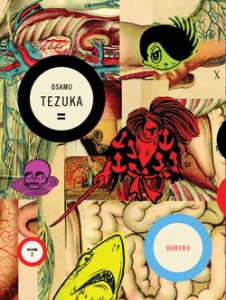 Though much of the devastation that Hyakkimaru and Dororo witness is man-made (Dororo takes placed during the Sengoku, or Warring States, Period), demons exploit the conflict for their own benefit, holding small communities in their thrall, luring desperate travelers to their doom, and feasting on the never-ending supply of human corpses. Some of these demons have obvious antecedents in Japanese folklore — a nine-tailed kitsune — while others seem to have sprung full-blown from Tezuka’s imagination — a shark who paralyzes his victims with sake breath, a demonic toad, a patch of mold possessed by an evil spirit. (As someone who’s lived in prewar buildings, I can vouch for the existence of demonic mold. Lysol is generally more effective than swordplay in eliminating it, however.) Hyakkimaru has a vested interest in killing these demons, as he spontaneously regenerates a lost body part with each monster he slays. But he also feels a strong sense of kinship with many victims — a feeling not shared by those he helps, who cast him out of their village as soon as the local demon has been vanquished.
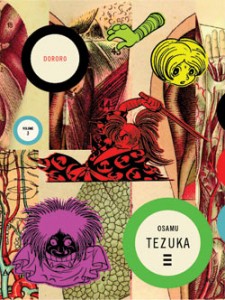 For folks who find the cartoonish aspects of Tezuka’s style difficult to reconcile with the serious themes addressed in Buddha, Phoenix, and Ode to Kirihito, Dororo may prove a more satisfying read. The cuteness of Tezuka’s heroes actually works to his advantage; they seem terribly vulnerable when contrasted with the grotesque demons, ruthless samurai, and scheming bandits they encounter. Tezuka’s jokes — which can be intrusive in other stories — also prove essential to Dororo‘s success. He shatters the fourth wall, inserts characters from his stable of “stars,” borrows characters from other manga-kas’ work, and punctuates moments of high drama with low comedy, underscoring the sheer absurdity of his conceits… like sake-breathing shark demons. Put another way, Dororo wears its allegory lightly, focusing primarily on swordfights, monster lairs, and damsels in distress while using its historical setting to make a few modest points about the corrosive influence of greed, power, and fear.


 From the back cover:

 From the back cover:

 Sawako Kuronuma doesn’t mean to terrify her classmates. In fact, she wants nothing more than to befriend them, but her resemblance to a character from a horror movie combined with her reserved demeanor keeps them at bay. Everyone, that is, except for a cheerful boy named Kazehaya, who is friendly to all and known to look out for those who don’t quite fit in. When Sawako accidentally says something about him that might be construed as insulting, Kazehaya gives her the opportunity to explain her true feelings. Learning from this experience, she henceforth attempts to clear up misunderstandings about her temperament and rumored psychic powers by revealing her true feelings all over the place, earning her a few additional friends who are moved by her earnest efforts. Kazehaya continues to encourage her to open up, though the attention he pays Sawako causes rumors to fly, including one that might put her new friendships in jeopardy.

 From the back cover: