• Skip to primary navigation
  • Skip to main content
  • Skip to primary sidebar
  • Home
  • About Us
    • Privacy Policy
    • Comment Policy
    • Disclosures & Disclaimers
  • Resources
    • Links, Essays & Articles
    • Fandomology!
    • CLAMP Directory
    • BlogRoll
  • Features & Columns
    • 3 Things Thursday
    • Adventures in the Key of Shoujo
    • Bit & Blips (game reviews)
    • BL BOOKRACK
    • Bookshelf Briefs
    • Bringing the Drama
    • Comic Conversion
    • Fanservice Friday
    • Going Digital
    • It Came From the Sinosphere
    • License This!
    • Magazine no Mori
    • My Week in Manga
    • OFF THE SHELF
    • Not By Manga Alone
    • PICK OF THE WEEK
    • Subtitles & Sensibility
    • Weekly Shonen Jump Recaps
  • Manga Moveable Feast
    • MMF Full Archive
    • Yun Kouga
    • CLAMP
    • Shojo Beat
    • Osamu Tezuka
    • Sailor Moon
    • Fruits Basket
    • Takehiko Inoue
    • Wild Adapter
    • One Piece
    • After School Nightmare
    • Karakuri Odette
    • Paradise Kiss
    • The Color Trilogy
    • To Terra…
    • Sexy Voice & Robo
  • Browse by Author
    • Sean Gaffney
    • Anna Neatrour
    • Michelle Smith
    • Katherine Dacey
    • MJ
    • Brigid Alverson
    • Travis Anderson
    • Phillip Anthony
    • Derek Bown
    • Jaci Dahlvang
    • Angela Eastman
    • Erica Friedman
    • Sara K.
    • Megan Purdy
    • Emily Snodgrass
    • Nancy Thistlethwaite
    • Eva Volin
    • David Welsh
  • MB Blogs
    • A Case Suitable For Treatment
    • Experiments in Manga
    • MangaBlog
    • The Manga Critic
    • Manga Report
    • Soliloquy in Blue
    • Manga Curmudgeon (archive)

Manga Bookshelf

Discussion, Resources, Roundtables, & Reviews

Features & Reviews

Bookshelf Briefs 1/25/20

January 25, 2020 by Ash Brown, Sean Gaffney and Michelle Smith Leave a Comment

Again!!, Vol. 12 | By Mitsurou Kubo | Kodansha Comics – For better or worse, Again!! has always been unpredictable. I appreciate that it didn’t always follow the expected story beats, but at the same time, the inconsistency has been frustrating. For example, Imamura’s fluctuating dedication to the Ouendan had him proclaim at one point how much he wanted his grandma to see him cheering, and had that occurred it would’ve been a heart-tugging moment. But it didn’t happen. Instead, Imamura returns from another do-over (this time, flashing to a future in which his death inspired the other characters) with an apathetic attitude that eventually prompts him to return to 2014—a future where his grandmother is dead—without apparently a single pang about it. The ending is also kind of abrupt and ambiguous. In the end, I find myself wishing this had been more predictable, ‘cos at least it would’ve been more satisfying. – Michelle Smith

Chihayafuru, Vol. 18 | By Yuki Suetsugu | Kodansha Comics (digital only) – This volume is full of choices for Chihaya. It’s time to complete another career survey, and this time she fills in a more realistic goal than becoming Queen. It’s also less ambitious, however, and thus her karuta advisor comes to see her play at the Yoshino Club Tournament to ask someone with more experience whether Chihaya really has the potential to become Queen. Happily, she’s playing with more precision and focus than ever, but her next opponent is Haruka Inokuma, a 4-time former Queen, so her chances really hinge on how she fares in that match. (I suspect Taichi vs. Arata is in the offing, as well.) Too, the school trip conflicts with the Master/Queen qualifiers, and Chihaya must choose which side of herself she wants to cultivate more. I seriously love this series and am eagerly anticipating the next volume! – Michelle Smith

Dr. STONE, Vol. 9 | By Riichiro Inagaki and Boichi | Viz Media – Perhaps being interesting was too much to ask, but Taiju and Yuzuriha are at least contributing now that they’ve been added to Senku’s team—Taiju by being a literal tank soaking up damage, and Yuzuriha by apparently taking all the statues that Tsukasa smashed and sewing them together, presumably so they can be revived. If this seems farfetched, it’s no more so than finding the hospital where Tsukasa’s terminally ill little sister was located and unstoning her, which apparently also cures her illness. That said, Tsukasa may not be the end boss, as there’s another who’s been waiting for the moment to make his debut as a Big Bad. This continues to be ridiculous but also cool. – Sean Gaffney

Hatsu*Haru, Vol. 10 | By Shizuki Fujisawa | Yen Press – Best Couple get the cover, and I continue to be more interested in them than I am Riko and Kai, who are cute and all but also somewhat predictable. The four of them go to the hot springs, mostly as Riko is too nervous to be alone with Kai, and Takaya learns that Ayumi leaves herself wide open. After a cute but slight Valentine’s chocolate chapter, the best part comes when Ayumi gets a bad cold and Takaya visits, meeting her parents and finding out she’s actually pretty rich and her family are famous film creators. Ayumi is not yet ready to reciprocate Takaya’s feelings, but she does open up to him about wanting to seek her own path. It’s great to see, and we have three volumes left after this, so I’m sure it will work out. – Sean Gaffney

ROADQUEEN: Eternal Roadtrip to Love | By Mira Ong Chua | Seven Seas – While not technically manga, ROADQUEEN will likely still appeal both stylistically and thematically to readers who enjoy Japanese comics. In particular, the volume makes an excellent addition to Seven Seas’ catalog of yuri titles. ROADQUEEN originated as a short online comic, followed up by a much longer multi-chapter sequel. Both of these stories and an additional bonus comic are collected in this volume. Leo, the prince of Princess Andromeda Academy, only has eyes for Bethany—her motorcycle. At least until Vega arrives on the scene and steals Bethany away. Vega promises she’ll give the bike back, but only after Leo proves that she can be a decent lesbian (not to mention human being). ROADQUEEN is deliberately over-the-top, Chua obviously having a lot of fun playing with tropes, but it can actually be very touching, too. With an abundance of humor and a ton of heart, ROADQUEEN is an absolute delight. – Ash Brown

Saki the Succubus Hungers Tonight, Vol. 1 | By Mikokuno Homare and studio HIP-CATs | Ghost Ship – I will admit that for a title that’s coming out via the Ghost Ship label, which means “borderline porn,” this is pretty cute. Saki is a fairly new, still virginal succubus who has been thrown out of her family home as she’s old enough to be finding men to “feed” on, but she’s honestly a bit too shy for all that. She is thus near starvation when found by Renta, an adult salaryman who is also a virgin. They clearly fall for each other pretty fast, but are also both innocent and clueless, so nothing happens… well, OK, something happens, she manages to “feed,” but the plot is still “will they ever actually do anything” and the answer is likely “no.” Still, for tease, this is relatively cute and sweet. – Sean Gaffney

Snow White with the Red Hair, Vol. 5 | By Sorata Akiduki | Viz Media – Welp, despite what I thought, the series does not end just because the main couple confessed. Indeed, most of the volume involves separating the two—not by design, but simply as Shirayuki has been invited to another country for a get together… her old country, where Prince Raj is. Indeed, after having it out with her a couple of volumes ago, Raj is seemingly turning over a new leaf, but that doesn’t mean he’s comfortable around her at all—he never expected she’d accept the invitation. Her bodyguard for this journey is Obi, and I note that this series is very good at having a bunch of guys in it who are not immediately in love with the heroine. Whether that’s true of the new villain introduced here, who knows? – Sean Gaffney

Teasing Master Takagi-san, Vol. 7 | By Soichiro Yamamoto | Yen Press – Having established that our leads will end up married with a child in the future, the series can now slowly move forward in increments, culminating in the final chapter here, where Nishikata, of his own volition, asks Takagi to the summer festival. But we’re also looking back, as we get to see how the two of them first met, and how Nishikata’s two basic qualities—a nice guy with great faces when he’s embarrassed or upset—inspire Takagi almost immediately. I’m not sure this is exactly when she falls for him, but she certainly has by the end of this book, which gives us another nice blushing reaction from her. Oh yes, and there’s still plenty of teasing. You expected something else? – Sean Gaffney

The Way of the Househusband, Vol. 2 | By Kousuke Oono | VIZ Media – This was another fun volume of The Way of the Househusband, in which Tatsu tries aerobics and yoga, intimidates a yakuza by offering him kitchen gadgets, eradicates stubborn stains in Masa’s laundry, plays volleyball with housewives, and more. I really appreciate that we saw more of Miku, his wife, this time around, and probably my favorite chapter is the final one, in which her parents drop by for a visit. Even though the fish-out-of-water setup in this series reminds me of the premise of Saint Young Men, The Way of the Househusband is not only visually superior (better art, great pacing to jokes), but has more heart, especially the bonus chapter in which we see Miku’s dad practicing for the moment when he asks Tatsu if he wants to go outside and play catch. I stop short of calling the manga sweet, but it’s wholly endearing. Highly recommended. – Michelle Smith

Yowamushi Pedal, Vol. 13 | By Wataru Watanabe | Yen Press – Yowamushi Pedal, Vol. 13 | By Wataru Watanabe | Yen Press – OK, I was probably foolish to think the race would end in this volume. We’re gonna have to wait for fourteen. But in return, we get so much shonen sports at its best. Midousuji does his best, but then crashes and burns. Instead, it’s Manami who gets the bulk of this book, where we discover that he enjoys shifting gears higher when he should be doing the opposite, just to make things even more fun. That said, he shouldn’t dismiss our hero, Onoda, who has his pedaling and his Pretty Princess song to keep him going forever. (Oh yes, and his mother shows up—apparently at rando, as he never told her about the race? This was the funniest part of the book.) Things should end next volume… well, at least this race. – Sean Gaffney

Filed Under: Bookshelf Briefs

Invaders of the Rokujouma!?, Vol. 29

January 24, 2020 by Sean Gaffney

By Takehaya and Poco. Released in Japan as “Rokujouma no Shinryakusha!?” by HJ Bunko. Released in North America digitally by J-Novel Club. Translated by Warnis.

I’ve been saying for a while now that the “harem total” in this series is not going to get larger or smaller, and in this volume I am proved wrong. That said, if you’re going to add someone to a pile of girls who are as much a found family as romantic rivals, go big or go home. God joins the party here, in the presence of the being who greeted Koutarou in Volume 1. For a while it was thought to be Harumi/Alaia in some way, but now we know that that wasn’t thinking quite grandiose enough. Before we get to that point, though, we continue the theme of the previous books, as one by one the cast vanish from Koutarou’s life, essentially his worst fear, and he has to deal with it. He doesn’t deal with it very well. Fortunately, the dwindling group of women in his life are able to figure out what is going on long enough for him to go back to the place it all began… and also set up some intriguing alternate universes.

The cover art… and the plot… and every single thing about the book, really… might make you assume this is the last book in the series. It’s certainly the final part of the “main” plot that the author originally came up with – this is where he envisioned it ending, no matter how many books it turned out to be. But the cast are becoming third-years (except for the graduated Harumi), and we’re going to be seeing what happens next starting with Vol. 30. As for this book, there’s not much to it aside from emotional beats. They’re very good emotional beats, don’t get me wrong, but I do wish Koutarou had sort of figured out that when he is standing next to a girl and reminiscing about all the good times they’ve had since book 1, she’s going to be the next to go. There is a bit of a “memory reset” at the end, but it’s entirely voluntary, and you understand why they did it.

The interesting thing, to me, was the concept of the alternate universes brought up by Nalfalaren. The one we’ve been reading is the only one in like 5 billion or so where Koutarou revives her with all nine girls who are “part of her” at his side. In other words, this is the only harem end universe. We see one of the alternate universes towards the end of this book, as Koutarou has to deal with a world where none of the cast ever showed up in Room 106 and he ended up dating Shiori Kashiwagi, who readers may recall as having a crush on him a few books back, and is entirely a normal girl. It’s good to know someone is there to help Koutarou get over the tragedies in his life regardless, but it’s still nice to see the ending I think readers wanted, which is ambiguous but also feels right.

Next time we’re getting a continuation, but we’re also going to start to see some of those “alternate universes” where Koutarou was able to settle on one of the girls. Either way, you don’t have to worry about the cast vanishing from your lives anytime soon.

Filed Under: invaders of the rokujouma!?, REVIEWS

Manga the Week of 1/29/20

January 23, 2020 by Sean Gaffney, Michelle Smith, Anna N, Ash Brown and MJ 1 Comment

SEAN: The end of the month, and it’s time for lots and lots of stuff. What have we got?

First of all, jumping to the front of the queue because of what it is, we have Udon’s debut of The Rose of Versailles. You should know this one. One of the most influential manga ever. It’s hardcover. It’s almost 500 pages. You will all read it. It’s definitely Pick of the Week, so you’ll have to pardon the double pictures.

MICHELLE: *Kermit flailing*

ANNA: Back before there was an actual industry for translated manga in the United States, I read the excerptr of The Rose of Versailles that was translated in Frederik R. Schodt’s Manga! Manga! The World of Japanese Comics. I am so excited to read this.

ASH: I’ve read that excerpt, too! (It’s a great book.) I am absolutely thrilled The Rose of Versailles is finally becoming a reality in English.

MJ: I’m so excited, I can barely type. This release has taken a while, and I have no doubt it will be worth the wait!

SEAN: Cross Infinite World has another shoujo light novel, this one called The Misfortune Devouring Witch is Actually a Vampire?! (Ijippari na Majo Dono e). You can tell the title has been Westernized as it’s a ?!, not a !?.

ASH: Ha!

SEAN: Dark Horse has the 3rd Elfen Lied omnibus.

Ghost Ship has three titles, one a debut. Saki the Succubus Hungers Tonight (Saki-chan wa Konya mo Peko Peko) runs in Houbunsha’s Weekly Manga Times, and features a young and innocent succubus who is trying to get… male bodily fluids from a guy without doing anything really dirty. It’s sort of cute in a “not quite porn” way.

MJ: This is… not what I’m looking for in manga. Or really anything at all. I kind of regret reading this description.

SEAN: They’ve also got Yokai Girls 9 and Yuuna and the Haunted Hot Springs 8.

J-Novel Club has two new light novel series debuting. By the Grace of the Gods (Kami-tachi ni Hirowareta Otoko) is another reincarnation isekai series from Hobby Japan, but this one seems to involve very nice people. The hero is nice, the gods are nice, the slimes are nice… it seems nice. Expect “slice of life”.

The other title comes from the PASH! Books imprint, and is The World’s Least Interesting Master Swordsman (Jimi na Kensei wa Soredemo Saikyou desu). The plot really, really sounds like One-Punch Man to me… a reincarnated guy who swings his sword to get stronger… for 500 years… suddenly finds he’s super strong. But his swordsmanship is boring. I suspect this one will live and die by the supporting cast.

Also from J-Novel Club is How NOT to Summon a Demon Lord 12, Kokoro Connect 8, and Record of Wortenia War 4.

On the manga side, J-Novel Club has a 2nd Discommunication and the 3rd How a Realist Hero Rebuilt the Kingdom.

Kodansha’s print debut has already come out digitally: Living-Room Matsunaga-san, a shoujo series from Dessert. A young woman moves into a boarding house filled with oddballs, and finds herself looked after by an older man.

MICHELLE: I’d been meaning to read this one!

ASH: I’m curious, too.

MJ: This sounds interesting! Or possibly creepy? It seems like it could go either way!

SEAN: Also out in print is The Quintessential Quintuplets 7.

No digital debuts for Kodansha, but we do get Altair: A Record of Battles 14, Boarding School Juliet 14, DAYS 16, Drowning Love 16, Guilty 4, and Watari-kun’s ****** Is about to Collapse 2.

MICHELLE: Huzzah for more DAYS!

SEAN: Seven Seas has two debut light novels, one print and one digital. The print we saw before digitally: SCP Foundation: Iris Through the Looking Glass. It tied into the SCP Foundation universe.

The digital-first debut is At Night, I Become a Monster (Yoru no Bakemono). It’s from the author of I Want to Eat Your Pancreas, so expect good writing and melancholy. A boy turns into a monster during the evenings, and runs into a classmate.

MICHELLE: Hm, interesting!

ASH: I’m waiting for the print, but I am intrigued.

MJ: Interested.

SEAN: Also out from Seven Seas: The Dungeon of Black Company 4, Magika Swordsman and Summoner 12, My Monster Secret 19, and Toradora! light novel 9.

For Udon, see The Rose of Versailles above. Just thought I’d mention it again. The Rose of Versailles. Officially out in English. And looking amazing.

MICHELLE: I still can’t really believe it, honestly. I’ll believe it when I’m holding it in my hands.

ANNA: I’m trying to mentally prepare.

ASH: One of my most anticipated releases of the current and past several years.

MJ: What everyone else said. I mean. AAAAAAAAAAAAAAA.

SEAN: Vertical has a 4th APOSIMZ.

The rest of Yen Press, but we’re not close to done. Yen On’s debut is Wandering Witch: The Journey of Elaina (Majo no Tabitabi). A Softbank Creative series about, well, a wandering witch. The premise makes it sound like a happier, more positive version of Kino’s Journey.

Yen On also has A Sister’s All You Need 6, Goblin Slayer 9, and Torture Princess 3.

Also, in an effort to make all their books available digitally, Yen On now has digital debuts of two older series that were print-only. Rokka: Braves of the Six Flowers Vols. 1-6, and the standalone The Hero and His Elf Bride Open a Pizza Parlor in Another World.

Three debuts… sort of… in the manga department. Toilet-Bound Hanako-kun is a digital-only series now making its print debut. It also has an anime running now. It runs in GFantasy, so expect it to be a shonen series for girls.

ASH: I’m here for it! Looking forward to giving the series a try.

MJ: Did you say GFantasy? You know I’m here for that.

SEAN: The other debuts are adaptations of light novels. I’ve Been Killing Slimes for 300 Years (and Maxed Out My Level) runs in Gangan Online, and The World’s Strongest Rearguard runs in Kadokawa’s Comic Walker. The former is cute fluff, the latter is bad but fun.

We also get Aoharu x Machinegun 16, Final Fantasy: Lost Stranger 4, High School Prodigies Have It Easy Even in Another World 6, Horimiya 13, Murcielago 13, No Matter How I Look at It It’s You Guys’ Fault I’m Not Popular! 15, and The Saga of Tanya the Evil 9.

Again, and I cannot emphasize it enough, Rose of Versailles. Anything apart from that?

Filed Under: FEATURES, manga the week of

Kitaro: The Trial of Kitaro

January 23, 2020 by Sean Gaffney

By Shigeru Mizuki. Released in Japan as “Gegege no Kitaro” by Kodansha and Shogakukan, serialized in various magazines. Released in North America by Drawn & Quarterly. Translated by Zack Davisson.

This is the final volume of D&Q’s Kitaro collections, and, while Kitaro has never really been serialized in a plot or characterization way, it picks an apt final story to end on. The largest story in the book is the titular Trial, where Kitaro is brought up against the Yokai Supreme Court and charged with helping humans at the cost of yokai. Which, admittedly, there’s a grain of truth to. A number of Kitaro’s adventures have featured him helping hapless humans who are being used and/or outright tortured by yokai – indeed, we’ll see some later in this collection. That said, no surprises for guessing who’s really gotten Kitaro into this mess. After much foofaraw, the trial ends with Kitaro agreeing that he will not only help innocent humans beset by yokai, but also the reverse – such as not helping the shady TV producers who are manipulated by Nezumi Otoko into the documentary stat starts this all off.

As this is the final Kitaro review I’m writing up (presumably), I’d like to expound once again on Nezumi Otoko, the Donald Duck to Kitaro’s Mickey Mouse. The trial story features perhaps Nezumi Otoko at his most iconic – setting up the entire situation in the first place for cash, teaming up with an even worse yokai, framing Kitaro and testifying against him, and then quickly rolling over when things turn against him. Of all the many and varied yokai we’ve seen over the course of the series, Nezumi Otoko’s actions are perhaps the most jaw-dropping – even the evil yokai are more consistent in what they do day to day. But of course Kitaro gives the reason why Nezumi Otoko is who he is – he’s half human, and it’s the humanity in him that makes him crafty and a bit of a complete snake. That said, for Kitaro to continually hang out with him after everything shows he has the patience of a saint… or that Nezumi Otoko has the love of the author.

The rest of the stories in the volume are more typical, featuring the classic Kitaro way of doing things… get devoured and killed by the enemy, then come back and do something about it. The most interesting story other than the trial episode has to deal with a cursed toilet in the middle of the woods (yes, really) and Kitaro also losing all his hair… which, as is pointed out by Nezumi Otoko, is one of the sources of his strength. Honestly, without it he’s almost unrecognizable. I also liked the story of the merman who blackmails/tortures Kitaro into getting him fish, and actually ends up living in a mansion as a human. This leads to the dark punchline where Kitaro agrees to turn him INTO a human, and then the merman finding out that life as a human is not all that greater after all. Also, watch out for the cute maid working in the merman’s mansion who walks off with Kitaro in the end – Mizuki rarely drew cute girls in this series.

The seven volumes of Kitaro released over here, as well as the compilation that came first, do so much to show off the strengths of Shigeru Mizumi as an artist and storyteller. They’re a must for any library. Ge! Ge! Ge-ge-ge-no-geeeeee…

Filed Under: kitaro, REVIEWS

In Another World with My Smartphone, Vol. 18

January 21, 2020 by Sean Gaffney

By Patora Fuyuhara and Eiji Usatsuka. Released in Japan as “Isekai wa Smartphone to Tomo ni” by HJ Novels. Released in North America by J-Novel Club. Translated by Andrew Hodgson.

Any Smartphone book that manages to put Touya in actual danger is automatically more interesting than most. This one actually does it twice. Not that anything actually happens to him… remember what you’re reading. But the Mutant Phrase descend with an anti-God weapon that is so poisonous that it takes Touya out for three days, and later on an inadvisable attempt at waking an ancient weapon results in time literally being rewritten to make sure it didn’t happen… something Touya is aware of but no one else is. Unfortunately, neither of these crises serve to move Touya beyond his typical bland facade… generally the only thing that can do that these days is mentioning love, as per most awkward overpowered male leads in isekai. Sadly, the weddings are still a fair ways away, but at least we’re seeing a number of other plots starting to come together. Could the end be in sight? (Probably not.)

At the start of the book, the regular Touya world and the Reverse World finally merge together, and much of the rest of the volume is spent dealing with the political fallout from that. It does not help that the bad guys choose this moment to launch their ‘anti-Touya’ poison attack, which destroys one of the kingdoms we’d seen previously. (Not Touya’s own hand this time, so that’s good.) We actually get a few Phrase battles this time around, including Ende getting his revenge against the evil twins who mopped the floor with him last time. And we finally get an idea of what happened back in ancient times when the Phrase first invaded, and hopefully a way to avoid it happening again. In between there’s the usual wacky slice-of-life stuff… a young idiot prince comes by to show how strong he is and gets his ass kicked; Hilde’s sister fights a dragon; Sakura sings Freddie Mercury songs. The usual.

I admit, much as I grouse about the series when it’s doing things wrong like having Touya be history’s greatest monster, when it doesn’t happen there’s very little TO talk about in a review of Smartphone. Touya is bland. His fiancees, though they have more emotional range, are equally bland. There’s the royalty of the neighboring kingdoms… they’re pretty bland as well. This is sort of like a “slow life” series without the slow life part. The author says that we’re going to be fighting the Evil God next time, which is good, because when there are fights at least something is happening on the page. The wedding might also help, but that’s still a few books away. That leaves us with Touya wandering around doing Touya things, which is… boring. Dull. Nearly getting killed was the best thing to happen to him all book.

The series is still worth reading for the tiny little things that make it bearable – Sue’s Hammer Throw was great – but I suspect most readers, like me, are waiting for Touya to get married and simply paddling along ill that happens. 2 out of 5 Smartphones this time around.

Filed Under: in another world with my smartphone, REVIEWS

Daytime Shooting Star, Vol. 4

January 20, 2020 by Anna N

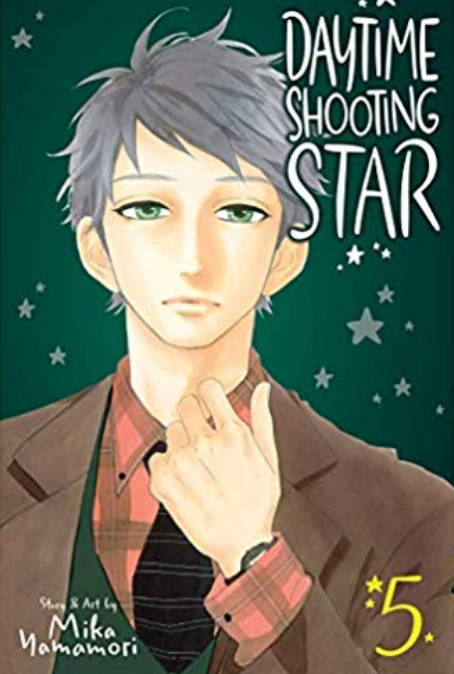
Daytime Shooting Star Volume 4 by Mika Yamamori

This volume of Daytime Shooting Star is focused on summer vacation. I really like the way the matte cover sets off the powdery pink blossoms used in the cover illustration for this volume. I’m so curious as to how this student-teacher romance manga will conclude, I’m guessing a giant time skip picking up with the high school characters post-college graduation. The volume opens as Suzume uses her intense knowledge of fish and extra cash to help out a strange but somewhat familiar man in the grocery store who has difficulty both shopping for seafood and remembering his wallet. When she drops by his house to get repaid for his groceries, she realizes that he’s Mamura’s father! Suzume gets a glimpse of Mamura’s very loud little brother, and she and Mamura are able to talk to each other again like friends.

Tsubomi ends up blowing out of town leaving a tornado of emotional devastation in her wake, as she seems to think it is appropriate to leave a note for her ex-boyfriend Shishio with the teenage girl who has a crush on him. Susume can’t resist the impulse to deliver it, and when she meets Shishio again, they decide to go on a group outing with her classmates to the aquarium, since Tsubomi enclosed an aquarium gift certificate. Of course, the day of the outing no-one else shows up, so the student and teacher are on a full-on solo date where Suzume gets to indulge in all the fish trivia questions she has ever dreamed of. Shishio continues to be fairly inappropriate but not doing anything physical beyond resting his head on Suzume’s shoulder. Even though he rejected Suzume’s love confession, it is clear that he’s still looking out for Suzume at school and in general acting protective and awkward at various moments. Suzume sees all this happening and becomes confused yet again. Fortunately there’s the school festival coming up that will provide a welcome distraction from all these romantic foibles, or amp everything up even more?

I continue to enjoy Yamamori’s stylish character designs. Suzume’s moments of introspection and insight as she’s attempting to get a handle on the world around her keeps Daytime Shooting Star interesting. It is easy to see how she’ll eventually grow up to be a formidable adult.

Filed Under: Manga Reviews, REVIEWS Tagged With: daytime shooting star, shojo beat, shoujo, viz media

Outbreak Company, Vol. 12

January 20, 2020 by Sean Gaffney

By Ichiro Sakaki and Yuugen. Released in Japan by Kodansha. Released in North America by J-Novel Club. Translated by Kevin Steinbach.

I feel that I’ve said a lot when reviewing Outbreak Company that the book starts off badly and gets better as it goes along till a good climax, and that holds true here as well. That said, the annoying parts of the book are very annoying. I haven’t used the word ‘queerbaiting’ when reviewing this series, mostly as it’s highly unlikely the author is doing it deliberately to bring in BL fans. (Then again, given that afterword, I may be wrong.) But for the most part the book is content to view Garius the way that Minori does – as a product of BL fantasy that she can ship with either Shinichi or newcomer Rubert – without ever explicitly having Garius say that he’s gay or state he is gay. It may sound like it’s so implied that they don’t have to, but that’s the point – the BL subtext is slathered on with Minori-vision, making it hard to take seriously. There’s no gay characters here, just a bunch of heavy breathing.

I may be more annoyed than usual as Garius and his supposed homosexuality are front and center in the plot this time. The prince of a neighboring country that is on good terms with Eldant has arrived to propose marriage to Petralka. He apparently knew Garius when they were younger, and it is heavily hinted they were lovers in college – again, with just enough plausible deniability that, should the author want, he can satisfy fans that might be put off by that – and the implication is he’s doing this to get close to Garius. The other half of the plot, which works MUCH better, is that Rubert’s country are very much prejudiced against non-humans, and an alliance between the two countries is bad news for most of the cast. Plus there’s the fact that Petralka loves someone else. Can Shinichi get over his obliviousness and self-hatred long enough to solve this new problem? And will Minori ever shut up?

Shinichi’s low self-worth – still stemming, he says, from getting rejected by the girl he likes for being a creepy otaku – has hovered over the entire series. You’d think, after saving the world multiple times and having at least three different women, and possibly more, in love with him that he might be gaining more self-confidence, but the lack of communication about his real feelings – which is the same reason that he can’t recognize the girls are in love with him – has kept him from seeing that he’s changed. This is frustrating to the reader, and also to Hikari and Matoba, who see him as a standard harem lead and want to kick him in the balls. Fortunately, his opening up to Petralka about his past may have helped to trigger something – she and Myusel are far more open about the love triangle they’re in (sorry, Elvia, you were never going to win this one) and the cliffhanger ending is that Shinichi finally figures this out.

Will this affect the plot going forward? Well, we’ve still got 6 more volumes and an ‘after story’ volume to go, so I suspect not all that much. Till then, please enjoy a new Outbreak Company, irritating and teeth-grinding as it still is.

Filed Under: outbreak company, REVIEWS

Invaders of the Rokujouma!?, Vol. 28

January 20, 2020 by Sean Gaffney

By Takehaya and Poco. Released in Japan as “Rokujouma no Shinryakusha!?” by HJ Bunko. Released in North America digitally by J-Novel Club. Translated by Warnis.

The author admits that this was supposed to be the last book but it got too big, so it’s split into a two-parter with a cliffhanger ending. It also gives some extra attention to Clan and Maki, two of the last to join in the Koutarou sweepstakes, and therefore the ones with the least development with him. That said, Clan going with Koutarou to the past gave her a leg up on the others, and Maki got a book of her own as well. The plot machinations involved mean we get a “greatest hits” compilation with those two, which is sweet and reminds you of why you like them, and also writes them out… at least for now. Because the girls are disappearing, starting with those two, and no doubt that feeds into the final book of the “main” series. Fortunately for the reader, they seem to know what’s going on, even if Koutarou doesn’t. It’s probably connected to the ancient ruins he fell into in the first book.

The main thrust of the book is not the disappearances, though, but Forthothe going public. After spending so much time trying to cover up the existence of alien worlds, and parallel magical worlds, and underground dwellers, they’re all coming out at once, and Earth is trying to deal with the fallout. And I do mean all of Earth – the fact that all this cool stuff is centered on Japan means that other countries are upset, and are not going to simply smile and nod. As a result, we have spies following our heroes around trying to prove their connections to everyone. Mostly this happens because, well, Theia used Forthothe’s own past as part of her drama club show, so it has everything written down. Koutarou, Maki and Clan’s job is to make the spies think the girls – particularly Kiriha and Yurika – are normal. They do a good job.

Though the book has not explicitly made this a “everybody wins” sort of series, that’s clearly the way that it’s heading, and the books have set this up very well, emphasizing the close bond everyone has with each other. That said, I do also appreciate that everyone is not magically OK with everything – when, in the classroom, Koutarou and Maki have a telepathic conversation, we see the other girls jealous of their closeness. One of the running themes of the series is that each of the girls desires what the other one has – Harumi wants to be roughhoused with, Clan wants to be cared for, everyone wants the closeness that Koutarou and Yurika or Theia have… they’re not a hive mind. Or at least not yet… if the disappearances and the “globes” that we see at the very end are anything to go by, Koutarou may have to handle this final crisis by himself.

The 29th volume (31st in the series – remember the .5s!) has the original “main” cast on the cover, as befits an ending volume. Of course, it’s not ending. But this is a good setup for a sort of finale. Fans of the series should enjoy it. Also, it’s quite short.

Filed Under: invaders of the rokujouma!?, REVIEWS

Kobold King, Vol. 1

January 19, 2020 by Sean Gaffney

By Syousa. and sime. Released in Japan by Legend Novels (Kodansha). Released in North America by J-Novel Club. Translated by Fatuma Muhamed.

I find myself saying “this is a book of two halves” quite often, but it fits with this one as well, so I’m going to stick with it. Our hero is Gaius, a huge ex-soldier who has left his position in the kingdom for reasons that are hinted at but never quite fully explained, and gone back to his home village… which was destroyed long before. He’s come to put his relative’s ashes to rest. Then he comes across a monster trying to kill what sounds like a child in the woods, but turns out to be a Kobold, which is to say a cute puppy that walks on two legs and talks. She takes him to her village, which is recovering from an attack by humans, and he starts off as a prisoner. But gradually he endears himself to everyone there, and life is wonderful… at least until humanity reinserts itself into his life. From there, the book takes a much darker and more tragic turn.

Frankly, Gaius fits in much better with the kobolds than he does with other humans, and not just because he’s one-quarter troll. He’s a huge bear of a man, really sweet and nice but also tends to act without thinking and does not do well with politics or tactics… you can sense why he left the kingdom, in the middle of a tactical war, without really being given the gist. He’s also one of those “I smile but it looks scary” types. The best part of the book is the first third or so, which is just him and the kobolds, as he ingratiates himself and proves indispensable to them. The middle sags a little by adding a few “this is more like anime” sort of characters – his ex-adjutant is a half-elf who’s in love with him, something which everyone can see except him. There’s also his adopted daughter Darke, whose backstory is not revealed till the end, which means mostly she irritates, as she wants to be Gaius’ first lover. And there is a teenage dwarf, Emon (his name is a pun on Doraemon), who wants to be a strong and brave warrior.

After a middle third of these three joining the cast, the humans (who had already driven the kobolds from their first village and killed a great number of them) return to finish the job. I knew there would be another battle, but I wasn’t expecting it to get so dark – Gaius’ attempt at negotiation is an utter failure, and characters we’ve come to care about die or are permanently disabled. That said, it serves to emphasize the aims of the book, which is “war is hell” and “humans are bastards”. There’s a battle for a throne between two royal family members, and though we never see either royal, both sides look pretty bad to me. The kobolds are dismissed as “monsters” and therefore creatures to be exterminated. We meet a band of evil adventurers (an excellent part of the book that shows off the dark side of adventuring after reading all those isekais) and see how each one is individually the worst.

So in the end this is a good book in getting Gaius to stand up and fight again, rather than simply retreating, but it’s a downer, frankly. Fortunately, it does not seem like the sort of series that’s going to run and run, so things should resolve soon. Worth a read.

Filed Under: kobold king, REVIEWS

Is It Wrong to Try to Pick Up Girls in a Dungeon?, Vol. 14

January 18, 2020 by Sean Gaffney

By Fujino Omori and Suzuhito Yasuda. Released in Japan as “Dungeon ni Deai o Motomeru no wa Machigatte Iru Darou ka?” by GA Bunko. Released in North America by Yen On. Translated by Winifred Bird.

This was long. Hideously long. Even by the standards of DanMachi, which has had some very long books, it’s long. It’s longer than Book 8, the previous record holder. It’s longer than almost all the Tanya the Evil books. Arguably, it uses its length wisely, which may come as a surprise given how much of it is just straight up monster fights. But it doesn’t just have fight after fight with no purpose. Each of the fights is meant to develop the character of one of the regulars, mostly Bell and Lyu, who do the heavy lifting in the book, but also Welf, Cassandra, and the rest of the other party who are desperately trying to find them. It earns its length. That said, I do think it could have bee a BIT shorter. I love the way the author writes fights, but by the end of the book I felt like Bell and Lyu do, i.e. mostly dead.

The book is divided into two halves, or rather one third and two thirds. The first third features the rest of the cast down in the dungeon on the 26th floor trying to survive without Bell, and finding strength beyond simply supporting him in his own dream. Welf in particular comes off well here, making an even more magic sword than his others, but Cassandra has perhaps the best emotional arc of the section, even if I’d have liked a bit more payoff where everyone actually admits she was right. Which, yes, goes against her character name. The second part of the book features Bell and Lyu down on the 37th floor, where Bell has to battle Killer Sheep Skeletons, The Juggernaut that he thought they’d killed off earlier back for revenge, a battle arena filled with infinitely spawning monsters, and perhaps most dangerous of all, Lyu’s suicidal tendencies.

Lyu’s backstory is finally given in full here, and it’s pretty much what I expected. It’s broken her to such an extend that, experiencing almost the same events as well as Bell seemingly trying to throw his own life away to save her (which happens… I lost count, but a LOT in this book) is making her want to give up, and the only reason she keeps trying is she wants to save Bell and see him safely off before she allows herself to be destroyed. It’s heartbreaking, and those who wanted Lyu to be a bit more emotional will be happy but also sad. (That said, I could have done without the comedy epilogue with her losing her top… but I guess after the emotional wringer you needed SOME comedy.) As for Bell, he’s had other books that have helped to show off his development more, and this is more Lyu’s. Here he’s just the almost indestructible rabbit that will save everyone in the world. Of course, this also means that Lyu has fallen in love with him. Honestly, given the sheer amount of focus she’s gotten in this series, she may be second only to Aiz in the “what if it’s not Hestia?” love interest sweepstakes.

Thankfully, the next book in the series looks to be much shorter than this, and also less emotionally devastating. Unfortunately, it’s not scheduled yet for North American release, so it may be a bit. Till then, this is one of the best books in the series, assuming you survive the read.

Filed Under: is it wrong to try to pick up girls in a dungeon?, REVIEWS

Bookshelf Briefs 1/16/20

January 16, 2020 by Ash Brown, Sean Gaffney and Michelle Smith Leave a Comment

Anonymous Noise, Vol. 18 | By Ryoko Fukuyama | Viz Media – Welp, I was wrong. Romantically, the final pairing is not what I expected. That said, romance, as always in this series, takes a back seat to the music, and musically the pairing is exactly what I expected. It’s actually quite interesting to see the basic “final volume” beats of a shoujo manga framed in terms of career and musical partner, while the heroine actually ends up with someone else. It’s quite a choice. Elsewhere, the book wraps up the one remaining unresolved pairing. But most of all for me, it goes back to its roots and shows what I loved most about it—Nino screaming the songs like they’re primal. I’ll miss this series, and am interested in what the author is going to do next. – Sean Gaffney

Bakemonogatari, Vol. 2 | By NISIOISIN and Oh!great | Vertical Comics – One thing about the artwork in this manga adaptation, particularly of its lead character, is that it does not shy away from how relentlessly creepy and sexually harassing Araragi can be. The novels made you question how much of it was a narrative device, the anime framed it as so over the top it was almost parody, but the manga makes you squirm at seeing Araragi’s face as he simultaneously beats up and pervs on a little girl. This second volume finishes Hitagi Crab and gets almost halfway through Mayoi Snail, and does a good job at making itself distinct—here the park is a normal park, not the grandiose wonder as seen in the anime. Provided you can tolerate Araragi, an excellent adaptation. – Sean Gaffney

Daytime Shooting Star, Vol. 4 | By Mika Yamamori | VIZ Media – Believing that Shishio has gotten back together with his ex, Suzume tries to see it as an opportunity to forget him. It’s not true, though, and after her friends arrange for them to have an aquarium date, Shishio starts acting different around her. I certainly don’t want him to return her feelings, but it’s also pretty shitty that he treats her like she’s special and gives her false hope when he has already rejected her. At least he’s aware of this. There’s a great sequence where they both stop themselves from calling out to the other in the hallway, trying to avoid falling into their typical patterns, but by the end he’s rushing to rescue her from overbearing upperclassmen and falling pots. I really, really am enjoying this series, but continue to hope that she’s eventually going to get over him once and for all. – Michelle Smith

Dirty Pair | By Haruka Takachiho and Hisao Tamaki| Seven Seas – I was both looking forward to this and also dreading it, and in the end the dread won out. I suppose every generation gets the Lovely Angels it deserves. It’s not as if the original novels did not have Kei and Yuri walking around in Bikini tops and short shorts and cracking wise, and they do here as well. And the novels did indeed have the “we are psychically bonded and get hints about solving crimes that way” jazz as well. But this manga adaptation takes the fanservice to eleven, with the Angels making out and getting orgasm faces as they use their psychic powers. The plot of these is essentially very similar to the originals, and the basic “they solve the mystery, but everything is destroyed” premise is still there and valid. That said, the fanservice makes me recommend this only to hardcore fans of the Lovely Angels. – Sean Gaffney

Haikyu!!, Vol. 36 | By Haruichi Furudate | VIZ Media – After losing the first set to Nekoma, Karasuno wins the second. As Furudate-sensei elegantly shows through a series of panels comparing past scoreboards to the current one, this is the first time that has ever happened. Indeed, throughout the volume, Furudate excels at conveying the significance of things, particularly when the most reserved players on each team experience a moment in which they recognize how much fun volleyball can be. Tsukishima actually smiles when he’s finally able to score a point against his rival/mentor Kuroo while Kenma, whose predictions are usually correct, is happy when Hinata is able to surprise him with a trick shot. And, in turn, Kuroo is happy that the friend who’s been indulging him all these years is finally enjoying himself. It’s all about appreciating the people who get you and who challenge you. I love this series so much. – Michelle Smith

Himouto! Umaru-chan, Vol. 8 | By Sankakuhead | Seven Seas – I always enjoy the way that there is slow, methodical character development for Umaru in these books. She may still be incapable of taking care of herself without her brother around, but she’s beginning to grow up and demonstrate she might be able to function in society. Of course, there is also the usual Umaru humor, particularly when dealing with Hikari, who not only looks and acts like Umaru but is trying to occupy the same place in her brother’s life. (Speaking of which, we also get more shots of Kanau, Hikari’s older sister and Taihei’s boss, who also might have a thing for him, though I suspect if there’s any romance in this series at all it will be with Ebina, who’s had longer to develop.) Cute, cute, cute. – Sean Gaffney

Kaguya-sama: Love Is War, Vol. 12 | By Aka Akasaka | Viz Media – I get the sense that the author has figured out how many volumes he wants this series to be now, as the pacing seems to have become more rapid. Not in terms of the gags, but in terms of the plot—Shirogane’s desire to resolve his relationship with Kaguya by the Culture Festival seems to mean it will happen next volume or the one after, and for once he seems quietly determined—I think committing to Stanford lit a fire in him. Elsewhere, Chika once again tries to cheat her way to victory and is punished, and also tries to teach Shirogane something easy and is punished. And there’s a chapter advertising the We Want to Talk About Kaguya spin-off, which… we’re not getting here. A lot of fun as usual. – Sean Gaffney

To Be Next to You, Vol. 1 | By Atsuko Namba | Kodansha Comics (digital only) – Nina Uemura is in love with her next-door neighbor, Kyosuke Tachibana, who has just started his first year of high school. She ends up witnessing the moment when one of his new classmates, Yuiko Asou, kisses him. This ultimately spurs Nina to confess, but when he goes in to kiss her, she freaks out. Meanwhile, Kyosuke and Asou seem to be getting closer. Because Asou is written so sympathetically (she’s genuinely a good person, and her once-kind boyfriend has become a jerk) and Nina comes across as quite immature comparatively, this manga so far reads like she’s the interloper onto Kyosuke’s love story. He’s moving ahead and she’s desperate to stay by his side, even if he’s entering a world that she’s not yet prepared for. It’s good stuff! I look forward to volume two. – Michelle Smith

Vinland Saga, Vol. 11 | By Makoto Yukimura | Kodansha Comics – It’s been a year and a half since the last omnibus volume of Vinland Saga was released. Somehow in that amount of time I had forgotten just how much humor Yukimura incorporates into what is otherwise an incredibly serious narrative. It helps keep the manga from becoming overwhelmingly bleak, but the balance of between the comedy and tragedy in the eleventh omnibus feels a little off—the jokes and occasional pop culture references (while entertaining) at times lessen the impact of the surrounding scenes. Even so, Vinland Saga remains an intensely compelling and powerful work. These volumes bring to a close the battle at Jomsborg. Throughout the conflict, Thorfinn repeatedly comes up against his decision to live without taking the lives of others. His resolve is severely tested when he confronts the man behind his father’s death and the warriors who likewise seek the deaths of Thorfinn and his companions. – Ash Brown

Filed Under: Bookshelf Briefs

Manga the Week of 1/22/20

January 16, 2020 by Sean Gaffney, Michelle Smith, Anna N, Ash Brown and MJ Leave a Comment

SEAN: More January, More Manga.

ASH: Huzzah!

SEAN: J-Novel Club gives us another debut, Her Majesty’s Swarm (Joou Heika no Isekai Senryaku), again from Kodansha’s new Legend Novels imprint, and by the author “616th Special Information Battalion”. Yes, that’s the real pen name. A college woman who plays a game as an evil character is now trapped in a very similar world… as said evil character.

We also get Altina the Sword Princess 2 and Ascendance of A Bookworm 5.

ASH: I need to catch up on Bookworm.

Kodansha, in print, gives us Cells at Work! Code BLACK 3, I’m Standing on a Million Lives 5, Sailor Moon Eternal Edition 7, and The Seven Deadly Sins 36.

In digital releases, the debut is MabuSasa (Mabuichi-kun to Sasagawa-san), which runs in Kodansha’s shoujo title Palcy. a BL loving girl and a scary guy… can they bond?

MICHELLE: It could be cute!

ANNA: It does sound potentially cute!

MJ: I’d give this a look!

SEAN: There’s also Cosplay Animal 10, Defying Kurosaki-kun 14, My Boss’s Kitten 4, My Boy in Blue 14, and The Quintessential Quintuplets 11.

No debuts for Seven Seas, but they have the 5th Arifureta manga, Magical Girl Site 11, Nurse Hitomi’s Monster Infirmary 10, and Sorry for My Familiar 6.

Tokyopop has a 7th Konohana Kitan.

And Vertical has the 7th CITY.

Viz has Black Lagoon 11. Black Lagoon 9 came out in 2010. I think this series may have a bit of a problem.

MICHELLE: I really loved the first three volumes when I read them long ago, and this release makes me want to get caught up. But then I’ll be waiting years again for the next, most likely.

ASH: Black Lagoon can be really great, but the long wait between volumes can be really hard.

MJ: My memories of Black Lagoon are so fuzzy now…

SEAN: They also have Beastars 4, Children of the Whales 14, Levius/Est 2, No Guns Life 3, and The Way of the Househusband 2.

MICHELLE: Hooray for The Way of the Househusband! I need to check out Beastars, too.

ANNA: I need to catch up on Beastars, and I’m happy about Way of the Househusband 2, the first volume was hilarious.

ASH: Beastars and The Way of the Househusband are what I’m particularly excited about this week.

MJ: I need to catch up with both!

SEAN: And there’s a bunch of Yen. Yen On gives us The Asterisk War 12, Death March to the Parallel World Rhapsody 10, and Strike the Blood 14.

Yen also has, on the manga side, Angels of Death 9, A Certain Magical Index 20 (manga), Hatsu*Haru 10, DanMachi: Sword Oratoria 10, Karneval 9, Nyankees 5, Overlord: The Undead King Oh! 2, Reborn As a Polar Bear 2, and Teasing Master Takagi-san 7.

Manga? Manga!

Filed Under: FEATURES, manga the week of

Saint Young Men, Vol. 1

January 15, 2020 by Katherine Dacey

Saint Young Men sounds like the set-up for a George Carlin routine: Jesus and Buddha spend a “gap year” on Earth, sharing an apartment in present-day Tokyo while wrestling with the temptations and banalities of modern life. The manga’s prevailing tone, however, is more silly than satirical, focusing not on big theological or philosophical questions, but mundane ones: how to stretch a monthly budget, where to find the best souvenirs, how to fend off drunken commuters.

Most of the humor stems from Hikaru Nakamura’s portrayal of Jesus and Buddha as opposites, with Jesus as a cheerful spendthrift with a fondness for t-shirts and tschotkes, and Buddha as a frugal “big brother” who agonizes over every purchase. The two have a kind of Ernie-and-Bert dynamic in which Buddha frequently chastises Jesus for his impulsive behavior, whether Jesus has purchased a “shinsengumi set” or wants to wear a pair of Mickey Mouse ears in public. Though their bickering provides most of the series’ comic fodder, there are also jokes about walking on water and turning water into wine, as well as a few sly pokes at Osamu Tezuka’s Buddha.

Anyone hoping to be outraged by Saint Young Men will be sorely disappointed, since its most blasphemous idea is that even Jesus and Buddha can’t resist the temptations of social media and shopping for melon bread. Anyone hoping for more insight into the human condition will likewise be disappointed, as Nakamura settles for easy laughs in lieu of real insight or religious critique—a missed opportunity, I think, since her premise offers plenty of latitude to reflect on Buddhist and Christian teachings, or the perils of modern-day materialism. A few good sight gags land well, but the manga’s eagerness to please blunts the edge of its best ideas. Your mileage may vary.

SAINT YOUNG MEN, VOL. 1 • STORY AND ART BY HIKARU NAKAMURA • TRANSLATION BY ALTHEA AND ATHENA NIBLEY • KODANSHA COMICS • 152 pp.


Filed Under: Manga, Manga Critic, REVIEWS Tagged With: Comedy, Hikaru Nakamura, Kodansha Comics, Saint Young Men

Sword Art Online, Vol. 18: Alicization Lasting

January 15, 2020 by Sean Gaffney

By Reki Kawahara and abec. Released in Japan by Dengeki Bunko. Released in North America by Yen On. Translated by Stephen Paul.

This is not, of course, the final volume of Sword Art Online. There’s a 2-part Underworld arc after this one, and Kawahara just started a new arc with surprise twists that’s still ongoing in Japan. But this has the feel of an ending, and you certainly get the sense that had they wanted to, the series could happily have ended here. It’s a good ending, despite all the issues I’ve had with Alicization in the past, A very strong beginning, then a middle that gets a bit tedious and annoying, before a stronger finish. A word of warning to those who love Sword Art Online but hate Kirito: he’s back, and is absolutely ridiculous in this book. He flies, like Superman. It’s even lampshaded. (I was actually startled when the book shifted back to his first-person narration, as I’d forgotten that was the standard.) Do the others get anything to do? Um, no, Kirito’s back. Didn’t you hear? But they do cheer him on really well.

To be fair, Asuna does some things as well. In fact, this leads to what may be my favorite part of the book. The book itself is not shy about showing that, haremettes aside (with Alice a strong #2 at this point – sorry, Sinon) there is only one ultimate pairing, and it’s Kirito and Asuna. That said, when the chips are down and they need some inner strength and resolve, they do not turn to each other. It’s no surprise that Kirito hears Eugeo’s voice telling him to get up and save everyone – their bond is the most important part of this arc, Alice or no, and Underworld is the sort of world where the spirit of a dead person taking form to spur on the living would be par for the course. That said, Yuuki was never in the Underworld, but she’s here as well, reassuring Asuna and giving readers one last chance to see Mother’s Rosario in action. I like how the relationships between Kirito and Eugeo, and between Asuna and Yuuki, are shown to be so impactful and important on their lives going forward.

For those who want to see Kirito being a bit merciless, there’s his dealing with both PoH (who gets an abbreviated backstory here showing his childhood) and Gabriel Miller – both of whom he essentially murders, though Gabriel’s actual ending back in “the real world” is a bit more fantastical than I’d like in a non-game setting, and also reminded me of the end of the movie Ghost. Unfortunately, Kayaba is also still around, despite dying 16 books ago, and Kawahara continues to try to show him as a true hero saving everyone while occasionally dropping the odd “he also killed over 4000 people and there’s no forgiving that” paragraph which really does not convince anyone. To be honest, after Underworld resolves, the rest of the battle on the Ocean Turtle reads as a letdown, and I was relieved when we got to the epilogue.

We get a good look at Kirito’s self-destructive tendencies in his relationships with other people here, and how Asuna and the others have helped cure that mostly. He’s now actively thinking of a future, for both himself and the Underworld, at a Japanese college. (Given what Lisbeth said about them being at a special school and getting counseling that assumes they’re all going to snap at any moment, I assume the government will lean on organizations hard to employ/educate them in the future, as otherwise I can’t see anyone hiring a SAO survivor.) He has Asuna at his side, of course. And also Alice, who is now in the real world via a robot body, which is eyebrow-raising but does lead to the best joke in the book, which I won’t spoil but involves a big box. (It’s also hinted on the back cover.)

And so Alicization is over, and thank Goodness. Kirito is back and taking the spotlight from everyone else, so haters will be thrilled they can get very angry again. That said, there was a very obvious story not told in this book – what happened to Kirito and Asuna in the two hundred years they were trapped in Underworld? We might find out in the 19th book, which stars… Ronie?

Filed Under: REVIEWS, sword art online

The Promised Neverland, Vol. 13

January 14, 2020 by Sean Gaffney

By Kaiu Shirai and Posuka Demizu. Released in Japan as “Yakusoku no Neverland” by Shueisha, serialization ongoing in the magazine Weekly Shonen Jump. Released in North America by Viz Media. Translated by Satsuki Yamashita.

Well, last time I said that Lucas and Yugo probably were not long for this world, but would go out in a blaze of glory, and I turned out to be 100% right there. This is the fate of ‘mentor’ characters in a lot of series, not just manga, and it makes sense in a story way – their work here is done, they’ve saved Emma and the others, and now they can get the classic ‘yes, they’re really dead this time’ moment (unlike, say, Norman, who didn’t get this and isn’t dead) when they see all their dead friends in the afterlife welcoming them. It really is a cool death, though, and will likely look fantastic animated. Sadly, they did have the main bad guy get away so that he can threaten our heroes once more, and also let them know that they need a new safe space – as Emma cheerfully says at the end of the volume, nowhere is safe for them right now – that’s why they’re doing this.

This is not to say that Emma does not suffer quite a bit in this book. Yugo’s death in particular – which plays out as his coming to visit and give her new advice, then point out that he’s just a dream she’s having – is heartbreaking, and it hits all the kids, including the Goldy Pond ones, really hard. So hard that they’re about to go off half-cocked and try to find Lucas and Yugo. Fortunately, the villain of this arc is so wretchedly horrible that he manages to drive the point home that they have to move on. That said, Andrew’s fate is nasty, as befits someone who is hell bent on murdering about 60 kids. It does feel a bit of a copout that he’s taken out by a demon, though – you get the sense the author is trying to keep Emma’s hands clean. This is even lampshaded by Andrew, who says Emma won’t be able to shoot him dead.

We’re getting more of a sense that the kids here are not the only force fighting back. We’ve heard about William Minerva, even though it seems doubtful he’s still alive. We also see another group of humans trying to save farms… or at least give those within them mercy killings. Given the attitude and personality of some of these people we meet, I suspect that Emma and Ray’s pile of idealistic children may be running into a pragmatic brick wall soon. We also see “William Minerva” from the back, and he looks vaguely familiar… in a way I think the reader is supposed to be able to guess. That said, before they meet Mr. Minerva, they need to save the dying Chris, so there may be another action sequence to go.

This is the sort of manga that cries out to be animated as well, so we’re fortunate that more is coming. Till then, enjoy another solid volume, which promises many changes still to come.

Filed Under: promised neverland, REVIEWS

  • « Go to Previous Page
  • Page 1
  • Interim pages omitted …
  • Page 161
  • Page 162
  • Page 163
  • Page 164
  • Page 165
  • Interim pages omitted …
  • Page 538
  • Go to Next Page »
 | Log in
Copyright © 2010 Manga Bookshelf | Powered by WordPress & the Genesis Framework